Simerg is an independent initiative dedicated to Ismaili Muslims, the Aga Khan — their Hereditary Imam — and the Ismaili Imamat, and Islam in general through literary readings, photo essays and artistic expressions
Author Archives: Malik Merchant, Editor
Founding publisher and editor of www.barakah.com, www.simerg.com and www.simergphotos.com.
Simerg’s sister website, Barakah, has created a special new Talika page with links to all the Talikas (written messages) that Mawlana Hazar Imam has sent to his Jamats around the world since the beginning of the Covid-19 pandemic. The Talika page will be updated whenever a new Talika is received from Mawlana Hazar Imam. However, for a start we are also providing the links to all the Talikas from March 2020 to Current (July 2021) hereunder; they are listed in reverse chronological order:
Before departing this website please take a moment to review Simerg’s Table of Contents for links to hundreds of thought provoking pieces on a vast array of subjects including faith and culture, history and philosophy, and arts and letters to name a few. Also visit Simerg’s sister websites Barakah, dedicated to His Highness the Aga Khan, and Simergphotos.
Simerg’s series entitled “Books by Ismaili Authors” continues with USA writer Shelina Shariff-Zia’s book “Nairobi Days”. We follow the same Q/A format as our recent presentations of books written by Ali Lakhani, Nizar Sultan, Nargis Fazal, Nazlin Rahemtulla, Azmina Suleman, Alnasir Rajan, Shafeen Ali, Mansoor Ladha, Zeni Shariff and Shamas Nanji. We invite Ismaili authors around the world to participate in this series, regardless of when their books were published. See details of the series HERE and submit your responses to Simerg’s editor, Malik, at Simerg@aol.com.
****************
Simerg: What is behind the naming of the title of the book?
Shelina Shariff-Zia: The novel is set in Nairobi and my title is an allusion to “Malgudi Days,” by R. K. Narayan.
Simerg: Why would you want me or my family members to read the book, and what will we all learn from it?
Shelina: I want to share our historical heritage of growing up in East Africa and what life was like for the jamaat there. You would learn the history and politics since 1962 through the eighties, as a backdrop to the story of the heroine Shaza growing up.
Simerg: What inspired you to write the book?
Shelina: I have been a journalist and am now an English College Professor so writing comes easily to me. In April 2012, my mother passed away from cancer. In her last few years she spent hours talking about her life in Uganda and as a new bride and then teacher in Kenya. She told me many stories about the family as a distraction from her illness and to keep those memories alive. Two days after I came back from the funeral I sat at my computer and started typing. I wrote about my grandmother, then my mother, my aunts and the family dogs. As I wrote each chapter I emailed it to my brother who asked for more. After writing about 160 pages of a memoir I started to write a fictionalized version and a love story. In ten months I had 500 pages written of a story that wrote itself.
Article continues below
Front and back covers of Shelina Shariff-Zia’s novel “Nairobi Days.” First edition, 334 pp. Dog Ear Publishing, November 2017 (unavailable). Second edition, 404 pp. Bublish Incorporated, December 2020. Click on image for enlarged version.
Simerg: How can I purchase the book and what are its available formats?
Shelina:Nairobi Days is available as a paperback, an ebook and Kindle on Amazon, Ingrams, Barnes and Noble, Indiebound, Apple Books and Kobo among other options.
[Please click Amazon.com, Amazon.ca,Indiebound, Barnes and Nobles and Kobo (via Chapters-Indigo) to purchase Paperback or Ebook copies of the 2nd edition of Nairobi Days. Also, many local neighbourhood bookstores may be able to order the book for you. The first edition of the book is no longer available — Ed.]
Simerg: How did you find a publisher for the book?
Shelina: I wrote a lot of letters and made many phone calls!
Simerg: Did you hire an editor, an illustrator or did you do all the work by yourself?
Shelina: I hired an editor and as he also had a day job the editing took many months as he edited a chapter a week. The publishing company illustrated the cover and typeset the book with input from me. I hired an Ismaili photographer to take the author pictures.
Simerg: How long did it take you to write Nairobi Days — from start to finish and to begin marketing it?
Shelina: Writing the book took ten months. Getting it edited, proofread and published took another four years. The marketing is an ongoing process. My publisher set up a Facebook page, Good Reads page and Amazon Page. The first edition came out in November 2017. I got a new publisher Bublish and came out with a second edition in the Fall of 2020.
I have had readings at Shakespeare’s bookstore in Manhattan, Kew and Willow books in Queens, Bronx Community College, the Jewish Community Center in Forest Hills among other venues. The Ismaili Center in Vancouver was very supportive and organized an event attended by about 200 people in April 2019. . But so far other Jamatkhanas or Ismaili Centers have not been encouraging, They do not seem to have any readings for authors but tell me they would if people wrote religious books!
Synopsis and Links to Reviews of “Nairobi Days”
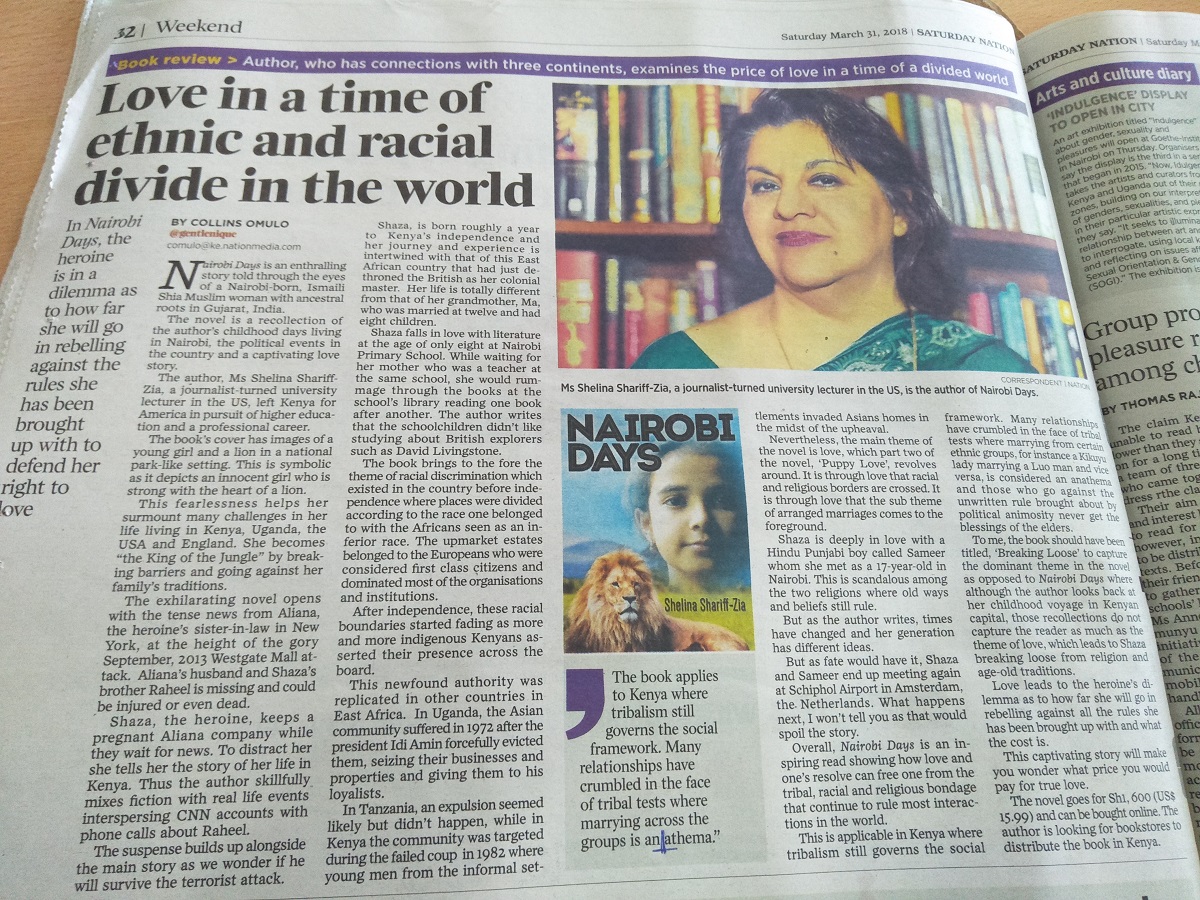
Review of Shelina Shariff-Zia’s “Nairobi Days” in Kenya’s Nation newspaper. Click on image for enlarged version.
This diaspora novel is a celebration of Indian and African culture as seen through the eyes of a young woman, who brings her heritage with her wherever she goes. As a member of an Indian minority in a small African country, Shaza’s life is complicated from the beginning. She looks for trouble and is always getting into scrapes and fights. She allies herself with her soft-hearted grandmother in a lively house full of relatives dropping by for long meals and siestas. Her family sends her to a strict English boarding school, but she tries to run away. Later, she meets Idi Amin, the bloodthirsty Ugandan dictator, he invites her to the palace which few people come back from alive…
As a teenager, Shaza goes to a convent school run by Irish nuns. Despite the strict rules, the girls are beginning to discover the opposite sex and flirting with what’s forbidden. Shaza is part of a Muslim family that emigrated from India at the turn of the century, but the old ways still rule. No one in Kenya dates, they just sneak around. At seventeen, Shaza meets a handsome Hindu boy at a party; Sameer is smitten but they come from two different religions. Sameer and Shaza sneak around going to parties and movies, seeing each other secretly.
Shaza is torn between her sense of duty and her longing for Sameer. Will the relationship survive her family’s disapproval and a long separation? They live in difficult times in a turbulent African country; Shaza’s cousin is almost killed by thugs and Kenya has a coup d’état where the Indian minority is targeted. The saga follows Shaza’s life from the 1960’s to the 1980’s showing the political upheavals in Kenya and her move to the United States.
Nairobi Days is a coming of age story, a love story, a political novel and above all a celebration of life.
[The novel has received excellent reviews and ratings by verified purchasers at Amazon and Goodreads. Please click on the two links — Ed.]
Date posted: July 21, 2021.
_______________________
Shelina Shariff-Zia
Shelina Shariff-Zia grew up in Nairobi, a tomboy who was always getting into trouble. She was the fifth generation of an Indian family who migrated to Kenya from Gujarat. She moved to Texas to attend Rice University where she studied literature. After an M.A. at Columbia, she was a journalist. She now teaches college students in the Bronx.
_____________________
Calling all Ismaili Authors
We encourage Ismaili writers to introduce their books in a similar format as has been done in the post above. Please also see the series launch article and submit your responses to Malik at Simerg@aol.com. All submissions will be acknowledged. If a writer has published multiple books, each book will be highlighted in a separate article, and not combined with other books into one post. All writers should include a brief profile with a portrait photo.
The Ismaili Authors’ Series so far (in chronological sequence, oldest article first):
We welcome feedback from our readers. Please complete the LEAVE A REPLY form below or click Leave a comment. Your letter may be edited for length and brevity, and is subject to moderation.
Before departing this website please take a moment to review Simerg’s Table of Contents for links to hundreds of thought provoking pieces on a vast array of subjects including faith and culture, history and philosophy, and arts and letters to name a few. Also visit Simerg’s sister websites Barakah, dedicated to His Highness the Aga Khan, and Simergphotos.
[We begin story telling in Simerg with stories exclusively written for this website by Vancouver based creative writer Farah Tejani, who has contributed inspiring poems for Simerg, including one last year on the occasion of Eid al-Adha titled The Great Sacrifice. This beautiful story of the Ladybug is being presented to our readers at a time when Muslims will be celebrating the Eid over the coming days. There are numerous lessons to be learnt from the story including patience, courage, and giving hope to others who need it the most. The Ladybird’s journey to locate a new friend in need is also one of great sacrifice, as danger is ever present on the road she travels to fulfill her noble mission! We encourage parents to read this story to their young children, and also print the story so that older children may read it. We are sure, however, that the story will be enjoyed by readers of any age, young and old.
Elizabeth the ladybug prided herself on being a very adventurous and curious little insect. Oh, life was simply so magnificent and extraordinary, and she remembered to thank God every single second. There was so much to learn and do, and this day was a very special day. Somehow inside she knew this was going to be a day she would never forget.
There was just something about the way the sun burst out of the sky just like a clown out of a wind-up music box. Today was just after a summer rain which made a double rainbow in the clouds. Elizabeth’s grandpa used to say that this meant there was a pot of gold at the end, but Elizabeth was not interested in gold today. Her grandfather always told her, “Always remember, Lizzie,” because that is what her family called her, “There are always many, many more important things in this world than gold.”
When Elizabeth was very young, her mother asked her, “Lizzie, honey, if you could do anything you want, what would you like to do more than anything in this world?” and Elizabeth kicked her little black foot in the blades of grass, “I don’t know…anything?” “Yes,” her mother smiled, not having a clue what her daughter would say. “I guess I would like to get to know everybody in the whole wide world!”
“Oh my!” she exclaimed, “This world is a pretty big place, and how would such a little ladybug like you do that?”
Elizabeth looked at her very seriously, “That’s easy. One at a time!”
Her mother laughed and gave her daughter a big hug! She knew if any ladybug could do it, Lizzie would! She would fly as far as her little wings would take her. There was nothing more fun than making new friends. And Lizzie had lots of them.
And this day was special. Elizabeth was on a mission to make a new friend at her favorite park in Richmond, British Columbia. Slowly she made small steps which gave her more time to see more things. Her mother used to tell her, “Lizzie, remember not to run through life too quickly; you might miss out on the good stuff…which was true indeed. So there were times when she would use her wings, but times when she would take slow meticulous steps and enjoy it like a hot cup of chocolate when it’s snowing.
Swan. Photo: Malik Merchant
Minoru Park was so special because it had squirrels and rabbits and ducks and swans and all types of plants and flowers. Elizabeth had many friends here already but today she was on a special mission to meet a new friend she just knew needed her help. You know how you just know things sometimes?…Yeah, like that.
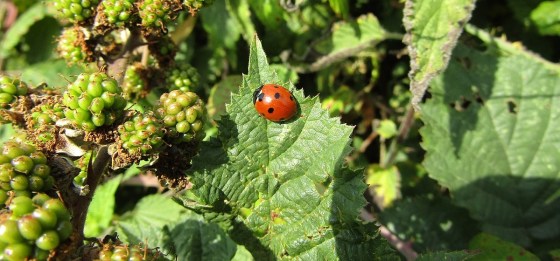
Elizabeth passed all the friends she knew already because she was so tiny, and it was hard for them to see her. So she made her way across the step bridge and smiled at the mating swans which were making a heart shape with their necks. CLICK. She took a photo with her mind because she didn’t have a camera. This is how you make memories. Elizabeth had taken many photos in her mind. Sunsets, spider webs, flowers, squirrels, rabbits, frogs, butterflies and especially family. Photos that she could remember whenever she wanted to.
Suddenly, Elizabeth smelled a beautiful fragrance coming from the flowers on the other side of the bridge. She tiptoed on the dew on the grass so as not to disturb them and watched in wonder as they went about their day.
She was quite surprised to find some yellow sunlit dandelions doing the tango and dancing in the breeze. They were not aware that she was nearby and so they just laughed and giggled and enjoyed the warmth on their petals. Elizabeth called up from below, “Hey, my name is Elizabeth…do you want to be my friend?” But they were not able to hear her, so she just kept going, sure she would find that special friend.
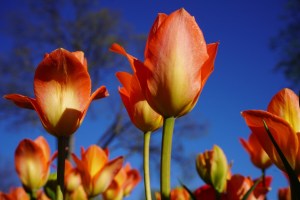
Tulips. Photo: Nurin Merchant
And then Elizabeth went to the next bush and she couldn’t believe what she saw! Believe it or not Elizabeth saw some tulips holding briefcases, pens and pencils and charts and diagrams! They seemed to be talking and holding some kind of very important business meeting. Just like humans! “Oh, if only humans only knew what animals and nature do when they are asleep or not paying attention!” Elizabeth decided it was probably best not to disturb them. She carried on her very important adventure.
Elizabeth went a bit further and came across some lilacs singing in a choir! A choir! Oh, they sure sounded as pretty as they looked. It was the end of summer and they were already practicing Christmas carols. Elizabeth sat and listened to their songs for a bit. She was quite amazed at how gifted and talented they were. Elizabeth was going to stop and ask if she could sing with them, but she was determined to make a new friend today, and this would just delay her.
Elizabeth went a little further to a bush with no flowers, just bulbs that had not bloomed just yet. But there right in front of her lying in the grass was a single long stem rose that had been plucked and thrown away! This rose did not look happy just drying up and withering in the sun.
Wilting rose. Photo: Rashida Tejani
“Are you okay?” Elizabeth asked her sincerely.
No answer.
Elizabeth asked again and moved closer in case she couldn’t hear her.
“Hey, my name is Elizabeth…do you want to be my friend?”
But there was no response.
Elizabeth began to worry and she tried again, really anxious on becoming this rose’s friend… she just knew this was the special reason for today’s adventure and she was not going to give up.
“Excuse me, can you hear me? Are you okay? I would like to be your friend.”
Suddenly a small soft voice uttered very slowly and with much effort, “Oh, can’t you see? There’s no time for friends. Can’t you see that a human has plucked me from my bush and cast me to the ground. I was up there in my bush and I was the first one to bloom, so some human thought I was pretty and smelled me and then just decided to throw me away like an old newspaper that has already been read!”
Elizabeth knew this was her special friend and she knew she would do anything to help her.
“What do you mean?” Elizabeth was genuinely concerned. “How can I help you?”
“Put me back in my rose bush with my friends!”
Elizabeth knew she had to do something.
“Just like you need the plants and the dew on grass I need water and the sun and the soil to LIVE!” The rose craned her neck up with much effort to look Elizabeth in the eyes. “The sun is so hot and blazing on me that I am drying up and withering away! I don’t have too many words left but I hope you will hear me and share this message. I wish human beings would be more careful. LIVE AND LET LIVE!”
With one of her thorns she pointed at the puddle just next to them.
“You look like a very brave, strong and determined little lady bug. I have faith in you, my new friend. Do you have the strength to roll my stem in there, just so I can live just a little bit longer?”
Elizabeth had tears in her eyes, and looked sadly at the dying rose. But she was so happy she called her her new friend. “I know I can!” She knew there was a reason for her going on her adventure.
And with that, Elizabeth dug her heels in the ground and rolled the end of the flower’s stem into the puddle that she was so happy was there.
“LIVE AND LIVE!” The rose was fading now. With whatever strength she could gather from the water in the puddle she managed to say some very important things!
“Don’t put lions in cages, don’t put elephants in cages, don’t put gorillas and monkeys in cages, don’t put killer whales and dolphins in aquariums, don’t put fish and snakes and lizards in tanks…and for God’s sake don’t pluck flowers because they are pretty and they smell nice! LIVE AND LET LIVE! We last a lot longer in the bush and animals last a lot longer in their natural habitat!”
Elizabeth flew up to her petals and closed her eyelids and with that the rose slowly faded away leaving three or four dried red rose petals that looked like tears. Elizabeth took a very sad but meaningful snapshot in her mind and felt very sad that she only had this friend for a matter of minutes. But she was grateful for the lesson that would last a lifetime!
Tears were flowing from her eyes as she sat with the rose while the sun was setting in the distance. She had never thought about how important life was. No one had ever tried to take hers except for that young girl on the farm who put her under a glass where she was held prisoner for hours, but fortunately one of the adults used the glass to get some orange juice and she managed to get away. God knows what the young child would have done with her if the grown up didn’t come in time!
Elizabeth did not even know the rose’s name. “LIVE AND LET LIVE” indeed. Elizabeth said a small prayer of gratitude to God. “Thank you, for this GIFT OF LIFE YOU HAVE GIVEN ME, MY GIFT BACK TO YOU IS WHAT I DO WITH IT.” Amen.
Farah Tejani is a creative writer based in Vancouver. She is currently working on Childrens’ stories and a collection of poetry called “Elastic Embrace” to be published later this year. She has contributed numerous poems for Simerg and its sister website Barakah in recent months. Here are links to some of Farah’s poems: The Fragrance of Spring; Elastic Embrace; and The Great Sacrifice.
We welcome feedback from our readers. Please complete the LEAVE A REPLY form below or click Leave a comment. Your letter may be edited for length and brevity, and is subject to moderation.
_______________
Before departing this website please take a moment to review Simerg’s Table of Contents for links to hundreds of thought provoking pieces on a vast array of subjects including faith and culture, history and philosophy, and arts and letters to name a few. Also visit Simerg’s sister websites Barakah, dedicated to His Highness the Aga Khan, and Simergphotos.
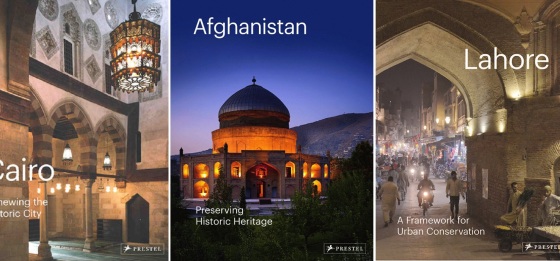
The Edinburgh International Culture Summit held virtually from August 24-26, 2020 brought together the world’s leading minds in the fields of culture, the sciences and politics to discuss issues which effect nations around the world. Cameron Rashti, the Director of Aga Khan Historic Cities Programme, Aga Khan Trust for Culture, was one of the participants and reflected on “Culture in Vibrant Communities” providing interesting insights into the goal and purpose of the Aga Khan Historic Cities programs in Central Asia, the Middles East, South Asia, and Africa.
Cameron Rashti joined the Aga Khan Trust for Culture (AKTC) in 1994. A graduate of Dartmouth College, Pratt Institute and Columbia University, he is a registered architect in the USA and the UK. Prior to joining the Trust, he held senior positions on major architectural and urban redevelopment projects in New York (1979-89) and in London (1989-94), as Vice President of Perkins & Will International. On behalf of AKTC, Rashti oversees a portfolio of diverse urban conservation and redevelopment projects in historic cities and heritage sites across the Middle East, Central and South Asia, and the Far East and teams of dedicated professionals in each location. He has served since 2010 as Delegate of the President of the Foundation of Chantilly, mandated with the safeguarding and redevelopment of the Domaine de Chantilly. Rashti has coordinated and contributed to a series of publications produced with Prestel on the Aga Khan Historic Cities Programme’s work and development models.
________________________
Before departing this website please take a moment to review Simerg’s Table of Contents for links to hundreds of thought provoking pieces on a vast array of subjects including faith and culture, history and philosophy, and arts and letters to name a few. Also visit Simerg’s sister websites Barakah, dedicated to His Highness the Aga Khan, and Simergphotos.
I have learnt with deep sadness that Dr. Vali Jamal, a noted economist at the United Nations from the 1970’s to 1990’s, an author and a valuable contributor to Simerg’s acclaimed series on Ismaili Jamatkhanas and Thanking Ismaili Historical Figures, passed away in Kampala, Uganda, on July 11, 2021, at the age of 80.
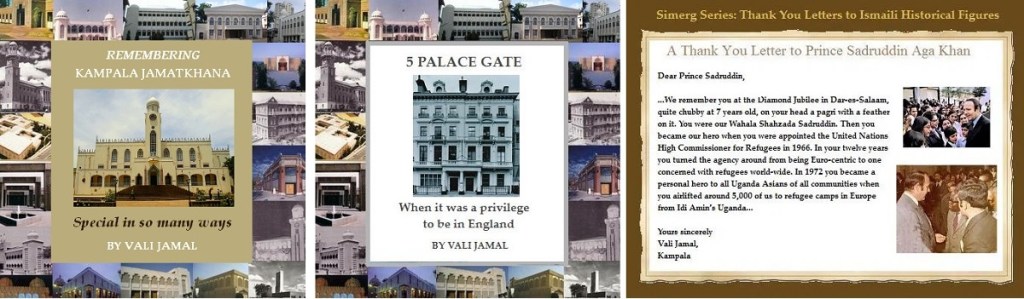
In 2011, when we published his pieces on 5 Palace Gate, the iconic address in London’s South Kensington that was the centre of Ismaili culture and spiritual life in the UK, and the Kampala Darkhana Jamatkhana, Vali was in the midst of completing a book on Ugandan Asians that was scheduled to be published later that year. Vali was deeply devoted to the book, and very passionate about the subject of the history of Asians and their rich contributions to Uganda. He kept on expanding the book in the ensuing years with the result that the book reached a page count of almost 3000, containing thousands of images.
A version of the cover page of Vali Jamal’s painstaking work on the Ugandan Asians
He jokingly remarked it was a fist breaker because of its size and weight. The dream of launching the book in Uganda and elsewhere was never realized during his lifetime.
I sincerely hope that the book is ultimately published for the amount of authentic and important visual and textual information that Vali painstakingly gathered over the years from primary and first hand sources as well as from individual Asian families he connected with and wrote to him.
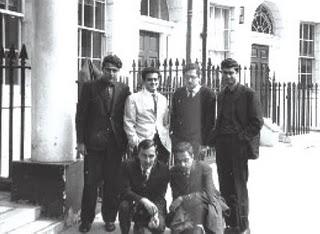
Vali Jamal and friends outside Uganda House, London, summer 1962. Clockwise from standing: Amin Chatur, Mansur Lalani, Vali Jamal, Zuli Rajan, Nurdin Juma Jutha and Sikander (aka Pyaralli) Ismail. Photo: Vali Jamal.
Vali, a devoted murid of Mawlana Hazar Imam, His Highness the Aga Khan, never failed to appreciate and recognize the contribution of the Ismaili Imam’s uncle, Prince Sadruddin Aga Khan, in the resettlement of the Ugandan refugees, and wrote a touching tribute piece to the Prince in Simerg’s Thanking Ismaili Historical Figures. In his email exchanges he would often also quote how Mawlana Hazar Imam was personally involved in the resettlement of thousands of Ugandan Asians in Canada through the Government of Canada and Canada’s Prime Minister at the time, the Late Pierre Trudeau, father of the present Prime Minister Justin Trudeau about whom he sent us a special piece when he was elected as the Prime Minister for the first time in 2015.
Dr. Vali Jamal was a Senior Economist at the International Labour Organization of the United Nations from 1976 to 2001. He completed his BA at Cambridge University and PhD at Stanford University, California. He then began working on his book and participated in discussions on the Ugandan Asians through email exchanges as well in the social media.
Images that Simerg created linking them to Vali Jamal’s 3 pieces for the website. See links below.
We would like to remember and recollect Dr. Vali Jamal through the wonderful pieces he contributed to this website. Please read the following pieces:
We pray that Dr. Vali Jamal’s soul may rest in eternal peace. We convey our sincere condolences to all his family members, friends and supporters around the world. We welcome tributes and messages of condolences to Dr. Jamal in our feedback form below.
Date posted: July 12, 2021.
____________________
We invite our readers to submit their condolences, memories and tributes to Dr. Vali Jamal. To pen your reflection please complete the feedback form below or click on Leave a comment.
Links to article(s) by Vali Jamal on external websites:
Links to his other pieces will be added as received.
____________________
Before departing this website please take a moment to review Simerg’s Table of Contents for links to hundreds of thought provoking pieces on a vast array of subjects including faith and culture, history and philosophy, and arts and letters to name a few. Also visit Simerg’s sister websites Barakah, dedicated to His Highness the Aga Khan, and Simergphotos.
Shia Ismaili Muslims all over the world will commemorate the 64th Imamat Day anniversary of Mawlana Hazar Imam, His Highness the Aga Khan, on Sunday July 11, 2021.
From the day our beloved Prophet Muhammad (S.A.S.) passed away on June 8, 632, and Hazrat Ali (A.S.) became the first Imam on the Divine Commandment that the Prophet had received at Ghadir Khumm, there have been forty-nine Ismaili Imams in continuous Hereditary Succession, spanning a period of 1389 years in Islamic history.
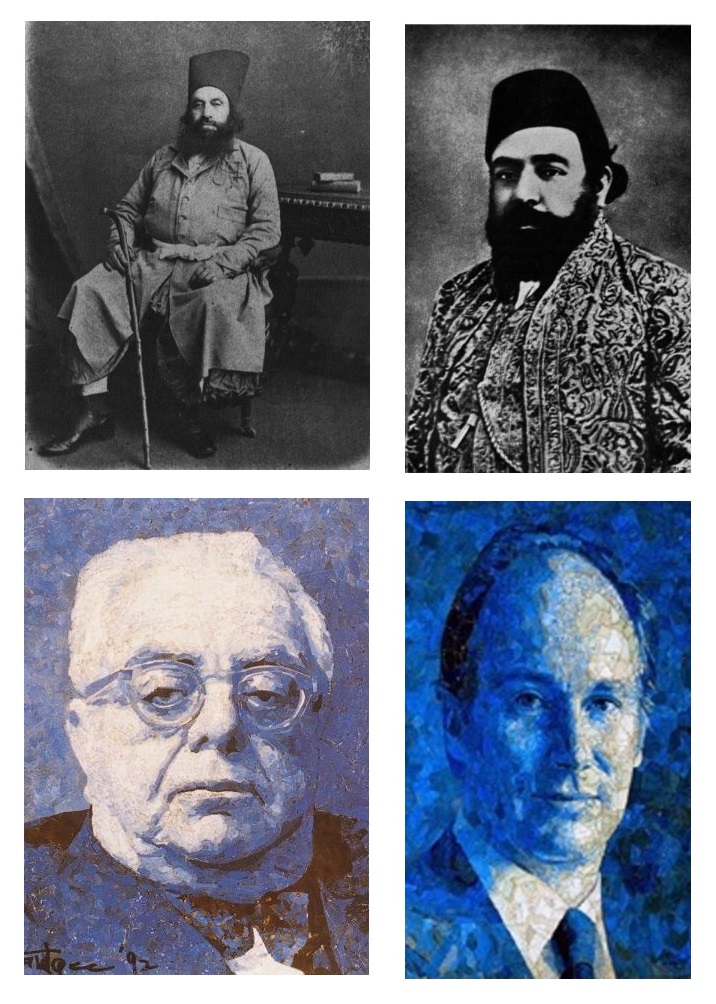
Upper row: Imam Shah Hassanali Shah (Aga Khan I) and Imam Shah Ali Shah (Aga Khan II). Lower row: Imam Sultan Mahomed Shah (Aga Khan III) and Mawlana Shah Karim Al Hussaini (Aga Khan IV). Total reign of the four Imams 203 years from 1817 to current year (2021). Longest reign Aga Khan III, 71 years; followed by Aga Khan I and Aga Khan IV, each 64 years.
Mawlana Hazar Imam and his immediate three predecessors have reigned the Jamat for a total of 203 years or 14.6 % of the entire span as follows:
1. Mawlana Shah Karim Al Hussaini Hazar Imam (His Highness the Aga Khan IV, Imam from 1957 – Current, 64 years, he became the 49th Imam at the age of 20); 2. Imam Sultan Mahomed Shah (His Highness the Aga Khan III, Imam from 1885 – 1957, Imam for 71 years, he became the 48th Imam at the age of 7 years); 3. Imam Shah Ali Shah (Aga Khan II, 1881 – 1885, Imam for 4 years, he became the 47th Imam at the age of 51 years); and 4. Imam Shah Hassanali Shah (Aga Khan I, 1817 – 1881, Imam for 64 years, he became the 46th Imam at the age of 13 years).
This 203 year period of the reign of 4 successive Ismaili Imams accounts for more time than does the entire Fatimid period, reigned by 8 Imams from Imam Mehdi (11th Imam, North Africa) to Imam Mustansir bi Allah (18th Imam, Cairo)!
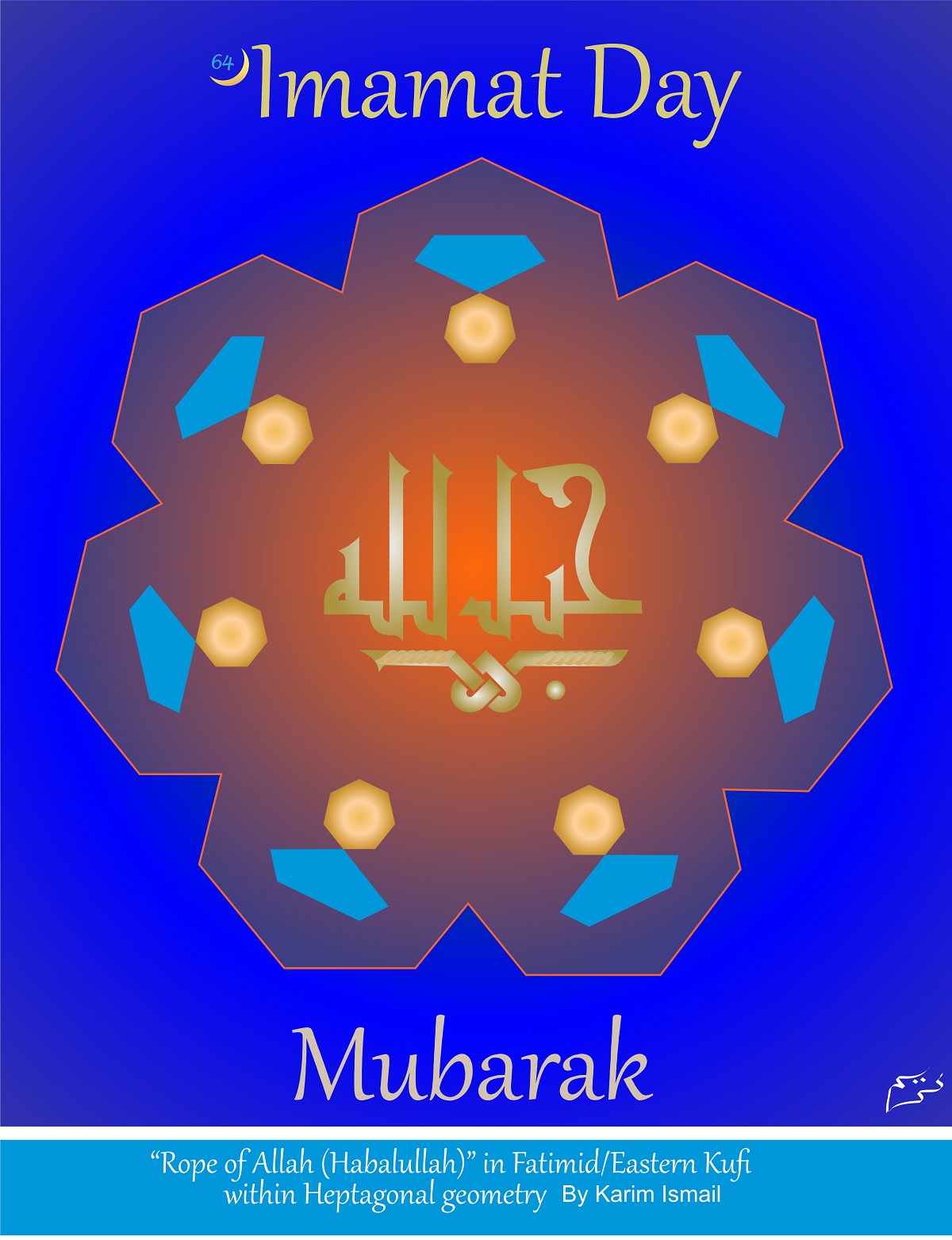
On that historical and interesting statistical fact, we convey to Ismaili Jamats around the world as well as friends and supporters of the community Imamat Day Mubarak through a beautifully designed card by Toronto’s Karim Ismail.
The design carries a rich and significant meaning for all Shia Ismaili Muslims as explained in Ismail’s brief note below. We sincerely thank him for sharing this very special and extraordinary work with us and our readers around the world.
We would be remiss if we did not mention the impact the coronavirus pandemic has had on humanity at large. Many of us have lost four beloved friends and family members to Covid-19 or other illnesses and causes, and social distancing, travelling and restrictive gathering rules have prevented us from fully participating in funerals. We pray that the souls of the deceased may rest in eternal peace and that their family members may find strength and courage to overcome the grief over the loss.
On this 64th Imamat Day of Mawlana Hazar Imam, we also pray for the fulfillment of our readers’ wishes and that everyone’s lives are filled with barakah (happiness) and success. We particularly wish families with young children and youth success in their studies.
2021 Imamat Day Card
Click on image for enlargement
Explanatory Note of the 2021 Imamat Day Card
By KARIM ISMAIL
In Shi’i tradition, “The Rope of Allah” (Qur’an 3:103) refers to the “Ahl al Bayt” — the Imams from the House of the Prophet Muhammad (S.A.S).
This important tradition appears in the card within heptagonal geometry (seven-sided polygon) about which the (Late) Karl Schlamminger, creator of extraordinary designs and distinctive calligraphies for the Ismaili Centres in London, Lisbon and Toronto, observed as follows in an essay for Arts & The Islamic World (volume 3, number 3, page 25-26):
“The floor of the outer entrance hall [of the Ismaili Centre London] has an open ended pattern in heptagonal form which rises at the focus of the room to create a fountain: such a pattern in such space is of course a completely classical Islamic response — but I have never heard of a heptagonal pattern anywhere in Islamic architecture.
“The number seven symbolizes for Ismailis the values of its essential philosophy — but has never been used in an architectural context. Here the sevenness of the design is no superficial effigy or naturalistic picture of an idea, but — as always in Islam — is expressed in geometry (literally: measurement of the earth).”
Before departing this website please take a moment to review Simerg’s Table of Contents for links to hundreds of thought provoking pieces on a vast array of subjects including faith and culture, history and philosophy, and arts and letters to name a few. Also visit Simerg’s sister websites Barakah, dedicated to His Highness the Aga Khan, and Simergphotos.
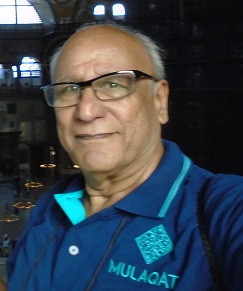
Karim Ismail
Originally from Uganda, Karim Ismail lived in England before settling in Canada. By profession, he is a Pharmacist (retired). It was in England, in 1986, that he came across the artwork of a German Muslim, Karl Schlamminger (1935-2017), at the Ismaili Centre London. Karl’s artwork on calligraphy and geometrics, had a profound effect on Karim. He is frequently seen conducting calligraphy workshops for children at Toronto’s Aga Khan Museum, which is currently closed due to Covid-19. Karim was also active on the literature counter at the Ismaili Centre Toronto, before the closure of Jamatkhanas due to Covid-19.
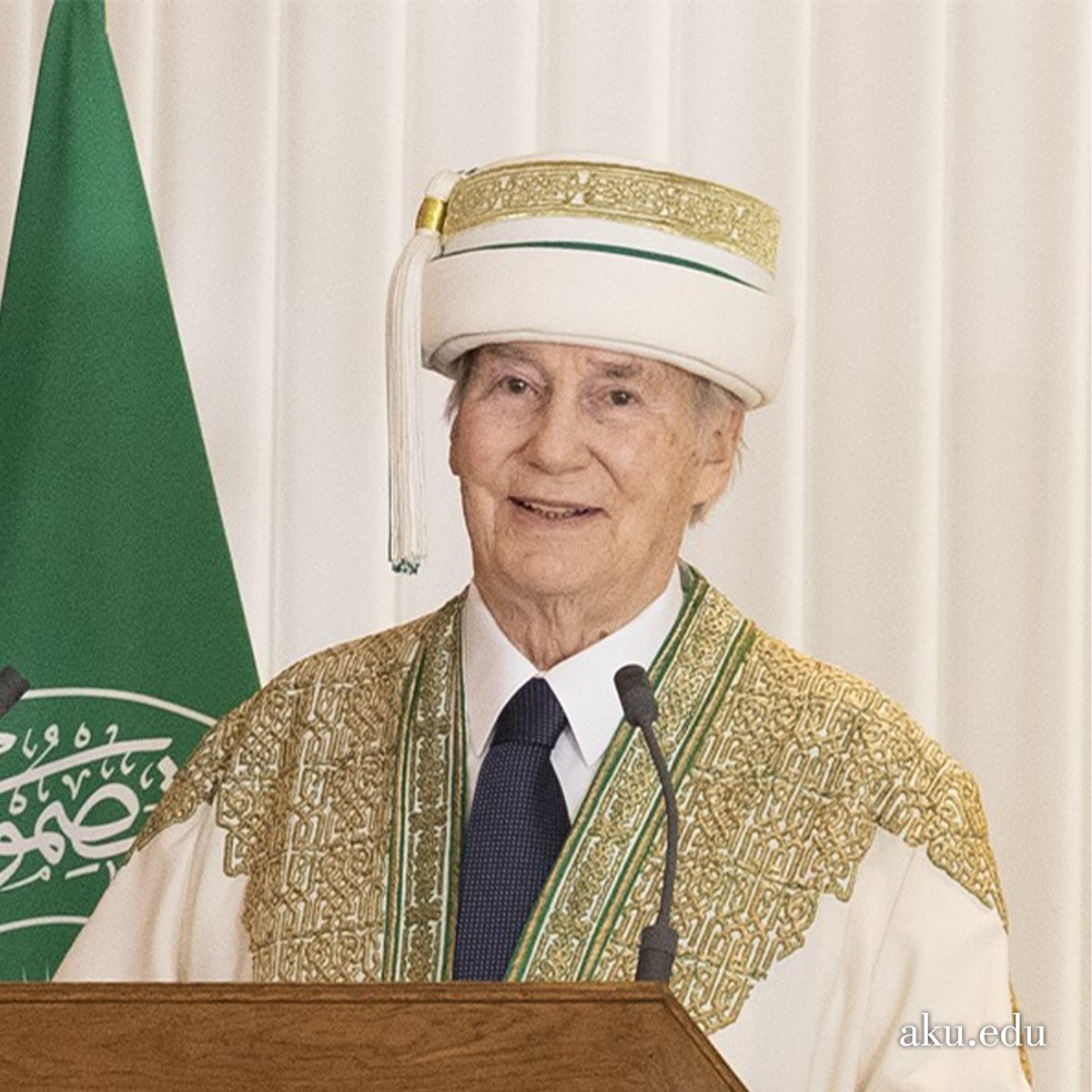
His Highness the Aga Khan addressing the 2020 Aga Khan University Convocation. His 64th Imamat Day will be celebrated on July 11, 2021. He became the 49th Imam of the Ismaili Muslims at the age of 20 when he was still a student at Harvard University. Please click on photo for article by acclaimed American writer Michael Hamilton Morgan.
“Believe it or not — hard work in the areas of education, scientific research, medicine, public works, charity, economic development and entrepreneurship — are the behavioral pillars of historical Muslim culture that made Muslim culture the single most progressive force in the world from about 650 to 1500 of the current era…..This ancient Muslim religious devotion to science, ideas, openness and empirical evidence has indeed been obscured in the mainstream….in the Muslim world, incomplete popular understanding of the faith of Islam has weakened understanding of the importance of logic and reason to the Islamic tradition.
“In this vast tapestry of the interaction of Muslims with each other, and with other cultures and faiths, there is one tradition that unfailingly continues the progressive heritage of classical Islam — profoundly intellectual, open, tolerant, pacific — and in particular one leader who has made it especially attuned to the many difficulties of the world today. That would be Ismailism and its revered Imam, the current Aga Khan IV”….. READ FULL ARTICLE.
Michael Morgan is an international speaker and author of Lost History: the Enduring Legacy of Muslim Scientists, Thinkers and Artists (National Geographic/Random House) which has reached thousands of readers around the world, and has been translated into several languages. Morgan received Egypt’s Presidential award for the Arts & Sciences in 2008. His insightful article on the Aga Khan is a must read!
Date posted: July 7, 2021.
_________________________
Before departing this website please take a moment to review Simerg’s Table of Contents for links to hundreds of thought provoking pieces on a vast array of subjects including faith and culture, history and philosophy, and arts and letters to name a few. Also visit Simerg’s sister websites Barakah, dedicated to His Highness the Aga Khan, and Simergphotos.
As Ismaili Muslims prepare to commemorate the 64th Imamat Day anniversary of their 49th Imam on July 11, 2021, we bring you these fine piece by Ismaili and non-Ismaili authors that provide a rich account of the work of His Highness the Aga Khan in different areas of human endeavour. The first piece by Shiraz Nasser is a narrative that provides an Ismaili perspective of the facets that he sees where Mawlana Hazar Imam has touched the lives of Ismailis and non-Ismailis alike. It is a great introductory piece by which to recall the Imam’s accomplishments, and to begin studying the life of the Imam in more depth. To read each piece, click on the image or its hyperlinked caption. You will be taken to Barakah, a website dedicated to His Highness the Aga Khan, members of his family and the Ismaili Imamat.
Before departing this website please take a moment to review Simerg’s Table of Contents for links to hundreds of thought provoking pieces on a vast array of subjects including faith and culture, history and philosophy, and arts and letters to name a few. Also visit Simerg’s sister websites Barakah, dedicated to His Highness the Aga Khan, and Simergphotos.
Simerg’s series entitled “Books by Ismaili Authors” continues with Canadian writer M. Ali Lakhani’s book “Faith and Ethics: The Vision of the Ismaili Imamat”. We follow the same Q/A format as our recent presentations of books written by Nizar Sultan, Nargis Fazal, Nazlin Rahemtulla, Azmina Suleman, Alnasir Rajan, Shafeen Ali, Mansoor Ladha, Zeni Shariff and Shamas Nanji. We invite Ismaili authors around the world to participate in this series, regardless of when their books were published. See details of the series HERE and submit your responses to Simerg’s editor, Malik, at Simerg@aol.com.
****************
Simerg: What is behind the naming of the title of the book?
M. Ali Lakhani: The book is the first major survey of the ideas of His Highness Prince Karim Aga Khan, based on his public statements over the last six decades. It illustrates how the ethos of the Ismaili Imamat is derived from the principle of tawhid, what the Imam calls an “all-encompassing unity” which is the essence of the faith of Islam. Ethics is the way of translating faith into action, of bringing our faith into the world; which is why the Imam defines ethics as the bridge between faith (din) and the world (duniya). The title of my book reflects this principal theme.
Simerg: Why would you want me or my family members to read the book, and what will we all learn from it?
Lakhani: The book will, it is hoped, explain the key messages of the Ismaili Imam to both Ismailis and to non-Ismaili audiences. It addresses the themes of, for example, tradition and modernity, the modernist ethos, Islam and the West, cosmopolitanism and pluralism, and harmonizing identity and belonging through culture.
Simerg: What inspired you to write the book?
Lakhani: I was invited by the Institute of Ismaili Studies (IIS) to write the book in order to expand on the ideas of my essay, published in volume 34 of my journal, Sacred Web titled ‘Living the Ethics of One’s Faith: The Aga Khan’s Integral Vision’. (Read article)
I have also spoken about these ideas at the Royal Asiatic Society (for the Temenos Academy) and have written about them for the Doha International Centre in an article titled ‘Integral Pluralism as the Basis for Harmony: The Approach of His Highness The Aga Khan’ (Read article).
Article continues below
____________________
M. Ali Lakhani’s “Faith and Ethics: The Vision of the Ismaili Imamat” examines how the ideas and actions of the 49th Ismaili Imam, Prince Karim Aga Khan, provide an Islamic response to the challenges that face Muslims in the modern era.
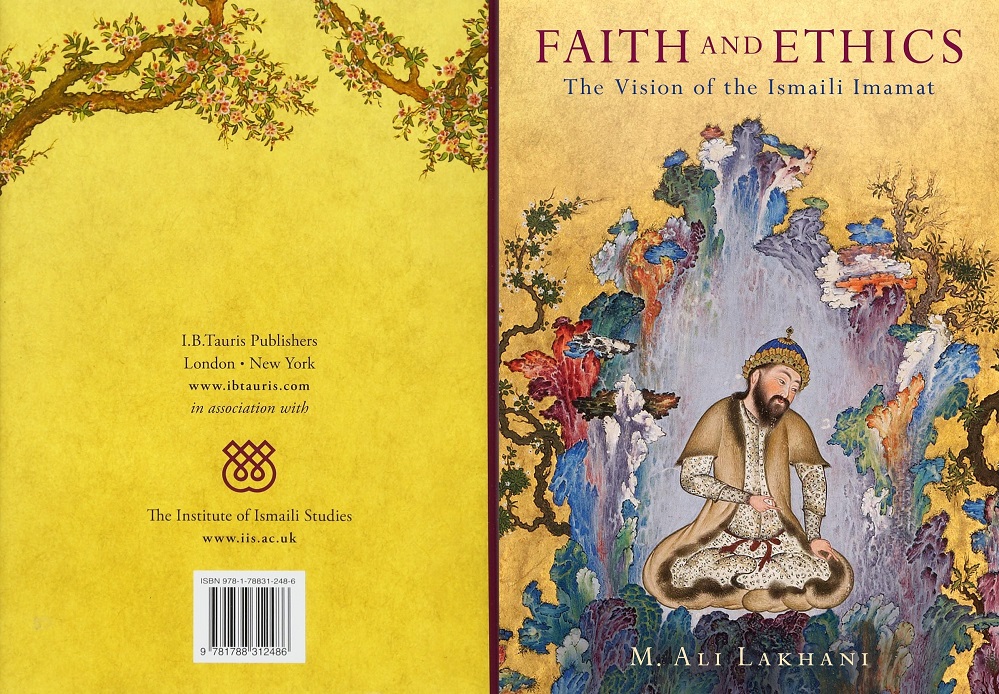
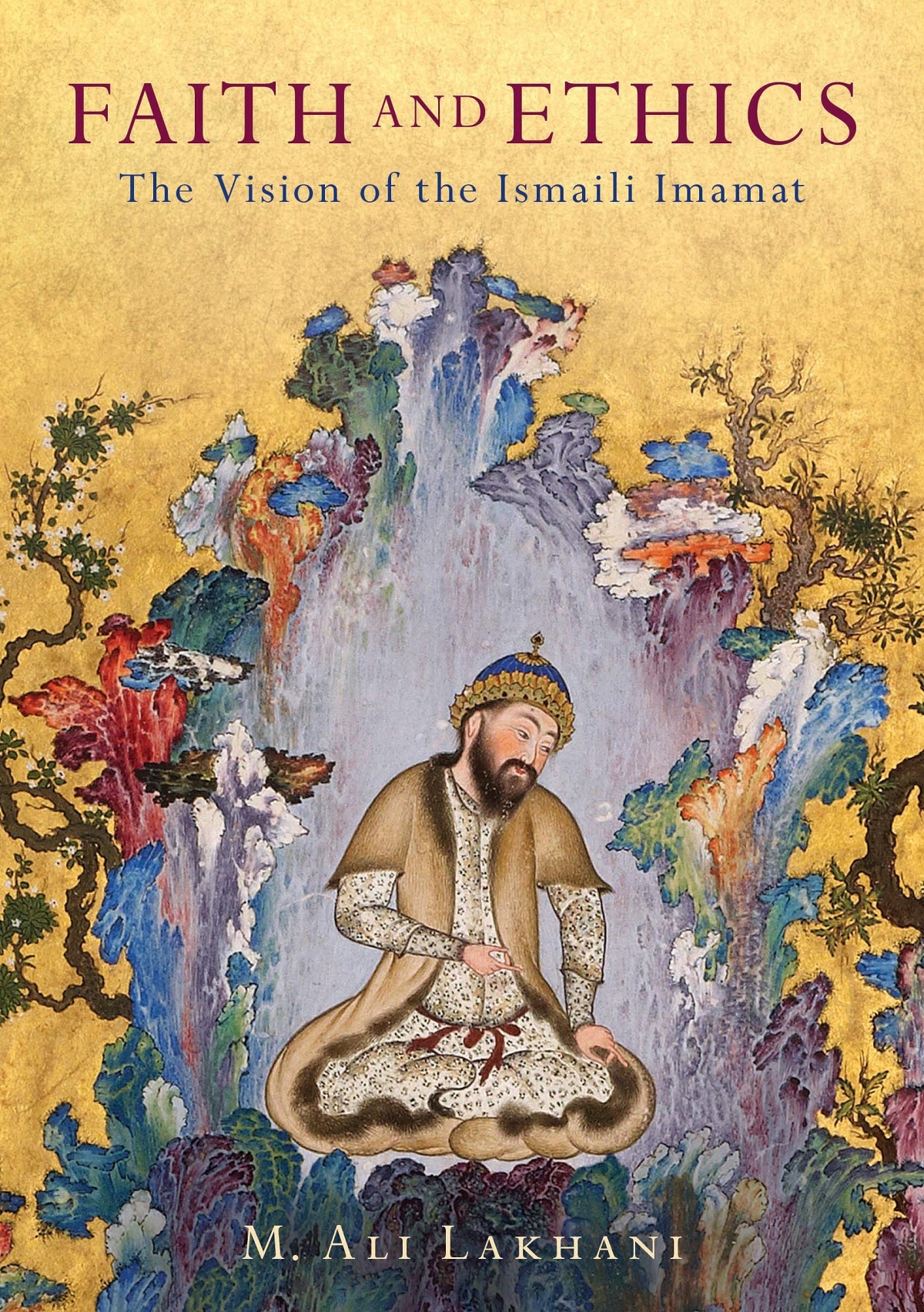
Jacket of M. Ali Lakhani’s “FAITH AND ETHICS: The Vision of the Ismaili Imamat,” 272 pp, I.B. Tauris and the Institute of Ismaili Studies; December 2017, Illustrated edition, Feb. 28 2018.
____________________
Simerg: How can I purchase the book and what are its available formats?
Lakhani: The book was published by the IIS and IB Tauris in 2017, and is available in hardcover format from Amazon Canada, and as a Kobo Ebook at Chapters-Indigo. Both the Kindle and hardcover editions are also available at Amazon.com, and Barnes and Nobles has the book available in hardback as well as a NOOK book. Prices vary from store to store.
[The book may be eligible for delivery within Canada in your area by July 7, 2021; please click Amazon Canada, free delivery is available with Amazon prime membership; the other option is to purchase it as an ebook, as noted above — Ed.]
Simerg: How did you find a publisher for the book?
Lakhani: The book was commissioned by the publisher, the IIS. I accepted the commission on condition that it would be my independent work of scholarship, free of any influence regarding its content by the IIS.
Simerg: Did you hire an editor, an illustrator or did you do all the work by yourself?
Lakhani: I handpicked the illustrations, including the splendid cover illustration, whose marvelous original is housed at the Aga Khan Museum in Toronto, and which depicts the ethical human being, a major theme of the book (as I explain in the text).
Article continues below
Praise for Ali Lakhani’s Book
Lakhani’s lengthy discussion of the Aga Khan’s cosmopolitan approach to modern conflict simultaneously has the wider application of demonstrating to outsiders that Islam in the orthodox, Quranic sense is a religion of unity and justice, not of persecution and oppression…. Islam as presented in the Quran and by the Muslim sages is anything but pitiless and fanatical; it is joyful, intellectually rigorous and compassionate….The Aga Khan’s ethical teachings as presented in this book are especially applicable to the challenges presented by religious pluralism and to encouraging dialogue between religious perspectives, and to calm down reactions to polemics between religious people and secularists, but less so for conflict resolution that requires shared epistemological and ontological principles…. Lakhani’s book is valuable for the insight it offers into Islam’s rich pluralistic and tolerant tradition.” — Andrew Frisardi, American writer whose essays and reviews have appeared in numerous U.S. magazines and journals, including the Atlantic Monthly, Hudson Review, the New Republic and the New Yorker (Read full review)
__________________
Simerg: Which was your first book and how many have you written?
Lakhani: This was my third published book of a total of four books by me. It was an honor to have this book published by the IIS on the occasion of the Imam’s Diamond Jubilee.
My other three publications are:
The Sacred Foundations of Justice in Islam contains my First Prize essay on Imam Ali from the 2001 Imam Ali International Conference. That essay and Dr. Reza Shah Kazemi’s Second Prize essay were hailed by Dr. Seyyed Hossein Nasr to be among the best writings in English on Imam Ali.
The Timeless Relevance of Traditional Wisdom contains many of my writings on metaphysics, religion, philosophy, tradition and modernity, gathered from my biannual book-form journal, Sacred Web: A Journal of Tradition and Modernity (www.sacredweb.com).
When the Rose Blooms (The Matheson Trust, London, 2021), my latest book, is a collection of spiritual aphorisms which I wrote more than three decades ago. The book includes beautiful illustrations which were designed by Nigel Jackson.
Synopsis of the Book
Shi`i Ismaili Muslims are unique in following a living, hereditary Imam (spiritual leader), whom they believe to be directly descended from the Prophet Muhammad. The Imam’s duty has been to guide his community with Islamic principles that apply to the needs of the time.
In this insightful book, M. Ali Lakhani examines how the ideas and actions of the current Ismaili Imam, and fourth Aga Khan, Prince Karim al-Hussaini, provide an Islamic response to the challenges that face Muslims in the modern era. Prince Karim’s programmes, implemented mainly through the broad institutional framework of the Aga Khan Development Network, are aimed at improving the quality of human life among the disadvantaged, regardless of their religion or ethnicity. Addressing global issues ranging from healthcare and education to culture and civil society, the Aga Khan’s initiatives are founded on core Islamic principles and values. This book is the first to provide an extensive survey of the Aga Khan’s aspirations, showing how the values of integrity and dignity are at the forefront of his work, with the traditional Muslim concepts of cosmopolitanism and social justice guiding his response to the stark challenges of the modern age.
At a time when criticisms and misrepresentation surrounding Islam abound, Faith and Ethics explores the religion’s universal principles and values, which the author believes can make a positive impact both among Muslims and non-Muslims. The book will be of special interest to scholars researching Islam, Muslim faith and ethics and the Ismailis, and to general readers wanting a deeper understanding of Islam.
Date posted: July 4, 2021.
_______________________
M. Ali Lakhani
M. Ali Lakhani, QC, graduated from Cambridge University and has been practising as a barrister in Vancouver for the last forty years. Interested in applying metaphysics to modern world issues, in 1998 he founded Sacred Web: A Journal of Tradition and Modernity, a leading journal in the field that has published articles by the Prince of Wales, the Dalai Lama, Karen Armstrong, Huston Smith, Seyyed Hossein Nasr and William C. Chittick, among others.
_____________________
Calling all Ismaili Authors
We encourage Ismaili writers to introduce their books in a similar format as has been done in the post above. Please also see the series launch article and submit your responses to Malik at Simerg@aol.com. All submissions will be acknowledged. If a writer has published multiple books, each book will be highlighted in a separate article, and not combined with other books into one post. All writers should include a brief profile with a portrait photo.
The Ismaili Authors’ Series so far (in chronological sequence, oldest article first):
We welcome feedback from our readers. Please complete the LEAVE A REPLY form below or click Leave a comment. Your letter may be edited for length and brevity, and is subject to moderation.
Before departing this website please take a moment to review Simerg’s Table of Contents for links to hundreds of thought provoking pieces on a vast array of subjects including faith and culture, history and philosophy, and arts and letters to name a few. Also visit Simerg’s sister websites Barakah, dedicated to His Highness the Aga Khan, and Simergphotos.
Once an isolated region barely touched by the hands of time, Afghanistan’s Wakhan Corridor stands on the brink of great change with the building of a new road linking it with China. Study map below and click on the map or HERE to read BBC’s new photo travel piece by Simon Urwin.
The Wakhan Corridor is an area of far north-eastern Afghanistan (or Badakhshan) which forms a land link or “corridor” between Afghanistan and China. The Corridor separates Tajikistan in the north from Pakistan in the south. Along with Mazar-e Sharif (Afghanistan), Dushanbe (Tajikistan’s capital) and Ishkashim (which borders Badakhshan of both Afghanistan/Tajikistan) which are all circled in red, the map also shows the Panj River. It is a tributary of the Amu Darya. The river is 1,125 km long and forms a considerable part of the Afghanistan – Tajikistan border. Map: Adapted from University of Texas. Annotated by Simerg. Please click on map for BBC article. Caption includes material from Wikipedia.
Date posted: July 3, 2021.
__________________
Before departing this website please take a moment to review Simerg’s Table of Contents for links to hundreds of thought provoking pieces on a vast array of subjects including faith and culture, history and philosophy, and arts and letters to name a few. Also visit Simerg’s sister websites Barakah, dedicated to His Highness the Aga Khan, and Simergphotos.