Simerg is an independent initiative dedicated to Ismaili Muslims, the Aga Khan — their Hereditary Imam — and the Ismaili Imamat, and Islam in general through literary readings, photo essays and artistic expressions
Author Archives: Malik Merchant, Editor
Founding publisher and editor of www.barakah.com, www.simerg.com and www.simergphotos.com.
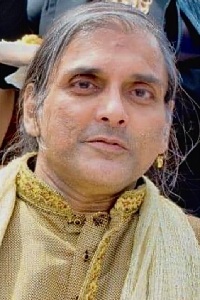
I’ve been watching the special Eid ul-Fitr presentation Shukrana since it was launched on Ismaili TV Sunday, May 24 2020, at 2 am! Yes! You are reading the hour correctly. When Saba Rawjani of Ottawa was performing on Sunday, my daughter Nurin was doing her gardening under sunny skies and a temperature of 25c in Ottawa! I urged her to get back and watch Saba (see photo at top of post). What a sweet and charming talent Saba is, and what about the control of her voice! Of course, I have heard her in Ottawa since she was a child, but how much she has grown over the years! Then, on Sunday morning the Syrian performance was incredible. Truly, every performance has been top class! And what about those messages from little children — I’m glad they are repeated every so often. Keep one thing in mind: every composition has been done with the artists’ love for Mawlana Hazar Imam, and in the spirit of ONE JAMAT.
I will review the concert at a later time but in the meantime I simply urge you to leave everything aside, for a few hours everyday, and watch the superb musical talent of the Jamat from every corner of the Ismaili world.
You still have more than 24 hours of continuous watching. What have I been doing during my absolutely essential sleeping time? Take my notebook into my bedroom, lay it on the dresser beside me, with the screen facing my bed! Something or the other nudges me to open my eyes, and I stare at the screen with delight. My ears are always open! I feel rested, and I owe it to delightful voices and instruments of Ismaili artists! What a wonderful intrusion!
WATCH IT, and ask your family members to join you! Sorry, but make the Shukrana viewing mandatory, at least for a few hours of the remaining time that is left! Please click Ismaili.tv.
Date posted: May 25, 2020, 01:05 AM.
Before departing this website please take a moment to review Simerg’s Table of Contents for links to hundreds of thought provoking pieces on a vast array of subjects including faith and culture, history and philosophy, and arts and letters to name a few.
_______________________
Malik Merchant of Simerg
Malik Merchant is the founding publisher/editor of Simerg (2009), Barakah (2017) and Simergphotos (2012). A former IT consultant, he now dedicates his time to small family projects and other passionate endeavours such as the publication of this website. He is the eldest son of the Late Alwaez Jehangir Merchant (1928-2018) and Alwaeza Maleksultan Merchant, who both served Ismaili Jamati institutions together for several decades in professional and honorary capacities. His daughter, Nurin Merchant, is a veterinarian. He may be contacted at Simerg@aol.com.
The following message in English and all the translations that follow are reproduced from the The Ismaili, the official website of the community. After reading the message, please scroll to the bottom of this post to read our supplication to Mawlana Hazar Imam — it follows the Tajik translation. For another version of this post, please visit our sister website Barakah, which is exclusively dedicated to Mawlana Hazar Imam and his family.
Message from Mawlana Hazar Imam (English)
My beloved spiritual children,
On the occasion of Eid ul-Fitr, I send my special loving blessings to my Jamats throughout the world for your happiness, peace, safety, and good health. My family joins me in wishing you all Eid Mubarak.
As the Jamati and AKDN institutions continue their collaboration with various governments, public health authorities and other partners in the endeavor to overcome the challenge of the COVID-19 pandemic, I would like my spiritual children to continue to exercise the utmost rigor in undertaking all personal measures to safeguard your own health, as recommended by the public health authorities and my Institutions.
At this difficult time, I applaud, with the highest admiration and gratefulness, the selfless services of all my Jamati volunteers, as well as the doctors, nurses, paramedics and support workers in the AKDN and other health facilities and related programmes: Their exemplary courage, commitment and dedication in extending care and comfort to my Jamat and others, and especially to those who are vulnerable and sick, is an outstanding actualization of the human values and ethics that all faiths cherish.
It is my wish that my Jamat should look to the future with hope and courage, in keeping with its age-old tradition of unity, generosity and mutual support which has at all times enabled it to move forward to a position of enhanced strength and resilience, from generation to generation.
My spiritual children should always remain mindful that it is the principles of our faith that will bring peace and solace in these times of uncertainty. I am with my Jamat at all times, and each of you, individually, is always in my heart, in my thoughts and in my prayers.
I send my most affectionate paternal, maternal loving blessings to all my Jamat – for happiness, good health, confidence and security in your lives ahead, and for mushkil-asan.
Yours affectionately,
Aga Khan
___________________
Message from Mawlana Hazar Imam (French)
MESSAGE DE MAWLANA HAZAR IMAM
Le 23 Mai 2020,
Mes chers enfants spirituels,
En cette occasion de Eid-ul-Fitr, j’envoie mes bénédictions affectueuses spéciales aux Jamats du monde entier pour votre bonheur, pour la paix, la sécurité et pour une bonne santé. Ma famille se joint à moi pour vous souhaiter à tous Eid Mubarak.
Alors que les Institutions Jamaties et AKDN poursuivent leurs collaborations avec les gouvernements, les autorités de santé publique et d’autres partenaires pour surmonter le défi de la pandémie COVID-19, je voudrais que mes enfants spirituels continuent à appliquer avec la plus grande rigueur toutes les mesures personnelles pour protéger sa santé, en lien avec les recommandations des autorités de santé publique et de mes Institutions.
En ces temps difficiles, je rends hommage, avec ma plus grande admiration et reconnaissance, aux service dévoués de mes volontaires du Jamat, ainsi qu’aux médecins, infirmiers, personnels paramédicaux, et à tous ceux qui travaillent au sein d’AKDN, des autres établissements de santé et des programmes associés. Leur courage exemplaire, leur engagement et leur dévouement pour apporter soins et réconforts au Jamat et en dehors, et plus spécifiquement aux membres vulnérables et malades, sont une représentation exceptionnelle des valeurs humaines et de l’éthique chères à toutes les religions.
C’est mon souhait que mon Jamat regarde vers le futur avec espoir et courage, en gardant sa tradition séculaire d’unité, de générosité et d’entraide, qui nous a permis en tout temps d’accroître notre position de résilience et de force à travers les générations.
Mes enfants spirituels doivent toujours garder à l’esprit que ce sont les principes de notre foi qui nous apporteront la paix et le réconfort en ces temps incertains. Je suis avec mon Jamat en tout temps et, chacun de vous, individuellement, est toujours dans mon cœur, dans mes pensées et dans mes prières.
J’adresse à mon Jamat mes meilleures bénédictions paternelles et maternelles les plus affectueuses – pour le bonheur, pour une bonne santé, pour la confiance et la sécurité dans votre avenir, et pour Mushkil-asan.
Affectueusement,
Aga Khan
___________________
Message from Mawlana Hazar Imam (Portuguese)
MENSAGEM DE MAWLANA HAZAR IMAM
23 de maio de 2020
Meus amados filhos espirituais,
Por ocasião do Eid ul-Fitr, envio as minhas especiais e amorosas bençãos aos meus Jamats por todo o mundo, para a vossa felicidade, paz, segurança e boa saúde. A minha família junta-se a mim para vos desejar, a todos, Eid Mubarak.
Enquanto as instituições Jamati e as da AKDN continuam a colaborar com os vários governos, autoridades de saúde pública e outros parceiros na tentativa de ultrapassar o desafio da pandemia da COVID-19, gostaria que os meus filhos espirituais continuassem a exercer o máximo rigor na tomada de todas as medidas individuais para salvaguardar a sua própria saúde, tal como recomendado pelas autoridades de saúde pública e pelas minhas Instituições.
Neste período difícil, aplaudo, com a maior admiração e gratidão, os generosos serviços prestados por todos os meus voluntários do Jamat, assim como os prestados pelos médicos, enfermeiros, paramédicos e pelos auxiliares quer na AKDN quer nas outras instituições de saúde e entidades relacionadas: A sua coragem exemplar, compromisso e dedicação na prestação de cuidados e conforto ao meu Jamat e aos outros, e em especial àqueles que são vulneráveis e doentes, é uma afirmação notável dos valores humanos e da ética que todas as fés partilham.
É meu desejo que o meu Jamat olhe para o futuro com esperança e coragem, mantendo a sua longa tradição de união, generosidade e apoio mútuo, que lhe permitiu, em todos os momentos, de geração em geração, seguir em frente para uma posição reforçada de força e resiliência.
Os meus filhos espirituais devem ter sempre em mente que são os princípios da nossa fé que nos trazem paz e consolo nestes tempos de incerteza. Estou com o meu Jamat em todos os momentos, e cada um de vocês, individualmente, está sempre no meu coração, nos meus pensamentos e nas minhas orações.
Envio as minhas mais afetuosas bênçãos paternais e maternais a todo o meu Jamat – para felicidade, boa saúde, confiança e segurança nas vossas vidas futuras, e para mushkil-asan.
Afetuosamente,
Aga Khan
___________________
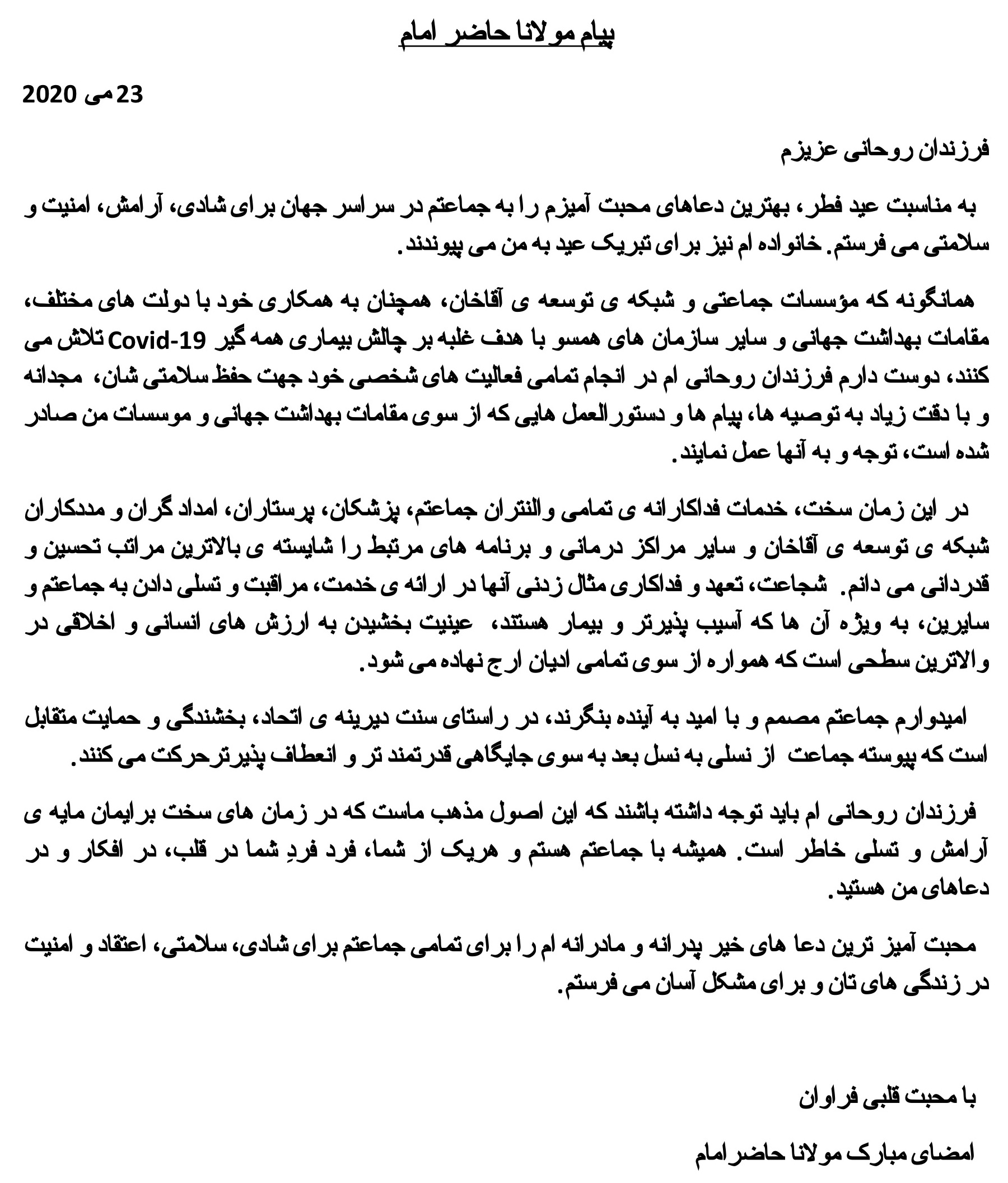
Message from Mawlana Hazar Imam (Farsi)
Message from Mawlana Hazar Imam (Farsi)
___________________
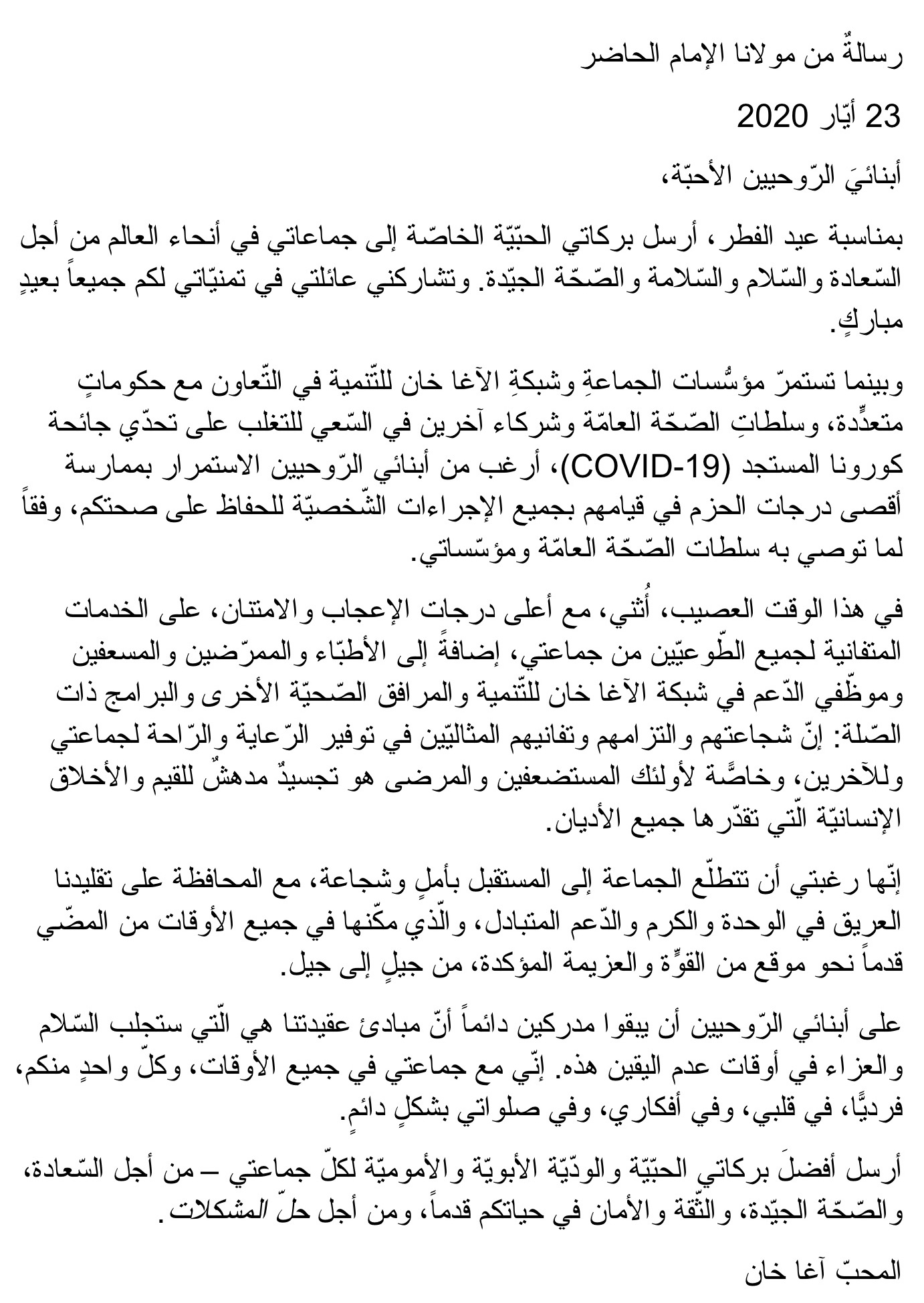
Message from Mawlana Hazar Imam (Arabic)
Message from Mawlana Hazar Imam (Arabic)
___________________
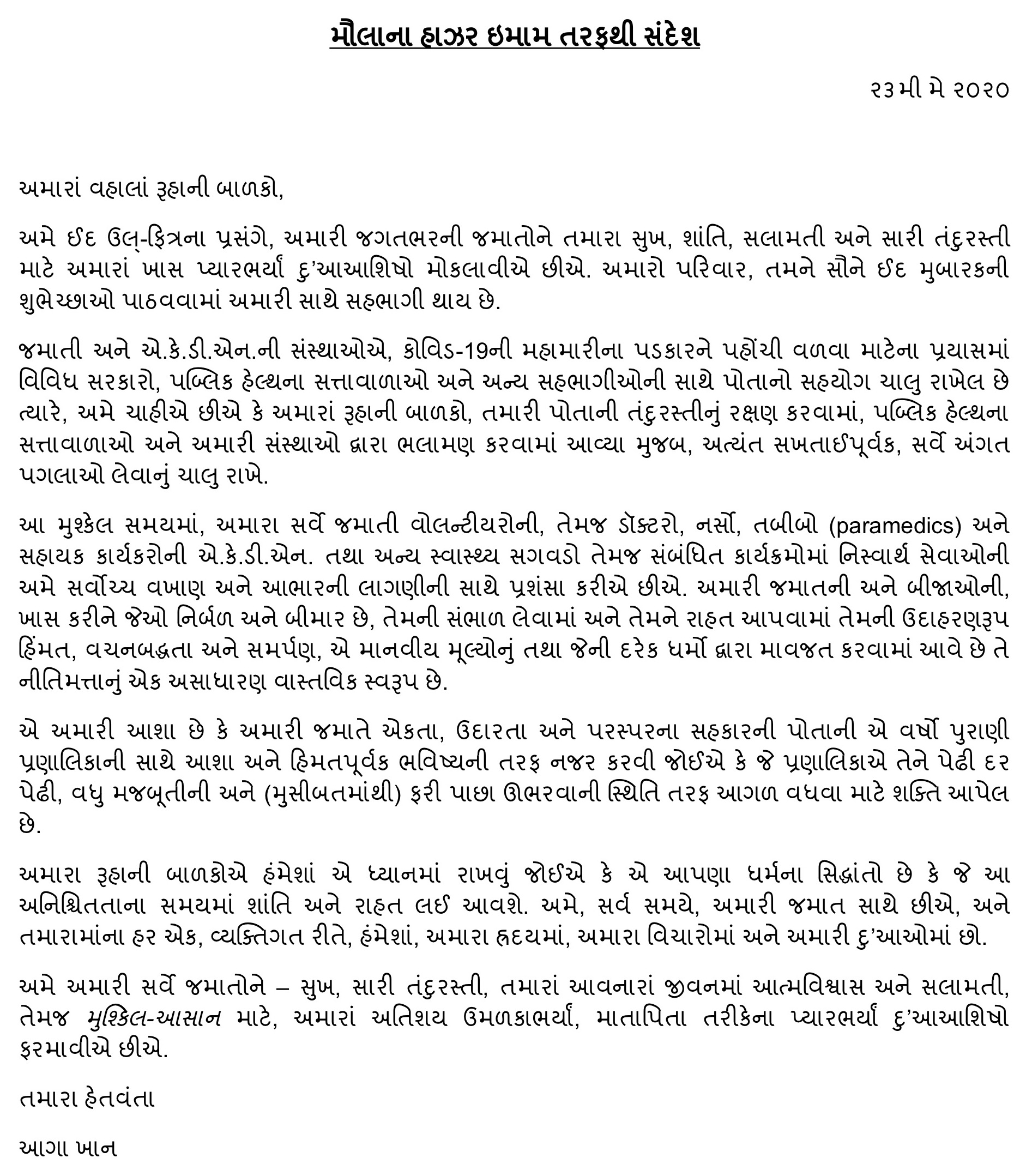
Message from Mawlana Hazar Imam (Gujarati)
Message from Mawlana Hazar Imam (Gujarati)
___________________
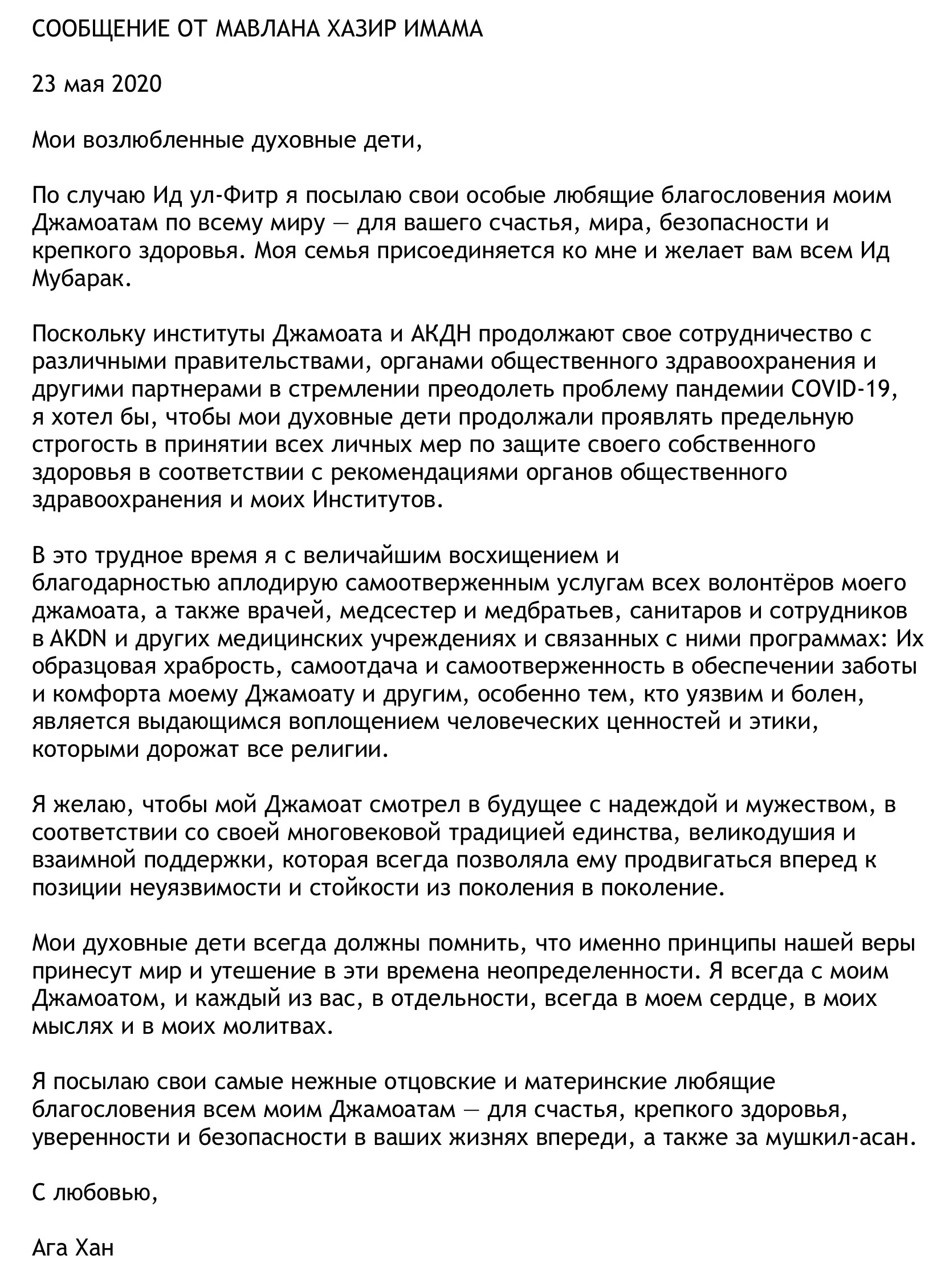
Message from Mawlana Hazar Imam (Russian)
Message from Mawlana Hazar Imam (Russian)
_______________________
Message from Mawlana Hazar Imam (Urdu)
Message from Mawlana Hazar Imam (Urdu)
___________________
Message from Mawlana Hazar Imam (Tajik)
Message from Mawlana Hazar Imam (Tajik)
___________________
Shukrana and Supplication
We submit our humble gratitude to our beloved Mawlana Hazar Imam for his blessings to the world wide Jamat on the occasion of Eid ul-Fitr
We submit the following supplications from verse 1 of Pir Hasan Kabirdin’s Ginan Sahebe Farman Lakhi Mokalea:
“O brother! Listen, My Lord Ali has written and sent a Farman. The beloved Lord has remembered this servant today with kindness in his heart”
Date posted: May 23, 2020.
_______________
Before departing this website please take a moment to review Simerg’s Table of Contents for links to hundreds of thought provoking pieces on a vast array of subjects including faith and culture, history and philosophy, and arts and letters to name a few.
We welcome feedback/letters from our readers. Please use the feedback box which appears below. If you don’t see the box please click Leave a comment. Your comment may be edited for length and brevity, and is subject to moderation. We are unable to acknowledge unpublished letters.
As announced a few days ago, we commence a special series of tributes to Ismailis as well as non-Ismaili members of Ismaili families who have passed away during the Coronavirus pandemic, either due to Covid-19 or any other cause. For details on submitting your tribute to a deceased family member or a very close friend, please read TRIBUTES and write to Malik Merchant at Simerg@aol.com; you must include your full name and contact information.
___________
Inna lillahi wa inna ilayhi raji’un “Surely we belong to God and to Him we return” — Holy Qur’an, 2:156
Alnoor Ramji (Canada)
Submitted by Abdulrasul Allibhai Ramji and Lilly Ramji
Alnoor Ramji, age 62 (d. April 14, 2020)
It was the beginning of March 2020. Alnoor’s 62nd birthday was just 3 weeks away. But he had cancer, and was in the last stages of his life. He did not let it control him. Rather, he coped with it, accepted it and carried on with his passion of raising funds for the Aga Khan Foundation’s annual World Partnership Walk (WPW). In each of the previous years, he had raised between $13,000 to $15,000. With all the passion that he had developed over the years for the work of the Imamat around the world, he started sending out a message that simply said, “Donate to WPW [World Partnership Walk].” For him, that would be the most cherished birthday gift anyone could ever give him. In a little more than 3 weeks, Alnoor raised $18,000.
He passed away on April 14, 2020, but not before the Mukhi and Kamadiasahebs of Toronto’s Headquarters Jamatkhana at the Ismaili Centre, made a conference call to him. He answered them with the greeting Ya Ali Madad. They bestowed Dua (prayers) on him, and Alnoor responded with the word “Amen” each time – a total of four times.
His funeral was held in Toronto on April 17, 2020. He leaves behind his parents, Abdulrasul Allibhai Ramji and Lilly Ramji. His two sisters, Nilam (Naushadaly) in Edmonton, Alberta, and Rubina (Craig) in Sydney, Nova Scotia, were both unable to attend the funeral.
Editor’s note: An obituary for Alnoor Ramji was published in The Toronto Star on April 17, 2020. Please click HERE to read the detailed piece.
_____________________________
Goulzare Foui (France)
Submitted by Nigar Ribault
Goulzare Foui
« Ma chère Goulzare Foui,
Vous m’aviez dit de ne pas m’inquiéter parce que vous aviez juste la grippe. Vous connaissiez si bien mon caractère angoissé : « mais qu’est ce qu’on va faire de toi avec ces angoisses mon petit ? ».
Et soudain, en quelques jours, vous avez été emportée par ce virus.
Je vous appelle et je vous cherche depuis 40 jours que vous êtes partie …
Et vous êtes là ! :
Les roses ont fleuri et me font signe. Je vous vois Goulzare (Jardin fleuri) dans ces fleurs. Je vois votre beau sourire lumineux. J’entends votre voix dans le chant des oiseaux du printemps. Vous chantez comme un rossignol dans le grand jardin de Mowla Bapa.
Vous ne m’avez pas quittée : vous êtes dans mon cœur pour toujours et dans ce que vous m’avez transmis. Je vous aime ma Goulzare Foui. La petite sœur de mon papa.
Votre Nigar »
~~~~~~~~~~~~
Translation by Dr. Nurin Merchant
My dear Goulzare Foui,
You told me not to worry, that it was just the flu. You knew my anxious character well — “what are we going to do with you and all of your anxieties my little one?”
And suddenly, in just a few days, this virus had taken you from us.
I call you, I seek you ever since the day you left us 40 days ago.
And there you are!
The roses have bloomed, giving me a sign. I see you Goulzare (flowery garden). I see your beautiful and radiant smile. I hear your voice in the song of the spring birds. You are singing like a nightingale in Mowla Bapa’s big garden.
You have not left me: you are here. Here in what you shared with and passed down to me, and forever in my heart. I love you my Goulzare Foui. My dad’s little sister.
Your Nigar.
Translators note: In the translation, I have tried to keep the meaning of Nigar’s beautiful tribute to her aunt as best as I could.
_____________________________
Amirali S. Nagji (USA)
Submitted by Akberali Nagji
Amirali Nagji, age 78 (d. April 2, 2020)
Amirali Nagji passed away of natural causes on April 2, 2020 in Albuquerque, New Mexio, USA. He was 78. Originally from Mtwara, Tanzania, Amirali was very hardworking and generous; he was known for helping many people by giving free accommodation in his motel.
He served Jamati institutions for twenty years, and had also held the position of Mukhisaheb of Albuquerque Jamat.
Outside Ismaili institutions, he served seniors at a local hospital. His ever-smiling face and friendly demeanor provided comfort to many.
Amirali loved to travel and was fond of Bolywood music. As well as being a good dancer, he had a wonderful sense of humour, for which he was greatly admired.
He is survived by his wife Nurjehan, daughter Alia and her husband Shafin, and two grandchildren.
We pray that his soul may rest in eternal peace. Amen.
___________________________
Sultan Piroj Maknojiya Methanwala (India)
Submitted by the families of Nazarali Kasamali Momin and Akbarali Kasamali Momin
Sultan P. M. Methanwala (d. May 16, 2020)
Sultan Bhai Piroj Maknojiya Methanwala passed away on May 16, 2020 in Vaishali Nagar Jogeshwari West, Mumbai.
He was a prominent leader both within and outside the Ismaili Jamat. He had served as the Mukhisaheb of the Jamat with great distinction, and was deeply loved by members of the Jamat.
He was also a life long social worker, and reached out to all communities to provide care and assistance.
He will be deeply remembered and missed by his family, the Vaishali Nagar Jamat and other communities whom he served selflessly.
May Mawla rest his soul in eternal peace and may Mawla give strength to his family members and the Jamat to bear the loss of a commendable leader of the Jamat. Amen.
___________________________
Salima Wanda Arthurs (Canada)
Submitted by Shaida Hussein
Salima Wanda Arthurs, age 64 (d. April 24, 2020)
Salima Wanda Arthurs, 64 years old, passed away in Calgary, Alberta, Canada, on Friday April 24, 2020, the first day of Ramadhan, from cancer.
Her mum, Margaret, sister Linda, some friends and myself, Shaida Hussein, attended the funeral ceremony. Like other Ismaili funerals that take place during the current pandemic, the funeral and post burial ceremonies such as chaanta, last respects, samar and zyarat were conducted according to physical distancing and other guidelines that have been established by each province.
Salima embraced the Ismaili Muslim faith in 1985, and was a committed volunteer in jamati (community) services. She contributed to the work of Ismaili Tariqah and Religious Education Board on the literature counter and served in the admissions committee, as well as participated in other institutional projects and programs. She was a humble and a compassionate person, and will be fondly remembered and missed by the Calgary Jamat as well as her family and friends.
We pray for her soul to rest in eternal peace. We also pray that Almighty God grants her family and friends the strength and courage to bear this loss.
_____________________
To submit a tribute to your family member who has passed away due to Covid-19 or any other cause, please read TRIBUTES and write to Malik Merchant at Simerg@aol.com; please include your full name and contact information.
Before departing this website please take a moment to review Simerg’s Table of Contents for links to hundreds of thought provoking pieces on a vast array of subjects including faith and culture, history and philosophy, and arts and letters to name a few.
We welcome tributes from our readers to individuals portrayed in this piece. Please use the feedback box which appears below. If you don’t see the box please click Leave a comment.
This pandemic has brought the world humbling and tumbling to its knees, which is actually the best position from which to beg for the Supreme Being’s forgiveness, mercy, and blessings. Its economies have been battered and shattered and almost all of the world’s citizens have been imprisoned in their dwellings. He alone will eventually empower our scientists and secular and sacred leaders to find effective vaccines to successfully overcome this calamity.
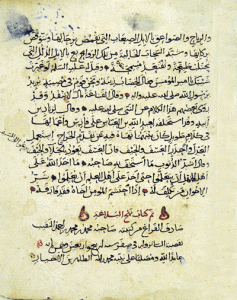
Guidance from a seventh century ruler to his regional governors entrusted with administering a new and rapidly expanding empire has timeless relevance to our pandemic times. Hazrat Ali was the first hereditary Shia Muslim Imam, as well as the fourth caliph of all Muslims, after the death of the Prophet Muhammad (S.A.S.), in 632 A.C. His letter enumerated a host of principles of good governance. He urged his subordinates to rule with intelligence and wisdom; justice, truth, and forgiveness; compassion and forbearance; humility and patience in calamity; consultation and wise counsel; piety and prayers; and above all to seek Divine Guidance. These are lessons which still apply today. [1]
article continues after photo
A folio from Hazrat Ali’s Nahj al-Balagha (Peak of Eloquence).
Remarkably, during the Prophet Muhammad’s time (570-632 A.C.), he had strongly recommended territorial quarantine and stricter personal hygiene, such as frequent hand washing during contagion. Later Muslim scientists and doctors had done the same, and Europe subsequently learned this practice from them. [2]
Turning to the current pandemic, this silent, inscrutable, and insidious enemy with unhindered Global Entry has awakened and heightened the need for prayers and some critical aspects of pluralism, which include public-private partnerships at all levels, to address the current dire situation engulfing almost every country.
Prayers have shown effectiveness since biblical times, and pluralism is inherent, in various forms, in all religious teachings. Some countries even have pluralism embodied in their constitutions, but sadly it often gets ignored.
article continues after photo
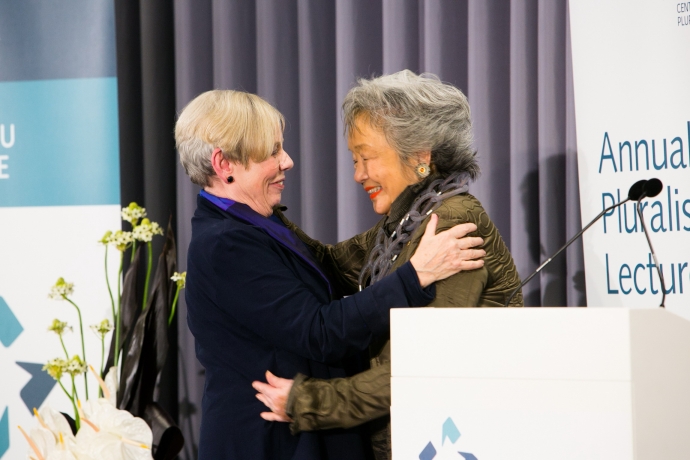
The Right Honourable Adrienne Clarkson, former Governor-General of Canada, and GCP Board Member thanks Karen Armstrong for delivering the GCP 2018 Annual Pluralism Lecture. Photo: AKDN / Anya Campbell
Karen Armstrong, the renowned historian and scholar of religions, has described the Qur’an as the most pluralistic scriptural book, which teaches not just tolerance of diversity, but beyond this a universal brotherhood, empathy, and an inclusive approach that harnesses the intelligence of all in society (annual pluralism lecture at the new Aga Khan Centre, London, 2018). Pluralism entails inclusion of all of God’s children who inhabit our shared planet, as an integral part of the community. Hardly any country is totally homogenous – most are quite heterogeneous with racially, ethnically, and religiously diverse minorities. Accommodating such diversity is best addressed through dialogue, mutual respect, research, and collaboration to promote a better understanding of differences as strengths.
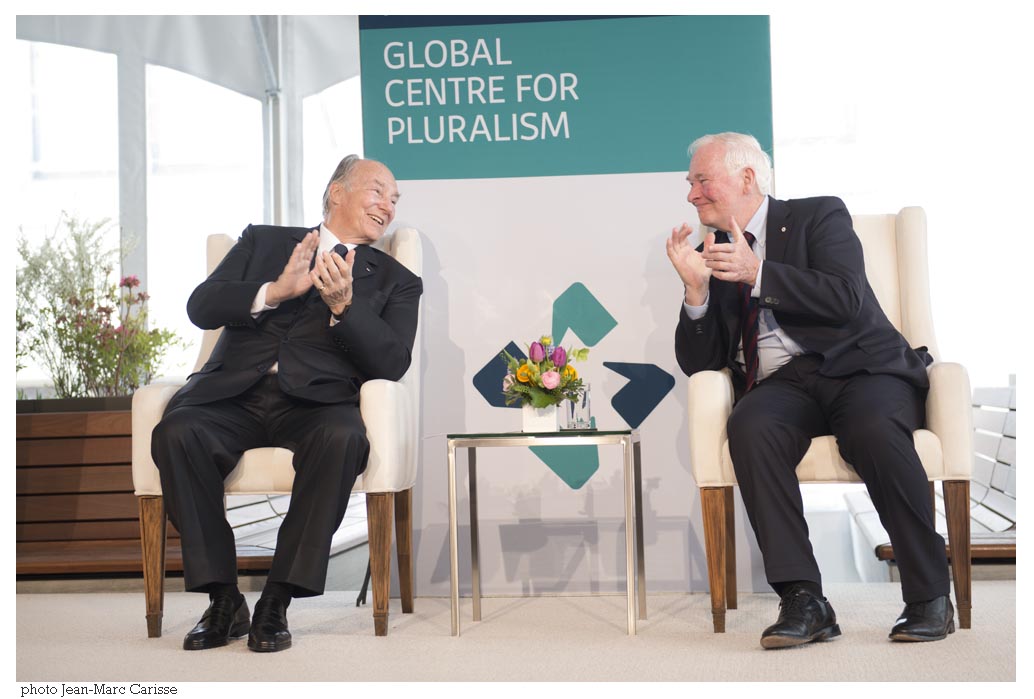
The idea of defining, promoting and giving pluralism an international platform emerged, significantly, after another calamity, namely the 9/11 terrorist attacks on America, that shook the world and drastically changed lives and livelihoods. In January 2002, the then Canadian prime minister Jean Chretien and the Aga Khan, the 49th hereditary Imam of the Ismaili Muslims, discussed the desirability of jointly creating a formal body to study, explain, and promote pluralistic values across the world and to prevent escalations of conflicts between the West and the Muslim countries. A decade later the Global Centre for Pluralism was formally established in Ottawa, Canada.
Pluralism, essential in ordinary times to promote mutual understanding, respect, and acceptance of differences, is even more critical in extraordinary times, such as the present, where widespread panic has driven many to act without regard for the wellbeing of others.
Equally alarming, Asian Americans have collectively been demonized and blamed for the virus. Fortunately, there have also been numerous wonderful and inspiring examples of collaboration, innovation, ingenuity, generosity, and volunteering to help those on the frontlines and those thrust onto food line.
However, let us not forget the other endemic and mutating virus of scammers and fraudsters preying on the most desperate of our fellow countrymen. We need more vigilance, prayers, partnerships and pluralism to combat both of these common enemies. Until God’s mercy results in effective vaccines, the best interim vaccines are the three Ps and gratitude.
Coincidentally, during this month of Ramadan, some fundamental practices of Islam are more evident now than at other times: fasting, prayer, and charity towards all — especially the weak, the sick, the poor, orphans, widows, and other most disadvantaged members of society. This constitutes the social conscience of Islam.
It is this Atlanta-based writer’s hope that Muslims and non-Muslims alike will share their relief/stimulus checks, if possible, with those in greater need. Unfortunately, their numbers are exploding, and they largely depend on such charities as the Atlanta Community Food Bank, Atlanta Union Mission, Salvation Army, and Red Cross among many others. Atlanta-based CARE is internationally active, as is the Aga Khan Foundation USA, which is a part of the Aga Khan Development Network (AKDN) – the world’s largest, most cost-effective, private, multifaceted network with hundreds of partners including the US Government.
May God Bless America and our interconnected planet.
Date posted: May 19, 2020. Last updated: May 20, 2020 (Revisions by author)
Before departing this website please take a moment to review Simerg’s Table of Contents for links to hundreds of thought provoking pieces on a vast array of subjects including faith and culture, history and philosophy, and arts and letters to name a few.
___________________
Notes:
[1] Nahjul Balagha, Peak of Eloquence; Sermons, Letters, and Sayings of Imam Ali ibn Abu Talib, Elmhurst NY, 1981. [2] Article by Yahia Hatim, Moroccan Times, April 4th, 2020. See also March 17, 2020 Newsweek article by Craig Considine.
____________________
The writer, who was born in Uganda, has a doctorate from the University of London, U.K. in African History. He has taught at Bowdoin College (Maine) and Western Michigan University. Later he worked at the Institute of Ismaili Studies in the U.K. A lifetime member of the Global South Studies Association and a longtime resident of Atlanta, he is a volunteer and donor for AKDN.
________________
Author’s recommendation: For a superb explanation of pluralism in the Qur’an, see Rahim Snow’s highly acclaimed book “Remember Who You Are: 28 Spiritual Verses from the Holy Quran to Help You Discover Your True Identity, Purpose, and Nourishment in God,” published by Remembrance Studio, 2017, Pp. 213. Please visit his website by clicking Rahim Snow .
We welcome feedback/letters from our readers. Please use the feedback box which appears below. If you don’t see the box please click Leave a comment. Your comment may be edited for length and brevity, and is subject to moderation. We are unable to acknowledge unpublished letters.
In the age of the Coronavirus many families are unwilling or unable to claim bodies of those who have died, not just from the virus, but from other diseases and even accidents. In this situation, Surat’s Abdul Rehman Malbari and his Ekta Trust step in….watch this highly inspiring video report by MOJO, with English subtitles, and read the BBC and Times of India report that follow the video.
“For three decades, Abdul Malabari has been an undertaker for unclaimed bodies. But he never thought he would have to bury people whose families wanted to say goodbye but couldn’t because of Covid-19” — BBC
Before departing this website please take a moment to review Simerg’s Table of Contents for links to hundreds of thought provoking pieces on a vast array of subjects including faith and culture, history and philosophy, and arts and letters to name a few.
The tributes may be submitted for passings due to Covid-19 or any other cause
Some years ago, Simerg launched PASSINGS where Ismailis around the world were invited to submit obituaries or tributes to honour members of their families who had passed away, irrespective of the time frame. Over the past few years, we have seen a trickle of these obituaries and tributes flowing in, and we have graciously published them to the comfort of several family members.
Today, the coronavirus pandemic has brought great sadness to families who have lost family members during the past two months. Like other places of worship, Jamatkhanas in North America, the UK, Europe and many other parts of the world, have remained closed since around the middle of March. Whether the death has been due to Covid-19 or other illnesses, funeral, burial and post-burial ceremonies and rites have been vastly compromised, with limited number of family members and friends being permitted to attend the mourning ceremonies, both before and immediately after the person has been buried.
Restrictions have even prevented family members from being close to their loved ones during their times of illness and during the final moments of their lives. Often, the death of the individual is unknown to many due to Jamatkhana closures, as special prayers for the soul of the deceased (known as samar, which takes place in many parts of the world where the deceased is known through family and friends) can no longer be conducted. With all of these elements missing, many families who have lost their beloved have not experienced a sense of closure with respect to the loved ones that have left them.
Most recently, as readers might be aware, Simerg paid a loving tribute to Missionary Amirali Gillani. His closest family members were deeply comforted by the condolences that they were offered by friends, relatives as well as well-wishers from around the world, who made contact by phone and emails. Many submitted tributes to Missionary Amirali Gillani in the comments section of this website. We went on to report about the extraordinary funeral and burial ceremonies that took place in Toronto for the long serving and well-known Ismaili missionary.
Today, we announce a special weekly series in which we will publish tributes to deceased Ismailis or individuals who are members of Ismaili families who have passed away during the coronavirus pandemic.
The tribute that you pen is not restricted to deaths caused by Covid-19. It will be to anyone who is part of an Ismaili family and who has died from any cause – Covid-19 or otherwise – during the coronavirus pandemic. This opportunity to submit tributes is being offered to Ismaili families around the world in the spirit of the ONE JAMAT that we are, under the leadership and loving care of Mawlana Hazar Imam, His Highness the Aga Khan.
Please email the tribute (preferably 75-100 words in length), along with the deceased family member’s portrait photo (if available, in jpeg format), to Malik Merchant at simerg@aol.com. You MUST include your full name and phone number where you can be reached. Anonymous tributes will not be accepted.
The Toronto Star article The Lives They Lived will help you in developing a comprehensive tribute, and Simerg’s editor will always be available to provide his assistance in formulating a good tribute, so long as you provide good information about the deceased.
Kindly note that Simerg’s tribute will be for ALL deceased Ismailis and members of Ismaili families who have passed away during the pandemic due to Covid-19 and other causes. Again, please send your tribute to Simerg@aol.com.
We hope to commence the series of tributes on Friday, May 22, 2020. In addition to English, we will also accept tributes written in French, Portuguese and Spanish with their corresponding English translations, provided by you (you may use Google translate, if you wish).
Date posted: May 17, 2020. Last updated: May 18, 2020 (added note about submitting tributes in French, Spanish, and Portuguese).
Before departing this website please take a moment to review Simerg’s Table of Contents for links to hundreds of thought provoking pieces on a vast array of subjects including faith and culture, history and philosophy, and arts and letters to name a few.
_________________________
Malik Merchant is the founding publisher/editor of Simerg (2009), Barakah (2017) and Simergphotos (2012). A former IT consultant, he now dedicates his time to small family projects and other passionate endeavours such as the publication of this website. He is the eldest son of the Late Alwaez Jehangir Merchant (1928-2018) and Alwaeza Maleksultan Merchant, who both served Ismaili Jamati institutions together for several decades in professional and honorary capacities. His daughter, Nurin Merchant, is a veterinarian. He may be contacted at Simerg@aol.com.
We welcome feedback/letters from our readers. Please use the feedback box which appears below. If you don’t see the box please click Leave a comment. Your comment may be edited for length and brevity, and is subject to moderation. We are unable to acknowledge unpublished letters.
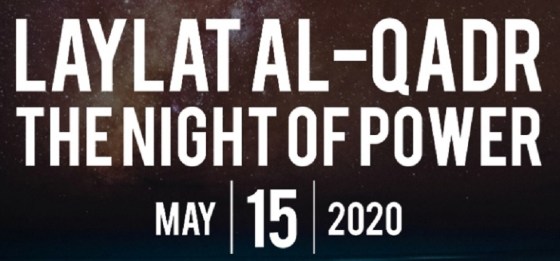
Jamats around the world must participate in this unique venture undertaken by Ismaili Institutions for this most extraordinary night commemorating the revelation of the Holy Qur’an
There is a very impressive array of programming organized for the night of Laylat al-Qadr by the Ismaili Tariqah and Religious Education Boards in the UK, Canada and the USA. Each jurisdiction has its own set of presentations and Simerg urges everyone — wherever they be — to avail themselves of outstanding recitations, sermons, interviews and stories as well as participate in quiet reflective moments that have been designated at specific times. A lot of effort has been put into this programming catered to every member of the Jamat, young and old alike.
Since this is an on-line presentation, viewers will be able to toggle to watch specific programs offered outside their own regions. Please click on the following images or links to see what the ITREBs in North America, the UK and Europe are offering on this truly auspicious and holy night of Laylat al-Qadr. The program can also be seen — for all jurisdictions — on a staggered basis on the website Ismaili TV, where time-zones are common, for example Canada and USA.
Please click on image for link to Laylat al-Qadr USA
Date posted: May 15, 2020.
__________________________
Before departing this website please take a moment to review Simerg’s Table of Contents for links to hundreds of thought provoking pieces on a vast array of subjects including faith and culture, history and philosophy, and arts and letters to name a few.
The echoes of Nature Bring us back to the cave Wherein spirituality harkens the soul Hush What is this ? To “Read”? Not yet. First to calm down Slow down the thoughts And attend the Divine Intellect That which emanates within each of our souls Within the bear of this Magnificent body That is all too human But never humanly created.
The echoes of Nature Bring us back to the cave To will the calm. Creating space to calm the Will. The physical jamat Khana is closed today The spiritual space wide open The windows to spring invite us in To quiet the mind for moments within
The echoes of Nature Light our world Let fresh air be a gift to enjoy. Within the chaos we must remember our Peace The time is given To slow the rat race. Echoes of Nature Harken the soul Can you hear? Perhaps outside in nature Or your child’s face asleep Or the eyes of a pet by your side
About the author: A regular contributor to this website, Dr. Navyn Naran was born in Dar es Salaam, Tanzania, to Anaar (1936-2017) and Badrudin Naran (1930-1979). She is currently in Toronto working in pediatrics and volunteering at the Aga Khan Museum.
____________________
We welcome feedback/letters from our readers. Please use the feedback box which appears below. If you don’t see the box please click Leave a comment. Your comment may be edited for length and brevity, and is subject to moderation. We are unable to acknowledge unpublished letters.
Before departing this website please take a moment to review Simerg’s Table of Contents for links to hundreds of thought provoking pieces on a vast array of subjects including faith and culture, history and philosophy, and arts and letters to name a few.
Heart in a pulsating mode; in rhythm with the breath Mind reaching its zenith; as thoughts meet their death
Gratefulness taking over; Conveying lightness to the body Entire body in smiles; Perhaps the spiritual light in embody
All because of the Dhikr, the constant chanting His attributes in tempo, energy in sync; all else negating
Dhikr: What an effect on the waves of the Gamma and the Theta Both leave defeated, allowing the take-over by the wave of relaxing Alpha
Dhikr: Bringing an awareness of His elements; so many …..Ninety-nine An inner need arises; to ascribe, to impute these traits divine
Dhikr: My heart is in a pulsating mode, in sync with the mind Now there is total unity; as mind, body and soul are totally entwined.
Date posted: May 13, 2020.
Before departing this website please take a moment to review Simerg’s Table of Contents for links to hundreds of thought provoking pieces on a vast array of subjects including faith and culture, history and philosophy, and arts and letters to name a few.
______________________
Editor’s note: We welcome Roxana Jaffer as our new contributor. Dhikr, penned by her in March 2020, is the first of her several poems we will be publishing in the coming weeks.
A Kenyan born girl, brought up in the UK and now residing in UAE, Roxana Jaffer has many awards to her name including “Global Inspirational Leadership Award”, “Best Best Woman in Hospitality UAE Award”, and “The Most Influential Women Leader Award 2019”. She was also recognized as one of the “Indian Super 100 Women Achievers in the Middle East & Africa”. She partners with UN World food program, and her endeavours have managed to feed over 460,000 hungry children in the world. She is instrumental in Holiday Inn Dubai attaining the coveted CSR Arabia award, four years running out of 13 Arab countries.
An Accountant by profession she has an MBA from University of Liverpool in Leadership and is a scholar of the Harvard Business School for Executive Education.
Roxana epitomises the best in human endeavour -– fun, laughter, hard work, creativity, caring for others, leading with a social conscience and above all, striving to make the world a better place and is the founder of the NGO -– ‘abc: an Advent for Building human Capital’ (see www.myabcfoundation.org) which accords English to the unemployed in Hunza and Delhi, resulting in a 70% impact as youth get growth.
Her creativity is taking a different turn as she expresses spirituality through poetry she pens.
______________________
We welcome feedback/letters from our readers. Please use the feedback box which appears below. If you don’t see the box please click Leave a comment. Your comment may be edited for length and brevity, and is subject to moderation. We are unable to acknowledge unpublished letters.
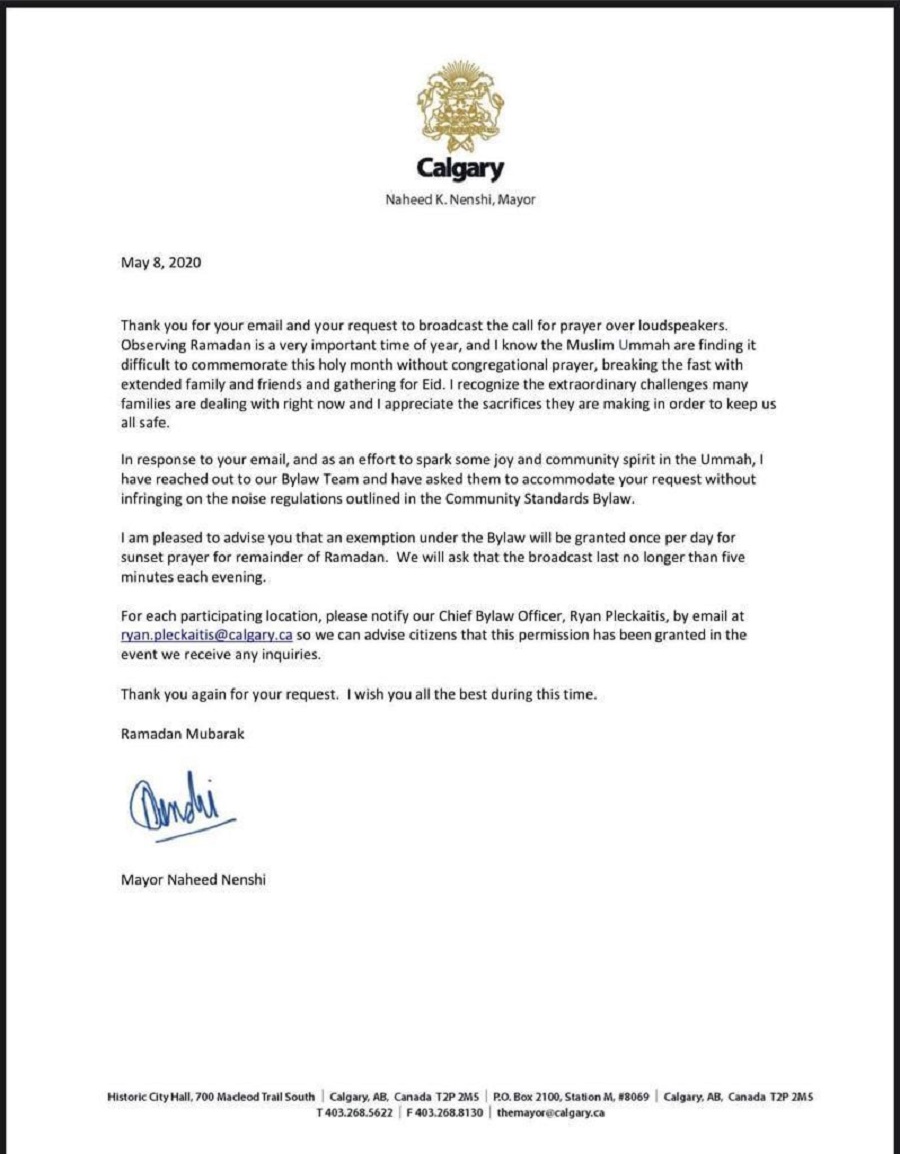
CBC reported that history was made in Windsor, Ontario, when the Muslim Adhan (call to prayer) was allowed to be recited over a loudspeaker on the roof of the city’s mosque during the remaining days of Ramadhan. Now the beautiful and heart warming Islamic call to prayer will also be heard at participating Calgary mosques once a day during the sunset prayer.
The following is Mayor Naheed Nenshi’s response to a request from the Muslim community:
Part of Calgary Mayor Naheed Nenshi’s letter: “In response to your email, and as an effort to spark some joy and community spirit in the Ummah, I have reached out to our Bylaw Team….I am pleased to advise you that an exemption under the Bylaw will be granted once per day for sunset prayer for reminder of Ramadan…”
Editor’s Note: Calling Calgarians — have you taken a very good video recording of the recitation of the Adhan in Calgary? If so, please submit it to Malik Merchant at email Simerg@aol.com, Subject: Adhan recording in Calgary. We will review your submission, and publish some of very best ones from across the city on this website. Please specify mosque location, date and time of the Adhan.
Date posted: May 10, 2020. Last updated: May 11, 2020.
Before departing this website please take a moment to review Simerg’s Table of Contents for links to hundreds of thought provoking pieces on a vast array of subjects including faith and culture, history and philosophy, and arts and letters to name a few.
_________________________
We welcome feedback/letters from our readers. Please use the feedback box which appears below. If you don’t see the box please click Leave a comment. Your comment may be edited for length and brevity, and is subject to moderation. We are unable to acknowledge unpublished letters.