Simerg is an independent initiative dedicated to Ismaili Muslims, the Aga Khan — their Hereditary Imam — and the Ismaili Imamat, and Islam in general through literary readings, photo essays and artistic expressions
“You and I are brothers, and you and I are from the same city, the same country; we speak the same language and share the same history” — Christian pastor
Every Ramadan, an Iraqi Christian preacher returns from the Netherlands to his hometown of Mosul. He celebrates the holy Islamic month there to promote understanding between Muslims and Christians. Voice of America’s Kawa Omer has the story, narrated by Bezhan Hamdard.
The Aga Khan on Moving Christian-Muslim Relations Forward for a Better World
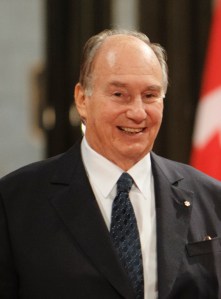
“Our histories have taught us the value of dialogue, and that rarely, indeed very rarely, does anything good come out of conflict. Our world view is to engage with the problem of social exclusion in our societies and to contribute to building bridges across faiths and across nations, by linking diverse parts of the world” — the Aga Khan
“I have no doubt that for you, whose historical roots are in the Christian world, it is as painful as it is for us Muslims, with our roots in the East, to watch an increasingly deep gulf growing between significant parts of our respective worlds. We cannot stand by as passive observers letting this gulf grow wider and wider, at the cost of future generations. If we have the will, which I am certain we share, we have the historical knowledge and the ethical foundations to move our world forward, to make it a better and more hopeful place, and to put an end to the storm of hatred which appears to be building up around us.
“Our histories have taught us the value of dialogue, and that rarely, indeed very rarely, does anything good come out of conflict. Our world view is to engage with the problem of social exclusion in our societies and to contribute to building bridges across faiths and across nations, by linking diverse parts of the world.
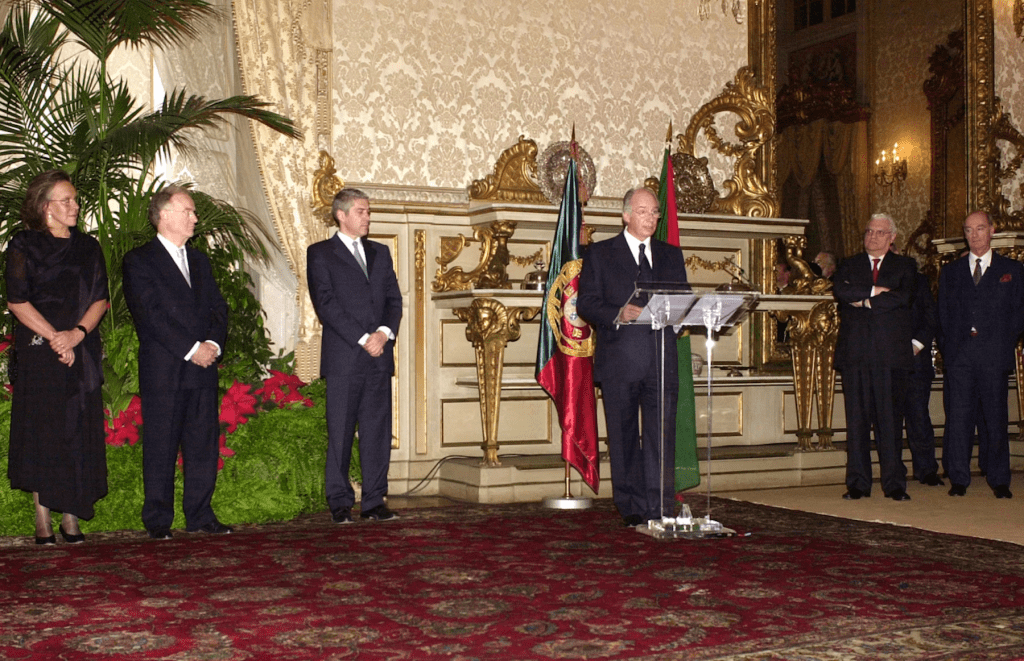
“We are concerned, and most rightly so, that there is poverty among our respective peoples, and we cannot stand by watching this inhuman indignity become a permanent part of our societies, of our generations of today and tomorrow. We must work together to develop an arsenal of peaceful weapons to attack this plight which blights our times, and to try to make sure that those who are marginalised today can be certain that we are not blind to them, that we will not let their future generations live in the same hopeless world in which they themselves are seeking, often only in despair, to survive.” — the Aga Khan, speaking at the Protocol of Co-operation Signing Ceremony between the Ismaili Imamat and the Government of Portugal, Lisbon, Portugal, December 19, 2005 (Read full speech HERE).
(This article has been adapted and abridged from an article first published on the official website of the Ismaili Muslim community under the title Why Do Muslims Revere Jesus? Please note that the photograph of the Altar of Nativity and the selected verses from chapter 19 of the Qur’an, are not part of the Ismaili piece — Ed.)
“Then she brought him to her own folk, carrying him. They said: O Mary! Thou hast come with an amazing thing.” — Qur’an, 19:27
His name is mentioned in the Holy Qur’an twenty-five times, often in the form ‘Isa ibn Maryam, meaning “Jesus, son of Mary.” In the Qur’an, he is referred to by the unique title of “Messiah” (al-masih in Arabic), meaning “anointed one.” Descriptions of Jesus in the Qur’an include many aspects of the narrative found in the Gospels about the life of Jesus, including his virgin birth, the signs given to him by God, that he was raised by God into His presence, and it also suggests his future return. Jesus is also referred to in the Qur’an as the “Word” and the “Spirit” of God, a special honour.
The Altar of the Nativity, beneath which is the star marking the spot where tradition says the Virgin Mary gave birth to Jesus. Photograph: Muslim Harji, Montreal.
The Holy Qur’an frequently mentions that divine guidance was sent to humankind through various prophets. For example, it says:
“So [you believers], say, ‘We believe in God and in what was sent down to us and what was sent down to Ibrahim (Abraham), Isma’il (Ishmael), Ishaq (Isaac), Ya’qub (Jacob), and the Tribes, and what was given to Musa (Moses), ‘Isa (Jesus), and all the prophets by their Lord. We make no distinction between any of them, and we devote ourselves to Him’” (Qur’an 2:136).
This view that all prophets are considered to be equal is also supported by a widely-reported hadith, in which Prophet Muhammad (peace be upon him and his family) is believed to have said:
“Both in this world and in the Hereafter, I am the nearest of all the people to Jesus, the son of Mary. The prophets are paternal brothers; their mothers are different, but their religion is one.”
Many Qur’anic verses also describe the prophets as belonging to the same family. For example, there is a line of prophets descended from Prophet Ibrahim. Both of his sons, Ishaq and Isma’il were prophets, as was Prophet Ishaq’s son, Prophet Ya’qub, and his grandson, Prophet Yusuf, or Joseph (peace be upon them).
Thus, God chose certain families over others based on their devotion, faith and commitment towards the Divine, as reflected in the following two Qur’anic verses:
“Allah chose Adam and Nuh (Noah), the family of Ibrahim, and the family of Imran above all mankind: a progeny one from the other” (Qur’an, 3:33-34).
“We have already given the family of Ibrahim the Book and Wisdom and conferred upon them a great kingdom” (Qur’an, 4:54).
Article continues below, after quotes from the Qur’an
_________________________________________
Mary and the Birth of Jesus in the Qur’an
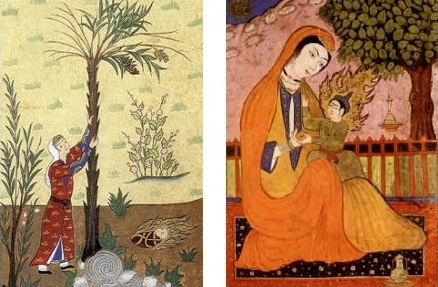
Left: Virgin Mary nurtured by a palm tree in a Turkish miniature, as described in the Qur’an; right: Mary and Jesus in a Persian miniature. Images: Wikipedia.
Please click on the image for enlargement. Read Barnaby Rogerson’s story related to the above verses HERE
_________________________________________
Jesus in Islamic Traditions
The Qur’an mentions that angels announced the coming birth of Prophet ‘Isa, saying:
The angels said, ‘O Maryam, Allah gives you good news of a Word [kalima] from Him. His name is [the Messiah], ‘Isa ibn Maryam, honoured in this world and in the next, and of those brought near [to God]’” (Qur’an, 3:45).
Throughout history, Prophet ‘Isa has been viewed by Muslims as someone who embodied the qualities of piety and a concern for the needy, and whose example inspired Prophet Muhammad. In Sufi literature, he is frequently portrayed as an example of detachment from the material world and closeness to God.
The Ikhwan al-Safa’, or Brethren of Purity, depicted Prophet ‘Isa as a spiritual exemplar par excellence. In his article “Jesus, Christians and Christianity in the Thought of the Ikhwan al-Safa’,” Dr Omar Ali-de-Unzaga writes:
“Jesus figures prominently in the Rasa’il, as one of the exemplars who embodied the views of the Ikhwan al-Safa’: belief in the eternity of the soul and the pursuit of the purification of the soul from matter by detachment from the bodily realm.”
“Despite the long history of religious conflict, there is a long counter-history of religious focus on tolerance as a central virtue – on welcoming the stranger and loving one’s neighbour. ‘Who is my Neighbour?’ – one of the central Christian narratives asks. Jesus responds by telling the story of the Good Samaritan – a foreigner, a representative of the Other, who reaches out sympathetically, across ethnic and cultural divides, to show mercy to the fallen stranger at the side of the road.”
THE people Of the book
In Islamic traditions, Jesus is held in high regard as a messenger of God and an exemplar of piety and as a guide to spiritual truth. He is also part of the shared heritage that binds the monotheistic faiths of Judaism, Christianity, and Islam. Together, they are known in the Qur’an as the ahl al-kitab, or People of the Book, that is, people to whom God sent revelation.
His Highness Prince Karim Aga Khan highlighted this shared Abrahamic heritage in his address to the Canadian parliament in 2014, stating:
“We find singularly little in our theological interpretations that would clash with the other Abrahamic faiths — with Christianity and Judaism. Indeed, there is much that is in profound harmony.”
We welcome feedback from our readers. Please click LEAVE A COMMENT. Your letter may be edited for length and brevity and is subject to moderation.
~~~~~~~~
SOURCES:
Faith and Practice in Islamic Traditions, vol. 1 (Student Reader). London: Islamic Publications Limited for The Institute of Ismaili Studies, 2015.
The Qur’an and its Interpretations vol. 1 (Student Reader). London: Islamic Publications Limited for The Institute of Ismaili Studies, 2017.
Shedinger, Robert F. “Jesus“, in: Oxford Bibliographies in Islamic Studies.
Omar Ali-de-Unzaga. “Jesus, Christians and Christianity in the Thought of the Ikhwan al-Safa’”, in: Christian-Muslim Relations. A Bibliographical History. Volume 2 (900- 1050), ed. David Thomas et al. (Leiden: E.J. Brill, 2010); The History of Christian-Muslim Relations, 14; pp. 306-311.
On April 9, 2023, Christians around the world will observe Easter Sunday as mark of their faith that Jesus Christ — Prophet Issa (may peace be on him) as he is known in Islam — was resurrected three days after his death by crucifixion. Simerg presents a selection of photos related to Easter traditions and the Christian faith captured by Montreal’s Muslim Harji during his travels around the world. The photographs shown on this page are part of a broader presentation of Harji’s highly acclaimed and must-read photo essay SACRED SPACES in world faiths that appears on Simergphotos.
As part of his famous Apostolic Journey to France in 2008, Pope Benedict XVI — who died on December 31, 2022 — paid a visit to the “Institut De France” in Paris where he was presented with a gold medal by the Institut. Pope Benedict also unveiled a plaque commemorating his visit. During his very brief remarks to the audience, the Pope expressed his gratitude to the Institut “both personally and as the successor of [Simon] Peter.” The Aga Khan met the Late Pope, with everyone’s attention drawn to their handshake…Over the past 15 years, there has been an increased collaboration between Catholic institutions and the work of the Ismaili Imamat, through the Aga Khan Development Network…The Catholics adhere to the belief that the Pope is a successor of St. Peter. The succession of the Pope is determined by a college of cardinals who elect the Pope, while the office of the Imam of the Ismailis is a hereditary position. — READ MORE
Date posted: January 1, 2023.
__________________________
REVIEW SIMERG’S TABLE OF CONTENTS AND VISIT ITS SISTER WEBSITES
Before departing this website, please take a moment to review Simerg’s Table of Contents for links to hundreds of thought-provoking pieces on a vast array of subjects including faith and culture, history and philosophy, and arts and letters to name a few. Also visit Simerg’s sister websites Barakah, dedicated to His Highness the Aga Khan, and Simergphotos. The editor may be reached via email at mmerchant@simerg.com.
His name is mentioned in the Holy Qur’an twenty-five times, often in the form ‘Isa ibn Maryam, meaning “Jesus, son of Mary.” In the Qur’an, he is referred to by the unique title of “Messiah” (al-masih in Arabic), meaning “anointed one.” Descriptions of Jesus in the Qur’an include many aspects of the narrative found in the Gospels about the life of Jesus, including his virgin birth, the signs given to him by God, that he was raised by God into His presence, and it also suggests his future return. Jesus is also referred to in the Qur’an as the “Word” and the “Spirit” of God, a special honour. READ MORE
_____________________
Photo of the Day: Birthplace
Click on photo for enlargement
Photo of the Day: The Altar of the Nativity, beneath which is the star marking the spot where tradition says the Virgin Mary gave birth to Jesus. Photo: Muslim Harji, Montreal.
_____________________
Muslims Articulate the Immaculate Conception of Jesus in the Presence of a Christian Emperor
To read Barnaby Rogerson’s article, please click HERE or on image below
Left: Virgin Mary nurtured by a palm tree in a Turkish miniature, as described in the Qur’an; right: Mary and Jesus in a Persian miniature. Please click on image for Barnaby Rogerson’s article. Images: Wikipedia, Creative Commons
Date posted: December 25, 2022.
Featured photo at top of post: Festive season decorations at CrossIron Mills, Calgary, December 24, 2022. Photograph: Malik Merchant/Simerg.
_______________________
REVIEW SIMERG’S TABLE OF CONTENTS AND VISIT ITS SISTER WEBSITES
Before departing this website, please take a moment to review Simerg’s Table of Contents for links to hundreds of thought-provoking pieces on a vast array of subjects including faith and culture, history and philosophy, and arts and letters to name a few. Also visit Simerg’s sister websites Barakah, dedicated to His Highness the Aga Khan, and Simergphotos. The editor may be reached via email at mmerchant@simerg.com.
“Muhammad, who could do nothing to alleviate the suffering of his small embattled community of believers, at last advised some of his followers to leave sacred Mecca and take refuge elsewhere”….Read Barnaby Rogerson’s Piece
The Altar of the Nativity, beneath which is the star marking the spot where tradition says the Virgin Mary gave birth to Jesus. Photo: Copyright Muslim Harji, Montreal, PQ. Please click on image for Barnaby Rogerson’s piece.
________________
“Christians may be surprised to learn that Muslims believe in the Virgin Birth and Jesus’ miracles”….. Read Michael Wolfe’s Piece
Left: Virgin Mary nurtured by a palm tree in a Turkish miniature, as described in the Qur’an; right: Mary and Jesus in a Persian miniature. Please click on image for Michael Wolfe’s article “Jesus Through a Muslim Lens.” Images: Wikipedia.
Verses from the Holy Qur’an on the Immaculate Conception of Jesus Christ
19:17 Then We sent unto her Our Spirit and it assumed for her the likeness of a perfect man.
19:18 She said: Lo! I seek refuge in the Beneficent One from thee, if thou art God-fearing.
19:19 He said: I am only a messenger of thy Lord, that I may bestow on thee a faultless son.
19:20 She said: How can I have a son when no mortal hath touched me, neither have I been unchaste?
19:21 He said: So (it will be). Thy Lord saith: It is easy for Me. And (it will be) that We may make of him a revelation for mankind and a mercy from Us, and it is a thing ordained.
19:22 And she conceived him, and she withdrew with him to a far place.
19:23 And the pangs of childbirth drove her unto the trunk of the palm-tree. She said: Oh, would that I had died ere this and had become a thing of naught, forgotten!
[Mary complains to a palm tree about the pains of childbirth. The tree tells her to shake its trunk and ripe dates will fall.]
19:24 Then (one) cried unto her from below her, saying: Grieve not! Thy Lord hath placed a rivulet beneath thee,
19:25 And shake the trunk of the palm-tree toward thee, thou wilt cause ripe dates to fall upon thee.
19:26 So eat and drink and be consoled. And if thou meetest any mortal, say: Lo! I have vowed a fast unto the Beneficent, and may not speak this day to any mortal.
19:27 Then she brought him to her own folk, carrying him. They said: O Mary! Thou hast come with an amazing thing……CLICK TO READ FULL ARTICLE
Date posted: December 25, 2020.
Before departing this website please take a moment to review Simerg’s Table of Contents for links to hundreds of thought provoking pieces on a vast array of subjects including faith and culture, history and philosophy, and arts and letters to name a few.
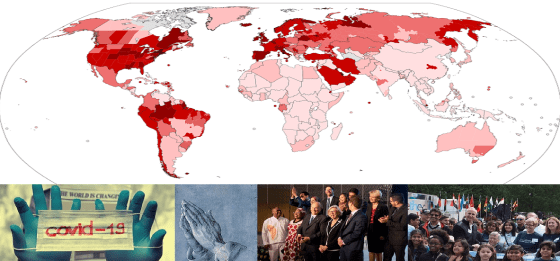
This pandemic has brought the world humbling and tumbling to its knees, which is actually the best position from which to beg for the Supreme Being’s forgiveness, mercy, and blessings. Its economies have been battered and shattered and almost all of the world’s citizens have been imprisoned in their dwellings. He alone will eventually empower our scientists and secular and sacred leaders to find effective vaccines to successfully overcome this calamity.
Guidance from a seventh century ruler to his regional governors entrusted with administering a new and rapidly expanding empire has timeless relevance to our pandemic times. Hazrat Ali was the first hereditary Shia Muslim Imam, as well as the fourth caliph of all Muslims, after the death of the Prophet Muhammad (S.A.S.), in 632 A.C. His letter enumerated a host of principles of good governance. He urged his subordinates to rule with intelligence and wisdom; justice, truth, and forgiveness; compassion and forbearance; humility and patience in calamity; consultation and wise counsel; piety and prayers; and above all to seek Divine Guidance. These are lessons which still apply today. [1]
article continues after photo
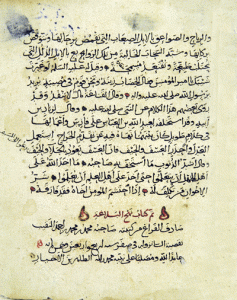
A folio from Hazrat Ali’s Nahj al-Balagha (Peak of Eloquence).
Remarkably, during the Prophet Muhammad’s time (570-632 A.C.), he had strongly recommended territorial quarantine and stricter personal hygiene, such as frequent hand washing during contagion. Later Muslim scientists and doctors had done the same, and Europe subsequently learned this practice from them. [2]
Turning to the current pandemic, this silent, inscrutable, and insidious enemy with unhindered Global Entry has awakened and heightened the need for prayers and some critical aspects of pluralism, which include public-private partnerships at all levels, to address the current dire situation engulfing almost every country.
Prayers have shown effectiveness since biblical times, and pluralism is inherent, in various forms, in all religious teachings. Some countries even have pluralism embodied in their constitutions, but sadly it often gets ignored.
article continues after photo
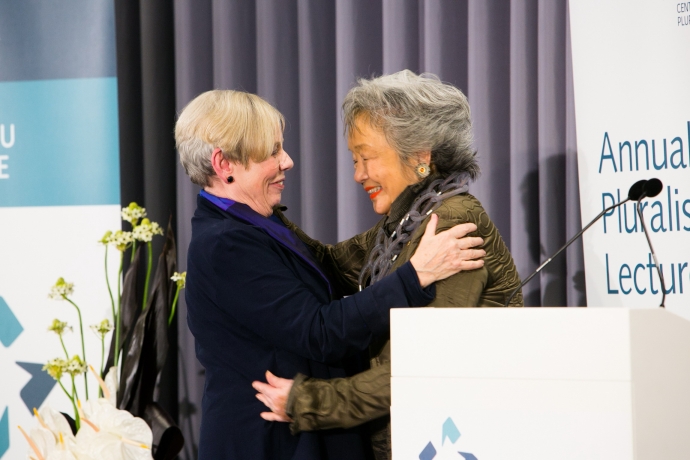
The Right Honourable Adrienne Clarkson, former Governor-General of Canada, and GCP Board Member thanks Karen Armstrong for delivering the GCP 2018 Annual Pluralism Lecture. Photo: AKDN / Anya Campbell
Karen Armstrong, the renowned historian and scholar of religions, has described the Qur’an as the most pluralistic scriptural book, which teaches not just tolerance of diversity, but beyond this a universal brotherhood, empathy, and an inclusive approach that harnesses the intelligence of all in society (annual pluralism lecture at the new Aga Khan Centre, London, 2018). Pluralism entails inclusion of all of God’s children who inhabit our shared planet, as an integral part of the community. Hardly any country is totally homogenous – most are quite heterogeneous with racially, ethnically, and religiously diverse minorities. Accommodating such diversity is best addressed through dialogue, mutual respect, research, and collaboration to promote a better understanding of differences as strengths.
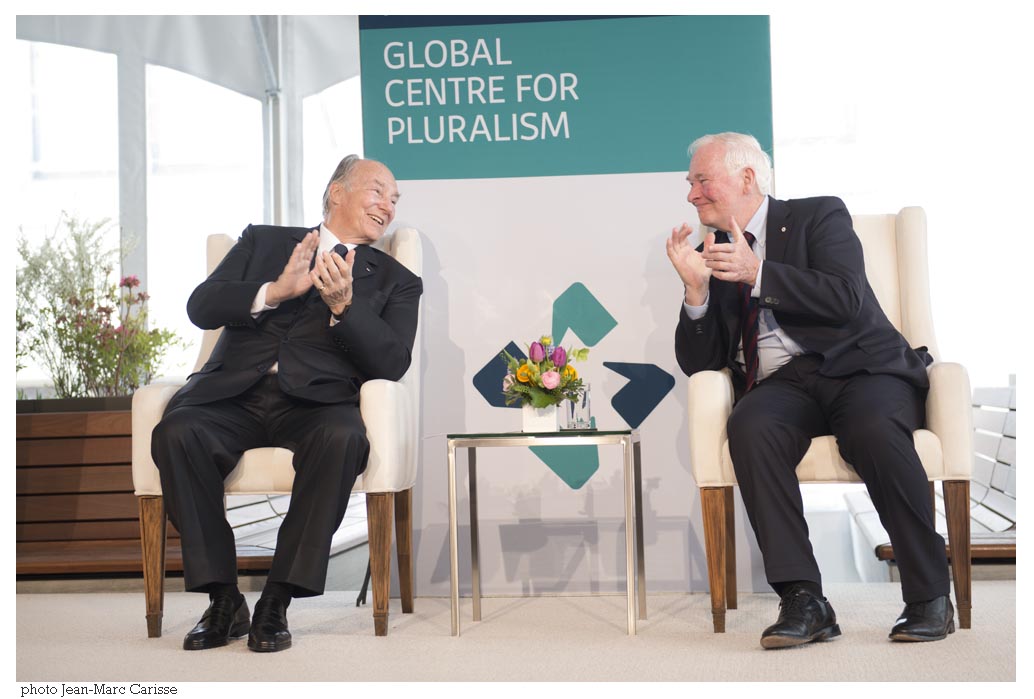
The idea of defining, promoting and giving pluralism an international platform emerged, significantly, after another calamity, namely the 9/11 terrorist attacks on America, that shook the world and drastically changed lives and livelihoods. In January 2002, the then Canadian prime minister Jean Chretien and the Aga Khan, the 49th hereditary Imam of the Ismaili Muslims, discussed the desirability of jointly creating a formal body to study, explain, and promote pluralistic values across the world and to prevent escalations of conflicts between the West and the Muslim countries. A decade later the Global Centre for Pluralism was formally established in Ottawa, Canada.
Pluralism, essential in ordinary times to promote mutual understanding, respect, and acceptance of differences, is even more critical in extraordinary times, such as the present, where widespread panic has driven many to act without regard for the wellbeing of others.
Equally alarming, Asian Americans have collectively been demonized and blamed for the virus. Fortunately, there have also been numerous wonderful and inspiring examples of collaboration, innovation, ingenuity, generosity, and volunteering to help those on the frontlines and those thrust onto food line.
However, let us not forget the other endemic and mutating virus of scammers and fraudsters preying on the most desperate of our fellow countrymen. We need more vigilance, prayers, partnerships and pluralism to combat both of these common enemies. Until God’s mercy results in effective vaccines, the best interim vaccines are the three Ps and gratitude.
Coincidentally, during this month of Ramadan, some fundamental practices of Islam are more evident now than at other times: fasting, prayer, and charity towards all — especially the weak, the sick, the poor, orphans, widows, and other most disadvantaged members of society. This constitutes the social conscience of Islam.
It is this Atlanta-based writer’s hope that Muslims and non-Muslims alike will share their relief/stimulus checks, if possible, with those in greater need. Unfortunately, their numbers are exploding, and they largely depend on such charities as the Atlanta Community Food Bank, Atlanta Union Mission, Salvation Army, and Red Cross among many others. Atlanta-based CARE is internationally active, as is the Aga Khan Foundation USA, which is a part of the Aga Khan Development Network (AKDN) – the world’s largest, most cost-effective, private, multifaceted network with hundreds of partners including the US Government.
May God Bless America and our interconnected planet.
Date posted: May 19, 2020. Last updated: May 20, 2020 (Revisions by author)
Before departing this website please take a moment to review Simerg’s Table of Contents for links to hundreds of thought provoking pieces on a vast array of subjects including faith and culture, history and philosophy, and arts and letters to name a few.
___________________
Notes:
[1] Nahjul Balagha, Peak of Eloquence; Sermons, Letters, and Sayings of Imam Ali ibn Abu Talib, Elmhurst NY, 1981. [2] Article by Yahia Hatim, Moroccan Times, April 4th, 2020. See also March 17, 2020 Newsweek article by Craig Considine.
____________________
The writer, who was born in Uganda, has a doctorate from the University of London, U.K. in African History. He has taught at Bowdoin College (Maine) and Western Michigan University. Later he worked at the Institute of Ismaili Studies in the U.K. A lifetime member of the Global South Studies Association and a longtime resident of Atlanta, he is a volunteer and donor for AKDN.
________________
Author’s recommendation: For a superb explanation of pluralism in the Qur’an, see Rahim Snow’s highly acclaimed book “Remember Who You Are: 28 Spiritual Verses from the Holy Quran to Help You Discover Your True Identity, Purpose, and Nourishment in God,” published by Remembrance Studio, 2017, Pp. 213. Please visit his website by clicking Rahim Snow .
We welcome feedback/letters from our readers. Please use the feedback box which appears below. If you don’t see the box please click Leave a comment. Your comment may be edited for length and brevity, and is subject to moderation. We are unable to acknowledge unpublished letters.
“Prophet Muhammad believed that freedom of religion and civic rights were important components of a ‘Muslim Nation’….His covenants with Christians can be viewed as a kind of medicine to cure the diseases of Islamic extremism and Islamophobia.” — Rice University Study
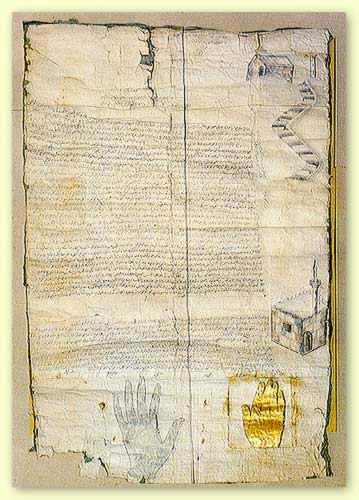
The Covenant with the Monks of Mount Sinai was commissioned by Prophet Muhammad, with Hazrat Ali as its scriber. Manuscript copies are from Saint Catherine’s Monastery, and Simonopetra. Photo: Wikipedia.
The following piece is adapted from a report released by Rice University – ed.
Prophet Muhammad believed that freedom of religion and civic rights were important components of a ‘Muslim nation,’ according to a Rice University analysis of the Prophet’s covenants with Christians.
Researcher Craig Considine, a lecturer in Rice’s Department of Sociology, argues that the covenants can be used to develop a stronger democratic partnership between Muslims and Christians in the Islamic world and elsewhere. His study is published in the journal Religions under the title “Religious Pluralism and Civic Rights in a ‘Muslim Nation’: An Analysis of Prophet Muhammad’s Covenants with Christians.” It can be downloaded through the link provided at the bottom of this post.
“These covenants were designed to protect and even defend peaceful Christian communities, not attack them,” Considine said. He found that these agreements established freedom of religion and civic rights for Christians living within the “ummah” (Arabic for “community”). “The research clearly shows that contemporary Islamic states that mistreat and discriminate against Christians cannot be justified in light of Prophet Muhammad’s covenants,” adds Considine.
The covenants were written between 622 and 632 A.D. Considine said it is assumed they were written because of Prophet Muhammad’s desire to build alliances to bolster his new community and because of his positive interactions with members of the Christian faith. The paper explores the Prophet’s covenants with the monks of Mount Sinai, the Christians of Najran, the Christians of Persia and the Christians of the World.
In “The Covenant of the Prophet with the Christians of Persia,” the Prophet was emphatic on the issue of complete religious freedom:
“And even as they honor and respect me, so shall Muslims care for that people as being under our protection and whensoever any distress or discomfort shall overtake (Christians), Muslims shall hold themselves in duty bound to aid and care for them, for they are a people subject to my Nation, obedient to their word, whose helpers also they are. It therefore is proper for my sake to attend to their comfort, protection and aid, in face of all opposition and distress, suppressing everything that becomes a means to their spoliation,” the Prophet wrote.
Considine said a similar — if not identical — passage is found in the three other covenants addressed in this paper.
Article continues after Aga Khan quote….
HIS HIGHNESS THE AGA KHAN ON THE ETHIC OF PLURALISM
“A cosmopolitan ethic is one that welcomes the complexity of human society. It balances rights and duties, freedom and responsibility. It is an ethic for all peoples, the familiar and the Other, whether they live across the street or across the planet…..Sadly, the world is becoming more pluralist in fact, but not necessarily in spirit. “Cosmopolitan” social patterns have not yet been matched by “a cosmopolitan ethic.”…..As you build your lives, for yourselves and others, you will come to rest upon certain principles. Central to my life has been a verse in the Holy Qur’an which addresses itself to the whole of humanity. It says: “Oh Mankind, fear your Lord, who created you of a single soul, and from it created its mate, and from the pair of them scattered abroad many men and women…” I know of no more beautiful expression about the unity of our human race — born indeed from a single soul.” — Excerpts from the Aga Khan’s speech made to the Parliament of Canada, Ottawa, February 27, 2014.
“Prophet Muhammad made it clear that freedom of religion is an inherent right for Christians living in a Muslim nation,” he said. “His cordial relations with Christians were not due merely to political expediency or personal aspirations, but rather they resulted from his belief that Christians should be able to freely practice their own faith in accordance with their own will. Christian Persians were under no compulsion whatsoever to accept or reject Islam.”
Considine also noted that Prophet Muhammad believed that a Muslim nation must also extend civic rights to Christian religious leaders, as discussed in “The Covenant of the Prophet with the Christians of the World.” The Prophet wrote:
“The covenant of Allah is that I should protect their land, their monasteries, with my power, my horses, my men, my strength and my Muslim followers in any region, far away or close by, and that I should protect their businesses. I grant security to them, their churches, their businesses, their houses of worship, the places of their monks, the places of their pilgrims, wherever they may be found.”
“The Prophet Muhammad did not want to inflict harm on Christians, nor interfere or encroach on their privacy or private property,” Considine said. “For the state to give preference to one or more groups means devaluating citizens based upon their ethnic or cultural backgrounds.”
Considine said documents have been located in obscure monasteries around the world and books that have been out of print for centuries.
Considine said the rediscovery of these documents provides an opportunity to give new birth to Islam and regenerate the essence of Islamic teachings. He hopes that the findings will have a positive impact on the impressions of Muslims in today’s society and will combat anti-Muslim sentiments.
“Prophet Muhammad’s covenants with Christians can be viewed as a kind of medicine to cure the diseases of Islamic extremism and Islamophobia,” Considine said. “His message radiates compassion and peace. This is what American society — and indeed the world — needs now more than ever.”
Handshake: Pope Benedict XVI and His Highness the Aga Khan
As part of his famous Apostolic Journey to France in 2008, Pope Benedict XVI, on September 13, paid a visit to the “Institut De France” in Paris. The Pope, who had been elected as the 265th Pope of the Roman Catholic Church in 2005, was presented with a gold medal by the Institut, and also unveiled a plaque commemorating his visit. During his very brief remarks to the audience, the Pope expressed his gratitude to the Institut “both personally and as the successor of [Simon] Peter.”
His Highness the Aga Khan, Mawlana Hazar Imam, was also in attendance at the Institut de France as the Associate Foreign Member of the Académie des Beaux-Arts (Academy of Fine Arts), one of five learned societies within the Institut which was founded in 1795.
Everyone’s attention in the hall was drawn to Mawlana Hazar Imam and the Pope, with an extraordinary sense of interest and keenness, as the two faith leaders greeted each other with a handshake.
A couple of years earlier in 2006, the Pope made some controversial remarks concerning Islam to which the Aga Khan responded inanInterview: Islam is a Faith of Reasonwhich appeared in Germany’s widely read Spiegel website.
In 2013, Pope Benedict dramatically resigned his position as the Head of the Catholic Church due to his deteriorating strength, advanced age and the heavy demands of being Pope, and retired at the Mater Ecclesiae, a small monastery located inside the Vatican State City. His present successor is Pope Francis I, born Jorge Mario Bergoglio.
Everyone’s attention is drawn to Pope Benedict XVI and His Highness the Aga Khan as they greet each other on September 13, at the Institut de France in Paris during an official visit by the Pope to France in 2008. Photo: Copyright. Getty Images. Published on Simerg/Simergphotos with a Licensing arrangement with Getty Images. Fench caption: Vue plongeante du pape BENOIT XVI serrant la main de l’AGA KHAN à son arrive sous la coupole de l’Institut de France à PARIS entouré de nombreux académiciens et autres personnalités dont Gabriel DE BROGLIE, Hélène CARRERE D’ENCAUSSE, Jean-François JARRIGE, Jean-François BACH, Arnaud D’HAUTERIVES, Michel ALBERT, Christian PONCELET président du Sénat, Jean TULARD, Alain DECAUX, Pierre-Jean REMY, Michel MOHRT, Max GALLO, le cardinal André VINGT-TROIS archevêque de Paris et le cardinal Paul POUPARD. (Photo by Philippe Petit/Paris Match via Getty Images).
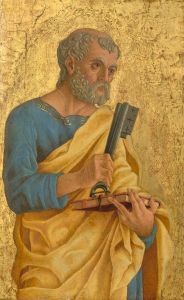
SIMON PETER IN THE CHRISTIAN AND ISMAILI TRADITIONS
The Catholics adhere to the belief that the Pope is a successor of St. Peter or Simon Peter. The succession of the pope is determined by a college of cardinals who elect the pope, while the office of the Imam of the Ismailis is a hereditary position.
In a speech made at the Canadian Parliament in 2014, the Aga Khan declared that “the Ismaili Imamat is a supra-national entity, representing the succession of Imams since the time of the Prophet.” And, in an interview with Politique International he said, “The religious leadership of the Ismaili Imam goes back to the origins of Shia Islam when the Prophet Muhammad appointed his son-in-law, Ali, to continue his teachings within the Muslim community. The leadership is hereditary, handed down by Ali’s descendants, and the Ismailis are the only Shia Muslims to have a living Imam, namely myself.”
In the Catholic tradition, the foundation for the office of the Pope is found primarily in Matthew, where Jesus is quoted as telling Simon Peter:
“You are ‘Rock,’ and on this rock I will build My Church and the gates of hell shall not prevail against it. And I will give unto thee the keys of the kingdom of heaven: and whatsoever thou shalt bind on earth shall be bound in heaven: and whatsoever thou shalt loose on earth shall be loosed in heaven.”
This series of successions of the Pope is known as “Apostolic Succession,” with the line of Bishops stretching back to the apostles, who lived during the time of Jesus. Simon Peter is recognized as having been the first Pope. Early Christians however reserved the title of “Pope” for St. Peter’s successors.
In branches of Shia theology as well as Ismailism, Simon Peter’s role is seen as the direct parallel to that of Hazrat Ali as the first Imam. Ismailis along with some other Shia groups maintain that every major Prophet had a spiritual legatee (Waṣi) or successor called the Asas (foundation) who taught the inner meaning to those who had the capacity to understand it. In this regard, Adam had Seth; Noah had Shem; Moses had Aaron, and Jesus had Simon Peter. A well known sacred tradition of the Prophet Muhammad says that “Ali is to me as Aaron was to Moses,” confirming that Ali held the same level of authority as Aaron did.
Date posted: January 3, 2018
An earlier version of this post appeared on this website on December 31, 2015. _______________
We welcome your feedback, please click Leave a commentor send it tosimerg@aol.com, Your feedback may be edited for length and brevity, and is subject to moderation. We are unable to acknowledge unpublished letters.
The following were used as references for the compilation of this piece:






 Simerg - Insights from Around the World