Simerg is an independent initiative dedicated to Ismaili Muslims, the Aga Khan — their Hereditary Imam — and the Ismaili Imamat, and Islam in general through literary readings, photo essays and artistic expressions
In February 2015, divers off the coast of Caesarea spotted by chance a group of gold coins lying on the seabed. They immediately alerted marine archaeologists of the Israel Antiquities Authority (IAA), who conducted a salvage excavation at the site and recovered more than 2,580 Fatimid coins of pure (24 karat) gold weighing a total of 7.5 kg.
Please click on the image to view an on-line exhibit of the discovery.
The coins date from the mid-9th to the early 11th century CE. They were minted by the Fatimid caliphs of Egypt, and include dinars minted in al-Qayrawan, on the Tunisian coast, by Imam al-Mahdi (AH 297–322 = 910–934 CE), the founder of the Fatimid caliphate as well as a much larger collection belonging to the Fatimid caliphs Imam Al-Hakim (AH 386–411 = 996–1021 CE) and his successor Imam Al-Zahir (AH 411–427 = 1021–1036 CE).
Following the discovery, an exhibition was held from June to December 2015 at the Samuel and Saidye Bronfman Archaeology Wing of The Israel Museum in Jerusalem. Some very interesting data and information about the Fatimid coins was also posted on the Museum’s website, which includes topics such as the inscription on the coins, the coin’s purchasing power, the script, and the purity of the coins. We invite our readers to visit the website by clicking on http://www.imj.org.il/exhibitions/2015/caesarea/ or on the image shown above.
Editor’s note: Shortly after the 9/11 attacks in the USA in 2001 which killed almost 3000 people in an instant, numerous articles began to appear in the media around the world that drew parallels between the actions of Al-Qaeda and the warfare activity of the Ismailis during the 12th and 13th centuries that over time grew into fantastic legendary tales. In response to one such column that appeared in the October 8 edition of Canada’s National Post newspaper, Professor Azim Nanji and Dr. Farhad Daftary of the Institute of Ismaili Studies in London contributed the following letter in the newspaper:
“It is unfortunate that the search for historical connections in the aftermath of the terrible events of Sept. 11 has made historical truth itself a casualty. George Jonas’s column, Mortal Enemies Are to be Destroyed (Oct. 8) attempts to draw parallels between the ancient history of the Ismaili Muslims and the actions of these terrorists. In the last 25 years, scholarship, Muslim and Western, has shown the legend about the Assassins to be a fabrication concocted by contemporary enemies of the Ismailis. The Nizari branch of Ismaili Muslims organized a state in Iran and Syria in the 12th and 13th centuries. It flourished for almost two centuries, as a place of learning, scholarship and international influence, in spite of adverse circumstances and militant hostility from its neighbours. These Ismailis were heirs to the Fatimid dynasty that founded Cairo and established the University of Al‑Azhar, acts which represented a truly brilliant epoch in medieval Muslim history However, due to hostility prevailing in political and military spheres, the Ismailis became the object of theological and intellectual attacks, as their society attracted many scholars and scientists to their libraries and observatories. This climate of threat was accentuated by direct military attempts to destroy their centres and communities. It is in this context that their attempts at self‑defence need to be understood. These were directed at political and military figures and never against the general populace: a fact recognized by their enemies. Reporters obsessed with tracing tenuous historical links to current episodes of violence can learn much from history about the rich intellectual and cultural interactions among Muslims, Christians, Jews and others.”
Sporadic responses like the letter above, academic books by Dr. Daftary and the late Dr Peter Willey and many others as well as scholarly articles in journals do not appear to have made any impact in demystifying and debunking the myth of the assassins. Furthermore, the non-availability and non-distribution of important historical and theological works on Ismailis, in giant brick and mortar stores like Chapters and Indigo in Canada haven’t helped the cause either. There are a number of enjoyable, accessible and easy to comprehend books, produced by the Institute of Ismaili Studies and other academic and non-academic publishers, that should be on bookstore shelves alongside numerous Sunni, Shia and general works on Islam and other religions to counter misperceptions and negative stereotyping about the Ismailis as well as to impart an understanding of the community’s religious doctrines from Ismaili sources.
The plot of the highly popular video game “Assassins’ Creed” which is now available on almost all computer platforms revolves around the legendary “assassins” of the 12th and 13th centuries. The video game, which was created in 2007, was inspired by the 1930’s novel Alamut by the Slovenian writer Vladimir Bartol. New versions of the game have appeared annually since but the 2016 edition has been bypassed to prepare for a greatly enhanced 2017 version. However, a movie version of the video game is planned for release at the end of this year under the title “Assassin’s Creed: The Movie.”
Now, in response to the idea that ISIS or IS (Islamic State) is based on the Assassins, Dr. Farhad Daftary has contributed the following piece for the February 21, 2016, (USA) edition of The Conversation, which has a mission to provide readers with a reliable source of high quality, evidence based information.
Islamic State and the Assassins: reviving fanciful tales of the medieval Orient
(How do we account for forces and events that paved the way for the emergence of Islamic State? Our series on the jihadist group’s origins tries to address this question by looking at the interplay of historical and social forces that led to its advent.
Today, historian Farhad Daftary debunks the idea that Islamic State is based on the so-called Assassins or hashishin, the fighting corps of the fledgling medieval Nizari Ismaili state).
Many Western commentators have tried to trace the ideological roots of Islamic State (IS) to earlier Islamic movements. Occasionally, they’ve associated them with the medieval Ismailis, a Shiʿite Muslim community made famous in Europe by returning Crusaders as the Assassins.
But any serious inquiry shows the teachings and practices of medieval Ismailis, who had a state of their own in parts of Iran from 1090 to 1256, had nothing in common with the senseless terrorist ideology and ruthless destruction of IS and its supporters.
Attacks on civilians, including women and children, and engaging in the mass destruction of property are forbidden both by Prophet Muhammad and in the tenets of Islamic law. Needless to say, the Ismailis never descended to such terrorist activities, even under highly adversarial circumstances.
Significant discordance exists between the medieval Ismailis and contemporary terrorists, who – quite inappropriately – identify themselves as members of an Islamic polity.
Fanciful Oriental tales
The Ismailis, or more specifically the Nizari Ismailis, founded a precarious state in 1090 under the leadership of Hasan-i Sabbah. As a minority Shi’ite Muslim community, they faced hostility from the Sunni-Abbasid establishment (the third caliphate after the death of the Prophet Muhammed) and their political overlords, the Seljuq Turks, from very early on.
Struggling to survive in their network of defensive mountain fortresses remained the primary objective of the Ismaili leadership, centred on the castle of Alamut (in the north of modern-day Iran). Their state survived against all odds until it was destroyed by the all-conquering Mongols in 1256.
During the course of the 12th century, the Ismailis were incessantly attacked by the armies of the Sunni Seljuq sultans, who were intensely anti-Shiʿite. As they couldn’t match their enemies’ superior military power, the Ismailis resorted to the warfare tactic of selectively removing Seljuq military commanders and other prominent adversaries who posed serious existential threats to them in particular localities.
An agent (fida’i) of the Ismailis (left, in white turban) fatally stabs Nizam al-Mulk, a Seljuk vizier, in 1092. Public domain via Wikimedia Commons
These daring missions were carried out by the Ismaili fidaʾis, who were deeply devoted to their community. The fidaʾis comprised the fighting corps of the Ismaili state.
But the Ismailis didn’t invent the policy of assassinating enemies. It was a practice employed by many Muslim groups at the time, as well as by the Crusaders and many others throughout history.
Unfortunately, almost all assassinations of any significance occurring in the central lands of Islam became automatically attributed to the Ismaili fidaʾis. And a series of fanciful tales were fabricated around their recruitment and training.
These tales, rooted in the “imaginative ignorance” of the Crusaders, were concocted and put into circulation by them and their occidental observers; they’re not found in contemporary Muslim sources.
The so-called Assassin legends, which culminated in Marco Polo’s synthesis, were meant to provide satisfactory explanations for the fearless behaviour of the fidaʾis, which seemed otherwise irrational to medieval Europeans.
The very term Assassin, which appears in medieval European literature in a variety of forms, such as Assassini, was based on variants of the Arabic word hashish (plural, hashishin) and applied to the Nizari Ismailis of Syria and Iran by other Muslims.
In all the Muslim sources where the Ismailis are referred to as hashishis, the term is used in its pejorative sense of “people of lax morality”. There’s no suggestion that they were actually using hashish. There’s no evidence that hashish, or any other drug, was administered to the fida’is, as alleged by Marco Polo.
The literal interpretation of the term for the Ismailis as an “order of crazed hashish-using Assassins” is rooted entirely in the fantasies of medieval Europeans.
Modern scholarship in Ismaili studies, based on the recovery and study of numerous Ismaili textual sources, has now begun to dispel many misconceptions regarding the Ismailis, including the myths surrounding their cadre of fidaʾis.
And the medieval Assassin legends, arising from the hostility of the Sunni Muslims to the Shiʿite Ismailis as well as the medieval Europeans’ fanciful impressions of the Orient, have been recounted and deconstructed.
A culture of learning and tolerance
Living in adverse circumstances, the Ismailis of Iran and Syria were heirs to the Fatimid dynasty that founded the city of Cairo and established al-Azhar, perhaps the earliest university of the world. Although preoccupied with survival, the Ismailis of the Alamut period maintained a sophisticated outlook and a literary tradition, elaborating their teachings within a Shiʿite theological framework.
An entirely fictional illustration from The Travels of Marco Polo showing the Nizari imam Alâ al Dîn Muhammad (1221-1255) drugging his disciples. Public Domain via Wikimedia Commons
Their leader, Hasan-i Sabbah, was a learned theologian. And the Ismaili fortresses of the period, displaying magnificent military architecture and irrigation skills, were equipped with libraries holding significant collections of manuscripts, documents and scientific instruments.
The Ismailis also extended their patronage of learning to outside scholars, including Sunnis, and even non-Muslims. They were very tolerant towards other religious communities.
In the last decades of their state, in the 13th century, even waves of Sunni Muslims found refuge in the Ismaili fortress communities of eastern Iran. These refugees were running from the Mongol hordes who were then establishing their hegemony over Central Asia.
All this stands in sharp contrast to the destructive policies of IS, which persecutes religious and ethnic minorities and enslaves women.
The medieval Ismailis embodied qualities of piety, learning and community life in line with established Islamic teachings. These traditions continue in the modern-day Ismaili ethos. And the present-day global Ismaili community represents one of the most progressive and enlightened communities of the Muslim world.
The Ismailis have never had anything in common with the terrorists of IS, who murder innocent civilians at random and en masse, and destroy monuments of humankind’s shared cultural heritage.
Global terrorism in any form under the banner of Islam is a new phenomenon without historical antecedents in either classical Islamic or any other tradition. IS’s ideology reflects a crude version of the intolerant Wahhabi theology expounded by the Sunni religious establishment of Saudi Arabia, which is itself a narrow perspective that fails to recognise any pluralism or diversity of interpretations in Islam.
Date posted on Simerg:Monday, February 29, 2016. Last updated:March 1, 2016 (12:50 EST).
_______
This is the fifth article in The Conversation website’s series on the historical roots of Islamic State. Look out for more stories on the theme in the coming days on The Conversation website.
Imam is the Threshold through which God and the creatures communicate; Imam is a Cosmic Necessity and the earth cannot be devoid of an Imam – without an Imam the earth and the universe would crumble; The Imam is the Proof, the Manifestation and the Organ of God and he is the Means by which human beings can attain the knowledge of God — Excerpt from The Divine Guide in Early Shi’ism by Mohamad Ali Amir-Moezzi, pp 125-131, SUNY, 1994.
2. THE ROLE OF MAWLANA HAZAR IMAM
Historically and in accordance with Ismaili tradition, the Imam of the time is concerned with spiritual advancement as well as improvement of the quality of life of his murids. The imam’s ta‘lim lights the murid’s path to spiritual enlightenment and vision. In temporal matters, the Imam guides the murids, and motivates them to develop their potential…..Mawlana Hazar Imam Shah Karim al Hussaini, His Highness Prince Aga Khan, in direct lineal descent from the Holy Prophet (s.a.s.) through Hazrat Mawlana Ali (a.s.) and Hazrat Bibi Fatima (a.s), is the Forty-Ninth Imam of the Ismaili Muslims….Clauses (F) and (G) of the Preamble of the Ismaili Constitution ordained in 1986 [1].
3. HIS HIGHNESS THE AGA KHAN: THE LIVING IMAM
The religious leadership of the Ismaili Imam goes back to the origins of Shia Islam when the Prophet Muhammad appointed his son-in-law, Ali, to continue his teachings within the Muslim community. The leadership is hereditary, handed down by Ali’s descendants, and the Ismailis are the only Shia Muslims to have a living Imam, namely myself. [2] The Ismaili Imamat is a supra-national entity, representing the succession of Imams since the time of the Prophet…today the Ismailis are the only Shia community who, throughout history, have been led by a living, hereditary Imam in direct descent from the Prophet. [3]
~~~~~
READINGS
1. THE NUR (LIGHT) OF IMAMAT
What is this special light that Allah refers to [in Holy Qur’an 4:174], which guides and makes things clear? For Shia Muslims, this light is the Light of Imamat. The Shias refer to it as the Nur of Imamat. Nur means light. The Nur of Imamat is a spiritual light….Click to read more
2. LOVE FOR THE IMAM
“Say (O Muhammad): No reward do I ask (for my favours) except your love for my kith and kin” – Holy Qur’an, 42:23
“He who loves us will be with us on the Day of Judgement” – Imam Ja’far as-Sadiq….Click to read more
3. THE FORMULATION OF THE DOCTRINE OF IMAMAT
Like his father and grandfather before him, Imam Ja’far remained politically quiescent and inactive…..it was in this period of political inactivity – to an extent – that the main religious ideas and doctrinal formation of Imamate concepts really crystallised….Click to read more
4. THE TERM IMAM IN THE HOLY QUR’AN
The term Imam is used seven times in the singular and five times in the plural form in the Holy Qur’an. It is not, however, used in the same sense every time. The different shades of meaning which it indicates therefore needs to be analysed….Click to read more
5. THE DOCTRINE OF IMAMAT DURING THE FATIMID PERIOD
The central doctrine of the Ismaili community has always been the doctrine of Imamat because around it are built all the goals of the community and the roles of the dais, but this doctrine is also not rigid, it has been evolving, particularly in the writings and preachings of the dais….Click to read more
6. IMAMAT IN ISMAILI GINANIC LITERATURE
According to the Ginans the Imam is the source of Guidance for mankind. He shows them the right path, saves the people from ignorance and acts as a Divine Light in the darkness….Click to read more
Date posted: Saturday, January 23, 2013 (this is a slightly updated version of a previous post).
Abstract (from History Compass): The Fatimids have been consistently studied as powerful contenders in the commercial and political control of the Mediterranean Sea. It is therefore surprising to find that only passing attention has been paid so far to the use of the Nile the Fatimids made as the ‘avenue’ through which goods from Africa and the Indian Ocean could be transported from Upper Egypt, to Cairo, then Alexandria and from there distributed to other Mediterranean ports. My argument in this paper is that the imperial aspirations of the Fatimids in Cairo and beyond were in many ways dependant on the unpredictability of the natural cycles that are characteristic of the river to this day but also on the Fatimids’ success or failure in politically and economically managing the varied social, political and trading activities that took place along the Egyptian section of the Nile valley. Beside commercial navigation, throughout the history of Egypt during the Fatimid period, the river was used for transport of people, water supply, the staging of state rituals and parades, as holiday destination for the imam-caliphs and their courts but also as a vehicle through which pilgrims form various regions of the Islamic world continued to penetrate Egypt whilst back and forth on their way to Mecca.
“When the Nile reached its peak, the golden parasol was unfurled, trumpets sounded, and the caliph, mounted and clothed in sapphires and emeralds, emerged to the wonderment of his subjects…it was difficult for many spectators to catch even a brief glimpse of the passing caliph. But the very act of seeing him, it was believed, conveyed blessings upon the beholder.”
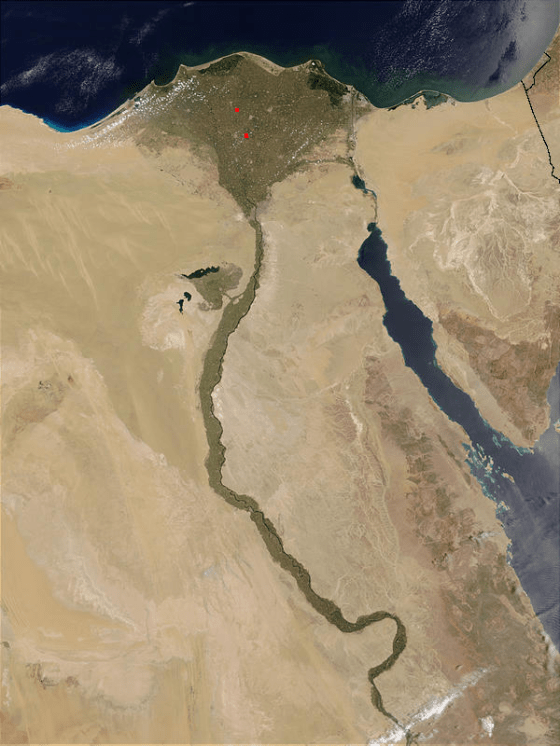
This pair of true-and false-color images from the Moderate Resolution Imaging Spectroradiometer was acquired on June 3, 2002. For thousands of years, the lower Nile valley (northern end) has been a cradle of civilization. Surrounded by deserts, the Nile river brings much—needed water to the land and people, making the valley into an oasis of agriculture and life. At its delta at the Mediterranean Sea, the Nile broadens into a large fan-shaped delta. All of Egypt’s large cities fall along the Nile, which sustains life in a region of scant rainfall. Photo Credit: Jacques Descloitres, MODIS Land Rapid Response Team, NASA/GSFC
Flowing out of a barren desert, from a source “beyond all known horizons,” the Nile had baffled the world for thousands of years. Regular as sun and moon, in the middle of burning summer, without a drop of rain in sight, when all other rivers on earth were drying up, for no apparent reason at all, the Nile rose out of its bed every year, and for three months embraced all of Egypt.
The ancient Egyptians knew when the flood would come, almost to the hour, but they never knew how much water it would bring to irrigate their fields. Egypt’s prosperity depended not only on the flood but also upon the accurate measurement of its height, for on that depended the allotment of water to its many users and the taxes they would have to pay in the coming year.
In the Middle Ages, each day during flood-time, the town crier walked the streets of Cairo announcing to the city the height of the rising Nile, although in drier years the actual height might be kept secret for fear of causing financial panic. “Twelve cubits today and the Lord is bountiful. God hath given abundance and watered the high fields,” he would say, to which a boy accompanying the crier would reply in his high-pitched voice, “Bless ye Muhammad.”
…The river having reached its anxiously awaited peak, preparations were made for the annual ‘Procession to the Nile.’ In 1047, the visiting Persian scholar Nasir Khosrau left a particularly rich description of the annual Fatimid procession celebrating the Nile’s inundation of Egypt.
For this great occasion, he wrote, the caliph [Imam al-Mustansir Billah] went personally to his treasury to select his symbolic regalia: parasol, turban, sceptre and sword. The sound of the palace band, which would accompany the procession, was so enormous that for three days before the event, massed drums and trumpets played continuously in the palace stables to accustom the animals to the noise. The job of decking out the processional route fell to the jewelers and tailors of the city, and this, too, always took three days and nights to arrange.
When the Nile reached its peak, the golden parasol was unfurled, trumpets sounded, and the caliph, “mounted and clothed in sapphires and emeralds,” emerged to the wonderment of his subjects.
Amidst clouds of incense, the procession of 10,000 men on horses moved off toward the great gate of Bab Zuwaylah, and beyond it to the flooding Nile.
From the surrounding rooftops, joining the din of drums, clashing cymbals and trumpets, “which sounded like thunder,” came choruses of the women’s ululations, “made by holding one hand under the nose and waggling the tongue in mid-scream.”
Leading the great procession were the sons and soldiers of the caliph’s princes (amirs). Then came the “amirs of the silver rods,” their symbols of office hung with little silver bells that jingled as they marched. Next came the “amirs of the collar,” two bearers of “the standards of praise,” and bearers of the symbolic inkstand and sword. Next came the mounted caliph surrounded by “men of the stirrup,” two at his horse’s bit, two at the neck, two at the stirrups, with the “commander of commanders” holding the caliph’s whip. The bearer of the golden parasol “took care to keep the caliph shaded from the sun,” while strategically placed in front of the caliph’s horse were two designated fly-swatters.
Amidst such a vast assembly of courtiers and crowd, it was difficult for many spectators to catch even a brief glimpse of the passing caliph. But the very act of seeing him, it was believed, conveyed blessings upon the beholder.
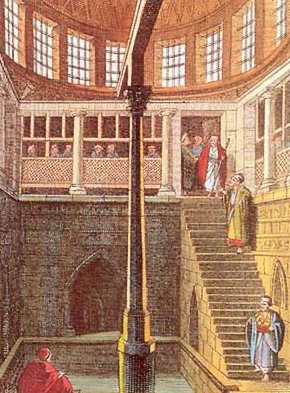
In both ancient and medieval Egyptt a nilometer was used to record how high the Nile was during the year. The nilometer was a staircase that proceeded down into the Nile with marks on it so the Egyptians knew how far the river rose. Image: TourEgypt.net
On reaching the Isle of Rhoda, the caliph dismounted, and the ceremony of anointing the Nilometer began. A mixture of saffron and mastic was handed to an official. Still in his clothes, he plunged into the flood-water and hung by his legs around the measuring column, dabbing on the perfumed mixture as readers above recited verses from the Qur’an.
The caliph went on to attend the opening of the “Canal of Egypt” (Al-Khalij al-Misri), which was kept dammed with stagnant water during the river’s winter months. At the canal, one of the caliph’s most magnificent silk tents was ready to give him protection from the summer sun. (Fatimid tents, transported on the backs of many camels, were portable palaces that took seven to nine years to make.) Amid more trumpet fanfares, the caliph thrust a spade onto the winter earthen dam and at once diggers attacked the dam with their hoes, cutting a series of narrow trenches across its surface. The impatient floodwaters quickly took over, eroding deeper channels, washing the dam completely away, and within an hour the life-giving flood reached the heart of all Cairo.
[Today] The Nile flood still comes, of course, but no one in Egypt sees it. Instead, it is contained in the immense inland sea called Lake Nasser, behind the Aswan High Dam. Here, Nile water collected year by year is led along neat narrow canals as unobtrusively as water coming out of a bathroom tap.
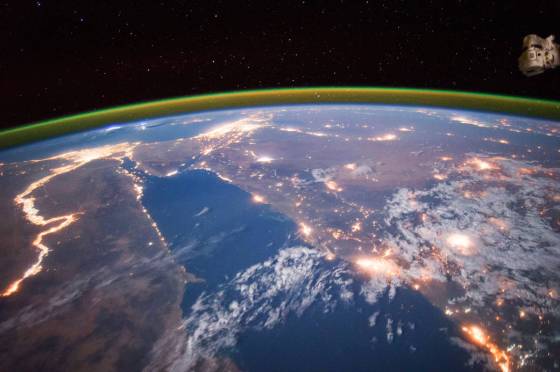
One of the fascinating aspects of viewing Earth at night is how well the lights show the distribution of people. In this view of Egypt, we see a population almost completely concentrated along the Nile Valley, just a small percentage of the country’s land area. The Nile River and its delta look like a brilliant, long-stemmed flower in this astronaut photograph of the southeastern Mediterranean Sea, as seen from the International Space Station. The Cairo metropolitan area forms a particularly bright base of the flower. The smaller cities and towns within the Nile Delta tend to be hard to see amidst the dense agricultural vegetation during the day. However, these settled areas and the connecting roads between them become clearly visible at night. Likewise, urbanized regions and infrastructure along the Nile River becomes apparent . This astronaut photograph (ISS025-E-9858) was acquired on October 28, 2010, with a Nikon D3S digital camera using a 16 mm lens, and is provided by the ISS Crew Earth Observations experiment and Image Science & Analysis Laboratory, Johnson Space Center. The image was taken by the Expedition 25 crew. The image has been cropped and enhanced to improve contrast. Lens artifacts have been removed. Credit: NASA
NASA astronaut Scott Kelly, recently past the halfway mark of his one-year mission to the International Space Station, photographed the Nile River during a nighttime flyover on Sept. 22, 2015. Kelly (@StationCDRKelly) wrote, “Day 179. The #Nile at night is a beautiful sight for these sore eyes. Good night from @space_station! #YearInSpace.” Image Credit: NASA
______________
John Feeney (d. 2006)
About the writer: The late New Zealand born filmmaker, photographer and writer John Feeney was among the early developers of wide-screen and large-format film techniques. For over 4 decades from 1963 onwards until his death in Wellington in 2006 at the age of 84, he divided his time between residences in Cairo and New Zealand. His piece (images excepted) is adapted from “The Last Nile Flood” which originally appeared in the May/June 2006 print edition of Saudi Aramco World, a publication to which Feeney regularly contributed for some 35 years.
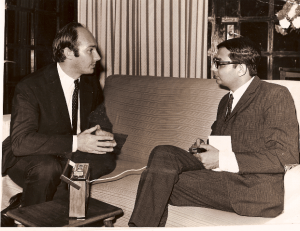
1970: Mansoor Ladha, veteran award winning journalist, writer and author, interviewing His Highness the Aga Khan for Tanzania’s daily, The Standard (now Daily News). Photo: Mansoor Ladha Collection. Copyright.
BY MANSOOR LADHA
As a journalist, a writer and an author, what better time to be than reporting milestones and significant events during the Fatimid Period or the “Golden Age” of Ismailism, when Ismaili Imams ruled over a vast empire and when Ismaili literature, philosophy and law flourished. It was during the Fatimid Period that the Ismaili scholars and authors produced what were to become the classic texts of Ismaili literature dealing with a multitude of exoteric and esoteric subjects. I think I might have made Ismaili fiqh (jurisprudence) my area of specialization, because it had not existed during the pre-Fatimid period. It was codified and became catalogued during the early Fatimid period. It was during the Fatimid period that Ismailis made their important contributions to Islamic theology and philosophy in general and to Shia thought in particular. Modern recovery of Ismaili literature clearly attests to the richness and diversity of the literary and intellectual traditions of the Ismailis.
Egypt became the center of the Fatimid empire that included at its peak North Africa, Sicily, Palestine, Lebanon, Syria, the Red Sea coast of Africa, Yemen and the Hejaz. Egypt flourished as the Fatimids developed an extensive trade and diplomatic network and ties which extended all the way to China. Map: Wikipedia; click to enlarge
But, I think, for me of all the events that I would have reported, there are a number of related incidents that stand out, and which I would have liked to witness in the company of Imam Muizz’s trusted commander, Jawhar al-Siqilli. He was of Sicilian descent.
He had been entrusted by the Imam to conquer Egypt. With a 100,000 men assembled and equipped at a cost of 24 million dinars, he set out for Egypt on February 5th, 969.
Embedded I would be, like the modern journalists in this vast army, alongside my hero! The road to Egypt had been well ascertained, forts had been built through the route at specific places. Jawhar was carrying with him a thousand caskets filled with silver. Camels carried gold ingots in plain sight, cast in the shape of millstones, to impress the crowds and the local peoples through which the army passed. Then four months later, in June of the same year, I would arrive with Jawhar in Egypt, and hardly witness any resistance!
As the first measures after the conquest, I see him issue a proclamation promising financial reforms and an end to injustice. He reached out to Sunnis, Jews and Christians and offered them protection.
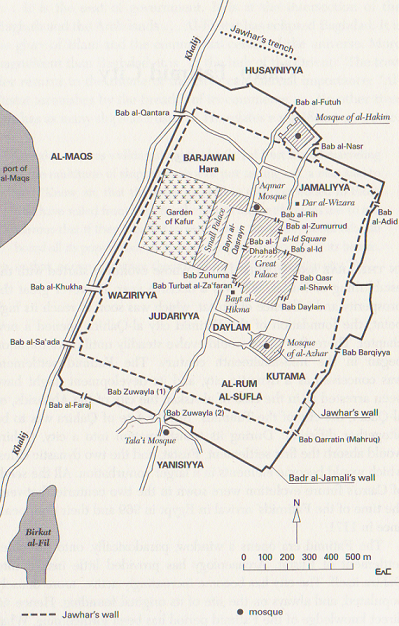
Then I had been with him as he crossed the Nile, and on July 6 of the same year, he marched through Fustat, and established himself north of the city in the plain that would become his new capital – a capital that Imam Muizz had expressed a wish would rule the world.
Fatimid Cairo with an outline of Jawhar’s wall shown by dashes (Please click to enlarge)
This site was empty except for a monastery and a castle. On the very night of Jawhar’s arrival in this empty spot, I would have seen the Sicilian mark the perimeter of the city with wooden stakes strung together with belled ropes. A crow would land on the rope and set the bells jingling. The ground breaking work would commence at that spot for what would eventually become known as al-Qahira (“The Triumphant”). I would see the birth of what is now modern Cairo!
But the epochal incident, the Grand Darbar, would come four years later. During this interim time I would see Jawhar establish the new capital, pacify the provinces, institute financial reform, defeat the Qarmats in December 971, and introduce new religious observances in conformity with the Shia Ismaili faith. This would include a call to prayers containing the Shiite invitation to “come to the best prayer.”
Now that all had been done, no further time would be spent. There was nothing left to do but to invite Imam al-Muizz.
In 973, the Imam leaves the Maghreb on his way to Egypt with his sons and relatives with him, along with coffins of his ancestors. One of his stops is Alexandria, where the Imam resolves to dedicate his life in the exercise of good works. He then preaches to them in a manner which draws tears from many who are present.
He departs after spending three days in Alexandria, and on June 6, 973, he reaches a place known as Mina. Jawhar is there to receive him. I see him go forth to meet his master and I witness him drawing near the Imam, dismounting from his horse and kissing the ground before the Imam in a show of loyalty, humility and submission to the Amirul Muminin. This is affection and love for the Imam I see at the highest and deepest level. It is a profound experience and a joy to behold, which I would report.
The Imam would then cross the Nile on the Rawdah bridge, bypass Fustat, and proceed straight to Cairo and take possession of the palace or fort that Jawhar had constructed for the Imam.
It is Ramadhan – year AH 362. The feast marking its end is underway. I’d see Imam Muizz conduct his prayers at the new mosque in Cairo, and then ascend the pulpit to give his sermon, with Jawhar on the steps of the pulpit. I would feel the emotions as the crowds weep and sob at hearing the Imam’s sermon.
Outside, the Imam would then mount his horse surrounded by his four armoured and helmeted sons, while two elephants led the procession. Destination – the fort, and I on my heels to get there for the Darbar!
Then, at the fort, all the citizens eagerly await to pay their allegiance to the new Caliph. Jawhar would be within my sight, and very close to the Imam, to his right.
I would witness the Imam majestically seated on his golden throne as he received all the nobles, Qadis, Vazirs and Ulemas of his city. They would present the Imam with their beautiful gifts as well as a robe made from a rare yarn that is known to grow only in Tunis. The material has a special shine and is gilded with gold and silver. The Imam would then be presented a Turban of a similar material and he would adorn the robe and the Turban. A resplendent Darbar for me to record and report as a journalist!
My friend, Jawhar, would get his turn. I would see him present the Imam, al-Muizz, with the best breed of 150 horses gilded with saddles and bridles of gold and diamonds as well as camels and ponies, saddled with boxes filled with all rare items in Egypt.
Then the Imam Muizz in a remarkable gesture of magnanimity and forgiveness would announce the release of about 1000 of his prisoners and present robes and Khalat to all his nobles and officers.
Would Jawhar be forgotten in the sight of the Imam? No. I would be exuberant to see my beloved Imam’s immense love for someone responsible for conquering Egypt some four years earlier. Jawhar would be honoured as he is presented with a golden Khalat and a turban. Imam Muizz then would tie a sword on Jawhar’s waist and present him with 20 horses with golden saddles, 50 thousand dinars and 200,000 dirhams.
With this Darbar, Egypt and Cairo enter a new era that would last almost two centuries and constitute one of the most brilliant periods in Ismaili history and Islamic Civilization.
Indeed a monumental and epochal event to witness and report! What a story and I Wish I’d Been There with Jawhar.
About the Writer: Mansoor Ladha is an award-winning journalist based in Calgary, Canada. He has held several senior editorial positions with daily and weekly newspapers in Canada, Kenya and Tanzania, which included the Edmonton Journal, Morinville Mirror, Redwater Tribune, Daily Nation, Kenya, and Daily News, Tanzania. Currently, he freelances for the Calgary Herald, the Vancouver Sun, and the Calgary Senior newspapers and travel magazines. He has also published a book entitled A Portrait in Pluralism: Aga Khan’s Shia Ismaili Muslims and is currently working on memoirs on his life in East Africa and in Canada. Last year, he was one of the several writers, scholars and journalists invited to contribute a chapter in the book called, The Story That Brought Me Here. He has served on several public and voluntary bodies in Canada. His complete profile can be viewed on his Web site www.mansoorladha.ca.
_______________
This piece by Mansoor Ladha is one of 32 succinct pieces on Ismaili history that appeared in this blog’s highly acclaimed first anniversary special series, I Wish I’d Been There.
2. We welcome feedback/letters from our readers. Please click Leave a comment, or email it to simerg@aol.com. Your feedback may be edited for length and brevity, and is subject to moderation. We are unable to acknowledge unpublished letters.
______________
Narrative references:
1. Cairo by Andre Raymond, translated by Willard Wood, published by Harvard University Press, Cambridge, MA, 2000.
Also note: Cairo map shown is from this book
2. Jawhar as-Siqilli by Zawahir Nooraly in book Great Ismaili Heroes, Pakistan. The complete article is also available on-line at: http://www.amaana.org/heroes/note010.htm
A view of the African and Middle Eastern Reading Room at the Library of Congress in Washington, D.C. Inset the Main Building. Photo: Library of Congress, USA.
INTRODUCTION
In 1945, the US Library of Congress (LOC) purchased a collection of printed books and manuscripts form Shaykh Mahmud al-Iman al-Mansuri, professor of religion at the al-Azhar University, Cairo. Assembled by the Shaykh from sources in the Middle East, Africa, and Europe, the collection deals with virtually every aspect of Qur’anic and Islamic studies and includes commentaries, biographies, dictionaries, and works on history, literature, and philosophy. Approximately 1,300 of the 5,000 volumes that comprise the collection are book manuscripts. The collection is known as the Mansuri Collection.
MANUSCRIPT DEDICATED TO IMAM AL-HAKIM
Among the thousands of items in the Mansuri Collection, is a work on astronomy dedicated to the 16th Ismaili Imam (or the 6th Fatimid Caliph), al-Hakim bi Amr-Allah (d. 411AH/1021 CE). The text is a popular exposition on the study of the order of events in time, and the order in which they occur, especially in those related to astronomical movements and the measurement of time.
A folio from a manuscript whose original work was dedicated to Ismaili Imam al-Hakim. Photo: Library of Congress, USA.
Note on fol. 2a says that the author, Ibn Jahhaf al-Ḥusayn ibn Zayd ibn ʻAli, was a famous astronomer during the reign of the 6th Fatimid Caliph al-Ḥakim bi-‘Amr Allah (996–1021). The manuscript is yellowed cream, with watermarks, and is in bad condition due to damage from humidity. Edges of some leaves have been repaired. There are dark stains on edges of paper and the last few leaves are missing. The title page is black and red ink; and the colour of the text is black, red, green and yellow. There are occasional diacritical marks, with notes on title page and marginal notes. There are catchwords on rectos.
SUMMARY
Personal Name
Ibn Jaḥhaf, al-Ḥusayn ibn Zayd ibn ʻAli.
Related names
Watari, Muḥammad ʻAli ibn Zahir, former owner.
Ibn al-ʻAttaar, Muḥammad ibn Muḥammad, active 1426. Kashf al-qina firasm al-arba.
Mansuri Collection (Library of Congress) DLC.
Uniform title
Yawaqit fi maʻrifat al-mawaqii
Main title
Kitab al-yawaqit fi maʻrifat al-mawaqit
Description
8 leaves (33 lines), bound : paper ; 20 x 15 cm.
Binding:
New cardboard covered with cloth; leather spine.
Acquisition source, purchase: Mahmud al-Mansuri ; 1945.
Additional formats:
Also available in digital form on the Library of Congress website.
LC control no: 2008401930
Geographic area code:
n-us-dc
Type of material:
Rare Book or Manuscript
Date posted:Tuesday, March 31, 2015.
__________________
Please click on either of the following two Library of Congress links for additional images of the manuscript:
The recent discovery of 2000 gold coins from the Fatimid Period has received world wide media coverage. The following three minute video presentation summarizes the coin findings as well as conveys the feelings of Dr. Robert Kool, curator of coins at the Israel Antiquities Authority.
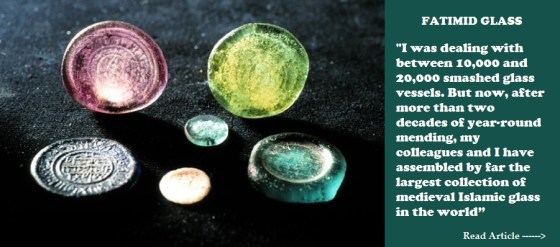
This website’s photo blog, Simergphotos, was launched just over three years ago. Together, Simerg with Simergphotos, has achieved a combined viewership of over two million – 1.8 million and 306,000 since 2009 and 2011 respectively. During the course of this time we have published memorable photo essays covering a vast array of subjects. Beginning this week, we bring you links to highly informative and educational pieces. Our journey commences with Prince Amyn Aga Khan’s Investiture as Head of Ismaili Scouts, the Discovery of Fatimid Glass in a Byzantine Shipwreck, Alamut Where Every Stone Tells a Story, and A Journey to Bagamoyo Jamatkhana. Please click on the images below for these fascinating historical stories.
The highlight of the book is the history/storytelling of the Fatimid era….Goodreads….Al Khemir seduces readers with the manuscript’s mythical beauty and the philosophy of its art form…The Independent….A remarkable novel, skilfully and imaginatively weaving history and human lives across time and continents….The Guardian









 Simerg - Insights from Around the World


