Simerg is an independent initiative dedicated to Ismaili Muslims, the Aga Khan — their Hereditary Imam — and the Ismaili Imamat, and Islam in general through literary readings, photo essays and artistic expressions
“God chose Adam and Noah and the House of Abraham and the House of Imran above all beings, the seed of one another; God hears, and knows” — Qur’an, 3:33-34, translation by A. J. Arberry, see Corpus Quranfor multiple translations
A calligraphy designed by Toronto’s Karim Ismail honouring the first Shia Imam Ali, on the auspicious commemoration of Idd-e Ghadir.
On Monday, June 24, 2024, Ismaili Muslims in Canada and other parts of the world will unite to observe and celebrate Eid-e Ghadir. This momentous occasion marks the pivotal gathering at Ghadir Khumm, where Prophet Muhammad (peace be upon him and his family) designated Hazrat Ali as his successor, the first in the continuing line of Hereditary Imams.
This historical event holds immense significance in the Ismaili faith. Today, the holder of the Hereditary position is Mawlana Hazar Imam, His Highness the Aga Khan, the 49th Imam in direct succession. In this regard, the Aga Khan has affirmed “that the Ismailis are the only Shia community who, throughout history, have been led by a living, hereditary Imam in direct descent from the Prophet” — His Highness the Aga Khan, Parliament of Canada, Ottawa, February 27, 2014.
History records that on the way back to Medina after performing the final pilgrimage to Mecca, the Prophet received a revelation:
“O Messenger, deliver [to the people] what has been revealed to you from your Lord, and if you do not do so, then you will not have delivered His message” Surah al-Ma’ida (5:67)
Upon receiving this revelation, the Holy Prophet stopped at an oasis known as Ghadir Khumm. He addressed a large gathering of Muslims who had accompanied him. The Prophet proclaimed: “Man kuntu mawlahu fa aliyyun mawlahu,” meaning: “He whose Mawla I am, Ali is his Mawla.” The Prophet then prayed: “O Allah, be a friend of whoever is his friend and extend your support to those who support him.”
This event, occurring at a crucial point in Islamic history, marked the transition of leadership from the Prophet to Hazrat Ali, setting the stage for the leadership and future of the Muslim community. Thus, by declaring Hazrat Ali Mawla after him, the Prophet transferred the spiritual authority bestowed upon him by Allah to Hazrat Ali, making him — and all the Imams that follow — the Amirul Mu’minin, or Master of the Believers. In this context, ‘Mawla’ refers to a leader, protector, and guide, indicating the profound responsibility and authority bestowed upon Hazrat Ali.
Article continues below following excerpts
________________________________
Excerpts from L. Veccia Vaglieri piece in Encyclopaedia of Islam, Second Edition
“Ghadir Khumm is famous in the history of Islam because of a sentence (or some sentences) in favour of ‘Ali which the Prophet uttered there during a discourse….Taking ‘Ali by the hand. he asked of his faithful followers whether he, Muhammad, was not closer to the Believers than they were to themselves; the crowd cried out: “It is so, O Apostle of God!”, he then declared. “He of whom I am the mawla, of him ‘Ali is also the mawla (man kuntu nawlahu fa-‘Ali mawlahu)
Photograph: Vysotsky – Own work, CC BY-SA 3.0, Wikimedia.
~~~~~~
“Most of those sources which form the basis of our knowledge of the life of the Prophet pass in silence over Muhammad’s stop at Ghadir Khumm….Consequently, the western biographers of Muhammad, whose work is based on these [Sunni] sources, make no reference to what happened at Ghadir Khumm. It is however certain that Muhammad did speak in this place and utter the famous sentence…the hadiths are so numerous and so well attested by the different isnads that it does not seem possible to reject them.” Vaglieri goes on to state that on instruction from Prophet Muhammad, Hazrat Ali received baiyat (the oath of allegiance) from the Muslims assembled there, including Umar b. al-Khattab, Islam’s second Caliph.
(Note: special access is required to read articles in the on-line edition of EI2. Vaglieri’s piece was reproduced in full in the UK Ismaili Association’s publication Ilm, December 1976, pages 28-30, with the permission of E.J. Brill, publishers of EI2.)
________________________________
Excerpts from the Preamble of the Ismaili Constitution
“In accordance with Shia doctrine, tradition, and interpretation of history, the Holy Prophet (s.a.s.) designated and appointed his cousin and son-in-law Hazrat Mawlana Ali Amiru-l-Mu’minin (a.s) to be the first Imam to continue the Ta’wīl and Ta’līm of Allah’s final message and to guide the murids, a term referring to the followers and disciples of the Imams. The proclamation also established the principle of the Imamat continuing by heredity through Hazrat Mawlana Ali (a.s) and his daughter Hazrat Bibi Fatimat-az-Zahra, Khātun-i-Jannat (a.s)”
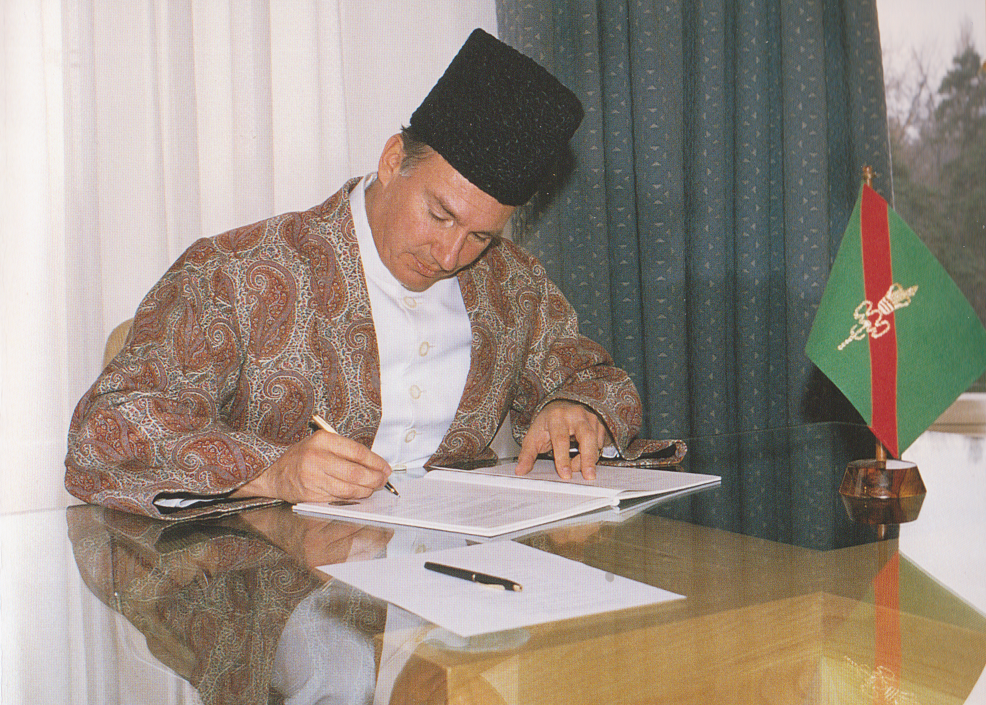
Mawlana Hazar Imam, His Highness the Aga Khan, is seen signing a new constitution for the worldwide Ismaili community on his 50th birthday, December 13, 1986. The preamble excerpts produced in this post are from this constitution.
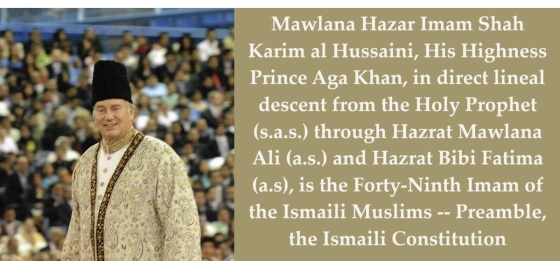
“Mawlana Hazar Imam Shah Karim al Hussaini, His Highness Prince Aga Khan, in direct lineal descent from the Holy Prophet (s.a.s.) through Hazrat Mawlana Ali (a.s.) and Hazrat Bibi Fatima (a.s), is the Forty-Ninth Imam of the Ismaili Muslims.”
________________________________
…. continued
On instruction from Prophet Muhammad, Hazrat Ali received baiyat (the oath of allegiance) from the Muslims assembled there. According to Shia traditions and sources, following the proclamation, the final verse of the Qur’an was revealed to the Prophet:
“On this day, I have perfected for you your religion, completed my favours upon you, and have chosen for you Islam as your religion.”
Eid-e Ghadir is an anniversary of profound significance to all Shia Muslims. It is also associated with the well-attested tradition that the Prophet is said to have proclaimed:
“I am leaving among you two matters of great weight (al-thaqalayn), the Book of Allah and my kindred (itrati), the People of my House (Ahl al-Bayt), and these two shall never be separated until they return to me at the Pool [of Kawthar in Paradise on the Day of Judgement]…”
The phrase ‘two matters of great weight’ refers to the Quran and the Ahl al-Bayt, emphasizing their inseparability and eternal significance in the Islamic faith.
In commemorating Eid-e Ghadir, the Ismaili community celebrates the seminal event of Ghadir Khumm, reaffirming their allegiance to the Imam of the Time as the direct lineal successor and inheritor of Hazrat Ali’s authority. The community is not just inspired, but united and driven by the following remark made during his speech in Canada’s Parliament on February 27, 2024:
“Today, the Ismailis are the only Shia community who, throughout history, have been led by a living, hereditary Imam in direct descent from the Prophet.”
Date posted: June 23, 2024.
____________________
Please click HERE for many more pieces on this website on the topic of Eid-e Ghadir.
Every year, on the 10th day of the Islamic month of Dhul-Hijjah, Muslims worldwide celebrate Eid al-Adha (also known as Eid-al-Nahr). This significant event, which this year falls on or around June 17, 2024, after the completion of the Hajj ceremonies, is rooted in a historical event. It commemorates the profound sacrifice of Prophet Ibrahim, who was willing to sacrifice his son, Prophet Ismail, as an act of obedience to Allah’s command. This act of sacrifice is what gives the festival its name. This story is narrated in the Holy Quran in surah (chapter) 37, ayats (verses) 100-112, as follows:
“My Lord, grant me [a child] from among the righteous.” (100)
So We gave him good tidings of a forbearing boy. (101)
And when he reached with him [the age of] exertion, he said, “O my son, indeed I have seen in a dream that I [must] sacrifice you, so see what you think.” He said, “O my father, do as you are commanded. You will find me, if Allah wills, of the steadfast.” (102)
And when they had both submitted and he put him down upon his forehead (103)
We called to him, “O Abraham, (104)
You have fulfilled the vision.” Indeed, We thus reward the doers of good. (105)
Indeed, this was the clear trial. (106)
And We ransomed him with a great sacrifice (107),
and We left for him [favorable mention] among later generations: (108)
“Peace upon Abraham.” (109)
Indeed, We thus reward the doers of good. (110)
Indeed, he was of Our believing servants. (111)
And We gave him good tidings of Isaac, a prophet from among the righteous. (112)
The story is a powerful demonstration of their unwavering faith and submission to Allah’s will. It is this faith and submission of Prophet Abraham and his son Prophet Ismaili that we commemorate and honour during Eid-al-Adha.
Examining the Quran further, one begins to understand and realize what Allah truly desires from us in the context of sacrifice. Allah says:
“Neither their meat nor blood reaches Allah. Rather, it is your piety that reaches Him. This is how He has subjected them to you so that you may proclaim the greatness of Allah for what He has guided you to and give good news to the good doers.” (Quran 22:37)
The above verse clearly states that what Allah considers is one’s righteousness, which is the way one practices and conducts one’s life.
Therefore, in all that one undertakes, it is essential to stay God-conscious (Taqwa) by remembering Allah in all walks of life. The Holy Quran says:
“O mankind, We have created you male and female, and We have made you into tribes and nations in order that you might come to know one another. Truly, in the sight of God, the most honoured amongst you is the most pious amongst you.” (Quran 49:13).
Our beloved Prophet and his hereditary successors, the Imams from Hazrat Ali to Mawlana Shah Karim al-Hussaini Hazar Imam, His Highness the Aga Khan, have always guided us to stay firm on Sirat-al-Mustaqim (the straight path).
They have provided us with invaluable guidance, urging us to practice Taqwa and seek spiritual advancement. This guidance, a beacon of light in the darkness, emphasizes the importance of developing an inner sense of God-consciousness, which is crucial for maintaining a righteous, honourable, respectful and fulfilling life.
In his sermon on the occasion of Eid al-Adha, 336 AH (June 21, 948 AC) at al-Mahdiyya in North Africa, the Fatimid Imam/Caliph Mawlana Mansur said:
“Pray to God most sincerely and implore Him wishfully, approaching with what He commands you to do or restrained you from.” (Walker, 2009)
Similarly, his successor, Imam Mu’izz, in his khutba (sermon) on Eid al-Adha, 341 AH (April 28, 953 AC), at al-Manṣuriyya, said:
“O people, God created you not in jest, (Quran — 23:115), nor will He overlook you without purpose. He does not impose on you a hardship in religion (Quran — 22:78), and yet He does not disregard being remembered, but rather He created you for worship, obeying Him, and He ordered you to obey His messenger. For obedience, He made fixed signs and written decrees. So draw near to God through what He commanded you to do. It is through piety that deeds are accepted and hopes are realized. Praise God for His having guided you (Quran — 22:37); thank Him for what He has given you.” (Walker, 2009)
Article continues below
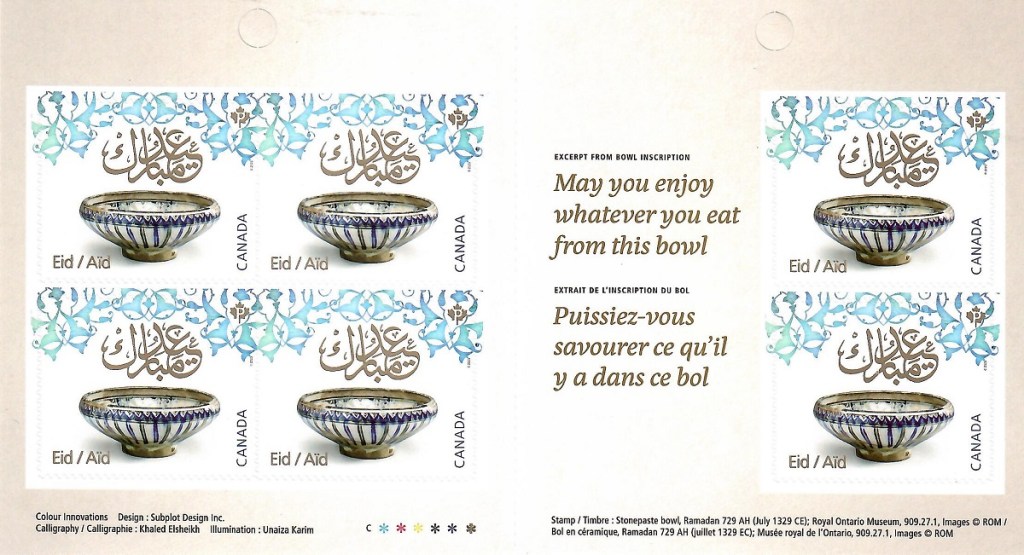
Eid Mubarak stamp issued by Canada Post in April 2023
These thoughtful words underline Islam’s fundamental principle, emphasizing the importance of obedience to God’s commands and the guidance of His messenger. Through sincere devotion and adherence to these teachings, one can attain spiritual elevation and happiness and realize the true purpose of one’s existence.
The connection between spirituality and moral consciousness is not just a personal journey, but a central theme in Islamic thought that unites us all. According to Islamic teachings, human beings are inherently endowed with a deep sense of God-consciousness, which forms the foundation of our shared moral and social responsibilities. This intrinsic awareness of right and wrong guides us in our personal lives and interactions with others, fostering a sense of community and mutual responsibility.
In a hadith (tradition), the Prophet Muhammad is reported to have said:
“Submission is public, and faith is in the heart.” Then, he pointed to his breast three times, repeating: “Fear of God (Taqwa) is here, fear of God is here.”
This profound statement highlights the intimate and internal nature of true faith. While outward acts of submission, such as rituals and observances, are visible to the public, the essence of faith lies deep within the heart, manifesting as a profound consciousness of God (Taqwa). This inner awareness shapes a person’s moral compass, guiding them toward righteousness and away from wrongdoing. This intrinsic God-consciousness forms the bedrock of ethical and social responsibilities, encouraging individuals to act with integrity, compassion, and justice in all aspects of life.
What does God’s consciousness and piety entail?
As M. Ali Lakhani eloquently articulates:
“Human beings are, according to Islam, endowed with a sense of God-consciousness (Taqwa)… In Islamic thought, the soul’s capacity for spiritual awareness is also implicit in its possession of a moral conscience, an innate sense of right and wrong (Quran 91:7-10). Both spiritual awareness and moral conscience are seen as attributes of the soul’s primordial nature. God consciousness is the foundation of moral consciousness, of which one aspect is social consciousness with its corresponding social responsibilities — of service, generosity, equity, cooperation — which are all part of the fiduciary obligations of human life.” (Lakhani, 2018)
In conclusion, we draw an excerpt from a speech made by Mawlana Hazar Imam, His Highness the Aga Khan, at the American University of Cairo upon receiving an honorary degree:
“…I think of the words of Hazrat Ali ibn Abi Talib, the first hereditary Imam of the Shia Muslims and the last of the four rightly guided Caliphs after the passing away of the Prophet (may peace be upon Him). In his teachings, Hazrat Ali emphasized that ‘No honour is like knowledge.’ And then he added that ‘No belief is like modesty and patience, no attainment is like humility, no power is like forbearance, and no support is more reliable than consultation’.
“Notice that the virtues endorsed by Hazrat Ali are qualities which subordinate the self and emphasize others – modesty, patience, humility, forbearance and consultation.” (Commencement address of His Highness the Aga Khan at the American University in Cairo, Egypt, 2006)
Through sincere devotion and adherence to these teachings mentioned by Mawlana Hazar Imam, one can attain spiritual enlightenment and realize the true purpose of one’s existence. Acts of piety and devotion to God, will act as protecting shields in our daily life and bring us closer to God.
This Eid — and throughout our lives — let us try to become more selfless and more God-conscious, performing meritorious deeds to please the Almighty and ultimately achieving the level of purity that will bring us closer to Allah. These deeds will also bring honour and respect to our lives.
Date posted: June 15, 2024.
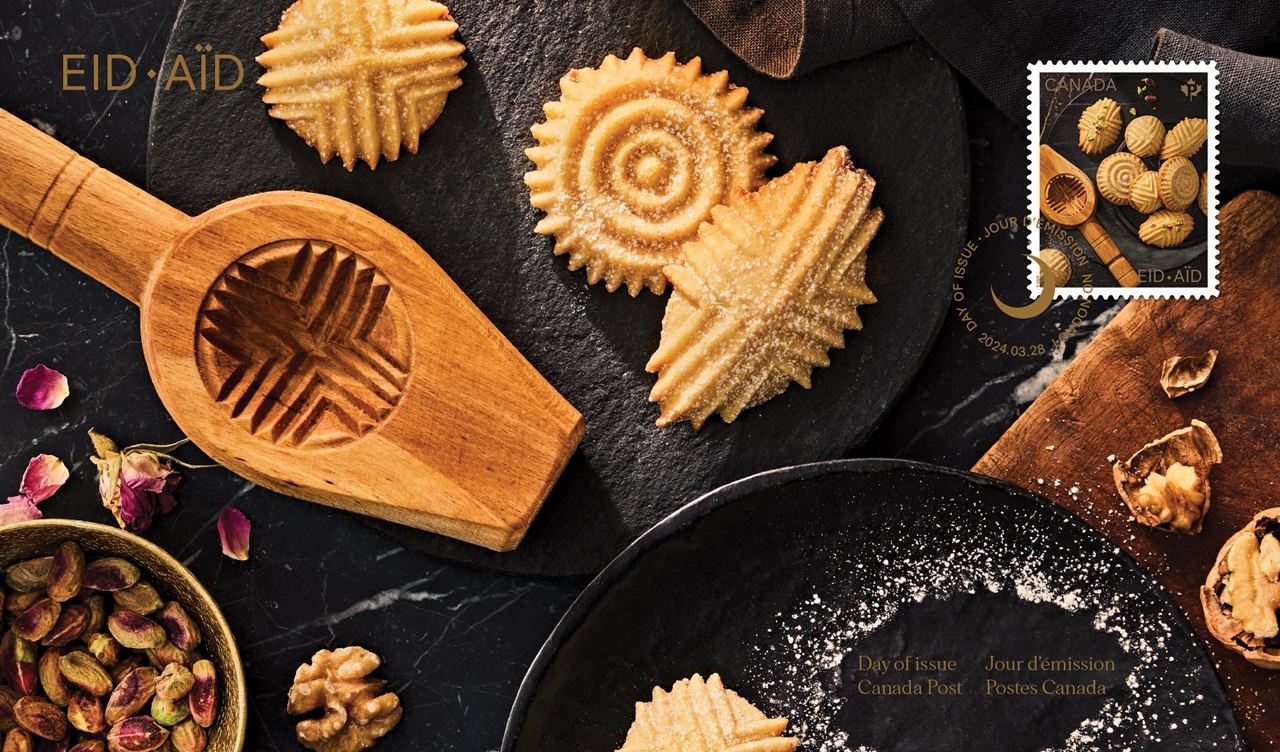
Featured image at top of post: First Day Cover issued by Canada Post on March 27, 2024.
______________________
Shan-E-Ali Wazir Ali is a passionate Religious Education Centre Teacher and Educator from Karachi, Pakistan. He specializes in Ismaili literature, including devotional works, magazines, periodicals, articles, and books. He incorporates heritage materials into his REC Secondary Classes, fostering insightful discussions. He actively follows the work of Ismaili and AKDN institutions to stay current with their activities and the work of the Ismaili Imamat.
Simerg wishes Muslims worldwide and friends of the Muslim community a very happy Eid Mubarak for 2024. We welcome Canada Post’s special Eid Stamp and First Day Cover publications for the auspicious occasion featuring images of a delicious Middle Eastern cookie — the maamoul.
We sincerely hope and pray that wars will be replaced by peace so that children everywhere, especially in war-affected zones, can experience the sweet delights that Eid offers everyone and begin to live with hope for the future. It is up to humanity to ignite the unfortunate ones with the spark of hope over a life of continuing degradation and despair.
___________________
2024 Commemorative Eid Stamp Issued by Canada Post
Canada Post’s Commemorative Eid Stamp for 2024, issued March 27. Photograph: Canada Post.Please click BUY 2024 EID STAMPS BOOKLET OF 6($5.52).
On March 27, 2024, Canada Post issued a new stamp to mark two important Islamic holidays: Eid ul-Fitr, which will be celebrated this week from April 10 after the month of Ramadhan after the sighting of the New Moon on April 9, and the upcoming Eid ul-Adha, which will be held from June 17 to mark the Festival of Sacrifice commemorating Ibrahim’s (Abraham) willingness to sacrifice his son to God. The Eid ul-Adha will be held at the end of the annual pilgrimage to Mecca.
The 2024 issue is Canada Post’s sixth Eid stamp; the others were issued in 2017, 2020, 2021, 2022 and 2023.
The 2024 stamp was designed by Kristine Do, photographed by Maya Visnyei, and food-styled by David Grenier. Printed by Colour Innovations, the issue includes six Permanent™ domestic rate stamps booklets and an Official First Day Cover cancelled in London, Ontario. The new stamp and collectibles are available at canadapost.ca and postal outlets across Canada.
Celebrated by more than one million Muslims in Canada, both events can last several days and include communal prayers and feasts, visits with family, gift-giving and acts of charity. The 2024 commemorative stamp features maamoul, Middle Eastern cookies, and a traditional carved wooden mould used to make them.
Melt-in-your-mouth cookies stuffed with a delicious walnut, pistachio or date filling, maamoul are a sweet staple during Eid celebrations. They are traditionally handmade from semolina and flavoured with fragrant rose or orange-blossom water and mahlab — a spice made from ground cherry pits. Before baking, the dough balls are stuffed with walnut, pistachio, or date filling and formed with specially carved wooden moulds. Early versions of maamoul can be traced back to ancient Egypt and Mesopotamia. Today, family and friends often gather before Eid ul-Fitr and Eid ul-Adha to bake the cookies together.
Story continues below
Canada Post 2024 Eid Stamp Booklet
2024 Eid booklet of six stamps issued by Canada Post on March 27, 2024. The stamps can be detached from the booklet and used to mail letters. Please click BUY 2024 EID STAMPS BOOKLET($5.52).
~~~~~~~~~
Canada Post 2024 Eid Stamp First Day Cover
2024 Eid Stamps First Day Cover issued by Canada Post on March 27, 2024. Please click BUY 2024 EID FIRST DAY COVER ($1.92).
The Eid stamp is one of several stamps Canada Post issues each year to mark annual celebrations important to Canada’s culturally diverse population – others include Diwali, Hanukkah and Christmas. To buy the stamp online, please click Buy 2024 Eid Stamps Booklet of 6. Most postal outlets do not carry Eid stamps and are not aware of their release. I recommend that you obtain them online, where postage is free if you order 5 booklets or more.
Date posted: April 8, 2024. Last updated: April 21, 2024 (typos).
“I should emphasize that a total solar eclipse is probably THE most spectacular celestial phenomenon that earth-based human beings can experience. It is truly a miracle of nature. The sun is hugely larger than the moon and yet, viewed from the earth, one is just far away enough compared to the other that they both subtend exactly the same size in the sky” — Arif Babul, University of Victoria Distinguished Professor of Physics and Astronomy
The total eclipse of the sun, a rare celestial event where the moon completely obscures the sun for a brief period, is set to occur on April 8, 2024. Tens of millions across North America who will be on the path of the total solar experience will witness this once-in-a-lifetime experience. After crossing Mexico and the U.S., it will enter Canada in Southern Ontario on its eastward path to other parts of Ontario, Quebec and the Atlantic provinces, where the sun’s light will be completely blocked out by the moon. Many other parts of Canada, such as Alberta, will only experience a partial eclipse, where not all of the sun’s light is obscured.
With the sun’s incredibly bright face fully eclipsed by the moon, its faint, normally invisible, corona of hot gases pops up. Zooming further reveals red features in two or three places on the dark rim. These are solar prominences. Photograph: Arif Babul. Please click on the image for Arif Babul’s story and photographs.
In Ontario, the solar eclipse is expected to start just minutes after 2:00 p.m. and last for about two and a half hours. The sun will be fully eclipsed at approximately 3:20 to 3:25 p.m. EDT (Eastern Daylight Time). The anticipation is so high that Niagara Falls is preparing to welcome over 1 million visitors for this extraordinary event. Reuters writes: “From vintage train rides costing almost $4,000 per person to hotel rooms listed at $1,600 a night, businesses in and around majestic Niagara Falls are preparing to cash in on the April 8 total solar eclipse – with around a million visitors expected.”
This is a rare chance, as the next total solar eclipse won’t grace North America until 2045.
The solar eclipse has prompted school closures in many parts of Ontario for the well-being of students and staff during the solar eclipse. As many students would be getting on the bus or walking home from school during this timeframe, their risk of looking directly at the solar eclipse would be significantly increased.
Story continues below
Watching the solar eclipse safely with solar eclipse glasses. Photograph: Al-Akhbar weekly newsletter, His Highness the Aga Khan Council for Canada.
Everyone will need to be careful as looking directly at the eclipse, could damage your eyes. However, the solar eclipse is a spectacular sight and a significant educational opportunity. Ottawa’s Canada Aviation and Space Museum will throw open the doors of an aircraft hangar tohost an eclipse viewing event. The museum will also provide free eclipse viewing glasses with admission, along with educational activities and crafts for children.
The beautiful Aga Khan Park on Wynford Drive in Toronto hosts what the Al-Akhbar Ismaili community newsletter calls “a celestial gathering like no other.” The sold-out, awe-inspiring solar eclipse event will occur on April 8 from 1:45 to 4:30 p.m. The Park will provide a pair of solar glasses and will have a special guest speaker who will discuss solar eclipses and their significance.
Story continues below
The Diamond Ring effect is a breathtaking sparkle of the sun’s radiance coming from a tiny exposed sliver of the sun’s surface. It is seen 15 seconds before and again just after totality. Photograph: Arif Babul. Please click on the image for Arif Babul’s story and photographs.
In 2017, our sister website Simergphotos published Professor Arif Babul’s eyewitness account of his experience of the total solar in Idaho. The 2017 eclipse lasted close to 3 minutes. This year’s eclipse will differ from the 2017 eclipse, as the moon will be closer to the Earth. Thus, it will cast a more enormous shadow onto the Earth and cover the sun longer. The April 8 eclipse will last for more than four minutes.
Interestingly, the New Moon that will be seen on April 9, the day following the total solar eclipse, will also mark the end of the month of Ramadhan. On April 10, hundreds of millions of Muslims will observe Eid ul-Fitr, the most important festival in the Muslim calendar. Simerg and its sister website will provide updates leading to the total solar eclipse and the celebration of the Muslim Eid festival.
Featured image at top of page: Artist’s representation of a total solar eclipse, with a new moon in the foreground and the Sun’s corona visible in the background. Photograph: NASA/Vi Nguyen. Click Download the Poster.
“You and I are brothers, and you and I are from the same city, the same country; we speak the same language and share the same history” — Christian pastor
Every Ramadan, an Iraqi Christian preacher returns from the Netherlands to his hometown of Mosul. He celebrates the holy Islamic month there to promote understanding between Muslims and Christians. Voice of America’s Kawa Omer has the story, narrated by Bezhan Hamdard.
The Aga Khan on Moving Christian-Muslim Relations Forward for a Better World
“Our histories have taught us the value of dialogue, and that rarely, indeed very rarely, does anything good come out of conflict. Our world view is to engage with the problem of social exclusion in our societies and to contribute to building bridges across faiths and across nations, by linking diverse parts of the world” — the Aga Khan
“I have no doubt that for you, whose historical roots are in the Christian world, it is as painful as it is for us Muslims, with our roots in the East, to watch an increasingly deep gulf growing between significant parts of our respective worlds. We cannot stand by as passive observers letting this gulf grow wider and wider, at the cost of future generations. If we have the will, which I am certain we share, we have the historical knowledge and the ethical foundations to move our world forward, to make it a better and more hopeful place, and to put an end to the storm of hatred which appears to be building up around us.
“Our histories have taught us the value of dialogue, and that rarely, indeed very rarely, does anything good come out of conflict. Our world view is to engage with the problem of social exclusion in our societies and to contribute to building bridges across faiths and across nations, by linking diverse parts of the world.
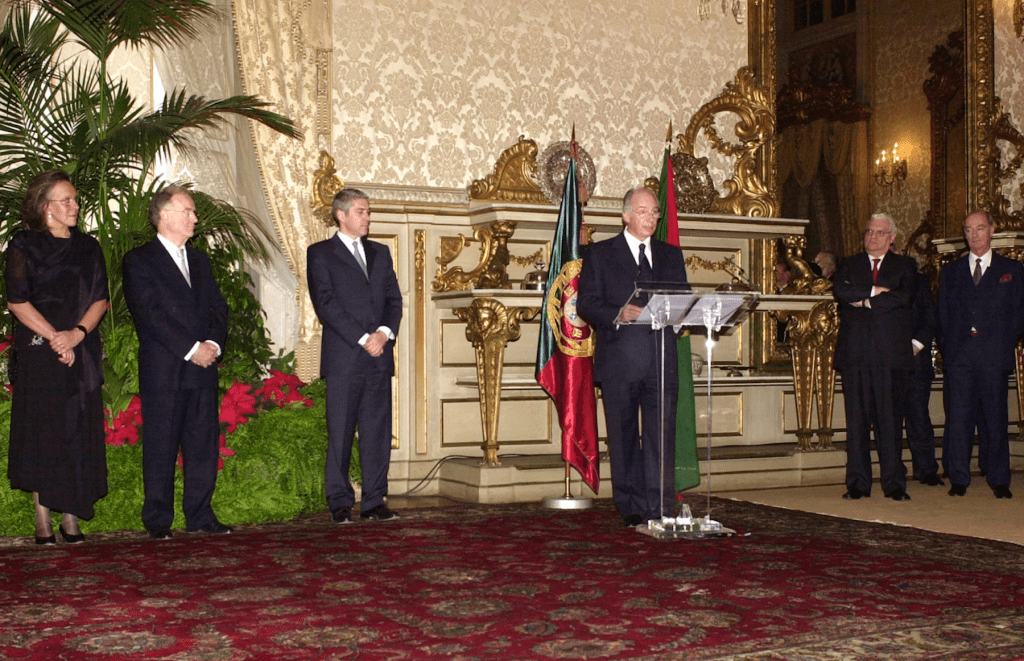
“We are concerned, and most rightly so, that there is poverty among our respective peoples, and we cannot stand by watching this inhuman indignity become a permanent part of our societies, of our generations of today and tomorrow. We must work together to develop an arsenal of peaceful weapons to attack this plight which blights our times, and to try to make sure that those who are marginalised today can be certain that we are not blind to them, that we will not let their future generations live in the same hopeless world in which they themselves are seeking, often only in despair, to survive.” — the Aga Khan, speaking at the Protocol of Co-operation Signing Ceremony between the Ismaili Imamat and the Government of Portugal, Lisbon, Portugal, December 19, 2005 (Read full speech HERE).
The author has adapted this article from the March 1982 issue of Al-Misbah Magazine, published by the Ismailia Association for the UK. The original article, which was under the title Navroz, has been edited and improved for clarity and includes additional material.
Navroz, meaning New Day or New Year, marks the start of the Persian spring festival. It occurs on or around March 21 of the March equinox. The United Nations has designated March 21 as the International Day of Nowruz annually (the Secretary General’s 2024 message can be read HERE.)
It is an occasion of great rejoicing among people in Iran, many parts of the Middle East, Central and South Asia, and the Shi’a communities worldwide. Besides being New Year’s Day, it is also celebrated as the Festival of Spring because it is at this period that winter makes its exit for the colourful spring season.
Navroz holds a significant place in history, dating back some 2,500 years to the reign of King Jamshed. Despite a temporary halt after the rise of Islam in Iran, it was reintroduced by the Abbasid Caliph Mansoor in 770 AC (153 AH, or Hijri). Since then, Navroz has been a cherished national occasion and custom, celebrated with zeal by more than 300 million people worldwide.
In Fatimid Egypt, the state ruled by Ismaili Imams, the Spring Festival was a national celebration during the reign of the first eight Fatimid Imams/Caliphs from 969 to 1094 AC (358 to 487 AH). Although the Fatimid Imams ruled over Egypt, this festival was not exclusively Ismaili because the Ismailis, even at that time, were a minority group in the Caliphate.
The actual celebration of Navroz among the Ismailis could be said to have started in Iran during the Alamut Period of Ismaili history. Ismailis living in Alamut were farmers; hence, in the spring season, they would look forward to preparing their farms for a good harvest.
The glorious transformation of nature at the time of Navroz, the start of the spring season, reminds us of Allah’s creative power and the bounties He continually showers on us. The arrival of spring, with its sprouting seedlings, blossoming buds, vibrant colours, and rushing waters, is a vivid reminder of our true inner essence.
Like these elements of nature, we, too, have the potential to bloom and grow under the nurturing care and warmth of Imam-of-the-Time. The Preamble of the Ismaili Constitution proclaims that the Imam’s ta‘lim (guidance/teaching) lights the each follower’s path to spiritual enlightenment and vision.
Born as Ismailis, with the recognition of the Imam, this life is the spring season of our souls. The Divine Noor shines brightly over our souls. We must cleanse ourselves of unrighteousness and cultivate an original, spontaneous, and permanent relationship with the Noor (Light) of Imamat so that every breath and activity of our life becomes the worship of the Merciful. The festival of Navroz should result in a spiritual rebirth for each of us and inspire greater love for our Imam.
Article continues below
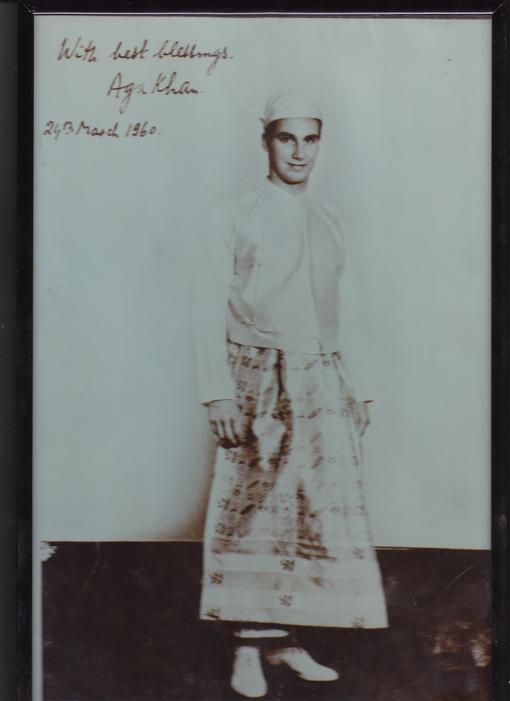
This is a signed photograph, dated March 24, 1960, of Mawlana Hazar Imam, His Highness the Aga Khan, 49th Imam of the Shia Imami Ismailis, pictured in a Burmese traditional dress during his visit to Burma in March 1960 when he celebrated the Persian New Year, Navroz, which falls on March 21st, with his Ismaili followers. The signed photograph contains his blessings. Photo: Anwar Virani Archives, Ottawa.
Navroz is an auspicious time to initiate self-improvement because nature, so to speak, is turning a new page in the book of life. It is a time to review our lives and determine necessary improvements. In a detached, objective way, we should analyze our positive and negative traits and then resolve to change bad habits into good ones.
Our covenant with Mawlana Hazar Imam is a promise we have given him to endeavour to achieve a proper balance between our material and spiritual lives. When choosing our resolution, one idea should always loom before the rest: ask ourselves, “What do we want from life, and what will earn Mawlana Hazar Imam’s divine pleasure?” A straightforward answer to this question should be: “To govern our lives by his deep desire for us to live within the Islamic concepts of unity, justice, tolerance, goodwill, generosity and the regularity by which we practice our faith.”
Mowlana Hazar Imam’s message spells out the meaning and significance of this auspicious day for us. He says: “I say to you all on Navroz, ‘Navroz Mubarak,’ and I want you, at the beginning of this New Year, to try to think a bit ahead in your future. Each Navroz, say to yourselves, ‘Have we done our work?’ If you have, then I will be very happy indeed. I say Idd Mubarak to all of you and give you most affectionate blessings.” — Rangoon, Burma, March 21, 1960.
By steeping our consciousness in love for the Imam-of-the-Time and wisely directing our activities, we shall make our lives one unending act of worship. Therefore, let this Navroz be a New Day on the path of spiritual glory, material well-being, and progress. Let each New Day be a Navroz to strengthen our spiritual bonds with Imam-e-Zaman, reminding us that his blessings are always with us.
We conclude with our beloved Imam’s final words spoken in Rangoon: “On this day of Navroz, I say to each and every one of you, Idd Mubarak, and I pray that in this New Year, your worldly and spiritual happiness should progress tenfold and that this will be the case every year.” — Rangoon, Burma, March 21, 1960.
Date posted: March 18, 2024. Last updated: March 20, 2024 (inserted link to UN Secretary General’s 2024 Nowruz message in 1st paragraph).
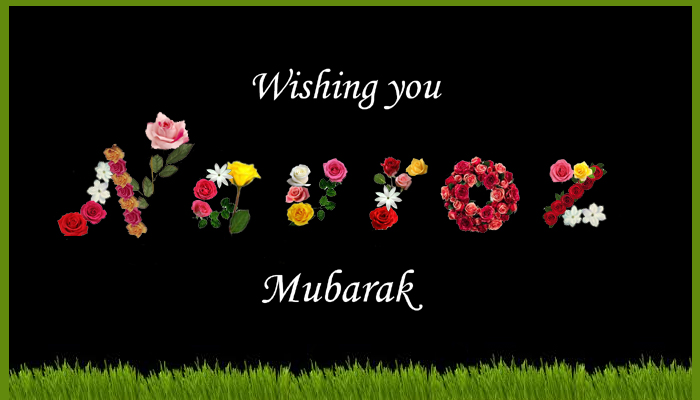
Conceived and created by Dr. Nurin Merchant, this Navroz greeting incorporates the rose and jasmine flowers which are extremely popular in Iran during the celebration of Navroz. The base of the picture shows shoots of wheat grass signifying robust evergreen health throughout the year.
Abstract: The auspicious occasion of Navroz generates immense happiness and makes our hearts jump with joy as we receive blessings from Mawlana Hazar Imam together with roji and Ab-e-Shifa and recite the traditionally Ginan Navroz na din Sohamna. This post includes two beautiful recitations of the Ginan by Shamshudin Bandali Haji (full Ginan) and Mumtaz Bhulji (selected verses) followed by an explanation by Sadruddin Hassam. In the Ginan, Sayyid Fatehali Shah relates the combined experience of the zahiri deedar (exoteric or physical glimpse or meeting) that he was granted by the 45th Ismaili Imam, Shah Khalilullah (peace be on him), and the inner joy of contentment and ecstasy that he experienced with the bestowal of Noorani (spiritual or esoteric) grace.
Navroz Ginan recitation by Shamshu Bandali Haji
Recitation of Navroz Ginan by Late Shamshudin Bandali Haji. In his opening remark, the reciter mistakenly attributes the Ginan to Pir Shamsh. The clarification about the composer is provided in the article below.
_______________________
Navroz Ginan recitation of selected verses by Mumtaz Bhulji
Recitation of selected verses of Navroz Ginan by Mumtaz Bhulji
An attempt is made in this article to give an interpretation of the devotional Ginan Navroz na din Sohamna, which is recited by Ismaili Jamats in many parts of the world on the occasion of the celebration of the Persian New Year which falls on March 21st. In this ginan the composer, Sayyid Fatehali Shah, relates the combined experience of the zahiri deedar (exoteric or physical glimpse or meeting) that he was granted by the 45th Ismaili Imam, Shah Khalilullah (peace be on him), and the inner joy of contentment and ecstasy that he experienced with the bestowal of Noorani (spiritual or esoteric) grace. At the same time, he gently persuades the mu’min (a believer) to always strive for esoteric understanding as well as to develop a lasting spiritual relationship with the Imam of the Time. It may be noted that in Shia Imami Ismaili theology each Imam is the bearer of the same Divine Light (Noor). The Divine Institution of Imamat has its origins in the first Shia Imam, Hazrat Ali (peace be on him), who was declared as the successor to Prophet Muhammad (may peace be upon him) at the famous historical event at Ghadir-e-Khumm.
As the composer has to narrate the exoteric experience as well as the ineffable esoteric relationship, the ginanic diction that he uses has to resort to the traditional and familiar imagery and symbolic expressions in order to convey his message. The words, the imagery and the symbolic expressions, however, blend beautifully in this ginan. This beauty, unfortunately, cannot be recreated in this prosaic interpretation. Nor can we go into the prosody of the ginan.
In this reading we shall first address a common held misunderstanding about the identity of the composer. We shall then make an attempt to describe the exoteric experience of the composer’s meeting with the Imam, as so wonderfully narrated in the ginan, and finally we shall examine and interpret some of the key words and expressions to convey the ineffable spiritual experience as well as the composer’s gentle persuasion to the mu’mins. One hopes that this brief reading will heighten the reader’s appreciation and understanding of this ginan.
~~~~~~~
A clarification about the composer and the period of composition
The composition of this ginan is sometimes wrongly attributed to Pir Shams al-Din who lived more than four centuries before the actual composer of this ginan, Sayyid Fatehali Shah. This mistake may have arisen because of the pen-name he has used in the second line of the last verse which reads:
Bhane Shamsi tamme sambhro rookhi.
It was a normal practice for the composer to mention his own name in the concluding verses of the ginan. But Shamsi here does not refer to Pir Shams al-Din – rather it was the pen-name of Sayyid Fatehali Shah.
He, like a number of other Sayyids, who did the work of da’wa (propagation and teaching) in India, may have been a descendant of Pir Hassan Kabirdin. Sayyid Fatehali Shah himself preached among the communities in Sind. He eventually died there and was buried near Jerruk which is south of Hyderabad in Pakistan.
The first two lines in verse seven give us the clues as to the period when this ginan was composed as well as validate the real name of the composer. These lines read:
Eji gaddh Chakwa ne kille Shah Khalilullah ramme Tiyaan Fatehali ne mayya karine bolaawiyya
Shah Khalilullah here refers to the forty-fifth Ismaili Imam, whose Imamat was from 1780 to 1817 A.C. He lived in Iran in the town of Mahallat, which is located approximately 362 kilometers from Tehran. The town is situated on the slope of a mountain. Mahallat is also amongst the most ancient residential areas in Iran and was an important base of the Ismailis; hence the many references to the 46th and 47th Imams (Aga Khan I and II) as Aga Khan Mahallati. Sayyids and murids of the Imam from various parts used to come to Mahallat to pay their respects. This ginan is therefore fairly recent, having been composed either towards the end of eighteenth century or early in the nineteenth century.
It appears that like many other murids, Sayyid Fatehali Shah travelled from Sind to Iran to meet Hazrat Imam Shah Khalilullah.
On arriving in Mahallat on the day of Navroz, he learns that the Imam has gone to the woods on a hunting expedition. The Sayyid naturally feels disappointed that having come all the way, he did not have the opportunity for the deedar. This feeling of sadness is lamented in the first stanza of the ginan. Despite this, there is an undercurrent of inner hope at the prospect of having the deedar by the mercy of the Imam.
The pangs of separation from the beloved and the yearning for reunion are a recurrent theme in Ismaili ginans and also in Sufi mystical poetry. In this ginan, there is the lament of this separation, but in keeping with the traditional ginanic function, there is also gentle persuasion and hope of spiritual union.
We shall now examine how Sayyid Fatehali Shah relates his zaheri deedar of the Imam and how this blends with his esoteric experience.
~~~~~~~
The meeting with the Imam of the Time in the woods and at the fort
In the following four verses (1, 2, 3 and 7), Sayyid Shamsi relates his quest for the Master which leads to his meeting with Imam Shah Khalilullah. The meetings (deedar) fulfilled his intense yearning.
Transliteration:
Eji Navroz na din sohamna, Shah Ali Qayam shikaar ramwa vann gaya, Sevak na mann thaya oodassi, Praan Ali charne rahiya…..1
Interpretive Translation and Explanation
On a beautiful day of Navroz, Imam-e-Zaman had gone to the woods to hunt. (I) His murid (disciple) became sad at heart (for missing my Master), as my soul was yearning to be at the feet of the Imam. (An expression of respect and – obedience to the Imam)….1
Navruz (Navroz – Gujrati variation) is a Persian word meaning ‘New Year’s Day’ (twenty-first March). This is the first day of spring, hence the day is beautiful (sohamna). Shah Ali Qayam refers to Imam-e-Zaman (Imam of the Time) because Noor-e-Imama is everpresent (qayam). Shikaar ramwa gaya means ‘went hunting’ and vann means ‘woods.’ Sevak is ‘one who is ready to serve or obey,’ in this case a ‘disciple’ or a ‘murid.’ Praan means ‘inner life’ or ‘soul.’
VERSE 2
Transliteration
Eji Shah Qayam preete jo chint baandhi Nar ne preete amme vann gaya Eva vann sohamna Nar Qayam ditha, Dela dai devanta rahiya …..2
Interpretive Translation and Explanation
Impatient because of my ardent and deep loving desire to meet the Imam, I also went into the woods, which in the presence of the Imam unfolded like heavenly gates looking angelically beautiful….2
The expression preete jo chint baandhi literally means ‘with love when (one) focuses on the remembrance (dhikr).’ Dela dai devanta rahiya is an idiomatic expression implying ‘the unveiling of angelic (devanta) beauty with the opening of gates (dela).’ When the murid (devotee) searches inwards for the murshid (master), spiritual insight keeps on unveiling the gates with ever-increasing beauty.
VERSE 3
Transliteration
Eji bhalu thayu Saahebe soomat aali, Shah Ali Qayam saathe ramwa amme vann gaya. Anant aasha poori amaari Shah dil bhaave gamya….3
Interpretive Translation and Explanation
It was a blessing that the Master inspired in me the wisdom so that I went into the woods. My intense yearning was fulfilled because true bliss had blossomed in my heart…..3
Saahebe soomat aali means ‘the Master inspired in me the wisdom.’ Anant asha poori amaari means ‘my intense yearning (for deedar, both zahiri and batini) was fulfilled.’
VERSE 7
Transliteration
Eji gaddh Chakwa ne kille Shah Khalilullah ramme, Tiyaan Fatehaline mayya kari ne bolaawiya, Anant aasha poori amaari Neet Ali Noore oothiya….7
Interpretive Translation and Explanation
Shah Khalilullah, pleasantly relaxing at the fortress in Chakwa, graciously summoned me (Fatehali) in his presence; then with the constant overflowing of His Noor, fulfilled my many ardent wishes (for spiritual growth)….7
The expression Neet Ali Noore oothiya implies ‘the mystical experience of the overflowing of the Noorani Deedar of Ali (The Imam Eternal) which was granted (to him).’
~~~~~~~
The inner search and experience
In the remaining four verses (4, 5, 6 and 8 ) of the ginan, Sayyid Shamsi, touches upon his own inner yearnings and gently persuades the listener to seek out the spiritual vision through the love and grace of the spiritual lord.
VERSE 4
Transliteration
Eji hette Alisu hirakh baandho, Avichal ranga Sahebse girahiya, Evi chint baandhi Nar Qayam saathe, Sat bhandaar motiye bhariya….4
Interpretive Translation and Explanation
Be joyfully bound in the love of Ali And attain the unfading spiritual color (the state of bliss) from the Master; When my mind was bound to the Ever-Living Lord in contemplation Reality adorned (the Soul) with priceless treasure of (Noorani) pearls….4
Avichal ranga Sahebse girahiya means ‘the permanent state of bliss from the Lord’ and refers to the nafs-i-mutmainna or ‘the contented self’ (Holy Qur’an, 89:27). It is a state of mind which is serene because the self has understood the Reality. The verse of the Holy Qur’an reads: But ah! thou soul at peace! (translated M. Pickthall).
VERSE 5
Transliteration
Eji amme Saheb saathe sahel kidha, Riddh siddhaj paamiya, Ek mann ginan je saambhre Aa jeev tena odhariya….5
Interpretive Translation and Explanation
I (Fatehali) relished the spiritual journey with the Master (the Imam), and (as a result) I was blessed with spiritual elevation and gnosis (spiritual insight). He who listens to the Ginans attentively (and strives for the contemplative knowledge), his soul finds the path to salvation….5
Here the Sayyid implies that a mu’min should strive for the batini deedar (spiritual reality of the Imam). One may achieve this with the blessing of the Imam.
VERSE 6
Transliteration
Eji jeev jiyaare joogat paame, Praan popey ramm rahiya, Agar chandan prem rasiya, Hette hans sarowar zeeliya…..6
Interpretive Translation and Explanation
When the self understands reality, the soul blends beautifully like a flower and experiences musk and sandalwood-like fragrance. The self floats in ecstasy of love as a swan swims in a lake….6
This verse contains symbolic expressions and imagery to convey the ineffable serenity and the inner joy of the fortunate one who has been graced with the the batini (esoteric) experience. The life of such a person becomes beautiful like a flower.
The fragrance of musk (agar) and sandalwood (chandan) symbolizes good behavior of the gifted one through speech and good deeds.
The swan (hans) represents the soul that is pure. Through esoteric and ecstatic experiences it remains liberated and is in abiding love for the beloved.
VERSE 8
Transliteration
Eji bhai re moman tamey bhaave araadho, Bhane Shamsi tamey saambhro rookhi, Saaheb na goon nahi wisaare, Tena praan nahi thashe dookhi….8
Interpretive Translation and Explanation
O momin brothers! With deep affection remember the Lord. Take heed and listen to what Shamsi says: “They who do not forget the batin of the Imam (realizable through Imam’s grace), their souls will never ever be miserable or unhappy”…..8
Sayyid Shamsi gently reminds his momin brothers (rookhi) always to remember the Lord with affection. Here, rookhi is probably the intimate form of the word rikhisar which is used in the ginans to refer to mu’min brothers. The word has been used thus to rhyme with the last word of the stanza dookhi (miserable).
The last two lines are to remind us not to forget the batin of the Imam but to strive towards it through regular prayers. Those who carry out these responsibilities with dedication and devotion can never be unhappy whatever the worldly life might impose upon them. Thus the souls of the true mu’mins will always be at peace within themselves, knowing that they are under the protection and guidance of a living manifest Imam.
“Remember the Day when we will summon all human beings with their Imam. …” – The Holy Qur’an 17:71
From the above discourse, we can see why the ginan is appropriate for the occasion of Navroz, which marks the commencement of a new year. The glorious transformation of nature in spring reminds us of the creative power of Allah, who continually showers His bounties for us. Thus, the festival of Navroz should effect a spiritual renewal in each one of us. It should inspire greater love for Imam-e-Zaman as is enjoined upon us by Allah and our beloved Prophet Muhammad (may peace be upon him).
This Navroz ginan by Sayyid Fatehali Shah reminds us of our spiritual obligations for continuous search for enlightenment through the Ta’alim (teachings and guidance) of the Imam of the time.
Date posted: March 19, 2020. Last updated: March 20, 2024 (reformatting.)
_____________________
Before departing this website please take a moment to review Simerg’s Table of Contents for links to hundreds of thought provoking pieces on a vast array of subjects including faith and culture, history and philosophy, and arts and letters to name a few.
The piece on Navroz included this post has been adapted by Simerg from the original article, “Eji Navroz Na Din Sohamna – An Interpretation,” by Sadrudin K. Hassam, which appeared in Ilm, Volume 9, Number 2, (March 1985).
The month of Rajab, 7th in the Islamic calendar, marks two important anniversaries — the birth of the first Shia Imam and Islam’s 4th Caliph, Hazrat Ali (may peace be upon him), on the 13th of Rajab (which was observed on January 24, 2024), and the Shab-i-Miʿrāj on the 26th of Rajab commemorating the blessed night when Prophet Muhammad (peace be upon him and his progeny) ascended to the heavens. The Mi’raj of the Prophet Muhammad will be observed by Ismaili Muslims in Canada and several other countries around the world on Wednesday, February 7, 2024.
Mi’raj is an Arabic word which literally means a ‘ladder’ and refers to an experience in the life of Prophet Muhammad which took place during the night. Thus, sometimes it is referred to as the ‘night journey’ of the Prophet. The first verse of Surah al-Isra (The Night Journey) in the Holy Qur’an says:
“Glory be to Him, who carried His servant by night from the Holy Mosque to the Further Mosque the precincts of which We have blessed, that We might show him some of Our signs. He is the All-hearing, the All-seeing.” — 17:1, translated by A.J. Arberry, see Corpus Qur’an for multiple translations.
Article continues below
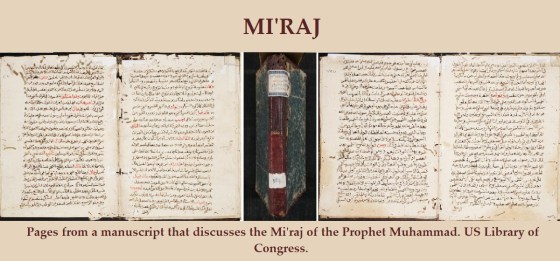
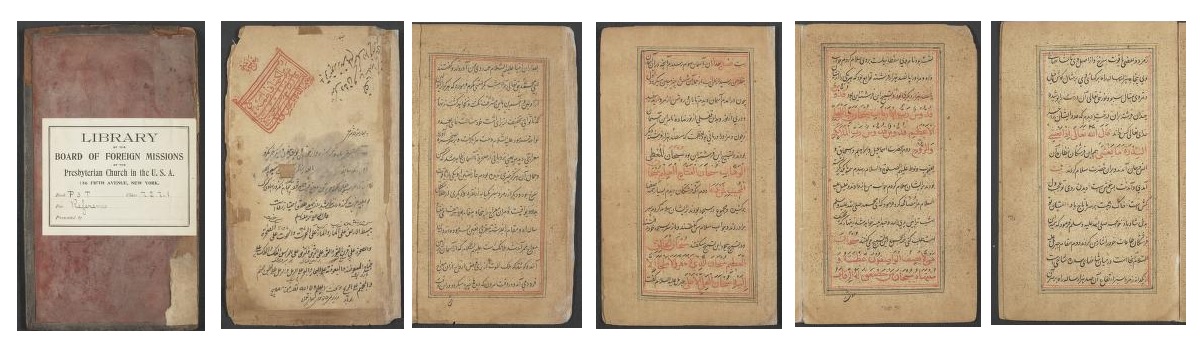
Six images from a total of 408 from an unidentified Persian treatise on the Miʻrāj and several other topics from the Hadith (traditions) of the Prophet Muhammad. Image: US Library of Congress. For more details please click https://www.loc.gov/item/2016397783/
~~~~~~
Fragment from page 7 of the Bustan of Sadi. The last two lines of poetry on this page extol the Prophet’s miraculous ascension to the heavens (mi’raj): One night he sat (on his flying steed Buraq) and passed through the heavens. / In majesty and grandeur, he exceeded the angels. / So impulsive, he urged (his steed) into the plain of closeness (to God) / While Gabriel remained behind him at the Lote Tree (of the Limit). Image: Wikipedia.
Among Sufis and other Islamic esoteric traditions, such as those practiced by Ismaili Muslims, Mi’raj is considered the highest point of spiritual perfection an individual can attain through religion and the practice of faith. Believers long to experience a Mi’raj, just as the Prophet experienced it. The Shia Ismailis seek out this spiritual elevation under the guidance of the Imam-of-the-Time, presently Mawlana Shah Karim Al-Hussaini Hazar Imam, His Highness the Aga Khan, who leads his followers to self-awareness, spiritual insight and elevation. This is clearly noted in the Preamble of the Ismaili Constitutionin paragraph (F), which reads:
“Historically and in accordance with Ismaili tradition, the Imam of the time is concerned with spiritual advancement as well as improvement of the quality of life of his murids. The Imam’s ta‘lim lights the murid’s path to spiritual enlightenment and vision. In temporal matters, the Imam guides the murids, and motivates them to develop their potential.”
His Highness the Aga Khan is the 49th Hereditary Imam, directly descended from Hazrat Ali, whose remarkable teachings have come down to us through the preservation of his sermons and teachings which are recorded in works such as Nahj al-Balaghah. Close to the heart of the Ismaili Muslims are poems of the Imam Ali known as Kalam-i Mawla that have been rendered into Hindi. The verses speak about the conduct, behaviour and action of man during his sojourn on earth (please read Farouk Topan’s excellent piece Kalam-i-Mawla)
We are pleased to provide a recitation of verses from the Kalam of Hazrat Ali that focus on ethics, spirituality and the Mi’raj of the Prophet Muhammad. The verses are recited by Alnoor Saleh and have been downloaded from the MUST VISIT website Ginans Central, which is maintained by Karim Tharani of the University of Saskatchewan.
“As you build your lives, for yourselves and others, you will come to rest upon certain principles. Central to my life has been a verse in the Holy Quran which addresses itself to the whole of humanity. It says: ‘Oh Mankind, fear your Lord, who created you of a single soul, and from it created its mate, and from the pair of them scattered abroad many men and women. I know of no more beautiful expression about the unity of our human race — born indeed from a single soul.” — The Aga Khan, excerpt from an address to both the Houses of the Canadian Parliament, February 27, 2014, see featured photo at top of post.
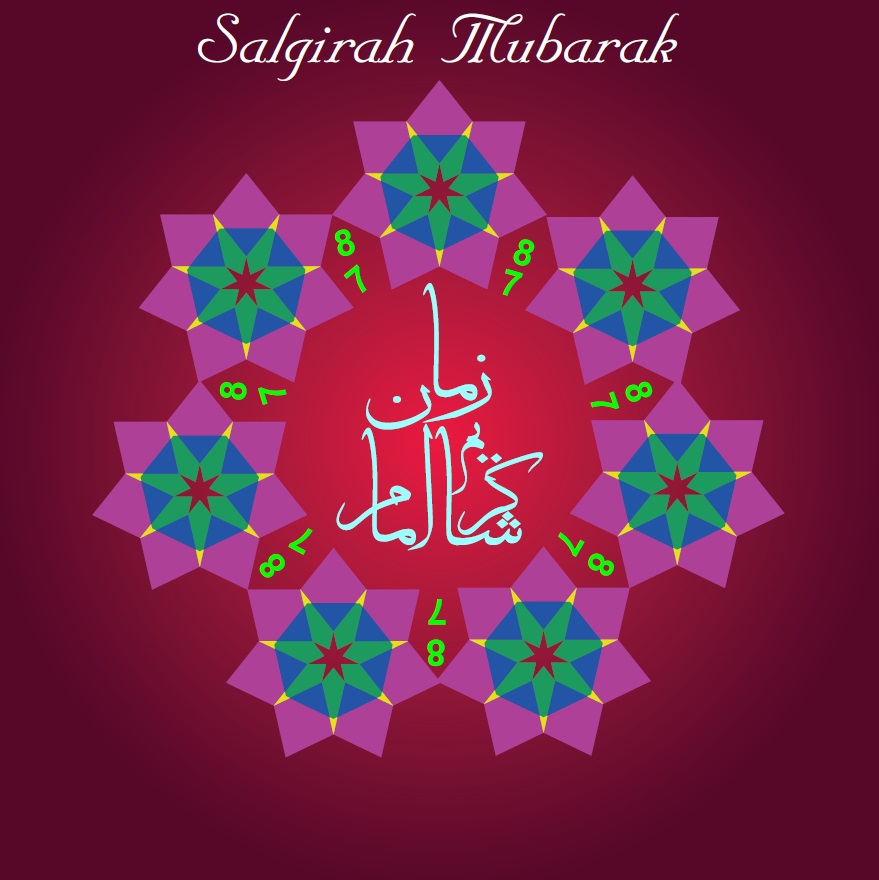
A calligraphy by Toronto’s Karim Ismail depicting the 87th birthday of His Highness the Aga Khan, the 49th Hereditary Imam of the Ismaili Muslims. Please clik on image for special post.
On December 13, 2023, Ismaili Muslims around the world mark the 87th birthday of their Imam, His Highness the Aga Khan. Simerg’s sister website Barakah presents a special post for the birthday. Please click The Benevolent Imam.
At the age of 87, the current Aga Khan is the oldest living Imam in Ismaili history. On July 11, 2023, he celebrated his 66th Imamat Day, still 5 years away from the record breaking 71 years of his predecessor, Aga Khan III (d. July 11, 1957), who began his reign at the age of seven in August 1885. Canada is home to more than 100,000 Ismailis and the Aga Khan’s projects include the beautiful Aga Khan Garden in Edmonton — part of the University of Alberta’s Botanic Garden — and the Aga Khan Museum in Toronto, two iconic Ismaili Centres in Toronto and Vancouver, and the Global Centre for Pluralism in Ottawa. In Calgary, the Ismailis host the annual stampede breakfast which is open to the entire public. Thousands attend and enjoy this annual event.
Known as Mawlid or Mild-un-Nabi, the birth anniversary of the Prophet Muhammad (may peace be upon him and his family) is celebrated in different parts of the world by reflecting on his rich and inspirational life. In 2023, the anniversary falls on September 26/27, equivalent to the 12th day of the Muslim month of Rabi Al-Awwal, in the Islamic year 1444 Hijri. The Islamic calendar is roughly 10 days shorter than the Gregorian Calendar every year.
The Aga Khan’s speech was made at a special Seerat Conference honouring the life of Prophet Muhammad. Attended by eminent Muslims and non-Muslims historians and scholars from around the world, the speech answers the question: What should Muslim Societies seek to be in the future?
Did Muslims and Islamic countries and their leaders take up the clarion call and follow the 49th Ismaili Imam’s timeless advice given 47 years ago? Please read the Aga Khan’s 1976 insightful speech by clicking HERE.