The following article is reproduced from http://www.barakah.com, a website with the theme “His Highness the Aga Khan: A Visual and Textual Celebration, 1957-2017.”
Karim Aga Khan: Modern Personification of Historical Islamic Rationalism, Charity and Peace
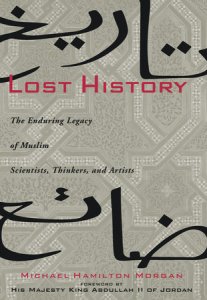 Lost History: The Enduring Legacy of Muslim Scientists, Thinkers and Artists by Michael Hamilton Morgan with a Foreword by His Majesty King Abdullah II of Jordan.
BY MICHAEL HAMILTON MORGAN
When I published my book “Lost History” in 2007, only 6 years after the attacks of 9/11 and while the US and allies were still fighting wars in the ancient Islamic treasure-houses of Iraq and Afghanistan, I thought that non-Muslims were finally beginning to be open to the breadth and depth — and global debt owed — to historical Muslim culture.
My publishers and editors — while firmly supportive of the book — had been privately concerned that the book might trigger angry reactions both from conservative Muslims and from Islamophobes.
Their concerns were not borne out. Contemporary antagonists on both sides chose to ignore my historical discussions, or to focus on other disputes. My argument showing how much the modern digital world owes to the ancient Muslim-sponsored thinkers in Baghdad, Aleppo, Isfahan, Cairo, Palermo, Cordoba, Bukhara, Isfahan, Delhi and many other cities was well received. The surprise to me was how well received it was in the Muslim world, being translated into languages like Arabic and Indonesian, as well as for faraway non-Muslim readers in Japan and even Korea.
If only that modest success could have been sustained. But then came the continuing disintegration of Iraq and Syria, the rise of ISIS, floods of refugees and horrific Islamophobic political demagoguery in both Europe and the US. It was as though one beheading could erase all the slow progress made in getting non-Muslims to understand that ISIS and its fellow travelers were not the spokesmen for the faith of Islam that most Muslims know and practice — or that history teaches us.
Perhaps there is no hope of counteracting the sensationalism of terrorism with a book…or even a parade of books. Perhaps the only way is through decades — or even centuries — of hard work in the areas of education, scientific research, medicine, public works, charity, economic development and entrepreneurship.
Believe it or not, those are the behavioral pillars of historical Muslim culture. Though most non-Muslims don’t realize, it was those pillars and others that made Muslim culture the single most progressive force in the world from about 650 to 1500 of the current era. Those pillars seeded the European Renaissance and Enlightenment and gave us things like the algorithm, data mining, evidence-based medicine, universities, hospitals, psychotherapy, modern optics, space travel and a thousand other things that we think come exclusively from the West.
And it would be dishonest to say that all those things were purely Muslim-generated. Instead, they were Muslim sponsored — the fruits of a vision of Islam that opened its intellectual doors to all good ideas and thinkers, no matter where they came from or which deity they worshipped. In hadith, the Prophet Mohammad is quoted as saying, “even if ye must go to China, seek knowledge,” and “The ink of the scholar is holier than the blood of the martyr”. These were the scriptural guides that drove these centuries of invention and discovery.
In fact, I argue that Islam was the most intellectual of the three Abrahamic faiths, and perhaps of any religion in human history. For hundreds of years, mainstream Islam taught that the secrets of God’s universe could be unlocked with reason and logic — that those intellectual tools were in fact keys to divine revelation. Classical Muslim thinkers saw no contradiction between reason and divine revelation — for them, logic and revelation were one and the same. Unfortunately, that lesson seems lost now, even in that direct product of the European Enlightenment, the United States, where state legislatures and US Senators argue that science should be ignored when it comes to climate change and Darwin’s theory of evolution. On top of that, no one remembers that Darwin had been previewed by Al Jahiz’ theory of natural selection in Baghdad 1,000 years earlier.
This ancient Muslim religious devotion to science, ideas, openness and empirical evidence has indeed been obscured in the mainstream. In the West, the loss of this connection has come from the hard separation of science from faith, and both have suffered. Faith for many in fundamentalist Christianity has become an anti-intellectual thing, when there need not be such a dichotomy. On the scientific side, the compartmentalization of Western intellectual tradition means that science has become very secular. Career scientists are generally uneasy to have their faith mixed into science: many see the two as directly contradictory.
And in the Muslim world, incomplete popular understanding of the faith of Islam has weakened understanding of the importance of logic and reason to the Islamic tradition.
But some have always been quietly swimming against that popular tide of prejudice and misunderstanding. Whether they will be able to offset the currents of ignorance and mistrust that dominate the media and politics remains to be seen — but it is certain that among those most directly touched by their work, the lesson of logic, reason, openness and peace is resonating.
In this vast tapestry of the interaction of Muslims with each other, and with other cultures and faiths, there is one tradition that unfailingly continues the progressive heritage of classical Islam — profoundly intellectual, open, tolerant, pacific — and in particular one leader who has made it especially attuned to the many difficulties of the world today.
That would be Ismailism and its revered Imam, the current Aga Khan IV. As a minority within a minority of Islam, Ismailism does not enjoy hundreds of millions of followers. Its adherents today number about 15 million — though they are dispersed to many corners of the world — South and Central Asia, Africa, Canada and elsewhere. This is only a drop in the ocean of greater Islam that may number 1.6 billion worldwide.
Additionally, Ismailism is not well understood, even by mainstream Shiites, much less majority Sunnis. In some ways its situation is similar to Christian misunderstanding of Judaism, which is hugely outnumbered by its Christian and Muslim descendants. Like Judaism with its pogroms and anti-Semitism, Ismailism has suffered historical persecution at the hands of the majorities. As with Jews in the Holocaust, Ismailis in the 13th century were even threatened with extermination, first at the hands of the Sunni majority and then at the hands of the Mongol invaders of Persia. For centuries, Ismailis survived in Persia and elsewhere either in mountaintop redoubts or underground and or in nearly permanent exile.
But to the benefit of today’s world and many millions of people, the Ismailis have not been exterminated or absorbed. In some ways, their intellectualism may have been intensified by the centuries of persecution. Today, the Aga Khan and the Ismailis have bent over backward — and at great risk — to nurture the elements of progressive Islam that changed the world 1000 years ago.
The fruit of all this historical tumult is the Ismailism of today, and the Aga Khan. He and his followers continually remind the world that quiet good work can be more powerful than loud rhetoric and sensational acts, that the intellect and reason are the keys to progress, that openness and tolerance heal the world, and that peace is the expression of the divine on earth.
Since the Aga Khan was crowned in 1957, he has devoted his time, energy, fortune and the efforts and contributions of his followers to major global efforts in education, economic development, entrepreneurialism, charity, medicine and other fields.
By no coincidence, all these fields are at the core of classical Muslim culture and greatness. They have done more for the world than blind piety and xenophobia ever could.
His Highness was explicit on the powerful intellectual tradition of Islam when interviewed by Der Spiegel in 2006:
SPIEGEL: Does Islam have a problem with reason?
Aga Khan: Not at all. Indeed, I would say the contrary. Of the Abrahamic faiths, Islam is probably the one that places the greatest emphasis on knowledge. The purpose is to understand God’s creation, and therefore it is a faith which is eminently logical. Islam is a faith of reason.
And His Highness has spent his lifetime walking the talk of that. Through global institutions like the Aga Khan Development Network (AKDN), he has founded and inspired multiple initiatives like the Aga Khan University, the University of Central Asia, the Aga Khan Fund for Economic Development (AKFED), the Aga Khan Trust for Culture, the Aga Khan Foundation, the Aga Khan Health Services, the Aga Khan Education Services, the Aga Khan Planning and Building Services, and the Aga Khan Agency for Microfinance. One of the companies where AKFED is the main shareholder is Serena Hotels Group.
The Aga Khan Development Network, which coordinates the activities of over 200 agencies and institutions, employs approximately 80,000 staff, the majority based in developing countries. AKDN is dedicated to improving living conditions and opportunities for the poor, without regard to their creed, ethnicity or gender. The AKDN’s annual budget for non-profit development activities in 2010 was estimated to be US$625 million. The network operates in more than 35 of the poorest countries in the world
Each one of these efforts would merit articles longer than this. But one that should be singled out and explained is the AKDN’s business activities like Serena Hotels.
Many coming from the Christian tradition will find a religious group’s investment in business puzzling to say the least. That is because Christianity, unlike Islam, has always had an ambivalent view of business. Witness Jesus’ statement, “it is easier for a camel to pass through the eye of needle, than for a rich man to enter the Kingdom of Heaven.”
Islam never had that antipathy to business, owing in large part to the Prophet himself, who was aided in promoting his religious vision after marrying caravan entrepreneur Khadija. Although Islam has strong requirements to devote a share of one’s wealth to public charity and to the faith, it has never had the antipathy to commerce that Christianity did.
Although many in the West have argued that business can be a force for change, few have explicitly based their business activities in religious faith. I would argue that the Aga Khan has showed that religiously-inspired business can be a progressive force in society, by creating jobs, spreading wealth, providing needed services, stimulating economic growth and higher tax revenues and social progress.
 His Highness the Aga Khan and His Excellency President Museveni speak to Mr Expedito Wakibulla at the opening of the Kampala Serena Hotel. Mr. Wakibulla is a renowned Ugandan wood carver, whose artworks are used extensively throughout the Kampala Serena. Shown at the left are the Serena Lodges at Lake Manyara (top) and Serengeti National Parks. Photos: AKDN/Gary Otte.
His efforts in education — for how can logic and reason advance without education — are equally admirable. Founded in 1983 by Prince Karim Aga Khan IV, Aga Khan University launched a medical college and a teaching hospital in Pakistan. The university grew to be international, and in 2004 established a teaching hospital in Nairobi and in 2016 another one in Dar es Salaam, Tanzania. In 2002, the university established a campus in London dedicated to the study of the Muslim Civilizations. In 2015, the university established the Institute for Human Development. In 2016, the university launched the East African Institute. The university’s clinical laboratories in Karachi are the only in Pakistan to be accredited by the College of American Pathologists.
The university’s campus in Karachi is ranked among the top universities in Asia and among the top 300 in the world for medicine. Pakistan ranks the university as the top medical school in Pakistan. The university runs one of the world’s largest networks of accredited teaching hospitals, with 14 hospitals in Pakistan, East Africa and Afghanistan. In 2016, these hospitals treated an estimated 1.75 million patients.
But there’s more to this story. The University of Central Asia (UCA) was founded in 2000. The Presidents of Tajikistan, the Kyrgyz Republic and Kazakhstan and the Aga Khan signed the treaty establishing this secular, not-for-profit, private university. The Presidents are Patrons of UCA and His Highness the Aga Khan is the Chancellor.
 His Highness the Aga Khan, the Chancellor of the University of Central Asia (UCA), accompanied by Kyrgyzstan’s Minister for Education Mr Kanat Sadykov, Naryn Governor Mr Amanbay Kayipov, Mayor Mr Rakhat Adiyev, the Akim of the Naryn District Zhanboev Tugolbai and UCA leadership as the delegation reviewed the first campus of UCA in Naryn in November 2014. The campus was inaugurated by the Aga Khan on October 19, 2016. Photo: AKDN/Gary Otte.
UCA’s mission is to foster the socio-economic development of Central Asia, particularly its mountain societies, while helping the peoples of the region preserve and draw upon their rich cultural heritages as assets for the future. The university is advancing construction of three campuses in Khorog, Tajikistan; Tekeli, Kazakhstan and Naryn, Kyrgyz Republic (which was inaugurated in October 2016).
The three campuses, hosting academic, administrative, residential, library, cultural and athletic facilities, will serve almost 4000 students, faculty and staff.
Let us hope that all these noble efforts will finally begin to undermine the mis-named “clash of civilizations” and the mis-named “Islamic terrorism”. We will not know for some time.
This article started by referring to the deep misunderstanding in the world and even among Muslims about what Islam is and what Islam has given to the world. ISIS and fellow travelers continue to steal the headlines with their acts of violence. But the Aga Khan showed us the way out of this fog of ignorance in the same interview with Der Spiegel. I will close the article with his words:
SPIEGEL: “The West (will stand) against the Rest” wrote Professor Samuel Huntington in his famous book “Clash of Civilizations.” Is such a conflict, such a clash inevitable?
Aga Khan: I prefer to talk about a clash of ignorance. There is so much horrible, damaging, dangerous ignorance.
SPIEGEL: Which side is responsible?
Aga Khan: Both. But essentially the Western world. You would think that an educated person in the 21st century should know something about Islam; but you look at education in the Western world and you see that Islamic civilizations have been absent. What is taught about Islam? As far as I know — nothing. What was known about Shiism before the Iranian revolution? What was known about the radical Sunni Wahhabism before the rise of the Taliban? We need a big educational effort to overcome this. Rather than shouting at each other, we should be learning to listen to each other. In the way we used to do it, by working together, with mutual give-and-take. Together we brought about some of the highest achievements of human civilization. There is a lot to build on. But I think you cannot build on ignorance.
Date posted on Simerg: September 19, 2017.
Copyright: Michael H. Morgan/Simerg. 2017.
_______________
 International speaker, author, business advisor and award-winning former U.S. diplomat Michael Morgan currently advises companies in the U.S., Europe, Latin America, Africa and Asia-Pacific seeking capital and partnerships — in industries like energy, infrastructure, telecom, pharmaceuticals, entertainment, sports and real estate. Morgan is a member of the Advisory Board of Proximera Fund/Fuchs Group (www.fuchsgroup.com) in Luxembourg, CBT Fund in Shanghai and is Head of Investor Relations at Aseare Health (www.aseare.com).
Since 2007, Morgan has been a keynote speaker at the Arab Business Council, British Parliament, World Economic Forum, U.S. Treasury, Georgetown University, UCLA, University of Virginia, the Mohammed bin Rashid Foundation in Dubai, the Abu Dhabi International Book Fair, the Asia Society and many other venues.
Morgan’s 2007 book Lost History: the Enduring Legacy of Muslim Scientists, Thinkers and Artists (National Geographic/Random House) has reached thousands of readers around the world, and has been translated into Arabic, Indonesian, Urdu, Bosnian, Japanese, Korean and other languages. Morgan received Egypt’s Presidential award for the Arts & Sciences in 2008. Morgan’s 2002 book Collision with History: the Search for John F. Kennedy’s PT 109 has been optioned as a feature film by Atmosphere Entertainment in Hollywood.
_______________
We welcome your feedback, please click LEAVE A COMMENT or send your comment to simerg@aol.com. Please visit http://www.barakah.com for insightful essays on His Highness the Aga Khan. Also become a friend of Barakah at http://www.facebook.com/1000fold.








 Simerg - Insights from Around the World