Simerg is an independent initiative dedicated to Ismaili Muslims, the Aga Khan — their Hereditary Imam — and the Ismaili Imamat, and Islam in general through literary readings, photo essays and artistic expressions
Category Archives: Ismaili Centres and Jamatkhanas
Nairobi’s Town Jamatkhana was opened on January 14, 1922. On its 100th anniversary, we invite our readers to read Zahir Dharsee’s highly acclaimed piece Memories of Nairobi’s Majestic Town Jamatkhana that first appeared on this website in 2011 as part of our special Jamatkhana Series.
May we note that to mark the anniversary, Kenya’s Daily Nation has published a special piece co-authored by Azim Lakhani and Shamira Dostmohamed. Please read their article by clicking on Celebrating Over a Century of Ismaili Community in Kenya. It includes an excellent overview of numerous events that have taken place at the Jamatkhana over the past decade.
Please click for article and photos.
Date posted: January 14, 2022.
___________________
Before leaving this website please take a moment to visit Simerg’s Table of Contents for links to hundreds of thought provoking pieces on a vast array of subjects including faith and culture, history and philosophy, and arts and letters to name a few. Also, visit Simerg’s sister websites Barakah, dedicated to His Highness the Aga Khan, and Simergphotos.
The Ismaili Center Houston (ICH) promises to be an architecturally innovative building. It draws inspiration from several design traditions and will likely generate discussion and debate about present-day Muslim architecture. The confluence of Muslim and non-Muslim motifs in the Center very much reflects the centuries-long Ismaili openness to diverse cultures (e.g. see my article Ismailis: A Pluralist Search for Universal Truth). It is fascinating how the building’s architect, Farshid Moussavi, has intermingled features from the Zoroastrian Sassanid, Christian Byzantine, Muslim Isfahani and secular Western societies in a contemporary Ismaili American edifice.
However, some vital considerations seem to be missing from the building that aspires to stand as “a symbol of dialogue” in responding to its “geographies and contexts.”
An architectural conversation with the first peoples of Texas would have been far-sighted, especially at a time when indigeneity is of rising importance in North American contexts. For example, the challenge of dealing with Houston’s heat and humidity could have turned to the history of the local Akokisa people who built airy beehive-shaped structures to cope with the climate.
Article continues below
The prominent “chorkhona” skylight in the Ismaili Centre Dushanbe. The chorkhona is the defining symbol of the traditional structure of the Pamiri House, whose design principles reflect pre-Islamic philosophical symbols of the Central Asian region. Photo: Karim H. Karim.
A vital principle of architectural practice is attention to the cultural heritage of the proposed building’s daily users. The vast majority of Houston’s Jamat are families that have either arrived directly from India and Pakistan or from the South Asian Ismaili diaspora in Africa. But South Asian architecture appears to have been downplayed in ICH. On the other hand, conscious efforts were made to reflect Pamiri design in Dushanbe’s Ismaili Centre. The databases of the Aga Khan Trust for Culture and the Aga Khan Program in Architecture are rich with information about Muslim architecture in India and Pakistan. Given that the cupola is celebrated in ICH’s design, a nod to the innovative and distinctive chattri in the Indo-Muslim style of Gujarat would have been particularly apropos.
The American Ismaili Jamat’s dominantly South Asian provenance holds other potential that could have been explored through ICH’s architecture. Among the possible partners for dialogue in local and global contexts for Muslims in the USA are diverse Indian American associations. They have strong presence in the American political establishment and are also key players on the transnational scene, including the ties of some with India’s ruling Hindu nationalists. A truly path-breaking pluralist dialogue in the United States holds far-reaching potential for transforming the two diasporic communities’ engagement with each other and charting steps that address the concerns of India’s Muslims with integrity. The AKDN’s calibrated engagement with Afghanistan’s Taliban government is instructive in this regard. One can only imagine the profound diplomatic symbolism of an Islamic architectural pluralism that incorporates design from ancient Indian civilization, as ICH’s architect has creatively done with pre-Islamic Persepolis of her native Iran.
Date posted: November 26, 2021.
_____________________
Karim H. Karim
About the author: Karim H. Karim is Chancellor’s Professor and Director of Carleton University’s Centre for the Study of Islam where he held an International Ismaili Studies Conference. He previously served as Co-Director of the Institute of Ismaili Studies (IIS) and Director of Carleton’s School of Journalism & Communication. Dr. Karim has held visiting scholarly appointments at Harvard University, Aga Khan University/Simon Fraser University, and the IIS. He has also been an advisor for the AKU and the Central Asian University and has served as a member of the AKDN’s Higher Education Forum. Professor Karim is an award-winning author, whose globally-cited writings include publications on culture, architectural design and pluralism as well as on Ismaili communities, institutions, and leadership. He and his wife have established The Karim and Rosemin Karim Prize that recognizes research excellence in understudied areas of Ismaili Studies.
Simerg welcomes your feedback. Please complete the LEAVE A REPLY form below or click Leave a comment.
Before departing this website please take a moment to review Simerg’s Table of Contents for links to hundreds of thought provoking pieces on a vast array of subjects including faith and culture, history and philosophy, and arts and letters to name a few. Please also visit Simerg’s sister websites Barakah and Simergphotos.
What made the project especially rewarding was the close alignment between the client and the architect’s aspirations. What made it very challenging was my knowledge of the high standards that His Highness has set for architecture for many many years — Architect Farshid Moussavi, text transcription from video shown below
Presentation by Farshid Moussavi on the Ismaili Centre Houston, November 15, 2021
After many years of anticipation, designs of the forthcoming Ismaili Center in Houston were presented on Monday, November 15, 2021 by design architect Farshid Moussavi at a special event hosted in Houston, TX, and streamed live around the world on Ismaili TV.
The caption for the brief video shown above on Youtube notes that a full event video will be made available on Ismaili TV. We sincerely hope that the full video is also made available on the Ismaili’s Youtube video channel.
The following text is adapted from the press release issued by His Highness the Aga Khan Shia Imami Ismaili Council for the USA. (Read original press release HERE).
Ismaili Center to be Houston’s Newest Cultural Asset
Note: All images may be clicked on for enlargements
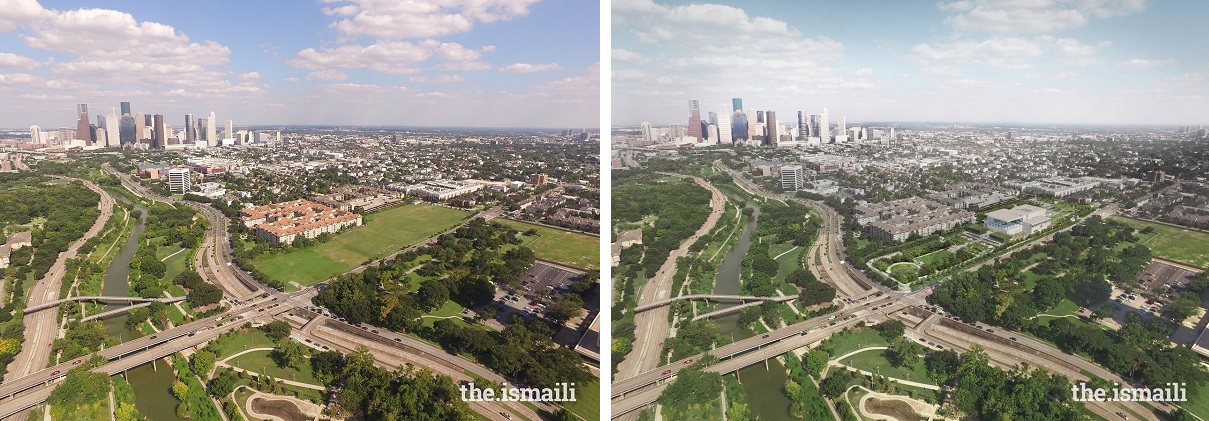
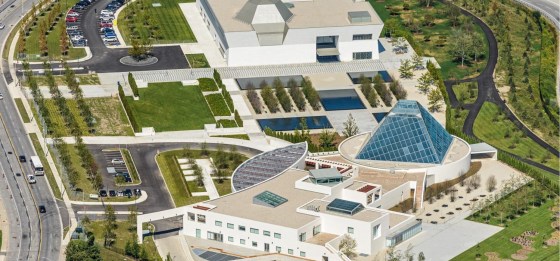
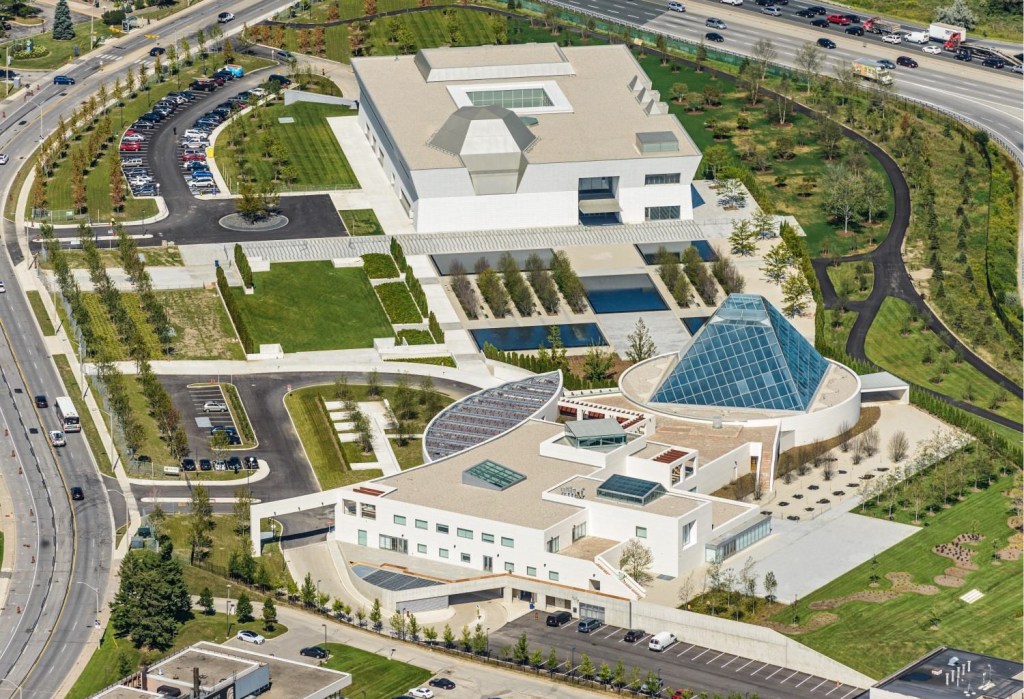
At left, aerial view of the empty site of the Ismaili Center Houston, and at right an aerial view of the Ismaili Center and its gardens as it will look when it is completed in three years time. The center’s site is in the heart of the City of Houston across from Buffalo Bayou Park to the left. IMAGE: IMARA HOUSTON INC. / IPL via The Ismaili.
The design for the Ismaili Center to be built in Houston’s Buffalo Bayou watershed was presented to the public on November 15, 2021 at a gathering of government and civic officials, community representatives and leaders from civil society organizations. Situated on Allen Parkway and Montrose Boulevard, the Ismaili Center is commissioned by Mawlana Hazar Imam, His Highness the Aga Khan, 49th Hereditary Imam of the Shia Ismaili Muslims and founder and Chairman of the Aga Khan Development Network (AKDN).
Article continues below
________________________________
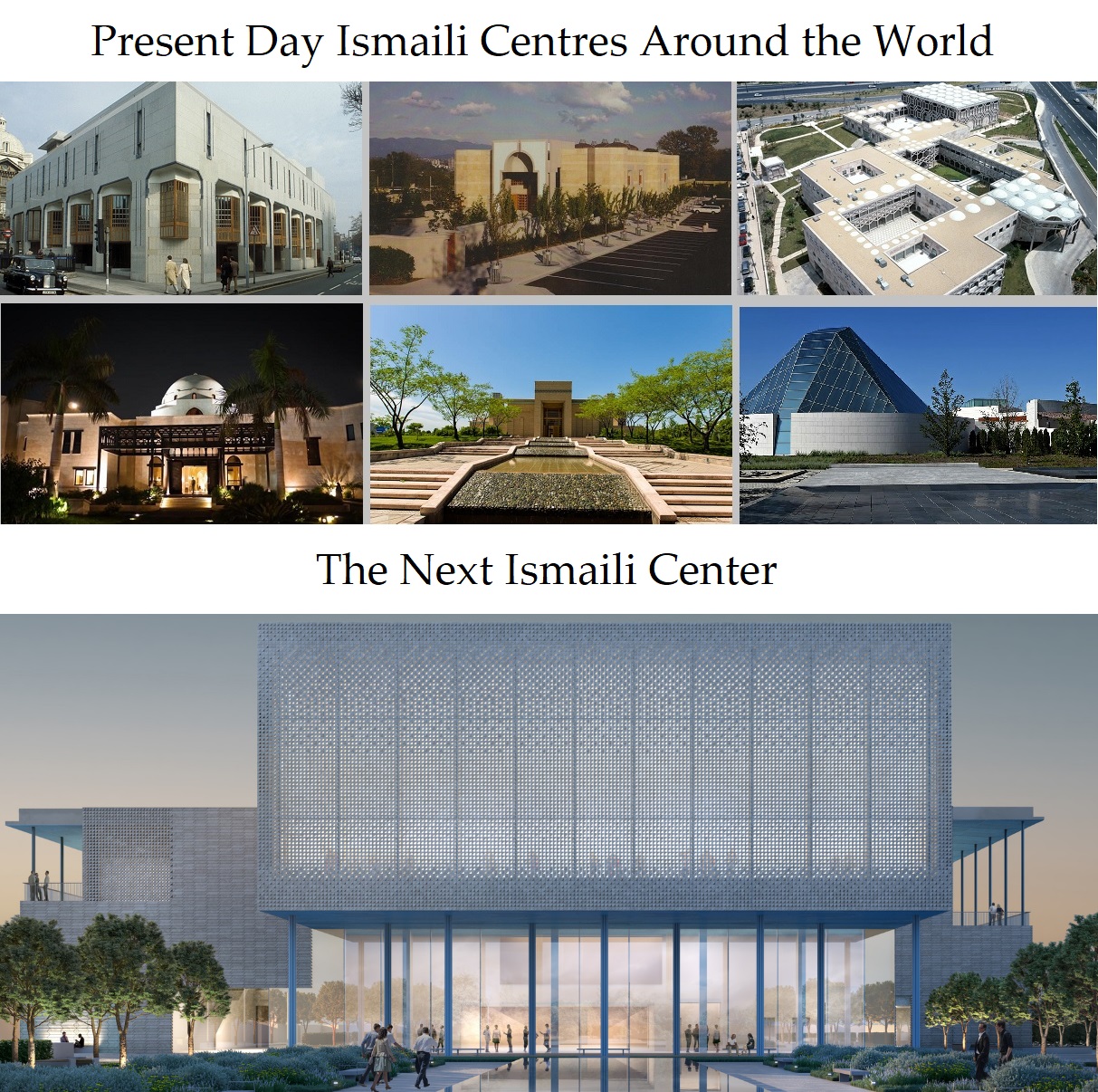
Top row (from left): Ismaili Centre London (Opened April 24, 1985), Ismaili Centre Vancouver (August 23, 1985), and Ismaili Centre Lisbon (July 11, 1998); Centre row: Ismaili Centre Dubai (March 26, 2008), Ismaili Centre Dushanbe (October 12, 2009), and Ismaili Centre Toronto (September 12, 2014); Bottom row: The 7th Ismaili Centre Houston (future date). Collage: Malik Merchant/Simerg.
________________________________
Dedicated to advancing pluralism, public understanding and civic outreach, the Center in Houston joins its counterparts established in London, (UK), Lisbon (Portugal), Dubai (UAE), Dushanbe (Tajikistan), Vancouver and Toronto (both in Canada). Each of these buildings — designed by architects of international standing and multi-cultural sensitivity — is reflective of their own geographies and contexts. As ambassadorial buildings around the world, they are symbolic of the Ismaili community’s presence, pluralistic outlook and ethos of volunteering. The Ismaili Center Houston, with its openness of both purpose and structure, will seek to express these values. Speaking in Sugar Land, Texas in 2002, Mawlana Hazar Imam observed that “since all that we see and do resonates on the faith, the aesthetics of the environments we build and the quality of the interactions that take place within them reverberate on our spiritual lives.”
The Ismaili Center Houston will be a venue for educational, cultural and social events, to encourage understanding and facilitate the sharing of perspectives across peoples of diverse backgrounds, faiths and traditions. It will aim to build bridges through intellectual exchange by hosting concerts, recitals, plays, performances, exhibitions, conferences, seminars, conversations, book launches and community gatherings. The building will also provide space for quiet contemplation and for prayer, as well as serve as the administrative headquarters of the Ismaili community in the USA.
In presenting the design, Iranian born Farshid Moussavi, an internationally acclaimed architect, who also designed the Museum of Contemporary Art in Cleveland, observed: “What made this project especially rewarding was the close alignment between the aspirations of the client and architect. What made it especially challenging was my awareness of the rigorous standards that His Highness the Aga Khan has established for architecture! We have tried to work with Islamic design philosophy, and celebrate its singularity and unique qualities as well as the features it has in common with Western design, so that the building, both through its fabric and through the way it is used, would act as a symbol of dialogue.”
Article continues below
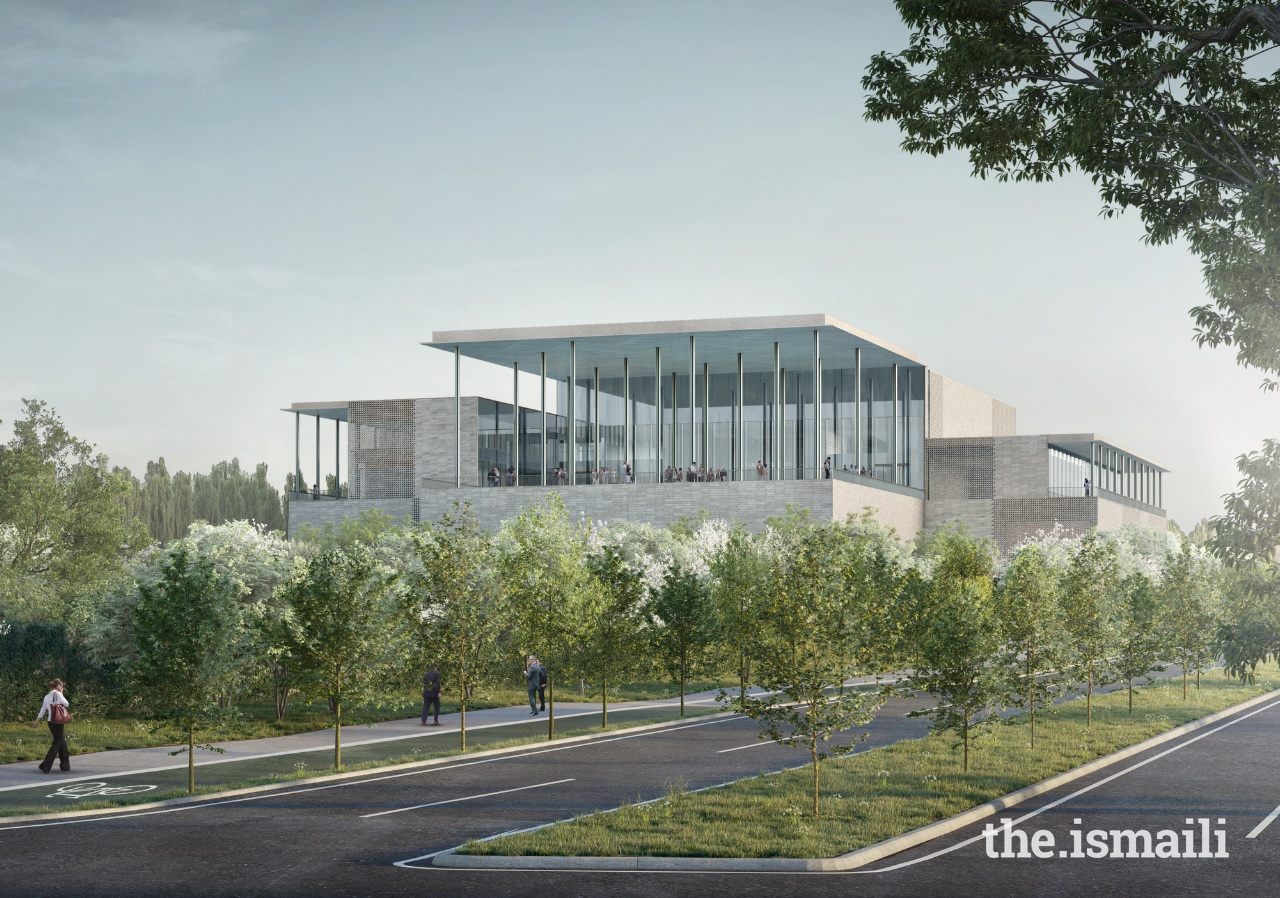
The Ismaili Center Houston will serve as both a Jamatkhana for the Ismaili community to come together for prayers, spiritual search, and contemplation; as well as an ambassadorial cultural center. IMAGE: IMARA HOUSTON INC. / IPL via The Ismaili.
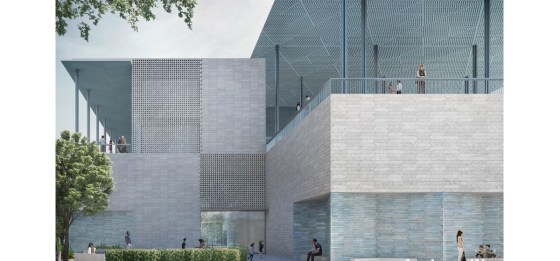
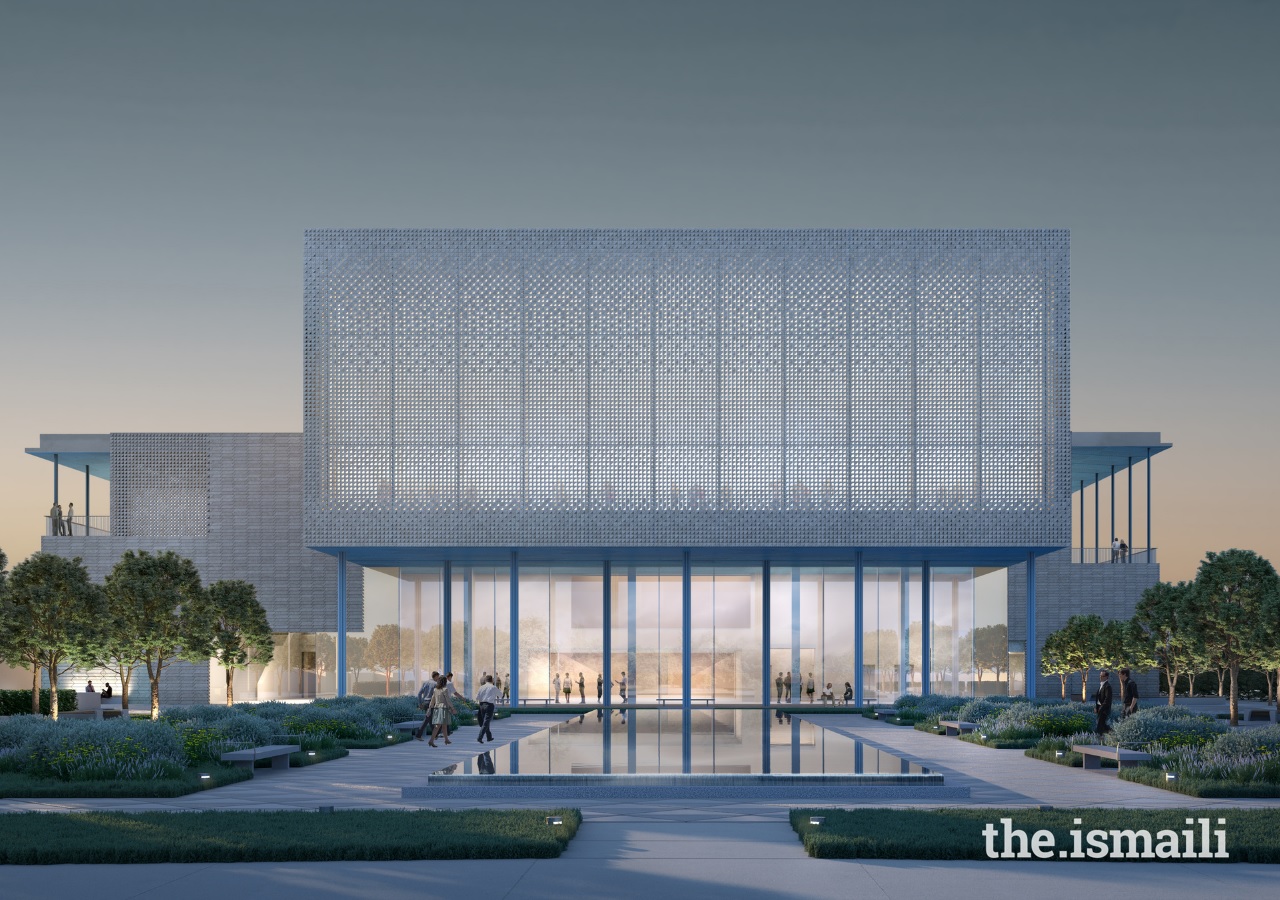
The building is designed with a compact footprint, leaving large portions of the site to be used as gardens. Given the frequently hot and humid climate of Houston and the prominence of the site in the city, it is designed with a tripartite form with each of its volumes hosting a soaring eivan (veranda) to enable social and cultural gatherings to occur outdoors throughout the year. The eivans are supported by forty-nine slender columns reminiscent of those used in Persepolis and seventeenth century palaces in Isfahan, Persia. In being open on all sides and visible from all approaches to the site, the eivans will make the Ismaili Center open and inviting in every direction. At night, they will transform it to a beacon of light along Montrose Boulevard and Allen Parkway.
Article continues below
The forecourt garden with its reflecting pool at the entrance of the building creates a contemplative atmosphere. The new Center will feature beautiful spaces, intricate geometry, and highly crafted work. IMAGE: IMARA HOUSTON INC. / IPL via The Ismaili.
The Center’s design, contemporary in its expression, is reflective of a historically rooted, rich architectural heritage. It combines contemporary architectural technology — its light steel structure — with traditional Persian forms and ornament, including ceramic mosaics and screens drawn from Islamicate traditions around the world. Its design for sustainability includes assuring enhanced energy performance and longevity and durability of materials, by encasing exposed steel with concrete for a 100-year lifecycle, and using stone for the building’s exterior walls.
Conceived as a tapestry in stone, the exterior walls will transition from solid areas to porous screens that will provide shade and privacy, and from flat surfaces to deep alcoves to permit shady repose fronting the gardens. The building exterior will therefore be defined by simplicity of form, openness, and an abstract decorative character.
Article continues below
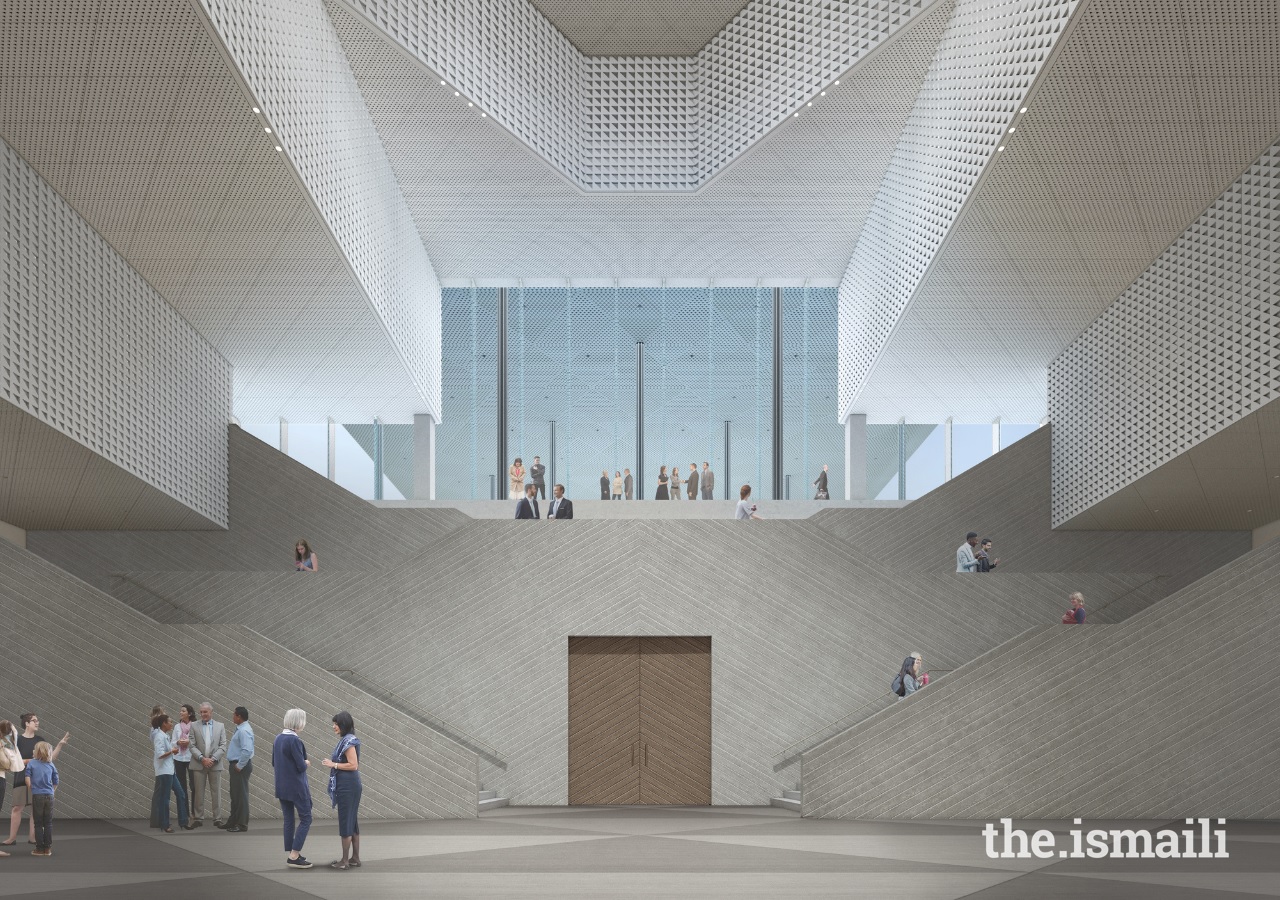
Central atrium and staircase at the Ismaili Center Houston. Each atrium is designed in such a way as to fill the heart of the building with natural light. IMAGE: IMARA HOUSTON INC. / IPL via The Ismaili.
The building interior will include three atriums that will act as common, non-exclusive flexible spaces between rooms dedicated to specific events. Each is located adjacent to an eivan to bring in natural light and views of the sky to the heart of the building. The central atrium’s stepped structure clad in ceramic screens, celebrates the heritage of the cupola dating back to 3000 BCE, dominant in both the architecture of the Sasanian period in Persia and the Christian buildings of the Byzantine empire. The west and east atriums will give access to a theater, a large hall and learning spaces.
Article continues below
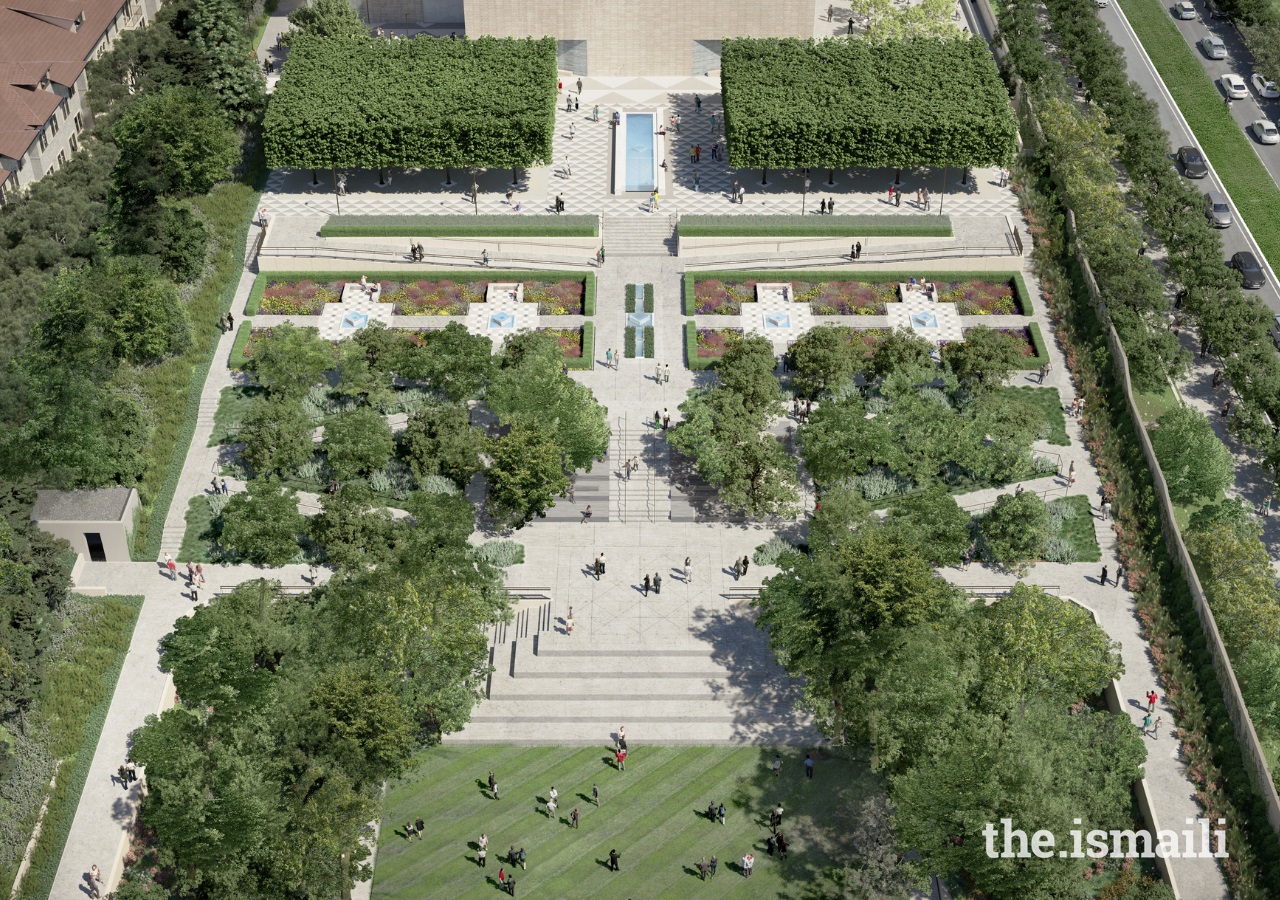
From wherever one enters the site, visitors will be welcomed by garden spaces. The Center’s landscaped gardens will provide a sense of serenity and peace, offering a respite from its urban surroundings. IMAGE: IMARA HOUSTON INC. / IPL via The Ismaili.
The Center’s landscaped gardens will provide a sense of serenity and peace, offering a respite from its urban surroundings. The gardens will include tree canopies, fountains, shaded footpaths, flowerbeds, lawns and walkways. These will be spaces of solace, providing for the rejuvenation of the mind and the spirit.
In his remarks, Houston Mayor Turner reflected, “The Center will elevate, yet again, Houston on the world map as a global city where people of all backgrounds can come together. This notion of learning about and accepting differences amongst peoples and communities, what we call pluralism, is central to the Aga Khan’s vision for the survival of an increasingly interconnected world. The Ismaili Muslim community in Houston and the United States continues to actualize the values that these Centers aim to promote – friendship, service, and mutual understanding.”
Speaking at the ceremony, President Al-Karim Alidina of the Ismaili Council for the USA acknowledged the role of the various teams: “This project, would not be possible without the dedicated efforts of Farshid Moussavi Architecture, Nelson Byrd Woltz Landscape Architects, AKT II – Structural Engineer and DLR Group the architect and engineers of record. We also look forward to working with the construction manager McCarthy Builders and the numerous local contractors who will build and craft this building over the next three years.”
The Ismaili Center Houston will offer a new dimension to the cultural life of the city and a place of gathering for the Ismaili community where visitors will be welcome.
Simerg welcomes your feedback. Please complete the LEAVE A REPLY form below or, if you don’t see it, click Leave a comment.
Before departing this website please take a moment to review Simerg’s Table of Contents for links to hundreds of thought provoking pieces on a vast array of subjects including faith and culture, history and philosophy, and arts and letters to name a few. Please also visit Simerg’s sister websites Barakah and Simergphotos.
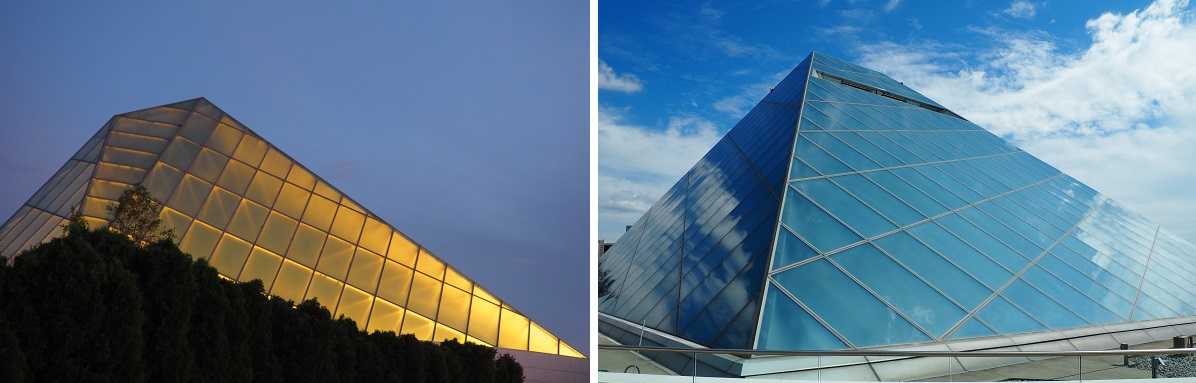
“What we dedicate today is what we identify as an Ismaili Centre — a building that is focused around our Jamatkhana, but which also includes many secular spaces…..And soaring above it all is the great crystalline dome that you have observed, through which light from the prayer hall will provide a glowing beacon, symbolising the spirit of enlightenment that will always be at the heart of the Centre’s life.” — His Highness the Aga Khan, Opening Ceremony of Ismaili Centre Toronto, September 12, 2014.
Simerg’s Malik Merchant visits the rooftop terrace of the Ismaili Centre, and comes as close as possible to the unique dome of Toronto Headquarters Jamatkhana located on 49 Wynford Drive. Click HERE or on image below to see photos of the dome and the area surrounding the Ismaili Centre.
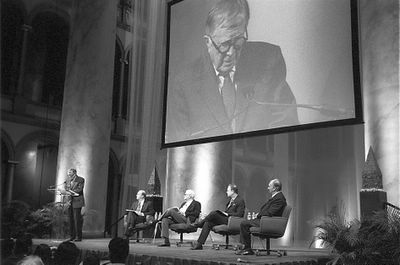
I first met met Bruno Freschi, the architect of the Ismaili Centre Vancouver, in Washington D.C., when Mawlana Hazar Imam, His Highness the Aga Khan, was awarded the Vincent Scully Prize in January 2005 at the National Building Museum. After meeting him at the door, I politely intruded into a conversation the Aga Khan Council Canada President, Firoz Rasul, was having with Fumihiko Maki, the Japanese architect of the Delegation of the Ismaili Imamat Building in Ottawa (December 2008), and the Aga Khan Museum in Toronto (September 2014), and introduced Bruno to the President. So for the first time two great architects from different ends of the world met each other. We are truly proud of what both have done for the Ismaili Imamat and the Ismaili community.
Later that evening before the ceremonies were over — and also later in my interview with him — Bruno told me that he met Mawlana Hazar Imam who thanked him for building the Jamatkhana in Vancouver which he said was one of his most favoured buildings. At the time, Bruno was based in the US capital.
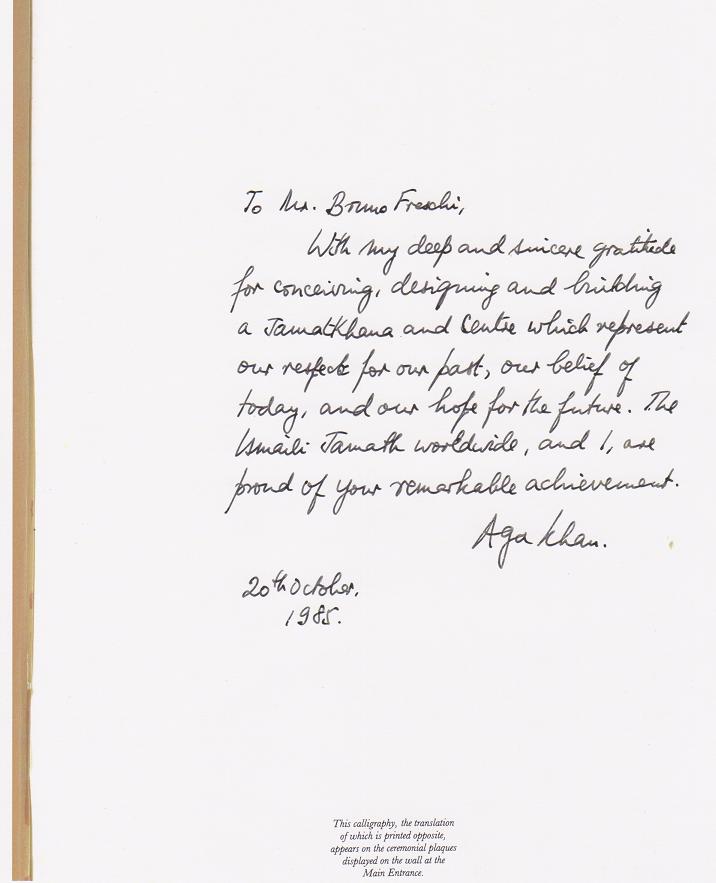
His Highness the Aga Khan’s appreciative note to Mr. Bruno Freschi for his “remarkable achievement”. Message written in the architect’s personal volume of the Ismaili Centre Souvenir publication. Image: Bruno Freschi Collection, 1985.
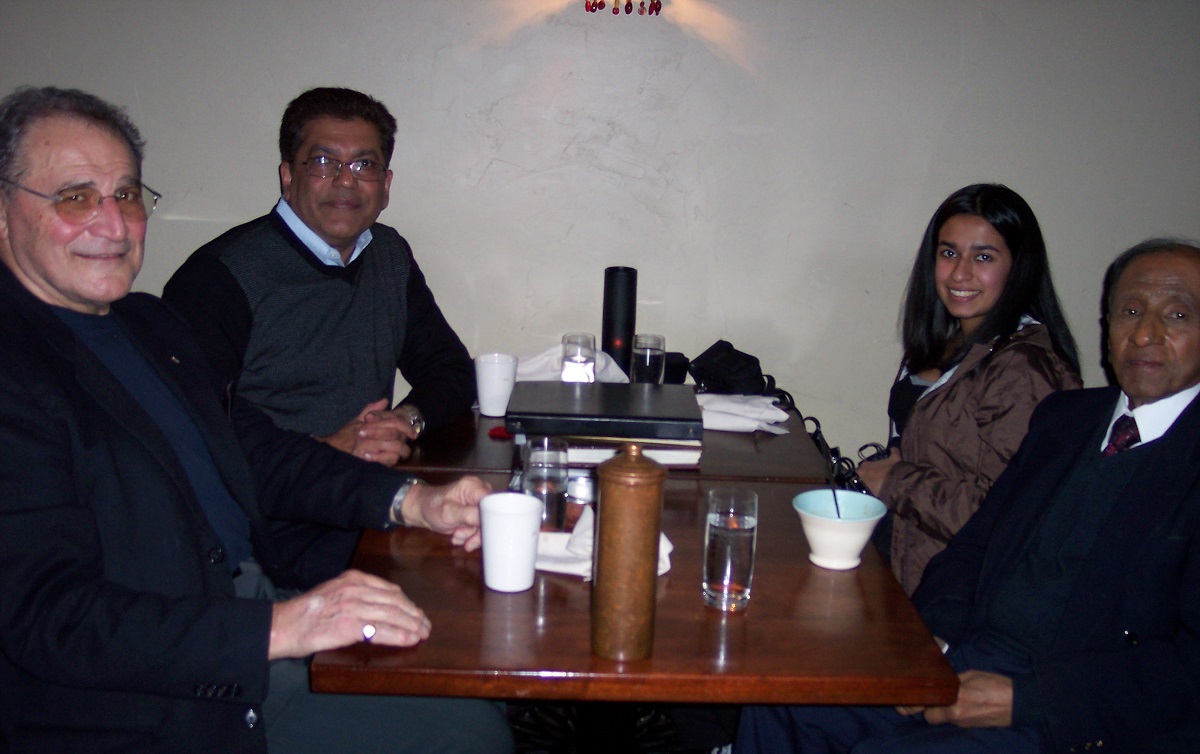
A few years later when Bruno was back in Vancouver but still travelling, I met him for the second time shortly after launching Simerg in the spring of 2009. My daughter had travelled with me to visit my parents in Vancouver. Bruno happened to be in town and was available one evening for dinner at the famous VJ’s restaurant.
(From left, anti-clockwise) Bruno Freschi, Jehangir Merchant (d. May 2018), Nurin Merchant and Malik Merchant at the famous VJs in Vancouver, March 2009.
My dad joined us for a fantastic meal with Bruno, and what an evening it turned out to be. Among other matters, and in a setting of a great ambience, our conversation also centered around the magnificent Jamatkhana building that he had designed. That evening’s conversation along with subsequent text exchanges then became part of Simerg’s though provoking interview with Bruno Freschi, that includes several unique photos.
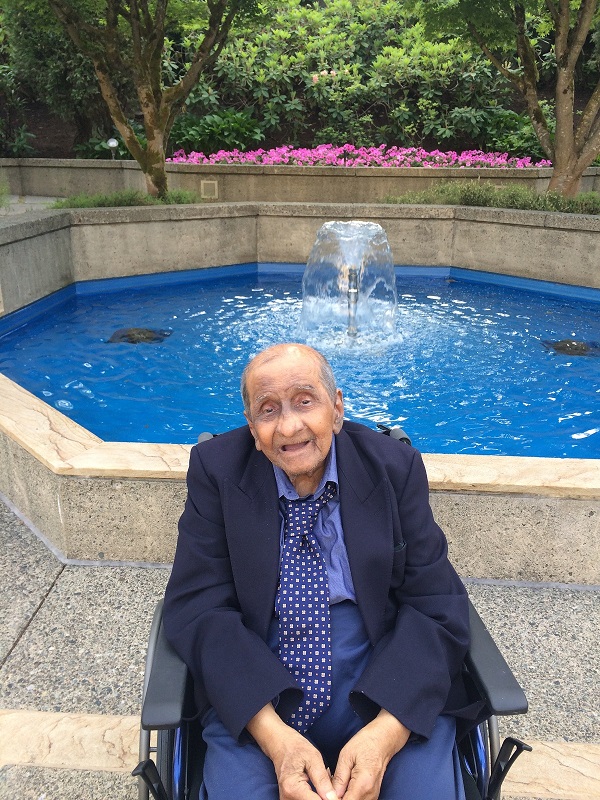
Jehangir Merchant pictured in front of the fountain in the beautiful courtyard of the Ismaili Centre and Jamatkhana, Vancouver, designed by Bruno Freschi. It was designated as the Darkhana Jamatkhana by Mawlana Hazar Imam, His Highness the Aga Khan. Both Jehangir and his wife, Maleksultan, attended the Darkhana Jamatkhana every single day, and found immense comfort and happiness within the Jamatkhana space and the building’s overall interior and exterior environment. This photo was taken a few months before Alwaez died in May 2018 at the age of 89. Photo: Malik Merchant/Simerg.
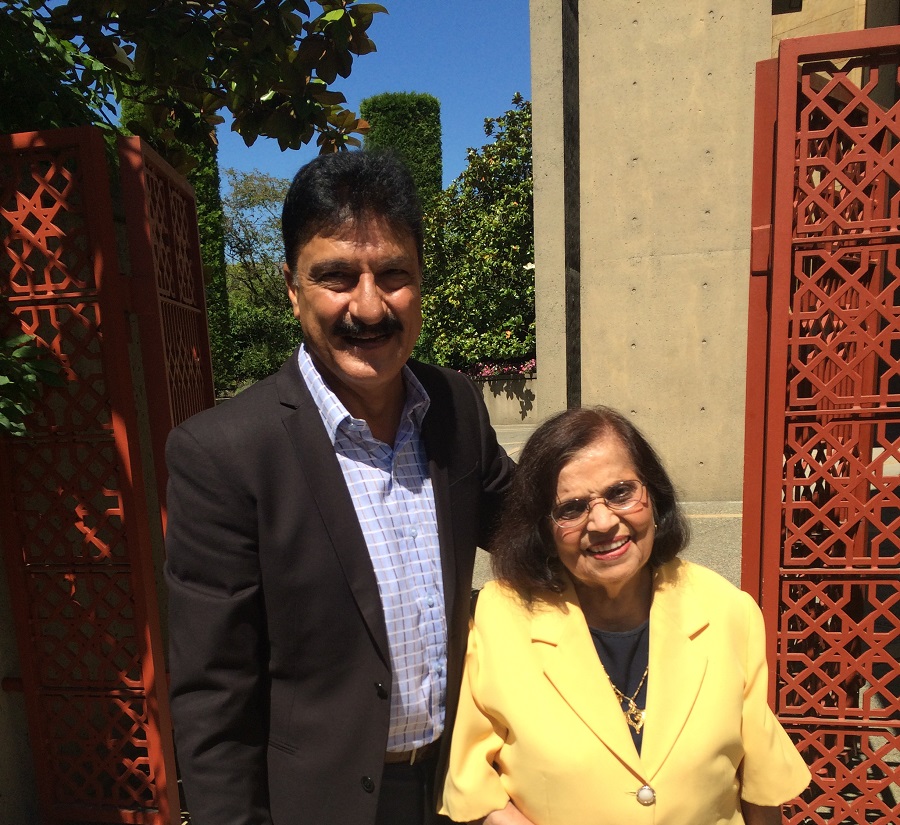
Mrs. Merchant (d. January 2021) pictured with Nazim Rawji, her former 1960/1970’s neighbour from Dar es Salaam, Tanzania, outside the courtyard of the Ismaili Jamatkhana and Centre in Vancouver during an event marking the 59th Imamat Day of Mawlana Hazar Imam, His Highness the Aga Khan. The building was designed by architect Bruno Freschi, and opened in 1985 by Prime Minister Brian Mulroney in the presence of Mawlana Hazar Imam. Photo: Malik Merchant. July 2016.
I invite readers to read Simerg’s insightful interview with Bruno, and to also watch a fantastic program hosted by journalist Zahra Premji in Ismaili Canada’s series Summer Reflections. The video, below, must not be missed as it provides Bruno Freschi’s rare and unique glimpses into the making of this absolutely beautiful building which was opened in September 1985. His admiration and respect for Mawlana Hazar Imam is deeply touching.
I have always enjoyed being around Bruno because of his humble qualities and for sharing inspiring insights into the work of the Ismaili Imamat. I was delighted to meet him again at a much different VJ’s some years later just before the Diamond Jubilee of Mawlana Hazar Imam. He then contributed a thought provoking article The architecture of empathic pluralism: His Highness the Aga Khan, an inspired vision of architecture for Barakah, a website dedicated to Mawlana Hazar Imam and members of his family. Then, after my dad passed away, I met him once more when my mum was with me at a daytime event at the Ismaili Centre. She was very happy that she had finally met the person who designed the Jamatkhana that both she and my dad had visited every single day for years and years. The Jamatkhana had provided them with spiritual happiness and comfort as well as strength in their daily lives, like it has for thousands and thousands of Ismailis living in Vancouver as well as visitors from around the world.
We thank you Bruno for creating a beautiful space to which we all enter (go in) with anticipation and leave (go out) with an immense amount of happiness and hope. We return to it over and over again. Your insight into the Ismaili Jamatkhana and Centre will make us think more about the building you painstakingly designed for us, working together side by side with our beloved Imam to see its total and full completion.
The Ismaili Canada Conversation with Bruno Freschi
Note: To skip the pre-show of songs and music, please start the video at approximately the 13 minute mark to watch Zahra Premji’s excellent and extensive interview with Bruno Freschi, the architect of the Ismaili Jamatkhana and Centre in Vancouver.
To skip songs and watch Ismaili Centre program and interview with Bruno Freschi, please begin at 13 minute mark.
Date posted: August 14, 2021.
________________________
Before departing this website please take a moment to review Simerg’s Table of Contents for links to hundreds of thought provoking pieces on a vast array of subjects including faith and culture, history and philosophy, and arts and letters to name a few. Also visit Simerg’s sister websites Barakah, dedicated to His Highness the Aga Khan, and Simergphotos.
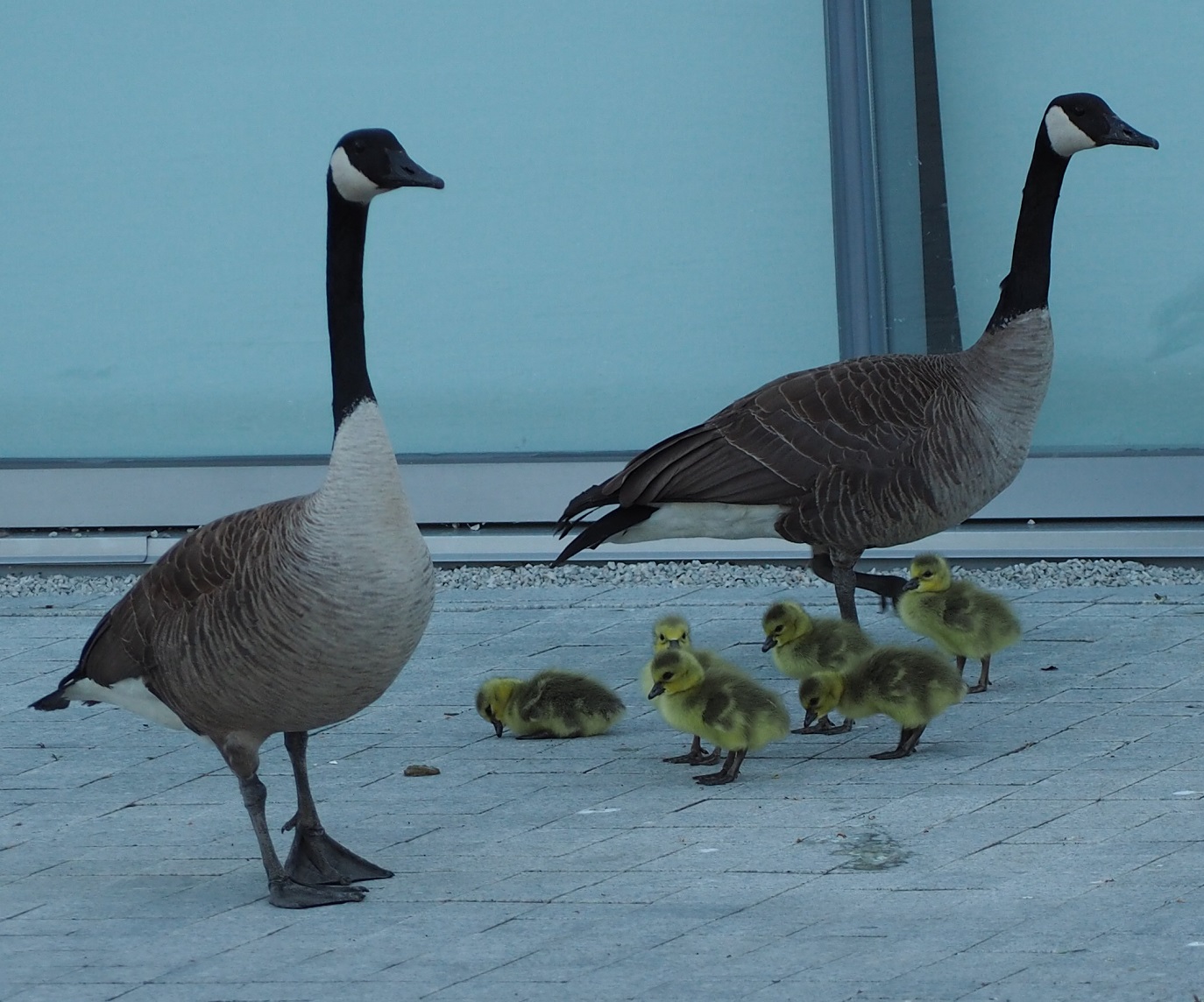
The female goose I had photographed so many times in the weeks before I travelled to Vancouver lay on her eggs for around 28 days. No food, no drinks, no wandering around!
She had to find a perfect spot to protect her nest from animals and human interference, and that she did at a shrub just outside the South East wall of the Ismaili Centre. What a strategy — uncomplicated and safe!
The eggs hatched on the morning of Wednesday May 12, as per the security guard who was present at the nesting site when I met him. My plan was to actually go to Edward Gardens for a long walk but instead of travelling straight on Wynford Drive to reach Don Mills Road, I “lost my senses” and ended in the parking lot of the Aga Khan Museum. I couldn’t have been happier, with what I saw and came away with.
I would call it “A Miracle of Life” and it took place at the end of Ramadhan, and on the day of the sighting of the new moon that Ismaili Muslims celebrate as Chandraat as per the wishes of their 48th Imam, Mawlana Sultan Mahomed Shah, His Highness the Aga Khan (1877-1957). He bestowed the night on the Ismailis for the inner peace and happiness it would bring. For me seeing this phenomenon of birth, and looking at the tiny goslings was an incredible and joyous event. I consider it as the most appropriate gift of Eid ul-Fitr. Enjoy the photographs.
To my fellow brothers and sisters in the Ismaili community, I share with you the following message that Mawlana Hazar Imam, His Highness the Aga Khan, conveyed to us a year ago on the occasion of Eid ul-Fitr:
“It is my wish that my Jamat should look to the future with hope and courage, in keeping with its age-old tradition of unity, generosity and mutual support which has at all times enabled it to move forward to a position of enhanced strength and resilience, from generation to generation.
“My spiritual children should always remain mindful that it is the principles of our faith that will bring peace and solace in these times of uncertainty. I am with my Jamat at all times, and each of you, individually, is always in my heart, in my thoughts and in my prayers.
“I send my most affectionate paternal, maternal loving blessings to all my Jamat – for happiness, good health, confidence and security in your lives ahead, and for mushkil-asan.”
My daughter Nurin joins me in conveying all readers of Simerg, Barakah and Simergphotos Eid Mubarak with best wishes and prayers for good health; long lives and success in all walks of life.
Date posted: May 13, 2021. Last updated: May 14, 2021 (link to updated version of post, click HERE)
________________________
Before departing this website please take a moment to review Simerg’s Table of Contents for links to hundreds of thought provoking pieces on a vast array of subjects including faith and culture, history and philosophy, and arts and letters to name a few. Also visit Simerg’s sister websites Barakah, dedicated to His Highness the Aga Khan, and Simergphotos.
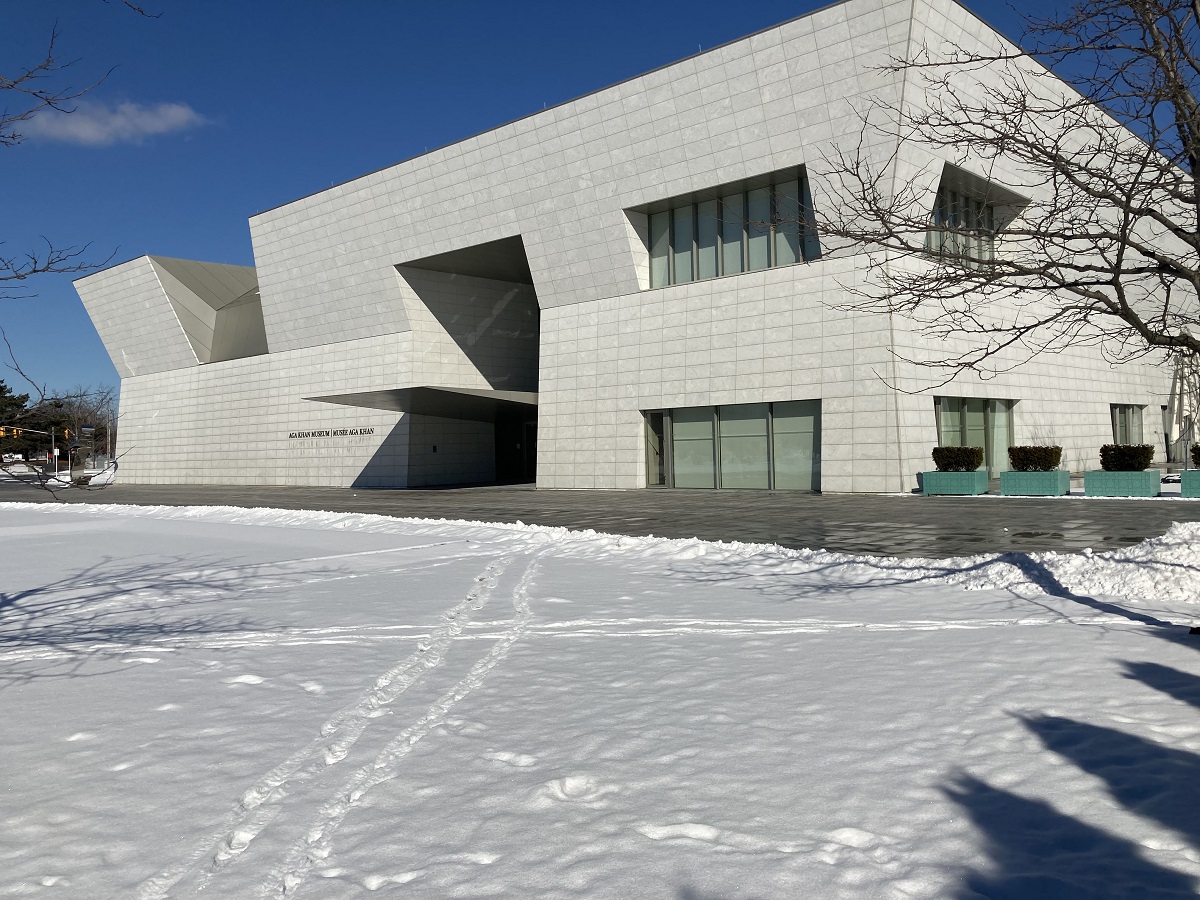
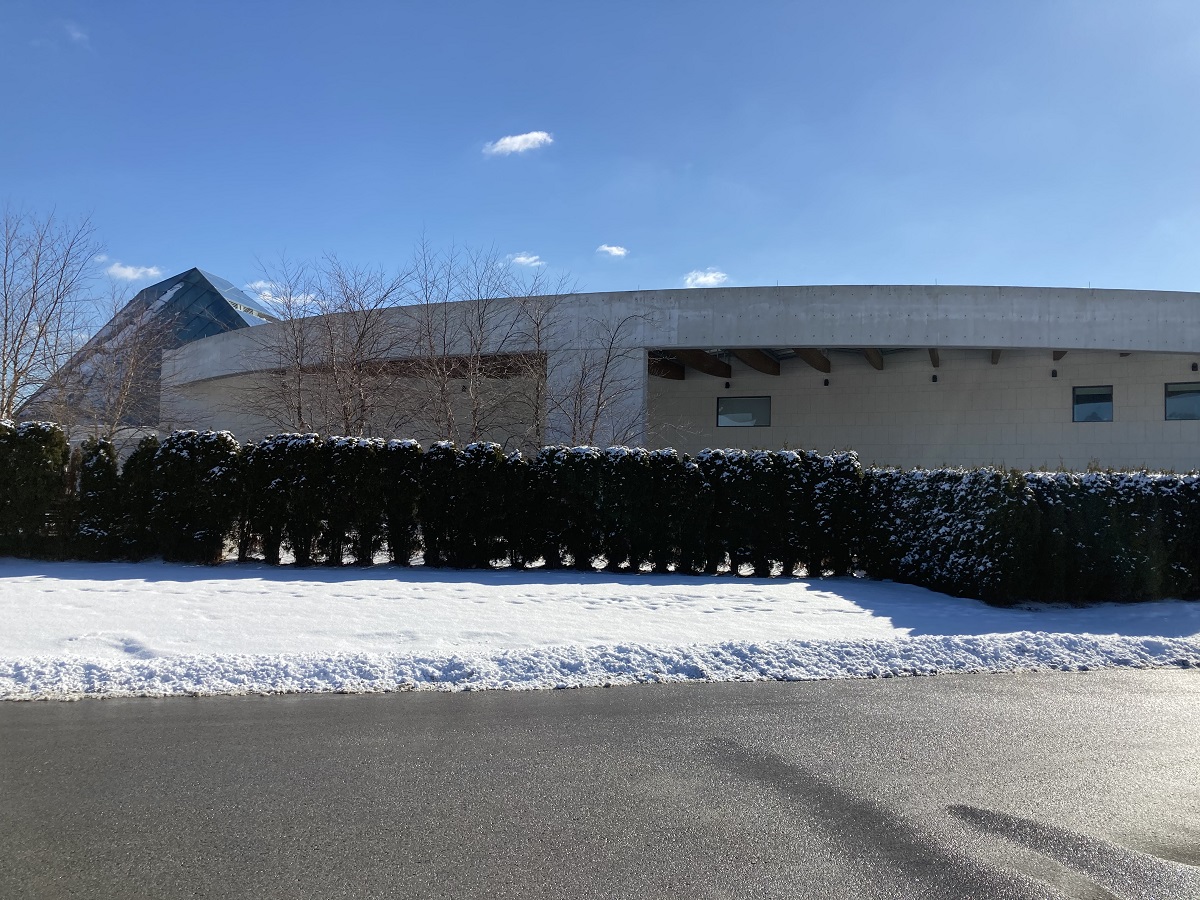
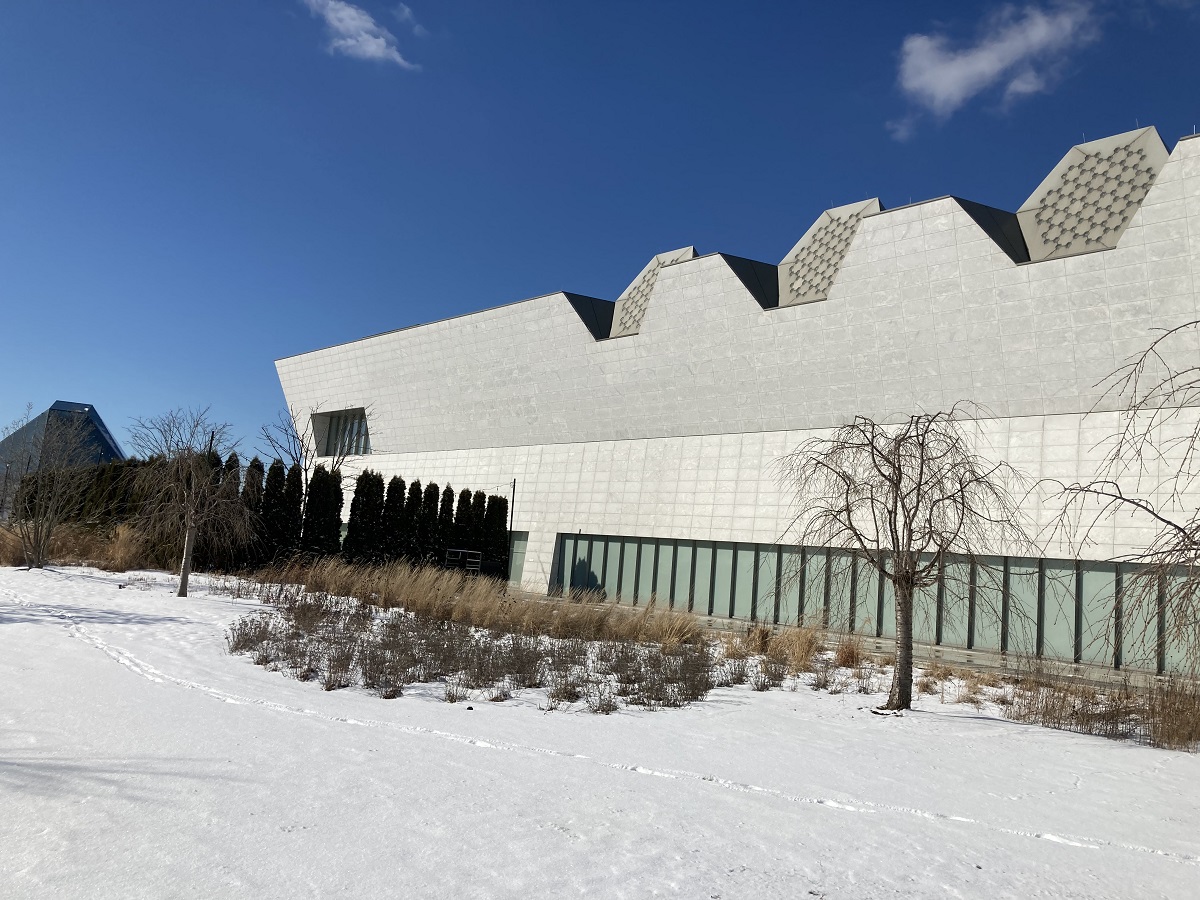
A view of the Aga Khan Museum’s main entrance bloc on February 14, 2021. Photo: Malik Merchant / Simerg.
I couldn’t have asked for a better and happier February 14, 2021. I woke up very early to complete an exclusive photo piece of Mawlana Hazar Imam His Highness the Aga Khan’s visit to Pemba on November 18, 1957. Looking out of the atrium windows across my living room facing North-West, I knew the sun was rising on the South-East side. It was -9°C and there was absolutely no wind. I had been cooped up inside for the past few days and wanted some fresh air. I brewed Colombian Supremo Coffee that I had purchased earlier during the week at St. Lawrence Market, filled a huge steel mug that keeps beverages boiling hot for about an hour, and headed to “What a Bagel” bakery on York Mills and Leslie, which was spewing out fresh hot bagels the minute I arrived there. “Give me a really hot one,” I said, and asked the ever-smiling server to make me a vegetarian sandwich. “Not toasted,” I reminded her, as many who come to the shop insist on having their order toasted, even if they are fresh from the oven.
I jumped into my car, turned it on with a low heat setting and enjoyed the bagel and coffee. What next? A visit to my Valentine, and I am sure that makes my readers curious. A meeting, maybe, at the Aga Khan Park?
So still was the wind at Aga Khan Park on February 14, 2021, that the flags of the Ismaili Imamat, the city of Toronto, the province of Ontario and Canada were unmoved! It was a beautiful day to savour at the Park in -5°C Celsius. Photo: Malik Merchant/Simerg.
Ismaili Centre main entrance with the Jamatkhana dome at left under blue skies on February 14, 2021. Photo: Malik Merchant/Simerg.
Who might that “lucky” Valentine be? In the absence of my lovely daughter who is several hundred kilometres away and my beloved mother who passed away only three weeks ago, I turned to my constant companions for several months — the Ismaili Jamatkhana dome, the Aga Khan Museum and the Aga Khan Park where I have experienced so much happiness and inspiration. I adore being there. Can one make non-human object(s) around you as your Valentine for February 14th? Not by the definition of Valentine’s, but I contrived one just for myself!
I cannot thank anyone but Mawlana Hazar Imam for his vision in conceiving and building three extraordinary spaces for the enjoyment of people in Toronto and everyone around the world. I am one of the lucky ones, who gets to visit the grounds as and when I like. February 14, 2021 was a very special day. There was beautiful light snow on the ground, the sky was blue and sunny, it wasn’t cold and the flags stood still in the absence of any windshield factor!
I FaceTimed my daughter Nurin to show her the beautiful environment that surrounded me. My face, she could see, had lit up.
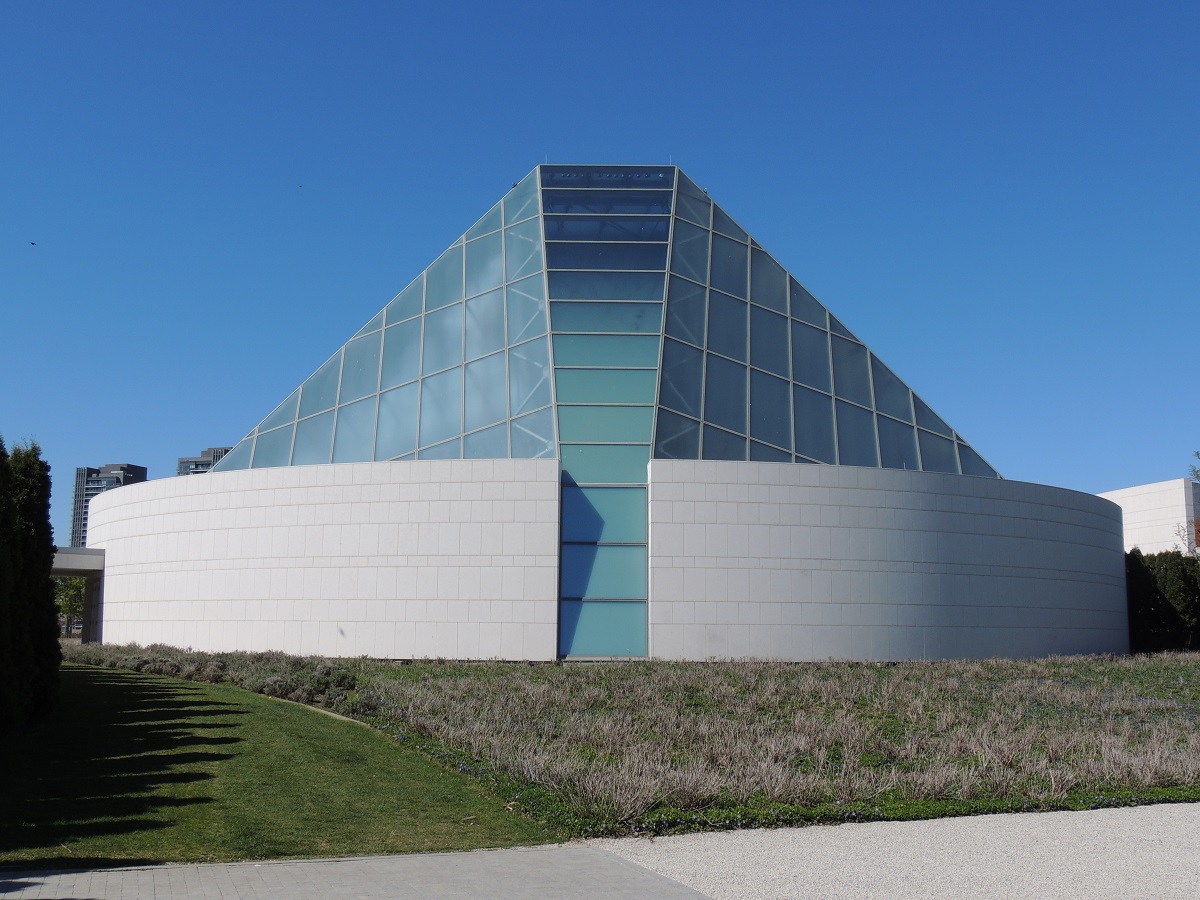
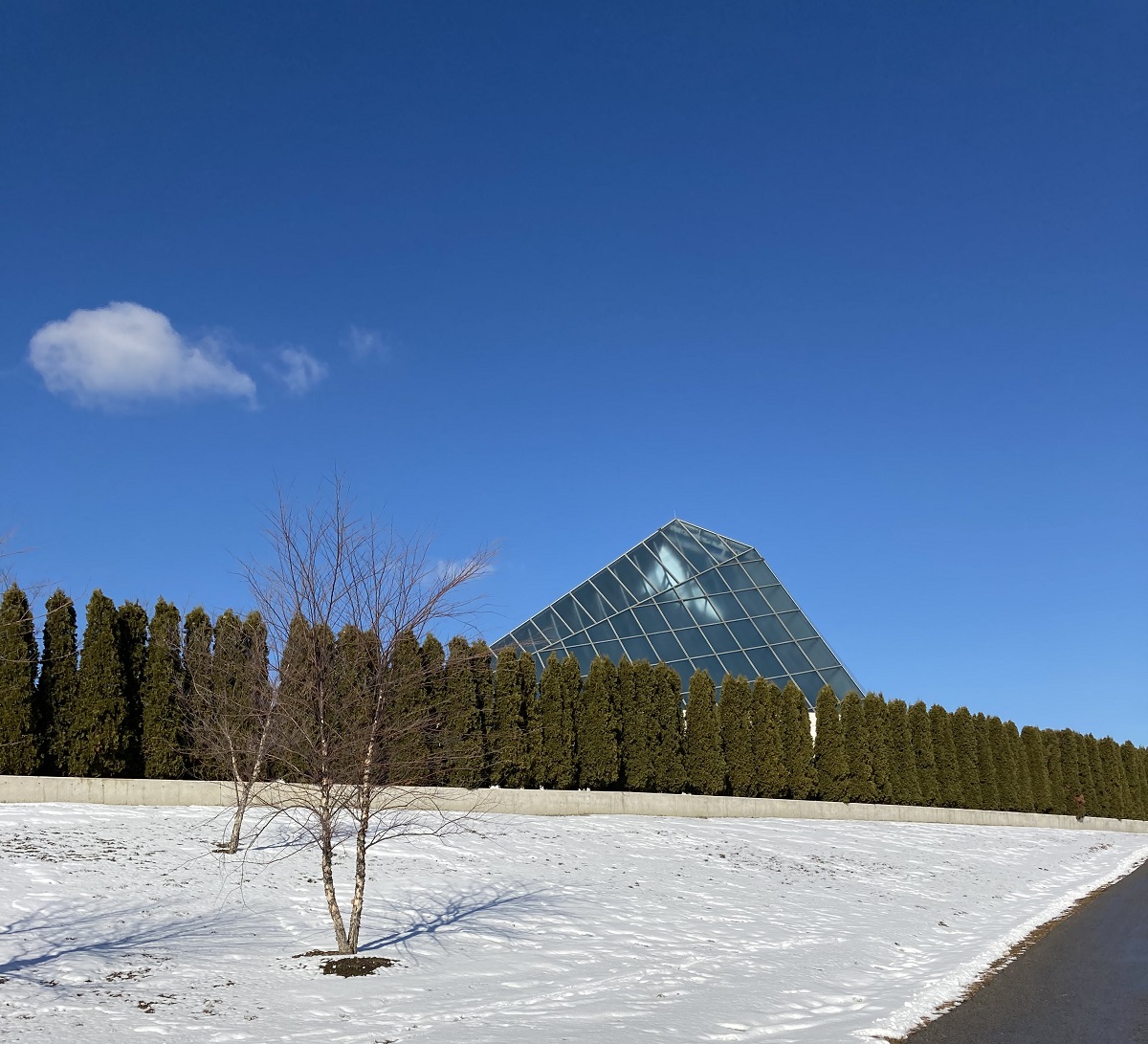
The dome of the Toronto Ismaili Headquarters Jamatkhana captured under sunny blue skies on Valentine’s Day, February 14, 2021. The glass niche in the centre of the circular wall faces the direction of Kaba where all Muslims face for prayers. Photo: Malik Merchant/Simerg.
A man walks by one of the snow covered ponds at the Aga Khan Park, with the Aga Khan museum in full view under sunny blue skies. Photo: Malik Merchant/Simerg.
A family with children walk on the Aga Khan Park trail under sunny blue skies on February 14, 2021. The dome of the Ismaili Jamatkhana at left reflects a rare white cloud in the sky, and the Aga Khan Museum building can be seen further away. Photo: Malik Merchant/Simerg,
A close up view of the CN Tower from the south east end of the Aga Khan Park on February 14, 2021. Photo: Malik Merchant/Simerg.
The Big Heech Sculpture located in front of the Aga Khan Museum’s main entrance bloc. Photo: Malik Merchant/Simerg.
A view of the Aga Khan Museum and the Ismaili Headquarters Jamatkhana dome from the grounds of Aga Khan Park. Photo: Malik Merchant/Simerg.
An amazing reflection of a rare cloud on the dome of the Ismaili Jamatkhana on an otherwise clear blue sky on February 14, 2021. Photo: Malik Merchant/Simerg.
After spending a good measure of my morning at the Aga Khan Park, I returned home to continue working on the Pemba photo essay for the remainder of the day, while many others would be enjoying their Valentine’s day with their partners in creative settings necessitated by Covid-19.
We welcome feedback from our readers. Please complete the LEAVE A REPLY form below or click Leave a comment. Your letter may be edited for length and brevity, and is subject to moderation.
Before departing this website please take a moment to review Simerg’s Table of Contents for links to hundreds of thought provoking pieces on a vast array of subjects including faith and culture, history and philosophy, and arts and letters to name a few. Also visit Simerg’s sister websites Barakah, dedicated to His Highness the Aga Khan, and Simergphotos.
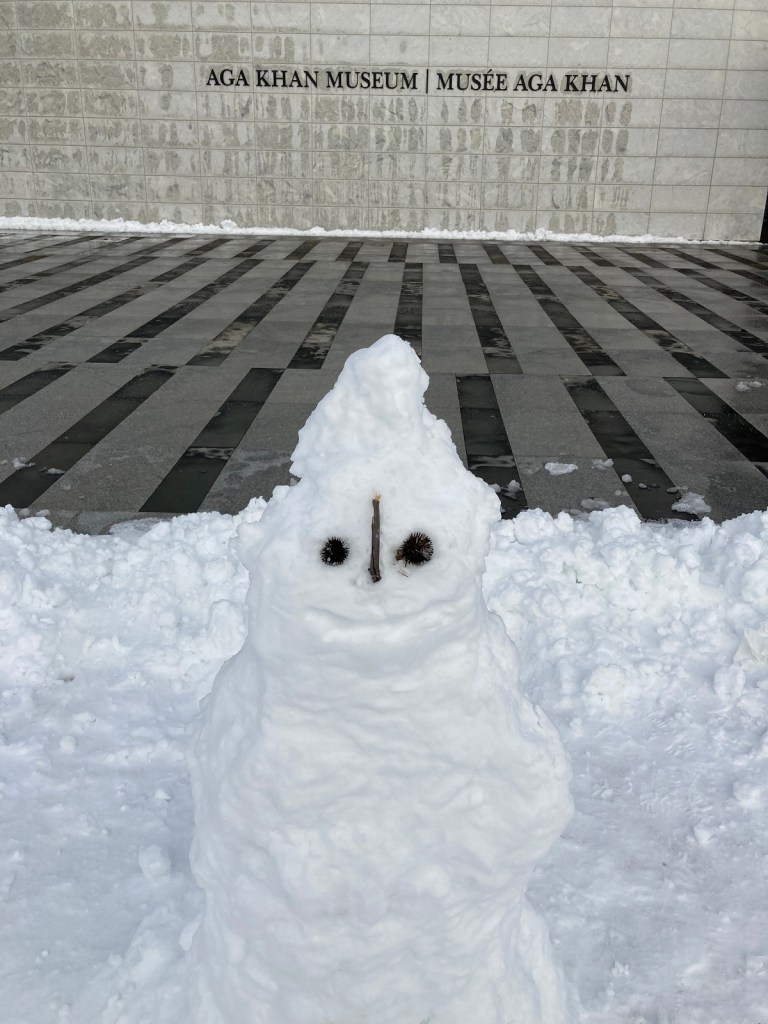
With more than 10 cms of overnight snow, affirming December 25, 2020 as white Xmas, Malik Merchant put on his winter boots, in addition to wearing warm clothes, and headed to his favourite spot armed with a fully charged camera, an orange and an apple (to keep the doctor away)! Someone’s genuine love for winter, however, put Malik behind in second place, as a cheerful looking snowman had already been constructed…..MORE
The Aga Khan Museum has been hosting the annual fund raising LAPIS event for the past few years, with Prince Amyn Muhammad Aga Khan honouring the event by personally attending it. Now due to Covid-19, the signature event has been reinvented with a broadcast from the Aga Khan Museum that everyone is invited to register for free.
The program on Thursday September 24, 2020 will be live streamed at 8 PM ET, and include remarks from Prince Amyn, Chairman of the Aga Khan Museum Board, meaningful conversations with acclaimed international artists on art in a changing world and four breathtaking performances with diverse talent from around the world.
The Aga Khan Museum invites you to join with friends and family from around the world as together it shares a unique message of hope, resilience and light. Please click HERE TO REGISTER.
Aga Khan Museum and Ismaili Centre 6th Anniversary
And while we are on the subject of the Aga Khan Museum, let us remind our readers that September 12, 2020 marked the 6th anniversary of the inauguration of the Aga Khan Museum and the Ismaili Centre by Mawlana Hazar Imam, His Highness the Aga Khan, and the then Prime Minister of Canada the Rt. Hon. Stephen Harper. The Museum officially opened to the public on September 18, 2014, with the Ismaili Centre Jamatkhana(known as the Toronto Headquarters Jamatkhana) opening to Ismaili community for prayers on Friday, September 19, 2014.
To commemorate the openings of the Aga Khan Museum and the Ismaili Centre as well as the annual Lapis event, we are delighted to present this thoughtful poem by Farah Tejani of Vancouver.
Celebrating the Aga Khan Museum and the Ismaili Centre in Toronto
Ismaili Imamat Projects on Wynford Drive, Toronto, Canada. The Ismaili Centre (with glass dome), the Aga Khan Museum and the Aga Khan Park.
By FARAH TEJANI
Two complementary sister structures of architectural elegance and splendor Jut out and pierce the heart of Toronto’s sky. The Aga Khan Museum and The Ismaili Centre.
United are they for the beneficial purpose of extending a hand Of Everlasting Friendship, Between Muslims and Non-Muslims alike. Uniting the Muslim Ummah, The World Ummah, With Cultural and Religious Tolerance and Respect…
Dispelling all deplorable depictions of Islam in the Media, By propagating the Truth:
Peace, Love, Brotherhood, Compassion, Spirituality and Prayer.
Yes, we extend a hospitable, gracious, loving hand of friendship, Celebrating Cultural Diversity, Historical Traditions, Arts and Artifacts, Awe-inspiring Calligraphic Designs and Structures, Tours, Recitals, Exhibitions, Theatre, Films and Educational and Cultural Activities.
The Ismaili Centre has unique and grand tiled floors Laced with elaborate, poignant calligraphy, Upon entering the prayer hall We begin every act beseeching God to Bless and Accept All Our Endeavours.
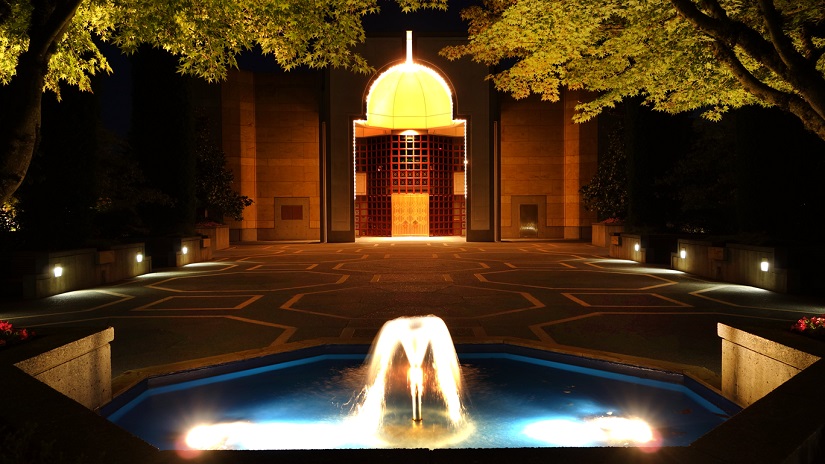
The Prayer Hall’s distinctive And elegant Crystalline dome, Illuminates the night sky, Reflecting itself into the pond, While angels come together to lift and carry, Each and every Murid’s, Most Earnest and Heartfelt Prayer To the stars: Just Outside Allah’s Door.
Comprising one fifth of the world, We are Muslims… Yet there is little known of our faith and traditions. These two buildings will stand side by side like Doves of Peace, Aiming to bridge the gap and promote Compassion and Understanding, Welcome, one and all.
Housing Well-Preserved Priceless Works of Art: Objects and Artifacts, From the Aga Khan and his Family’s Personal Collection, The Aga Khan Museum’s Relics will tell of themselves, For countless years to come.
Tradition and Modernity, Come and join together to create these Majestic Timeless Landmarks, For people from all parts of the world to enjoy.
As His Highness the Aga Khan said at the Opening Ceremony: “We are, after all, a community that WELCOMES THE SMILE!” With His Grace, many outdated notions of what Islam is Will be Demystified, And the Exemplary Fundamental Truths Unveiled For all to see.
So again we say Welcome… We extend a hand of Loyal and Loving Friendship, With Peace, Brotherhood, Unity and Prayer at the Core of Our Existence. And from the Heart of each and every individual Ismaili, We welcome you to Our Wonderful Universal and Timeless Tradition. Come discover, share and learn.
Date posted: September 29, 2020.
________________________
We welcome feedback from our readers. Please complete the LEAVE A REPLY form below or click on Leave a comment . Your letter may be edited for length and brevity, and is subject to moderation.
Farah graduated with her Bachelor of Arts in English Literature and her Master of Fine Arts in Creative Writing from the University of British Columbia in May of 1997 and earned top Honors for her Thesis on Short Fiction. With the help of her agent Barbara Graham she then went on to publish a collection of short stories published by Trafford, called, “Make Your Own Chai, Mama’s Boy!” — ten short stories dealing with different dilemmas South Asians face. Farah also wrote and co-directed her stage play, “Safeway Samosas,” which won “The Best of Brave New Playwrights Award” in July 1995. Her short story , “Too Hot” won third place in the “Canada-Wide Best Short Fiction Award.” and was read at The Vancouver Writers Festival. Currently, Farah is working on Childrens’ stories and a collection of poetry called, “Elastic Embrace” to be published in 2021. Her most recent poetic pieces are Behold the Light of Ali and The Great Sacrifice.
[This special piece for Simerg is a revised version of the original article by the author that was published in Khojawiki in July 2020 — Ed.]
In 1933, in the midst of a global recession, a landmark building, a prayer house, arose in the center of a small provincial town in the interior highlands of Africa. The story of this remarkable building had its genesis in Kutch based family patriarch by the name of Hamir Pradhan, my great grandfather.
The Hamir family of Sinogra/ Nagarpur districts of Kutch was remembered as a reasonably prosperous and enterprising family in the latter half of 1800s. Hamir Pradhan had sired eight sons and one daughter. He was also a person of deep faith and community service. He had built and donated a small Jamatkhana in Sinogra. There is evidence that Hamir Pradhan had created a legacy of community service and sacrifice that left deep impression on his children and the community in Kutch.
During early part of 1900s, six of the Hamir male siblings had joined the large scale migration of peoples from Kutch, Kathiawaar and other parts of Gujarat plagued by large scale famine, to the colonized countries of eastern and southern Africa. One of the young men among these siblings to migrate was Mohamed Hamir Pradhan, my grandfather. He was married to Bachibai, my grandmother. She and their first born daughter Fatma, who was around 3 years at the time, were to join my grandfather in Africa several years later.
My grandfather, Mohamed Hamir (Pradhan) was born in Sinogra, Kutch in 1880. Following his siblings, in 1902, he arrived in Tanganyika (now Tanzania), a German colony at the time. After a short stint in Kilosa with one of his brothers, Haji Hamir, he followed another brother, Satchu Hamir, to Iringa, a quintessential German/British colonial outpost town in the Southern Highlands, where he went to work for him in his retail (duka) shop. He helped his brother expand his business to inland villages, often traveling for weeks with a caravan of porters carrying merchandise. In 1905, three years after his arrival in Tanganyika, he formed his own business.
Benefiting from his trading experience and extensive contacts with both the German and later British colonialist, he was able to capitalize and benefit from the war economy of the First World War (1914-1918). Over the next three decades he became a successful entrepreneur in retail and residential real estate development. Also over the next several years he and my grandmother Bachibai who had joined him from Kutch, expanded the family to include three more daughters and a son. This expanded, and eventually extended family through marriages, was to play a large role in my grandfather’s business successes, and more importantly in helping him achieve his ultimate legacy. Since his son, my father was only 12 or 13 years of age, his daughters played a key role in running his retail business and were deeply involved on his legacy project.
The names of my grandfather’s children and their marital families are (chronologically): daughters Fatma Mahamed Ladha, Sikina Bhimji Asser Sachedina, Jena Ramzan Parpia, and Rehmat Fazal Manji; and son and daughter-in law Akbar and Kulsum Mohamed Hamir.
In early 1930’s and in the midst of The Great Global Economic Depression, our grandfather embarked on a project that would become a matter of pride and an important legacy for our family and the Ismaili community of Iringa. Inspired by his father Hamir Pradhan’s generosity and community service, as well as his own deep faith, he proposed to the community that he wanted to build a Jamatkhana complex and donate it to the Imam for benefit of the Ismaili community in Iringa. My grandfather’s proposal called for a two story Jamatkhana building with a capacity for 600 people, four times the Jamat size at the time. The complex was to include primary school facilities, a social hall, a guest house (dharmshara) and a recreation compound. The building was to be located right in the middle of the main street, which later was named as Jamat Street, a tribute to the Ismaili community of Iringa for the Jamatkhana building that manifested prominently on the street.
With perseverance and after several design changes, he was able to get an agreement on his plan and approval for the project from the appropriate jurisdictional leadership as well as our Imam. The construction was commenced in 1931 and completed in 1933. Due to drastic economic conditions, my grandfather had to resort to borrow money to complete the project. Several prominent families had stepped up to lend him the money. Our family folklore describes his obsession with the project that was of legendary proportion. At times, things got so desperate that he personally and physically toiled on the projects along with our family members to help the project move along to completion.
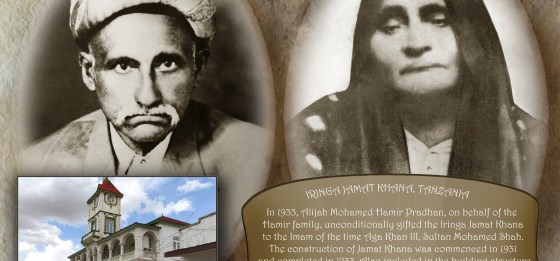
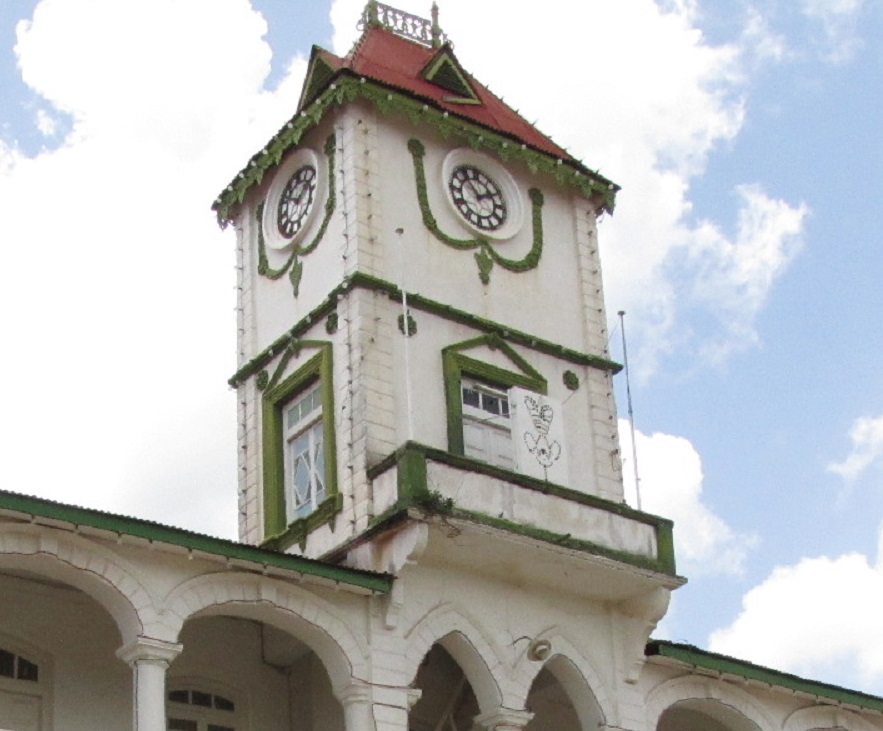
Street scene with Iringa Ismaili Jamatkhana standing out prominently with its high tower and clock. The Jamatkhana was completed in 1933 with the support and initiative taken by Alijah Mohamed Hamir Pradhan. Photo: Courtesy Shafin Haji.
At the time of the completion of the Jamatkhana in 1933, it was reported to be one of the best in Tanganyika, and architecturally one of the most beautiful in the whole of East Africa. Over the next twenty-five years the Ismaili Jamat in Iringa grew five-fold, exceeding the original capacity of 600. The Jamatkhana complex was not only the anchor of the community, but also a major catalyst for the growth of the Ismaili community in Iringa. Later in the 1960s, my father, Alijah Akbar Mohamed Hamir, expanded the capacity of the Jamatkhana to accommodate the growing Khoja Ismaili community in Iringa.
At the Golden Jubilee of Imam Sultan Mahomed Shah in Nairobi 1936, our grandparents were scheduled for special audience with the Hazar Imam in order to formally present the gift of the Iringa Jamatkhana. However due to the last minute illness of my grandmother they were not able to make the long journey to Nairobi. Our Imam accepted their gift in their absence, and conveyed much appreciation and blessings to them and to their family. This was the happiest moment in our grandfather’s life! The Imam also bestowed on him an honorific title of Alijah.
A close up view of Iringa Ismaili Jamatkhana, completed in 1933 with the support and initiative taken by Alijah Mohamed Hamir Pradhan. Photo: Courtesy Shafin Haji.
An enlarged view of the prominent bell clock of the Iringa Jamatkhana. Photo: Courtesy Shafin Haji.
Since its manifestation almost 90 years ago, the Iringa Jamatkhana continues to stand as symbol of the town’s identity. Located in the heart of the town, the high and prominent clock tower, adoring the architecturally beautiful building, remains the emblem and inspiration to the local and diasporic community of Iringa. Its large bell clock and high visibility reminds people to the calling of the time, and the out-of-town visitors to their bearings.
It is a source of pride for our community and our family to have the Jamatkhana be such an iconic monument of the town. It is also a tribute to my grandfather’s foresight, faith, leadership and perseverance. His generosity and service to the community is a remarkable legacy and an inspiration for our family and for the future generations.
Date posted: August 2, 2020.
We welcome feedback/letters from our readers. Please use the feedback box which appears below. If you don’t see the box please click Leave a comment. Your comment may be edited for length and brevity, and is subject to moderation. We are unable to acknowledge unpublished letters
___________________
Mohamed Hamir
About the author: Mohamed Hamir, originally from Tanzania, has lived in numerous locations throughout USA since 1969. He is a retired financial services executive including a 20 year career with Citibank in the USA. He has an undergraduate degree in science from London University, UK and an MBA in finance from Indiana University. His work experience and extensive travel included both USA domestic and international markets.
Since his retirement in 2001, he has been passionate about causes involving female infanticide and education of marginalized children. He is on the Advisory Board and member of the LEADers Circle of PRATHAM USA, a prominent global educational NGO. He is also the Executive Producer of “Petals in the Dust”, an award winning documentary exposing gender discrimination, girl killing and violence against women in India.
Among his numerous services to the Ismaili community, he has served as both Mukhi and Kamadia of the Jamats in the USA. From 1988 to 1991 he served as a member of the National Council for USA with a portfolio of fund raising for Jamatkhanas. In 1968, when he was a student in London, he co-founded and was the first president of the inaugural Aga Khan Sports Club of U.K. He currently resides with his family in Southern California.
___________________
Before departing this website please take a moment to review Simerg’s Table of Contents for links to hundreds of thought provoking pieces on a vast array of subjects including faith and culture, history and philosophy, and arts and letters to name a few.
















 Simerg - Insights from Around the World