Simerg is an independent initiative dedicated to Ismaili Muslims, the Aga Khan — their Hereditary Imam — and the Ismaili Imamat, and Islam in general through literary readings, photo essays and artistic expressions
On the occasion of his 84th birthday or Salgirah on December 13, 2020, His Highness the Aga Khan has sent a special message, traditionally referred to as a Talika, to his followers around the world. The Talika is published HERE in English, French, Portuguese, Farsi, Arabic, Gujarati, Tajik, Urdu and Russian.
We have an insightful article for our readers on the significance of the Aga Khan’s birthday. To read it, please click HERE or on the Salgirah Mubarak greeting shown below.
We convey Salgirah greetings to our readers, Ismailis and non-Ismailis alike, and wish everyone and their families happiness and success as well as courage, strength and good health — especially in the present time of a global pandemic. We further hope and pray for the fulfillment of all your wishes. Ameen.
The calligraphy in this beautiful Salgirah Mubarak greeting celebrating the 84th birthday (Salgirah) of Mawlana Hazar Imam, His Highness the Aga Khan, was created by Karim Ismail of Toronto, and represents the Aga Khan’s name “Nur Mawlana Shah Karim al Hussaini” in Fatimid Kufi script. Please click on image to read article on significance of Salgirah.
Britain has vaccinated its first citizen against the COVID-19 virus.
Ninety-year-old nursing home resident Margaret Keenan received the first of two doses of a vaccine jointly developed by U.S.-based pharmaceutical giant Pfizer and Germany’s BioNTech.
The vaccination campaign, dubbed “V-Day” by Health Secretary Mark Hancock, began nearly a week after the government’s medical regulatory agency granted emergency approval for the vaccine, making Britain the first western nation ready to begin mass inoculations.
The approval came weeks after Pfizer announced the vaccine had been shown to be more than 90% effective after its final clinical trial.
Keenan, who will turn 91 next week, is among the thousands of nursing home residents and their caregivers, along with staffers with Britain’s National Health Service, that have been prioritized by officials to receive the first shots.
Britain received 800,000 doses of the Pfizer/BioNTech vaccine Sunday, the first of a total of 40 million it purchased from Pfizer. Great Britain has a population of more than 66 million people. Delivery of the vaccine is complicated by the fact that it must be stored in super-cold refrigerators at temperatures below 70 degrees Celsius.
Britain has recorded more than 61,000 deaths since the start of the pandemic, one of the world’s hardest-hit countries and the worst affected country in Europe.
The start of the coronavirus vaccination campaign in Britain comes as many other nations inch closer and closer to beginning their own inoculation efforts.
South Korea and Canada
The South Korean government announced Tuesday that the Pfizer/BioNTech vaccine is one of a handful it has secured for its 44 million people. The Health Ministry says it has pre-ordered 64 million doses of vaccines under development by Pfizer, British-based pharmaceutical giant AstraZeneca, and U.S.-based drug makers Johnson & Johnson and Moderna, for 34 million South Koreans.
Seoul says another 10 million people will receive vaccines developed by Pfizer, AstraZeneca and French pharmaceutical company Sanofi and secured through the COVID-19 Vaccines Global Access Facility, or COVAX, the joint project between the World Health Organization, the Coalition for Epidemic Preparedness Innovations and Gavi, The Vaccine Alliance, an organization founded by Bill and Melinda Gates to vaccinate children in the world’s poorest countries.
Canada announced Monday it would receive its first doses of the same vaccine by the end of December.
Canadian Prime Minister Justin Trudeau said Monday [see excerpts below] that up to 249,000 doses of the vaccine would arrive this month, and 3 million are slated to be delivered early next year. Canada has a population of more than 37 million people.
Separate Developments: India and Indonesia
In a separate development, the Serum Institute of India has applied for emergency use of a COVID-19 vaccine under development by British pharmaceutical giant AstraZeneca in collaboration with the University of Oxford. Serum, the world’s largest vaccine manufacturer, is leaning heavily toward the AstraZeneca/Oxford vaccine because it can be stored at 2 to 8 degrees Celsius, as opposed to the super-cold requirements of the Pfizer/BioNTech vaccine.
Indonesian President Joko Widodo announced Sunday the country has received a shipment of a coronavirus vaccine developed by China’s Sinovac biotechnology company. The vaccine is still undergoing testing in Indonesia, where the government is making final preparations for an initiative to inoculate as many as 270 million people.
WHO urging for persuasion over mandating vaccinations
While WHO officials are urging governments to persuade their citizens to get vaccinated, public health experts warn that a mandate may not be the right approach.
“I think all of us who work in public health would rather avoid that as a means for getting people vaccinated,” WHO’s emergencies director Michael Ryan told a virtual press conference Monday.
The world has more than 67.6 million total COVID-19 cases, including more than 1.5 million deaths. The United States leads the world in both categories, with 14.9 million total cases and more than 283,700 deaths, according to Johns Hopkins University.
The Pfizer-BioNtech vaccine against the coronavirus must be stored at extremely cold temperatures, raising some concerns about the difficult task of moving it across the United States for inoculations. But dry ice companies across the U.S. say they’re up for the challenge. Voice of America’s Esha Sarai spoke with one such company in Baltimore, Maryland
Covid-19 vaccinations in Canada: Excerpts from remarks by Prime Minister Justin Trudeau
December 7, 2020, Ottawa, Ontario
Canada has secured an agreement with Pfizer to begin early delivery of doses of their vaccine candidate.
We are now contracted to receive up to 249,000 of our initial doses of Pfizer-BioNTech’s COVID-19 vaccine in the month of December.
Pending Health Canada approval, the first shipment of doses is tracking for delivery next week.
Shipments will continue to arrive into 2021, with millions of doses on the way.
This will move us forward on our whole timeline of vaccine rollout, and is a positive development in getting Canadians protected as soon as possible.
Pfizer, the Public Health Agency of Canada, and the provinces and territories, are working together to finalize preparations at the first 14 vaccination sites this week.
I want to assure Canadians that any vaccine approved in Canada will be safe and effective.
The regulatory process is ongoing and experts are working around the clock.
They will uphold Canada’s globally recognized gold standard for medical approvals.
We also have agreements with six other vaccine candidates, making our range of potential vaccines the broadest and most diverse in the world.
In addition to Pfizer-BioNTech, there are also Moderna, AstraZeneca-Oxford, and Johnson & Johnson who have already submitted their vaccine candidates to Health Canada.
We are working hard to ensure that Canadians have access to a safe and secure vaccine as soon as possible, as soon as the doses are ready.
Date posted: December 8, 2020.
Before departing this website please take a moment to review Simerg’s Table of Contents for links to hundreds of thought provoking pieces on a vast array of subjects including faith and culture, history and philosophy, and arts and letters to name a few.
Inna lillahi wa inna ilayhi raji’un “Surely we belong to God and to Him we return” — Holy Qur’an, 2:156
“Life is a great and noble calling, not a mean and grovelling thing to be shuffled through as best as we can but a lofty and exalted destiny.” — Mawlana Sultan Mahomed Shah, His Highness the Aga Khan III (1877-1957), 48th Imam of the Shia Imami Ismaili Muslims.
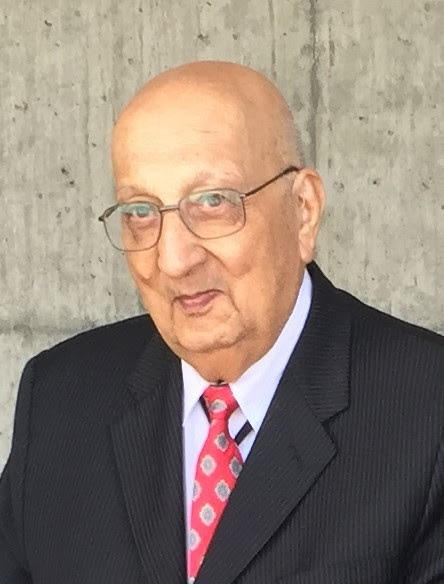
Alwaez Rai Sultanali Mohamed (March 17, 1927 – November 28, 2020). Photo: Family collection.
It is with deep sadness that I inform readers of the passing away of a great and learned missionary in the Ismaili community, Alwaez Rai Sultanali Mohamed, on November 28, 2020 in Vancouver at the age of 93.
Alwaez Rai Sultanali Mohamed, also known as Missionary Saheb, was born in Mumbai on March 17, 1927, and became an Alwaez in Mumbai studying under very prominent professors and Waezein with a group of other new missionaries that included the Late Alwaez Rai Jehangir Merchant and Alwaeza Raisaheba Malek Merchant. His wife Alwaeza Raibanu Rahematkhanu joined the Waezin training program a year later.
Alwaez Rai Sultanali Mohamed, like his wife Missinarybanu Rahematkhanu, was a deeply religious man with an extraordinarily strong belief in the Ismaili faith, and a profound devotion and love for Mawlana Hazar Imam, His Highness the Aga Khan. Missionarybanu predeceased him, passing away in Vancouver in October 2010 at the age of 77.
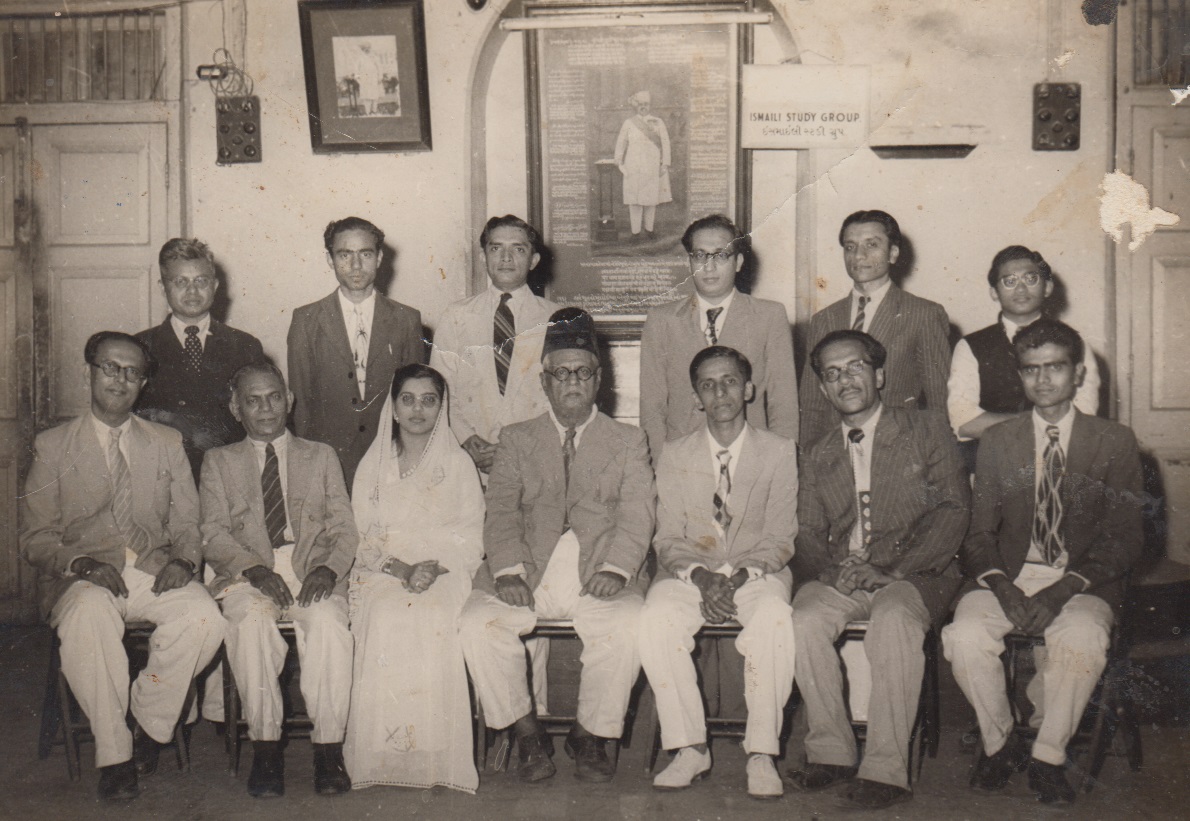
Alwaez Sultanali Mohamed (standing 4th from left) with fellow students, including Maleksultan and Jehangir Merchant (seated 3rd and 5th from left) and lecturers of a waezin training program that was established in the early 1950’s to train new Ismaili missionaries. Photo: Jehangir Merchant Collection.
Alwaez and Alwaez initially began their service in Mumbai, and soon after their wedding the young couple emigrated to Kisumu, Kenya, in 1957. Whilst continuing in their respective professions in Kisumu, they rendered voluntary service with dedication and devotion as Alwaezein for many years, in various cities in Kenya and to the jamats of other countries.
Alwaez Sultanali had a deep-rooted love for knowledge and spent many hours in research, which furthered his deep knowledge of Islam and the Ismaili Tariqah. He wrote a Ginan book called Wonderful Tradition, and a book on the Ismailis in Gujarat called Heroes of Surat. He also curated the content of the monthly Chandraat Bulletin in Kisumu. The books and the bulletin were published by the Ismaili Tariqah and Religious Education Board for Kenya (ITREB), which was was then known as the Ismailia Association.
Alwaez was an authority in the field of the esoteric meaning of our Ginans and was a mentor to many on this subject. Until recent years, he conducted special Ginan talks on a weekly basis, and through his easy teaching style and kind and friendly nature, he touched the hearts of all who attended his sessions as well as everyone who knew him or met him. His departure is a great loss to his family, friends and the Jamat.
On a personal note, the late Alwaez was a great family friend and I vividly recall the few days we spent with his loving family in Kisumu. He made it a point to take us to the shores of Lake Victoria every evening until we would be able to sight a hippo. He fulfilled that promise, and one can imagine our delight at seeing the animal as young kids. That was my first memory of Alwaez and Alwaeza, who as I found out through the course of my life were always intimately connected with my parents.
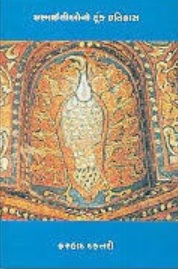
The cover page of the Gujarati translation of Farhad Daftary’s book A Short History of the Ismailis. Entitled Ismailio-no Tunk Ittihaas, the translation was done by missionaries Sultanali Mohamed and Jehangir Merchant.
Indeed, my late dad Alwaez Jehangir sought his constant advice on various terms in the Gujarati language, and was proud to have him as co-translator of Farhad Daftary’s book A Short History of the Ismailis. Alwaez Sultanali was also well known for his expert knowledge of the Khojki script. His contributions to the Institute of Ismaili Studies includes the translation of some Khojki literature into English.
Missionarysaheb and Missionarybanu will be remembered fondly by the Jamat for enhancing their spiritual knowledge and by the young students that stayed in the Aga Khan Hostel in Kisumu where they were wardens for a few yew years as their beloved Sir and Bai.
Alwaez and Alwaeza are survived by their three children: daughter Dr. Nevins married to Dr. Zuheir Saeed; son Akber married to Nasira Lakha and son Amanullah married to Nimet Babul, together with five grandchildren and two great grandchildren. This is a sad moment for the family, especially with his passing coming at a time when many of us want to pay our personal respects and be at his funeral, and simply can’t because of the restrictions that are in place due to the Covid-19 pandemic.
His funeral will take place in Vancouver on Wednesday, December 9. Relatives, friends and well wishers of the missionary may contact Alwaez’s daughter at Nevins@shaw.ca. We also invite our readers to submit their condolences, memories and tributes to the late missionary Sultanali Mohamed by completing the feedback form below or by clicking on Leave a comment.
We pray for the peace and eternal rest of the soul of Alwaez Rai Sultanali Mohamed. Amen. We also convey our deepest heartfelt condolences to members of his family for strength and courage to face his great loss. Our prayers are with them at this time of bereavement.
Date posted: December 6 , 2020.
____________________
We invite our readers to submit their condolences, memories and tributes to the late missionary Sultanali Mohamed by completing the feedback form below or by clicking on Leave a comment. The family of late Sultanali missionary welcomes your emails regarding any questions you might have on the funeral ceremony or other related matters. Please address your email to nevins@shaw.ca.
Simerg invites Ismaili families to submit obituaries and tributes for deceased members of their families. For guidelines, please click Passings.
Before departing this website please take a moment to review Simerg’s Table of Contents for links to hundreds of thought provoking pieces on a vast array of subjects including faith and culture, history and philosophy, and arts and letters to name a few.
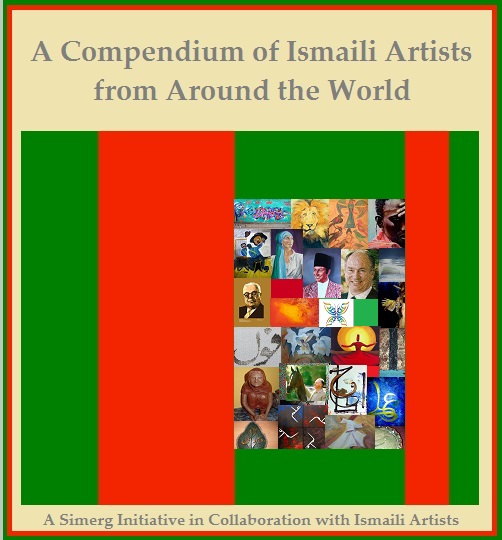
The Golden and Diamond Jubilees of Mawlana Hazar Imam, His Highness the Aga Khan, revealed and showcased the amazing talent of the artists in the Ismaili community. Hundreds of young children and youth as well as elderly members of the Jamat participated in locally held programs during the Golden Jubilee. Ten years later, the Diamond Jubilee became truly international in scope, and the final celebrations in July 2018 in Lisbon brought together a large gathering of a variety of artists including film makers, singers, dancers as well as fine art and visual artists to perform in front of large crowds and display works of art at an international gallery. Their high quality performances captivated audiences daily throughout the Diamond Jubilee Celebrations.
Please click on image to download 2014 edition of compendium. We invite new entries and updates from Ismaili visual artists for the revised edition to be published in 2021.
Some years ago, Simerg produced a highly acclaimed Compendium of Ismaili Artists dedicated to the visual arts. It requires a major and long overdue update! Simerg sincerely hopes that Ismaili visual artists from around the world will go through the compendium and submit their profiles as illustrated in the compendium. Simerg plans to update the compendium and produce a new edition by the autumn of 2022. Please submit your profile and a work of art to Malik Merchant at his email address mmerchant@barakah.com (a common email address for this website, Simerg, as well as its two sister blogs barakah and simergphotos).
The institutional support for the arts has been truly commendable, and we hope that such support will continue.
The Ismaili literary scene had been somewhat dormant for quite some time until the emergence of Moez Vassanji who is one of Canada’s most celebrated writers. He is a prolific writer whose published work include novels, short story collections and non-fiction collections. Moez is a two time Giller Prize winner and has received numerous other awards and recognitions. In February 2005, he was made the Member of the Order of Canada for contribution to arts/writing.
Talented Ismaili Writers
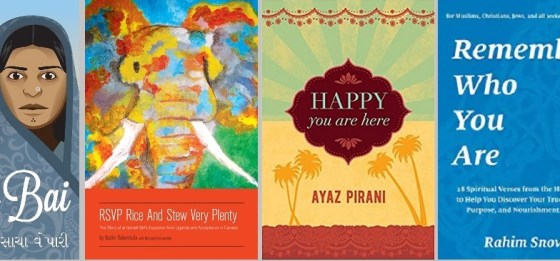
Cover pages of a few of the dozens of books authored by Ismailis.
But what about other fine Ismaili authors who have appeared in the writing scene over the past two decades? They have remained virtually unknown to the community at large. Personally, I would have liked to have seen their works to have been sold through the Jamatkhana literature counters around the world, and for the authors to be given an opportunity to do readings in front of audiences, at least at their local Jamatkhana setting. We hope that when the pandemic is over this suggestion will be taken up by our institutions and that Ismaili authors who feel they have written a book that is worthy of reading because of its overall publication quality and literary merit will be able to present themselves to the Jamat, sell their books and sign them for Jamati members who wish to purchase their works. Many authors market and sell their books via on-line sellers such as Amazon, but institutional support and encouragement is vital for their exposure to a world wide Jamat.
Simerg invites Ismaili writers to come forward and submit a synopsis of their book for publication on this website. In addition, we want each writer to respond to the following questions in no more than 50 words per question:
(1) What is behind the naming of the title of the book?
(2) Why would you want me or my family members to read the book, and what will we all learn from it?
(3) What inspired you to write the book?
(4) How can I purchase the book and what are its available formats (ebook, kindle, hardback, paperback?)
Response to the following questions are optional:
(5) How did you find a publisher for the book?
(6) Did you hire an editor, an illustrator or did you do all the work by yourself?
(7) Which was your first book and how many have you written?
(8) How long did it take you to write the book – from start to finish and to begin marketing it?
(9) Tell us something more about your book (and its primary character).
Categories for inclusion in our listing: Novels, short stories, inspirational books, biographies, poetry, jigsaw puzzles as well as all non-fiction on diverse subjects (except religious and literary works published by the Institute of Ismaili Studies).
Languages: We will list books published in English, French, Portuguese, Spanish and Kiswahili, but the synopsis must be submitted in English. Books in other languages will be considered for listing at a later date.
Your response: Authors should submit their responses to the 9 questions accompanied by the book’s synopsis in English and an image of the cover page to the attention of Malik Merchant at mmerchant@simerg.com. If your book has been reviewed or is available for on-line purchase, you may provide link(s) to the book reviews and where the book is available for purchase. If you have a website dedicated to your literary work(s), please provide the address of your website.
Simerg looks forward to a fantastic response from Ismaili artists and writers on these two projects dedicated to them.
Ismaili Author Series: Featured Books (as of August 20, 2025)
Date posted: December 3, 2020. Last updated: August 20, 2025.
________________________
Before departing this website please take a moment to review Simerg’s Table of Contents for links to hundreds of thought provoking pieces on a vast array of subjects including faith and culture, history and philosophy, and arts and letters to name a few.
We welcome feedback from our readers. Please complete the LEAVE A REPLY form below or, if you don’t see the box, please click Leave a comment. Your letter may be edited for length and brevity, and is subject to moderation.
Simerg’s Malik Merchant at the courtyard of the Aga Khan Museum, Toronto
Malik Merchant is the founding publisher/editor of this website, Simerg (2009) as well as two other blogs Simergphotos (2012) and Barakah (2017). Formerly an IT consultant, he now dedicates his time to family projects and his 3 websites. He is the eldest son of Alwaez Jehangir Merchant (1928-2018) and Alwaeza Maleksultan Merchant (1931-2021) who both served Ismaili Jamati institutions for several decades in Mozambique, Tanzania, Pakistan, the UK and Canada in both professional and honorary capacities as teachers and missionaries. Malik’s daughter, Dr. Nurin Merchant, assists him as an honorary editor of the three websites. She received her veterinary medicine degree with distinction from the Ontario Veterinary College (2019, University of Guelph) and now works as a veterinarian.
It is with deep sadness and a heavy heart that we announce the death of James D. Wolfensohn on Wednesday, November 25 2020 at his home in Manhattan at the age of 86.
I reached out to the Institute for Advanced Study (IAS), where Mr. Wolfensohn served as the past chair of the board, to allow Simerg to reproduce the obituary that has been posted on its website. We sincerely thank Lee Sandberg the press contact at IAS for the permission. For the information of our readers, The Institute for Advanced Study is one of the world’s foremost centers for theoretical research and intellectual inquiry. Located in Princeton, N.J., the IAS is dedicated to independent study across the sciences and humanities. Founded ninety years ago, the Institute is devoted to advancing the frontiers of knowledge without concern for immediate application. From founding IAS Professor Albert Einstein to the foremost thinkers of today, the IAS enables bold, curiosity-driven innovation to enrich society in unexpected ways.
His Highness the Aga Khan (left) at a Press Conference on February 22, 2005 in Geneva, Switzerland, announcing the launch of the new Aga Khan Agency for Microfinance (AKAM) to help some of the world’s most vulnerable populations through innovative services including micro-insurance, small housing loans, savings, education and health accounts, and support for small entrepreneurs seeking to develop businesses related to restored cultural assets. The Aga Khan was joined at the news conference by Jim Wolfensohn, President of the World Bank (right) and John Fergusson, AKDN Head of the Department of Public Affairs. Photo: AKDN/Jean-Luc Ray.
On a personal note, I was present on January 25, 2005 at the National Building Museum in Washington D.C. when Mr. Wolfensohn introduced Mawlana Hazar Imam as the recipient of the Vincent Scully Prize. As an Ismaili, the tribute I heard is perhaps one of the finest and most touching I have ever heard or read during Mawlana Hazar Imam’s entire Imamat. Here is an excerpt from the tribute. The link to the complete tribute follows the obituary.
“In my 10 years at the bank, I’ve had the opportunity of meeting many people in the so-called development business. People that are concerned with the issues of poverty, people that in various ways display their interest in humanity, their concern for history, their concern for hope and for the future. And in that 10 years, I can tell you that there is one person who stands out in my mind as an icon of not only thought and philosophy but of action. And I have to say this in front of His Highness, that I don’t say this about everybody in the development business. He has truly done the most amazing job not only for the Ismaili community throughout the world, but really for all the communities that he serves.”
SIR JAMES D. WOLFENSOHN
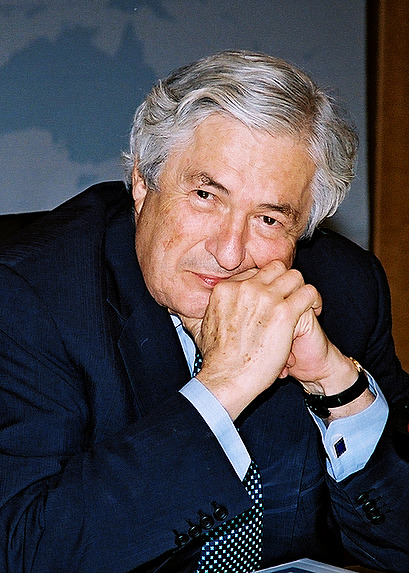
The following obituary and accompanying portrait photograph is reproduced with the permission of the Institute for Advanced Study where Mr. Wolfensohn had served as the chair of the Board. Please click James D. Wolfensohn to read the obituary at source, and to learn more about the work of the organization.
James D. Wolfensohn (December 1, 1933 – November 25, 2020)
Sir James D. Wolfensohn, Chairman of Wolfensohn & Company, L.L.C. and a global champion of human rights, economic justice, scholarship, and the arts, died on Wednesday, November 25 at his home in Manhattan at the age of 86.
Wolfensohn was the ninth president of the World Bank, sworn into office on June 1, 1995, after being nominated by President Bill Clinton. A transformative and hands-on leader, Wolfensohn re-envisioned the Bank’s commitment to alleviating poverty, investing in sustainable development, and promoting social justice globally.
In 1979, Wolfensohn joined the Institute for Advanced Study’s Board of Trustees and became the Board’s longest-serving Chair (1986–2007). Wolfensohn had a passionate commitment to the Institute’s mission of enabling the world’s foremost scholars to conduct breakthrough research at the highest levels of academia.
“Jim embraced the world and everything in it—its challenges, the arts, science, politics, and people most of all,” stated Robbert Dijkgraaf, IAS Director and Leon Levy Professor. “A man of no excuses and a boundless diversity of interests, Jim believed in and harnessed the enormous potential of the human spirit for the common good. We are eternally grateful for the wisdom and generosity he brought to the Institute and world for which he cared so deeply.”
James David Wolfensohn was born on December 1, 1933, in Sydney, Australia. He was a veteran of the Royal Australian Air Force and a member of the 1956 Australian Olympic fencing team. Educated at the University of Sydney, he received a B.A. and LL.B. in 1954 and 1957, respectively. He worked as a lawyer at an Australian law firm and went on to earn an M.B.A. from Harvard University in 1959.
“Jim was larger than life, hard-working, and compassionate,” stated Charles Simonyi, IAS Board Chair. “His moral vision spanned the globe, complemented by a gift for connecting with individuals. Passionate about music and sciences, he was an inspiration to all who knew him. The Institute for Advanced Study will always treasure the memory of his extraordinary leadership.”
After launching his career as an investment banker, Wolfensohn worked for several different institutions in Australia, including Darling & Co., before joining the London-based investment bank J. Henry Schroder & Co. This position led Wolfensohn to return to the U.S. to become the managing director of the bank’s New York City office from 1970 to ’76. In 1979, as a senior executive at Salomon Brothers, he oversaw the emergency restructuring of Chrysler Corporation, working with then CEO Lee Iacocca and then President of the New York Federal Reserve Bank Paul A. Volcker. Wolfensohn spent another fourteen years in investment banking as President and CEO of James D. Wolfensohn, Inc. Wolfensohn became a naturalized U.S. citizen in 1980.
As the longest-serving Chair in the Institute’s history, Wolfensohn stewarded the growth of the Institute’s endowment, which more than doubled in real terms under his leadership. His many accomplishments as Chair included overseeing the endowment of six Professorships across the Institute’s four Schools. Wolfensohn also took a particularly active interest in extending the global impact and profile of the Institute, reaffirming and strengthening its reputation as an international center for scholarship.
Having served as Chairman of the Boards of Carnegie Hall (1980–91) and the John F. Kennedy Center for the Performing Arts (1990–95), Wolfensohn, who was an accomplished cellist himself, encouraged musical performance at the Institute, contributing to the establishment of the Artist-in-Residence program and regular concerts. Reflecting Wolfensohn’s long-standing commitment to the Institute and his dedication to the arts, the Institute named its lecture and performance hall, Wolfensohn Hall, in his honor in 1993.
Wolfensohn was the third World Bank president to serve more than one five-year term. During his tenure, which extended from 1995 to 2005, Wolfensohn visited more than 120 countries, often accompanied by his wife and partner Elaine. Wolfensohn implemented an agenda to fight corruption, fund education, and support global health and HIV/AIDS programs. His efforts were also transformative in bringing more transparency to the organization.
In 2005, Wolfensohn’s experience as an investment banker and international advocate for human rights led him to found Wolfensohn & Company, LLC. The firm provides strategic consulting advice to governments and large corporations doing business in emerging market economies.
Among his numerous awards, Wolfensohn was made an honorary officer of the Order of Australia (1987), received an honorary knighthood of the Order of the British Empire (1995) for his service to the arts and the Leo Baeck Medal (2006) for his humanitarian work promoting tolerance and social justice. In 2020, Wolfensohn was recognized with the IAS Bamberger Medal for his extraordinary service in fortifying IAS for the twenty-first century and his unwavering commitment to the pursuit of new knowledge.
Wolfensohn was a member of the American Academy of Arts & Sciences and the American Philosophical Society.
Wolfensohn was predeceased by his beloved wife Elaine, and is survived by children Sara, Naomi, and Adam; and seven grandchildren.
Date posted: November 26, 2020. Last updated: December 3, 2020 (typo).
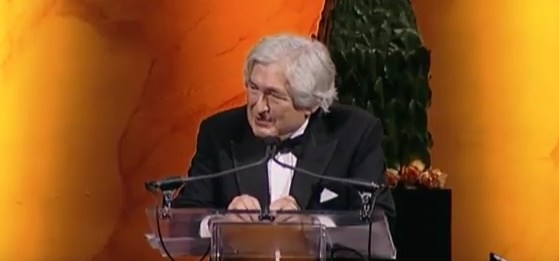
Featured photo at top of post: James Wolfensohn speaking on January 25, 2005 in Washington DC when the National Building Museum presented its sixth prestigious Vincent Scully Prize to His Highness the Aga Khan in recognition of his contributions to promoting design excellence and improving the built environment in the Muslim world.
__________________________
We welcome tributes and condolences in honour of Sir James David Wolfensohn. Please complete the feedback form below or click on Leave a comment.
The link that we are providing via either of the three images shown below will take you to the CBC TV website where you can listen to Matt Galloway’s interview with President Barack Obama that was posted on Monday November 23, 2020 (NOTE: the audio interview is at the beginning of the post and to listen to it please click on The Current icon). The interview is wide-ranging and candid, and includes remarks that many of us will be hearing for the first time. It will of interest to Canadians as well as everyone around the world whose attention is focused on the recent US elections won by Joe Biden. Moreover, it is also based on the President’s new book A Promised Land.
BARACK OBAMA INTERVIEW: Please click HERE or on any one of three images below
The Obama family make an unannounced visit to tour the Martin Luther King, Jr. National Memorial in Washington, D.C., the night before the President made remarks at the official dedication of the memorial on October 16, 2011 during his term at the White House. (Photo by Pete Souza)
President Barack Obama stands with his Vice President Joe Biden, now President-Elect, in the Green Room of the White House prior to delivering a statement on the economy in the East Room, Nov. 9, 2012. (Official White House Photo by Pete Souza)
Dec. 14, 2011 “During one of the Christmas Holiday receptions at the White House, I noticed the First Lady’s hands resting on the podium as President Obama made brief remarks.” (Official White House Photo by Pete Souza)
NOTE: Readers also have the option of listening to the complete 75 minute episode of The Current program aired on November 23, by clicking HERE.
The photographs shown in this post are from a tribute to President Obama that we published on our sister website Simergphotos. The featured photo at the top of the post is from Jan. 21, 2009, President Obama’s first morning in the Oval Office as President of the United States, where he is seen reading some briefing material before a meeting.
Date posted: November 23, 2020.
___________________
Before departing this website please take a moment to review Simerg’s Table of Contents for links to hundreds of thought provoking pieces on a vast array of subjects including faith and culture, history and philosophy, and arts and letters to name a few.
“We have nightmares, you dream, awful dreams…None of us became nurses and thought we would do anything like this”
Health workers at a 14-bed hospital in North Dakota are struggling to keep friends’ family members alive, as rates of new Covid-19 infections soar in the US heartland’s tight-knit communities. PLEASE CLICK HERE or on image below.
(Editor’s note: As of November 20, 2020, Jamatkhanas in the Canadian province of British Columbia (BC) are once again temporarily closed due to orders issued by the provincial government that impact all places of worship. The BC Jamatkhanas had re-opened at the beginning of August with limited attendance capacity both in the evenings and mornings. Zaher Ahamed’s excellent piece is an attempt to convey his joyful experience of attending a Jamatkhana in Canada in the midst of Covid-19. On new developments about Jamatkhana openings and closures in Canada, please subscribe to the official Al-Akhbar electronic bulletins distributed by Ismaili institutions in Canada).
“Maybe….because of this pandemic, I have experienced the true nature of our faith and gained a new insight into one of our central religious practices of our tariqah: the remembrance of Him in His house during the hour of Baitul Khayal” — Zaher Ahamed
By ZAHER MEGHJI AHAMED
Headquarters Jamatkhana Vancouver. Photo: FNDA.
It was our first journey to the re-opened Headquarters Jamatkhana in Vancouver during a pandemic: it was for the early morning contemplation and prayers or Baitul Khayal during the earlier part of August, and it turned out to be a total ethereal, peaceful and powerful experience, the closest I have ever felt to the presence of the Nur (Light) of Imam in a what had become a truly perfect sacred spiritual space.
There was pin drop silence! The pandemic protocol put in place, after going through a painless computerized registration system as you entered, did not permit for social chit-chat, small talk and worldly conversations over a cup of chai before entering the sacred space.
We were swept with only the thought of Him silently with dignity into the Jamatkhana prayer hall. We were in a peaceful dignified space, where there was not a word between the murids, each masked, each enclosed in his or her own socially distanced bubble. The conversation was only with Him, just as it was meant to be. We felt ourselves immersed in the cosmic quiet and stillness, focusing now only on seeking out moments of happiness through the Divine Word, knowing that, with the Imam’s presence in this space, He was with us blessings us on our own individual journey to seek to come nearer to Allah through the Nur of Hazrat Ali.
With a silent and reflective utterance of “Haizanda” (He is ever living) we stepped into this sacred space and right into his presence! With closed eyes, a quiet mind and an open heart we slipped into the rhythm of silently uttering the Divine Word, first with our lips and then in our hearts, feeling it flow through, ever so slowly, into the depth of our soul, awakening it: and over a period of time, the word now deeply embedded released moments of energy, awareness, joy and happiness…. all in a timeless moment, the soul wanting to stay for ever and then…. the hour was over in what seemed like a second…. with the promise of another day to be again in His presence in this sacred space.
“Sacred Space” – the Jamatkhana prayer hall, Ismaili Centre Vancouver. Photo: Bruno Freschi Collection, 1985.
This is what the house of the Lord was meant to be like!
Then, without a word with anyone, we stepped straight outside into our car, carrying the peace that was in our hearts. And on our way home, we saw the light of the waning moon with Venus ablaze shining on us, leaving us speechless in the cosmic balance of His creation.
The calmness that we had felt in the Jamatkhana continued on our journey home. It was then that I remembered Hunza, where I had felt that same pin drop silence with no words in calm and quiet in a Jamatkhana with a dimly lit hall, “a sacred space,” in Karimabad. And now, I had once again experienced that in my own Jamatkhana in Vancouver — and that too in a global pandemic or maybe because of a global pandemic!
Maybe, ironically, because of this pandemic, I have experienced the true nature of our faith and gained a new insight into one of our central religious practices of our tariqah: the remembrance of Him in His house during the hour of Baitul Khayal.
Going for Ibadat in the morning, in its truest sense, should be an act filled with a simplicity and a reverence of the highest kind for this sacred space devoid of any refreshments, hanging around the chai table and having meaningless conversations that last until almost 5 a.m!
Spaces created in Jamatkhanas for prayer are sacred spaces!
It was truly a unique experience and in terms of the logistics, the whole process of going to the Jamatkhana, from the time of arrival until departure, was very well organized, with an army of well trained volunteers directing your every move: Your car on arrival is directed into a pre-planned space; if you have not brought your mask one is provided to you; next you confirm your spot and answer standard Covid-19 protocol questions and have your temperature taken; you then get directed into the shoe/coat area, have your hands sanitized and then are led finally into your own space.
When the limited rites and ceremonies, tailored to keep murids safe, are completed, you are led out to your car in an orderly manner. Fifty pre-allocated murids who have come to the Jamatkhana for the morning Ibadat and prayers each, I believe, leaves with a unique experience.
What else are we witnessing during the pandemic?
I believe, we are seeing the birth of a “global Ismaili renaissance” showcased and driven by a digital platform of webinars, zoom sessions and the Ismaili TV. We are seeing the fruition of the coming together of Ismaili talent in all its forms: academic scholars and waezins, health care professionals, dancers, musicians, singers, consultants, counselors, journalists, Aga Khan Development Network (AKDN) executives and staff, and Jamati leaders, all the result of our Imam’s extraordinary vision and its execution over the last 60 years.
It is like seeing a period of our rich Fatimid heritage in a digital mirror!
Seniors are zooming… the youth are dancing, men are cooking… women are leading and “dadimas” (grandmothers) are “face timing… and all this within just the last 7 months.
Learning, Mawlana Hazar Imam has often said, should continue throughout our lives. Age should not be a constraint, and this is precisely what we are witnessing. We are exploring with full confidence, and thousands of voices from around the world and from our global Jamat are now being heard directly. This is the commencement of a new digital communications era, and the challenge now will be to stay truly connected and to manage this era carefully with awareness and sensitivity so that it does not stifle in its own success.
As for me and my family, this pandemic has brought us even closer and it feels good to be in the centre of “This Ismaili Renaissance”.… a truly humbling experience!
Date posted: November 20, 2020.
________________________
Zaher Ahamed
Zaher Ahamed is an internationally recognized expert in Strategic Marketing, Multicultural Communications, Diversity & Human Resources Development, Strategic Planning, Design & Project Management. His over 40 years of Business & Consulting experience includes working with Expo 86, the Royal Bank of Canada, Life Care International, Terry Fox Foundation, WIOMSA (Zanzibar), Governments of Canada & British Columbia as well as holding teaching positions with the University of Stockholm, Red Deer University and BCIT in Europe and in Canada.
He has had extensive experience working for corporate and not-for-profit organizations in the Middle East and Africa. In Nairobi, Kenya, he worked with the Aga Khan University Hospital, as a project manager for the establishment of turnkey state-of-the-art digitally connected Pilot Primary Health care and diagnostic Aga Khan Medical centres in East Africa. His volunteer experience includes working in Syria, Zanzibar, East Africa, Sweden. USA and Canada. He is multilingual and has a deep interest in Ismaili history and Ginanic and Sufi traditions. Now retired in Vancouver, BC, Canada, Zaher continues to perform voluntary work with Ismaili and non-Ismaili institutions around the world.
________________________
We welcome feedback from our readers. Please complete the LEAVE A REPLY form below or, if you don’t see the box, please click Leave a comment. Your letter may be edited for length and brevity, and is subject to moderation.
Before departing this website please take a moment to review Simerg’s Table of Contents for links to hundreds of thought provoking pieces on a vast array of subjects including faith and culture, history and philosophy, and arts and letters to name a few.
“I would take my students on a field trip to Toronto to see this miracle of miniature painting, one that continues to fascinate when greatly magnified. It features extraordinary details of flora and fauna, as well as a rainbow coalition of human beings from every continent and culture, much as one sees on the streets of Toronto.” — Gary Tinterow, Museum of Fine Arts, Houston, on the Shahnameh Folio ‘Court of Gayumars’ at the Aga Khan Museum
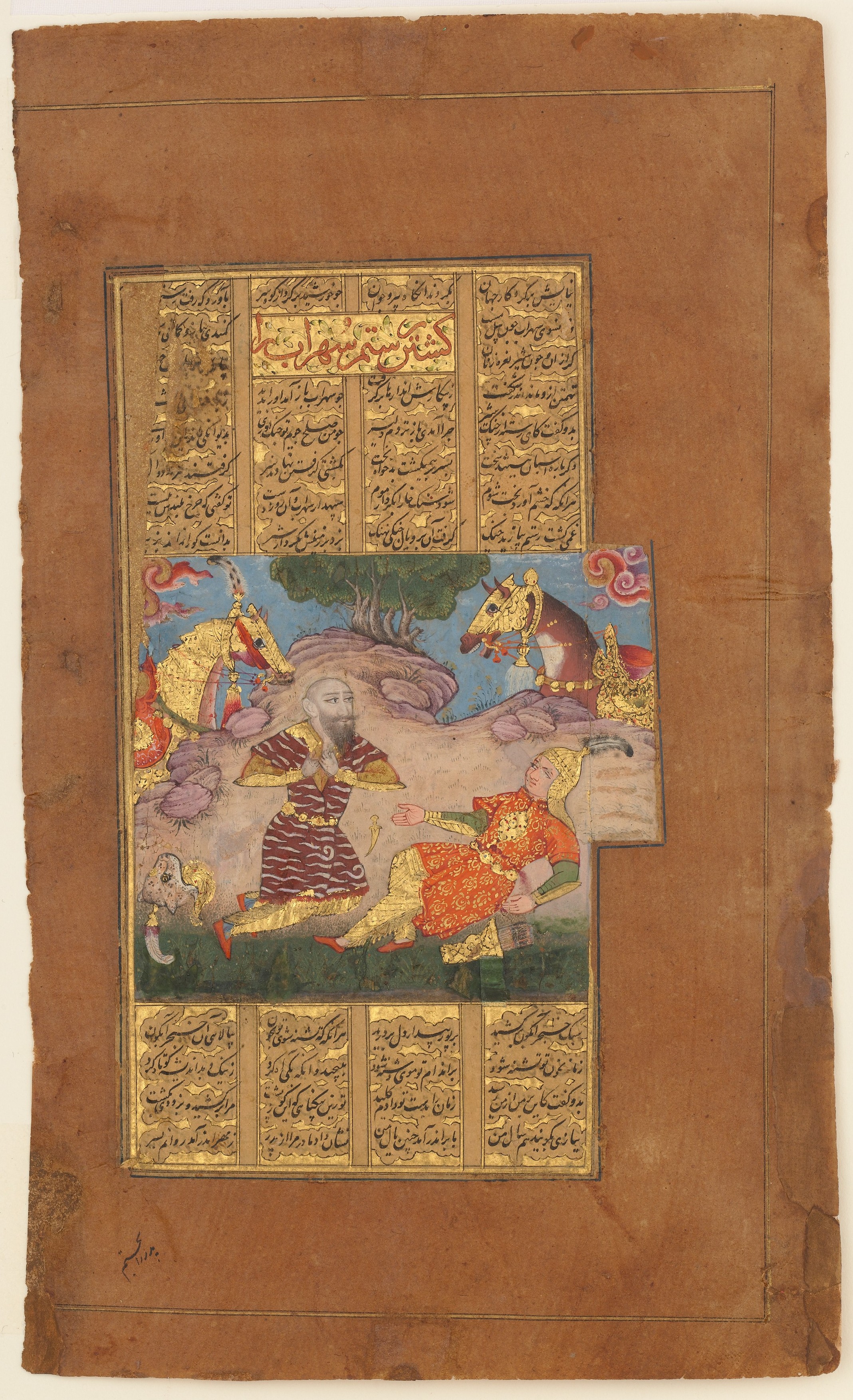
When I first started learning English upon my arrival in the early 1960’s in Dar es Salaam from Lourenco Marques (now Maputo), Mozambique, where I had received instructions in Portuguese at my primary school, in Gujarati at today’s equivalent of Baitul Ilm classes, and spoke Hindi at home, my dad presented me with a hardback version of the story of Rustum (or Rustam) and Sohrab (Suhrab). It was a large print book with beautiful illustrations. However, it was also story of tragedy. Rustum had been separated from his princess (Tahmina) for a long time, and did not know that he had a son named Sohrab from her. Several years later, the father and his son met on one to one combat on opposing sides, where Rustum wrestled Sohrab to the ground and fatally injured him. Rustum, to his horror, realised the truth when he saw his own arm bracelet on Sohrab, which he had given to Tahmina many years before and which she had in turn given to Sohrab before the battle, in the hope that it might protect him.
Little did I know then, that this was a story from Shahnameh, The Book of Kings, written by Ferdowsi, now some 1030 years ago.
The hero Rustam was unaware that he had a son, Suhrab, by Princess Tahmina. It came to pass that the two met in battle, fighting on opposing sides. They struggled in single combat until Rustum stabbed Suhrab fatally. Rustum realized that he had slain his own son when he saw Suhrab’s arm bracelet, which he himself had given to Tahmina many years before. Tahmina had given it to Suhrab before the battle, hoping it would protect him. Photo: Wikipedia, CCO 1.0 Public Domain.
The illustration from the book, which my beloved late father Jehangir Merchant had given me, of a father standing above his son, whom he has just mistakenly killed in a combat, is one of the most powerful and saddest images I have seen in storytelling. The folio of the father and son in tragic combat that is shown above is from the collection of New York’s Metropolitan Museum of Art.
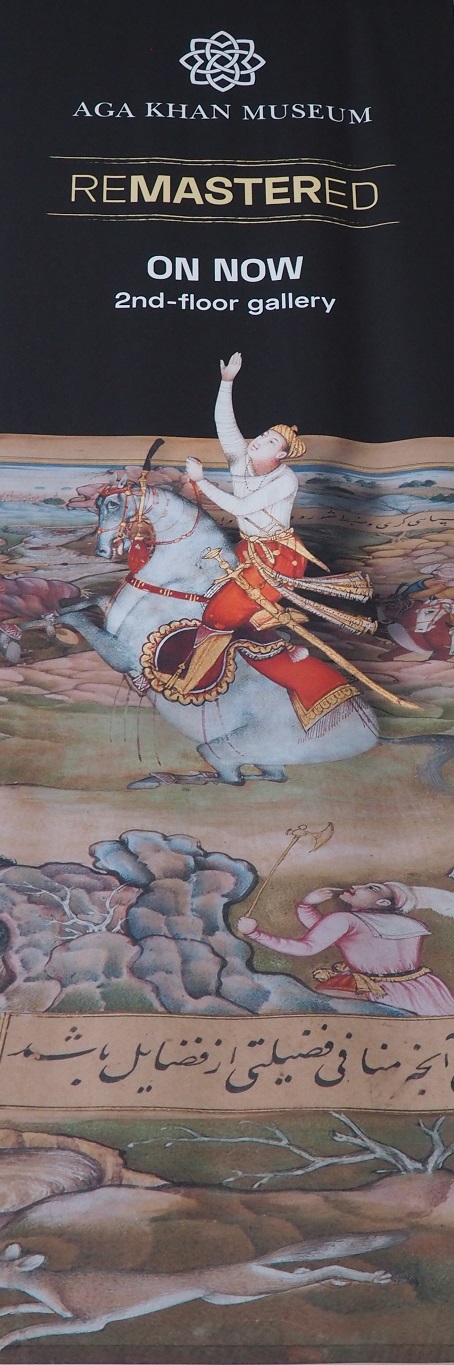
Remastered at Aga Khan Museum until March 21, 2021. Photo: Malik Merchant /Simerg
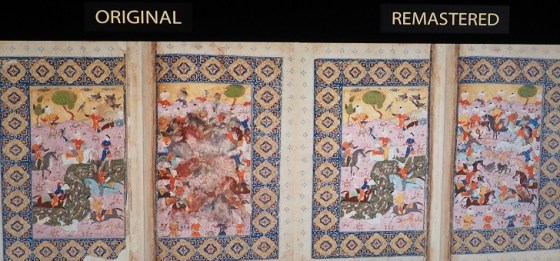
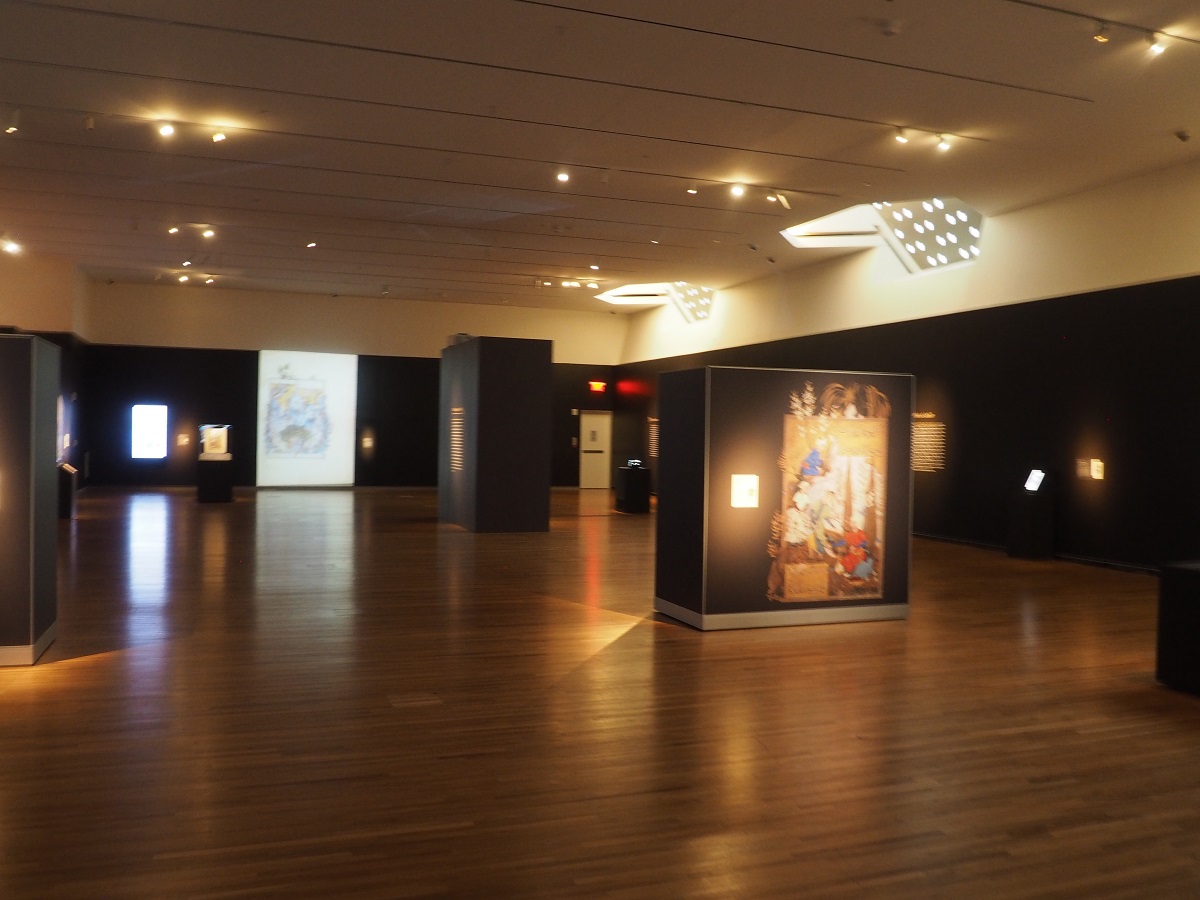
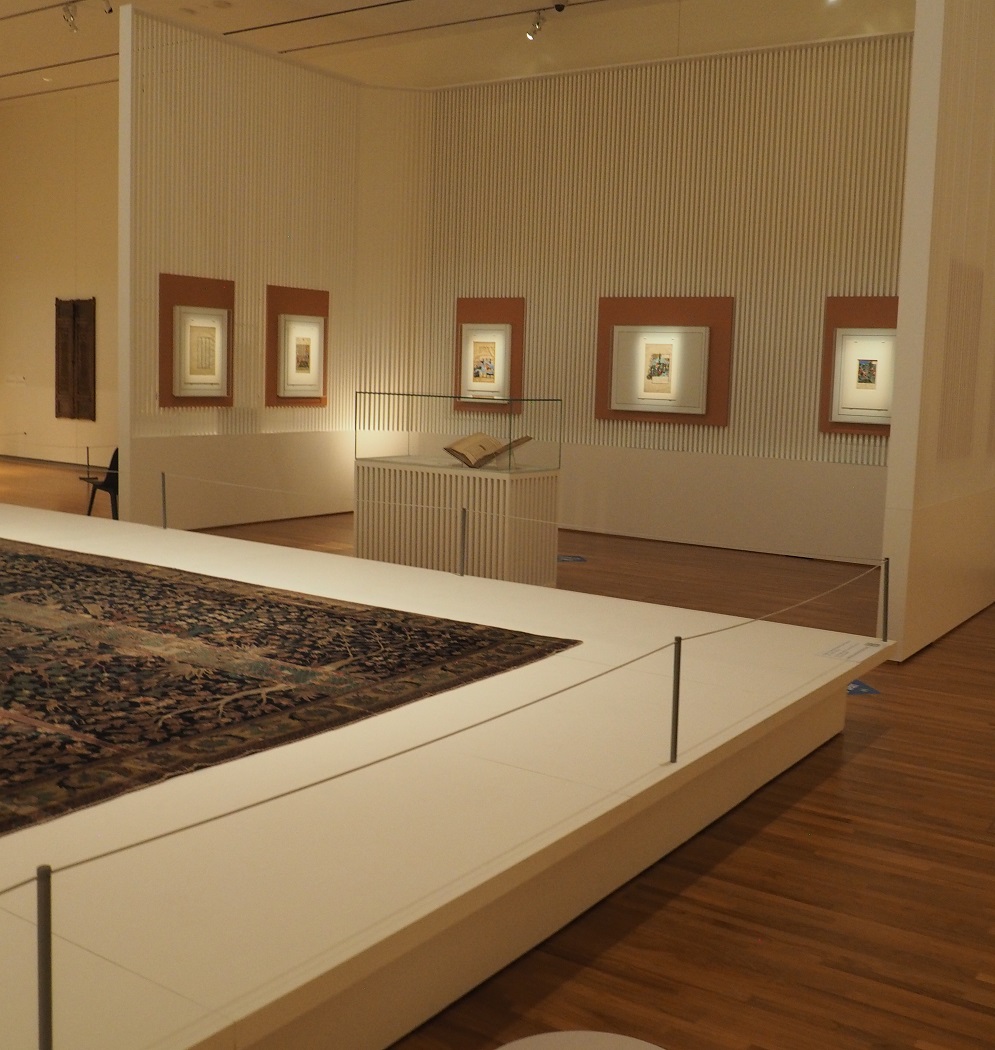
The Aga Khan Museum does not have any folios from the Shahnameh depicting this specific battle scene, but some other outstanding loose folios from the Shahnameh form part of a new exhibition under the theme REMASTERED in the museum’s upper gallery (running until March 21, 2021). In addition, the permanent collection on the main floor of the museum contains other magnificent folios from a number of illustrated manuscripts of the Shahnameh that were produced during the 13th-16th centuries. These folios are located just at the right of the Wagner carpet exhibit.
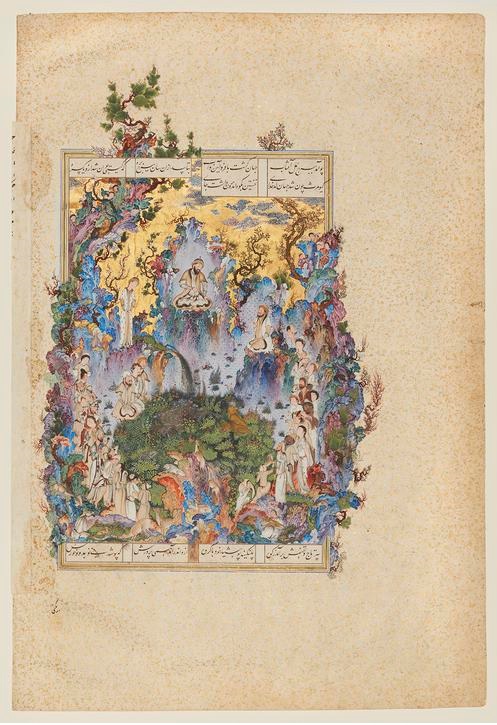
Missing from display, at the moment, is what is considered to be one of the finest folios from the Shahnameh, called The Court of Gayumars. Apollo Magazine, in its issue dated August 29, 2018 recommended the Gayumars as “one of the pieces that every school kid in the USA needs to see.” Writing for the issue, Gary Tinterow, Director of the Museum of Fine Arts, Houston, stated:
“I would take my students on a field trip to Toronto to see this miracle of miniature painting, one that continues to fascinate when greatly magnified. It features extraordinary details of flora and fauna, as well as a rainbow coalition of human beings from every continent and culture, much as one sees on the streets of Toronto.” He has also recommended that when the folio is exhibited, it should contain a little bit of commentary.
And speaking of the new REMASTERED exhibition itself, Ulrike al-Khamis, the acting Director and CEO of the Aga Khan Museum, in a recent press release stated: “We have created one of the most innovative showcases of Islamic manuscript paintings ever to have been assembled. Remastered invites viewers to immerse themselves in the beauty of some of the most impressive masterpieces in the Islamic tradition and find new meaning in centuries-old stories of heroism, love and principled living.”
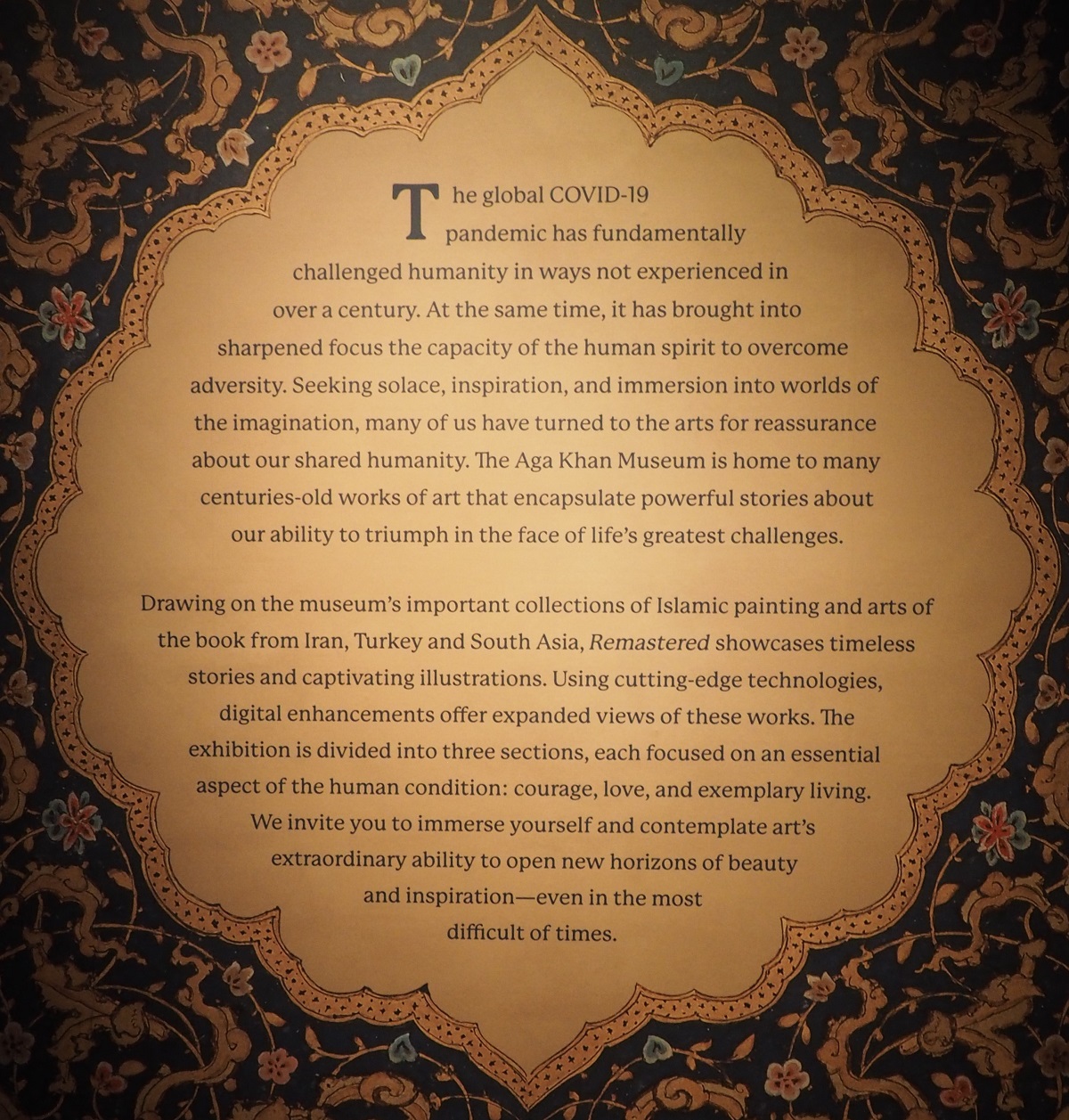
Aga Khan Museum’s introduction to the new Remastered Exhibition, on until March 21, 2021. Photo: Malik Merchant / Simerg.
A view of the Remastered Exhibition that runs on the second floor of the Aga Khan Museum in Toronto until March 21, 2021. Photo: Malik Merchant / Simerg.
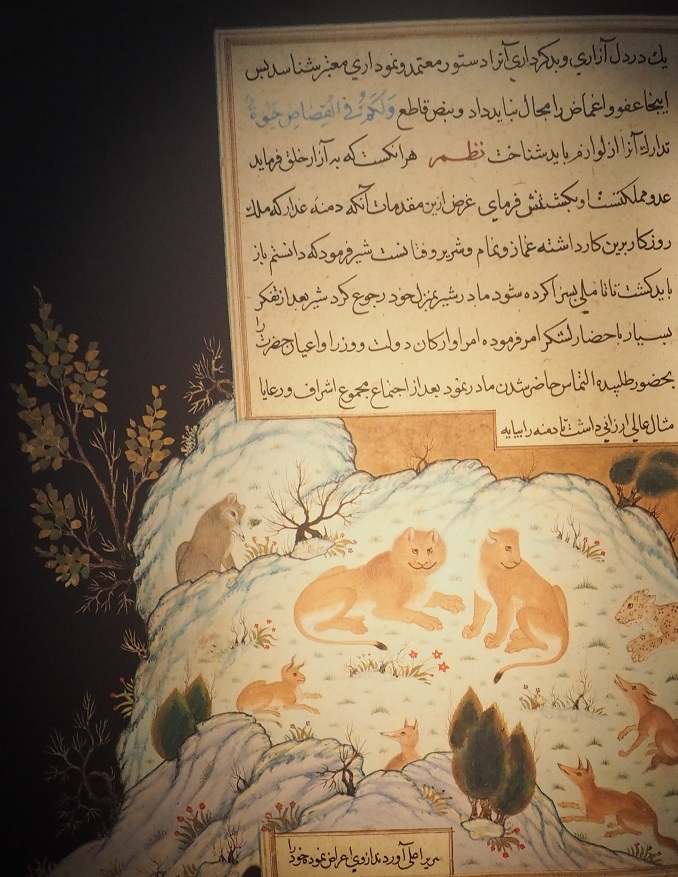
A display at the Remastered exhibition which was launched recently at the Aga Khan Museum, and continues to March 21, 2021. Here the jackal Dimneh is brought before the Lion-King and his mother. Illustration from a manuscript of Anvar-i Suhaili, Iran 1593. Photo: Malik Merchant / Simerg.
Over the coming weeks, we plan to publish special features on the folios in the Remastered exhibition that powerfully present tales of courage, stories of the heart, and exemplary living or model life, along with their corresponding digitally engaging panels prepared by Ryerson University library that offer new ways of understanding the manuscripts.
“Ferdowsi is everything we expect of a great poet…, for he teaches us both what people are and what they should become” — Federico Mayor
The focus of this post is on the Shahnameh, which forms an integral and important component of Remastered. What is the Shahnameh and who was Ferdowsi? Of course, readers will find many resources on the internet but I have come across a fantastic address delivered by UNESCOS’s former Director General,Federico Mayor in 1990 on the 1000th anniversary of the completion of the Book of Kings. His piece, below, is a must read.
Ferdowsi’s Shahnameh: The Book of Kings
An image of folio Court of Gayumarfrom Firdawsi’s Book of Kings. This page is considered as one of the most exquisite pieces in the Aga Khan Museum collection, and has been recommended as one that every student must be taken to see. Photo: The Aga Khan Museum.
“The ‘intellect’, which Ferdowsi calls Kherad, demands more than ‘intelligence’ in the common meaning of the term: it includes the ability to perceive good, a deep-seated and generous wisdom and a serenity that comes from balance and self-control. The concept of Kherad runs through the entire book, being at one and the same time its dominant theme, the spirit that animates it and the good it extols” — Federico Mayor
By FEDERICO MAYOR
The following article has been adapted from an address delivered in Tehran on December 22, 1990 by Mr Federico Mayor, to mark the celebration of the 1000th anniversary of the completion of the manuscript of the Book of Kings (the Shanameh by Firdausi). At the time, Mr. Mayor was the Director-General of the United Nations Educational, Scientific and Cultural Organization (UNESCO). Mr. Mayor’s complete address can be read at the organization’s website HERE.
‘Be Name Khodavande Jano Kherad’ (‘In the name of the Lord of the soul and of wisdom’). These majestic words open the Shahnameh, The Book of Kings, that monument of universal literature. And as I read on I discover, immediately after the glorification of the Creator, a passage on this second page that forces me to stop, taken aback with amazement, wonder and near disbelief: the words before me sing the praises of intelligence!
Can it really be that a thousand years ago, an Iranian poet was exalting above all else the process of thought based on knowledge? And he did it with such conviction and felicitous expression that he cannot fail to convince:
‘The intellect is the greatest of all the gifts of God…It is the source of your joys and your sorrows, of ‘your profits and your losses…It is the guardian of the soul, and to it is thanksgiving due’. “
At that instant, I knew I had come across a work and a man of exceptional qualities. This ‘intellect’, which Ferdowsi calls Kherad, demands more than ‘intelligence’ in the common meaning of the term: it includes the ability to perceive good, a deep-seated and generous wisdom and a serenity that comes from balance and self-control. The concept of Kherad runs through the entire book, being at one and the same time its dominant theme, the spirit that animates it and the good it extols.
“Can it really be that a thousand years ago, an Iranian poet was exalting above all else the process of thought based on knowledge? And he did it with such conviction and felicitous expression that he cannot fail to convince” — Federico Mayor
There are few books in the world and in history that have become, like The Book of Kings, an expression of national identity. Ferdowsi’s poem is both the reflection and the leaven of a culture that is in many respects reconciled with itself.
In terms of language, it forms a reservoir, an encyclopaedia of inexhaustible wealth. In terms of historical perspective, it reconciles past and present. In terms of historical perspective, reconciles past and present, integrating in a unified culture the pre-Islamic tradition and the contributions of Islam; that is an achievement whose importance is not perhaps sufficiently appreciated, for the resulting fusion, with its creative repercussions, was to prove most prolific.
Lastly, in terms of literary genre, it is an epic that blends in a single creation the true and the legendary, the observable and the imaginary. Ferdowsi reconciles history and myth, resembling at one moment Herodotus and at the next Homer. As a historian, he relates an episode with the same fervour and magical inspiration as if it were a tale; as a mythologist, he describes an adventure with the same precision and concern for details as if it were drawn from real life.
Ferdowsi thus bequeathed to his country a heritage that has been transmitted from one generation to the next in all its vitality. There are few civilizations in which a poetic work has become so ‘popular’, that is to say both widely known and deeply loved.
Let me say how much I regret that my ignorance of your language prevents me from savouring in full the subtlety of these lines, their majesty and their secret music.
“The 1000th anniversary of the completion of the manuscript continues a long-standing tradition whereby, ever since the death of the poet, scholars have attempted to make amends for the ingratitude of the Sultan to whom Ferdowsi offered this treasure and who failed to appreciate its true value” — Federico Mayor
But even when translated Ferdowsi’s poetry preserves an inimitable charm. The Book of Kings, which was translated into Arabic in the 12th century of the Christian Era, has been avidly read, studied and commented on. Historians, linguists, poets, writers, painters and miniaturists have used it as the source material for the work of several lifetimes. Jules Mohl translated it in its entirety into French in the 19th century, and thanks should be rendered to him for devoting 30 years of his life to the translation of the 60,000 verses that Ferdowsi had spent 30 years perfecting 800 years before.
The task was so tremendous that not all the volumes were published until two years after the translator’s death. Mohl has been the benefactor of countless scholars in Western Europe — he has enabled them to discover one of the summits of world literature.
0n 11 February 1850 the French writer, Sainte-Beuve, in one of his Causeries du lundi (Monday conversations), urged the resumption of publication by the Imprimerie rationale (national publishing house) of what he called ‘the magnificent book’. Stressing the popularity of the work in Iran, he enthusiastically presented the author, his themes and a few episodes, based on his reading of Jules Mohl. His enthusiasm proved to be contagious: the English poet, critic and essayist, Matthew Arnold, became immersed in all the available historical and geographical works on Persia, reread the Iliad, and in 1853 published a splendid poem entitled Sohrab and Rustum, relating the tragic episode of the hero’s killing of his son on the field of battle. A complete translation into English of The Book of Kings was published in 1925; the translation was an enormous task that had been carried out by two brothers, Arthur and Edmund Warner.
A view of the Aga Khan Museum’s folios from manuscripts of Shahnameh, The Books of Kings, that were produced between 13th-16h centuries. At the near end is the famous Wagner Carpet depicting “Islamic Garden of Eternal Bliss.” Photo: Malik Merchant / Simerg.
In Germany, the great lyrical poet and orientalist Friedrich Rückert translated the tragedy of Rustum and Sohrab, at the beginning of the 19th century. Another German poet, Schack, translated the entire epic part of the work, the translation being published in 1853. Complete translations of The Book of Kings exist today in all the widely spoken languages, and numerous translations of extracts exist in some 40 languages.
The 1000th anniversary of the completion of the manuscript continues a long-standing tradition whereby, ever since the death of the poet, scholars have attempted to make amends for the ingratitude of the Sultan to whom Ferdowsi offered this treasure and who failed to appreciate its true value.
And today here, in this hall that bears the poet’s name, we ourselves have now come together from the four corners of the world, to carry on and give new impetus to that tradition. But what is it in The Book of Kings that draws us together, captivates our hearts and enables its author to triumph over both time and place?
0f many outstanding passages in the work, one might mention the meeting of the hero Rustum and his son Sohrab, a beautiful and poignant story of two beings related by blood and brought by destiny to a fatal confrontation. Following in the footsteps of Sophocles, who gave voice to the sufferings experienced by Oedipus when he had murdered his father and then married his mother, Ferdowsi paints the picture of Rustum discovering that he has just killed his own son. This is a perfect example of what Aristotle meant by ‘tragedy’: it is a story that arouses in us feelings of both pity and horror, for Rustum, during the three days of the duel between them, has come to admire the qualities of his adversary — agility, intelligence in combat, nobility and chivalry.
On several occasions, father and son are on the point of recognizing one another; their speeches are tinged with admiration and tenderness, but Fate will not be cheated. When Sohrab dies under Rustum’s blows and Rustum discovers the identity of his victim all Ferdowsi’s readers shudder; all are fathers who have just killed their sons. We can see why this great tragic theme has attracted the attention of poets of all periods and civilizations: the feelings to which it gives rise are common to all times and all countries.
In celebration of the millennium of Ferdowsi’s birth a solemn tribute was paid to him at the Sorbonne, where French poets emphasized the lesson of wisdom he dispensed:
‘This poet is not only an enchanter: he is a scholar; he is not only a scholar: he is a sage. While our heads are still humming with all the wonders he has filled them with our spirits retain the lessons he has given us. Even when the enchantment of his tale fades and we fall back into the normal world from the fairyland into which he had carried us we are not disoriented: on the contrary, the poet deposits us on a well-marked road with a sturdy staff in our hand. Ferdowsi is everything we expect of a great poet…, for he teaches us both what people are and what they should become’.
The Book of Kings is indeed studded with precepts, and it is not uncommon for an episode to be accompanied, in the same enchanting style, by a moral for the reader’s edification.
“the characteristic of Ferdowsi by which he appears eminently modern to us is without doubt, first of all, his faith in the ability of people to rise above hostility, contempt, suspicion and hatred by an impulse of fellow feeling and compassion” — Federico Mayor
Statue of Ferdowsi in Tus, Iran. Photo: Wikipidea / CC by 4.0.
Princes, for example, are exhorted to be humble, in a concept of power in which the notion of ‘service’ predominates. ‘When you become a sovereign,’ says Ferdowsi, ‘behave as a humble servant’. Addressing the mighty, the poet reminds them of the ephemeral nature of all things, like the slave who, in ancient Rome, had to accompany the victor on his triumphal chariot and whisper to him from time to time: Memento quia pulvis es(‘Remember that thou art but dust’). Nevertheless, the characteristic of Ferdowsi by which he appears eminently modern to us is without doubt, first of all, his faith in the ability of people to rise above hostility, contempt, suspicion and hatred by an impulse of fellow feeling and compassion. The French poet Lamartine, moved by the moral qualities with which Ferdowsi endows his heroes, wrote of them: ‘They are more than kings, for kings reign only for a time — and these heroes reign over the future’.
In The Book of Kings there are many colourful battle scenes, but they never glorify vanity nor the thirst for violence. On the contrary, Ferdowsi depicts in them the absurdity of conflict and struggle. We have seen the pain in which the duel between Rustum and Sohrab ends. Elsewhere, Alexander the Great goes to the bedside of his mortally wounded enemy, Darius III. Moved by compassion, he swears to the dying man that he will re-establish peace between the Persians and the Greeks, and when Darius is dead, he organizes his funeral with great ceremonial. In another scene Isfendyar, mortally wounded by Rustum, sees in a flash that his killer is only the instrument of fate and is not truly responsible for his death. Before dying therefore, he entrusts to him the education of his son, Bahman.
Ferdowsi shows his respect for and appreciation of others, with their different religious, ethnic and social backgrounds. Would it not be worth while to relay and amplify this message Asia has passed on to the world down the centuries?
Another view of the Shahnameh folios on the main floor of the Aga Khan Museum. Photo: Malik Merchant / Simerg.
I personally think that The Book of Kings should be distributed as widely as possible. This work is not only part of the human heritage but can also help men and women of the 20th century — what am I saying, the 21st century — to improve and to live in greater peace with themselves and with others. I would in particular want to see it brought to the knowledge of young people throughout the world. By exposing young people to the humanism of Ferdowsi we sow the seeds of wisdom in the minds of those who will forge the future.
‘It is through peace that men achieve happiness’, said Ferdowsi, ‘may those who preach war vanish from our midst’.
Peace, not violence. Temperance, not excess. Mercy, not cruelty. Remember the passage in which the young Iredj sets out in a spirit of peace and wisdom to find his brothers, whose evil designs are known to him. When one of them hits him in anger and is about to kill him Iredj says to him gently ‘Have you no fear of God or pity for our father?…What? You are alive and you want to take the life of another? How can you reconcile these two things? Harm not an ant that is dragging a grain of wheat, for it is alive, and life is sweet and good’ .
This love of life is love of one’s fellow, of all others. Ferdawsi, the Persian national poet, is not a chauvinistic poet. This is why the Arabs, the Turks and the Indians have adopted Ferdawsi, translating him into their languages. He is becoming universal, he belongs to everyone. That is what makes Ferdowsi an inspired forerunner of today’s world, in which the spirit of war may be vanquished only by the spirit of tolerance and in which it is UNESCO’s task to ensure that peoples achieve a better understanding of each other through an ever-deeper knowledge of their respective cultures, which represent their most precious heritage.
Indeed, it was with lines by Ferdowsi that Mr Golan Ali Raadi, the then Chairman of the Executive Board, welcomed the ceremonial inauguration of UNESCO Headquarters on 3 November, 1958:
‘The best-constructed buildings crumble under the action of the rain and burning sun, But neither wind nor rain shall have any hold on the monument my verse has built.’
Just as Ferdowsi’s words are in striking accord with the intention of UNESCO’s founders, so I hope that the Organization will pursue its action in accordance with the ideals that inspired the poet: a sense of honour and human dignity, a demand for justice in the exercise of power, tolerance, compassion for the weak and the vanquished, serenity and wisdom — in a word, Kherad.
Date posted: November 15, 2020.
______________________________
Federico Mayor. Wikipedia CC BY 2.0
Federico Mayor Zaragoza (born 27 January 1934 in Barcelona) is a Spanish scientist, scholar, politician, diplomat, and poet. He served as director-general of UNESCO from 1987 to 1999. He is currently the chairman of the Foundation for a Culture of Peace and member of the Honorary Board of the International Decade for the Promotion of a Culture of Peace and Non-Violence for the Children of the World as well as the honorary chairman of the Académie de la Paix. According to 1995 issue of the Ismaili magazine, during his tenure as UNESCO’s Director General, Mawlana Hazar Imam, His Highness the Aga Khan, was invited to address a full session of its Executive Board, which met at UNESCO headquarters in Paris. Mr. Mayor paid tribute to the Aga Khan Development Network’s success in building capacity and empowering people — especially women — to manage their own development according to local models that respect the diversity of needs and resources. (Profile excerpted from Wikipedia and the Ismaili, 1995).
Please click on Toronto.com and Toronto Star to read reviews of Aga Khan Museum’s new exhibition Remastered (on until March 21, 2021).Please also visit the Aga Khan Museum website for the latest information and details about visiting the museum — it is open Thursday-Sunday, with a pay as you wish entrance.
Before departing this website please take a moment to review Simerg’s Table of Contents for links to hundreds of thought provoking pieces on a vast array of subjects including faith and culture, history and philosophy, and arts and letters to name a few.
We welcome feedback from our readers. Please complete the LEAVE A REPLY form below or, if you don’t see the box, please click Leave a comment. Your letter may be edited for length and brevity, and is subject to moderation.
The Ismaili community tends to shy away from controversies. However, lately, we have seen the engagement of Ismaili activists and youth with Black Lives Matter and the US elections. In response, we have given fora to the Ismaili youth to talk about racial injustice and discuss issues raised by challenged members, such as the deaf within the Jamat (community).
Over the past day, I received several links carrying damaging reports about Ms. Yasmin Ratansi, an iconic member of the Liberal Party of Canada for decades and the Federal MP for the Don Valley East riding since 2014. She has resigned from the Liberal caucus over allegations that she employed her sister at her constituency office. She has decided to represent herself in her riding as an Independent. The opposition party, however, is calling for her immediate resignation. Prime Minister Justin Trudeau in a statement made to the journalists on Tuesday, November 10, said that he was deeply disappointed by the news that he had learned from Ms. Ratansi about how she handled the office. He added that it was unacceptable and expects there will be a thorough follow up by [House of Commons] administration on the matter.
Yasmin Ratansi is very well known among her constituents and within the Ismaili Muslim community, where she has been an active member since her childhood years in Dar es Salaam, Tanzania. She has also served in Jamati institutions in numerous capacities.
We feel proud when Ismailis are elected or appointed to high positions at the provincial or federal level. Over the years, Simerg has proudly shown Yasmin’s pictures and presented pertinent articles that were brought to our attention.
Now the long admired Yasmin has let her own community down, with this latest revelation. While she has apologized for her actions, she owes an apology particularly to the Ismaili community for her mistake.
We have numerous other Ismailis working at Federal level as MPs and in the Senate. Over the years, I have been disappointed with all of them for not even having the courtesy to respond to important matters that I had brought to their attention.
The friend who first sent me a link through Whatsapp on Yasmin Ratansi was deeply hurt by what he had read on CBC. He was particularly concerned that repeated guidance on ethics by Mawlana Hazar Imam, His Highness the Aga Khan, had been ignored.
During his 2017-2018 Diamond Jubilee visits to Ismailis around the world, Mawlana Hazar Imam urged them to think about the foundations of their work, noting that this had its basis on the faith and its ethics. That ethic, he said, entailed integrity, humility and honesty, and the rigor of behaving in a manner that would be beneficial to the current and future generations of the Jamat as well as to the country and society at large.
This brings me to the important point that Ismailis who are serving or wish to serve within the Jamati institutional structure, or public office should be cognizant of this advice from Mawlana Hazar Imam.
Date posted: November 11, 2020.
___________________________
Before departing this website please take a moment to review Simerg’s Table of Contents for links to hundreds of thought provoking pieces on a vast array of subjects including faith and culture, history and philosophy, and arts and letters to name a few.