Elastic Embrace: A Collection of Poems by Farah Tejani

A Mother’s Plea

By FARAH TEJANI

With one hand on his expanded stomach and another wiping his eyes,
The hot sun shows no mercy, and the despondent mother cries.
She has no fear and curses God, for how could this not shake her,
She vows to make her reasons heard just when she’ll meet her Maker.

“Why must my babe go hungering for basic bread and water,
When across the globe another Mom is feeding milk to her daughter,
In big brick homes with fancy lawns and furniture and floors,
While I hide from the sun in my simple hut with no doors?

Can you hear my wretched painful cries as the tears fall down my face?
Is this why you gave me this gift so that I could not give him even a trace,
Of something warm and substantial to ease the hole within his gut.
Or is this my sad misfortune to be haunted in this agonizing rut?

How do you wish me to appease him, how is he supposed to understand?
Why does his own mother, his loving provider, not soothe him with her hand?”
The mother enraged by the Injustice and Unfairness of it all,
Decides there is nothing left to do but to surrender to the Fall.

She takes a piece of fabric from the only dress that she has in her keeping,
And moistens it with water she has boiled, and cooled down while she was sleeping,
And draws it to her son’s parched lips, with prayers he will not get worse;
And after he has drunk a few spoonfuls, she will pray to release this curse.

The doctors never make trips out to her people, they are miles from anywhere,
“Yet people in better off countries are privileged with the very best Healthcare!”
With trembling hands she tries to soothe her aching hungry child,
But all the while the injustices just make her mind run wild.

“Just give me some hope, just give a sign, that You will promise to provide,
All I want is these words from You and on this I will abide.”
Just then she heard a rumbling of a crowd outside her door,
A truck was parked and handing out rations while the people shouted, “More!”

Her uncle came with powdered milk and she simply could not believe it,
She mixed it with the boiled water and praised how she received it,
She drew it to his hungry mouth and he drank it with sheer delight,
While tearfully she thanked her Maker and praised Him with her might.

“Hear me, I am grateful, but please God promise me this,
You will stand faithfully by my side so that I will not dismiss,
That when in need You are always there, so preserve my faith in You.
Now my child’s hunger is satisfied, I am not so disheartened and blue.”

The mother held her babe to her breast and stroked him sweetly to sleep,
And in his ears she whispered a promise that she vowed that she would keep,
“I leave you In my Maker’s Hands, for He looks after us  all,
And whenever I am weak in faith I will remember upon Him to call.”

(The poem was composed on May 18, 2020).

_________________

The Forest Cries at Night

By FARAH TEJANI

Dance june bug dance,
Upon the dogwood’s dew kissed petal,
Make your movements carefully
On which foot will you settle.

Do you wonder needlessly,
About that dreaded rattle snake,
Or how she strikes fear in all who pass,
With the clatter that she makes?

In the forest you are just a little one,
Amidst the towering trees,
With their sinewy branches,
Blowing secrets in the breeze.

Mocking monkeys hanging by their tails,
Eating ripe and sweet bananas,
They thrive in this lush green forest,
But could not possibly endure the savannahs.

Parrots with feathered wings bright,
Squawk loudly praising the Moon,
Rains quench this great green carpet,
The owls hoot a different tune.

Greet the twitching grasshopper,
Paying heed to their chirping sounds,
Should there be a coming storm,
Every animal knows what might abound.

Hear the forests buried secrets,
Their message to us all,
The riches that lie within her,
ARE THE SACRED TREES THAT WE FALL!

So find shelter friendly squirrels,,
Shine on Madame Firefly,
These are the tears of the forests,
And the animals never lie.

(The poem was composed on May 10, 2020).

____________________

From Behind Heaven’s Curtain

By FARAH TEJANI

Take time and summon thoughts for those whom we cherish,
In doing so we make certain that from our memories they don’t perish.
As for the loved ones who’s souls have remorsefully passed on,
Though it may feel like, they are certainly not gone.

From behind Heaven’s Curtain, they watch us from Above,
When loneliness prevails, they shower us with LOVE.
Blessing our endeavours, every moment, every action,
Our successes, they recount with humble satisfaction.

When we are in distress, they beg God to ALTER,
Our destiny, so that we can endure but not falter.
Their prayers go answered; they are so loved by the LORD
And it is on these sweet prayers that our very lives have soared.

Their hearts burst with joy when we are immersed in happiness,
Months without hardships and countless hours without stress.
In remembering our LOVED ONES precious pictures we keep,
Upon gazing at their faces we cannot help but weep.

We ask God how could He? It was much too soon for them to part,
But we are soon reminded of what we have known from the start,
From the very moment we are born there is one thing for sure,
There is no way to defy the grasp of death’s final lure.

Reminisce and treat precious these moments we have now,
Before destiny takes another life and then it is too late somehow.
Be joyous, take pictures, share loving words, embrace,
Texting’s overrated LOVE IS ONLY REAL FACE TO FACE.

So put down your phone and just travel the distance,
Be prepared for often you will be met with resistance.
Because these days, no one has time left to spare,
Take time to MAKE TIME and let them know that YOU CARE.

Busy lives just get busier and often time gets LOST
And once it is GONE we realize at what PRECIOUS COST.
While we are living make peace and share your heart,
So that should one of us leave this earth, with LOVE SHALL WE PART.

(The poem was composed on May 27, 2020).

Date posted: July 24, 2020.

_____________________

Farah Tejani Simerg Ismaili poet and writer
Farah Tejani

We are delighted to introduce readers of Simerg to our new contributor Farah Tejani, with three of her recently penned poems.

Farah graduated with her Bachelor of Arts in English Literature and her Master of Fine Arts in Creative Writing from the University of British Columbia in May of 1997 and earned top Honors for her Thesis on Short Fiction. With the help of her agent Barbara Graham she then went on to publish a collection of short stories published by Trafford, called, “Make Your Own Chai, Mama’s Boy!” — ten short stories dealing with different dilemmas South Asians face. Farah also wrote and co-directed her stage play, “Safeway Samosas,” which won “The Best of Brave New Playwrights Award” in July 1995. Her short story , “Too Hot” won third place in the “Canada-Wide Best Short Fiction Award.” and was read at The Vancouver Writers Festival. Currently, Farah is working on Childrens’ stories and a collection of poetry called, “Elastic Embrace” to be published in 2021.

__________________

Before departing this website please take a moment to review Simerg’s Table of Contents for links to hundreds of thought provoking pieces on a vast array of subjects including faith and culture, history and philosophy, and arts and letters to name a few.

We welcome feedback/letters from our readers. Please use the feedback box which appears below. If you don’t see the box please click Leave a comment. Your comment may be edited for length and brevity, and is subject to moderation. We are unable to acknowledge unpublished letters

Editor’s Choice: A Cemetery for All Faiths, and a Single Cause of Death – A Must Read Piece in the New York Times

None of Iraq’s existing graveyards wanted the bodies of COVID-19 patients. So Shiite leaders created a burial ground outside Najaf for them that is also open to Sunnis and Christians. The Iraqis call it the “Corona cemetery.” It already has more than 3200 graves since the cemetery ground was broken 4 months ago. This is a must read piece! Please click New York Times: ‘Our Role Is to Reduce Their Grief’ – A Cemetery for All Faiths.

Date posted: July 20, 2020.

_________________

Shariff Alladina, Ismaili Ginana Reciter, Tanga, Tanzania, Simerg

1960s musical renditions by Shariff Alladina of 4 popular Ismaili Ginans including the Chhogaḍio, Bhāī Tīnī Vireṅ Jīuṅ Umeduṅ

By SAFDER ALLADINA

In my recent piece about my paternal grandparents Alladin and Prembai (see The Story of Tanga’s Alladin Bapu Family) I briefly noted that one of their sons Shariff Alladina (1910-1976), who happened to be my father, had a fine singing voice. I provided links to his Ginans that I had loaded into Soundcloud sometime ago (please click Shariff Alladina’s 4 Ginans, titled as Bapaji 1 thru 4 on Soundcloud). Ever since, I have been pressed for more information about my father as well as his interest in music and Ginans.

Story continues after photo

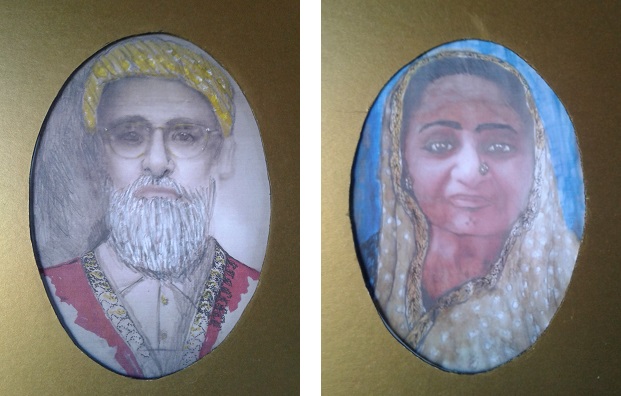
A portrait of a bearded man wearing traditional attire and glasses on the left, and a woman in a sari with a decorative head covering on the right, both framed in oval shapes.
Shariff Alladina’s parents, Alladin and Prembai. Photo: Safder Alladina.

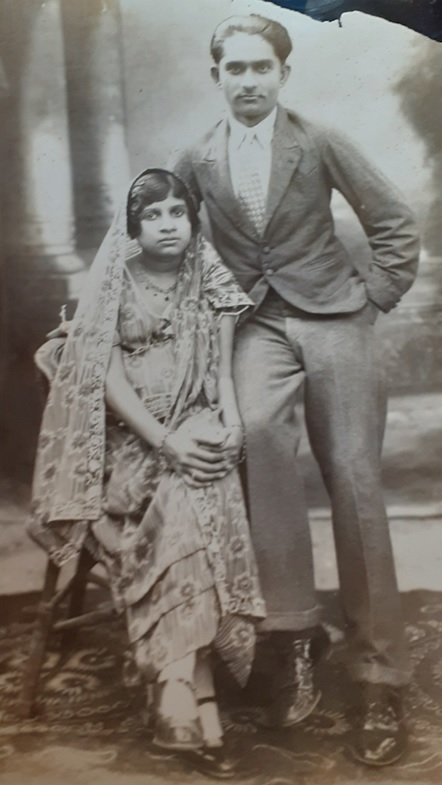
My late father — shown at top of this post — was a business man of Tanga, Tanzania. He came from a musical family. Born in Kathiawar, India, Shariff was brought to Tanganyika in a dhow as a toddler of about two by his parents Alladin and Prembai. In 1930 Shariff married Zera, a Kachhi girl from Zanzibar. It was not very usual for Kathiawari and Kachhi to inter-marry but Saleh Harji, a close friend of Shariff, was able to negotiate the marriage with his niece Zera. She came from well-established families in Zanzibar. Her paternal and maternal grandparents were Mukhi and Kamadia of Zanzibar jamat on multiple times. Zera’s family story is documented in Zahir Dhalla’s piece A rare 100 year old family photo fills in a few blanks of Ismaili Khoja history in East Africa.

Story continues after photo

Shariff and Zera Alladina Patney, Tanga Ginan Reciter Ismaili Simerg
Shariff and Zera Alladina Patney, 1930. Photo: Safder Alladina Collection.

There were many singers and musicians in the family. My father taught me to sing Jeere waala Paat madaviney chok puravo (a Ginan which is often recited on days when Ab-e-Shifa is partaken) when I was about 10 years old. Mukhi Habib Kassam, who sang the Ginans early in the evening, was so pleased with my singing that he gave me one shilling!

Every Sunday morning, there was a gathering in my house where musicians and music lovers would gather to listen to the singers and instrumentalists. Ustad Ismail Ragi was a local music master who attended these morning sessions of riyaz until he fell ill and the local businessmen got together to raise money to send him with his wife to India for medical attention.

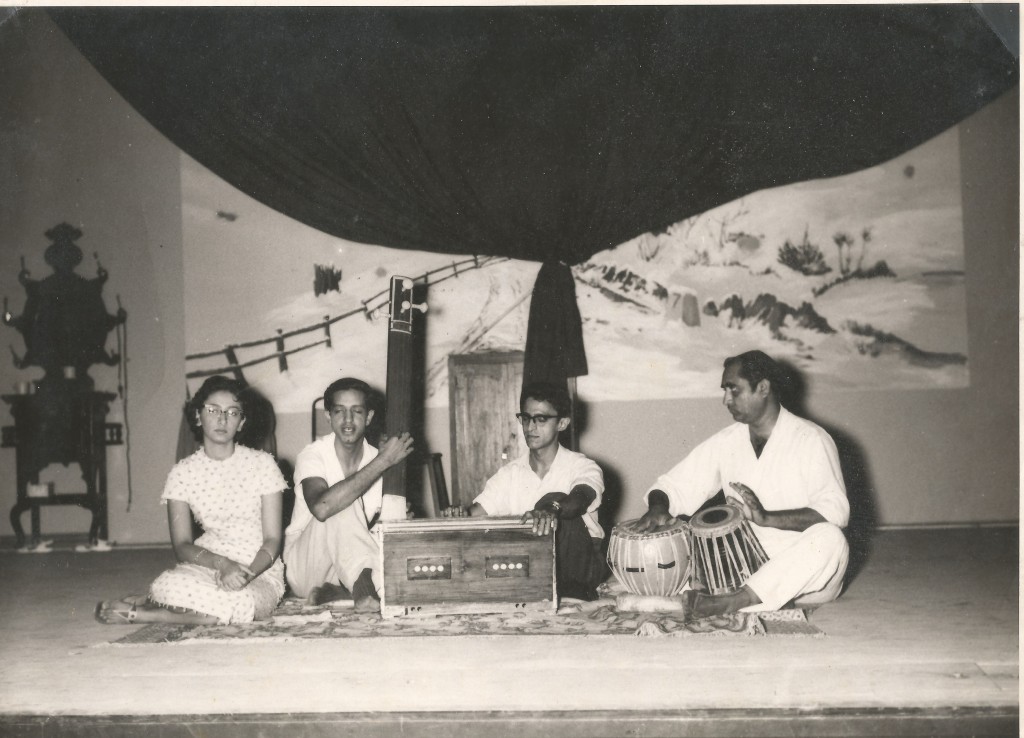
In the 1960s the sessions were attended by Gangu, a harmonium player and Batuk, a young tabla player. The recordings of my father’s songs, including the four Ginans in Souncloud, came out of these sessions of riyaz on Sunday mornings. I was in the UK at the time.

Shariff Alladina recited the Ginans many times in the Jamatkhana. He also gave lectures in the Jamatkhana where he would introduce pieces of Ginans, Bhajans and Sufi poetry in between his speech. He tutored many young people in Tanga to sing Ginans including his daughters Malek, Shirin and Khatun. Khatun’s rendition of Hazrat Ali’s Mowlana Kalam was enjoyed by many.

With these few remarks contextualizing my father’s interest in the wonderful tradition of Ginans and music, I once again invite readers to click on Soundcloud for Shariff Alladina’s recitation of 4 Ginans as well as a Thumri.

The Ginans in Soundcloud, named as Bapaji 1, 2, 3, and 4, are as follows:

1. Bhāī tīnī vireṅ jīuṅ umeduṅ āsuṅ puṇīuṅ or sānjno chhogaḍio;

2. Sabhāgā is dhunīāṅdhe vich kiyā gin āve;

3. Sāmī rājo more manthī na vīsarejī; and

4. Moman man em jāṇjojī.

Ginans Central at the University Saskatchewan is an excellent resource for Ginans and Ginanic research, and I would suggest you visit the website and see items #140, #614, #751, and #464 corresponding to each of the 4 Ginans listed above that are in Soundcloud.

Date posted: July 20, 2020.

Before departing this website please take a moment to review Simerg’s Table of Contents for links to hundreds of thought provoking pieces on a vast array of subjects including faith and culture, history and philosophy, and arts and letters to name a few.

________________

We welcome feedback/letters from our readers. Please use the feedback box which appears below. If you don’t see the box please click Leave a comment. Your comment may be edited for length and brevity, and is subject to moderation. We are unable to acknowledge unpublished letters
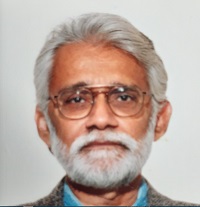
A portrait of an elderly man with gray hair and a beard, wearing glasses and a formal jacket, looking directly at the camera.

Safder Alladina has taught English as a Foreign Language in England, Japan and Portugal and English as a Second Language in England and Canada. In his 35 years of teaching, he has taught Early Years, Primary, Secondary and Adult classes; and developed and taught Teacher Education programmes at graduate and post-graduate levels at the University of North London, UK, and the University of British Columbia, BC. His research work is in Sociolinguistics. He has retired to a hobby farm in the interior of British Columbia where he does his writing under the pen name of S. Giga Patney.

The melodious life and legacy of Shamshu Jamal (1936 – 2019)

Shamshu Jamal (1936-2019), Ismaili singer, simerg photo
Shamshu Jamal (1936-2019). Photo: Shamshu Jamal family archives.

By KARIM H. KARIM
(with contributions from Dolatkhanu Jamal, Rosemin Karim, Riyaz Jamal, Imran Karim and Irshad Karim)

Shamshu Jamal has left a profound impression on the global Ismaili jamat. His music was “magical,” declared a poem written in honour of his 80th birthday in 2016. The singer, musician, lyricist, composer, and music teacher had innumerable admirers in the countries across North America Europe, Africa and Asia where he performed in a tenure of over 60 years. Shamshudin Noordin Jamal was the unofficial poet laureate and bard of Canada’s Satpanthi Khoja Ismailis. His musical legacy has been passed on to a multitude of students and to his children and grandchildren, with whom he produced several recordings.

It was not only Shamshu’s music but his personal affability, generosity and humility that touched people’s hearts. Despite achieving success and fame, he remained grounded in family and community.

Shamshu was a loving son, husband, father and grandfather as well as a devoted friend. He and his wife lived simply in the same home in Vancouver for the last four decades. It was where he received prominent musicians and legions of admirers. It was also where he taught music and even repaired colleagues’ harmoniums.

Participating actively in the life of the neighbourhood, he stayed in touch with people who left and made new acquaintances. The many close friends and fans around the world are a testament to his compassion and graciousness. His humour was legendary – he seemed to have a joke for every occasion. Shamshu is remembered as having a smile on his lips and a twinkle in his eye. These features of his personality shone through in his singing and compositions.

Shamshu Jamal was born in a home whose air was filled with music. His father performed at gatherings and held sessions at the family’s residence. He taught the young Shamshu about the basics of Indian ragas and how to sing and play instruments during the 1940s. This early introduction to music stirred an irrepressible desire to learn more.

Formal Indian musical training was not available in Dar es Salaam, Tanzania, so Shamshu began teaching himself through research, careful listening and constant practice. He instinctively understood rhythm, melody and vocal expression. As a young teenager, he would sneak into the concerts of prominent artists visiting from India. Performing at private musical gatherings and then on the stage before turning twenty, he soon emerged as a virtuoso both within and outside the Khoja Ismaili community.

story continues after photo

Shamshu Jamal performing in the 1960's. Photo for Simerg
Shamshu Jamal and colleagues performing in Dar es Salaam in the 1960’s. Photo: Shamshu Jamal family archives.

Shamshu’s attention to linguistic detail and diction drew him into the hearts of ghazal lovers who marvelled at his knowledgeable and precise enunciation of Urdu, which was not his mother language. He performed with a circle of fellow singers and musicians who were Muslims, Hindus, Sikhs and other members of the diaspora that had crossed the Indian Ocean to settle in Africa.

In 1973, Shamshu Jamal and his family moved to Vancouver as part of the East African Ismaili migration to western countries. He re-established old musical contacts and made new ones. The larger South Asian community of Vancouver responded enthusiastically to Shamshu’s talented renderings of ghazals and bhajans. He performed with singers and musicians from various cultures and religions. As an accomplished harmonium player, he also shared the stage with renowned artistes from India, such as the classical vocalists Pandit Jasraj and Shrimati Shweta Jhaveri and the master tabla players Ustad Zakir Hussain and Pandit Swapan Chaudhuri.

Shamshu generously gave of his musical self to his own and other communities for all of his adult life. He became a much sought-after teacher of Indian music, sharing his time and knowledge with students from various communities. Notwithstanding his success, he continued his own journey of studying music.

In 2000, the Government of Canada recognized his accomplishments and awarded him a prestigious grant to pursue advanced musical studies in India. It was in that year that he retired from his job as an accountant to devote himself more fully to music.

story continues after photo

Shamshu Jamal and fellow musicians performing in Vancouver. Photo for Simerg
Shamshu Jamal and fellow musicians performing in Vancouver in the 2010s. Photo: Shamshu Jamal family archives.

Shamshu’s live concerts were much celebrated events even when he was in his eighties. He performed at public venues, at Ginan mushairas in Jamatkhana social halls and at private music parties in homes. His particularly distinctive vocal style had been developed over many decades. Quite apart from his mastery of the technical aspects of music, the real excitement of Shamshu’s performances lay in the enthralling manner in which he engaged and connected with the audience. The mischievous smile, the impromptu alaaps and variations, and the ability to draw out deeply embedded emotions will be remembered long into the future.

His delivery remained at a sophisticated level even as age modulated the timbre of his voice. He practiced extensively before each performance. Audiences were delighted at the way that Shamshu maintained his vocal range and high notes of alaaps even as evening concerts flowed into the early morning. Apart from devotional material and heart-rending ghazals, Shamshu’s repertoire also regaled his audiences with playful songs like “Aavata Jata Jara” in Gujarati and “Nazar Se Milaa Kar” in Hindi.

From time to time, there arise individuals whose voices capture a community’s most profound feelings. For Canada’s immigrant Khoja Ismailis, one of those powerful voices has been Shamshu Jamal. His musical creativity has vocalized some of the deepest emotions of the community. Various versions of his original composition in Gujarati of “Mara Mowla Canada Padharshe” (1978) continue to be sung to this day. The word “Canada” is changed in different parts of the global diaspora to “London,” “Kenya,” “America” etc. when anticipating Mawlana Hazar Imam’s arrival in particular locations. It is viewed as Shamshu Jamal’s signature song which Malik Talib, former president of the Aga Khan Ismaili Council for Canada, termed as “iconic” for the community. This geet’s literal English translation, “My lord shall make a visitation to Canada” does not do justice to the deeply-felt range of sentiments that it expresses.

When Shamshu composed it in 1978, he creatively captured an immigrant community yearning for its spiritual leader’s first visitation in the autumn of that year. Its members were in a western country, far away from their eastern roots and were uncertain of their future. The Imam had been a constant guide when they had lived in Africa. There was eager anticipation of his advice on how to deal with the difficult situation in which they found themselves. With his finger on the pulse of the community, Shamshu Jamal gave voice to what it was feeling in its heart. The lyricist compassionately articulated the anxiety of uprootedness as well as the aspirations for renewal.

The same padhramni’s book-end composition of “Mowla Sidhaavi Gya” by Shamshu is a profoundly sad geet of the Imam leaving the community at the end of his visit. It vocalizes the bitter-sweet feelings of the Jamat at the end of the mulaqaat and to this day produces streams of tears from listeners’ eyes. This song has also become an iconic expression of similar departures of Mawlana Hazar Imam over many years since 1978.

Jamal went on to produce many other geets in praise of the Imam, particularly commemorating his various jubilees. Ever the perfectionist, he enlisted the participation of professional musicians in London, England for the Silver Jubilee album Jubilee Ke Naghme (1983) and in Mumbai, India, for the Golden Jubilee’s Jashne Jubilee (2008).

One of Shamshu Jamal’s major achievements was to enable Canadian Khoja Ismailis, who have been cut off from their cultural roots, to appreciate the profound depth of their Indian musical heritage. He enabled the Jamat to understand the musical culture and classical ragas on which the ginans are based. Shamshu recorded “Tran Tran Ved Na Dhyaavo” in Raag Malkauns, Joothi Re Duniya in Raag Bairagi Bhairav, Dur Desh Thi Aayo Vañjhaaro in Raag Jaijaiwanti and many others. These are masterful renditions that have now become integral to the treasury of the recorded Satpanth heritage, one of whose founders was Pir Shams (12th-13th century).

Shamshudin Noordin Jamal’s star shines brightly in the firmament of music. He lived a full and accomplished life. His legacy was visible at his funeral at which his grandchildren soulfully sang ginans that he had taught them. Shamshu Jamal’s final farewell is expressed in Shakeel Badayuni’s ghazal, Aakhri Waqt Hai Saans Hai Aakhri, which he used to sing at his concerts:

“Duniya walo mubarak ho duniya tumhe,
Kar chale hum salaam akhri.”

Translation

“This world is yours now, o people of the world,
I have done my final farewell.”

Date posted: July 16, 2020.

________________________

We invite you to submit your condolences, memories and tributes to Shamshu Jamal by completing the feedback form below or by clicking on LEAVE A COMMENT. Should you have difficulty in submitting your comment through the feedback form, please email it to simerg@aol.com; Subject: Shamshu Jamal.

________________________

A professional headshot of a middle-aged man with short gray hair and glasses, wearing a suit and tie, smiling gently at the camera.
Karim H. Karim

About the author: Karim H. Karim is the Director of the Carleton Centre for the Study of Islam and a Professor at Carleton University’s School of Journalism and Communication.

_____________________

To submit an obituary or tribute to a deceased member of your family, please see our post Simerg Invites Obituaries / Tributes to Honour Past / Recent Deceased Ismailis

Muslims pray around the Kaba, Library of Congress, reproduced in Simerg

Islam’s anti-racist message from the 7th century still resonates today

By ASMA AFSARUDDIN
Indiana University

One day, in Mecca, the Prophet Muhammad dropped a bombshell on his followers: He told them that all people are created equal.

“All humans are descended from Adam and Eve,” said Muhammad in his last known public speech. “There is no superiority of an Arab over a non-Arab, or of a non-Arab over an Arab, and no superiority of a white person over a black person or of a black person over a white person, except on the basis of personal piety and righteousness.”

In this sermon, known as the Farewell Address, Muhammad outlined the basic religious and ethical ideals of Islam, the religion he began preaching in the early seventh century. Racial equality was one of them. Muhammad’s words jolted a society divided by notions of tribal and ethnic superiority.

Today, with racial tension and violence roiling contemporary America, his message is seen to create a special moral and ethical mandate for American Muslims to support the country’s anti-racism protest movement.

Apart from monotheism – worshipping just one God – belief in the equality of all human beings in the eyes of God set early Muslims apart from many of their fellow Arabs in Mecca.

Chapter 49, verse 13 of Islam’s sacred scripture, the Quran, declares: “O humankind! We have made you…into nations and tribes, so that you may get to know one another. The noblest of you in God’s sight is the one who is most righteous.”

Muslims pray around the Kaba, Library of Congress, reproduced in Simerg
Muslims of all backgrounds praying around the Kaʻbah during Hajj, the annual pilgrimage to Mecca, in a photo taken between 1885-1889. Photo: Al Sayyid Abd al-Ghaffār, Physician of Mecca / US Library of Congress

This verse challenged many of the values of pre-Islamic Arab society, where inequalities based on tribal membership, kinship and wealth were a fact of life. Kinship or lineal descent – “nasab” in Arabic – was the primary determinant of an individual’s social status. Members of larger, more prominent tribes like the aristocratic Quraysh were powerful. Those from less wealthy tribes like the Khazraj had lower standing.

The Quran said personal piety and deeds were the basis for merit, not tribal affiliation – an alien and potentially destabilizing message in a society built on nasab.

As is often the case with revolutionary movements, early Islam encountered fierce opposition from many elites.

The Quraysh, for example, who controlled trade in Mecca – a business from which they profited greatly – had no intention of giving up the comfortable lifestyles they’d built on the backs of others, especially their slaves brought over from Africa.

The Prophet’s message of egalitarianism tended to attract the “undesirables” – people from the margins of society. Early Muslims included young men from less influential tribes escaping that stigma and slaves who were promised emancipation by embracing Islam.

Women, declared to be the equal of men by the Quran, also found Muhammad’s message appealing. However, the potential of gender equality in Islam would become compromised by the rise of patriarchal societies.

By Muhammad’s death, in 632, Islam had brought about a fundamental transformation of Arab society, though it never fully erased the region’s old reverence for kinship.

Early Islam also attracted non-Arabs, outsiders with little standing in traditional Arab society. These included Salman the Persian, who traveled to the Arabian peninsula seeking religious truth, Suhayb the Greek, a trader, and an enslaved Ethiopian named Bilal.

All three would rise to prominence in Islam during Muhammad’s lifetime. Bilal’s much-improved fortunes, in particular, illustrate how the egalitarianism preached by Islam changed Arab society.

An enslaved servant of a Meccan aristocrat named Umayya, Bilal was persecuted by his owner for embracing the new faith. Umayya would place a rock on Bilal’s chest, trying to choke the air out of his body so that he would abandon Islam.

Moved by Bilal’s suffering, Muhammad’s friend and confidant Abu Bakr, who would go on to rule the Muslim community after the Prophet’s death, set him free.

Bilal Prayer Call
Bilal, center, found freedom in Islam. Wikimedia Commons

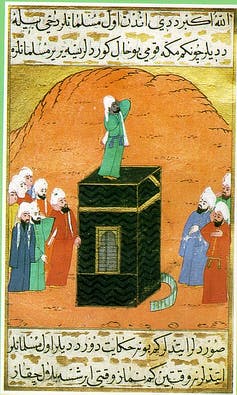
Bilal was exceptionally close to Muhammad, too. In 622, the Prophet appointed him the first person to give the public call to prayer in recognition of his powerful, pleasing voice and personal piety. Bilal would later marry an Arab woman from a respectable tribe – unthinkable for an enslaved African in the pre-Islamic period.

For many modern Muslims, Bilal is the symbol of Islam’s egalitarian message, which in its ideal application recognizes no difference among humans on the basis of ethnicity or race but rather is more concerned with personal integrity. One of the United States’ leading Black Muslim newspaper, published between 1975 and 1981, was called The Bilalian News.

More recently Yasir Qadhi, dean of the Islamic Seminary of America, in Texas, invoked Islam’s egalitarian roots. In a June 5 public address, he said American Muslims, a population familiar with discrimination, “must fight racism, whether it is by education or by other means.”

Many Muslims in the U.S. are taking action, supporting the Black Lives Matter movement and protesting police brutality and systemic racism. Their actions reflect the revolutionary – and still unrealized – egalitarian message that Prophet Muhammad set down over 1,400 years ago as a cornerstone of the Muslim faith.The Conversation

Date posted: July 16, 2020.

[Editor’s Note: I first read the above piece in the religion section of the Salt Lake Tribune, which republished it from The Conversation under a Creative Commons Licence. We do likewise, and invite our readers to read the original piece by clicking HERE; it includes several more hyperlinks within the body of the article that some readers may find useful for further study. Image(s) in Simerg’s piece may vary from those posted in The Conversation and the Tribune .]

Before departing this website please take a moment to review Simerg’s Table of Contents for links to hundreds of thought provoking pieces on a vast array of subjects including faith and culture, history and philosophy, and arts and letters to name a few.

_______________________-

Asma Afsaruddin is Professor of Islamic Studies and former Chairperson, Department of Middle Eastern Languages and Cultures, Indiana University.

This article is republished from The Conversation under a Creative Commons license. To read original article in The Conversation, please click HERE.

_________________

The editor highly recommends the following recent pieces published in Simerg:

1. His Highness the Aga Khan on partnership between races as a condition of peace and prosperity; and
2. Ismaili Youth Perspectives on Black Lives Matter and Social Justice Issues.

Ismaili Diaries: The story of Tanga’s iconic Alladin Bapu family

Preamble to this series on life in the Ismaili community: This is the second in a series of articles dealing with life in the Ismaili community from the late 19th century onwards. The first in the series was on a Rare 100 year old photo. The piece that follows has been adapted by Safder Alladina from his book “Ties of Bandhana: The Story of Alladin Bapu” which was published under his pen name Safder Giga Patney. The paperback book, see image below, is available on Amazon.

Front and back covers of "Ties of Bandhana", by Safder, Simerg article
Front and back covers of “Ties of Bandhana”, available from Amazon.

The lead in this special series is Toronto’s Zahir Dhalla, who wishes Jamati members to dig into their archives and submit electronic versions of family historical photos to Simerg@aol.com. Zahir would then be quite willing to work with families, and prepare stories for publication in Simerg or in its two sister websites, Barakah and Simergphotos.

Alladin and Prembai

Alladin Suleman Hasham Mohamad Giga Patney of Chhachhar, Kathiawar. Gujarat, India.  c1910, Ismaili Simerg
Alladin Suleman Hasham Mohamad Giga Patney of Chhachhar, Kathiawar, Gujarat, India,  c1910. He was born on Sept 9, 1851, in Pattan, India, and died on July 28, 1926 in Tanga, Tanganyika

By SAFDER ALLADINA

Alladin and Prembai owned fields and orchards in Chhachhar in Kathiavar in Gujarat. But at the end of the 19th century the area suffered a series of droughts and famines, and families were looking towards Zanzibar and the East African countries. In addition to this the British Raj, with the connivance of the Nawab of Junagadh and his officials, had imposed excessive taxes and levies. On Mawlana Sultan Mahomed Shah’s advice and support from Ismailiss who had made it good in East Africa, families were encouraged to move to East Africa.

Alladin and Prembai, with their children travelled to German East Africa in a dhow. After thirty odd days on the boat they landed at Tanga, Tanganyika. The family had relations in Moshi so they went there in bullock carts on a journey that took them fifteen days. In Moshi, Alladin and Prembai tried to farm but they were new to the climate, weather and growing conditions. After two years, they decided to return to Tanga. The railways and automobiles had arrived in the country and Alladin, with his eldest son Kassam started a shop selling tires, car parts and other hardware.

The shop was on Marketstrasse, Tanga, Deutsche Ost Afrika (German East Africa, now Tanzania), at the corner of the road that came up from the harbour. A railway line from the station cut through the southern part of the town and went down to the port taking sisal, timber and coffee to the ships anchored in the harbour. Steamboats from Europe brought cars, machinery, cloth and equipment while the dhows from India and the Gulf countries brought cloth, tiles, earthenware pottery, salt cod, carpets, spices and tea.

Kassam, Alladin’s eldest son who had a smattering of German now, was talking to the German officials to be allowed to put a petrol pump at the shop. They liked the young man dressed in long khaki pants and a solar topi in the German fashion, and who spoke German and suggested that he go to Berlin on a scholarship to become an engineer instead of pumping gasoline. Kassam’s young wife, who had a boy and a girl now, and his mother were distraught when they heard this: Hai, hai Allah! Hooñ kadi na jawa daooñ! Prembai asserted. (By God! I’ll never let him go abroad.) [1]

story continues after photo

Prembai Ibrahim Teja, c1910 Simerg Ismaili Diaries
Prembai Ibrahim Teja. She was born on June 29, 1854, in Chhachhar, India, and died on June 12, 1924 in Tanga, Tanganyika.

A couple of years later, their son Karim was identified by the German officials as suitable candidate to be sent to Berlin for further education. In 1914, a passage was booked for Hamburg on the Deutsch Ost Afrika line the Pandakoti for Karim to go to Berlin. But war broke out and the Pandakoti was bombed and sunk at Manza Bay near Tanga. Karim had to stay in Tanga and after his father died, ran the gas station on Market Street.

Eventually, Kassam got a license to sell petrol. Drums of petrol were brought to the shop front. A piston pump, operated by hand, was attached to a drum and the fuel pumped into cars and trucks and also sold in tin jerry cans. Motorcycles had now appeared in town. Alladin and Kassam found that they had to start keeping car parts and tyres for the growing automobile population in town.

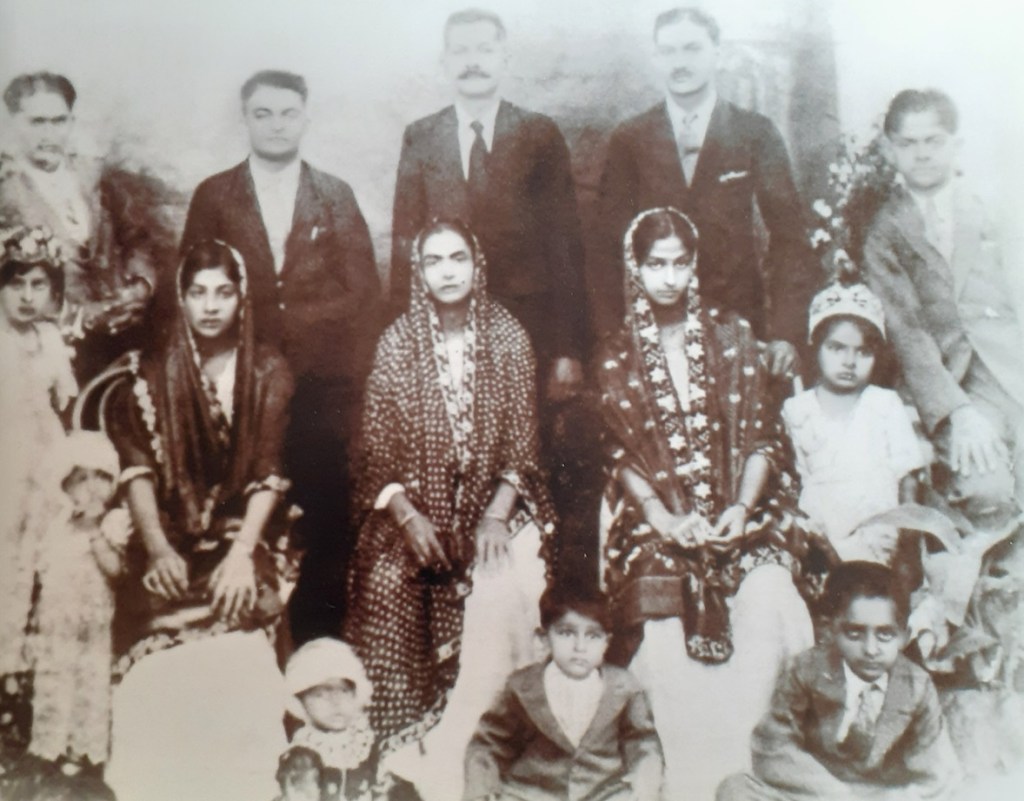
The family photo, below, shows Karim and Alimohamed newly married. Trinkets of gold and bandhanis of silk were brought out for the marriages of their sons Karim and Ali Mohamed. There was now an extended family of Alladin and Prembai: three married sons and their wives and at least five to six children. Shariff and Fatehali, Kassam and Maanbai’s eldest son, were unmarried.

Shariff had a fine singing voice and was a favourite of the ladies in town. He also used to sing Ginans in the Jamatkhana. (For Shariff Alladina’s 4 Ginans, see Soundcloud, Safder, Bapaji )

story continues after photo

Alladin and Prembai’s family, Ismaili Simerg
Alladin and Prembai’s family, c1925, Tanga, Tanzania (then Tanganyika). Children seated on floor, l. to r : Sherbanu, Amir and Murad; Middle row, l to r: Nurbanu and Milli (2 children), Sikina, Maanbai and Kursum (ladies), Kursum (young girl); Gentlemen l. to r: Shariff, Alimohamed, Kassam, Karim and Fatehali, Kassam and Maanbai’s eldest son. See Note [2] below for more info.

In the August of 1914, there was word around that there was going to be a world war. The British were going to attack German East Africa.

That September, the Districtkommissar went in his open sided automobile to the bigger shops and businesses of the Indians and told them that they would have to leave town and find somewhere to stay until they were given permission to return to their homes. The businessmen were ordered to inform all the other Indian homes in town. Being colonial subjects of the British, the German government saw them as security risk. An Indian owned provision store and Alladin’s petrol pump were told to remain open but their families would have to leave.

story continues after photo

Alladina Bros & Shariff Service Station, Tanga Tanganyika, Simerg Ismaili
Business cum Residence Alladina Bros & Shariff Service Station, 26 Marketstrasse Tanga, German East Africa, antebellum WW I. Photo: Karim Alladin, via his youngest son Mirza, Vancouver. BC.

Alladin and Kassam stayed to keep the business open, while Prembai, and her sons with their wives and children, left by train for Muheza thirty miles inland, in the foothills of the East Usambara Mountain. They stayed with a family from Kodinar, a small town near Chhachhar, the Alladins home village.

On 14th November of 1918, Armistice was declared and the First World War had ended. On 25 November, what was German East Africa became Tanganyika and was given a Class B Mandate by the League of Nations and effectively became Tanganyika Territory of the United Kingdom. The Union Jack now flew over the Customs House, the boma of the District Commissioner, the police station and the Schule school.

Prembai died after the war and Alladin a few years later. They were buried in the Ismaili cemetery at the southern edge of the town. Maanbai became Moti Ma, the matriarch of the household, and Kassam became Mota Bapa  – Big Father of the family.

Today, the Alladin family members are dispersed around the globe in Canada, the USA, the United Kingdom and Belgium, engaged in various professions and businesses – many are still connected to the automobile business.

Date posted: July 14, 2020.

_________________

Safder Alladina

Safder Alladina has taught English as a Foreign Language in England, Japan and Portugal and English as a Second Language in England and Canada. In his 35 years of teaching, he has taught Early Years, Primary, Secondary and Adult classes; and developed and taught Teacher Education programmes at graduate and post-graduate levels at the University of North London, UK, and the University of British Columbia, BC. His research work is in Sociolinguistics. He has retired to a hobby farm in the interior of British Columbia where he does his writing under the pen name of S. Giga Patney.

_________________

The following additional details have been compiled by Zahir Dhalla, author of Ismailis in Tanga.

Alladin and Prembai’s sons started their own businesses in Tanga as follows: Kassam started an auto parts business with his sons; Karim managed the petrol station on Market Street and then went on to start as auctioneer and accountant; Alimohamad started a provision store with his brother Shariff; and Shariff went on to start as copra merchant on his own. He then went into rice milling and producing coir fibre for export.

Collectively, the Alladins became the biggest of Tanga Ismailis Big Five Clans viz. The Alladins: 60; The Hajis: 50; The Nathoos: 40; The Babuls: 30; and The Bhanji Jiwas: 30.

____________________

Notes:

[1]. Kassam and Maanbai were parents to Fateali, Milli, Sherbanu, Amir and Murad; Roshan and Sikina were sisters; all gentlemen standing were sons of Alladin and Prembai and were born in India as was Maanbai. Everyone else in the photo was born in Tanga.

[2]. Offering scholarships to young men was seen elsewhere too: Ismail Jaffer Somji, born 1901, in Bagamoyo, was offered in 1914 full scholarship for himself and elder brother Kassamali. But, as happened above, his ma refused to let them go! Zahir K. Dhalla.

_________________

We welcome feedback/letters from our readers. Please use the feedback box which appears below. If you don’t see the box please click Leave a comment . Your comment may be edited for length and brevity, and is subject to moderation. We are unable to acknowledge unpublished letters
Come Watch Afraaz Mulji perform today, July 12, at Aga Khan Museum at Noon, 1 and 3 PM

Afraaz Mulji on July 11, 2020 Aga Khan Museum
Afraaz Mulji at AKM, July 11, 2020

Sit in the Aga Khan Museum’s courtyard, sip a latter, have a biscotti, visit Prince Sadruddin Aga Khan’s collection of Islamic ceramics in the Bellerive Room, listen to performance by Afraaz Mulji and then walk through the Aga Khan Park. Enjoy July 12 at the Aga Khan Museum. Register (preferable) your visit at RESERVE TICKET. NOTE: Entrance to the Museum during the first month of reopening is Free or Pay as You Wish. For story on performance on July 11, 2020, please click A beautiful rendition of Nashid al Imamah by Afraaz Mulji at Aga Khan Museum

Date posted: July 12, 2020.

____________________

Mawlana Hazar Imam’s Talika Mubarak, and Imamat – a Hereditary Divine Institution that has spanned 1388 years from the time Prophet Muhammad (S.A.S) passed away in 632 C.E.

Introduced by MALIK MERCHANT
Publisher/editor SimergSimergphotos  and Barakah

From the day our beloved Prophet Muhammad (S.A.S.) passed away on June 8, 632, and Hazrat Ali (a.s.) became the first Imam on the Divine Commandment that the Prophet had earlier received at Ghadir Khumm, there have been forty-nine Ismaili Imams, spanning a period of 1388 years in human history.

A historical collage featuring four prominent figures in Ismaili history: a seated man in traditional attire with a cane on the left, a bearded man in ornate dress on the right, and two stylized portraits of men in blue tones below.
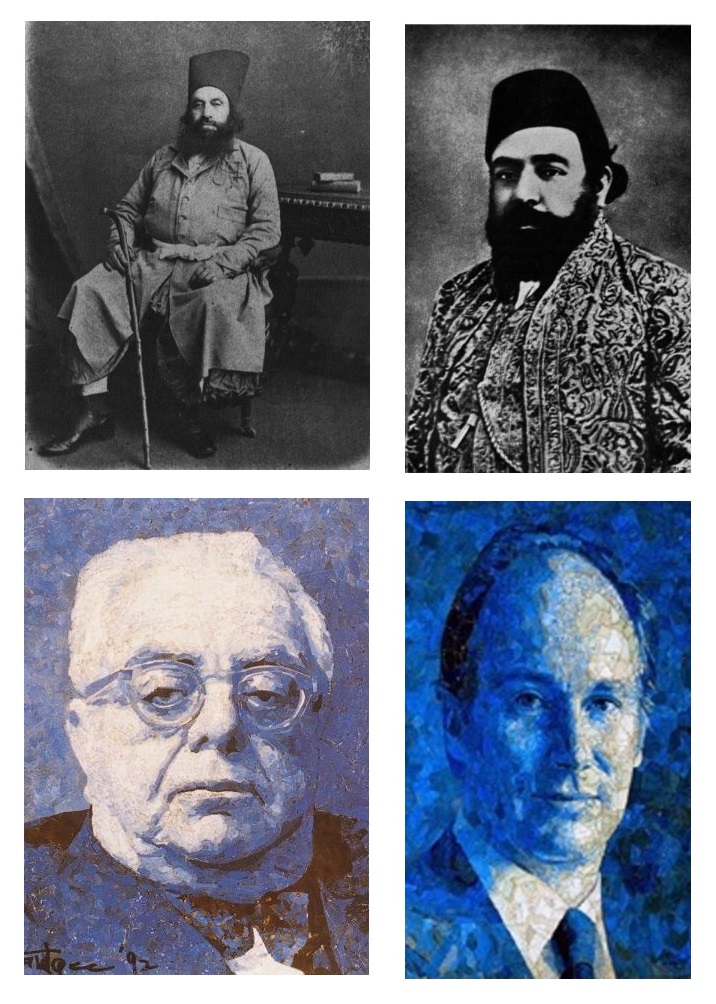
Top: Imam Shah Hassanali Shah and Imam Shah Ali Shah; Bottom: Imam Sultan Mahomed Shah and Mawlana Sha Karim Hazar Imam ( both Gulgee lapis portraits).

Mawlana Hazar Imam and his immediate 3 predecessors have reigned the Jamat for a total of 202 years — 14.6 % of the 1388 years of Imamat to date — as follows: Mawlana Shah Karim Al Hussaini Hazar Imam (His Highness the Aga Khan IV, Imam from 1957 — 2020 and continuing, 63 years, he became the 49th Imam at the age of 20); Imam Sultan Mahomed Shah (His Highness the Aga Khan III, Imam from 1885 – 1957, 71 years, he became the 48th Imam at age 7 years), Imam Shah Ali Shah (Aga Khan II, 1881 – 1885, 4 years, he became the 47th Imam at the age of 51 years), and Imam Shah Hassanali Shah (Aga Khan I, 1817 – 1881, 64 years, he became the 46th Imam at the age of 13 years).

This 203 year period accounts for more time than does the entire Fatimid period, reigned by 8 Imams from Imam Mehdi (11th Imam to Imam Mustansir bi Allah (18th Imam)!

A green poster featuring the quote from Prophet Muhammad about the two weighty things he left behind: 'The Book of Allah and my Progeny.' The design includes an infinity symbol and highlights the importance of these teachings.
Art work Nurin Merchant, Credit: Infinity design povray.org

Some of the traditions of the Prophet Muhammad on the Imamat are follows: “I leave among you two weighty things: The Book of Allah and my Progeny. If you keep attached to these two never, never will you go astray. Both are tied with a long Rope and cannot be separated until the Day of Judgment.”

I recollect a Farman made by Mawlana Hazar Imam during his Silver Jubilee (1982) in Nairobi, Kenya, where he said that he was the 49th Imam and that there would always be Imams in the future, whether it is the space age or even beyond that! That Allah’s guidance is ever present on this earth through the manifest Imam is reaffirmed in another tradition of the Prophet that says that if the world were to remain without an Imam for one moment, the whole world with everything in it would perish instantaneously.

A Ginanic verse that correlates to the Hadith is:

Purush shan matra pag dharani na dharante,
Sansaar, chandra, suraj na dhrashtante,
Kuchh na dhrashtante,
Bhom kar, megh, dharti na aakaash bhave 

Translation:

If the Imam did not have his feet on this earth for even a moment,
then the world, moon, sun would vanish
and nothing would exist,
neither the heaven nor the earth.

On those affirmations from the Prophet Muhammad, our Ginans and Mawlana Hazar Imam, let us therefore truly rejoice that we have a living Imam and that our future generations will also continue to always live under the loving care guidance and protection of the Imam of the Time.

Let us on this auspicious 63rd Imamat Day offer our heartful thanks to Mawlana Hazar Imam for the following Talika that we have received yesterday, July 10, 2020. It was also read out to us last night by ever inspiring President of the Aga Khan Council for Canada, Ameerally Kassim-Lakha, in the weekly reflections program.

We convey Imamat Day Mubarak to our readers and Jamats around the world.

_______________________

Talika Mubarak from Mawlana Hazar Imam (English)

His Highness the Aga Khan, Mawlana Hazar Imam

My beloved spiritual children,

On the occasion of Imamat day, the 11th of July 2020, I send my warmest and most affectionate paternal maternal loving blessings to all my beloved spiritual children throughout the world.

I send my best loving blessings for the souls of all my ruhani spiritual children, and I pray that their souls may rest in eternal peace.

While the Covid-19 pandemic continues to pose a challenge globally, I have agreed to the re-opening of Jamatkhanas in areas where the health authorities allow gatherings in spaces of prayer.

As Imam-of-the-Time, I have authorised modifications to the conduct of ceremonies in our Jamatkhanas, to ensure compliance with present health and safety requirements. This matter is constantly under my review, and I will make appropriate decisions on when to return to normal practice.

It is my wish that, in attending Jamatkhana, as indeed at all other times, my Jamat should continue to exercise utmost care and rigour in observing the measures recommended by the public health authorities.

On this happy occasion, I send my most affectionate loving blessings to all my spiritual children who have submitted services and sent messages of congratulations and good wishes.

I send my most affectionate special loving blessings for mushkil-asan, good health, safety and security for all my Jamats, and the restoration of peace and stability, with best loving blessings for your spiritual happiness, worldly progress, strength of faith, and for unity in the Jamat.

Yours affectionately,

Aga Khan

___________________

Message from Mawlana Hazar Imam (French)

Aga Khan IV seated in ceremonial attire, smiling, with a decorative backdrop.

A l’occasion de l’Imamat Day, Mawlana Hazar Imam nous a gracieusement béni d’un Saint Talika pour son Jamat global qui est partagé sur le site The Ismaili.

Mes Chers Enfants Spirituels,

A l’occasion de l’Imamat day, le 11 juillet 2020, j’envoie mes plus chaleureuses et mes plus affectueuses tendres bénédictions paternelles et maternelles à tous mes enfants spirituels bien-aimés à travers le monde.

J’envoie mes meilleures bénédictions affectueuses pour les âmes de mes enfants spirituels ruhani, et prie pour que leurs âmes reposent dans la paix éternelle.

Alors que la pandémie Covid-19 continue à poser un défi au niveau mondial, j’ai donné mon accord pour la réouverture des Jamatkhanas dans les zones où les autorités sanitaires autorisent les rassemblements dans les espaces de prière.

En tant qu’Imam-du-Temps, j’ai autorisé des modifications dans la conduite des cérémonies dans nos Jamatkhanas, afin de garantir leur conformité avec les exigences actuelles en matière de santé et de sécurité. C’est un sujet que je suis constamment, et je prendrai les décisions appropriées quant au moment de revenir à une pratique normale.

C’est mon souhait qu’en venant au Jamatkhana, comme en toutes circonstances, mon Jamat continue à faire preuve du plus grand soin et de la plus grande rigueur dans le respect des mesures recommandées par les autorités de santé publique.

En cette heureuse occasion, j’envoie mes plus affectueuses tendres bénédictions à tous mes enfants spirituels qui ont soumis des services et envoyé des messages de félicitations et de bons vœux.

J’envoie mes plus affectueuses tendres bénédictions spéciales pour mushkil-asan, une bonne santé, la sûreté et la sécurité de tout mon Jamat, et le retour de la paix et de la stabilité, avec mes meilleures bénédictions affectueuses pour votre bonheur spirituel, le progrès matériel, la force de la foi, et pour l’unité dans le Jamat.

Affectueusement,

Aga Khan

___________________

Talika from Mawlana Hazar Imam (Portuguese)

Mawlana Hazar Imam seated in traditional attire, smiling warmly, with a decorative patterned backdrop.

Por ocasião do Imamat Day, Mawlana Hazar Imam graciosamente enviou um Talika Mubarak para o Jamat global e que partilhamos pelo The Ismaili.

Meus amados filhos espirituais,

Por ocasião do Imamat Day, 11 de julho de 2020, envio as minhas mais calorosas e mais afetuosas bênçãos paternais e maternais a todos os meus filhos espirituais por todo o mundo.

Envio as minhas melhores bênçãos de amor para as almas de todos os meus filhos espirituais ruhani, e oro para que as suas almas descansem em paz eterna.

Apesar da pandemia de Covid-19 continuar a representar um desafio global, concordei com a reabertura de Jamatkhanas nas áreas onde as autoridades de saúde permitem encontros em locais de oração. 

Como Imam do Tempo, autorizei modificações na realização de cerimónias nos nossos Jamatkhanas, de forma a assegurar o cumprimento dos atuais requisitos de saúde e segurança. Este assunto está constantemente sob a minha análise, e tomarei as decisões apropriadas acerca de quando se poderá regressar à prática normal.

É meu desejo que, tanto ao frequentar o Jamatkhana, como também em todos os outros momentos, o meu Jamat continue a exercer o máximo cuidado e rigor no cumprimento das medidas recomendadas pelas autoridades de saúde pública. 

Nesta feliz ocasião, envio minhas mais afetuosas bênçãos de amor a todos os meus filhos espirituais que submeteram serviços e enviaram mensagens de felicitações e votos de felicidades.

Envio minhas mais afetuosas e especiais bênçãos de amor para mushkil-asan, boa saúde, segurança e proteção, para todos os meus Jamats, e restauração da paz e estabilidade, com as melhores bênçãos de amor para a vossa felicidade espiritual, progresso material, força de fé e para união no Jamat. 

Afetuosamente

Aga Khan

___________________

Talika from Mawlana Hazar Imam (Farsi)

Mawlana Hazar Imam seated in ceremonial attire, smiling against a decorative background.
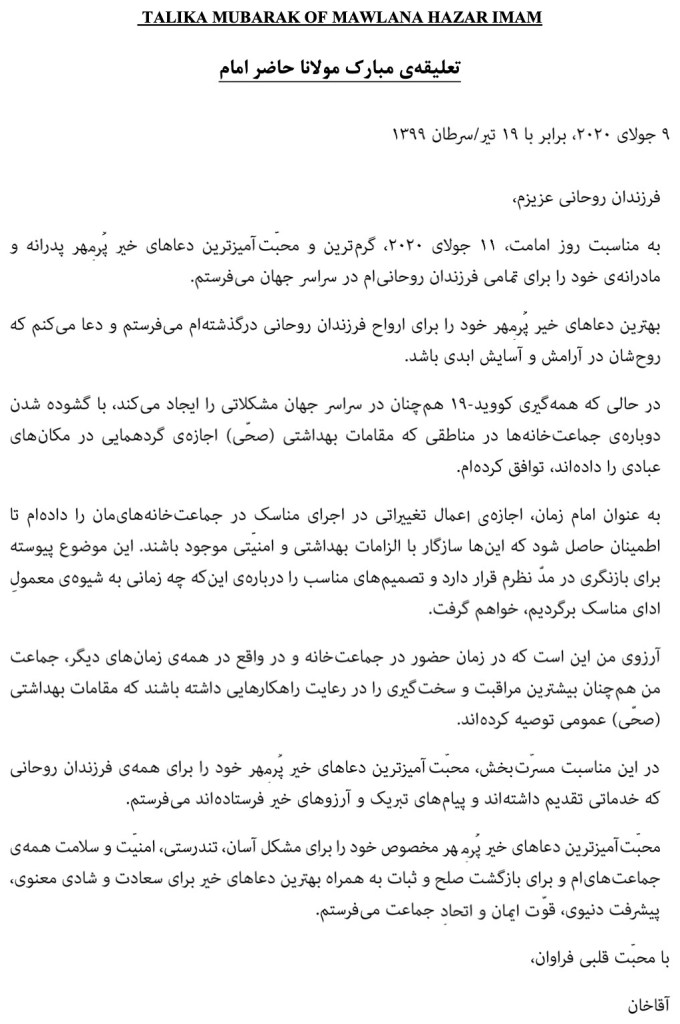
Talika Mubarak from Mawlana Hazar Imam, addressing his spiritual children on the occasion of Imamat Day, expressing affection and blessings amidst the challenges of the Covid-19 pandemic.
Talika in Farsi

___________________

Talika from Mawlana Hazar Imam (Arabic)

Mawlana Hazar Imam wearing a ceremonial outfit, seated with a decorative backdrop.
Imamat Day Talika, Aga Khan, Hazar Imam, Simerg
Talika in Arabic

___________________

Talika from Mawlana Hazar Imam (Gujarati)

A portrait of Mawlana Hazar Imam, dressed in ceremonial attire, smiling while seated against a decorative backdrop.
Imamat Day Talika, Aga Khan, Hazar Imam, Simerg
Talika in Gujarati

___________________

Talika from Mawlana Hazar Imam (Russian)

Aga Khan IV seated in traditional attire, smiling, with a decorative background.
Imamat Day Talika, Aga Khan, Hazar Imam, Simerg
Talika in Russian

_______________________

Talika from Mawlana Hazar Imam (Urdu)

Aga Khan seated in traditional attire with a decorative background.
Imamat Day Talika, Aga Khan, Hazar Imam, Simerg
Talika in Urdu

___________________

Talika from Mawlana Hazar Imam (Tajik)

Aga Khan IV, dressed in ceremonial attire, seated with a serene expression against a decorative background.
Imamat Day Talika, Aga Khan, Hazar Imam, Simerg
Talika in Tajik

___________________

Shukrana and Supplication

We submit our humble gratitude to our beloved Mawlana Hazar Imam for his blessings to the world wide Jamat on the occasion of his 63rd Imamat Day.

We submit the following supplications from verse 1 of Pir Hasan Kabirdin’s Ginan Sahebe Farman Lakhi Mokalea:

“O brother! Listen, My Lord Ali has written and sent a Farman. The beloved Lord has remembered this servant today with kindness in his heart”

Date posted: July 11, 2020.
Last updated: July 12, 2020.

Before departing this website please take a moment to review Simerg’s Table of Contents for links to hundreds of thought provoking pieces on a vast array of subjects including faith and culture, history and philosophy, and arts and letters to name a few.

CORRECTION: When the post was initially published, the Arabic translation was loaded into the Farsi Talika block, and appeared twice. The post now stands corrected, and we regret the confusion it caused.

_________________________

We welcome feedback/letters from our readers. Please use the feedback box which appears below. If you don’t see the box please click Leave a comment. Your comment may be edited for length and brevity, and is subject to moderation. We are unable to acknowledge unpublished letters