Simerg is an independent initiative dedicated to Ismaili Muslims, the Aga Khan — their Hereditary Imam — and the Ismaili Imamat, and Islam in general through literary readings, photo essays and artistic expressions
I applaud Simerg for drawing attention to this extremely important issue [Deaf Ismailis] that goes to the heart of inclusivity within our community. And, I am delighted – thrilled – to read about the fledgling efforts to reach out our hearing-challenged brothers and sisters. Definitely a step in the right direction!! But, I would like to highlight that in addition to deaf Ismailis, there are Ismailis with other challenges who also find it very difficult to immerse themselves as deeply in the Jamatkhana (JK) and communal activities as they want. Sometimes these are due to barriers that the rest of us have created (and maintain) because we view their challenges as a negative, a result of karma, or whatever.
I would encourage your readers to query themselves: Do we hold implicit or explicit biases? And do these cause us to act in way that causes hurt or just deprives others of feeling like they are valued members of our jamat? Our ethics are clear on this: It is the duty of each and everyone of us to act in a way that brings a spark of hope (and happiness) to others. On this note, I would like to draw attention to one particular progressive jurisdiction that is showing the rest of us the way: UK. There are JKs in the UK where the front row is reserved for deaf people who are able to lip read so they can read Mukhi/Kamadias’ (M/K) and the reciters’ lips during JK. And on a handful of occasions, a student with Downs Syndrome has been appointed Student Majalis M/K.
Date posted: July 10, 2020.
________________
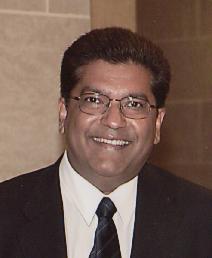
Arif Babul
Arif Babul is distinguished Professor of Astronomy and Physics at the University of Victoria in British Columbia, Canada.
He has contributed numerous articles to Simerg, including a highly interesting multi-part interview. We invite our readers to read them by clicking on the following links:
External Link: We invite our readers to read The Ismaili article Dismantling the Barriers of Disability The featured photo at top of this post is from the article.
We welcome feedback/letters from our readers. Please use the feedback box which appears below. If you don’t see the box please click Leave a comment . Your comment may be edited for length and brevity, and is subject to moderation. We are unable to acknowledge unpublished letters.
Before departing this website please take a moment to review Simerg’s Table of Contents for links to hundreds of thought provoking pieces on a vast array of subjects including faith and culture, history and philosophy, and arts and letters to name a few.
This special article for Simerg was written jointly by SALMA KHANJI, IMRAN HAKAMAILI, FARAH LADHA, RAMZAN SOMANI and SHAIZA JETHA, and edited by NURIN MERCHANT
Picture yourself sitting in Jamatkhana on a Friday evening, listening to a Ginan or Qasida. Voices of fellow Jamati members resonate within the prayer hall, as they sing along in unison or chit chat amongst themselves. Mukhisaheb’s voice can then be heard, announcing the commencement of Du’a, and subsequent prayers, ginans, readings and announcements. You listen to the words being spoken, thinking about their meaning, as your mind subconsciously perceives the tone and pitch of the presenter’s voices.
Now, picture yourself sitting in Jamatkhana on a Friday evening, unable to hear a single sound. Wanting desperately to be able to participate in and understand the prayers and ceremonies, just as your spiritual brothers and sisters do, but unable to easily do so. This is the challenge Deaf Ismailis face not only here in North America, but all around the world.
Our Deaf Ismaili brothers and sisters can be found across the globe, from small villages and towns across India, Pakistan, the Middle East, Central Asia and Africa, to larger cities across Canada, Europe, the United States, and elsewhere. Just as our Hearing brothers and sisters living in various parts of the world speak different languages, so do the Deaf murids.
However, there are only two Ismaili sign language interpreters in North America, where American Sign Language (ASL) is used and globally only seven Ismaili sign language interpreters are known.
Sign language is not an international language -– every country and language has its own form. Each one is just as beautiful, unique, and cultural as spoken languages. For example, there is a sign for “jambo” (meaning “hello” in Swahili) in East African sign languages, such as Kenyan and Tanzanian. There is also a sign for “bon appétit” (meaning “enjoy your meal” in French) in French Sign language. However, neither of these signs are used or recognized by individuals who communicate in American Sign Language, which is largely used in Canada and the United States, nor in British Sign Language, which is used throughout the United Kingdom.
story continues after photo
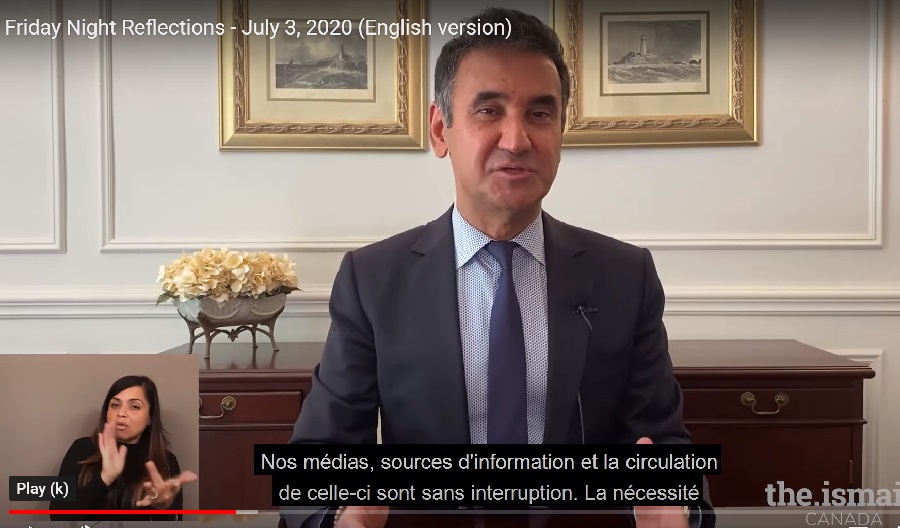
President Ameerally Kassim-Lakha of His Highness the Aga Khan Shia Imami Ismaili Council for Canada gives his weekly address to the Canadian Jamat during the Friday Night Reflections program, while Safina Heneisen, a US based sign interpreter shown at bottom left of the photo, conveys the President’s message to Deaf Ismailis. In the top featured photo, the sign interpreter conveying Mawlana Hazar Imam’s speech is Vancouver’s Farah Ladha.Both photos have been extracted from the weekly Reflections program.
Since the coronavirus pandemic, all gatherings have become virtual. It was nice to see that the Canadian institutions had recruited sign language interpreters for the Friday Night Reflections series, a weekly webinar that airs on the Ismaili Canada website every Friday. This is a step in the right direction in terms of engaging and involving the Deaf Ismaili community. But that is not all that we can do! We are One Jamat -– what more can we do to include our Deaf brothers and sisters?
When Deaf murids are asked for their thoughts, many say they want to go to Jamatkhana to participate in and learn about our rituals, our history, our traditions, and our culture. But, without the presence of someone who can interpret this information to them in sign language, they are unable to learn and participate in a way that Hearing Ismailis can, which sadly but understandably, causes many to stop coming to Jamatkhana altogether.
YOUNG DEAF ISMAILI CHILDREN
There are also many young Deaf Ismaili children within our community, who do not have access to the Ta’lim Curriculum or teachings at Bait-ul-ilm (BUI) in sign language. Parents have expressed much sadness in seeing their children being unable to participate in these teachings. If you find yourself thinking, “why don’t parents of Deaf children just teach them our faith in sign language themselves at home?”, please consider this: do you (or any parent) have the same level of knowledge as a trained Secondary Teacher Education Program (STEP) BUI teacher, or an Alwaez? Furthermore, this type of thinking does not consider the experience of attending BUI, of interacting with other Ismaili children, and of feeling like a part of the community.
Deaf children and adults experience many challenges just in the process of seeking to understand and be understood. Imagine being in a country where you do not understand the language but still need to ask for directions. That would be a challenge. Now imagine you are in that same country; you have learned a little bit of the language and are required to give a fluent presentation. Imagine being judged on your performance, on the errors in vocabulary choice and grammar that cause misunderstanding or confusion. That is the challenge that Deaf children and adults face daily.
For Deaf people to have full communication access, they need communication partners that share the same language that they use. For learning and participating fully in the BUI and in the Jamatkhana there needs to be access in sign language. This can be provided by a teacher who is proficient in sign language. If there is no teacher who is skilled with sign language, the services of a professional sign language interpreter can be used. Such professionals will have completed many years of specialized training and are able to interpret in a variety of situations from business meetings to conferences, medical appointments to classrooms, and even in Jamatkhana.
Not only are professional sign language interpreters trained in a variety of settings, they are also ethically bound to a strict code of confidentially set by their local and national associations. Some interpreters even work internationally.
Interpreters play key roles in this process of learning and belonging. When Deaf murids receive information in sign language, they thrive in our community. By learning the meanings of Firmans and of our various prayers using sign language, they have said that they feel more connected to our faith –- not only physically to the space of Jamatkhana, but spiritually as well. We would like to share a few examples of how interpreters can be key contributors in building bridges and connections between Deaf and Hearing Jamati members.
story continues after photo
A group photo of students attending American Sign Language (ASL) class in a Jamatkhana. Photo credit: Farah Ladha.
EXAMPLES: THE JOY OF FEELING CONNECTED
A Deaf man in his 40s was interested in learning about mehmani that is brought to Jamatkhana, which is then sold as nandi. The question was why is it brought to Jamatkhana as a mehmani? And how its auctioned off after? The presence of an interpreter encouraged this murid to buy nandi in Jamatkhana for the first time. The custom was interpreted for the Deaf murid in sign language, including the description of the item, and the entire bidding process. When he wanted something, he would raise his hand. A Jamati member next to him informed him when his upper price limit had been reached by tapping him on the shoulder, causing him to lower his hand if the price exceeded his set amount. This not only helped him to participate in and understand the tradition of nandi, it also helped him to feel connected and interact with other Jamati members and allowed them to learn how to communicate with a Deaf murid.
Another example: For many years, a well-known Deaf murid attended Jamatkhana regularly. Every day, he would be greeted with a handshake to say hello. Nothing more was conveyed between himself and other Jamati members, as a communication barrier existed between them. One day, the Deaf murid, through a sign language interpreter, was able to present to the Jamat about his life. Audience members wept at having seen him for many years but never truly knowing him or his story. They also didn’t know that as a child, Hazar Imam had put his hand on his shoulder during a mulaqat while at the same time telling his father not to worry, his Deaf son would be ok. Nor were they aware that he had gone on to have a very successful business. His story would never have come to light if it were not for the presence of an interpreter, who facilitated the communication and understanding using sign language and the audience’s spoken language.
DIAMOND JUBILEE AND RECENT SUCCESS STORIES
A final example outlining a recent success story is one from the Diamond Jubilee. After tireless work and education about the inclusion of the Deaf Jamat, sign language interpretation was provided live for the first time for the Mulaqats in Karachi, Paris, and Lisbon, as well as across Canada and in Atlanta Georgia, USA. Over 250 Deaf murids were able to understand Hazar Imam’s Firmans for the first time.
However, there were still hundreds more that were not able to reap the benefit of the live interpretation either due to lack of professional Ismaili sign language interpreters in their area, or due to lack of education and knowledge of the presence of Deaf Ismaili murids, as well as the provision of adequate supports for them. Inshallah as more education is disseminated and awareness is raised, Deaf Ismailis will start to see a change, and more steps will be made towards their inclusion.
GOOD NEWS
The good news is that there is inclusive change happening. Gatherings for Deaf Ismailis have been organized, which have proven to be great opportunities for Deaf murids to meet and greet one another, as well as to teach, learn, and share knowledge. Watching elderly Deaf Jamati members interacting with younger members is a beautiful sight to see and reflect upon. Just as we reminisce about how our grandparents explained concepts to us in their mother tongue, when we were younger, the elder Deaf Ismailis are teaching the younger generations in their shared sign language.
Some Jamats have gone a step further and have hosted sign language 101 workshops for their members, where professional sign language instructors (some from outside of our community) come to teach basic sign language. The workshops have been very successful, and some Jamats have decided to pursue additional workshops so that they can advance their knowledge. All Jamats could host these types of workshops in order to promote communication between Deaf and Hearing murids.
EXCEPTIONAL AND INSPIRING STORIES, AND STIGMAS
In addition to allowing Hearing and Deaf Jamati members to communicate, these workshops also allow individuals with hearing loss to learn sign language and thus have seamless communication as hearing deteriorates with age. For example, there was a woman who brought her elderly mother, who was profoundly deaf in one ear and losing hearing in the other, to one of these organized workshops. Both wanted to learn sign language so that they could continue to communicate once her mom had fully lost her hearing. Both mum and daughter were very touched and emotional when they witnessed firsthand how sign language is possible to learn and assists in communication between the Hard of Hearing and the Hearing. These workshops again were facilitated by professional sign language interpreters, some from within the community and some from outside of it.
These are good news stories, yes. But negative stigmas are still attached with Deafness, mainly the myth that Deaf are unable to be educated or taught or even work to make a living. This is entirely untrue, and an example given by Habiba Teja at a woman’s gala presentation highlights this fact.
Habiba is a well-known nutritionist and was talking about her experience with improving food quality through Aga Khan University (AKU) in Pakistan and Eastern Africa. Through this endeavor, she was able to help many impoverished people find work. One example she gave was about how she learned of a young Deaf man in his 20’s who sat in his room all day and stared at a wall. She visited with him and taught him job skills by communicating with him visually by hand gesturing, and by physically showing him what to do. He was quick to learn and was able to find full time paid work. This turned his entire life around and he began earning an income. He has since gotten married and has a family of his own. The stigma associated with him being Deaf had prevented anyone from trying to support his learning; believing he couldn’t learn, no one bothered taking the time to teach him anything. Habiba’s story touched many and shattered the notions that the Deaf people are unable to be educated or work.
This is not the only stigma we need to face as a community. We need to work together as a community to squash the stigmas associated with Deafness, Blindness, and Disabilities in general. Unfortunately, these stigmas are still very prevalent in the Ismaili Community today. We need to educate ourselves and to reach out to those who feel left out in our community due to situations beyond their control. We need to inspire one another and learn from one another. And perhaps for some of you reading this, it may seem like a lot to take in. Maybe trying to learn a bit of sign language feels overwhelming. For those people, we offer this one quote from a Deaf person:
“Hearing people can learn sign language. Deaf people cannot learn to hear.”
ISMAILI DEAF WEBSITE
Try to learn even just a little bit of sign language to be able to communicate with your Deaf brothers and sisters. If you know of any Deaf Jamati members wanting to participate in activities within our community, but not being able to do so due to the reasons outlined in this article or others, encourage your local or national council to provide a professional sign language interpreter. If they are unsure about how to do this, we invite them to visit the Ismaili Deaf Website and fill out the contact form – information will then be provided to them.
The website also contains lots of information for the general public about the terminology that you have read within this article, such as Deaf, Hearing, Hard of Hearing and Deaf Blind. Furthermore, it has many articles about sign language, and about the achievements and successes of some of our Deaf Ismailis and interpreters. If you are curious about where you can learn sign language in your area, and/or how to have access to professional sign language interpreters, you can fill out the online contact form.
A FINAL NOTE FROM A DEAF ISMAILI MURID
“Without interpreters, our lives would be completely lost. We would feel helpless and struggle in our daily lives because we would not understand what is happening around the world. We use sign language every day of our lives; a rich visual language which includes the use of facial expression, body language and gestures. Without sign language, we cannot function and participate fully in society as it is our means to communicate in all settings: educational, medical, workplace and at Jamatkhana. Sign language interpreters help us to better understand our faith and religion and in Jamatkhana especially if possible, Ismaili interpreters are so helpful to help us growing in our faith with Allah. Life is about learning and participating in a fully accessible society.”
If you are interested in learning sign language to make friends, to help one another, or to become a certified interpreter, we encourage you to contact your local Deaf and Hard of Hearing service organization as well as local colleges and universities who offer sign language courses. They will be happy to provide you with more information. Of course, you may reach out to us at the Ismaili Deaf Website, and complete the CONTACT US form
Date posted: July 7, 2020. Last updated: July 9, 2020 (photo caption update with names of sign interpreters).
__________________
FEEDBACK FROM READERS: We welcome feedback/letters on this very important subject from Deaf Ismailis, their families and friends as well as everyone who is concerned about the difficulties Deaf people around the world face every single day of their lives. Stories of inspirational Deaf Ismailis are also welcome. Please use the feedback box which appears below (you may remain anonymous, if you wish). If you don’t see the box please click Leave a comment. Your comment may be edited for length and brevity, and is subject to moderation. We are unable to acknowledge unpublished letters. Simerg’s editor, Malik Merchant, may be reached at Simerg@aol.com. Feel free to write to him – he will only respond to verifiable individuals!
Before departing this website please take a moment to review Simerg’s Table of Contents for links to hundreds of thought provoking pieces on a vast array of subjects including faith and culture, history and philosophy, and arts and letters to name a few.
My Spanish cousins, Yasmin and Shamsah, recently reminded me to watch a special program on Ismaili TV which among other things portrayed their grandfather’s arrival in Spain in 1914, and how he raised a beautiful family that has now lived in Spain for more than 106 years!
The 20-minute Spanish historical segment of the program is presented in the Youtube link below, and we sincerely thank the Aga Khan Development Network’s communication department for arranging to send us the clip. It will familiarize our viewers about an important phase in the Ismaili settlement in Europe, a narrative that been missing when discussing recent Ismaili migrations to Europe.
My aunt Sakina, who is 93, introduces the film with great insight, wisdom and passion, and one quickly realizes her immense faith and love for Mawlana Hazar Imam, His Highness the Aga Khan.
story continues after video link
Youtube Video on Jamat in Spain
As the story goes, Sakina aunty accompanied her father, Ashad Ali Haji, to India in 1947. The trip lasted 3 months and during this time she met my father Jehangir’s older brother, Abdulmahomed, whom she would marry 3 years later. They would spend the next 10 years in India, mainly in Calcutta.
The couple then lived in London, England, until the mid 1960’s before settling down with their four children — Abdulsultan Yasmin, Gulammahomed and Shamsah — in Madrid.
While in London, Abdulmahomed uncle served as Kamadiasaheb and Mukhisaheb of the Jamat during the early 1960’s. He and my father both passed away six months apart, less than 3 years ago. Apparently, because they used different surnames, many Jamati members do not know the family link — my uncle used the surname Allibhoy Mahomed and my father used Merchant. Their father manufactured leather goods and traded as a leather merchant, and I suspect that’s how I have Merchant as my surname.
story continues after photo
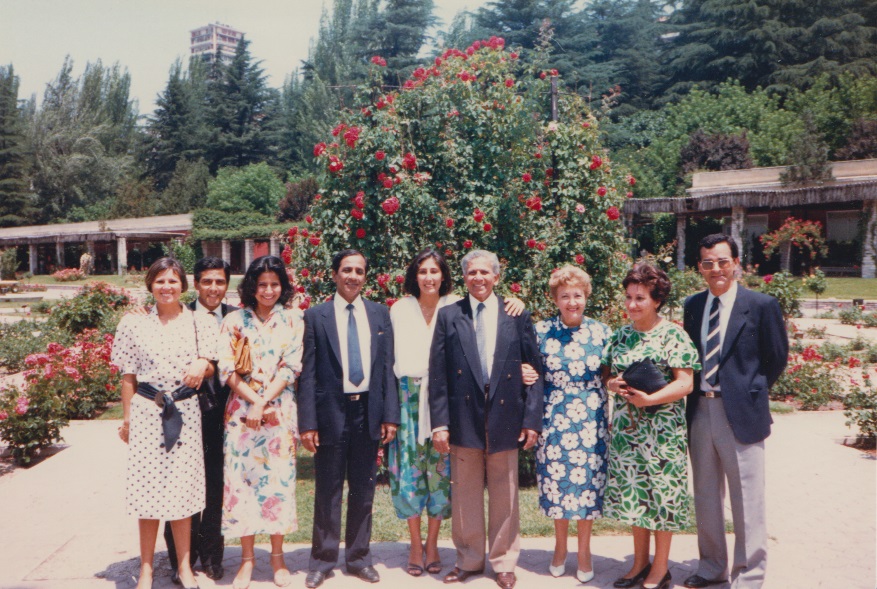
Photo taken in Madrid at wedding of Gulammahomed (missing in photo). From left to right: Maria Jose, Abdulsultan, Yasmin, Jehangir Alibhai Merchant, Shamsah, Abdulmahomed Allibhoy Mahomed, Sakina, Gulbanu and Felipe. Photo: Jehangir Merchant Family Collection.
Over the past 43 years, I have had the privilege of meeting Abdulmahomed uncle, Sakina aunty, and my four cousins as well as their families several times. Our most recent get together was in Lisbon in July 2018, during Mawlana Hazar Imam’s Diamond Jubilee visit. Abdulmahomed uncle is buried in Lisbon, and we all went to his burial site to pay homage to him and pray for his soul. He is seen in the film, walking by his beloved wife of more than 70 years, Sakina (see featured photo at top of this post).
Sakina aunty has a photographic memory, whereby she can recount with precise detail every important incident from the 1940’s onwards. Once she starts telling stories, you want keep on hearing. She accompanied her father and siblings to a number of mulaqats with Mawlana Sultan Mahomed Shah. This blessing of mulaqats continued after Mawlana Shah Karim Hazar Imam succeeded to the throne of Imamat in 1957. Incidents from the mulaqats are in themselves deeply touching, and some that were articulated to me related to the continuity of the Imamat from Hazrat Ali, and attested to the fact that the Imams are bearers of the same Noor (Light). The Spanish Jamat exhibition that was held in Lisbon 4 years ago included some rare photographs of those mulaqats.
Hopefully, Sakinas aunty’s rich and detailed accounts of memorable moments will be captured by her family members in the coming months, and we sincerely hope that other families around the world have started documenting stories of their parents and grandparents, before they leave this earth. The younger generation can draw immense wisdom from the faith of their forefathers.
The Jamat in Spain has grown to several hundred in the past 30 years, and live in different cities, and the film highlights this. If you visit Spain, please obtain the contact information of my aunt and her family as well as other Mukhisahebs or institutional representatives in Spain from the Ismaili council in your jurisdiction. Note that due to Covid-19, Jamatkhanas in Spain may be closed, as is the case in many other parts of the world. Gradual reopening of Jamatkhanas is taking place, as in Portugal.
Youtube Video on Jamat in Spain
Watch this amazing Youtube presentation by The Ismaili.
Date posted: July 5, 2020. Last updated: July 6, 2020 (clarity to story as per feedback).
Before departing this website please take a moment to review Simerg’s Table of Contents for links to hundreds of thought provoking pieces on a vast array of subjects including faith and culture, history and philosophy, and arts and letters to name a few.
_____________________
We welcome feedback/letters from our readers. Please use the feedback box which appears below. If you don’t see the box please click Leave a comment . Your comment may be edited for length and brevity, and is subject to moderation. We are unable to acknowledge unpublished letters.
Simerg’s Merchant
Malik Merchant is the editor of Simerg (2009), Barakah (2017) and Simergphotos (2012). A former IT consultant, he now dedicates his time to small family projects and other passionate endeavours such as the publication of this website. He is the eldest son of the Late Alwaez Jehangir Merchant (1928-2018) and Alwaeza Maleksultan Merchant, who both served Ismaili Jamati institutions together for several decades in professional and honorary capacities. His daughter, Nurin Merchant, is a veterinarian based in Ottawa. Malik may be contacted at Simerg@aol.com.
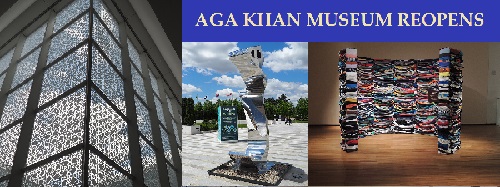
The Aga Khan Museum, closed since March 13, 2020, reopened after more than 100 days. Malik Merchant was present for the opening and shares his experience with story and photos…..MORE ON SIMERGPHOTOS
Sanctuary, a current exhibition running at the reopened Aga Khan Museum. Please click on image for reopening story and photos. Photo: Malik Merchant /Simerg.
July 1, 2017 was 150th anniversary of Canada’s founding. I had planned to be in Ottawa for the greatest Canada Day celebration in the country. However, my 45000 km road trip that began in Vancouver was delayed, and I arrived in Winnipeg on June 30th after having driven 2600 kms (including the detours I had taken to see sites in Alberta and Saskatchewan)! Ottawa was a further 2200 kms away, and the forecast there called for rainy weather.
Winnipeg was basking in sunshine when I woke up! At the hotel, I had learned about Winnipeg’s 11 year old tradition of forming a living Canadian flag in various parts of the city. For the 150th anniversary, the largest living Maple Leaf formation was going to be at the city’s downtown intersection at Portage Avenue and Main Street.
Canada’s Largest Living Maple Leaf formed with the participation of thousands of individuals in Winnipeg on July 1, 2017, to celebrate the country’s 150th birthday. Photo: Downtown Winnipeg Biz.
2,500 red T-shirts were handed out at 8:30 AM, and Canadians of all backgrounds were asked to position themselves in the square. Nigerian born Ismaila Alfa, host of Up To Speed on CBC Radio One in Winnipeg, led the sea of reds through a couple of practice sessions to get everything right. Then, he asked the crowd to look up at the camera hosted in a high rise office tower for two photos — the first with a smile and the second one with the cheerful singing of “Canada” . This was a truly memorable moment for me as I have never witnessed anything like this before, and have only attended Canada Day Celebrations in Ottawa! I share the photographs from that happy day 3 years later, while we are all stuck at home watching the 153rd Canada Day virtually due to Covid-19.
Canada’s Largest Living Maple Leaf formed with the participation of thousands of individuals in Winnipeg on July 1, 2017, to celebrate the country’s 150th birthday. Photo: Downtown Winnipeg Biz.
As an Ismaili Muslim, my first impressions of Canada were formed in November 1978 when I travelled to Toronto from the UK for Mawlana Hazar Imam’s, His Highness the Aga Khan, first ever visit to his newly settled Ismaili followers. When he repeatedly called on the Ismailis in Canada to “Make Canada your home” I reflected on that message and decided to make Canada my home some 2 years later.
This unique and historical photo signed by the late Canadian Prime Minister, Pierre Trudeau, was taken in the Prime Minister’s Office during Mawlana Hazar Imam’s Silver Jubilee visit to Canada in April 1983. (l to r) – Hon. Secretary Farouk Verjee (Aga Khan Council for Canada), Mr. Gerry Wilkinson (His Highness the Aga Khan’s Secretariat, Aiglemont, France), Hon. Secretary Mohamed Manji (Aga Khan Ontario Council), President Amirali Rhemtulla (Aga Khan Grants Council), Mawlana Hazar Imam, Prime Minister Pierre Trudeau, Prince Amyn Muhammad Aga Khan, President Mehboob Dhanani (Aga Khan Ontario Council) and President Zulficar Lalji (Aga Khan Council for Canada). The full signature line note from the Prime Minister read: To Farouk with the best of Memories. Trudeau. 1983. Photo: Farouk Verjee Collection, Vancouver.
Mawlana Hazar Imam’s profound affinity and respect for Canada has been explained in a very thoughtful piece by Mohib Ebrahim. I urge everyone to read it. I take a number of quotations from Mohib’s article which reflect the Imam’s confidence in Canada as a force of good:
“Canada [is] an international power who takes her responsibilities seriously and whose policies have never in her history been tainted by the cruder forms of colonialism, racialism or isolationism.” — Diplomatic Banquet, Toronto, November 1978.
“Successful experience with democracy, civil society and pluralism are the national genius of Canada of which much of the developing world is in dire need.” — Ottawa, June 2005
“[A]s you continue your search for the best constitutional solution to your future, … let me emphasise that Canada remains for the rest of the world an enviable haven. A haven of peace, and of immense natural beauty and wealth. The wealth I speak of, is not merely its natural resources but the peoples of Canada, steeped in your tradition of tolerance, generosity and compassion in alleviating human suffering and respect for diversity of thought and culture.” — Diplomatic Corps Banquet Toronto, August 1992.
On this 153rd anniversary marking the birth of Canada, my 89 year old beautiful mother Maleksultan and my lovely daughter Nurin join me in wishing all Canadians and everyone living in this great country a very Happy Canada Day.
Ismaili Muslim is appointed as the new Lieutenant Governor of Alberta
We are particularly proud and joyous that Prime Minister Justin Trudeau announced yesterday, June 30, the appointment of Salma Lakhani, a proud Ismaili Muslim, as the new Lieutenant Governor of Alberta. Ms. Lakhani will be the first Muslim Lieutenant Governor in Canadian history.
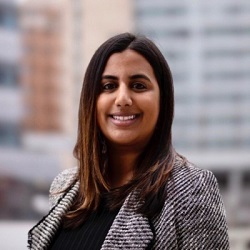
Salma Lakhani
A long time resident of Edmonton, Ms. Lakhani has dedicated her life to helping people in need and those who face obstacles to success in our society. Through her work to advance education, health care, women’s empowerment, human rights, and support for new immigrants, she continues to be a champion of diversity, pluralism, and inclusion.
Born in Uganda, her home country from which her family was expelled in 1972, Ms. Lakhani completed an honours degree in Clinical Biochemistry at the University of Manchester. She moved to Edmonton with her husband, Dr. Zaheer Lakhani, in 1977. The couple has two daughters. I recollect Dr. Zaheer as the Aga Khan Council Chairman for Edmonton during the early 1980’s. He mingled with everyone in the Jamat, and as a leader consulted with Jamati members regularly. He was always supported by his wife Salma during his term.
The Ismaili, the official website of the Ismaili community, has published a special article about her appointment.
We congratulate Ms. Lakhani and her family on her appointment, and wish her happiness and success in the role she will play for all Albertans.
As we all celebrate Canada Day, we sincerely hope that this great nation of 37.6 millions people will come out even stronger from the Covid-19 pandemic that we are living through today with the rest of humanity.
Date posted: July 1, 2020.
Before departing this website please take a moment to review Simerg’s Table of Contents for links to hundreds of thought provoking pieces on a vast array of subjects including faith and culture, history and philosophy, and arts and letters to name a few.
____________________
We welcome feedback/letters from our readers. Please use the feedback box which appears below. If you don’t see the box please click Leave a comment. Your comment may be edited for length and brevity, and is subject to moderation. We are unable to acknowledge unpublished letters.
Malik with his mother Maleksultan Merchant at the Vancouver Ismaili Centre.
Malik Merchant is the editor of Simerg (2009), Barakah (2017) and Simergphotos (2012). A former IT consultant, he now dedicates his time to small family projects and the publication his websites. He is the eldest son of the Late Alwaez Jehangir Merchant (1928-2018) and Alwaeza Maleksultan Merchant, who both served Ismaili Jamati institutions together for several decades in professional and honorary capacities. His daughter, Nurin Merchant, is a veterinarian based in Ottawa. Malik may be contacted at Simerg@aol.com.
When Ayaz Pirani is in your neighbourhood doing a reading from one of his books, please attend the event. You will become utterly relaxed listening to his beautiful poetry reading in a calm, gentle and soothing voice. He was in Toronto last year and I attended his reading at Knife Fork Books on 244 Augusta Avenue in the vibrant Kensington Market Area. I couldn’t locate the place easily, and even the NU Bügel staff did not know there was beautiful poetry being served upstairs on a regular basis. After a few more inquiries, I climbed a few set of stairs, excused myself for arriving a little bit late and sat to listen to Ayaz! The small crowd, mainly a gathering of Ismaili youth and professionals, kept urging Ayaz to continue with his reading, and he graciously complied. Meeting him later, I came away even more convinced of the nobility of his heart and soul. I acquired Kabir’s Jacket Has a Thousand Pockets but had to put it away in storage with my other books, as I was preparing to leave for Vancouver to be with my mum. I never got to reading the book nor interviewing this highly gifted literary personality in the Ismaili community. Recently, I asked him to present a short overview of his titles. I am delighted to present his piece below. Links to some on-line stores selling Ayaz’s books are provided at the end of the piece. I look forward to interviewing this literary jewel in the coming months, once my nomadic life style comes to an end!
___________
“My love of ginans is various and unending. They have the charms and rhetorical force of written language as well as the emotional and nourishing elements of oral tradition” — Ayaz Pirani
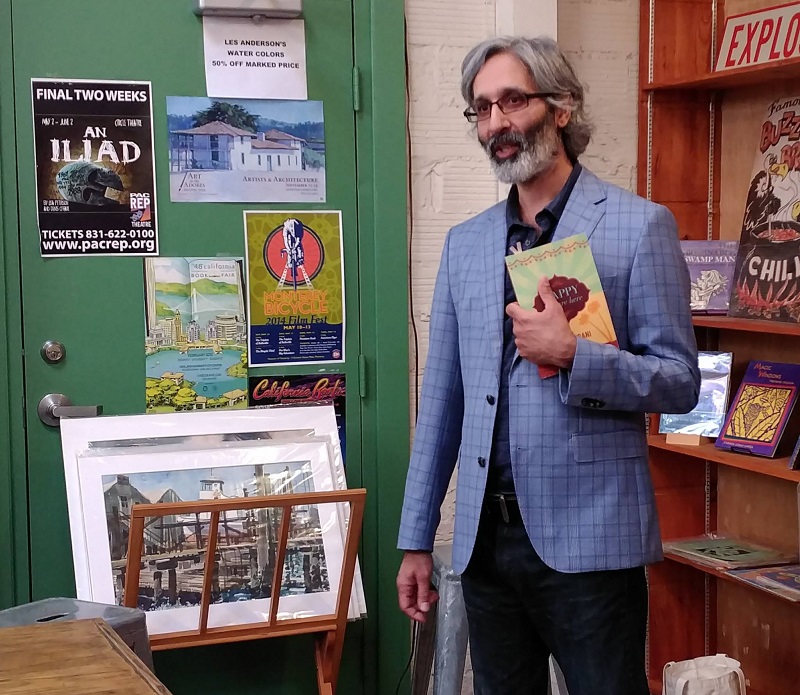
Ayaz Pirani reading from “Happy You Are Here” at Old Capitol Books in Monterey, California. Photo: Ayaz Pirani.
By AYAZ PIRANI
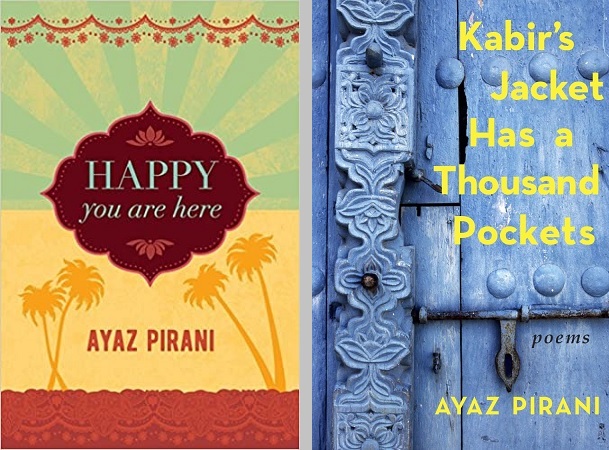
With my first book, Happy You Are Here, I began to wrestle with geography and humanness in my poems. Canadian poet Suzanne Buffam called Happy You Are Here “tender and intimate” and Heather Birrell said “Ayaz Pirani positions himself as a kind of plainspoken anti-prophet, bringing human nosiness and gratitude to a number of subjects—displacement and immigration, the oak woods of the Arroyo Seco, a mother’s love, a pub in Toronto…—as well as the more mysterious geographies of the soul.”
My second book, Kabir’s Jacket Has a Thousand Pockets, was described as “wisdom poetry” that was “surprising and sly” by New England poet David Rivard. All of my work, including my new chapbook, Bachelor of Art, is informed by my affection for Ginans. Perhaps for this reason Rivard felt they were tinged with perennial truths.
My love of Ginans is various and unending. They have the charms and rhetorical force of written language as well as the emotional and nourishing elements of oral tradition. When a Ginan is experienced in situ, that is, in a Jamatkhana, there is further the resonances that come from a living heritage.
Happy You Are Here was reviewed in The Dalhousie Review and Qwerty Magazine and my individual poems have recently appeared in The Malahat Review, ARC Poetry Magazine, and The Antigonish Review.
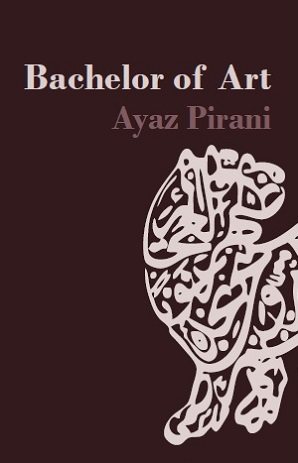
Cover of Bachelor of Art features a calligram of Hazrat Ali as the Tiger of God
My new work, Bachelor of Art, is a chapbook of poems. Individual poems include “Ali’s Tiger,” “Nutshells,” and “Sat Panth.” It’s a bit hard to talk about my own work without sounding pretentious, especially when it’s a genre like poetry which has so many romantic associations. In my work I’m trying to describe a particular diaspora experience by finding resources in various treasuries: ginans, divans (of Kabir, Ghalib, et al.), and English literature. I suppose I’m conscious of trying to situate my poems as a Canadian experience as well. I’m drawn to subjects like loneliness, immigration, faith, human awkwardness, love.
~~~~~~~
Ayaz Pirani’s books are available in local bookstores and online at Amazonand Chapters-Indigo. His new book, Bachelor of Art, is currently available from Anstruther Press for $10. The cover features a calligram of Hazrat Ali as the tiger of God.
Date posted: June 30, 2020.
Before departing this website please take a moment to review Simerg’s Table of Contents for links to hundreds of thought provoking pieces on a vast array of subjects including faith and culture, history and philosophy, and arts and letters to name a few.
____________________
We welcome feedback/letters from our readers. Please use the feedback box which appears below. If you don’t see the box please click Leave a comment. Your comment may be edited for length and brevity, and is subject to moderation. We are unable to acknowledge unpublished letters.
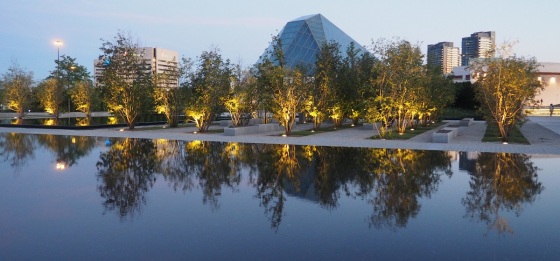
The Aga Khan Museum in Toronto reopens to the public on Saturday, June 27, 2020. As a passionate supporter of the Museum, Simerg’s Malik Merchant decides to visit the grounds on the penultimate day of the reopening to take some pictures. Please click on image below or Aga Khan Museum Reopening Countdown Photos
Please click on photo for Aga Khan Museum countdown to reopening.
When I am in Toronto, I walk through the Aga Khan Park virtually every day. I take the east entrance, and first walk around to the Ismaili Centre, sit on a bench by tree number 49, and if it’s evening time I contemplate. Often, I read newspapers. The other day I read my month’s supply of the Toronto Star and the Sunday New York Times — 4 hours under glorious sunshine, but protected by the shade of trees.
Ismaili Centre, Jamatkhana dome. Photo: Malik Merchant / Simerg.
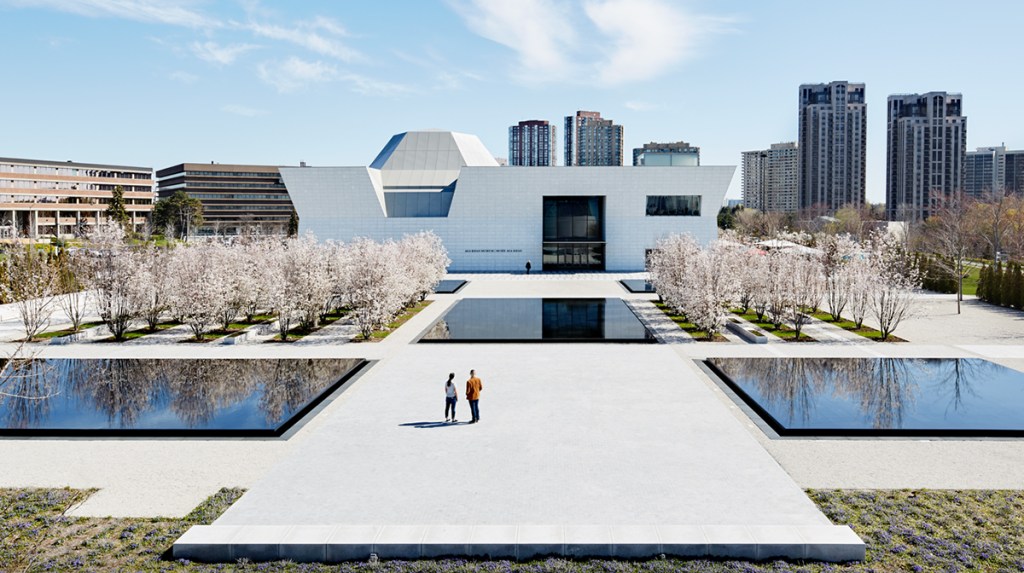
Then, as I cross a small pathway by the majestic dome of the Ismaili Jamatkhana, I see the Museum 200 metres away, where a lone guard stands by the main entrance. Is he bored? I wonder. Thousands have been, for many many weeks. The Museum’s on-line programming has kept us going. But we miss the inside — the actual exhibits, the shop, the samosas at the café, the Diwan restaurant, the courtyard with its many performances, the design, colours and architecture of the building, the Bellerive Room, and the tunnel entrance downstairs that we walk through when we are parked underground! Yes, we do miss so many things, inside and outside the museum building, beautifully thought out by His Highness the Aga Khan and his younger brother Prince Amyn. The children especially love water, and the 5 ponds are empty. The geese who used to fly into the ponds in glorious harmony at around 6:00 AM have to take their bathing somewhere else — it’s truly a joy to watch them bathing in an acrobatic manner! Absolutely magical! For the rest of us, who walk by the 5 ponds or sit on the benches, there is no running water to soothe our senses! But all this changes on Friday, June 26!
Aga Khan Museum and Aga Khan Park. Photo: Aga Khan Museum.
Museum supporters have just received an email from the Aga Khan Museum’s Development Manager, Caroline Chan, inviting them to a special Friends and Patrons day onFriday, June 26, 2020, before it opens to the general public on Saturday June 27!
The supporters will be the first to see the Museum’s Sanctuary and Chrysalis exhibitions, which both explore the many dimensions of sanctuary, immigration, and migration. The guests have been invited to enjoy a complimentary beverage and cookies at the Courtyard Café and take in the summer blooms at the Aga Khan Park!
Sanctuary exhibition hall. Photo: Aga Khan Museum.
In line with provincial health directives, the visit will be a little different from what we have been accustomed to in the past. Special health and safety protocols have been put in place including a tool to conduct self-assessment for coronavirus, wearing of face masks, availability of hand sanitization stations and social distancing.
Carolin’es invitation ends with the slogan “Welcome back to where we all belong!”
In addition, the Aga Khan Museum’s CEO, Henry Kim, issued a statement on the reopening. Here are excerpts from his statement:
Dear friends,
I would like to thank you for your patience and ongoing support during these challenging times. With restrictions on gatherings gradually easing, I am pleased to let you know that the Museum will reopen on June 27, 2020. As we rebuild our lives and livelihoods over the next few months, I do hope you can look to the Museum as a source of hope and inspiration.
The safety of our visitors is our primary focus, and our intention is to make your return a safe and enjoyable experience. We have instituted a number of measures designed to protect you and our staff, so that during your visit, you can see beautiful art, be moved by learning, and enjoy live performances worry-free.
As your hosts, we have a duty to ensure your health and safety — it is our highest priority……
The world has changed, and so have we. Reflecting what we have gone through together over the last few months, we have redrawn our programs for the remainder of the year and created Rebuild 2020, our commitment to reconnect and reinvigorate communities through the arts. Please do visit our website for more information on the many programs we have created to reignite your curiosity and spark your imagination.
Whether you explore online or plan to visit in-person, you are welcome at the Aga Khan Museum. We cannot wait for your return.
With gratitude,
Henry S. Kim Director and CEO, Aga Khan Museum
Mr. Kim, I can assure you we have missed you more than you have missed us! It is us who can’t wait to get into the beautiful and inspiring space, which His Highness the Aga Khan created for millions to enjoy some 6 years ago!
Date posted: June 23, 2020.
Before departing this website please take a moment to review Simerg’s Table of Contents for links to hundreds of thought provoking pieces on a vast array of subjects including faith and culture, history and philosophy, and arts and letters to name a few.
_____________________
We welcome feedback/letters from our readers. Please use the feedback box which appears below. If you don’t see the box please click Leave a comment . Your comment may be edited for length and brevity, and is subject to moderation. We are unable to acknowledge unpublished letters.
Malik Merchant is the founding publisher/ editor of Simerg (2009), Barakah (2017) and Simergphotos (2012). A former IT consultant, he now dedicates his time to small family projects and other passionate endeavours such as the publication of this website. He is the eldest son of the Late Alwaez Jehangir Merchant (1928-2018) and Alwaeza Maleksultan Merchant, who both served Ismaili Jamati institutions together for several decades in professional and honorary capacities. His daughter, Nurin Merchant, is a veterinarian based in Ottawa. Malik may be contacted at Simerg@aol.com.
They entered the Jamatkhana prayer hall, Sat on the patterned carpet or the seniors on chairs Closed their eyes. So some chatted to acquaintances Ya Ali Madad “ki ayon?” “Did you hear? Did you go…? Shukr Mawla…” Mukhi-Kamadiasaheban enter, we start. Every day, 365.
A pandemic, unprecedented. A change. The place of prayer remained. And was attended, at set time and others, “All day, all night, every day, every night” Outdoors and in, on screen and off, They looked toward the esoteric qibla, breathed the esoteric Qur’an.
The Jamatkhana holds a special place and cannot be replaced The place of prayer remains within The soul is not erased. “There are those I see with my eyes”…. Yes, there is that we see with our eyes, And then, there is that we may feel in the heart.
Will the space of gathering open? A sanctuary for so many, A familiar space of belonging, Connection, hope and light. When will it open? No one can speculate. For it is, when the Imam decides.
“Remember, remember, remember, And never forget “Take your tasbirh, take your tasbirh” Like your breath, in and out. Only you can decide. The exoteric and the esoteric
The Jamatkhana is a physical space A sanctuary, a place of peace.
Date posted: June 22, 2020.
Before departing this website please take a moment to review Simerg’s Table of Contents for links to hundreds of thought provoking pieces on a vast array of subjects including faith and culture, history and philosophy, and arts and letters to name a few.
___________________
About the author: A regular contributor to this website, Dr. Navyn Naran was born in Dar es Salaam, Tanzania, to Anaar (1936-2017) and Badrudin Naran (1930-1979). She is currently in Toronto working in pediatrics and volunteering at the Aga Khan Museum.
____________________
We welcome feedback/letters from our readers. Please use the feedback box which appears below. If you don’t see the box please click Leave a comment . Your comment may be edited for length and brevity, and is subject to moderation. We are unable to acknowledge unpublished letters.
By ALYNA NOREEN DADA (Special contribution to Simerg)
Pluralism
We hear this word constantly and are reminded of the ethics of pluralism in Mawlana Hazar Imam’s, His Highness the Aga Khan, Farmans and speeches how we can integrate this in our everyday lives. What does pluralism mean and how can we, as Ismaili Muslims, understand our role in the Black Lives Matter movement and apply the tenets of our faith to make a meaningful contribution to improving the quality of life for our African-American community?
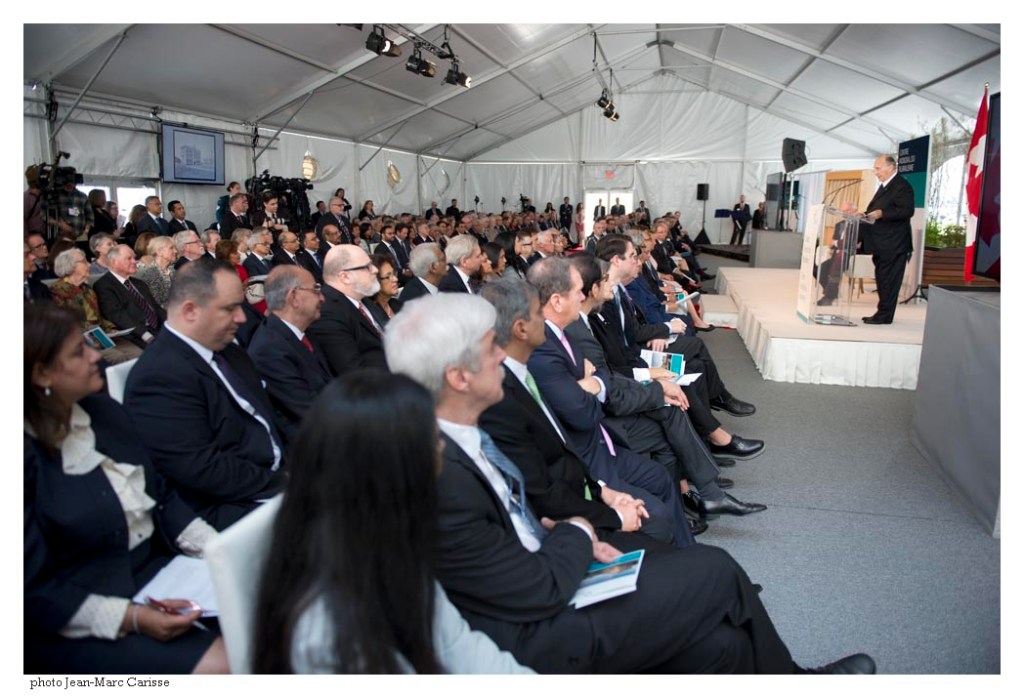
His Highness stated in his speech on May 16, 2017 at the opening ceremony of the new headquarters of the Global Centre for Pluralism in Ottawa, “Pluralism does not mean the elimination of difference, but the embrace of difference. Genuine pluralism understands that diversity does not weaken a society, it strengthens it. In an ever-shrinking, ever more diverse world, a genuine sense of pluralism is the indispensable foundation for human peace and progress.” [Bold emphasis added here, and in remainder of article]
We are grateful to be a part of a religious ummah which prides on serving others and the societies in which we live and also allows us to build upon our moral compass by leveraging our intelligence, experience and humility with guidance from the Imam. In order to create a pluralistic society, our duty as Ismailis must be to support the movement and black-led organizations, particularly when we see African-Americans like George Floyd, Breonna Taylor, Ahmaud Arbery and many others murdered unjustly when fighting for their own human rights.
However, this begs the question, why is anti-blackness so prevalent in the South Asian including our own Ismaili Khoja community and whydo older generations continue to question the purpose of Black protests and police brutality that we see on a plethora of news channels every second of every day?
article continues after photo
Civil rights leaders, including Dr. Martin Luther King (3rd from left), meet with President John F. Kennedy in the oval office of the White House after the March on Washington, D.C. on August 28, 1963. Photo: Warren K. Leffler, U.S. News & World Report Magazine Photograph Collection / US Library of Congress.
This is a turning point in history that should serve as an awakening: our presence in the United States is as a result of work of Black activists who often sacrificed their lives to achieve equal rights. During the Civil Rights Movement in the 1960s, African Americans led by the notable Dr. Martin Luther King used protests and civil disobedience to help abolish some of the most racist laws in the US not only for themselves, but for all communities of color like South Asians. Ultimately, this led to the US government implementing the Immigration and Nationality Act of 1965, which eliminated the racist quotas and allowed South Asian communities to emigrate to the US. We should be indebted to the civil rights movement and black activists who eliminated major barriers that allowed us as a community to settle and thrive in various parts of the United States and beyond.
I believe that the youth in our community have an obligation to educate our first-generation immigrants on their microaggressions and inherent biases pertaining to Black people.
article continues after images
~~~~~~~~~~~~~~~~~
____________________
Fortunately, many Ismaili youth activists from all over the world have come together to vocalize racial injustices, particularly in light of recent killings of Black men and women due to police brutality in the United States.
They have been doing a wonderful job mobilizing resources (that I will discuss in greater detail later in this article). The goal of these coalesced resources is to target larger audiences initially at a local level, ultimately expanding this to a national platform to highlight this systemic issue.
South Asian/East African youth who are typically first or second younger generation Americans can begin to have these conversations, starting with their families and escalating it to a wide scale audience. Citing guidance from Mawlana Hazar Imam is paramount as this will quickly resonate with the older members of our community. Given that we’re a group of multicultural individuals with distinctive backgrounds should serve as a great example of strength in diversity and solidarity. Islamic principles of inclusion, peace and generosity should be used as our guiding principles when engaging various constituents of the Ismaili Jamat.
(Please note, these activists’ groups are not associated with the official Jamati institutions. They are Ismailis who have a passion for social justice issues and grassroots organization and want to create a forum for discussion to help implement change within our community)
Ismaili Activists
An Instagram Account was created to underscore social justice issues that exist in USA and bridge the gap with what Ismailis should be addressing within our community. The purpose of this social media platform is to provide an open forum to for members to have honest discussions about topics that are seldom talked about within Ismailis due to either lack of knowledge, awareness or inability to vocalize these issues. Please click on Ismaili Activists Instagram Platform.
Please click for Ismaili Activists on Instagram
________________________
Ismailis for Black Lives Matter
A group of Ismaili youths from USA & Canada created a GoFundMe campaign, Ismailis for Black Lives Matter, an independent fundraiser set up with the purpose of involving the Ismaili Community in the discussion around racial injustices pertaining to African Americans.
This initiative symbolizes ally hood to the Black Lives Matter Movement and helps to educate members of the Jamat as well as mobilize the financial resources of the Ismaili community in accordance with the faith’s core principles. The campaign raised over $20,000 and was supported by platforms like Twitter and Ismaili Mail.
The team also created a librarywith talking points and helpful resources to further education on the Black Lives Matter Movement.
________________________
Ismailis for Change
This Slack group is focused on taking action based off an open letter addressed to the Jamat written by Alia Jeraj, a Minnesotan Ismaili. The Slack work group, created by Zahir Surmawala, is comprised of Ismailis from a variety of professional backgrounds including: product managers, tech entrepreneurs, attorneys, diversity and inclusion educators, healthcare professionals, artists, interfaith preachers etc. These individuals have all been brought together with one common goal of educating the Jamat on social justice issues to build solidarity for the African-American Community. Please click Open LetterResource Guide.
I, along with my Ismaili brothers and sisters, hope you find these resources helpful and we continue to make the voices of our Black community heard.
Date posted: June 18, 2020.
__________________________
We welcome feedback/letters from our readers. Please use the feedback box which appears below. If you don’t see the box please click please click Leave a comment. Your comment may be edited for length and brevity, and is subject to moderation. We are unable to acknowledge unpublished letters.
Alyna Noreen Dada is a healthcare professional working for a national physician organization that transforms the healthcare delivery experience for providers and consumers.
Originally from the New Jersey area, she is a graduate of The George Washington University in Washington, DC with a degree in public policy and public health and has been living in the District for a decade.
Alyna’s family hails from Kenya and South Africa by way of the UK and settled in the United States in the early 1980’s.
Living in DC for the last few years has certainly piqued Alyna’s interest in social justice and policy issues, particularly around racial injustice and the Black Lives Matter Movement. After all, she lives blocks away from the White House!
_____________
Before departing this website please take a moment to review Simerg’s Table of Contents for links to hundreds of thought provoking pieces on a vast array of subjects including faith and culture, history and philosophy, and arts and letters to name a few.






















 Simerg - Insights from Around the World