
Izzat Muneyb (d. May 20, 2017)
By Abdulmalik Merchant
(NOTE: You may submit a condolence by clicking the COMMENTS box shown above left, beside the title — thank you, ed.).
It is with great sadness that we announce the passing of Izzat Muneyb on May 20th, 2017 in London, England, at the age of 75. Izzat was buried at the Ismaili cemetery at Brookwood in Surrey immediately following a funeral ceremony held at the West London Jamatkhana on Saturday, May 27th at 10:45 a.m.
We convey our heartfelt condolences to Izzat’s surviving sisters Zarin and Gulzar and their families, as well as all who knew her in the U.K. and many other parts of the world. We pray for the eternal peace and rest of Izzat’s soul.
Izzat Muneyb was raised in Mombasa, Kenya, and then pursued her further studies in the UK where she obtained an Honours degree in English from Birmingham University, a Post-Graduate Certificate in Education from Kings College, London and a Masters in Curriculum Studies from London University, England. She had a varied career, working in the fields of education, health, commerce and public order. She served on various Ismaili community institutions, including the Shia Imami Ismaili Tariqah Board, Mombasa, His Highness the Aga Khan Provincial Tribunal and His Highness Aga Khan Education Board in Nairobi. As an Education Board member, she originated the concept of, and edited, the Commemorative Issue 1977-78, to celebrate sixty years of Ismaili education in Kenya. From 1983–1994, she worked at the Institute of Ismaili Studies in London as a Member of the Education Unit and contributed to the Ta’lim Curriculum which is used throughout the Ismaili world to impart religious education Over the last few years, she focused on her own creative writing in London.
Izzat contributed numerous pieces for this website, and we are pleased to re-publish her thoughtful reflections on the Prophet Muhammad (s.a.s.), the Prophet’s mosque in Madinah and the first purpose built Ismaili Centre and Jamatkhana in the Western World that is located in London.
WE WELCOME READERS’ TRIBUTES IN MEMORY OF IZZAT MUNEYB
We invite your tributes and messages of condolences in memory of Izzat Muneyb. You may do that by clicking on LEAVE A COMMENT (that is also shown at left of the title of this post, at top). Should you run into issues while submitting your comment, then please send it via email to simerg@aol.com, Subject: Izzat Muneyb.
~~~~~~~~
1. In Praise of Prophet Muhammad
(May Peace Be Upon Him)
BY IZZAT MUNEYB
Author’s note: This song introduces us to some of the titles by which Prophet Muhammad came to be known. They are: ‘Ahmad’, ‘Mustafa’, ‘Rahmatan li’l-‘aalameen and ‘King of law laak’. The words ‘law laak’ in Arabic mean, “Were it not for…” There is a Hadith of Prophet Muhammad, where Allah speaking to His prophet, says, “Were it not for you, I would not have created the universe – law laaka lamaa khalaqtu’l-aflaaka.” [1]
N.B: The lines marked * are sung twice.
Muhammad, Muhammad,
How shall we praise you, Muhammad?*
Shall we call you Ahmad?*
He who is praised in heaven
Shall be praised here on earth.
Muhammad, Muhammad,
How shall we praise you, Muhammad?*
Shall we call you Mustafa?*
The Chosen of God on earth,
You have brought us the Qur’an.
Muhammad, Muhammad,
How shall we praise you, Muhammad?*
Shall we call you Rahmatan li’l-‘aalameen?*
God sent you as a Mercy
To the whole of creation.
Muhammad, Muhammad,
How shall we praise you, Muhammad?*
Shall we call you the ‘King of law laak’?*
Even God says He created
The universe for you.
Muhammad, Muhammad,
How shall we praise you, Muhammad?*
© Copyright: Izzat Muneyb.
____________
Notes:
[1] Source: Sukheel Sharif, The Jawziyyah Institute, 2006
~~~~~~~~~~~
2. Building the Prophet’s Mosque — Masjeedun Nabee — in Madinah

An Islamic miniature from Siyer-i Nebi (16th century, Turkey), depicting Bilal giving the call to prayer. Photo: Wikipedia.
BY IZZAT MUNEYB
Author’s Note: This ballad tells the story of how the first mosque in Islam, the Prophet’s Mosque in Madinah, Masjeedun-Nabee, was built and how the first Muslims were called to prayer, with Bilal, a black Muslim, reciting the first adhaan. [1] The Prophet (Peace be upon Him) let his she-camel, Qaswaa’, who was “under the command of God”, choose the site. This allowed him to not have to accept land from, and thus show partiality to, any of the influential clans in Madinah.
N.B: The first line of each verse is sung twice. The ballad should ideally be sung to the accompaniment of a guitar.
Qaswaa’ the camel has chosen the ground,
Dig here, O Muslims and level the ground. Qaswaa’.…….1
Muhammad has said, “O, here will I stay,
Here build my mosque and here shall I die”. ..…….………2
Cut down the trees and make the pillars,
Lay down the bricks and cement with mortar. ……………….3
The Muhaajiroon [2] and the Ansaar [3]
Work with a will in the spirit of Islam. ……………….4
Aly then asks how to ‘complete’ the mosque,
“How shall we call the believers to prayer?” ..…………….5
The Muslims think hard, “O shall we use bells [4]
If not a Jewish horn, then a trumpet perhaps.” ………………6
Then, humble and meek, Abdallah did speak,
“I dreamt, Ya Rasool, a human voice, I pray.” ..…………….7
Muhammad then said: “O my faithful Bilal,
It is you who must say the very first Adhaan.” ..………….…8
And so did Bilal God’s praises sing
And his powerful voice in Madinah did ring. ..……………9
Here endeth my tale of Masjeedun-Nabee,
It still stands today in Madinah city. …………….10
© Copyright: Izzat Muneyb
____________
[1] Adhaan is the Muslim call to prayer. Bilal climbed up a palm tree, to recite the first adhaan, because he wanted his voice to carry far and wide. Minarets appeared around eighty years after the Prophet’s death, to call the faithful to prayer.
[2] Muhaajiroon– The Emigrants, Muslims who made the hijrah or migrated from Makkah to Madinah, because of the persecution of the Makkan Quraysh. The Prophet finally made the hijrah during September 622 A.C., after all the Muslims, except Imam Ali, had left Makkah.
[3] Ansaar – The Helpers, Madinan Muslims, who helped the Makkan Muslims settle in Madinah.
[4] Ringing church bells is a Christian practice – the Muslim call to prayer had to be unique to Islam.
~~~~~~~~~~~
3. At the Ismaili Centre

The Entrance Hall of the London Ismaili Centre.
BY IZZAT MUNEYB
As soon as I enter the Ismaili Centre,
What do I see in Arabic calligraphy?
Bismi’llaahir-Rahmaanir-Raheem
Is what I see. ”In the name of Allah
Most Kind, Most Merciful.”
In the name of Allah I begin all things,
In the name of Allah I conceive all thoughts;
In the name of Allah I complete all deeds.
As soon as I enter the Ismaili Centre,
What do I see in shining marble
And white plaster?
I see a star-shaped fountain, pouring out water.
The fountain is so clear,
And the water so pure…
We too must be pure in body and soul
And polish the mirror of our hearts!
Why is the fountain seven-sided?
What does it mean?
Seven is the number of perfection
And seven times seven gives us
Our forty-ninth Imam.
The guidance of the Imam of the time –
And his portrait in mosaic, crafted from lapis,
Glowing with gentle radiance reminds us –
Helps us to grow closer to Allah.
But, have you seen the grey interlace design
Around the fountain?
Yes, it is a flower of beauty.
Al-kathratu fi’l wahdati,
Wa’l wahdatu fi’l kathrati
Is what it means.
The One has originated
The multiplicity of creation;
Now, from that multiplicity we move
Towards the Unity of the One.
And as I climb the stairs of the Ismaili Centre,
What do I see hanging from the ceiling?
I see lamps luminous and gleaming,
Full of light and full of meaning.
By the light of the lamp
We read the Qur’an.
With the light of the Lamp
We begin to know.
The light of the Lamp
Leads us to the Light of God
As I climb to the next level,
What do I see?
I see a painting, vibrant,
Swirling in colour.
It tells of the Verse of Light,
The Aayat’un Noor,
It hints at the mystery of
Noorun ‘alaa Noor.
As I enter the prayer hall
What do I see on the qiblah wall
In dark columns tall?
Carved in wood and written in space,
The panels say, Allah, Muhammad and Ali,
Allah, Muhammad and Ali.
These Beautiful Names invite me
To take my place with the Jamat,
They become my rosary.
As I sit down, as I close my eyes,
What do I do? What do I say?
I remember Allah.
I say,“Ya Muhammad”, “Ya Ali”,
I say, Salawaatu’llaahi alayhumaa
Salawaatu’llaahi alayhumaa.
The Grace of God fills the hall,
The Light of God bathes us all.
Cleansed in thought and spirit,
I feel the presence of God
And am filled with His peace.
© Copyright: Izzat Muneyb.
Date posted: May 27, 2017.
Last updated: May 30, 2017 (formatting and new comments).
_______________
Editorial Note: The poem was first published in July 1987 in Ilm, Volume 11, No. 2, p. 39-41. It was originally written for the younger members of the Jamat, to be recited either by an individual, or as a choric or part poem. Readers might find the movement of the poem interesting. As the individual climbs higher through the various levels of the London Ismaili Centre to the Jamatkhana hall, so also the poem marks an inner journey from a physical to a devotional and then to a spiritual plane of being.
_______________
Your tribute to Izzat Muneyb
We invite your tributes and messages of condolences in memory of Izzat Muneyb whose funeral took place on Saturday, May 27, 2017 in London, England. Readers may do so by clicking on LEAVE A COMMENT. If you encounter problems in submitting your comment, then please send it to simerg@aol.com, Subject Izzat Muneyb.
















 A team of Ismaili volunteers are seen pictured in the Social Hall of the new Ismaili Centre in Toronto which opened for the Ismaili community on Friday, September 19 , 2014. Photo: Malik Merchant/Simerg. Copyright
 A senior citizen enjoys a glass of sherbet as he celebrates the opening of the Ismaili Centre in Toronto. Photo: Malik Merchant/Simerg. Copyright.
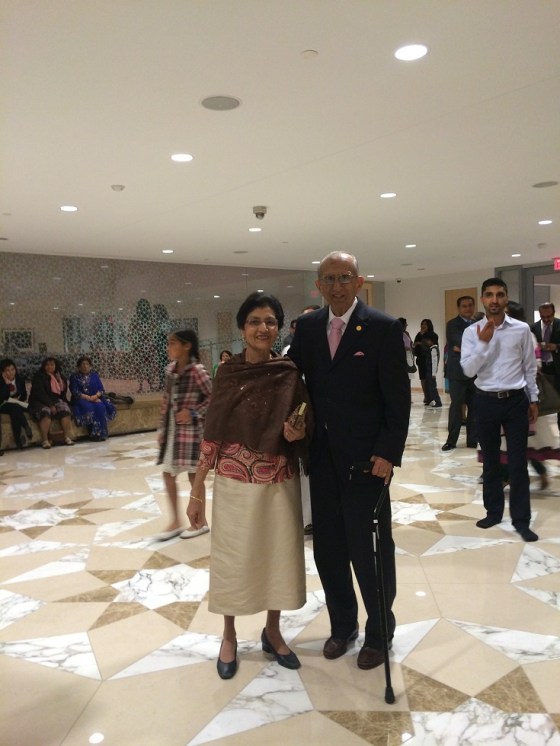 Mr. Ameeraly Ratansy and his wife, Mrs. Shirin Ratansy, at the Ismaili Centre on the opening day, Friday, September 19, 2014. Photo: Malik Merchant/Simerg. Copyright.
 One of several meeting areas on the main floor of the Ismaili Centre in Toronto which opened to members of the Ismaili community on Friday, September 19, 2014. Photo: Malik Merchant/Simerg. Copyright.
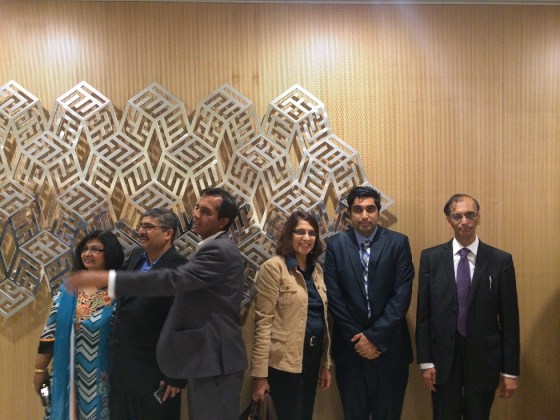 Visitors standing in front of a sculptural calligraphy by the German Muslim artist Karl Schlamminger; this calligraphic composition represents Allah, Muhammad and Ali. Schlamminger’s works are also to be found at the Ismaili Centres in London, England, and Lisbon, Portugal. Photo: Malik Merchant/Simerg. Copyright.
 The Ismaili Tariqah and Religious Education Board’s literature counter on the opening night of the Ismaili Centre. Tasbihs were among the most popular items. Photo: Malik Merchant/Simerg. Copyright.
 A view of the indoor parking garage of the new Ismaili Centre in Toronto. Hundreds of cars can be parked indoors. Photo: Malik Merchant/Simerg. Copyright.
 Entrance to the Ismaili Centre from the indoor parking garage. Facing the entrance is a fascinating work of Islamic calligraphy representing the opening of the Holy Qur’an, the Basmallah as seen in the next photo. Photo: Malik Merchant/Simerg. Copyright.
 The Basmallah is repeated four times in this iconic piece designed by German Muslim artist Karl Schlamminger. The calligraphy is the first piece that members will see as they enter the building from the indoor parking garage – see previous photo. Above and below are angled photos taken from either side. Photos: Malik Merchant/Simerg. Copyright.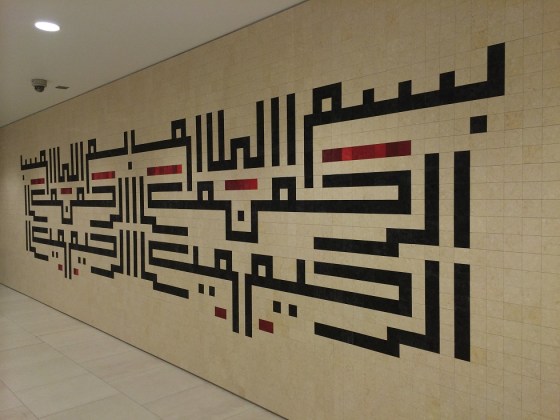

 Jamati members on the move as they try to see as much of the Ismaili Centre when its doors opened for the first time for members of the Ismaili community. Photo: Malik Merchant/Simerg. Copyright.
 Visitors take time to view one of the many wall exhibits displayed at the Ismaili Centre. This montage provides an overview of the construction phases of the Ismaili Centre. Photo: Malik Merchant/Simerg. Copyright.
 A unique blend of art work, calligraphy and photos are exhibited along the corridor spaces of the Ismaili Centre. A visitor walks by one such exhibit, giving the Centre the feel of a Gallery in certain areas. Photo: Malik Merchant/Simerg. Copyright.
 After spending several hours at the Ismaili Centre visitors rest their tired feet on the seating located in front of the reading lounge. Many had arrived as early as 5 pm to ensure that they had a place to sit inside the Jamatkhana. Photo: Malik Merchant/Simerg. Copyright.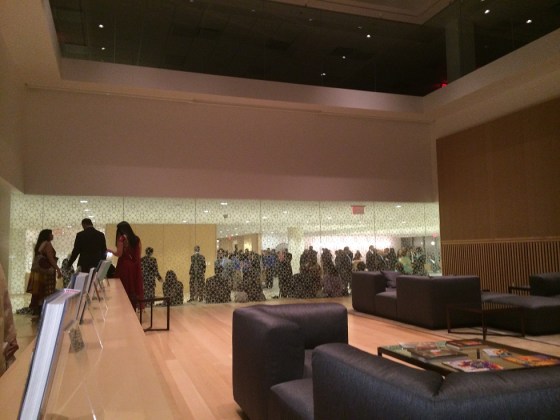


 Ismaili volunteers cheerfully raise their glasses to celebrate the Ismaili Centre’s first day for members of the Ismaili community. The volunteers bring smiles to countless members within their own community as well as to other communities through numerous outreach programs. Photo: Malik Merchant/Simerg. Copyright.
 Taking comfort and rest: An elder from the jamat of Afghanistan, now settled in Canada. Photo: Malik Merchant/Simerg. Copyright.
 ….With her family and friends. Photo: Malik Merchant/Simerg. Copyright.


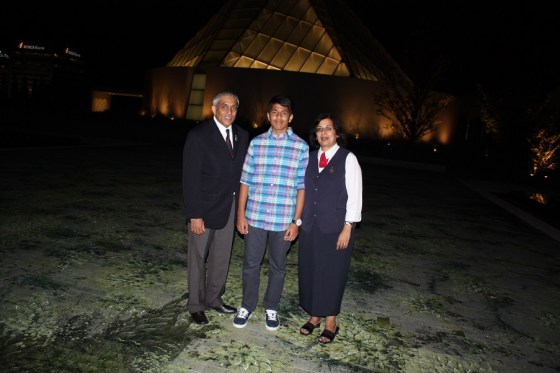 Alykhan (centre) is pictured in the Park with his dad and mum, Shafiq Dhanji and Rozina Dhanji, after the conclusion of the evening celebrations at the Ismaili Centre. Photo: Malik Merchant/Simerg. Copyright.
 We are thrilled to host this contest and look forward to a fantastic response from the public.


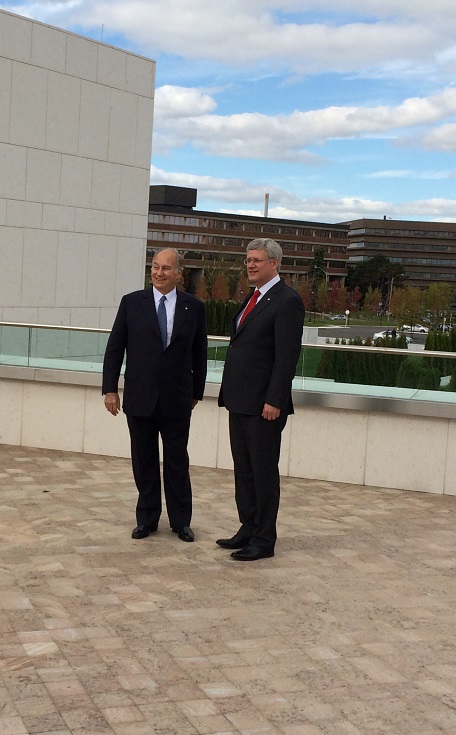
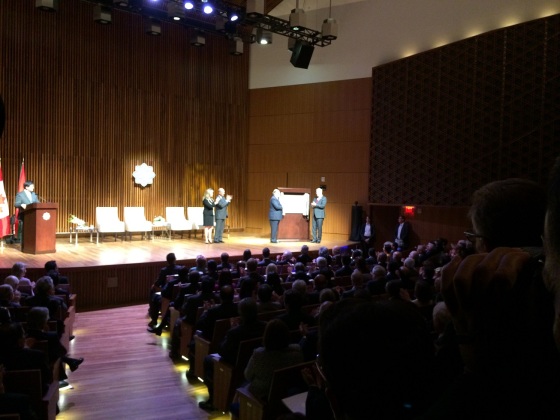
 Guests invited for the opening of the Aga Khan Museum watch a live relay of His Highness the Aga Khan and the Prime Minister walk along the Park to the Museum building from the Ismaili Centre. Photo: Malik Merchant/Simerg. Copytight.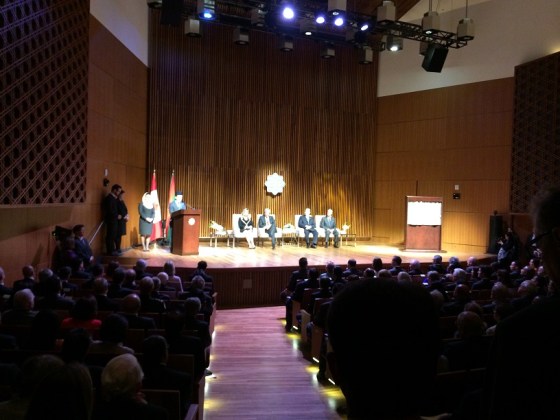


 Simerg - Insights from Around the World