Simerg is an independent initiative dedicated to Ismaili Muslims, the Aga Khan — their Hereditary Imam — and the Ismaili Imamat, and Islam in general through literary readings, photo essays and artistic expressions
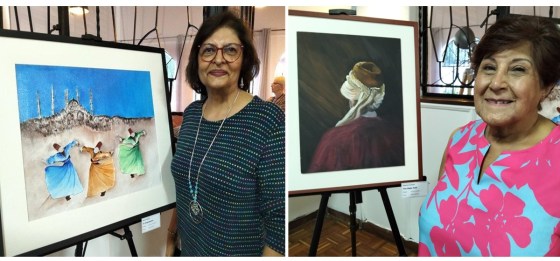
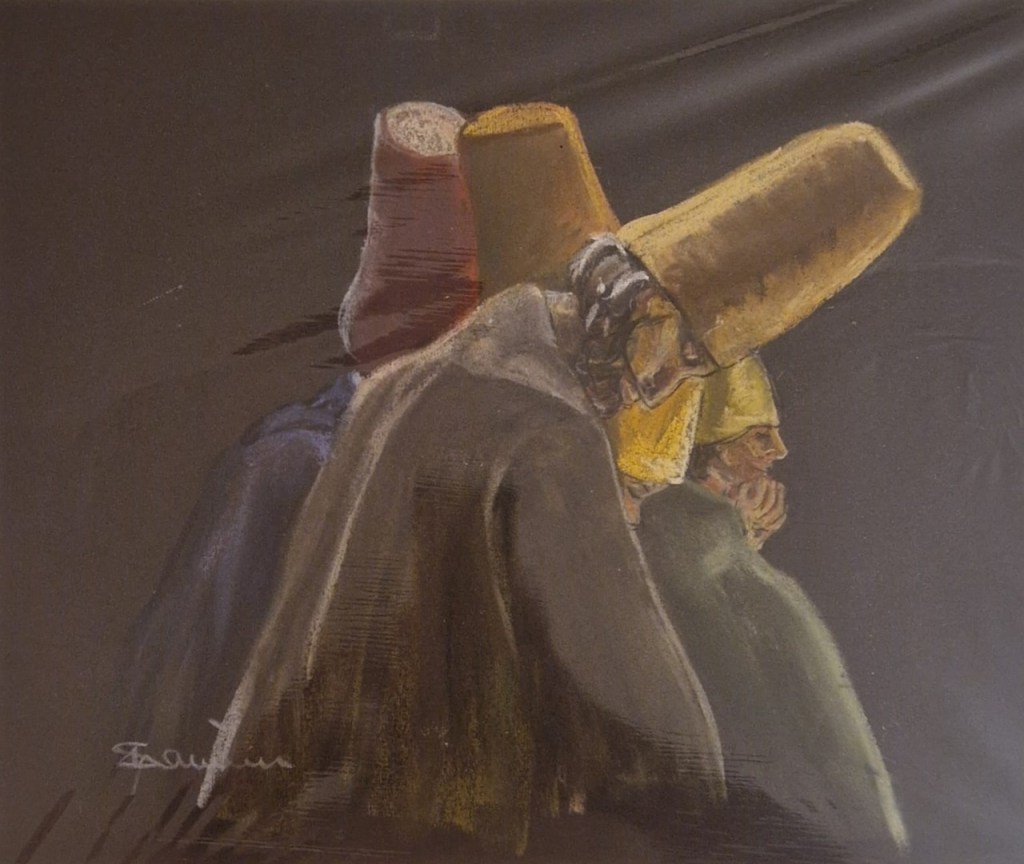
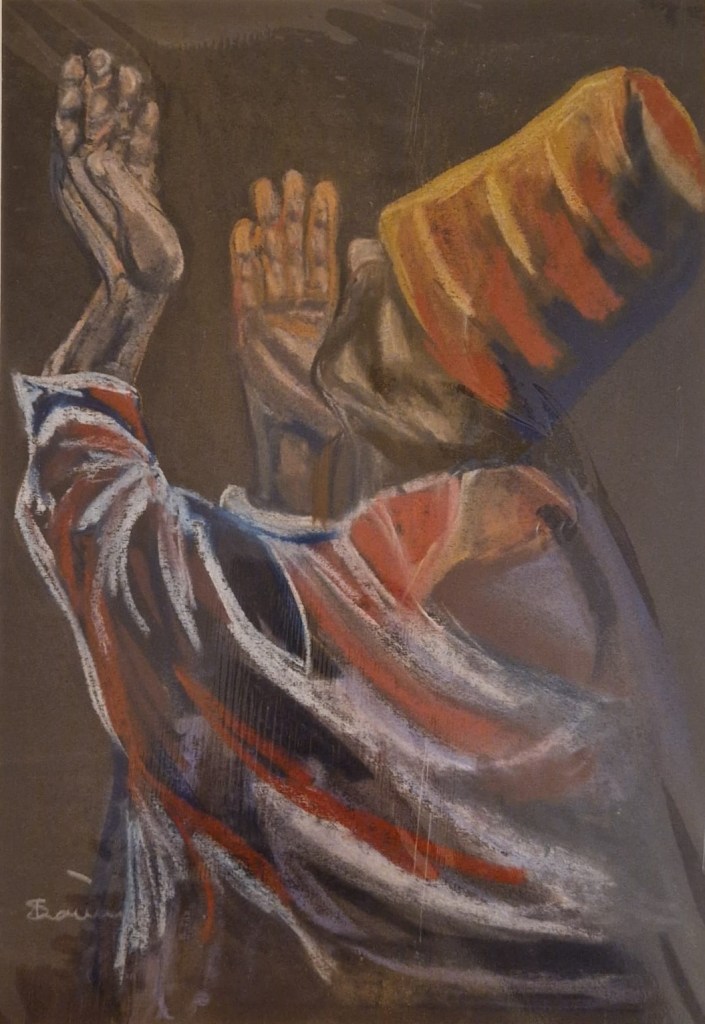
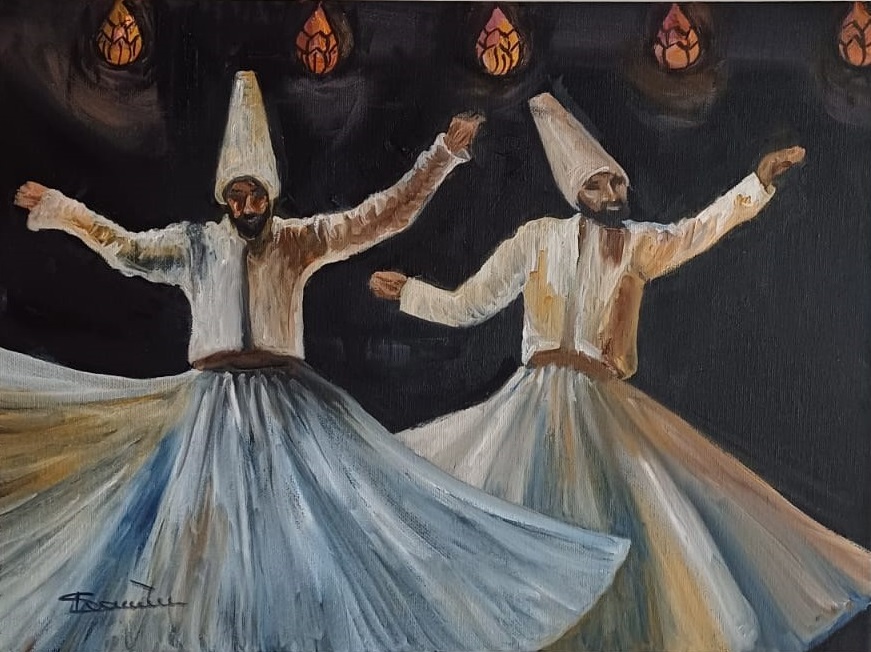
Chez Mahmadi, a renowned sanctuary in Nairobi, Kenya, graciously invited two Ismaili artists, Nimira Shariff and Shamim Subzali, to exhibit a collection that uniquely depicted a theme anchored on Sufism — the mystical aspect of Islam. Despite being separated by the winds of time and space, living oceans apart, these two artists embarked on a collaborative journey that transcended physical distance. They displayed their noteworthy pieces from their respective collections of artwork, each showcasing a unique style of inspiration and talent, all under the singular theme of Sufism. Chez Mahmadi, the serene host that showcased the beautiful exhibition from February 1 – 23, 2025, is a multifunctional space that champions an aura designed to inspire, connect, and nurture one’s mind in unison with the soul.
In a story featured in the Asian Weekly, Tanya Vas noted that the exhibition was a harmonious blend of art and atmosphere, each element resonating with the Sufi theme. She described the art pieces as having vibrant hues and swirling patterns, which seemed to breathe, vividly bringing to life the spiritual essence of Sufism.
Artist Nimira Shariff noted the differences in their artistic styles yet emphasized how their works complemented each other. Shamim Subzali shared the joy they found in working with the Sufi theme. The artists are thrilled to showcase a collection of their exhibition work in Simerg, which warmly welcomes and encourages Ismaili artists worldwide to showcase a selection of their works in our continuing series on Ismaili Artistic Expressions.
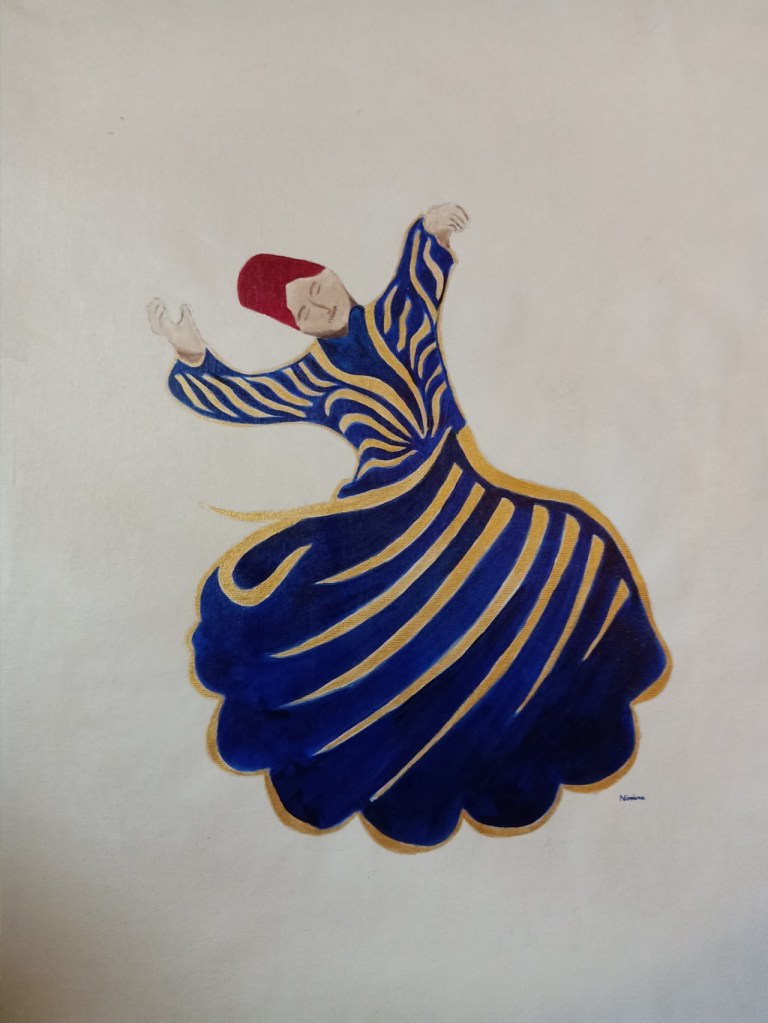
ARTWORK BY NIMIRA SHARIFF
Nimira Shariff
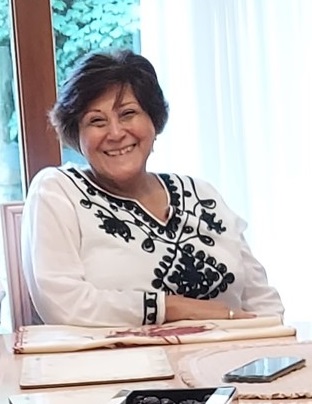
Nimira Shariff is inspired by pursuing a lifelong passion for ‘Art,’ validating that which is authentic or allegorical at the heart of a given scene. This is evident as she displays her talent stimulated by the inner beauty within her environment and the inner being she yearns for. Using watercolours, Nimira finds harmony in depicting animals, birds, flowers, landscapes, whirling dervishes, and silhouettes of African women. In addition, she has dabbled meticulously using Oils and Pastels. The medium she applied for the Chez Mahmadi Sufi Art Exhibition was Acrylic. This exhibit engrossed her to plough further into ‘The World of Sufism’, exemplifying her passion and the cornerstone of her disposition, illustrating that ‘no literature is enough for her to dwell in.’
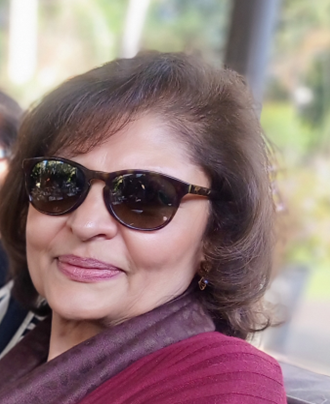
Shamim Subzali has nurtured her skill by creating impressive pieces of artwork. She favours the formation of portraitures yet continues to explore various art themes, as is demonstrated in this specific Sufi art works. Some of her other creations encompass animals, landscapes, whirling dervishes, life drawings, still life, seascapes, and portraits, drawing inspiration from impressionists. At the Chez Mahmadi exhibit, Shamim harnessed the use of Oils, Pastels, and Watercolours. She continues to excel by experimenting with various other mediums and techniques, such as charcoal and pencil. Shamim’s artful approach is a testament to her talent as she states ‘the learning curve is ever evolving, and never diminishes’. Her ongoing artistic journey is an inspiration to all. Discover the intriguing wonders of an enchanting journey by reading Shamim Subzali’s BIO.
“BROTHERHOOD” by Shamim Subzali.
~~~~~~~~~~
“PRAISE” by Shamim Subzali.
~~~~~~~~~~
“SAMA BROTHERHOOD” by Shamim Subzali.
~~~~~~~~~~
“TOTAL SUBMISSION” by Shamim Subzali.
Date posted: March 31, 2025. Last updated: April 1, 2025 (inserted links).
_______________________
“DAD” (Al-Karim Jaffer), acrylic painting by son Faizaan Jaffer.
About the contributor: Al-Karim Jaffer, the youngest of four siblings, was born in Burundi and has travelled extensively, having resided in the Democratic Republic of Congo (DRC), the UK, and the USA. Presently, he lives in Vancouver, B.C., where he cherishes his family and community. As a proud father of two outstanding young men, his commitment to their well-being and the well-being of his community is unwavering. He is ready to serve with outright dedication and passion. Volunteerism has consistently been the tenet of his being. Life has taken him on a spiritual search path by composing allegorical poetry inspired by faith, the environment, and nature photography.
The editor invites Ismaili artists to submit a selection of their paintings and other works of art for publication in Simerg. Please submit images of no more than 8 objects in Jpeg (1280 x 940) and your profile to the editor, Malik, at mmerchant@simerg.com.
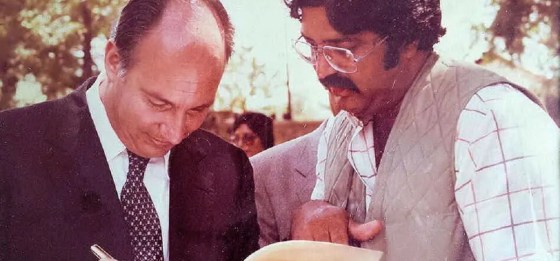
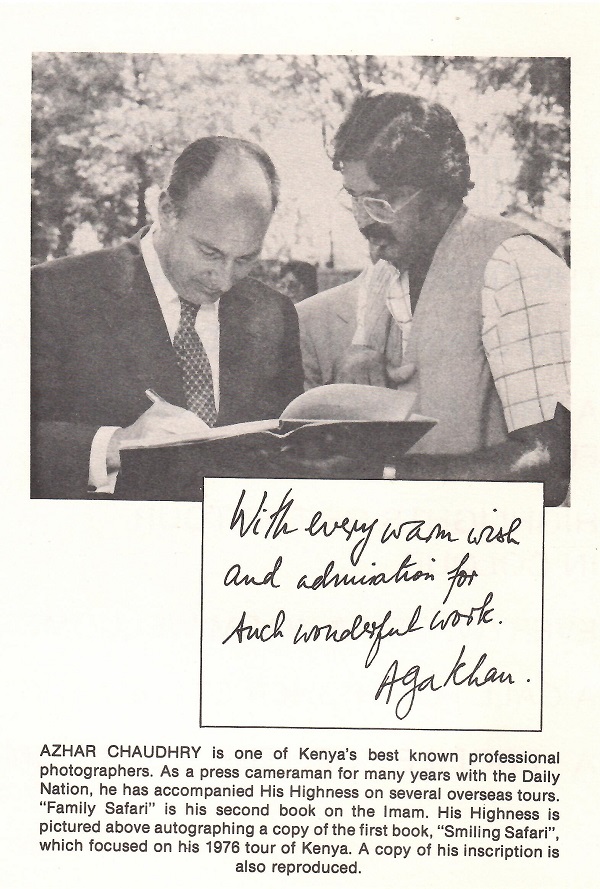
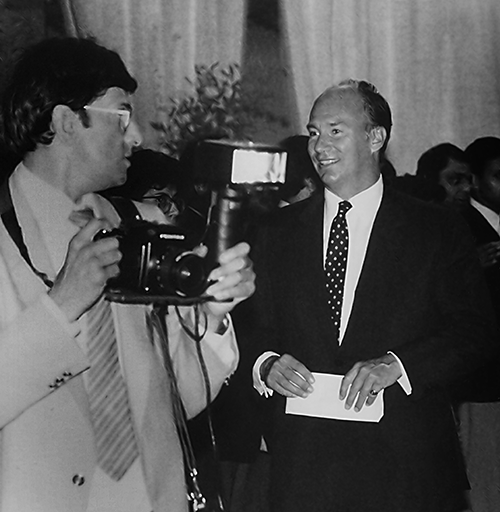
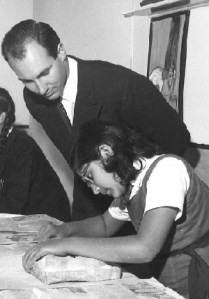
Featured photo at top of post: Former Daily Nation chief photographer Azhar Chaudhry (d. November 2020, aged 75) looks on as His Highness the Aga Khan signs a copy of a special souvenir publication entitled “Smiling Safari” that Azhar published in 1976 to commemorate the 49th Ismaili Imam’s visit to Kenya in the same year. Photograph: Azhar Chaudhry Family Collection. See same image in black and white below, that includes the Aga Khan’s inscription in the souvenir.
By FAISAL (FAS) NADEEM
In the early hours of November 1, 2020, my beloved uncle Azhar Chaudhry lost his battle to live and I lost one of my heroes.
Azhar was only two years old in 1947 at the time of Indo-Pak partition and his family migrated from Indian Punjab to Pakistan’s rich farmlands of South Punjab. Soon after, his father took them to Kenya as he had found work on the railways.
In his early 20’s, Azhar had to go through a personal tragedy when due to some medical complications one of his legs was amputated. But he never had this get him down as he narrates his own story in Zarina Patel’s book “The In-between World of Kenya’s Media: South Asian Journalism, 1900-1992,” a limited edition of which was published in 2016.
Azhar was a self-made man through and through. He started his professional life as an apprentice with the Kenyan newspaper, The Standard, working as a Lino Operator and trained to become a professional photographer at the London School of Arts. From 1963 he worked for The Daily Nation and later on became their Chief Photographer and Picture Editor. His love and passion for photography remained in his DNA for the rest of his life and Azhar contributed to many important publications. In 1969, Azhar’s published his first book “Jomo Kenyatta: A man and his people”.
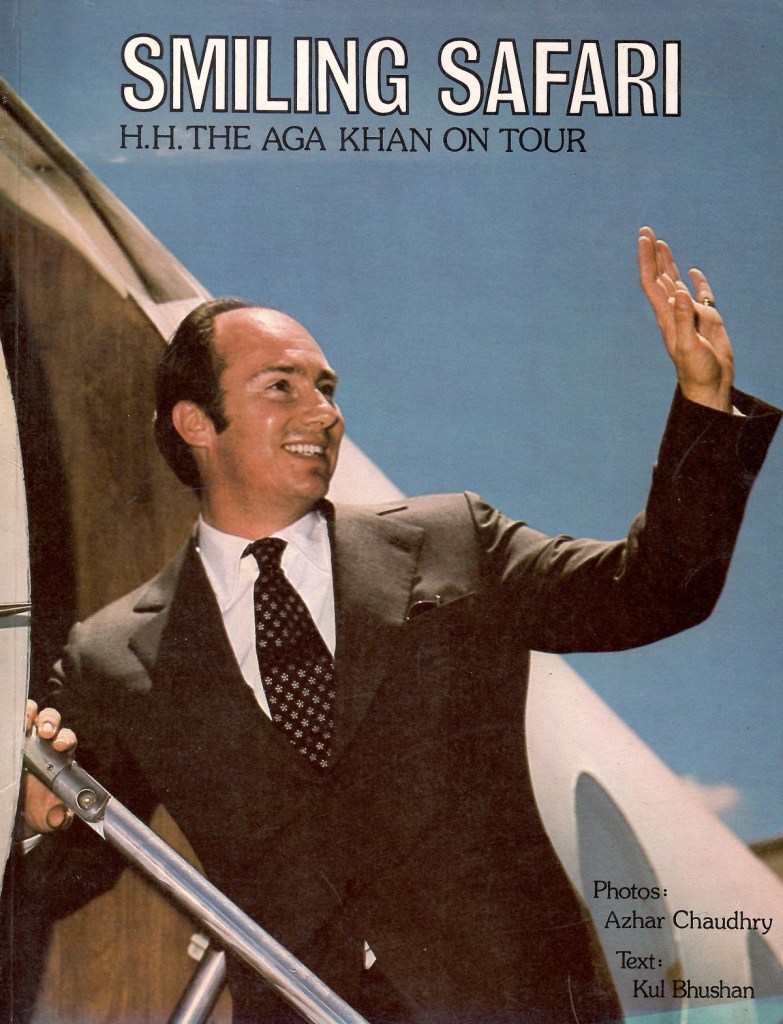
Being a keen traveler, shooter, safari enthusiast and photographer was a combination that opened several high-profile avenues for him. He travelled with former Kenyan President Moi and also with the Aga Khan, the founder of the Nation Group of newspapers, and documented the Aga Khan’s travels to Kenya through two special souvenir issues — Smiling Safari published in 1976 and Family Safari published in 1981.
Story continues below
Cover page of “Smiling Safari — H.H. The Aga Khan on Tour,” photos by Azhar Chaudhry and text by Kul Bhushan, published by Azhar Chaudhry, 1976, 80 pp.; out of print.
~~~~~~~
Cover page “Family Safari — H.H. The Aga Khan on Kenya Tour,” pictures by Azhar Chaudhry, published by Azhar Chaudhry, 1981, 108 pp., out of print.
~~~~~~~
This black and white image appears in Azhar Chaudhry’s Family Safari, his second pictorial souvenir which commemorated the Aga Khan visit to Kenya in 1981. The Aga Khan’s signed inscription in the book reads “With every warm wish and admiration for such wonderful work. Aga Khan.”
Azhar was a keen rifle shooter and represented Kenya’s shooting team at various world shooting events. He was part of the overseas teams that took part at the international shooting events of 1986 and 1990 at The National Rifle Association of the United Kingdom (Bisley, Surrey).
A man of many talents, Azhar had developed his love for cooking into passion and from early 1990’s Azhar had become a full-time restaurateur. He successfully ran the famous Nairobi restaurant renowned for its steaks ‘The Professional’. Located in the heart of Nairobi and just opposite the Kenyan Parliament Buildings, this famous joint was based in the Kenyatta International Conference Centre. He ran this restaurant for a decade or so.
Azhar was a colorful man in his personal life too, and for various reasons he got married about 4 times but was never able to settle in a long-term marriage. During the first decade of the 2000, when Azhar was in his 4th marriage, he left Kenya and settled with his wife and two boys Ayman and Areeb in Nelspruit, South Africa. His first venture here was to run a butcher’s shop furthering his culinary skills. By 2005 he was keeping the family in Nelspruit and had moved himself to Johannesburg.
This is the time when I had planned to do an extensive family holiday in South Africa with visits to places such as Cape Town Peninsula, Robyn Island, Nelsprut, Kruger Safari Park, Johannesburg and Sun City. During this trip, we had the pleasure of spending time with his family in Nelspruit and then visited him at his newly opened Pakistani restaurant Dawat. I must say it was one of the best restaurants that I experienced in South Africa; it not only specialised in Pakistani cuisine but also served Chinese, Thai and Continental dishes including his famous steaks. Over the years many celebrities visited the famed Dawat which was located in Fordsberg (Johannesburg). Subsequently, he opened a branch in Cape Town as well. He sold both these restaurants to settle into his retirement days.
I had the pleasure of meeting and spending time with Azhar in Pakistan during 2015 when he was accompanying his friend from South Africa, the world-renowned orthopaedic specialist Professor Charles Lautenbach who was in Lahore to deliver his research paper at a Conference. Professor Lautenbach had designed a procedure for treating bone infections, which he researched and continued to refine over the span of his medical career. He also trained a number of doctors from around the world in what became known as the ‘Lautenbach technique’. It was a pleasure to accompany Azhar and the Professor to a few private dinners. I was lucky enough to meet Azhar again for the last time in 2017 when he came to Lahore for dental treatment.
He then re-organised his personal life and settled in Port Alfred with his elder son Ayman who was completing his commercial pilot training there. I last spoke with Azhar on Aug 29, 2020, after he and Ayman had moved to their new place in Port Alfred by the river.
Sadly, during the last week of October 2020, when visiting his younger son Areeb in Cape Town, he felt poorly and had to be taken to the Netcare Christiaan Barnard Memorial Hospital. He was diagnosed with COVID-19 and never recovered from this episode and passed away during the early hours of November 1, 2020. Azhar’s last resting place is at Grassy Park Cemetery, Cape Town.
Rest in Peace Azhar. You will always be my hero. Your family — the Chaudhry clan — and your friends all over the globe will miss you dearly.
Date posted: August 31, 2023. Last updated: September 1, 2023 (link updates.)
____________________
As Chief Photographer of the Daily Nation for many years, Azhar Chaudhry was well-known by readers of the Daily Nation and widely respected by his colleagues in the East African media. Of course, many know him through his popular restaurants in Nairobi and South Africa. We invite our readers to submit their personal tributes and fond memories of Azhar Chaudhry by clicking on LEAVE A COMMENT.
ABOUT THE AUTHOR
Faisal Nadeem
Faisal (Fas) Nadeem is an electrical engineer and an IT specialist by profession and lives near Oxford, England. As a hobby, Fas spends his time researching on those who are near and dear to him, as well as his family who come from a humble Punjabi farming background. With facts not easy to come by, he relies on older members of his family for information gathering. Fas is widely travelled and has toured several countries across Europe, Asia, Africa and the Middle East. Thus his interests span across many cultures and faiths. Fas, who has two grown-up sons, is surrounded by members of his extended family and has many friends in the UK who are from East Africa and the Sub-Continent. Fas may be reached by email at fasnadeem@gmail.com.
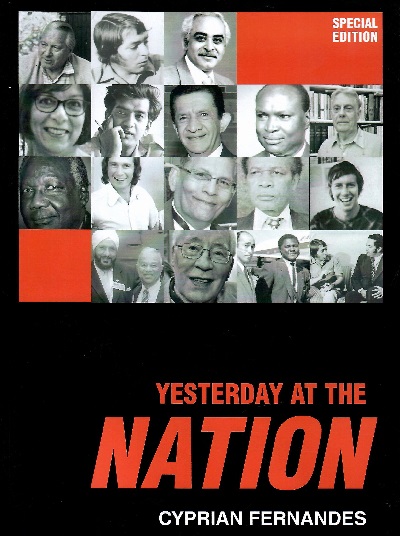
(Special Edition Yesterday at the Nation by Cyprian Fernandes, published by Cyprian Fernandes, Pendle Hill NSW Australia, printed and produced by Australian Trade Printers, April 2020. 132 pp.)
The Daily Nation was my favourite newspaper in Dar es Salaam, along with the Tanganyika Standard (later the Standard and then the Daily News). The popular Kenyan newspaper founded by Mawlana Hazar Imam, His Highness the Aga Khan, first rolled off at the press as a Sunday newspaper on March 20, 1960, and then as a daily on October 3 of the same year.
The paper would arrive in Dar es Salaam from Nairobi in an afternoon flight. At around 6 PM, our 2nd floor neighbour at Islamabad Flats on United Nations Road, (Late) Akbar Ladha, would knock on my door on his way up and hand me a copy of the paper. He and Sherali Bhai owned a prestigious camera shop on Dar es Salaam’s Independence Avenue, and received letters and packages from all over the world from their clients and suppliers. Akber Bhai knew I was an avid stamp collector, and he would pass all foreign envelopes to me.
On Saturday afternoon, I would cycle to downtown to get my own copy of the early editions of the Sunday Nation and the Sunday Post — without the English premier league results! I became conversant with many of the Nation’s columnists, writers and photographers as well as editors. Among them were Philip Ochieng (who would later join the Tanzania’s Daily News for a brief period), Kul Bhushan who reviewed Indian films, sports writer and editor Norman da Costa, chief reporter Cyprian Fernandes, Ismaili reporter Sultan Jessa and photographer Azhar Chaudary, among several others.
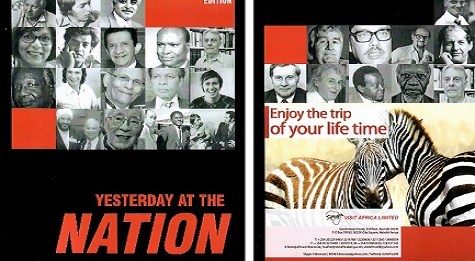
Front cover of special souvenir edition to mark the 60th anniversary of the Nation. The portraits are of Nation journalists, deceased as well as living. Photo: Cyprian Fernandes / Yesterday at the Nation.
Many years later, I had the fortune of meeting the Nation’s Bill Fairbain in Ottawa. Author of a number of books in recent years, he contributed a special piece for Simerg. Then, I connected with Sultan Jessa who invited me to his home in Montreal and handed me a collection of photos taken by Azhar Chaudary, which were reproduced in Barakah and Simerg. Sultan passed away in 2019. I prepared a tribute to him and linked it to a much longer piece I had written earlier in Simerg.
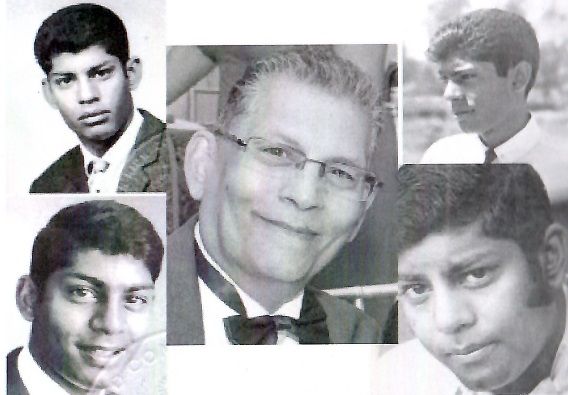
The many faces of Cyprian Fernandes through the years as they appear in his souvenir publication, “Yesterday at the Nation.” Photo: Cyprian Fernandes / Yesterday at the Nation.
Last December, I received a note from the Nation’s former chief reporter Cyprian Fernandes, who has made his home in New South Wales, Australia. He wanted to reproduce my article on Sultan Jessa in a special “not for sale” souvenir to mark the 60th birthday of the paper that he stated in his email to me was “my other mother, The Nation.” I was glad to oblige. When the publication was ready in April 2020, Cyprian mailed two copies to me by Australia’s Post Express — including one to give to Sultan Jessa’s widow, Rosila. I kept on tracking the package for weeks. Due to Covid-19, it never left Australia by air. Instead, I would learn several weeks later, that it was sent by surface. I received “Yesterday at the Nation” just last week!
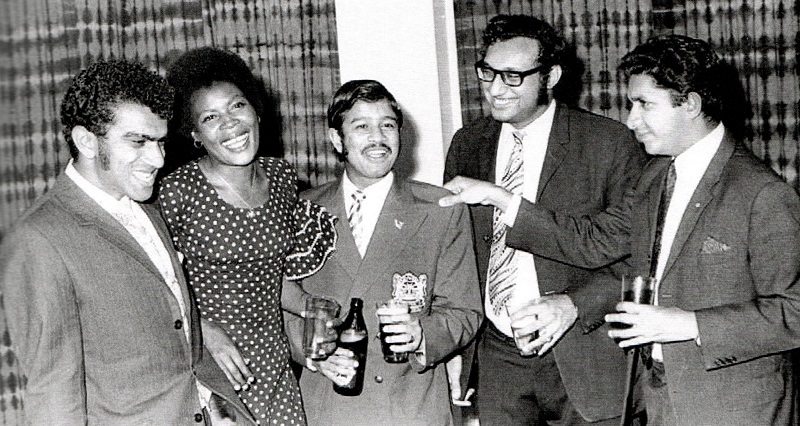
“Once when they were young,” from left Nation’s Polycarp Fernandes, Fibi Munene, Norman da Coata, Alfred Araujo and Sultan Jessa. Photo: Cyprian Fernandes / Yesterday at the Nation.
Cyprian commences his souvenir book by producing the introductory note that appeared on the front page of the Nation on the first day of its publication, March 20, 1960. He then says that the souvenir “was made possible by the articles provided by former Nation colleagues and the writings and obituaries of colleagues who have gone before us.”
In his preface “Once Upon a Time” Cyprian notes the brilliant work that Gerry Loughran did chronicling the first 50 years in “Birth of a Nation, The Story of a Newspaper in Kenya” (available in paperback or kindle edition at Amazon).
But for this 60th anniversary souvenir produced completely independently, Cyprian wanted to go further and he therefore dug deep to find more stories about the paper and from the paper. One thing he has done most admirably is to recognize the surviving and deceased journalists who worked at the Nation as well as those whom he tried hard to locate but was unsuccessful to get in touch with. His focus is on the period 1960-1975, a little over the time he himself spent at the paper.
Back cover of a special souvenir edition to mark the 60th anniversary of the Nation. The portraits are of Nation journalists, deceased as well as living. Photo: Cyprian Fernandes / Yesterday at the Nation.
The 132 page souvenir contains previous articles by Michael Curtis (1920-2004) who Mawlana Hazar Imam first recruited as a speech writer and publicity organizer when he became Imam in 1957; experiences at the Nation by numerous editors such as Jack Beverley (Sunday Nation editor from 1962-64), Jon Bierman (Daily Nation, 1960-63), Joe Rodriques, Boaz Omori and Hilary Ng’weno among others. In reading their stories, one learns about the challenges the editors and journalists faced when they were bold in their opinions about heads of state or on local and international political issues. As we find out from Cyprian’s book many were fired or forced to resign or even ended up in jails. One, a news editor by the name of Mike Chester, was expelled from Kenya due to mistaken identity!
One particular event that was reported well, and has been reproduced in the Souvenir, is when Kenya successfully launched the San Marco’s satellite into equatorial orbit from Malindi. Adrian Grimwood’s column in the Sunday Nation of November 12, 1972 explains what would likely take place on the day of the launch. The launch itself was reported on the front page of the Daily Nation’s coast edition with the headline “Kenya in the Space Age.”
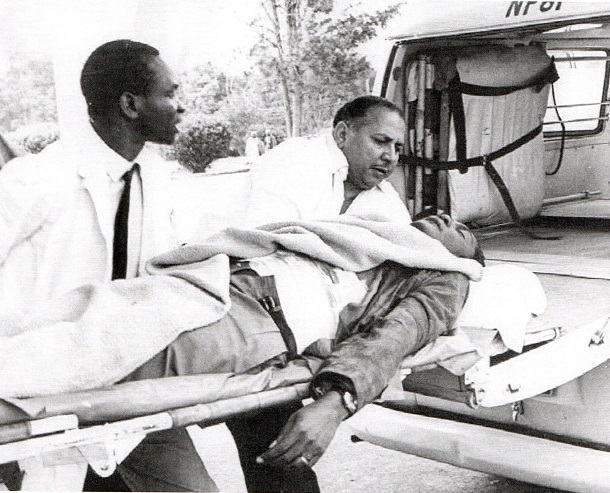
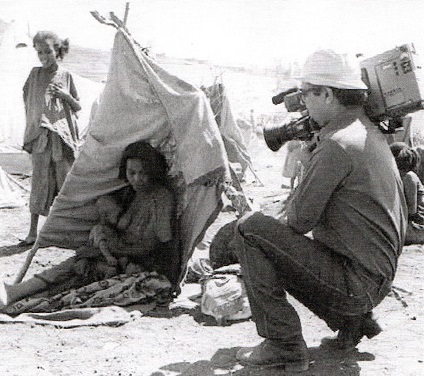
A tragic story that Cyprian includes in his souvenir is that of the extraordinary photographer and front line cameraman Mohamed “MO” Amin who was at the right place at the right time when Kenyan cabinet minister Tom Mboya was assassinated. Within a couple of minutes of being shot, Mo Amin was there to record on still and movie cameras, like the photo that is shown below. The souvenir also notes Mo Amin’s coverage of the 1984 Ethiopian famine in that it proved to be so compelling that it inspired a collective global conscience and became the catalyst for the greatest-ever act of giving. “Unquestionably,” the souvenir notes, “it also saved the lives of millions of men, women, and children.”
Within a couple of minute’s of the Kenyan Minister Tom Mboya being shot on Nairobi’s main street, Mo Amin was there to record on still and movie cameras, like the photo shown here. Photo via Cyprian Fernandes / Yesterday at the Nation.
Mo Amin in Ethiopia at the height of drought crisis. Photo via Cyprian Fernandes / Yesterday at the Nation.
Mo Amin died in a hijacked Ethiopian Airlines plane that crash landed in November 1996 in the Comoros Islands. It is said that he died standing while still negotiating with the hijackers until the moment of the crash.
A great piece in the souvenir is about Joe Rodriques, who spent 18 years at the Nation, the final few as the paper’s Editor-in- Chief. During his tenure, The Daily Nation was accused by President Moi’s government of assuming the role of an opposition party and selecting news on a sectarian and tribally motivated basis. Rodriques had written an editorial against the Government when the long time Kenyan politician and opposition leader Oginga Odinga was banned from standing in a by-election. Rodriques was arrested and interrogated. The souvenir notes that “The Nation published an apology of sorts, assuring the government of its support, but actually without using the word apology. This was the beginning of the end of Joe Rodriques, as Editor-in-Chief and his own 18 year association with the paper.”
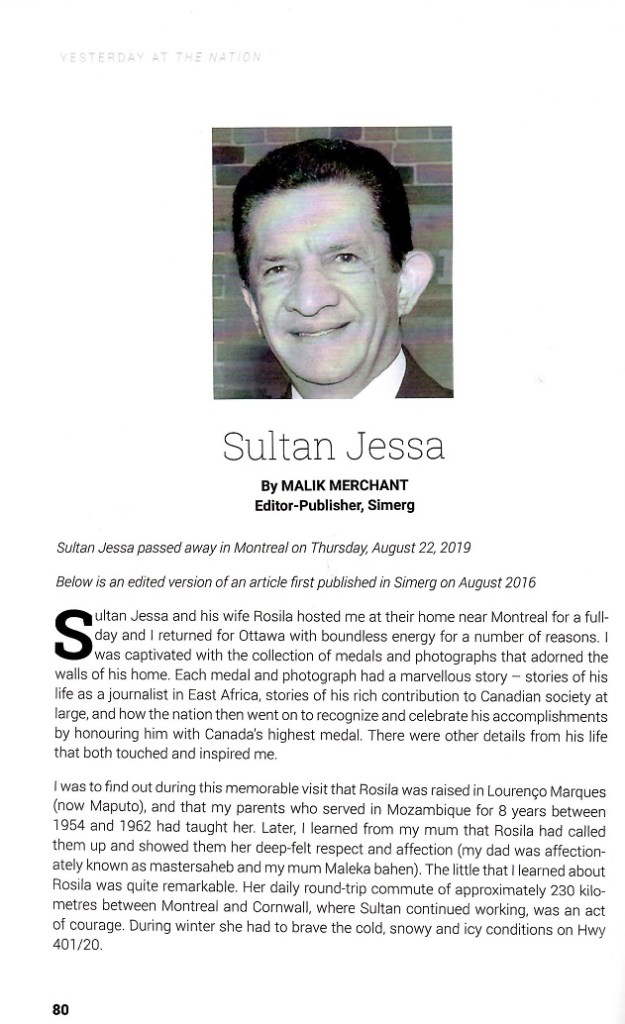
A page from Simerg’s 4 page piece on Sultan Jessa from “Yesterday at the Nation” by Cyprian Fernandes.
Writing for himself, Cyprian Fernandes observes, “I owe the Nation — everyone who worked in editorial, photographic, proofreading, the compositors, advertising, Karo and Kano the drivers — and everyone else at Nation House the greatest debt of my life. Thanks for giving me a journalistic life that has spanned nearly 60 years and like Johnny Walker still keeps on walking — for the moment at least.”
He ends his detailed narrative about his days at the Nation with the following anecdote:
“I was travelling with the then Vice President Daniel arap Moi and his wife to Botswana. All went well, except for two things: The VP’s security kept his spare bullets by a candle in his bedroom…there was a lot of bang bang. When I tried to phone my story in via Johannesburg, the operator at the other end let loose a torrent of racist abuse including telling me to ask my wife and taste the real thing….and lots more. Unfortunately for him, the President of Botswana, Sir Seretse Khama, was in the room and listened in. A few weeks later I received an official apology from the South African government and an invitation to visit South Africa as (an honorary white man).”
Cyprian’s love for “my other mother, The Nation” is deep and sincere. The souvenir edition has been prepared, printed and mailed out from his own personal resources. I was delighted to receive a personalized signed copy and thank him for a volume that I will cherish for the rest of my life. It is one of very few copies that has been produced, and I am indeed lucky to be among the recipients. I hope a demand for the souvenir will prompt Cyprian to come up with a larger printer run for interested readers to purchase. The Daily Nation’s 60th anniversary falls on October 3, 2020.
Date posted: August 27, 2020.
_________________________________
Before departing this website please take a moment to review Simerg’s Table of Contents for links to hundreds of thought provoking pieces on a vast array of subjects including faith and culture, history and philosophy, and arts and letters to name a few.
We welcome feedback from our readers. Please complete the LEAVE A REPLY form below or click on Leave a comment. Your letter may be edited for length and brevity, and is subject to moderation.
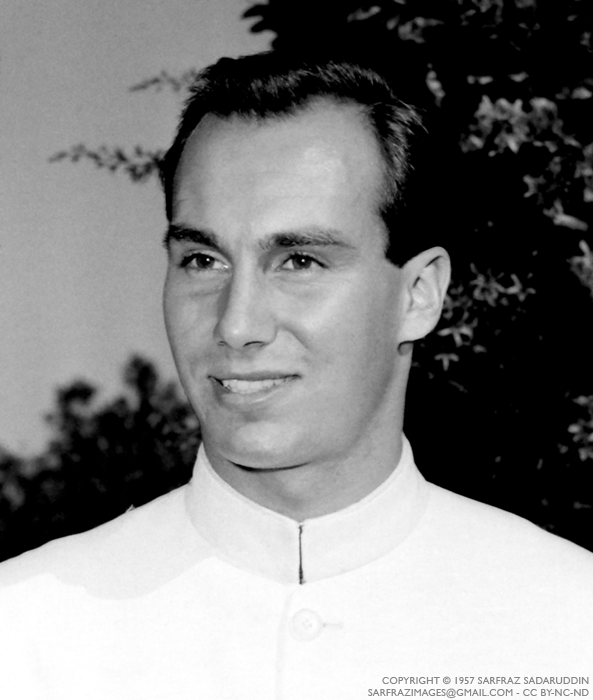
Editor’s note:Among the photos we recently published of His Highness the Aga Khan’s visit to the Aga Khan Primary School, Nairobi (see link at bottom of this page), was a unique, previously unpublished portrait of the Aga Khan. We are pleased to inform readers that the photographer of that portrait, Sarfraz Sadaruddin of Vancouver, Canada, has approached us and generously provided us not only with permission to publish his photograph, but also a sister portrait taken at the same time (both of which are reproduced below). He has also provided special permission, under a Creative Commons License, for others to use these portraits, subject to the conditions and restrictions laid out below.
Ismaili readers of this website will be particularly happy to see these two unique portraits of their beloved 49th Imam as they prepare to celebrate Eid al-Fitr. Simerg takes this opportunity to offer congratulations to all Ismailis as well as the entire Muslim world on the most auspicious occasion of Eid al-Fitr marking the end of Ramadhan, and wishes everyone barakah (happiness) and success in all walks of life. We pray for peace and unity amongst Muslims everywhere to please Almighty God, and thus gain more from Allah’s continuous and endless wonderful blessings to mankind.
THE PORTRAITS OF HIS HIGHNESS THE AGA KHAN BY SARFRAZ SADARUDDIN
By Mohib Ebrahim
During His Highness the Aga Khan’s 1957 visit to East Africa — his first after becoming Imam of the Shia Imami Ismaili Muslims, the Aga Khan hosted a private function at his residence for many dignitaries — including the late Tom Mboya — and Ismaili community leaders. Sarfraz Sadaruddin, then 19, was one of the photographers covering the event and, never one to be shy, requested the Aga Khan if he could take some portraits of him. The Aga Khan graciously agreed, asking Sarfraz to proceed to the rear garden where he could take the pictures he needed while the Aga Khan was engaged with his guests there and this was when and where these two portraits were taken.
Sarfraz Sadaruddin during Expo 1986.
Sarfraz Sadaruddin, son of the late Rai A.M. Sadaruddin (see Voices: Sir Sultan Muhammad Shah, Aga Khan III – Eloquent Persian Quatrain by 48th Ismaili Imam Graces a 1923 Invitation For Talk About Imamat), was born in Nairobi, Kenya where he developed a passion for photography in his mid-teens and apprenticed with Kodak Limited for five years before moving to Hamburg, Germany, in 1960 where, on scholarship, he attended Agfa’s training college. Later, he moved to London to continue his photography studies at Ealing Technical College and then worked as a professional, freelance photographer, in the U.K. and continent, for newspapers, advertising firms and Royalty. In 1980, he moved to Vancouver, Canada, where he now resides and continues covering events.
In Kenya, since the Aga Khan’s coronation in 1957 until he left in the 1960s, Sarfraz was a key, official photographer at the Aga Khan’s functions in Nairobi. He covered the 49th Ismaili Imam’s Nairobi Enthronement (Takhtnashini) Ceremony, the opening ceremony of the Platinum Jubilee Hospital, now the Aga Khan University Hospital, and the entire Kenya leg of the 1959 visit including opening ceremony of the Aga Khan High School. He was also invited to cover the Aga Khan’s visit to the Aga Khan Primary School and many other private events the Aga Khan attended or hosted.
In London, Sarfraz was invited to cover the Foundation Stone ceremony of the Ismaili Centre as well as the Aga Khan’s community visits and functions.
Sarfraz Sadaruddin taking pictures during His Highness the Aga Khan’s Vancouver Silver Jubilee visit in 1983.
In Vancouver, Sarfraz continued to cover the Ismaili Imam’s visits, including extensive coverage of the opening ceremony of the Ismaili Centre, Burnaby, which took place in the presence of then Prime Minister, Brian Mulroney, then British Columbia Premier, Bill Bennett, and His Highness the Aga Khan.
Also in Vancouver, outside of the community, Sarfraz was an official press photographer for many visits of Royalty as well as the World Expo, 1986. Key Expo events he covered include the opening by His Royal Highness Prince of Wales and the late Princess Diana and twenty “National Days.” He was complimented by the then Lieutenant Governor of BC, The Hon. Robert G. Rogers, for his outstanding work.
Simerg welcomes feedback on this post. Please click on Comment.
_________________
LIMITED PERMISSION TO REUSE THE PORTRAITS
In order that the Jamat may enjoy and use these two portraits, Sarfraz is releasing them under under the Creative Commons Attribution-NonCommercial-NoDerivatives 4.0 International License (CC BY-NC-ND) — the first time, to my knowledge, photographs of Mawlana Hazar Imam, have been so generously shared for the Jamat to enjoy without fear of copyright infringement. Please note the images are still copyright and not in the public domain, but the license does allow them to be re-used non-commercially, without modification and with credit as embedded in the images and set out as below, including the web-link:
Sarfraz kindly requests that all those who have copied and republished his photograph from the original posting on Simerg and its sister photoblog Simergphotos, to please add the above credit and replace their images with the one published here.
Date posted: Saturday, July 26, 2014.
Copyright: Mohib Ebrahim. 2014.
____________
About the Author: Mohib Ebrahim is Sarfraz’s nephew, grandson of the late Rai A.M. Sadaruddin and founder of the NanoWisdoms Archive (http://www.nanowisdoms.org), a unique website dedicated solely to the Ismaili Imamat’s speeches, interviews and writings launched in 2011 upon receiving special permission from Aiglemont to publish the Aga Khan’s speeches. With over 500 readings and thousands of quotes it is the most comprehensive, public collection of Imamat knowledge available today.
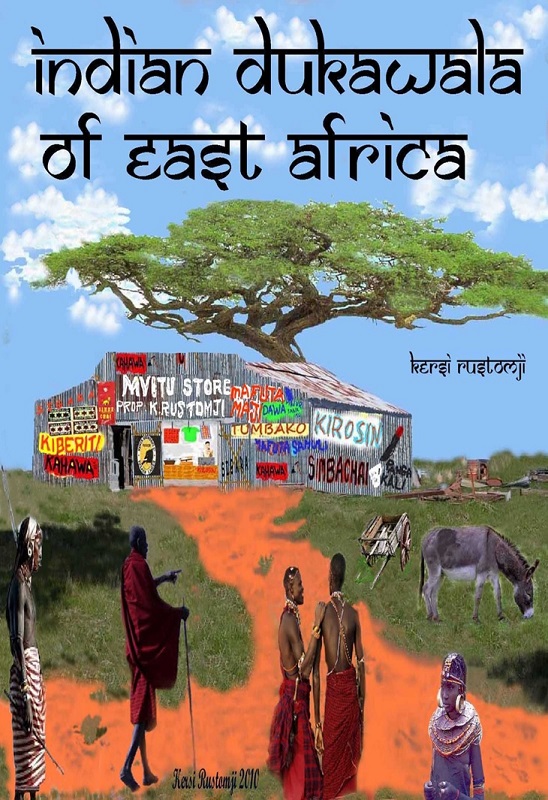
This work is a small tribute to the unsung intrepid pioneering Indian traders and very often their families, who braved the unknown hazards of the “Dark Continent”, carried on regardless of disease, lack of comforts, privations, ill-health, and even death, which they knew was their constant and real possibility.
“While the tribute is aimed at all the Indian, later termed Asians traders and shop keepers, we should bear in mind that these intrepid early trading pioneers also included Ismailis, who became prominent merchants and developers in all economic fields in East Africa. The Ismailis left behind an admirable record of their contribution, and this work touches them too.” — Kersi Rustomji
Hitherto the dukawala remain unrecognised nor given a deservedly appropriate place in the annals of these nations. Without record of these traders and other Indians who also played a very prominent and important part in the economic and the political growth of these nations, the histories of these three East African countries would be incomplete.
The image depicts on the rich red soil, a typical Indian duka, a small trading store, in small towns and remote country areas of East Africa. The signage is also typically hand painted work of the duka owners. These put up with any paint at hand, included some spelling errors. The man behind the counter is my paternal uncle Jehangirji Rustomji, who first opened a small watch repair duka in the old Indian Bazaar, now Biashara Street, in early 1906 in Nairobi, Kenya. He later moved to the then Government Road, now Moi Avenue, in the corner of a chemist shop, Chemitex, next to the old Alibhai Sherrif hardware shop, going towards the Ismaili jamatkhana, on the corner of Government Road and River Road. Later his youngest son Rati joined him, and after Jehangirji’s death, Rati carried on the little business until 2009, when he retired and closed the little duka after 103 years of its existence. Rati still lives in Nairobi. Copyright: Kersi Rustomji, Australia.
“[My] mum trained as a teacher in London and was passionate about the importance of education, the communication of knowledge and the enhancement of the individual through such knowledge. During her time in Kenya, she held the position of Principal at the Aga Khan Primary School in Nairobi where His Highness the Aga Khan on at least one occasion, privileged her to host a visit.” — Allison Wallace
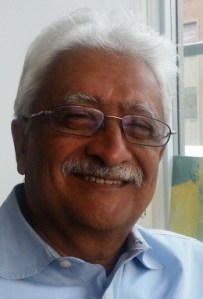
Toronto based Ismaili author, M..H. Velshi whose book excerpt can be read by clicking on the image or link below
The year is 1936, and the setting for a serious dialogue between a brother and his sister is Mumbai’s famous Chawpati on Marine Drive – with the continent of Africa in the distant horizon, thousands of miles away….
“To Africa,” she said.
She looked at his startled face and continued, “That’s your future. So many of my friends have gone and bought shops or farms, or found work on the railways…You know for many years our Imam, Mowlana Sultan Mohammed Shah, has been issuing firmans to us Ismailis to migrate to Africa. Now the Ismailis have built large jamatkhanas in Africa where people can pray and meet freely every day. You won’t be alone. When I heard one of his firmans…I knew it was a message meant for you. It’s your way out.”
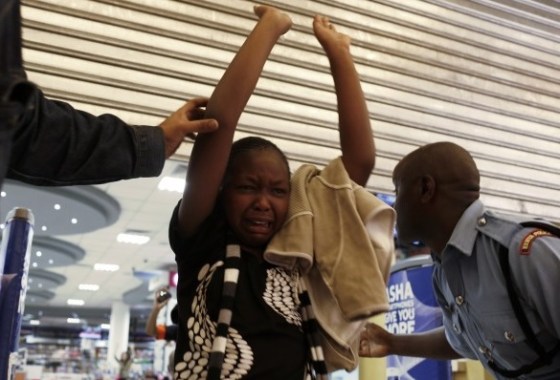
A girl is helped by police officers inside the Westgate Mall in Nairobi where 59 people are reported killed during Saturday’s terrorist attack. Please click on next image, see below, for a slide show at the Denver Post website. Viewer discretion is advised as some of the images are disturbing. Links are also provided to the websites of Al-Jazeera and the Washington Post.
Editor’s note: Please also click on the Comments link at top left of this post. They include updates about the dead victims and the injured.
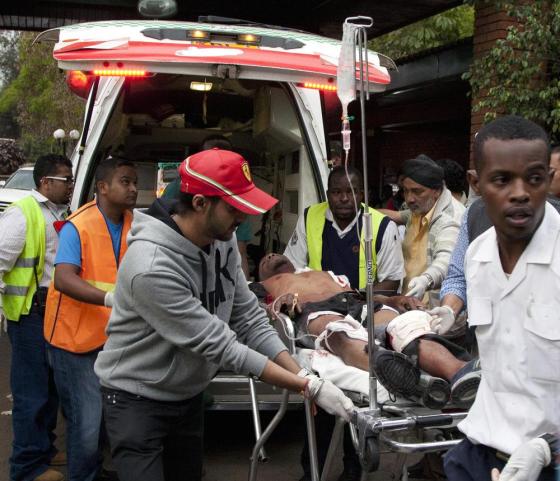
Kenya’s grief is our grief. The unimaginable and unthinkable has happened in Nairobi, where dozens of people, including Canadians, are dead or injured in a brutal attack against civilians in a mall. The victims included children. The latest reports indicate that at least 59 people were killed and 175 injured in Saturday’s incident.
We feel as if humanity has been taken in its entirety. The preceding statement has its basis in the Holy Qur’an, which speaks about the sanctity of life (see quote by His Highness the Aga Khan on the Simerg banner at top of this page). Lost lives and injuries are even more difficult to bear and accept when they involve children, as in this incident that has wounded the entire world.
At this time, our prayers and thoughts are for the people of Kenya, and especially for the families who are grieving from this senseless and unjustifiable act. We pray for the souls of the deceased, and wish all the injured quick and complete recovery. We ask the Kenyan people to be courageous and vigilant in the wake of these despicable and cowardly acts.
In a written statement released on Saturday evening, Canada’s Prime Minister Stephen Harper said:
“Canada condemns in the strongest possible terms this cowardly, hateful act that apparently targeted innocent civilians who were simply out shopping. Terrorist attacks like this seek to undermine the very values and way of life that Canadians cherish….The hearts and prayers of all Canadians go out to the families and friends of all those affected by this senseless tragedy, and we extend our deepest condolences to those suffering the loss of Annemarie Desloges, one of our diplomats who has died in the attack.”
The tragedy is receiving extensive coverage from around the word, and we warn readers that some of the more than 50 images posted at The Denver Post (see link below or click on image) and other websites are quite disturbing and shocking. Readers may express their grief and convey their condolences by clicking on the comments icon at the top left of this page.
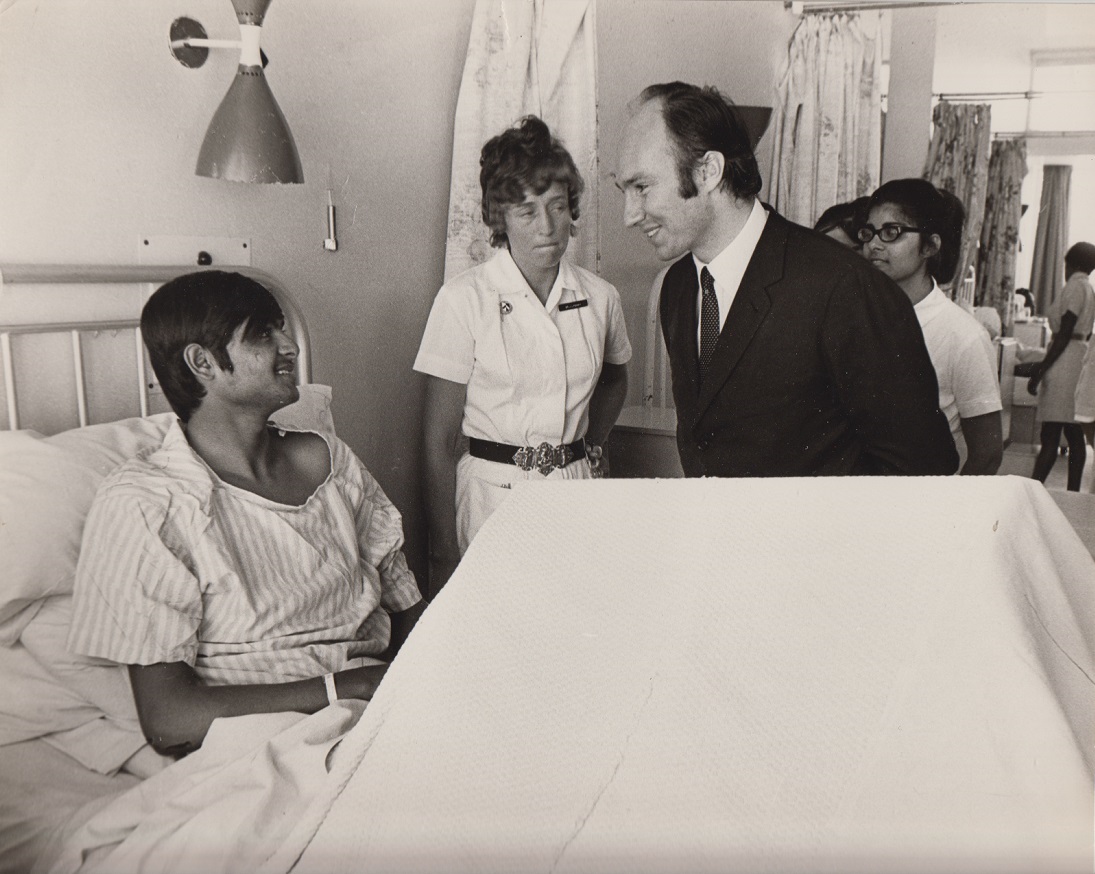
An injured person is brought to the Aga Khan Hospital in Nairobi after an attack at a mall in the Kenyan capital. Please click for a slide show and photos at the Denver Post.















 Simerg - Insights from Around the World