Simerg is an independent initiative dedicated to Ismaili Muslims, the Aga Khan — their Hereditary Imam — and the Ismaili Imamat, and Islam in general through literary readings, photo essays and artistic expressions
Author Archives: Malik Merchant, Editor
Founding publisher and editor of www.barakah.com, www.simerg.com and www.simergphotos.com.
The Aga Khan’s visit: Last updated April 1, 2026, 20:00 EDT
Mawlana Hazar Imam, His Highness the Aga Khan, bestowing his Didar in Toronto before his departure, March 31, 2026. Photograph: Still from the Ismaili Update 8.
At the conclusion of His Highness the Aga Khan’s visit to Canada, we provide anchor links to Barakah’s day-by-day coverage of his historic first visit to Canada as the 50th Hereditary Imam of the Shia Ismaili Muslims.
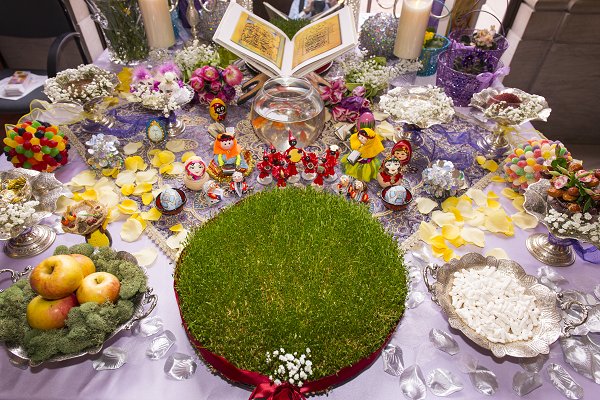
Conceived and created by Nurin Merchant, this Navroz greeting incorporates roses and jasmine, which are extremely popular in Iran during Navroz. The base of the picture shows shoots of wheat grass, signifying robust evergreen health throughout the year..
Eid al-Fitr Statement by the Prime Minister of Canada, the Right Honourable Mark Carney
March 19, 2026 Ottawa, Ontario
“Tonight, Muslims in Canada and around the world will celebrate Eid al-Fitr, marking the end of the holy month of Ramadan.
Over the coming days, Muslims will gather with family and friends to enjoy feasts, exchange gifts, recite prayers, and reflect on the spiritual lessons of Ramadan. Before this sacred celebration starts, Muslims will give Zakat al-Fitr. This is an act of charity that reflects the spirit of generosity at the heart of Islam.
As Eid sheds light on the importance of community, unity, and faith, we are reminded that these values are embedded in the many contributions Canadian Muslims make to building a stronger, more resilient country.
I wish a blessed and happy Eid al-Fitr to all those celebrating. Eid Mubarak.”
Read the Prime Minister’s Eid al-Fitr statement at source in English HERE and in French HERE.
~~~~~~~~
Nowruz Statement by the Prime Minister of Canada, the Right Honourable Mark Carney
NOTE: The image of the haft-sin table is not part of the Prime Minister’s statement.
March 20, 2026 Ottawa, Ontario
“Nowruz – also known as the Persian New Year – marks the arrival of spring and the promise of renewal for millions of people in Canada and around the world, including Iranian, Kurdish, Afghan, and Central Asian communities.
Today, families and friends gather around the haft-sin table to share meals, read poetry, and welcome the year ahead with optimism. This is also a time when loved ones will pause to reflect on the moments over the year that brought them joy, and the people in their lives who made them special.
Message continues below
To celebrate the new year, families gather around a specially prepared holiday table to make wishes for the coming months. Items on the haft sin table refer to new life and renewal. Haft sin table at the Freer|Sackler’s, 2013 Nowruz celebration. Photograph: Freer|Sackler staff photographer.
During this time of profound uncertainty for Canadians with ties to people and communities throughout the Middle East, this spirit of renewal and optimism is especially important. The moments that bring people together and deepen our sense of belonging can be a source of peace and stability.
Nowruz underscores the strength that comes from Canada’s diversity. The communities who celebrate Nowruz have helped build a more prosperous and resilient country.
I wish all those celebrating a happy Nowruz.
Har Ruz etan Nowruz, Nowruz etan Pyrouz.”
Read the Prime Minister’s Nowruz statement at source in English HERE. and in French HERE.
___________________
Nowruz Message by the United Nations Secretary General, António Guterres
Click HERE for a video message by António Guterres, Secretary-General of the United Nations, on the International Day of Nowruz 2026. The text follows:
“Dear friends,
For more than 300 million people around the world, Nowruz represents renewal.
A new year.
A new spring.
A new chance to build bridges of understanding and mutual respect among all cultures and peoples.
In these difficult and divided times, the message of Nowruz is vital.
Its timeless values of diversity, dialogue, understanding and reconciliation represent a powerful path to achieving the peace, human rights and dignity that the United Nations works for each and every day.
The challenges faced by the human family are immense.
But Nowruz can be our guide.
Across all nations and cultures, let’s walk together as we build a more peaceful, sustainable and inclusive world for all people.
May this Nowruz bring joy, health, prosperity and peace”.
Read the Secretary General’s message at source HERE. Also, read a post on the history and significance of Nowruz on the UN website HERE.
Date posted: March 20, 2026. Last updated: March 21, 2026 (reformatting).
The motif representing Nur, or Light, has been utilized during the inaugural visits of Mawlana Hazar Imam, His Highness the Aga Khan, to Ismaili Muslims globally since he became the 50th Hereditary Ismaili Imam on February 4, 2025, succeeding his father, Mawlana Shah Karim, His Late Highness Aga Khan IV. His seventh visit to his followers will be to Canada from March 25-31, 2026. Photograph: The Ismaili.
Our tradition begins its teachings not with rules, but with reminders of presence. Pir Ṣadardin, in his timeless wisdom, offers us a spiritual imagination that prepares the heart before it prepares the body.
In the Ginan Satgur Sathe Gothadi Kije[1], he evokes a powerful image:
Jyote jagadine jumloji betha…
Translation
The Lord sits with His Light in full blaze.
This is not poetry for the mind alone. It is a vision for the murid. It invites us to imagine the Jamatkhana not as a hall of bricks and lamps, but as a sanctified space where the Divine Light is already present, already radiant. When a murid enters with this awareness, the heart softens, the senses awaken, and the soul becomes receptive.
Another Ginan by Pir Ṣadardin [2] deepens this inner posture:
When you enter the Jamatkhana, O chivalrous brother, remain in the presence of the Light; avoid slander and idle talk.
Here the Pir gently redirects us: the Jamatkhana is not a place for distraction, gossip, or worldly chatter. It is a sanctuary of presence. The murid is encouraged to feel, not merely know, that he or she stands before the Light of the Imam.
These verses form the spiritual foundation of our discussion. They remind us that conduct is not merely behaviour; it is an inner state that expresses itself outwardly.
When the Imam Physically Graces the Jamat with Didar
There are moments in the life of a murid that are unlike any other. When the Imam of the time physically graces the Jamat with Didar, the familiar space transforms. What was a sanctuary, becomes a royal court, a sacred, luminous, resplendent space filled with joy, anticipation, and profound gratitude.
For many murids, this moment is the fulfilment of a lifelong yearning: to see the Murshid, to be seen by the Murshid, to feel the warmth of his presence.
But this raises an essential question:
What should be the state, inner and outer, of the murid in the presence of the Imam? This is not a new question. Our tradition has contemplated it for centuries.
Guidance from Qadi Nu‘man: The Adab of the Murid
In the 10th century, Qadi Nu‘man [3], one of the great jurists of the Fatimid tradition, wrote extensively on adab, the etiquette and conduct of the followers of the Imam. His guidance remains deeply relevant.
He reminds us that the physical presence and the Didar of the Imam is not a public spectacle; it is an intense, personal, one-on-one encounter between the murid and the Murshid. Even in a gathering of thousands, the murid stands as though alone before the Imam.
From this understanding flow the essential qualities of conduct:
HUMILITY: A heart emptied of pride, ego, and self-importance.
RESPECT AND REVERENCE: Speech, movement, and gaze shaped by awareness of sanctity. No rushing to greet the Imam, no physical contact with the Imam, no standing to draw attention to oneself.
STILLNESS AND PRESENCE: No distraction. No idle talk. No wandering thoughts.
AWARENESS OF LIGHT: Every gesture shaped by the recognition that the Imam bears Divine Light.
At this point, the teaching of Pir Shams in Saloko Moto [4] becomes especially meaningful:
Satgur says…Offer your true tithe, and bow at the feet of the Imam from a respectful distance.”
This verse captures the essence of reverence: devotion expressed with humility, sincerity, and dignified distance.
The Conduct of the Murid and the Awe of the Imam
The conduct of the murid must reflect the essence of the Imam. As the master of ta’wil, the one who unveils the inner reality (batin) of the physical (zahir) universe, the Imam stands at the apex of spiritual authority [5]. In the Ginans, he is described as the sovereign of the fourteen spiritual realms, the one through whom the cosmos is interpreted and harmonized.
Such a station naturally calls the murid into a posture of awe, humility, and respectful distance. This is not distance of heart, but a way of carrying oneself that acknowledges the Imam’s spiritual stature.
In a congregation of thousands, each murid arrives for the Didar with his or her own hopes, burdens, and expectations of grace. It becomes a shared ethical responsibility to preserve the sanctity of the collective space. Any action that draws attention to oneself, disrupts the serenity of others, or creates disturbance, even unintentionally, risks overshadowing the quiet interior work that each soul is undertaking.
Mindfulness, therefore, is not only a personal virtue but a communal obligation. It ensures that the congregation remains a vessel of harmony, not distraction; a place where the murid’s inner orientation toward the Imam can unfold without interruption.
Nasir Khusraw’s Eyewitness Account
The 11th-century Ismaili da’i, traveller and poet-philosopher Nasir Khusraw offers a vivid glimpse of this reverence. In his eye-witness description of the procession of the Festival of the Canal (Fath al-khalij) during the time of Imam al-Mustansir bi’llah in AH 438-39/1047 CE, Nasir Khusraw informs us that when the Imam, wearing a white robe, passed by on a horse, the murids and citizens alike, bowed in devotion and awe, lowering their heads in deep respect, reciting prayers and benedictions [6].
This simple gesture reveals a profound truth: the presence of the Imam evokes spontaneous reverence in the hearts of believers.
A Fatimid Example of Reverent Conduct
Al-Maqrizi’s [7] historical accounts of the Fatimid court illuminate this principle with striking clarity. Audiences with the Imam–Caliph were carefully structured to preserve the dignity and contemplative gravity of the encounter. Visitors approached with measured steps, maintained silence, and observed spatial boundaries that signalled respect for the Imam’s spiritual and temporal authority.
This Fatimid ethos mirrors the ethical expectation placed upon murids today: to uphold the serenity of the communal space, to avoid actions that draw attention to oneself, and to recognize that the Imam’s presence, whether physical or symbolic, requires behaviour aligned with reverence.
The Meaning of Adab (Sabyata, Maryada)
The classical Arabic/Persian term adab, is expressed in Gujarati/Hindi as sabyata (refined behaviour) and maryada (dignified respect). They refer to the graceful, respectful way a murid carries themselves in sacred spaces in the presence of the Imam. In our tradition, adab toward the Imam is not merely social etiquette; it is a spiritual discipline. It reflects an inner recognition of the Imam’s role as the bearer of divine guidance. To act with adab is to let one’s outward behaviour mirror one’s inward understanding.
Concluding Reflection
To stand before the Imam, physically or spiritually, is to stand in the presence of Light. The murid’s conduct, shaped by humility, reverence, and awareness, becomes an offering in itself. When each murid upholds serenity and dignity, the entire Jamat becomes a vessel worthy of the moment of grace.
Date posted: March 19, 2026.
________________
END NOTES
Gujarati Ginans and Granths
[1] Pir Sadardin, Satgur Sathe Gothadi Kije. P. 28.
[2] Pir Sadardin, Gat Mahe Avine Sanmukh Rahiye. P.116
English
[3] Qādi Nu‘man’s teachings on adab are preserved across Fatimid jurisprudential works; see Halm, Heinz. The Fatimids and Their Traditions of Learning. London: I.B. Tauris.
[4] Pir Shams, SalokoMoto
[5] For the Imam as master of ta’wil, see Daftary, The Ismailis: Their History and Doctrines.
[6] Paula Saunders, Ritual, politics and the city in Fatimid Cairo. Pp. 103-04
[7] Al-Maqrizi, Ittiʿaz al-Ḥunafaʾ, descriptions of Fatimid court protocol.
___________________
BIBLIOGRAPHY
Gujarati Ginans and Granths
Mahan Ismaili Sant Pir Sadardin Rachit Ginanono Sangrah 1. Bombay 1952
Pir Shams Rachit Saloko Moto, Ginans Series 2, Ismailia Association for Pakistan, Karachi, -3, 1967
English
Daftary, The Ismaʿilis: Their History and Doctrines.
Halm, Heinz. The Fatimids and Their Traditions of Learning, London: I.B. Tauris.
Hunsberger, Alice C, and Institute of Ismaili Studies, London, 2003. Nasir Khusraw, the Ruby of Badakhshan: A Portrait of the Persian Poet, Traveller and Philosopher.
Maqrizi, Taqi al-Din Aḥmad. Ittiʿa al-Ḥunafāʾ bi-Akhbar al-Aʾimma al-Faṭimiyyin al-Khulafaʾ. Cairo: Supreme Council for Islamic Affairs.
Saunders, Paula, Ritual, politics and the city in Fatimid Cairo, New York, 1994.
______________________
About the author: Shiraz Pradhan is an international consulting engineer, author, and long‑time researcher of the Ginan tradition. He serves as the Chairperson of the Association for the Study of Ginans, an international organisation dedicated to preserving and advancing Ginan scholarship. Shiraz has written extensively on Nizari Ismaili Ginans and Satpanth in Ilm (Ismailia Association UK, 1987) and on Simerg. His interests span the Vedas, Judeo‑Christian history, and Sufism, reflecting his broad engagement with spiritual traditions. His forthcoming book, Amrapuri: Exploring the Evolution of Nizari Ismaili Satpanth through the Prism of Ginan Literature, brings together years of dedicated study.
Mawlana Hazar Imam, His Highness Prince Rahim Aga Khan, became the 50th Imam of the Ismaili community following his father Mawlana Shah Karim’s passing on February 4, 2025. In his address to his community, the new Imam pledged to visit them in the months ahead. That pledge is being fulfilled. He has visited France, Kenya, Uganda, the USA, and Portugal in the past 5 months and has just concluded his visit to the UK.
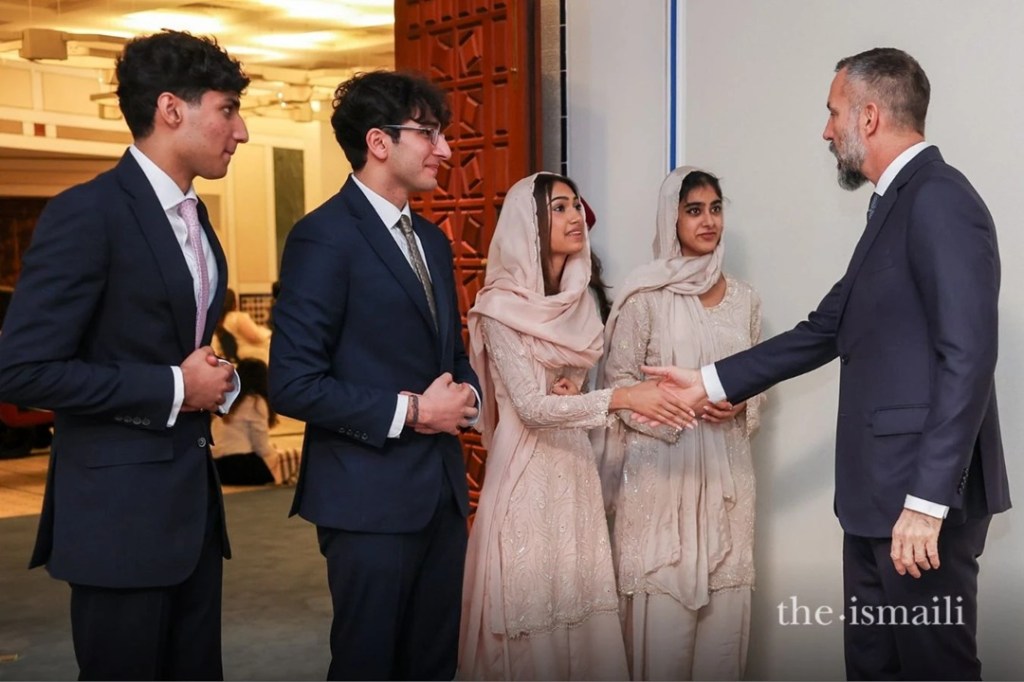
Mawlana Hazar Imam, His Highness the Aga Khan, being received by youth leaders at the Darkhana Jamatkhana, London, February 2, 2026. Please click on the photo for UK visit details.
The UK visit in summary:
On Thursday, February 5, 2026, Mawlana Hazar Imam concluded his five-day visit to the United Kingdom with a meeting with the Prince of Wales.
On February 4, His Majesty King Charles III hosted a dinner in his honour at Windsor Castle, inspiring pride among community members worldwide. The UK and global Ismaili communities celebrated the first anniversary of Hazar Imam’s leadership on the same day. Earlier during the day, he met the British Prime Minister at 10 Downing Street and signed a Memorandum of Understanding with the UK Foreign Secretary Yvette Cooper.
On February 3, Mawlana Hazar Imam met with the Mayor of London, then graced members of the Ismaili community with a Didar at ExCel Centre, before meeting with multi-faith families.
On February 2, he bestowed the Didar on Ismaili youth in two separate sessions at the Darkhana Jamatkhana in London. He had arrived in London on Sunday, February 1, 2026.
Inna lillahi wa inna ilayhi raji’un “Surely we belong to God and to Him we return” — Holy Qur’an, 2:156
“Life is a great and noble calling, not a mean and grovelling thing to be shuffled through as best as we can but a lofty and exalted destiny.” — Mawlana Sultan Mahomed Shah, His Highness the Aga Khan III (1877-1957), 48th Imam of the Shia Imami Ismaili Muslims.
Raisaheba Sakina Allibhoy Mahomed (1927 – 2026) pictured on January 25, 2025, on her 98th birthday. Photograph: Abdulmahomed Alibhoy Mahomed Family Collection, Madrid.
It is with deep sadness that I share the news of the passing of my beloved aunt, Raisaheba Sakina Allibhoy Mahomed (nee Ali Prados), in Madrid, Spain, on Saturday, January 10, 2026, two weeks before her 99th birthday. She is survived by her four children, AbdulSultan, Gulam, Yasmin and Shamsah; grandchildren Jan Rashid, Omar, Yasmin, Nizar, Rebeca Laila, Gabriel Aziz, David Ali and Hana; sister Gulbanu Ali Prados; and brother Khanmahomed Ali Prados. Sakina was the granddaughter of the esteemed Ismaili missionary Jamal Meghji Mukhi and the daughter of Ashad Ali Haji, both of whom reflected her notable lineage. Her funeral will take place on Friday, January 16, at the Imaili Centre in Lisbon, starting at 1:30 PM local time.
Sakina aunty died of old age, yet her ability to communicate with her family members until her last day highlights her enduring resilience, strength and courage. I personally spoke to her just a few weeks ago, when I discussed my visit to Houston for the opening of the Ismaili Center by Mawlana Hazar Imam, His Highness the Aga Khan, on November 6, 2025.
Regular readers of this website may have watched with great interest a YouTube video presented by the Ismaili a few years ago that familiarized our viewers with the history of the Spanish Jamat and its first settlement in Spain in 1914. This narrative is missing when discussing recent Ismaili migrations to Europe in the 20th century. Sakina Aunty, who was 93 when I first posted the film in 2020, introduced the film with great insight, wisdom, and passion, and one quickly realizes her immense faith and love for the Imam-of-the-Time, Mawlana Shah Karim, whose leadership continues to inspire us all. Of course, the news of his passing on February 4, 2025, was received by her with deep sadness, yet she found comfort in Mawlana Shah Rahim Hazar Imam’s pronouncement as the 50th Imam, which touched her deeply. Her wish to travel from Madrid to Lisbon for the recent Didar did not materialize due to mobility issues. Still, she was deeply gratified and touched that her son, Gulam, and daughter, Yasmin, were able to present themselves before Mawlana Hazar Imam on behalf of the Madrid Jamat.
Story continues below
Must Watch YouTube Video on Jamat in Spain
As the YouTube story goes, Sakina Aunty, who was born in Madrid on January 25, 1927, accompanied her father, Ashad Ali Haji, to India in 1947. The trip lasted 3 months, and during this time she met my father Jehangir’s older brother, Abdulmahomed, whom she would marry 3 years later. They would spend the next 10 years in India, mainly in Kolkata (then Calcutta). The couple then lived in London, England, until the mid 1960’s before settling down with their four children — AbdulSultan, Yasmin, Gulammahomed and Shamsah — in Madrid.
While in London, my uncle Abdulmahomed served as Kamadiasaheb and Mukhisaheb of the Jamat at 5 Palace Gate. He and my father, Jehangir, both passed away six months apart, about 8 years ago. Apparently, because they used different surnames, many Jamati members do not know the family link — my uncle used the surname Allibhoy Mahomed, and my father used Merchant. Their father, Allibhoy Mohamed, manufactured leather goods and traded as a leather merchant, and I suspect that’s how I have Merchant as my surname.
Story continues below
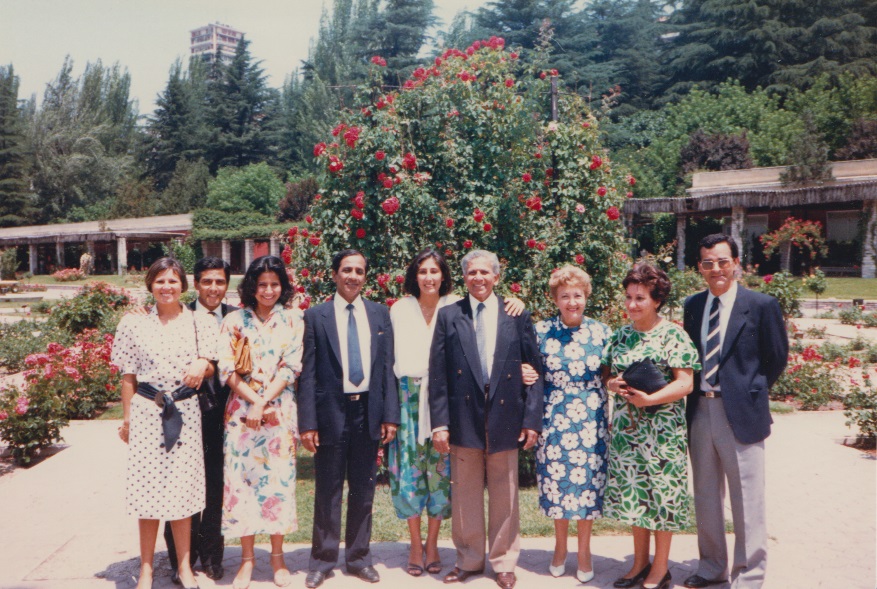
Photo taken in Madrid at the wedding of Gulammahomed (missing in photo). From left to right: Maria Jose, AbdulSultan, Yasmin, Jehangir Alibhai Merchant, Shamsah, Abdulmahomed Allibhoy Mahomed, Sakina Allibhoy Mahomed, Gulbanu and Felipe. Photo: Jehangir Merchant Family Collection.
~~~~~~~~
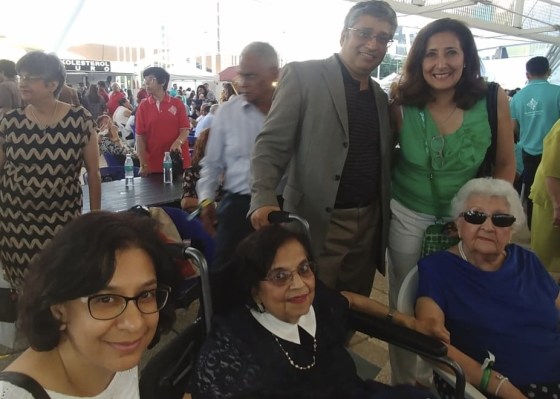
A Diamond Jubilee moment: Sakina Allibhoy Mahomed and Mrs. Merchant with Shamsah, Alnoor, Shellina and Shams (standing at left) at the Diamond Jubilee food court, Lisbon, July 2018. Photograph: Submitted by Feriyal Merchant.
~~~~~~~~
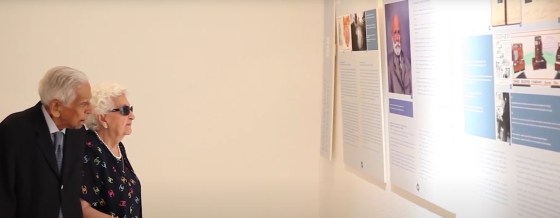
Sakina and her lifelong husband Abdulmahomed watch the Spanish Jamat exhibition hosted at the Ismaili Centre in Lisbon. Photograph: Still from the Ismaili video.
Over the past 50 years, I have had the privilege of meeting Sakina Aunty and my four cousins, as well as their families, several times. My family — my mother, Mrs. Merchant, my brother Alnoor and Shellina, and I — last met Sakina in Lisbon in July 2018, during Mawlana Shah Karim’s Diamond Jubilee visit. Abdulmahomed uncle is buried in Lisbon, and we joined the family at his burial site to pay our respects and pray for his soul, which always reminds me of our enduring family bonds.
Sakina aunty had a photographic memory, enabling her to recount every vital incident from her childhood onwards with precise detail. Once she began telling stories, you would want to keep listening. She accompanied her father and siblings to mulaqats with Mawlana Sultan Mahomed Shah. This blessing of mulaqats continued after Mawlana Shah Karim succeeded to the throne of Imamat in 1957. Incidents from these mulaqats are deeply touching in their own right, reminding us of our shared spiritual journey and connecting listeners to the ongoing legacy of the Imamat of Hazrat Ali. Some of these incidents, as articulated to me, highlight the continuity of the Imamat and the Imams as bearers of the same Noor (Light). Her stories changed how Jamati members felt about their faith.
Her exemplary service under three Imams, Mawlana Sultan Mahomed Shah, Mawlana Shah Karim and Mawlana Shah Rahim Hazar Imam, together with that of her late husband, is a strong pillar and a very important legacy for coming generations. It is impressive to think that of the 111 years of history of the Jamat of Spain, she was there for almost 99 of those years.
Sakina will be remembered by the Jamat in Spain with great affection for her kindness and generosity, which inspired feelings of gratitude and admiration. Her service to the Jamat and the Imam-of-the-Time exemplified her dedication, fostering a sense of respect and appreciation among community members and visitors alike.
Sakina Aunty’s children, who spent years with their beloved mum, will particularly miss her presence, and we pray for their courage and fortitude at this difficult time. We ask our readers to join us in praying for the peace of Raisaheba Sakina’s soul. Ameen.
Date posted: January 11, 2026. Last updated: January 15, 2026 (funeral date and time added).
_____________________
We invite our readers to express condolences and tributes to Rai Saheba Sakina Alibhoy Mahomed. Please click Leave a comment.
“Read and study the good religious and cultural educational materials which have been produced for the Jamats by our institutions: seek knowledge and understanding independently. Try to deepen your understanding of our history, our values and the principles of our faith” — Mawlana Hazar Imam, Shah Rahim al Hussaini, Paris, July 12, 2025.
Continuing in the tradition of the 49th Ismaili Imam, Mawlana Shah Karim Shah, His Late Highness Aga Khan IV, his successor Mawlana Hazar Imam Shah Rahim al Hussaini, His Highness the Aga Khan V — perhaps with even greater emphasis — has recommended to his followers in many of his Farmans (guidance) delivered in 2025 that they feel the presence of faith in their hearts and souls by calling on Allah, the Prophet, and the Names of the Imams at any time or place. I want to share my personal reflections on the importance of invoking the Names of our Imams and how understanding their lives can make our invocations more meaningful and satisfying.
One day, after visiting my dad at his nursing home in the morning, I decided to walk back about 30 minutes to my mum’s home, leaving the car in the garage until my next visit to my dad later in the evening. This time, during the peaceful walk, instead of invoking Allah, the Prophet, Mawlana Shah Karim — then Imam-of-the-Time — or Hazrat Ali, I chose to remember each of the forty-nine — now 50 — Imams by repeating their names in succession, a few times each, until I reached home.
The walk through the greenery in Burnaby, Canada, with its beautiful flowers and plants in residential gardens, and the calling out of the Imams’ names, gave me immense spiritual satisfaction and happiness. I realized, however, that when I remembered the Imams whose histories I knew — even in part — a vital incident from their lives would invariably pop into my mind, even for a second or two. But what about other historical Imams I knew very little about? While all Imams are bearers of the Noor of Imamat, which transcends space and time, I could not connect with the Imams as much as I did with others whose histories I knew.
Historical knowledge also connected me with outstanding Ismailis who served the Imam-of-the-Time and the Jamat (community) with zeal, devotion, and, in many cases, extraordinary gallantry and bravery. Of course, striking my mind were also individuals, groups, and caliphates who were archenemies of the Jamat and the Imamat, and those who had broken their pledges with the Imam-of-the-Time and often misled the Jamat. Literally, a second or two can bring significant historical incidents before you! And this is where a book such as Farhad Daftary’s The Ismaili Imams has become, for me, a valuable resource over the last few years for learning about our Imams.
Story continues below
Cover page of The Ismaili Imams: A Biographical History by Farhad Daftary, Hardback, 260 pp., published October 2020, I.B.Tauris in association with the Institute of Ismaili Studies.
For many in the Jamat who do not read regularly or at all, I wish to remind them of Mawlana Hazar Imam’s recent guidance on reading. He said, “Get into the habit of putting down your phone and picking up a book. You will find it broadens the mind and provides a respite from our frenzied lives and can help relax.” (Paris, Youth Mulaqat, July 13, 2025, page 19, Farman Mubarak book distributed in Canada). Picking up a book such as the History of Ismaili Imams will help us understand our roots and follow the lives and teachings of the Imams more closely.
And Mawlana Hazar Imam has mentioned that reading “can help relax.” How? As a brief side note, my doctor’s concern that I could be suffering from sleep apnea prompted him to set me up for an appointment with an expert on the issue. When he learned about my late-night habits and the time I spent on my websites before bed, he advised me to stop using electronic devices at least 45 minutes before bed and to read during that time! This change has made a noticeable difference. It has helped me immensely. Following the advice, I am totally relaxed after reading. I’m asleep in a few moments for the rest of the night!
There are countless articles on the importance of reading in-print books rather than reading online, and my point here is to instill the habit of reading in our lives and to inspire our children, because sharing this joy can motivate others to start their own reading journey. I frequent the beautiful Canadian mega bookshop Chapters/Indigo quite often, and my heart danced with delight when, during the recent Thanksgiving sales promotion, I saw a 4-year-old pushing a cart of children’s books his mother had bought for him, excitedly heading to the cashier!
For avid readers, I encourage you to heed Mawlana Hazar Imam’s call to engage with our history. He said: “…. read and study the good religious and cultural educational materials which have been produced for the Jamats by our institutions: seek knowledge and understanding independently. Try to deepen your understanding of our history, our values and the principles of our faith” — Paris Didar, July 12, 2025.
Story continues below
Stories of the Ismaili Imams launched by the.ismaili, official website of the Ismaili Muslim community.
While I was finishing this piece, with Daftary’s History of the Imams in mind, I learned that the Ismaili website has launched a series titled “Stories of Ismaili Imams” under the Faith and Tradition category available in textual form and YouTube video. This is an excellent initiative.
However, I am a little disappointed with the level of detail provided. I am also concerned about the defensive approach the series has taken regarding the lives of a few Imams, and, as an example, I specifically take up the case of Imam Nizar, who succeeded the Fatimid Imam al-Mustansir bi’llah by his Nass. He was the rightful successor, and Hassan bin Sabah ensured that the Imamat continued as per Imam al-Mustansir bi’llah’s instructions, with Mawlana Nizar and subsequently in the fortresses of Iran. Rashid al-Din Sinan was a key Ismaili figure in Syria, supporting the Ismaili Imams who succeeded Imam Nizar. The statement, “the most prominent supporter of Imam Nizar’s claim to Imamat was the da‘i Hasan-i Sabbah,” is weak and, from an Ismaili perspective, is a defensive (and apologetic) response to the Nizari Ismaili belief that Imam Nizar was the rightful and appointed heir to his late father.
To enhance the series and tell the stories of the rest of the Imams, I reference an excellent book, The Presidents of the United States of America (see photo below), which I acquired more than a decade ago in Rapid City, South Dakota, known for its life-sized statues of U.S. presidents. Along with its current abbreviated online version titled ‘The Presidents: Biography and Portraits,’ it can serve as a model for both the online series and a future printed publication. The online portraits of the US presidents, shorter than portraits in the print version and though very concise — each president is described in much less than 1000 words — George Washington: 875 words, Lincoln: 718, Kennedy: 570, Obama: 660, Carter: 577, etc. — are informative, well-written, and engaging. In contrast, the online portrait of Hazrat Ali, for example, is covered in only 260 words, that of Imam Jafar al-Sadiq, 218 words, etc. The presidential stories stay in your mind! More detailed portraits of Imams can make the series more informative and valuable for readers. I think the Institute of Ismaili Studies (IIS) in London has access to scholars and hundreds of alumni who can write inspiring stories of Ismaili Imams. Collaboration with these experts can ensure the series is well-prepared and meaningful!
Story continues below
Front cover, The Presidents of the United States of America, by Michael Beschloss and Hugh Sidey, Foreword by Barack Obama, published by The White House Historical Association, 2009, pp. 97.
~~~~~~~~
Barack Obama profiled in the print edition of The Presidents of the United States of America. The former president’s condensed online profile is 660 words long yet covers key historical moments from his life and his US leadership.
Whether online or in print, spending a few moments, say 4-8 minutes, reading a 500-700-word narrative every few days will stir our minds, hearts and souls even more as we invoke the names of our Imams. That common thread of the Noor of Imamat that binds all murids together will become even stronger as we read the stories of the Imams, their maternal and paternal care for the Jamat of the time, and the Jamat’s devotion to the Imams and to the community. A richer, more detailed portrait of the Imams will introduce us to outstanding individuals who served the Jamat and the Imam-of-the-Time with seriousness. Again, I repeat, there are plenty of scholarly resources within the IIS and Ismaili institutions to enhance the Ismaili Imam series and make it more engaging and informative.
Story continues below
Details of the literary night program introduced in Ottawa by the Ottawa Library Committee during the Golden Jubilee of Mawlana Shah Karim, His Late Highness Aga Khan IV, are shared here. Children from senior kindergarten to Grade 12 selected unique readings from over 200 pieces on all aspects of Islam and Ismaili history, with most readings lasting 1 to 3 minutes. Although the program created great interest, it was not continued in subsequent years because, as the author was told, “it takes up too much time.” Click HERE or on the image for a PDF version of the program.
Hopefully, the Ismaili Tariqah and Religious Education Boards (ITREB) and Jamati institutions in Canada and around the world will strengthen their library systems despite potential resource constraints by leveraging existing assets, seeking support, and launching programs to inspire reading. Many libraries across Canada, including in large centres like Calgary, have been closed for years, as was the one in Ottawa for 7-8 years.
“Get into the habit of putting down your phone and picking up a book,” as Mawlana Hazar Imam said recently, is a motto we should adopt in 2026. Creating annual reading weeks, to coincide with the country’s or world’s annual reading week, and engaging informed college students, youth, and professionals in the library and literature counters to advise on good reading material are necessary steps to awaken the Jamat at all levels to become more engaged with their faith and its beauty and history. Asking young children and youth to come to the stage with a book or two, to read inspiring anecdotes from the book and tell the Jamat that the book is available in the library, or to prepare and deliver short waezes (sermons) with the help of their teachers are ways to motivate reading.
The Ismaili Canada, print edition, December 2011, 80 pages. The complete print edition was discontinued and replaced with an abbreviated version, which was then folded about two years ago.
I’m also truly worried about how our print publications have declined and folded, and I hope community leaders understand just how important they are for our cultural identity, within and outside the community, and that they are revived. The full-sized magazine, The Ismaili Canada (see photograph, above), USA, U.K., etc., which was such a joy to own and read, was cut by over 70% a few years back, and the smaller version was discontinued 2-3 years ago. Maybe there was no interest in reading these beautiful magazines. But why?
Since I arrived in Canada 45 years ago, there’s been no strong program to encourage reading among our community members. Recently, I even suggested that each youth have their own copy of the Farman books of Mawlana Hazar Imam, but I was told that interested youth can request a copy; that’s quite different from inviting them and giving them the privilege and opportunity of owning and having easy access to their own, just as Mawlana Hazar Imam gifted each Jamati member with a Tasbih during his visits to France, Kenya, Uganda, the USA and Portugal. By making the youth and professionals owners of their own Farman books, carrying them in their school bags and briefcases, or at their desks at home or work, I would expect them to read at any time, rather than seeking to access a single Farman book at home, often not easily accessible or misplaced!
I also encourage institutional leaders, those in charge of libraries and literature counters, to visit bookshops and magazine sections — they’ll see the incredible interest in books these days. Printed magazines are more abundant than ever! Let’s help our youth develop a love for reading; it’s a powerful way to strengthen our community’s future. And institutions, let’s not leave this just to parents — let’s create inspiring programs that motivate everyone to read more. Again, I say, there have been no reading programs in Canada for decades.
Whether ITREB and other Jamati leaders will follow up on these fine suggestions, which were humbly submitted to the leadership some time back, is another matter altogether. But for now, please read Daftary’s History of Ismaili Imams or visit the Ismaili Imams’ abbreviated stories online. The invocation of the Names of the Imams with some background in mind will make our engagements with the historical Imams more meaningful.
Date posted: January 10, 2026.
Note: A version of this post appears on Simerg’s sister website Barakah.
_________________
Simerg values your feedback on the pieces it publishes. Please click HERE to leave a comment. It has two sister websites: Barakah is dedicated to Mawlana Hazar Imam, His Highness the Aga Khan, members of his family and the Ismaili Imamat; Simerphotos is an exciting travelogue about art, culture, and nature. You can stay updated by following Malik on @Instagram, @Facebook, @X and @LinkedIn.
Simerg’s vast array of articles is summarized in the Table of Contents 2009-2019 and 2020-Current.
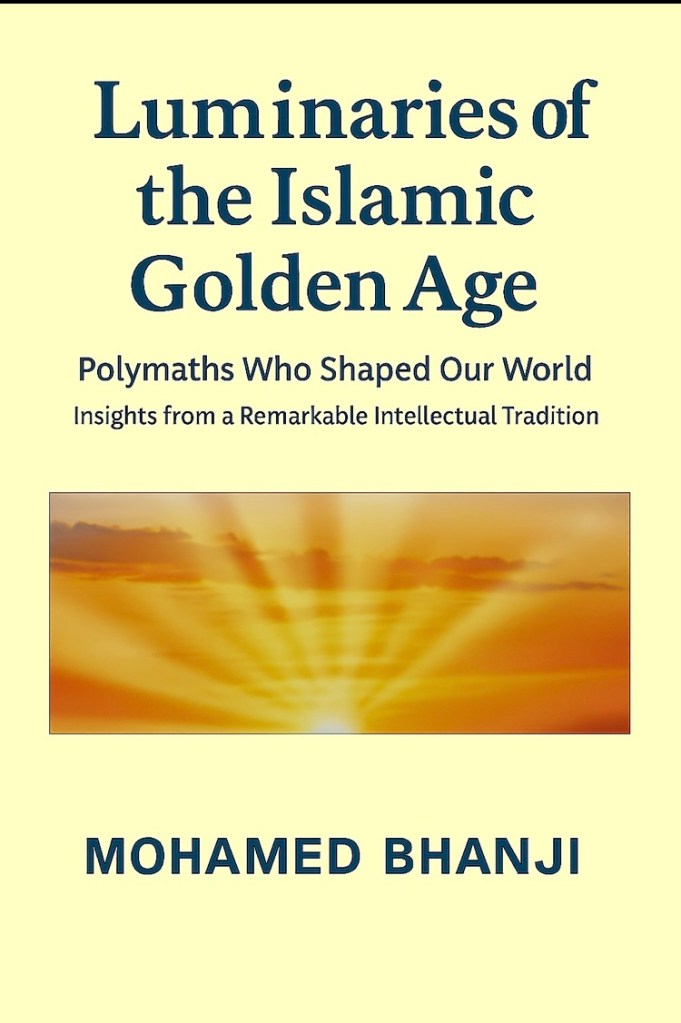
Simerg’s series on “Books by Ismaili Authors” continues with Mohamed Bhanji’s highly educational and informative “Luminaries of the Islamic Golden Age,” published as an e-book in 2025. We value the insights of Ismaili authors worldwide and invite you to share your work in this ongoing series by submitting responses to our questions — please see the details HERE. For any queries, please email Malik at mmerchant@simerg.com.
____________
Simerg: What is behind the naming of the title Luminaries of the Islamic Golden Age?
Mohamed Bhanji: The title emphasizes the brilliance of Muslim scholars as luminaries who sharpened the cutting edge of knowledge during the Islamic Golden Age — a period when science, philosophy, and culture flourished, laying the foundations for our modern world.
Simerg: Why would you want me or my family members to read the book and what will we learn?
Bhanji: The e-book reconnects readers with nearly thirty luminaries of the Islamic Golden Age, offering insights into a remarkable intellectual tradition.
Families will discover how these polymaths advanced knowledge — and why their lessons in curiosity, resilience, and ethics remain timeless and profoundly relevant in the age of AI.
~~~~~~~~
“This e-book is a curated synthesis of a series of posts I originally shared on LinkedIn, thoughtfully expanded with appropriate content from additional sources. My hope is that it offers a window into a rich and too-often-forgotten intellectual tradition — and that it helps lift the veil on what Aga Khan IV called “this amnesia [that] has left a six hundred-year gap in the history of human thought.” — Mohamed Bhanji, author of Luminaries of the Islamic Golden Age.
Luminaries of the Islamic Golden Age by Mohamed Bhanji, 82 pages, self-published as an ebook, 2025. Click on the image to download it for free as a PDF file.
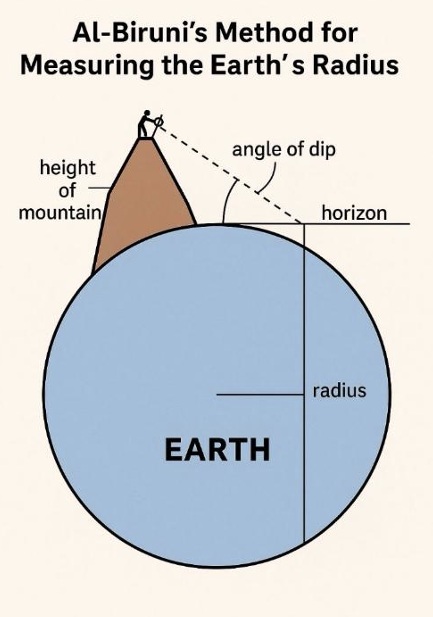
How did Al-Biruni (773-1050) calculate the Earth’s diameter?
He climbed a tall mountain (most likely in present-day Pakistan).
He measured the angle of the dip of the horizon from the peak using an astrolabe.
Knowing the height of the mountain and the angle, he applied trigonometric formulas to estimate the Earth’s radius.
Story continues below
Al-Biruni’s results:
He estimated Earth’s radius to be about 6,339.6 km, which is very close to the modern value of about 6,371 km.
That gives a diameter of approximately 12,679 km, again impressively close to the modern value of 12,742 km.
Significance:
Al-Biruni’s method did not require knowledge of the Earth’s full circumference or travel between distant locations.
His use of pure geometry and careful observation was incredibly innovative for the time.
~~~~~~~~
Simerg: What inspired you to write the book?
Bhanji: Mawlana Shah Karim, His Late Highness Aga Khan IV, insightfully observed:
“The Islamic field of thought and knowledge included and added to much of the information on which all civilizations are founded. And yet this fact is seldom acknowledged today, be it in the West or in the Muslim world, and this amnesia has left a six-hundred-year gap in the history of human thought.”
These words inspired me to embark on a journey into the rich yet often forgotten history of the Muslim intellectual tradition.
Simerg: How can one purchase the book or access it?
Bhanji: Readers can read it for free online as a flipbook at bit.ly/liga-ebook or download it for free as a PDF file HERE.
Date posted: January 6, 2026.
______________
Mohamed Bhanji is a volunteer educator/tour guide at the Aga Khan Museum in Toronto, with a passion for sharing stories about the artistic, intellectual, and scientific contributions of Muslim civilizations to our shared world heritage. Bhanji leads visitors through the Museum’s architectural design and permanent collection of Islamic Art, emphasizing the significance of Islamic architecture. Previously, Bhanji served as Special Advisor to the Chief Commercial Officer at VIA Rail Canada from February 1984 to September 2021, leading strategic initiatives, including the Traveller Touch-Points Transformation program, and establishing partnerships in the travel sector. Academic credentials include a Master’s degree and a Bachelor’s degree in Chemical Engineering from Loughborough University, England.
~~~~~~~~~
Links to the Ismaili Authors’ Series (in chronological sequence, oldest article first)
Before departing this website please take a moment to review Simerg’s Table of Contents for links to hundreds of thought provoking pieces on a vast array of subjects including faith and culture, history and philosophy, and arts and letters to name a few. Also visit Simerg’s sister websites Barakah, dedicated to His Highness the Aga Khan, and Simergphotos. Simerg’s editor Malik Merchant may be reached via email at mmerchant@simerg.com. You can also stay updated by following Malik on Facebook, X, and LinkedIn.
Mawlana Hazar Imam, His Highness the Aga Khan, with his children Prince Sinan Aga Khan (left, born January 2, 2018), and Prince Irfan (born, April 11, 2015)
For stories about Hazrat Ali, Prince Sinan Aga Khan and the Aga Khan’s forthcoming visit to the U.K., please click HERE
On New Year’s Day, January 1, which coincided with 13th Rajab in the Muslim lunar calendar, Ismailis worldwide gathered in Jamatkhanas to honour the birth anniversary of Hazrat Ali (Peace be upon him). This annual celebration reinforces their deep connection to the first Imam and the Hereditary Institution of Imamat, a core part of the Shia Ismaili Muslim faith, helping the community feel spiritually rooted. The occasion also featured a Talika, a holy written message, from Mawlana Hazar Imam, His Highness the Aga Khan, the 50th Imam in direct succession to Mawlana Ali, announcing his upcoming visits to the UK and Germany in February. In his Talika, Mawlana Hazar Imam also conveyed his blessings that 2026 would bring happiness, peace and good health to the Jamat. On January 2, his younger son, Prince Sinan Aga Khan, turned nine.
Please read these stories on our sister website Barakah, which is dedicated to His Highness the Aga Khan, members of his family and the Ismaili Imamat.
My beloved daughter, Farah, sadly passed away on December 17, 2025, at the age of 57. As a creative writer and storyteller, she contributed several pieces to Simerg and its sister website Barakah, one of which elicited a response from Mawlana Hazar Imam, His Highness the Aga Khan, then Prince Rahim.
Farah’s arduous personal journey over the past 27 years was intertwined in 2025 with the profound events of the Ismaili Imamat — the passing of Mawlana Shah Karim and the succession of Mawlana Shah Rahim Hazar Imam — both of which are central to the community’s modern history.
Rashida Tejani with her daughter, Farah, who passed away in Vancouver on December 17, 2025, aged 57. Photograph: Rashia Tejani Collection.
~~~~~~~~
Farah Tejani (d. December 17, 2025) with her younger brother Faizal, 50. Photograph: Rashida Tejani Collection.
For Farah, the most significant shock in her life was the loss of our beloved 49th Imam, Mawlana Shah Karim, on February 4, 2025. I vividly recall breaking the news of his passing over the phone. It tore her heart, and I can’t express the shock she felt or the depth of her grief until the announcement the following day that Prince Rahim was the new Mawlana Hazar Imam of the Ismailis. As the new Imam took over the reins and marked his Takht-nishini a week later, her emotions began to settle, and she penned a tribute to Mawlana Shah Karim while reflecting on the eternal rope of Imamat, whose new holder was Mawlana Hazar Imam.
Mawlana Shah Karim, His Late Highness Aga Khan IV (d. February 4, 2025, aged 88) and his successor Mawlana Hazar Imam, His Highness Prince Rahim Aga Khan.
This tribute — the piece below — was Farah’s last story, shaped by the tragic event of the 49th Imam’s passing and the succession of the 50th Imam. With the piece, she scanned several photos of Mawlana Shah Karim from Gary Otte’s pictorial biography, “Depth of Field: The Aga Khan Beyond the Lens,” and, in two images, she wrote her own touching reflections on the late Imam. I am gratified that the editor of Barakah is publishing this piece by her before 2025 ends. It is a fitting conclusion to her series of articles published on this inspiring platform.
For me, as for any other parent, the death of my beloved daughter has been the most hurtful episode in my life. I ask you to join me in praying for the eternal peace of my daughter, and for my courage and fortitude to bear her loss. I also invite you to read Simerg’s tribute to Farah published on December 19.
~~~~~~~~~
Reflections on Mawlana Shah Karim and Mawlana Hazar Imam
Mawlana Hazar Imam, His Highness the Aga Khan, the 50th Hereditary Imam of the Ismaili Muslims, addressing Ismailis worldwide on his Takht-nishini (ceremonial installation) held at the Diwan of Imamat, the Seat of the Ismaili Imamat, in Lisbon, Portugal, February 11, 2025. Photograph: AKDN.
By FARAH TEJANI
As I begin this piece, I humbly say to my 50th Imam, Mawlana Hazar Imam Shah Rahim al Hussaini: I hold fast to the Rope of Imamat and offer my devotion and allegiance to you.
The moment I learned that my Mawlana Shah Karim, His Late Highness Aga Khan IV, had passed away, my heart was pierced with profound grief and a sense of tragic loss. I remember my mom calling me on the phone and saying with a sense of urgency, “Farah, I have some very tragic news.” I immediately called out the name of one family member after another, to which she would sob and say, “No! Way Worse!”
She did not want to torture me anymore; she just wanted to somehow prepare me. But there was no way to prepare for this. “WHO?!?” I demanded. She blurted out, “Mawla Bapa!” The news struck me with awe, like a thunderclap, shattering the peace of my world. Mawlana Shah Karim’s face of Pure Nurani Light filled the inside of my eyelids. I responded “NNNNOOOOOOOOOOOOOO!!!!!!!!”
Story continues below
Mawlana Shah Karim, His Late Highness Aga Khan IV, at work in the office at his residence, Gstaad, Switzerland, 1963. Photograph: Depth of Field: The Aga Khan Beyond the Lens, ed. by Gary Otte, page 112. Farah Tejani submitted this photo for publication, sharing a personal message to encourage her readers to write, just as Mawlana Shah Karim does in this historic image.
~~~~~~~~
Mawlana Shah Karim His Late Highness Aga Khan IV, in the start area for a giant slalom ski race that prepared him for participation in the 1964 Winter Olympics in Innsbruck, Austria. Photograph: Depth of Field: The Aga Khan Beyond the Lens, ed. by Gary Otte, page 81.
I saw his face again. And then I saw pictures of him from my copy of “Depth of Field: The Aga Khan Beyond the Lens”: The one of him working intently at his desk at his residence. Then, the black-and-white photo of him competing in downhill skiing in preparation for the Olympics, to represent Iran. Then, the iconic one of him greeting to his Jamat, with a big smile and waving lovingly for all His Beloved Spiritual Children to see. Then, focusing on a view from the Great Wall of China. Then giving a mulaqat to his spiritual children in Bartang, Tajikistan, amidst the Pamir mountains under blue skies. Then, standing in front of the entire House of Commons in the Canadian Parliament, humbly, after giving a powerful speech and being met with a unanimous standing ovation. These pictures and moments connect him with us, his community, and his Imamat at different times. There are countless faces of him at so many ages, and there are so many meaningful expressions of hope, discipline, determination, celebration, deep thought, peaceful divinity, and inner joy. So many expressions.
Story continues below
Mawlana Shah Karim, His Late Highness Aga Khan IV, addresses his community and others present during a mulaqat in Bartang, Tajikistan, September 1998. Photograph: Depth of Field: The Aga Khan Beyond the Lens, ed. by Gary Otte, page 112. Farah Tejani submitted this photograph, expressing her grief over Mawlana Shah Karim’s passing, with a prayer and a teary eye, in her own writing.
My heart could not take it. I felt lonely in my studio apartment, and tears filled my eyes as I envisioned him, with his gentle, loving, tender hands that had touched and blessed millions of people all over the world. The world at large was grieving the loss of one of the most significant humanitarians on this globe today, who put the needs of the impoverished, economically downtrodden and educationally unfortunate at the forefront. As the Founder and Chair of the Aga Khan Development Network, the Aga Khan University, the University of Central Asia, Aga Khan Hospitals, and hundreds of Aga Khan Schools, their impact was felt across the globe.
I will never forget my travels to East African Aga Khan Schools in Nairobi, Kisumu, Mombasa and Tanzania in 1992, with 26 other Ismaili youth. We were all armed with a Bachelor’s Degree in one of the areas of service, such as English, Education, Science, Algebra, or any of the other core subjects. I distinctly remember the Aga Khan, my spiritual father, encouraging me to question, take time, offer our service in an area not as fortunate, and study the Aga Khan Schools and Institutions to see what it is all really about. His words of wisdom and encouragement continue to inspire and motivate me to this day. I even went to Mawlana Sultan Mahomed Shah’s burial site in Aswan, and along with 26 others, we were graciously permitted to enter the Mausoleum and see the long-stem red rose that Begum Aga Khan, Om Habiba (Mata Salamat), arranged to have placed daily on her late husband’s coffin.
Story continues below
Mawlana Shah Karim, His Late Highness Aga Khan IV, focuses on a view from on top of the Great Wall of China during a tour that was part of the Aga Khan Award for Architecture International Seminar, October 1981. Photograph: * Depth of Field: The Aga Khan Beyond the Lens, ed. by Gary Otte, page 125.
~~~~~~~~
Mawlana Shah Karim, His Late Highness Aga Khan IV, acknowledging volunteers as he leaves a ceremony at Dar es Salaam’s Darkhana, Tanzania’s main Jamatkhana, July 2011. Photograph: Depth of Field: The Aga Khan Beyond the Lens, ed. by Gary Otte, page 167.
~~~~~~~~
Mawlana Shah Karim, His Late Highness Aga Khan IV, receives a standing ovation during his speech to a joint session of the Canadian House of Commons and the Senate in the Parliament Building in Ottawa, February 27, 2014. Photograph: Depth of Field: The Aga Khan Beyond the Lens, ed. by Gary Otte, pages 100-101, a two-page spread.
I was also fortunate enough to work at the Aga Khan University and the Institute for Educational Development in Karachi, Pakistan, thanks to a cousin who sent me a detailed day-to-day itinerary for the entire month of 1997. I was grateful to have received a few job offers, but my true heart’s desire was to serve in one of the Aga Khan Schools in East Africa, where I was born and had already visited in 1992. Nevertheless, I will never forget the sense of awe, absolute inspiration, and wonder I felt when I first saw the beautiful pink marble university with students going from here to there with so much pride in holding their textbooks and knapsacks. The Aga Khan University was poetically beautiful and architecturally designed, and even had courtyards that were non-discriminatory, with benches where you would see less fortunate people sleeping. With gardeners who would give their time to keep up the meticulous landscaping, I was always thinking about my Mawlana Shah Karim.
February 4th, 2025, will always be a sombre day for everyone around the world. For 67 years, Mawlana Shah Karim devoted his life to health, education, rural development, economic growth, institution-building, and enhancing the quality of life. Due to his spiritual and material guidance, Ismailis are settled in the countries in which we live. At the same time, he has shown deep concern for his Jamats, who are poverty-stricken, and has been asking his institutions, for as long as I can remember, to assist them in overcoming their plight.
The resting place for Mawlana Shah Karim was in Aswan, in the same mausoleum as his grandfather, Shah Sultan Mohammed Shah, Aga Khan III. Mourners and especially his family were grief-stricken but poised and gracious under the circumstances.
We are so blessed and fortunate to have the Rope of Imamat to hold on to for over 1,400 years of unbroken Hereditary Imamat. The auspicious occasion of the Takht-nishini (ceremonial installation) on February 11, when the Oath of Allegiance (Baya’h) was given to the 50th Imam, Mawlana Shah Rahim, took place at the Diwan of the Ismaili Imamat in Lisbon. At this moment, our community stood united, filled with joy and anticipation for our new Present Living Imam’s guidance and love despite the grief of losing our Beloved Shah Karim.
The momentous ceremony moved many to tears of joy and hope, especially the first Farman made by Mawlana Shah Rahim, when he also reflected on his father’s Imamat. The significance and meaning of his poignant, solemn, sensitive, timely, authoritative words were so powerful, endearing and comforting. The Farman was detailed and covered subjects like pluralism, diversity, world peace and order, climate control, taking care of the less fortunate, volunteerism and his solemn vow and commitment to the protection and security of his global Ismaili Jamat. Every youth in the community should seek to read the Farman, as official printed copies are now available.
Ismailis truly are very blessed. The Divine and Sublime beauty of it all is that I feel Shah Karim’s eternal ever-lasting presence in his son, Mawlana Shah Rahim. Shah Karim always promised us that he would never leave us: “Always remember…I am always with you,” he would often tell us, whether he was physically around us. Throughout the Takht-nishini ceremony, I felt his genuine promise come true. I felt this through the same Nur vested in the Rope of Imamat from the time of Hazrat Ali (A.S.) I hear his words echoing in my head. And now they are Mawlana Rahim’s words. He even went on to say, “If you have any worries and concerns, then turn to your Imam.” These are powerful soothing words full of comfort and inspiration.
Story continues below
The students Mukhi and Kamadia from Belgium, and Mukhiani and Kamadiani from Switzerland — who serve as congregational leaders in periodic Jamatkhana student gatherings — welcome Mawlana Hazar Imam, His Highness the Aga Khan, to the youth mulaqat (meeting) in Paris, France, July 12, 2025. Photograph: IPL / Akbar Hakim.
Glory Be to Allah, and All Praise Goes to Allah, the Lord of All Worlds. Mashallah. Ya Hazar Imam, Oh Mawlana Shah Rahim, bless us with your Wisdom, your Experience, your Nurani Deedar, your Holy Blessed Guidance, Spiritually and Materially and your Divine and Physical Protection from any ill fate or disposition. Ameen.
I feel secure in the knowledge that our faith will be practiced and interpreted as it should be by the Nass that Shah Karim conferred to Him as Imam-of-the-Time, and by the Nur that he is carrying with him from the very moment of Shah Karim’s passing.
With no doubt in my mind, heart and soul, I have complete faith in Mawlana Shah Rahim, and I feel so Physically and Divinely protected by our beloved 50th Imam just as I did by his father, Mawlana Shah Karim Aga Khan IV.
Date posted: December 31, 2025.
A version of this post appears on Simerg’s sister website Barakah, which is dedicated to His Highness the Aga Khan.
Inna lillahi wa inna ilayhi raji’un “Surely we belong to God, and to Him we return” — Holy Qur’an, 2:156
“Life is a great and noble calling, not a mean and grovelling thing to be shuffled through as best as we can, but a lofty and exalted destiny.” — Mawlana Sultan Mahomed Shah, His Highness the Aga Khan III (1877-1957), 48th Ismaili Imam.
***
A TRIBUTE TO AHAMED ISMAIL (1942 – 2025)
Prepared by MALIK MERCHANT (The family of AHAMED ISMAIL and FAROUK VERJEE contributed to the tribute)
It is with deep sadness that we announce the passing of Ahamed Ismail of Vancouver, Canada, on December 5, 2025, at age 83. He is survived by his wife, Nasim; his son, Aly, and his wife, Sarah; his daughter, Feyzi, and his grandchildren, Adam, Alysa, and Latifa.
Ahamed was born on March 8, 1942, and grew up in Musoma, Tanzania. In 1956, he moved to Dar es Salaam for further studies. A defining moment during this period came when his religious education teacher, Karim Master, selected him to recite Qur’anic verses before Mawlana Shah Karim during the Imam’s second visit to Dar es Salaam in 1957, the first being for his ceremonial installation (Takht-nishini).
Ahamed Ismail is seen reciting Qur’anic verses during the opening of the Aga Khan School in Dar es Salaam, Tanzania, with the school’s patron, Mawlana Shah Karim, His Late Highness Aga Khan IV, standing next to him. Photograph: Ahamed Ismail Family Collection. Click HERE for the story.
This event was a profoundly meaningful and happy moment in Ahamed’s life. When he shared his inspiring story with the editor, Malik Merchant, during their meeting in Vancouver, it left a lasting memory on him. Malik’s rich memory of Ahamed is that of a devout murid of the Imam-of-the-Time, demonstrating purity of heart and thought, and being very humble and sincere.
Upon completing his studies, Ahamed returned to Musoma, where he pursued a career in banking. He was then promoted and transferred to Dar es Salaam, where he married Nasim in 1970 in the presence of Mawlana Shah Karim.
In June 1972, Ahamed moved with his wife to Vancouver, where the Ismaili population was only 50 people at the time. Immigrants faced many challenges finding suitable jobs, but with his background in banking and a sound secondary education, Ahamed was able to secure a job with CIBC within a month and progressed in the banking industry to become the branch manager of Van City’s main branch, the largest credit union in Vancouver, where one of his roles was to approve mortgages. Highly regarded by his community, he was sought out for advice on financial and mortgage matters.
Ahamed Ismail and his wife, Nasim, with their children, Aly and Feyzi, in a photo taken in the 1980s. Photograph: Ahamad Ismail Family.
Seeing the potential of Ahamed as a highly motivated and talented individual who could serve the Ismaili community well in an administrative capacity, the newly appointed President of the Aga Khan Council for Canada, Farouk Verjee, and the Hon. Secretary, Bashir Jaffer, enlisted Ahamed into the Council for Canada, which at the time was headquartered in Vancouver. Ahamed did excellent work in his position under the Council’s inspiring leadership. Unassuming in his role, Ahamed played a vital role in the construction and opening phases of the Ismaili Centre in Burnaby. His dedication and efforts were instrumental in preparing for the momentous historic opening ceremony on August 23, 1985, which was graced by Prime Minister Brian Mulroney and Mawlana Shah Karim. The same evening, Mawlana Shah Karim declared to the delight of the Jamath of some 20,000 at BC Place that it would henceforth be the Darkhana — the chief among all Jamatkhanas — of Canada.
Story continues below
Ahamed Ismail (in beard) is seen following Mawlana Shah Karim, His Late Highness Aga Khan IV, accompanied by Princess Salimah, after he arrives in Vancouver for the historic opening ceremony of the Ismaili Centre, Vancouver, in August 1985. Farouk Verjee, the President of the Aga Khan Council for Canada, is seen walking beside Mawlana Shah Karim at left. Photograph: Farouk Verjee Collection.
When Mawlana Shah Karim was departing Vancouver, President Farouk Verjee humbly requested that Mawlana Shah Karim formally appoint Ahamed as CEO of the Aga Khan National Council, highlighting the strategic importance of the role. Mawlana Shah Karim immediately agreed, making Ahamed the first CEO of the Aga Khan National Council of Canada, a milestone for the Ismaili institution.
At the end of Verjee’s term as Aga Khan Council President, Ahamed and Bashir Jaffer accompanied him to his final and most significant meeting at Aiglemont, France, with Mawlana Shah Karim, reflecting on the meaningfulness of their leadership and service. As Verjee notes, “We were very privileged to serve the House of Hazrat Ali during the early years of our settlement in Canada.”
Story continues below
Farouk Verjee, left, the President of the Aga Khan Council for Canada, introduces Ahamed Ismail to Mawlana Shah Karim, His Late Highness Aga Khan IV, as he departs Vancouver after the opening ceremony of the Ismaili Centre. At President Verjee’s humble request, Mawlana Shah Karim formally appointed Ahmed Ismail as the CEO of the Aga Khan National Council. Photograph: Farouk Verjee Collection.
In May 1987, Mawlana Shah Karim made the significant decision to relocate the Aga Khan National Council’s headquarters to Toronto, marking a substantial shift in its history. A few months later, in August 1987, Ahamed moved there with his family. He worked tirelessly, sincerely, and with dedication. Still, his term with the Council ended in a major disappointment for him and his family, who had uprooted their lives in Vancouver to relocate to Toronto. He then joined Revenue Canada (now known as the Canada Revenue Agency or CRA) and, with his wife, became an Investment Executive at ScotiaMcLeod and an associate at First Associates.
In 2005, while still in Toronto, Ahamed was diagnosed with Parkinson’s, which led him to leave his job. His wife also left her position, and they began working as travel agents from home at a much slower pace due to his illness.
In 2011, Ahamed moved back to Vancouver with his wife to be with his son, Aly, and his first grandchild, Adam. His life was deeply rooted in family, and he cherished these moments, spending his last 14 years in peace and happiness, surrounded by the love of his family and friends. He managed Parkinson’s well and, with strength and grace, inspired everyone around him.
However, his health took a turn for the worse. On November 28, 2025, he experienced some severe internal bleeding, which damaged his intestines, and he left this world a week later, on December 5. The news of his passing saddened all those who knew him and worked with him. Abdul Rahemtulla, the Chair of the Edmonton Ismaili Administrative Committee in the 1980s, described Ahamed as a kind, calm, and intelligent gentleman, a good listener, and someone with whom he had the pleasure of working.
The Ismaili community has lost a giant of a leader, a pure-hearted, sincere, and humble individual whose qualities of compassion and humility left a lasting impression. His funeral at the Burnaby Lake Jamatkhana on December 11, attended by hundreds of community members and friends, and his burial at Victory Memorial Cemetery in White Rock, reflect the community’s respect and gratitude for his life.
We pray that Ahamed Ismail’s soul may rest in eternal peace and that his family continues to find strength and courage to face the significant loss of their beloved husband, father and grandfather. Ameen.
Date posted: December 26, 2025.
~~~~~~~~~~
We invite our readers to express condolences and tributes to Ahamed Ismail. Please click LEAVE A COMMENT.
















 Simerg - Insights from Around the World