His Highness the Aga Khan, Tanganyika and Zanzibar in 1936, Alamut, Bagamoyo, Jefferson’s Qur’an, Pierre Trudeau, President Barack Obama…. – 2012 Photo Picks

This is a delightful selection from hundreds of photos published since September 2012 at this website’s companion photo blog, Simergphotos. Please click 2012 Simerg Photo Collection or on the following image:

Dec. 14, 2011 “During one of the Christmas Holiday receptions at the White House, I noticed the First Lady’s hands resting on the podium as the President made brief remarks.” (Official White House Photo by Pete Souza)

Dec. 14, 2011 “During one of the Christmas Holiday receptions at the White House, I noticed the First Lady’s hands resting on the podium as the President made brief remarks.” (Official White House Photo by Pete Souza)

The Verses of the ‘Immaculate Conception’ of Jesus in the Qur’an and their Impression on a Christian Emperor by Barnaby Rogerson

Muhammad, who could do nothing to alleviate the suffering of his small embattled community of believers, at last advised some of his followers to leave sacred Mecca and take refuge elsewhere. He said to them: “If you were to go to Abyssinia, it would be better for you until such time as God shall relieve you from your distress.” The Quraysh of Mecca, rather than celebrate their departure, grew irritated by this development. They dispatched a delegation to the ruler of Axsum where the Quraysh delegation planned to slander the new faith in the eyes of a Christian king, and so expedite their expulsion….Read More

The Altar of the Nativity, beneath which is the star marking the spot where tradition says the Virgin Mary gave birth to Jesus. Photo: Muslim Harji, Montreal, PQ. Copyright. Please click on image for Barnaby Rogerson's piece.

The Altar of the Nativity, beneath which is the star marking the spot where tradition says the Virgin Mary gave birth to Jesus. Photo: Muslim Harji, Montreal, PQ. Copyright. Please click on image for Barnaby Rogerson’s piece.

Shakespeare’s Man of 1538, and the Life of an Indian, African and American in 2012: A Trilogy By Mo Tejani

Special to Simerg

Mo Tejani’s trilogy of poems is based on Shakespeare’s The Seven Ages of Man and looks at the life of an Indian, African, and American in 2012 in contrast to Shakespeare’s man of 1538.

PLEASE CLICK: “The Seven Ages of Man Redux” by Mo Tejani

Please click for Trilogy

Please click for Trilogy

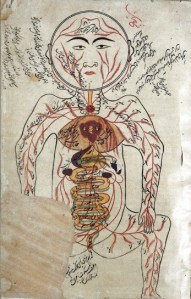
Historical Illustrations: Ibn Sina and his Canon of Medicine @ Simergphotos

One of the most famous exponents of Muslim universalism and an eminent figure in Islamic learning was Ibn Sina, known in the West as Avicenna (981-1037). For a thousand years he has retained his original renown as one of the greatest thinkers and medical scholars in history. His most important medical works are the Qanun (Canon) and a treatise on Cardiac drugs…..The enduring respect in the 21st century for a book written a millennium earlier is testimony to Ibn Sina’s achievement….”

Historical Images: Ibn Sina and His Canon of Medicine

Arteries and Viscera -  depiction in Avicenna's Canon of Medicine). Please click for historical images. Credit" Wellc ome Images. Copyright.

Arteries and Viscera – depiction in Avicenna’s Canon of Medicine. Please click on image for article. Credit: Wellcome Images. Copyright.

“Shukr Mawlo, Shukr Mawlo” – A Story for Mawlana Hazar Imam’s Salgirah by Gulnor Saratbekova

“…I was approaching the age of 12 and it was just before people became completely hopeless. I remember clearly when I saw our Mawla on TV for the very first time (it was when we had electricity for some hours). I was at my uncle’s and there were about 15 of us living at his house. I didn’t understand why suddenly all the grownups started to cry and say SHUKR MAWLO, SHUKR MAWLO….”

“Shukr Mawlo, Shukr Mawlo” – When Hope is All You Have Left, a Story for Mawlana Hazar Imam’s Salgirah

Pamiri Ismaili youth. Please click for "Shukr Mawlo". Photo: Matthieu Paley. Copyright.

Pamiri Ismaili youth. Please click for “Shukr Mawlo”. Photo: Matthieu Paley. Copyright.

13th December, 2012: Celebrating Mawlana Hazar Imam’s 76th Salgirah – Photo Essay, Readings and the Ginan “Eji Dhan Dhan Aajano” with Meaning

Mawlana Hazar Imam’s Salgirah and the Depth of His Love for the Jamat

The term Salgirah is of Persian origin. Sal means anniversary and girah means knot and hence Salgirah literally means ‘an anniversary knot added on to a string kept for the purpose’. This article approaches the subject of Mawlana Hazar Imam’s birthday in terms of the Imam’s love for his murids and the love and devotion of the murids for their Imam.

In Metaphoric Ginan “Eji Dhan Dhan Aajano” Pir Sadr al-Din Asks Mu’mins to Act Righteously and Gain Spiritual Recognition of Imam-e-Zaman

The Ginan has attained a very special status because it is primarily recited during the festivities marking the Salgirah of the Imam. The appropriateness of reciting Eji Dhan Dhan Aajano during the Salgirah will become apparent as we try to understand the ginan and its underlying spiritual teachings.

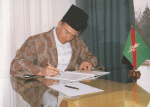
The Preamble Of “The Constitution of the Shia Imami Ismaili Muslims”

The new Ismaili Constitution was ordained, signed and sealed by His Highness the Aga Khan on December 13th, 1986, his 50th birthday. His Highness did this with the belief that the Constitution would provide a strong institutional and organizational framework for his Ismaili community to contribute meaningfully to the societies among whom they live.

His Highness the Aga Khan and the Ismailis

.

.

On the occasion of His Highness the Aga Khan’s 75th birthday on December 13, 2011, Simerg published a three-part photo essay tribute to the 49th Ismaili Imam. The series has been consolidated into a captivating one piece photo essay, which can be read at Simerg’s companion photo blog, Simergphotos, by clicking on the above link.

___________________

A Note to Readers: Please scroll down or click Home page for other recent posts and click What’s New for links to all articles published on this blog since March 2009. Subscribe to this Website via the box near the top right of this page.

A Shia Muslim Perspective on Embryonic Stem Cell Research and the Rights of a Foetus

ADVANCES IN SCIENCE AND MEDICINE, AND A SHIA ISLAMIC RESPONSE

Ever since researchers in 1998 discovered that stem cells extracted from embryonic tissue could regenerate to become any type of cell, there has been a deep divide on the morality of such research. When stem cells are taken from an embryo, the embryo loses its viability: it cannot become implanted into a womb or develop into a fetus. To knowingly damage an embryo in order to remove stem cells is, for some, equal to destroying human life. For others, who see great promise in what stem cells might do to cure illnesses it is immoral not to move forward with such research. What is Islam’s position on this ethical question? Read how Iran, a Shia Muslim country, has responded to this debate.

Please click Embryonic Stem Cell Research and the Rights of a Foetus: A Shia Muslim Perspective from Iran or on the image below.
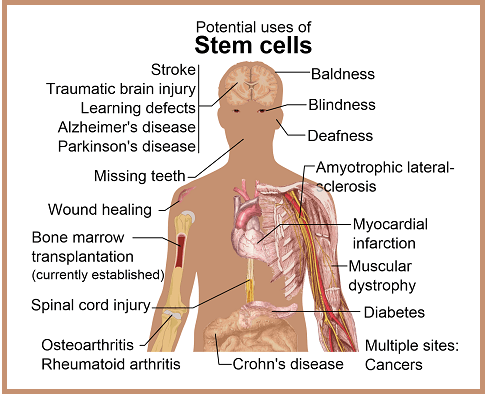
Diseases and conditions where stem cell treatment is promising or emerging. Please click for article "A  Shia Muslim Perspective on Stem Cell Research." Image: Wikipedia.

Diseases and conditions where stem cell treatment is promising or emerging. Please click for article “A Shia Muslim Perspective on Stem Cell Research.” Image: Wikipedia.

Historical Images: Thomas Jefferson’s Copy of the Qur’an @Simergphotos

The latest weekly historical illustration at Simergphotos is that of a rare copy of an English translation of the Qur’an which was acquired over two centuries ago by Thomas Jefferson, one of America’s Founding Fathers as well as its 3rd President. This was the 2-volume set on which US Muslim Congressman Keith Allison rested his hand for the oath to the office on January 4, 2007. Please click Historical Images: President Thomas Jefferson’s Copy of the Qur’an or on the following image:

Keith Ellison, the first Muslim ever elected to the US Congress, took his oath of office on January 4, 2007 by placing his hand on Thomas Jefferson's copy of the Qur'an. Please click for Historical Illustrations."

Keith Ellison, the first Muslim ever elected to the US Congress, took his oath of office on January 4, 2007 by placing his hand on Thomas Jefferson’s copy of  the Qur’an. Please click for “Historical Images.”

America’s Founding Fathers and Islam by James Hutson

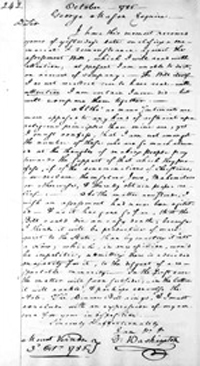
The US Library of Congress contains the papers of 23 presidents, from George Washington to Calvin Coolidge. Manuscript Division Chief James Hutson draws upon the papers of Washington, Thomas Jefferson and other primary documents to discuss the relationship of Islam to the new nation.

Please click: America’s Founding Fathers and Islam: A Brief Discussion Based on Documents at the Library of Congress

George Washington's 1785 letter wherein he declared that he would welcome "Mohometans" to Mount Vernon if they were "good workmen. Image credit: Library of Congress. Please click for article

George Washington’s 1785 letter wherein he declared that he would welcome “Mohometans” to Mount Vernon if they were “good workmen.” Image credit: Library of Congress. Please click for article