PLEASE CLICK: Mawlana Hazar Imam’s 80th Birthday – Montreal’s Beautiful Event
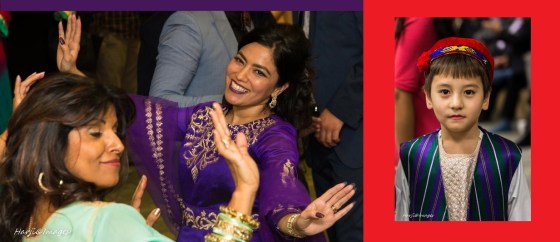
Please click for a gorgeous collection of photos of the Montreal Saligrah. Photo: Muslim Harji. Copyright.
Date posted: December 21, 2016.
_______________

Please click for a gorgeous collection of photos of the Montreal Saligrah. Photo: Muslim Harji. Copyright.
Date posted: December 21, 2016.
_______________
INTRODUCED BY ABDULMALIK MERCHANT
(with material from The Ismaili website)
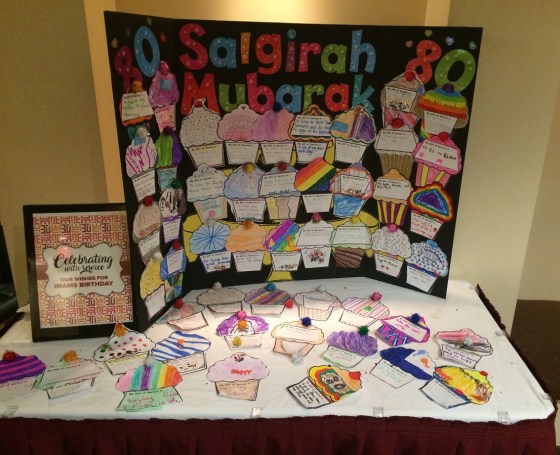
A mosaic of colourful Salgirah cards prepared by children of Burnaby Lake jamatkhana on the occasion of Mawlana Hazar Imam’s 80th birthday. Photo: Malik Merchant/Simerg
“No ocean, no mountain, and no desert can keep the Imam from his murids,” was the caring message that Mawlana Shah Karim al-Hussaini Hazar Imam, His Highness the Aga Khan, delivered to his spiritual children, the Ismailis, during one of the many visits which he undertook to his global community during his Golden Jubilee Celebrations. The Jubilee began on July 11, 2007, when he completed 50 years of his reign as the 49th hereditary Imam, directly descended from the Prophet Muhammad (s.a.s.), and ended on December 13, 2008, on the exact day of his 72nd birthday. He was born in Geneva in 1936.
Eight years on, on Saturday December 17, 2016, the harsh elements of nature — snow, freezing rain, and cold — did not subdue or keep tens of thousands of Ismailis in Canada, from attending the video showing of their beloved Imam’s 80th birthday celebration that had taken place just a day earlier at his estate and the Imamat headquarters in Aiglemont, France.

Malik Talib, President of the Ismaili Council for Canada, makes a point during a conversation with other Ismaili leaders at the 80th birthday celebration of Mawlana Hazar Imam. Photo: The Ismaili/Zahur Ramji.
Ismaili leaders from around the world, including President Malik Talib of Canada, travelled to France on behalf of their constituents to personally offer congratulations, express shukrana (thanks), and to reaffirm the Jamat’s bayyah (oath of allegiance) to the 49th Ismaili Imam. Also attending the birthday celebration, were members of Mawlana Hazar Imam’s family – Prince Amyn Muhammad, Princess Zahra, Prince Rahim and his wife Princess Salwa along with their son Prince Irfan, Prince Hussain, Prince Aly Muhammad and Princess Zahra’s children, Sara and Ilyan.
Earlier during the week, on December 13, the actual day of his birthday, Ismailis had gathered in their local jamatkhanas for special prayers and ceremonies to affirm their loyalty and love for their Imam. Mawlana Hazar Imam, in becoming 80, has established himself as the oldest serving Imam in Ismaili history!

Designed specially for the celebration of Mawlana Hazar Imam’s 80th birthday, this centre piece of the venue comprised a geodesic dome. Neither of the East nor of the West, the dome is an ancient symbol of Divine shelter, care and guidance. The Ismaili/Farhez Rayani.
The celebration in Aiglemont was housed in specially designed marquee, with a protective dome that signified the guidance and shelter that Hazar Imam constantly provides. The dome itself was inspired by an icosahedron — a geometric structure composed of 20 triangles. Each triangle symbolised one of the 20 national Ismaili Councils appointed by the Imam to oversee the community’s well-being.
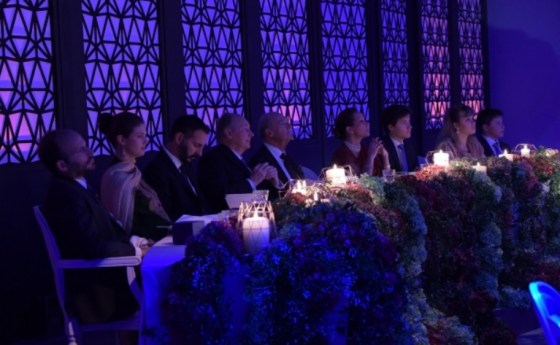
Mawlana Hazar Imam’s family in attendance at his 80th birthday celebration held at his home in Aiglemont on Friday, December 16, 2016. From left to right: Prince Hussain, Princess Salwa and her husband Prince Rahim, MAWLANA HAZAR IMAM, Prince Amyn Muhammad, Princess Zahra, Prince Ali Muhammad, and Princess Zahra’s children, Sara and Ilyan. Photo: The Ismaili/Zahur Ramji.

The President of the Aga Khan Ismaili Council for Syria, Muhammad Wardeh, recites the Tilawat-e-Qur’an at the start of Mawlana Hazar Imam’s 80th birthday celebration. Photo: The Ismaili/Zahur Ramji.

Mawlana Hazar Imam addresses Jamati and institutional leaders, who gathered at his home on the occasion of his 80th birthday. The Ismaili/Zahur Ramji

Prince Amyn Muhammad and Princess Zahra applaud as the birthday cake is presented to Mawlana Hazar Imam. Photo: The Ismaili/Zahur Ramji.

Mawlana Hazar Imam cuts his birthday cake, as Princess Salwa and Prince Hussain look on. The Ismaili/Farhez Rayani.

Mawlana Hazar Imam is presented with a birthday gift on behalf of the global Jamat. Titled “Horses”, this lapis lazuli mosaic was commissioned from the late Ismail Gulgee in 1989. Looking on are the Chairman of the Ismaili Leaders International Forum, Mahmoud Eboo (right), and Vazir Shafik Sachedina. Photo: The Ismaili/Zahur Ramji.

Salim Ahmed, a Canadian jamati leader and a former Darkhana Mukhi, and his wife, are greeted by Prince Hussain at the 80th birthday celebration of Mawlana Hazar Imam. Photo: The Ismaili/Zahur Ramji.

Mawlana Hazar Imam meets with the musicians and singers who performed at the celebration of his 80th birthday. Photo: The Ismaili/Zahur Ramji.
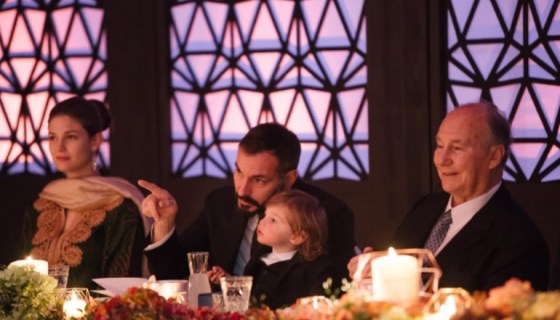
Mawlana Hazar Imam, Prince Rahim with Prince Irfan, and Princess Salwa at the 80th birthday celebration. Photo: The Ismaili/Zahur Ramji.
Reflecting on the progress of the Jamat over the past several decades, Hazar Imam said, “I think we can conclude today that the Jamat is a strong community. It is a global community. It is a community with strong institutions, with strong ethics and it is respected around the world. This evening is an extraordinarily special occasion for the global Jamat and for the leaders who are here present tonight who are representing them.”
He said that his wish for the decades ahead was that “you stand firmly by the principles and ethics of our faith. Wherever you are, whatever age you are, whatever you do in your lives, it is essentially important to me that the principles of our faith should be respected everyday of your lives.”
When Mawlana Hazar Imam cut a birthday cake presented on behalf of the global Jamat, he was serenaded by all those gathered with Happy Birthday sung in two languages. Hazar Imam was also presented with a gift of art — a mosaic of horses by the late Ismail Gulgee that was commissioned in 1989. It was selected “because of Hazar Imam’s passion for horses, the history of horses within Islamic civilisation and the history even within Mawlana Hazar Imam’s own family,” explained Chairman Eboo.
Mawlana Hazar Imam expressed great happiness at the celebration of his 80th birthday. “If I had known it was going to be so wonderful, I would have tried to bring it forward,” he joked, “and I would have tried to multiply it!” He said, “I hope that in the decades ahead, you will remember this occasion as one of special happiness, as I do.”
~~~~~~~~~

Jamati members enjoying the jaman at darkhana jamatkhana following the 80th birthday video presentation from Aiglemont, France. Photo: Simerg.
The jamat at the Darkhana, where I was present for the showing, watched the entire program with awe and absolute discipline.We then proceeded in an orderly fashion to a specially constructed tent in the parking lot to partake of the feast (jaman) prepared by a team of special volunteers of the jamat – the randhan committee. It consisted of fresh lettuce, vegetable and chicken biryanis with kachumber (diced tomatoes and onions), a dessert (barfi), soft drinks and chai! The tent was heated and very comfortable, protecting everyone from the freezing temperatures. The senior citizens of the jamat were served their dinner at the jamatkhana’s social hall on the second floor. After the feast, members of the jamat joined for a dandhia raas (stick dancing and hand clapping) program!

Senior citizens wait for the commencement of the dandhia raas program in the social hall of the Ismaili Centre in Burnaby, after completing their meal. Photo: Simerg.
The 80th birthday celebration has generated the momentum for yet another significant milestone in Mawlana Hazar Imam’s life – the celebration of his Diamond Jubilee beginning July 11, 2017, which will take place as Canada begins celebrating its 150th birthday on July 1, 2017.
Date posted: December 20, 2016.
______________
For a video of the 80th birthday celebration of His Highness the Aga Khan held in Aiglemont, France, on December 16, 2016, please visit http://www.theismaili.org, the official website of the Ismaili community. Readers will also find there a gallery of more than 30 photographs of the celebration.

Malik Talib
Mr. Malik Talib, the President of His Highness the Aga Khan Shia Imami Ismaili Council for Canada, along with the Chairmen of the Ismaili Tariqah and Religious Education Board (Dr. Kabir Jivraj), Grants and Review Board (Mr. Amir Lakhani), and Conciliation and Arbitration Board (Mr. Karim Sunderji), and the Mukhi of Darkhana Jamatkhana (Mr. Zahir Bhatia) issued the following message through the Canadian Ismaili community’s special newsletter edition of “Al-Akhbar,” as tens of thousands of Ismailis gathered in jamatkhanas across the country to observe the historic 80th birthday or Salgirah of Mawlana Shah Karim al-Hussaini Hazar Imam, His Highness the Aga Khan on December 13. The celebrations will continue late into the week with special cultural events, voices from the jamat and video presentations.

Mawlana Hazar Imam pictured at the 1998 darbar held in Lisbon, Portugal.
This is a historic event for our Jamat. No part of our lives has been untouched by the work and dedication of Mawlana Hazar Imam. For the Jamat in Canada, our very presence here and all of the opportunities afforded to us, have been made possible by the singular concern of our Imam for our material and spiritual well-being.
The spirit of frontierless brotherhood and sisterhood that has helped the community weather many storms springs from a common allegiance to our Imam, uniting us in purpose and vision.
The volume and quality of initiatives established and sustained by the office of the Imamat are staggering. More importantly, these have improved the well-being of millions.
In light of all with which we have been blessed, what can we give back? Perhaps the most powerful form of gratitude would be a re-commitment to the principles of our faith and many of the efforts to which they give rise:
- Attending to our spiritual lives in a world increasing concerned with material well-being as the sole objective of life;
- Improving the quality of life of the Jamat and the communities in which we live;
- Strengthening community and family ties amidst the challenges of modern living;
- Enhancing our understanding of our faith and our ability to articulate the peaceful, compassionate message of Islam;
- Promoting pluralism in a world that seems ever more fragmented.
As we approach Canada’s 150th birthday and look forward to commemorating the Diamond Jubilee, it is our hope and prayer that the coming months will be a time of excitement, fulfillment, renewal and happiness.
To all our volunteers and donors who unconditionally and generously commit their time and resources, we sincerely express our special thanks and gratitude.
We offer our humble shukrana to our beloved Mawlana Hazar Imam for his continued guidance, and pray for peace and stability for the Jamats living in difficult circumstances and for our collective good health, faith, prosperity, success and unity. Ameen.
Date posted: December 14, 2016.
________________
For a feedback, please click Leave a comment.
SALGIRAH MUBARAK TO ISMAILIS AROUND THE WORLD

A portrait of His Highness the Aga Khan. Photo: Jean-Marc Carisse. Copyright.
Introduced by Abdulmalik Merchant
(Editor: Simerg, Simergphotos and barakah)
Spread in various countries around the world, the Shia Imami Ismailis have their own innumerable ways for celebrating important religious occasions according to their various cultural, social and religious traditions and backgrounds. One very important occasion in the annual calendar of the Ismailis is the Salgirah, or the birthday of their Imam. His Highness the Aga Khan is their present Imam, and Ismailis around the world are marking his 80th Salgirah on December 13, 2016.
His 80th birthday makes Mawlana Hazar Imam’s lifespan the longest in the chain of forty-nine Imams who have succeeded as hereditary Imams after Prophet Muhammad (s.a.s.). The previous Imam, His Highness the Aga Khan III, Mawlana Sultan Mahomed Shah (November 2, 1877 – July 11, 1957), lived almost 80 years! Combined, the reigns of the successive 48th and 49th Imams have lasted and incredible 131 years! Mawlana Sultan Mahomed Shah became Imam at the age of 7, and reigned for 72 years while Mawlana Shah Karim al-Hussaini became Imam on July 11, 1957 at the age of 20, and has already reigned for 59 years. Simerg has dedicated a special website, http://www.barakah.com, to celebrate his Diamond Jubilee, and extensive material will be added to barakah during the next several months leading to the Diamond Jubilee next July.
For this historical and singularly auspicious Salgirah, we extend our heartiest congratulation to Mawlana Hazar Imam and the Noorani family as well as to all Ismailis around the world. We join with all our readers to offer prayers for Mawlana Hazar Imam’s long life and good health and pray that every Ismaili may have barakah and spiritual peace through his blessings. We also pray for jamati members who are facing hardships and difficulties in many parts of the world, such as in Syria, with hope that peace and security may return to their homelands.
The following excerpts from Mawlana Hazar Imam’s farmans and articles will enhance the readers’ understanding about the occasion as well as the special relationship that binds the Imam of the Time with his spiritual children.
“I would like my Jamat to think what is the meaning of a birthday in an individual’s life and what is is the meaning of a birthday in Imam’s life. What can a jamat give to Imam on his birthday and what would really make him happy, and, after all, this, in an individual’s life and in Imam’s life, should and must be a day of happiness.
“Jamat can give me one happiness; that is that they should be united, that they should be regular in all jamat work and that they should live in the best tradition of my spiritual children. My East Pakistan [now Bangladesh – ed.] jamats have given me this gift for nine days and I want you to know that today is not only a symbolic birthday but it is a real birthday, it is a day of real happiness for me.”
“….My jamat should accept in all matters nothing but the best; this means that you should seek to improve your worldly conditions by every means possible so long as you remain within our faith. Spiritually this means that you have to be regular in prayer, regular in service, regular in attendance in jamatkhana.” — Mawlana Hazar Imam, His Highness the Aga Khan, Farman Mubarak, Dacca, December 9, 1964. [1]
“You have gathered here today to wish me a happy birthday and to reaffirm your loyalty and love to your Imam. My happiness at being with you on this occasion is deep and pure; all my thoughts, all my hopes and all my prayers are for you.
“Since the 11th of July 1957, all my aims and ambitions have been devoted to help and guide my spiritual children in spiritual and worldly matters. The happiness which I have gained from my work, the encouragement to carry more and more responsibility and undertake more and more projects, the continuous search for truth in all matters, all this has been due to you.
“For hundreds of years, my spiritual children have been guided by the rope of Imamat; you have looked to the Imam of the Age for advice and help in all matters and through your Imam’s immense love and affection for his spiritual children, his Noor has indicated to you where and in which direction you must turn, so as to obtain spiritual and worldly satisfaction.” Mawlana Hazar Imam, His Highness the Aga Khan, Farman Mubarak, Karachi, December 13, 1964 [2]
“During the next generations, you will be living in a world of increasing material plenty, of voluminous material activity, and where a large part of man’s intelligence and thought will be devoted to providing material benefits to you.
“In the minds of some, there may be one day, some confusion as to the meaning and necessity for faith and if my spiritual children were ever to manage their lives in such a way as to come to believe that their minds create rather than having been created and that their material comfort is such that spiritual humility is no longer warranted, I can tell you now that the true and real happiness, which I pray it should be your blessing to experience will never touch your hearts.
“Any rapid change in your material surroundings will impose upon you immense unhappiness, immense worry and frustration. You will fall to understand that the material benefits will have produced in your hearts only dissatisfaction and disillusionment, when in fact you have in front of you every day from sunrise to sunset, from this world to all the others, from the smallest material particle to the creation of life itself, a visual and intellectual proof that as yet man has succeeded only in a minute manner to influence the world in which he lives and that this influence has been exercised only on what some misguided believe to be the significant aspect of human life on earth and that is the material one. Our concept has always maintained worldly matters where they belong and I am convinced that as a whole my jamat is a great deal happier than many others who have unlimited material wealth but who know not from where this wealth comes, what is its value, and why it is, even in practical terms, tending to become more and more of a burden rather than a blessing.” Mawlana Hazar Imam, His Highness the Aga Khan, Farman Mubarak, Karachi, December 13, 1964. [2]
“On this happy day I rejoice in being with my spiritual children and in the knowledge that their spiritual and moral strength is such as to allow them to benefit from many more worldly goods without forsaking the remembrance of, and the submission to, ‘He from whom we have come and to whom we will return’.
“I give on this occasion to each and every spiritual child here and every spiritual child today living in this world, my most affectionate paternal maternal loving blessings: Khanavadan, Khanavadan.” Mawlana Hazar Imam, His Highness the Aga Khan, Farman Mubarak, Karachi, December 13, 1964. [2]
________________
References:
[1]. Hikmat, His Highness Prince Aga Khan Shia Imami Ismailia Association for Canada [now Ismaili Tariqah and Religious Education Board, ed.], Salgirah issue, December 13, 1986, Vol. II, No. VIII, p. 3.
[2]. Ismaili Mirror, Pak Ismailia Publication, Garden Jamatkhana, 13 December 1974, Karachi, Pakistan, p. 5. Also see Hikmat, Vol II, No. VI, February/March 1986, p. 1.
~~~~~~~
|
Mawlana Hazar Imam’s Salgirah and the Depth of His Love for the Jamat
|
|
|
+ Listen to ginan at Ginan Central Eji Dhan Dhan Aajano has attained a very special status because it is primarily recited during the festivities marking the birthday of Mawlana Hazar Imam. The appropriateness of reciting the ginan during Salgirah will become apparent as we try to understand the ginan and its underlying spiritual teachings. To listen to various renditions of Eji Dhan Dhan (#160), as well as over 760 other ginans please click http://ginans.usask.ca/recitals/ginans.php?id=0. |
|
|
The Preamble Of “The Constitution of the Shia Imami Ismaili Muslims”
|
|
|
His Highness the Aga Khan and the Ismailis  . On the occasion of His Highness the Aga Khan’s 75th birthday on December 13, 2011, Simerg published a three-part photo essay tribute to the 49th Ismaili Imam. For those who may have missed, the series has been consolidated into a captivating one piece photo essay, which can be read by clicking on the above link. |
Date posted: December 12, 2016.
___________________
Feedback? Please click Leave a comment.
Archives: Please click Table of Contents for links to all articles published on this blog since March 2009. Subscribe to this Website via the box near the top right of this page.
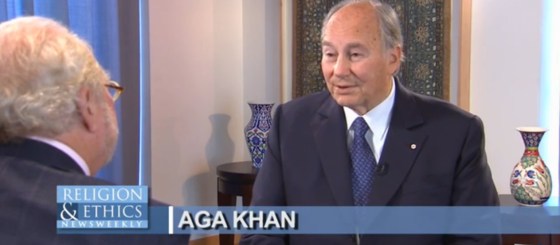
Click on image or on any text below for link to interview/transcript.
INTRODUCED BY ABDULMALIK MERCHANT
~~~~~~~~~~
 Date posted: Wednesday, November 30, 2016.
__________
PLEASE CLICK: Special Coverage – Mawlana Hazar Imam’s Visit to the UAE
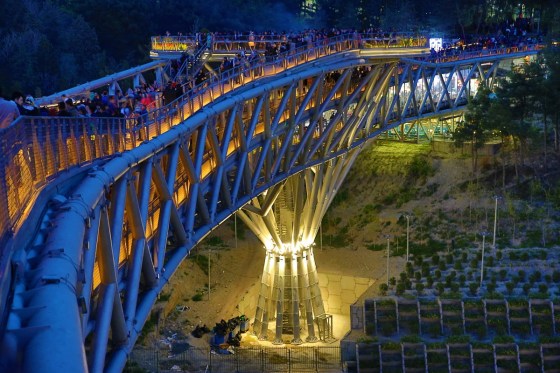
Tabiat Pedestrian Bridge, Tehran, one of 6 projects to win the 2016 Aga Khan Award for Architecture. Photo: Aga Khan Trust for Culture/Barzin Baharlouie. Please click on photo for special report.
Date posted: Monday, November 7, 2016.
___________________
“I wish you all success, good health, happiness, everything you wish, everything you wish for, Best Blessings.” – Mawlana Hazar Imam, His Highness the Aga Khan. Please see one minute video footage from October 19, 2016, below.
LETTER FROM PUBLISHER
By Abdulmalik Merchant
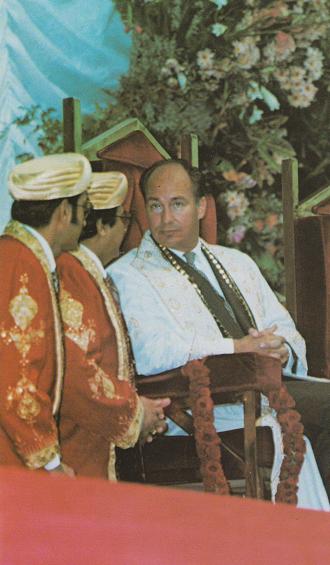
Mawlana Hazar Imam, His Highness the Aga Khan, pictured at the Olympia Hall, London, during his weeklong visit to the United Kingdom Jamat in September 1979. Seated next to him on the stage are Mukhi Noordin Jivraj and Kamadia Nizar Dhanani. Photo: Jehangir Merchant Collection.
Some 37 years ago, my dad (Alwaez Rai Jehangir Merchant) wrote a piece for Ilm magazine on Mawlana Hazar Imam’s memorable week long visit to the United Kingdom jamats held at the beginning of September 1979. He mentioned about the unbounded joy originating from the souls of the members of the UK Ismailis when the visit was announced with a talika read in Jamatkhanas on July 7th, 1979. Then, describing the last few moments of Mawlana Hazar Imam’s final day of his seven day memorable stay in England, my dad wrote:
“In his infinite mercy and grace, Mawlana Hazar Imam then blessed the jamat for happiness, good health, unity, success in spiritual happiness, success in worldly happiness and for remaining on the Straight Path. What more would the mu’mins wish? Their Imam, their beloved Mawla had blessed them munificently. Tears were streaming from their eyes in reverence and devotion for their beloved Mawla for the immense love he had shown towards them….Very slowly and graciously, Mawla walked all around the [Olympia] hall to be as near to his spiritual children as possible for the last time during this visit. When he arrived at the exit of the hall, he majestically turned towards his spiritual children, stood there in all his glory for one brief moment, showered his Noor on the whole assembly of souls and then moved away from the sight of his beloved spiritual children who had all made him so very very happy.”
I mention this anecdote because something remarkable and inspiring happened a few days ago on October 19, 2016 in Kyrgyzstan as Mawlana Hazar Imam visited the new Naryn campus of the University of Central Asia. An amateur video footage that we have received captures the excitement, uncontrollable joy, happiness and emotion from a group of Ismaili murids as Mawlana Hazar Imam most graciously walks over to them, and from a very close distance, with hands stretched out, graciously and lovingly blesses them with the following words:
“I wish you all success, good health, happiness, everything you wish, everything you wish for, Best Blessings.”
The voices that we hear in the footage as Mawlana Hazar Imam steps in the direction of his followers (“Ya Hazar Imam”), and when he leaves them after fulfilling their dreams and filling their hearts, minds and souls with peace and unbounded spiritual happiness is a testament to the faith and love that each and every Ismaili around the world holds for his or her beloved Imam.
WATCH FOOTAGE OF MAWLANA HAZAR IMAM BLESSING MURIDS IN KYRGYZSTAN ON OCTOBER 19, 2016
Inshallah, the jamats all over the world will be blessed with the Imam’s Holy Deedar during the forthcoming Diamond Jubilee Celebration as we commemorate 60 years of his glorious and magnificent reign as our 49th Imam on July 11, 2017.
It is not in vain that Ismaili Pirs and missionaries wrote how fortunate the Ismaili people are to attain the recognition of the Imam of the Time, who is the direct descendant of the Prophet Muhammad (s.a.s.). Pir Sadardin wrote:
Eji Anand anand kariyo rikhisaro,
Awwal Shah tamey paya
Rejoice! O you who are on the True Path, rejoice!
For you have the Supreme Master.
On that note, we convey our heartiest felicitations and mubaraki to everyone who was present in Naryn to gain the Imam’s blessings, and wish to express our heartful thanks to the individual who has shared this video with us for the benefit of all our readers.
Date posted: October 21, 2016.
________________
We welcome your feedback. Please click Leave a comment.

His Excellency Mohammad Ashraf Ghani, President of Afghanistan (right) with His Highness the Aga Khan, Founder and Chairman of the Aga Khan Development Network and 49th Imam of Ismaili Muslims. Photo: European Union. Copyright.
Mawlana Hazar Imam, His Highness the Aga Khan, the 49th Imam of Shia Imami Ismaili Muslims, is attending the Brussels Conference on Afghanistan on Wednesday, 5 October, 2016. The conference is being co-hosted by the European Union and Afghanistan. Like previous conferences, this conference is the opportunity to signal sustained political and financial support to Afghan peace, state-building and development. Mawlana Hazar Imam has contributed significantly towards these purposes over the past several years, and has participated and spoken at previous such conferences held around the world.
We are pleased to provide links to videos of Mawlana Hazar Imam’s presence at the conference in Brussels, including his bilateral meetings with conference attendees, a “family photo” of conference participants and the statement that he has made.
~~~~~~~~~
~~~~~~~~~
~~~~~~~~~
If you encounter technical problems in watching any of the videos, please visit https://tvnewsroom.consilium.europa.eu/videos.
Date posted: October 5, 2016.
______________
For more photos and videos of the conference please visit https://tvnewsroom.consilium.europa.eu/videos
By Abdulmalik Merchant
(Publisher-Editor, http://www.simerg.com, http://www.simergphotos.com and http://www.barakah.com)
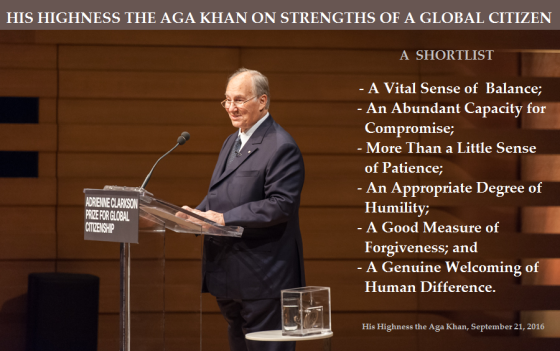
Photo: The Ismaili/Lisa Sakulensky. Copyright. Note: Superimposition of text on photo by Simerg.
There were many cherishable and memorable moments on Wednesday, September 21, 2016, at Koerner Hall in Toronto when the inaugural Adrienne Clarkson Prize for Global Citizenship was presented to His Highness the Aga Khan. World renowned vocalist and songwriter Rufus Wainwright welcomed the audience with a wonderful rendition of Leonard Cohen’s song Hallelujah. We were reminded by Rufus that September 21 also marked Cohen’s birthday – his 82nd. A video of Prime Minister Justin Trudeau’s congratulatory message to His Highness Aga Khan received a big applause from the packed auditorium hall, as did the actual presentation of the unique award to His Highness by Madame Clarkson. This was followed by her welcome speech and the 49th Ismaili Imam’s words of wisdom.

The Rt. Hon. Adrienne Clarkson, Canada’s 26th Governor General from 1999-2005, awarding the inaugural Adrienne Clarkson Prize for Global Citizenship to His Highness the Aga Khan, 49th Imam of Ismaili Muslims, in Toronto on September 21, 2016. Photo: The Ismaili/Vazir Karsan. Copyright.
But of all the absorbing moments that the event offered, there was one defining moment in Mawlana Hazar Imam’s speech that I took to my heart. In concluding his speech, Mawlana Hazar Imam defined what it takes for each one of us to be a Global Citizen. He said:
“These are just a few thoughts as I look to the future of Global Citizenship. The challenges, in sum, will be many and continuing. What will they require of us?
“A short list might include these strengths: a vital sense of balance, an abundant capacity for compromise, more than a little sense of patience, an appropriate degree of humility, a good measure of forgiveness, and, of course, a genuine welcoming of human difference.”
It was with reference to this last sentence that Madame Clarkson then began her conversation with Mawlana Hazar Imam. The following is a transcript that Simerg has prepared from an audio recording of the event, and we invite our readers to view the video of the wonderful event through the links that we have provided at the bottom of this page.
TRANSCRIPT OF THE CONVERSATION
(Prepared by Simerg from an audio recording)

His Highness the Aga Khan and the Rt. Hon. Adrienne Clarkson in conversation following the presentation of the Global Citizenship Award to the Ismaili Imam on September 21, 2016, in Toronto. Photo: The Ismaili/Lisa Sakulensky. Copyright. Ismaili.
Adrienne Clarkson: Thank you so much for those words. They are so well thought out, and over the years as we have known each other, I am always impressed by your deep sense of humane commitment and feeling that you have when you talk about things like forgiveness, and that, that is part of what we are as a society……One of the things I am very interested in, and I think everybody here is interested too, is in the fact that you put so much faith in Canada; that you have put institutions in Canada, like the Global Centre for Pluralism in Ottawa….And you have also put the Imamat in Ottawa. And when I think about it, I think: Is that because in 1972, we welcomed so many Ismailis. Is that the beginning of it, or is there something else about us: Is it that you are a secret fan of Mackenzie King.
Mawlana Hazar Imam: No, I think the answer to that is that as I look at the world around us, and I ask myself what would define countries where I would like to see my community reside. The first word that comes to my mind is countries of opportunity. And I believe Canada is one of the greatest countries of opportunity.
Adrienne Clarkson: I think that is true, and certainly the Ismaili community in Canada has made the most of the opportunities which all people who come to this country have. And that is the reason why I think people understand once they get here: that there lives are going to be different. And that is one of the interesting things too about what you talk about to the Jamat, to the community. And I think something that people should realise in the rest of Canada that you have your community, and it is very important; but that you emphasise how important it is to be part of the world outside your community. And why do you do that?
Mawlana Hazar Imam: Well, I have to go back to 1957. In 1957, many of the countries where my community was living were colonies. And those countries needed to go through the process of independence, needed to find the pathways forwards towards peace, towards development. And I have asked myself: How do countries achieve that? And if you go back to 1957, you look at the map of our world, and you try to define where all these countries that have now become independent, have created opportunity; I think one has to say that that has not been very successful.
Adrienne Clarkson: What have been the barriers? What are the barriers?
Mawlana Hazar Imam: Oh, I think there is a multitude of barriers. First of all, I suppose national resources would be a major issue. The second would be the level of human ability within a given country, whether it has a human ability to develop its resources, to build opportunity. So in that sense we are looking at processes of change. And they have occurred; they have occurred. There are today countries of opportunity which either did not exist or one would not have thought of as being countries of opportunity in 1957 when my grandfather died.
Adrienne Clarkson: And that has changed.
Mawlana Hazar Imam: That has changed.
Adrienne Clarkson: Well, you have had a lifetime of opportunity to see that. It is very rare to meet somebody who has had such an effect on the world, not only on a group of people, but in the world. Because that is what you have made it in sixty years. Next year will be your sixtieth anniversary as the Imam. And in sixty years, you have seen development, you have made development happen, you made resources available to places where there were absolutely no resources. And in doing that, it cannot have been easy to decide where that would happen, to decide who would be the collaborators, to bring along people who could understand and have the capacity to help with that development. How did you go about doing that?
Mawlana Hazar Imam: [I think] what you try to do is look at circumstances on an on-going basis. And then you work through what I would call predictability, and you try to project into the future what countries have the ability to follow the path of peace and development. And where there are situations which are potentially difficult, and that, of course, is something which changes practically every day; and, of course, it has changed a lot since 1957.
Adrienne Clarkson: And they did not teach you that at Harvard.
Mawlana Hazar Imam: I am not sure what they taught me at Harvard.
Adrienne Clarkson: We all wonder what we learned at university and how that was relevant to anything that we are doing today. But I think what is interesting in what you have been saying over the last, particularly over the last decade in your speeches, in your writings is that ignorance that we have. And I am always struck by the fact that we are, we speak out of such ignorance in a so-called western developed world, particularly about Islam. We do not know the varieties of the Muslim world at all, we seem not to be even interested in it, and the more people shout about it, the worse it becomes, because it is as though we shut out everything that could be various, that could be different, that could have any kind of nuance in it. How do you mitigate against that?
Mawlana Hazar Imam: I think probably the first step would be to extract from Islamic history, from Islamic philosophy the great names, the great thinkers, the great astronomers, the great scientists, the great medical figures, who have influenced global knowledge. I remember courses which taught general humanities. And those general humanities caused one to read in French, or Italian, or German, or English. Arabic! Never heard of it; Urdu! Never heard of it; Farsi! We do not even know what that is. So, it was a frightening vacuum in general education at the time. And I think that that vacuum has had terrible results.
Adrienne Clarkson: No, of course it has. It is ridiculous. I mean, we met only a few years ago, William Polk who was the first translator of the great epic Bedouin poem. And to think that only practically in the 21st century did we have access to that in translation is frightening, almost. A lacunae of knowledge. Not even accessible to us in any way.
Mawlana Hazar Imam: And that I think is one of the really serious issues – is that the cultures of Islam, of the Islamic world are not present in global cultural (let us say, how would I call it) presence.
Adrienne Clarkson: Well, of course, you have given us an enormous gift to Toronto in the Aga Khan Museum and the Jamatkhana, which is now virtually in the geographic centre of Metropolitan Toronto. And I think by those wonderful Islamic gardens with the pools of water, but using native Canadian trees, and native Canadian plants. I always think of you as somebody with a motto of: No idea too big, no detail too small. Because I know how you look at everything: you know, the grouting in the marble, the bulbs that will be planted, the colours of the bulbs. And, of course, that is an enriching thing for you to have that detail in your life, but also I think it enriches us. And when I think of the role that beauty and culture play in the message that you have to the world, I think we are enormously grateful to you…..
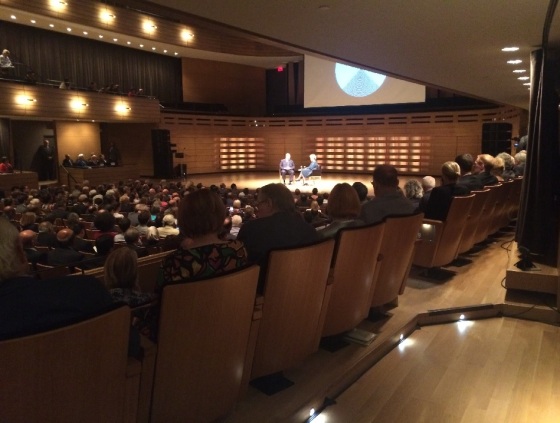
His Highness the Aga Khan and the Rt. Hon. Adrienne Clarkson in conversation following the presentation of the Global Citizenship Award to the Ismaili Imam. on September 21, 2016 in Toronto. Photo: Simerg.
(The Rt. Hon. Adrienne Clarkson then went on to describe the restoration work carried out by the Aga Khan Trust for Culture at the Humayun Gardens in New Delhi and the Babur Gardens in Kabul as well as the creation of Cairo’s new Al-Azhar Park from a site that had been used for many centuries as a landfill. The description is being skipped here. – Editor).
Adrienne Clarkson……..Why do you think beauty is so important to us, even when there are so many other needs around?
Mawlana Hazar Imam: Well, I think, all faiths express themselves in some cultural form or the other. And Islam is a faith which has expressed itself in cultural manifestations over centuries in different parts of the world. And I think it is very important that those manifestations should be seen and should be, I hope, admired, and that they should inspire young people who are talented young architects, land planners, whatever it may be. So that they can inspire their own buildings with a sense of continuity, but of our time. And I think it is very important that we not try to plagiarise history. (Laughter). I would get a, what would it be, a D or an E at Harvard for plagiarization.
Adrienne Clarkson: Well, of course, when you restore things or you make things new, you have to always avoid that. You have to say I am making something new. And that does not seem to fill you with any kind of fear.
Mawlana Hazar Imam: No, I think that every people in every given time should be encouraged to express themselves. And I remember that when the Pyramid was built in the Louvre, in the courtyard of the Louvre, there was immense debate as to whether this was appropriate or not. Well, it is there!
Adrienne Clarkson: Yes, yes, it is there. When we look at the world today….The rise of the Hard Right, of the really almost Fascist movements, reminds us sadly of times in the 1930s, and we have to really watch that because all that is to raise fear in people. And once fear rules people, they become blinded to all kinds of things. How do you deal with that? How do we deal with the fear?
Mawlana Hazar Imam: I think in this particular case, the issue is whether these countries have been willing to prepare themselves for this situation. Canada is a country that has permanent preparation. It is the way the country thinks. It welcomes people to come from outside, it has the institutions to support them when they arrive. It helps them integrate into Canadian society. That is not true of many western European countries, because they are facing economic constraint, because there are social tensions in various European countries also. Northern Europe does not speak the same language as Southern Europe, nor do they face the same problems. So I think we are living at a time when there are real difficulties, and my sense is that they are going to have to be analysed and solutions are going to have to be found. Because the movement of people is not going to stop. I do not see that stopping. It is driven by a number of factors, and I think in many of the countries which are sending people to Europe today, are dealing with populations who are seeking opportunity. There is a great sense of lack of opportunity. Opportunity is next door, it is not (around).
Adrienne Clarkson: (You know) When you were named as Imam in your grandfather’s will, he said he felt that he had to appoint somebody who was a young man, a man who was born in the atomic age, that is, the age of the 20th and 21st century. Has that influenced the way you think of things? Do you think of things in terms of a kind of millennial way, because you were appointed so young and you took on those duties so young. You knew you were expected to do something different. That is implicit in that will.
Mawlana Hazar Imam: Right. At the time and even today, many of the questions that I ask myself and that I discuss with members of my community is medium- and long-term projecting. Where are we going? And are we going in the right direction in various countries? Are we being equitable in relation to the demography of the community? Are we over-committing in certain parts of the world and under-committing in others? Are there circumstances in regions which make it impossible for our institutions to function? Or, on the contrary, are there countries that would welcome them? So we are looking at, let’s say, a semi-global situation on an on-going basis. So, in that sense, we are looking at how to plan. And planning, I think, in our case requires institutional initiative. We need to get our institutions in place before people decide to move.
Adrienne Clarkson: Well, that is the point. You are there before!
Mawlana Hazar Imam: We try.
Adrienne Clarkson: You are there before, because you have to then predict and you have to then say we are going to be out front, and when the tide is ready we will have the port built, so that the ships can arrive. How do you do that?
Mawlana Hazar Imam: You pray that Idi Amin never comes back!
Adrienne Clarkson: Yes. Well, let’s hope that that was only once in a hundred years, at least. But the idea of a threat to so many people comes up over and over again. I mean we know more about it now, because we have instant communications. So we know when whole groups are threatened, when things happen like that. But, you know, the ignorance that I talked about earlier is almost terrifying. That people do not understand the Muslim world whatsoever. And they do not understand, as you touched on in your speech, they do not understand the differences in the Muslim world. They have never read the Koran, they would not think of reading it or taking a study course in it. And I think that sort of thing really means that ignorance is promulgated and continued. And then, you know when very careless media add to that, then you really do not understand. Also, the other thing that I always like to point out is that Islam is six hundred years younger than Christianity. So, Christians should think, you know, what was Christianity like in the 15th century. And who was talking then? And how were they divided? It is very interesting to think of it in the cycles of history, as opposed to, just thinking, it is now and we are all the same and we are all equal, etc. We are not, really, because we have different heritages.
Mawlana Hazar Imam: That is true, but there was also a lot of inter-faith communication in the Middle Ages.
Adrienne Clarkson: That is right. The inter-faith communication is..
Mawlana Hazar Imam: A great deal [of inter-faith communication], particularly in the field of mystic faith.
Adrienne Clarkson: Mysticism!
Mawlana Hazar Imam: Yes.
Adrienne Clarkson: Linking Sufism and so on with Christian mysticism.
Mawlana Hazar Imam: Yes. Personal search.
Adrienne Clarkson: Why have we lost that?
Mawlana Hazar Imam: Probably, the requirements of modern life.
Adrienne Clarkson: Can we do anything about it? Should we be trying? Is that one of the things we should be trying, besides thinking of development, besides thinking of, you know, creating universities and schools. Can we do that?
Mawlana Hazar Imam: I think we need to reflect over is generosity in society. Our faith, the faith of Islam teaches generosity. But, I think it is very important that generosity should be part of public psyche.
Adrienne Clarkson: And that means being brought up with it.
Mawlana Hazar Imam: Means being brought up with it. Means recognising those in need of help. Means creating institutions to deliver that help. And, obviously, in poor countries, it is very difficult to achieve. But it should be a goal.
Adrienne Clarkson: Well, the problem is that the gap between rich and poor is growing and growing and growing, and not just in the developing world, but in the developed world. That is one of the real problems now for us, I think, as a society in the West is that disparity between the haves and have-nots. And the more that grows, the more unjust society becomes. And there seems to be very little that people want to do about that, very little that they really want to do about it. And things become charity. Charity is not the right way to go about it; development is the right vehicle now, surely.
Mawlana Hazar Imam: Yes. Well, in the faith of Islam the best charity is to give, to enable an individual or a family to become independent of their economic destiny. That is known as the best charity.
Adrienne Clarkson: How often is it? Does it happen?
Mawlana Hazar Imam: I honestly do not know. I would have to ask our bankers.
Adrienne Clarkson: As a final thing, I would like to ask you: What do you really think will happen now in the medium term for our future as we see Britain wanting to leave Europe, as we see the rise of very hard Right in the European countries, as we see what is happening in the United States, which is hardly even mentionable. What can we hope for now? How can we as individuals who really want to make things better, as we are faced with all of this, how does it happen, for us now?
Mawlana Hazar Imam: I think we have to offer rational people, options. I think it is very important to put in front of public opinion, good options. Alternatives.
Adrienne Clarkson: Different ways of behaviour.
Mawlana Hazar Imam: Different ways of behaving.
Adrienne Clarkson: And how do we do that? How do we make that? Is that through education? Is that through incentives? What is it? How is it done?
Mawlana Hazar Imam: I think it is through men and women coming forward to take positions of leadership. I think it is institutions who need to engage, rather than let the field open to anything. And, I have been very impressed since 1957 in developing countries, when elections had to be held or were held in circumstances where you would assume that the population did not have access to the information they would have, in our view, needed to express themselves rationally and competently. Well, I got it wrong. They are very, very wise. Public wisdom is not dependent on education.
Adrienne Clarkson: You are practically talking about Jung’s collective unconscious there. Is that, that there is a kind of wisdom that people share.
Mawlana Hazar Imam: Yes.
Adrienne Clarkson: Because of their common humanity.
Mawlana Hazar Imam: Because of the common humanity. Because of the common circumstance in which they are living.
Adrienne Clarkson: But does that bring us hope – as, you know, a collection of your speeches as ‘Where Hope Takes Root”. Is that where hope will take root?
Mawlana Hazar Imam: Yes. I believe so. But it means that decision makers have to be responsive.
Adrienne Clarkson: Well, it is very discouraging often when you look at the people who are elected in public office in different countries and the countries seem to vote for people that will harm them the most. Often, this is the most discouraging when you see in a democratic situation, even in free ones, where people will vote for something that is going to really harm them, and they do not seem to realise that it is very, very difficult, very difficult even because we have freedom of the press, we have enormous freedoms, particularly in North America and most of Europe. We have all those freedoms and yet we are in the dilemma that we are…Does that come back to the individual and their ability to do things?
Mawlana Hazar Imam: I think it comes back to the way the individual, or the family, rather than the individual, evaluate their position in society at a given time. Ultimately, the basic issue is: How does a family feed itself and educate the children, generation after generation? It is that clear, it is that important. And if society is able to provide that for the totality of the population in a given country, that is already a very sound foundation. But that is a condition sine qua non for a country to move ahead. If you have pockets of poverty, if you have populations or groups of populations who are marginalised, you are looking at a series of issues that one year are going to blow up. The predictability of crisis, in my view, in Third World countries is much higher than people would believe.
Adrienne Clarkson: You could predict them.
Mawlana Hazar Imam: You can predict them.
Adrienne Clarkson: Then why do not we avert them?
Mawlana Hazar Imam: Ah, that is a different question. I think predicting them is something that you can do, averting them does depend on a lot of different issues. That is not always easy.
Adrienne Clarkson: Thank you so much, Your Highness.
Mawlana Hazar Imam: Thank you. Thank you.
~~~~~~~
STATEMENT BY ANNA WILLIAMS, SCULPTOR OF THE MEDAL PRESENTED TO HIS HIGHNESS THE AGA KHAN

The medal presented to His Highness the Aga Khan for the Adrienne Clarkson Prize for Global Citizenship was sculpted by Anna Williams. The photo and her statement (below) are from the program booklet “Six Degrees Citizen Space 2016,” published by 6DegreesTO.com.
“Adrienne Clarkson asked me to create a medal for the Prize for Global Citizenship. I had the idea of bringing together the world of creation with that of the great mythological winged deities. Sedna is the Inuit goddess from whom all creatures of the sea spring. Atlanta, Nike, Lilith and the winged bearers of souls in Norse lore, the Valkyrie, each exist in an imperfect world. But through their strength, intelligence, independence, and compassion, they have created an iconography of champions and dissenters. Each in their own way is unyielding and stands apart as they chart a new course against buffeting waves. In the narrative of this medal, Sedna the creator emerges from the waves to pass a vulnerable world to the outstretched arms of our winged guardian.” — Anna Williams, sculptor.
Date posted: September 22, 2016.
Last updated: September 23, 2016, 15:25 (new photos added, completion of interview transcript and artist statement for Global Citizenship Medal).
____________
Please visit http://www.theismaili.org and http://www.akdn.org for extended coverage of the presentation ceremony.
“He is the 49th hereditary Imam of the Shia Imami Ismaili Muslims. He is a direct descendant of the Prophet Mohammed, peace be upon him, through the Prophet’s cousin and son-in-law Ali, the first Imam and his wife Fatima, the Prophet’s daughter…Through his words, through his actions, and through the results obtained by the institutions that he has pioneered, he is a beacon of light in much of the world’s conflicting darkness.” — The Right Honourable Adrienne Clarkson, 26th Governor General of Canada

Mawlana Hazar Imam, His Highness the Aga Khan, pictured before he was presented with the Order of Canada decoration by Her Excellency the Right Honourable Adrienne Clarkson in Ottawa on June 6, 2005. Photo credit: Sgt Eric Jolin, Rideau Hall
Named honorary companion of the Order of Canada in 2005 by the Right Honourable Adrienne Clarkson, His Highness the Aga Khan will be awarded the inaugural Adrienne Clarkson Prize for Global Citizenship on Wednesday September 21, 2016 at Koerner Hall in Toronto.
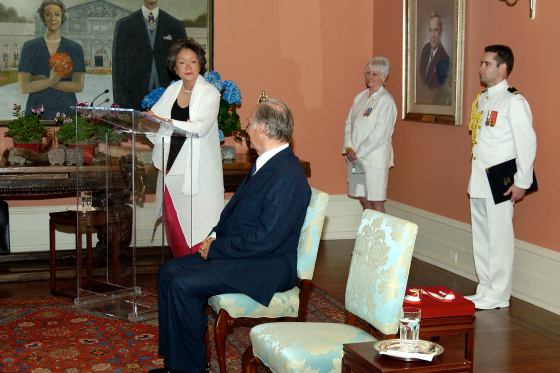
The Right Honourable Adrienne Clarkson, Governor General of Canada from 1999-2005, is presenting the Order of Canada decoration to His Highness the Aga Khan on June 6, 2005. Photo: Sgt Eric Jolin, Rideau Hall.
The prize is a new public initiative of the Institute of Canadian Citizenship, which was co-founded by Madame Clarkson with her husband John Ralston Saul after she left the office of Governor General in 2005. It will be given annually to an individual who has, through thought and dialogue, encouraged approaches and strategies that strive to remove barriers, change attitudes, and reinforce the principles of tolerance and respect.
A media release published at http://www.6degreesto.com states that “the symbolic importance of this prize has never been greater. In a time of unprecedented movement, displacement and re-settlement by immigrants and refugees, one of the central challenges we face is how we all live together.”
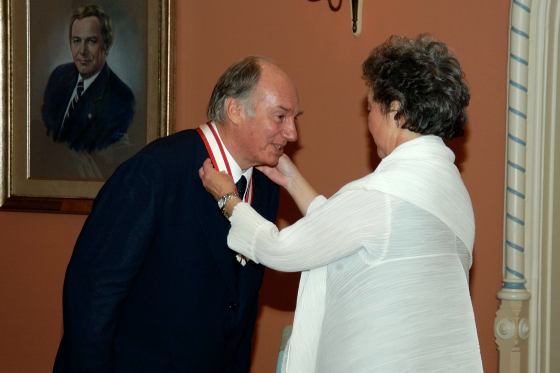
The Right Honourable Adrienne Clarkson, the 26th Governor General of Canada from 1999-2005, presenting the Order of Canada decoration to His Highness the Aga Khan on June 6, 2005. Photo: Sgt Eric Jolin, Rideau Hall.
At the award ceremony, His Highness the Aga Khan will receive the prize from the Rt. Hon. Adrienne Clarkson, and will share his wisdom and experiences with the audience on issues confronting the world today. He will then be joined on stage for a conversation with Madame Clarkson.
Remarking on the prize and the selection of the recipient, Adrienne Clarkson says: “Through his words, through his actions, and through the results obtained by the institutions that he has pioneered, he is a beacon of light in much of the world’s conflicting darkness.”
The internationally-acclaimed vocalist and songwriter Rufus Wainwright will perform in honour of the prize recipient.
~~~~~~~~~~~~
THE RIGHT HONOURABLE ADRIENNE CLARKSON ON HIS HIGHNESS THE AGA KHAN AND HIS ISMAILI FOLLOWERS
“In his own being, His Highness encompasses the world….Through the physical dispersal of their community through the centuries, their spiritual allegiance to the Imam and their adherence to the Shia Imami Ismaili branch of Islam was their greatest strength.”
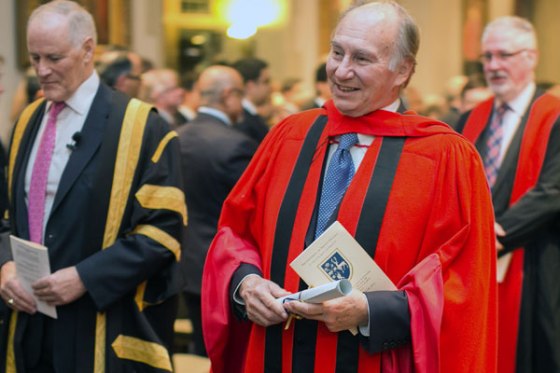
His Highness the Aga Khan with the Honourable Bill Graham, chancellor of Trinity College (at left) when he was awarded an honorary degree of Doctor of Sacred Letters on November 25, 2013, for his service to humanity. Photo: AKDN.
I. Excerpts from a Citation for His Highness the Aga Khan Delivered by the Rt. Hon. Adrienne Clarkson at Special Convocation, Trinity College, 25 November 2013.
I am deeply honoured to present today His Highness the Aga Khan, the Imam of the Shia Ismaili Muslims.
It was here at Trinity College in my first year, and actually in the living room at St. Hilda’s College across the street where I was living, when I first saw the picture of the young man aged 20 – also an undergraduate but at Harvard – who had just been named successor to his grandfather, the 48th Imam of the Shia Ismaili Muslims. I remember then thinking how extraordinary it was that someone almost my age would be taking on the leadership of 14 million people around the world on several continents, in diverse countries.
In this College the ideal and the beliefs we hold dear are held within the same ethical framework as that of His Highness.
The recipient of this Doctor of Sacred Letters today has two distinct roles in this world: one as spiritual leader which he has inherited as an extraordinary charge and has held now for 56 years, and the other in the world that we all live, in that he has built upon and recreated, involving all of us. He manifests the creative relationship of spiritual values and material concern which is unique in the world today.
He is the 49th hereditary Imam of the Shia Imami Ismaili Muslims. He is a direct descendant of the Prophet Mohammed, peace be upon him, through the Prophet’s cousin and son-in-law Ali, the first Imam and his wife Fatima, the Prophet’s daughter. He is the spiritual leader of 14 million Ismailis living all over the world…We are fortunate in Canada to count 100,000 Ismailis who are Canadian citizens. In his own being, His Highness encompasses the world.
Historically, the Ismailis developed a state that concentrated on arts, science and trade centered in Cairo for a number of centuries. But in the 13th century, the Ismailis were dispersed, a diaspora that spread to Persia, Central Asia, Syria, India, and eventually Africa. It is out of this dramatic dispersal and the necessary knowledge of living as a community to whom faith shows itself in works that the far-ranging and extraordinary activities of the present Aga Khan emerge.
Through the physical dispersal of their community through the centuries, their spiritual allegiance to the Imam and their adherence to the Shia Imami Ismaili branch of Islam was their greatest strength. The Ismaili community has developed through centuries an ethos of self-reliance, unity and common identity.
Ismailis have often been uprooted by radical changes in their respective countries, particularly on the Indian subcontinent and in East Africa where new nation states caused the dislocation of Ismaili populations. In 1972 when Idi Amin was president of Uganda, Ismailis and other Asians despite their citizenship and having lived there for several generations were expelled. So, fortunately for us, the Aga Khan took personal steps to find homes for the Ismailis not only in Asia but particularly in Canada and Europe. His personal appeal to Prime Minister Trudeau led to 10 000 Ismailis coming here in 1972. We did not realise as Canadians at the time how important this injection of Ismailis to our national and civic life would be. Who here does not have at least one Ismaili friend now? We have Ismaili students here at Trinity.
Christians and Jews in this country share in the Abrahamic tradition of Islam and we have much to learn from Quranic teachings. From the way in which the sacred and secular are knit together, and how it places a value on maintaining equilibrium between the spiritual well-being of an individual and the quality of their daily life. One thing that we who have been in Canada a little longer, notice about Ismailis is their devotion to community wherever they are and their willingness to give their time to volunteer activities. It springs from the Ismaili belief in man’s dignity and the idea that we are all human and that we must behave as though we are common members of that humanity. Therefore lending their skills, sharing their spare time, giving money, giving ideas to help relieve hardship, pain or ignorance is part of the DNA of the social consciousness of the Ismaili Muslim community.
In this place which all of us here who call ourselves Trinity graduates so treasure, it is deeply moving and appropriate for us to welcome as an honorary graduate a man who is perhaps the only person in the world to whom everyone listens. The Aga Khan remains an outstanding bulwark against ignorance, partisanship, and selfishness. He is honoured by civilisations that need not clash out of ignorance but can and must work together to fulfill God’s promise that we his people are one.
~~~~~~~~~~~~~~
“He not only celebrates diversity, he also honours the differences between people that can paradoxically give them their greatest bond….With the Aga Khan and what he represents, we are a better country.”

His Highness the Aga Khan and Mr John Ralston Saul, prominent Canadian essayist and novelist during a conversation on the challenges of pluralism which followed the lecture. Photo: AKDN/ Zahur Ramji.
II. Excerpts from an introduction by The Rt. Hon. Adrienne Clarkson at the LaFontaine-Baldwin Symposium, Toronto, Canada, on 15 October 2010.
He [the Aga Khan] embodies the values that we Canadians most cherish, and the actions that have created the country that we are. He not only celebrates diversity, he also honours the differences between people that can paradoxically give them their greatest bond. He has two roles in this world; one which he has inherited as an extraordinary charge, and the other that he has built upon and recreated, that now involves all of us. He manifests the creative relationship of spiritual values and material concern, which is unique in the world today, and is a model for all of us.
Ismaili tradition means that their Imam leads in the interpretation of matters of faith and the relationship of that faith to the conditions in the world in which we are living, the world in which we find ourselves. It is grounded in the ethics of Islam in which economic, social and cultural all come together to determine the quality of life for human beings. As the Aga Khan often says, “we have been created as one by a single Creator.”
Since 1957, projects have been initiated and always supported by the communities served no matter how diverse. They are aimed towards becoming self-sustaining, and frequently involve partnerships outside the Ismailis. Anyone who knows Ismailis in Canada, knows that they are the first to volunteer and give of themselves to causes which involve the common good. This is within their tradition and is admired by everyone in Canada. Through the Aga Khan Development Network, enormous work has been done because as His Highness has said, “development is sustainable, only if the beneficiaries become, in a gradual manner, the masters of the process.”
The Aga Khan Health Network has 168 centres in countries like Pakistan, India, Tajikistan, Afghanistan, Kenya, Tanzania, and Uganda. The Aga Khan Development Network is inclusive of the enormously different cultural traditions in all the countries and areas in which it all operates. And if you think about them, they’re so varied, that they are the very definition of diversity and plurality itself. In all these works, the Aga Khan seeks to create bridges, between the developed and the developing world. This is done with a very conscious sense of the dignity of all human beings. The consciousness that we are all human and nobody is more human than any other and the right of all human beings to the best that life has to offer in this world in culture, in health, in education, in participation.
I was very pleased that the Aga Khan accepted to be an honorary companion of the Order of Canada while I was Governor General in 2005 and during my last year in Ottawa I assisted as he put the spade in the ground for the Delegation of the Ismaili Imamat on Sussex Drive which is now open and is a beautiful architectural example on that very prominent roadway in Ottawa. Recently I was at the Foundation ceremony here in Toronto where ground was turned for the new Ismaili Centre and for the Museum for Islamic art which will grace a wonderful place just beside the Don Valley Parkway. In 2009, he was made an honorary citizen of Canada. Last week the Global Centre for Pluralism which is a partnership between the Aga Khan Development Network and the Government of Canada had its first meeting. I am delighted to be on that Board and to chair the Executive Committee to help forward His Highness’ vision with the partnership of Canada about plurality and diversity, making us all stronger. Canada should be very proud that he has chosen us as the centre for this work, which he holds very dear to his heart. On behalf of all Canadians, I thank him for this.
We could have no finer citizen and we could have no finer bearer of the motto of the Order of Canada: “they desire a better country.” With the Aga Khan and what he represents, we are a better country.
Date posted: September 19, 2016.
___________
 The term Salgirah is of Persian origin. Sal means anniversary and girah means knot and hence Salgirah literally means ‘an anniversary knot added on to a string kept for the purpose’. This article approaches the subject of Mawlana Hazar Imam’s birthday in terms of the Imam’s love for his murids and the love and devotion of the murids for their Imam.
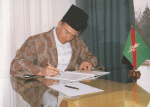 The new Ismaili Constitution was ordained, signed and sealed by His Highness the Aga Khan on December 13th, 1986, his 50th birthday. His Highness did this with the belief that the Constitution would provide a strong institutional and organizational framework for his Ismaili community to contribute meaningfully to the societies among whom they live.
 Simerg - Insights from Around the World