By Abdulmalik Merchant
(Publisher-Editor, http://www.simerg.com, http://www.simergphotos.com and http://www.barakah.com)
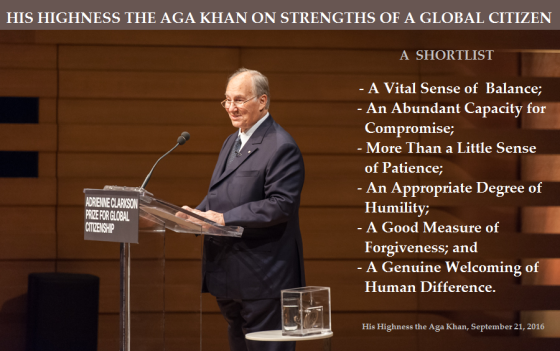
Photo: The Ismaili/Lisa Sakulensky. Copyright. Note: Superimposition of text on photo by Simerg.
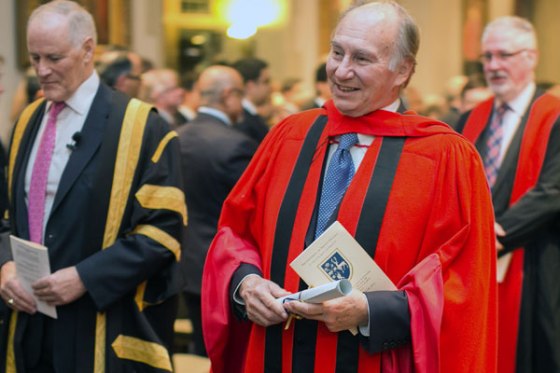
There were many cherishable and memorable moments on Wednesday, September 21, 2016, at Koerner Hall in Toronto when the inaugural Adrienne Clarkson Prize for Global Citizenship was presented to His Highness the Aga Khan. World renowned vocalist and songwriter Rufus Wainwright welcomed the audience with a wonderful rendition of Leonard Cohen’s song Hallelujah. We were reminded by Rufus that September 21 also marked Cohen’s birthday – his 82nd. A video of Prime Minister Justin Trudeau’s congratulatory message to His Highness Aga Khan received a big applause from the packed auditorium hall, as did the actual presentation of the unique award to His Highness by Madame Clarkson. This was followed by her welcome speech and the 49th Ismaili Imam’s words of wisdom.
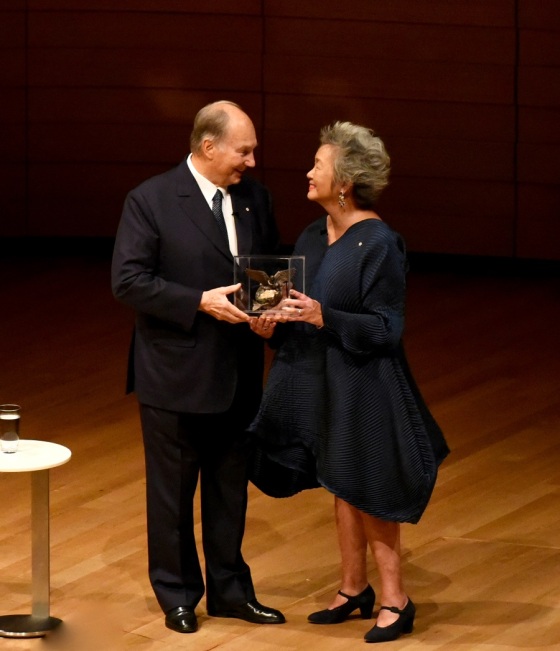
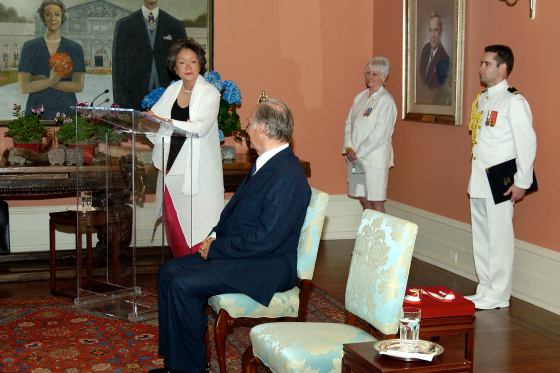
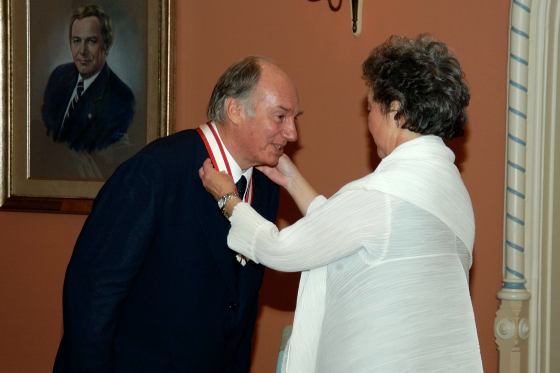
The Rt. Hon. Adrienne Clarkson, Canada’s 26th Governor General from 1999-2005, awarding the inaugural Adrienne Clarkson Prize for Global Citizenship to His Highness the Aga Khan, 49th Imam of Ismaili Muslims, in Toronto on September 21, 2016. Photo: The Ismaili/Vazir Karsan. Copyright.
But of all the absorbing moments that the event offered, there was one defining moment in Mawlana Hazar Imam’s speech that I took to my heart. In concluding his speech, Mawlana Hazar Imam defined what it takes for each one of us to be a Global Citizen. He said:
“These are just a few thoughts as I look to the future of Global Citizenship. The challenges, in sum, will be many and continuing. What will they require of us?
“A short list might include these strengths: a vital sense of balance, an abundant capacity for compromise, more than a little sense of patience, an appropriate degree of humility, a good measure of forgiveness, and, of course, a genuine welcoming of human difference.”
It was with reference to this last sentence that Madame Clarkson then began her conversation with Mawlana Hazar Imam. The following is a transcript that Simerg has prepared from an audio recording of the event, and we invite our readers to view the video of the wonderful event through the links that we have provided at the bottom of this page.
TRANSCRIPT OF THE CONVERSATION
(Prepared by Simerg from an audio recording)
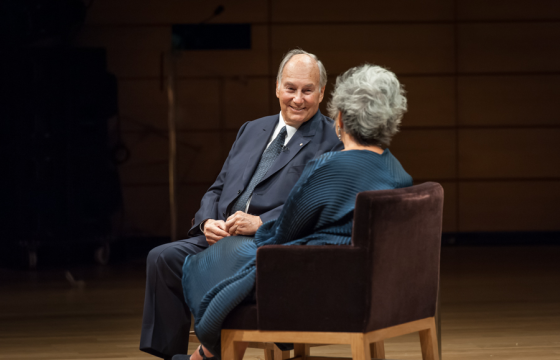
His Highness the Aga Khan and the Rt. Hon. Adrienne Clarkson in conversation following the presentation of the Global Citizenship Award to the Ismaili Imam on September 21, 2016, in Toronto. Photo: The Ismaili/Lisa Sakulensky. Copyright. Ismaili.
Adrienne Clarkson: Thank you so much for those words. They are so well thought out, and over the years as we have known each other, I am always impressed by your deep sense of humane commitment and feeling that you have when you talk about things like forgiveness, and that, that is part of what we are as a society……One of the things I am very interested in, and I think everybody here is interested too, is in the fact that you put so much faith in Canada; that you have put institutions in Canada, like the Global Centre for Pluralism in Ottawa….And you have also put the Imamat in Ottawa. And when I think about it, I think: Is that because in 1972, we welcomed so many Ismailis. Is that the beginning of it, or is there something else about us: Is it that you are a secret fan of Mackenzie King.
Mawlana Hazar Imam: No, I think the answer to that is that as I look at the world around us, and I ask myself what would define countries where I would like to see my community reside. The first word that comes to my mind is countries of opportunity. And I believe Canada is one of the greatest countries of opportunity.
Adrienne Clarkson: I think that is true, and certainly the Ismaili community in Canada has made the most of the opportunities which all people who come to this country have. And that is the reason why I think people understand once they get here: that there lives are going to be different. And that is one of the interesting things too about what you talk about to the Jamat, to the community. And I think something that people should realise in the rest of Canada that you have your community, and it is very important; but that you emphasise how important it is to be part of the world outside your community. And why do you do that?
Mawlana Hazar Imam: Well, I have to go back to 1957. In 1957, many of the countries where my community was living were colonies. And those countries needed to go through the process of independence, needed to find the pathways forwards towards peace, towards development. And I have asked myself: How do countries achieve that? And if you go back to 1957, you look at the map of our world, and you try to define where all these countries that have now become independent, have created opportunity; I think one has to say that that has not been very successful.
Adrienne Clarkson: What have been the barriers? What are the barriers?
Mawlana Hazar Imam: Oh, I think there is a multitude of barriers. First of all, I suppose national resources would be a major issue. The second would be the level of human ability within a given country, whether it has a human ability to develop its resources, to build opportunity. So in that sense we are looking at processes of change. And they have occurred; they have occurred. There are today countries of opportunity which either did not exist or one would not have thought of as being countries of opportunity in 1957 when my grandfather died.
Adrienne Clarkson: And that has changed.
Mawlana Hazar Imam: That has changed.
Adrienne Clarkson: Well, you have had a lifetime of opportunity to see that. It is very rare to meet somebody who has had such an effect on the world, not only on a group of people, but in the world. Because that is what you have made it in sixty years. Next year will be your sixtieth anniversary as the Imam. And in sixty years, you have seen development, you have made development happen, you made resources available to places where there were absolutely no resources. And in doing that, it cannot have been easy to decide where that would happen, to decide who would be the collaborators, to bring along people who could understand and have the capacity to help with that development. How did you go about doing that?
Mawlana Hazar Imam: [I think] what you try to do is look at circumstances on an on-going basis. And then you work through what I would call predictability, and you try to project into the future what countries have the ability to follow the path of peace and development. And where there are situations which are potentially difficult, and that, of course, is something which changes practically every day; and, of course, it has changed a lot since 1957.
Adrienne Clarkson: And they did not teach you that at Harvard.
Mawlana Hazar Imam: I am not sure what they taught me at Harvard.
Adrienne Clarkson: We all wonder what we learned at university and how that was relevant to anything that we are doing today. But I think what is interesting in what you have been saying over the last, particularly over the last decade in your speeches, in your writings is that ignorance that we have. And I am always struck by the fact that we are, we speak out of such ignorance in a so-called western developed world, particularly about Islam. We do not know the varieties of the Muslim world at all, we seem not to be even interested in it, and the more people shout about it, the worse it becomes, because it is as though we shut out everything that could be various, that could be different, that could have any kind of nuance in it. How do you mitigate against that?
Mawlana Hazar Imam: I think probably the first step would be to extract from Islamic history, from Islamic philosophy the great names, the great thinkers, the great astronomers, the great scientists, the great medical figures, who have influenced global knowledge. I remember courses which taught general humanities. And those general humanities caused one to read in French, or Italian, or German, or English. Arabic! Never heard of it; Urdu! Never heard of it; Farsi! We do not even know what that is. So, it was a frightening vacuum in general education at the time. And I think that that vacuum has had terrible results.
Adrienne Clarkson: No, of course it has. It is ridiculous. I mean, we met only a few years ago, William Polk who was the first translator of the great epic Bedouin poem. And to think that only practically in the 21st century did we have access to that in translation is frightening, almost. A lacunae of knowledge. Not even accessible to us in any way.
Mawlana Hazar Imam: And that I think is one of the really serious issues – is that the cultures of Islam, of the Islamic world are not present in global cultural (let us say, how would I call it) presence.
Adrienne Clarkson: Well, of course, you have given us an enormous gift to Toronto in the Aga Khan Museum and the Jamatkhana, which is now virtually in the geographic centre of Metropolitan Toronto. And I think by those wonderful Islamic gardens with the pools of water, but using native Canadian trees, and native Canadian plants. I always think of you as somebody with a motto of: No idea too big, no detail too small. Because I know how you look at everything: you know, the grouting in the marble, the bulbs that will be planted, the colours of the bulbs. And, of course, that is an enriching thing for you to have that detail in your life, but also I think it enriches us. And when I think of the role that beauty and culture play in the message that you have to the world, I think we are enormously grateful to you…..
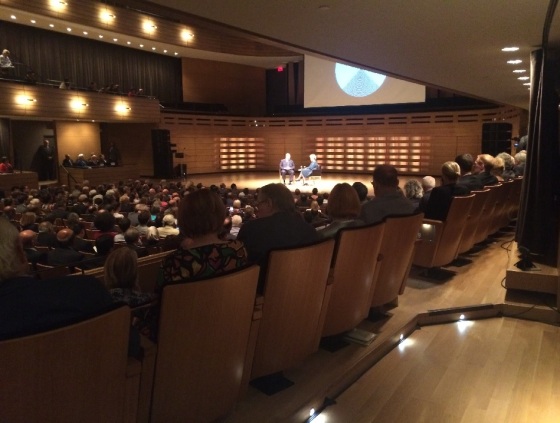
His Highness the Aga Khan and the Rt. Hon. Adrienne Clarkson in conversation following the presentation of the Global Citizenship Award to the Ismaili Imam. on September 21, 2016 in Toronto. Photo: Simerg.
(The Rt. Hon. Adrienne Clarkson then went on to describe the restoration work carried out by the Aga Khan Trust for Culture at the Humayun Gardens in New Delhi and the Babur Gardens in Kabul as well as the creation of Cairo’s new Al-Azhar Park from a site that had been used for many centuries as a landfill. The description is being skipped here. – Editor).
Adrienne Clarkson……..Why do you think beauty is so important to us, even when there are so many other needs around?
Mawlana Hazar Imam: Well, I think, all faiths express themselves in some cultural form or the other. And Islam is a faith which has expressed itself in cultural manifestations over centuries in different parts of the world. And I think it is very important that those manifestations should be seen and should be, I hope, admired, and that they should inspire young people who are talented young architects, land planners, whatever it may be. So that they can inspire their own buildings with a sense of continuity, but of our time. And I think it is very important that we not try to plagiarise history. (Laughter). I would get a, what would it be, a D or an E at Harvard for plagiarization.
Adrienne Clarkson: Well, of course, when you restore things or you make things new, you have to always avoid that. You have to say I am making something new. And that does not seem to fill you with any kind of fear.
Mawlana Hazar Imam: No, I think that every people in every given time should be encouraged to express themselves. And I remember that when the Pyramid was built in the Louvre, in the courtyard of the Louvre, there was immense debate as to whether this was appropriate or not. Well, it is there!
Adrienne Clarkson: Yes, yes, it is there. When we look at the world today….The rise of the Hard Right, of the really almost Fascist movements, reminds us sadly of times in the 1930s, and we have to really watch that because all that is to raise fear in people. And once fear rules people, they become blinded to all kinds of things. How do you deal with that? How do we deal with the fear?
Mawlana Hazar Imam: I think in this particular case, the issue is whether these countries have been willing to prepare themselves for this situation. Canada is a country that has permanent preparation. It is the way the country thinks. It welcomes people to come from outside, it has the institutions to support them when they arrive. It helps them integrate into Canadian society. That is not true of many western European countries, because they are facing economic constraint, because there are social tensions in various European countries also. Northern Europe does not speak the same language as Southern Europe, nor do they face the same problems. So I think we are living at a time when there are real difficulties, and my sense is that they are going to have to be analysed and solutions are going to have to be found. Because the movement of people is not going to stop. I do not see that stopping. It is driven by a number of factors, and I think in many of the countries which are sending people to Europe today, are dealing with populations who are seeking opportunity. There is a great sense of lack of opportunity. Opportunity is next door, it is not (around).
Adrienne Clarkson: (You know) When you were named as Imam in your grandfather’s will, he said he felt that he had to appoint somebody who was a young man, a man who was born in the atomic age, that is, the age of the 20th and 21st century. Has that influenced the way you think of things? Do you think of things in terms of a kind of millennial way, because you were appointed so young and you took on those duties so young. You knew you were expected to do something different. That is implicit in that will.
Mawlana Hazar Imam: Right. At the time and even today, many of the questions that I ask myself and that I discuss with members of my community is medium- and long-term projecting. Where are we going? And are we going in the right direction in various countries? Are we being equitable in relation to the demography of the community? Are we over-committing in certain parts of the world and under-committing in others? Are there circumstances in regions which make it impossible for our institutions to function? Or, on the contrary, are there countries that would welcome them? So we are looking at, let’s say, a semi-global situation on an on-going basis. So, in that sense, we are looking at how to plan. And planning, I think, in our case requires institutional initiative. We need to get our institutions in place before people decide to move.
Adrienne Clarkson: Well, that is the point. You are there before!
Mawlana Hazar Imam: We try.
Adrienne Clarkson: You are there before, because you have to then predict and you have to then say we are going to be out front, and when the tide is ready we will have the port built, so that the ships can arrive. How do you do that?
Mawlana Hazar Imam: You pray that Idi Amin never comes back!
Adrienne Clarkson: Yes. Well, let’s hope that that was only once in a hundred years, at least. But the idea of a threat to so many people comes up over and over again. I mean we know more about it now, because we have instant communications. So we know when whole groups are threatened, when things happen like that. But, you know, the ignorance that I talked about earlier is almost terrifying. That people do not understand the Muslim world whatsoever. And they do not understand, as you touched on in your speech, they do not understand the differences in the Muslim world. They have never read the Koran, they would not think of reading it or taking a study course in it. And I think that sort of thing really means that ignorance is promulgated and continued. And then, you know when very careless media add to that, then you really do not understand. Also, the other thing that I always like to point out is that Islam is six hundred years younger than Christianity. So, Christians should think, you know, what was Christianity like in the 15th century. And who was talking then? And how were they divided? It is very interesting to think of it in the cycles of history, as opposed to, just thinking, it is now and we are all the same and we are all equal, etc. We are not, really, because we have different heritages.
Mawlana Hazar Imam: That is true, but there was also a lot of inter-faith communication in the Middle Ages.
Adrienne Clarkson: That is right. The inter-faith communication is..
Mawlana Hazar Imam: A great deal [of inter-faith communication], particularly in the field of mystic faith.
Adrienne Clarkson: Mysticism!
Mawlana Hazar Imam: Yes.
Adrienne Clarkson: Linking Sufism and so on with Christian mysticism.
Mawlana Hazar Imam: Yes. Personal search.
Adrienne Clarkson: Why have we lost that?
Mawlana Hazar Imam: Probably, the requirements of modern life.
Adrienne Clarkson: Can we do anything about it? Should we be trying? Is that one of the things we should be trying, besides thinking of development, besides thinking of, you know, creating universities and schools. Can we do that?
Mawlana Hazar Imam: I think we need to reflect over is generosity in society. Our faith, the faith of Islam teaches generosity. But, I think it is very important that generosity should be part of public psyche.
Adrienne Clarkson: And that means being brought up with it.
Mawlana Hazar Imam: Means being brought up with it. Means recognising those in need of help. Means creating institutions to deliver that help. And, obviously, in poor countries, it is very difficult to achieve. But it should be a goal.
Adrienne Clarkson: Well, the problem is that the gap between rich and poor is growing and growing and growing, and not just in the developing world, but in the developed world. That is one of the real problems now for us, I think, as a society in the West is that disparity between the haves and have-nots. And the more that grows, the more unjust society becomes. And there seems to be very little that people want to do about that, very little that they really want to do about it. And things become charity. Charity is not the right way to go about it; development is the right vehicle now, surely.
Mawlana Hazar Imam: Yes. Well, in the faith of Islam the best charity is to give, to enable an individual or a family to become independent of their economic destiny. That is known as the best charity.
Adrienne Clarkson: How often is it? Does it happen?
Mawlana Hazar Imam: I honestly do not know. I would have to ask our bankers.
Adrienne Clarkson: As a final thing, I would like to ask you: What do you really think will happen now in the medium term for our future as we see Britain wanting to leave Europe, as we see the rise of very hard Right in the European countries, as we see what is happening in the United States, which is hardly even mentionable. What can we hope for now? How can we as individuals who really want to make things better, as we are faced with all of this, how does it happen, for us now?
Mawlana Hazar Imam: I think we have to offer rational people, options. I think it is very important to put in front of public opinion, good options. Alternatives.
Adrienne Clarkson: Different ways of behaviour.
Mawlana Hazar Imam: Different ways of behaving.
Adrienne Clarkson: And how do we do that? How do we make that? Is that through education? Is that through incentives? What is it? How is it done?
Mawlana Hazar Imam: I think it is through men and women coming forward to take positions of leadership. I think it is institutions who need to engage, rather than let the field open to anything. And, I have been very impressed since 1957 in developing countries, when elections had to be held or were held in circumstances where you would assume that the population did not have access to the information they would have, in our view, needed to express themselves rationally and competently. Well, I got it wrong. They are very, very wise. Public wisdom is not dependent on education.
Adrienne Clarkson: You are practically talking about Jung’s collective unconscious there. Is that, that there is a kind of wisdom that people share.
Mawlana Hazar Imam: Yes.
Adrienne Clarkson: Because of their common humanity.
Mawlana Hazar Imam: Because of the common humanity. Because of the common circumstance in which they are living.
Adrienne Clarkson: But does that bring us hope – as, you know, a collection of your speeches as ‘Where Hope Takes Root”. Is that where hope will take root?
Mawlana Hazar Imam: Yes. I believe so. But it means that decision makers have to be responsive.
Adrienne Clarkson: Well, it is very discouraging often when you look at the people who are elected in public office in different countries and the countries seem to vote for people that will harm them the most. Often, this is the most discouraging when you see in a democratic situation, even in free ones, where people will vote for something that is going to really harm them, and they do not seem to realise that it is very, very difficult, very difficult even because we have freedom of the press, we have enormous freedoms, particularly in North America and most of Europe. We have all those freedoms and yet we are in the dilemma that we are…Does that come back to the individual and their ability to do things?
Mawlana Hazar Imam: I think it comes back to the way the individual, or the family, rather than the individual, evaluate their position in society at a given time. Ultimately, the basic issue is: How does a family feed itself and educate the children, generation after generation? It is that clear, it is that important. And if society is able to provide that for the totality of the population in a given country, that is already a very sound foundation. But that is a condition sine qua non for a country to move ahead. If you have pockets of poverty, if you have populations or groups of populations who are marginalised, you are looking at a series of issues that one year are going to blow up. The predictability of crisis, in my view, in Third World countries is much higher than people would believe.
Adrienne Clarkson: You could predict them.
Mawlana Hazar Imam: You can predict them.
Adrienne Clarkson: Then why do not we avert them?
Mawlana Hazar Imam: Ah, that is a different question. I think predicting them is something that you can do, averting them does depend on a lot of different issues. That is not always easy.
Adrienne Clarkson: Thank you so much, Your Highness.
Mawlana Hazar Imam: Thank you. Thank you.
~~~~~~~
STATEMENT BY ANNA WILLIAMS, SCULPTOR OF THE MEDAL PRESENTED TO HIS HIGHNESS THE AGA KHAN

The medal presented to His Highness the Aga Khan for the Adrienne Clarkson Prize for Global Citizenship was sculpted by Anna Williams. The photo and her statement (below) are from the program booklet “Six Degrees Citizen Space 2016,” published by 6DegreesTO.com.
“Adrienne Clarkson asked me to create a medal for the Prize for Global Citizenship. I had the idea of bringing together the world of creation with that of the great mythological winged deities. Sedna is the Inuit goddess from whom all creatures of the sea spring. Atlanta, Nike, Lilith and the winged bearers of souls in Norse lore, the Valkyrie, each exist in an imperfect world. But through their strength, intelligence, independence, and compassion, they have created an iconography of champions and dissenters. Each in their own way is unyielding and stands apart as they chart a new course against buffeting waves. In the narrative of this medal, Sedna the creator emerges from the waves to pass a vulnerable world to the outstretched arms of our winged guardian.” — Anna Williams, sculptor.
Date posted: September 22, 2016.
Last updated: September 23, 2016, 15:25 (new photos added, completion of interview transcript and artist statement for Global Citizenship Medal).
____________
Please visit http://www.theismaili.org and http://www.akdn.org for extended coverage of the presentation ceremony.





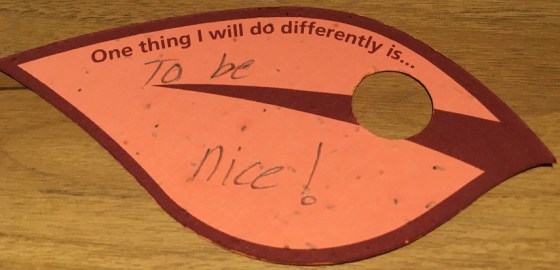
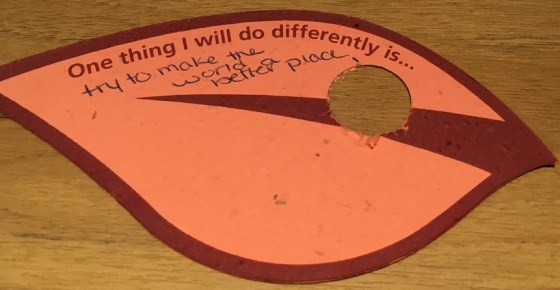
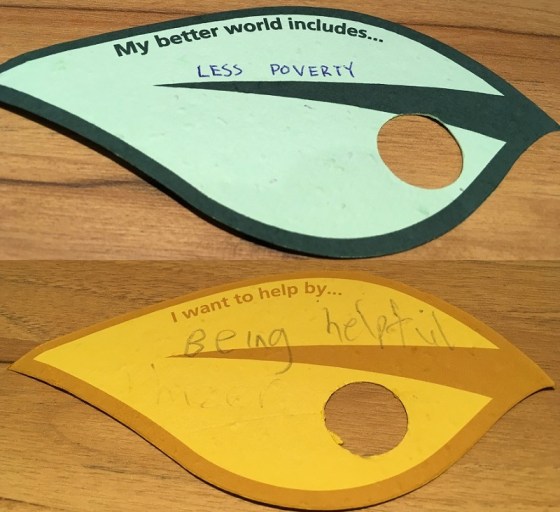
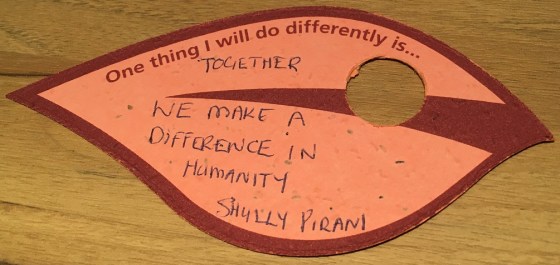
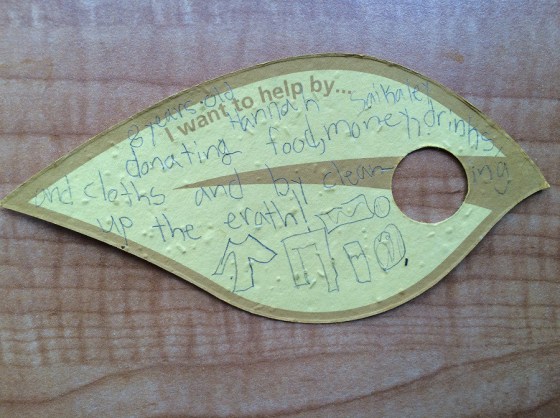 8 year old Hannah Saikaley’s wants to help by “Donating food, money, drinks and clothes and by cleaning the earth.”