A Unique Video of the Signing Ceremony Establishing “Seat of the Ismaili Imamat” in Portugal

Editor’s note: We are pleased to offer our readers a link to an extraordinary footage shown on Portuguese Cable News Channel, SIC Noticias,  of the signing ceremony that took place in Lisbon establishing the Seat of the Ismaili Imamat in Portugal. We also include two other short clips of remarks made by the Foreign Minister of Portugal and the Prime Minister of Portugal. The event in Lisbon on June 3, 2015 was a truly historic moment in the modern history of the Ismaili Imamat, and earlier this week we brought you the complete English text of the Agreement. Readers who haven’t read the text are invited to click on “Seat of the Ismaili Imamat” — Text of the Historic Agreement.

I. FANTASTIC VIDEO OF THE HISTORIC SIGNING ESTABLISHING THE SEAT OF THE ISMAILI IMAMAT IN PORTUGAL

Please click on image below or “Video of the Signing of the Historic Agreement Establishing the Seat of the Ismaili Imamat in Portugal

His Highness the Aga Khan signing the historic document establishing the Seat of the Ismaili Imamat in Portugal. Please click on image to view the video.

His Highness the Aga Khan signing the historic document establishing the Seat of the Ismaili Imamat in Portugal. Please click on image to view the video.

~~~~~~

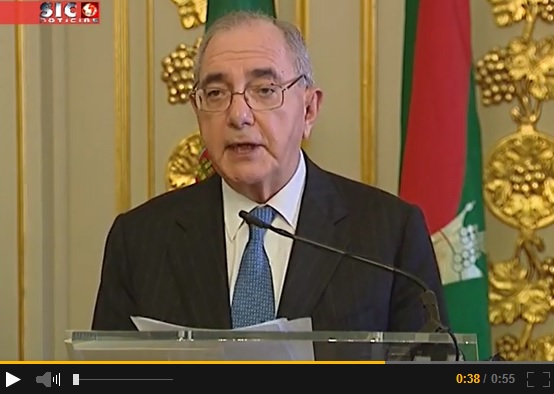
II. REMARKS BY THE MINISTER OF FOREIGN AFFAIRS, RUI MACHETE

Portugal's Minister of Foreign Affairs speaking at the signing of the Agreement  establishing the Seat of the Ismaili Imamat in Portugal. Please click on image to view a video clip of the remarks.

Portugal’s Minister of Foreign Affairs speaking at the signing of the Agreement establishing the Seat of the Ismaili Imamat in Portugal. Please click on image to view a video clip of the remarks.

~~~~~~

III. REMARKS BY THE PRIME MINISTER OF PORTUGAL, PEDRO PASSOS COELHO

Portugal's Prime Minister speaking at the signing of the Agreement establishing the Seat of the Ismaili Imamat in Portugal. Please click on image to view a video clip of the remarks.

Portugal’s Prime Minister speaking at the signing of the Agreement establishing the Seat of the Ismaili Imamat in Portugal. Please click on image to view a video clip of the remarks.

Date posted: August 6, 2015.

Full English text of agreement at “Seat of the Ismaili Imamat” — Text of the Historic Agreement Between the Ismaili Imamat and the Portuguese Republic.

__________

This post is also reproduced at http://www.simergphotos.com, Simerg’s photo blog.

“Seat of the Ismaili Imamat” — Text of the Historic Agreement Between the Ismaili Imamat and the Portuguese Republic

Introduced by Abdulmalik Merchant
Publisher-Editor, Simerg.com

Mawlana Hazar Imam thanking the government for inviting the Ismaili Imamat to establish its permanent Seat in Portugal. TheIsmaili/Gary Otte

June 3, 2015: Mawlana Hazar Imam thanking the government for inviting the Ismaili Imamat to establish its permanent Seat in Portugal. TheIsmaili/Gary Otte

On Thursday June 4, 2015, in a piece entitled History in the Making: Establishment of the Seat of the Ismaili Imamat in Portugal, we informed our readers about a landmark agreement that was signed a day earlier by His Highness Prince Karim Aga Khan, the 49th hereditary Imam of the Shia Imami Ismaili Muslims, and Portugal’s Minister of State and Foreign Affairs, Rui Machete, at the historic Necessidades Palace in Lisbon. The Agreement marked the first such accord in the Ismaili Imamat’s modern history.

We are pleased to inform our readers that we now have access to this milestone agreement which is being reproduced in full below based on the text of the original English version of the document, which appears on the website of the Portuguese Parliament. [1]

The Agreement is divided into 5 chapters dealing with (1) General Provision; (2) The Seat of Imamat; (3) Prerogatives of the Imam and the Members of the Seat; (4) Cooperation; and (5) Final Provisions, and consists of  21 articles. The Agreement, reflecting the mutual trust and esteem which has traditionally characterised the relationship between the Republic of Portugal and Mawlana Hazar Imam, affirms the recognition of the legal personality of the Ismaili Imamat.

During the signing on June 3, His Highness the Aga Khan hailed the agreement as a historic milestone in the Imamat’s history and said:

“Today is a unique and important occasion, where for the first time in our history we will have the opportunity to work with a partner with whom we share so many values, so many hopes and so many desires.”

________________

AGREEMENT BETWEEN
THE PORTUGUESE REPUBLIC
AND
THE ISMAILI IMAMAT
FOR
THE ESTABLISHMENT OF
THE SEAT OF THE ISMAILI IMAMAT IN PORTUGAL

Mawlana Hazar Imam and Portugal’s Minister of State and Foreign Affairs Rui Machete sign a landmark agreement establishing a formal Seat of the Ismaili Imamat in Portugal. TheIsmaili/Gary Otte

Mawlana Hazar Imam and Portugal’s Minister of State and Foreign Affairs Rui Machete sign a landmark agreement on June 3, 2015, establishing a formal Seat of the Ismaili Imamat in Portugal. TheIsmaili/Gary Otte

The Portuguese Republic and the Ismaili Imamat, hereinafter referred to as “Parties”,

Considering the Protocol of Co-operation between the Government of the Portuguese Republic and the Ismaili Imamat, signed in Lisbon on 19 December 2005 and considering further the Protocol of International Co-operation between the Ministry of Foreign Affairs of the Portuguese Republic and the Ismaili Imamat signed on 11 July 2008;

Recalling the Agreement between the Portuguese Republic and the Ismaili Imamat, signed in Lisbon, on 8 May 2009, whereby the legal personality of the Ismaili Imamat is recognised;

Having in mind the common purpose of strengthening the historical ties uniting both Parties, as well as of promoting enhanced enabling conditions for the activities of the Ismaili Imamat, its governance bodies and its dependent institutions, in particular the member entities of the Aga Khan Development Network;

Furthermore having in mind the promotion of the quality of life of the global Shia Imami Ismaili Muslim Community and more generally of the people of the countries where the Ismaili Imamat or its dependent institutions are or may become active, including Portugal and the Portuguese people in particular;

Considering that both Parties assume, as common objectives, the defence of human dignity, economic and social development, interfaith dialogue and the peaceful resolution of conflicts, as ways of achieving justice and peace;

Affirming the interest of both Parties in the establishment of the Seat of the Ismaili Imamat in the territory of the Portuguese Republic and their common will mutually to respect each other’s autonomy in the context of the mutual trust and esteem which has traditionally characterised their relationship;

Believing in the historic significance of such a decision for both Parties and fully appreciating the long term implications and complexities that such a decision entails;

Considering that the privileges, immunities and facilities recognised are not granted for the personal benefit of their holders, but merely in order to contribute to the effective and independent performance of their official and institutional functions on Portuguese territory;

Agree as follows:

Chapter I: General Provisions

ARTICLE 1

Definitions

For the purposes of this Agreement, the following terms shall have the meaning set forth below:

a) “Ismaili Imamat”, a legal entity, means the institution or office of the Imam of the Shia Imami Ismaili Muslims established in accordance with the applicable customary law;

b) “Imam” means the Imam of the Shia Imami Ismaili Muslims, embodying the Ismaili Imamat at any given time in history, designated in accordance with the said customary law;

c) “Dependent Institutions” means the instrumentalities of the Ismaili Imamat, in particular the member entities of the Aga Khan Development Network around the world, more particularly Fundação Aga Khan, a Portuguese foundation created by decree-law in 1996;

d) “Seat” means the global head office of the Ismaili Imamat, as further defined in the present Agreement;

e) “Members of the Seat” means the Senior Officials and the Staff Members of the Seat of the Ismaili Imamat;

f) “Senior Officials” means the Heads of the Ismaili Imamat Departments;

g) “Staff Members” means the Members of the Seat employed in the administrative and technical service of the Seat;

h) “Premises of the Seat” means the buildings or parts of buildings and the land ancillary thereto used exclusively for carrying out the official mission and performing the official functions of the Ismaili Imamat, including the central Seat premises, the premises of the Delegation of the Ismaili Imamat in Lisbon and the official residence of the Imam.

ARTICLE 2

Object

1. The Portuguese Republic acknowledges the legal personality and capacity of the Ismaili Imamat to act in international relations and welcomes the decision of the Imam to establish the Seat of the Ismaili Imamat in Portugal.

2. This Agreement establishes the privileges, immunities and facilities extended by the Portuguese Republic to the Ismaili Imamat, the Imam, the Senior Officials and the Staff Members, as well as to its Seat and assets, with a view to ensuring the performance of their official functions in Portugal and facilitating the same internationally.

_____________

Chapter II: Seat of the Ismaili Imamat

ARTICLE 3

Seat

1. The Portuguese Republic shall ensure the conditions for the establishment of the Seat of the Ismaili Imamat within its territory as well as for the exercise of its functions, in accordance with the present agreement.

2. The location of the Premises of the Seat shall be subject to mutual agreement between the Parties. Pending the construction or acquisition of the central Premises of the Seat, and within a period of five (5) years, the Seat may be established in Lisbon, in the existing premises of the Delegation of the Ismaili Imamat. The Imam shall notify his decision in this respect to the Minister of Foreign Affairs.

ARTICLE 4

Function of the Seat of the Ismaili Imamat

The function of the Seat is to serve as the global head office of the Ismaili Imamat with a view to:

a) Facilitating the spiritual and secular guidance of the Imam to the Ismaili Community globally;

b) Promoting the quality of life of the Ismaili Community globally and more generally of the people of the countries where the Ismaili Imamat or its Dependent Institutions are active;

c) Enhancing international relations and co-operation with States, International Organisations and other entities.

ARTICLE 5

Appointment of the Members of the Seat

1. The appointment of the Senior Officials of the Seat of the Ismaili Imamat by the Imam shall be preceded by a consultation with the Portuguese Government and shall be notified to the Ministry of Foreign Affairs according to the procedures applicable to members of diplomatic missions accredited in the Portuguese Republic.

2. The number of Members of the Seat shall be determined by the Imam as may be necessary to enable the Ismaili Imamat to carry out its functions. The Ismaili Imamat will review such number with the Ministry of Foreign Affairs.

3. The Ministry of Foreign Affairs shall issue diplomatic identity cards to the Members of the Seat, according to the functions they perform, the highest level being attributed to Senior Officials and the other levels to the other Members of the Seat as the Minister of Foreign Affairs and the Imam shall establish.

ARTICLE 6

Inviolability of the Premises of the Seat

1. The Portuguese authorities shall take all appropriate steps to protect the Premises of the Seat of the Ismaili Imamat against any intrusion, threats or damage.

2. The Premises of the Seat, as well as the Ismaili Imamat land, air or sea vehicles used for its official functions, are inviolable, except in emergency situations that endanger public order and security, in case of a serious incident or any other event requiring immediate protective measures.

3. The Premises of the Seat cannot be used as a place of refuge for any individual prosecuted for a crime or flagrante delicto or subject to a court warrant, criminal conviction or a deportation order issued by the Portuguese authorities.

ARTICLE 7

Inviolability of files and correspondence

The files and documents as well as the official correspondence of the Ismaili Imamat are inviolable at any time and wherever located within Portuguese territory.

ARTICLE 8

Use of distinctive signs

The Ismaili Imamat shall be entitled to use distinctive signs, flags and emblems, in the Premises of the Seat as well as on any of the said official vehicles, which shall enjoy a registration status no less favourable than that accorded by the Portuguese Republic to diplomatic missions.

ARTICLE 9

Facilities in respect of communications

The Ismaili Imamat shall enjoy on the territory of the Portuguese Republic, for the purposes of its official communications and correspondence, treatment no less favourable than that accorded by the Portuguese Republic to diplomatic missions.

ARTICLE 10

Immunity from jurisdiction and from execution

The Ismaili Imamat and its assets shall enjoy immunity from jurisdiction and execution within the scope of its official activities, except:

a) When the Ismaili Imamat expressly waives those immunities;

b) In the context of cases related to employment contracts;

c) In a lawsuit brought by a third party with a view to obtaining financial compensation for death and injuries suffered as a result of an accident caused by vehicles owned or used by the Seat, or in case of any offence involving one of those vehicles.

ARTICLE 11

Fiscal exemptions

1. Gifts and bequests made by the Ismaili Imamat or the Imam within the context of their official functions or received by the Ismaili Imamat or the Imam, as well as income received by them, including capital gains, as well as the assets held by the Ismaili Imamat or the Imam, shall not be subject to any tax, including income or wealth tax.

2. Without prejudice to the application of more favourable provisions, granted by the Portuguese Republic to any other religious institution, the provisions of paragraph 1 shall not extend to:

a) Income deriving from any business activity directly exercised in Portugal neither to the assets connected to such activity;

b) Interest and other investment income, either due or paid by any resident in Portugal or effectively connected with the activity of a permanent establishment or fixed base in Portugal, as foreseen in the Portuguese corporate income tax code.

3. The income referred to in paragraph 2 (b) shall be subject to withholding tax, of a final character, in accordance with the corporate income tax legislation of the Portuguese Republic.

4. The Ismaili Imamat shall be exempt from any national or local tax on immovable property as regards the Premises of the Seat.

5. The Ismaili Imamat and the Imam shall be exempt from stamp duty, as well as from any other transfer tax, on the acquisition or sale of movable or immovable properties used or to be used for their official functions.

6. The Ismaili Imamat and the Imam shall be exempt from any taxes or duties on the purchase, ownership, registration, use or sale of land, air or sea vehicles, including spare parts and consumables, used for its official functions.

7. The Ismaili Imamat shall be entitled to a refund of the amounts corresponding to VAT paid on goods, including the vehicles above-mentioned, and services purchased or imported for its official use. The Portuguese Republic will establish the conditions and procedures for the application of such refund.

8. Gifts made to the Ismaili Imamat shall be tax deductible according to the Portuguese legislation applicable to gifts made to religious institutions.

ARTICLE 12

Funds, foreign currency and assets

1. Subject always to the laws and regulations of the Portuguese Republic and of the European Union, namely those regarding the fight against money laundering and terrorism, the Ismaili Imamat may hold funds, securities, gold and other precious metals, or foreign currencies.

2. The Ismaili Imamat shall be free to receive any such values from within or from outside Portugal and hold and transfer the same within Portugal or from Portugal to any country and to convert any currency held or bought into any other currency.

3. This does not preclude the Portuguese Republic from adopting any requirements resulting from its membership of the European Union, including measures prohibiting, restricting or limiting the movement of capital to or from any third country.

Continued after photo below

The agreement establishing Portugal as the seat of the Ismaili Imamat took place at the Palace of Necessidades. It  is a historical building in the Largo do Rilvas, a public square in Lisbon, Portugal. It serves as headquarters of the Portuguese Foreign Ministry. Palace Photo Photo: Wikipedia.

The agreement establishing Portugal as the seat of the Ismaili Imamat took place at the Palace of Necessidades. It is a historical building in the Largo do Rilvas, a public square in Lisbon, Portugal. It serves as headquarters of the Portuguese Foreign Ministry. Palace photo: Wikipedia.

Chapter III: Prerogatives of the Imam and the Members of the Seat

ARTICLE 13

Prerogatives of the Imam

1. The Imam shall be granted the following prerogatives:

a) Ceremonial diplomatic treatment accorded in Portugal to foreign High Entities;

b) His official residence shall enjoy the same inviolability and protection as the premises of the Seat;

c) Inviolability of any type of papers, documents or materials as well as of any communications;

d) Immunity from any judicial action and legal proceedings in respect of acts done in the performance of his functions for the Ismaili Imamat, including immunity from any measures of execution;

2. The direct family members of the Imam shall be accorded the appropriate facilities and courtesy treatment.

ARTICLE 14

Prerogatives of the Senior Officials

The Senior Officials of the Seat shall enjoy such privileges, immunities and facilities as are necessary for the performance of their functions, such as:

a) Ceremonial treatment accorded to diplomatic representatives of equivalent level and in the same circumstances;

b) Their residence shall enjoy the same inviolability and protection as the Premises of the Seat;

c) Inviolability of any type of papers, documents or materials relating to the functions of the Ismaili Imamat, as well as of any communications;

d) Immunity from any judicial action and legal proceedings, including immunity from any measures of execution, in respect of acts done by them in the performance of their functions for the Ismaili Imamat;

e) Exemption from all direct taxes and social charges on salaries, wages and other similar remuneration paid to them in their capacity as Senior Officials by the Ismaili Imamat or its Dependent Institutions;

f) When required by Portuguese or European legislation, facilitation of issuance of visas and residence permits, extended to direct family members.

ARTICLE 15

Prerogatives of the Staff Members

The Portuguese authorities guarantee the protection and necessary assistance to the Staff Members of the Seat with a view to securing the efficient performance of their official functions, including, when required by Portuguese or European legislation, facilitation of issuance of visas and residence permits.

Chapter IV: Cooperation

ARTICLE 16

Support for scientific and economic development

1. The Ismaili Imamat shall actively support the efforts of the Portuguese Republic to improve the quality of life of all those living in Portugal, particularly through the development in Portugal of world-class research projects in the said area, but more generally on subjects of common interest to the Portuguese Republic and the Ismaili Imamat.

2. In view of the above, the Ismaili Imamat shall cause its highest level Dependent Institutions to create a special window devoted to achieving the objectives set out above in cooperation with the relevant Ministries or other entities of the Portuguese Government.

Chapter V: Final Provisions

ARTICLE 17

Joint Committee and Settlement of disputes

The Parties shall establish a Joint Committee composed of six (6) members, three (3) appointed by the Portuguese Republic and three (3) by the Ismaili Imamat, for the following purposes:

a) Aiming to guarantee the implementation of the present Agreement;

b) Settling any differences or disputes concerning the interpretation or application of the present Agreement, with the understanding that, if an agreed solution cannot be found in the context of the Joint Committee, the matter shall be brought to direct negotiation between the Parties.

ARTICLE 18

Amendments

1. The present Agreement may be amended by the Parties by written mutual consent.

2. The amendments shall enter into force in accordance with the terms specified in Article 21 of the present Agreement.

ARTICLE 19

Duration and termination

1. The present Agreement shall remain in force for an unlimited period of time.

2. Either Party may, after an initial period of twenty-five (25) years, terminate the present Agreement upon prior written notice of four (4) years, to be communicated through diplomatic channels. The Parties may by written agreement, modify the length of the said notice time.

ARTICLE 20

Cooperation with competent authorities

The Ismaili Imamat shall fully co-operate with the competent Portuguese authorities, without prejudice to this Agreement, with a view to complying with Portuguese legislation and preventing abuse of the privileges, immunities and facilities granted under the present Agreement.

ARTICLE 21

Entry into force

The present Agreement shall enter into force thirty (30) days after the date of notification in writing by the Portuguese Republic to the Ismaili Imamat, conveying the completion of the constitutional procedures of the Portuguese Republic required for that purpose.

Done in Portuguese and English, in Lisbon, on the 3rd day of June 2015.

For the Portuguese Republic

His Excellency Rui Chancerelle de Machete
Ministry of State and Foreign Affairs

For the Ismaili Imamat

His Highness Shah Karim al-Hussaini Prince Aga Khan, Forty-Ninth Hereditary Imam
of the Shia Imami Ismaili Muslims

Date posted: August 3, 2015.
Last updated: August 6, 2015 (Video link of the signing ceremony added, see below).

___________________

EXTRAORDINARY VIDEO: THE SEAT OF THE ISMAILI IMAMAT IN PORTUGAL

Please click on image below or “Video of the Signing of the Historic Agreement Establishing the Seat of the smaili Imamat in Portugugal

His Highness the Aga Khan signing the historic document establishing the Seat of the Ismaili Imamat in Portugal. Please click on image to view the video.

His Highness the Aga Khan signing the historic document establishing the Seat of the Ismaili Imamat in Portugal. Please click on image to view the video.

~~~~~~

[1] The PDF version of the June 3, 2015 Agreement is in the public domain, and may be viewed by clicking on English Text of the Agreement, PDF File, website of the Government of Portugal.

We welcome feedback/letters from our readers. Please click Leave a comment. For links to articles posted on this Web site since its launch in March 2009, please click Table of Contents.

Professor Jeremy Johns of Oxford on “The Magnificent Seven”: The Great Fatimid Rock Crystal Ewers Carved for the Fatimid Imams

Introduced by MALIK MERCHANT
(Publisher/Editor Simerg)

'The Magnificent Seven'
‘The Magnificent Seven’

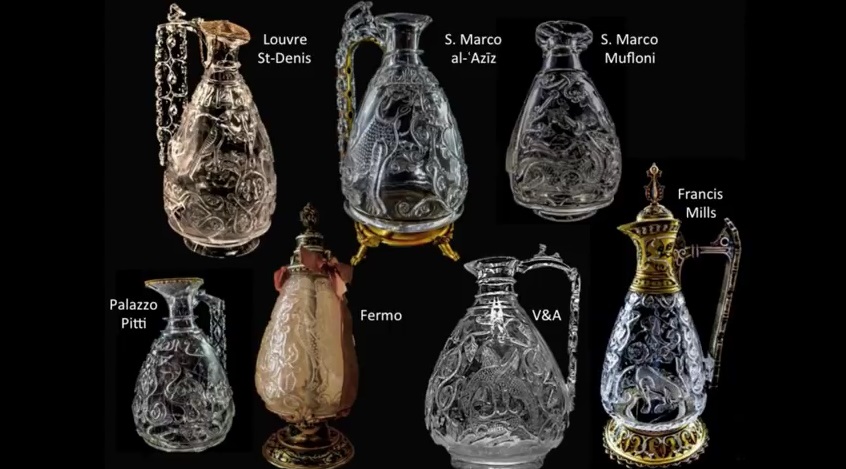
In 2008, the same year that the Delegation of the Ismaili Imamat Building was opened by Canada’s Prime Minister Harper in the presence of Mawlana Hazar Imam, His Highness the Aga Khan, a rediscovery of a spectacular medieval Islamic rock crystal ewer, forgotten since the mid-19th century, provided the catalyst for the re-examination of all of the surviving rock crystal ewers — the “Magnificent Seven”— carved for the Fatimid caliphs of Cairo in about the year 1000.

Jeremy Johns, and his colleague Elise Morero, are on the verge of completing a new multidisciplinary study of the Magnificent Seven and related artefacts, which is intended to be the first phase of a much wider project to examine the medieval Islamic carved rock crystal “industry”.

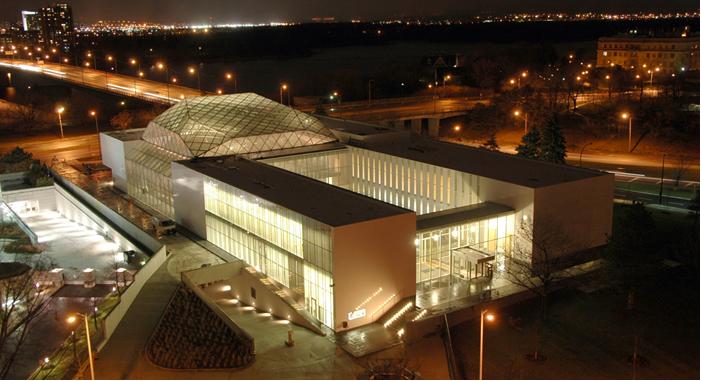
Ottawa, Canada’s capital, is home to the majestic Delegation of the Ismaili Imamat which was opened on December 8, 2008, at the end of the Golden Jubilee of His Highness the Aga Khan. The building is inspired by the mysteries of  rock crystal. Photo: Maki and Associates/Moriyama and Teshima Architects.
Ottawa, Canada’s capital, is home to the majestic Delegation of the Ismaili Imamat which was opened on December 8, 2008, at the end of the Golden Jubilee of His Highness the Aga Khan. The building is inspired by the mysteries of rock crystal. Photo: Maki and Associates/Moriyama and Teshima Architects.

The Fatimid Imams-Caliphs of Egypt who founded the city of Cairo in 969 and also the Al-Azhar University, are ancestors of His Highness the Aga Khan. They prized the qualities of  the rock crystal and carved them into vessels of different forms. In seeking to conceive a design for the Delegation of the Ismaili Imamat Building, His Highness wanted to connect the new building symbolically to the faith of Islam. The suggestion he made to the renowned Japanese architect, Professor Maki, focused on creating a certain mystique, centred around the beautiful mysteries of rock crystal.

In answering, “Why rock crystal?” the 49th Ismaili Imam explained:

“Because of its translucency, its multiple planes, and the fascination of its colours – all of which present themselves differently as light moves around them. The hues of rock crystal are subtle, striking and widely varied – for they can be clear or milky, white, or rose coloured, or smoky, or golden, or black.

“It is because of these qualities that rock crystal seems to be such an appropriate symbol of the profound beauty and the ever-unfolding mystery of Creation itself – and the Creator. As the Holy Qur’an so powerfully affirms, ‘Allah is the Creator and the Master of the heavens and the earth.’ And then it continues: ‘Everything in the heavens and on earth, and everything between them, and everything beneath the soil, belongs to Him’.”

We divide this post into two parts. We begin with an introductory piece on Fatimid ewers by Aliza Moledina, which is followed by a link to an extraordinary video presentation by Jeremy Johns, who with his colleague has used the traditional techniques of stylistic analysis and has returned to the written sources for the production and life histories of the ewers. Both the researchers have also subjected all seven ewers for the first time to detailed archaeometrical and tribological analyses, and have drawn upon ethnographical studies, archaeological excavation, and experimental archaeology to interpret their new findings.

The lecture gives a concise overview of their progress to date, and attempts to replace the ewers back into the socio-economic context from which they were produced. It is copiously illustrated with new images of these extraordinary artefacts, revealing hidden detail that puts us in touch with the hands of the craftsmen that made them.

~~~~~~~~

1. A BRIEF NOTE ON FATIMID ROCK CRYSTAL EWERS

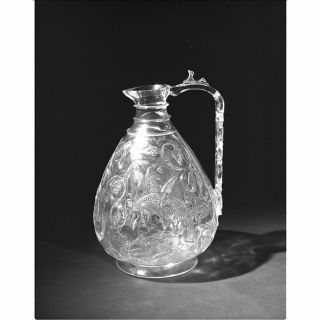
This rock crystal ewer exhibited at the Victoria and Albert Museum in London, UK,  is one of a series that survives in collections across Europe. Such high-quality rock crystal vessels were made for the rulers of Cairo during the Fatimid period (969-1171). This is confirmed by inscriptions on several of them which name specific rulers. Great skill was required to hollow out the raw rock crystal without breaking it and to carve the delicate, often very shallow, decoration.
This rock crystal ewer is at the Victoria and Albert Museum in London, UK. It is one of a series that survives in collections across Europe. Such high-quality rock crystal vessels were made for the rulers of Cairo during the Fatimid period (969-1171) as confirmed by inscriptions on several crystal ewers naming specific rulers. Great skill was required to hollow out the raw rock crystal without breaking it and to carve the delicate, and often very shallow decoration. Photo: Victoria and Albert Museum, London. Copyright.

Compiled By ALIZA MOLEDINA

Introduction:

The Fatimid Period in Islamic History (909–1171 C.E.) is characterized by the Imam-Caliphs’ emphasis on the search for knowledge and religious tolerance. Artwork thus gained importance and flourished. The Fatimids were able to draw upon diverse skills and knowledge from many sources to develop new techniques and styles for their artwork.

The Fatimids produced a wide variety of very beautiful and skilfully crafted works of art in textiles, ceramics, woodwork, metalwork, jewellery and rock-crystal. However, only a limited number of examples are available today, and it is by sheer chance that some happen to have a name or signature which links them to the Fatimids. The main reason why our knowledge of Fatimid objets d’art is so limited is that the great Treasury in which the Fatimids stored all their riches was looted between the years 1067 and 1072. They were then sold, melted down and minted into coins to be dispersed amongst the population of Fustat, or carried by merchants to other countries.

Rock Crystal

As a rare medium of art, rock crystal is made of pure quartz crystal and was only shaped by masterful craftsmen which made it highly valued by the Fatimids. The purest crystals were imported from Basra, Yemen and the islands around the East African Coast.

This piece was made between 1000 and 1050. This fine rock crystal piece appears to have been a container. Its complex shape can be seen as the body of a fish. Two convex faces are joined at an angle along the sides, which taper gently towards the base, or tail. However, the fish shape does not continue at the top, where the angled sides broaden out into shoulders. At the centre, these form a collar around the mouth of the hollowed out interior. Another hole was later drilled into the bottom to allow for a mount.
This piece was made between 1000 and 1050. This fine rock crystal piece appears to have been a container. Its complex shape can be seen as the body of a fish. Two convex faces are joined at an angle along the sides, which taper gently towards the base, or tail. However, the fish shape does not continue at the top, where the angled sides broaden out into shoulders. At the centre, these form a collar around the mouth of the hollowed out interior. Another hole was later drilled into the bottom to allow for a mount. Photo: Victoria and Albert Museum, London. Copyright,

Of all the rock crystal objects manufactured by Fatimid artisans, the Fatimid rock crystal ewers, such as the one shown at the top of this page, are considered among the rarest and most valuable objects in the entire sphere of Islamic art. Only five were known to exist before the extraordinary appearance of an ewer in a provincial British auction in 2008 which was later sold at Christie’s last October. It was the first time one has ever known to have appeared at auction. The last one to surface on the market was purchased by the Victoria and Albert Museum in 1862.

Of the very few rock crystal objects extant today (180 in total), only a few can be securely dated back to the Fatimid period. The treasury of the Basilica of San Marco in Venice has two ewers, one of which bears an inscription to the Fatimid Imam al-Aziz (975-996). Another rock crystal ewer holding an inscription to his son, Imam al-Hakim, is in the Cathedral of Fermo in Italy. An additonal rock crystal ewer was in the treasury of the Abbey of Saint Denis in Paris and is now in the Louvre. The one in the Museum of Limoges in France was stolen in 1980. Disaster also befell the final known ewer which was from the Pitti Palace collection in Florence and had an inscription to Husain ibn Jawhar. It had been on display in the Museo degli Argenti, and it was accidentally dropped by a museum employee in 1998, shattering it irreparably. Finally, a rock crystal crescent in the Museum in Nuremberg, which may have been mounted on a horse’s bridle as a royal emblem, bears the name of the Imam al-Zahir (1021-36).

In addition to the five (and now six) ewers, three or four smaller oval flasks are known to exist including one in the Victoria and Albert Museum in London (located just across from the Ismaili Jamatkhana and Centre), one in the Freer Gallery in Washington DC, and one in the Keir Collection, London. The oval flask in the Freer Gallery has a 17th century gold and enamel setting and is described by the museum as dating from the reign of the Hapsburg Emperor Rudolf II.

“The opulence of the Fatimid court fueled a renaissance in the decorative arts, which made Cairo the most important cultural center in the Islamic world. Nearby, Old Cairo, known as al-Fustat, became a major center for the production of pottery, glass, and metalwork, and rock-crystal, ivory, and wood carving; textile factories run by government officials created tiraz fabrics in the name of the caliph elsewhere in the Egyptian region, especially the Nile Delta. A novel, more refined style developed in pottery; bands with small animals and inscriptions now formed the major decoration in textiles; and rock-crystal carvers demonstrated great skill in works created for and treasured by the caliphs themselves.” — Excerpt from “The Art of the Fatimid Period,” Heilbrunn Timeline of Art History, Metropolitan Museum of Art

The Kitab al-Hadaya wa’l-Tuhaf (The Book of Gifts and Rarities, selections published by Harvard University Press; Cambridge, Mass., 1996) says that when Imam al-Mustansir was forced to open his treasury in 1068, the looters of the Palace “brought out of the Treasury of Precious Objects 36,000 pieces of rock crystal”.

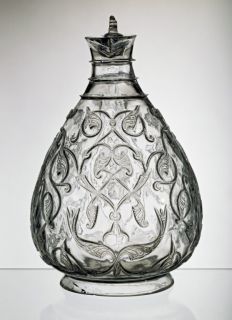
Fatimid Rock Crystal Ewer, shown above and here as seen from the front, is regarded as the most valuable object in Islamic Art
A front view of a Fatimid Rock Crystal Ewer, as shown above , is regarded as the most valuable object in Islamic Art. The ewer was carved from a single piece of very pure, very thin crystal. Photo: Victoria and Albert Museum, London. Copyright.

The extant rock crystal objects with no identifying inscription on them appear to be types of containers, either goblets for drinking or ewers and basins for holding liquids, perhaps for washing the hands of the guests after a meal. Over the centuries, many magical properties or benefits were deemed to be associated with objects made using rock crystal.

For example, by simply procuring a vessel made of rock crystal, an individual’s craving for water was considerably reduced. It was said that rock crystal glasses were supposed to shatter on contact with poisoned liquids, or the liquid changed colour, which is perhaps why they were so popular with rulers.

Cups of crystal are also mentioned repeatedly in the Qur’an as one of the many items the Believer has to look forward to in Paradise; for example in Sura 37 (Al-Saffat, The Arrangers, Verses 45-47, tr. Abdullah Yusuf Ali):

“Round will be passed to them a cup from a clear-flowing fountain, crystal-white, of a taste delicious to those who drink (thereof), free from headiness; nor will they suffer intoxication therefrom.”

This Qur’anic reference may suggest another reason why rock crystal drinking vessels were so popular in the Muslim world.

Small rock crystals like this bottle could not have held much, but their contents must have been very precious indeed to deserve such containers. They were most probably used for storing perfumes, which were among the most luxurious items of any Islamic court. They often survive in cathedral treasuries, where they were rededicated after being captured from their original Islamic settings. This bottle was purchased with the assistance of Messrs Henry Oppenheimer, Oscar Raphael and John Hugh Smith
Small rock crystals like this bottle could not have held much, but their contents must have been very precious indeed to deserve such containers. They were most probably used for storing perfumes, which were among the most luxurious items of any Islamic court. They often survive in cathedral treasuries, where they were rededicated after being captured from their original Islamic settings. This bottle was purchased with the assistance of Messrs Henry Oppenheimer, Oscar Raphael and John Hugh Smith. Photo: Victoria and Albert Museum, London. Copyright,

The skill required to hollow out a piece of crystal without blemishing it meant that relief decoration was often kept to a minimum, unlike other media in Islamic art where the surfaces were covered with decoration, to ensure that the viewer could appreciate the craftsmanship of the object. When adorned with relief carving, this usually depicted floral or animal themes, especially lions and birds amongst palmettes. Occasionally gold or precious stones were added on the handle, or to hide a cloud or knot in the crystal; however generally the purity of the crystal was judged sufficient in itself.

_________

Aliza Moledina

About the author: This piece is an expansion of a special Powerpoint presentation made by Aliza Moledina for a special Literary Night event held in Ottawa, Canada, in 2008 to commemorate His Highness the Aga Khan’s Golden Jubilee Celebrations. Aliza was at that time completing her Grade 12 studies at the Colonel By Secondary School, in Ottawa, Canada, after which she proceeded to the University of Western Ontario, in London, Ontario, Canada from where she recently graduated in medicine.

~~~~~~~~

2. ‘THE MAGNIFICENT SEVEN’ A VIDEO PRESENTATION BY JEREMY JOHNS

Date posted: July 30, 2015.
Last updated: August 13, 2021.

____________________

Professor Jeremy Johns, Oxford University

About Jeremy Johns: Professor Johns is Professor of the Art and Archaeology of the Islamic Mediterranean and Director of the Khalili Research Centre (KRC) for the Art and Material Culture of the Middle East in the University of Oxford. He is principally interested in relations between Muslim and Christian societies in the medieval Mediterranean as manifested in material and visual culture. His research has focused upon the archaeology of the transition from late antiquity to early Islam in the Levant and, especially, upon the archaeology, history and art history of Sicily under Islamic and Norman rule, from the Muslims’ conquest of the island in the 9th century to the destruction of the Islamic community of Sicily by Frederick II. His recent and forthcoming publications include the first comprehensive study of the Islamic painted ceilings of the Cappella Palatina in Palermo, and editions and studies of Arabic and bilingual documents from Norman Sicily. Amongst other projects, with Dr Elise Morero (KRC), he is currently engaged on a multidisciplinary study of the medieval Islamic carved rock crystal “industry”.

Ismaili Historical Insights: (I) 1925: Mahatma Gandhi on the Meritorious Deed of a Khoja Ismaili

Letter From Publisher

Simerg's Merchant

Simerg’s Merchant

By Abdulmalik J. Merchant

Simerg’s new feature Short Historical Insights is intended to make history educational, interesting and stimulating for readers through anecdotes, facts, stories as well as images related to Ismailis and their Imams, in no more than  500 words. Information in the series will be unearthed from a maze of documents, including those that are not easily accessible due to their sheer size or location, or material which, in the broader scope, would be of interest for research on specific themes. Of course, we will also rely on other well-known (or lesser-known) treatises and texts as well as libraries and museums for this new feature.

For the first episode, we go to a massive work called The Collected Works of Mahatma Gandhi and reveal a story that appears in Volume 33, which is dedicated to the period from September 1925 to February 1926 in Gandhi’s life. During his visit to Mundra in Gujarat, the father of India, is frustrated with members of his own faith with respect to their treatment of the Untouchables* and, somewhat grudgingly, praises the work of one Khoja (Ismaili) named Ibrahim Pradhan Saheb, who has unselfishly built a school for the outcast children.

This anecdote, by none other than Mahatma Gandhi, is an excellent example of the Ismaili spirit of loyalty to their countries of birth or adoption, a matter which Ismaili Imams have placed on their followers as one of their two principal obligations during their lifetime, the other being their loyalty to the Ismaili Muslim faith. Ibrahim Pradhan was an exemplary Ismaili in this regard, and we are pleased to provide a short account of his contribution from Mahatma’s own two speeches made in 1925.

Readers are invited to contribute to this new feature by submitting their pieces to  Simerg@aol.com. We always acknowledges letters and submissions from non-anonymous sources.

Ibrahim Pradhan’s Meritorious Deed As Recorded By Mahatma Gandhi

102 – Gandhi’s Speech at Mundra, November 1, 1925, page 177 – 181

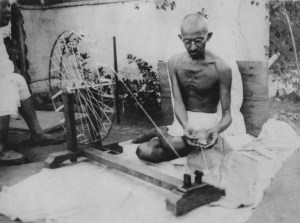
Mahatma Gandhi spinning yarn in the 1920's. Photo: Wikipedia.

Mahatma Gandhi spinning yarn in the 1920’s. Photo: Wikipedia.

(It is noted by Mahadev Desai that Mahatma Gandhi began his speech with “Antyaja brothers and sisters, their sympathizers, and other Hindu brothers and sisters”)

” ….It is wrong to invite me to a place where the entire public believes in untouchability. It is an insult to invite me to a place where the untouchables are treated with nothing but contempt. After having come here, I heard of the school for the untouchables. I felt that at such a place the Antyajas [lit. the last born – ed] would receive service. I would congratulate Ibrahim Pradhan Saheb on the school but the Hindu public deserves no such congratulations. Its existence puts the Hindus to shame. It is a matter of shame for me if a Muslim builds a Siva temple for my benefit. I was pleased to see the school’s activity of spinning and weaving; however, I immediately felt that neither I nor the Hindus could take credit for this meritorious deed. I can have no sense of satisfaction if a Muslim recites the Gayatri mantra instead of me. I can only feel satisfied when a Brahmin comes along and offers to recite the  Gayatri for me. However, in this case, the Khojas are doing the work that should be done by Hindus. Here, no one is bothered in the least about the Antyajas. I do not see any non-Antyajas except the guests sitting among the  Antyajas here before me. Even those who go around with me during the day have abandoned them and are seated in the enclosure for high-caste gentlemen. If you could rip open my heart today, you would find it crying — ‘O Lord! Could this be the Hindu dharma, where no one cares for the Antyajas? Is there not a single person in the town who will come to their rescue’?…

103 – Gandhi’s Reminiscences of Kutch, November 1, 1925, pages 181-187

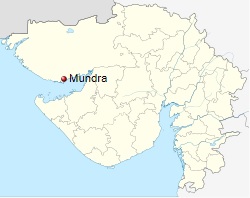
Location of Mundra in the Kutch district of  India's Gujarat State. Image: Wikipedia.

Location of Mundra in the Kutch district of India’s Gujarat State. Image: Wikipedia.

I had my bitterest experience in Mundra. I found only hypocrisy, insincerity and play-acting there. Even Muslims were made to sit in the enclosure for those who supported untouchability as if they too believed in it. Hence, only my companions and the Muslim volunteers remained in the section reserved for Antyajas. Many among the Hindu volunteers, though they claimed that they did not believe in untouchability at all, were nevertheless kept in the enclosure meant for those who did believe in it.

There is a school for the Antyajas in Mundra but it is a philanthropic Muslim gentleman, Sheth Ibrahim Pradhan, who runs it at his own expense. The school may be regarded as good up to a point. The children are kept very clean. The building is in the centre of the city. The children had even been taught Sanskrit verses, [which they recited] in a broken accent. Spinning, carding, ginning and weaving were taught in the school itself. Only children’s clothes were not made of khadi [handspun and hand-woven cloth – ed.]; however, the organizers had gone in for the cloth believing it to be pure khadi. The reader might perhaps conclude that this school would give me some satisfaction. It gave me no satisfaction but caused me grief, rather, as the credit for it would not go to a Hindu. I have already mentioned the name of the gentleman who finances it.

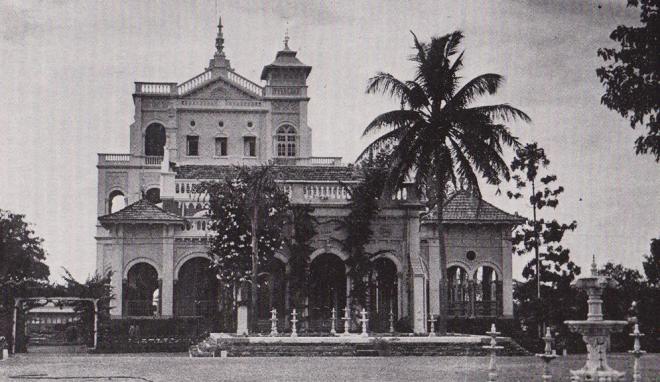
Yerawada (or Aga Khan) Palace, now the Gandhi Memorial, was built by the 48th Ismaili Imam to provide a means of livelihood to the famine stricken people in Pune. Historically, the palace holds great significance. Mahatma Gandhi, his wife Kasturba Gandhi and his secretary Mahadev Desai were interned in the palace from 9 August 1942 to 6 May 1944.  In 1969, the current 49th Ismaili Imam, Prince Karim Aga Khan, donated the Palace to the Indian people as a mark of respect to Gandhi and his philosophy. Today, the palace houses a memorial on Gandhi where his ashes were kept.

Yerawada (or Aga Khan) Palace, now the Gandhi Memorial, was built by the 48th Ismaili Imam to provide a means of livelihood to the famine stricken people in Pune. Historically, the palace holds great significance. Mahatma Gandhi, his wife Kasturba Gandhi and his secretary Mahadev Desai were interned in the palace from 9 August 1942 to 6 May 1944. In 1969, the current 49th Ismaili Imam, Prince Karim Aga Khan, donated the Palace to the Indian people as a mark of respect to Gandhi and his philosophy. Today, the palace houses a memorial on Gandhi where his ashes were kept.

The gentleman in charge of this school is the heir of the Aga Khan in Mundra. Sheth Ibrahim Pradhan deserves all praise for his charity, as I was informed that this school is not being run for the purpose of converting the untouchables or schoolchildren to Islam, but in order to enable them to make progress as Hindus. The people of Mundra also informed me that the gentleman in charge, Mauledina Meghji was a Vedantin [belonging to a school of Indian philosophy – ed.] and a learned person. All this must be regarded as satisfactory. However, what is the contribution of the Hindus? Untouchability is an ugly blot on the Hindu religion, it is a sin. The Hindus alone can do prayaschitta [atonement for sins] for it. The dirt on my body will go only when I myself remove it.

This institution adds to the prestige of Sheth Ibrahim Pradhan, and to that extent to the shame of the Hindus.

Date posted: July 26, 2015, word count, appx. 400 words.

_____________

Notes and references:

*Untouchables are outcasts—people considered too impure, too polluted, to rank as worthy beings. Prejudice defines their lives, particularly in the rural areas, where nearly three-quarters of India’s people live….Although the Indian constitution makes caste discrimination illegal, Untouchables living at the bottom of society are subjected to indignities” — from http://ngm.nationalgeographic.com/ngm/0306/feature1/

See complete volume 33 at http://www.gandhiserve.org/cwmg/VOL033.PDF.

Listen to the Inspiring Song Album “Thank You Allah” by Iconic Muslim Singer Maher Zain

Editor’s note: I have immensely enjoyed the diverse range of songs in this magnificent album by Maher Zain, a Muslim Swedish Rythm and Blues (R&B) singer, songwriter and music producer of Lebanese origin. With more Facebook fans than any other Muslim artist, Zain has attained stardom status among Muslims around the world and has become an icon of modern Islamic music. “Thank You Allah” is his debut album and was released internationally in 2009 by Awakening Records.

Among my favourites in the playlist below are Inshallah (#3) and The Chosen One (#7), which I found to be highly touching as it is reflective of examples from the life of Prophet Muhammad (s.a.s), as well as Palestine Will Be Free (#4), Awaken (#11) and Zain’s own version of  the highly popular Allahi Allah Kiya Karo (#6). He sings in Arabic, Urdu and English as well as other languages. Indeed, I would recommend that you listen to this entire Youtube album. The lyrics are moving and heart-rendering, and poignantly remind us of the state of our attitude and being on this planet earth! I am sure listeners will enjoy the songs in this album, many with video.

Date posted: July 24, 2015.

_________________

Do you have a comment on Maher Zain’s album? What was your favourite song? We welcome your feedback. See the comment box on this page or click Leave a comment.

@Simergphotos: The Silk Road Through the Lens of Muslim Harji and the Smithsonian Folklife Festival

Simergphotos presents An Anthology of the Silk Road Through the Lens of Muslim Harji and Smithsonian’s Folklife Festival with magnificent photos taken by Harji during his recent visits to the iconic Silk Road cities of Samarkand and Bokhara in Uzbekistan. Then the post steps back in time and brings you wonderful memories from the Smithsonian Institution’s Annual Folklife Festival held in Washington D.C. in 2002, which was entirely dedicated to one single subject: The Silk Road. The post contains photos from the opening day, which was attended by His Highness the Aga Khan, as well as an excellent thematic anthology covering many aspects of the exciting Silk Road!…More at Simergphotos.

Please click on image for Silk Roads Photo Essay.

Please click on image for Silk Roads Photo Essay.

PLEASE CLICK: An Anthology of the Silk Road Through the Lens of Muslim Harji and Smithsonian’s Folklife Festival

Mawlana Hazar Imam at the Silk Roads Festival in Washington D.C. IN 2002. Please click for more photos.

Mawlana Hazar Imam at the Silk Roads Festival in Washington D.C. IN 2002. Please click for more photos.

Eid ul-Fitr Should Provide Spark of Hope For the Less Privileged, and Foster Brotherhood, Forgiveness and Generosity in the Muslim Umma

“The poor are not mere inanimate, unmotivated, units of deprivation. They are living, thinking people like the rest of us.”
Mawlana Hazar Imam, His Highness the Aga Khan, 49th Ismaili Imam 

EID MUBARAK

Historical photo: Muslims offering the Eid ul Fitr prayers at  the Sheikhantaur Mosque in Tashkent. Photo created/ published between 1865 and 1872. Credit: The US Library of Congress.

Historical photo: Muslims offering the Eid ul Fitr prayers at the Sheikhantaur Mosque in Tashkent. Photo created/published between 1865 and 1872. Credit: The US Library of Congress.

The festival of Eid, also known as Bairam or Eid Ramadan is one of the most joyous days in the Islamic calendar. It is an occasion for celebration and rejoicing for Allah’s Bounty upon mankind for His revelation of the Holy Qur’an during the month of Ramadan. It is also a time for individuals to express their gratitude to Allah for having given them the strength, courage and resilience to complete the fast, and thus fulfilling the duty enjoined upon them by Allah.

On this joyous occasion, we convey our heartiest felicitations and Eid Mubarak to all our readers as well as Muslims around the world, with the fervent hope and prayer that peace and harmony should prevail over many areas of the Muslim world afflicted by horrible conflicts, which are resulting in the loss of lives and contributing to unbearable hardships and struggles. The Islamic ethic of forgiveness, generosity, and peaceful co-existence and unity through dialogue are keys by which conflicts can be resolved, whereby every Muslim can aspire for a life of material and spiritual well-being and happiness.

The excerpts produced in this post from the Holy Qur’an and the hadith as well as from the farmans, writings and speeches of Hazrat Ali (a.s.) and Mawlana Hazar Imam (His Highness the Aga Khan) are foundation blocks for building harmonious societies around the world. The acts of charity and generosity mentioned in the quotes will facilitate those who are underprivileged to manage their own destinies, thereby leading them to a life of dignity, befitting Allah’s greatest creation.

PROFOUND TEACHINGS OF ISLAM

(Selections from the Holy Qur’an, the hadith and teachings of Shia Ismaili Imams)

Conceptual image for the holy month of Ramadan and Eid al Fitr. Photo: Istockphoto

Conceptual image for the holy month of Ramadan and Eid ul Fitr. Photo: Istockphoto. Copyright.

“It is not righteousness that you turn your faces towards the East and the West, but righteous is the one who believes in Allah and the Last Day, and the angels and the Books and the prophets, and gives away wealth out of love for Him to the near of kin and the orphans and the needy and the wayfarer and to those who ask and set slaves free.” — Holy Qur’an, 2:177

“And whatever good you may spend on others is for your own good, provided that you spend only out of a longing for God’s countenance.” — Holy Qur’an, 2:272

“You will not enter paradise till you believe, and you will not believe till you love one another. Let me guide you to something by doing which you will love one another: Salute and sundry among you.”  — Tradition of the Prophet Muhammad (s.a.s.)

“Have a tender heart, as tender as a fistful of green grass; be not arrogant and stiff as a tree upright in a forest. A tree is toppled in a storm, but grass bends and sways happily with the wind.” Hazrat Ali (a.s.), Kalam-e-Mawla, 8:67

“A great river is not made turbid by a stone. A religious man who takes to heart an injury is as yet, but shallow water. If any misfortune befalls you, bear with it, that by forgiving others you may yourself obtain pardon. O my brother! seeing that we are at last to return to earth, let us humble ourselves in ashes before we are changed into dust.” — Hazrat Bibi Fatima (a.s.). [1]

“…As the world gets smaller, it is fundamental that people should work together and not against each other, and try to be a little more generous than you have been in the past. If people have made mistakes, forgive them their mistakes. If people have harmed you, forget and forgive. Do not hold grudges. Do not turn around and say, ‘he hurt me yesterday, so I will hurt him today’. This is not the spirit of Islam…” His Highness the Aga Khan, Farman Mubarak, Mumbai, 1969, Precious Gems.

“Islam is not passive. It does not admit that man’s spiritual needs should be isolated from his material daily activities. A Muslim must play an active role in helping his family and the brotherhood of believers. The object is not to achieve status, wealth and power, but to contribute to society’s overall development. This implies moral responsibility to help the weaker, less fortunate members.” — His Highness the Aga Khan, Toronto, May 14, 1987. [2]

“…when you are studying the Qur’an, when you are studying the history of Imams, when you are studying the history of pre-Islamic Arabia, I would like you to take from this history that which will help you to live within the spirit of Islam. This means to live honestly, to live purely, to know that you are brothers and sisters, to be available at all times when one or the other needs help, to be generous, to be honest. These are the qualities which you can trace throughout Qur’an-e Shariff, throughout the life of the Prophet, throughout the lives of the Imams. And this is something which I would like you to follow, not only in letter but also in spirit, because it is this spirit which cannot be changed, and which I would like my spiritual children to understand fully…” Farman Mubarak, His Highness the Aga Khan, Karachi, November 29, 1964. [3]

“There are those who enter the world in such poverty that they are deprived of both the means and the motivation to improve their lot. Unless these unfortunate ones can be touched with the spark which ignites the spirit of individual enterprise and determination, they will only sink back into renewed apathy, degradation and despair. It is for us, who are more fortunate, to provide that spark.” —  His Highness the Aga Khan, speech, Housing and Development, Mumbai, January 17, 1983.

“The poor are not mere inanimate, unmotivated, units of deprivation. They are living, thinking people like the rest of us.” — His Highness the Aga Khan, Aiglemont, March 16, 1983.

“On the occasion of my Silver Jubilee, I would be deeply happy if the members of my jamat, wherever they are and whatever their age, would reaffirm in a visible and united manner their commitment to the principles of Islam which bind all Muslims together, and which are unique example to all mankind: Belief in Allah, the fulfillment of His message to man, respect and support for His greatest creation, man himself. In this way let us establish even sounder foundations for a good and proper life and let us extend our support to those living in the developing areas of the world.” — His Highness the Aga Khan, 1982. [4]

A new moon at Mackerricher State Park, California, USA. Photo: Istockphoto. Copyright.

A new moon at Mackerricher State Park, California, USA. Photo: Istockphoto. Copyright.

Date posted: Friday, July 17, 2015.

_______________

We welcome your feedback. Please click Leave a comment

References:

[1] Quoted in Ilm, July 1986, page 17.

[2] Ilm, Volume 13, Number 1, July 1990, page 45-46.

[3] Farman Mubarak Pakistan Visit 1964, published by the Ismailia Association for Pakistan, quoted also in Ilm, Volume 13, Number 1, July 1990, page 38.

[4] Talika Mubarak of Mawlana Hazar Imam, Silver Jubilee, July 11, 1982, quoted in Ilm, July 1990, page 55.

Special Series: Ismaili Expressions on the Imamat — (II) The Beatific Vision of the Imam of the Time

INTRODUCED BY ABDULMALIK MERCHANT

A very happy moment in my life when I visited Brown University in 1996. I snapped this picture of my beloved 49th Imam, His Highness the Aga Khan, and only realized that he was looking straight at my disposable nine dollar camera after I got the film processed in Philadelphia.  Photo by Abdulmalik Merchant

A very happy moment in my life when I travelled to Brown University from Philadelphia in 1996. I snapped this picture of my beloved 49th Imam, His Highness the Aga Khan, and only realized that he was looking straight at my camera after I got the film processed in Philadelphia a couple of days later. Photo by Abdulmalik Merchant

Every Ismaili yearns to see the Imam of the Time. It’s a dream of a lifetime. Throughout history, past and present, Ismailis have travelled far and wide to earn this special moment of grace and barakah (happiness) in their lives. Since the advent of the 20th century, the 48th Imam, Mawlana Sultan Mahomed Shah, and the current 49th Imam, Mawlana Shah Karim (His Highness the Aga Khan), have graciously travelled to lands around the world to give their beloved murids (followers) this blessed opportunity. Scientific and technological advancements have speeded up and shortened the time-gap between visits of Mawlana Hazar Imam with his jamats, though even in these situations, some jamats  such as those living in Central Asia, did not have the opportunity of a meeting with the present Imam and his predecessors for decades and centuries. What sustained their faith, sometimes under extremely difficult and extra ordinary circumstances, was their spiritual bond with the Imam of the Time.  

His Highness the Aga Khan pictured amongst his followers in Badakhshan in May 1995.

His Highness the Aga Khan pictured amongst his followers in Badakhshan in May 1995.

A cornerstone of Ismaili doctrines has been the principle of the Unity of Imamat, that is the  Ismaili belief and understanding that each Imam, being the bearer of the Noor (Light) of Imamat, is the same irrespective of his own age or the time he lives in. Thus in Ismaili writings, in addition to the importance of the physical didar (or glimpse) of the Imam, a strong emphasis has been laid on the followers to seek to attain the Beatific Vision of the Imam of the Time through special prayers, in addition to the ritual prayers. This idea is also conveyed in the sixth article of the Preamble of the Constitution of the Ismailis, which states:

“Historically and in accordance with Ismaili tradition, the Imam of the time is concerned with spiritual advancement as well as improvement of the quality of life of his murids. The imam’s ta‘lim lights the murid’s path to spiritual enlightenment and vision…”

The following collection  of writings from Ismaili history articulates the importance of both the  physical as well as the spiritual glimpse of the Imam of the Time. Our next reading in this short four-part series to commemorate Mawlana Hazar Imam’s 58th Imamat Day will consist of excerpts from the writings of Ismaili Imams on the subject of Imamat. This will be followed by contemporary voices on Imamat by members of the jamat.

1. An Inspiring Anecdote: Da’i Al-Mu’ayyad al-Shirazi ‘s Mulaqat  with  the 18th Ismaili Imam (or 8th Fatimid Caliph), Imam al-Mustansir Billah

A folio from the manuscript of al-Shirazi's Sirat. Credit: The Institute of Ismaili Studies.

A folio from the manuscript of al-Shirazi’s Sirat. Credit: The Institute of Ismaili Studies.

“I was taken near the place where from I saw the bright Light of the Prophethood.  My eyes were dazzled by the Light. I shed tears of joy and felt as if I was looking at the face of the Prophet of Allah and of the Commander of the Faithful, Hazrat Ali. I prostrated myself before the one who is the fittest person to bow to. I wanted to say something, but I was awe-struck.

“I tried to speak but my tongue refused to move. People asked me to say what I wished to say. I could say nothing. The Imam said, ‘Leave him. Let his fear and awe subside’.

“After this, I rose. I took the holy hand of the Imam, placed it on my eyes and on my chest and then kissed it. I left the place with immense joy.”

The same dai,  in the following entreaty to Imam Mustansir, typifies an Ismaili’s impatience to behold the face of the Imam of one’s time, and the urgency of this beyond any possible worldly consideration. He states: 

“I swear, were you to crown me, and were you to grant me dominion over the world entire and say to me ‘Let our meeting be postponed but an hour’, I would reply: ‘O my Mawla, let us meet instead!  For your delay of but an hour has turned my hair gray’.”

2. A Pilgrim’s Experience

During the reign of the 34th Ismaili Imam Gharib Mirza, a pilgrim tracked his way to Anjudan to see the Imam on behalf of the jamats in Khurasan. The identity of the pilgrim is not very clear due to the poor quality of the manuscript but the ode to the Imam reads as follows:

“Greetings! O Emperor of the Realm of Faith and World; I come from Khurasan to behold your face. All I have is a soul imperfect, sins and transgressions galore.

“Despite such worthless goods, I long for your grace, hoping that through me you may forgive the trespasses of your servants-one and all.

“As you are the sovereign and governor of all creation, this being testified to by the Qur’an itself, your proper name has been made manifest to all the faithful.

“You are Shah Gharib and Mustansir, the inheritor of Shah Salam!”

3. Pir Sadr al-Din on the True Guide, the Beatific Vision of the Imam, and the Alchemy of Transformation from Contact with the Imam

Folio of Pir Sadr al-Din's Saloko Nano at the Institute of Ismaili Studies.

Folio of Pir Sadr al-Din’s Saloko Nano at the Institute of Ismaili Studies.

The following is a translation of Pir Sadr al-Din’s ginanic compositiom “Sakhi māhā pad keri vāt koek jānere.”

“Friend! None but a few know of the exalted station. Indeed, they alone recognize it who have found the true guide.

“Friend! Within the heart, at the confluence of the three spiritual rivers, there is an imperishable light. There – a shimmering effulgence, pearls are showered.

“Friend! I completely lost consciousness of my physical self when my meditation mounted the empyrean, bursting forth.

“Friend! I beheld the place of the lofty throne, I saw the seven islands, the nine continents.

“Friend! The religious scriptures and books cannot fathom this, for there is neither day there, nor night, neither sun, nor shade.

“Friend! My Lord is not such that He can be spoken of. He is to be seen – for He is indescribable, and nameless.

“Friend! How sweet is that Lord, indescribable, nameless. Says Pir Sadr al-Din, truly, with my own eyes, I have seen Him!”

~~~~~~

And the following is a translation of a verse from Sab Ghat Sami Maaro Bharpur Betha on spiritual transformation:

“O Brother, The True Preceptor is like the philosopher’s stone and the followers are like copper.

“When the copper comes in contact with the philosopher’s stone it becomes gold.

“The followers gain spiritual enlightenment from the contact of the Imam. He is the only Glorious, O brother.”

4. Nizar Quhistani on the Imam of the Time As the Source of Salvation, and on the Continuity of Imamat

“Salvation is to be found in the Imam of the Time.

“Ever since I found the Imamate, permanently in human form, I have known no other guide than the living, everlasting Imam.

“For in his command, I have found peace in both the worlds.

“My lover appears in different forms,

“Because for each period there comes a new guidance;

“One after the other, there  follows another Qaim  Imam Ali.

“I have given up everything except that contained in the Qur’anic verse ‘offspring, one of the other’.”

Date posted: July 8, 2015.

_______________

Readings adapted from The Life and Lectures of the Grand Missionary al-Muayyad-fid-Din al-Shirazi and The Ismailis in the Middle Ages: A History of Survival, a Search for Salvation by Shafique N. Virani, Hardcover, May 3, 2007.

Feedback welcome, please click Leave a comment.

Special Series: Ismaili Expressions on the Imamat and Imam of the Time — (I) The Preamble of the Constitution of the Shia Imami Ismaili Muslims

LETTER FROM PUBLISHER

By Abdulmalik Merchant

Canada’s Confederation Day, the American Independence Day, Tanzania’s Saba Saba celebrations and the Imamat Day of His Highness the Aga Khan, all fall in the month of July.

Canada is already preparing for its 150th birthday two years hence when Ismailis around the world will, inshallah, celebrate the Diamond Jubilee of their beloved 49th Imam, whom they respectfully address as Mawlana Hazar Imam.

 A portrait of Mawlana Hazar Imam, His Highness Prince Karim Aga Khan, with a framed portrait of Mawlana Sultan Mahomed Shah in the background. Photo by Philippe Le Tellier/Paris Match via Getty Images. Copyright.

A portrait of Mawlana Hazar Imam, His Highness Prince Karim Aga Khan, with a framed portrait of Mawlana Sultan Mahomed Shah in the background. Photo by Philippe Le Tellier/Paris Match via Getty Images. Copyright.

His Highness the Aga Khan succeeded to the 49th hereditary throne of Imamat at the age of twenty by the will of his grandfather, Mawlana Sultan Mahomed Shah, His Highness the Aga Khan III, who served as the 48th Ismaili Imam for a record 71 years (August 17, 1885 – July 11, 1957).

Over the next week, Simerg will provide an insight into the principles of Imamat through short readings. We begin the series by posting the Preamble of the Ismaili Constitution, which is an introductory succinct statement giving the historical roots of the Ismaili Imamat, the principle of Imamat succession, and the permanency of the spiritual bond that exists between the Imam and his followers.

Another theme that will be explored in the coming few days through the writings of Ismaili Pirs, missionaries and philosophers is the principle of the Unity of Imamat, that is the Ismaili belief and understanding that each Imam, being the bearer of the Noor (Light) of Imamat, is the same irrespective of his own age or the time he lives in.

Finally, another aspect that will become apparent from the readings to follow is that the hereditary institution of Imamat can never become extinct. This is in accordance with the well known Muslim prophetic tradition, hadith thaqalain, which says, “I leave behind me two weighty things: The Book of Allah and my Progeny. If you keep yourselves attached to these two, never, never will you go astray. Both are tied with a long rope and cannot be separated until the Day of Judgement.”

The Preamble of the Constitution of the Shia Imami Ismaili Muslims

Please click on photo for enlargement

December 13, 1986, Geneva: On his 50th birthday, His Highness the Aga Khan is seen ordaining a new constitution for the worldwide Ismaili community.

December 13, 1986, Geneva: On his 50th birthday, His Highness the Aga Khan is seen ordaining a new constitution for the worldwide Ismaili community.

“Mawlana Hazar Imam Shah Karim al Hussaini, His Highness Prince Aga Khan, in direct lineal descent from the Holy Prophet (s.a.s.) through Hazrat Mawlana Ali (a.s.) and Hazrat Bibi Fatima (a.s), is the Forty-Ninth Imam of the Ismaili Muslims.”

BACKGROUND

In 1905, the 48th Ismaili Imam, Sir Sultan Muhammad Shah, His Highness the Aga Khan III, issued a written set of ‘Rules and Regulations’ for the Ismailis of East Africa which effectively served as their communal constitution. This constitution re-affirmed the centrality of the Imam’s authority over the affairs of his community and also articulated the distinctive religious identity of the Ismailis. This document was revised and published several times until 1954, and was made available to Ismailis and non-Ismailis alike. Similar rules were given to the Ismaili community in British India.

During the 1960’s, the 48th Imam’s grandson and successor, Mawlana Shah Karim al-Hussaini Hazar Imam, His Highness the Aga Khan IV, gave Constitutions to his followers in Africa and Pakistan in 1962, and to the Jamat in India in 1967.

A constitution review committee was then formed in the early 1980’s, and after exhaustive review, Mawlana Hazar Imam, in 1986, ordained a new Ismaili Constitution known as “The Constitution of the Shia Imami Ismaili Muslims.”

The Ismaili Constitution became applicable throughout the world, linking all Ismailis to the Imamat. His Highness did this with the belief that the Constitution would provide a strong institutional and organizational framework through which his community would be able to contribute to the harmonious development of the Muslim Ummah and of the societies in which his followers lived. He expressed confidence that the Ismaili Constitution would give a stronger integrated identity to his community, and that in abiding by it in letter and spirit, the Ismailis would achieve greater peace, unity, happiness, security and wellbeing. He futher hoped that the Constitution would become an enabling document for all his murids (followers) for an active role in institution building, for creative application of their abilities, for personal development and for intellectual and spiritual satisfaction.

The new constitution was ordained, signed and sealed by Mawlana Hazar Imam on December 13th, 1986, his fiftieth Salgirah (birthday) and thirtieth year of Imamat. The Constitution was revised by Mawlana Hazar Imam on July 11, 1998, when he completed forty one years of his spiritual leadership.

THE PREAMBLE

(A) The Shia Imami Ismaili Muslims affirm the shahādah lā ilāha illa-llāh, Muhammadur rasulu-llāh, the Tawhid therein and that the Holy Prophet Muhammad (s.a.s.) is the last and final Prophet of Allah. Islam, as revealed in the Holy Quran, is the final message of Allah to mankind, and is universal and eternal. The Holy Prophet (s.a.s.) through the divine revelation from Allah prescribed rules governing spiritual and temporal matters.

(B) In accordance with Shia doctrine, tradition, and interpretation of history, the Holy Prophet (s.a.s.) designated and appointed his cousin and son-in-law Hazrat Mawlana Ali Amiru-l-Mu’minin (a.s), to be the first Imam to continue the Ta’wīl and Ta‘līm of Allah’s final message and to guide the murids, and proclaimed that the Imamat should continue by heredity through Hazrat Mawlana Ali (a.s) and his daughter Hazrat Bibi Fatimat-az-Zahra, Khātun-i-Jannat (a.s).

(C) Succession of Imamat is by way of Nass, it being the absolute prerogative of the Imam of the time to appoint his successor from amongst any of his male descendents whether they be sons or remoter issue.

(D) The authority of the Imam in the Ismaili Tariqah is testified by Bay‘ah by the murid to the Imam which is the act of acceptance by the murid of the permanent spiritual bond between the Imam and the murid. This allegiance unites all Ismaili Muslims worldwide in their loyalty, devotion and obedience to the Imam within the Islamic concept of universal brotherhood. It is distinct from the allegiance of the individual murid to his land of abode.

(E) From the time of the Imamat of Hazrat Mawlana Ali (a.s), the Imams of the Ismaili Muslims have ruled over territories and peoples in various areas of the world at different periods of history and, in accordance with the needs of the time, have given rules of conduct and constitution in conformity with the Islamic concepts of unity, brotherhood, justice, tolerance and goodwill.

(F) Historically and in accordance with Ismaili tradition, the Imam of the time is concerned with spiritual advancement as well as improvement of the quality of life of his murids. The imam’s ta‘lim lights the murid’s path to spiritual enlightenment and vision. In temporal matters, the Imam guides the murids, and motivates them to develop their potential.

(G) Mawlana Hazar Imam Shah Karim al Hussaini, His Highness Prince Aga Khan, in direct lineal descent from the Holy Prophet (s.a.s.) through Hazrat Mawlana Ali (a.s.) and Hazrat Bibi Fatima (a.s), is the Forty-Ninth Imam of the Ismaili Muslims.

(H) By virtue of his office and in accordance with the faith and belief of the Ismaili Muslims, the Imam enjoys full authority of governance over and in respect of all religious and Jamati matters of the Ismaili Muslims.

(I) It is the desire and Hidāyat of Mawlana Hazar Imam that the constitutions presently applicable to the Ismaili Muslims in different countries be superseded and that the Ismaili Muslims worldwide be given this constitution in order better to secure their peace and unity, religious and social welfare, to foster fruitful collaboration between different peoples, to optimise the use of resources, and to enable the Ismaili Muslims to make a valid and meaningful contribution to the improvement of the quality of life of the Ummah and the societies in which they live.

Date posted: Saturday, July 4, 2015.

© Simerg.com

~~~~~~~~~~~

We welcome feedback/letters from our readers. Please click Leave a comment.  Your feedback may be edited for length and brevity, and is subject to moderation. We are unable to acknowledge unpublished letters.

Please Sign-up for blog subscription at top right of this page.

____________

References for this post:

(1) The Ismailis: An Illustrated History by Farhad Daftary and Zulfikar Hirji, published by Azimuth editions in association with The Institute of Ismaili Studies (2008).

(2) Wikipedia article on Imamah, with link to website, http://www.salmanspiritual.com/

(3) http://www.kamalzar.com, website of Alwaez Kamaluddin Muhammad and Alwaeza Zarina Kamaludin.

Reminiscences of Two Great Ismaili Missionaries of the 20th Century – Pir Sabzali and Meghji Missionary

“[Pir Sabzali and Meghji Missionary] drew all their courage and strength from their intense and ardent practice of Ibadat and went out to accomplish their missions with intelligence and knowledge, and with the firm belief that the help of Hazar Imam was always with them.”

A youthful portrait of the Ismaili missionary, Meghji Maherali (1881 – 1941), of Mombasa, Kenya. Photo Credit: Archives of the family of Meghji Missionary. Copyright.

BY IZAT VELJI

My profound gratitude and thanks [to the late Ameer Janmohamed] for sharing so much about Pir Sabzali – it is indeed a living history. The personal comments and recollections made his Thank You Letter to Pir Sabzali all the more interesting and real. The group picture shown below of Imam Sultan Mahomed Shah with Ismaili missionaries astonished me because there in the photo staring back at me is my nanabapa [maternal grandfather]. I happen to be the proud grand-daughter of Missionary Meghji Maherali, seated at the extreme left in the centre row. In the same row, third from right, is Pir Sabzali.

Every time missionary Pir Sabzali came into Mombasa, he never left without visiting nanabapa. The two had ever so much to share. There was no rivalry, competition or one-upmanship between them. This was very evident from everything that my mother, Noorbanu, shared with us kids.

Mum said that at the dining table, Pir Sabzali and nanabapa shared stories about their travels and advised and helped each other on how to improve each other’s skills in establishing the various jamats they visited. They also discussed ways of improving their waezes [sermons] and participation in discussions so as to become more effective. Apparently, there was a lot of gentleness and warmth as well as mutual respect between them, and they had a soft sense of humour when they recounted personal anecdotes. It seems like they really fed off each other. Pir Sabzali would relay messages of blessings to nanabapa’s family from Mawlana Sultan Mahomed Shah.

Please click to enlarge and read caption. Photo: (Late) Ameer Janmohamed Collection. UK.

Later, they would retire to the front room where nanima would send a tray of chai and ‘goodies’ via my mum, who was then seven or eight years old. She remembered all this with so much pride and joy. My mum passed away in 2000. She said that the two missionaries would sit for hours apparently discussing all matters Ibadat (special worship prayers).

They drew all their courage and strength from their intense and ardent practice of Ibadat and went out to accomplish their missions with intelligence and knowledge, and with the firm belief that the help of Hazar Imam was always with them. With missionary Sabzali’s encouragement and help, nanabapa established a school of waezins in Mombasa, one of his recruits being my father, Noordin Koorjee. Even back then, our missionary leaders practised ‘succession planning’ so that Imam’s work would not come to a standstill after they passed on.

These two ashaqs [devotees] were very sincere in their service to Mawla, and deeply loyal to their Mashuq (the lord of the devotee).

STANDING BACK ROW- l to r: Missionary’s sons Gulamhussein, Fatehali, Sherali, Hussein; 2nd child Mehdi Gulamali is not in picture; SITTING ON CHAIRS – l to r: Daughters Khatija, Fatma, Missionary Meghji Maherali, wife Zainub with Hussein’s 3rd child Shirin, Hussein’s wife, Sikina; SITTING ON FLOOR – l to r: Dolat – Hussein’s 1st child, daughter Noorbanu (mother of Izat Velji, author of this article). Photo Credit: Archives of the family of Meghji Missionary. Copyright.

When Pir Sabzali’s health deteriorated and he was in his last days, Imam Sultan Mahomed Shah sent him a message saying that he still wished to send Sabzali to Africa. Missionary Sabzali died a few days later. This came verbally from my parents, not once but several times. I have no way of authenticating this statement, but if it’s true then only Mawlana Sultan Mahomed Shah and Mawlana Shah Karim, the present Imam, would know the true import and reach of this message to Pir Sabzali.

When nanabapa died, Imam Sultan Mahomed Shah sent a telegram to the Mombasa Council that “Missionary Meghji’s funeral be held with a lot of pomp because of Meghji’s long and wonderful service to the Mombasa jamat.” So, out came the Scouts Band, all spit and polish followed by the cubs and scouts troops followed by the jamat giving kandh to nanabapa all the way from Chief jamat khana to the cemetery. That’s a long distance.

Today, almost eighty years later, I stand head bowed, in sheer admiration for nanabapa and Missionary Sabzali, whose soul was granted Piratan by Imam Sultan Mahomed Shah. Incidents and events like these are simply overwhelming and sometimes difficult to grasp and comprehend. It is their spirit and devotion which keep the Jamat inspired.

Copyright: Izat Velji/Simerg.

_________________

Editor’s note: Izat Velji’s piece originally appeared on this website in response to Ameer Janmohamed’s Thank You Letter to Pir Sabzali and the Ismaili Pirs of the Ginanic Tradition, which was  published as part of this website’s highly acclaimed third anniversary series on thanking Ismaili historical figures.

We welcome your feedback – please click Leave a comment.

About the writer: Izat Velji spent her early childhood years in Kenya and Tanzania. After completing her secondary schooling in Kenya, she pursued a degree in education and teaching at the University of Nairobi. She then settled in Canada where she completed her degree in Medical Lab Sciences. Later, she was recruited into the faculty of the Aga Khan School of Nursing in Karachi where she taught a number of science subjects including Clinical Microbiology and Basic Immunology. During her tenure in Karachi, she was very fortunate to have met His Highness the Aga Khan who visited her lab and class, once with the late Pakistani President Zia ul-Haqq, and on another occasion with his brother Prince Amyn. Encouraged by her husband, Izat also undertook voluntary assignments with the Aga Khan Health Board for Karachi to develop, conduct feasibilities as well as implement Health Education materials for the province of Sindh and the Northern Areas of Pakistan including Hunza and Chitral. The material that she helped prepare continues to be used today by AKDN Agencies such as Focus in their teaching modules. Since returning to Canada, Izat has been very active with the Ismaili community as a volunteer and especially with the Duke of Edinburgh’s program for youth aged 14 to 25. Most recently in 2011, she was acknowledged by the Governor General at the Gold Award Ceremony.

~~~~~~~~~~~~