Challenges facing Deaf Ismailis around the world, and what the Jamat can do to support them

This special article for Simerg was written jointly by SALMA KHANJI, IMRAN HAKAMAILI, FARAH LADHA, RAMZAN SOMANI and SHAIZA JETHA, and edited by NURIN MERCHANT

Picture yourself sitting in Jamatkhana on a Friday evening, listening to a Ginan or Qasida. Voices of fellow Jamati members resonate within the prayer hall, as they sing along in unison or chit chat amongst themselves. Mukhisaheb’s voice can then be heard, announcing the commencement of Du’a, and subsequent prayers, ginans, readings and announcements. You listen to the words being spoken, thinking about their meaning, as your mind subconsciously perceives the tone and pitch of the presenter’s voices.

Now, picture yourself sitting in Jamatkhana on a Friday evening, unable to hear a single sound. Wanting desperately to be able to participate in and understand the prayers and ceremonies, just as your spiritual brothers and sisters do, but unable to easily do so. This is the challenge Deaf Ismailis face not only here in North America, but all around the world.

Our Deaf Ismaili brothers and sisters can be found across the globe, from small villages and towns across India, Pakistan, the Middle East, Central Asia and Africa, to larger cities across Canada, Europe, the United States, and elsewhere. Just as our Hearing brothers and sisters living in various parts of the world speak different languages, so do the Deaf murids.

However, there are only two Ismaili sign language interpreters in North America, where American Sign Language (ASL) is used and globally only seven Ismaili sign language interpreters are known.

Sign language is not an international language -– every country and language has its own form. Each one is just as beautiful, unique, and cultural as spoken languages. For example, there is a sign for “jambo” (meaning “hello” in Swahili) in East African sign languages, such as Kenyan and Tanzanian. There is also a sign for “bon appétit” (meaning “enjoy your meal” in French) in French Sign language. However, neither of these signs are used or recognized by individuals who communicate in American Sign Language, which is largely used in Canada and the United States, nor in British Sign Language, which is used throughout the United Kingdom.

story continues after photo
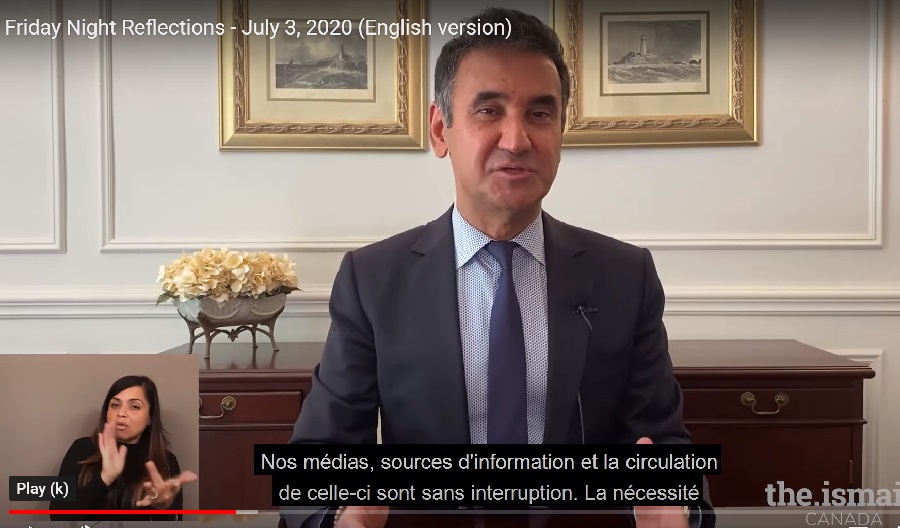
Ismaili Sign Interpreter
President Ameerally Kassim-Lakha of His Highness the Aga Khan Shia Imami Ismaili Council for Canada gives his weekly address to the Canadian Jamat during the Friday Night Reflections program, while Safina Heneisen, a US based sign interpreter shown at bottom left of the photo, conveys the President’s message to Deaf Ismailis. In the top featured photo, the sign interpreter conveying Mawlana Hazar Imam’s speech is Vancouver’s Farah Ladha. Both photos have been extracted from the weekly Reflections program.

Since the coronavirus pandemic, all gatherings have become virtual. It was nice to see that the Canadian institutions had recruited sign language interpreters for the Friday Night Reflections series, a weekly webinar that airs on the Ismaili Canada website every Friday. This is a step in the right direction in terms of engaging and involving the Deaf Ismaili community. But that is not all that we can do! We are One Jamat -– what more can we do to include our Deaf brothers and sisters?

When Deaf murids are asked for their thoughts, many say they want to go to Jamatkhana to participate in and learn about our rituals, our history, our traditions, and our culture. But, without the presence of someone who can interpret this information to them in sign language, they are unable to learn and participate in a way that Hearing Ismailis can, which sadly but understandably, causes many to stop coming to Jamatkhana altogether.

YOUNG DEAF ISMAILI CHILDREN

There are also many young Deaf Ismaili children within our community, who do not have access to the Ta’lim Curriculum or teachings at Bait-ul-ilm (BUI) in sign language. Parents have expressed much sadness in seeing their children being unable to participate in these teachings. If you find yourself thinking, “why don’t parents of Deaf children just teach them our faith in sign language themselves at home?”, please consider this: do you (or any parent) have the same level of knowledge as a trained Secondary Teacher Education Program (STEP) BUI teacher, or an Alwaez? Furthermore, this type of thinking does not consider the experience of attending BUI, of interacting with other Ismaili children, and of feeling like a part of the community.

Deaf children and adults experience many challenges just in the process of seeking to understand and be understood.  Imagine being in a country where you do not understand the language but still need to ask for directions. That would be a challenge.  Now imagine you are in that same country; you have learned a little bit of the language and are required to give a fluent presentation. Imagine being judged on your performance, on the errors in vocabulary choice and grammar that cause misunderstanding or confusion.  That is the challenge that Deaf children and adults face daily.

For Deaf people to have full communication access, they need communication partners that share the same language that they use.  For learning and participating fully in the BUI and in the Jamatkhana there needs to be access in sign language. This can be provided by a teacher who is proficient in sign language. If there is no teacher who is skilled with sign language, the services of a professional sign language interpreter can be used. Such professionals will have completed many years of specialized training and are able to interpret in a variety of situations from business meetings to conferences, medical appointments to classrooms, and even in Jamatkhana.

Not only are professional sign language interpreters trained in a variety of settings, they are also ethically bound to a strict code of confidentially set by their local and national associations.  Some interpreters even work internationally.

Interpreters play key roles in this process of learning and belonging. When Deaf murids receive information in sign language, they thrive in our community. By learning the meanings of Firmans and of our various prayers using sign language, they have said that they feel more connected to our faith –- not only physically to the space of Jamatkhana, but spiritually as well. We would like to share a few examples of how interpreters can be key contributors in building bridges and connections between Deaf and Hearing Jamati members.

story continues after photo

Ismailis taking the American Sign Language Class in a Jamatkhana
A group photo of students attending American Sign Language (ASL) class in a Jamatkhana. Photo credit: Farah Ladha.

EXAMPLES: THE JOY OF FEELING CONNECTED

A Deaf man in his 40s was interested in learning about mehmani that is brought to Jamatkhana, which is then sold as nandi. The question was why is it brought to Jamatkhana as a mehmani? And how its auctioned off after? The presence of an interpreter encouraged this murid to buy nandi in Jamatkhana for the first time. The custom was interpreted for the Deaf murid in sign language, including the description of the item, and the entire bidding process. When he wanted something, he would raise his hand. A Jamati member next to him informed him when his upper price limit had been reached by tapping him on the shoulder, causing him to lower his hand if the price exceeded his set amount. This not only helped him to participate in and understand the tradition of nandi, it also helped him to feel connected and interact with other Jamati members and allowed them to learn how to communicate with a Deaf murid.

Another example: For many years, a well-known Deaf murid attended Jamatkhana regularly. Every day, he would be greeted with a handshake to say hello. Nothing more was conveyed between himself and other Jamati members, as a communication barrier existed between them. One day, the Deaf murid, through a sign language interpreter, was able to present to the Jamat about his life. Audience members wept at having seen him for many years but never truly knowing him or his story. They also didn’t know that as a child, Hazar Imam had put his hand on his shoulder during a mulaqat while at the same time telling his father not to worry, his Deaf son would be ok. Nor were they aware that he had gone on to have a very successful business. His story would never have come to light if it were not for the presence of an interpreter, who facilitated the communication and understanding using sign language and the audience’s spoken language.

DIAMOND JUBILEE AND RECENT SUCCESS STORIES

A final example outlining a recent success story is one from the Diamond Jubilee. After tireless work and education about the inclusion of the Deaf Jamat, sign language interpretation was provided live for the first time for the Mulaqats in Karachi, Paris, and Lisbon, as well as across Canada and in Atlanta Georgia, USA. Over 250 Deaf murids were able to understand Hazar Imam’s Firmans for the first time.

However, there were still hundreds more that were not able to reap the benefit of the live interpretation either due to lack of professional Ismaili sign language interpreters in their area, or due to lack of education and knowledge of the presence of Deaf Ismaili murids, as well as the provision of adequate supports for them. Inshallah as more education is disseminated and awareness is raised, Deaf Ismailis will start to see a change, and more steps will be made towards their inclusion.

GOOD NEWS

The good news is that there is inclusive change happening. Gatherings for Deaf Ismailis have been organized, which have proven to be great opportunities for Deaf murids to meet and greet one another, as well as to teach, learn, and share knowledge. Watching elderly Deaf Jamati members interacting with younger members is a beautiful sight to see and reflect upon. Just as we reminisce about how our grandparents explained concepts to us in their mother tongue, when we were younger, the elder Deaf Ismailis are teaching the younger generations in their shared sign language.

Some Jamats have gone a step further and have hosted sign language 101 workshops for their members, where professional sign language instructors (some from outside of our community) come to teach basic sign language. The workshops have been very successful, and some Jamats have decided to pursue additional workshops so that they can advance their knowledge. All Jamats could host these types of workshops in order to promote communication between Deaf and Hearing murids.

EXCEPTIONAL AND INSPIRING STORIES, AND STIGMAS

In addition to allowing Hearing and Deaf Jamati members to communicate, these workshops also allow individuals with hearing loss to learn sign language and thus have seamless communication as hearing deteriorates with age. For example, there was a woman who brought her elderly mother, who was profoundly deaf in one ear and losing hearing in the other, to one of these organized workshops. Both wanted to learn sign language so that they could continue to communicate once her mom had fully lost her hearing. Both mum and daughter were very touched and emotional when they witnessed firsthand how sign language is possible to learn and assists in communication between the Hard of Hearing and the Hearing. These workshops again were facilitated by professional sign language interpreters, some from within the community and some from outside of it.

These are good news stories, yes. But negative stigmas are still attached with Deafness, mainly the myth that Deaf are unable to be educated or taught or even work to make a living. This is entirely untrue, and an example given by Habiba Teja at a woman’s gala presentation highlights this fact.

Habiba is a well-known nutritionist and was talking about her experience with improving food quality through Aga Khan University (AKU) in Pakistan and Eastern Africa. Through this endeavor, she was able to help many impoverished people find work. One example she gave was about how she learned of a young Deaf man in his 20’s who sat in his room all day and stared at a wall. She visited with him and taught him job skills by communicating with him visually by hand gesturing, and by physically showing him what to do. He was quick to learn and was able to find full time paid work. This turned his entire life around and he began earning an income. He has since gotten married and has a family of his own. The stigma associated with him being Deaf had prevented anyone from trying to support his learning; believing he couldn’t learn, no one bothered taking the time to teach him anything. Habiba’s story touched many and shattered the notions that the Deaf people are unable to be educated or work.

This is not the only stigma we need to face as a community. We need to work together as a community to squash the stigmas associated with Deafness, Blindness, and Disabilities in general. Unfortunately, these stigmas are still very prevalent in the Ismaili Community today. We need to educate ourselves and to reach out to those who feel left out in our community due to situations beyond their control. We need to inspire one another and learn from one another. And perhaps for some of you reading this, it may seem like a lot to take in. Maybe trying to learn a bit of sign language feels overwhelming. For those people, we offer this one quote from a Deaf person:

“Hearing people can learn sign language. Deaf people cannot learn to hear.”

ISMAILI DEAF WEBSITE

Try to learn even just a little bit of sign language to be able to communicate with your Deaf brothers and sisters. If you know of any Deaf Jamati members wanting to participate in activities within our community, but not being able to do so due to the reasons outlined in this article or others, encourage your local or national council to provide a professional sign language interpreter. If they are unsure about how to do this, we invite them to visit the Ismaili Deaf Website and fill out the contact form – information will then be provided to them.

The website also contains lots of information for the general public about the terminology that you have read within this article, such as Deaf, Hearing, Hard of Hearing and Deaf Blind. Furthermore, it has many articles about sign language, and about the achievements and successes of some of our Deaf Ismailis and interpreters. If you are curious about where you can learn sign language in your area, and/or how to have access to professional sign language interpreters, you can fill out the online contact form.

A FINAL NOTE FROM A DEAF ISMAILI MURID

“Without interpreters, our lives would be completely lost. We would feel helpless and struggle in our daily lives because we would not understand what is happening around the world.  We use sign language every day of our lives; a rich visual language which includes the use of facial expression, body language and gestures. Without sign language, we cannot function and participate fully in society as it is our means to communicate in all settings: educational, medical, workplace and at Jamatkhana. Sign language interpreters help us to better understand our faith and religion and in Jamatkhana especially if possible, Ismaili interpreters are so helpful to help us growing in our faith with Allah. Life is about learning and participating in a fully accessible society.”

If you are interested in learning sign language to make friends, to help one another, or to become a certified interpreter, we encourage you to contact your local Deaf and Hard of Hearing service organization as well as local colleges and universities who offer sign language courses. They will be happy to provide you with more information. Of course, you may reach out to us at the Ismaili Deaf Website, and complete the CONTACT US form

Date posted: July 7, 2020.
Last updated: July 9, 2020 (photo caption update with names of sign interpreters).

__________________

FEEDBACK FROM READERS: We welcome feedback/letters on this very important subject from Deaf Ismailis, their families and friends as well as everyone who is concerned about the difficulties Deaf people around the world face every single day of their lives. Stories of inspirational Deaf Ismailis are also welcome. Please use the feedback box which appears below (you may remain anonymous, if you wish). If you don’t see the box please click Leave a comment. Your comment may be edited for length and brevity, and is subject to moderation. We are unable to acknowledge unpublished letters. Simerg’s editor, Malik Merchant, may be reached at Simerg@aol.com. Feel free to write to him – he will only respond to verifiable individuals!

Before departing this website please take a moment to review Simerg’s Table of Contents for links to hundreds of thought provoking pieces on a vast array of subjects including faith and culture, history and philosophy, and arts and letters to name a few.

____________________

Brief notes on 3 books by Ismaili poet Ayaz Pirani, inspired by the oral tradition of Ginans

Introduced by MALIK MERCHANT
Publisher/editor Simerg (2009), Simergphotos (2012) and Barakah (2017)

When Ayaz Pirani is in your neighbourhood doing a reading from one of his books, please attend the event. You will become utterly relaxed listening to his beautiful poetry reading in a calm, gentle and soothing voice. He was in Toronto last year and I attended his reading at Knife Fork Books on 244 Augusta Avenue in the vibrant Kensington Market Area. I couldn’t locate the place easily, and even the NU Bügel staff did not know there was beautiful poetry being served upstairs on a regular basis. After a few more inquiries, I climbed a few set of stairs, excused myself for arriving a little bit late and sat to listen to Ayaz! The small crowd, mainly a gathering of Ismaili youth and professionals, kept urging Ayaz to continue with his reading, and he graciously complied. Meeting him later, I came away even more convinced of the nobility of his heart and soul. I acquired Kabir’s Jacket Has a Thousand Pockets but had to put it away in storage with my other books, as I was preparing to leave for Vancouver to be with my mum. I never got to reading the book nor interviewing this highly gifted literary personality in the Ismaili community. Recently, I asked him to present a short overview of his titles. I am delighted to present his piece below. Links to some on-line stores selling Ayaz’s books are provided at the end of the piece. I look forward to interviewing this literary jewel in the coming months, once my nomadic life style comes to an end!

___________

“My love of ginans is various and unending. They have the charms and rhetorical force of written language as well as the emotional and nourishing elements of oral tradition” — Ayaz Pirani

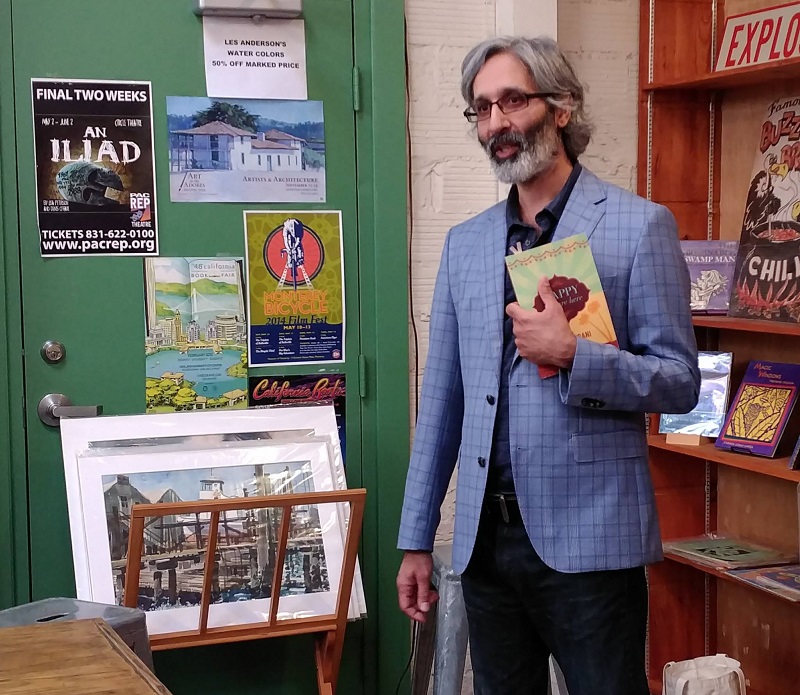
Ayaz Pirani author of Happy you are here and Kabir has a thousand Pockets
Ayaz Pirani reading from “Happy You Are Here” at Old Capitol Books in Monterey, California. Photo: Ayaz Pirani.

By AYAZ PIRANI

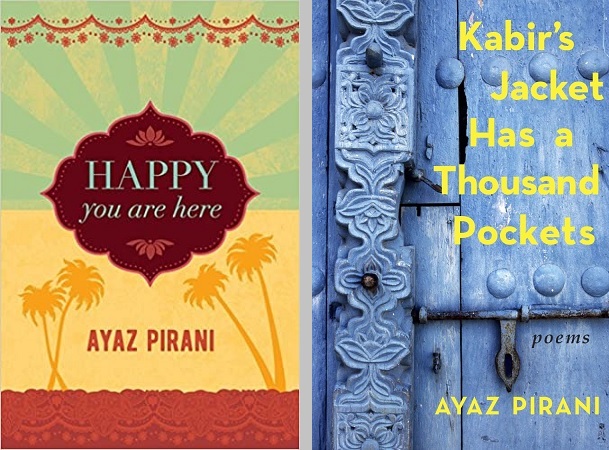
With my first book, Happy You Are Here, I began to wrestle with geography and humanness in my poems. Canadian poet Suzanne Buffam called Happy You Are Here “tender and intimate” and Heather Birrell said “Ayaz Pirani positions himself as a kind of plainspoken anti-prophet, bringing human nosiness and gratitude to a number of subjects—displacement and immigration, the oak woods of the Arroyo Seco, a mother’s love, a pub in Toronto…—as well as the more mysterious geographies of the soul.”

Cover of the book 'Happy You Are Here' by Ayaz Pirani featuring a sunburst design and palm trees.

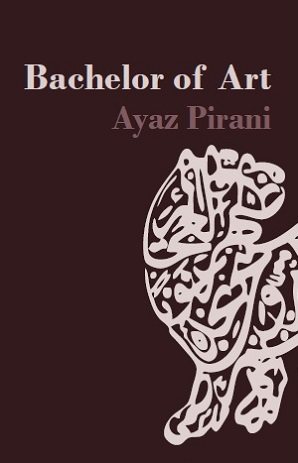
My second book, Kabir’s Jacket Has a Thousand Pockets, was described as “wisdom poetry” that was “surprising and sly” by New England poet David Rivard. All of my work, including my new chapbook, Bachelor of Art, is informed by my affection for Ginans. Perhaps for this reason Rivard felt they were tinged with perennial truths.

My love of Ginans is various and unending. They have the charms and rhetorical force of written language as well as the emotional and nourishing elements of oral tradition. When a Ginan is experienced in situ, that is, in a Jamatkhana, there is further the resonances that come from a living heritage.

Happy You Are Here was reviewed in The Dalhousie Review and Qwerty Magazine and my individual poems have recently appeared in The Malahat Review, ARC Poetry Magazine, and The Antigonish Review.

Bachelor of Art by Ayaz Pirani
Cover of Bachelor of Art features a calligram of Hazrat Ali as the Tiger of God

My new work, Bachelor of Art, is a chapbook of poems. Individual poems include “Ali’s Tiger,” “Nutshells,” and “Sat Panth.” It’s a bit hard to talk about my own work without sounding pretentious, especially when it’s a genre like poetry which has so many romantic associations. In my work I’m trying to describe a particular diaspora experience by finding resources in various treasuries: ginans, divans (of Kabir, Ghalib, et al.), and English literature. I suppose I’m conscious of trying to situate my poems as a Canadian experience as well. I’m drawn to subjects like loneliness, immigration, faith, human awkwardness, love.

~~~~~~~

Ayaz Pirani’s books are available in local bookstores and online at Amazon and Chapters-Indigo. His new book, Bachelor of Art, is currently available from Anstruther Press for $10. The cover features a calligram of Hazrat Ali as the tiger of God.

Date posted: June 30, 2020.

Before departing this website please take a moment to review Simerg’s Table of Contents for links to hundreds of thought provoking pieces on a vast array of subjects including faith and culture, history and philosophy, and arts and letters to name a few.

____________________
We welcome feedback/letters from our readers. Please use the feedback box which appears below. If you don’t see the box please click Leave a comment. Your comment may be edited for length and brevity, and is subject to moderation. We are unable to acknowledge unpublished letters.

Photograph shows James Meredith walking on the campus of the University of Mississippi, accompanied by U.S. marshals. LOC photo reproduced in Simerg

A lesson in Black history in a classroom in Jinja, Uganda: The case of Mississippi’s African-American James Meredith

Editor’s note: The following special piece for Simerg by UK’s Shiraz Pradhan is the second in Simerg’s series of articles on the subject of race, inequality, cultural diversity and pluralism. The first article in the series was President Kennedy’s address on June 13, 1963 to the Americans on the subject of Civil Rights. Shiraz’s piece has been adapted from a chapter in his latest novel “Michelangelo in Jinja” and contains illustrations that do not form part of his novel. Following the article, we have a video of a fascinating talk delivered at the US Library of Congress by Henry T. Gallagher that details the events, including the riot, that took place during the admission of the first black American student, James Meredith, to the University of Mississippi. Mr. Gallagher was among the 20,000 troops that were dispatched by President Kennedy to restore law and order in Mississippi during the riot. He was also personally responsible for looking after the safety of Mr. Meredith.

Stranglehold on Neck of Black People

A frontispiece illustration in "The Child's Anti-Slavery Book…, New York, [1860], showing an African-American slave father leaving his family as he is sold away from his family. Photo: US Library of Congress. Reproduced in Simerg.
A frontispiece illustration in “The Child’s Anti-Slavery Book…, New York, [1860], showing an African-American slave father leaving his family as he is sold away from his family. Photo: US Library of Congress.

By SHIRAZ PRADHAN

When James Meredith was being admitted to the segregated University of Mississippi as its first African-American student, the Uganda Argus carried a cryptic headline “Segregation Defeated”. This simple headline, in the months and years that followed, would change the history of Uganda and rest of Africa.

This event caused great joy in our part of the world and fueled the Ugandan ambition for independence. But in the next several weeks the story turned ugly as many white people of Mississippi and other southern states of the USA reacted violently to black encroachment on the white domain of university education and other civil privileges, forcing President John F. Kennedy to send troops in order to restore law and order.

Yes, it was that stark – blatant denial of black rights! The Meredith saga acted as a catalyst for the re-emergence of the Civil Rights Movement in the US originally started by Martin Luther King in 1954.

Photograph shows James Meredith walking on the campus of the University of Mississippi, accompanied by U.S. marshals. LOC photo reproduced in Simerg
Photograph shows James Meredith walking on the campus of the University of Mississippi, accompanied by U.S. marshals. Photo: Marion S. Trikosko / US Library of Congress via U.S. News & World Report Magazine Photograph Collection.

Mr Batra, our history teacher. seized on the Meredith story to shift his focus from Western and Eastern philosophies to philosophy of action and human rights. He said that philosophy, search for God and reaching nirvana were only words if they did not improve human condition. “As important as God is,” he said, “concern for human condition is no less. We have a duty to our fellow beings. God would wish for that. Today, I will talk about people whose philosophies were based on actions to improve the conditions of their people. More importantly, I will speak about the struggles of black people of America.”

Our teacher electrified the class. Jinja Secondary School in those days was called Indian Secondary School. William Wilberforce and Joseph Bufumbiro where the first native Ugandans who had joined our class. We had become aware of black aspirations. Africa in the 1960s was a smoldering tinder, ready to burst into flames at the slightest wind. The apartheid in South Africa was a stranglehold on the neck of Black People of South Africa. The Sharpeville massacre of innocent blacks in South Africa was fresh in our minds. Ian Smith of South Rhodesia (Zimbabwe) was ready to crush the hopes of black people for an equitable independence with one-man-one-vote and was conniving with the British to declare a minority White Unilateral Declaration of Independence (UDI), which he did in 1965.

The Mau Mau Insurgency for independence that lasted from 1952-1960 in our neighboring Kenya and the subsequent killings of the innocent Kikuyu people by the British was a pink-elephant in the room that no one wanted to mention.

Rolling a chalk-stick in his hand, Mr. Batra sensed our mood and continued. “We will shift our attention to that part of American history that was saddening. In the 1900s, the freed African-American slaves, still called by the derogatory term ‘negroes’, were struggling to gain equality.

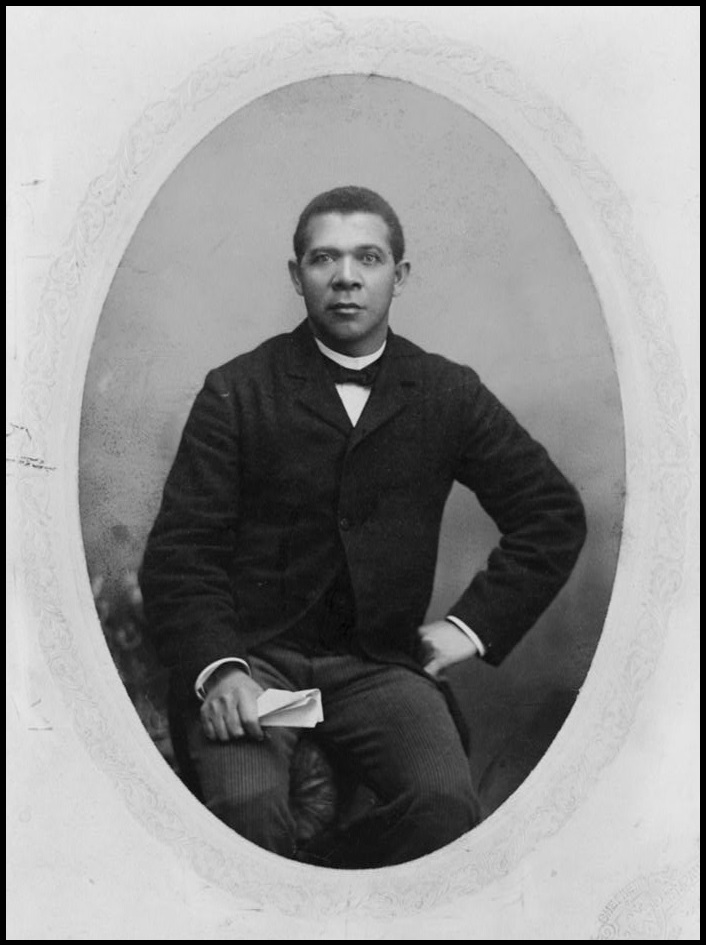
Booker T Washington, Library of Congress Photo, reproduced in Simerg
Booker T. Washington, three-quarter length portrait, seated, facing front; created / published between 1880 and 1890. Photograph possibly by Harry Shepherd. Photo: Booker T. Washington Collection, US Library of Congress.

Booker T. Washington was the first freed slave who had gained high prominence in politics in Washington, DC in the early 1900s. He was an advocate for building African-American economic strength, which he argued would give them the desired freedoms and equality. At this date, although freed, the African-American had no voting rights and no protection under the law. The lynching of black people for petty crimes or in some cases no crimes had accelerated. The whites made sure that black enterprises failed.

Booker T. Washington revolted against this white tyranny and sought to protect the senseless lynching of black people. The constitution drawn-up by the founding fathers of US recognized equal rights but in reality the rights of the black people were ignored. With no legal avenues at his disposal Booker T. Washington agreed to the only compromise solution to protect the rights of black people and save them from murder and lynching. This solution came to be known as the Atlanta Convention.

Agreed in 1905, this illegal convention was never written down. In it, the white establishment demanded that black people forego voting rights, agree only to basic education with no right to university education and no equality in law. The last dehumanizing demand of white people was for a forced segregation of black people in return for limited safety in law and basic freedom.

A poster in the collection of US Library of Congress condemning the South African apartheid policies, reproduced in Simerg
A poster designed and created in 1976 by Wilfred Owen Brigade condemning the South African apartheid regime, and showing support of the international boycott. Photo: US Library of Congress.

The white people of South Africa learned apartheid from this page of US history. Although not fully satisfactory, the Atlanta Convention stopped the senseless lynching and persecution of the black people. This was the singular achievement of Booker T. Washington.

As an afterthought, Mr Batra added, “The importance of James Meredith story that you read in Uganda Argus is that it has taken fifty years for one black student to challenge the unwritten, unlawful Atlanta Convention. The reaction of the white people of the south US demonstrates that white attitude towards the black people has not changed since the abolition of slavery.”

In his characteristic fashion, Mr Batra had not finished jarring our senses with impactful and unjust events from history. He had saved the most powerful of these for the last. He concluded his lesson by saying, “You will study the life of Abraham Lincoln in your literature class next year. He was the 35th president of the US. He abolished slavery in the US and restored human dignity. You would think that this would be a joyful achievement for the US and for Mr Lincoln. Unfortunately, he was silenced like Mahatma Gandhi by an assassin’s bullet soon after proclamation of the abolition of slavery.”

Caption in this illustration by Udo J. Keppler reads: "President Roosevelt: Lincoln emancipated you, the people gave you citizenship and I'll protect your rights."
Caption in this illustration by Udo J. Keppler reads: “President Roosevelt: Lincoln emancipated you, the people gave you citizenship and I’ll protect your rights.” The illustration shows President Theodore Roosevelt, standing with right hand on the left shoulder of an African American man, standing to the left, and his left hand on a paper labeled “15th Amendment”; behind them is a statue labeled “Lincoln – With Malice Toward None With Charity Toward all” showing Abraham Lincoln standing at the top with freed African American slaves. Section 1 of the 15th Amendment of the American Constitution reads, “The right of citizens of the United States to vote shall not be denied or abridged by the United States or by any State on account of race, color, or previous condition of servitude.” Section 2 then goes on to declare, “The Congress shall have the power to enforce this article by appropriate legislation.” Photo: US Library of Congress.

I asked. “Sir, why does every great life end in a tragedy?” Mr Batra thought for a while, before he answered: “Historically the human was a hunter-gatherer. His survival depended on defending his territory and maintaining superiority over others by dehumanizing and enslaving the enemy. The ancient humans hunted in bands. Anyone not belonging to the band was an enemy. This is the human instinct. In this sense a band can be any group with common interest and common characteristics such as race, color or religion. Anyone that challenges this convention is an enemy who needs to be dealt with.”

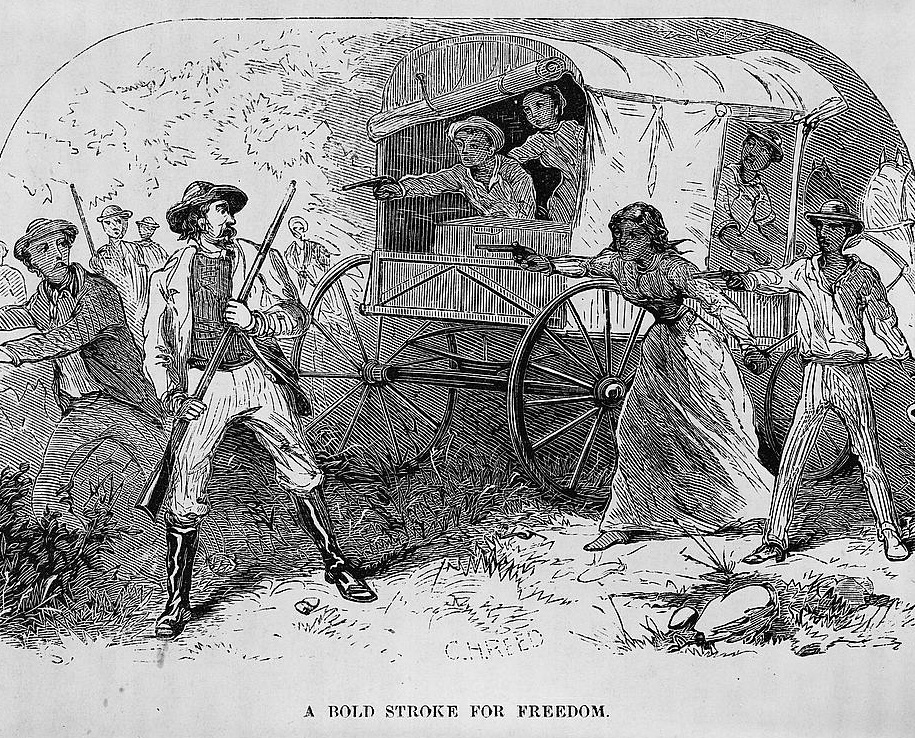
African-Americans with wagon pointing guns at slave-catchers, Library of Congress photo reproduced in Simerg
An illustration entitled ‘A bold stroke for freedom in “William Still, The Underground Railroad” 1872, p. 125, depicting African-Americans with wagon pointing guns at slave-catchers. Photo: US Library of Congress.

In the coming years the situation in Africa became grim as the apartheid grip on South Africa became stronger, Southern Rhodesia sunk in to a quagmire and Algeria began a war for independence from its French master. It was this one lesson with Mr Batra that gave us the motivation to pick up banners to end tyranny in Africa and to fight for justice for Nelson Mandela when the illegal South African regime tried him for treason.

Watch an important webcast presented by the US Library of Congress

SUMMARY: In September 1962, James Meredith became the first African American admitted to the University of Mississippi. A milestone in the civil rights movement, his admission triggered a riot spurred by a mob of 3,000 whites from across the South and all-but-officially stoked by the state’s segregationist authorities. The escalating conflict prompted President John F. Kennedy to send in 20,000 regular Army troops, in addition to federalized Mississippi National Guard soldiers, to restore law and order. “James Meredith and the Ole Miss Riot” is the memoir of one of the participants, a young Army second lieutenant named Henry T. Gallagher, born and raised in Minnesota.

VIDEO: James Meredith & the Ole Miss Riot

Date posted: June 12, 2020.

Before departing this website please take a moment to review Simerg’s Table of Contents for links to hundreds of thought provoking pieces on a vast array of subjects including faith and culture, history and philosophy, and arts and letters to name a few.

______________________

About the author: Shiraz Pradhan is a professional engineer, writer and philosopher. He grew up in Uganda and attended universities in Kenya and Pennsylvania, USA, and graduated with advanced degrees in Mechanical Engineering and Mechanics. As part of his involvement in several mega-project across the world, he has lived and worked in several countries in North and South America, Asia-Pacific, the Middle East and Europe. This has given him a globalist world-view which flavours his writings. His first novel Dancing with Shadows was published in 2015. Michelangelo in Jinja is his second book. Summing his writing, Pacific Book Review said: “Pradhan’s work is the first one I’m aware that is actively Globalist.” Shiraz has a keen interest in Judaeo-Christian History, Islamic Studies, Sufism and philosophies of the Vedas and Upanishads. With his interest and familiarity with several languages and dialects, Shiraz has specialized in the study of ancient and medieval devotional traditions of South Asia including the Nizari Ismail Ginans. He has published several essays and articles on these subjects, many of which have been published on this website. He is currently completing a book titles Amarapuri, the Abode of Eternity for publication in late 2020.  He is the Chairman of the Association of the Study of Ginans which specializes in the preservation, study and research of the ancient Ginans. Shiraz currently lives in the UK with his family.

Well I Never….


By ROXANA JAFFER

Well I Never …

Order of the day: “Stay at home”
An opportunity to relax n catch up with sleep

COVID 19, you came to destruct,
And Lockdown 20, you came to obstruct

Or a chance to question His existence deep
No resistance now in the discovery of NUR?

An – NUR the sacred sound of the universe
Found in every nook and cranny like a poetic verse

Well I Never …

To the garden perambulating the home
Round and Round; looking for the Unknown

As Adam found Eve in His Garden of Eden
Many jewels in my garden; blatant to my Oblivion

All speaking in color and shape, flower bush and tree
Iqra – Read, Read what you know not, come set yourself free

Learn the sound of NUR through the birds of the sky
Recite with the mind; find the power of the butterfly

Well I Never …

NUR exists; in the many shades of red and pink
Juxtaposed with variegated greens all in sync

Green berries flowering to pink; Honey bees in search of nectar
Confused with beautiful butterflies on their path as protector

Cant but just appreciate what I never saw before
Blessings manifold of the birds in their original couture

The Neem, the Lime, the Chikoo & Moringa opening their boughs
Guests invited to perch are the parrot, the dove and the crows

Well I Never …

Look everywhere and there is diversity in total harmony
Not castles in the air, but the moon dancing round the planets

Under the moonlight am I, a whirling dervish on the lawn
Moving to the rhythm of NUR, not aware when night becomes dawn

Twirling in happiness becoming submerged in His current
He who is above all else, only His cell is totally apparent

COVID 19, did you really come to destruct?
Really you helped to right the wrongs and reconstruct

Date posted: May 26, 2020.

Before departing this website please take a moment to review Simerg’s Table of Contents for links to hundreds of thought provoking pieces on a vast array of subjects including faith and culture, history and philosophy, and arts and letters to name a few.

______________________

Roxana Jaffer, Simerg

Kenyan born Roxana Jaffer, is an accountant by profession, and currently lives in the UAE. She is striving to make the world a better place, and is the founder of the NGO -– ‘abc: an Advent for Building human Capital’ (see www.myabcfoundation.org) which accords English to the unemployed in Hunza and Delhi, resulting in a 70% impact as youth get growth.

Her creativity is taking a different turn as she expresses spirituality through poetry she pens. We were delighted to welcome her into the Simerg fold with her recent composition Devotion Through Dhikr.

______________________

We welcome feedback/letters from our readers. Please use the feedback box which appears below. If you don’t see the box please click please click Leave a comment. Your comment may be edited for length and brevity, and is subject to moderation. We are unable to acknowledge unpublished letters.

Translucent Night


By NAVYN NARAN

A night view of the Ismaili Centre with its distinctive glass dome, illuminated warmly against a dark sky.

A grain of sand,
Held in its shell.
A pearl is born, hidden from sight
These are reflective within the whole
Under the opaque crystal
Of the peaked Ismaili Centre dome
Here grains of sand
transform into pearls.
A mountain peak risen
From circular white granite
The translucent glass faces
His one time home.

The moon is peeking out
As it waxes on a journey
The clearest night paves the way
towards a seventh heaven
No clouds to deter the clarity and blessings
of quanta and waves.
Piercingly clear, nothing interferes.
The dome sits majestically, still as thin air
In the bright night lit of stars
Where all souls pray.

Those who eat of the fruits of that which is within
In the peace of the night
Light enters through the transparent glass
You search for the spiritual nature of being
Between the opaque and the transparent.

Peace tonight as Shawwal arrives
Then dawn will break clearly
And rustle of wings and hymns of birds will be heard,
As buds have been born
Tulip has bloomed
Russian sage is waking
Cherry blossoms are done
Serviceberry smart in rows, salutes
Infinity pools await water,
Thoughts take root.

And so we wonder,
What is under this dome?

Ismaili Centre Toronto Dome
The dome of the Ismaili Centre Toronto

Date posted: May 25, 2020.

__________________________

A close-up portrait of a smiling woman with shoulder-length hair, wearing a patterned top.

About the author: A regular contributor to this website, Dr. Navyn Naran was born in Dar es Salaam, Tanzania, to Anaar (1936-2017) and Badrudin Naran (1930-1979). She is currently in Toronto working in pediatrics and volunteering at the Aga Khan Museum.

____________________

We welcome feedback/letters from our readers. Please use the feedback box which appears below. If you don’t see the box please click Leave a comment. Your comment may be edited for length and brevity, and is subject to moderation. We are unable to acknowledge unpublished letters.

Before departing this website please take a moment to review Simerg’s Table of Contents for links to hundreds of thought provoking pieces on a vast array of subjects including faith and culture, history and philosophy, and arts and letters to name a few.


The Echoes of Nature

By NAVYN NARAN

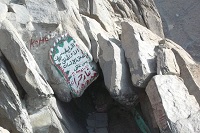
Cave of Hira, Saudi Arabia

The echoes of Nature
Bring us back to the cave
Wherein spirituality harkens the soul
Hush
What is this ?
To “Read”?
Not yet.
First to calm down
Slow down the thoughts
And attend the Divine Intellect
That which emanates within each of our souls
Within the bear of this Magnificent body
That is all too human
But never humanly created.

The echoes of Nature
Bring us back to the cave
To will the calm.
Creating space to calm the Will.
The physical jamat Khana is closed today
The spiritual space wide open
The windows to spring invite us in
To quiet the mind for moments within

The echoes of Nature
Light our world
Let fresh air be a gift to enjoy.
Within the chaos we must remember our Peace
The time is given
To slow the rat race.
Echoes of Nature
Harken the soul
Can you hear?
Perhaps outside in nature
Or your child’s face asleep
Or the eyes of a pet by your side

Pause
Come in.

© Navyn Naran. 2020.

Date posted: May 14, 2020.

____________________

Dr. Navyn Naran

About the author: A regular contributor to this website, Dr. Navyn Naran was born in Dar es Salaam, Tanzania, to Anaar (1936-2017) and Badrudin Naran (1930-1979). She is currently in Toronto working in pediatrics and volunteering at the Aga Khan Museum.

____________________

We welcome feedback/letters from our readers. Please use the feedback box which appears below. If you don’t see the box please click Leave a comment. Your comment may be edited for length and brevity, and is subject to moderation. We are unable to acknowledge unpublished letters.

Before departing this website please take a moment to review Simerg’s Table of Contents for links to hundreds of thought provoking pieces on a vast array of subjects including faith and culture, history and philosophy, and arts and letters to name a few.

Devotion Through Dhikr

By ROXANA JAFFER

Heart in a pulsating mode; in rhythm with the breath
Mind reaching its zenith; as thoughts meet their death

Gratefulness taking over; Conveying lightness to the body
Entire body in smiles; Perhaps the spiritual light in embody

All because of the Dhikr, the constant chanting
His attributes in tempo, energy in sync; all else negating

Dhikr:
What an effect on the waves of the Gamma and the Theta
Both leave defeated, allowing the take-over by the wave of
relaxing Alpha

Dhikr:
Bringing an awareness of His elements; so many …..Ninety-nine
An inner need arises; to ascribe, to impute these traits divine

Dhikr:
My heart is in a pulsating mode, in sync with the mind
Now there is total unity; as mind, body and soul are totally entwined.

Date posted: May 13, 2020.

Before departing this website please take a moment to review Simerg’s Table of Contents for links to hundreds of thought provoking pieces on a vast array of subjects including faith and culture, history and philosophy, and arts and letters to name a few.

______________________

Editor’s note: We welcome Roxana Jaffer as our new contributor. Dhikr, penned by her in March 2020, is the first of her several poems we will be publishing in the coming weeks.

Roxana Jaffer, Simerg

A Kenyan born girl, brought up in the UK and now residing in UAE, Roxana Jaffer has many awards to her name including “Global Inspirational Leadership Award”, “Best Best Woman in Hospitality UAE Award”, and “The Most Influential Women Leader  Award 2019”. She was also recognized as one of the “Indian Super 100 Women Achievers in the Middle East & Africa”. She partners with UN World food program, and her endeavours have managed to feed over 460,000 hungry children in the world. She is instrumental in Holiday Inn Dubai attaining the coveted  CSR Arabia award, four years running out of 13 Arab countries.

An Accountant by profession she has an MBA from University of Liverpool in Leadership and is a scholar of the Harvard Business School for Executive Education.

Roxana epitomises the best in human endeavour -– fun, laughter, hard work, creativity, caring for others, leading with a social conscience and above all, striving to make the world a better place and is the founder of the NGO -– ‘abc: an Advent for Building human Capital’ (see www.myabcfoundation.org) which accords English to the unemployed in Hunza and Delhi, resulting in a 70% impact as youth get growth.

Her creativity is taking a different turn as she expresses spirituality through poetry she pens.

______________________

We welcome feedback/letters from our readers. Please use the feedback box which appears below. If you don’t see the box please click Leave a comment. Your comment may be edited for length and brevity, and is subject to moderation. We are unable to acknowledge unpublished letters.

Ismailis on Social Media: You Need to Take Care and STOP Indiscriminate Likes, Follows and Forwards!

Aniza Meghani, Simerg
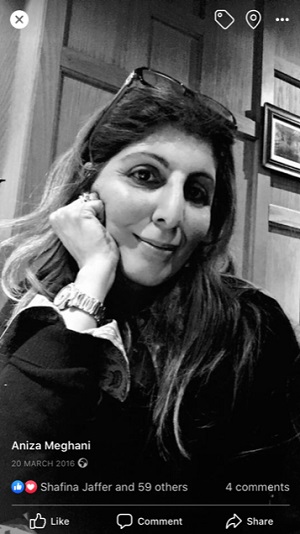
Social media portrait of Aniza Meghani, author of this post.

[A TRULY SHOCKING FORWARD: On Monday May 5, 2020, Simerg received numerous WhatsApp and email messages that stated “MHI has donated 250 million Euros towards the vaccine for COVID-19.” That misleading note was based on the wrong reading of a headline in the Portuguese newspaper noticiasaominuto  which said, “Imamat Ismaili dá 250 mil euros para o combate à Covid-19, and spread like fire around the world. Without even considering to do a (FREE!) google translate, the person(s) forwarding the note assumed that 250 mil euros in the headline represented 250 million euros! Utilizing Google translate would have informed the first sender(s) of the message that the amount is actually 250 thousand and not 250 million — mil denotes a thousand in Portuguese. Aniza Meghani in the following piece asks us to verify facts properly before rushing to accept and like everything that appears to look good on social media. The same care should be exercised with messaging applications. It becomes the duty of the recipient to conduct preliminary fact checking, through translations if necessary, before forwarding messages to their friends and group members. Once forwarded, the rippling effects are enormous, and almost impossible to reverse in a timely manner! A lot of time of precious time was lost in responding to individuals who sent out that error filled message. — Ed.]

By ANIZA MEGHANI

Social media is the most powerful tool in the world, one that can make you or break you! Gone are the days of hearing genuine news by physically buying the newspaper or researching material by visiting the good old fashion library. No more writing a letter and posting it before you patiently wait for a reply. THE WORLD IS YOUR OYSTER AT A TOUCH OF A BUTTON. That is the most dangerous part of it all. We simply access, copy, paste and distort leaving a trail of one’s data history. Data that others can still access. That is more worrying because if you are not careful, it will come back and haunt you when you least expect it. This is critical for students of today when applying for university places or jobs.

Be warned, in certain places as soon as you enter a building, your mobile will give them your history without you even knowing. Now that’s scary! So today, we have within our community, weblinks that allow us to access our Jamati activity and keep us informed. However, with so much misleading information and sites, let us protect ourselves and safeguard our community. To do so, I thought why not show examples of misleading sites that are harmful and painful.

Almost all Ismailis today, traversing through all age groups, from old to young, from those who are fully conversant in the English language to those who do not understand even basic words of English, everybody is on or wants to be on social media.

As Ismailis we are particularly drawn to those pages or sites which display beautiful photographs of our beloved Imam and members of his family, whom we respectfully refer as the Noorani family. Many of us immediately post a ‘like’ or reply with “Yam” wherever we see a photograph of Hazar Imam or his name.

Many of us even join these groups or sites or pages just because the name of Hazar Imam and his photograph are in the title.

I am writing this article because having just concluded reading the recently released Farman book containing the Jamati work Farmans from 2011-2013, it struck me as a matter of curiosity that Mawlana Hazar Imam, in these Farmans — as well as in the Lisbon Diamond Jubilee Darbar Farman — repeatedly stresses to us, his beloved children, to learn and understand English. My cocooned world is all about English, so it felt strange reading about the imperativeness of learning the global language of English.

It wasn’t until recently that I came across the danger of not knowing English well. Or perhaps even the dangers of not reading properly.

Social media is greatly to blame for this growing culture of posting likes to images and skimming through texts. Not really reading, not really absorbing the context of a post, just hitting the like or follow button on whatever pops up on the screen that catches your fancy, in this case, a photograph of Hazar Imam or his name.

It’s sad really. But something still needs to be done. Hence the purpose of this post.

There is a group, or maybe several groups, on social media that tend to post lovely photos of Mawlana Hazar Imam and the Noorani family. It’s heartening, I am sure, to see the glittering countenances of our Imam and the Noorani family, is it not? So, we click the like button and we follow that page or join that group – however, we are absolutely, intolerably clueless about the actual purpose of it. And then, bam! Out of the blue, the very same page posts a sacrilegious article about Hazar Imam, albeit coupled with a beatific photo of him.

Now, if you are a reader by nature, you would be highly scandalized. But if you’re a skimmer, or if you don’t understand English, or if you don’t bother to read the text and are just mesmerized by Mawla’s resplendent smile (I don’t blame you, but I do), you are treading on dangerous ground because you may inadvertently be joining a group that is anti-Imam, anti-Noorani family and anti-Ismaili.

My advice: whenever you see a photograph or name of Hazar Imam, refrain from putting a like or leaving a YAM reply or joining the group blindly. READ all the posts on that page — present and past — as well as read the website where the social media link takes you. And join or reply or like only if the page is in legitimate praise of Hazar Imam. Do the same for each quote, message and link that you receive, and don’t blindly re-forward a message that has been forwarded to you simply because it has come from a trustworthy or reliable source.

Because, as a murid of Hazar Imam, how can you — how can you approve of anything that mocks him, that belittles him, that spreads falsities and terrible lies about him and our faith? How can you be a part of that?

And do not forget that the administrators of these sites are very clever — they will post three very beautiful articles or photographs in praise of Hazar Imam, but then will slip in an article of hate speech against the Imam, the Noorani family and/or the Ismaili Community. STOP THE ZOMBIE-LIKING BECAUSE IT HELPS SPUR THESE NEFARIOUS PEOPLE ON AND SUCH PAGES AND SITES TO FLOURISH! And please explain this to all of your friends and relatives who are on social media but who do not understand English. You have a duty to do this.

Date posted: May 4, 2020.
Last updated: July 15, 2023 (formatting)

© Aniza Meghani / Simerg.

___________________

Aniza Meghani
Aniza Meghani

Originally from Uganda, Aniza Meghani lives in London, England, and is an entrepreneur of textiles and couture fabrics.

We welcome feedback/letters from our readers. Please use the feedback box which appears below. If you don’t see the box please click Leave a comment. Your comment may be edited for length and brevity, and is subject to moderation. We are unable to acknowledge unpublished letters.

We welcome feedback/letters from our readers. Please use the feedback box which appears below. If you don’t see the box please click Leave a comment. Your comment may be edited for length and brevity, and is subject to moderation. We are unable to acknowledge unpublished letters.

Before departing this website please take a moment to review Simerg’s Table of Contents for links to hundreds of thought provoking pieces on a vast array of subjects including faith and culture, history and philosophy, and arts and letters to name a few.

Harry's Trial Shaving Kit

On the Lighter Side: When Harry’s Became My New Intimate Friend

Ubiquitous Harry’s! You are everywhere today with your flashy bright yellow handle — on BBC, CBC, CTV, The Guardian, CNN, NY Times, the Salt Lake Tribune, the Christian Science Monitor and so on — even more now than when I first discovered you! Here is my story of intimacy with you!

Harry’s, I’m glad for my oversight, and re-trying you

By MALIK MERCHANT
(Publisher-Editor, Simerg, Barakah, and Simergphotos)

How much more marketing promotion can you take of the razor that wants you to try it out and win your hearts to experience a real shaving experience; a shaving experience? Is there something like that? Yes, a real culinary experience, a real holiday experience – I’ve heard of those. But a real shaving experience is a term that I was not familiar with or cared about until Harry’s came into my life.

I was lured to the experience when the Harry’s starter kit was being offered for free (plus a nominal shipping cost, all amounts specified in this post are in $ CAD).

I must admit, however, that I took on the offer when I ran into an issue for the first time ever with the 5 bladed Gillette Fusion razor. Another factor may have been for the fact that my favourite football team, London’s Tottenham Hotspur, has Harry Kane playing for it! Does he use it, I wonder? I note, though, that he has been sporting a beard for some time now. But what an incredible promotion he would do to a brand with his own namesake, if he were to start using it! What a special idea to the owners of Harry’s, with hopefully a commission to me, just for the suggestion! Hey, Harry’s contact Kane!

Harry's - a typical promotion ad running in the on-line media

Over the past 40 years since moving to Canada, I have always turned to Gillette’s new razors whenever they were introduced. I have been faithful to Gillette’s 5 bladed Fusion razor for more than 12 years — it was introduced in 2006. My previous ones were the company’s Sensor and Mach III.

For the first time ever, one day, as I was shaving with a new Fusion cartridge, the blue strip wear indicator came off. I wrote to Gillette explaining my concern, and sent them a photo of the Fusion blade with a receipt from the store. They sent me a replacement coupon worth $30.00! No questions asked! I continued using the damaged Fusion blade, as I didn’t feel that the peeled out blue strip had any impact on the blade’s shaving performance.

While I was still waiting for the Gillette coupon to arrive, I was drawn to Harry’s widespread promotion of its free trial kit. I ordered it, paying only the nominal shipping charge. Today, by the way, Harry’s charges $13.00 for the same kit, but with free shipping (all prices, as I noted earlier, in CAD $).

Like many other such free incentives, I submitted my payment details so that, unless I sent a cancellation note ahead of the next scheduled shipment, orders would be automatically sent to me based on my shaving habits that I had mentioned when completing my trial kit order.

The kit arrived, and I decided to set aside my coupon acquired Fusion cartridges in favour of the Harry’s — I had opted for a razor with an olive green handle (orange, and blue handles are also available at the same price; the razor with the chrome handle has a premium of $14), a shave gel bottle, and a cover to hold the blade cartridge.

Now, I have always admired German engineering, whatever form it takes, especially cars and stainless steel products. My cousin, who has been a career esthetician, has always relied on German products for all her esthetic needs, and she told me German products were the best and most reliable! I vividly remember my late dad telling me how his own father, or my grand father, ordered all the steel and metal parts from Germany for his leather manufacturing business in Bombay.

I wondered how Harry’s would fare against a company that has dominated the shaving market for decades, with a heavy emphasis and investment on its R & D. I had read many years ago, even before the introduction of Fusion, that some of Gillette’s products are researched for 5-7 years before they enter the market. Moreover, I had been using Gillette or Wilkinson products since my teen years in Dar es Salaam, Tanzania, when my dad first let me use his razor.

Harry's Trial Shaving Kit
Harry’s Trial Kit – razor, shaving gel, blade cartridge and cover

Of course, when the trial kit arrived, I was concerned that my long-term use of Gillette would bias me against Harry’s. I promised that I would not let that influence me in any way when making a judgement about Harry’s.

True to Harry’s word, I liked the razor! Harry’s claimed, at least at that time, that anyone trying it would be re-ignited with a real shaving experience. Ignited, I wondered? Had I ever actually enjoyed shaving? Was it like eating a gourmet meal at the finest of restaurants? 

Yes, with Harry’s! There was something peculiar about the shave. Ultimately though, my priority over the experience of shaving, was the blade’s endurance and my comfort with it. I felt nervous reaching to shave around the lower or upper lip areas. With Fusion, that fear of cutting myself was not there; with Harry’s, it was –  not that it did cut me. I just felt that with Harry’s, I needed to be a little careful, probably because I was not accustomed to it or felt the 5 blade German made cartridge might be too sharp for the more sensitive areas of my face.

Now how long would this first blade last? Harry’s didn’t come with a wear bar, like the blue one on Fusion, so I didn’t exactly know when I would be nearing the end of the blade’s lifecycle. In the case of Fusion, I would note that the effectiveness of the blade would recede with the thinning of the blue wear indicator. However, I always maximized the use of Fusion and continued its usage until the blue wear bar almost completely disappeared. At least Fusion gave some indication about when it might be time to replace it with another blade, and that was certainly not the case with Harry’s. Each Fusion blade, in all honesty, lasted me between 6-8 weeks, even with daily use! I have used both the Fusion manual and power assisted razors.

After about 4-5 weeks of daily shaves with Harry’s, I did not feel the blade needed replacement. My feeling of discomfort that it would cut me when shaving near the lip area remained. So, at the 6th week, I decided to stop using Harry’s and switched back to Fusion – the one that I had acquired with the coupon!

This time, the blue wear strip was just fine. But then, immediately, I really felt I was missing that Harry’s feeling of shaving — that enjoyable sound of the blades as the razor rolled down my cheeks.

I was at the time pre-occupied with lots of matters and I forgot to inform Harry’s to cancel future standing orders. I then received two more Harry’s cartridges while I was still on my first blade of Fusion. Due to my nomadic living style, I decided to let Harry’s’ know I did not want to receive any more blades; as it was the 2 cartridges from Harry’s and the 4 Fusion blades would last me at least 8-10 months in total.

A few months passed before the Fusion was done with. I was tempted to buy another 4-pack cartridge that was on sale. I resisted, vowing to use the Harry’s blades instead.

As I set off on a 5000 km drive to Ontario, Harry’s and I became intimate. We got along very well. Yes, shaving was enjoyable. That sense of a friction of your hair being lifted was a kind of an experience, and it felt good!

This second opportunity made me realize and appreciate the quality of Harry’s great product. I loved it. I began to use the Harry’s razor in the same carefree manner as I was using Fusion. I did not have any cuts. Harry’s, I realized, lasted me 6-8 weeks. The shaving remained consistently good. I did not have a blue strip to distract me. My Harry’s gel though ran out, and I acquired two Fusion cans at a great price! Both the gels are good, and I really haven’t done a comparison to determine which is better. The Fusion metal can used to leave a rusty circular mark on the counter from the base of the can and, over time, the wrapper around the can would begin losing colour. The current Fusion cans are definitely better. I had no such problems with Harry’s.

In terms of cost, I didn’t really see a great deal of difference between the Fusion cartridge and Harry’s, provided I acquired Fusion blades when they were on sale at special prices. Often, there are fantastic deals.

For me, having to reconsider a product by fluke, in the case of Harry’s, was a blessing in disguise. I was absolutely thrilled with the Harry’s razor and the accompanying shaving gel. The only thing that let me down me was the blade’s cover. The Fusion’s razor comes with a convenient snap-on base rest, when it is not in use, whereas Harry’s provides a small lblade container with 2 pieces that often completely separate from each other; they need to be clipped together once the blade cartridge has been inserted into its location — I found this to be a little bit frustrating.

As for Fusion, it is indeed a great product and Gillette has served me very well throughout the 40 years that I have been using it. During the last 3 years, I have switched between Fusion and Harry’s without any specific preferences for either of them. At the moment, I am back on Fusion as I have been living the life of a nomad and do not wish Harry’s sent to me at a location where I might not be — it would be too much to ask my mum to mail it from Vancouver to Ontario. I do miss Harry’s though — because it introduced me to a nice shaving experience that I hadn’t ever thought about.

Finally, may I provide a tip to Harry’s. I think women would also love your razor, if you build the right one for them; and I think your name is appealing enough! Tottenham’s women fans (or fans of whichever team Harry Kane decides to join at perhaps a fee of £100-150 million ) might just go crazy over it. Men, as you say somewhere, may be messy about shaving, but women have an unmatched elegance and style!

To the two handsome founding lads of Harry’s I say this: Remain humble, and you will do well for a long time. You have a fantastic product and while I do not have Harry’s at the moment, it is something that I will always hold dear to my heart! I am already tempted to once again go for your trial kit — with the vibrant orange handle! Whether I permanently become a Harry’s user still remains to be seen; I think I am now in the process of settling down at one place!

Date posted: April 29, 2020.
Last updated: April 30, 2020 (clarity).

Before departing this website please take a moment to review Simerg’s Table of Contents for links to hundreds of thought provoking pieces on a vast array of subjects including faith and culture, history and philosophy, and arts and letters to name a few.

_______________________

Simerg’s Merchant

Malik Merchant is the founding publisher/editor of Simerg (2009), Barakah (2017) and Simergphotos (2012). A former IT consultant, he now dedicates his time to small family projects and other passionate endeavours such as the publication of this website. He is the eldest son of the Late Alwaez Jehangir Merchant (1928-2018) and Alwaeza Maleksultan Merchant, who both served Ismaili Jamati institutions together for several decades in professional and honorary capacities. His daughter, Nurin Merchant, is a veterinarian.

We welcome feedback/letters from our readers. Please use the feedback box which appears below. If you don’t see the box please click Leave a comment. Your comment may be edited for length and brevity, and is subject to moderation. We are unable to acknowledge unpublished letters.

Ismaili Diary: A rare 100 year old family photo fills in a few blanks of Ismaili Khoja history in East Africa

Author Zahir Dhalla’s Preamble: Khojas, and Indians in general, were not known for keeping personal journals. Thus, there is a dearth of records documenting our history. However, the practice of keeping family photo albums was quite widespread. Photos can fill in some of those blanks, provided someone can tell the stories behind them. This would be a valuable series, people digging into their memorabilia and writing the stories behind them. Below then, is my attempt to do so, hoping it can also serve as one of the templates that others may want to use or adapt as preferred.

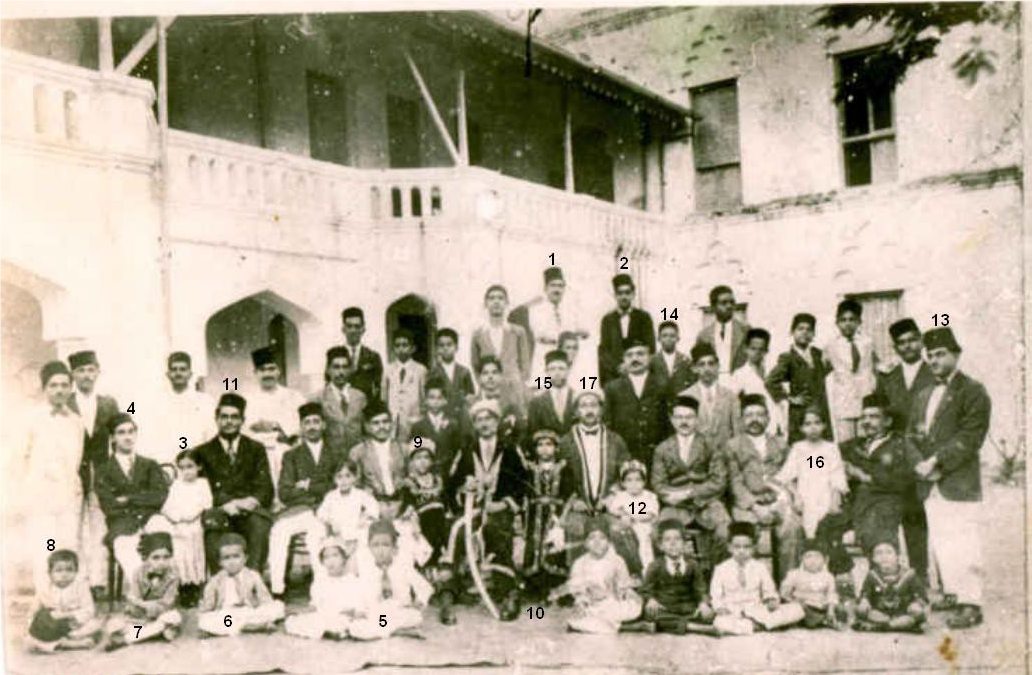
Huseinali Harji (with sword) historical Zanzibar wedding photo
Photo 1: Huseinali Harji (with sword) wedding photo. In the Ismaili Club’s courtyard, Zanzibar, early 1920s. It used to be the British Club where Dr. David Livingstone stayed in the late 1860s. Photo: Safder Alladina, Zerabai’s {10 in photo} youngest son. Captioning: Marhum Kassamali Tejpar, Roshan’s {3} husband. Please click on photo for enlargement.

By ZAHIR K. DHALLA

Gulamhusein Harji Sumar Walji Jendhani* was a pawn broker in the Soko Mahogo neighbourhood of Zanzibar’s Stone Town. Gulamhusein had a large brood, as was common at the time, of 9 sons and 3 daughters, by three wives, the eldest son, Ali {17 in top photo}, being my paternal grandmother Sakarbai’s {16} father. This wedding photo is of Gulamhusein Harji’s third son Huseinali’s marriage to Rukiya.

{1} Hassanali (Hasina){2} Saleh{3} Roshan Abdulhusein Alidina Saleh (Mrs Kassamali Tejpar)
{4} Hamdu Wali Dilgir{5} Badru Ali Harji{6} Kasu Ali Harji
{7} Mohamedali Ali Harji{8} Abdulmalek Ali Harji{9} Gulibai Hassina Harji
{10} Zerabai Hassina Harji{11} A G Abdulhusein{12} Sherbanu Hassina Harji
{13} Hussein “Tumbo” Harji{14} Kanu{15} Rahim Husein Dilgir
{16} Sakarbai Ali Harji{17} Ali Harji 
A guide to individuals in the annotated wedding photo. Dilgir {4} composed the Ismaili anthem.

These are their stories:

All elders and a few toddlers are wearing hats, while youngsters are bare headed, the groom and his eldest brother Ali {17} are wearing ceremonial turbans. By the 1950s, hats were no longer in vogue!

Of the Gulamhusein’s nine sons, Haji (see photo 4, below) and Noorali “Mamma” are not in the above wedding photo. “Mamma” chacha is possibly in the photo, just unidentified.

The Harjis spent, all told, a couple of decades or so in Tanga, Tanganyika (now Tanzania) where at one time they ran a grocery-wines-spirits store called Planters Store. All then left Tanga: Ali {17} going to Mombasa; Haji to Lushoto (see photo 4 below); Hussein {13} to Dar es Salaam; Saleh {2} taking over the grocery business under the name Korogwe Stores, with a branch store in Korogwe, a small town west of Tanga — he also ran a petrol station in Tanga; and Huseinali (the groom) running a chai, toast, maandazi, etc. restaurant called “Karaketa” at the Korogwe railway station, which his widow Rukiya ran after his death.

Story continues after photo

Khoja Ismaili family photo, Tanga, Tanganyika.
Photo 2: Khatibai and her three sons, right to left, Mohamedali {7 in top photo}, Kasu {6} and Abdulmalek {8}, Tanga, early 1950s.

KASU {6}: Younger half-brother of my paternal grandmother Sakarbai Ali Harji {16}, his is a touching story.

His mother Khatibai (nee Jiwan Lalji, Itmadi, of Zanzibar), a most beautiful lady, became demented (during WWII) and was hospitalized in Nairobi. Her three sons, Mohamedali {7}, Kasu {6} and Abdulmalek {8} (in decreasing order of age; see photo 2, above) conferred and decided that they would buy a native bride in Tanga for Kasu, who would settle there as a fishmonger. His bride, Chausiku, was a fine lady, devotedly looking after Khatibai. Khatibai, despite her condition, could always remember faces. Whenever we visited her, she would smile at each one of us, lighting up the whole room! When both Kasu and Khatibai passed away, Mohamedali sent support money to Chausiku. Before he passed away, he instructed son Zul (a fine guitar player in Nairobi, now in Tri-Cities, British Columbia, Canada) to continue support payments, which he did until one day he received a letter from Chausiku’s family, informing him that she had passed away, so not to send support money any more!

ABDULMALEK {8}: Youngest half-brother of my paternal grandmother Sakarbai Ali Harji {16}, he was the youngest of Khatibai’s sons. There was a comical vignette he told me: In 1940, he and three friends decided to enlist in the army (WW II). Mother Khatibai was against it, while father Ali {17} was okay with the idea. They headed for Nairobi for interviews, and along the way one of them dropped out! In Nairobi, someone questioned them as to what they thought they were doing: Didn’t they know they would get only black tea and burnt roti?

Part of their enlistment interview was an examination of their education:

Q. 7 + 5? A. 11. Wrong.

Q. 14 + 9? A. 22. Wrong.

They all came up short and were told, “All you Mombasa guys are hopeless” and were given tickets to return home. Actually, Abdulmalek’s whole class in Mombasa had failed Cambridge, except for one solitary student! Abdulmalek returned to working at his old job at Fatehali Dhala Grocers for 60 shillings a month, filling candy jars, opening and displaying crates of fruit from South Africa. Once he was in the middle of enjoying a nice peach from South Africa, when in walked Count Fatehali who remarked, “It is good that you are tasting and approving these fruits because only then will customers buy them!”

ALI {17}: Father of my paternal grandmother Sakarbai Ali Harji {16}, he was the eldest of the 9 brothers, born in Zanzibar in c1890. In the late 1920s, he worked at a cotton ginnery in Entebbe, Uganda, alongside my paternal grandfather, Gulamhusein, Ali’s son-in-law to be. His last job was as a detective with the CID (Criminal Investigation Department) in Mombasa. He was engaged by the head of the department, an Abdallah Mzee. But soon Ali crashed his motor bike, badly hurting his leg. He retired! Before he died, he told youngest son Abdulmalek {8} that he would be reborn as his son. Sure enough, within a year of his death, a son was born, Gulamali, named by Mawlana Sultan Mahomed Shah Aga Khan III. Gulamali would go on to play up his grandfather role to maximum advantage –- yes, he was untouchable!

Story continues after photo

Gulamhusein Harji Sumar residence in Zanzibar.
Photo 3: Gulamhusein Harji Sumar residence in Zanzibar.

GULIBAY {9}: Lady Gulibai, first cousin of my paternal grandmother Sakarbai Ali Harji {16}, was very well known in Nairobi. She married Ramzanbha of the K. B. Jamal family, owners of Tropicana bistro on Hardinge Street (now Kimathi Street), as well as of Keby’s restaurant further north of Tropicana.

SAKARBAI {16}: My paternal grandmother was very independent, not wanting to be a burden on anybody, even in death, for she had a small briefcase under her bed, which she showed everyone over time, containing everything necessary for a funeral and its rites: a shroud, cotton wool, holy water tablets (made from the earth at the well of Zam Zam), rose water, etc plus enough money for the prayer plate! Her independence also showed in how she addressed my paternal grandfather, her husband: she called him Dhalla, something unheard of in those days when a wife never called her husband by name, resorting to something oblique like “Are you listening?” or simply “Listen then”.

ZERABAI {10}: Born in Zanzibar, she moved to Tanga when she was 12/13 years old. She lived in Tanga the rest of the time until moving to Vancouver. She married Shariffbha Aladin Giga Patni. The Aladin clan adapted this name to a Muslim one: Alladina. This was around the time of the Indo-Pak hostilities after the partition. The Patni refers to people of the town of Patan in Gujarat, India, it having been built on the banks of the mythical river Saraswati.

Zerabai too, like her grandpa Gulamhusein Harji, had a large family of 5 sons and 3 daughters. She herself was of a large family; she was the eldest of a brood of 4 brothers and 6 sisters. When her mother, Khati Gulamhusein Bhaloo Kurji, died while most of her children were still growing up, her uncles Saleh {2} and Haji  stepped up and adopted all the young ones, each picking up 4 children! Zerabai herself was married off to Shariffbha when she was in her early teens.

BADRU {5}: He was the younger brother of my paternal grandmother Sakarbai Ali Harji {16}. He and his family lived in two places, in Tanga first, where most of his children were born, then in Mombasa.

Story continues after photo

A black and white photo featuring a man in a suit standing with three children, two girls on his sides and a boy in front, all posing outdoors.
Photo 4: Chacha Haji with adopted children Sherbanu, Gavar and Dolat, Lushoto, Tanganyika (now Tanzania), c1930s.

Any still around? To my knowledge, none of the identified people above are alive today, although Gulibai’s {9} younger sisters, Dolat (in photo 4 above), and Lily are alive and live in Vancouver and Toronto respectively. The Harji clan today is huge, of several hundred!

Readers may be interested in viewing a collection of Noorali Harji’s historical family photos with Mawlana Hazar Imam, and learn more about Gulamhusein Harji Sumar.

Date posted: April 23, 2020.
Last updated: May 1, 2020 (added 1905 historical photo in author’s footnote, see below).

_____________________

* Author’s footnote: Gulamhusein Harji Sumar (father of the groom, with the sword in the wedding photo) was a member of the first Supreme Council for Africa, 1905, Zanzibar. Itmadi Jiwan Lalji (father of Khatibai, photo 2) was a member too. Please see Noorali Harji’s historical family photos with Mawlana Hazar Imam.

Gulamhusein Bhaloo Kurji (maternal grandfather of Zerabai, number 10 in the wedding photo) ditto.

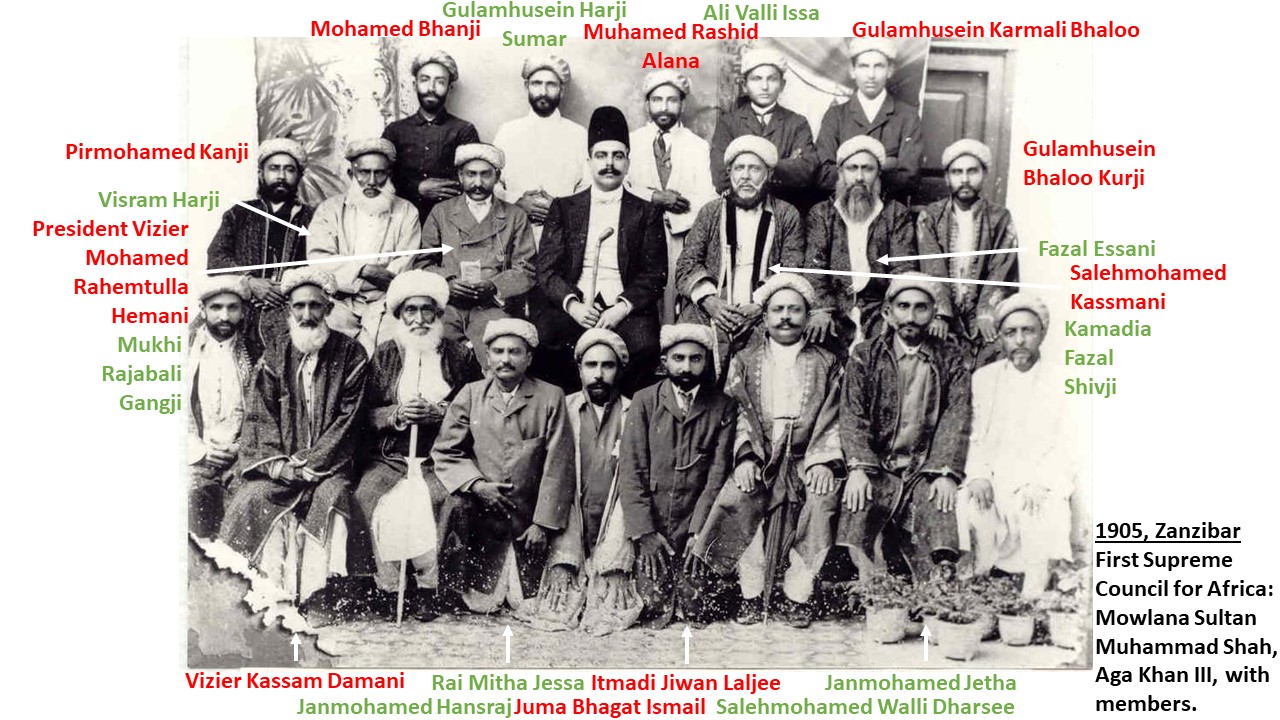
All the above three are also in the classic photo of Imam Mawlana Sultan Mahomed Shah Aga Khan III with the Supreme Council; see photo 5 below.

Aga Khan III 1905 Zanzibar historical photo with Ismaili leaders
Photo 5: Zanzibar 1905 — Aga Khan III, 48th Ismaili Imam, with Ismaili leaders. BACK ROW (left to right): Mohamed Bhanji, Gulamhussein Harji Sumar, Mohamed Rashid Alana, Ali Valli Issa, Gulamhussein Karmali Bhaloo; CENTRE ROW (left to right): Peermohamed Kanji, Visram Harji, President Varas Mohamed Remtulla Hemani, MAWLANA SULTAN MAHOMED SHAH, HIS HIGHNESS THE AGA KHAN, Varas Salehmohamed Kasmani, Fazal Issani, Gulamhussein Bhaloo Kurji; FRONT ROW (left to right): Mukhi Rajabali Gangji, Varas Kassam Damani, Varas Janmohamed Hansraj, Rai Mitha Jessa, Juma Bhagat Ismail, Itmadi Jivan Lalji, Salehmohamed Valli Dharsi, Janmohamed Jetha, Kamadia Fazal Shivji. Photo Credit: Nashir Abdulla Collection, Ottawa, Canada. Please click on photo for an annotated version.

_________

Author Zahir K. Dhalla, a middle-aged man with glasses and curly hair, wearing a suit and tie, is pictured against a blurred background.

Zahir K. Dhalla is a retired GIS (Geographic Information Systems) and IT (Information Technology) freelance consultant in Toronto, Canada. He is a graduate of the University of Nairobi, Kenya (mapping science) and the University of Toronto, Canada (computer science). In addition to his non-fiction writings (see list below) he has also written many private biographies as family keepsakes. He is also the editor of Ismailis of Tanga.

Zahir Dhalla’s books available from Amazon: 

  1. My F-word Plan: How I Routinely Maintain Low Weight & Good Health
  2. Poetry: The Magic of Few Words (Definition and Some Poetry on East Africa)
  3. Nine Ginans of Nine Ismaili Pirs: A Brief History of Khoja Ismailis
  4. Learn Good Swahili Step by Step: A Complete Language Textbook in 3 volumes:
    • A Complete Grammar
    • Swahili-English Dictionary (5,750 words)
    • English-Swahili Dictionary (5,750 words)
  5. The Willowdale Jamat Khana Story
  6. Writing [Auto] Biographies: Demonstrated by author’s early autobiography
  7. From Kibwezi to Kensington: Sherbanu K. Dhalla’s Memories of East Africa
  8. My Tanga Days: 1950s & 60s
  9. Learn Urdu: اُردو: Read, Write, Speak, includes 4,000-word Tri-directional Dictionary
  10. Naked Eye Astronomy: How to Read the Heavens
  11. Two Short Stories: I. Happy Phoebe, II. Troglodytes
  12. Khojo Aawyo! The Khoja has Come! A Story of Migrations
  13. Editor: http://theismailisoftanga50s60s.blogspot.com/

Also, read Zahir’s piece in Simergphotos Bagamoyo Beach Landing, where Aga Khan III was the first Ismaili Imam ever to set foot on East African soil in 1899.

Before departing this website please take a moment to review Simerg’s Table of Contents for links to hundreds of thought provoking pieces on a vast array of subjects including faith and culture, history and philosophy, and arts and letters to name a few.

We welcome feedback/letters from our readers. Please use the feedback box which appears below. If you don’t see the box please click Leave a comment. Your comment may be edited for length and brevity, and is subject to moderation. We are unable to acknowledge unpublished letters.