
Compiled and presented by Abdulmalik J. Merchant
Publisher-Editor, www.simerg.com
I. Excerpts from President Christina Paxson’s Introduction to His Highness the Aga Khan
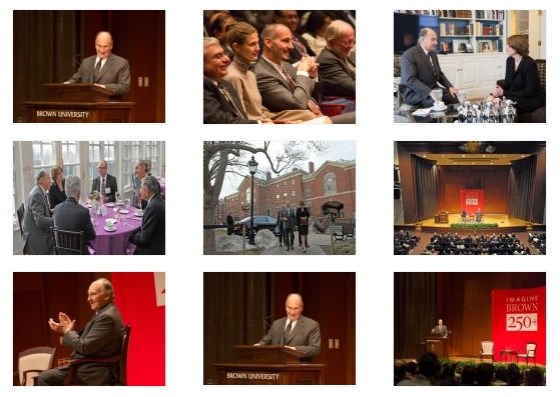
A collection of thumbnails from His Highness the Aga Khan’s visit to Brown University where delivered the Ogden lecture on the occasion of the University’s 250th anniversary. Photo: The Ismaili
Today we welcome His Highness the Aga Khan to the Brown campus — not as a newly arrived guest, but as a returning friend of the University and a Brown parent. In May 1996, Brown conferred the honorary Doctor of Law degree upon His Highness. At that time, President Vartan Gregorian said of him:
“He has become a major activist for civilised humanity and universal values. Not in words but in deeds. Not in one location but around the world. For he believes in the long tradition of Ismaili community values — that education, self-reliance, solidarity, and character are the elements which keep a community vibrant and healthy and lead to enlightenment and dignity.”
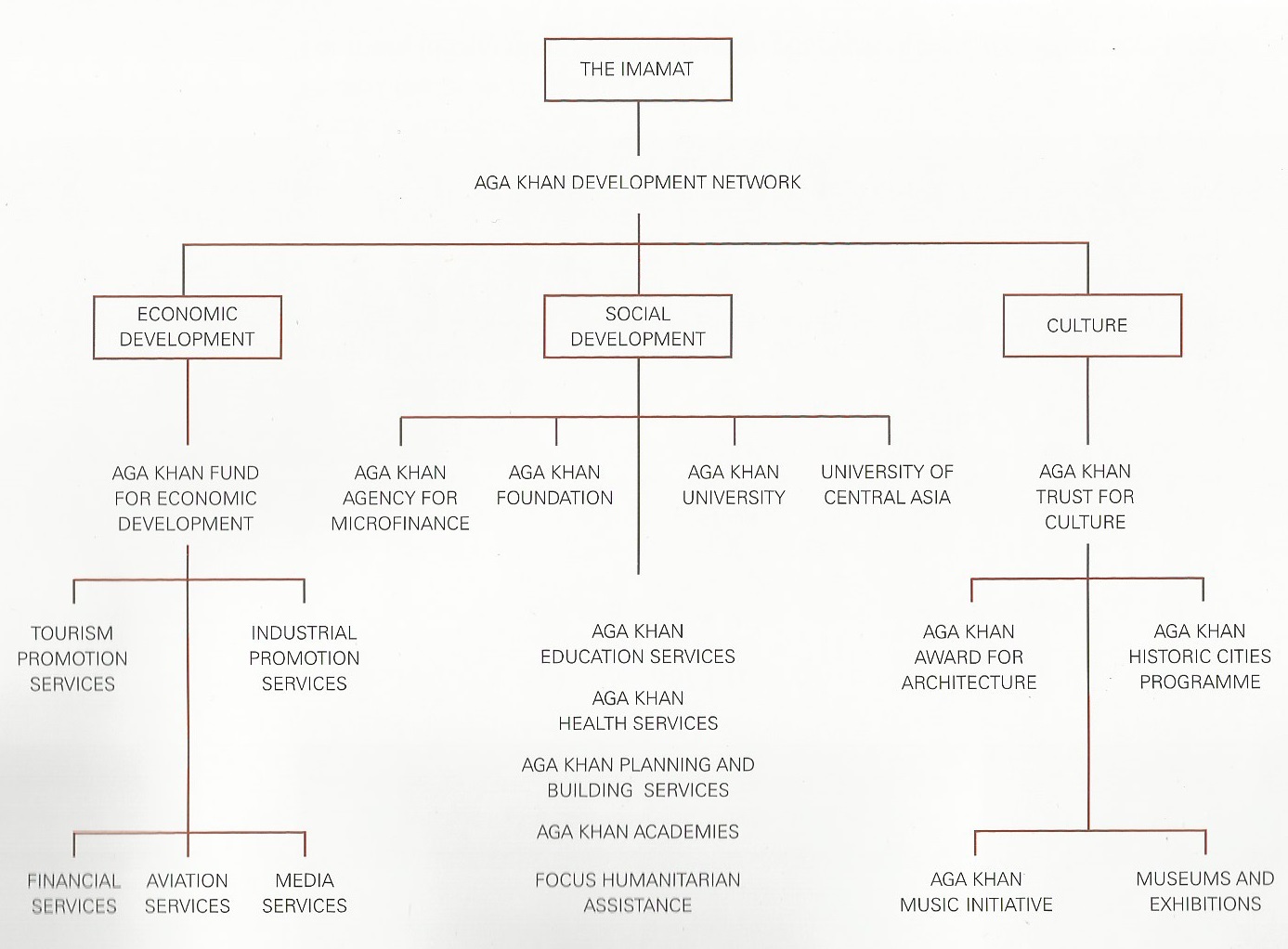
In the 18 years since, His Highness’s critically important work has intensified and expanded. As the 49th hereditary Imam — the spiritual leader — of the Shia Ismaili Muslims, His Highness has been productively engaged with the development of Asia and Africa, work he and his organisations have pursued for nearly 60 years. He is the founder and chairman of the Aga Khan Development Network, one of the world’s largest private development agencies, which has improved living conditions and opportunities for people in 30 countries through work in healthcare, education, architecture, rural development, the built environment, and the promotion of private-sector enterprise…About 80,000 people work for the Network.
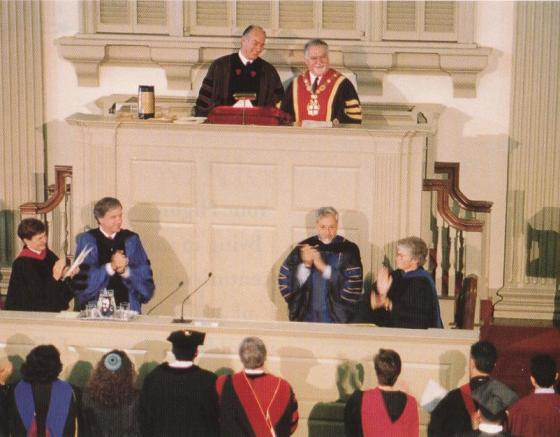
Eighteen years ago, on May 26, 1996, His Highness the Aga Khan receives a standing ovation at the conclusion of the Baccalaureate Address at Brown University, Providence, Rhode Island. Next to him is Vartan Gregorian who was then President of the University.
The Network’s efforts range from small — the micro loans and financing that are so important to eager but resource-poor entrepreneurs — to two entire universities: The five campuses of the Aga Khan University, and the University of Central Asia, whose School of Professional and Continuing Education has served nearly 50,000 students in Tajikistan, Kyrgyzstan, and Kazakhstan. His Highness once made the following remark:
“Education has been important to my family for a long time. My forefathers founded Al-Azhar University in Cairo some 1,000 years ago… Discovery of knowledge was seen by those founders as an embodiment of religious faith — faith as reinforced by knowledge of workings of the Creator’s physical world. The form of universities has changed over those 1,000 years, but that reciprocity between faith and knowledge remains a source of strength.”
Whether for 250 years or a thousand, we at Brown recognise and celebrate the institutions and people throughout the world who champion fundamental values like the discovery of knowledge and the notion that knowledge is a globally shared source of strength.
Ladies and gentlemen, please join me in welcoming His Highness the Aga Khan.
~~~~~~~~
II. Excerpts from His Highness the Aga Khan’s Ogden Lecture Delivered on March 10, 2014
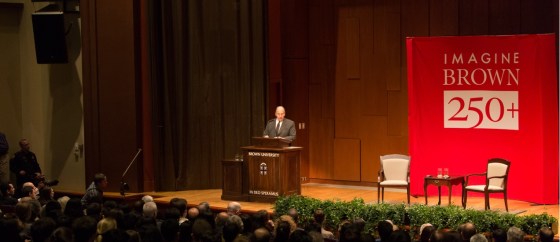
His Highness the Aga Khan visited Brown at the invitation of University President Christina Paxson. His Ogden Lecture was part of the school’s 250th anniversary celebrations. – Photo: AKDN/Farhez Rayani
Bismillah-ir-Rahman-ir-Rahim
1. STEPHEN OGDEN, PRINCE RAHIM, AND
THE AGA KHAN DEVELOPMENT NETWORKThank you very much, Madame President, for your very kind introduction. It is a great honour for me to give the Ogden Lecture…and to pay tribute to the memory of Stephen Ogden.
I have long felt a close sense of belonging at Brown; my eldest son was a member of the Brown Class of 1995, and I treasure the fact that I received an honorary degree from Brown, and was privileged at that time to give the Baccalaureate Address.
My own education has blended Islamic and Western traditions. I was studying at Harvard some 56 years ago when I inherited the Ismaili Imamat. It is not a political role, as has been mentioned, but let me emphasise that Islamic belief sees the spiritual and material worlds as inextricably connected. Faith should deepen our concern for improving the quality of human life in all of its dimensions. That is the overarching objective of the Aga Khan Development Network, which President Paxson has described so well.
2. 1996 AND NOW
It has been said that giving an effective university lecture requires the boldness to make some strong predictions about the future.
As I look back, over some 18 years now, to 1996, I think I actually under-estimated how many things would change in the years ahead. If you were a student at Brown 18 years ago, you would not have had any Facebook friends and you wouldn’t be following anyone on Twitter. And, even more sadly perhaps, no one would be following you!
There was no instant messaging at that time; indeed, as I recall, people actually used their telephones primarily for talking!
In fact, email itself was still quite a new thing in 1996. And those are only the most obvious examples of transformative change in our world.
What has been the impact of such changes? We often think about technological innovation as a great source of hope for the world. We hear about how the internet can reach out across boundaries, helping us all to stay in touch, and giving us access to information from every imaginable source.
3. COMMUNICATION TECHNOLOGIES – FULFILLED HOPES AND DISAPPOINTMENTS
But it is worth remembering that the same affirmations have greeted new communication technologies for centuries, from the printing press to the telegraph to television and radio. Yet in each case, while many hopes were fulfilled, many were also disappointed. In the final analysis, the key to human cooperation and concord has not depended on advances in the technologies of communication, but rather on how human beings go about using – or abusing – their technological tools.
Yes, the Information Revolution, for individuals and for communities, can be a great liberating influence. But it also carries some important risks.
A. Risks: Fleeting attention spans, Impulsive Judgments and Isolation
More information at our fingertips can mean more knowledge and understanding. But it can also mean more fleeting attention-spans, more impulsive judgments, and more dependence on superficial snapshots of events. Communicating more often and more easily can bring people closer together, but it can also tempt us to live more of our lives inside smaller information bubbles, in more intense but often more isolated groupings.
B. Risk: Greater Connectivity # Greater Connection
We see more people everywhere these days, standing or sitting or walking alone, absorbed in their hand-held screens. But, I wonder whether, in some larger sense, they are really more “in touch?” Greater “connectivity” does not necessarily mean greater “connection.”
Information travels more quickly, in greater quantities these days. But the incalculable multiplication of information can also mean more error, more exaggeration, more misinformation, more disinformation, more propaganda. The world may be right there on our laptops, but the truth about the world may be further and further away.
C. Risk: Contribution to Fragmentation
Among the risks of our new communications world is its potential contribution to what I would call the growing “centrifugal forces” in our time – the forces of “fragmentation.” These forces, I believe, can threaten the coherence of democratic societies and the effectiveness of democratic institutions.
The problem of fragmentation in our world is not a problem of diversity. Diversity itself should be a source of enrichment. The problem comes when diverse elements spin-off on their own, when the bonds that connect us across our diversities begin to weaken.
D. Risk: Knowledge Gaps…Becoming Empathy Gaps
Too often, as the world grows more complex, the temptation for some is to shield themselves from complexity, we seek the comfort of our own simplicities, our own specialities. As has often been said, we risk learning more and more, about less and less. And the result is that significant knowledge gaps can develop and persist.
The danger is that knowledge gaps so often run the risk of becoming empathy gaps. The struggle to remain empathetically open to the Other in a diversifying world is a continuing struggle of central importance for all of us.
The danger of having knowledge gaps grow into empathy gaps – that was the theme of my address in 1996. I discussed then what was becoming an enormous knowledge gap, nearly an ignorance gap, between the worlds of Islam and the non-Muslim world. Since that time, to be sure, there have been moments of encouraging progress on this front, including academic-centred efforts here at Brown, with your wonderful Digital Islamic Humanities Project.
4. THE WORSENING KNOWLEDGE GAP, AND THE LOSS OF AN IMPORTANT ISLAMIC TRADITION
But in many ways, that knowledge gap has worsened.
We have heard predictions for some years now about some inevitable clash of the industrial West with the Muslim world. These multiplied, of course, in the wake of the 9/11 tragedies and other violent episodes. But most Muslims don’t think that way; only an extreme minority does. For most of us, there is singularly little in our theology that would clash with the other Abrahamic faiths, with Christianity and Judaism. And there is much more in harmony. What has happened to the Islamic tradition that says that our best friends will be from the other Abrahamic Faiths, known as the “People of the Book”, all of whose faith builds on monotheistic revelation?
Of course, much of what the West has seen about the Muslim world in recent years has been through a media lens of instability and confrontation. What is highly abnormal in the Islamic world thus often gets mistaken for what is normal. But that is all the more reason for us to work from all directions to replace fearful ignorance with empathetic knowledge.
5. NON-RECOGNITION IN THE WEST OF MUSLIM CONTRIBUTIONS
Down through many centuries, great Muslim cultures were built on the principle of inclusiveness. Some of the best minds and creative spirits from every corner of the world, independent of ethnic or religious identities, were brought together at great Muslim centres of learning. My own ancestors, the Fatimids, founded one of the world’s oldest universities, Al-Azhar in Cairo, over a thousand years ago. In fields of learning from mathematics to astronomy, from philosophy to medicine Muslim scholars sharpened the cutting edge of human knowledge. They were the equivalents of thinkers like Plato and Aristotle, Galileo and Newton. Yet their names are scarcely known in the West today. How many would recognise the name al-Khwarizmi – the Persian mathematician who developed some 1,200 years ago the algorithm, which is the foundation of search engine technology?
6. HOSTILITY BETWEEN AND WITHIN FAITHS
In the Muslim world itself, as is true outside of it, much of our history, culture and art, has been obscured, and with it a clear sense of Muslim diversity. Among other “in-comprehensions” is the increasing conflict between Sunni and Shia Muslims. In places like Pakistan and Malaysia, Iraq and Syria, Lebanon and Bahrain, Yemen and Somalia and Afghanistan, the Sunni-Shia conflict is becoming an absolute disaster.
The harsh truth is that religious hostility and intolerance, between as well as within religions, is contributing to violent crises and political impasse all across the world, in the Central African Republic, in South Sudan and Nigeria; in Myanmar, in the Philippines and in the Ukraine, and in many other places.
Such hostilities, of course, represent the most sinister side of what I have described as the centrifugal, fragmenting patterns of our times.
7. RESPONSES TO INTOLERANCE
A. Recognition of Pluralism
How can we respond to such tendencies? The response, I would emphasise today is a thoughtful, renewed commitment to the concept of pluralism and to the closely related potential of civil society.
A pluralist commitment is rooted in the essential unity of the human race. Does the Holy Quran not say that mankind is descended from “a single soul?” In an increasingly cosmopolitan world, it is essential that we live by a “cosmopolitan ethic,” one that addresses the age-old need to balance the particular and the universal, to honour both human rights and social duties, to advance personal freedom and to accept human responsibility.
It is in that spirit that we can nurture bonds of confidence across different peoples and unique individuals, welcoming the growing diversity of our world, even in matters of faith, as a gift of the Divine. Difference, in this context, can become an opportunity – not a threat – a blessing rather than a burden.
B. Good Governance: The Example of America’s First President, George Washington
This brings us to the challenges for governance in our time. How do we organise our complex societies to achieve harmony and perhaps some progress, even at this time of growing diversity? These have always been difficult questions and they are not getting any easier. As you know, they were particularly difficult questions for the United States back in this university’s earliest years, as 13 former colonies tried to write a new national constitution.
George Washington, who had presided over the Constitutional Convention, came to this campus in 1790, after just one year as President, when Brown itself was only a quarter of a century old. He travelled to Providence to mark the recent adoption of the new US Constitution by the state of Rhode Island – the last of the original 13 states to do so.

The colossal face of George Washington as photographed from the Presidential Trail at the Rushmore Memorial. George Washington (1732 – 1799), America’s first President is considered the father of the country and is therefore the most prominent figure on the mountain. Photo: Malik Merchant. © Simerg.com
Washington’s visit in Providence marked a moment of historic constitutional significance. And the questions we have raised today, balancing centrifugal, fragmenting realities on the one hand with the imperatives of national bonding and governing on the other, were central concerns for Washington at that moment and throughout his career. After eight years of coping with these issues as the first American president, he made them the major theme of his famous Farewell Address.
He was worried, principally, he said then, about what he called the spirit of “faction” and its ability to undermine a sense of democratic nationhood. He described faction as a spirit, that “kindles the animosity of one part against another,” creating a “fatal tendency to elevate a small but artful and enterprising minority of the community” against the whole. It threatened, he said, “a frightful despotism”, one that could “render alien to each other those who ought to be bound together…”
C. New Government Frameworks and Constitutions Honouring Human Rights: Kenya and Tunisia
Such threats to bonding, and thus to balance, have long presented a central governance challenge, here and elsewhere. And these issues are now being addressed with new intensity all across the world.
Amazing as it may seem, fully 37 countries have been writing or rewriting their constitutions in the last ten years, with another 12 countries recently embarking on this path….And nearly half of these 49 countries have majority Muslim populations.
Clearly, many Muslim societies are seeking new ways to organise themselves. And there can be no “one size fits all”. The outcomes obviously are going to be many and varied. The process will challenge the creativity of the world’s best political and legal thinkers. Especially in the developing world, such matters will increasingly be in the hands of younger, more educated men and women, provided the system allows them to come to the forefront.
These governance issues are frankly today, of global concern. And I believe that the great universities of the world and Brown University in particular, can also play an especially creative role in responding to them.
The challenge, as we have said, will be one of balancing values and interests, honouring the importance of religious and ethical traditions, for example, while also respecting the free will of individual human beings; accommodating both the role of central governments and regional demands, reconciling the urban and the rural; providing for democratic change, and institutional continuity.
Creating new governance frameworks is obviously not an easy task. But it can be accomplished. In Kenya just three and a half years ago, for example, a new constitution ratified by two-thirds of the voters, redistributed power dramatically from the central level to 47 county governments. In Tunisia, just a few weeks ago, a new “consensus” constitution with 94 per cent approval from the elected Constituent Assembly reaffirmed the Islamic identity of the Tunisian state, while also protecting the human rights of religious and ethnic minorities.
D. Good and Quality Civil Society: Vital to Democratic Governance
In these cases, and in other places such as Bangladesh, one of the fundamental constructive forces at work has been the strength of civil society, it is a topic that is worth serious attention.
By civil society I mean an array of institutions that operate on a private, voluntary basis, but are motivated by high public purposes. They include institutions devoted to culture, to science and to research; to commercial, labour, ethnic and religious concerns; as well as a variety of professional societies. They include institutions of the media and education.
I think the conclusion is the success of democratic societies will depend in the end on more than democratic governments. The scale and the quality of civil society will become a factor, I believe, of enormous importance.
A quality civil society has three critical underpinnings: a commitment to pluralism, an open door to meritocracy, and a full embrace of what I described earlier as a cosmopolitan ethic.
The voices of civil society will reflect and express the growing complexity of society, not as autonomous fragments, but as diversified institutions seeking the common good. And I believe that the voices of civil society can be among the most powerful forces in our time. Where change has been overdue, they can be voices for change. Where people live in fear, they can be voices of hope.
8. ATTRIBUTES OF A GOOD CIVIL SOCIETY
A. Talent and Voluntary Service
One of the energizing forces that makes a quality civil society possible, of course, is the readiness of its citizens to contribute their talents and energies to the social good. What is required is a profound spirit of voluntary service, a principle cherished in Shia Ismaili culture, and honoured, I know, here at Brown.
B. Diversified Input
Progress is possible when the multiple, diversified needs of any society can be matched by multiple, diversified inputs; that is also what civil society is all about. This is why great universities, with their broad, diversified programmes, can be a resource of importance in the development of quality civil society, in their own countries but also around the world. And again, Brown offers a powerful example.
C. Predictability and Sophisticated Analysis
Perhaps the biggest quandary we face in our economic and social development programmes is the problem of “predictability”; knowing what changes are going to arise, and then deciding what is more or less likely to work in a given situation. But again, progress is possible when complex issues are subjected to competent, intelligent, nuanced and sophisticated analysis, free from dogmatism, and based upon what I would describe as “empathetic knowledge.” This happens best in open, meritocratic societies, where people’s responsibilities are based on their competence. It also happens best when the intellectual resources of the world’s great universities, like Brown, are brought into play.
D. Well-Informed Leaders with Broad Outlooks
A quality civil society, in any setting, will require well-informed leaders who are sensitive to a wide array of disciplines, and outlooks and cultures. It will require people with the ability to continue their learning in response to new knowledge. I know these are central concerns for Brown University, articulated so well in its new Strategic Plan and its call for “Building on Distinction.”
E. Diversity Without Fragmentation
As we look ahead, in sum, we face a world in which centrifugal and fragmenting influences are of growing importance, presenting new governance challenges all across the planet, and especially in fragile societies. In such a world, the voices of pluralistic civil society can help ensure that diversity does not lead to disintegration, and that a broad variety of energies and talents can be enlisted in the quest for human progress. Diversification without disintegration, this is the greatest challenge of our time.
9. THE IMPORTANCE OF THE HUMAN INTELLECT IN THE SHIA ISMAILI TRADITION AND THE ROLE OF IMAMAT INSTITUTIONS
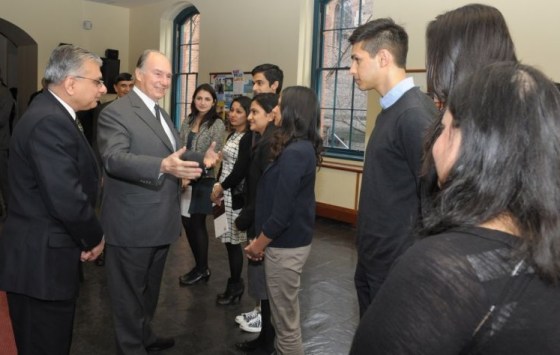
His Highness the Aga Khan meets with Ismaili students at Brown University. Photo: The Ismaili/Aly Z. Ramji
One of the important values of the Shia Ismaili tradition is the transformative power of the human intellect – that conviction underscores AKDN’s strong commitment to education, at all levels, wherever we are present. These activities include the Aga Khan University – now thirty years old – our newer University of Central Asia, our Aga Khan Academies at the primary and secondary levels, and our major commitment to the potential of Early Childhood Development.
The Aga Khan University in Karachi and East Africa is in the process today of creating a new Liberal Arts faculty, while also establishing eight new post-graduate schools. I would emphasise both these initiatives. Professional education is sorely needed in the developing world, but equally important is the capacity to integrate knowledge, to nurture critical thinking and ethical sensitivity and to advance interdisciplinary teaching and research.
10. FINAL REMARKS: SPEAKING FROM PERSONAL EXPERIENCE
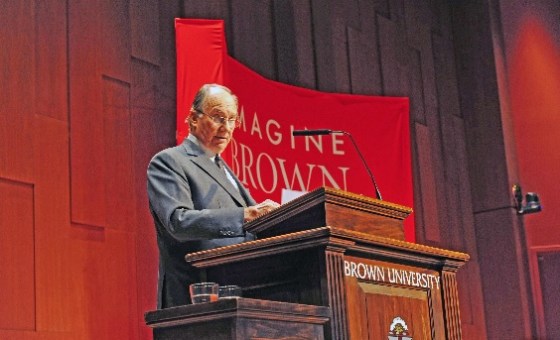
His Highness the Aga Khan delivers an Ogden lecture titled “Modern governance in a more complex world: Challenges and responses” at Brown University. – Photo: AKDN / Aly Z. Ramji
Over the past six decades I have been immersed in the problems of developing societies, grappling with ways to assist their populations, despite both natural hazards and human errors. It is my conviction that a strong, high-quality, ethical and competent civil society is one of the greatest forces we can work with to underwrite such progress. And, if this is correct, then the role of great universities has never been more important.
I am convinced that Brown will be among the greatest universities stepping up to this challenge, as it finishes its first 250 years, and embarks on its next quarter of a millennium!
Date posted: Wednesday, March 12, 2014
___________________
Please visit Ismailimail for a comprehensive collection of links to all material related to the above event. It is the best referral website for anything related to His Highness the Aga Khan and the Ismaili community.
Please also visit:
www.brown.edu
http://www.akdn.org
http://www.theismaili.org
www.nanowisdoms.org



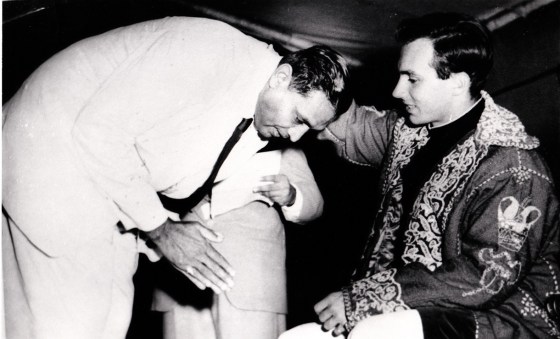




 The term Salgirah is of Persian origin. Sal means anniversary and girah means knot and hence Salgirah literally means ‘an anniversary knot added on to a string kept for the purpose’. This article approaches the subject of Mawlana Hazar Imam’s birthday in terms of the Imam’s love for his murids and the love and devotion of the murids for their Imam.
 The new Ismaili Constitution was ordained, signed and sealed by His Highness the Aga Khan on December 13th, 1986, his 50th birthday. His Highness did this with the belief that the Constitution would provide a strong institutional and organizational framework for his Ismaili community to contribute meaningfully to the societies among whom they live.
 Simerg - Insights from Around the World