Tributes to Ismailis who have passed away during the Covid-19 pandemic: Issue no. 1 of a multipart series

As announced a few days ago, we commence a special series of tributes to Ismailis as well as non-Ismaili members of Ismaili families who have passed away during the Coronavirus pandemic, either due to Covid-19 or any other cause. For details on submitting your tribute to a deceased family member or a very close friend, please read TRIBUTES and write to Malik Merchant at Simerg@aol.com; you must include your full name and contact information.

___________

Inna lillahi wa inna ilayhi raji’un
“Surely we belong to God and to Him we return” — Holy Qur’an, 2:156

Alnoor Ramji
(Canada)

Submitted by Abdulrasul Allibhai Ramji and Lilly Ramji
Alnoor Ramji, Simerg
Alnoor Ramji, age 62 (d. April 14, 2020)

It was the beginning of March 2020. Alnoor’s 62nd birthday was just 3 weeks away. But he had cancer, and was in the last stages of his life. He did not let it control him. Rather, he coped with it, accepted it and carried on with his passion of raising funds for the Aga Khan Foundation’s annual World Partnership Walk (WPW). In each of the previous years, he had raised between $13,000 to $15,000. With all the passion that he had developed over the years for the work of the Imamat around the world, he started sending out a message that simply said, “Donate to WPW [World Partnership Walk].” For him, that would be the most cherished birthday gift anyone could ever give him. In a little more than 3 weeks, Alnoor raised $18,000.

He passed away on April 14, 2020, but not before the Mukhi and Kamadiasahebs of Toronto’s Headquarters Jamatkhana at the Ismaili Centre, made a conference call to him. He answered them with the greeting Ya Ali Madad. They bestowed Dua (prayers) on him, and Alnoor responded with the word “Amen” each time – a total of four times.

His funeral was held in Toronto on April 17, 2020. He leaves behind his parents, Abdulrasul Allibhai Ramji and Lilly Ramji. His two sisters, Nilam (Naushadaly) in Edmonton, Alberta, and Rubina (Craig) in Sydney, Nova Scotia, were both unable to attend the funeral.

Editor’s note: An obituary for Alnoor Ramji was published in The Toronto Star on April 17, 2020. Please click HERE to read the detailed piece.

_____________________________

Goulzare Foui
(France)

Submitted by Nigar Ribault

Goulzare, France, Simerg
Goulzare Foui

« Ma chère Goulzare Foui, 

Vous m’aviez dit de ne pas m’inquiéter parce que vous aviez juste la grippe. Vous connaissiez si bien mon caractère angoissé : « mais qu’est ce qu’on va faire de toi avec ces angoisses mon petit ? ».

Et soudain, en quelques jours, vous avez été emportée par ce virus. 

Je vous appelle et je vous cherche depuis 40 jours que vous êtes partie … 

Et vous êtes là ! : 

Les roses ont fleuri et me font signe. Je vous vois Goulzare (Jardin fleuri) dans ces fleurs. Je vois votre beau sourire lumineux. J’entends votre voix dans le chant des oiseaux du printemps. Vous chantez comme un rossignol dans le grand jardin de Mowla Bapa.

Vous ne m’avez pas quittée : vous êtes dans mon cœur pour toujours et dans ce que vous m’avez transmis. Je vous aime ma Goulzare Foui. La petite sœur de mon papa. 

Votre Nigar »

~~~~~~~~~~~~

Translation by Dr. Nurin Merchant

My dear Goulzare Foui,

You told me not to worry, that it was just the flu. You knew my anxious character well — “what are we going to do with you and all of your anxieties my little one?”

And suddenly, in just a few days, this virus had taken you from us.

I call you, I seek you ever since the day you left us 40 days ago.

And there you are!

The roses have bloomed, giving me a sign. I see you Goulzare (flowery garden). I see your beautiful and radiant smile. I hear your voice in the song of the spring birds. You are singing like a nightingale in Mowla Bapa’s big garden.

You have not left me: you are here. Here in what you shared with and passed down to me, and forever in my heart. I love you my Goulzare Foui. My dad’s little sister. 

Your Nigar.

Translators note: In the translation, I have tried to keep the meaning of Nigar’s beautiful tribute to her aunt as best as I could.

_____________________________

Amirali S. Nagji
(USA)

Submitted by Akberali Nagji
Tribute to Amir Nagji, Simerg
Amirali Nagji, age 78 (d. April 2, 2020)

Amirali Nagji passed away of natural causes on April 2, 2020 in Albuquerque, New Mexio, USA. He was 78. Originally from Mtwara, Tanzania, Amirali was very hardworking and generous; he was known for helping many people by giving free accommodation in his motel.

He served Jamati institutions for twenty years, and had also held the position of Mukhisaheb of Albuquerque Jamat.

Outside Ismaili institutions, he served seniors at a local hospital. His ever-smiling face and friendly demeanor provided comfort to many.

Amirali loved to travel and was fond of Bolywood music. As well as being a good dancer, he had a wonderful sense of humour, for which he was greatly admired.

He is survived by his wife Nurjehan, daughter Alia and her husband Shafin, and two grandchildren.

We pray that his soul may rest in eternal peace. Amen.

___________________________

Sultan Piroj Maknojiya Methanwala
(India)

Submitted by the families of Nazarali Kasamali Momin and Akbarali Kasamali Momin

Sultan Methanwalla, Simerg
Sultan P. M. Methanwala (d. May 16, 2020)

Sultan Bhai Piroj Maknojiya Methanwala passed away on May 16, 2020 in Vaishali Nagar Jogeshwari West, Mumbai.

He was a prominent leader both within and outside the Ismaili Jamat. He had served as the Mukhisaheb of the Jamat with great distinction, and was deeply loved by members of the Jamat.

He was also a life long social worker, and reached out to all communities to provide care and assistance.

He will be deeply remembered and missed by his family, the Vaishali Nagar Jamat and other communities whom he served selflessly.

May Mawla rest his soul in eternal peace and may Mawla give strength to his family members and the Jamat to bear the loss of a commendable leader of the Jamat. Amen.

___________________________

Salima Wanda Arthurs
(Canada)

Submitted by Shaida Hussein

Salima Wandra Arthurs, Simerg
Salima Wanda Arthurs, age 64 (d. April 24, 2020)

Salima Wanda Arthurs, 64 years old, passed away in Calgary, Alberta, Canada, on Friday April 24, 2020, the first day of Ramadhan, from cancer.

Her mum, Margaret, sister Linda, some friends and myself, Shaida Hussein, attended the funeral ceremony. Like other Ismaili funerals that take place during the current pandemic, the funeral and post burial ceremonies such as chaanta, last respects, samar and zyarat were conducted according to physical distancing and other guidelines that have been established by each province.

Salima  embraced the Ismaili Muslim faith in 1985, and was a committed volunteer in jamati (community) services. She contributed to the work of Ismaili Tariqah and Religious Education Board on the literature counter and served in the admissions committee, as well as participated in other institutional projects and programs. She was a humble and a compassionate person, and will be fondly remembered and missed by the Calgary Jamat as well as her family and friends.

We pray for her soul to rest in eternal peace. We also pray that Almighty God grants her family and friends the strength and courage to bear this loss.

_____________________

To submit a tribute to your family member who has passed away due to Covid-19 or any other cause, please read TRIBUTES and write to Malik Merchant at Simerg@aol.com; please include your full name and contact information.

Before departing this website please take a moment to review Simerg’s Table of Contents for links to hundreds of thought provoking pieces on a vast array of subjects including faith and culture, history and philosophy, and arts and letters to name a few.

We welcome tributes from our readers to individuals portrayed in this piece. Please use the feedback box which appears below. If you don’t see the box please click Leave a comment.
Ismaili Diary: A rare 100 year old family photo fills in a few blanks of Ismaili Khoja history in East Africa

Author Zahir Dhalla’s Preamble: Khojas, and Indians in general, were not known for keeping personal journals. Thus, there is a dearth of records documenting our history. However, the practice of keeping family photo albums was quite widespread. Photos can fill in some of those blanks, provided someone can tell the stories behind them. This would be a valuable series, people digging into their memorabilia and writing the stories behind them. Below then, is my attempt to do so, hoping it can also serve as one of the templates that others may want to use or adapt as preferred.

Huseinali Harji (with sword) historical Zanzibar wedding photo
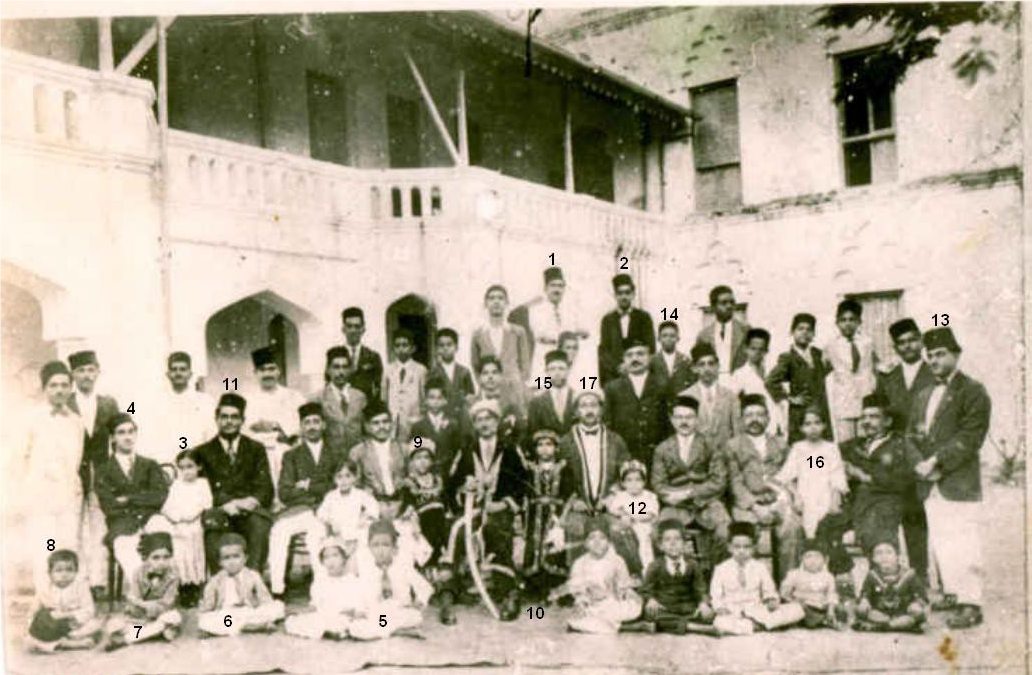
Photo 1: Huseinali Harji (with sword) wedding photo. In the Ismaili Club’s courtyard, Zanzibar, early 1920s. It used to be the British Club where Dr. David Livingstone stayed in the late 1860s. Photo: Safder Alladina, Zerabai’s {10 in photo} youngest son. Captioning: Marhum Kassamali Tejpar, Roshan’s {3} husband. Please click on photo for enlargement.

By ZAHIR K. DHALLA

Gulamhusein Harji Sumar Walji Jendhani* was a pawn broker in the Soko Mahogo neighbourhood of Zanzibar’s Stone Town. Gulamhusein had a large brood, as was common at the time, of 9 sons and 3 daughters, by three wives, the eldest son, Ali {17 in top photo}, being my paternal grandmother Sakarbai’s {16} father. This wedding photo is of Gulamhusein Harji’s third son Huseinali’s marriage to Rukiya.

{1} Hassanali (Hasina){2} Saleh{3} Roshan Abdulhusein Alidina Saleh (Mrs Kassamali Tejpar)
{4} Hamdu Wali Dilgir{5} Badru Ali Harji{6} Kasu Ali Harji
{7} Mohamedali Ali Harji{8} Abdulmalek Ali Harji{9} Gulibai Hassina Harji
{10} Zerabai Hassina Harji{11} A G Abdulhusein{12} Sherbanu Hassina Harji
{13} Hussein “Tumbo” Harji{14} Kanu{15} Rahim Husein Dilgir
{16} Sakarbai Ali Harji{17} Ali Harji 
A guide to individuals in the annotated wedding photo. Dilgir {4} composed the Ismaili anthem.

These are their stories:

All elders and a few toddlers are wearing hats, while youngsters are bare headed, the groom and his eldest brother Ali {17} are wearing ceremonial turbans. By the 1950s, hats were no longer in vogue!

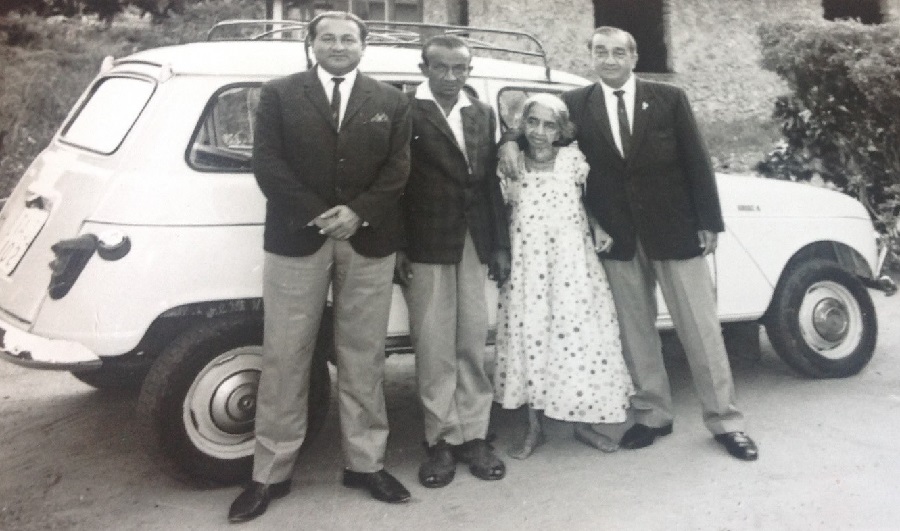
Of the Gulamhusein’s nine sons, Haji (see photo 4, below) and Noorali “Mamma” are not in the above wedding photo. “Mamma” chacha is possibly in the photo, just unidentified.

The Harjis spent, all told, a couple of decades or so in Tanga, Tanganyika (now Tanzania) where at one time they ran a grocery-wines-spirits store called Planters Store. All then left Tanga: Ali {17} going to Mombasa; Haji to Lushoto (see photo 4 below); Hussein {13} to Dar es Salaam; Saleh {2} taking over the grocery business under the name Korogwe Stores, with a branch store in Korogwe, a small town west of Tanga — he also ran a petrol station in Tanga; and Huseinali (the groom) running a chai, toast, maandazi, etc. restaurant called “Karaketa” at the Korogwe railway station, which his widow Rukiya ran after his death.

Story continues after photo

Khoja Ismaili family photo, Tanga, Tanganyika.
Photo 2: Khatibai and her three sons, right to left, Mohamedali {7 in top photo}, Kasu {6} and Abdulmalek {8}, Tanga, early 1950s.

KASU {6}: Younger half-brother of my paternal grandmother Sakarbai Ali Harji {16}, his is a touching story.

His mother Khatibai (nee Jiwan Lalji, Itmadi, of Zanzibar), a most beautiful lady, became demented (during WWII) and was hospitalized in Nairobi. Her three sons, Mohamedali {7}, Kasu {6} and Abdulmalek {8} (in decreasing order of age; see photo 2, above) conferred and decided that they would buy a native bride in Tanga for Kasu, who would settle there as a fishmonger. His bride, Chausiku, was a fine lady, devotedly looking after Khatibai. Khatibai, despite her condition, could always remember faces. Whenever we visited her, she would smile at each one of us, lighting up the whole room! When both Kasu and Khatibai passed away, Mohamedali sent support money to Chausiku. Before he passed away, he instructed son Zul (a fine guitar player in Nairobi, now in Tri-Cities, British Columbia, Canada) to continue support payments, which he did until one day he received a letter from Chausiku’s family, informing him that she had passed away, so not to send support money any more!

ABDULMALEK {8}: Youngest half-brother of my paternal grandmother Sakarbai Ali Harji {16}, he was the youngest of Khatibai’s sons. There was a comical vignette he told me: In 1940, he and three friends decided to enlist in the army (WW II). Mother Khatibai was against it, while father Ali {17} was okay with the idea. They headed for Nairobi for interviews, and along the way one of them dropped out! In Nairobi, someone questioned them as to what they thought they were doing: Didn’t they know they would get only black tea and burnt roti?

Part of their enlistment interview was an examination of their education:

Q. 7 + 5? A. 11. Wrong.

Q. 14 + 9? A. 22. Wrong.

They all came up short and were told, “All you Mombasa guys are hopeless” and were given tickets to return home. Actually, Abdulmalek’s whole class in Mombasa had failed Cambridge, except for one solitary student! Abdulmalek returned to working at his old job at Fatehali Dhala Grocers for 60 shillings a month, filling candy jars, opening and displaying crates of fruit from South Africa. Once he was in the middle of enjoying a nice peach from South Africa, when in walked Count Fatehali who remarked, “It is good that you are tasting and approving these fruits because only then will customers buy them!”

ALI {17}: Father of my paternal grandmother Sakarbai Ali Harji {16}, he was the eldest of the 9 brothers, born in Zanzibar in c1890. In the late 1920s, he worked at a cotton ginnery in Entebbe, Uganda, alongside my paternal grandfather, Gulamhusein, Ali’s son-in-law to be. His last job was as a detective with the CID (Criminal Investigation Department) in Mombasa. He was engaged by the head of the department, an Abdallah Mzee. But soon Ali crashed his motor bike, badly hurting his leg. He retired! Before he died, he told youngest son Abdulmalek {8} that he would be reborn as his son. Sure enough, within a year of his death, a son was born, Gulamali, named by Mawlana Sultan Mahomed Shah Aga Khan III. Gulamali would go on to play up his grandfather role to maximum advantage –- yes, he was untouchable!

Story continues after photo

Gulamhusein Harji Sumar residence in Zanzibar.
Photo 3: Gulamhusein Harji Sumar residence in Zanzibar.

GULIBAY {9}: Lady Gulibai, first cousin of my paternal grandmother Sakarbai Ali Harji {16}, was very well known in Nairobi. She married Ramzanbha of the K. B. Jamal family, owners of Tropicana bistro on Hardinge Street (now Kimathi Street), as well as of Keby’s restaurant further north of Tropicana.

SAKARBAI {16}: My paternal grandmother was very independent, not wanting to be a burden on anybody, even in death, for she had a small briefcase under her bed, which she showed everyone over time, containing everything necessary for a funeral and its rites: a shroud, cotton wool, holy water tablets (made from the earth at the well of Zam Zam), rose water, etc plus enough money for the prayer plate! Her independence also showed in how she addressed my paternal grandfather, her husband: she called him Dhalla, something unheard of in those days when a wife never called her husband by name, resorting to something oblique like “Are you listening?” or simply “Listen then”.

ZERABAI {10}: Born in Zanzibar, she moved to Tanga when she was 12/13 years old. She lived in Tanga the rest of the time until moving to Vancouver. She married Shariffbha Aladin Giga Patni. The Aladin clan adapted this name to a Muslim one: Alladina. This was around the time of the Indo-Pak hostilities after the partition. The Patni refers to people of the town of Patan in Gujarat, India, it having been built on the banks of the mythical river Saraswati.

Zerabai too, like her grandpa Gulamhusein Harji, had a large family of 5 sons and 3 daughters. She herself was of a large family; she was the eldest of a brood of 4 brothers and 6 sisters. When her mother, Khati Gulamhusein Bhaloo Kurji, died while most of her children were still growing up, her uncles Saleh {2} and Haji  stepped up and adopted all the young ones, each picking up 4 children! Zerabai herself was married off to Shariffbha when she was in her early teens.

BADRU {5}: He was the younger brother of my paternal grandmother Sakarbai Ali Harji {16}. He and his family lived in two places, in Tanga first, where most of his children were born, then in Mombasa.

Story continues after photo

A black and white photo featuring a man in a suit standing with three children, two girls on his sides and a boy in front, all posing outdoors.
Photo 4: Chacha Haji with adopted children Sherbanu, Gavar and Dolat, Lushoto, Tanganyika (now Tanzania), c1930s.

Any still around? To my knowledge, none of the identified people above are alive today, although Gulibai’s {9} younger sisters, Dolat (in photo 4 above), and Lily are alive and live in Vancouver and Toronto respectively. The Harji clan today is huge, of several hundred!

Readers may be interested in viewing a collection of Noorali Harji’s historical family photos with Mawlana Hazar Imam, and learn more about Gulamhusein Harji Sumar.

Date posted: April 23, 2020.
Last updated: May 1, 2020 (added 1905 historical photo in author’s footnote, see below).

_____________________

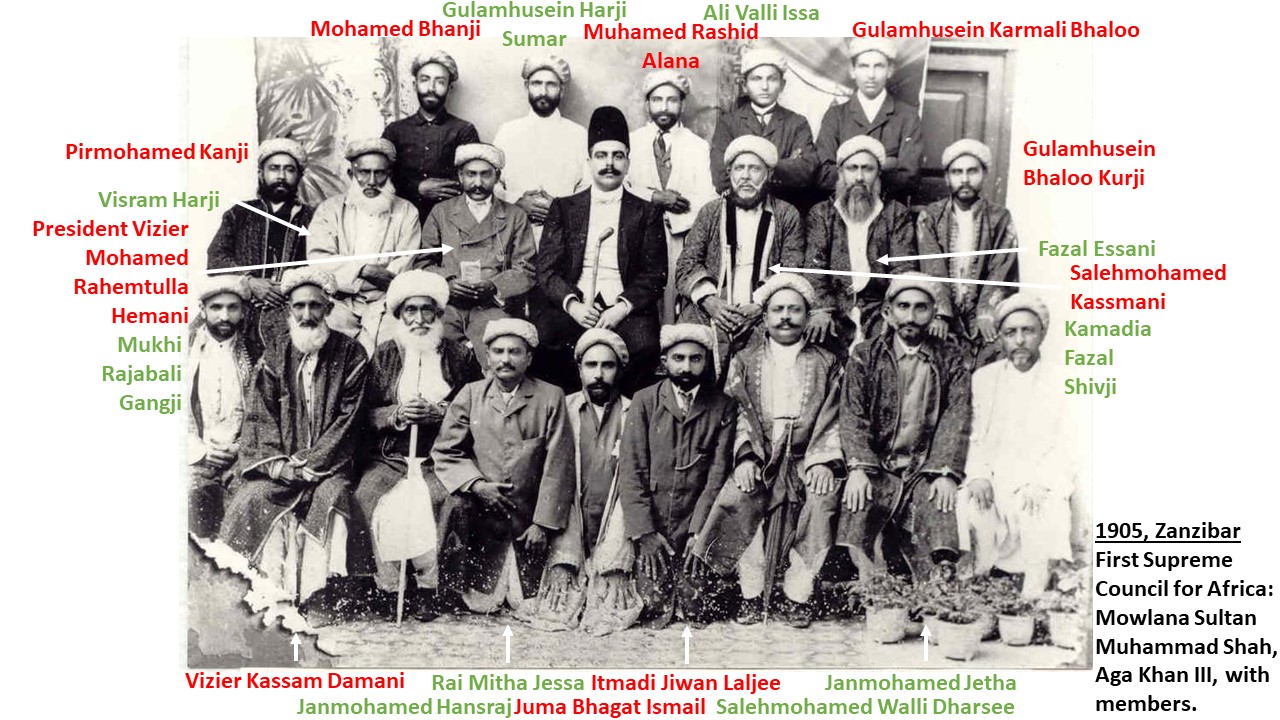
* Author’s footnote: Gulamhusein Harji Sumar (father of the groom, with the sword in the wedding photo) was a member of the first Supreme Council for Africa, 1905, Zanzibar. Itmadi Jiwan Lalji (father of Khatibai, photo 2) was a member too. Please see Noorali Harji’s historical family photos with Mawlana Hazar Imam.

Gulamhusein Bhaloo Kurji (maternal grandfather of Zerabai, number 10 in the wedding photo) ditto.

All the above three are also in the classic photo of Imam Mawlana Sultan Mahomed Shah Aga Khan III with the Supreme Council; see photo 5 below.

Aga Khan III 1905 Zanzibar historical photo with Ismaili leaders
Photo 5: Zanzibar 1905 — Aga Khan III, 48th Ismaili Imam, with Ismaili leaders. BACK ROW (left to right): Mohamed Bhanji, Gulamhussein Harji Sumar, Mohamed Rashid Alana, Ali Valli Issa, Gulamhussein Karmali Bhaloo; CENTRE ROW (left to right): Peermohamed Kanji, Visram Harji, President Varas Mohamed Remtulla Hemani, MAWLANA SULTAN MAHOMED SHAH, HIS HIGHNESS THE AGA KHAN, Varas Salehmohamed Kasmani, Fazal Issani, Gulamhussein Bhaloo Kurji; FRONT ROW (left to right): Mukhi Rajabali Gangji, Varas Kassam Damani, Varas Janmohamed Hansraj, Rai Mitha Jessa, Juma Bhagat Ismail, Itmadi Jivan Lalji, Salehmohamed Valli Dharsi, Janmohamed Jetha, Kamadia Fazal Shivji. Photo Credit: Nashir Abdulla Collection, Ottawa, Canada. Please click on photo for an annotated version.

_________

Author Zahir K. Dhalla, a middle-aged man with glasses and curly hair, wearing a suit and tie, is pictured against a blurred background.

Zahir K. Dhalla is a retired GIS (Geographic Information Systems) and IT (Information Technology) freelance consultant in Toronto, Canada. He is a graduate of the University of Nairobi, Kenya (mapping science) and the University of Toronto, Canada (computer science). In addition to his non-fiction writings (see list below) he has also written many private biographies as family keepsakes. He is also the editor of Ismailis of Tanga.

Zahir Dhalla’s books available from Amazon: 

  1. My F-word Plan: How I Routinely Maintain Low Weight & Good Health
  2. Poetry: The Magic of Few Words (Definition and Some Poetry on East Africa)
  3. Nine Ginans of Nine Ismaili Pirs: A Brief History of Khoja Ismailis
  4. Learn Good Swahili Step by Step: A Complete Language Textbook in 3 volumes:
    • A Complete Grammar
    • Swahili-English Dictionary (5,750 words)
    • English-Swahili Dictionary (5,750 words)
  5. The Willowdale Jamat Khana Story
  6. Writing [Auto] Biographies: Demonstrated by author’s early autobiography
  7. From Kibwezi to Kensington: Sherbanu K. Dhalla’s Memories of East Africa
  8. My Tanga Days: 1950s & 60s
  9. Learn Urdu: اُردو: Read, Write, Speak, includes 4,000-word Tri-directional Dictionary
  10. Naked Eye Astronomy: How to Read the Heavens
  11. Two Short Stories: I. Happy Phoebe, II. Troglodytes
  12. Khojo Aawyo! The Khoja has Come! A Story of Migrations
  13. Editor: http://theismailisoftanga50s60s.blogspot.com/

Also, read Zahir’s piece in Simergphotos Bagamoyo Beach Landing, where Aga Khan III was the first Ismaili Imam ever to set foot on East African soil in 1899.

Before departing this website please take a moment to review Simerg’s Table of Contents for links to hundreds of thought provoking pieces on a vast array of subjects including faith and culture, history and philosophy, and arts and letters to name a few.

We welcome feedback/letters from our readers. Please use the feedback box which appears below. If you don’t see the box please click Leave a comment. Your comment may be edited for length and brevity, and is subject to moderation. We are unable to acknowledge unpublished letters.
Jamila’s Kitchen & Grill: Metro Vancouver restaurant owned by Ismaili couple from Afghanistan has gratitude written all over it

Introduced by MALIK MERCHANT
Publisher/Editor SimergBarakah and Simerg Photos

Between Google and Yelp, Jamila’s Kitchen and Grill located on 2733 Barnet Hwy, in Coquitlam, one of the 21 municipalities comprising Metro Vancouver, has over 220 reviews with an average star rating of 4 (out of 5). Canadian media such as the national newspaper Globe and Mail, and greater Vancouver publishers Tricity News and CityNews1130 recently carried heartwarming stories about the restaurant and its owners, Malik Malikzada and his wife Jamila Malikzada. Please click on links that follow to read the articles. Please also see a brief description about the restaurant taken from its website.

THE GLOBE AND MAIL

Jamilas Kitchen

In 2000, the Malikzadas, with the help of Ismaili organization were accepted as refugees in Canada where they now run Jamila’s Kitchen and Grill in Coquitlam, B.C. The eclectic menu features South Asian dishes, which Ms. Malikzada learned to cook while living in Pakistan. Read more in the Globe and Mail

TRICITY NEWS

It was always Jamila’s dream to cook food in her own restaurant. Three years ago, she and her husband Malikzada took the plunge….they’re humbled to be able to give back to the community that’s taken them in by offering free food at their Coquitlam restaurant they’ve run for three years to those who can’t afford it. Read more in Tricitynews

CITY NEWS 1130

Whether they can pay or not, the owner of a restaurant in Coquitlam is offering hot meals to anyone who truly needs them. The owner of Jamila’s Kitchen and Grill says the offer is open to everyone, regardless of whether or not they can prove their circumstances. Read more in Citynews1130 (with video)

ABOUT JAMILA’S KITCHEN

Jamila’s Kitchen & Grill is a dream borne from the mind and heart of Jamila, a passionate chef of Afghan descent. Escaping Afghanistan as a family during civil war, she with her family relocated in Karachi, Pakistan and as chef worked in food industry and Aga Khan university hospital’s kitchen for many years and absorbing the culture through its language, art and cuisine.

Upon migrating to Canada Nov 2000, her immigrant experience confirmed to her that the importance of creating and combining ethnic food from Indian subcontinent, Afghanistan, Greek and indo-Chinese, she created Jamila’s Kitchen & Gill and merged with Pizza Island & Indian Spice as a hub for diverse cultures to feel always great.

The fusion approaches to food, contribute to creating a sense of universality while maintaining the quality that she has brought with her to this land. Appreciating the growing movement of lifestyles of health and sustainability, Jamila’s Kitchen & Grill merges with Pizza Island & Indian Spice and operating under one ceiling, and consciously integrates local and organic food into the menu; we love to serve our community.

Simerg wants to her from you…..

If you have eaten at Jamila’s Kitchen and Grill, please give your feedback by clicking on Leave a comment. We also welcome a comprehensive review of the restaurant in 500-600 words. If you wish to submit one, please write to Simerg@aol.com.

Date posted: February 28, 2020.

_______________________

Before departing this website please take a moment to review Simerg’s Table of Contents for links to hundreds of thought provoking pieces on a vast array of subjects including faith and culture, history and philosophy, and arts and letters to name a few.

Ismaili Bowler Diana Baig from Hunza inspires Pakistan to victory over West Indies in Women’s T20 Cricket World Cup + Profile

LATEST NEWS (March 1, 2020): Women’s T20 Pakistan vs South Africa — Diana Baig bowled well. She took the wickets of both the South African openers reducing them to 17 for the loss of 2 wickets. Her figures of 2 wickets for 19 runs from her 4 overs are impressive. South Africa scored 136-6 which included a magnificent knock of 53 by Laura Wolvaardt; Pakistan’s reply of 119-5 was short by 17 runs, and they fail to qualify for semi-finals. South Africa and England proceed from Group B. See Scorecard.

Please click The Cricketer: “Performance of the Day” – Diana Baig packs a punch to leave West Indies in Pieces

Three female cricketers in green uniforms celebrating a wicket during a match.
Diana Baig celebrates with her team mates as she takes a wicket. Please click on photo to read article in “The Cricketer.”

_____________

Video: Interview with amazing Diana Baig

_____________

Profile: Diana Baig
(adapted from Wikipedia)

Diana Baig (born 15 October 1995) is a Pakistani women’s cricketer and footballer. Baig was included in Pakistan squad for the 2013 Women’s Cricket World Cup and 2016 ICC Women’s World Twenty20 as well as the Twenty20 2020 World Cup being played in Australia.

Diana Baig, an Ismaili, was born in Hunza, Gilgit Baltistan. While growing up, she, like other females of her town, were encouraged by the progressive society around her. Her interest in sports started with street cricket and football. Learned and enthusiastic, she moved to Lahore, for her intermediate and undergraduate studies. She opted for Lahore College for Women University, where her endeavors were rewarded by the college. Her multi-talented sporting side gives her the edge, as she can represent her country at international level for both, football and cricket. She is fluent in English, Urdu and Burushaski.

Baig started her career in 2010, leading the Gilgit-Baltistan women’s cricket team. She was selected for Pakistan’s A team in 2012 and for the squad of the full national team in 2013.

She made her international cricket debut in 2015 against Bangladesh.

Diana began in football by chance. She was selected for the Pakistan football team when there was a shortage of players.

Her bowling and fielding performance in the ODI against India in 2017 Women’s Cricket World Cup was impressive and was praised by Ian Bishop, one of the commentators. She came into the team in place of Kainat Imtiaz, and she immediately made an impact by taking an important wicket, Smriti Mandhana with an inswinger.

In October 2018, she was named in Pakistan’s squad for the 2018 ICC Women’s World Twenty20 tournament in the West Indies. In January 2020, she was named in Pakistan’s squad for the 2020 ICC Women’s T20 World Cup in Australia.

Date posted: February 28, 2020.
Last updated: March 1, 2020.

Before departing this website please take a moment to review Simerg’s Table of Contents for links to hundreds of thought provoking pieces on a vast array of subjects including faith and culture, history and philosophy, and arts and letters to name a few.

_______________________

We welcome your comments. Please complete the feedback form below. If you can’t see the comment box please click LEAVE A COMMENT

Story of an East African Ismaili Autograph Book

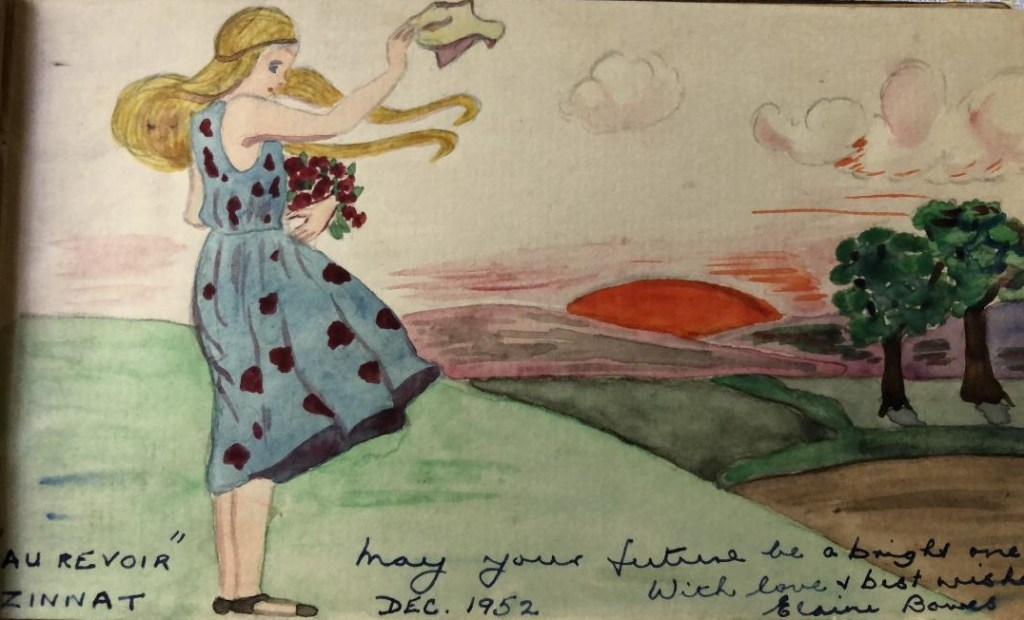
Zeenat’s autograph book was filled by people she loved and people who changed her life….A significant event that made Zeenat’s autograph book special for her was its opening page. Zeenat was lucky to be able to visit Mawlana Sultan Mahomed Shah and Mata Salamat at Villa Yakimour…..READ SHARIFFA KESHAVJEE’S PIECE ON HER SISTER’S AUTOGRAPH BOOK

Ismaili autograph book, Zeenat Jamal, East Africa
Please click on image for complete story.

Date posted: October 26, 2019.

__________________

Book Review of Mansoor Ladha’s Memoirs of a Muhindi: Fleeing East Africa for the West

By NIZAR MOTANI

________________________________________________________
Memoirs of a Muhindi: Fleeing East Africa for the West
By Mansoor Ladha,
252 pp. University of Regina Press,
CDN$ 23.15 (at Amazon), Kindle Edition CDN$ 11.19
________________________________________________________

Memoirs of a Muhindi by Mansoor Ladha

Memoirs of a Muhindi by Mansoor Ladha

Since the word Diaspora is encountered in many written accounts and conversations, the author has, thankfully, shed light on it.

“In Greek, the word diaspora means “to scatter,” but today we use the term to describe a community of people who live outside their country of origin or ancestry but maintain connections with it. A diaspora includes both emigrants and their descendants. While some people lose their attachment to their ancestral homeland, others maintain a strong connection to a place their ancestors may have left generations ago.”

As most of the Africa-born Asians reside in the West and their numbers are dwindling through natural causes, Ladha has taken upon himself to relate his own personal experiences and historical events about life in colonial and independent East Africa. And he has done a splendid job using his multiple journalistic skills.

I wish I had read and discussed his memoir with my family and friends much earlier.

The first generation in the West will see themselves in Ladha’s story; the diasporic generations born outside East Africa will learn about their parents’ unsustainable situation in East Africa and their dispossession, displacement and resettlement in North America and Western Europe.

Surprisingly, Ladha does not explain – for the benefit of the Western-born generations and other potential readers – “who is a muhindi?” until page 16! Muhindi is a Swahili word to describe a person of Asian descent. Simply put, it refers to a brown-skinned person.

To this reviewer, a Uganda-born third generation muhindi with a doctorate in African history, expelled by the notorious Idi Amin in 1972, Ladha’s memoir is replete with unusual personal experiences and less-known historical events.

An excellent discussion of the three-tier colonial, racially-structured system, which controlled, segregated and shaped race-relations, attitudes, behavior and opportunities in British East Africa, sets the stage for his story of navigating it hurdles. Under this racially segregated system, during and after the colonial period, Ladha takes the readers to places where most muhindis could not or would not go.

He is a self-proclaimed man with pride and principles. So when things turn out according to his expectations, he is happy; when they don’t, he is furious. Through this rather unorthodox muhindi, we get to visit: the palace of the Sultan of Zanzibar for an audience, while still in primary school; the British-controlled newspaper, The Standard, where he was the only Asian reporter and a copy editor; President Nyerere’s State House as the only Asian in the University of Dar-es-Salaam’s student executive committee, which went to protest the terms of the National Service (which he calls national servitude), resulting in their arrest, expulsion from the university, and deportation to their hometowns; the Nation House in Nairobi, Kenya, where he was given an expatriate   white person’s most privileged status employment package as a copy editor; his refuge in a British pub in England to narrowly escape a lynching by a mob of skinheads shouting “Paki go home,” and many more such unpredictable or gratifying occurrences.

His brothers had similar unusual experiences. Shiraz, a Makerere University educated doctor wanted to escape his government employment in Tanzania. So he fled to Uganda, only to find himself assigned to Idi Amin’s home town to take care of his prisoners with a possibility of becoming the brutal murderer’s personal physician. He had to flee again, this time to the United States.

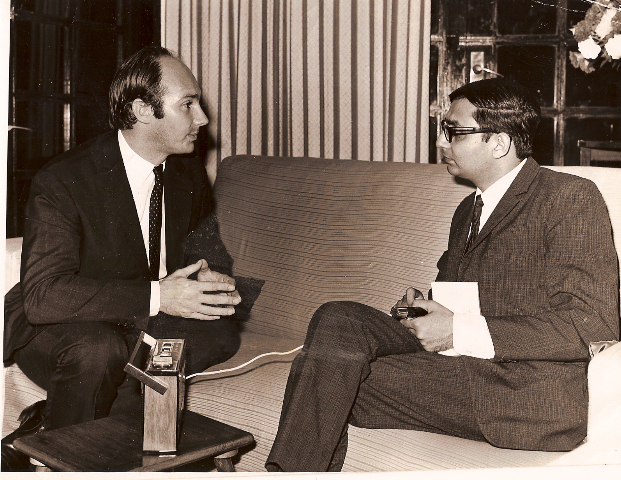
The Aga Khan being interviewed by Mansoor Ladha, one of the few Ismaili journalists who has had the privilege to interview the Aga Khan.

1970: Mansoor Ladha interviewing His Highness the Aga Khan for Tanzania’s daily, The Standard (now Daily News). Photo: Mansoor Ladha Collection. Copyright.

Mehboob (Mebs), the youngest brother, was sponsored by Shiraz and his Catholic wife to study in America. The poor chap ended up in a Catholic school where he had to “confess” his sins every week and attend mass. He left with no verdict on his sinfulness but an abiding love of wine.

Ladha himself left his beloved Tanzania as he could no longer live in the post-independence Tanzania where nationalization had rendered his family financially emasculated and Africanization had closed the doors of employment at the highest echelons for all the muhindis. Such elite positions were reserved for Africans, as they were for Europeans in the colonial period.

He did visit his beloved Tanzania twice as a tourist and also made two journeys to his grandparents’ ancestral homes in Gujarat. Canada became his new, permanent home but the barriers facing non-white immigrants surfaced often. Through determination and even daring, he became the editor and publisher of several weeklies in Alberta. Later he retired after selling his newspaper business, making Calgary his home.

Suffice to say, this interesting and enlightening memoir should be worthy of consideration by diasporic book clubs. Most of the fifteen chapters contain experiences, episodes and opinions likely to generate animated exchanges.

Besides being a valuable addition to one’s own library, it would be a suitable gift for your colleagues and neighbors who often ask the diasporic muhindis: “What is your nationality?” But they actually are curious about your country of origin, why you are not black if you came from Africa, and reasons for being in “their” countries.

Finally, many readers may be inspired by Ladha‘s memoir to tell their own stories in their own memoirs.

Date posted: December 27, 2018.

________________________

To acquire Mansoor Ladha’s book including the Kindle Edition please click https://www.amazon.ca/Memoirs-Muhindi-Fleeing-East-Africa/dp/0889774749.

Nizar Motani on the Aga KhanNizar A. Motani has a doctorate from the University of London (SOAS) in African history, specializing in British colonial rule in East Africa. He has been a college professor at Bowdoin College (Brunswick, ME) and Western Michigan University (Kalamazoo, MI). He was the first Publication Officer at the Institute of Ismaili Studies (London, UK). He now lives in Atlanta, Georgia.

Readers will be also be interested in the following pieces by Dr. Motani that were published on Simerg and Barakah: 

___________________

Additional reviews of Mansoor Ladha’s Memoirs at:

Reminiscences of Two Great Ismaili Missionaries of the 20th Century – Pir Sabzali and Meghji Missionary

“[Pir Sabzali and Meghji Missionary] drew all their courage and strength from their intense and ardent practice of Ibadat and went out to accomplish their missions with intelligence and knowledge, and with the firm belief that the help of Hazar Imam was always with them.”

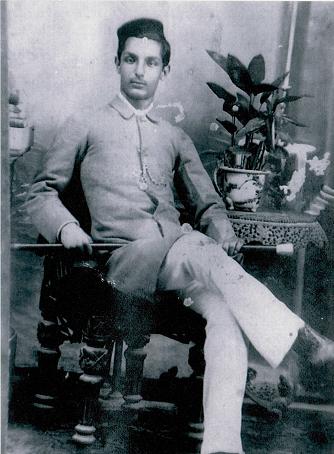
A youthful portrait of the Ismaili missionary, Meghji Maherali (1881 – 1941), of Mombasa, Kenya. Photo Credit: Archives of the family of Meghji Missionary. Copyright.

BY IZAT VELJI

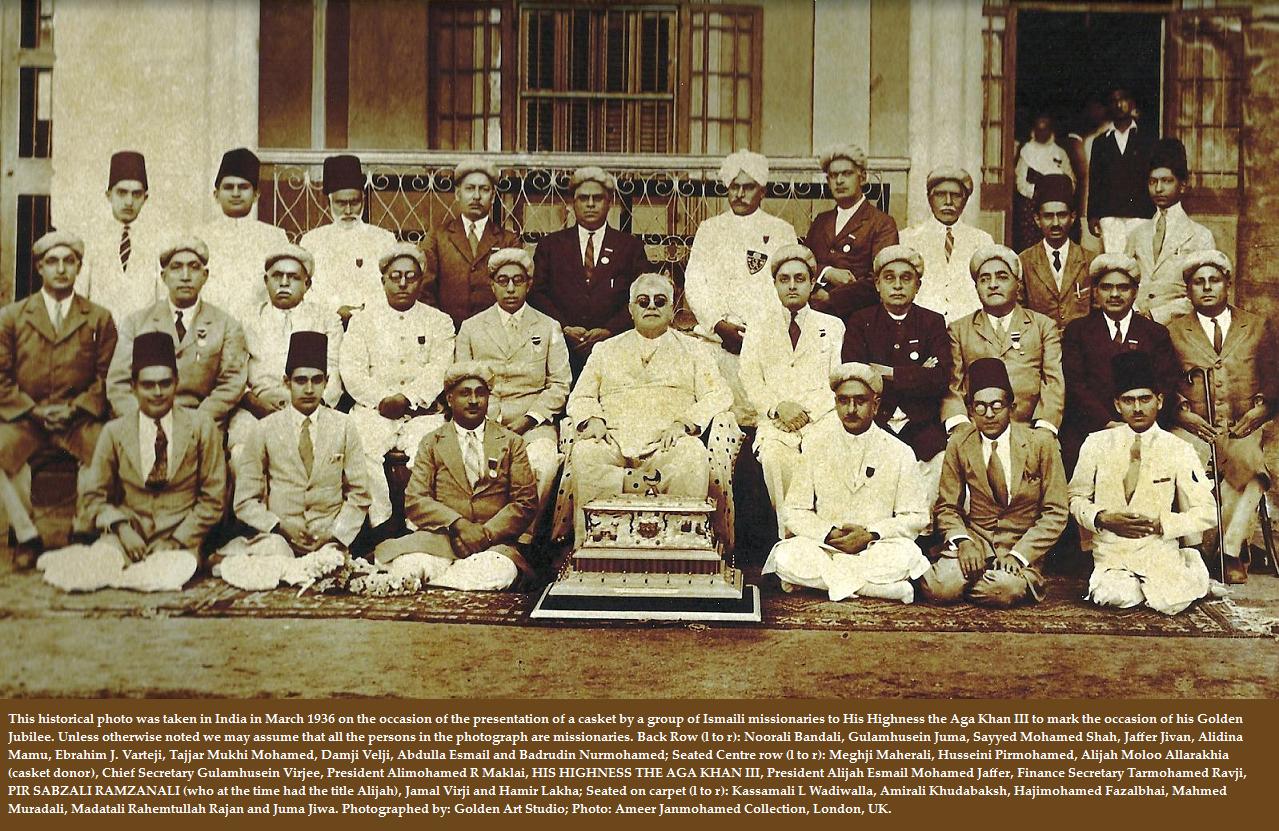
My profound gratitude and thanks [to the late Ameer Janmohamed] for sharing so much about Pir Sabzali – it is indeed a living history. The personal comments and recollections made his Thank You Letter to Pir Sabzali all the more interesting and real. The group picture shown below of Imam Sultan Mahomed Shah with Ismaili missionaries astonished me because there in the photo staring back at me is my nanabapa [maternal grandfather]. I happen to be the proud grand-daughter of Missionary Meghji Maherali, seated at the extreme left in the centre row. In the same row, third from right, is Pir Sabzali.

Every time missionary Pir Sabzali came into Mombasa, he never left without visiting nanabapa. The two had ever so much to share. There was no rivalry, competition or one-upmanship between them. This was very evident from everything that my mother, Noorbanu, shared with us kids.

Mum said that at the dining table, Pir Sabzali and nanabapa shared stories about their travels and advised and helped each other on how to improve each other’s skills in establishing the various jamats they visited. They also discussed ways of improving their waezes [sermons] and participation in discussions so as to become more effective. Apparently, there was a lot of gentleness and warmth as well as mutual respect between them, and they had a soft sense of humour when they recounted personal anecdotes. It seems like they really fed off each other. Pir Sabzali would relay messages of blessings to nanabapa’s family from Mawlana Sultan Mahomed Shah.

Please click to enlarge and read caption. Photo: (Late) Ameer Janmohamed Collection. UK.

Later, they would retire to the front room where nanima would send a tray of chai and ‘goodies’ via my mum, who was then seven or eight years old. She remembered all this with so much pride and joy. My mum passed away in 2000. She said that the two missionaries would sit for hours apparently discussing all matters Ibadat (special worship prayers).

They drew all their courage and strength from their intense and ardent practice of Ibadat and went out to accomplish their missions with intelligence and knowledge, and with the firm belief that the help of Hazar Imam was always with them. With missionary Sabzali’s encouragement and help, nanabapa established a school of waezins in Mombasa, one of his recruits being my father, Noordin Koorjee. Even back then, our missionary leaders practised ‘succession planning’ so that Imam’s work would not come to a standstill after they passed on.

These two ashaqs [devotees] were very sincere in their service to Mawla, and deeply loyal to their Mashuq (the lord of the devotee).

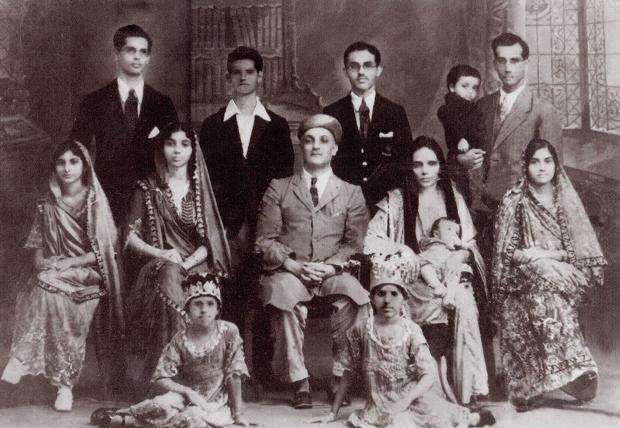
STANDING BACK ROW- l to r: Missionary’s sons Gulamhussein, Fatehali, Sherali, Hussein; 2nd child Mehdi Gulamali is not in picture; SITTING ON CHAIRS – l to r: Daughters Khatija, Fatma, Missionary Meghji Maherali, wife Zainub with Hussein’s 3rd child Shirin, Hussein’s wife, Sikina; SITTING ON FLOOR – l to r: Dolat – Hussein’s 1st child, daughter Noorbanu (mother of Izat Velji, author of this article). Photo Credit: Archives of the family of Meghji Missionary. Copyright.

When Pir Sabzali’s health deteriorated and he was in his last days, Imam Sultan Mahomed Shah sent him a message saying that he still wished to send Sabzali to Africa. Missionary Sabzali died a few days later. This came verbally from my parents, not once but several times. I have no way of authenticating this statement, but if it’s true then only Mawlana Sultan Mahomed Shah and Mawlana Shah Karim, the present Imam, would know the true import and reach of this message to Pir Sabzali.

When nanabapa died, Imam Sultan Mahomed Shah sent a telegram to the Mombasa Council that “Missionary Meghji’s funeral be held with a lot of pomp because of Meghji’s long and wonderful service to the Mombasa jamat.” So, out came the Scouts Band, all spit and polish followed by the cubs and scouts troops followed by the jamat giving kandh to nanabapa all the way from Chief jamat khana to the cemetery. That’s a long distance.

Today, almost eighty years later, I stand head bowed, in sheer admiration for nanabapa and Missionary Sabzali, whose soul was granted Piratan by Imam Sultan Mahomed Shah. Incidents and events like these are simply overwhelming and sometimes difficult to grasp and comprehend. It is their spirit and devotion which keep the Jamat inspired.

Copyright: Izat Velji/Simerg.

_________________

Editor’s note: Izat Velji’s piece originally appeared on this website in response to Ameer Janmohamed’s Thank You Letter to Pir Sabzali and the Ismaili Pirs of the Ginanic Tradition, which was  published as part of this website’s highly acclaimed third anniversary series on thanking Ismaili historical figures.

We welcome your feedback – please click Leave a comment.

About the writer: Izat Velji spent her early childhood years in Kenya and Tanzania. After completing her secondary schooling in Kenya, she pursued a degree in education and teaching at the University of Nairobi. She then settled in Canada where she completed her degree in Medical Lab Sciences. Later, she was recruited into the faculty of the Aga Khan School of Nursing in Karachi where she taught a number of science subjects including Clinical Microbiology and Basic Immunology. During her tenure in Karachi, she was very fortunate to have met His Highness the Aga Khan who visited her lab and class, once with the late Pakistani President Zia ul-Haqq, and on another occasion with his brother Prince Amyn. Encouraged by her husband, Izat also undertook voluntary assignments with the Aga Khan Health Board for Karachi to develop, conduct feasibilities as well as implement Health Education materials for the province of Sindh and the Northern Areas of Pakistan including Hunza and Chitral. The material that she helped prepare continues to be used today by AKDN Agencies such as Focus in their teaching modules. Since returning to Canada, Izat has been very active with the Ismaili community as a volunteer and especially with the Duke of Edinburgh’s program for youth aged 14 to 25. Most recently in 2011, she was acknowledged by the Governor General at the Gold Award Ceremony.

~~~~~~~~~~~~

Readers’ Reflections and Prayers for Grief-Stricken Syria

The following is a selection of comments received from readers in response to Simerg’s recent posts concerning Syria, namely:

LETTERS

Ya Ali Madad:

Friend, brother… I have so much pain in my heart, I can not write… my tears are bigger than my chances to talk. [We] are united and together to face the barbarism!

Abd an-Nur al-Gharib

~~~~

Being an Ismaili Muslim, we all have done bayah of the Imam of the Time and this means we are spiritual children of Mawlana Hazar Imam and he is our father and mother, which connects all murids around the world as Ismaili brothers and sisters.

My deep prayers, wishes, dua, bandagi, and concern for my brothers and sisters in Syria. May our beloved Hazar Imam, the Lord of din and duniya, please bestow his protection upon the jamat and guard them with his hands on their shoulders.

Mawla ease their difficulties, make the Syrian jamats prosperous, and bless them with long, healthy lives as well as abundance of peace and love.

Mawla, it is my humble prayer that with your divine grace and power, the murids facing difficulties are protected. Inshallah, these humble supplications will reach you. Ameen.

Amirali Minsariya

~~~~

Difficult times do come in life of an individual or jamat but we must face them with courage and patience. I just want to tell my brothers and sisters in faith dwelling in Salamiyah that you are not alone there; we all are with you and will stand by you and we are ready to help you in any possible way we can.

Rizwan Shariff

~~~~

Our prayer is for your peace! It is terrible to perceive that we are unable to help you physically.

Vasila Bozichaeva

~~~~

Dear Syrian Brothers and Sisters.

I am writing this to you from USA to let you know that our prayers and good wishes are always with you. May Mowlana Hazar Imam grant all Syrian Murids respite from their troubles and bless them with peace and prosperity.

Karim Hasham

~~~~

Ignorant as I am in Arabic, the English version you have given out of this Prayer (Naad-e-Ali) with beautiful Arabic script that sadly I cannot read, but can hear it and share it with our afflicted brethren not just in Syria but also in Bahrain, Iran and more currently with Shia in Sana’a in Yemen. This, the most powerful prayer of Nade Ali in its entirety rings in my ears and jogs my memory of times when I have addressed it to Mowla.

Since our young days our parents taught us lovingly while comforting us. When any of us face tribulations, for Mushkeel Asaan we privately recite it connecting as if on a direct line, a personal phone call to Ali. He is engraved in our hearts; this supplication is embossed deep down in our soul as the SOS, ultimate call out to help us, to our Mowla Ali present our ‘ghat’ closer than our jugular vein. Ginans: ‘Rome rome maaro Shah vase, jem champa phul manhe vaas…avun Janine bhagatai kijiye …’

Enough. Words fail me as I bow down my head in Sujjud with all his created human kind. Thank you for the beautiful gift of ‘Nade Ali’ to us, the victims of atrocities, pain and suffering. Ameen.

Zarinaspeaks

~~~~

It is indeed heart rendering and heart wrenching to see such cruelty taking place in Syria. It is my hope and prayer that sanity prevails and may Almighty Allah give strength and courage to the families who have lost their kith and kin and may their souls rest in eternal peace in the world beyond and they attain Jannathul Firdhouse.

Amyn Chatoor

~~~~

Ya Ali Madad,

I am Jalal from Salamieh, and I am an Ismaili teacher in the National council. From my side, I believe that your prayers with ours can open the sky for the end of this stupid civil war. So far, I really appreciate your interests and deep emotions about the Ismaili brothers and sisters.

Your brother in faith.

Jalal

~~~~

My deepfelt condolences to each and every family who has lost loved ones and intense prayers that Mawla gives you the courage to bear this loss and that Salamiya and indeed Syria returns to peace and tranquility. You are not alone; of that you can be sure! The world Ismailis are with you. You will prevail, inshallah! It must be so terrifying having ISIS at your doorstep! The threat is so very real.

Izat

~~~~

I feel extremely saddened by the torture and brutality that the jamat of Syria is facing. Our sincere prayers for their mushkil asan. May the peace and safety soon return to Syria.

Syria jamat please stay strong to your faith. We stand by you in your difficult times.

Nessa

~~~~

Time and again, in his farmans of recent years, especially during the Golden Jubilee Mowlana Hazar Imam has said to the jamat to say a silent prayer. Calling the names of the imams, or Prophet Mohammed or Ali. Also the most powerful prayer is the Salwat.
The Syrian jamat is going through a lot of difficult times and we pray for peace to be restored for them. Amen.

Ya Ali Tun Reham Kar, Ya Mowla Tun Fazal Kar, Har Bhala Tun Dur Kar, Mushkil ku Asaan, Mowla Ali.

Shirin Hirji

~~~~

Our prayers are with the bravest jamat in the world! May ALLAH protect you from all brutal acts of so-called Muslims. Syria is in our prayers.

Maqsood Ali Khan

~~~~

Thank you for the opportunity to interact. The situation is very dangerous in Salamieh. We are tracked in the city from both the east and the west by the ISIS and al Nusra fronts. The soldiers from Salamieh belong to Government force trying to defend. Note that Salamieh is represented by numerous Muslim tariqahs. We have lived peacefully together for many many years. We have some choices including:

1. The hope that Canadian air forces will also play a role around Salamieh;
2. More military support to Salamieh from the regime; and
3. Possible plane evacuation of women and children from the city in case we can’t defend the city any more.

No doubt, there is support to the community from AKDN, but it is like staying here (and dying?). Yesterday the rebels fired 2 missile at Salamieh and 10 people died, with 30 injured.

The world should move to stop this dangerous situation around Salamieh.

Ya Ali Madad

Ali

~~~~

Dear brothers and sisters:

Every moment holds love if we connect inside. Like the sea’s calm beneath, God’s strength rules if we submit the tides and ripples of pain to Him in total surrender and say Salwaat or His name in jaap continuously. Ali bolo Munivar jan Ali ke charan chint lao ek man. Solace and peace come from knowing that we are always in His sight even though we may not be able to see Him. This pain is necessary to awaken. Just submit all pain to Him aape uthi shah ne besan dije vira, sohi tamara dharam likhaiya (You get up and have Him sit at the driver’s seat of your heart, your religion is only that much. Ask Him continuously your next step, tauba shukhar madad).

Jal tu Jalal tu , Kudrat no karnaar tu , Har bala taad tu, Mushkil asaan kar tu Ya Ali Ya Ali Ya Ali

With love, prayers, light. We are one soul, we suffer with your suffering too. Rest assured that is true.

Naaz

~~~~

Ya Ali Madad,

I am extremely grief stricken to know about my beloved spiritual brothers and sisters along with our little Masoom angles to be the victims of horrendous brutalities of ISIS thugs. May our beloved Mowlana Hazir Imam help the jamat all over to get away with their worldly and spiritual challenges and may GOD bestow them the highest place in Jannah. Let us pray to Mowla to keep all humanity under his gracious custody safe and secure. The humanity is under threat and it is time that we all need to stay united and face them without any fear. They will meet their fate soon and will burn in hell. Their end is near.

Tahira Noor

~~~~

Your message has a very deep and touching impact on the Syrian Jamat. Your continuous support and prayers will definitely make a change hopefully.

With Ya Ali Madad

Mahmoud Syria

~~~~

Dearest Ismaili parents, brothers, sisters and children:

We are deeply sad for the difficult circumstances you are facing. We might be far but our hearts are heavy with grief. We cannot reach you but we are of the same spiritual parent that makes us pray for you more strongly. Inshallah Mowla will help you overcome this very difficult moment in your lives. Allah bless all the departed souls in eternal peace Ameen.

Nade Ali, Nade Ali. Ya Mawla to madat kar, mushkil assan kar, rahem kar.  Shukr Alhamdulillah.

Ya Ali Madad.

Zeenat Salim

~~~~

My prayers for our Syrian brothers and sisters. May Mawla bring peace and security to your homes. May the departed souls rest in peace. Ameen.

Amin Hunzai

~~~~

This is beyond troubling. It is like going back to the time of Genghis Khan who committed the same barbaric acts.

Mallee Stanley

~~~~

We remember you at this time and pray that peace return to you, your great city and great country. We remember you prayed for us when we were expelled from Uganda. We remember you were beloved of Prince Aly Khan and he of you – “Salamiyah ke pyare, himatwale, tumko lakho salaam”, we used to sing. (Beloved of Salamiyah, the brave one, 100 thousand greetings to you.) How he dashed out over the mountains from Beirut to declare to you that the naas had been passed to Karim al Husseini. May peace be upon him who rests in your city and may peace reign over you again. You are not forgotten.

Vali Jamal

~~~~

All I think of is how our beloved Hazar Imam must be feeling. Can you imagine how much this must hurt him? The scariest thing is there doesn’t seem to be an end to this war. In fact, things are just getting worse in so many countries – in Yemen too. Sincere prayers always.

Rashida Rahemtulla

~~~~

I pray to Hazar Imam that whatever sewa that I have done, the benefit of that service should go to my brothers and sisters in Syria. Ameen.

Karim Jivraj

~~~~

You are very right; with complete faith if one recites Nad-e-Ali; and Inshallah success will be positive. This particular piece of writing made my day.

Manji

~~~~

God: Keep and save Syria and defend its good people, culture and its deep history. Ameen, Ameen Ameen. Ya Allah, Ya Muhammad, Ya Ali, defeat its enemies. “There is no hero but Ali; there is no sword but Dhu’lfaqar”.

Hatim Mahamid

Date posted: Sunday, April 26, 2015.

____________________

If you missed the earlier posts, please click on the following links:

We invite our readers to offer their solidarity with the Ismaili jamat in Syria and the people of Syria by conveying their heartfelt wishes and prayers by clicking on Leave a comment or in the comment box below. If you encounter any difficulty in submitting your comment, please email your comment for publication to Simerg@aol.com, subject “Syria.” Please note that we never publish your email address with your feedback, and that you may submit your feedback using a pen name or a partial name, if you wish.

In Memoriam: Mohammed Ibrahim Ali (1925 – 2014) by Enoo

PLEASE CLICK: In Memoriam: Mohammed Ibrahim Ali

 A SON’S TRIBUTE TO A LOVING FATHER

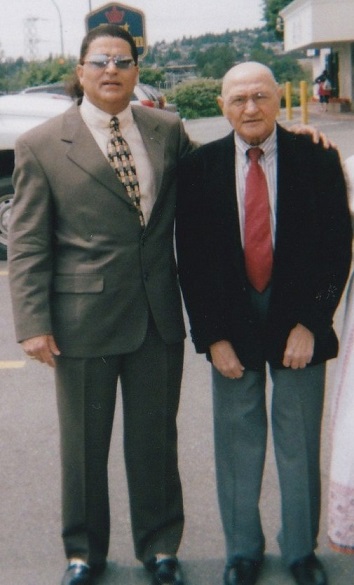
Renowned Ismaili musician and composer, Enoo, pictured with his beloved dad in 2005 before the Vancouver  mulaqat with Mawlana Hazar Imam. Photo: Enoo archives.

Renowned Ismaili musician and composer, Enoo, pictured with his beloved dad in Vancouver in 2005 before the mulaqat with Mawlana Hazar Imam. Photo: Enoo archives.

IMPORTANT NOTE: Simerg invites obituaries/in memoriam pieces honouring deceased family members. Please see submission guidelines and examples by clicking Obituaries and Tributes.

A Story from ‘Pyara Imam ni Pyari Wato’: Historical Memories by Sairab Abuturabi and Jaferali Bhalwani

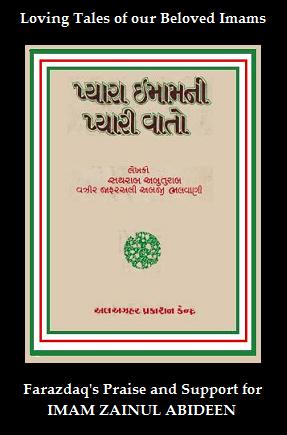
Loving Tales of our Beloved Imams: (I) Farazdaq’s Praise and Support of Imam Zainul Abideen (a.s.)

“…This tale belongs to ages past. It goes back to the era of Hazrat Imam Zainul Abideen (a.s.), our third Imam, from whose veins was to ensue the Divine Line of the Imams. He was the Imam who, on the battlefield of Karbala, received the nass of Imamat from his father, Hazrat Imam Hussain (a.s.) with the blessing: “Through you the line of Imamat will continue till the Day of Judgment…”

Please click for story