Important Notes on Baitul Khayal, Bol, the Soul and Imam’s Status as Ismailis around the world continue to receive Hazar Imam’s Didar and Blessings

“The esoteric (batini) vision, realized through pious works and the constant remembrance of God during the nightly vigil, as well as the exoteric (zaheri) vision, and beholding the gateway of God’s mercy, becomes the ultimate purpose of human life….Piety should be for the purpose of recognizing and beholding God, which is achieved through the recognition and vision of the Imam of one’s time.” — Imam Mustansir-Billah, 32nd Ismaili Imam

1. Ism’ul Azam and Baitul Khayal

By SHIRAZ PRADHAN

In the Memoirs of Aga Khan, our beloved 48th Imam Mawlana Sultan Mahomed Shah outlines the distinction between two human experiences as categorized by the Muslim philosopher Ibn-Rushd (Averroes):

“On the one hand, our experience of nature as we recognize it through our senses…and on the other hand, our immediate and imminent experience of something more real, less dependent on thought or on the processes of the mind, but directly given to us, which I believe to be religious experience.”

The craving for this direct experience is innate in all of us. Depth psychology which recognizes this craving in a totally different form states that human psyche has great capacity and an insatiable desire for love. The quest for this love molds human actions. In some it takes the form of material pursuits, in others it takes the form of religious and mystical pursuits. And in some souls’ this quest for divine love finds satisfaction in devotion and love for another human being.

Further in his Memoirs, the Imam expounds on this very theme and says:

 “We live, move and have our being in God…when we realize this, we are already preparing ourselves for the gift of the power of direct (mystical) experience…some men are born with such natural spiritual capacities and possibilities of development that they have direct experience of that great love, that all-embracing, all-consuming love which direct contact with reality gives to human soul.”

A question naturally arises in the mind: What about people who are not so gifted and not born with the natural capacity of development for spiritual experience?

Allah is mindful of this innate human desire for love and direct vision. Allah grants a gift and a means for this direct experience to all: “And to Allah belong the best names, so call on Him by them.” — Holy Qur’an, 7:180

The invocation of best names (Ism’ul-Azam) referred to in the above Sura are the most beautiful names of Allah, invocation of which provides the path to his mercy and direct experience. The Qur’an also enjoins constant remembrance of Allah:

“O you have faith, remember Allah with frequent remembrance and glorify him morning and evening.” — 33:41-42.

Bol is a Gujarati word for Ism’ul-Azam. In Ismailism, the path to direct experience of the divine reality of Allah through the Noor (Light) of Imamat becomes a very personal and private affair. Each murid has his personal connection with the Imam. The personal spiritual bond of bayah (allegiance) between the Imam and the murid is the cornerstone of this bond.

Every murid has a desire for this vision of Noor. This desire is weak in some and strong in others. The real quest for the vision of the Noor begins when a murid fights the buffeting currents and vicissitudes of daily life and begins to hear the call of the divine and the desire for vision of Noor possesses his heart. The thirst for love that philosophers had talked about becomes a reality. The most enchanting verses of a Ginan of Pir Sadardin which describe the agony of a love-thirsty soul resonate in his heart:

Sajan per hun sada balihari
Ke jine Sajan mohe nipat bhisari
Ab ko je me Sajan pau
Haide under Sej bichau
Milu usinku Noor sangath
Phir nav jalu duje ka haath.

TRANSLATION

(Sajan=Beloved)
I am forever ready to sacrifice my life for the Beloved,
That beloved who has so forgotten and forsaken me
If perchance I attain to the Beloved
I will spread a silk carpet in my heart
And meet him in a shower of Noor
Never again to thirst for aught.

When a soul become thus love-stricken, the path to enlightenment become visible to him and he seeks the Imam’s guidance. The Imam in his benevolence and love for the murid grants him a personal key to the spiritual universe and the possibility to ascend to that peak from whence he has potential of vision of Noor of Imamat and the quenching of that insatiable thirst for love. The key to this spiritual universe is Bol.

The remembrance (dhikr) of this Bol at prescribed time when the world rests is the essence of Baitul Khayal. “The honor and greatness of a believer lies in his praying at night,” said Imam Ja’far as-Sadiq. A number of verses in the Holy Qur’an attest to the importance of the night worship. Allah says, “and part of the night; bow down before Him and magnify Him through the long night. — 76:26 (tr. Arberry). This verse of the Holy Qur’an tells us to remember Allah at such a time when others are asleep.

The Holy Qur’an tells us:

“You have indeed in the Apostle of God a beautiful pattern of conduct.” –33:21.

Thus, as an example to be followed, the Prophet’s escape to Mount Hira for extended hours of contemplation as well as his experiences during the night journey, miraj, are indicative of the rise of the soul from the plane of material existence to the proximity of God. The night journey  emphatically proclaimed that if God has placed man on this earth, He has also set up a ladder for man to climb up to Him. Baitul Khayal accords us this opportunity.

Thus, the practice of Baitul Khyal sits at the crest of spiritual practice of Ismailism and is also referred to as Motu Kam (Big Work). As the prescribed practice becomes a routine, the spiritual universe begins to unfold and the bond between the Imam and murid becomes stronger, and the link that binds the murid to the Imam becomes shorter and shorter. It is a process of divine alchemy which is sung in the Ginan Jire vala, dhan re ghadi:

Paras perse to Loha raang pelte
To jagmag jyote jagaye.

TRANSLATION

That which was base metal
Transforms to gold and begins to shine
by divine alchemy

The experience of this transformation and the uplifment of the soul through the constant meditative practice of the Ism’ul-Azam is articulated in some of the verses of the Ginan Brahm Prakash composed by Pir Shamsh: 

“True Word” (or Ism’ul-Azam, Bol) is my Guide,
to which the world gives no recognition….1

Do meditate on the Word,
and recite Pirshah as often as possible…..2

And upon utterance of the Word,
the light of love shall be kindled,

and in the heart, great “Faith” will be generated….5

Where the Love flows so incessantly,
the devotee drinks of it and
becomes love-intoxicated….9

How shall I extol (for you) this divine ecstasy!
Its status is so great, that it defies all speech….11

No amount of literature read or listened to,
Could help to attain this experience of happiness….12

The skies in the West glow
and one witnesses a unique and
unparalled show (of “Light” – “Noor”)

_____________

2. The Imam’s True Status

Imam to be perceived with true heart cropped

Image credit: roseannapiter.com.

(Adapted from an ode by 33rd Ismaili Imam ‘Abd al Salam)

The talisman that can open the treasure trove of spiritual meaning of the Holy Qur’an is the Imam. The true essence of the Imam cannot be recognized with earthly, fleshly eyes, for these can only see his physical form, perishing like all else with the passage of time.

His true face is to be perceived with the eyes of the heart. He has thousands of physical habitations, but his true home is traceless; he has had a thousand names, but all of them refer to one reality.

Today he is known as ‘Abd al-Salam, but tomorrow the physical body will be gone and the name will change, yet the essence will remain in the next Imam of the lineage.

Those who look at the Imam as they squint will consider him like any other human being, but as soon as the eyes of the heart perceive correctly, his true status is discovered. In form the Imams change, but in meaning and substance they are changeless. Human language cannot attain to the majesty of the Imams. The Imam is the most precious ingredient in the supreme elixir (miraculous substance) of eternal life-red sulphur. He is not simply a pearl, but the ocean that gives birth to pearls. The existence of the Imam, who leads humankind to a recognition of God, is the very pinnacle of creation. — Adapted from Ismaili in the Middle Ages by Shafique Virani.

3. The Importance of the Soul

By AL-MU’AYYAD AL-SHIRAZI

“Look at the trouble your parents have taken from the days of your childhood in the growth of your bodies and in the improvement of your physical life on earth. But for the interest they took in you, you would not have been what you are. Your souls are thousand times more important than your bodies. The Imams are your spiritual parents. Avail yourselves of a few days of life which are at your disposal here and look after your spiritual elevation under the care of your spiritual parents. “Once you miss this opportunity, you will repent forever. You will not be given a second chance to set things right.”

Date posted: November 9, 2017.

_________________

Note: This piece also appears on simerg’s special project http://www.barakah.com which is dedicated to His Highness the Aga Khan.

Shiraz Pradhan PortraitShiraz Pradhan, in parallel with his work as an international engineering consultant, has contributed for several years to furthering religious education among the Ismaili community in the UK, Canada, USA and Japan. He is the author of several articles published on this website and was a regular contributor to UK’s flagship Ismaili magazine, Ilm. Currently he is concluding the script of a full-length play of the 10th Century trial of the Sufi Saint Mansur al-Hallaj in Baghdad based on historical facts.

Ismailis of Eastern Canada and their upcoming holy encounter with their beloved 49th Imam, His Highness the Aga Khan: #2 – Go, run to the ‘Manifest Light’ and ‘Ship of Salvation’ with joy and hope

This is the second article in a special series that we hope will contribute to making the forthcoming mulaqat with Mawlana Shah Karim al-Hussaini Hazar Imam more meaningful and purposeful. If you missed any of the previous post(s), here are the links:

  1. Ismailis of Eastern Canada and their upcoming holy encounter with their beloved 49th Imam, His Highness the Aga Khan: #1 – FORGIVENESS
Aga Khan Eastern Canada Upcoming Visit

Eastern Canada shown in green on map (left) consists of the provinces of New Brunswick, Newfoundland and Labrador, Nova Scotia, Ontario, Prince Edward Island, and Quebec. The total population is 23,946,177 (2016), and approximately 40-45,000 Ismailis live in these provinces, with the largest concentration in Ontario and Quebec. Credits: Map (left) yy Connormah – Wikipedia, CC BY 1.0, https://commons.wikimedia.org/w/index.php?curid=19857457, and (right) Department of Natural Resources.

1. By Shaykh Khudr, contemporary of 40th Ismaili Imam, Mawlana Nizar

The people of the House of Prophethood
are the Manifestations of Light;

They are that which exists forever
and in what has already elapsed;

They are the ships of salvation for those
who come running to them with hope;

They are the rain abundant in moisture
and their grace is the best of springs;

The essence of their souls is knowledge
from a world beyond the intellects;

Indeed, it is their invitation which rescues
souls from the pit of destruction.

~~~~~~~

2. By Muayyad Al-Shirazi, Fatimid period

“I was taken near the place where from I saw the bright Light of the Prophethood. My eyes were dazzled by the Light. I shed tears of joy and felt as if I was looking at the face of the Prophet of Allah and of the Commander of the Faithful, Hazrat Ali. I prostrated myself before the one who is the fittest person to bow to. I wanted to say something, but I was awe-struck.

“I tried to speak but my tongue refused to move. People asked me to say what I wished to say. I could say nothing. The Imam said, ‘Leave him. Let his fear and awe subside’. After this, I rose. I took the holy hand of the Imam [Mustansir-billah], placed it on my eyes and on my chest and then kissed it. I left the place with immense joy.”

~~~~~~~

3. By Fidai Khurasani

He is always present
a witness with his followers;

but who has seen his beauty
except the blessed?

He who is the cupbearer of
the fount of paradise

is aware altogether of
the hearts of his followers

He is the Imam of the time
the guide and comforter

the protector of his followers
whether young or old

Like the sun in the sky
he is manifest in the world

but the blind bat cannot see
his luminous face

~~~~~~~

4. By Imam Mustansir-Billah, 32nd Ismaili Imam

“All believers are urged to come into the presence of the Imam and to see him with their own eyes. Thus, the esoteric (batini) vision, realized through pious works and the constant remembrance of God during the nightly vigil, as well as the exoteric (zaheri) vision, achieved by travelling to the Imam’s residence and beholding the gateway of God’s mercy, becomes the ultimate purpose of human life.

“Piety should be for the purpose of recognizing and beholding God, which is achieved through the recognition and vision of the Imam of one’s time.”

Date posted: November 6, 2017.

______________

Related: Ismailis of Eastern Canada and their upcoming holy encounter with their beloved 49th Imam, His Highness the Aga Khan: #1 – Forgiveness

We welcome your feedback. Please click on Leave a comment.

His Highness the Aga Khan: What we are now reading @Barakah.com

Please click on photos or Barakah

Aga Khan receives Lifetime Achievement Award from Asia Society.

~~~~~

140 years: From birth of Aga Khan III to Diamond Jubilee of Aga Khan IV.

~~~~~

Aga Khan 1979 Asia Society Speech: “Building City of God and Man”

~~~~~~

AGA KHAN’S FORTHCOMING VISIT TO EASTERN CANADA

GOD’S KINGDOM: AGA KHAN ON PATRIOTISM

AGA KHAN’S VIEW OF THE WORLD

A LONG ASSOCIATION: AGA KHAN AND JOHNSTON

AGA KHAN IN EAST AFRICA: 5 DAYS TO REMEMBER

1946 JUBILEE: ISMAILI WOMEN OF TIME REMINISCE

A PEARL FOR MONARCH OF FAITH AND PRACTICALITY

Date posted: November 2, 2017.
__________

Mawlana Hazar Imam, His Highness the Aga Khan, to Bless Ismailis in Eastern Canada with Didar in November 2017

2017 Aga Khan Tanzania Darbar zr1_web_4823

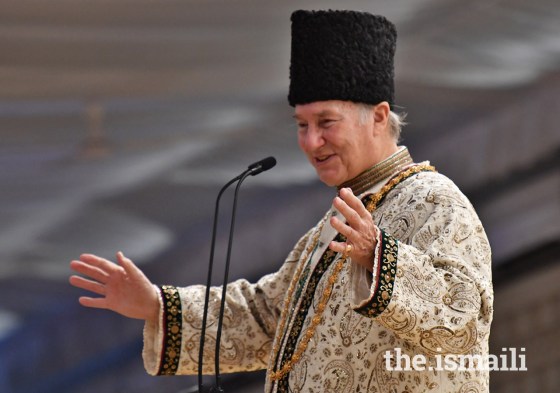
His Highness the Aga Khan, Mawlana Hazar Imam, at the Dar es Salaam Darbar in October 2017. He will grace the Eastern Canadian Ismailis with his didar in November 2017.

Ismailis gasp in delight and shed tears of joy at announcement of Mawlana Hazar Imam’s visit to Canada in November 2017

By Malik Merchant, Editor

(Note: We will have regular updates leading upto the visit; here are the latest updates for this blog):


Ismailis in Eastern Canada will, inshallah, be graced with the holy visit of their beloved 49th Imam, His Highness the Aga Khan, during the month of November 2017. The announcement of the visit by the Ismaili Leadership International Forum (LIF) came as a big surprise, and thousands who were present in Jamatkhanas across Canada on Friday, October 27,  gasped with delight when the news of the visit was read out. At the Ismaili Centre in Toronto, the Jamat was informed about the visit  by the Chairman of the LIF, Mahmoud Eboo, who is also the representative of the Aga Khan Development Network (AKDN) in Canada.

The exact dates and details of the visit were not announced on Friday. However, an update on Saturday October 28th, stated that Mawlana Hazar Imam’s mulaqats with the Eastern Canada Jamat, which will include religious work, will take place in Toronto for the Ontario region and in Montreal for the Quebec and Maritime Provinces.  Although located in Ontario, the Jamat in Ottawa, Canada’s capital, will join hands with the Jamats of the Quebec and Maritime Provinces in Montreal.

This will be the third visit by the Aga Khan to his followers during his Diamond Jubilee year that commenced on July 11, 2017, when he completed 60 years of his reign. Earlier in October, he made official visits to Uganda and Tanzania at the invitation of the two governments. During the five day tour that began on October 8th, Mawlana Hazar Imam graced the Ismailis with momentous Darbars (lit. a court or audience chamber where kings had formal or informal meetings) in Kampala and Dar es Salaam.

On this most auspicious and joyous news of Mawlana Hazar Imam’s forthcoming visit to Canada, we convey our heartiest felicitations to Ismailis in Canada and around the world and offer a humble supplication with the following words taken from a Ginan by Pir Hasan Kabirdin (14th century).

Transliteration

Eji, Aash Karine Ya Ali* hun tere dar ubhi,
Kar jodine em mangu Ya Shah;
Dejo didar tusi mahavar datar Shah,
Hama tere charane lagu.

Translation

With hope O Ali I stand at Thy door,
With palms joined I sincerely beg of Thee;
Bless me with Thy Holy Didar, O Great Lord and Benefactor!
At Thy Feet I fall to prostrate.

*Ismaili doctrine emphasizes the principle of the Unity of Imamat under the superficial diversity exhibited by each Imam of the Time. It is in this sense that the Ismailis believe that Imam is the same irrespective of his own age or the time he lives in. Thus, the name of the first Imam, Hazrat Ali, is commonly invoked for each Imam of the Time.

The proverbial valour and exemplary statesmanship of Imam Mawla Murtaza Ali, the encyclopaedic erudition of Imam Ja’far as-Sadiq, the extraordinary intellectual brilliance of Imam al-Hakim bi Amrillah, the administrative ability of Imam Mustansir Billah (during the first half of his Khilafat), the political acumen of Imam Sultan Mahomed Shah, Aga Khan III (he defied geography and created history), the organizing genius of the present Imam, Mawlana Shah Karim al-Husayni, are only some of the more spectacular characteristics exhibited by the Imam of the Time in accordance with the exigencies of the situations facing him.

Date posted: October 27, 2017.
Last updated: October 29, 2017.

Related updated post: Ottawa Celebrates Mawlana Hazar Imam’s Forthcoming Visit to Canada, @Barakah.com

_____________

We invite our readers to download Simerg’s special PDF publication Imamat and Didar Series.

We welcome your feedback. Please click LEAVE A COMMENT

Ismaili Heritage and Traditions: Fascinating Insights into Early Recordings of Ginans and Geets

By ALNOOR JEHANGIR MERCHANT

Simerg’s recent post titled Awesome and Rare Collection of Ismaili Ginans with Music at the British Library and a number of related online contributions, especially Aly Sunderji’s sharing of the equally rare and exceptional audio recordings of devotional songs produced in Tanganyika in 1946 commemorating the Diamond Jubilee of Imam Sultan Mahomed Shah, Aga Khan III (link https://www.youtube.com/watch?v=KqxUDlY_pis&index=1&list=PL8-KGtAvEpq5s1nBIplLQA3j1RDptQ5GJ) is an opportune moment to add some further remarks on the recordings of ginans and geets* produced during the first half of the 20th century. It is hoped that these remarks and, more particularly, the recordings themselves, will provide an impetus in documenting and preserving the diversity of the Ismaili community’s musical heritage and traditions.

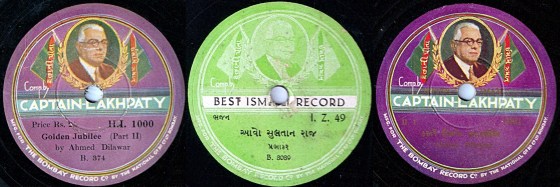
Original disc labels of four ginan recordings that are part of a digitization project being carried out by the British Library (clockwise from top left): Satgur miliya mune aje composed by Bibi Imam Begum and sung by Rama and Rahim Ali; Ho jire mara hansa composed by Pir Sadardin; Ab teri mohobat lagi composed by Pir Shams; and Marna hai zarur composed by Pir Imam Shah and all sung by Master Juma Kakali. Images: The British Library (collage by Simerg).

It is difficult to give a precise dating as to when the ginans digitised by The British Library as part of their Endangered Archives Programme (EPA) Project were originally recorded. The ‘Young India’ record label which, according to the British Library catalogue, published these recordings was established around 1935 and continued for approximately 20 years; thus, the recordings should be dated to the period 1935-1955. An examination of the images of the disc labels, however, provides additional information that seems to have been overlooked in the cataloguing process.

On three of the ginan recordings, the disc label states ‘Ismailia Record’, along with the following: Manufactured by National Gramophone Record Manufacturing Company, Bombay, India [and] Sole Distributers [sic], The King Record Company, Kalbadevi, Bombay. The ‘Ismailia Record’ ginan recordings are in the voice of Master Jumma Kakali. On the fourth ginan recording, the disc label states ‘Best Ismaili Record’, along with the following: Manufactured for the Bombay Record Company by the National Gramophone Record Company Limited, Bombay.

As all four ginan recordings do not mention ‘Young India’ on the disc label, it may be that ‘Ismailia Record’ and ‘Best Ismaili Record’ were independent record producers. Unfortunately, the disc labels do not contain any information on the date of production of the records. However, according to Hussain Jasani, who has undertaken some research, there is evidence to suggest that these recordings were produced during 1938. According to Jasani, one of the volumes of the community’s magazine, Ismaili, published during that year, refers to these recordings. [Paper presented by Hussain Jasani, “Preserving Community Heritage; The Oldest-known Ginan (Audio) Recordings”, IIS Alumni Association, European Chapter Group, Annual Meeting, London, 29th September 2017].

Are these the earliest recordings, musical or otherwise, of ginans? In her essay titled “Sacred Songs of Khoja Muslims: Sounded and Embodied Liturgy and Devotion”, (published in: Ethnomusicology, 48, 2 [Spring/Summer 2004]: 251-270), Amy Catlin-Jairazbhoy suggests that a number of ginan recordings made by the Dutch ethnomusicologist and pioneer in the study of South Asian music, Arnold Adriaan Bake, are the earliest. She states (p. 256):

“Probably the earliest ginan recordings were made by Arnold Bake in Karachi in 1939. These as yet unpublished field recordings were sung individually by teenaged boys, presumably found at the Karachi jama‘at (community) school.”

Three of Bake’s Karachi recordings dated 11 March 1939, which he catalogued as ‘Khoja devotional song’ have been identified as:

  • Satgur avya kai apne dwar, sung by a 14-year old boy, Karim Ali Muhammad
  • Hamdil khaleq, sung by a 14-year old boy, Rahim Ali Muhammad
  • Haq tu pak tu, sung by Sadulli M. Abdulla.

Jasani’s research suggests that the Bombay recordings, and not the Karachi ones, are the earliest. While the ginan recordings produced (most likely in 1938) as part of the ‘Ismailia Record’ and ‘Best Ismaili Record’ labels or those in the Bake collection (recorded in March 1939) may be among the earliest, it would not be out-of-place to suggest that there could be earlier recordings of ginans, musical or otherwise, which remain to be ‘discovered’.

It is known that sound recordings from South Asia began to be produced at the turn of the 20th century, with the earliest known dating to around 1899. The foremost researcher of early Indian sound recordings is Michael Kinnear. His two books, The Gramophone Company’s First Indian Recordings 1899-1907 (Bombay, 1994) and The Gramophone Company’s Indian Recordings 1908-1910 (London, 2000) document not only the history of the Gramophone Company and its successor companies’ activities in India, as well as the recording expeditions it undertook in the country, but the two volumes also provide complete listings of all known and traceable recordings taken on those expeditions. In one of his other encyclopaedic works titled The 78 RPM Record Labels of India (Apollo Bay, 2016), Kinnear covers all known record labels and histories of the companies from 1899 to the late 1960s. Perhaps, an analysis of the listings contained in Kinnear’s works will lead to the identification of ginan recordings from the first decades of the 20th century. Another important resource could be the various magazines published within the Ismaili community at the time. The Society of Indian Record Collectors may also be an avenue worth exploring. Indeed, it is from the collection of one of the members of the Society of Indian Record Collectors, Suresh Chandvakar, that some of The British Library’s ginan recordings have been digitised.

With respect to the recordings of geets, little research has been carried out. Ali Asani, in the chapter ‘The Git Tradition: A Testimony of Love’ in his work titled Ecstasy and Enlightenment: The Ismaili Devotional Literature of South Asia (London, 2002) writes (p. 71):

“The tradition of composing gits, as we know in its present form, has been associated particularly with Nizari Ismaili communities of South Asian origin….Unfortunately, we know precious little about its development. As is the case with many folk traditions that have been orally transmitted, its historical origins are quite obscure. Moreover, the gits themselves have never been systematically collected and documented.”

In his essay, Asani predominantly refers to geet recordings from the 1980s onwards. And, Amy Catlin Jairazbhoy, states that the Khoja geet emerged “at some uncertain time in the twentieth century” (p. 262). In her essay titled “Songs of Praise: the Git Tradition of the Nizari Ismaili Muslims”, in Gujarati Communities Across the Globe: Memory, Identity and Continuity, ed. by Sharmina Mawani and Anjoom A. Mukaddam (Stoke-on-Trent, 2012), pages 59-78, Sharmina Mawani writes that “few authors have focused on gits…. and the way in which this creative form of expression has flourished from one generation to another” (p. 59). Although her discussion focuses on post-1960 geets, Mawani does refer to a geet by Fateh Ali Ismail Ibrahim titled Aayi Aayi re Sakhi written specifically for the Diamond Jubilee of Imam Sultan Mahomed Shah in 1946, the original lyrics and tune of which “were inspired by the joyous and celebratory nature of the occasion” (pp. 71-72). Indeed, one of the recordings placed online by Aly Sunderji is of this geet (please click https://www.youtube.com/watch?v=E-GnZn4UC7A&index=5&list=PL8-KGtAvEpq5s1nBIplLQA3j1RDptQ5GJ)

The audio recordings shared by Aly Sunderji of devotional songs produced in Tanganyika in 1946 commemorating the Diamond Jubilee of Imam Sultan Mahomed Shah provide us with important information on the geet tradition. And, significantly, in Suresh Chandvakar’s collection, there are a number of recordings that are also most certainly part of this tradition, but which are slightly earlier date-wise.

Original disc labels of geet recordings that are part of a digitization project being carried out by the British Library. Images: The British Library (collage by Simerg).

An examination of the listing of the individual recordings from Chandvakar’s collection identifies five enigmatic entries: Aavo Sultan Raj, Golden Jubilee Part 01, Golden Jubilee Part 02, and two listed as Captain Lakhpati. Further, the disc labels on these recordings provide some fascinating information. The disc label for Aavo Sultan Raj states: Compiled by ‘Best Ismaili Record’; the disc labels for Golden Jubilee and Captain Lakhpati state: Compiled by ‘Captain Lakhpaty’. This, undoubtedly, refers to Abdullah Jaffer Lakhpati, who is considered among the founders of the H. H. the Aga Khan Bombay Volunteer Corps, and who was also a versatile poet and artist. It is known that Lakhpati was appointed as Captain of the Volunteer Corps in February 1936. With this reference date, as well as upon listening to the recordings, it is clear that these geets were most likely composed to commemorate the Golden Jubilee of Imam Sultan Mahomed Shah, Aga Khan III, in 1935-36. To date, therefore, these are the earliest musical recordings of geets.

As to the performers, Ahmed Dilawar and Prabhakar, it has not been possible, as yet, to locate any further information on these individuals. It is likely that the various publications issued by the community, such as Ismaili and Fidai, could shed more light on these specific compositions and the performer(s), as well as on the tradition and history of geets.

One final point: All the disc labels of the ginan and geet recordings identified in this article and that posted previously share a common feature. What may be considered as the ‘Headline’ banner in the top half of the disc label is either an illustration depicting an image of Imam Sultan Mohamed Shah in the centre with the red and green Ismaili standard on either side, or the Imamat Crest in the centre, again with the Ismaili standard on either side. Does this not suggest that the recordings were officially produced for circulation?

All the ginan and geet recordings, (links to the geets are provided hereunder), along with Aly Sunderji’s sharing of the Diamond Jubilee geets, provide a fascinating insight into the historical development of this tradition, and allow us to reflect anew on this musical heritage.

Link to Aavo Sultan Raj

http://sounds.bl.uk/World-and-traditional-music/Young-India-record-label-collection/025M-CEAP190X7X07-008ZV0

Link to Golden Jubilee Part 01

http://sounds.bl.uk/World-and-traditional-music/Young-India-record-label-collection/025M-CEAP190X7X06-001ZV0

Link to Golden Jubilee Part 02

http://sounds.bl.uk/World-and-traditional-music/Young-India-record-label-collection/025M-CEAP190X7X06-002ZV0

Link to Captain Lakhpati

http://sounds.bl.uk/World-and-traditional-music/Young-India-record-label-collection/025M-CEAP190X7X06-003ZV0

Link to Captain Lakhpati

http://sounds.bl.uk/World-and-traditional-music/Young-India-record-label-collection/025M-CEAP190X7X06-004ZV0

Date posted: October 1, 2017.
Last updated: October 5, 2017 (additional source(s) added by the author, Alnoor Merchant, in paragraph referencing Sharmina Mawani’s essay).

_________________

*The term used to describe a devotional ‘folk song’ is git; however, the more commoner spelling form, geet, is used in this article.

About the author: Alnoor Jehangir Merchant is an independent researcher on Ismaili studies, and a specialist advisor on rare books, coins, photographs and objets d’art relating to the worlds of Islam.

We welcome your feedback. To leave a comment please click LEAVE A COMMENT. If you encounter a technical issue, send your comment to Simerg@aol.com, Subject: Ginans and Geets.


The Imamat and Didar of Hazar Imam

“With hope I stand at thy door, O Ali! And sincerely beg of thee, bless me with thy holy didar, O great lord and benefactor! At thy feet I fall to prostrate”….MORE

PLEASE CLICK: Simerg’s Imamat and Didar Series (pdf)

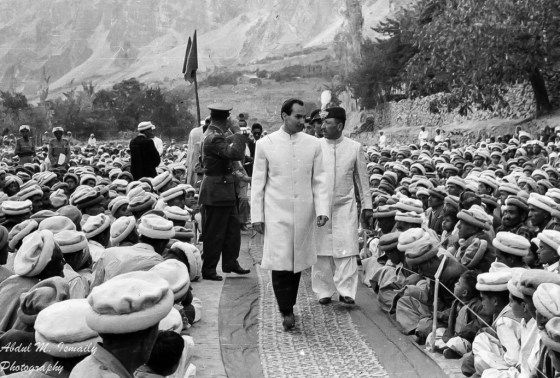
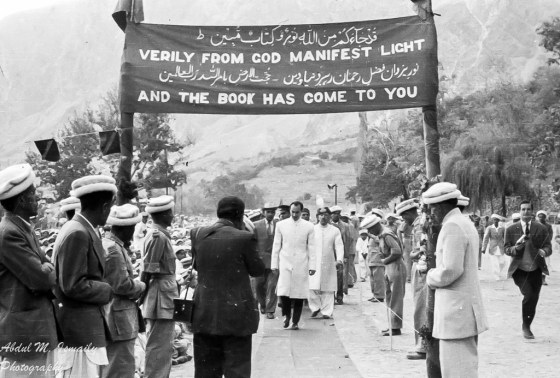
The Jamat of Hunza accept the gracious didar (glimpse) of Mawlana Hazar Imam, His Highness the Aga Khan, as he visits the Princely State in the Northern Areas of Pakistan in 1960. Photo: Abdul M. Ismaily (papa jaan). Copyright.

“I was taken near the place where from I saw the bright Light of the Prophethood. My eyes were dazzled by the Light. I shed tears of joy and felt as if I was looking at the face of the Prophet of Allah and of the Commander of the Faithful, Hazrat Ali. I prostrated myself before the one who is the fittest person to bow to. I wanted to say something, but I was awe-struck.”….MORE

The Jamat of Hunza accept the gracious didar (glimpse) of Mawlana Hazar Imam, His Highness the Aga Khan, as he visits the the Northern Areas of Pakistan in 1960. Photo: Abdul M. Ismaily (Papa Jaan). Copyright.

Date posted: September 28, 2017.

__________________

Awesome and Rare Collection of Ismaili Ginans with Music at the British Library

1935-1955: Truly Inspiring Recordings of Ab Teri Mohabat, Marna Hai Re Jarur, Ho Jire Mara Hansa, Satgur Miliya Mune Aaj and Bhajan

By MALIK MERCHANT
(Material compiled from the British Library, Endangered Archives Project)

A Young India gramaphone record. Photo: The British Library, Endangered Archives.

Simerg has come across an extremely rare collection of ginans that were recorded on 78-rpm shellac gramophone records in Mumbai, India between 1935-1955. The ginans accompanied by music are part of a huge collection of almost 1427 original film, music, classical music, folk music, publicity and educational material that have so far been digitized by the  British Library in London, England as part of their Endangered Archives project. A 24 month grant of £21,300 (sterling pounds) for this project was awarded to an independent researcher, Dr. Suresh Chandvankar, in 2008.

During 1930-55, the British and German record manufacturing companies were well established and had a major share of disc manufacturing in India. The ‘Young India’ record label was an ‘indigenous’ effort at record production by ‘The National Gramophone Record Manufacturing Company Ltd. Bombay’ and during the twenty year period produced 10,000 titles on hundreds of 78-rpm shellac gramophone records in Mumbai. Mainly amateur and upcoming artists were recorded under the ‘Young India’ label. The company ceased to function in 1955 so these recordings were never reissued on audio tapes and CDs. Hence, the British Library felt it important and relevant to preserve these invaluable recordings and the associated documents.

Clockwise from top left: A Young India disk; Young India sign; a collector; and a collection of Young India record. Photos: British Library, Endangered Archives.

The repertoire covered music from different regions of India and sung in many different languages. During the long tenure of over twenty years, Indian citizens witnessed several important events such as the movement and struggle for freedom, Indian Independence in 1947, World War II and the beginning of the romantic period of independent India. This was also reflected in the records produced. Thus, there are speeches of great leaders, ballads, skits and dialogues on a number of subjects depicting changing social and political situations.

In late 1948, the ‘National Gramophone Record’ factory at Wadala was experiencing both technical and financial problems which severely curtailed its production capacity. The situation worsened slowly and by late 1955, the factory had closed down with stocks left over at the factory sold off at greatly reduced prices to a number of agencies. With time, the records and catalogues were either destroyed or scrapped. Slowly, all the material related to this company began to disappear.

It is estimated that over 1,000 records are available in the private collections of record collectors, located in Mumbai, Ahmadabad, Delhi, Chennai and Kolkata, and are only available on 78-rpm breakable shellac discs. In addition, over 100 catalogues, booklets and record sleeves are held by private collectors and it is possible to collect or borrow them for this project. These have never been sold commercially, with the result that very few copies have survived to the present.

Through the British Library project endangered archival material pertaining to ‘Young India’ record label will be restored, digitised and thus preserved for posterity.

The project succeeded in locating and digitising over 725 discs (1450 songs) of the ‘Young India’ record label. A large number of catalogues and advertising material was located at many places and more than 1,000 digital images have been taken of documents and disc labels. This will form a very valuable reference source for researchers in the future.

Here are the links to the recitation of Ginans performed by numerous individuals including Master Jumma, Rama, Kumari, and Rahemali.

(Note: Once you are on the British Library page when you have clicked on a Ginan link below, remain on that page and click under Related Items to listen to other Ginans – you need not use the back arrow to return to this page for links to other recordings).

Update (October 28, 2025): We note that the links listed below, which were previously accessible, are no longer accessible. We will endeavour to provide new links so readers can listen to the Ginans once again.

Two recordings of Ab Teri Mohabat

Two recordings of Marna Hai re Jarur 

Two recordings of Ho Jire mara Hansa 

Recording of Satgur miliya mune aaj

Recording of Bhajan, Aavo Sultan Raj (possibly of Ismaili origin) 

Date posted: Sunday, September 24, 2017, 03:45 am.
Last updated: October 28, 2025. We note that the Ginan links listed in the post, which were previously accessible, are no longer accessible. We will endeavour to provide new links so readers can listen to the Ginans once again.

Previous update: September 24, 2017, 03:51 am) – Correction: In the first version of this post it was incorrectly mentioned on the title and elsewhere in the article that the archives are at the British Museum. The Endangered Archives Project is an initiative of the British Library and not the British Museum. We apologize for this oversight.

________________

We welcome your feedback. Please click Leave a comment. Do you have any information about Master Jumma, Rama, Kumari, Rahemali, and others who were involved in the singing of the ginans? Let us know! If you encounter any technical issues in submitting your comment, please send your feedback to Simerg@aol.com, Subject: Ginan archives.

Essay on His Highness the Aga Khan by Michael Morgan, author of “Lost History”

The following article is reproduced from http://www.barakah.com, a website with the theme “His Highness the Aga Khan: A Visual and Textual Celebration, 1957-2017.”

Karim Aga Khan: Modern Personification of Historical Islamic Rationalism, Charity and Peace

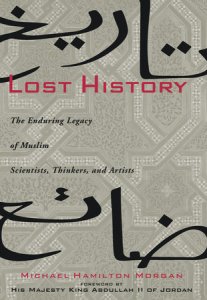
Lost History: The Enduring Legacy of Muslim Scientists, Thinkers and Artists by Michael Hamilton Morgan with a Foreword by Jordan`s King Abdullah II.Lost History: The Enduring Legacy of Muslim Scientists, Thinkers and Artists by Michael Hamilton Morgan with a Foreword by His Majesty King Abdullah II of Jordan.

BY MICHAEL HAMILTON MORGAN

When I published my book “Lost History” in 2007, only 6 years after the attacks of 9/11 and while the US and allies were still fighting wars in the ancient Islamic treasure-houses of Iraq and Afghanistan, I thought that non-Muslims were finally beginning to be open to the breadth and depth — and global debt owed — to historical Muslim culture.

My publishers and editors — while firmly supportive of the book — had been privately concerned that the book might trigger angry reactions both from conservative Muslims and from Islamophobes.

Their concerns were not borne out. Contemporary antagonists on both sides chose to ignore my historical discussions, or to focus on other disputes. My argument showing how much the modern digital world owes to the ancient Muslim-sponsored thinkers in Baghdad, Aleppo, Isfahan, Cairo, Palermo, Cordoba, Bukhara, Isfahan, Delhi and many other cities was well received. The surprise to me was how well received it was in the Muslim world, being translated into languages like Arabic and Indonesian, as well as for faraway non-Muslim readers in Japan and even Korea.

If only that modest success could have been sustained. But then came the continuing disintegration of Iraq and Syria, the rise of ISIS, floods of refugees and horrific Islamophobic political demagoguery in both Europe and the US. It was as though one beheading could erase all the slow progress made in getting non-Muslims to understand that ISIS and its fellow travelers were not the spokesmen for the faith of Islam that most Muslims know and practice — or that history teaches us.

Perhaps there is no hope of counteracting the sensationalism of terrorism with a book…or even a parade of books. Perhaps the only way is through decades — or even centuries — of hard work in the areas of education, scientific research, medicine, public works, charity, economic development and entrepreneurship.

Believe it or not, those are the behavioral pillars of historical Muslim culture. Though most non-Muslims don’t realize, it was those pillars and others that made Muslim culture the single most progressive force in the world from about 650 to 1500 of the current era. Those pillars seeded the European Renaissance and Enlightenment and gave us things like the algorithm, data mining, evidence-based medicine, universities, hospitals, psychotherapy, modern optics, space travel and a thousand other things that we think come exclusively from the West.

And it would be dishonest to say that all those things were purely Muslim-generated. Instead, they were Muslim sponsored — the fruits of a vision of Islam that opened its intellectual doors to all good ideas and thinkers, no matter where they came from or which deity they worshipped. In hadith, the Prophet Mohammad is quoted as saying, “even if ye must go to China, seek knowledge,” and “The ink of the scholar is holier than the blood of the martyr”. These were the scriptural guides that drove these centuries of invention and discovery.

In fact, I argue that Islam was the most intellectual of the three Abrahamic faiths, and perhaps of any religion in human history. For hundreds of years, mainstream Islam taught that the secrets of God’s universe could be unlocked with reason and logic — that those intellectual tools were in fact keys to divine revelation. Classical Muslim thinkers saw no contradiction between reason and divine revelation — for them, logic and revelation were one and the same. Unfortunately, that lesson seems lost now, even in that direct product of the European Enlightenment, the United States, where state legislatures and US Senators argue that science should be ignored when it comes to climate change and Darwin’s theory of evolution. On top of that, no one remembers that Darwin had been previewed by Al Jahiz’ theory of natural selection in Baghdad 1,000 years earlier.

This ancient Muslim religious devotion to science, ideas, openness and empirical evidence has indeed been obscured in the mainstream. In the West, the loss of this connection has come from the hard separation of science from faith, and both have suffered. Faith for many in fundamentalist Christianity has become an anti-intellectual thing, when there need not be such a dichotomy. On the scientific side, the compartmentalization of Western intellectual tradition means that science has become very secular. Career scientists are generally uneasy to have their faith mixed into science: many see the two as directly contradictory.

And in the Muslim world, incomplete popular understanding of the faith of Islam has weakened understanding of the importance of logic and reason to the Islamic tradition.

But some have always been quietly swimming against that popular tide of prejudice and misunderstanding. Whether they will be able to offset the currents of ignorance and mistrust that dominate the media and politics remains to be seen — but it is certain that among those most directly touched by their work, the lesson of logic, reason, openness and peace is resonating.

In this vast tapestry of the interaction of Muslims with each other, and with other cultures and faiths, there is one tradition that unfailingly continues the progressive heritage of classical Islam — profoundly intellectual, open, tolerant, pacific — and in particular one leader who has made it especially attuned to the many difficulties of the world today.

That would be Ismailism and its revered Imam, the current Aga Khan IV.Aga Khan portrait by Jean Marc CarisseAs a minority within a minority of Islam, Ismailism does not enjoy hundreds of millions of followers. Its adherents today number about 15 million — though they are dispersed to many corners of the world — South and Central Asia, Africa, Canada and elsewhere. This is only a drop in the ocean of greater Islam that may number 1.6 billion worldwide.

Additionally, Ismailism is not well understood, even by mainstream Shiites, much less majority Sunnis. In some ways its situation is similar to Christian misunderstanding of Judaism, which is hugely outnumbered by its Christian and Muslim descendants. Like Judaism with its pogroms and anti-Semitism, Ismailism has suffered historical persecution at the hands of the majorities. As with Jews in the Holocaust, Ismailis in the 13th century were even threatened with extermination, first at the hands of the Sunni majority and then at the hands of the Mongol invaders of Persia. For centuries, Ismailis survived in Persia and elsewhere either in mountaintop redoubts or underground and or in nearly permanent exile.

But to the benefit of today’s world and many millions of people, the Ismailis have not been exterminated or absorbed. In some ways, their intellectualism may have been intensified by the centuries of persecution. Today, the Aga Khan and the Ismailis have bent over backward — and at great risk — to nurture the elements of progressive Islam that changed the world 1000 years ago.

The fruit of all this historical tumult is the Ismailism of today, and the Aga Khan. He and his followers continually remind the world that quiet good work can be more powerful than loud rhetoric and sensational acts, that the intellect and reason are the keys to progress, that openness and tolerance heal the world, and that peace is the expression of the divine on earth.

Since the Aga Khan was crowned in 1957, he has devoted his time, energy, fortune and the efforts and contributions of his followers to major global efforts in education, economic development, entrepreneurialism, charity, medicine and other fields.

By no coincidence, all these fields are at the core of classical Muslim culture and greatness. They have done more for the world than blind piety and xenophobia ever could.

His Highness was explicit on the powerful intellectual tradition of Islam when interviewed by Der Spiegel in 2006:

SPIEGEL: Does Islam have a problem with reason?

Aga Khan: Not at all. Indeed, I would say the contrary. Of the Abrahamic faiths, Islam is probably the one that places the greatest emphasis on knowledge. The purpose is to understand God’s creation, and therefore it is a faith which is eminently logical. Islam is a faith of reason.

And His Highness has spent his lifetime walking the talk of that. Through global institutions like the Aga Khan Development Network (AKDN), he has founded and inspired multiple initiatives like the Aga Khan University, the University of Central Asia, the Aga Khan Fund for Economic Development (AKFED), the Aga Khan Trust for Culture, the Aga Khan Foundation, the Aga Khan Health Services, the Aga Khan Education Services, the Aga Khan Planning and Building Services, and the Aga Khan Agency for Microfinance. One of the companies where AKFED is the main shareholder is Serena Hotels Group.

The Aga Khan Development Network, which coordinates the activities of over 200 agencies and institutions, employs approximately 80,000 staff, the majority based in developing countries. AKDN is dedicated to improving living conditions and opportunities for the poor, without regard to their creed, ethnicity or gender. The AKDN’s annual budget for non-profit development activities in 2010 was estimated to be US$625 million. The network operates in more than 35 of the poorest countries in the world

Each one of these efforts would merit articles longer than this. But one that should be singled out and explained is the AKDN’s business activities like Serena Hotels.

Many coming from the Christian tradition will find a religious group’s investment in business puzzling to say the least. That is because Christianity, unlike Islam, has always had an ambivalent view of business. Witness Jesus’ statement, “it is easier for a camel to pass through the eye of needle, than for a rich man to enter the Kingdom of Heaven.”

Islam never had that antipathy to business, owing in large part to the Prophet himself, who was aided in promoting his religious vision after marrying caravan entrepreneur Khadija. Although Islam has strong requirements to devote a share of one’s wealth to public charity and to the faith, it has never had the antipathy to commerce that Christianity did.

Although many in the West have argued that business can be a force for change, few have explicitly based their business activities in religious faith. I would argue that the Aga Khan has showed that religiously-inspired business can be a progressive force in society, by creating jobs, spreading wealth, providing needed services, stimulating economic growth and higher tax revenues and social progress.

Aga Khan at the opening of the Kampala Serena and photos of the Serena Lodges at Lake Manyara and Serengeti National ParksHis Highness the Aga Khan and His Excellency President Museveni speak to Mr Expedito Wakibulla at the opening of the Kampala Serena Hotel. Mr. Wakibulla is a renowned Ugandan wood carver, whose artworks are used extensively throughout the Kampala Serena. Shown at the left are the Serena Lodges at Lake Manyara (top) and Serengeti National Parks. Photos: AKDN/Gary Otte.

His efforts in education — for how can logic and reason advance without education — are equally admirable. Founded in 1983 by Prince Karim Aga Khan IV, Aga Khan University launched a medical college and a teaching hospital in Pakistan. The university grew to be international, and in 2004 established a teaching hospital in Nairobi and in 2016 another one in Dar es Salaam, Tanzania. In 2002, the university established a campus in London dedicated to the study of the Muslim Civilizations. In 2015, the university established the Institute for Human Development. In 2016, the university launched the East African Institute. The university’s clinical laboratories in Karachi are the only in Pakistan to be accredited by the College of American Pathologists.

The university’s campus in Karachi is ranked among the top universities in Asia and among the top 300 in the world for medicine. Pakistan ranks the university as the top medical school in Pakistan. The university runs one of the world’s largest networks of accredited teaching hospitals, with 14 hospitals in Pakistan, East Africa and Afghanistan. In 2016, these hospitals treated an estimated 1.75 million patients.

But there’s more to this story. The University of Central Asia (UCA) was founded in 2000. The Presidents of Tajikistan, the Kyrgyz Republic and Kazakhstan and the Aga Khan signed the treaty establishing this secular, not-for-profit, private university. The Presidents are Patrons of UCA and His Highness the Aga Khan is the Chancellor.

Aga Khan reviews progress of University of Central Asia's Naryn Campus in 2014. The campus was inaugurated in October 2016.His Highness the Aga Khan, the Chancellor of the University of Central Asia (UCA), accompanied by Kyrgyzstan’s Minister for Education Mr Kanat Sadykov, Naryn Governor Mr Amanbay Kayipov, Mayor Mr Rakhat Adiyev, the Akim of the Naryn District Zhanboev Tugolbai and UCA leadership as the delegation reviewed the first campus of UCA in Naryn in November 2014. The campus was inaugurated by the Aga Khan on October 19, 2016. Photo: AKDN/Gary Otte.

UCA’s mission is to foster the socio-economic development of Central Asia, particularly its mountain societies, while helping the peoples of the region preserve and draw upon their rich cultural heritages as assets for the future. The university is advancing construction of three campuses in Khorog, Tajikistan; Tekeli, Kazakhstan and Naryn, Kyrgyz Republic (which was inaugurated in October 2016).

The three campuses, hosting academic, administrative, residential, library, cultural and athletic facilities, will serve almost 4000 students, faculty and staff.

Let us hope that all these noble efforts will finally begin to undermine the mis-named “clash of civilizations” and the mis-named “Islamic terrorism”. We will not know for some time.

This article started by referring to the deep misunderstanding in the world and even among Muslims about what Islam is and what Islam has given to the world. ISIS and fellow travelers continue to steal the headlines with their acts of violence. But the Aga Khan showed us the way out of this fog of ignorance in the same interview with Der Spiegel. I will close the article with his words:

SPIEGEL: “The West (will stand) against the Rest” wrote Professor Samuel Huntington in his famous book “Clash of Civilizations.” Is such a conflict, such a clash inevitable?

Aga Khan: I prefer to talk about a clash of ignorance. There is so much horrible, damaging, dangerous ignorance.

SPIEGEL: Which side is responsible?

Aga Khan: Both. But essentially the Western world. You would think that an educated person in the 21st century should know something about Islam; but you look at education in the Western world and you see that Islamic civilizations have been absent. What is taught about Islam? As far as I know — nothing. What was known about Shiism before the Iranian revolution? What was known about the radical Sunni Wahhabism before the rise of the Taliban? We need a big educational effort to overcome this. Rather than shouting at each other, we should be learning to listen to each other. In the way we used to do it, by working together, with mutual give-and-take. Together we brought about some of the highest achievements of human civilization. There is a lot to build on. But I think you cannot build on ignorance.

Date posted on Simerg: September 19, 2017.

Copyright: Michael H. Morgan/Simerg. 2017.

_______________

Michael Hamilton MorganInternational speaker, author, business advisor and award-winning former U.S. diplomat Michael Morgan currently advises companies in the U.S., Europe, Latin America, Africa and Asia-Pacific seeking capital and partnerships — in industries like energy, infrastructure, telecom, pharmaceuticals, entertainment, sports and real estate. Morgan is a member of the Advisory Board of Proximera Fund/Fuchs Group (www.fuchsgroup.com) in Luxembourg, CBT Fund in Shanghai and is Head of Investor Relations at Aseare Health (www.aseare.com).

Since 2007, Morgan has been a keynote speaker at the Arab Business Council, British Parliament, World Economic Forum, U.S. Treasury, Georgetown University, UCLA, University of Virginia, the Mohammed bin Rashid Foundation in Dubai, the Abu Dhabi International Book Fair, the Asia Society and many other venues.

Morgan’s 2007 book Lost History: the Enduring Legacy of Muslim Scientists, Thinkers and Artists (National Geographic/Random House) has reached thousands of readers around the world, and has been translated into Arabic, Indonesian, Urdu, Bosnian, Japanese, Korean and other languages. Morgan received Egypt’s Presidential award for the Arts & Sciences in 2008. Morgan’s 2002 book Collision with History: the Search for John F. Kennedy’s PT 109 has been optioned as a feature film by Atmosphere Entertainment in Hollywood.

_______________

We welcome your feedback, please click  LEAVE A COMMENT or send your comment to simerg@aol.com. Please visit http://www.barakah.com for insightful essays on His Highness the Aga Khan. Also become a  friend of Barakah at http://www.facebook.com/1000fold.


Prince Amyn Muhammad Aga Khan is 80 years old: A thank you letter to the Prince

Dear Prince Amyn, we have witnessed and continue to witness with immense happiness your enormous love, loyalty and respect for our beloved Hazar Imam. Throughout your life, you have been by his side as his trusted supporter, loyal advisor and confidant. You continue to be an epitome of inspiration in the service of the Imam, the Institution of Imamat, worldwide Jamats” — READ MORE

Please click on image to read Azeem Maherali’s thank you letter to Prince Amyn Aga Khan. Photo: Khizr Hayat Collection.

Date posted: September 13, 2017.

__________________


Total Solar eclipse on August 21: One of Nature’s most awe inspiring sights; watch ScienceCast and follow live coverage

On Monday, August 21, 2017, all of North America will be treated to an eclipse of the sun. Anyone within the path of totality can see one of nature’s most awe inspiring sights – a total solar eclipse. This path, where the moon will completely cover the sun and the sun’s tenuous atmosphere – the corona – can be seen, will stretch from Salem, Oregon to Charleston, South Carolina. Observers outside this path will still see a partial solar eclipse where the moon covers part of the sun’s disk. NASA will cover the eclipse live from coast to coast, beginning at noon EDT.

~~~~~~~

THE ISLAMIC WORLD AND ASTRONOMY

Islamic astronomy became the western world’s powerhouse of scientific research during the 9th and 10th centuries AD, while the Dark Ages engulfed much of the rest of the western world. The works by Ptolemy, Plato, and Aristotle were translated, amplified upon and spread throughout the Muslim world. Al-Khwarazmi developed the first tables trigonometric functions (ca 825 AD) which remained the standard reference well into the modern era. Al-Khwarazmi was known to the west as “Algorizm” and this is, in fact, the origin of the term ‘algorithm’. Al-Khwarazmi’s calculations were good to five places, allowing for unprecedented precision in astronomy and other sciences. At Antioch, Muhammad al-Batani (ca 850 AD) began with Ptolemy’s works and recalculated the precession of the equinoxes, and produced new, more precise astronomical tables. Following a steady series of advances in Islamic trigonometry, observations by Ibn Yunus of lunar and solar eclipses were recorded in Cairo ca 1000 AD. Ibn Yunus is regarded as one of the greatest observational astronomers of his time. The pace of Islamic science and scholarship eventually slowed down in the 11th and 12th centuries. Many great books and great ideas of the Islamic Age lay fallow for hundreds of years until they were finally translated into Latin and fueled the European revolution in thinking and the birth of science as we know it today. [1]

FATIMID ASTRONOMER IBN YUNUS

The Fatimid astronomer Ibn Yunus (950-1009), was one of the greatest astronomers of medieval Islam and the most important astronomer of medieval Egypt. He recorded both the lunar and solar eclipses in Cairo.  As a young man he witnessed the Fatimid conquest of Egypt and the founding of the new city of Cairo in 969. In the period up to the reign of 15th Ismaili Imam and 5th Fatimid Caliph, Mawlana al‐ʿAzīz (975–996), he made astronomical observations that were renewed by Mawlana al-Hakim bi-Amr Allah, who succeeded Imam al‐ʿAzīz in 996 at the age of 11. Ibn Yunus wrote a major astronomical handbook called Al-Zij al-Hakimi al-kabir (The Great Hakimi astronomical table) which he dedicated to Imam al-Hakim. Although Ibn Yunus’ handbook was widely used in Islam, and his timekeeping tables survived in use in Cairo into the 19th century, his work only became known in the West less than 200 years ago. [2]

Yunus expressed the solutions in his Zij without mathematical symbols, but Delambre noted in his 1819 translation of the Hakemite tables that two of Ibn Yunus’ methods for determining the time from solar or stellar altitude were equivalent to the trigonometric identity 2cos(a)cos(b) = cos(a+b) +cos(a-b) identified in Johannes Werner’s 16th-century manuscript on conic sections. Now recognized as one of Werner’s formulas, it was essential for the development of prosthaphaeresis and logarithms decades later. [3]

Date posted: August 19, 2017.

____________

Islamic astronomy and Ibn Yunus sections compiled from the following sources:

[1]. https://science.ksc.nasa.gov/
[2]. Ibn Yunus – McGill University
[3]. Ibn Yunus – Wikipedia