Simerg is an independent initiative dedicated to Ismaili Muslims, the Aga Khan — their Hereditary Imam — and the Ismaili Imamat, and Islam in general through literary readings, photo essays and artistic expressions
“Often when I see members of the Ismaili community, they start by thanking me and thanking my father specifically, and I always have to turn it around and say no, no, no, thank you. Thank you for being the embodiment of the vision that my father and so many others had” — Prime Minister of Canada, March 21, 2018, Ismaili Centre.
(Video, followed by transcript)
~~~~~~
Transcript of remarks made by Prime Minister Justin Trudeau at the Ismaili Centre, Toronto on the occasion of Navroz, March 21, 2018
Thank you. Thank you my friends. Navroz Mubarak. Hello everyone, and thank you for that incredibly warm welcome. I want to begin by thanking Malik Talib, President of the Ismaili Council for Canada, for his invitation, for his kind words. I want to thank my colleagues Arif Virani, Alli Al Hasi, Yasmin Ratansi, who are here with me today, for all the incredible work they do in their communities and across the country.
And I want to thank all of you for being here today. This is always a wonderful moment for me to come to this beautiful centre to see friends, old and new, and to celebrate a community that, for me, represents some of the very best of Canada. The sense of connection, the sense of service, the deep values that fold into every action of this community is, I think, a testament to both the success of this country and those upon whom this success rests. Often when I see members of the Ismaili community, they start by, as Arif did, thanking me and thanking my father specifically, and I always have to turn it around and say no, no, no, thank you. Thank you for being the embodiment of the vision that my father and so many others had. Thank you for the incredible….
(Applause)
Thank you for showing not just Canadians, but the world, with and through your success and your devotion, both to your own identities but also to this shared identity we build as Canadians, what it is to be open and to prosper through being welcoming and engaging with the world and not closing oneself off. You are an extraordinary example of the very best of Canada, and every day I thank you for it.
(Applause)
And I think there is no better example of that than, as Malik pointed out, the over one million hours of community and volunteer service to mark Canada’s 150th anniversary that this community accomplished — it is an extraordinary achievement and a perfect example of the commitment that all you, but all of us should have every day to contributing to the community, to the country that surrounds us. It is a beautiful testament to the dedication to this country and to all its citizens.
It’s quite fitting we celebrate Navroz here, as the Ismaili community is known around the world for its commitment to pluralism. Tens of thousands of people see this symbol of diversity off the Don Valley Parkway every day. Navroz is a chance for all Canadians to honour the many communities that have observed this tradition for generations and the many contributions you have all made to Canada. This event is a testimony to the diversity that makes Canada stronger and Canadians better.
So thank you for gathering here today. I’ve been giving some thought to the idea of Navroz, which marks the start of the New Year and the beginning of spring. The idea of new beginnings is central to Navroz.
How can we create and take advantage of opportunities throughout the new year? How can we maintain hope? How can we remain optimistic in the face of adversity? How can we foster openness and understanding, not just today but every day? While there may be … more than one answer to these questions, they give us pause to reflect on the past year. And this reflection may allow us to move forward as we welcome a new year.
This led me to think back on a meeting I had just a few weeks ago with the Afghan Girls Robotics Team. By the time they arrived in Canada, these incredibly smart and driven young women had already been awarded the top prize at Robotics competitions around the world, gaining international recognition for their accomplishments in STEM. They spoke of their successes with pride and shared their plans for the future with optimism and hope. They spoke of their aspirations, not only for themselves, but also for their community, for Afghanistan, and for other women in their field.
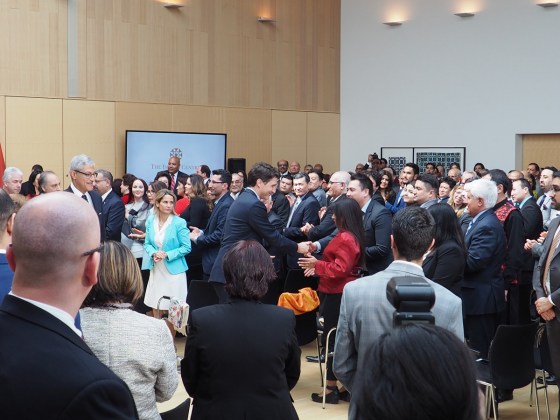
(Applause, speech continues after photo)
Prime Minister Trudeau at Navroz celebrations held on March 21, 2018 at the Toronto Ismaili Centre. Photo: Simerg/Malik Merchant.
I am sharing their stories with you today because the path to success was far from easy for these young women. But despite the obstacles, they have remained optimistic, strong and full of hope. Brilliant, kind and proud.
I mention that Afghan Girls Robotics Team because in a way they embody the spirit of Navroz. These twelve young women were beyond ready for the next chapter of their journey here in Canada and ever so eager for new beginnings. And as it so happens, we met on the last day of February, on the eve of this month of renewal. Now, I know we can’t all claim to be leaders in robotics, but do not let their extraordinary circumstances and abilities distract you from the more familiar elements of their story.
For generations, people have come to Canada to realize their dreams. Some faced impossible odds for a chance to build a better life for themselves, while others made considerable sacrifices to ensure the success of their children and grandchildren. As we mark Navroz today in the Ismaili Centre, I want to recognize that everyone in this room can relate to these stories.
Take the Ismaili community, for example, many of whom were welcomed in Canada in 1972, after being forcibly expelled from Uganda by Idi Amin. This is a community like so many others that overcame significant obstacles, and of course its members are leaders in every profession across the country today.
Indeed, the story of hope and hard work is one that Canadians from all backgrounds can relate to. One that lives on in our communities and hopefully transcends our borders.
While Navroz is a time of celebration and new beginnings, it also reminds us of our privilege during this time of change. As Canadians, we are fortunate to live in a country where our rights are enshrined in the Constitution, where our freedoms are entrenched in laws. The Charter of Rights and Freedoms ensures that all Canadians can speak their mind, practice their faith, and stand up for what they believe in. Because of the Charter, every Canadian is entitled to a new beginning.
I want to end by sharing with you the wise words of the Persian poet, Hafez, which I believe capture the spirit of this occasion.
“Spring and all its flowers now joyously break their vow of silence. It is time for celebration, not for lying low.”
Once again, thank you for having me here today to join in this celebration. To all those who have gathered around the Haft-Seen table this week and are gathering in Jamat Kalmas (ph?) this evening. I wish you all peace, health, happiness, and prosperity in the New Year.
Navroz Mubarak. May peace and blessings be upon you.
Since the commencement of his Diamond Jubilee on July 11, 2017, His Highness the Aga Khan, Mawlana Hazar Imam, has visited 9 countries and flown more than 90,000 kilometres. At the age of 81, the 49th Hereditary Imam of the Ismailis is the oldest reigning Imam in Ismaili history. We invite our readers to read and learn about his life through a treasury of insightful essays, memorable quotes, narratives, beautiful songs and stunning photographs, including rare and historical images, on our sister website Barakah. The following is Barakah’s table of contents as of March 26, 2018.
“Prophet Muhammad believed that freedom of religion and civic rights were important components of a ‘Muslim Nation’….His covenants with Christians can be viewed as a kind of medicine to cure the diseases of Islamic extremism and Islamophobia.” — Rice University Study
The Covenant with the Monks of Mount Sinai was commissioned by Prophet Muhammad, with Hazrat Ali as its scriber. Manuscript copies are from Saint Catherine’s Monastery, and Simonopetra. Photo: Wikipedia.
The following piece is adapted from a report released by Rice University – ed.
Prophet Muhammad believed that freedom of religion and civic rights were important components of a ‘Muslim nation,’ according to a Rice University analysis of the Prophet’s covenants with Christians.
Researcher Craig Considine, a lecturer in Rice’s Department of Sociology, argues that the covenants can be used to develop a stronger democratic partnership between Muslims and Christians in the Islamic world and elsewhere. His study is published in the journal Religions under the title “Religious Pluralism and Civic Rights in a ‘Muslim Nation’: An Analysis of Prophet Muhammad’s Covenants with Christians.” It can be downloaded through the link provided at the bottom of this post.
“These covenants were designed to protect and even defend peaceful Christian communities, not attack them,” Considine said. He found that these agreements established freedom of religion and civic rights for Christians living within the “ummah” (Arabic for “community”). “The research clearly shows that contemporary Islamic states that mistreat and discriminate against Christians cannot be justified in light of Prophet Muhammad’s covenants,” adds Considine.
The covenants were written between 622 and 632 A.D. Considine said it is assumed they were written because of Prophet Muhammad’s desire to build alliances to bolster his new community and because of his positive interactions with members of the Christian faith. The paper explores the Prophet’s covenants with the monks of Mount Sinai, the Christians of Najran, the Christians of Persia and the Christians of the World.
In “The Covenant of the Prophet with the Christians of Persia,” the Prophet was emphatic on the issue of complete religious freedom:
“And even as they honor and respect me, so shall Muslims care for that people as being under our protection and whensoever any distress or discomfort shall overtake (Christians), Muslims shall hold themselves in duty bound to aid and care for them, for they are a people subject to my Nation, obedient to their word, whose helpers also they are. It therefore is proper for my sake to attend to their comfort, protection and aid, in face of all opposition and distress, suppressing everything that becomes a means to their spoliation,” the Prophet wrote.
Considine said a similar — if not identical — passage is found in the three other covenants addressed in this paper.
Article continues after Aga Khan quote….
HIS HIGHNESS THE AGA KHAN ON THE ETHIC OF PLURALISM
“A cosmopolitan ethic is one that welcomes the complexity of human society. It balances rights and duties, freedom and responsibility. It is an ethic for all peoples, the familiar and the Other, whether they live across the street or across the planet…..Sadly, the world is becoming more pluralist in fact, but not necessarily in spirit. “Cosmopolitan” social patterns have not yet been matched by “a cosmopolitan ethic.”…..As you build your lives, for yourselves and others, you will come to rest upon certain principles. Central to my life has been a verse in the Holy Qur’an which addresses itself to the whole of humanity. It says: “Oh Mankind, fear your Lord, who created you of a single soul, and from it created its mate, and from the pair of them scattered abroad many men and women…” I know of no more beautiful expression about the unity of our human race — born indeed from a single soul.” — Excerpts from the Aga Khan’s speech made to the Parliament of Canada, Ottawa, February 27, 2014.
“Prophet Muhammad made it clear that freedom of religion is an inherent right for Christians living in a Muslim nation,” he said. “His cordial relations with Christians were not due merely to political expediency or personal aspirations, but rather they resulted from his belief that Christians should be able to freely practice their own faith in accordance with their own will. Christian Persians were under no compulsion whatsoever to accept or reject Islam.”
Considine also noted that Prophet Muhammad believed that a Muslim nation must also extend civic rights to Christian religious leaders, as discussed in “The Covenant of the Prophet with the Christians of the World.” The Prophet wrote:
“The covenant of Allah is that I should protect their land, their monasteries, with my power, my horses, my men, my strength and my Muslim followers in any region, far away or close by, and that I should protect their businesses. I grant security to them, their churches, their businesses, their houses of worship, the places of their monks, the places of their pilgrims, wherever they may be found.”
“The Prophet Muhammad did not want to inflict harm on Christians, nor interfere or encroach on their privacy or private property,” Considine said. “For the state to give preference to one or more groups means devaluating citizens based upon their ethnic or cultural backgrounds.”
Considine said documents have been located in obscure monasteries around the world and books that have been out of print for centuries.
Considine said the rediscovery of these documents provides an opportunity to give new birth to Islam and regenerate the essence of Islamic teachings. He hopes that the findings will have a positive impact on the impressions of Muslims in today’s society and will combat anti-Muslim sentiments.
“Prophet Muhammad’s covenants with Christians can be viewed as a kind of medicine to cure the diseases of Islamic extremism and Islamophobia,” Considine said. “His message radiates compassion and peace. This is what American society — and indeed the world — needs now more than ever.”
The purpose of this post is to provide external links to news of Mawlana Hazar Imam’s Diamond Jubilee visit to the United Arab Emirates (UAE). We we will make every effort to ensure that links are filtered so that the news is not repetitive – often the same news agency report is shared by different media. The page will be updated on a regular basis.
The Aga Khan in the Emirates
January 25, 2018
Mawlana Hazar Imam bids Khuda Hafiz before departing the UAE. The Ismaili/Simon Milne-Day.
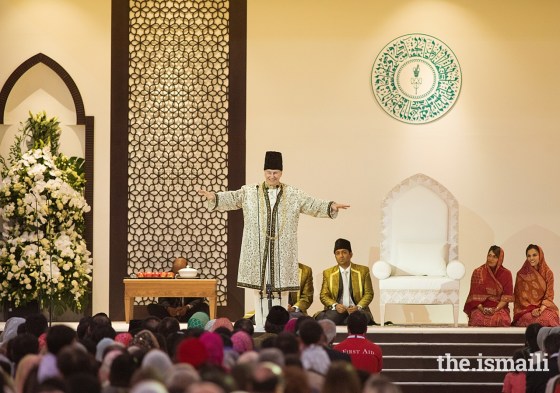
Mawlana Hazar Imam walks through the Jamat during the Diamond Jubilee Darbar in Dubai. The Ismaili/Akbar Hakim.
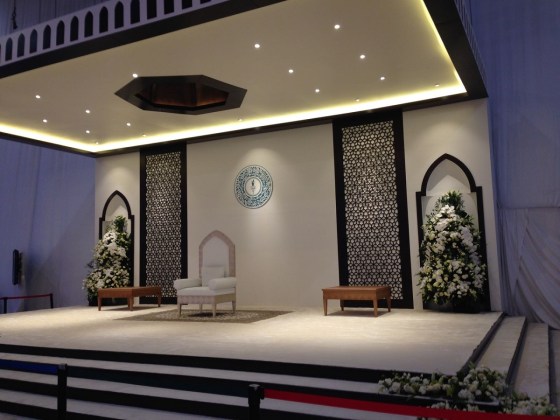
A view of the beautiful stage for the Darbar held in Dubai for the Emirates Jamat. On the centre, behind the chair, is the circular Diamond Jubilee logo bearing the crest of the Ismaili Imamat. The crest has 60 crescents surrounding it, representing Mawlana Hazar Imam’s 60 year reign. A Kufic rendition of the Qur’anic ayah or verse (49:13) from Surah Al-Hujurat (the Dwellings) with the following meaning, forms the outer perimeter of the logo. “O mankind! Lo! We have created you male and female, and have made you nations and tribes that ye may know one another. Lo! the noblest of you, in the sight of Allah, is the best in conduct. Lo! Allah is Knower, Aware.” — Translation by Pickthall.
Mawlana Hazar Imam addresses the Jamat during the Diamond Jubilee Darbar held at Dubai World Central. Photo: The Ismaili/Akbar Hakim.
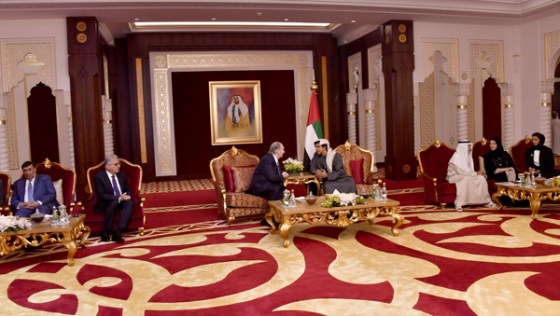
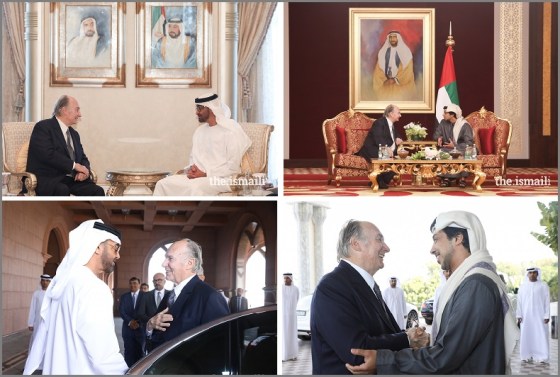
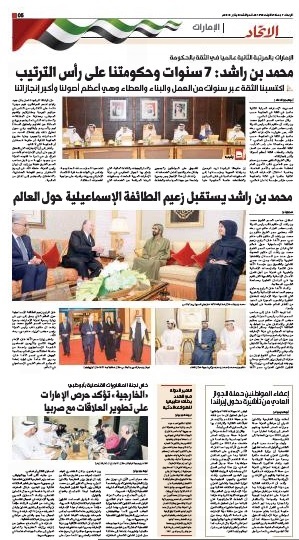
His Highness the Aga Khan meets with His Highness Sheikh Mohamed Bin Zayed Al Nahyan (left column) and His Highness Sheikh Mansour bin Zayed Al Nahyan. Click on The Ismaili link below for report and enlarged photos.
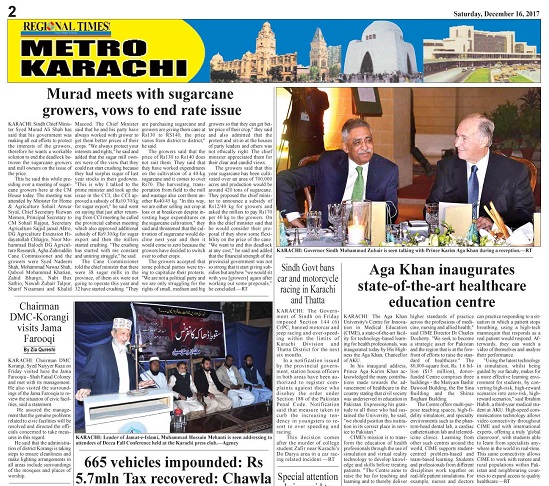
President Firoz Rasul delivering his address in the presence of His Highness the Aga Khan during the inauguration ceremony in Karachi, Pakistan, on December 15, 2017 of a new AKU Centre for Innovation in Medical Education (CIME), a state-of-the-art facility for technology-based learning for health professionals. Photo: The Ismaili/Rahil Imtiaz Ali.
Message from President Firoz Rasul of the Aga Khan University
January 11, 2018
Dear Friends, Alumni and Supporters,
2018 marks the 35th year since the founding of the Aga Khan University and we begin the year with the unveiling of a study completed last year on the economic impact of AKU in Pakistan.
The landmark study by Centennial Group International, a leading international strategy and policy consulting firm based in Washington DC and comprising former World Bank economists and executives, refers to AKU as “a national innovator and a powerhouse for quality; a nationwide role model for high-quality tertiary education and medical care,” and lauds the University for its role as the premier higher education institution in Pakistan. The study quantified AKU’s contribution as an educator, a pioneering healthcare provider, an employer, a research hub, an international gateway, and a compassionate supporter to those in need.
The report shows that in 2015 (the latest year data was available when Centennial began its work in 2016), the Aga Khan University generated more than US$1 billion or PKRs 103 billion in economic value for Pakistan. It notes that the University generates its economic impact in a variety of ways. By providing high-quality education, it increases the earning power of its alumni. By providing outstanding healthcare to 1.3 million individuals annually, it keeps people healthy and productive. And as a major purchaser of goods and services, it generates revenues for businesses and jobs for people across the country. AKU supports 42,000 jobs – both directly and indirectly – and its spending also has a multiplier effect: for every rupee of its direct value added, it generates 7.3 rupees in economic benefits.
The report clearly demonstrates that beyond the highly qualified graduates, the generation of new knowledge and the delivery of quality healthcare, AKU makes an enormous impact on the economic well-being of Pakistan. This contribution of AKU would not have been possible without the vision and guidance of our Founder and Chancellor, His Highness the Aga Khan, and the generosity of donors, partners, alumni, supporters and volunteers.
We express our deep gratitude to each of you for your commitment and unwavering support. I am sure you will read the report (available here) with great pride as you see evidence of how your University can not only address the the most vexing problems in our communities, but also add value to the economy.
Mr. Firoz Rasul has served as President of the Aga Khan University (AKU) since May 1, 2006. Prior to his engagement with AKU, President Rasul was involved in building several business enterprises and the development of social and community institutions. He served as Chief Executive Officer and then Chairman of Ballard Power Systems, a world leader in fuel cell technology from December 1988 until May 2004.
Between 2000 and 2006, he was President of the Aga Khan Council for Canada, where he led the development of several large-scale projects for the Aga Khan Development Network, including The Global Centre of Pluralism in Ottawa and the Aga Khan Museum in Toronto.
As a business leader, he was named the 2001 National Transportation Person of the Year by the Government of Canada, and Wilfred Laurier University’s School of Business and Economics recognized him with its Outstanding Business Leader award.
Mr Rasul received a Bachelor’s degree in Industrial Engineering from the University of Hertfordshire in the United Kingdom and an MBA from McGill University in Montreal. Mr Rasul was conferred with the Degree of Doctors of Laws, honoris causa, by Simon Fraser University in 2001.
In 11 years as AKU’s president, Mr Rasul has been instrumental in developing a rich partnership with the University of Alberta that has created opportunities for exchange and collaboration for students, professors and researchers at both universities. On June 8, 2017, the University conferred on him an honorary Doctorate of Science.
Handshake: Pope Benedict XVI and His Highness the Aga Khan
As part of his famous Apostolic Journey to France in 2008, Pope Benedict XVI, on September 13, paid a visit to the “Institut De France” in Paris. The Pope, who had been elected as the 265th Pope of the Roman Catholic Church in 2005, was presented with a gold medal by the Institut, and also unveiled a plaque commemorating his visit. During his very brief remarks to the audience, the Pope expressed his gratitude to the Institut “both personally and as the successor of [Simon] Peter.”
His Highness the Aga Khan, Mawlana Hazar Imam, was also in attendance at the Institut de France as the Associate Foreign Member of the Académie des Beaux-Arts (Academy of Fine Arts), one of five learned societies within the Institut which was founded in 1795.
Everyone’s attention in the hall was drawn to Mawlana Hazar Imam and the Pope, with an extraordinary sense of interest and keenness, as the two faith leaders greeted each other with a handshake.
A couple of years earlier in 2006, the Pope made some controversial remarks concerning Islam to which the Aga Khan responded inanInterview: Islam is a Faith of Reasonwhich appeared in Germany’s widely read Spiegel website.
In 2013, Pope Benedict dramatically resigned his position as the Head of the Catholic Church due to his deteriorating strength, advanced age and the heavy demands of being Pope, and retired at the Mater Ecclesiae, a small monastery located inside the Vatican State City. His present successor is Pope Francis I, born Jorge Mario Bergoglio.
Everyone’s attention is drawn to Pope Benedict XVI and His Highness the Aga Khan as they greet each other on September 13, at the Institut de France in Paris during an official visit by the Pope to France in 2008. Photo: Copyright. Getty Images. Published on Simerg/Simergphotos with a Licensing arrangement with Getty Images. Fench caption: Vue plongeante du pape BENOIT XVI serrant la main de l’AGA KHAN à son arrive sous la coupole de l’Institut de France à PARIS entouré de nombreux académiciens et autres personnalités dont Gabriel DE BROGLIE, Hélène CARRERE D’ENCAUSSE, Jean-François JARRIGE, Jean-François BACH, Arnaud D’HAUTERIVES, Michel ALBERT, Christian PONCELET président du Sénat, Jean TULARD, Alain DECAUX, Pierre-Jean REMY, Michel MOHRT, Max GALLO, le cardinal André VINGT-TROIS archevêque de Paris et le cardinal Paul POUPARD. (Photo by Philippe Petit/Paris Match via Getty Images).
SIMON PETER IN THE CHRISTIAN AND ISMAILI TRADITIONS
The Catholics adhere to the belief that the Pope is a successor of St. Peter or Simon Peter. The succession of the pope is determined by a college of cardinals who elect the pope, while the office of the Imam of the Ismailis is a hereditary position.
In a speech made at the Canadian Parliament in 2014, the Aga Khan declared that “the Ismaili Imamat is a supra-national entity, representing the succession of Imams since the time of the Prophet.” And, in an interview with Politique International he said, “The religious leadership of the Ismaili Imam goes back to the origins of Shia Islam when the Prophet Muhammad appointed his son-in-law, Ali, to continue his teachings within the Muslim community. The leadership is hereditary, handed down by Ali’s descendants, and the Ismailis are the only Shia Muslims to have a living Imam, namely myself.”
In the Catholic tradition, the foundation for the office of the Pope is found primarily in Matthew, where Jesus is quoted as telling Simon Peter:
“You are ‘Rock,’ and on this rock I will build My Church and the gates of hell shall not prevail against it. And I will give unto thee the keys of the kingdom of heaven: and whatsoever thou shalt bind on earth shall be bound in heaven: and whatsoever thou shalt loose on earth shall be loosed in heaven.”
This series of successions of the Pope is known as “Apostolic Succession,” with the line of Bishops stretching back to the apostles, who lived during the time of Jesus. Simon Peter is recognized as having been the first Pope. Early Christians however reserved the title of “Pope” for St. Peter’s successors.
In branches of Shia theology as well as Ismailism, Simon Peter’s role is seen as the direct parallel to that of Hazrat Ali as the first Imam. Ismailis along with some other Shia groups maintain that every major Prophet had a spiritual legatee (Waṣi) or successor called the Asas (foundation) who taught the inner meaning to those who had the capacity to understand it. In this regard, Adam had Seth; Noah had Shem; Moses had Aaron, and Jesus had Simon Peter. A well known sacred tradition of the Prophet Muhammad says that “Ali is to me as Aaron was to Moses,” confirming that Ali held the same level of authority as Aaron did.
Date posted: January 3, 2018
An earlier version of this post appeared on this website on December 31, 2015. _______________
We welcome your feedback, please click Leave a commentor send it tosimerg@aol.com, Your feedback may be edited for length and brevity, and is subject to moderation. We are unable to acknowledge unpublished letters.
The following were used as references for the compilation of this piece:
Abdulmalik Merchant: “From all those you have heard and met during your lifetime, what would you say to his followers about their own Imam?”
J. Patrick Boyer: “All around the world there are individuals holding office….But being an office holder does not make someone a leader. The Aga Khan is a leader. To have the opportunity to follow him and advance the vital causes he identifies, as Ismaili Muslims do, is a rare opportunity.”
His Highness the Aga Khan delivers a historic address to a joint session of the Parliament of Canada on 27 February 2014, at the invitation of Prime Minister Stephen Harper.
I was privileged to meet J. Patrick Boyer at the launching of his book “Foreign Voices in the House: A Century of Addresses to Canada’s Parliament by World Leaders” at the wonderful café and photo gallery of my friend Jean-Marc Carisse. Boyer is author of 23 books on Canadian history law, politics and governance, and his Foreign Voices in the House is unique because it is the first such book published that provides a complete record of high level oratory delivered by world leaders to Canadians at their own doorstep. The first speech was delivered one hundred years ago in 1917! I later interviewed Boyer and published the complete interview on Barakah, a website dedicated to His Highness the Aga Khan for his Diamond Jubilee.
In the following condensed version of the interview, Boyer gives his insightful and thought provoking analysis of the Aga Khan’s 2014 address to the Canadian Parliament and makes the readers aware of the Aga Khan’s sole right, as hereditary Imam of the Ismaili Muslims, to provide authoritative guidance on matters of faith and to interpret the Qur’an. Boyer’s astute awareness of the Ismaili Imam’s role is drawn from articles of the Preamble of the Ismaili Constitution, which was ordained on December 13, 1986, on the anniversary of the Aga Khan’s 50th birthday.
Foreign Voices in the House (Dundurn, 201, 600 pages, photographs. ISBN 9781459736856 Can$35.00), is available at Perfect Books located on 258 Elgin Street, Ottawa, phone (613) 231-6468. Other sources for obtaining the book are Amazon and Chapters-Indigo. A Kindle edition is available for C$9.99.
Exclusive Interview: J. Patrick Boyer on His Highness the Aga Khan
“[The Aga Khan’s] accomplishments stand apart from whether others accord him “official recognition” or not, and will endure with or without a Nobel Peace Prize….Sir Edmund Hillary treasured above all others an enormous decorative star, very bright and very colourful, hammered from tin and presented by the Kathmandu Taxi Drivers Association. I think the Aga Khan would likewise treasure something from people who have their feet on the ground, their hearts in harmony with others, and wanting to honour courageous action.”
Abdulmalik Merchant: This book is uniquely Canadian because you are a Canadian and the book has also been printed and bound in Canada. You must be truly proud of it.
J. Patrick Boyer: You’re right. I am proud, for my country, having created this unique book.
During my years as a member of Canada’s House of Commons, a dozen world leaders delivered major addresses. Pérez de Cuéllar of the United Nations, Prime Minister Nakasone of Japan, President Reagan of the U.S., President Mitterrand of France, Queen Beatrix of The Netherlands, Chancellor Kohl of Germany, Prime Minister Thatcher of the U.K., President Herzog of Israel, King Hussein of Jordan, Nelson Mandela of South Africa, President Salinas of Mexico, and President Yeltsin of Russia. That was an imposing, impressive parade of players on the international scene.
Each was at the height of his or her power, advancing major policies for the world, seeking Canadian support for sharing their vision. Their messages also offered snapshots of history in the making. Indeed, the influence they had on political Ottawa made their speeches intrinsic to Canada’s evolution in world affairs. This is clear when you read what they said over an entire century in a dynamic world context.
So rather than see them fade away, I decided to gather and publish all such speeches in a single collective work. That, too, makes Foreign Voices in the House “uniquely Canadian.” All addresses by world leaders to Canadian parliamentarians over the last century are now available in one book for the first time.
Merchant: When did the idea first occur to you to gather the speeches and publish them in a book form?
Boyer: The idea came when I was witnessing, at close range, U.S. President Ronald Reagan deliver a masterful performance. So there is an exact answer to your question – April 6, 1987….That’s a long stretch to be working on a book, isn’t it? But the explanation is that the further back I went, the more speeches I kept finding! And meanwhile, coming forward in time, fifteen more leaders – including His Highness the Aga Khan in 2014 – arrived in Ottawa to speak from Canada’s most prestigious podium. So the list kept growing, at both ends.
Yet even though the project kept expanding, I decided 2017 was an ideal year to publish Foreign Voices. It’s a full century since René Viviani of France in 1917 became the first foreign leader to speak in our House of Commons. And in 2017 Canadians reflected on 150 years of Confederation and what has taken to make us the people we are. And as you already realize, Abdulmalik, Foreign Voices in the House documents that journey the way nothing else can.
“Given the state of world affairs today, [the Aga Khan’s]….address is one of the most important of all speeches delivered to the audience of Canadian parliamentarians over the last hundred years.”
Merchant: You have been writing since 1975 on a wide range of subjects – election issues, justice, democracy and leadership, among many other themes. What particular challenges did Foreign Voices present to you – gathering the speeches, or the search for material for your insightful introductory remarks before each speech?
Boyer: The first challenge was finding all the speeches foreign leaders had delivered. After I asked researchers in the Parliamentary Library about this, they became as curious as I was. Their existing list at the time seemed scant, so they looked for more, and found quite a few.
Next, not all were printed in parliamentary records. For example, the 1964 address by United Nations Secretary-General Thant, was one I had to obtain through other sources. Other times the speech didn’t get printed in the parliamentary proceedings for weeks, or months. Even after the Library researchers thought all had been found – and posted on Parliament’s official website that Winston Churchill’s 1941 speech was the first – I still found earlier ones. For instance, not only did France’s René Viviani speak in 1917, but so did Britain’s Arthur Balfour.
Another challenge was tracking down photographs of each world leader in Canada’s parliament. Readers are astonished to see such legendary figures as Franklin Roosevelt, Sukarno, Nehru, Liaquat Ali Khan, Charles de Gaulle, and Madame Chiang Kai-shek in Canada’s House of Commons…..Tracing all those photographs proved harder than one might think.
Writing the biographies of each leader which accompany his or her speech, to which you refer, was utterly enjoyable….My short biographies help readers who might not know the fascinating stories of these human individuals delivering their urgent messages.
Merchant: In your introduction to the volume, you note two important contexts involving any speech that is delivered: the Occasion and the Audience. Would you elaborate on these two core elements for the speech that the Aga Khan delivered, and how important it was for him to address the Canadian Parliament?
Boyer: Yes, putting a speech in context is essential to understanding it. This requires seeing the crises and events of transcending significance at the time the leader spoke…..
When the Aga Khan addressed Canadian parliamentarians, the world was awakening to new challenges relating to the Muslim world, the Ummah, in its many complexities. It is, frankly, quite sad how little a great many people actually know about Islam and its accomplishments over many centuries, leaving them more open to fear and misunderstandings. He addressed our House of Commons, moreover, in a special category of “world leader.” On three occasions, secretaries-general of the United Nations (Thant, Perez de Cuellar, and Kofi Annan) presented a global frame of reference for Canada’s international relations and transnational conditions. They did not speak for another country but rather the comity of all nations. It is in their company that the Aga Khan delivered his message, and why I group all four, in Foreign Voices, in a section called “Transnational Leaders.”
Given the state of world affairs today, his rational, specific, historically based, and ultimately inspiration address is one of the most important of all speeches delivered to the audience of Canadian parliamentarians over the last hundred years.
Merchant: What duties do Parliamentarians have to convey his message to their citizens?
Boyer: It’s in the interest of all Canadians to understand the constructive work of The Aga Khan foundations and Ismaili Muslims, both in our country and around the world. This extends from training nurses, building schools, establishing universities, and relocating refugees to the work of the Centre for Global Pluralism in Ottawa which honours and advances pluralistic outlooks, and the Aga Khan Museum in Toronto which promotes cultural awareness of Islam’s rich heritage over many centuries. It’s vital for Canadians to see how this dovetails with the pluralism of Canada’s society.
The Aga Khan said on February 27, 2014 that he believed Canada “uniquely able to articulate and exemplify three critical underpinnings of a quality civil society,” noting that these are “commitment to pluralism, to meritocracy, and to a cosmopolitan ethic.” That point, and many others from his remarkable address, deserve wide dissemination by parliamentarians.
That’s why, as a former parliamentarian, I included the Aga Khan’s speech in Foreign Voices, to spread his message about people with different values living in greater harmony.
Merchant: Is this being done, considering that the Ismaili Imam touched on so many issues that are relevant and important for Canadians – civil society, pluralism, democracy, and Canada’s involvement in the world?
Boyer: The extent to which parliamentarians are spreading his message is impossible to measure. I do what I can, because as you note Malik, his speech addresses so many issues so freshly and constructively. The Aga Khan spirit reflects what I call “optimistic realism.” By publishing his full speech, to repeat, I’m trying to ensure that readers of Foreign Voices in the House will get the full extent of his teachings.
Merchant: Remarkably there are 64 speeches in your volume including some 8 by British Prime Ministers between 1917 and 2011; 10 by US Presidents between 1943 and 2016, and dozens by world leaders from every continent. Besides all the leaders who delivered the speeches, who else would you have liked to have seen deliver a speech at the Parliament?
Boyer: I would have found it inspirational to hear Mahatma Ghandi, and Martin Luther King Jr.
But you know, Brian MacArthur said in his 1995 Penguin Book of Historic Speeches that addresses by “contemporary leaders” – among whom he mentioned Bill Clinton, Helmut Kohl, François Mitterrand, Franklin Roosevelt, Winston Churchill, Vaclav Havel, and Nelson Mandela – “transcend national boundaries and inspire mankind.” Those seven all spoke in Canada’s House of Commons. Their speeches are in Foreign Voices in the House, along with their photographs and biographies.
So my point would be that, with the many speeches already on record in Foreign Voices, there’s more than enough to inform, inspire, and fuel introspection.
“[The Ismaili Constitution] is a step forward in what the Aga Khan, in his speech to our Parliament, envisages as creating “a cosmopolitan ethic” for our cosmopolitan society. The Constitution seeks allegiance, within this universal brotherhood, through loyalty and obedience to the Imam.”
Merchant: As you know the Aga Khan has been honoured with titles and awards as well as honorary degrees from renowned institutions around the world. In a recent piece in the Huffington Post, a writer stated that the Ismaili Imam is one of the most deserving individuals of the Nobel Peace Prize. Would you agree with that statement? If that does not happen during his lifetime, would you think the impact of his contribution to humanity is diminished in any manner?
Boyer: Without question the Aga Khan is deserving of respectful honour and due recognition for his leadership in fashioning a better world. However, his accomplishments stand apart from whether others accord him “official recognition” or not, and will endure with or without a Nobel Peace Prize.
Sir Edmund Hillary was showered with high honours after climbing Mount Everest with Sherpa Tenzing in 1953. Thirty years later when visiting Toronto he told me the one presentation he treasured above all others was an enormous decorative star, very bright and very colourful, hammered from tin and presented by the Kathmandu Taxi Drivers Association.
I think the Aga Khan would likewise treasure something from people who have their feet on the ground, their hearts in harmony with others, and wanting to honour courageous action.
Sir Edmund continued with exciting adventures, but slowly found his values changing. Increasingly important to him were human relationships. He became involved in assistance programs in Nepal – building schools and hospitals, bridges and water pipelines. “To help others improve their way of life became a prime target,” he said. “Getting involved with people and their problems” was “very satisfying.”
This same theme is in the Aga Khan’s speech. “The Canadian spirit resonates with a cherished principle in Shia Ismaili culture,” he explained. “The importance of contributing one’s individual energies, on a voluntary basis, to improving the lives of others…a matter of enlightened self-fulfillment.”
I believe such men act because of their values, not because they value recognition.
Merchant: I found your references to the Aga Khan’s ecclesiastical role very pertinent as you have based it on the Preamble of the current Ismaili Constitution that was ordained in 1986, on the anniversary of his 50th birthday (he was born December 13, 1936). Would you elaborate on that based on your reading of the Preamble.
Boyer: The role of religious codes and institutions is highly problematic in a world where millions have been slaughtered for their beliefs and millions more shackled with guilt and punishment by those whose pretense is to interpret divine intent in judging others.
However, in this domain, the Ismaili Constitution stands apart. Its Preamble seeks to establish by proclamation the legitimacy of a divine lineage and the ultimate status of rules governing spiritual and temporal matters for all Ismaili Muslims.
To me, as a non-believer in any particular organized religion, the importance of this Constitution lies in providing an institutional and structural world-wide framework so that followers can contribute to harmonious development – both throughout the Muslim Ummah and within the societies of countries where they are citizens. This integrated identity is hugely important for world harmony and predictability, especially for adherents of a religious faith lacking any specific territorial grounding but existing, instead, across global boundaries.
For the universe of Ismaili Muslims, as well as for those sharing the planet with them, this Constitution is a positive advance in global society. It is a step forward in what the Aga Khan, in his speech to our Parliament, envisages as creating “a cosmopolitan ethic” for our cosmopolitan society. The Constitution seeks allegiance, within this universal brotherhood, through loyalty and obedience to the Imam. The overarching goal is to secure the peace and unity of followers, as well as their religious and social welfare. It also seeks fruitful collaboration between different peoples, optimal use of resources, and a pathway for Ismaili Muslims to make contributions that improve quality of life in the Ummah as well as in the societies where they live.
Only by understanding full picture can the true role of the Aga Khan be grasped for its ecclesiastical and secular importance.
Merchant: What are key points from the Aga Khan’s speech that you would want the readers to reflect on?
Boyer: That “pluralism” is to embrace others without having to give up one’s own identity. That lofty principles, if they are to have any meaning, cannot exist in some abstract sphere but must take meaning in real peoples’ daily lives – in homes, schools, factories, offices, and on playing fields and buses. If they have no meaning in places so small they cannot be seen on any map of the world, they have no meaning anywhere.
Merchant: From all those you have heard and met during your lifetime, what would you say to his followers about their own Imam?
Boyer: I would point out that all around the world there are individuals holding office in governments, religious organizations, business corporations, educational institutions, sports organizations, and so forth. But being an office holder does not make someone a leader. The Aga Khan is a leader. To have the opportunity to follow him and advance the vital causes he identifies, as Ismaili Muslims do, is a rare opportunity.
I myself am delighted to have made your acquaintance through the official launch in Ottawa of my book Foreign Voices. I salute your dedicated contributions as editor and publisher of the digital magazines Simerg and Barakah. Through them, I am also happy to connect with your readers. Thank you for this opportunity.!”
Patrick Boyer has been a printer, lawyer, Member of Parliament, parliamentary secretary for Foreign Affairs, parliamentary secretary for National Defence, and chairman of three parliamentary committees dealing with equality rights, the status of disabled persons, and election law reform.
He is the author of some 24 books, hundreds of magazine and newspaper articles, and as a broadcast journalist had his own TV shows. He has also taught at four universities, and worked on democratic development projects in Vietnam, Cambodia, Thailand, Bulgaria, Ukraine, and Iraq. He chaired an international committee of parliamentarians on the global spread of democracy. He is founder of the Corinne Boyer Fund for Ovarian Cancer Research and Treatment, today’s Ovarian Cancer Canada.
In public affairs, Patrick has a track record of commitment to nuclear disarmament, democratic renewal, women’s health issues, the cultural heritage of Canadians, and individuals with mental and physical disabilities. His website is:http://www.patrickboyer.ca.
READER’S FEEDBACK
We welcome your feedback on this VERY important interview, where the author has provided insights into His Highness the Aga Khan. Please complete the LEAVE A REPLY form below or CLICK HERE. If you encounter technical issues, send your comment tosimerg@aol.com, Subject: Patrick Boyer interview with the Aga Khan.
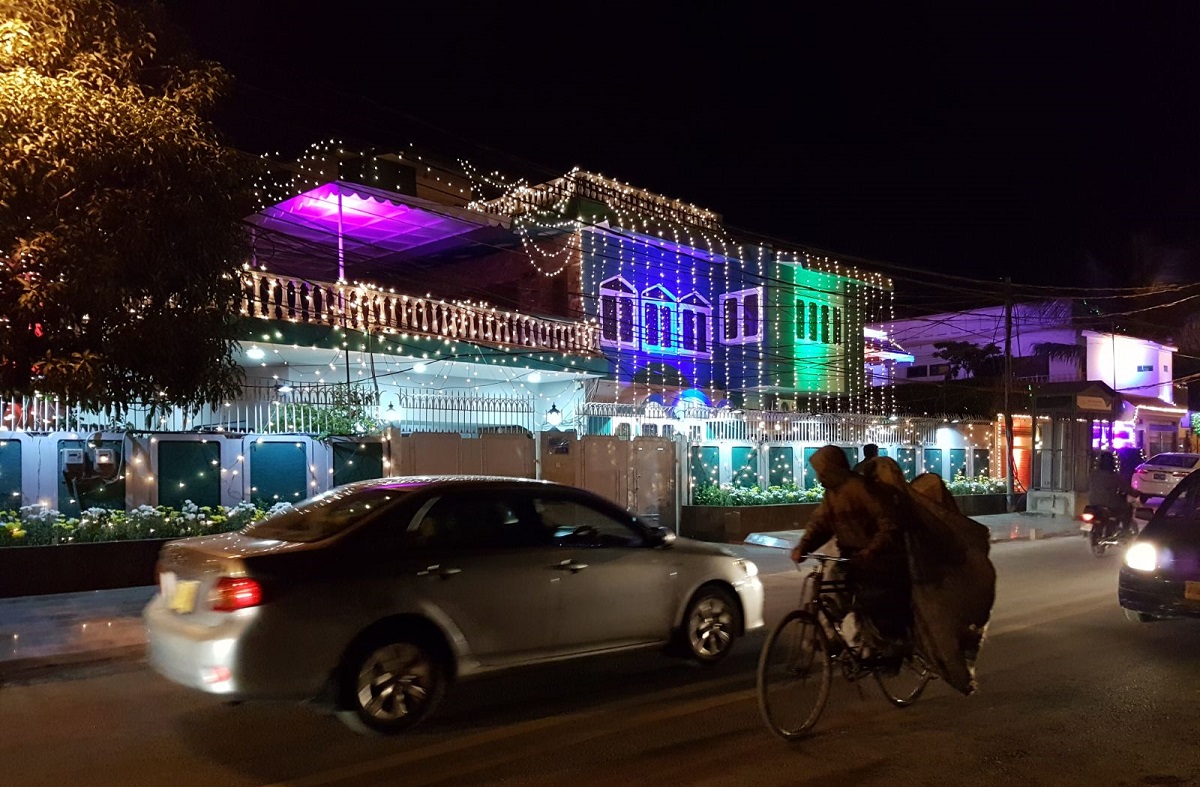
A house in a Karachi neighbourhood is beautifully decorated to mark the Aga Khan’s visit to his Ismaili community after 17 long years. Photo: Simerg.
PAGE LAST UPDATED: December 20, 08:25 AM EST (in Karachi +10h, December 20, 06:25 PM).
The purpose of this post is to provide external links to media coverage of Mawlana Hazar Imam’s Diamond Jubilee visit to Karachi, Pakistan’s largest city and its commercial capital. We we will make every effort to ensure that we skip on links that contain repetitive information – often the same news agency report is shared by different media.
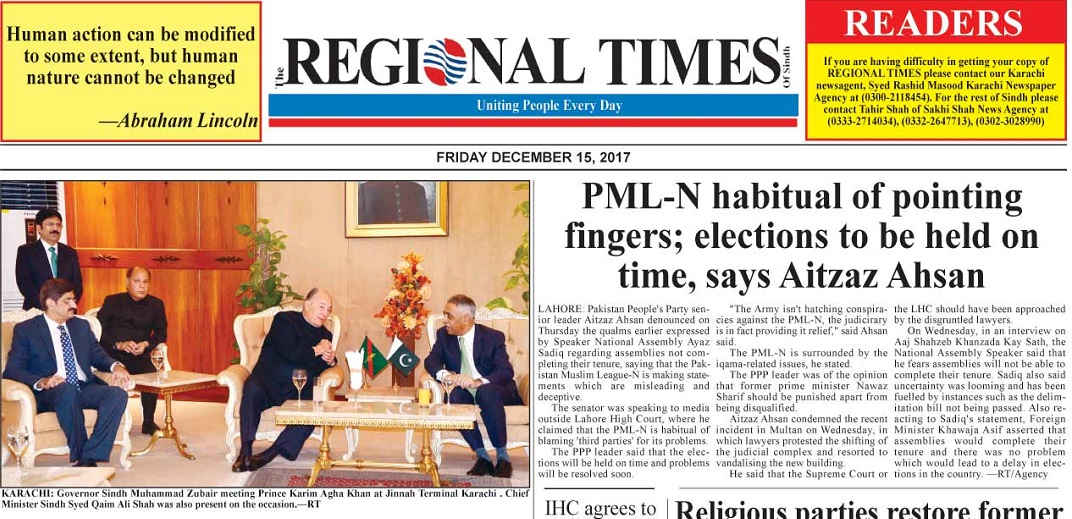
His Highness the Aga Khan pictured meeting with former Pakistan President, Asi Ali Zardari, during his current visit to Karachi. Zardari presented the Aga Khan Sindhi topi (cap) and ajrak, a unique form of blockprinted shawl.
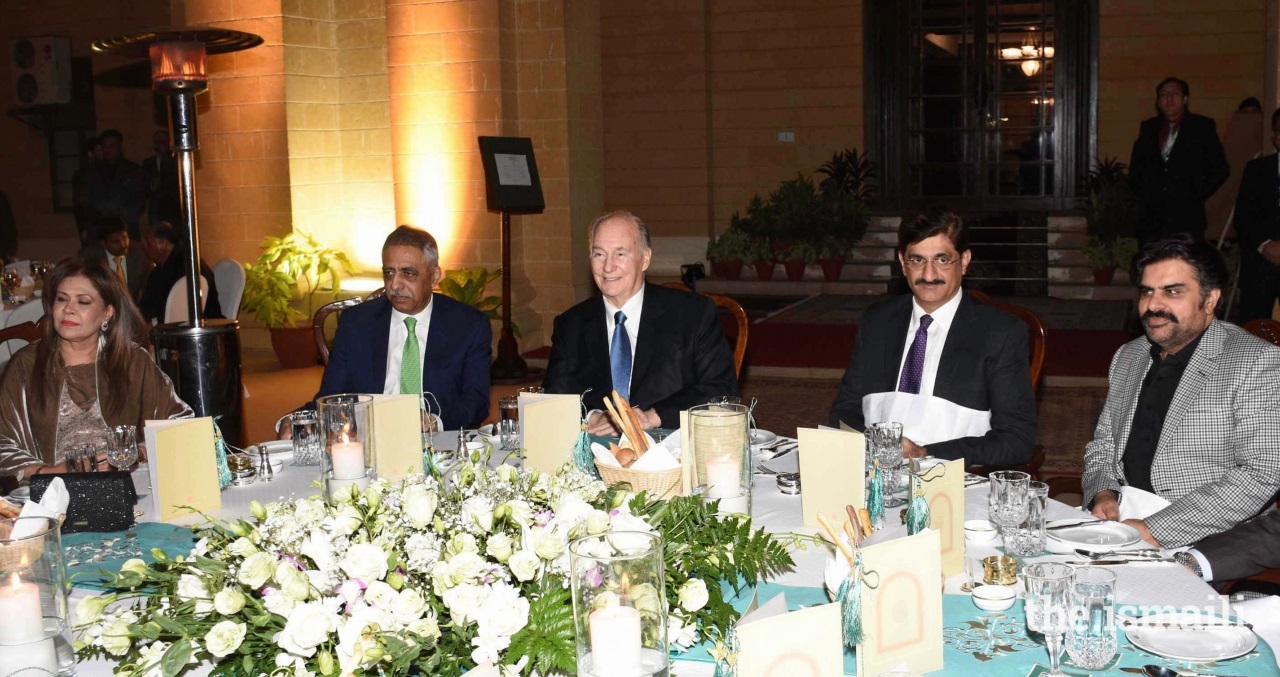
The Aga Khan at a dinner hosted in his honour by Muhammad Zubair, Governor of Sindh, at the Governor’s House Karachi. Syed Murad Ali Shah, Chief Minister of Sindh, and Ismaili institutional leaders were also present. Photo: The Ismaili/Arif Hussain. See link below for more photos.
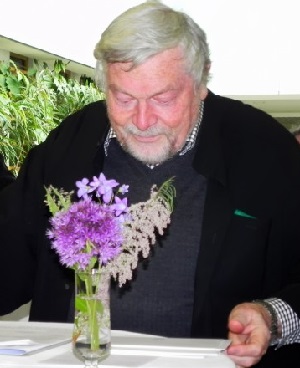
It is with much sadness that we report that the internationally renowned artist and sculptor Karl Schlamminger passed away on Saturday, December 9, 2017, in Munich at the age of 82. Karl Schlamminger is best known for his design of the logo for the Aga Khan Award for Architecture, in which the word Allah is repeated eight times in rectangular kufic script to create an interlocking central diamond pattern.
Aga Khan Award for Architecture Logo designed by Karl Schlamminger. Photo: Archnet.
Most recently, Karl Schlamminger designed the sculpture of the Global Pluralism Award, wherein the three-dimensional latticework yields a plurality of intersections, offering ever new vantage points, symbolizing pluralism.
Global Pluralism Award sculptor designed by Karl Schlamminger. Photo: The Global Centre for Pluralism.
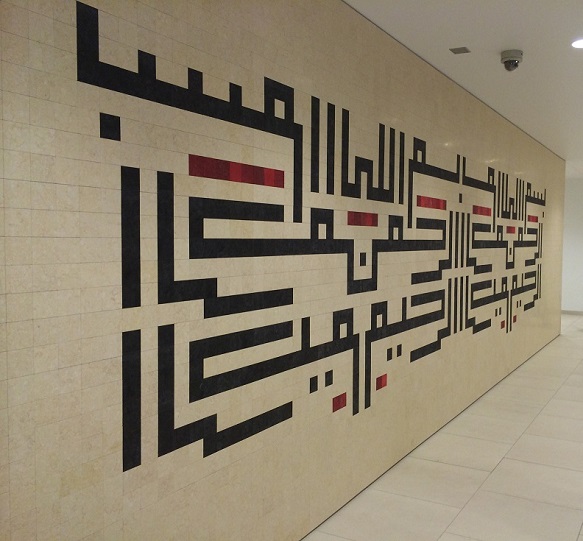
For Ismailis throughout the world, the extraordinary designs and distinctive calligraphies specially created by Karl Schlamminger for the Ismaili Centres in London, Lisbon and Toronto exemplify the indelible and everlasting contribution of this outstanding artist and creative genius.
Basmallah calligraphy by Karl Schlamminger at the Ismaili Centre, Toronto. Photo: Simerg/Malik Merchant.
Date posted: December 14, 2017. Last updated: April 18, 2024 (formatting).






 Mr. Firoz Rasul has served as President of the Aga Khan University (AKU) since May 1, 2006. Prior to his engagement with AKU, President Rasul was involved in building several business enterprises and the development of social and community institutions. He served as Chief Executive Officer and then Chairman of Ballard Power Systems, a world leader in fuel cell technology from December 1988 until May 2004.






 Simerg - Insights from Around the World