His Highness the Aga Khan: Democracy To Survive Across Planet Must Lead to Improvement in the Quality of Human Life and Give Genuine Hope for Future

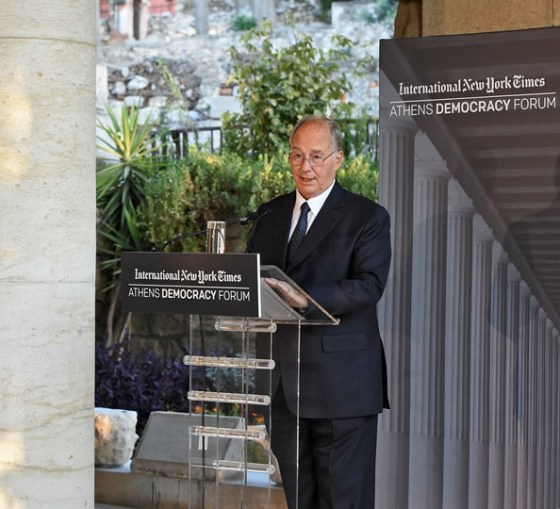
His Highness the Aga Khan delivering the Keynote Address to the 2015 Athens Democracy Forum on September 15, 2015. Photo: AKDN / Gary Otte

His Highness the Aga Khan delivering the Keynote Address to the 2015 Athens Democracy Forum on September 15, 2015. Photo: AKDN / Gary Otte

The following are excerpts from remarks made by His Highness the Aga Khan on September 15, 2015, in a keynote address to the Athens Democracy Forum, an international gathering of diplomats, business leaders and opinion makers. The event was hosted by the International New York Times and the United Nations Democracy Fund.

THE NEW YORK TIMES

I have long admired – since my undergraduate days at Harvard – what the [New York] Times has meant to the pursuit of truth and justice in our world. And I have appreciated our opportunities to work together through our Diplomatic Academy in Paris for example, and also through the good counsel the Times provides for our media company in East Africa.

ELEMENTS FOR STRENGTHENING EFFECTIVENESS OF DEMOCRACY

The topic of democracy and its challenges is one that I have followed closely for a long time, most intently in the developing world….where so many members of the Ismaili community live and where so much of our development work takes place.

I believe that the progress of democracy in our world is fundamentally linked to improving the quality of human life. The promise of democracy is that the people themselves best know how to achieve such progress. But if that promise is disappointed, then democracy is endangered. A UNDP survey of South American publics some years ago demonstrated that most people preferred an effective authoritarian government to an ineffective democratic one. Quality of life was the prime concern.

But what can we say then, about why democratic systems often fall short in their efforts to improve the quality of their constituents’ lives? Let me suggest four elements that could help strengthen democracy’s effectiveness in meeting this central challenge.

(I). Improved Constitutional Understanding

His Highness the Aga Khan speaking at the Stoa of Attalos in Athens where he delivered a Keynote Address at the Athens Democracy Forum on the International Day of Democracy. Photo: AKDN / Gary Otte

His Highness the Aga Khan speaking at the Stoa of Attalos in Athens where he delivered a Keynote Address at the Athens Democracy Forum on the International Day of Democracy. Photo: AKDN / Gary Otte

My first suggestion is that the current challenges to governance should be seen less as problems of democracy than as problems of constitutionality. There are more countries today than I can ever recollect before that are grappling with outdated constitutions – frameworks that seem unable to reconcile opposing factions, advance economic priorities, encourage civil society, or protect human rights.

But constitutional revision, especially in developing countries, is not easy. One problem is a poor understanding of comparative government systems. That subject is not part of most educational curricula, and in the countries I know best, the media rarely explain the logic or the options of constitutional change.

In some countries there actually is no clear constitutional means for constitutional change. Even when a referendum is held to validate such change, most people are neither prepared nor willing to express a considered judgment. The result is that governments in power often have an open field.

In my view then, a first step to better democratic governance is a better public understanding of constitutional principles.

It is easy for example, to say that we want government “of, by and for the people” – that governments should be servants of the people, and ultimately responsible to them. But that does not mean that most governmental decisions must be made by an enormous range of far-flung participants: by vast plebiscites, or popular referenda, or public opinion polling, or the number of hits on an internet blog. Such misapplied versions of democracy can produce irrational leadership choices and poorly informed policies. Sometimes, efforts to impose simplistic popular democracy can create voids of governance, which can be exploited to dangerous ends – and I have seen this in various countries in the developing world.

But then, who should make various governmental decisions? My response would emphasise the idea of balanced authority, including the concept of healthy federalism. For increasingly diverse societies, a constitution that divides and balances power is essential.

In discussing constitutional challenges, it is impossible to ignore the recent revival or creation of new theocratic political parties in the Islamic world. The question is how theocratic principles of governance can operate constitutionally in increasingly secular political environments. It seems essential to me that such principles should be regularly tested by the electoral process, if only so that the Muslim world can have a better understanding of the secularisation processes, which are inherent in western democracy. And democratic principles in turn, must respect the broad diversity of human faiths and cultures.

Finding the right constitutional balance is no easy matter, and we make a great mistake if we think that one size can somehow fit all. Effective constitutions must be adapted to a variety of cultural and demographic realities. But it can be done. One recent example is that of Tunisia, where after intense and arduous negotiation, a promising new constitution won broad public support. My central point, in sum, is that we cannot build better democratic performance over time without a better understanding of constitutional values.

(II). Independent and Pluralistic Media

His Highness the Aga Khan with Stephen Dunbar-Johnson, President, International at The New York Times and Nobel-winning economist Paul Krugman, op-ed columnist at the New York Times. Photo: AKDN / Gary Otte

His Highness the Aga Khan with Stephen Dunbar-Johnson, President, International at The New York Times and Nobel-winning economist Paul Krugman, op-ed columnist at the New York Times. Photo: AKDN / Gary Otte

A second key variable for enhancing democratic effectiveness is the critical role of competent and independent media voices. We often forget that ancient Greek democracy required a highly compact community living within the sound of a “crier’s voice,” as Aristotle said. Under such conditions, face-to-face dialogue could foster a sense of trust and political accommodation.

But these ideal conditions now obtain only rarely. Populations are much larger, more widely scattered, and more diverse. They can most easily be mobilised around vivid but superficial symbols and negative propositions. Often what counts most in our extended societies is not what one is for, but whom one is against.

In such circumstances, polarisation and impasse are constant risks.

Nor can we rely on advances in communication technologies to overcome the obstacles of distance and diversity. In fact, new media technologies have often made matters worse (and I don’t mean the New York Times!) From the development of written language to the invention of printing, to the development of electronic and digital media – quantitative advances in communication technology have not necessarily produced qualitative progress in mutual understanding.

To be sure, each improvement in communications technology has triggered new waves of political optimism. But sadly, if information can be shared more easily as technology advances, so can misinformation and disinformation. If truth can spread more quickly and more widely, then so can error and falsehood.

Throughout history, the same tools – the printing press, the telegraph, the microphone, the television camera, the cell phone, the internet – that promised to bring us together, have also been used to drive us apart.

The age-old promise of democracy is that social cohesion and public progress could be achieved by consensus rather than by coercion. But genuine democratic consent depends on dependable public information.

The danger in an age of mass media is that information also can be misused to manipulate the public. All around the world, authoritarian rulers increasingly use media to “coerce” the consent of the governed. Our hosts today, the International New York Times, recently published a remarkable description of this phenomenon under the headline, “The Velvet Glove.”

The power of a leader’s reasoning or the truth of his arguments, the report suggests, are often less important than his command of media influence. What results can be the illusion of democracy, but not its substance.

No, our technologies alone will not save us. But neither need they ruin us. It is not the power of our tools, but how we use them that will determine our future.

Among other things, this means prioritising the role of independent media, and indeed, of a multiplicity of independent voices. Demographic pluralism must be reflected in healthy media pluralism.

I mentioned earlier my own involvement in the African media scene – as founder of the Nation Media Group. It was launched at the time of Kenyan independence, and for nearly six decades media independence has been its watchword – a sine qua non for democratic health.

(III). Potential of Civil Society
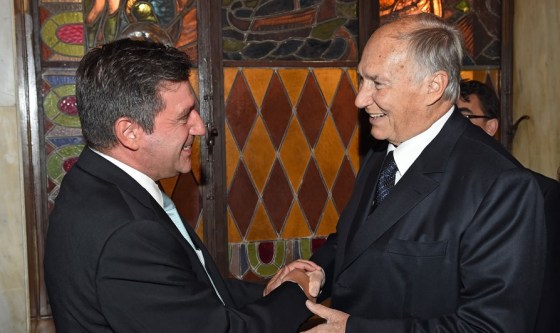
His Highness the Aga Khan is received by the Mayor of Athens, Mr Giorgos Kaminis at a dinner he hosted for Forum participant at Athens City Hall. Photo: AKDN / Gary Otte

His Highness the Aga Khan is received by the Mayor of Athens, Mr Giorgos Kaminis at a dinner he hosted for Forum participant at Athens City Hall. Photo: AKDN / Gary Otte

This leads me to my third observation. Government, while critical, can only take us so far. At a time of democratic disappointment, we must re-emphasise the immense potential of those non-governmental institutions that we call “civil society.”

Too often, our thinking is trapped in a false dichotomy. We talk about the public sector and the private sector, but we often undervalue a third sector – that of civil society.

Civil society is powered by private energies, committed to the public good. It draws on the ancient, classical link between democracy and the publicly-committed citizen.

It includes institutions of education, health, science and research, embracing professional, commercial, labour, ethnic and arts organisations, and others devoted to religion, communication, and the environment.

It seeks consensus through genuine consent. It can experiment, adapt and accommodate diversity. It can in the fullest sense be “of, by and for the people.” It can in the fullest sense be a remarkable support – but only on condition that is it sustained, accepted and encouraged by government.

(IV). Genuine Democratic Ethic

Finally, let me mention a fourth concern that underlies this entire discussion – the central importance of fostering a “democratic ethic.”

At the heart of a democratic ethic is a commitment to genuine dialogue to achieve a better quality of life, even across new barriers of distance and diversity. This means a readiness to give and take, to listen, to bridge the empathy gaps as well as the ignorance gaps that have so often impeded human progress. It implies a pluralistic readiness to welcome diversity and to see our differences not as difficult burdens but as potential blessings.

One ultimate requirement for any effective democracy is the capacity to compromise. Social order rests in the end either on oppression or accommodation. But we can never find that balancing point – where the interests of all parties are recognised – unless competing leaders and their diverse followers alike, are committed to finding common ground.

That common ground, in my view, is the global aspiration for a better quality of life – from the reduction of poverty to quality longevity – built upon opportunities that will provide genuine hope for the future.

Democracy can only survive if it demonstrates – across the years and across the planet – that it is the best way to achieve that goal.

Thank you.

Date posted: September 16, 2015.

_____________

Please click on http://www.akdn.org for complete speech, video and photos.

An Englishman Reflects on the Nature of Imam Ali by Barnaby Rogerson @Simerg

Editor’s note: For the month of September 2015, Simerg will be publishing new posts on a less frequent basis. Normal publication of 6 – 8 new posts per month will resume in October. The following piece by Barnaby Rogerson first appeared on this website in 2012.

PLEASE CLICK: An Englishman Reflects on the Nature of Imam Ali

“….No one could ever doubt the devotion with which Ali held Muhammad and the many bonds that connected them: Ali was the Prophet’s cousin, the Prophet’s son-in-law, the Prophet’s first male believer, the father of the Prophet’s only male grandchildren, the Prophet’s most intimate disciple and the first heroic warrior champion of Islam. Ali had also served the Prophet as an army commander, missionary, diplomat and administrative secretary…..”

This is an image of Nurin Merchant’s mixed media canvas painting titled “Nature of Prayer.” Secured on the 14″ x 10″ canvas with strong glue are a handmade Tasbih (prayer beads), and 3 dried leaves bearing the Arabic inscriptions of Allah, Ali, and Muhammad. The whole piece represents prayer through the invocation of these names. Copyright: Nurin Merchant. Please click for Barnaby Rogerson’s article.

Previous post: Readings for the Birth Anniversary of Hazrat Ali (a.s.): Kalam-i Mawla, Nahj al-Balaghah for Young People, and more @Simerg

Remembering Alijah Zulfikarali Khoja

By Abdulmalik Merchant

Alijah Zul Khoja: Lifetime Educator

Alijah Zul Khoja: Lifetime Educator and Leader

It is with deep sadness that we announce the passing of an outstanding educator and leader of the Ismaili Muslim community, (Alijah) Zulfikarali M.A. Velji Khoja, in Ottawa, Canada, on Friday, September 4th, 2015. His funeral and burial ceremonies will take place in Ottawa on Wednesday, September 9.

Born in Pretoria, South Africa, Mr. Khoja was a skilled trainer, facilitator, educational consultant and mediator. His experience and training was diverse: with a post-graduate degree in Radio Chemistry from Carleton University, Ottawa, and professional designations from the Universities of Birmingham, Queens, Ottawa, Windsor and the London School of Economics, he travelled worldwide on many consulting assignments as a Mediator. These included: The Canadian Human Rights Commission, Better Business Bureau, Ottawa-Carleton Dispute Resolution Centre,and the Ottawa-Carleton District School Board.

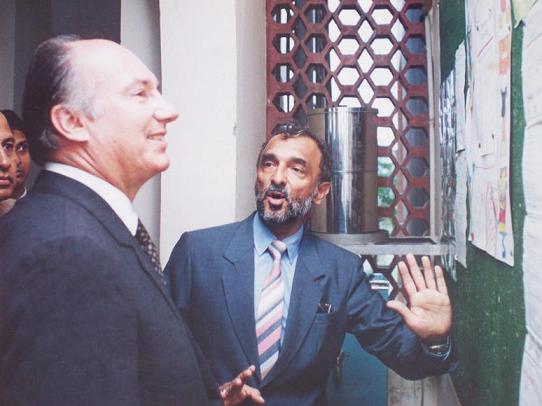
This visit to the Aga Khan School in Dhaka took place during Mawlana Hazar Imam's four day stay in Bangladesh in 1993. During the school visit Hazar Imam was accompanied by a Government Minister, The President of the Council, school board members. In this photo, Zul Khoja, the principal of the school from 1992-1994 is seen showing a curricular activity implemented to introduce creative and critical thinking among the students. Mawlana Hazar Imam took immense pride in this activity, known as the Mind Benders Club, and turned to his guests to explain the accomplishments in his school. Zul notes that when Mawlana Hazar Imam introduced him o the guests, it was done with a

This visit to the Aga Khan School in Dhaka took place during Mawlana Hazar Imam’s four day stay in Bangladesh in 1993. During the school visit Hazar Imam was accompanied by a Government Minister, The President of the Council, school board members. In this photo, Zul Khoja, the principal of the school from 1992-1994 is seen showing a curricular activity implemented to introduce creative and critical thinking among the students. Mawlana Hazar Imam took immense pride in this activity, known as the Mind Benders Club, and turned to his guests to explain the accomplishments in his school. Zul noted that when Mawlana Hazar Imam introduced him to the guests, it was done with a “full bio!” Mr. Khoja said that when he escorted the party into the school, it took the Imam less than 30 seconds to fully understand what was being accomplished in the school. One of the areas that the late Zul Khoja specialised in was the education of bright and gifted children. Please click on photo for Zul’s piece, Ismaili Penmanship. Photo: Zul Khoja Collection.

As an administrator, educator and trainer, Zul worked at the Ottawa-Carleton District School Board. He was also headmaster, educator and trainer (Professional Development) to The Aga Khan Development Network, both in Bangladesh and Kenya. Zul’s voluntary service with the Ismaili Community and its institutions included several countries (South Africa, Kenya, Bangladesh and Canada). The services in Canada included training Management Auditors and conducting Management Audits. He also served as a Baitul Ilm teacher and held leadership positions with both the Ismaili Tariqah and Religious Education Board and the Aga Khan Council since his settlement in Ottawa in the 1970’s. Most recently he  served as the Convener for Donor Services for the Aga Khan Foundation committee in Ottawa, where he resided with his wife, Khairunissa. He also leaves behind two children, a son, Sherali, and a daughter, Rozmin.

We pray that Allah may rest Alijah Zul Khoja’s soul in eternal peace, and that He may bless his entire family with courage and fortitude at this difficult time.

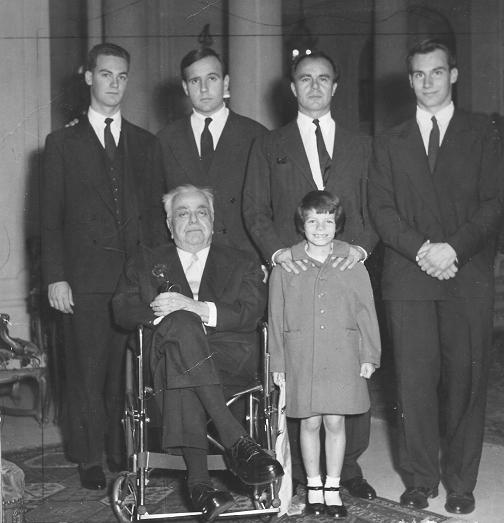
The late 48th Ismaili Imam, His Highness the Aga Khan, seated on a wheelchair with members of his family with his successor, the present Imam, Prince Karim Aga Khan, standing at extreme right. Others in the photo (l to r), grandson Prince Amyn Muhammad, and the late Imams two sons, the late Prince Sadruddin and Prince Aly Khan, who is seen holding his daughter Princes Yasmin Aga Khan Photo: Zul Khoja Collection, Ottawa.

The late 48th Ismaili Imam, His Highness the Aga Khan, seated on a wheelchair with members of his family with his successor, the present Imam, Prince Karim Aga Khan, standing at extreme right. Others in the photo (l to r), grandson Prince Amyn Muhammad, and the late Imams two sons, the late Prince Sadruddin and Prince Aly Khan, who is seen holding his daughter Princes Yasmin Aga Khan. This rare photo was provided to Simerg by Alijah Zul Khoja.

__________

Mr. Khoja had contributed to this blog in numerous ways including writing a memorable piece  Ismaili Penmanship in 1906 for this website’s special series, I Wish I’d Been There.

Date posted (from Halifax, Nova Scotia): September 8, 2015.

Remembering Hurricane Katrina on its 10th Anniversary

Editor’s note: This poem was composed by Nazim Bhimani, a deaf Ismaili boy, when he was twelve. Nazim calls himself Deaf 1 Naz, and his profile in his own words can be read by clicking on Nazim Bhimani: The Deaf World.

HURRICANE KATRINA

“You came with a beautiful name and took everything in vain” pens Deaf 1 Naz

By Nazim Bhimani

You came with a beautiful name, and took everything in vain,
You left the babies crying, fathers dying, and mothers praying,
You came with danger and left with total devastation and pain.

KATRINA KATRINA,

You took so many human lives,
the dogs, the cats, the house, the monies, the food, the water,
Are you sure you are mother nature’s daughter??

KATRINA KATRINA,

You took so much, yet you didn’t even leave a pot of rice,
instead you left them with disease that come from rats and mice,
and you didn’t even try and make things right,
so Katrina you are not nice.

KATRINA KATRINA,

Oh my God! what have you done?
Have you come here to make us pay the price?

Date posted: August 30, 2015.

_________________

Please also read Nazim Bhimani: The Deaf World.

Simerg invites readers’ feedback. Please click on Leave a comment.

Aleppo and Its Majestic Citadel: Chilling Reports from the Current Civil War, and 14th Century Narratives by Ibn Batutta

I. THE HARSH REALITIES OF ALEPPO TODAY

(A). Syria’s Most War-Torn City by Newsweek Magazine

(Note: Newsweek’s story, accessible by clicking on the first image shown below, contain graphic images and may disturb some readers. Discretion is advised).

“Longer even than the journey from Damascus to Aleppo is the time it takes to get from one end of Aleppo to the other. Moving from the east to the western side of the city once took only a short bus ride. Now it involves navigating a labyrinth of side roads and as many as 20 checkpoints; an endurance test that can last between 10 and 16 hours” — James Harkin for Newsweek, August 19, 2015. Please click on Newsweek – Syria’s War Torn City or click on image below for Harkin’s full report.

A sergeant in Lewa Salaheddin, a Kurdish battalion of the Free Syrian Army, sits in front of a block of destroyed buildings in Aleppo, Syria on December 6, 2012. It’s more than three years since the fight for Aleppo began. By late 2012, parts of the city were already in ruins. Patrick Tombola/laif/Redux

A sergeant in Lewa Salaheddin, a Kurdish battalion of the Free Syrian Army, sits in front of a block of destroyed buildings in Aleppo, Syria on December 6, 2012. It’s more than three years since the fight for Aleppo began. By late 2012, parts of the city were already in ruins. Patrick Tombola/laif/Redux

_______________

(B). A Resident’s Account of Aleppo’s Humanitarian Crisis and the Fear for its Historic Citadel

Editor’s note: The following excerpts are from the website of the Centre for Research and Globalization based in Montreal. For a full account published on July 25, 2015, please click on Global Research – Aleppo’s Humanitarian Crisis.

“Aleppo city has shrunk to a fifth of its original site. I walk everyday in the city. I see children and girls without limbs because of a mortar over here or shrapnel over there that hit them randomly and caused them a terrible wounds and horrific memories that will never leave them. The girl who lost one leg is standing on her good leg and selling bread, while the little boy who lost one arm is selling chewing gum. Those are the “injured” people who come in the news, just numbers in one line of a report, after each attack from the terrorists. “Injured” doesn’t mean scratched or having a bleeding finger; it means someone lost his eyes or her limbs.”

continued…

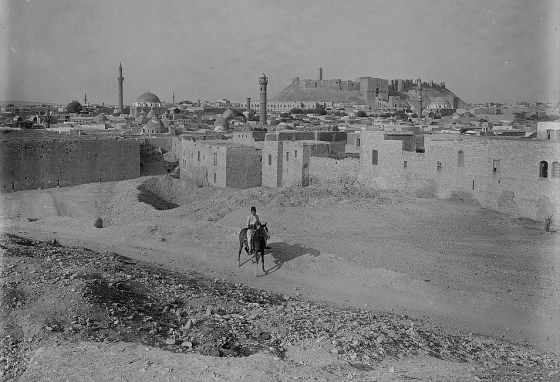
Aleppo and its castle from South West. Created/Published between 1898 and 1946. Photo: USA Library of Congress Collection, Gift Episcopal Home; 1978.

Aleppo and its castle from South West. Photo taken in 1898, and created/published
between 1898 and 1946. Photo: USA Library of Congress Collection, Washington, D.C.

“The last symbol left of Aleppo, is the most famous one: the Citadel. I can see part of it from our balcony, but I can see it more clearly from the roof of the building….It has been badly injured, but it’s still there, dominating the city skyline. It’s where they found the Storm God’s Temple a few years ago. It withstood many invaders, including the Mongols and Crusaders. It has been damaged severely several times through history, but it has been rebuilt over and over again, as an immortal symbol to the inhabitants of one of the oldest living cities in history. I just pray I don’t live to witness its total destruction as I have seen happen to many of the surrounding buildings.”

________________

II. IBN BATUTTA’S 14TH CENTURY DESCRIPTION OF ALEPPO AND ITS CITADEL

The Citadel of Aleppo is a large medieval fortified palace in the centre of the old city of Aleppo, northern Syria. It is considered to be one of the oldest and largest castles in the world. Usage of the Citadel hill dates back at least to the middle of the 3rd millennium BC. Subsequently occupied by many civilizations including the Greeks, Byzantines, Ayyubids and Mamluks, the majority of the construction as it stands today is thought to originate from the Ayyubid period. An extensive conservation work has taken place in the 2000s by the Aga Khan Trust for Culture in collaboration with Aleppo Archeological Society. Dominating the city, the Citadel is part of the Ancient City of Aleppo, a UNESCO World Heritage Site since 1986. The Citadel has received significant damage in the ongoing Syrian Civil War. Photo and caption: Wikipedia.

The Citadel of Aleppo is a large medieval fortified palace in the centre of the old city of Aleppo, northern Syria. It is considered to be one of the oldest and largest castles in the world. Usage of the Citadel hill dates back at least to the middle of the 3rd millennium BC. Subsequently occupied by many civilizations including the Greeks, Byzantines, Ayyubids and Mamluks, the majority of the construction as it stands today is thought to originate from the Ayyubid period. An extensive conservation work has taken place in the 2000s by the Aga Khan Trust for Culture in collaboration with Aleppo Archeological Society. Dominating the city, the Citadel is part of the Ancient City of Aleppo, a UNESCO World Heritage Site since 1986. The Citadel has received significant damage in the ongoing Syrian Civil War. Photo and caption: Wikipedia.

An Introduction to Ibn Batutta

“No intelligent man,” wrote Ibn Djuzayy, the scribe to whom Ibn Batutta (also Batutah etc) dictated his memoirs, “can fail to see that this sheikh is the traveller of the age.” But Ibn Batutah (1304-1368 or 1377) was not only the greatest Arab traveller of the Middle Ages, he was one of the greatest travellers of all time. At the age of twenty-one, he set out from his birthplace, Tangiers (Morocco), and started his travels by undertaking the pilgrimage to Mecca. This was the start of thirty years of wandering during which he would travel almost 120,000 kilometres that would take him halfway round the world as far as China. His account of his travels (the Rihla), in addition to its literary value, gives a panoramic picture of the 14th-century world.

If there are historical inaccuracies in Ibn Battuta’s writings, they are largely attributable to the pronounced taste for the bizarre which was characteristic of the age, and to the loss of his notebooks during a pirate attack in the Indian Ocean.

But errors or exaggerations do not detract from the value of Ibn Battuta’s narrative which is written in a direct, straightforward style punctuated by observations which are not without humour. His entertaining story has been translated, wholly or in part, into some 15 languages and ranks among the masterpieces of Arabic literature.

Ibn Batutta on Aleppo and Its Citadel

From Sermin we proceeded to Haleb (Aleppo), a large city and splendid metropolis. This is how Abulhossein the son of Jobeir described it:

“This city is of enormous worth and its fame will last forever. Kings have often sought to possess it and men have been impressed by its importance. What a number of battles it has provoked, and what a quantity of shining words have been unsheathed for it! Its fortress is renowned for its power and its height is clearly to be seen. No one dared attack it because of its strength, or if they did they did not conquer it.

“The sides are of freestone and its proportions are full of symmetry. It has outlasted the days and the years and has seen nobles and beggars carried to their last resting-places. Where are the Hamdanite princes and their poets now? They are no more, and only the buildings remain. Oh wonderful city! It endures, but its owners have passed on. They have perished but its hour has not come. It was sought for after them and taken without great difficulty. It was coveted and won at the smallest cost.

Such is this city of Aleppo. How many of its kings has it not changed into a past tense (expression borrowed from grammar) and how many vicissitudes has it not defied because of its position! Its name was made in the feminine gender, it was adorned with the finery of a chaste virgin, it succumbed to the victor as others have done. It shone like a young bride after the sword (seif) of its dynasty, Ibn Hamdan (a reference to Prince Seif eddaoulah).

Alas! its youth will pass, it will be no longer desired, only a short while and it will be destroyed.”

continued….

Aleppo from castle. Photo taken in 1898, created/published between 1898 and 1946. Credit: Library of Congress Prints and Photographs Division, Washington, D.C.

Aleppo from castle. Photo taken in 1898, created/published between 1898 and 1946. Credit: Library of Congress Prints and Photographs Division, Washington, D.C.

The fortress of Aleppo is called Ash shahba (the grey one). Within it there are two wells from which water gushes, and there is no fear of thirst there. The castle is surrounded by two walls, there is a great moat from which water rises, and its wall has many towers standing close together. This fortress encloses marvellous chambers pierced with windows. All the towers are occupied and in this fortified castle food is not impaired by the passage of time.

There is a sanctuary which is visited by many people, and it is said that Abraham prayed there to God. This fortress resembles the one called Rahbet (square of) Malik Ibn Thaouk, near the Euphrates, between Syria and Iraq. When the Tartar tyrant Kazan marched against the city of Aleppo, he besieged this fortress for many days. Then, frustrated in his desire to take it, he withdrew. Ibn Jozay says: Alkhalidy, the poet of Seif eddaoulah, writes as follows about this fortress:

“With its high belfry and invincible flanks, it is a vast, grim place which rises up against him who would take it.

“The atmosphere spreads a layer of cloud over this place and adorns the castle with a necklace of brilliant stars.

“When lightning flashes in the night this fortress appears through its interstices, shining like the constellation of the Virgo through the openings in the clouds.

“How many armies has this castle not destroyed and how many conquerors has it not put to flight!”

The same poet also speaks of the castle in the following admirable verses:

“It is a citadel whose base embraces the springs of water, and its summit is higher  than Orion’s Belt.

“It knows no rain, because for it the clouds are a ground,  whose sides are trodden by its cattle.

“When the cloud has given water in abundance, he who lives in the fortress uses all the water in his tanks before its summits are moistened.

“Its belvedere would be counted amongst the stars of the heavens if it passed through their orbits.

“The cunning of this fortress has repulsed the tricks of its enemies and the evils it caused were greater than theirs.”

Here is what Jemal eddin Ali, the son of Abulmansur, has to say about this castle:

“Because of its enormous height and the point which its summit attains, this castle nearly stops the celestial sphere that turns around the earth.

“Its inhabitants have gone to the Milky Way as to a watering place and their horses have nibbled the stars as though grazing on flowering plants.

“The vicissitudes of time turn from it in fear, and for this castle there is no change.”

Date posted: August 22, 2015.

____________________

Editor’s note: The above introduction to Ibn Batutta and his narratives on Aleppo and its Citadel have been adapted from the January 1986 issue of The Unesco Courier which was dedicated to Treasures of World Literature. Please visit http://www.unesco.org/new/en/unesco-courier/.

We welcome your feedback. Please click on Leave a comment.

___________________

FORTHCOMING PHOTO AND LITERARY PIECES ON SIMERGPHOTOS AND SIMERG

  • “Prayer Halls of Badakhshan Through the Lens of Muslim Harji,” to be published week of August 24th, 2015 on Simerg’s photo blog, http://www.simergphotos.com
  • “Naklanki Geeta – Quantum Mechanics in Ginans” by Shiraz Pradhan, to be published week of September 7th, 2015 on this website, http://www.simerg.com.

Great Epics: Ferdowsi’s Shahnameh (The Epic of the Kings), With Two Magnificent Illustrations from the Aga Khan Museum

Written a thousand years ago, Ferdowsi’s Shahnama or The Epic of the Kings tells the story of the Iranian people from the time of the world’s creation. National epic, landmark in world literature and a profound expression of the Iranian soul, Ferdowsi’s masterpiece is still read and recited throughout Iran.

I. THE EPIC OF THE KINGS, AN INTRODUCTION

The statue of Ferdowsi in Ferdowsi Square in Tehran. Photo: Wikipedia.

The statue of Ferdowsi in Ferdowsi Square in Tehran. Photo: Wikipedia.

By Nahal Tadjadod

In a square in Teheran, the capital of Iran, there is a statue of Ferdowsi [or Firdawsi, Firdausi etc, Ed.) where the poet holds his Epic of the Kings (Shahnama or Shahnameh, Ed.) in his hand and gazes at the peaks of the Alborz mountains. When I was young, my parents often took me to this place and while they looked on attentively I recited these lines by Ferdowsi:

“I have toiled painfully these thirty years. I have restored Iran to life by my verse. Henceforth I cannot die; for I live, having broadcast the seeds of my verses.”

These words were engraved in the memory of the child I was then and I know that they have shaped my innermost identity. There is nothing astonishing in that. For a thousand years Ferdowsi’s poem has been read, recited and copied in Iran. Even today it is recited in the cafés. Early on it became our national epic.

Why has it always been so popular? Not because of the originality of its subject the history of ancient Iran from the time of its first mythical king to the last sovereign of the Sassanid dynasty in the seventh century AD nor because of the novelty of its content. “What I will say, all have already told,” Ferdowsi claimed. The poet transmitted; he invented nothing. He drew on old oral traditions and on ancient texts such as the Avesta, a holy book of the eighth century BC, or reworked somewhat earlier tales on the same theme.

The First Masterpiece of Persian Literature

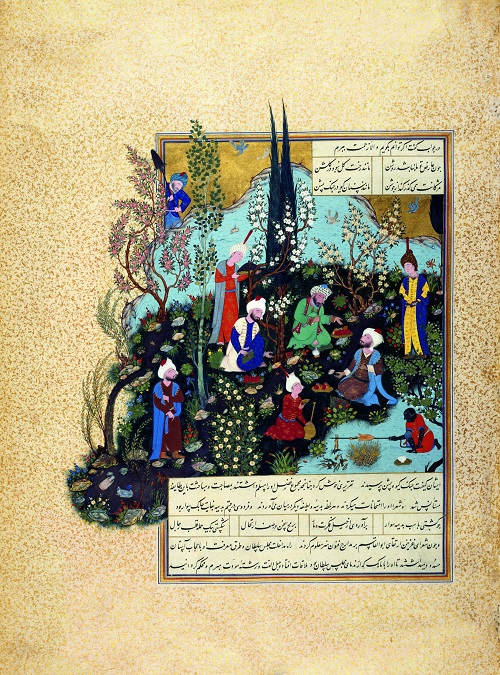
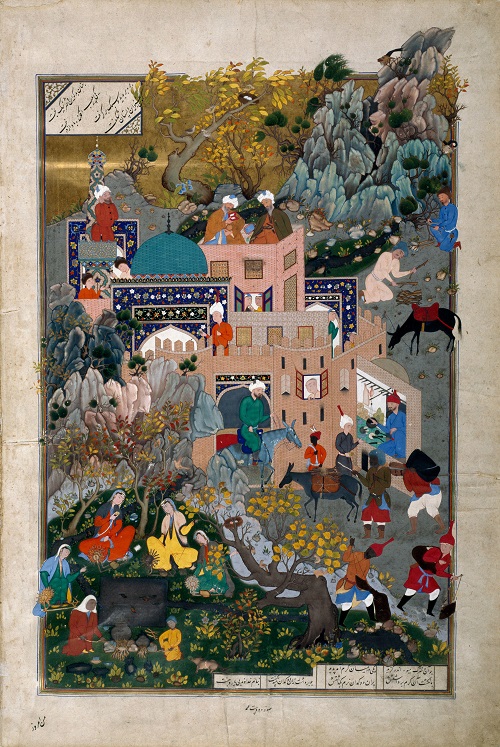
This illustration is from Shah Tahmasp I’s Shahnameh, one of the most remarkable Persian manuscripts, which was started when Shah Tahmasp returned to Tabriz from Herat in 1522. This illustration shows Firdausi, the author of the written version of the Shahnameh, with the three poets of the court of Mahmud, the sultan of Ghazna, a city which is now in modern-day Afghanistan. Firdausi left Tus, his native city, in northeast Iran, to seek out the patronage of the sultan for his Shahnameh. Before meeting with the sultan, he was confronted by three poets of the court who cornered him before finally acknowledging his superior talent. In this miniature painting a small black servant roasts a bird on a spit while young fine-faced boys bring wine and delicacies to the three Ghazna poets, seated, in the centre of the picture, on the grassy bank of a stream of water. Firdausi’s isolation is emphasized by his position to the extreme left of the main group, just where the composition spills over into the margin. Photo and caption credit: Aga Khan Museum, Toronto, Canada. Copyright.

This illustration is from Shah Tahmasp I’s Shahnameh, one of the most remarkable Persian manuscripts, which was started when Shah Tahmasp returned to Tabriz from Herat in 1522. This illustration shows Firdausi, the author of the written version of the Shahnameh, with the three poets of the court of Mahmud, the sultan of Ghazna, a city which is now in modern-day Afghanistan. Firdausi left Tus, his native city, in northeast Iran, to seek out the patronage of the sultan for his Shahnameh. Before meeting with the sultan, he was confronted by three poets of the court who cornered him before finally acknowledging his superior talent. In this miniature painting a small black servant roasts a bird on a spit while young fine-faced boys bring wine and delicacies to the three Ghazna poets, seated, in the centre of the picture, on the grassy bank of a stream of water. Firdausi’s isolation is emphasized by his position to the extreme left of the main group, just where the composition spills over into the margin. Photo and caption credit: Aga Khan Museum, Toronto, Canada. Copyright.

This immense poem of 50,000 couplets appeared in the tenth century, at a key moment in the history of Iranian culture. Since the fall of the Sassanids, the literary language of Iran had been Arabic. Middle Persian, the main vehicle of Sassanid civilization, was disappearing. At this moment, a young literature in an Iranian idiom-Persian emerged in the east. Ferdowsi’s poem would be its first masterpiece.

The Epic of the Kings does not describe the deeds of a single hero or king nor even a long adventure. It begins with the creation of the world and relates the history of fifty reigns on three distinct planes: the mythical, the epic and the historical.

The first part relates civilizing myths. The Pishdadians, the “first created”, teach men to clothe themselves, to work metal, to master fire, to tame animals and to organize themselves in society. After ruling for 700 years, King Jamshid, succumbing to pride, has to yield his throne to a demoniac creature, the tyrant Zahhak who will rule for a thousand years. His malign power will finally be conquered by the justice-loving Faridun. These heroes, who personify the conflict between the forces of darkness and light, constitute a religious theme which is typically Iranian.

The second, longest and most truly epic part of the poem evokes the reign of the Kaianid kings. Here, in the centrepiece of the poem, light has triumphed. Rostam is the champion of all the heroes who live at the Kaianid court. Prodigiously strong, loyal to his king and faithful to his country, he is the terror of the enemy. This period is marked by interminable wars against Turan, a central Asian country whose ruler Afrasiyab is the sworn enemy of Iran.

In the final part, the poet presents a number of historical figures but in a rather fantastic light.  He gives a notable account of the conquest of Alexander the Great (Sekandar), based on the  Alexander legend of the Orient. The ending, even closer to history, tells of the exploits of the Sassanid rulers until the end of the dynasty.

Faridun and Zahhak: The Just man and the Tyrant

The story of Zahhak the tyrant, told in the first and most brilliant part of the poem, extols the  sufferings of a martyred people.

The courageous but wayward son of King Mardas, Zahhak is led astray by Eblis, the devil. After making a pact with Eblis, Zahhak usurps the throne. Revealing himself to the king in various forms, the devil extends his power further each day. One day Eblis presents himself in the guise of a cook. “The diet is not varied,” he says, “for flesh is not eaten,” and he wishes Zahhak to eat all kinds of viands, both birds and quadrupeds. When the devil, who has gained Zahhak’s confidence, embraces him, a black serpent thrusts its head out of each of the tyrant’s shoulders. Whenever he cuts them off they sprout anew like two branches of a tree. Then Eblis appears again, this time disguised as a physician, and proposes as a remedy that Zahhak should eat two human brains each day.

Thus for a thousand years the demons cause evil to reign and no one dares talk openly of good. But one night Zahhak dreams that he is laid low by a young prince who strikes him with a bullheaded mace and drags him in chains to Mount Damavand. Plunged in darkness, the world was as black as a raven’s wing. The tyrant consults the Mubads, the Zoroastrian priests, who read the stars and tell him that his vanquisher, who is not yet born, will be called Faridun. “He will hate you, for his father will die at your hand and you will also kill the cow that will serve him as nurse. To avenge the cow he will take up the bull-headed mace.”

Mad with anxiety, the king hunts everywhere for traces of Faridun. The blessed child is born at the same time as the most marvellous of cows. He is entrusted by his mother to the keeper of the park where the nurse-cow lives, and is nourished with her milk. One day Zahhak hears of the park and the cow, kills the fabulous animal and rushes to Faridun’s house. He finds no one there. Overcome with fear, Faridun’s mother has taken her son to Mount Alborz.

At the age of sixteen Faridun learns of his origins from his mother and decides to fight the tyrant. In  anguish Zahhak convokes all the elders of the land to seek their support. “I desire you to subscribe to a proclamation on my behalf that as commander in chief I have sown no seed but that of uprightness…and that I would never fail to maintain justice.” All consent except one man, Kava the Blacksmith, who rises in protest. “I am Kava, seeking for justice. Most of the wrong done to me comes from yourself. It is you who constantly thrust the lancet into my heart. Why do you inflict harm on my children? I had eighteen alive in the world, and now only one remains.”

Overcome with astonishment and fear, Zahhak restores the man’s remaining son to him and asks him in exchange to add his testimony to the proclamation. Kava reads the proclamation, tears it into pieces, and tramples them underfoot.

Kava leaves the palace and the people crowd around him. Fastening a blacksmith’s leather apron to a spearhead, he calls on the people to free themselves from the tyrant’s yoke. Followed by a multitude of the stout-hearted, Kava the liberator sets out in search of Faridun, who agrees to lead the popular rising. The people of the city and the army mass before the palace, whose guards dare not resist. Faridun rides into the palace without striking a blow and seizes the royal crown. Attacked by Zahhak, the young prince shatters Zahhak’s helmet with his bull-headed mace. At that instant the angel Sorush appears and stops Faridun killing Zahhak. “Do not strike him down,” he says. “His time has not yet come. Tie him securely inside the mountain.” Faridun then drives the tyrant into the mountains and wishes to strike off his head, but the angel Sorush appears again and tells him to leave the captive in fetters on Mount Damavand to endure an eternal agony.

Ferdowsi: A Poet of Human Grandeur

In the person of Faridun, an era of enlightenment and justice succeeds a long period of obscurity and tyranny. Here Ferdowsi returns to pre-Islamic traditions; he takes this idea of an eternal combat between good and evil from Zoroastrian eschatology. The interminable wars between Iran and Turan are the reflection of this. But Ferdowsi does not profess a naive dualism. He shows that these two principles coexist in everyone: human beings can do good as well as spread evil.

Thus, after a thousand years of tyranny, light and good seem to triumph: the new king, mandated by heaven, serves his people devotedly. But evil persists, it has not ceased to exist. This is what the angel means when he twice prevents the tyrant from being put to death. Zahhak is finally fettered on the summit of Mount Alborz as if to show by his existence that the victory of good over evil has not yet been won.

Ferdowsi bases his poem on the implacable force of destiny. This quintessentially epic theme echoes the sense of fatality which is so deeply anchored in the Iranian soul. And yet his characters are still men, torn and tortured by doubt and sensitive to the misfortunes of the age. They are to be pitied rather than condemned. Zahhak, the bloody tyrant, the symbol of cruelty, does not act freely; he has, after all, sold his soul to the devil. He is merely an instrument. As a great tragic epic poet, Ferdowsi thus creates terrible situations in which a man is led to kill his brother, or a father kills his son. Links of kinship add grandeur and resonance to the combat waged by the individual against higher forces.

The Epic of the Kings is still a living epic for Iranians because it is profoundly in tune with the Iranian soul. The Iranian peasant, even if he can neither read nor write, responds to the exploits of Rostam, the hero par excellence, and weeps to think of his sufferings when he is compelled to kill his own son to defend his country. Neither good nor ill will lastfor ever: the finest thing is to leave good deeds to be remembered by.

Ferdowsi’s voice still speaks to us across the ages.

_____________

The above piece has been adapted from the September 1989 issue of The Unesco Courier which was dedicated to “Great Epics, Heroic Tales of Man and Superman.” Please visit http://www.unesco.org/new/en/unesco-courier/.

Quotations from the Shahnama in this article are taken from the translation by Reuben Levy which was published as The Epic of the Kings by Routledge & Kegan Paul (London, 1967) and features in the Unesco Collection of Representative Works.

~~~~~~~~~~

II. THE STORY OF HAFTVAD AND THE WORM 

A folio from Shahnameh of Shah Tahmasp depicting the story of Haftvad and the worm. Photo and caption credit: Aga Khan Museum, Toronto, Canada. Copyright.

A  folio from Shahnameh of Shah Tahmasp depicting the story of Haftvad and the worm. Photo and caption credit: Aga Khan Museum, Toronto, Canada. Copyright.

Story from the website of the Aga Khan Museum

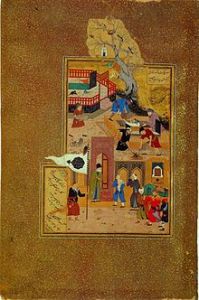
In this tale the daughter of Haftvad is spinning cotton with her female friends one day outside the village and discovers a worm in her apple. She decides to keep the worm, regarding it as a lucky charm, and places it in her spindle case for safekeeping. She asserts that the worm will help her to spin greater quantities of cotton than she ever has before, and to her friends’ amazement her boast is realized. With each day she spins greater quantities of cotton and nurtures the worm by feeding it pieces of apple. When her father, Haftvad, learns of this, he takes the worm to be a good omen and over time it grows to fill a custom-made chest, and then a stone cistern. After five years, it is as large as an elephant and has to be housed in a fortress. As the worm grows, so do Haftvad’s fortunes. When King Ardashir learns of this, he becomes jealous and suspicious and plots to kill the worm. Eventually, Ardashir succeeds in penetrating the fortress and kills the worm by pouring molten lead down its throat. The tale ends with the deaths of Haftvad and his sons, vanquished by Ardashir’s army. This painting, one of a few signed works in the Shahnameh of Shah Tahmasp I, is among the last added to the book. A signature, reading “Dust Muhammad painted it” (savvarahu Dust Muhammad), combined with written sources, identifies the artist as Dust Muhammad Musavvir or Dust-i Divana. Although the implications of the signature remain unclear — did he design the composition and/or execute the painting in whole or in part? — the painting is one of the strongest in Shah Tahmasp I’s Shahnameh. The vignette of Haftvad’s daughter spinning cotton at the lower left activates the pictorial narrative, but the remainder of the painting is conceived as evidence of Haftvad’s good fortune. The village, an aggregate of many finely made buildings, bustles with the activities of daily life. A muezzin makes the call to prayer as two figures sit atop a building consulting books with the tools of a scribe set down beside them. Elsewhere in the village, figures transport bundles of wood gathered from the countryside and carry sacks of goods, while a butcher serves a customer. The painting is replete with many other details of the everyday and depicts the elements of its extra-urban landscape with equal depth and complexity.

Date posted: Monday August 17, 2015.

____________________

For more on the Ferdowsi and the Shahnameh please also visit:

  1. http://www.agakhanmuseum.org; and
  2. Listen to http://www.bbc.co.uk/programmes/b01p7dcv

Two Mystical Stories by Farid al-Din Attar

Editor’s note: The following two mystical stories have been adapted from the August-September 1981 issue of The Unesco Courier magazine, which was dedicated to Islam and the Muslim world.

INTRODUCTION
(compiled from UNESCO Courier)

A manuscript by Farid Al Din Attar kept in Pergamon Museum, Berlin, Germany. Photo: Wikipedia.

A manuscript by Farid Al Din Attar kept in Pergamon Museum, Berlin, Germany. Photo: Wikipedia.

We present two extracts from The llahi-nama or Book of God by the great Persian mystic poet Farid al-Din Attar (circa 537-627 AH, 1140-1230 AC) translated into English by John Andrew Boyle. The translation, with a foreword by Annemarie Schimmel, was published by the Manchester University Press in 1976 and forms part of the Unesco Collection of Representative Works.

Doctor, pharmacist and perfumer, Attar, whose name means “He who trades in perfumes”, wrote a prose work containing much information on the mystics, Tadhkirat ul-Auliya (abridged English translation, Biographies of the Saints, 1961) as well as several major works of poetry. In the West his best-known work is Mantiq-ut-Tair (The Conference of the Birds), an allegorical poem describing, the quest of birds for the Simorgh, or Divine Bird, led by the hoopoe, the wisest of them all. But ‘Attar’s masterpiece is doubtless the Mosibat-nameh (“Book of Affliction”), which describes the quest of the soul, embodied by the Pilgrim, for unity.

1. ZUBAIDA AND THE SUFI
A miniature painting by Bihzad illustrating the funeral of the elderly Attar of Nishapur after he was held captive and killed by a . Mongol invader. Photo: Wikipedia.

A miniature painting by Bihzad illustrating the funeral of the elderly Attar of Nishapur after he was held captive and killed by a Mongol invader. Photo: Wikipedia.

Zubaida was seated on a camel-lifter, journeying auspiciously upon the Pilgrimage. A gust of wind blew the curtain to one side: a Sufi caught sight of her and fell headlong to the ground.

He set up such a crying and commotion that no one could silence him. Perceiving that, Sufi Zubaida whispered to a eunuch*: “Free me quickly from his noise even though it cost thee much gold”.

The eunuch offered the man a purse of gold: he would not take it, but when he was offered ten purses he gave way. Having accepted the ten purses of gold, he ceased at once to cry and to utter pitiful moans.

Zubaida, perceiving the true state of affairs, that that Sufi had turned away from the mystery of love, told the eunuch to bind his hands and to break his seven limbs with blows of the rod.

He cried out: “What then did I do that I should suffer these endless blows?”

Said Zubaida:

“0 lover of thyself, what wilt thou do henceforth, liar that thou art?

“Thou didst pretend to love such a one as I, and yet when thou wert shown gold thou hadst enough of loving me. I have found thee nought but pretense from head to feet, and I find thy pretense to be false.

“Thou shouldst have sought after me; since thou didst not I knew for certain that thou wert feeble in action. Hadst thou sought after me, all my goods and property, all my gold and silver, would have been thine absolutely.

“But since thou soldest me I resolved to punish thy ardour. Thou shouldst have sought after me, 0 foolish man, and then all would have been thine at once.”

Fix thy heart on God and thou shalt be saved; if thou fix thy heart on men thou shalt be afflicted. Close tightly to thyself all other doors; seek out His door and fix thy heart upon it entirely, So that through the dark cloud of separation may shine the light of the dawn of knowledge. If thou find that light thou shalt find also the way to knowledge.

The saints that raised their heads to the moon were guided by the light of knowledge.

~~~~~

2. STORY OF BISHR HAFI
The Mausoleum of Attar in Nishapur, Iran. Attar had an immense and lasting influence on Persian poetry and Sufism. Photo: Wikipedia.

The Mausoleum of Attar in Nishapur, Iran. Attar had an immense and lasting influence on Persian poetry and Sufism. Photo: Wikipedia.

Bishr Hafi was walking along early one morning drunk with the lees of wine and yet pure in his soul, when he found lying in the road a piece of paper on which was written the name of God.

All he had in the world was a single grain. He sold it for musk. See what gain! At nightfall that God-seeking man perfumed the name of God with his musk.

That night, just before dawn, he dreamt that there came a Voice to him saying:

“0 thou who didst raise My name from the dust and with reverence didst both perfume and purify it, I have made thee a seeker of the truth; I have both perfumed and purified thee”.

0 Lord this sweet-singing ‘Attar has perfumed Thy name with the perfume of his poetry. And yet what though he sang sweetly? Thy name has always been perfumed. Still by Thy grace make him the dust of Thy doorway; make him famous with Thy name. He can expect nothing save from Thy grace, for he can produce not a single act of devotion.

Date posted: Friday, August 14, 2015.

_________________

Credits: Introduction and stories compiled and reproduced from The Unesco Courier. Please visit the magazine website at http://www.unesco.org/new/en/unesco-courier/. Photos taken from Wikipedia, please visit http://www.wikipedia.org.

* A man who has been castrated, especially (in the past) one employed to guard the women’s living areas at an oriental court.

Ottawa’s Iconic Magazine Stores, and Specialty Print Magazines, “Azure” and “Arts of Asia”, on the Aga Khan Museum and the Ismaili Centre in Toronto

LETTER FROM PUBLISHER

Simerg's Merchant

Simerg’s Merchant

By Abdulmalik Merchant

I have lived in Ottawa for almost thirty years, and as a lover of magazines and newspapers I have been a weekly visitor to two great and noteworthy magazine stores in the downtown area, “The Globe” in the Byward Market area and “Mags & Fags” on Elgin Street, as well as “Brittons” located in the dynamic and eclectic shopping district in the Glebe neighbourhood. Brittons  abruptly closed its doors earlier this year, with a notice posted on the door that stated, “Due to changing times our business is no longer economically viable.” Mathematically, these stores have been visited by me alone approximately 1300 times! I have seen Prime Ministers, Bank of Canada Governors, ambassadors, politicians of every party and famous writers at these stores. Also, I may add that the idea for Simerg’s highly acclaimed series I Wish I’d Been There was conceived from a special issue of American Heritage magazine that I had acquired at Mags & Fags during the 1980’s.

Mags & Fags on Elgin was my favourite all along, not because of (Cuban) cigars or anything like that, but for the sheer number of magazines and newspapers that it carried from around the world. During the 1980’s and early 1990’s the magazine store even kept provincial and regional newspapers from around Canada, various USA States, as well from Africa (Al-Ahram, Egypt), the Middle East (Kayhan, Iran) and South East Asia. Gradually, over the years with the advent of the internet, the demand for newspapers declined, as did their availability at Mags & Fags. However, it remained the preeminent magazine store in Ottawa.

Mags & Fags before the recent transformation. Now the magazine section is confined to the shelf area shown at left. Photo: Mags & Fags.

Mags & Fags before the recent transformation. Now the magazine section is confined to the shelf area shown at left. Photo: Mags & Fags.

The store has undergone a major transformation, and the entire magazine holding is now on one side of the wall, and not as dominant as it once was. Almost 80% of the shop is now dedicated to specialty cards and gift items. I lamented this change to one of the store managers on duty recently, who told me that sales of magazines and newspapers have declined substantially because of their on-line availability. The exceptions, though, are luxury and specialty magazines covering travel, fashion, history, as well as arts, culture and science. Some of these magazines are incredibly beautiful and bold and, because of demand, continue to generate adequate revenues, keeping the magazine section robust.

The Saturday Evening Post, one of my regular monthly investments for its great features as well as wonderful health gems.

The Saturday Evening Post, one of my regular monthly investments for its great features as well as wonderful health gems.

Among the specialty or luxury print magazines that I came across this weekend at Mags & Fags, is the current July-August issue of Hong Kong’s “Arts of Asia” which carries an elaborate piece on the Aga Khan Museum with a collection of fantastic photos from the museum’s Islamic Art collection (for on-line piece, please click on first image shown below, but note that the downloadable PDF file available via the second column of the “editorial” page is huge at 15MB).

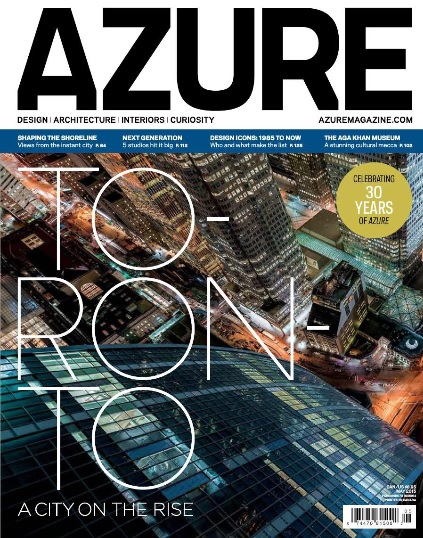
Earlier, I had purchased the May 2015 issue of the Canadian “Azure” magazine dedicated to the City of Toronto, with a nice piece on the Aga Khan Museum and the Ismaili Centre (for on-line article, please click on second image below).

While I am happy to provide readers with links to the on-line articles, on a personal note I would say that the on-line versions do not do justice to their print counterparts which are alluring, and a joy to turn and read from page to page, and cover to cover. The magazines I have listed should be available at good magazine stores or newsagents in your area, and I might add that Chapters-Indigo has expanded its magazine section considerably in the last few years. The cover price of Arts of Asia is US$20.00 (selling in Ottawa for C$21.00), and Azure is under $10.00.

My weekly rendezvous with magazines and newspapers at Mags & Fags, the Globe and Chapters-Indigo will continue, and I hope to provide readers with information on outstanding print magazines that carry fine pieces on the Aga Khan Development Network and its agencies, as well as the Ismaili Imamat and the admirable Ismaili community, of which I am a proud member. To familiarize yourself with the Ismailis and His Highness the Aga Khan, please visit the websites http://www.theismaili.org, http://www.akdn.org and http://www.iis.ac.uk. An outstanding resource and referral blog for all things Ismaili is http://www.ismailimail.wordpress.com, a private initiative.

Please click on image to visit Arts of Asia. Then click on link

Please click on image to visit Arts of Asia website. Then click on link July-August 2015 article “THE AGA KHAN MUSEUM OPENS IN TORONTO” on second column of Editorial section to download complete PDF article (15mb).

~~~~~~~

Please click on image for the Spectacular Aga Khan Museum and the Ismaili Centre

Please click on image for article “The Spectacular Aga Khan Museum and the Ismaili Centre.”

Date posted: August 8, 2015.
Last updated: August 9, 2015.

____________________

We welcome your feedback. Please click on Leave a comment. For articles posted on this blog since its founding, please click on Table of Contents (2009–2015).

A Unique Video of the Signing Ceremony Establishing “Seat of the Ismaili Imamat” in Portugal

Editor’s note: We are pleased to offer our readers a link to an extraordinary footage shown on Portuguese Cable News Channel, SIC Noticias,  of the signing ceremony that took place in Lisbon establishing the Seat of the Ismaili Imamat in Portugal. We also include two other short clips of remarks made by the Foreign Minister of Portugal and the Prime Minister of Portugal. The event in Lisbon on June 3, 2015 was a truly historic moment in the modern history of the Ismaili Imamat, and earlier this week we brought you the complete English text of the Agreement. Readers who haven’t read the text are invited to click on “Seat of the Ismaili Imamat” — Text of the Historic Agreement.

I. FANTASTIC VIDEO OF THE HISTORIC SIGNING ESTABLISHING THE SEAT OF THE ISMAILI IMAMAT IN PORTUGAL

Please click on image below or “Video of the Signing of the Historic Agreement Establishing the Seat of the Ismaili Imamat in Portugal

His Highness the Aga Khan signing the historic document establishing the Seat of the Ismaili Imamat in Portugal. Please click on image to view the video.

His Highness the Aga Khan signing the historic document establishing the Seat of the Ismaili Imamat in Portugal. Please click on image to view the video.

~~~~~~

II. REMARKS BY THE MINISTER OF FOREIGN AFFAIRS, RUI MACHETE

Portugal's Minister of Foreign Affairs speaking at the signing of the Agreement  establishing the Seat of the Ismaili Imamat in Portugal. Please click on image to view a video clip of the remarks.

Portugal’s Minister of Foreign Affairs speaking at the signing of the Agreement establishing the Seat of the Ismaili Imamat in Portugal. Please click on image to view a video clip of the remarks.

~~~~~~

III. REMARKS BY THE PRIME MINISTER OF PORTUGAL, PEDRO PASSOS COELHO

Portugal's Prime Minister speaking at the signing of the Agreement establishing the Seat of the Ismaili Imamat in Portugal. Please click on image to view a video clip of the remarks.

Portugal’s Prime Minister speaking at the signing of the Agreement establishing the Seat of the Ismaili Imamat in Portugal. Please click on image to view a video clip of the remarks.

Date posted: August 6, 2015.

Full English text of agreement at “Seat of the Ismaili Imamat” — Text of the Historic Agreement Between the Ismaili Imamat and the Portuguese Republic.

__________

This post is also reproduced at http://www.simergphotos.com, Simerg’s photo blog.