Simerg is an independent initiative dedicated to Ismaili Muslims, the Aga Khan — their Hereditary Imam — and the Ismaili Imamat, and Islam in general through literary readings, photo essays and artistic expressions
Editor’s Note: The author’s name, a refugee in Spain, is being withheld to respect her privacy and protect her family members, who are dispersed in South and Central Asia. We have communicated with the author and are pleased to publish her inspiring and moving account of her Didar with Mawlana Hazar Imam, His Highness the Aga Khan, the 50th Hereditary Imam of the Shia Ismaili Muslims. She attended the Didar with the Jamat of Portugal and Spain on Wednesday, December 3, 2025, and with the youth of both countries the following morning, Thursday, December 4. Her resilience and courage, highlighted by her family’s widespread dispersal, are remarkable. Her piece emphasizes the importance of shared stories that strengthen our community bonds and sense of purpose.
Letter from Spain: My Didar of Mawlana Hazar Imam in Lisbon
The motif representing Nur or Light, has been used by Mawlana Hazar Imam, His Highness the Aga Khan, during his inaugural visits to Ismaili Muslims around the world. His recent visit to Portugal from December 3 to 5, 2025, was his fifth such visit since becoming their 50th Imam on February 4, 2025. It was preceeded by visits to the USA (November), Uganda (September), Kenya (August), and France (July). Photograph: The Ismaili.
I received the news of the Didar of Mawlana Hazar Imam Shah Rahim al Hussaini twenty days earlier. It felt like a morning breeze carrying a long-held, unreachable wish. When I first heard that the Didar would take place from the 1st to the 4th, my heart began to shiver with happiness. Yet, at the same time, a weight of sorrow settled in my chest. I feared that I might not be able to go — that the wish I had carried throughout my life would never come true — because I am a refugee in Spain, awaiting the final documents confirming my refugee status.
With all the “yeses” and “nos” circling in my mind, and despite all the limitations around me, a small flame of hope kept whispering in my heart: You must go… You have to try. You deserve for this dream to come true.
Following that hope, I spoke with my social worker and case lawyer. I explained the value of this visit and described how deeply it mattered to me, both mentally and personally. But their response was subdued. They warned it could jeopardize my refugee case.
Yet I knew that if I did not make it to this Didar, I might lose a part of myself forever — a part that could never be found again. I accepted the risk because this was not just a journey. It was a symbol of my resilience and hope. It made me feel as though my soul was being protected. I decided to set out on the journey I had been waiting for my entire life, trusting that faith and perseverance would guide me through.
On Monday morning, the 1st of December — the Didar by now had been confirmed for the 3rd with the Jamat and on the 4th with the youth — I took a chance and rode to Lisbon. I prayed silently: Dear Allah, please make my path into this Didar easy… I want to reach without any trouble. By Allah’s grace, I entered Portugal without any problems, and waves of joy began moving through my heart.
That night, and the night before visiting Mawlana Hazar Imam, I could not sleep at all. I kept thinking: I am going to meet someone who has known me for so long, who loves me, who cares for me, who is my Imam, and who is like a father to me.
The arrival of morning felt like the arrival of light into the darkest corners of my heart. I counted every moment, feeling deeply grateful for the bond I had with the Imam, wondering whether I was dreaming or awake. In my 24 years of life, this was my first time visiting the Hazar Imam of the Ismaili community, and it felt almost unbelievable. Suddenly, I heard “اللهم صلّی علی محمد و آل محمد”…. Allahumm-a Sall-i ‘Ala Muhammad-in Wa Al-i Muhammad…. My eyes were already open, yet I tried to open them wider — to see more, hear more, feel more.
Story continues below
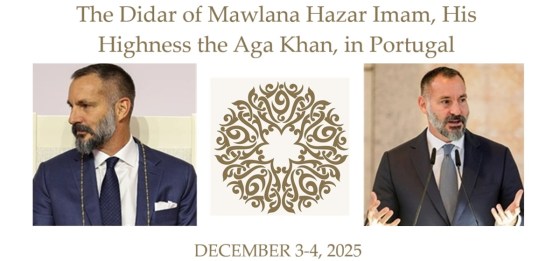
Mawlana Hazar Imam, His Highness the Aga Khan, on stage at the Didar for the Jamat of Portugal and Spain, in Lisbon, December 3, 2025. Photograph: IPL / Akbar Hakim.
“From where will he enter?” I whispered with a trembling voice. And then, in that very moment, my eyes caught sight of Hazar Imam. A wave of emotion washed over me — my heart grew heavy, my throat dried, and tears began falling from the corners of my eyes. With my hand on my heart, I kept watching him, overwhelmed by a mix of awe and longing.
For a moment, my heart spoke words that had been silent for years — words filled with sorrow, loneliness, and the hardships of being a refugee. With every step Hazar Imam took, my heart repeated those words, tears streaming down my face. I whispered, Why have I come so late to see you? Why could I not attend this Didar with my family? Why have we been shattered?
Although I felt immense happiness at reaching this Didar and seeing the luminous face of Hazar Imam, a heaviness lingered in my heart. In this sacred moment, my elation from finally arriving was met by loneliness. The joy of connection stood beside the ache of separation from my family and memories of enduring many hardships. These two emotions, happiness and pain, moved together within me.
Meeting Hazar Imam was a transformative spiritual experience that marked a turning point in my faith journey. I felt his presence, hearing every word in my heart and sensing each of my steps. From that moment, I no longer remained the weak and broken version of myself. A new hope has blossomed within me, and a new strength has settled in my heart.
As I write this piece, I feel like the luckiest person on earth. I feel light and relieved, no longer weighed down. All the helplessness and weakness that overshadowed me for years have disappeared. This is the light of Imamat. From the moment I saw Imam Hazir, Shah Rahim al Hussaini, and spoke to him with my broken heart, I found the peace I had been missing for years. Now, I feel like a blessed and spiritually renewed child.
Fortunately, as a young member of the Jamat, I had the opportunity to attend another Didar the next morning, Thursday, December 4. This Didar was in the intimate setting of the Darkhana Jamatkhana at the Ismaili Centre Lisbon. The previous day’s Didar was attended by around 3,000 members from Portugal and Spain. It was held at FIL — Feira Internacional de Lisboa, in Parque das Nações. I was informed it was the venue of the Diamond Jubilee celebrations of Mawlana Shah Karim in July 2018.
Now I was already in Lisbon. I had had my first beautiful Didar, which filled me with (spiritual) happiness I cannot truly express in words. I was going to be in Mawlana Imam Hazar Imam’s presence, to see him in person once again and to listen to his loving words that always bring peace to my heart.
We left the hotel at 7:30 in the morning. With every step I took toward the venue, I felt joy slowly flooding my heart, like a calm yet powerful wave. I had prepared myself with care, wanting to be worthy of such a special moment.
But just when everything seemed perfect, something unexpected happened. I didn’t have the special card for the second day. They had told me earlier that the same card from the first day would be enough. Still, they refused to let me enter. My heart sank. I thought I might miss the second moment, surrounded by Hazar Imam’s young spiritual children, I had been waiting for.
They asked me to wait on the side while they decided. Every second felt incredibly long. I watched other young people walk in, smiling, while I stood outside. I was caught between hope and disappointment. I could feel my heartbeat slowing down, as if giving up…
After about twenty minutes, someone came and told me I could go inside. At that moment, it felt like I could breathe again. I stepped in, full of emotion. I was almost the last person to arrive, but my heart was overflowing with gratitude… truly grateful.
Not long after, Hazar Imam walked into the Jamatkhana hall. I instinctively straightened up, as if my whole being wanted to welcome him with love and respect. He looked at the youth with warm energy and a loving fatherly smile. I felt something new growing inside me.
Story continues below
Mawlana Hazar Imam, His Highness the Aga Khan, addresses young members of the Ismaili communities of Portugal and Spain in the Darkhana Jamatkhana at the Ismaili Center, Lisbon, December 4, 2025. Photograph: IPL / Akbar Hakim.
When he began to speak, his words glowed with faith, hope, learning, respect, and strength. I promised myself I wouldn’t just listen — I would live those words. Like millions around the world, I will listen again as Mawlana Hazar Imam’s Farmans are read out in Jamatkhanas and distributed as printed booklets.
I was going through one of the most challenging moments of my life, feeling lost until his words felt like fresh air filling my lungs again. At first, I was overwhelmed by despair, but his encouragement brought back my desire to live and to fight for a better tomorrow. It felt as if a hand of light lifted me from darkness and whispered: It’s not over… There is always hope. The two days of Didar became the most memorable and happiest days of my life, and I will cherish the experience for the rest of my life.
Date posted: December 9, 2025
NOTE: A version of this post appears on our sister website Barakah, which is dedicated to His Highness the Aga Khan, members of his family and the Ismaili Imamat.
Thursday, November 6, 2025, marked a historic day in the life of the Ismaili Muslims of the USA as Mawlana Hazar Imam, His Highness the Aga Khan, the 50th Hereditary Imam of the Ismaili Muslims, and the Honorable Mayor of Houston, John Whitmire, officially inaugurated the Ismaili Center in Houston.
Mawlana Hazar Imam, His Highness the Aga Khan, welcomes the Honorable Mayor of Houston, John Whitmire, as he arrives to inaugurate the Ismaili Center, Houston, November 6, 2025. Photograph: IPL / Akbar Hakim.
It was also a historic day in the context of six other beautiful Ismaili Centres that were conceived and inaugurated around the world between 1985 and 2014 by His Late Highness Aga Khan IV, Mawlana Shah Karim, the 49th Imam. The Ismaili Center Houston, first conceived by Mawlana Shah Karim in 2006, was inaugurated by his Hereditary successor, His Highness Prince Rahim Aga Khan.
An aerial view of the 11-acre site of the Ismaili Center, Houston. In the centre of the photo, the Ismaili Center building, with the larger North garden — bottom of photo — facing the Allen Parkway as well as the largest evian in the Ismaili Center. . The South Garden, at the top of the photo, has vehicle exits to West Dallas Avenue (top) and to Montrose Boulevard at the right. To the left of the photo, there is a smaller Evian with views of a residential neighbourhood and the downtown skyline of Houston. Photograph: Iwan Baan.
The new seventh Ismaili Center in Houston is situated on more than nine acres of gardens and green space. It is in close proximity to Houston’s downtown core, featuring fantastic cultural spaces. Houston is ranked as America’s most ethnically diverse major city and is home to thriving communities that have shaped its reputation for innovation, the arts, and culture. Among these vibrant communities is the diverse Ismaili community, estimated to be around 30,000 strong. The Ismaili Center, with its unique architecture and cultural programs, will serve as a hub for cultural, artistic and educational exchange, connecting the Ismaili community with the rest of Houston and contributing to the city’s rich cultural tapestry.
Mawlana Hazar Imam, His Highness the Aga Khan (2nd from left), with members of his family — his brother Prince Hussain, his uncle and younger brother of His Late Highness Aga Khan IV, Prince Amyn, and his youngest brother Prince Aly Muhamad, who joined him for the inauguration in Houston of the first Ismaili Center in the USA, November 6, 2025. Photograph: IPL / Akbar Hakim.
Mawlana Hazar Imam’s uncle, Prince Amyn, the younger brother of the late Imam, His Late Highness Aga Khan IV, and his two younger brothers, Prince Hussain and Prince Aly Muhammad, attended the ceremony alongside members of Congress, Texas state legislators, and representatives of faith communities from across the country.
Story continues below
The stage is set for the arrival of Mawlana Hazar Imam, His Highness the Aga Khan, and Houston Mayor John Whitmire for the inauguration of the Ismaili Center, Houston. The new logo of the Ismaili Center, Houston, takes a prominent position at the center of the stage, symbolizing a new chapter for Ismaili Centres located in other countries worldwide. The unveiled plaque is positioned to the right, with the flags (from right to left) of the Ismaili Imamat, the State of Texas, and the USA at the left. Photograph: Malik Merchant / Barakah.
The soft tunes from a team of musicians from Central Asia filled the air as the 3rd-floor social hall, the space chosen for the inauguration, began to fill up shortly after 10:00 AM. A simple yet beautiful stage had been set up with flags of the USA, the State of Texas, and the Ismaili Imamat at one end, and the inauguration plaque, waiting to be unveiled, at the other. When the arrival of His Highness the Aga Khan’s motorcade was announced, everyone’s attention was drawn to the TV screen. His Highness then warmly received Mayor John Whitmire. The audience was asked to rise as the dignitaries entered the inauguration hall. A rendering of the American National Anthem was sung by a group of Ismaili youth, followed by a musical rendition of the Nashid al Imamah, a significant part of the Ismaili community’s culture during events such as this. This Nashid is somewhat equivalent in tune to what was once regarded by community members as its anthem, the “Noore-Rasullilah,” which marked the commencement of important events for decades before the musical rendition of the Nashid was introduced during the Golden Jubilee of His Late Highness in 2008.
Story continues below
Mawlana Hazar Imam, His Highness the Aga Khan, Houston Mayor John Whitmire and attendees pay their respects at the recitation of the USA Anthem and a rendering of the Nashid al Imamah during the inauguration of the Ismaili Center, Houston, November 6, 2025. Photograph: IPL / Akbar Hakim.
The recitations were then followed on the stage with an Arabic reading of a Quranic verse from Surah Al-Hujurat (49:13) and its English translation, which reads as follows:
“O mankind, indeed We have created you from male and female and made you peoples and tribes that you may know one another. Indeed, the most noble of you in the sight of Allah is the most righteous of you.” — Al-Hujurat, The Dwellings, 49:13.
Al-Karim Alidina, President of the Aga Khan Ismaili Council for the USA, welcomed guests and traced the project’s origins to a long-term vision. “His Highness Prince Karim Aga Khan had a decades-long aspiration to establish an Ismaili Center in the United States,” he said, “one that would reflect the values and identity of the Ismaili community. So today marks a moment of pride and joy for the community.”
Story continues below
The Honorable Mayor of Houston, John Whitmire, delivers a passionate extempore speech at the inauguration of the Ismaili Center, Houston, November 6, 2025. Photograph: IPL / Akbar Hakim.
~~~~~~~~
Mawlana Hazar Imam, His Highness the Aga Khan, applauds during a moment of Mayor John Whitmire’s remarks delivered at the inauguration of the Ismaili Center, Houston, November 6, 2025. Photograph: IPL / Akbar Hakim.
In his extempore speech, Mayor Whitmire passionately spoke of the magnitude and historic nature of the landmark occasion. “The Ismaili community working with the city of Houston residents,” he said, “our region, our state of Texas, and the United States — we’re making a statement today that we’re all in this together. The Mayor looked forward to the Center’s impact in the city and beyond: “This is only the beginning of something great,” he said. His remarks were met with a rousing reception from the audience and greatly appreciated by His Highness.
In his address, Mawlana Hazar Imam reflected on his father Mawlana Shah Karim’s vision for the building and its gardens, his personal interest in their design, and his wish to designate the Ismaili Center in Houston as a Diamond Jubilee project. Mawlana Hazar Imam also spoke about his own aspirations for the building and its intended use. “This building may be called an Ismaili Center, but it is not here for Ismailis only. It is for all Houstonians to use; a place open to all who seek knowledge, reflection, and dialogue,” he said.
Story continues below
Mawlana Hazar Imam, His Highness the Aga Khan, addresses guests gathered for the inauguration of the Ismaili Center, Houston, November 6, 2025. Photograph: IPL / Akbar Hakim.
“Whether through hosting recitals, launching books, presenting concerts, promoting local artists, or offering training, our intent is to provide a constant rhythm of events that spark curiosity, engender understanding, and encourage exchange.” However, in his remarks, he did emphasize the importance of the building as a Jamatkhana, a space for Ismaili worship.
Hazar Imam thanked the Mayor’s office, design team, project committee, leaders of the Jamat, donors, and the many volunteers for their time, effort, and dedication. His Highness also acknowledged the support of the mayors preceding Mayor Whitmore. He thanked the entire building team, including the architect, the landscape architects, and the engineers.
In paying a special tribute to his uncle Prince Amyn, he said that his “guidance, commitment, and close personal engagement over many years have been pivotal to the creation of Ismaili Centres across the world, and to this Ismaili Center here in Houston. He has been a constant and regular presence on this site and at deliberations throughout planning and execution. I am profoundly grateful for his insight and contribution.”
Story continues below
Mawlana Hazar Imam, His Highness the Aga Khan, and Houston Mayor John Whitmire, congratulate each other after unveiling the Ismaili Center, Houston, inauguration plaque, November 6, 2025, marking an historic day in the life of the 50th Ismaili Imam, the Ismaili community in the usa and around the world, and the city of Houston, November 6, 2025. Photograph: IPL / Akbar Hakim.
The Mayor and His Highness then unveiled the plaque, etched in Gold. The plaque spanning 12 rows reads:
BISMILLAHIR RAHMANIR RAHIM (inscription is in Arabic) THE CREST OF THE ISMAILI IMAMAT followed by:
THE OPENING CEREMONY OF THE ISMAILI CENTER WAS PERFORMED BY THE HONORABLE JOHN WHITMIRE MAYOR OF HOUSTON IN THE PRESENCE OF HIS HIGHNESS PRINCE RAHIM AGA KHAN FIFTIETH IMAM OF THE SHIA IMAMI ISMAILI MUSLIMS ON NOVEMBER SIXTH, 2025
The Inauguration Plaque of the Ismaili Center, Houston, was unveiled by Houston Mayor John Whitmire and Mawlana Hazar Imam, His Highness the Aga Khan, November 6, 2025. Photograph: Malik Merchant / Barakah.
After congratulatory exchanges, the dignitaries left the inauguration hall. Many visitors stayed behind to have their photos taken on the stage in front of or alongside the Flags and the inauguration plaque. In contrast, others were guided to the reception area in the large verandah where volunteers walked around and served a variety of tasty hors d’oeuvres accompanied by delicious light sherbet and a fruit drink.
Story continues below
A beautiful and intricate Mehndi (Henna) design on the hands of a visitor attending the inauguration of the Ismaili Center, Houston. Note the words’ Ya Ali’ appearing on the left hand (with the ring). November 6, 2025. Photograph: Malik Merchant / Barakah.
~~~~~~~~
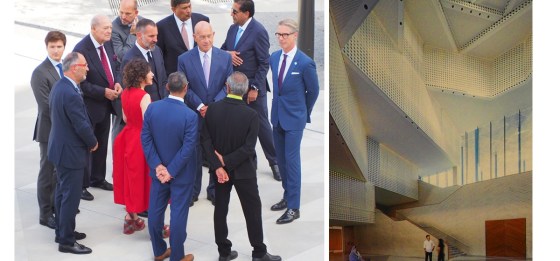
The Ismaili Centre, Houston design and project teams — design architect Farshid Moussavi, Landscape architect Thomas Wolz, structural design consultant Hanif Kara, and Ismaili leaders pose for a group photo with Mayor Whitmire, Mawlana Hazar Imam — His Highness the Aga Khan –Prince Amyn, Prince Hussain, and Prince Aly Muhammad, as visitors watch from the reception area overlooking the Garden, November 6, 2025. Photograph: IPL / Akbar Hakim.
Overlooking the Gardens from the reception area, we witnessed the keen interest that Mawlana Shah Rahim and Mayor Whitmore showed as they were guided through the building by the building team.
Story continues below
Mawlana Hazar Imam, His Highness the Aga, and members of his family, along with Mayor John Whitmire, gather by the reflecting pool at the North Garden of the Ismaili Center in Houston and receive an overview of the magnificent buildings from the dedicated design and building team on November 6, 2025. Photograph: Malik Merchant / Barakah.
~~~~~~~~
The North Garden of the Ismaili Center, Houston, is the larger of the two gardens. This is a view from the North Eivan (veranda), which is the largest of the three eivans. It can accommodate up to 800 people for lectures or receptions and up to 600 for banquets, November 6, 2025. Photograph: Malik Merchant / Barakah.
~~~~~~~
Mawlana Hazar Imam, His Highness the Aga, and members of his family, along with Mayor John Whitmire and leaders of the Ismaili community, listen attentively as they receive an overview of the Ismaili Center, Houston, from the dedicated design and construction team, November 6, 2025. Photograph: Malik Merchant / Barakah.
~~~~~~~
Mawlana Hazar Imam, His Highness the Aga Khan, and Mayor John Whitmire listen attentively as they receive an overview of the Ismaili Center, Houston, from the dedicated design and construction team, November 6, 2025. Photograph: Malik Merchant / Barakah.
~~~~~~~~
Mawlana Hazar Imam, His Highness the Aga Khan, and members of his family, along with Mayor John Whitmire, listen closely as the President of the Aga Khan Council for the USA, Al-Karim Alidina, offers remarks during the tour of the Ismaili Center in Houston following the inauguration ceremony, November 6, 2025. Photograph: Malik Merchant / Barakah.
Having relished the tasty hors d’oeuvres, the visitors were then delighted as Prince Amyn, Prince Hussain, and Prince Aly Muhammad joined them and freely mingled with the crowd, happily taking pictures with them.
Story continues below
Prince Hussain Aga Khan, younger brother of Mawlana Hazar Imam, His Highness the Aga Khan, mingles with visitors gathered at the North Verandah of the Ismaili Center Houston, the reception area, following the inauguration ceremony and after completing his tour of the building and its gardens. He mentioned to me that he would need to revisit the Center to see it in its entirety, November 6, 2025. Photograph: Malik Merchant / Barakah.
~~~~~~~~
Prince Amyn Aga Khan, uncle of Mawlana Hazar Imam, His Highness the Aga Khan, and younger brother of His Late Highness Aga Khan, mingles with visitors gathered at the North Verandah of the Ismaili Center Houston, following the inauguration ceremony and after completing a tour of the building and its gardens, November 6, 2025. Photograph: Malik Merchant / Barakah.
~~~~~~~~
Prince Aly Muhammad, younger brother of Mawlana Hazar Imam, His Highness the Aga Khan, mingles with visitors gathered at the North Verandah of the Ismaili Center, Houston, following the inauguration ceremony and after completing a tour of the building and its gardens, November 6, 2025. Photograph: Malik Merchant / Barakah.
I had been introduced to the Ismaili Center, along with several other media representatives, in a three-hour session the day before, on Wednesday, November 4. However, time was limited to visit the many spaces within and outside the Center, as preparations had to be finalized for the following day’s inauguration.
Story continues below
Amazingly, the Ismaili Center, Houston, has interconnected wings, three in all, each of which features a soaring Eivan. This view of the largest Evian, which hosted the reception after the inauguration ceremony, is from another smaller Evian, November 6, 2025. Photograph: Malik Merchant / Barakah.
~~~~~~~~
A view of a residential neighbourhood and further away, Houston’s downtown skyline from a smaller Evian at the Ismaili Center, Houston, November 6, 2025. Photograph: Malik Merchant / Barakah.
On inauguration day, after most of the visitors had left, I spent a considerable amount of time touring the interior and exterior of the building. I was fascinated by the Center’s interconnected wings, each of which features a soaring eivan — an open-sided veranda that provides shaded spaces for gathering and reflection, as well as the classrooms, the theatre room, and the more than 30 artistic works that were being mentioned as being a permanent feature of the Center.
On inauguration day, a special exhibit of creative objects was displayed in an exhibition space. Additionally, the Center features offices, meeting rooms, social halls, and exhibition spaces. The central atrium features a very high skylight, inspired by Ismaili dwellings in the Pamirs of Central Asia.
Story continues below
The Ismaili Center, Houston, with its beautiful reflecting pond in the South Garden, as buses come to collect visitors for a trip back to their hotels after a historical inauguration ceremony performed by Mawlana Hazar Imam, His Highness the Aga Khan, and Houston Mayor John Whitmire, November 6, 2025. Photograph: Malik Merchant / Barakah.
Outside, the visitors are welcomed by a diverse array of green spaces that change with the seasons. These include reflecting pools, flower beds, lawns, and walkways. The gardens are home to 800 trees and native floodplain species, carefully chosen to suit the local environment. As the landscape architect explained, the entire outdoor space will take on a different appearance as plants and trees grow over the coming months. The elusive monarch butterflies added a touch of enchantment.
Story continues below
From left to right, the Flags of the Ismaili Imamat, bearing the gold crest of Mawlana Hazar Imam, His Highness the Aga Khan, the State of Texas and the USA fly in the south garden, near the Montrose Blvd gate exit of the Ismaili Center, Houston, November 6, 2025. Photograph: Malik Merchant / Barakah.
Reflecting the late Imam’s desire to infuse the Gardens with a sense of whimsy, he proposed planting cacti around one of the reflecting ponds. As a flag enthusiast, I made my way to one of the Center’s gates to capture the American, Texas, and the Ismaili Imamat Flags fluttering in the breeze — it was a patient wait, as the wind was calm. In every corner of the two longitudinal gardens, I experienced a serene and beautiful environment.
Story continues below
Cacti in the South Garden of the Ismaili Center, Houston, November 5, 2025. Photograph: Malik Merchant / Baralkah.
Back inside, I observed the heart of the building filled with natural light, with views of the sky above. The in-out concept presented a visitor from the outside at any entrance. The myriad offices, meeting rooms, social halls, exhibition space, and a theatre offer places for learning and contemplation as well as entertainment.
Story continues below
An exhibition prepared to celebrate the inauguration of the Ismaili Center, Houston, November 6, 2025. Photograph: Malik Merchant / Barakah.
~~~~~~
A depiction of the central atrium area of the Ismaili Center, Houston, by Salina Kassam, a Kenyan-born Ismaili artist now based in Canada, as part of her series entitled “Ineffable Spaces: The Seven Ismaili Centres, 2025.” The works of art of the seven beautiful centres form part of a permanent collection of artistic works in the Houston Ismaili Center. They are inkjet photographs printed on cotton paper, November 6, 2025. Photograph of the artwork captured by Malik Merchant / Barakah.
~~~~~~~~
Central Atrium of the Ismaili Center, Houston, with a skylight inspired by the traditional ceiling of Ismaili dwellings in the Pamirs in Central Asia, November 5, 2025. Photograph: Malik Merchant / Barakah.
~~~~~~~~
A view of the Jamatkhana in the Ismaili Center, Houston, a place of worship for the Ismaili Muslims. The Mihrab, facing the Kaaba, is in the far end of the photo. The panels around the diamond-shaped Jamatkhana, which can accommodate around 1,500 people, are inscribed in Arabic with the names of Allah, Muhammad, and Ali. The carpet has a beautiful pattern, November 5, 2025. Photograph: Malik Merchant / Barakah.
The diamond-shaped Jamatkhana prayer hall, which can accommodate up to 1,500people, is surrounded by panels featuring calligraphy that bears the words “Allah,” “Ali,” and “Muhammad.” The beautiful carpet is lightly coloured. My greatest wish to participate with my brothers and sisters within the Jamatkhana space for prayers will not be fulfilled as the Ismaili Center’s official opening will take place days after my departure.
Story continues below
After a memorable and historic day celebrating the inauguration of the Ismaili Center in Houston, visitors board their buses to return to their hotels, November 6, 2025. Photograph: Malik Merchant / Barakah.
For the hundreds of thousands who will visit the Center in the future, Ismailis and non-Ismailis alike, its opening marks a milestone moment for the 50th Ismaili Imam, and his spiritual children, the Ismailis, in the USA and worldwide.
As Mawlana Hazar Imam explained in his speech: “It is my deep hope, that with your engagement, this Center will lift spirits and broaden horizons; this Center will bring people together, strengthen bonds, and help us all, collectively, to bring happiness and harmony to societies here and elsewhere.”
Date posted: November 7, 2025. Last updated: November 24, 2025 (formatting.)
A version of this post appears on Simerg’s sister website, Barakah, which is dedicated to His Highness the Aga Khan.
Abstract: In this expanded version of his original article, which was published in the February 2025 issue of the Institute of Ismaili Studies Alumni Newsletter, Professor Karim writes about the subtle dynamics between the Imam-of-the-Time and those in his service, an insight he gained from his personal interactions with Mawlana Shah Karim Shah, who appointed him to the leadership of the Institute of Ismaili Studies. The article not only describes the contemporary dynamics but also emphasizes the enduring historical significance of truth, faith, piety, and proper management in Ismaili administration, instilling a sense of tradition and continuity.
To be asked by Mawlana Shah Karim (1936-2025) to lead the Institute of Ismaili Studies (IIS) was an exceptional honour. The London-based IIS is unique among the large number of institutions that His Late Highness Aga Khan IV and 49th Nizari Ismaili Imam established in his Imamat of 67 years (July 11, 1957, to February 4, 2025). Its management demands a nuanced understanding of the academic and communal spheres which intersect within it. The Imam’s invitation to me in 2009 felt like the culmination of a long relationship with the Institute, where I had been a student, a research collaborator and a senior visiting scholar over the previous two and a half decades. I stepped down from my position as Director of Carleton University’s renowned School of Journalism and Communication and headed for London.
Story continues below
The Institute of Ismaili Studies (IIS) owes its establishment to the leadership and vision of Mawlana Shah Karim, His Late Highness Aga Khan IV. Along with leaders of the Ismailia Association and Ismaili scholars, a momentous decision was made to establish the IIS at a conference held in April 1975 in Paris. This decision, which carries the weight of history, was a pivotal moment for the Ismaili community. The IIS was formally established on December 13, 1977, through a Talika (written holy message) that His Late Highness sent to his worldwide community. Photograph: Ilm magazine, October 1975.
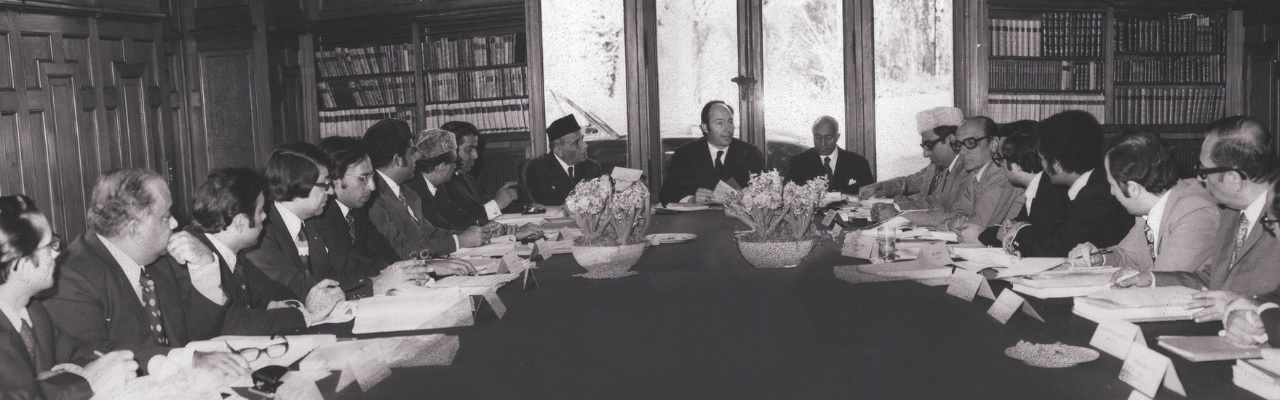
Before joining the IIS as Co-Director, it had been my privilege to give seva (service) to jamati (community) institutions in Kenya, USA, UK and Canada. I had also conducted research for Aga Khan Foundation Canada and been a correspondent for Compass News Features, a media agency which Mawlana Shah Karim founded in Luxembourg. The Aga Khan University (AKU) had asked me in 2007 to serve on an international “Thinking Group,” comprising prominent professors and senior journalists who were tasked with exploring the possibility of establishing a Graduate School of Media and Communications. Several months into the deliberations, Aga Khan IV, the university’s founding chancellor, informed us that he would meet with us in Washington, DC. We were assembled in a room when His Highness walked in, wearing a sling on his right arm because of a skiing accident a few weeks prior. He went around the table, smiling and graciously greeting each person. Having led the highly successful Nation media organization in East Africa since the late 1950s, he spoke about the media business and journalism education. With Kenya’s post-election violence fresh in his mind, the Imam shared insights about how the corruption of journalists and media owners contributed to social instability. The distinguished group was impressed with the breadth and depth of his knowledge and left with a deepened scope of considerations. Some seven graduate AKU schools had been planned but only the Graduate School of Media and Communications in Nairobi proceeded to establishment. I was thankful that Mawlana Shah Karim gave me the opportunity to contribute to my country of birth in this manner.
It was September 2009 when I arrived in London from Ottawa, Canada, to assume the IIS’s co-directorship. A few weeks later, Mawlana Shah Karim invited the Aga Khan Development Network’s Higher Education Forum, of which I was a member, to a dinner meeting at his secretariat in Aiglemont, France. The Forum also included the senior leadership of Aga Khan Foundation, Aga Khan University, the University of Central Asia, Aga Khan Academies, and Aga Khan Education Services. According to the arrangements that the Imam had determined, Azim Nanji, the preceding IIS director, was to be seated on Mawlana Shah Karim’s left-hand side and I on his right. This was a remarkable honour for Azim Nanji, me and the IIS. The Imam entered the room, greeting us warmly. Attendees took their seats but, feeling daunted, I hesitated. Mawlana Shah Karim kindly gestured for me to sit next to him. The participants presented project updates about which the Imam asked probing questions. He was gracious about shortcomings and made suggestions on dealing with challenges. After the meeting came to a close, Mawlana Shah Karim looked at me and told me not to hesitate to contact him should the need arise. I felt humbled and immensely grateful.
“I was convinced that it was vital for individuals tasked with responsibilities to be entirely transparent with Mawlana Shah Karim even if it produced discomfort for oneself and others in the room. Therefore, I became resolute in speaking up — at the risk of being marginalized — when I saw things to be amiss. Mawlana Shah Karim’s positive responses to my carefully considered interventions were very encouraging.” — Karim H Karim
It was my good fortune to have a number of interactions with the 49th Imam. He upheld very high standards and asked the same of others. Mawlana Shah Karim expected accurate information and frankness, especially when goals had not been met. Having thoroughly read the papers submitted in advance of meetings he inquired into specifics and gave discerning guidance. From time to time, as the discussion was flowing in a particular direction, I would ask myself whether it was appropriate for me to offer contrary observations and critical thoughts on vital points. It turned out that Mawlana Shah Karim appreciated such interventions, which I sought to conduct in a thoughtful and respectful manner. He was also kind in tolerating my errors, gently directing me towards correcting them. This helped me understand more clearly the subtle dynamics of interaction between the Imam and those in his service.
Around a thousand years ago, da‘i Ahmed al-Naysaburi’s writings reminded Fatimid administrators that the Imam-of-the-Time depends on them for the ethical governance of his community, failing which “chaos will reign.” He was extremely concerned that influential officials had become preoccupied with their own power and privilege rather prioritizing knowledge of the faith(ilm), piety (taqwa) and proper administration (siyasa), the fundamental principles by which the Imamat’s institutions should abide. The more meetings I attended with Mawlana Shah Karim the more it became apparent that he was not always receiving the complete picture, especially when conflicts of interests were involved or when things had not turned out according to expectations. Qadi al-Nu‘man, who was a close confidant of several Fatimid Imams, advised those who interacted with the Imam: “Let us speak the truth and hide nothing from the Imams.” I was convinced that it was vital for individuals tasked with responsibilities to be entirely transparent with Mawlana Shah Karim even if it produced discomfort for oneself and others in the room. Therefore, I became resolute in speaking up — at the risk of being marginalized — when I saw things to be amiss. Mawlana Shah Karim’s positive responses to my carefully considered interventions were very encouraging.
However, adverse organizational currents began to generate a disabling environment for me. I strived to deal with the changing situation, but it became increasingly problematic to carry out my duties. Being under intense stress, I was compelled to review my position and consider the possibility of moving back to Canada. This presented an extremely difficult situation: it was my Imam who had personally selected me for the leadership role in his vital institution, and I felt deeply distressed that I would be letting him down. After several long weeks of agonizing, I wrote to him seeking guidance. Mawlana Shah Karim’s personal assistant contacted me to arrange a telephone call. I waited anxiously in my office as the time arrived. The phone rang, and the assistant informed me that the Imam was on the line.
Mawlana Shah Karim greeted me affectionately and he mentioned a current international issue which we discussed briefly. Turning to the matter at hand, he said that he understood the organizationally problematic nature of the situation and appreciated the difficulty of the circumstances for me. The Imam told me that it was my decision to stay or to leave and that he would be fine with whatever I decided. Mawlana Shah Karim assured me that “there are many ways to serve.” These words, expressed with paternal care, lifted an enormous weight from my shoulders. Following considerable further reflection, I wrote to the Imam of my decision to return to Canada. Upon settling back in Ottawa, I continued to provide service to Imamat institutions like the Central Asian and Aga Khan universities and was immensely pleased with Mawlana Shah Karim’s continued positive responses to my recommendations.
Story continues below
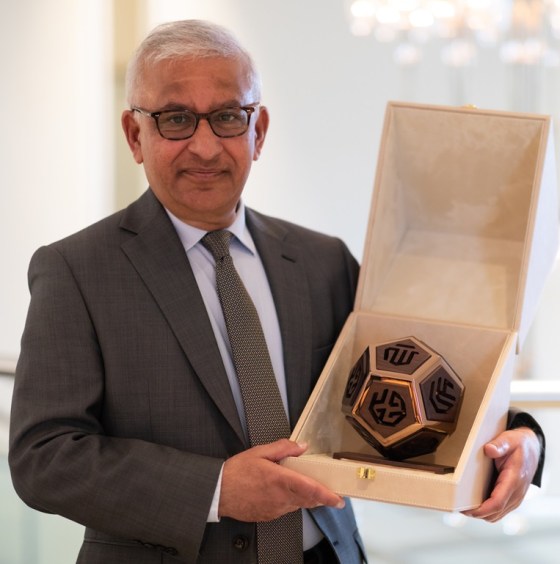
Professor Karim H. Karim, the author of this piece and a respected member of our academic and Ismaili community, was awarded the first Alumni Recognition Award by the Institute of Ismaili Studies. This prestigious honour, presented to him on March 23, 2024, at the Ismaili Centre London, is a testament to his exceptional service, leadership, positive impact, and professional excellence. Photograph: The Institute of Ismaili Studies via Karim H. Karim.
Mawlana Shah Karim’s words from the phone call shaped the direction of my subsequent service to the Imamat and the community. While at the IIS, I had published a chapter on Ismailis in Canada in a book that my fellow Co-Director Farhad Daftary edited. This was the beginning of a series of writings on the contemporary community, which I am analyzing from the basis of my research and institutional service. The insights gained from these sources have strengthened my conviction about the vital importance of upholding intellectual rigour and professional ethics in studying the community, its organizations and its leadership. I draw from my academic training as well as my religious commitment to truth in this endeavour. It is of great significance to me that the original and authentic name of the Imamat’s movement is “Da‘wat al-Haqq” — Invitation to Truth — which has involved critical self-reflection on the part of the community’s intellectuals in their endeavour to uphold its integrity.
At the grand Diamond Jubilee Darbar in Lisbon in July 2018, Mawlana Shah Karim asked his murids (committed aspirants) to be da‘is (summoners to truth). As mentioned above, Ismaili da‘is like al-Nu‘man and al-Naysaburi provided corrective guidance to officers of the Fatimid state who lapsed ethically from time to time. Administrators are under pressure to deliver on commitments and tend on occasion to adopt means that diverge, often unknowingly, from the tradition’s ethical precepts. It is vital that there be an intellectual counterpoint in the contemporary community that discusses ethical adherence with the institutional structure just as al-Nu‘man, al-Naysaburi and other da‘is did in their time. Upon discussing this matter with a former president of the Aga Khan Ismaili Council for Canada, I learned that Mawlana Shah Karim advised community leaders to engage in productive discourse with the independent voices of sincere murids.
My writings and oral discourses, which seek to offer respectful and carefully considered communal self-critique, elicit considerable discussion and feedback. A conference paper that I delivered in 2022 at the IIS on the challenges of ethical propriety in Ismaili institutions generated intense debate, with scholars and students variously agreeing and disagreeing with me. I am heartened that many scholars cite my writings on contemporary Ismaili topics in their academic publications. However, I consider the platforms of independent and autonomous Ismaili communal media like Simerg to be the most viable venues for sharing analysis and engaging in discussion with the community and its leadership.
Mawlana Shah Karim’s advice that “there are many ways to serve” has constantly inspired and motivated me to pursue a path that may be occasionally contentious but constantly and sincerely strives to respond to the da‘wa’s call to truth. It was extremely humbling and encouraging that in 2024 the IIS endowed me with an award for “exceptional service, leadership, positive impact and professional excellence.”
Date posted: September 29, 2025.
________________
About the author:Karim H. Karim is a Chancellor’s Professor at Carleton University in Canada. He has served as Co-Director of the Institute of Ismaili Studies and as Director of Carleton University’s Centre for the Study of Islam and its School of Journalism and Communication. Professor Karim is a prize-winning, interdisciplinary scholar whose publications have received worldwide acclaim. The Ismaili Imamat, the Government of Canada, the Institute of Ismaili Studies and civil society organizations have granted him honours.
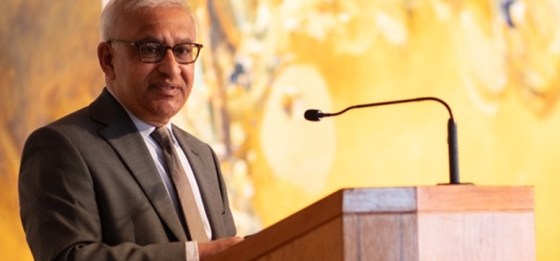
Featured photo at the top of the post: Professor Karim H Karim delivering his remarks on March 23, 2024, at the Ismaili Centre in London upon being presented with the Inaugural Alumni Recognition from the Institute of Ismaili Studies. Photograph: Institute of Ismaili Studies via Karim H. Karim.
If you have feedback on this piece, please click LEAVE A COMMENT. Also, don’t miss the opportunity to explore the diverse and extensive range of articles by clicking on TABLE OF CONTENTS. We also invite you to visit our sister websites, Barakah and Simergphotos. You can stay updated by following the editor, Malik Merchant, @Facebook, @X and @LinkedIn.
~~~~~~~~
Articles contributed by Karim H Karim on Simerg and its sister websites:
“…When she was still in her early to mid-twenties, she was involved in a remarkable rescue operation involving her best friend’s two children who had been forcibly abducted from Singapore to Karachi. Risking her own life, she made her way to Karachi, located the boys and delivered them safely to their uncle’s home…” — 1950’s
“…As is so often the case the Imam of the Time, at an appropriate time, found an opportunity to recognize her entire family during a special audience…” — 1982-83, Silver Jubilee
Simerg encourages readers to submit tributes or death notices for deceased members of their families. For submission details, please click Obituaries and Tributes.
The pace of life today is said to be much faster than it was just a few decades ago. This is an axiom of our times. What, however, is not axiomatic is the corollary that is often assumed to stem from it, namely that spiritual value and worth get diminished in proportion to the increase of pace. It is not uncommon to hear the lament that nowadays people have no time for religion. Many people actually believe this, and that is a great pity. For religion is not a ‘thing’ one ‘does’ if one has time. Religion is a commitment, an involvement of one’s being and personality, utterly, totally and completely.
Human nature, however, accepts few commitments gladly and it abhors those which are seen as imposed externally. Some people consider religion as a process forced upon them from outside themselves. To view religion as an imposition is to misunderstand its message and its function.
The fundamental message of religion to Man is to be at peace — at peace with himself, with his fellow human beings, and at peace with his Creator; the fundamental function of religion is to enable a person to understand and to know his own nature, his environment and to begin to recognise and to know his Creator. Knowledge and peace are interlinked. One makes the attainment of the other possible and a person who attains a degree of both becomes a potential recipient of God’s most valuable gifts to Man: wisdom. Tranquility is a reflection of wisdom.
Photo: John Macdonald.
“I do not believe that we should fear material progress, nor should we condemn it. The danger is that it could become an obsession in our lives and that it could dominate our way of thinking” — Mawlana Hazar Imam [1]
“The day we no longer know how, nor have the time nor the faith to bow in prayer to Allah because the human soul that He has told us is eternal is no longer of sufficient importance to us to be worthy of an hour of our daily working, profit-seeking time, will be a sunless day of despair” — Mawlana Hazar Imam [2]
An essential aspect of knowledge is the understanding that even a tiny part of our lives cannot be isolated from what is termed ‘religion’; for religion properly understood, is nothing less – and even more – than life itself. We, as Muslims, are not and cannot be ‘outside’ of Islam. Islam involves us completely; that, indeed, is the essence of our existence.
The realization of this simple fact is the basis for experiencing an inner calm and tranquility. Then the pace of life around a person becomes largely immaterial, and its varied speed becomes a matter of petty insignificance. This is not to underestimate the powerful attractions of the style of life prevalent in many parts of the world; it is simply to point out that, if one wants to stop oneself from being drifted away aimlessly by the currents of materialism, one can stabilize oneself through the teachings and practices of Islam.
Date posted: Thursday, November 6, 2014.
_______________
The essay has been adapted from Ilm, Volume 2, Number 1, published by the Ismaili Tariqah and Religious Education Board (ITREB) for the United Kingdom, where it appeared under the title “Islam and the Modern Pace of Life.” Excerpts from the speeches of His Highness the Aga Khan were not part of the original piece by Dr. Topan.
[1] His Highness the Aga Khan, Takht Nashini (ceremonial installation), Karachi, Pakistan, January 23, 2958.
[2] His Highness the Aga Khan, Convocation Address, Peshawar University, Pakistan, November 30, 1967.
________________
Links for speeches of His Highness the Aga Khan:
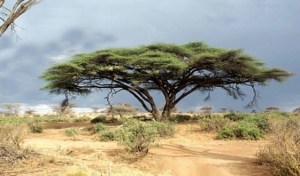
Faith (Iman) is like a tree, the roots of which go into the heart: its trunk is in reason, and its branches are in the instincts, while imagination is its new shoots and leaves – (senses of) the body. The foundation (asl) of faith is love for the Imam-e-Zaman (the Imam of the Time). And if this foundation, that is, this love, and the roots of faith are strong and in good condition, all other parts of the tree, such as its trunk, its branches and leaves, can be expected to continue to flourish even if they are (accidentally) damaged. If, on the contrary, the roots are not well grounded, or even rotten, the whole tree will soon dry, and then will become good for nothing except to be used as fuel.
Thus love for Mawlana Hazar Imam is everything, being the root of faith. If it is not strong, all the acts of outward piety (a’mal-i zahiri) which are like leaves of the tree, will fade. If you have thousands of leaves, fresh and of good colour, they will dry in a short time, and then a very small fire will be sufficient to burn them completely.
~~~~
2. LOVE FOR HAZAR IMAM
by Imam Ja’far as-Sadiq
It is related from Imam Ja’far as-Sadiq (a.s.) that a group of Shias visited him one day. One in the group addressed the Imam and spoke of a man who was with them.
“O Son of the Messenger of God: this man has love for you.”
On hearing these words, the Imam looked at the person and said:
“The best kind of love is the love for the sake of God and His Messenger. There is no gain in any other kind of love.”
The Imam then continued.
“Once the ansars [helpers] came to Hazrat Muhammad Mustafa (s.a.s.) and said, ‘O Messenger of God! We were on the wrong path and Allah guided us through you. We were destitute and we prospered by your blessings. For this reason, you may ask of anything you desire from our belongings and we shall give it to you.’
“At this, the following verse was revealed by Allah, ‘Say (O Muhammad): No reward do I ask (for my favours) except your love for my kith and kin’.”
Moved to tears, Imam Ja’far as-Sadiq then raised his hands and exclaimed:
“Praise be to God, Who has exalted us above all.”
___________
“Faith” adapted from Risala dar haqiqat-i din by Pir Shihabu’d-Din Shah Al-Husayni, translated as True Meaning of Religion by Wladimir Ivanow. Pir Shihabu’d-Din Shah was the eldest son of the 47th Ismaili Imam, Aga Ali Shah, also known as Aga Khan II. The Pir was only 33 when he died due to a chest related illness, a few months before the demise of his own father, Imam Aga Ali Shah. Mawlana Shah Sultan Mahomed Shah, His Highness the Aga Khan III, then only 8 years old, succeeded to the throne of Imamat as the 48th Imam.
“Love for Imam” excerpted from article by Jehangir Merchant and Alnoor Bhatia published in Ilm, Volume 5, Number 1 (July 1979). The article was based on the Gujarati edition of Qadi al-Numan’s work, Da’aim al-Islam.









 Simerg - Insights from Around the World