“As we all know, Canada is home to a well-established and
fast-growing Ismaili community. His Highness has therefore
become an increasingly frequent visitor, and always a welcome one.”
— Prime Minister Stephen Harper

His Highness the Aga Khan and Prime Minister Stephen Harper walk the Hall of Honour at the Parliament of Canada. where His Highness delivered an address to both the Houses on Thursday, February 27, 2014. This impressive ceremonial hall is used for state occasions, parliamentary events, and formal processions such as the Speaker’s Parade. The Hall of Honour is part of the central axis of the Centre Block, joining Confederation Hall to the Library of Parliament, and providing access to the main committee rooms. Photo credit: The Office of the Prime Minister of Canada.
Material compiled and presented by Abdulmalik Merchant
Publisher-Editor, www.simerg.com
The following are thematic excerpts from His Highness the Aga Khan’s address to the Parliament of Canada on Thursday, February 27, 2014. A collection of selected links to the full speech text, the speech video as well as information related to the events that took place at the Parliament is provided at the end of this piece. Note – several photos are clickable for enlargement. See also new post His Highness the Aga Khan at the Parliament of Canada: Selected Excerpts from the Live English Translation of Remarks Made in French
1. THE ISMAILI IMAMAT REPRESENTS THE SUCCESSION OF IMAMS SINCE THE PROPHET MUHAMMAD
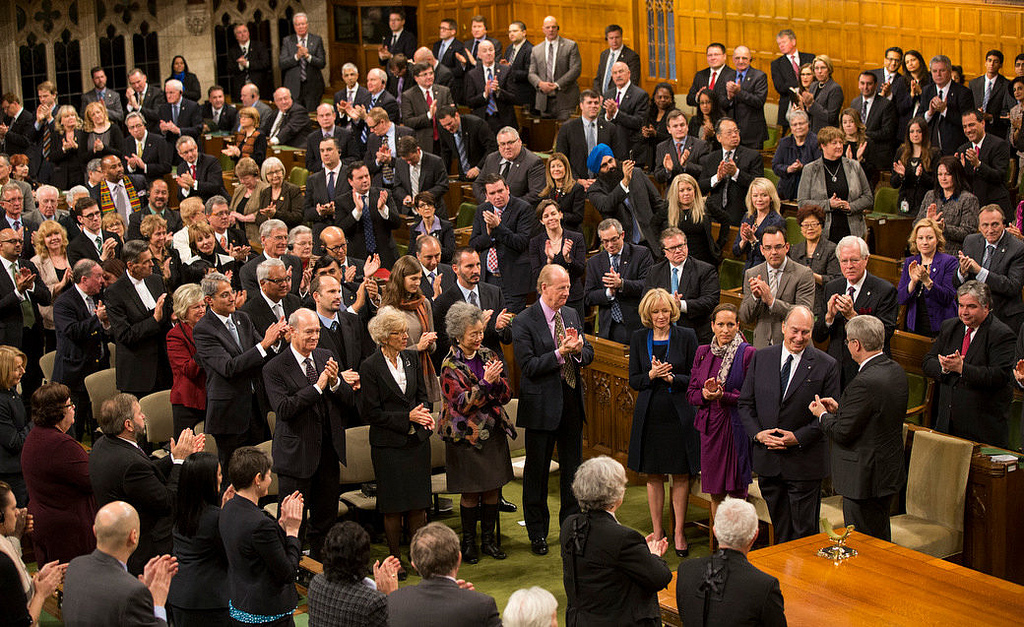
His Highness the Aga Khan is applauded by the Prime Minister, Members of the House, as well as other distinguished visitors as he arrives in the House of Commons on Thursday, February 27, 2014 to deliver a rare address – the first by a faith leader in 75 years. The Ottawa Citizen published a similar photo on its front page of Friday February 28, giving it the title “In Divine Company.” Alongside the Ismaili Imam are his daughter Princess Zahra and the Prime Minister’s wife, Laureen Harper. Others in the photo, in rows adjacent to Mrs. Harper (l to r) — 1st row: The Aga Khan’s younger brother, Prince Amyn Muhammad Aga Khan, Chief Justice of the Supreme Court of Canada, The Right Honourable Beverly McLachlin, Former Governor General of Canada, The Right Honourable Adrienne Clarkson, and renowned Canadian author, intellectual and philosopher, John Ralston Saul; 2nd row (l to r). President Malik Talib of the Aga Khan Ismaili Council for Canada, Prince Hussain Aga Khan, Princess Salwa Aga Khan and her husband Prince Rahim Aga Khan – with both the Princes in the row being the Aga Khan’s children. Photo credit: The Office of the Prime Minister of Canada.
Bismillah-ir-Rahman-ir-Rahim
I propose today to give you some background about myself and my role, and then to reflect about what we call the Ummah — the entirety of Muslim communities around the world.
I will comment, as a faith leader, on the crisis of governance in so much of the world today, before concluding with some thoughts about the values that can assist countries of crisis to develop into countries of opportunity, and how Canada can help shape that process.
First then, a few personal words. I was born into a Muslim family, linked by heredity to the Prophet Muhammad (may peace be upon him and his family). My education blended Islamic and Western traditions, and I was studying at Harvard some 50 years ago (yes 50 years ago — actually 56 years ago!) when I became the 49th hereditary Imam of the Shia Imami Ismaili Muslims.
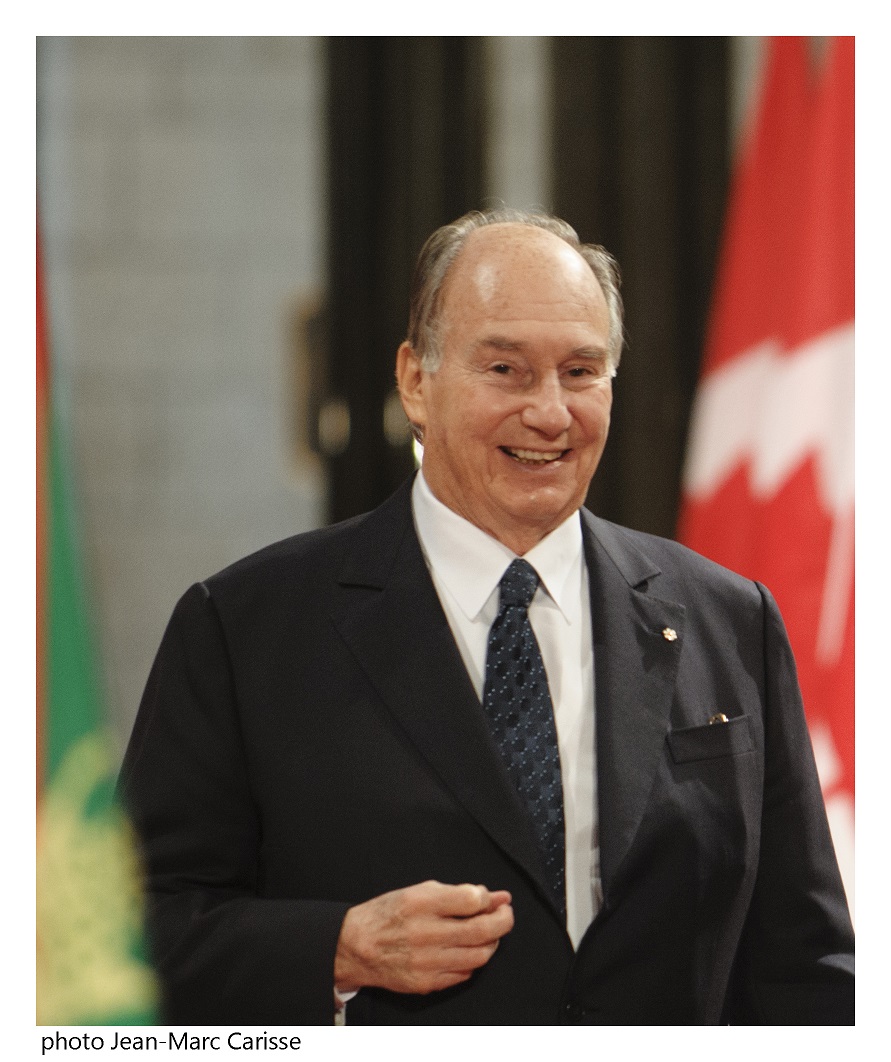
His Highness the Aga Khan at the Canadian Parliament on Thursday, February 27, 2014. Photo: Copyright Jean-Marc Carisse.
The Ismaili Imamat is a supra-national entity, representing the succession of Imams since the time of the Prophet. But let me clarify something more about the history of that role, in both the Sunni and Shia interpretations of the Muslim faith. The Sunni position is that the Prophet nominated no successor, and that spiritual-moral authority belongs to those who are learned in matters of religious law. As a result, there are many Sunni imams in a given time and place. But others believed that the Prophet had designated his cousin and son-in-law, Ali, as his successor. From that early division, a host of further distinctions grew up — but the question of rightful leadership remains central. In time, the Shia were also sub-divided over this question, so that today the Ismailis are the only Shia community who, throughout history, have been led by a living, hereditary Imam in direct descent from the Prophet.

An expression of gratitude and humility by His Highness the Aga Khan as he accepts a standing ovation at the Canadian Parliament on Thursday February 27, 2014. Prime Minister Stephen Harper is seen applauding, with Princess Zahra, the daughter of His Highness, and Laureen Ann Harper, the Prime Minister’s wife, standing alongside the 49th Ismaili Imam. Photo credit: The Office of the Prime Minister of Canada
The role of the Ismaili Imam is a spiritual one; his authority is that of religious interpretation. It is not a political role. I do not govern any land. At the same time, Islam believes fundamentally that the spiritual and material worlds are inextricably connected. Faith does not remove Muslims — or their Imams — from daily, practical matters in family life, in business, in community affairs.
Faith, rather, is a force that should deepen our concern for our worldly habitat, for embracing its challenges, and for improving the quality of human life.
This Muslim belief in the fusion of Faith and World is why much of my attention has been committed to the work of the Aga Khan Development Network.
2. COMMUNITY IN 1957 AND NOW, WORLD CONFLICTS AND THE RESILIENCE OF THE ISMAILI PEOPLE
In 1957, when I succeeded my grandfather as Imam, the Ismaili community lived for the most part in the colonies or ex-colonies of France, Belgium and the British Empire, or behind the Iron Curtain. They are still a highly diverse community, in terms of ethnicity, language, culture, and geography. They continue to live mostly in the developing world, though increasing numbers now live in Europe and North America.
Before 1957, individual Ismaili communities had their own social and economic institutions where that was allowed. There was no intent for them to grow to national prominence, and even less a vision to coordinate their activities across frontiers.
Today, however, that situation has changed, and the Aga Khan Development Network has a strong presence in several dozen countries, where appropriate regional coordination is also useful.
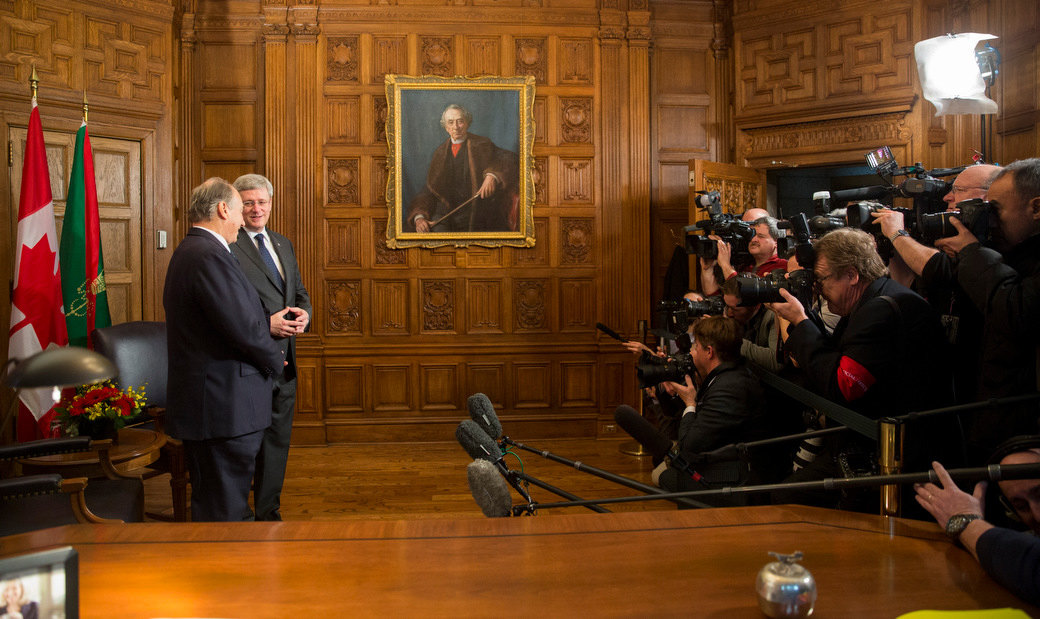
His Highness the Aga Khan and the Right Honourable Stephen Harper, the Prime Minister of Canada, face eager cameras at the Canadian Parliament Building on Thursday, 27 February, 2014. An oil on canvas painting of The Right Honourable Sir John Alexander Macdonald, Prime Minister (1867-1873; 1878-1891) adorns a wall as part of the House of Commons Heritage Collection, while the Ismaili Imamat and Canadian Flags form a backdrop in this historical photo. Photo credit: The Office of the Prime Minister of Canada.
The AKDN — as we call it — is composed of a variety of private, non-governmental, non-denominational agencies implementing many of the Imamat’s responsibilities….Most of our AKDN activities have been born from the grass-roots of developing countries, reflecting their aspirations and their fragilities. Through the years, of course, this landscape has changed fundamentally, with the creation of new states like Bangladesh, the horrors of ethnic cleansing in Uganda, the collapse of the Soviet empire and the emergence of new countries with large Ismaili populations such as Tajikistan.
More recently, of course, we have faced the conflicts in Afghanistan and Syria. But through all of these experiences, the Ismaili peoples have demonstrated an impressive capacity to persevere and to progress.
3. COMMON DENOMINATORS OF THE HUMAN RACE,
CANADA’S LEADERSHIP AND COLLABORATIVE WORK
Our work has always been people-driven. It grows out of the age-old Islamic ethic, committed to goals with universal relevance: the elimination of poverty, access to education, and social peace in a pluralist environment. The AKDN’s fundamental objective is to improve the quality of human life.
Amongst the great common denominators of the human race is a shared aspiration, a common hope, for a better quality of life. I was struck a few years ago to read about a UNDP survey of 18 South American states where the majority of the people were less interested in their forms of government, than in the quality of their lives. Even autocratic governments that improved their quality of life would be more acceptable for most of those polled than ineffective democratic governments.
I cite that study, of course, with due respect to governmental institutions that have had a more successful history — including certain very distinguished parliaments!
But the sad fact behind so much instability in our world today is that governments are seen to be inadequate to these challenges. A much happier fact is that, in the global effort to change this picture, Canada is an exemplary leader.
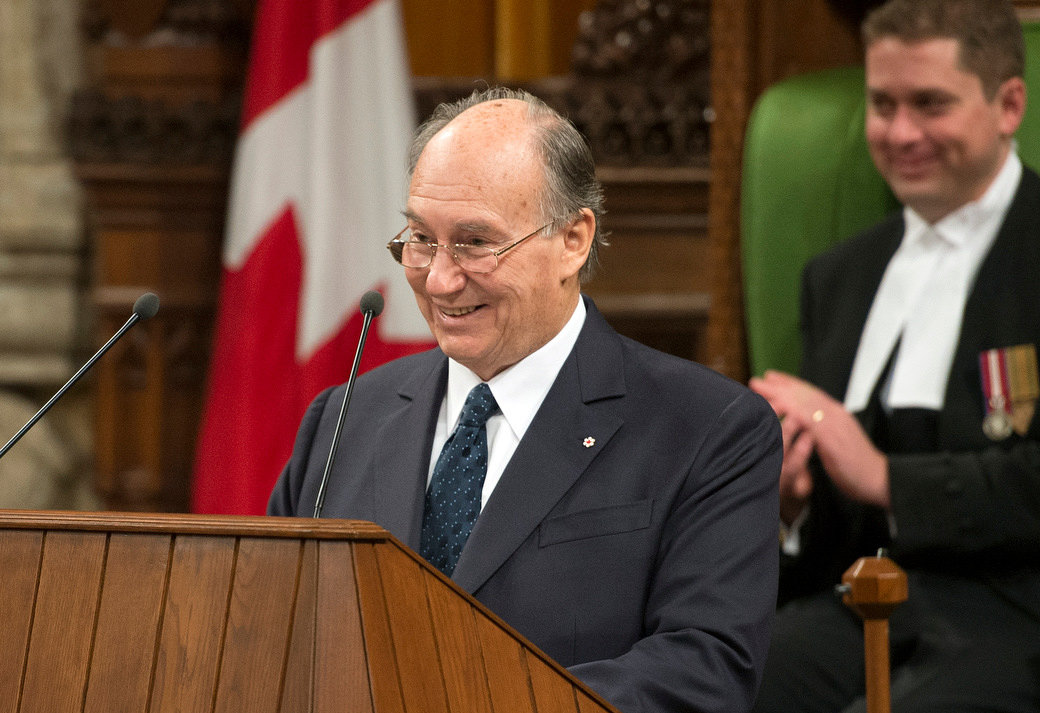
His Highness the Aga Khan seen smiling in a lighter moment during his address to both the Houses of the Canadian Parliament on Thursday, February 27, 2014. Referring to the two gold medals won by the Canadian hockey teams in the Sochi Olympics, the Ismaili Imam remarked, “As an ex-player myself I was hoping you would require your honorary citizens to join your team. I am convinced that the Dalai Lama and I would have been a formidable defence.” Photo credit : The Office of the Prime Minister of Canada.
One of our earliest collaborations was to establish the first private nursing school in Pakistan, in cooperation with McMaster and the CIDA of that time. It was the first component of the Aga Khan University — the first private university in that country. The nursing school’s impact has been enormous; many of those who now head other nursing programmes and hospitals in the whole of the region — not just Pakistan — are graduates of our school. Canada was also one of the first donors to the Aga Khan Rural Support Programme in Northern Pakistan, tripling incomes in this remote, marginalised area….
I could speak about our close ties with Canadian universities also, such as McMaster, McGill, the University of Toronto, and the University of Alberta, enhancing our own institutions of tertiary education — the Aga Khan University and the University of Central Asia.
The latter institution has resulted from the Imamat’s unique, tripartite treaty with the governments of Kazakhstan, Kyrgyzstan and Tajikistan. It serves some 22 million people who live in Central Asia, in hillside and high mountain environments, areas of acute seismic and economic vulnerability.
I could list many more examples in cultural development and in scientific research. And we are especially proud of the Global Centre for Pluralism here in Ottawa, a joint project of the Imamat and the Canadian government.
4. CANADA’S 150TH ANNIVERSARY AND THE IMAMAT PARTNERSHIP WITH CANADA
In just three years, Canada will mark its 150th anniversary, and the whole world will be ready to celebrate with you. Sharing Canada’s robust pluralistic history, is a core mission of our Global Centre, and 2017 will be a major opportunity for doing so, operating from its headquarters in the former War Museum on Sussex Drive. Perhaps 2017 and the celebrations can be a catalyst with our neighbours to improve the entire riverfront area around that building.
Our partnership in Canada has been immensely strengthened, of course, by the presence for more than four decades of a significant Ismaili community. Like most historic global communities the Ismaili peoples have a variegated history, but surely our experience in Canada has been a particularly positive chapter.
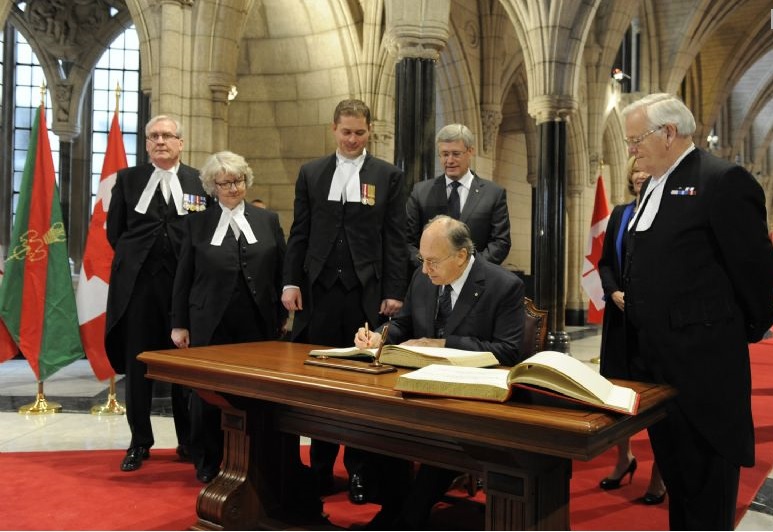
His Highness the Aga Khan signs the visitors books for the House of Commons and the Senate in the Canadian Parliament Rotunda as Prime Minister Stephen Harper, his wife Laureen Harper, The Honourable Andrew Scheer, Speaker of the House of Commons and the Honourable Noël Kinsella, Speaker of the Senate, and other individuals look on. Photo credit: TheIsmaili/Gary Otte.
I happily recall the establishment of the Delegation of the Ismaili Imamat here in 2008 and the Prime Minister’s description that day of our collaborative efforts to make Canada “the headquarters of the global effort to foster peace, prosperity, and equality through pluralism.”
We are deeply pleased that we can sign today a new Protocol with your Government — further strengthening our ongoing platform for cooperation.
As we look to the next 25 years of the AKDN, we believe that our permanent presence in the developing world will make us a dependable partner, especially in meeting the difficult challenges of predictability.
5. THE ISLAMIC UMMAH AND INCLUSIVENESS OF OTHER FAITHS DURING THE ABBASID AND FATIMID ERAS
Against this background, let me move on to the broad international sphere, including the role of relations between the countries and cultures of Islam — what we call the Ummah — and non-Islamic societies. It is central to the shape of global affairs in our time.
I would begin by emphasising a central point about the Ummah often unseen elsewhere: the fundamental fact of its immense diversity. Muslim demography has expanded dramatically in recent years, and Muslims today have highly differing views on many questions.
Essential among them is that they do not share some common, overarching impression of the West. It has become commonplace for some to talk about an inevitable clash of the industrial West and Islamic civilizations. But Muslims don’t see things in this way. Those whose words and deeds feed into that point of view are a small and extreme minority. For most of us, it is simply not true. We find singularly little in our theological interpretations that would clash with the other Abrahamic faiths — with Christianity and Judaism. Indeed, there is much that is in profound harmony.

Officers of the Royal Mounted Canadian Police Salute as His Highness the Aga Khan and Prime Minister Harper walk up the stairs at Parliament Hill on Thursday, February 27, 2014. COC Photo by Jason Ransom
The complexity of the Ummah has a long history. Some of the most glorious chapters in Islamic history were purposefully built on the principle of inclusiveness — it was a matter of state policy to pursue excellence through pluralism. This was true from the time of the Abbasids in Baghdad and the Fatimids in Cairo over 1,000 years ago. It was true in Afghanistan and Timbuktu in Mali, and later with the Safavids in Iran, the Mughals in India, the Uzbeks in Bukhara, and Ottomans in Turkey. From the 8th to the 16th century, al-Andalus thrived on the Iberian Peninsula — under Muslim aegis — but also deeply welcoming to Christian and Jewish peoples.
Today, these Islamic traditions have been obscured in many places, from Muslims and non-Muslims alike.
6. AGA KHAN TRUST FOR CULTURE
AND THE AGA KHAN MUSEUM

A depiction of the Aga Khan Museum and the Ismaili Centre which are nearing completion in Toronto, Canada.
The work of the Aga Khan Trust for Culture….is to revive the memory of this inclusive inheritance. Another immediate initiative is the Aga Khan Museum which will open this year in Toronto, an important testimonial in a Canadian setting to the immense diversity of Islamic cultures.
7. SUNNI AND SHIA TENSIONS AND IMPORTANCE FOR NON-MUSLIMS TO COMMUNICATE WITH BOTH PARTIES
Perhaps the most important area of incomprehension, outside the Ummah, is the conflict between Sunni and Shia interpretations of Islam and the consequences for the Sunni and Shia peoples.
This powerful tension is sometimes even more profound than conflicts between Muslims and other faiths. It has increased massively in scope and intensity recently, and has been further exacerbated by external interventions. In Pakistan and Malaysia, in Iraq and Syria, in Lebanon and Bahrain, in Yemen and Somalia and Afghanistan it is becoming a disaster. It is important, therefore, for non-Muslims who are dealing with the Ummah to communicate with both Sunni and Shia voices. To be oblivious to this reality would be like ignoring over many centuries that there were differences between Catholics and Protestants, or trying to resolve the civil war in Northern Ireland without engaging both Christian communities. What would have been the consequences if the Protestant-Catholic struggle in Ireland had spread throughout the Christian world, as is happening today between Shia and Sunni Muslims in more than nine countries? It is of the highest priority that these dangerous trends be well understood and resisted, and that the fundamental legitimacy of pluralistic outlooks be honoured in all aspects of our lives together — including matters of faith.
8. THE WORLD HAS TO PAY MORE ATTENTION TO CIVIL SOCIETY
By Civil Society I mean an array of institutions which operate on a private, voluntary basis, but are motivated by high public purposes. They include institutions devoted to education, culture, science and research; to commercial, labor, ethnic and religious concerns; as well as professional societies in law, accounting, banking, engineering and medicine. Civil Society encompasses groups that work on health and safety and environmental matters, organisations that are engaged in humanitarian service, or in the arts or the media.
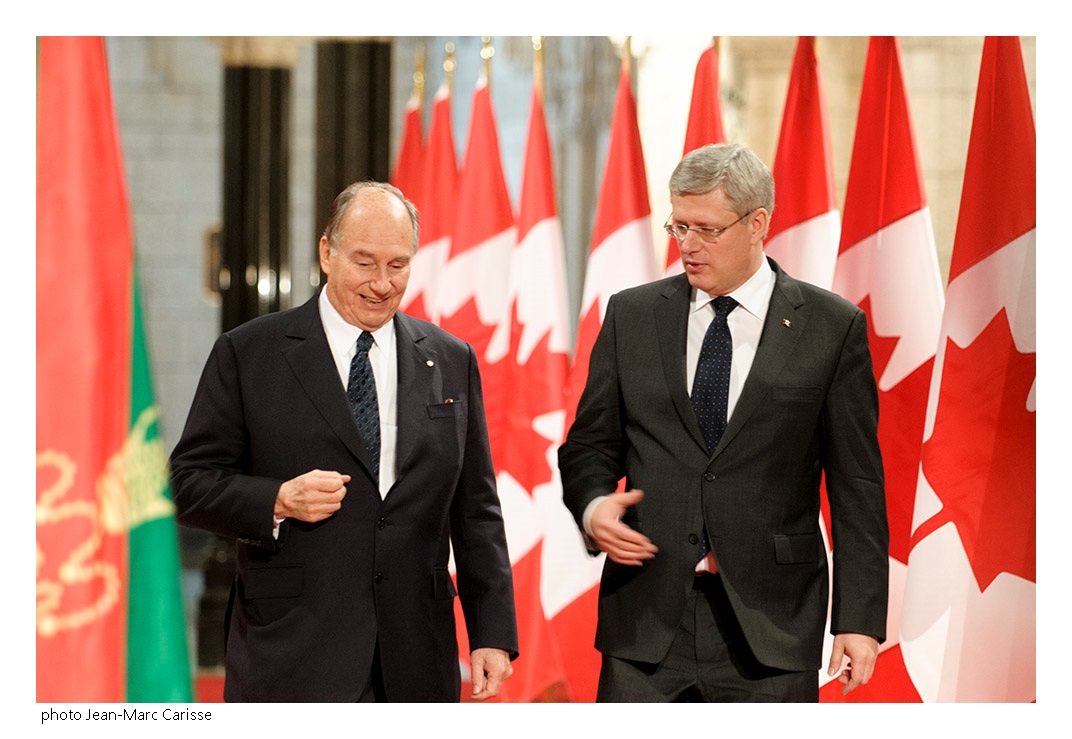
His Highness the Aga Khan and Prime Minister Harper in a conversation as they proceed to the signing ceremony of the protocol of understanding between the Ismaili Imamat and Canada. They are flanked on either side by the red and green flag of the Ismaili Imamat and the maple leaf flag of Canada. Photo: Jean-Marc Carisse. Copyright.
We see it expanding in many places, from Sub-Saharan Africa to Tunisia and Egypt, from Iran to Bangladesh. At a time of extreme danger in Kenya a few years ago — the beginnings of a civil war — the former Secretary-General of the United Nations, Kofi Annan, led the way to a peaceful solution which rested heavily on the strength of Kenya’s Civil Society.
Increasingly, I believe, the voices of Civil Society are voices for change, where change has been overdue. They have been voices of hope for people living in fear.
They are voices that can help transform countries of crisis into countries of opportunity. There are too many societies where too many people live in a culture of fear, condemned to a life of poverty. Addressing that fear, and replacing it with hope, will be a major step to the elimination of poverty. And often the call for hope to replace fear will come from the voices of Civil Society.
9. UNDERPINNINGS OF A QUALITY CIVIL SOCIETY
I believe that Canada is uniquely able to articulate and exemplify three critical underpinnings of a quality Civil Society — a commitment to pluralism, to meritocracy, and to a cosmopolitan ethic.
A cosmopolitan ethic is one that welcomes the complexity of human society. It balances rights and duties, freedom and responsibility. It is an ethic for all peoples, the familiar and the Other, whether they live across the street or across the planet.
Quality education is fundamental to the development of a meritocratic Civil Society, and thus to the development of pluralistic attitudes.
The history of Canada has a great deal to teach us in this regard, including the long, incremental processes through which quality civil societies and committed cultures of pluralism are built. One of the watchwords of our new Global Centre for Pluralism is that “Pluralism is a Process and not a Product.” I know that many Canadians would describe their own pluralism as a “work in progress,” but it is also an asset of enormous global quality.
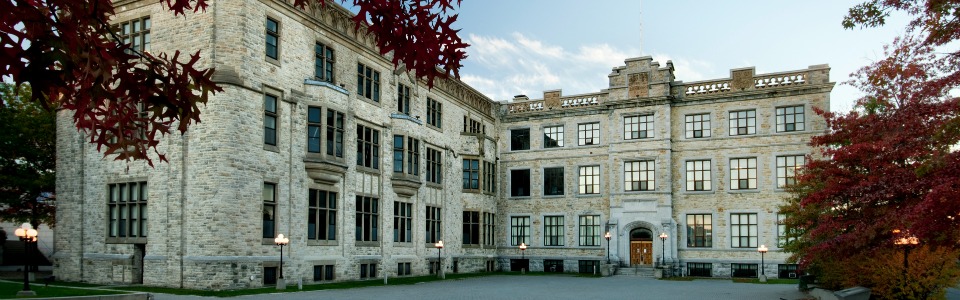
The Old Canadian War Museum will become the future site of the Global Centre for Pluralism, once renovations are completed inside the building. The Centre is governed by an international Board of Directors chaired by His Highness the Aga Khan. The Global Centre for Pluralism was inspired by the example of Canada’s inclusive approach to citizenship, and works to advance respect for diversity worldwide, believing that openness and understanding toward the cultures, social structures, values and faiths of other peoples are essential to the survival of an interdependent world.
What more will a quality Civil Society now require of us? Sadly, the world is becoming more pluralist in fact, but not necessarily in spirit. “Cosmopolitan” social patterns have not yet been matched by “a cosmopolitan ethic.” In fact, one harsh reality is that religious hostility and intolerance seems to be on the rise in many places — from the Central African Republic, to South Sudan, to Nigeria, to Myanmar, the Philippines and other countries — both between major religious groups and within them.
Again, Canada has responded in notable ways, including the establishment — just one year ago — of the Office of Religious Freedom. Its challenges, like those facing the Centre for Global Pluralism, are enormous and its contributions will be warmly welcomed. And surely it will also serve as a worthy model for other countries.
In sum, I believe that Civil Society is one of the most powerful forces in our time, one that will become an increasingly universal influence, engulfing more countries, influencing, reshaping and sometimes even replacing ineffective regimes. And I also believe that Civil Society around the world should be vigorously encouraged and wisely nurtured by those who have made it work most successfully — Canada first amongst all.
10. THANK YOU PRIME MINISTER
The Aga Khan Development Network has worked over five decades to assist in the enhancement of Civil Society. And as we look to its future, we are honoured that Canada views us as a valued partner. Thank you Prime Minister. One key to Canada’s success in building a meritocratic Civil Society is your recognition that democratic societies require more than democratic governments.
11. “ENLIGHTENED FULFILLEMENT”
THROUGH VOLUNTARY SERVICES
I have been impressed by recent studies showing the activity of voluntary institutions and not-for-profit organisations in Canada to be among the highest in the world. This Canadian spirit resonates with a cherished principle in Shia Ismaili culture — the importance of contributing one’s individual energies on a voluntary basis to improving the lives of others.
This is not a matter of philanthropy, but rather of self-fulfillment — “enlightened self-fulfillment.”

His Highness the Aga Khan and Prime Minister Stephen Harper sign a Protocol of Understanding further strengthening the ongoing platform of cooperation between the Ismaili Imamat and Canada. Photo: Jean-Marc Carisse. Copyright.
During my Golden Jubilee — and this is important — six years ago Ismailis from around the world volunteered their gifts, not only of wealth, but most notably of time and knowledge, in support of our work. We established a Time and Knowledge framework, a structured process for engaging an immense pool of expertise involving tens of thousands of volunteers. Many of them traveled to developing countries as part of this outpouring of service — one third of those were Canadians. Their impact has been enormous in helping us to achieve best practice standards in our institutions and programmes, making us we hope an even better partner for Canada!
The Aga Khan University in Karachi and East Africa are expanding to create a new Liberal Arts faculty, and to establish eight new post-graduate schools in collaboration with several Canadian universities.
12. SALUTING FRASER MUSTARD FOR HIS WORK
ON EARLY CHILDHOOD DEVELOPMENT
We also share with Canada a deep appreciation for the potential of early childhood education. It is the period of the greatest development of the brain. This education is one of the most cost-effective ways to improve the quality of life for rural as well as urban populations. Congratulations, Prime Minister, for your initiative on this.
In this regard, let me take a moment to salute the late Dr Fraser Mustard, whose work in Early Childhood Development will impact millions of people around the world. The AKDN has been fortunate to have been inspired and counselled by this great Canadian scientist and humanist.
13. THE OPPORTUNITY TO ADDRESS TO THE PARLIAMENT
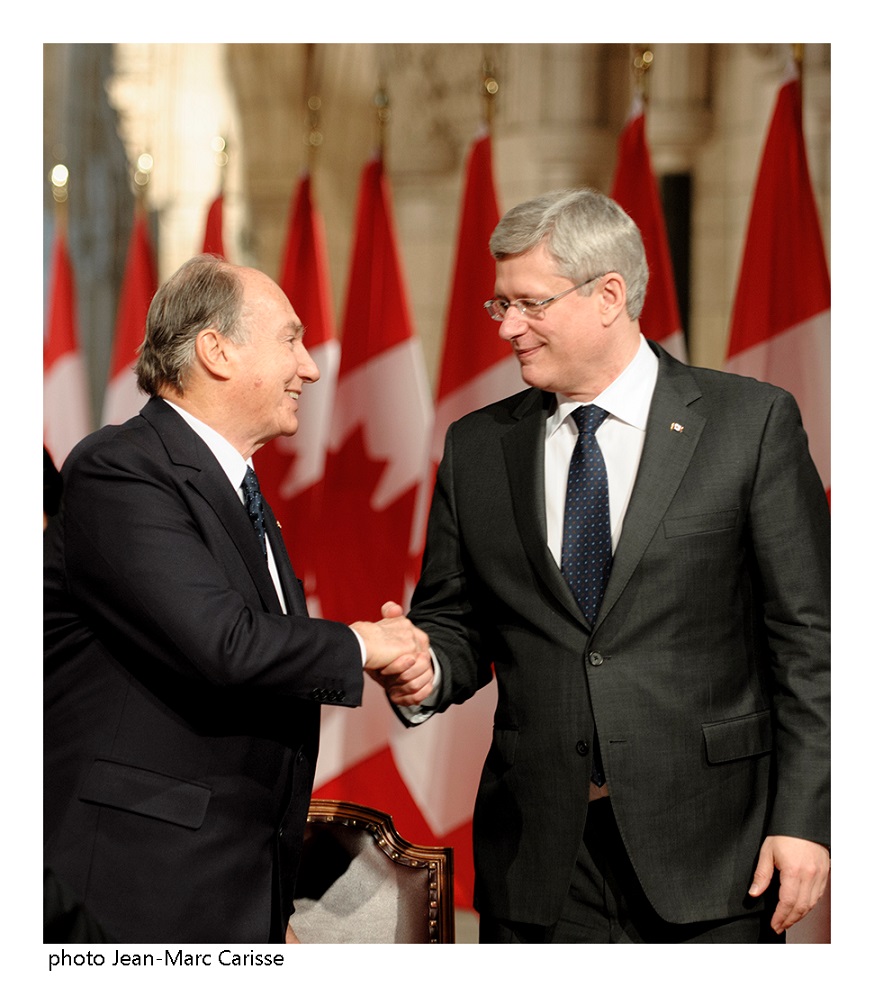
His Highness the Aga Khan and Prime Minister Stephen Harper congratulate each other after signing a Protocol of Understanding between the Ismaili Imamat, a 1400 year hereditary Institution, and Canada. Photo: Jean-Marc Carisse. Copyright.
I am most grateful to the Prime Minister and to you who have given me this opportunity to share — from a faith perspective — some of the issues that preoccupy me when looking ahead. I hope I have explained why I am convinced about the global validity of our partnership for human development.
14. A BEAUTIFUL EXPRESSION FROM THE HOLY QUR’AN
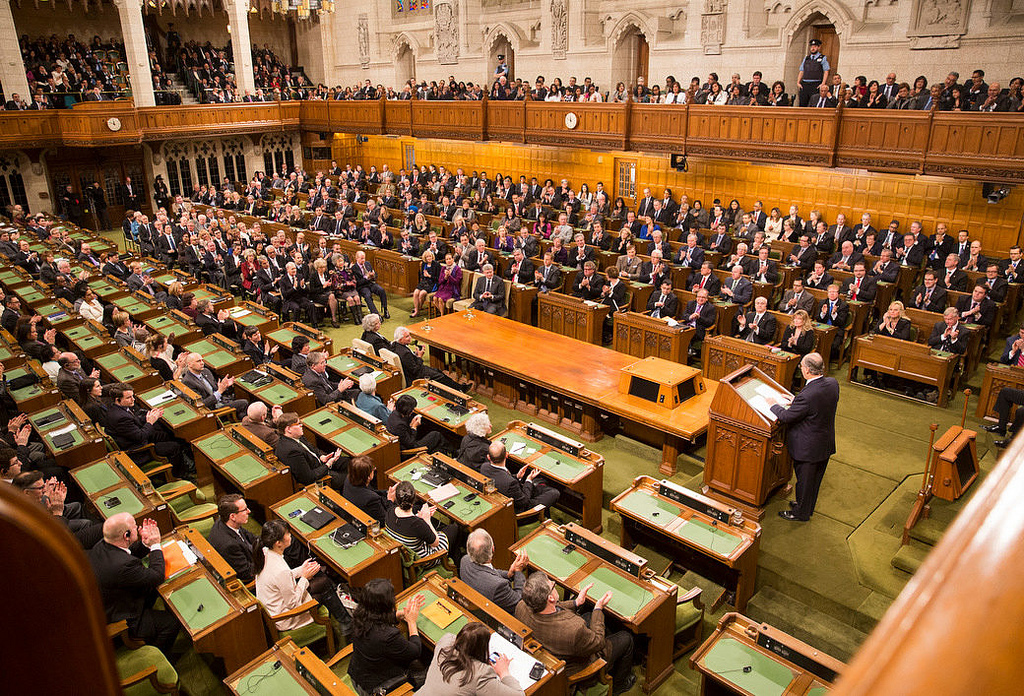
His Highness the Aga Khan seen addressing at the House of Commons Chambers to both the houses of Canadian Parliament on Thursday, February 27, 2014. Photo credit: The Office of the Prime Minister of Canada.
Let me end with a personal thought. As you build your lives, for yourselves and others, you will come to rest upon certain principles. Central to my life has been a verse in the Holy Quran which addresses itself to the whole of humanity. It says:
‘Oh Mankind, fear your Lord, who created you of a single soul, and from it created its mate, and from the pair of them scattered abroad many men and women.’
I know of no more beautiful expression about the unity of our human race — born indeed from a single soul.
Date posted: Saturday, March 1, 2014. Copyright.
Date last update: Sunday, March 2, 2014, 09:30 EST (new related links, below)
Related:
______________
For non-comparable referral links to all things Ismaili as well as material about His Highness the Aga Khan’s recent official visit to Canada, please visit ismailimail. For past and recent speeches of Ismaili Imams please visit www.nanowisdoms.org.
Also click on the following links for some extraordinary official coverage of the visit including photographs, videos and speeches:
_________________
We welcome feedback/letters from our readers on the essay. Please use the Comments LEAVE A REPLY box which appears below. Your feedback may be edited for length and brevity, and is subject to moderation. We are unable to acknowledge unpublished letters.
Please visit the Simerg Home page for links to articles posted most recently. For links to articles posted on this Web site since its launch in March 2009, please click Table of Contents. Sign-up for blog subscription at top right of this page.




 Simerg - Insights from Around the World