PLEASE CLICK: Ottawa Celebrates forthcoming visit of Mawlana Hazar Imam, His Highness the Aga Khan, to Eastern Canada
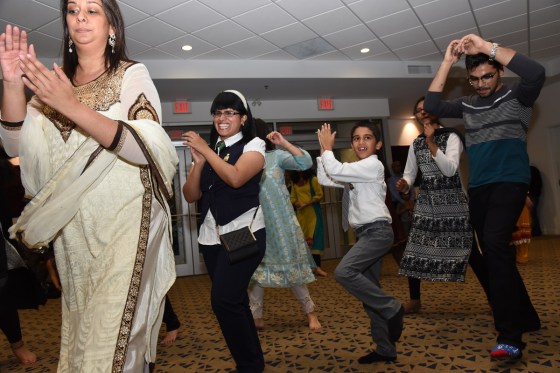
Photo: Safiq Devji. Please click on photo for story.
Date posted: October 29, 2017.
________

PLEASE CLICK: Ottawa Celebrates forthcoming visit of Mawlana Hazar Imam, His Highness the Aga Khan, to Eastern Canada
Photo: Safiq Devji. Please click on photo for story.
Date posted: October 29, 2017.
________
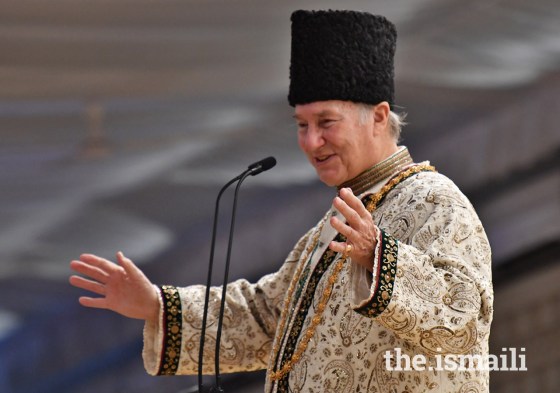
His Highness the Aga Khan, Mawlana Hazar Imam, at the Dar es Salaam Darbar in October 2017. He will grace the Eastern Canadian Ismailis with his didar in November 2017.
By Malik Merchant, Editor
(Note: We will have regular updates leading upto the visit; here are the latest updates for this blog):
Ismailis in Eastern Canada will, inshallah, be graced with the holy visit of their beloved 49th Imam, His Highness the Aga Khan, during the month of November 2017. The announcement of the visit by the Ismaili Leadership International Forum (LIF) came as a big surprise, and thousands who were present in Jamatkhanas across Canada on Friday, October 27, gasped with delight when the news of the visit was read out. At the Ismaili Centre in Toronto, the Jamat was informed about the visit by the Chairman of the LIF, Mahmoud Eboo, who is also the representative of the Aga Khan Development Network (AKDN) in Canada.
The exact dates and details of the visit were not announced on Friday. However, an update on Saturday October 28th, stated that Mawlana Hazar Imam’s mulaqats with the Eastern Canada Jamat, which will include religious work, will take place in Toronto for the Ontario region and in Montreal for the Quebec and Maritime Provinces. Although located in Ontario, the Jamat in Ottawa, Canada’s capital, will join hands with the Jamats of the Quebec and Maritime Provinces in Montreal.
This will be the third visit by the Aga Khan to his followers during his Diamond Jubilee year that commenced on July 11, 2017, when he completed 60 years of his reign. Earlier in October, he made official visits to Uganda and Tanzania at the invitation of the two governments. During the five day tour that began on October 8th, Mawlana Hazar Imam graced the Ismailis with momentous Darbars (lit. a court or audience chamber where kings had formal or informal meetings) in Kampala and Dar es Salaam.
On this most auspicious and joyous news of Mawlana Hazar Imam’s forthcoming visit to Canada, we convey our heartiest felicitations to Ismailis in Canada and around the world and offer a humble supplication with the following words taken from a Ginan by Pir Hasan Kabirdin (14th century).
Transliteration
Eji, Aash Karine Ya Ali* hun tere dar ubhi,
Kar jodine em mangu Ya Shah;
Dejo didar tusi mahavar datar Shah,
Hama tere charane lagu.
Translation
With hope O Ali I stand at Thy door,
With palms joined I sincerely beg of Thee;
Bless me with Thy Holy Didar, O Great Lord and Benefactor!
At Thy Feet I fall to prostrate.
*Ismaili doctrine emphasizes the principle of the Unity of Imamat under the superficial diversity exhibited by each Imam of the Time. It is in this sense that the Ismailis believe that Imam is the same irrespective of his own age or the time he lives in. Thus, the name of the first Imam, Hazrat Ali, is commonly invoked for each Imam of the Time.
The proverbial valour and exemplary statesmanship of Imam Mawla Murtaza Ali, the encyclopaedic erudition of Imam Ja’far as-Sadiq, the extraordinary intellectual brilliance of Imam al-Hakim bi Amrillah, the administrative ability of Imam Mustansir Billah (during the first half of his Khilafat), the political acumen of Imam Sultan Mahomed Shah, Aga Khan III (he defied geography and created history), the organizing genius of the present Imam, Mawlana Shah Karim al-Husayni, are only some of the more spectacular characteristics exhibited by the Imam of the Time in accordance with the exigencies of the situations facing him.
Date posted: October 27, 2017.
Last updated: October 29, 2017.
Related updated post: Ottawa Celebrates Mawlana Hazar Imam’s Forthcoming Visit to Canada, @Barakah.com
_____________
We invite our readers to download Simerg’s special PDF publication Imamat and Didar Series.
We welcome your feedback. Please click LEAVE A COMMENT

“The closer you come, the more you will see him.” A digital portrait of His Highness the Aga Khan by Akber Kanji. The portrait is composed of several hundred thumbnails representing a cross-section of events during the Aga Khan’s Imamat. Please click on image for Andrew Kosorok’s essay. Image: Akber Kanji. Copyright.
_______________

Please click on photo to read Mwalimu Bukenya’s essay on the Aga Khan.
Date posted: October 18, 2017.
_________________________
PLEASE CLICK: The Aga Khan’s Diamond Jubilee in Uganda and Tanzania
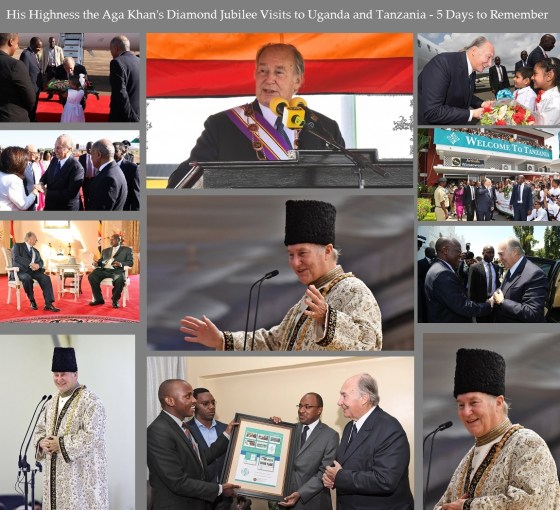
Please click on image for a comprehensive coverage.
Date posted: October 15, 2017.
______________
5 days to remember: The Aga Khan’s Diamond Jubilee in Uganda and Tanzania
AUDIO OF REMARKS BY HIS HIGHNESS THE AGA KHAN UPON RECEIVING UGANDA’S HIGHEST HONOUR
~~~~~~~~~~
COVERAGE
~~~~~~~~~~
PHOTOS OF MAWLANA HAZAR IMAM’S ARRIVAL AND FLASHBACK: THE AGA KHAN AND UGANDA
PLEASE CLICK: His Highness the Aga Khan arrives in Uganda for 55th Uhuru Day celebrations and to grace Ismailis with Darbar

Please click on image for photos and story as well as special feature The Aga Khan and Uganda

Photo: Vivian Rozsa. Copyright. Please click on image for Aga Khan’s View of the World.
Date posted: October 7, 2017.
______________
Anaar Naran (1936-2017) passed away peacefully on September 14, 2017 in Richmond, Virginia. Many readers responded to the post and on the social media with messages of condolences to her family as well as prayers for the eternal peace of her soul. We publish below an edited version of a eulogy presented by her son Amyn. — Ed.
By AMYN NARAN

Anaar Naran holding her youngest daughter Naaznyn, with son Amyn and daughter Navyn standing beside her. A photo of her husband Badrudin, who passed away in 1979 at the age of 48, is shown in the backdrop. Photo: Naran Family Archives.
My mom was like a superhero to me. No not the fly-through-the-air kind but the kind that gave me unconditional love, nothing I could say or do would diminish me.
We would talk almost everyday for a few minutes. It was important to me that she knew I cared. The phone greeting ‘hi Amyn’ or just plain ‘hi’ was sweet and gentle…the ‘love u’/ “love you ma” at the end was equally sweet. Sometimes I would just pause and say “I love you mah, you know that right ? “and she would say ‘I love you too’.
A little background on my mum, Anaar Naran: Rheumatic fever in early childhood (its bad), death of a father at 7, new father figure, limitations because she was female, 2 miscarriages, moving continents with young kids, moving continents again 7 years later, losing a husband soon after, financial challenges, loss of a father figure, loss of mother, brother, important members of her family, surgeries to back, brain, heart, multiple heart-attacks, multiple strokes, more surgeries and countless procedures.
To have had so many headwinds in life, the least I could do was provide a little love…but my love was nothing compared to that I received. NOTHING! this is what my superhero gave me – unconditional love. There is a tradition of the Prophet Muhammad that says, “Paradise lies at the feet of your mother.” Indeed!

A portrait of Anaar Naran with a photo of her beloved Imam, Mawlana Shah Karim al-Hussaini Hazar Imam, His Highness the Aga Khan, in the background. Photo: Naran Family Archives.
The thing that had provided MOM sustenance was her faith; the work, resources and love for her faith were herculean. Her care for others superseded that of herself. Without a doubt that without her faith, without her faith, I don’t think she would have lived as long and been part of our lives.
Throughout my life MOM has been a fabric, a connection to the past, a connection to lives and experiences of the different members of my family…my dad, my grandmas, my chachas. Losing her is also losing all that.
On the phone we would reminisce, I’d make up stories and listened to her recent escapades. I didn’t realize I talked too fast…she ‘d tell me and I wouldn’t always get it. Y
Strokes affect the brain health..and continue to deteriorate the brain. Mom’s strokes had robbed her of sight in a strange way, her field of vision was inconsistent…imagine if you couldn’t predict what you walked on: it was there or maybe it was there ? That made her feel dizzy, and she had to cope with that problem every day.
The spoken word was both hard to process and hard to find and speak and that is why sometimes her words were sharp, and I didn’t fully get that. Sometimes on the phone she’d say how much she hurt, and that was unbearable to hear. The options she had because of all her medications were few.
Even with all the hurdles, Mom was fiercely independent and loathed the need to be dependent on anyone for help. One time when I was visiting in New Canaan, I took her to a bank. She walked to a teller and said: ‘I’ve had a stroke so please be patient with me’. A couple of times on visits to the bank, I’d just wait outside the bank and she would appreciate that because it proved she was independent. Her determination was incredible.
I say to my mum: Mom please forgive me, as whilst I loved you from the bottom of my heart, I was not perfect…I just knew that everyday, I wanted to hear your voice and make you feel loved, you, my superhero.
We often shared the following ginans and prayers. Unch thi Ayo, Kalpat Jalpat, Tarye Tu Taran, Ya Raballa, Ya Ali Aghisani, Ya Ali to Rahem Kar, Ya Rahman Ya Rahim. As I mentioned previously, her faith sustained her!
Ma, I love and will love you with all my heart till the day I die. I hope I see you on the other side.
Date posted: October 5, 2017.
_________________
We welcome feedback from our readers. Please click LEAVE A COMMENT.
By ALNOOR JEHANGIR MERCHANT
Simerg’s recent post titled Awesome and Rare Collection of Ismaili Ginans with Music at the British Library and a number of related online contributions, especially Aly Sunderji’s sharing of the equally rare and exceptional audio recordings of devotional songs produced in Tanganyika in 1946 commemorating the Diamond Jubilee of Imam Sultan Mahomed Shah, Aga Khan III (link https://www.youtube.com/watch?v=KqxUDlY_pis&index=1&list=PL8-KGtAvEpq5s1nBIplLQA3j1RDptQ5GJ) is an opportune moment to add some further remarks on the recordings of ginans and geets* produced during the first half of the 20th century. It is hoped that these remarks and, more particularly, the recordings themselves, will provide an impetus in documenting and preserving the diversity of the Ismaili community’s musical heritage and traditions.

Original disc labels of four ginan recordings that are part of a digitization project being carried out by the British Library (clockwise from top left): Satgur miliya mune aje composed by Bibi Imam Begum and sung by Rama and Rahim Ali; Ho jire mara hansa composed by Pir Sadardin; Ab teri mohobat lagi composed by Pir Shams; and Marna hai zarur composed by Pir Imam Shah and all sung by Master Juma Kakali. Images: The British Library (collage by Simerg).
It is difficult to give a precise dating as to when the ginans digitised by The British Library as part of their Endangered Archives Programme (EPA) Project were originally recorded. The ‘Young India’ record label which, according to the British Library catalogue, published these recordings was established around 1935 and continued for approximately 20 years; thus, the recordings should be dated to the period 1935-1955. An examination of the images of the disc labels, however, provides additional information that seems to have been overlooked in the cataloguing process.
On three of the ginan recordings, the disc label states ‘Ismailia Record’, along with the following: Manufactured by National Gramophone Record Manufacturing Company, Bombay, India [and] Sole Distributers [sic], The King Record Company, Kalbadevi, Bombay. The ‘Ismailia Record’ ginan recordings are in the voice of Master Jumma Kakali. On the fourth ginan recording, the disc label states ‘Best Ismaili Record’, along with the following: Manufactured for the Bombay Record Company by the National Gramophone Record Company Limited, Bombay.
As all four ginan recordings do not mention ‘Young India’ on the disc label, it may be that ‘Ismailia Record’ and ‘Best Ismaili Record’ were independent record producers. Unfortunately, the disc labels do not contain any information on the date of production of the records. However, according to Hussain Jasani, who has undertaken some research, there is evidence to suggest that these recordings were produced during 1938. According to Jasani, one of the volumes of the community’s magazine, Ismaili, published during that year, refers to these recordings. [Paper presented by Hussain Jasani, “Preserving Community Heritage; The Oldest-known Ginan (Audio) Recordings”, IIS Alumni Association, European Chapter Group, Annual Meeting, London, 29th September 2017].
Are these the earliest recordings, musical or otherwise, of ginans? In her essay titled “Sacred Songs of Khoja Muslims: Sounded and Embodied Liturgy and Devotion”, (published in: Ethnomusicology, 48, 2 [Spring/Summer 2004]: 251-270), Amy Catlin-Jairazbhoy suggests that a number of ginan recordings made by the Dutch ethnomusicologist and pioneer in the study of South Asian music, Arnold Adriaan Bake, are the earliest. She states (p. 256):
“Probably the earliest ginan recordings were made by Arnold Bake in Karachi in 1939. These as yet unpublished field recordings were sung individually by teenaged boys, presumably found at the Karachi jama‘at (community) school.”
Three of Bake’s Karachi recordings dated 11 March 1939, which he catalogued as ‘Khoja devotional song’ have been identified as:
Jasani’s research suggests that the Bombay recordings, and not the Karachi ones, are the earliest. While the ginan recordings produced (most likely in 1938) as part of the ‘Ismailia Record’ and ‘Best Ismaili Record’ labels or those in the Bake collection (recorded in March 1939) may be among the earliest, it would not be out-of-place to suggest that there could be earlier recordings of ginans, musical or otherwise, which remain to be ‘discovered’.
It is known that sound recordings from South Asia began to be produced at the turn of the 20th century, with the earliest known dating to around 1899. The foremost researcher of early Indian sound recordings is Michael Kinnear. His two books, The Gramophone Company’s First Indian Recordings 1899-1907 (Bombay, 1994) and The Gramophone Company’s Indian Recordings 1908-1910 (London, 2000) document not only the history of the Gramophone Company and its successor companies’ activities in India, as well as the recording expeditions it undertook in the country, but the two volumes also provide complete listings of all known and traceable recordings taken on those expeditions. In one of his other encyclopaedic works titled The 78 RPM Record Labels of India (Apollo Bay, 2016), Kinnear covers all known record labels and histories of the companies from 1899 to the late 1960s. Perhaps, an analysis of the listings contained in Kinnear’s works will lead to the identification of ginan recordings from the first decades of the 20th century. Another important resource could be the various magazines published within the Ismaili community at the time. The Society of Indian Record Collectors may also be an avenue worth exploring. Indeed, it is from the collection of one of the members of the Society of Indian Record Collectors, Suresh Chandvakar, that some of The British Library’s ginan recordings have been digitised.
With respect to the recordings of geets, little research has been carried out. Ali Asani, in the chapter ‘The Git Tradition: A Testimony of Love’ in his work titled Ecstasy and Enlightenment: The Ismaili Devotional Literature of South Asia (London, 2002) writes (p. 71):
“The tradition of composing gits, as we know in its present form, has been associated particularly with Nizari Ismaili communities of South Asian origin….Unfortunately, we know precious little about its development. As is the case with many folk traditions that have been orally transmitted, its historical origins are quite obscure. Moreover, the gits themselves have never been systematically collected and documented.”
In his essay, Asani predominantly refers to geet recordings from the 1980s onwards. And, Amy Catlin Jairazbhoy, states that the Khoja geet emerged “at some uncertain time in the twentieth century” (p. 262). In her essay titled “Songs of Praise: the Git Tradition of the Nizari Ismaili Muslims”, in Gujarati Communities Across the Globe: Memory, Identity and Continuity, ed. by Sharmina Mawani and Anjoom A. Mukaddam (Stoke-on-Trent, 2012), pages 59-78, Sharmina Mawani writes that “few authors have focused on gits…. and the way in which this creative form of expression has flourished from one generation to another” (p. 59). Although her discussion focuses on post-1960 geets, Mawani does refer to a geet by Fateh Ali Ismail Ibrahim titled Aayi Aayi re Sakhi written specifically for the Diamond Jubilee of Imam Sultan Mahomed Shah in 1946, the original lyrics and tune of which “were inspired by the joyous and celebratory nature of the occasion” (pp. 71-72). Indeed, one of the recordings placed online by Aly Sunderji is of this geet (please click https://www.youtube.com/watch?v=E-GnZn4UC7A&index=5&list=PL8-KGtAvEpq5s1nBIplLQA3j1RDptQ5GJ)
The audio recordings shared by Aly Sunderji of devotional songs produced in Tanganyika in 1946 commemorating the Diamond Jubilee of Imam Sultan Mahomed Shah provide us with important information on the geet tradition. And, significantly, in Suresh Chandvakar’s collection, there are a number of recordings that are also most certainly part of this tradition, but which are slightly earlier date-wise.
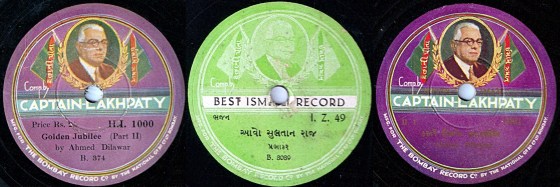
Original disc labels of geet recordings that are part of a digitization project being carried out by the British Library. Images: The British Library (collage by Simerg).
An examination of the listing of the individual recordings from Chandvakar’s collection identifies five enigmatic entries: Aavo Sultan Raj, Golden Jubilee Part 01, Golden Jubilee Part 02, and two listed as Captain Lakhpati. Further, the disc labels on these recordings provide some fascinating information. The disc label for Aavo Sultan Raj states: Compiled by ‘Best Ismaili Record’; the disc labels for Golden Jubilee and Captain Lakhpati state: Compiled by ‘Captain Lakhpaty’. This, undoubtedly, refers to Abdullah Jaffer Lakhpati, who is considered among the founders of the H. H. the Aga Khan Bombay Volunteer Corps, and who was also a versatile poet and artist. It is known that Lakhpati was appointed as Captain of the Volunteer Corps in February 1936. With this reference date, as well as upon listening to the recordings, it is clear that these geets were most likely composed to commemorate the Golden Jubilee of Imam Sultan Mahomed Shah, Aga Khan III, in 1935-36. To date, therefore, these are the earliest musical recordings of geets.
As to the performers, Ahmed Dilawar and Prabhakar, it has not been possible, as yet, to locate any further information on these individuals. It is likely that the various publications issued by the community, such as Ismaili and Fidai, could shed more light on these specific compositions and the performer(s), as well as on the tradition and history of geets.
One final point: All the disc labels of the ginan and geet recordings identified in this article and that posted previously share a common feature. What may be considered as the ‘Headline’ banner in the top half of the disc label is either an illustration depicting an image of Imam Sultan Mohamed Shah in the centre with the red and green Ismaili standard on either side, or the Imamat Crest in the centre, again with the Ismaili standard on either side. Does this not suggest that the recordings were officially produced for circulation?
All the ginan and geet recordings, (links to the geets are provided hereunder), along with Aly Sunderji’s sharing of the Diamond Jubilee geets, provide a fascinating insight into the historical development of this tradition, and allow us to reflect anew on this musical heritage.
Link to Aavo Sultan Raj
Link to Golden Jubilee Part 01
Link to Golden Jubilee Part 02
Link to Captain Lakhpati
Link to Captain Lakhpati
Date posted: October 1, 2017.
Last updated: October 5, 2017 (additional source(s) added by the author, Alnoor Merchant, in paragraph referencing Sharmina Mawani’s essay).
_________________
*The term used to describe a devotional ‘folk song’ is git; however, the more commoner spelling form, geet, is used in this article.
About the author: Alnoor Jehangir Merchant is an independent researcher on Ismaili studies, and a specialist advisor on rare books, coins, photographs and objets d’art relating to the worlds of Islam.
We welcome your feedback. To leave a comment please click LEAVE A COMMENT. If you encounter a technical issue, send your comment to Simerg@aol.com, Subject: Ginans and Geets.
 Simerg - Insights from Around the World