A Gift….September 12, 2014

EXCITEMENT IN THE AIR

by Navyn Naran
zr6_8015-crop

There is excitement, magic in the air.
the Imam has arrived,
the buildings are washed and rewashed with rain,
the winds have combed out snarls and veils
Gray, opaque clouds, as if cotton wool
had been soaked in water
and strewn over the ceiling here.
ahh, cloudbreak.

In the horizon, a peek of baby blue,
tinged with light cream;
the clouds moving elsewhere.
Leaves green, having just been cleansed
by buckets of water overnight,
freshly manicured, ready to welcome
Him to Wynford Drive.
It’s as of the whole area has
returned from a morning jaunt,
refreshed and nicely sore,
rejuvenated for this day!

Prince Karim (left) posing for a birthday photo with his uncle, Prince Sadruddin, and his younger brother Prince Amyn

Which Day?
This day, the 12th of September 2014,
Prince Amyn Mohamed Aga Khan’s Birthday
He was born within a year of the Imam,
adoring the brother he followed as a child.
Whatever Karim does, this ginger colored head
and Trustworthy, Loyal Heart, wanted to do
an adoring brother, he could only be
as Ali to Muhammad, attached:
The elders remember him; a playful, sweet child,
a flair, a flamboyance, detailed care.

As specialized cardiac cells continuously fire ,
beat by beat, and in rhythm,
Prince Amyn, a shadow-like of the Form,
as the gardener of the Master’s land
in His highest esteem.
No laurels; much humor and style.
and it is on this very day, a historic gift to the globe .
77 Wynford Drive on this 77th Birthday.
photo 2

The Aga Khan Museum. The Ismaili Centre. The Park.
In the present, a present,
and presence of leaders, donors, volunteers
and a very Special Eye.
Who’d have thought it in Uganda in 1970?
Who’d have thought it in Canada in 2000?
this is not a facade to name or number,
it is to be understood.
For some perhaps piece by piece.
For others, a space for contemplation.
For opening the eyes.

I remember the barren, grey dirt being overturned,
the harsh, cold winters, icy,
unthawing, unrelenting,
when yellow hatted men worked tirelessly,
from below ground up.
Pieces of structure in an architect’s mind,
in the Architect’s Mind, comes alive.
Work. Many hours and stressors,
much negotiated and coordinated.
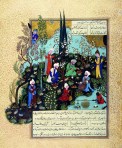
Shah Nameh s

One would never know.
Simple lines, soft color and a
sense of cleanliness and peace.
Magnificent.
Day or night. Lights enter and open,
leave everything behind.
Enter. Come. Ayez…

Come reflect, details of the shahnameh,
the kufic script in a Blue Qur’an,
the magic of art and calligraphy.
Rest a while, be seated. Read.
in the hush of the quiet,
only footsteps of men and women,
children and elders, absorbing.
Perhaps it is only history. Past.
If the skills and beauty compose a piece,
this civilisation is to be included,
to be modeled, continued.
Pluralistic.

It is a day of celebration. Come, Enter, Ayez…

Copyright: Navyn Naran/Simerg

~~~~~~~

“A FABULOUS, GLORIOUS GIFT BY HIS HIGHNESS”

By Malik Merchant
Editor, Simerg
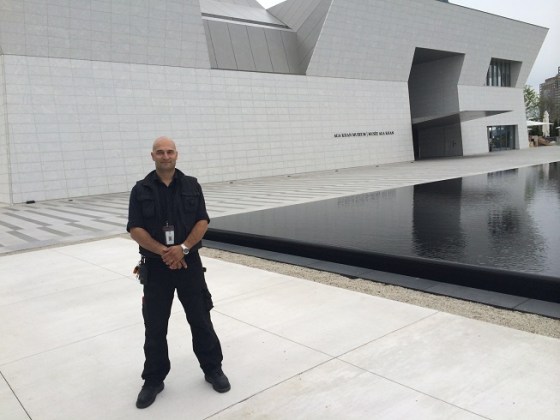
Alex Sarris. Photo" Malik Merchant/Simerg.

Alex Sarris. Photo: Malik Merchant/Simerg.

Alex Sarris, the facility operator at the site of the Aga Khan Museum, the Ismaili Centre and their Park was a few feet away from me. He was discussing with one of his colleagues a hitch that had occurred and which could possibly take a few hours to resolve. I was tantalized by the breathtaking Museum and the Centre that I had earlier walked through as a member of the media invited for the pre-opening review. The view of the two buildings on either side of the Park was stunning. The architectural contrast and splendour could only  be truly appreciated when looking at them from the Park. The calm water of the pond in front of me soothed me. I listened to Alex as I took my final bites of a deliciously chunky roast beef sandwich that had been served to the media earlier at the museum as part of a light lunch. I had wrapped it and tucked it in my computer bag. I was hungry enough again after walking through the museum galleries and the Ismaili Centre! Food! Yes, the ultimate delight when deliciously served!
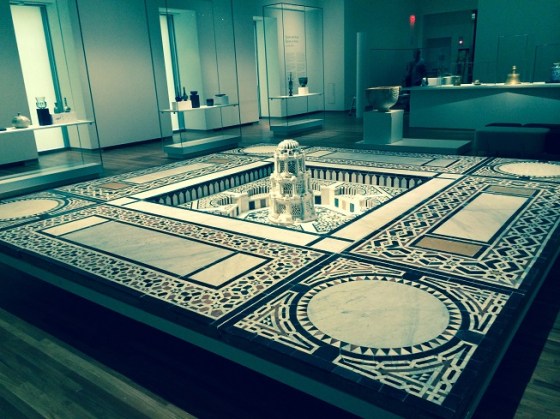
Part of main exhibition hall, Aga Khan Museum. Photo: Malik Merchant/Simerg

Part of main exhibition hall, Aga Khan Museum. Photo: Malik Merchant/Simerg

I thought about the challenges Alex and his team faced during the years they had worked  at the site, under some harsh winter weather! How might have these workers coped, I wondered, like many hundreds and thousands of workers who work on outdoor construction projects. But here was a frustrating delay less than 48  hours before its opening by His Highness the Aga Khan. There was also so much work being done both outside and inside the buildings, I would have thought the opening day was  still several weeks away. Alex soon left  his colleague brimming with confidence and with a cheerful face. I called him aside, and asked him to describe what he saw around him and how he felt. He looked at the two buildings and the park and said, “Fabulous, glorious, a gift by His Highness the Aga Khan befitting a united society cooperating and working together to advance the ideals of pluralism.”
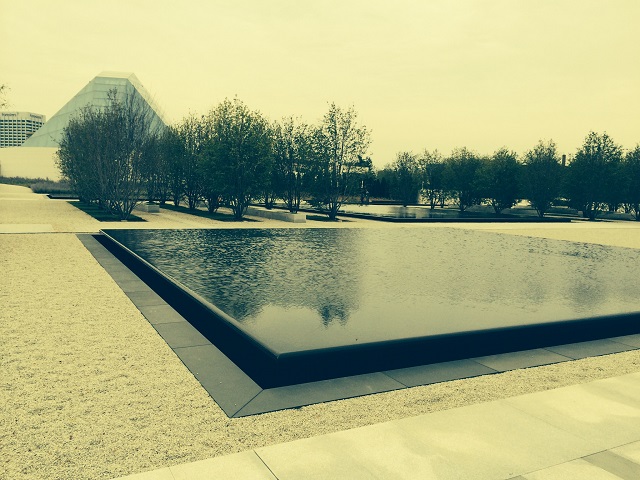
The Park and the Ismaili Centre. Photo:  Malik Merchant/Simerg.

The Park and the Ismaili Centre. Photo: Malik Merchant/Simerg.

“And what about the final few hours to finish the job?” I asked him. He replied, “Two days of diligent working will bring the site up to the highest standards established by His Highness.”  He had greeted me earlier with “Ya Ali Madad” and departed with “Mubaraki to all Ismailis and to all Canadians on this unique occasion.” In all these years, I have not learnt more than 2 or 3 French or Spanish words but I knew Alex had learnt quite a few new words from the on site ‘Ismaili dictionary’ when he had used, in reference to the hitch, the word “mushkil-asaan,” an Arabic phrase used in Ismaili prayers meaning resolution of difficulty. He was seeking a resolution to his immediate problem as well any other outstanding issues that they all faced collectively as a team.

I was grateful for his openness and humility, and was touched and inspired by his cheerful and positive outlook. I bid this wonderfully articulate person good bye, as he graciously permitted me to take his photo with my mobile! 

Date posted: Friday, September 12, 2014.

_________________________

Morning at the Park, Jamatkhana and the Museum by Navyn Naran

The Ismaili Centre and the Aga Khan Museum will be officially opened later this week in the presence of His Highness the Aga Khan, the 49th Imam of the Ismaili Muslims. A series of poems celebrating the many aspects of the two majestic buildings as well as their Park, which is to be opened in 2015, will be published throughout the week. We begin with Navyn Naran’s contemplative piece, Morning at the New Park, Jamatkhana and Museum.

Astrolabe. Credit: Aga Khan Museum Collection

Astrolabe. Credit: Aga Khan Museum Collection

Photo Essay: Stunning New Day and Night Photographs of the First Ismaili Centre in North America by Mohib Ebrahim

The Ismaili Centre and the Aga Khan Museum Opening Ceremonies Set for September 12, 2014

“The Jamati Institutions of Canada are delighted to confirm that the Opening Ceremonies of the Ismaili Centre Toronto and the Aga Khan Museum will take place in the presence of Mawlana Hazar Imam on Friday, September 12, 2014. It is anticipated that the Opening Ceremony for the Ismaili Centre will take place in the afternoon on September 12, followed immediately by an Opening Ceremony at the Aga Khan Museum. To mark this historic occasion, we invite Jamati members to view a live showing of the opening ceremony at the Ottawa Headquarters Jamatkhana and the Kingston Jamatkhana.” Courtesy: Al-Akhbar Newsletter, Special Ottawa Edition, Friday, September 5, 2014. [Note: Jamats around the country will gather at their respective jamatkhanas or specially hired halls to watch the opening ceremony – ed.]

As Canadians from all backgrounds, cultures and faiths await the official opening in Toronto of the Ismaili Centre and the Aga Khan Museum (the Park will open in 2015) conceived by His Highness the Aga Khan, the 49th Imam of the Ismaili Muslims and the direct descendant of the Prophet Muhammad (s.a.s), Mohib Ebrahim of Vancouver presents an array of stunning breathtaking photographs that he took during a recent  memorable visit to the first Ismaili Centre and Jamatkhana in North America built in Burnaby, British Columbia, in 1985. Please click Photo Essay: Stunning and Beautiful Day and Night Time Photography of North America’s First Ismaili Centre.

Burnaby Ismaili Centre, by Mohib Ebrahim, © 2014. Please click on image for photo essay.

Burnaby Ismaili Centre, by Mohib Ebrahim, © 2014. Please click on image for photo essay.

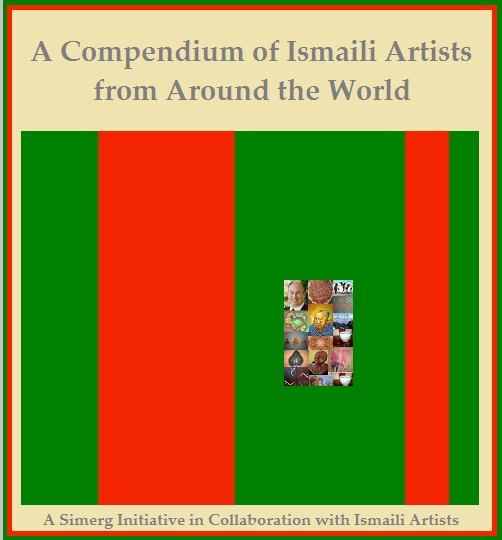
Compendium of Ismaili Artists from Around the World: A Simerg Initiative

Simerg is delighted to introduce a preview edition of the long awaited arts compendium of Ismaili artists. The publication currently profiles 19 Ismaili visual artists from around the world, and more entries will be added as we hear from Ismaili artists – professionals and non-professionals alike. We ask that artists submit a brief profile and an image from one of their art pieces for inclusion in the next updated version of this unique “directory.” The updated version, which will be designated as the first official edition, will be published on October 1, 2014. To download or view the preview version of the compendium, please click on the image below.

TO VIEW/DOWNLOAD PDF PLEASE CLICK ON IMAGE

Ismaili Artist Compendium Cover with Thumbnails

Simerg to Launch Photo Contest to Celebrate the Opening of the New Aga Khan Museum

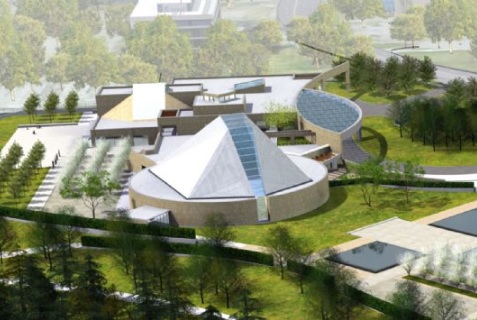
An artistic rendering of the Ismaili Centre, the Aga Khan Museum and their Park. Photo: The Ismaili/Imara.

An artistic rendering of the Ismaili Centre, the Aga Khan Museum and their Park. Photo: The Ismaili/Imara.

Simerg is celebrating the public opening of the Aga Khan Museum on September 18, 2014, by launching a photography contest. A total of 25 photos, all related to the Aga Khan Museum, the Ismaili Centre and their Park taken from the time the grounds become open to the public through to September 25, 2014, will be selected by an independent panel of judges and posted on this website on or around 7th October, 2014. The prizes will consist of a total of 20 free annual youth and family memberships to the museum as well as 5 merit prizes from the museum’s shop.

There will be two categories. The Youth Category will be open to anyone 19 and under. A total of 10 annual youth memberships will be given to the winning entries and, in addition, the judges will select 5 merit entries who will be awarded with the Aga Khan Museum catalogue.

The Open Category is for anyone over the age of 19. It will be for all amateur photographers and photography enthusiasts as well as anyone who likes to shoot photographs, either using a camera or their smart hand-held devices and phones! For this category we will expect each photo to be accompanied with a 75 to 100 word narrative to encapsulate the photographer’s experience of the Aga Khan Museum, the Ismaili Centre or their Park. Only spaces where photos are allowed to be taken will be accepted for the contest.

The opening days of the museum will be the perfect breeding ground for passionate picture taking and writing a brief narrative, and if you are selected as a winner in the Open Category you will be one of 10 to receive an annual family membership.

Here are some ideas for taking and submitting photos: artistic and architecture beauty and grandeur of the projects, interior spaces (where permitted), landscape, nature (as in the park), as well as spontaneous moments involving people!

The prizes that are to be given are from gracious donations by numerous individuals and families in Ontario. Further details of the contest, including the names of judges, will be published in the coming fortnight. Start preparing for this contest as communities in Ontario and Canada as well as around the world eagerly anticipate the opening of three unique cultural initiatives undertaken by His Highness the Aga Khan!

“What is Faith?” by Pir Shihabu’d-Din Shah and “Love for the Imam” by Imam Ja’far as-Sadiq

1. FAITH

by Pir Shihabu’d-Din Shah

Faith (Iman) is like a tree, the roots of which go into the heart: its trunk is in reason, and its branches are in the instincts, while imagination is its new shoots and leaves – (senses of) the body. The foundation (asl) of faith is love for the Imam-e-Zaman (the Imam of the Time). And if this foundation, that is, this love, and the roots of faith are strong and in good condition, all other parts of the tree, such as its trunk, its branches and leaves, can be expected to continue to flourish even if they are (accidentally) damaged. If, on the contrary, the roots are not well grounded, or even rotten, the whole tree will soon dry, and then will become good for nothing except to be used as fuel.

Thus love for Mawlana Hazar Imam is everything, being the root of faith. If it is not strong, all the acts of outward piety (a’mal-i zahiri) which are like leaves of the tree, will fade. If you have thousands of leaves, fresh and of good colour, they will dry in a short time, and then a very small fire will be sufficient to burn them completely.

~~~~

2. LOVE FOR HAZAR IMAM

by Imam Ja’far as-Sadiq

It is related from Imam Ja’far as-Sadiq (a.s.) that a group of Shias visited him one day. One in the group addressed the Imam and spoke of a man who was with them.

O Son of the Messenger of God: this man has love for you.”

On hearing these words, the Imam looked at the person and said:

“The best kind of love is the love for the sake of God and His Messenger. There is no gain in any other kind of love.”

The Imam then continued.

“Once the ansars [helpers] came to Hazrat Muhammad Mustafa (s.a.s.) and said, ‘O Messenger of God! We were on the wrong path and Allah guided us through you. We were destitute and we prospered by your blessings. For this reason, you may ask of anything you desire from our belongings and we shall give it to you.’

“At this, the following verse was revealed by Allah, ‘Say (O Muhammad): No reward do I ask (for my favours) except your love for my kith and kin’.”

Moved to tears, Imam Ja’far as-Sadiq then raised his hands and exclaimed:

“Praise be to God, Who has exalted us above all.”

___________

“Faith” adapted from Risala dar haqiqat-i din by Pir Shihabu’d-Din Shah Al-Husayni, translated as True Meaning of Religion by Wladimir Ivanow.  Pir Shihabu’d-Din Shah was the eldest son of the  47th Ismaili Imam, Aga Ali Shah, also known as Aga Khan II. The Pir was only 33 when he died due to a chest related illness, a few months before the demise of his own father, Imam Aga Ali Shah. Mawlana Shah Sultan Mahomed Shah, His Highness the Aga Khan III, then only 8 years old, succeeded to the throne of Imamat as the 48th Imam.

“Love for Imam” excerpted from article by Jehangir Merchant and Alnoor Bhatia published in Ilm, Volume 5, Number 1 (July 1979). The article was based on the Gujarati edition of Qadi al-Numan’s work, Da’aim al-Islam.

A Tribute to Mawlana Hazar Imam for Creating “Centres” of Soul at Wynford Drive in Toronto

On October 10, 2010, Bashir Fazal Ladha of the United Kingdom, during his visit to Toronto, went to Wynford Drive to see how the construction work of the Ismaili Centre, the Aga Khan Museum and their Park was coming along. He writes: “It was a thrilling moment and I was full of excitement when I saw the progress, and in a moment of inspiration I composed a poem which I have decided to share with readers of Simerg.” The opening of the museum to the public on September 18, 2014 was announced recently and we take the privilege to repost this beautiful and inspiring poem for all our readers.

Writing the History of Tomorrow

Please click to enlarge

A photo of the site captured on October 10, 2010 by Jim Bowie - the day Bashir Ladha visited the area and was thus inspired to write the poem. Photo: Jim Bowie

A photo of the site captured on October 10, 2010 – the day Bashir Ladha visited the area and was thus inspired to write the poem. Photo: Jim Bowie. Copyright.

BY BASHIR LADHA

A look down deep in the bowls of the earth
“A foundation being laid, a foundation of a building?” I ask
Not only, it is a foundation of a history to unfold…..

I bow my head in submission to
The Lord of  Time and Age
Yes the Lord of Time and Age
For indeed you are beyond time and space

The planets rotate in their orbits
Glorifying your majestic presence
In those momentous moments,
time and history are created

Not the history as in past,
but the unfolding of tomorrow

Lord you create  a new history brick by brick
As the form takes place…
The Majesty of your
awe-inspiring Light is Manifested

Stage by stage, the inner world is recreated
The plaster of your mercy,
the warmth of your love

All adorn the formless and
the formed building you built

You call these “centres”
Indeed these are “centres” of soul
where your name is mentioned

The light shines forth from its windows
Inviting the convenienced  and the stray
Inviting both to a new history of tomorrow
and recreating the event of
alastu*
Inviting to the life of paradise

Museum where the past will be enlivened
Prayer hall where the soul will be enriched
Park where the future will be contemplated
All this, a gift to humanity

Then why, Ya Mawla why do I neglect
Why do I remain unheeded
remaining a slave to my ego?

Teach me O Lord to submit,
to worship as if I see you

And if I do not see you,
to know that you see all

Wynford Drive, Toronto, Ontario, Canada
I walk with you to a future
A history of tomorrow
Blessed by the Lord of Time and Age

I walk in hope and faith
for a better world ahead
.

* The day of the Primordial Covenant or the Day of Alastu is when God addressed the people and said, “Am I not your Lord?”  (alastu bi Rabbikum). It was the day when hearts were given spiritual nourishment.

© Simerg.com

________________

About the writer: Bashir Ladha has served Ismaili Institutions for the past forty years as an Alwaez, teacher and writer. He has been with the Ismaili Tariqah and Religious Education Board for the United Kingdom since 1983.

The Aga Khan Museum, the Ismaili Centre and their Park: Why I Like This Photo

As work commenced on the large empty plot that had formerly housed the Bata Shoe Company, the trees that lined the perimeter of the site were carefully removed, and gave way to heavy construction equipment and trucks as well as hundreds of skilled professionals for the multi-year construction phase of new Aga Khan Museum, the Ismaili Centre and their Park. Cranes illuminated the night sky. From a highrise building across the Don Valley Parkway, and from the beginning of the project, resident Jim Bowie began taking pictures of the site every single day from his balcony. When we published his highly acclaimed photo essay, In the Making: The Aga Khan Museum, the Ismaili Centre and their Park, we  invited  our readers to select a photo they liked. Here are reposts of two winning entries, as Canada and the world await the opening of the magnificent Aga Khan Museum to the public on September 18, 2014.

The Symbolism of the Halo

By Dana Lopez

Click to enlarge

A halo from the construction site of the new Ismaili Jamatkhana and the Aga Khan Museum in Toronto. The long exposure created this halo from the lights on November 29, 2010. It is not an effect that Jim Bowie created, and he can't quite explain it. Photo: Jim Bowie, Toronto.

A halo from the construction site of the new Ismaili Jamatkhana and the Aga Khan Museum in Toronto. The long exposure created this halo from the lights on November 29, 2010. It is not an effect that Jim Bowie created, and he can’t quite explain it. Photo: Jim Bowie, Toronto.

I enjoyed viewing Jim Bowie’s photo because of its symbolism. Two features are notable in particular. First, the area ringed by the halo appears calm, whereas the area outside the halo pulsates with heavy traffic. I came away with the impression that the haloed area represents a beacon in a hectic world. Second, the three bright lights inside the halo look like newborn stars, perhaps even a new universe. Viewed through this prism, the photo is asking us to make enlightenment the focal point of our daily lives. This interpretation is consistent with the desired impact of the center: to give strength to those of the Ismaili faith while beckoning others to explore the rich contributions of Islamic culture.

~~~~~~~

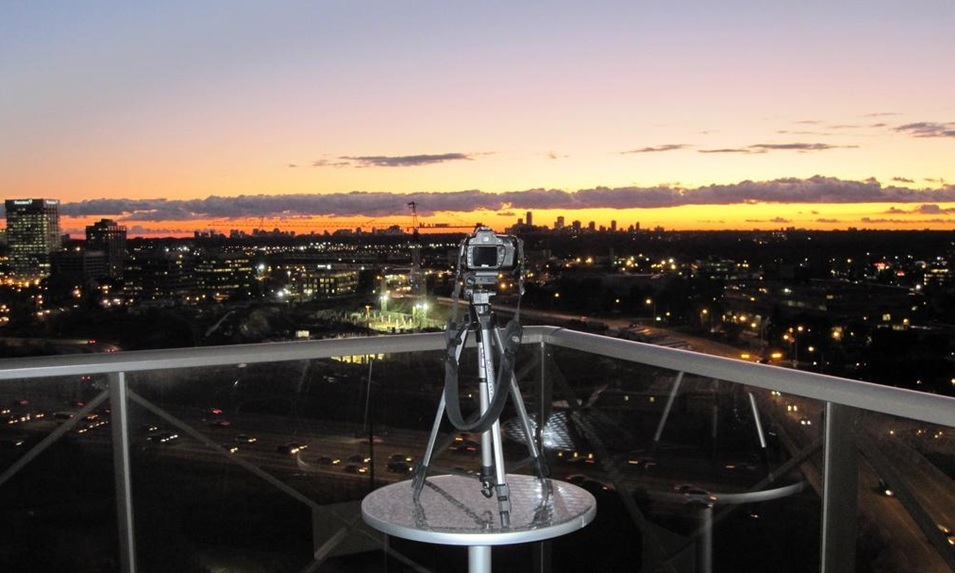
Camera in Balcony

Click to enlarge

Jim Bowie's camera aimed at the construction site of the Aga Khan Museum, the Ismaili Centre and their Park. Photo: Jim Bowie

Jim Bowie’s camera aimed at the construction site of the Aga Khan Museum, the Ismaili Centre and their Park. Photo: Jim Bowie

By Kathreen Anne Lelis

I like this photo because it depicts the rising beauty ought to be discovered and deserves a future glory. The building site is surrounded by streets and industrialized buildings to mark new development – the Aga Khan Museum, Ismaili Center and their Park built at the center to serve as EMBLEM of a country with unity amidst cultural diversity. The light from the site shows its glowing hope in building a strong foundation to create glory. The camera serves as the people’s excitement to capture the priceless beauty made for them. It is facing the horizon which means that people are ready to face the opportunities the buildings offer and travel from the past to discover the reason of their success towards the future.

_____

About the winners: At the time her winning entry was published, Dana Lopez was a law student studying to become a child advocate at the California Western School of Law. She was honored to participate in Simerg’s essay contest because she believes that replacing fear with hope for a brighter future is the best way to ensure a stable civil society. Kathreen Anne Lelis lives in Philippines where she studied at the San Pedro College of Davao City.

Why I am Excited About the Aga Khan Museum, the Ismaili Centre and their Park – Two Winning Essays

The opening of the Aga Khan Museum to the public on September 18, 2014  has just been announced. To mark this special announcement, we repost below two winning essays by Emmanuel Iduma of Nigeria and Zohra Nizamdin of the USA from Simerg’s essay competition on the subject “Why I am Excited About the Aga Khan Museum, the Ismaili Centre and their Park.”

WHY I AM EXCITED ABOUT THE AGA KHAN MUSEUM, THE ISMAILI CENTRE AND THEIR PARK

BY EMMANUEL IDUMA

A photo from April 2010 of the site of the Aga Khan Museum, the Ismaili Centre and their Park as the trees were being removed to make room for the contruction. "No need to worry...the trees will be replaced," wrote Jim Bowie for a photo essay for Simerg. Photo: Jim Bowie. Copyright.

Early memories: A photo from April 2010 of the site of the Aga Khan Museum, the Ismaili Centre and their Park as the trees were being removed to make room for the construction. “No need to worry…the trees will be replaced,” wrote Jim Bowie for a photo essay for Simerg. Photo: Jim Bowie. Copyright.

Excitement is the wrong word to use in describing how I feel about these projects. I am seeking for the right word. Yet, there are two tasks before me – first, to argue briefly on what interests me about the projects; second, to make a case for why these projects must remain important in the global scheme of things.

I am interested in diversity, in a multi-cultural existence, in life as seen from the lens of globalization. I believe, also, that diversity is a necessary part of human life. What these projects represent is diversity, as perfect as that can be – a merging of cultures, a fusion of civilizations, and nothing less. Thus, understanding that these projects were instituted to, in The Aga Khan’s words, “express a profound commitment to inter-cultural engagement, and international cooperation” establishes my claim that in the first place there is something uniquely global about these projects that make them worth reckoning.

Yet, the first conception becomes incisive when I consider it in the light of the contribution the projects would make to Canada, and hopefully, to the world. Each of the projects deserves a concise elucidation.

First, the Aga Khan Museum calls attention to the human need to share and to sustain. These qualities are often lacking in human interaction at all levels. On the individual level, we can learn to allow others partake in our life. Interestingly, the kind of sharing evinced by the Museum does more than allowing individuals to partake; it calls for civilizations to share their blessings with others. In this regard, it appears to me that sharing connotes sustainability. There is worldwide clamour for sustainability, and the Museum will become a beacon of lengthening what is notable about the Ismaili Imamat institution.

And what about the Ismaili Centre? Is there something irresistible about the fact that the Centre would feature a deep religious conviction? In a world plagued by scepticism and God-hating, I find it nourishing that the Centre would be significant for the significant reason that it is “dedicated to spiritual reflection.” I am in doubt that such reflection is not a basic human need – and should be added to Maslow’s list.

Wonderfully, what ties these three projects together is the architectural grandeur each exudes. The Park, for instance, draws upon a rich Islamic architectural heritage. A well-known fact is that Islam has provided the world with lovable masterpieces. I make bold to say that the Park would be another. Taken altogether, it exhilarates me to imagine the site of the projects being designated as a UNESCO World Heritage Site.

Eliot believes that in-between dreams and reality lurks shadows. Yet, I find that these projects require us to keep dreaming, despite the fact that they are being realized, or the lurking shadows. And this is necessary because Canada and the rest of the world is in need of the spiritual, natural and artistic splendour the Projects offer.

Copyright: Simerg.com

~~~~~~

WHY I AM EXCITED ABOUT THE AGA KHAN MUSEUM, THE ISMAILI CENTRE AND THEIR PARK

BY ZOHRA NIZAMDIN

A depiction of the  Aga Khan Museum, the Ismaili Centre and their Park..

A depiction of the Aga Khan Museum, the Ismaili Centre and their Park..

Just as the wings of a butterfly flap can have large effects on the other side of the world, I believe that the combination of Aga Khan Museum, the Ismaili Centre, and their Park will have a positive impact of epic proportions throughout dimensions of space and time. There are a plethora of reasons why I am ecstatic about this project but there are some that really speak to my soul. Some of these reasons include my involvement in making history, the cultivation of art in Islam and the expression of pluralism.

When I was a young girl, I would always wonder what it would be like to live in the times of Imam Muizz and the Fatimid period. It would be such a spectacle to see the first Fatimid gold coin, the birth of the first university, and the Ismaili contributions to culture and the advancement of sciences in areas such as chemistry and physics. Many of our Pirs and Dais played a major role in shaping the history of our rich culture which has been cultivated throughout time. Although it would have been astonishing to be alive in that era, it is just as awe-inspiring to be alive today. The Aga Khan legacy has paved the path for the betterment of society in the future. His Highness the Aga Khan has devoted his entire life to advance humanity so that the generations to come will have valuable assets to look after.

The contents of the museum will encompass contemporary Islamic art to the origin of our faith, 14oo years ago. Art is the representation of the philosophy of a certain population at given period in time. The Aga Khan Museum will display the rich culture and timeline of Islam through solidified philosophies in the form of various artifacts. Some of the art will be personally donated from His Highness the Aga Khan, which will add to the magnificence of the collection. Such assortment of beauty and culture will shed light on the humanities of Islam and display the peaceful and affluent history of Islam.

The main reason I am so excited about this amazing endeavor is because of its promotion of pluralism in the Western world in regards to Islam. The exhibit of various pieces from different backgrounds and ethnicities will serve to broaden the horizons of the Islamic perspective as well as other point of views. It is my deepest desire that this combination of Museum, Ismaili Center and Park functions to bring all of humanity together under a common purpose: to learn and appreciate Islam for what it is, a peaceful and unifying religion.

I am honored and delighted to see all of these wondrous ideals coming together to form the mosaic of peace and understanding. A center of worship, an art platform and a park of natural beauty to tie all the inner and outer spaces together into one location that can provide realization and deep, inner peace.

Copyright: Simerg.com

~~~~~~~~~

About the writers: Emmanuel Iduma holds a Bachelor’s degree in Law (LL.B) from Obafemi Awolowo University, Ile-Ife, Nigeria. At the time he wrote the essay, he was studying to be called to the Nigerian Bar in the Nigerian Law School, Enugu. His writing has been published online and in print, including in Saraba, which he co-publishes (www.sarabamag.com).

Zohra Nizamdin was born in Doha, Qatar, and studied at the Pak Shama School. After coming to the United States, she went to Brook Haven College where she received her Associate degree in Science and Arts. She is currently based in San Antonio, Texas.

Are you in Toronto? Do you plan to attend the museum’s opening day? What excites you about the museum’s opening? Please click Leave a comment. Your feedback may be edited for length and brevity, and is subject to moderation. We are unable to acknowledge unpublished letters.

The Hijra: Movement of God’s People by Omid Safi

Standing outside the city, Muhammad looked back lovingly on Mecca and said: “Of all God’s earth, you are the dearest place unto me, and the dearest unto God. Had not my people driven me out from you, I would not have left you.”…Read more….The Quintessential Marking Point of Islamic History

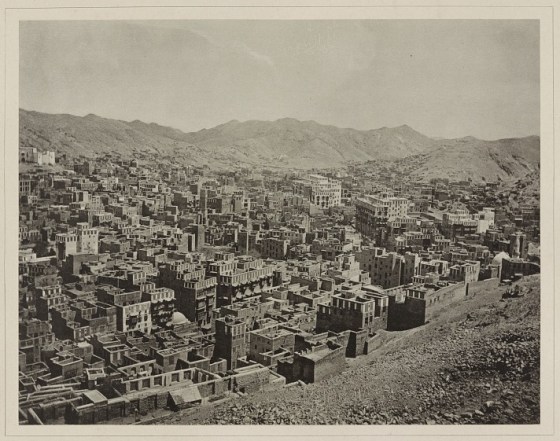
An 1889 photo showing a view of the city of Mecca. Photograph attributed to al-Sayyid ʻAbd al-Ghaffār by scholar Claude Sui. (Source: "Travel to the Holy Land and photography in the nineteenth century" by Claude Sui. Chapter in: To the Holy Lands: Pilgrimage centres from Mecca and Medina to Jerusalem. Mannheim: Reiss-Engelhorn Museum, 2008, pages 56-63). Credit: USA Library of Congress. Please click on image for article by Omid Safi

A photo taken in 1889 showing a view of the city of Mecca. Photograph attributed to al-Sayyid ʻAbd al-Ghaffār by scholar Claude Sui. (Source: “Travel to the Holy Land and photography in the nineteenth century” by Claude Sui. Chapter in: To the Holy Lands: Pilgrimage centres from Mecca and Medina to Jerusalem. Mannheim: Reiss-Engelhorn Museum, 2008, pages 56-63). Credit: USA Library of Congress. Please click on image for article by Omid Safi