Simerg is an independent initiative dedicated to Ismaili Muslims, the Aga Khan — their Hereditary Imam — and the Ismaili Imamat, and Islam in general through literary readings, photo essays and artistic expressions
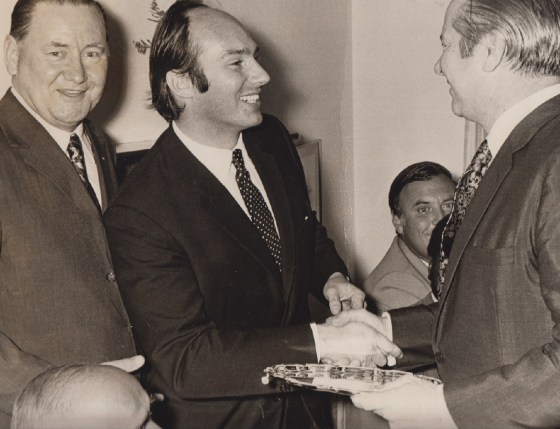
His Highness the Aga Khan being greeted by Mr. Michael Curtis of the Nation Group. Photo: Azhar Chaudhry. Sultan Jessa Collection.
Mr. Michael Curtis, a British Fleet Street editor and executive, was introduced to Mawlana Hazar Imam, His Highness the Aga Khan, just as he had been proclaimed the 49th Ismaili Imam by his grandfather, Imam Sultan Mahomed Shah, His Highness the Aga Khan III. His recruitment as a staff of His Highness was intended as a short term assignment as a speech writer and publicity organizer during a series of public appearances in Asia and Africa related to the Aga Khan’s installation as Imam. This brief assignment, however, grew into an engagement with His Highness that spanned several decades. The visionary Michael Curtis — who was noted by UK’s Guardian Newspaper as being 50 years ahead of his time in the paper’s obituary to the journalist — was asked to establish the Nation Media Group, which started publishing the Sunday Nation and subsequently the Daily Nation in Kenya, competing successfully with the existing colonial newspapers, the Tanganyika Standard and the East African Standard. At the culmination of the process of Africanising the Nation Group, Michael Curtis stepped down in 1977, after pioneering the introduction of the first web-offset presses installed outside the United States as well as increasing the Nation’s circulation to 165,000 and a readership reputed to touch three million.
Mr. Curtis moved to His Highness the Aga Khan’s Headquarters in Aiglemont, France, where he oversaw the Ismaili Imamat’s rapidly expanding non-denominational health and educational activities throughout South Asia and East Africa, until his retirement in 1994.
Michael Howard Curtis, who was born in Cambridge in 1920, died from cancer in 2004 at the age 84.
The following is an excerpt from a piece written by Mr. Michael Curtis for the Daily Nation’s special souvenir published on the occasion of His Highness the Aga Khan’s wedding in 1969 to Princess Salimah.
“I was Serving No Ordinary Man”
BY MICHAEL CURTIS (1920 – 2004)
It was 12 years ago in Dar-es-Salaam in October 1957. Prince Karim, His Highness the Aga Khan, was to be installed as successor to his grandfather in the first of a series of elaborate ceremonies to be held that year throughout Africa and Asia.
As personal aide to His Highness, I had gone ahead as part of an advance party and was greeted by the local leaders who told me that a serious problem had arisen. The only other such ceremony in living memory had taken place 72 years before in Bombay, when Aga Khan III had succeeded to the Imamate.
Not surprisingly, there was some doubt about the form the service would take and it seemed that an acute difference of opinion had arisen as to which verses of the Koran should be included. There was clearly nothing to be done but to await a ruling from the Aga Khan himself.
It was an unforgettable scene and took place in one of the state rooms of Government House where the Aga Khan was guest of the Colonial Governor at that time, the late Lord Twining. The Ismaili leaders were seated, as is their custom, cross-legged in a semi-circle around their young Imam and the two factions elaborated their different points of view.
To a non-Muslim the arguments were difficult to follow, but it was clear to me that a strong difference of opinion existed and that the Aga Khan would be called upon to resolve a ticklish point of theological doctrine.
This was the first occasion on which he had been called to exercise the responsibilities bequeathed to him by his grandfather. Still an undergraduate at Harvard, he looked very young, a trifle pale and tense as he listened to the rival claimants. There was a pause as they finished. Then the Aga Khan asked a question which obviously puzzled his followers. “Who,” he asked, “will recite the verses you wish me to decide upon?”
A chorus of voices assured him that a young man from Zanzibar had been procured for the recitation and that his fame as a psalmodist of the Koran was acclaimed far and wide.
“If that is so,” said His Highness, “let this young man suggest those verses in which his ability is most outstanding and thereafter I shall decide which particular chapters and verses will be selected.”
It was a solution that delighted everyone. The opposing factions accepted it gladly, for neither had lost face. The choirboy for certain would sing as he had never sung before — which in truth he did the following afternoon. It was a decision which reflected the instinctive simplicity of true wisdom and first revealed to me that I was serving no ordinary man.
I have related this tale before, and if I repeat it today it is because I know of no other anecdote which more aptly illustrates his wisdom and judgement.
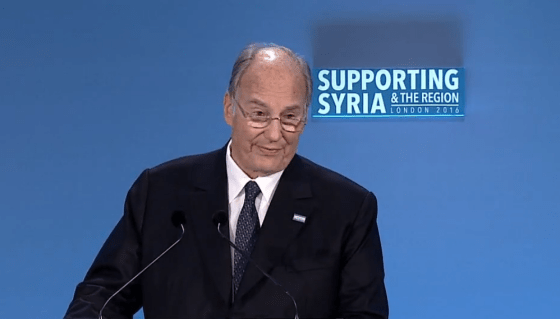
In remarks made at an International Conference under the theme “Supporting Syria and the Region Conference”, in London, England, Mawlana Hazar Imam, His Highness the Aga Khan, today called for the establishment of ‘islands of stability’ in war-ravaged Syria that could provide areas of relative safety in the midst of conflict. The conference, co-hosted by Germany, Kuwait, Norway, the United Kingdom and the United Nations. was attended by representatives from sixty countries, including 30 world leaders.
“The situation in Syria is a close to hell as we are likely to find on this earth,” said UN Secretary General Ban Ki-moon. Referring to the Geneva meeting between the Syrian Government and the opposition parties that had broken down just a day earlier, he said the talks were “undermined by the continuous lack of sufficient humanitarian access, and by a sudden increase of aerial bombings and military activities within Syria”. He urged the warring sides to “get back to the table, not to secure more gains on the battlefields”.
Deploring the devastation in war-ravaged Syria, Mawlana Hazar Imam, His Highness the Aga Khan, called for the establishment of “islands of stability” to provide areas of relative safety in the midst of conflict. The 49th Shia Ismaili Imam, pledged $200 million towards achieving peace, stability, and reconstruction in the country.
The British Prime Minister, David Cameron, said that “if ever there was a moment to take a new approach to the humanitarian crisis in Syria surely it is now,” mentioning the huge number of Syrians who “fear they have no alternative than to put their lives in the hands of evil-people smugglers in search of a future”.
The following are the transcript and video of the remarks made by His Highness the Aga Khan at the Supporting Syria and the Region Conference.
Bismillah-ir-Rahman-ir-Rahim
Co-hosts of the Conference on Supporting Syria and the Region,
Excellencies,
Ladies and gentlemen,
I thank the co-hosts for organising this much-needed initiative to deepen the understanding of, and garner international support for the peoples of Syria, Alongside all those present here today, I am deeply distressed over the indiscriminate and widespread devastation of life and property, including that of irreplaceable cultural assets which are the manifestation of Syria’s stunningly rich pluralistic history.
The Aga Khan Development Network (AKDN), which is the Ismaili Imamat’s global agency for supporting development, is fully engaged with the peace process under UN leadership, and is firmly committed to helping build a Syria that continues to respect pluralism, remains secular, and embarks on a political process led by Syrians.
AKDN’s development and humanitarian work in Syria began many years before the war. In the present situation, we have committed resources and efforts to ensure that Internally Displaced People receive humanitarian assistance, and are supported to sustain their livelihoods. We are taking two approaches:
First, we are supporting local community leaders, teachers, doctors, engineers and others to foster stability, protecting their families and their communities. We are thus building and strengthening civil society to take as much responsibility as possible for their own future.
Second, we are investing in communities, by supporting agriculture, income generation, early childhood education, schools, and hospitals. We also provide vocational training to create skills. Our goal is to sustain hope.
We aim to meet the urgent needs of the present, but where also possible to protect and strengthen the foundations for the future. We seek to create “islands of stability”, where there is public consensus, in the face of war. It is my conviction that “islands of stability” can be replicated wherever security permits. Investing in them will help prevent displacement of people and anchor communities that would otherwise flee as refugees.
Since the onset of conflict in 2011, AKDN has dedicated $50 million towards these endeavours in Syria and is now committing to increasing this investment to $200 million over the next four years. Our efforts will expand to wider areas of the country. Our goal is peace, stability, and reconstruction.
The sacred space is set The energy is invoked The earth’s ochre red Makes a path through the green. Reflected in the Ismaili and Uganda flag The logo of the university Radiating, rippling outwards
Our world of rapid change Meets in Uganda to break the ground Nakawa is chosen to propel
the University Hospital To reach beyond its borders The frontiers of Science Radiation ever outwards
Decades of decay at Mulago A new seed of hope is planted Pioneering pluralism In Uganda’s rich soil Revitalizing the land For life long learning Radiating ever outwards
The President and Imam’s vision Bringing to the region Appropriate advanced Health Care The people can access Here at home the very best The youth empowered to remain Here at home to give their best practices Expanding ever outwards
The people rejoice with lush voices Their partners join hands to celebrate This great milestone laid by the red bricks That fulfills the words of the anthem That ever propel outwards
Salute to the President and Imam for Their vision, their respect For national progress Global standards of excellence To be in the frontier of scientific
and humanistic knowledge The best in the world Propelling expanding ever outward An emblematic crown over Uganda
Date posted: December 18, 2015.
Copyright: Shariffa Keshavjee/Simerg
______________
Nakawa – an area in the city of Kampala. Mulago – The hospital located on Mulago Hill in Kampala.
Links to stories and videos of the Land Grant Ceremony of the new Aga Khan University Teaching Hospital to be built in Uganada:
His Highness the Aga Khan is greeted by Justin Trudeau as he arrives in Ottawa, Canada, to celebrate his Golden Jubilee in 2008. At that time, Mr. Trudeau was a Member of Parliament in his riding in the Province of Quebec. He won the Liberal leadership in 2011, and after winning the recent Federal Elections held in October, he was sworn in as the Prime Minister of Canada on November 4th 2015. A day earlier he visited the Delegation of the Ismaili Imamat Building on Sussex Drive in Ottawa – see photo below. Photo: The Ismaili.
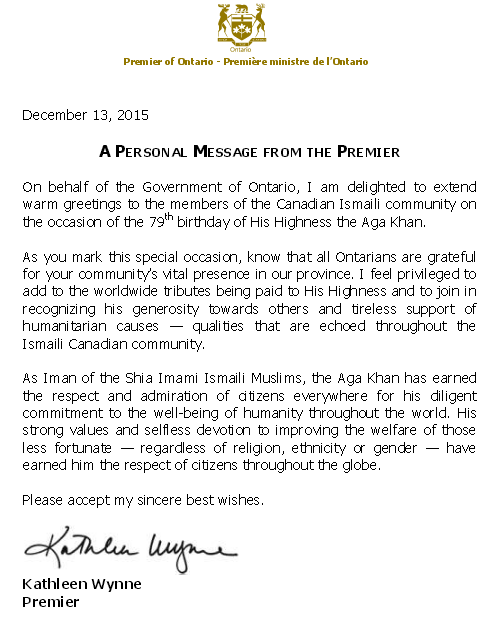
The Prime Minister of Canada, the Right Honourable Justin Trudeau, issued the following statement on December 13, 2015, on the 79th birthday of His Highness Prince Karim Aga Khan:
“Today, we celebrate the birthday of His Highness the Aga Khan, the spiritual leader of the Shia Ismaili Muslims, who has dedicated his life to the promotion of peace, pluralism, and compassion around the world.
“For over fifty years, the Aga Khan has been an inspiration to millions, working tirelessly to improve the health and education of those living in some of the world’s most vulnerable countries. As a global humanitarian leader, he has worked with many partners – including Canada – to implement vital programs that advance long-term solutions to poverty, illiteracy, and disease.
Prime Minister Justin Trudeau with Aga Khan Development Netork (AKDN) Representative Dr. Mahmoud Eboo (left) and the President of the Aga Khan Ismaili Council for Canada, Malik Talib, at the Delegation of the Ismaili Imamat in Ottawa on November 3, 2015, a day before he was sworn in as Prime Minister. Photo: The Ismaili.
“I have seen first-hand the Aga Khan’s commitment to the ideals of diversity and inclusion. As a nation, we are proud His Highness was granted honourary Canadian citizenship for the leadership he has shown to advance development, pluralism, and tolerance – values that are at the core of our national identity.
“The world needs champions of diversity and compassion. Today, we are delighted to thank our good friend, the Aga Khan, for all that he has done to help those in need, and wish him good health, happiness, and peace on this special day.”
__________
“Happy Birthday to the Hazar Imam” – Yasmin Rattansi, MP Don Valley E.
His Highness the Aga Khan, MP Yasmin Ratansi and External Affairs Minister Pierre Pettigrew (July 2004 – February 2006). Photo: Jean-Marc Carisse. Copyright.
“Mr. Speaker, I take this opportunity to thank the constituents of Don Valley East for re- electing me to Parliament.
“My riding is proud to house three architectural jewels of Toronto: the Aga Khan Museum, the lsmaili Centre, and the Aga Khan Park built in Canada by His Highness the Aga Khan with his own funds.
“On December 13, His Highness will be celebrating his 79th birthday. I rise today in the House to pay a special tribute to a remarkable human being. His tireless efforts in building bridges across the globe, his commitment to eradicating poverty and ignorance for millions of people, irrespective of race or religion, through the AKDN network are unparalleled.
“I was fortunate to have worked with His Highness in establishing the Global Centre for Pluralism here in Ottawa.
“Happy birthday to the Hazar Imam. May all who come in touch with him benefit from his integrity, humility, honesty, and courage to do good.”
~~~~~~~~~
A Message and Tweets from the Premier of Ontario, Kathleen Wynne, and Arif Virani, MP Parkdale–High Park.
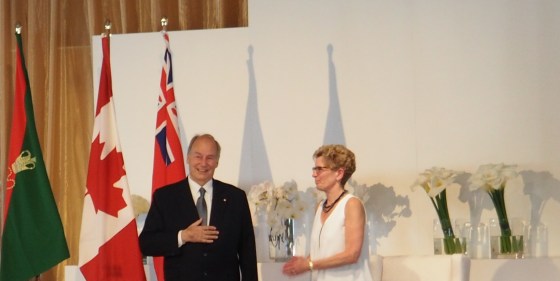
Mawlana Hazar Imam graciously accepts the standing ovation he receives after completing his speech at the opening of the Aga Khan Park in Toronto on May 25, 2015. With him is the Premier of Ontario, Kathleen Wynne. Photo: Simerg/Malik Merchant. Copyright.
Warm wishes to Ontario’s Ismaili community on the occasion of His Highness the Aga Khan’s 79th birthday today!
….and a Tweet from the 2 Ismaili Mountaineers, Mirza Ali and Samina Baig, who conquered the “Seven Summits”, i.e. the highest mountain in each of the 7 continents
ON this day 2Years ago."Salgira Mubarak Ya Mawla " Saligirah Mubarak to Ismaili Brethren around the world!! #peacepic.twitter.com/5ipiaOrjmu
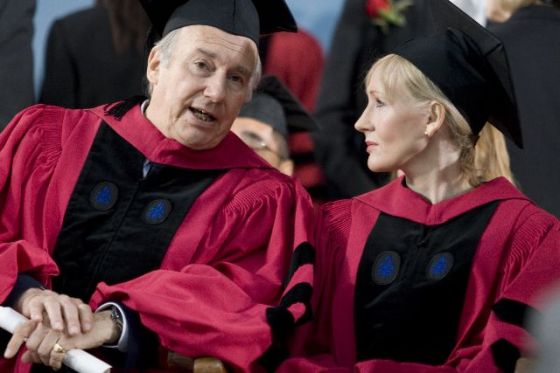
June 5, 2008: His Highness the Aga Khan received an Honorary Doctor of Laws degree from Harvard University in Cambridge, Massachusetts. He is seen speaking to fellow honorary degree recipient British author J.K. Rowling who received an honorary Doctor of Letters degree. Photo Credit: Akdn.org
His Highness the Aga Khan shared his decades long experience as the 49th hereditary Imam of Shia Ismaili Muslims in an address he delivered at Harvard University on November 12, 2015 in which he focused on building a better world through the notion of the Cosmopolitan Ethic. In an analysis of the term and what it means to him, he also emphasized that it resonates with the world’s great ethical and religious traditions. The address that he delivered is one which every Muslim and non-Muslim should reflect on and hold true to their hearts because, as His Highness said, each one of us is born of a single soul.
His Highness the Aga Khan spoke at Harvard on November 12, 2015 as part of the Samuel L. and Elizabeth Jodidi Lecture series, which provides for “the delivery of lectures by eminent and well-qualified persons for the promotion of tolerance, understanding and good will among nations, and the peace of the world. Photo: AKDN
“…I would emphasise that a cosmopolitan ethic is one that resonates with the world’s great ethical and religious traditions.
“A passage from the Holy Qur’an that has been central to my life is addressed to the whole of humanity. It says: “Oh Mankind, fear your Lord, who created you of a single soul, and from it created its mate, and from the pair of them scattered abroad many men and women…”
“At the very heart of the Islamic faith is a conviction that we are all born “of a single soul.” We are “spread abroad” to be sure in all of our diversity, but we share, in a most profound sense, a common humanity.
“This outlook has been central to the history of Islam. For many hundreds of years, the greatest Islamic societies were decidedly pluralistic, drawing strength from people of many religions and cultural backgrounds. My own ancestors, the Fatimid Caliphs, founded the city of Cairo, and the great Al Azhar University there, a thousand years ago in this same spirit.
“That pluralistic outlook remains a central ideal for most Muslims today. There are many, of course, some non-Muslims and some Muslims alike, who have perpetrated different impressions.
“At the same time, institutions such as those that have welcomed me here today, have eloquently addressed these misimpressions. My hope is that the voices of Islam itself will continue to remind the world of a tradition that, over so many centuries, has so often advanced pluralistic outlooks and built some of the most remarkable societies in human history.
CENTRAL LESSON FROM A PERSONAL JOURNEY OF 58 YEARS
“Let me repeat, in conclusion, that a cosmopolitan ethic is one that will honour both our common humanity and our distinctive Identities — each reinforcing the other as part of the same high moral calling.
“The central lesson of my own personal journey — over many miles and many years — is the indispensability of such an ethic in our changing world, based on the timeless truth that we are — each of us and all of us — “born of a single soul.”
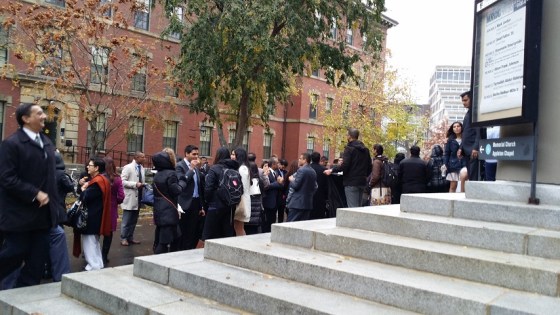
Ticket holders line up to listen to His Highness the Aga Khan at Harvard University on November 12, 2015. Photo: Azeem Maherali.
Editor’s note: Thematic excerpts from speeches made by His Highness the Aga Khan are highly popular with our readers, and we are pleased to present this feature once again for the recent Jodi lecture that was delivered by the 49th Ismaili Imam at Harvard University on Thursday, November 12, 2015. We begin with excerpts from introductory remarks made by Professor Ali Asani’s in welcoming His Highness to Harvard.
~~~~~~~~
WELCOME ADDRESS BY PROFESSOR ALI ASANI
“Your Highness, I am one of those children who many years ago was a student attending Aga Khan schools in Kenya, and with your support and guidance, went on to study and teach here at Harvard. Thank you.” — Dr. Ali Asani, November 12, 2015.
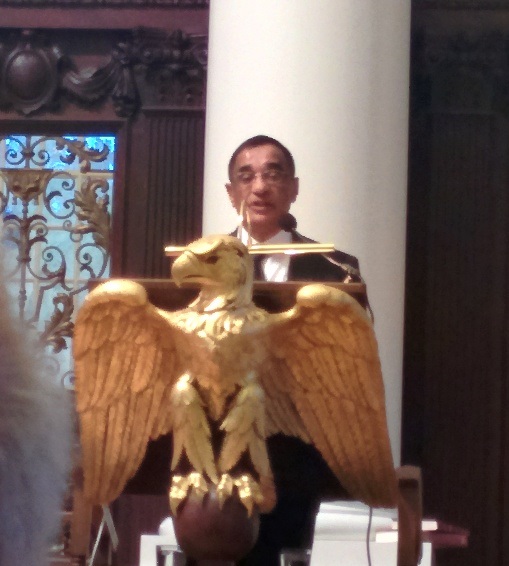
Professor Ali Asani introduces His Highness the Aga Khan before the 2015 Samuel L. and Elizabeth Jodidi Lecture at Harvard University. Photo: Navyn Naran.
“It is my honour and privilege to be here today, and to introduce to you — and to welcome back to Harvard — our guest speaker, His Highness the Aga Khan, 49th hereditary Imam of the Shia Imami Ismaili Muslims, Harvard class of 1959.
“For nearly six decades, the Aga Khan has been responsible for both the spiritual guidance and the material welfare of millions of Ismaili Muslims residing in over 25 countries, sometimes in contexts of conflict and poverty. Under his leadership, this multicultural, multiethnic, multilingual, and transnational community — or Jamat — has witnessed the greatest transformation in its history. He has guided the Ismailis through a dramatic metamorphosis that has impacted the lives of each and every member of his community.
“However, His Highness’s concerns have extended well beyond the communities of his followers to the larger societies in which they live….[He] has made it possible for hundreds of thousands of children of different religious, ethnic and racial backgrounds to study in Aga Khan kindergarten, primary and secondary schools, and academies located both in Africa and Asia. He has created two international universities and endowed professorships at major institutions of higher education — including Harvard.
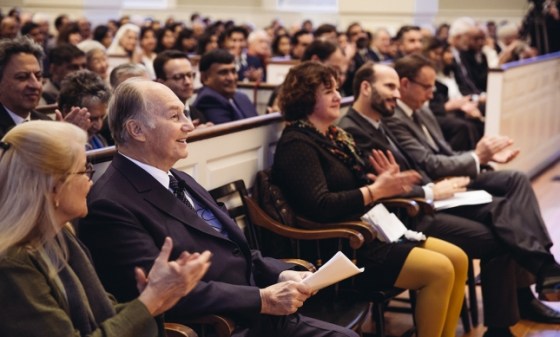
Audience applauds as His Highness the Aga Khan is welcomed to Harvard by Professor Ali Asani. Photo: The Ismaili/Farhez Rayani
“His Highness has made every sector and aspect of the human existence a part of his concern. His institutional efforts are deployed to meet the holistic and multiple needs of millions of people around the world, irrespective of their religion, race or nationality.
“According to a well-known saying attributed to the Aga Khan’s ancestor, the Prophet Muhammad (peace be upon him), “God is beautiful and loves beauty.” In keeping with ancient Islamic traditions of nurturing the arts, His Highness has also enriched the lives of people around the world by giving the priceless gift of beauty.
“While some wanton elements in our world today are sadly intent on destroying humanity’s cultural heritage, the Aga Khan’s institutions have been restoring historic monuments, beautifying urban landscapes with magnificent gardens and stunning award-winning buildings, reviving traditions of music and promoting the role of the arts as bridges of cultural understanding.
“Today, we live in an increasingly polarised world in which people are unable to tolerate difference, let alone understand and engage with it. The lives of one-and-a-half billion Muslims, and perhaps everyone on this planet, have been changed by the machinations of powerful geopolitical forces.
“Your Highness, in our world of increasing division orchestrated by small cells of radical extremists, and often manipulated by powerful forces with consequences that reverberate in large parts of the world, we cherish and honour your lifetime commitment to pluralism and the betterment of society, and look forward to your thoughts on The Cosmopolitan Ethic in a Fragmented World.
“Ladies and gentlemen, please welcome His Highness the Aga Khan.”
~~~~~~~
THEMATIC EXCERPTS FROM THE LECTURE OF HIS HIGHNESS THE AGA KHAN
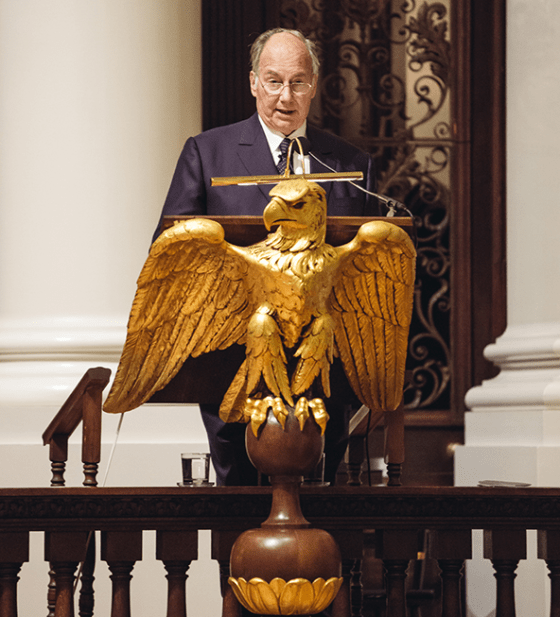
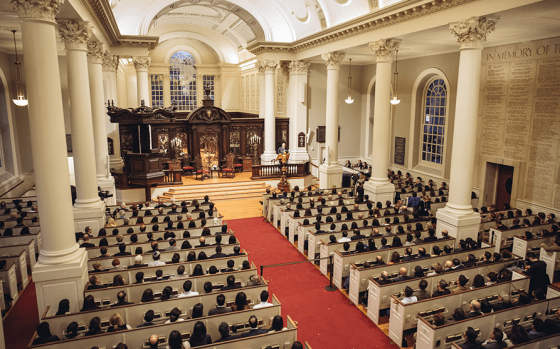
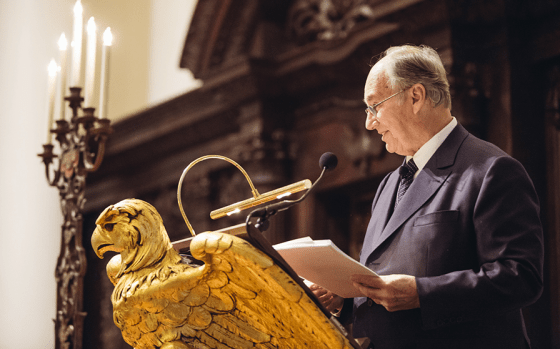
His Highness the Aga Khan speaks on November 12, 2015 at Harvard University’s Weatherhead Center for International Affairs on “The Cosmopolitan Ethic in a Fragmented World”. Photo: AKDN / Farhez Rayani
Bismillah-ir-Rahman-ir-Rahim
1. WHAT IT MEANS TO BE AN IMAM
Thank you for your warm welcome. It is indeed a great pleasure for me to return to Harvard and this wonderful campus. I am honored as well, to be giving the Jodidi Lecture for 2015, and to join the distinguished list of those who have given this lecture over the past 60 years.
….in 1957 I was a junior when I became the 49th hereditary Imam of the Shia Imami Ismaili Muslims — when my grandfather designated me to succeed him.
…What does it mean to become an Imam in the Ismaili tradition?…. it is an inherited role of spiritual leadership. As you may know, the Ismailis are the only Muslim community that has been led by a living, hereditary Imam in direct descent from Prophet Muhammad.
That spiritual role, however, does not imply a separation from practical responsibilities. In fact for Muslims the opposite is true: the spiritual and material worlds are inextricably connected. Leadership in the spiritual realm — for all Imams, whether they are Sunni or Shia — implies responsibility in worldly affairs; a calling to improve the quality of human life.
________________
2. ON HARVARD, AND THE AGA KHAN’S EXPERIENCES VISITING HIS WORLD WIDE FOLLOWERS ON BECOMING THE IMAM
As I prepared for this new role in the late 1950s, Harvard was very helpful. The University allowed me — having prudently verified that I was a student “in good standing” — to take eighteen months away to meet the leaders of the Ismaili community in some 25 countries where most of the Ismailis then lived, and to speak with their government leaders.
I returned here after that experience with a solid sense of the issues I would have to address, especially the endemic poverty in which much of my community lived. And I also returned with a vivid sense of the new political realities that were shaping their lives, including the rise of African independence movements, the perilous relations between India and Pakistan and the sad fact that many Ismailis were locked behind the Iron Curtain and thus removed from regular contact with the Imamat.
When I returned to Harvard, it was not only to complete my degree, but I was fortunate to audit a number of courses that were highly relevant to my new responsibilities. So as an undergraduate, I had the opportunity to benefit from the complete spectrum of courses offered by this great university.
….Harvard has continued to be a highly valued partner for our Network since this time. The University played a key role in developing the blueprint thirty years ago for the Aga Khan University — working first in the fields of medicine and nursing education, and now offering a broad variety of degrees on three continents. Another close Harvard relationship has involved the Aga Khan Program for Islamic Architecture, launched here and at MIT in 1977.
Regularity in Class Attendance
Incidentally, I must have been the only Harvard undergraduate to have two secretaries and a personal assistant working with me. And I have always been very proud of the fact that I never sent any of them to take notes for me at my class!
3. THE INITIATIVE OF THE AGA KHAN DEVELOPMENT NETWORK IN THE DEVELOPING AND ISLAMIC WORLDS
Through all of these years, my objective has been to understand more thoroughly the developing countries of Asia, Africa and the Middle East, and to prepare initiatives that will help them become countries of opportunity, for all of their peoples.
Concern For Islamic Architecture: Lack of Processes for its Renewal
My concern for the future of Islamic architecture grew out of my travels between 1957 and 1977 in countries with large Muslim populations. What I observed was a near total disconnect between the new built environment I encountered and Islam’s rich architectural legacy. There was no process of renewal, no teaching in architectural schools, no practices that were rooted in our own traditions. Except for the occasional minaret or dome, one of the world’s great cultural inheritances was largely confined to coffee-table books. It seemed to me that this state of affairs represented a monumental menace to our world’s cultural pluralism, as well as a dangerous loss of identity for Muslim communities.
The Aga Khan Programme for Islamic Architecture was one response to this situation, as was the creation of the Aga Khan architectural award, which also continues today. Bringing the art and architecture of the Islamic world to be understood and admired in the West, as it had been in the past, was a goal that also inspired the creation, just one year ago, of the Ismaili Centre and the Aga Khan Museum in Toronto — the only museum in the western hemisphere devoted entirely to Islamic culture.
AKDN Objective in One Word, “Opportunity”, and Thus Hope for Future
Today, the Aga Khan Development Network embraces many facets and functions. But, if I were trying to sum up in a single word its central objective, I would focus on the word “opportunity”. For what the peoples of the developing world seek above all else is hope for a better future.
Too often however, true opportunity has been a distant hope — perhaps for some, not even more than a dream. Endemic poverty, in my view, remains the world’s single most important challenge. It is manifested in many ways, including persistent refugee crises of the sort we have recently seen in such an acute form. And of course confounding new challenges continue to mount, such as the looming threat of climate change. My interest in climate change has been sharpened by recent studies linking it to the threat of earthquakes. This could be an issue in the high mountain areas of South Asia for example, where so many Ismailis live and are concentrated.
Sixty years ago as I took up my responsibilities, the problems of the developing world, for many observers, seemed intractable. It was widely claimed that places like China and India were destined to remain among the world’s “basket cases” — incapable of feeding themselves let alone being able to industrialise or achieve economic self-sustainability. If this had been true, of course, then there would have been no way for the people of my community, in India and China and in many other places, to look for a better future.
His Highness the Aga Khan spoke as part of the Samuel L. and Elizabeth Jodidi Lecture series, which provides for “the delivery of lectures by eminent and well-qualified persons for the promotion of tolerance, understanding and good will among nations, and the peace of the world. Photo: AKDN
Political realities presented further complications. Most of the poorest countries were living under distant colonial or protectorate or communist regimes. The monetary market was totally unpredictable. Volatile currencies were shifting constantly in value, making it almost impossible to plan ahead. And while I thought of all the Ismailis as part of one religious community, the realities of their daily lives were deeply distinctive and decidedly local.
Nor did most people yet see the full potential for addressing these problems through non-profit, private organisations — what we today call “civil society.”
And yet, it was also clear that stronger coordination across these lines of division could help open new doors of opportunity. We could see how renovated educational systems, based on best practices, could reach across frontiers of politics and language. We could see how global science could address changing medical challenges, including the growing threat of non-communicable disease. We could see, in sum, how a truly pluralistic outlook could leverage the best experiences of local communities through an effective international network.
But we also learned that the creation of effective international networks in a highly diversified environment can be a daunting matter. It took a great deal of considered effort to meld older values of continuity and local cohesion, with the promise of new cross-border integration.
A GOAL IN A FRAGMENTED WORLD: SEEKING TO BUILD AN EFFECTIVE COSMOPOLITAN ETHIC
Cosmopolitan Ethic
What was required — and is still required — was a readiness to work across frontiers of distinction and distance without trying to erase them. What we were looking for, even then, were ways of building an effective “cosmopolitan ethic in a fragmented world.”
This often meant working from the bottom up, learning to follow what was sometimes called “field logic.” Most of our initiatives began at a local, community level, and then grew into regional, national and international institutions.
Working in Partnerships
As we moved forward, we learned a number of important lessons. We learned that lifting health and education services to world class standards was a global promise that could inspire local support. We learned to attack poverty simultaneously with multiple inputs, on a variety of fronts. We learned to work with effective partners — including the not-for-profit institutions of civil society. We learned to see our role as one of supporting the public sector, not competing with it. And we learned the importance of measuring carefully the outcomes of our efforts, and then applying that knowledge.
All of these approaches were facilitated by a determination to overcome linguistic barriers through a language policy that promoted better use of the national language, and network-wide English as a strong connecting tool.
And so our Network grew. Today it embraces a group of agencies — non-governmental and non-denominational — operating in 35 countries. They work in fields ranging from education and medical care, to job creation and energy production; from transport and tourism, to media and technology; from the fine arts and cultural heritage, to banking and microfinance. But they are all working together toward a single overarching objective: improving the quality of human life.
PROMISES OF THE PAST AND….
Hope for International Cooperation
Meanwhile, in the Industrialised West, many things were happening that paralleled our AKDN experience. For one thing, an impulse for international cooperation was advancing in the late 1950s at an impressive pace. After half a century of violent confrontation, determined leaders talked hopefully about global integration. New international organisations and cross-border alliances blossomed. And Harvard University decisively expanded its own involvement in world affairs.
When the Jodidi Lectureship was established here in 1955, its explicit purpose (and I quote) was “the promotion of tolerance, understanding and good will among nations.” And that seemed to be the way history was moving. Surely, we thought, we had learned the terrible price of division and discord, and certainly the great technological revolutions of the 20th century would bring us more closely together.
Technological Promises and the New World Order
In looking back to my Harvard days, I recall how a powerful sense of technological promise was in the air — a faith that human invention would continue its ever-accelerating conquest of time and space. I recall too, how this confidence was accompanied by what was described as a “revolution of rising expectations” and the fall of colonial empires. And of course, this trend seemed to culminate some years later with the end of the Cold War and the “new world order” that it promised.
….THE PARADOXES
Disintegration
But even as old barriers crumbled and new connections expanded, a paradoxical trend set in, one that we see today at every hand. At the same time that the world was becoming more interconnected, it also become more fragmented.
We have been mesmerised on one hand by the explosive pace of what we call “globalisation,” a centripetal force putting us as closely in touch with people who live across the world as we are to those who live next to us. But at the same time, a set of centrifugal forces have been gaining on us, producing a growing sense — between and within societies — of disintegration.
Fragmentation
Whether we are looking at a more fragile European Union, a more polarised United States, a more fervid Sunni-Shia conflict, intensified tribal rivalries in much of Africa and Asia, or other splintering threats in every corner of the planet, the word “fragmentation” seems to define our times.
Confrontation and Disconnection
Global promise, it can be said, has been matched by tribal wariness. We have more communication, but we also have more confrontation. Even as we exclaim about growing connectivity we seem to experience greater disconnection.
Perhaps what we did not see so clearly 60 years ago is the fact that technological advance does not necessarily mean human progress. Sometimes it can mean the reverse.
Confusion
The more we communicate, the harder it can sometimes be to evaluate what we are saying. More information often means less context and more confusion. More than that, the increased pace of human interaction means that we encounter the stranger more often, and more directly. What is different is no longer abstract and distant. Even for the most tolerant among us, difference, more and more, can be up close and in your face.
His Highness the Aga Khan speaks at Harvard University on November 12, 2015. Photo: AKDN.
COUNTERING THE PARADOXES: USING COSMOPOLITAN ETHIC TO BRING BEAUTY TO THE SOCIAL FABRIC
The Terms Tolerance, Pluralism and Cosmopolitan
What all of this means is that the challenge of living well together — a challenge as old as the human-race — can seem more and more complicated. And so we ask ourselves, what are the resources that we might now draw upon to counter this trend? How can we go beyond our bold words and address the mystery of why our ideals still elude us?
In responding to that question, I would ask you to think with me about the term I have used in the title for this lecture: “The Cosmopolitan Ethic.”
For a very long time, as you know, the term most often used in describing the search for human understanding was the word “tolerance.” In fact, it was one of the words that was used in 1955 text to describe one of the objectives of this Jodidi Lecture.
In recent years our vocabulary in discussing this subject has evolved. One word that we have come to use more often in this regard is the word “pluralism.” And the other is the word “cosmopolitan.”
You may know that our AKDN Network, a decade ago, cooperated with the Government of Canada to create a new Global Centre for Pluralism based in Ottawa, designed to study more closely the conditions under which pluralist societies can thrive.
What is a Pluralist, Cosmopolitan Society?
A pluralist, cosmopolitan society is a society which not only accepts difference, but actively seeks to understand it and to learn from it. In this perspective, diversity is not a burden to be endured, but an opportunity to be welcomed.
A cosmopolitan society regards the distinctive threads of our particular identities as elements that bring beauty to the larger social fabric. A cosmopolitan ethic accepts our ultimate moral responsibility to the whole of humanity, rather than absolutising a presumably exceptional part.
Perhaps it is a natural condition of an insecure human race to seek security in a sense of superiority. But in a world where cultures increasingly interpenetrate one another, a more confident and a more generous outlook is needed.
Readiness to Dialog and to Listen to Everyone
What this means, perhaps above all else, is a readiness to participate in a true dialog with diversity, not only in our personal relationships, but in institutional and international relationships also. But that takes work, and it takes patience. Above all, it implies a readiness to listen.
What is needed, as the former Governor General of Canada Adrienne Clarkson has said, and I quote, is a readiness “to listen to your neighbour, even when you may not particularly like him.” Is that message clear? You listen to people you don’t like!
Differences Between the Concept of Globalization vs Thoughtful Cosmopolitan Ethic
A thoughtful cosmopolitan ethic is something quite different from some attitudes that have become associated with the concept of globalisation in recent years. Too often, that term has been linked to an abstract universalism, perhaps well-meaning but often naïve. In emphasising all that the human race had in common, it was easy to depreciate the identities that differentiated us. We sometimes talked so much about how we are all alike that we neglected the wonderful ways in which we can be different.
One result of this superficial view of homogenised, global harmony, was an unhappy counter-reaction. Some took it to mean the spread of a popular, Americanised global culture — that was unfair and an assessment that was erroneous. Others feared that their individual, ethnic or religious identities might be washed away by a super-competitive economic order, or by some supranational political regime. And the frequent reaction was a fierce defense of older identities. If cooperation meant homogenisation, then a lot of people found themselves saying “No.”
But an either-or-choice between the global and the tribal — between the concept of universal belonging and the value of particular identities — was in fact a false choice. The road to a more cooperative world does not require us to erase our differences, but to understand them.
What is a Responsible, Thoughtful Process of Globalization?
A responsible, thoughtful process of globalisation, in my view, is one that is truly cosmopolitan, respecting both what we have in common and what makes us different.
It is perhaps in our nature to see life as a series of choices between sharply defined dualities, but in fact life is more often a matter of avoiding false dichotomies, which can lead to dangerous extremes. The truth of the matter is that we can address the dysfunctions of fragmentation without obscuring the values of diversity.
COSMOPOLITAN ETHIC: CONSIDERATIONS FOR PROGRESS
Sensitivity to Economic Insecurity
A cosmopolitan ethic will also be sensitive to the problem of economic insecurity in our world. It is an enormous contributing factor to the problems I have been discussing. Endemic poverty still corrodes any meaningful sense of opportunity for many millions. And even in less impoverished societies, a rising tide of economic anxiety can make it difficult for fearful people to respect, let alone embrace, that which is new or different.
Addressing Human Longevity
This problem has been compounded by the very advances that have long been the source of so much hope. I am thinking here for example about medical advances that have dramatically increased human longevity. People live longer, but they often find that they have outlived their resources.
The developing world is now facing a major challenge: how does it care for the elderly? Even in more developed societies, social changes have eroded some of the domestic support that once eased the burdens of the aging. How, we must all ask, will we manage the new challenges of longevity?
Leadership Responsibilities
All of these considerations will place special obligations on those who play leadership roles in our societies. Sadly, some would-be leaders all across the world have been tempted to exploit difference and magnify division. It is always easier to unite followers in a negative cause than a positive one. But the consequences can be a perilous polarisation.
Quality of Education in the Midst of Information Explosion
The information explosion itself has sometimes become an information glut, putting even more of a premium on being first and getting attention, rather than being right and earning respect. It is not easy to retain one’s faith in a healthy, cosmopolitan marketplace of ideas when the flow of information is increasingly trivialised.
One answer to these temptations will be found, I am convinced, in the quality of our education. It will lie with our universities at one end of the spectrum, and early childhood education at the other — a field to which our Development Network has been giving special attention.
Quality of Education to Overcome Clash of Ignorance
Let me mention one more specific issue where a sustained educational effort will be especially important. I refer to the debate — one that has involved many in this audience — about the prospect of some fundamental clash of civilisations between Islam and the West. In my view, the deeper problem behind any prospective “clash of civilisations” is a profound “clash of ignorances”. And in that struggle, education will be an indispensable weapon.
THE WORLD’S ETHICAL AND RELIGIOUS TRADITIONS, AND A COSMOLITAN ETHIC
The Heart of the Islamic Message: Common Humanity
Finally, I would emphasise that a cosmopolitan ethic is one that resonates with the world’s great ethical and religious traditions.
A passage from the Holy Qur’an that has been central to my life is addressed to the whole of humanity. It says: “Oh Mankind, fear your Lord, who created you of a single soul, and from it created its mate, and from the pair of them scattered abroad many men and women…”
At the very heart of the Islamic faith is a conviction that we are all born “of a single soul.” We are “spread abroad” to be sure in all of our diversity, but we share, in a most profound sense, a common humanity.
Outlook From Islamic History
This outlook has been central to the history of Islam. For many hundreds of years, the greatest Islamic societies were decidedly pluralistic, drawing strength from people of many religions and cultural backgrounds. My own ancestors, the Fatimid Caliphs, founded the city of Cairo, and the great Al Azhar University there, a thousand years ago in this same spirit.
That pluralistic outlook remains a central ideal for most Muslims today.
There are many, of course, some non-Muslims and some Muslims alike, who have perpetrated different impressions.
Hopes from the Voices of Islam
At the same time, institutions such as those that have welcomed me here today, have eloquently addressed these misimpressions. My hope is that the voices of Islam itself will continue to remind the world of a tradition that, over so many centuries, has so often advanced pluralistic outlooks and built some of the most remarkable societies in human history.
CENTRAL LESSON FROM A PERSONAL JOURNEY OF 58 YEARS
Let me repeat, in conclusion, that a cosmopolitan ethic is one that will honour both our common humanity and our distinctive Identities — each reinforcing the other as part of the same high moral calling.
The central lesson of my own personal journey — over many miles and many years — is the indispensability of such an ethic in our changing world, based on the timeless truth that we are — each of us and all of us — “born of a single soul.”
Date posted:November 18, 2015.
_________________
For a comprehensive video of the event, please click on the following image.
His Highness the Aga Khan will deliver the Samuel L. and Elizabeth Jodidi Lecture at Harvard University’s Weatherhead Center for International Affairs on 12 November. Entitled “The Cosmopolitan Ethic in a Fragmented World”, his lecture is expected to cover the challenges to pluralism and cosmopolitanism. After the lecture there will be a conversation with Diana L. Eck
Although tickets for the lecture are no longer available, the entire event will be webcast live on http://www.akdn.org starting at 4pm EST.
Please check this website again on Wednesday, November 18, 2015, for speech and interview excerpts as well as a fine selection of photographs related to the event.
His Highness the Aga Khan graduated from Harvard University in 1959 with a BA Honours in Islamic History. This is his portrait in a Harvard University blazer as he smiles with an armful of books, on the Harvard Campus, Cambridge, Massachusetts, 1958. Copyright: Photo by Hank Walker/Time & Life Pictures/Getty Images.
ON HIM BECOMING THE 49TH IMAM
“The summer before his senior year, Prince Karim Khan ’58 received unexpected news. His grandfather, His Highness Aga Khan III, had died, and his will named Karim — fondly known by his classmates as ‘K’ — as his successor, making him Aga Khan IV. And so, at 20 years old, Karim became the leader of the Ismaili Muslims, a sect of Shia Islam with over 15 million followers who consider him a direct descendant of the Prophet Muhammad.
“Once Karim became the Aga Khan, the Islamic history concentrator no longer led a student’s life.
“[Aga Khan III] plucked K right out of the College,” said David H. Rhinelander ’58, one of Karim’s freshman roommates in Wigglesworth Hall. “He moved to a hotel and had to begin to run his empire while he was a student.” — Excerpts from an article by Nini S Moorhead published in the Harvard Crimson, June 2008.
_____
SOCCER TEAM
“The varsity soccer team opens its season this afternoon against Tufts and the game will be one of experimentation for Crimson coach Bruce Munro. He has had to revamp his lineup several times because of an alarming number of injured personnel, including Karim Aga Khan, the starting outside left. Larry Ekpebu will start for Khan at outside left, while Ken Marmar will open at outside right.” — Harvard Crimson, October 1, 1958.
_____
SCHOLARSHIP ESTABLISHMENT
“Karim Aga Khan ’59, who graduates with the Class of 1959 tomorrow, has established a ten-year program of scholarships for students attending Harvard from India, Pakistan, the Middle East, Persia, and East Africa.
“In a statement, the Aga Khan said that he will never regret his decision, after succeeding to his grandfather’s title, to return to Harvard to his studies. He added that he was ‘particularly impressed by the recent growth of facilities for the study of Middle Eastern and Asian affairs’.” — Harvard Crimson, June 10, 1959.
_____
LAUNCH OF ARCHNET
“The Aga Khan ’59, spiritual leader of the world’s 15 million Ismaili Muslims, joined the presidents of Harvard and MIT Friday to launch the world’s largest online resource for scholars of Islamic architecture.
“The resource, called ArchNet, contains over 600,000 images of Islamic architecture, tools for discussion and collaboration online among scholars and access to key journals of Islamic architecture. Harvard served as one of the primary collaborators in the creation of the site.
“Those speaking at Friday’s launch said they hoped the free site would provide architects, urban-planners and academics in resource-poor areas the tools they need to study, and give the Western public an opportunity to experience Islamic culture.
“In a brilliant way, [ArchNet] combines new technology and ancient culture to do something that is really quite important,” University President Lawrence H. Summers said in his remarks to the 150-person audience at MIT’s Media Laboratory.” — Harvard Crimson, September 30, 2002.
_____
HONORARY DOCTOR OF LAWS DEGREE
His Highness the Aga Khan receives an Honorary Doctor of Laws degree from Harvard University at commencement ceremonies June 5, 2008, in Cambridge, Massachusetts. Photo: AKDN.
~~~~~
FLASHBACK TO THE 48TH IMAM AND HARVARD
“The Aga Khan, world-famous leader of the Ismaili Community, a sect of the Moslem religion, has endowed a professorship of Iranian at the University, President Pusey announced yesterday.
“The chair, to be known as the Aga Khan Professorship of Iranian, will be devoted to the study of the history and civilization of Iran. Its purpose, according to the Khan, is “to preserve and transmit to future generations knowledge of the rich heritage of the Iranian past.”
“At the same time, Sadruddin Aga Khan, son of the Aga Khan, has established the Ismaili Community Fellowships for the study of the Middle East here.
“In announcing the gifts, Pusey said, ‘The sentiment of the Aga Khan and his son, Sadruddin, in thus fostering the growth of understanding between the East and the West is one we all deeply share. Certainly, all peoples around the world need to know and better understand the cultural heritage of those who are our neighbors in the modern age’.” — Excerpts from the Harvard Crimson, December 6, 1956





 Simerg - Insights from Around the World