Simerg is an independent initiative dedicated to Ismaili Muslims, the Aga Khan — their Hereditary Imam — and the Ismaili Imamat, and Islam in general through literary readings, photo essays and artistic expressions
A hundred years ago Katchhi and Kathiawadi Ismaili Khoja Muslims sailed to Africa and Zanzibar to make a living. Today, they have prospered in America, Canada and Europe. They wear western clothes, live in palatial homes and drive expensive cars but in the homes they still speak their rustic dialect and they remember the ‘pacchedi’ (Khoja Muslim head drape) their mothers wore.
The ‘Pacchedi Geet’ in a folk song form, is written in Gujarati, ‘transcreated’ in English, and transliterated in Roman script. The song is composed to remember and celebrate the pioneers who left India a century ago but kept memories of their homeland alive.
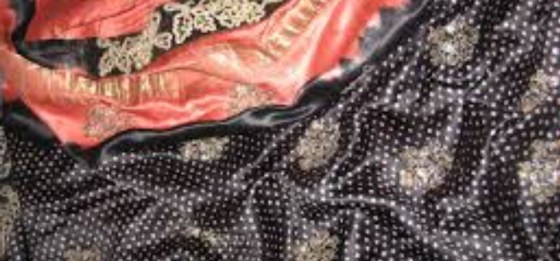
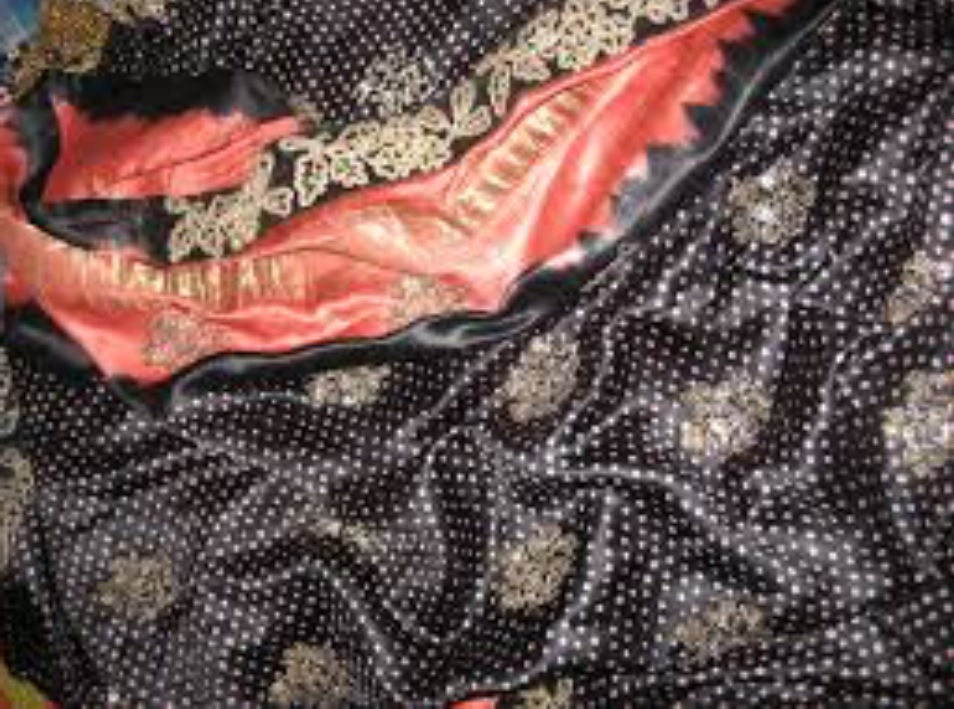
My thanks to Sultan Somjee for permission to use the bandhani image, and Zahir Dhalla for transcribing in Gujarati script.
I welcome singers to set up a geet with the lyrics that have been provided below. Recordings or questions regarding the geet may be sent directly to me at safder8@gmail.com or to the editor of Simerg at simerg@aol.com.
Drape (Khoja Pacched̨̨i)
Kohl-grey silk Studded with white stars A border of a thousand flowers. Mother, how many colours under your drape?
Milk, oudh and attar Strands of jasmine hanging, Underneath, I sleep in deep slumber. Mother, these are the colours under your drape.
Ghee, molasses, Apricots and raisins. Mother, your bread tastes so sweet. Mother, what colours under your drape?
Storms, thunder And lightening! Frightened, I hide under your drape. Mother, colours like these under your drape.
Witches, warlocks Ghosts and giants Scare me not under the shade of your drape. Mother, colours like these under your drape.
With tables and chairs We built boats And flew sails made out of your drape. Mother, how many colours under your drape?
Leaving home We crossed the seas. We spread Giga Patney’s patola. Mother, how can I break from the ties of your drape?
Your eyes closed, Your soul departed. We draped you in rosy pink. Mother, colours like these under your drape.
_________________
પછેડી (Gujarati)
સુરમય રેશમ માથે ધોળા તારા ચારે કોર હજાર ફૂલ ની પટ્ટી …..૧ માઈં તારી પછેડી ની પાછળ કેટલા રંગ ?
દૂધ ઊધ ને અંતર માથે ટાંક્યા મોતિયા છાયેં હું સુવું ઊંડી નીંદરે …..૨ માઈં તારી પછેડી ની પાછળ એવા રંગ!
ઘી ગોળ અને સૂકો મેવો મા, મને મીઠી લાગે તારી રોટલી …..૩ માઈં તારી પછેડી ની નીચે કેવા રંગ ?
વાયુ વીજળી મેધા ઘરજે હું ડરી સંતાઉ પછેડી ની નીચે …..૪ માઈં તારી પછેડી ની પાછળ એવા રંગ!
ડાકણ દઈંત ભૂત રાક્ષસ મને ન ડરાવે પછેડી ના છાયેં …..૫ માઈં તારી પછેડી ની પાછળ તેવા રંગ.
મેજ ખુરસી ના વાણ બનાવયા ઊપર ઊડાડીયા પછેડી ના સઢ …..૬ માઈં તારી પછેડી ની નીચે તેવા રંગ.
દેસ છોડી દરિયા તરીયા ગીગા પટણી ના પટોળા પાથરીયા …..૭ માઈં તારી પછેડી ની પછળ કેમ છોળું ?
આંખ મીચાણી જીવ ઊડયાં ઓઢાળી તને ગુલાબી પછેડી…..૮ માઈં તારી પછેડી ની નીચે એવા રંગ.
_________________
Pached̨i (Gujarati transliteration)
Surmai resham Mathé d̨̨hod̨a tara Chąré kor hajjar ful ni putti Maai tari pacched̨I ni pacchad̨ ketla rung
Dooth, oodh ne antar Mathé tankya motia Cchayeñ huñ suwuuñ oondi ninderé Maai tari pacched̨i ni pacchad ewa rung
Ghee, ghor̨̨ Ané sooko mewo Ma mané mith̨I lagé tari rotli Maai tari pached̨i ni niché kewa rung
Wayuñ, wijad̨i Megha gharajé Huñ santauñ durri pacched̨I ni niché Maai tari pached̨i ni niché kewa rung
Dakan̨, dayint Bhoot, rakshas Mané na darawé pachced̨I na cchayeñ Maai tari pacched̨̨i ni pacchad̨ tewa rung
Mej khud̨si na Waan̨ banawya Ooper oodad̨̨iya pacched̨̨I na suddh Maai tari pacched̨i ni niché kewa rung
Des cchod̨̨i Dariya tariyañ Giga Patney na patol̨a pathariyañ Ma tari pacched̨i ni pucchud̨ kem cchod̨uñ?
Aankhyuñ michan̨̨i Jeev oodiyañ Odh̨ad̨̨i tunné gulabi pacched̨̨i Ma tari pacched̨i ni niché ewa rung
Retroflex d̨, n̨ as in fud̨ (fruit) and pan̨i (water) Nasal ñ as in French ‘pain’ and Portuguese ‘paű’ (bread) Dental t as in tű (you) and d as in diwas (day)
_________________
Pached̨i (Kachchhi transliteration)
Surmai resham Muthé d̨̨hod̨a tara Chąré kor hajjar ful ji putti Maai toji pacched̨I ji pudthia kitra rung?
Retroflex d̨, n̨ as in fud̨ (fruit) and pan̨i (water) Nasal ñ as in French ‘pain’ and Portuguese ‘paű’ (bread) Dental t as in tű (you) and d as in diwas (day)
Date posted: August 15, 2020.
Before departing this website please take a moment to review Simerg’s Table of Contents for links to hundreds of thought provoking pieces on a vast array of subjects including faith and culture, history and philosophy, and arts and letters to name a few.
____________________
This piece is also available as a PDF File, and may be downloaded by clicking on The Drape PDF.
S. Giga Patney
S. Giga Patney has taught English as a Foreign Language in Japan, Portugal and England; and English as a Second Language in England and Canada. He won the Teacher Fellowship at the University of London Institute of Education when he was a teacher with the Inner London Education Authority. He was Head of Language Service In Berkshire, UK and Principal Lecturer in the Department of Teaching Studies at The University of North London. He joined the Department of Language Education at the University of British Columbia, Canada to teach on their post-graduate program. He has now retired and lives in the interior of British Columbia where he does his creative writing.
Books by the author:
Literary Fiction: The Shiv-Shivani Trilogy: Book 1: Shiva – Lord of Dance – A Novel in Raga Bhairava Book 2: Shivani’s Story – A Novel in Raga Bhairavi Book 3: Shivani’s Dance of Destruction – A Novel in Four Movements.
Fact-fiction: Ties of Bandhana- The Story of Alladin Bapu
Facetiae: The Alchemist Quartet Book 1: The Alchemist and the Prince – A Story of the Prince With a Nut in His Navel Book 2: The Alchemist’s Manuscript – Of the Travels of the Merchant of Yemen & His servant in the Erythrean Sea as Related to the Alchemist of Gozo, the Younger Book 3: The Alchemist and the Empire of Evil Book 4 (Forthcoming): The Alchemist and the Indian Boy
_________________________
If you wish to leave a comment, please complete the LEAVE A REPLY form below or click on Leave a comment. Your letter may be edited for length and brevity, and is subject to moderation.
The authors, Salim and Sultan Somani, acknowledge with thanks Nizar Adatia and Sultan Allidina for their valuable feedback and contribution to this article.
Introduction
This brief essay on the history of the Jamat of Jinja was prompted largely by some historical photos found in our family album and also by other photos that we encountered on the internet. Over the years we have shared these photos with friends and family from Jinja. But there are many others with whom we never had the chance to meet in person or through social media to share these remembrances. As we grow older, memories fade and people pass away, carrying with them some of the past history that the young and upcoming generation never get a chance to know about and appreciate. There are many who have no inkling of what their parents and grandparents went through, growing up in Africa, the trials and tribulations they encountered and the challenges they faced.
Rather than let these photos sleep in our albums, we have decided to give them exposure through this website, Simerg, and talk a little bit about them in the hope that they will trigger some memories and invite contributions to make this essay more complete. This essay has some gaps and missing information and is, by no means, exhaustive. Simerg, which is the repository of historical facts, findings and accounts, is, we believe, the right forum for this exposé.
These photos belonged to our beloved father, Gulamali Kara Somani, who was a great teacher and a volunteer. It is to him that we dedicate this essay and honor his memory. Towards the end of this essay, we have paid him a tribute for his outstanding and exemplary contributions to the Jinja Jamat and the role that he played in shaping and impacting the lives of all those whom he taught and worked with.
Jinja in Brief
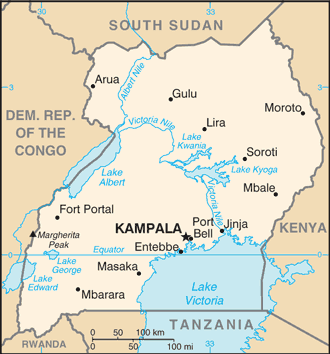
Map of Uganda. Image credit: Perry-Castañeda Collection / University of Texas.
Situated on the shores of Lake Victoria (the third largest lake in the world), where the River Nile (the longest river in the world) leaves the lake to make its long, meandering 4000 mile journey up north to the Mediterranean Sea, Jinja had the second largest Jamat in Uganda, after the Jamat of Kampala, some 50 miles away. This is going back some 70 years, to the fifties and sixties before the 1972 crisis when the dictator Idi Amin expelled everybody of Asian origin as well as many expatriates.
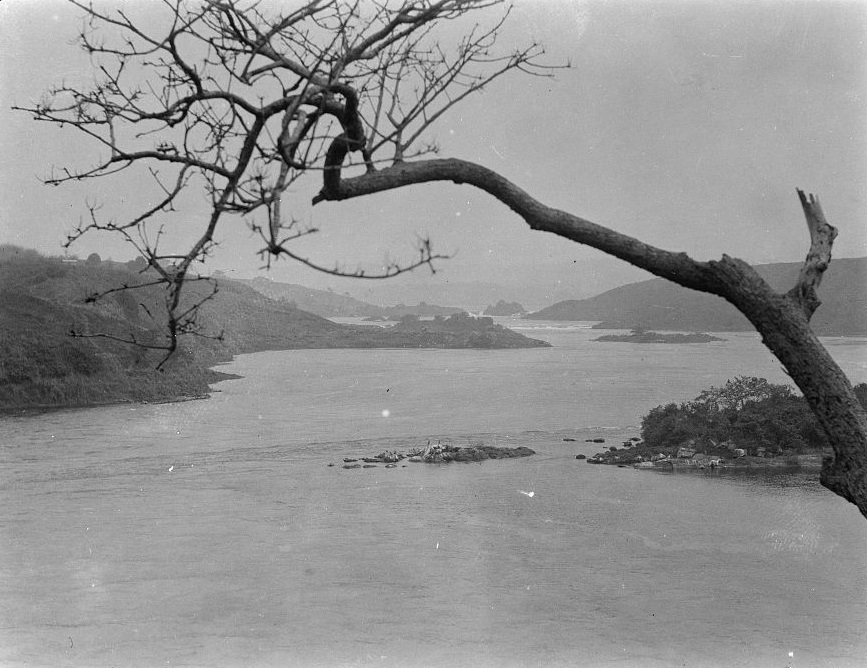
Jinja. Victoria Nile above the Rippon Falls. Photo taken in 1936 on a flight with Imperial Airways on a World Trunk route following the Nile from the Delta to the Victoria Nile and the Victoria Lake. Photo: G. Eric and Edith Matson Photograph Collection / US Library of Congress.
On the banks of the River Nile in Rippon Village was a huge rock which was a drop off or pick up point for travellers crossing the Nile. Jinja literally means a stone or rock and this is how the city derived its name. John Hanning Speke, a British explorer, discovered Jinja as the source of the River Nile in 1858.
First Indian Settlers in Jinja
The early 1900s saw the arrival of the first Indian settlers to Jinja. This is best described in the facebook post by Jinja City:
“Indians first settled in Jinja in the early 1900s. During the late 19th century, Indians of mostly Sikh descent were brought to Uganda on three-year contracts, with the aid of Imperial British contractor Alibhai Mulla Jeevanjee, to build the Uganda Railway from Mombasa to Kisumu by 1901, to Jinja by 1920 and to Kampala by 1931. Some died, others returned to India after the end of their contracts, and others chose to settle.
“Hajji Tamachi was the first Indian settler in Jinja. He set up Jinja’s first shop and Post Office. Hajji Tamachi played a vital role in encouraging other Indians to settle and do business in Jinja. Other Indians followed suite, with Alidina Visram, Vithaldas and Kalidas also setting up shop. Vithaldas and Kalidas, Madhvani’s uncles, helped to tutor Madhvani in business. Madhavani would later single handedly transform Jinja.”
With the building of the railway and much later in 1954, the Owen Falls Dam for generation of hydro-electric power, the Indian population grew with more of them setting up shop. Different communities lived side by side in peace and harmony, doing business and providing services in their respective fields of expertise and professions. Schools were built and so were places of prayer and worship. The Hindus had their temple, the Sikhs their Gurudhwara, the Ithnasharis their Masjid and, in 1937, the Ismaili Jamatkhana was built.
Ismaili Jamatkhana in Jinja
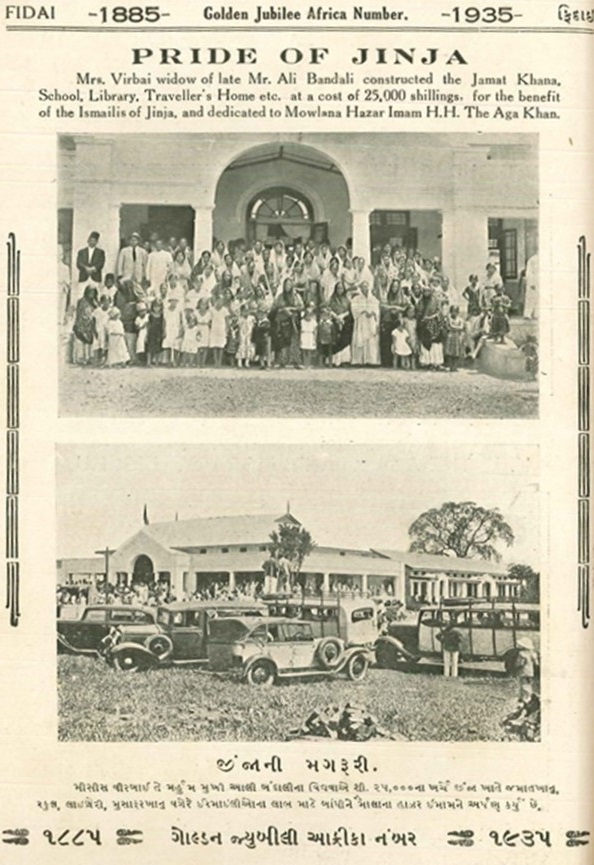
In 1937, on March 01, thanks to the generosity of Varasianima Virbai, widow of late Mr. Ali Bandali, the Jamatkhana, school, library, traveller’s residence (or musafarkhana) etc. were constructed at a cost of 25,000 shillings, for the benefit of Ismailis of Jinja. The project was dedicated to Mawlana Sultan Mahomed Shah Aga Khan (A.S.).
In the top photo, younger and older members of the Jamat are seen gathered at the entrance to the Jamatkhana building at the time of the opening, a proud moment indeed for the Jamat of Jinja. The second photo shows antique cars parked in the front of the Jamatkhana building, indicating that even at that time there were affluent members in the Jamat. Photos: Fidai Magazine, 1885-1936 Golden Jubilee Number.
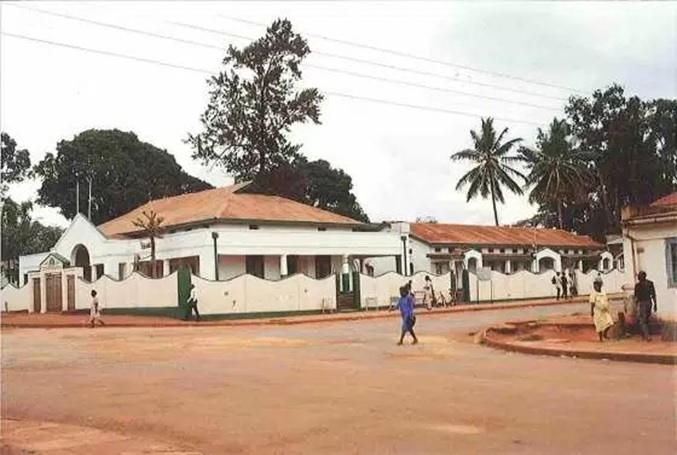
A photo of the Jamatkhana taken much later shows a wall built around the perimeter of the building to make it more secure and private. Land was also acquired for sports activities and to hold Imamat Day, Salgirah and Navroz festivities (generally referred to as Khushialis), as well as other special events.
Another new building was built to house the Council Chamber and the Council Office with some space allocated for activities such as baby shows, cooking demonstrations, exhibitions and other social events etc. The foundation stone of the building was laid by Mukhi Gulamhussein Karim. Mukhi Karim was a prominent and affluent member of the Jamat who served in key leadership positions and commanded lot of respect from members of the Jamat.
Religious Education Classes in Jinja
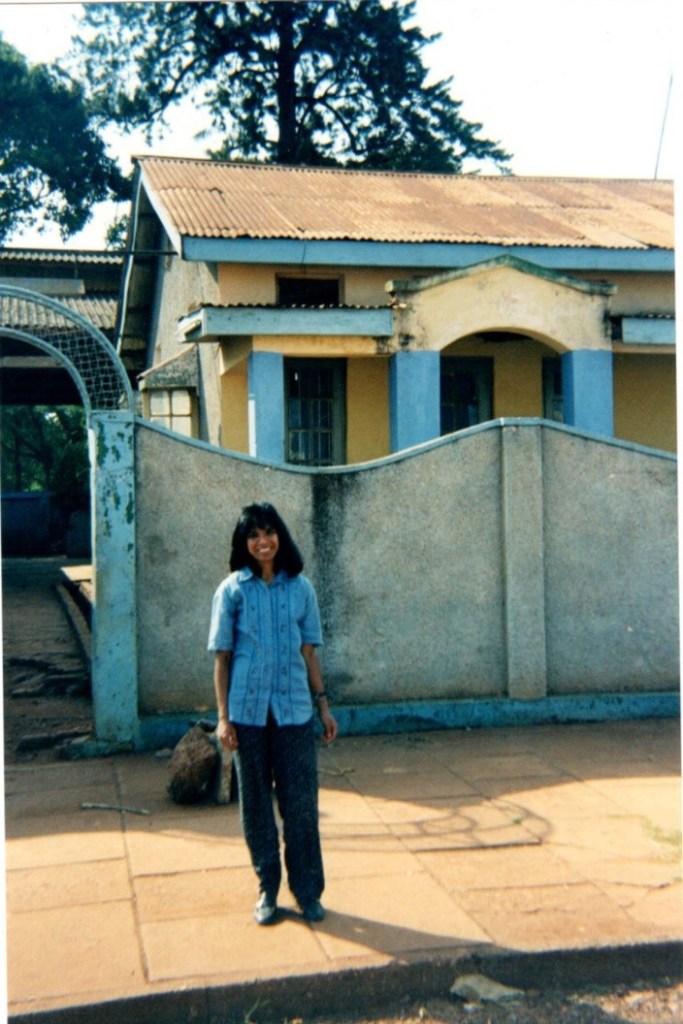
Shams Somani, who was on an assignment as a volunteer teacher with Aga Khan Schools Uganda during the year 1999-2000, is seen standing in front of the building adjacent to the Jamatkhana building where religious education classes were held. Next to the classrooms was the musafar khana (or traveller’s residence) and a residence for the Jamatbhai (caretaker of the Jamatkhana). Photo: Gulamali Kara Somani Family Collection.
Adjacent to the Jamatkhana building, was the building where there were spaces allocated for conducting religious education classes, a musafar khana and a residence for the caretaker of the Jamatkhana known as the Jamatbhai.
One of the principal mandates of the Ismailia Association, precursor to the present day Ismaili Tariqah and Religious Education Board (ITREB), was to run a religious education school. This school comprised of classes for students of all age groups, from lower primary to senior secondary level students. Popularly referred to as dharmic (religious) classes (the equivalent of today’s Baitul Ilm or BUI religious education program), they were held in the evenings during Jamatkhana time. After recitation of the two Du’as, subjects such as Du’a and its meanings, Ginans, History of our Holy Imams, and General Knowledge etc. were all taught. Our father, Gulamali Kara Somani, was the sole senior teacher and was assisted by other student teachers (e.g. Sultan Allidina, Rosy Kassamali) to teach the lower primary students. He was addressed to as ‘Sir’, a title that stuck with him for many years, even after he settled in Canada.
Much later on, there were other teachers who taught, namely, Gulamhussein Alibhai Pradhan (popularly referred to as GAP) and Yusufali K. Adatia (popularly referred to as YK).
‘Sir’ was a disciplinarian. Like it or not, all students were expected to go to the classes and parents made sure they did. In the evenings, there were those who played cricket and when it was time for classes, they would come carrying their cricket gear and place it at the back of the classroom. Before commencing the class, ‘Sir’ would take a cricket stump and place it on the teacher’s table in front. If anybody did not learn properly or misbehave, they would get the stump on the palms of their hands. Those were the days of corporal punishment. Generally, girls were better students than boys. But everybody learnt, whether out of fear or personal motivation and went on to progress in life. There were competitions held, such as waez (sermon) competitions, which brought out the best in the students.
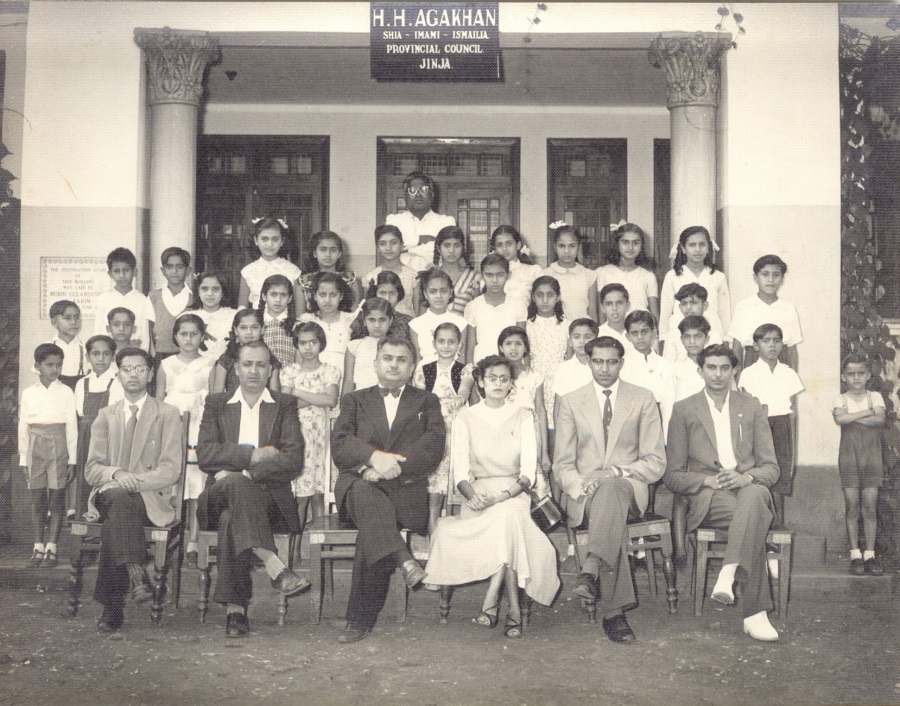
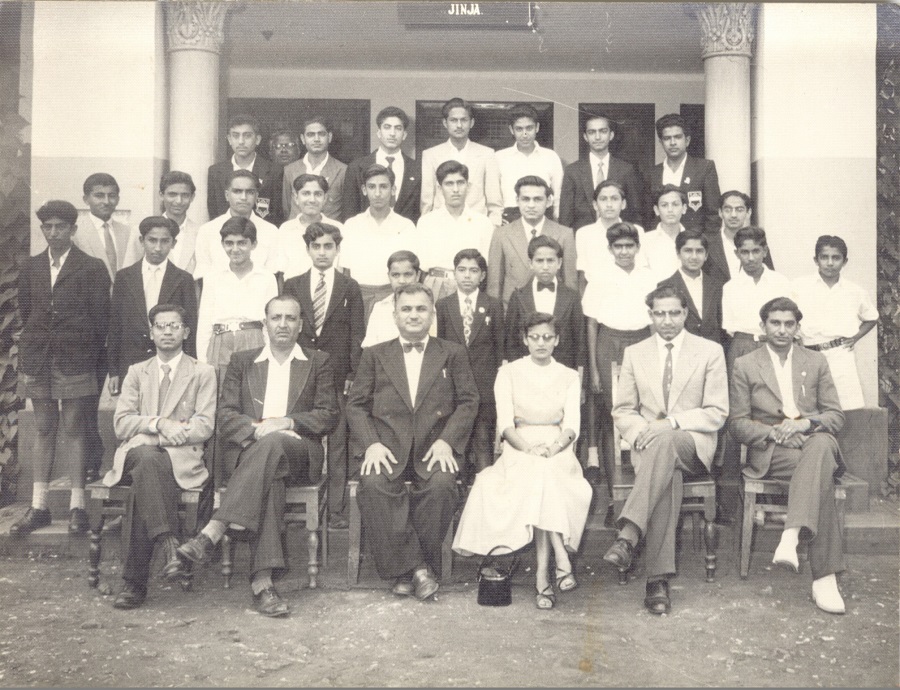
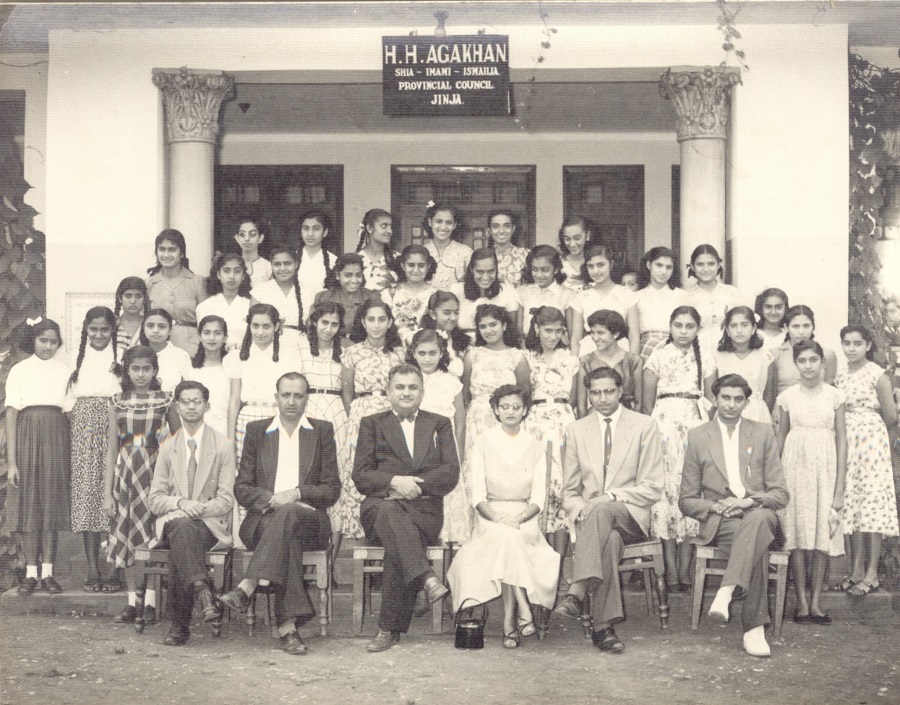
It was customary to have a visiting Alwaez meet and address the students of the dharmic classes. Such was the case when Alwaez Gulamhussein Juma visited Jinja. An opportunity was taken to take group pictures of the different classes of students on the steps of the Council Chamber and Office building.
Younger students of Jinja’s Ismaili religious education classes pictured with visiting Alwaez Juma, members of the Ismailia Association and the Jamatbhai, Dhanjibhai, standing at back centre, with hands folded. Seated front row left to right: Mr. Sadru Jiwani, Mr. Fazal Gulamhussein, Alwaez Gulamhussein Juma, Mrs. Maleksultan Hemani, Mr. Yusuf Adatia and Mr. Gulamali Kara Somani, our father (popularly called ‘Sir’).Individuals who can identify themselves or can be identified through their friends and colleagues are invited to present their names to Simerg@aol.com for a caption update.Photo: Gulamali Kara Somani Family Collection.
Younger as well as some older students of Jinja’s Ismaili religious education classes pictured with visiting Alwaez Juma, members of the Ismailia Association and the Jamatbhai, Dhanjibhai, standing at back, second from left, with glasses. Seated front row left to right: Mr. Sadru Jiwani, Mr. Fazal Gulamhussein, Alwaez Gulamhussein Juma, Mrs. Maleksultan Hemani, Mr. Yusuf Adatia and Mr. Gulamali Kara Somani, our father (popularly called ‘Sir’). Individuals who can identify themselves or can be identified through their friends and colleagues are invited to present their names to Simerg@aol.com for a caption update. Photo: Gulamali Kara Somani Family Collection.
The three historic photos that are presented here may have volumes to speak about the individuals, with their own personal stories and experiences. Unfortunately, some may have passed away. Of course, individuals who can identify themselves or whose friends can identify for them are invited to present their names to Simerg@aol.com so that the captions may be updated. For now the captions in all the three photos only include the names of the office bearers seated on the front row with Alwaez Juma.
All girls! Students of Jinja’s Ismaili religious education classes pictured with visiting Alwaez Juma and members of the Ismailia Association. Seated front row left to right: Mr. Sadru Jiwani, Mr. Fazal Gulamhussein, Alwaez Gulamhussein Juma, Mrs. Maleksultan Hemani, Mr. Yusuf Adatia and Mr. Gulamali Kara Somani, our father (popularly called ‘Sir’).Individuals who can identify themselves or can be identified through their friends and colleagues are invited to present their names to Simerg@aol.com for a caption update.Photo: Via author contacts.
Dhanjibhai – Jinja’s Jamatbhai
Dhanjibhai – see previous group photos
A unique individual in two of the photographs shown above, is the unmistakable figure of Dhanjibhai, bespectacled standing behind the group. He was the Jamatbhai, the caretaker for the Jinja Jamat who took care of the day-to-day operation of the Jamatkhana: opening and closing the Jamatkhana, cleaning, making all the necessary arrangements, preparing tea on a sigri (charcoal burning stove) etc. He was the point man for getting anything done on the Jamatkhana premises and had the keys to all the rooms. He was also responsible for collecting Jamatkhana empty plates, bowls etc. from Ismaili households, going from house to house and putting them in a big raffia basket carried by an assistant. Dhanjibhai also delivered notifications to all those who had been given waras (assignments) to recite Du’a, Tasbih, Ginan etc. in Jamatkhana. The response for the acceptance or non-acceptance of the wara had to be given immediately and indicated on the wara card.
Dhanjibhai lived in a residence just next to the musafarkhana with his wife, popularly known as maasi (aunty). In the evenings, maasi would prepare fried mogo (cassava) on a makaara (charcoal) burning sigri (stove) and was stationed near the back exit door. She would sell these mogo pieces inexpensively to supplement their meager income. There was chili, salt and a ambli (tamarind) sauce to go with the mogo which was a real treat. As youths, we would always look forward to this mouth-watering mogo after Jamatkhana, huddling near the parked cars on the street and socializing as we waited for our parents to come out of Jamatkhana.
Ismaili Institutions in Jinja
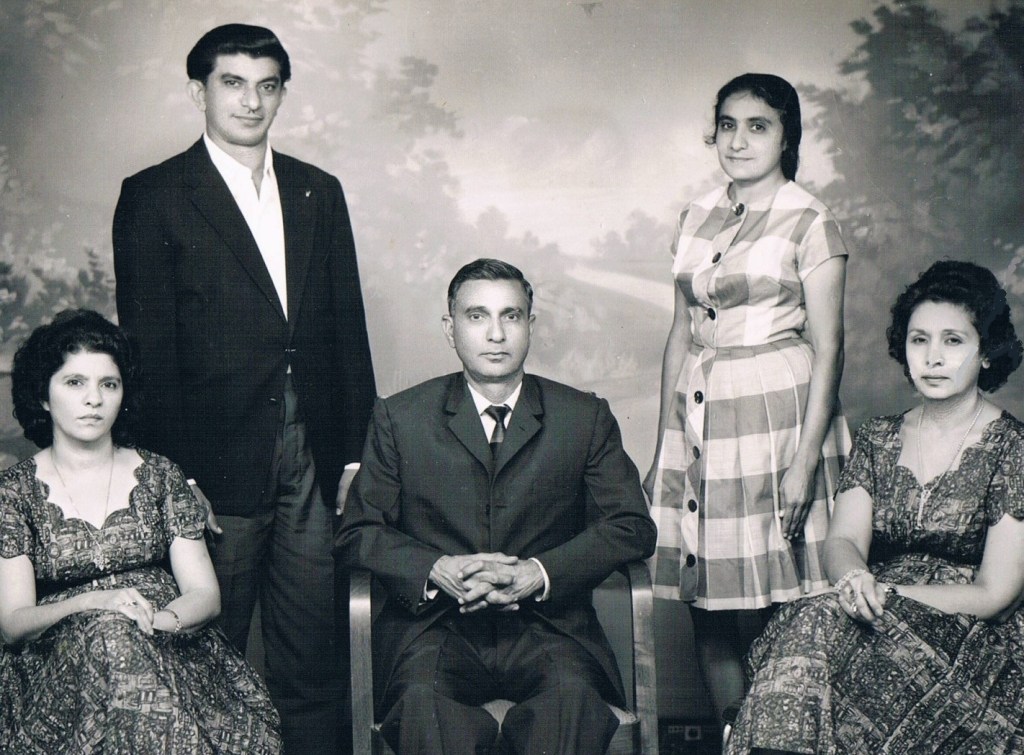
Jinja Ismailia Association members. Sitting left to right: Mrs. Shirin Haji Bachu, Mr. Ibrahim Mohamed Jamal (Chairman) and Mrs. Noorbanu Mohamed Mitha; and standing are Mr. Gulamali Kara Somani (our father: ‘sir’) and Ms. Malek Alarakhia, who was a secular school teacher.Photo: Gulamali Kara Somani Family Collection.
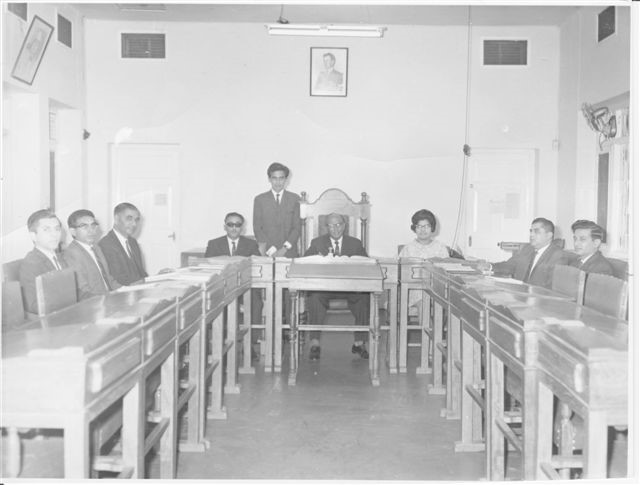
Inspite of the relative small size of the Jamat, Jinja was very well organized with a functioning Provincial Council, an Ismailia Association as well as numerous sub-committees to cater to the needs of different segments of the Jamat including women and youth. The Ismailia Association was primarily responsible for imparting religious education to members of the Jamat, arranging waezeen tours from time to time, selling religious books, making Farmans available, as well as ensuring that rites, rituals and religious ceremonies were being followed.
The Jinja Aga Khan Provincial Council in session. Sitting clockwise from left are Mr. Sadru Mitha, Mr. Abdul Ramji, Mr. Haji Bachu, Mr. Abdul Devji, Mr. Badru Gulamhussein Adatia (Secretary), Mr. Haroon R. Khamis (Council President), Mrs. Gulshan Adatia, Mr. Madat Hemani, and Mr. Sadru Walji Adatia.Photo: Via author contacts.
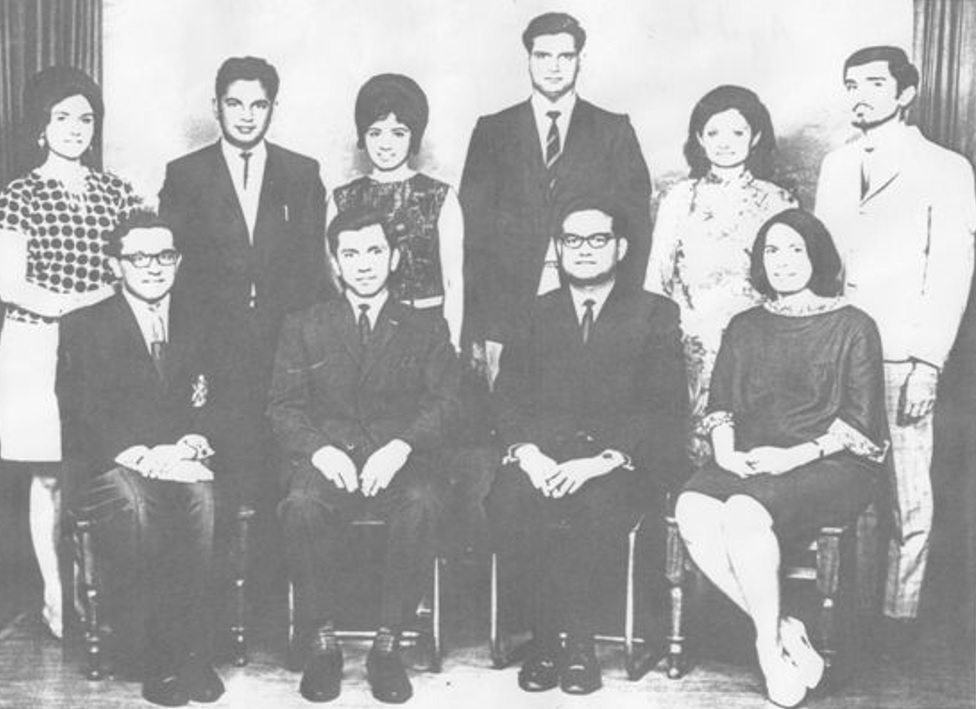
Members of the Jinja Ismaili Entertainment Committee. Seated left to right: Sadrudin V. Virani (Hon. Treasurer), Sadrudin Mitha (Ismaili Youth Organization, IYO, member), Madat Shariff (Chairman), Parin Jamani (Hon. Secretary); standing left to right: Zebun Mitha, Nizar Shariff, Zebun Khamis, Bahadur Shamji, Gulzar J. Karim and Amirali A. Lalani.Photo: Via author contacts.
In sports, the youths of Jinja were very active in practically every sport, be it badminton, table tennis, volleyball and netball (equivalent to today’s basketball). Soccer and cricket were also played, though the playground was not large enough. Volleyball, traditional style, was played regularly, usually over the weekends. Of particular interest was the volleyball match played between married vs bachelors that took place once a year during one of the Khushialis. The match created quite a rivalry and was talked about for weeks afterwards.
At Khushialis, the whole playground was taken over with various activities, both for youths and adults. Starting with the flag raising ceremony, there were games and matches played. Usually the finals in sports such as table tennis were played on that day and trophies awarded to the winners. At lunch time there was sagridaam jaman (communal feast) when pillau (rice), cooked in a deg (large pot) was served in thalaas (large round trays) by the dynamic volunteer corps in full uniform. The Khushiali was a two-day weekend event with dandiya raas (Indian folk stick dance) and raas garba (circular folk dance) being played on Saturday until late at night with music provided by the Ismaili band.
Ismaili Business and Professional Activities in Jinja
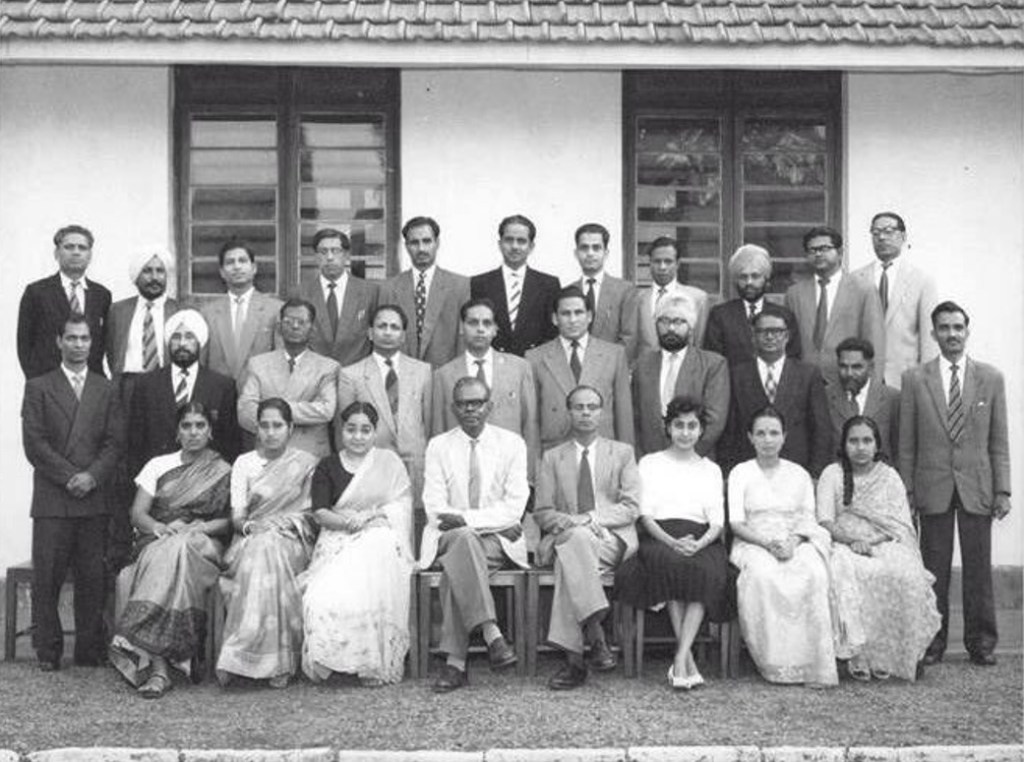
Ismaili entrepreneurs were active in all spheres of business; Taxi & Car Rental (Hadi Jamal), Bus Company (Mohamed Mitha, Ibrahim Mohamed, Kassam Haji), Watches & Jewellery (Charanias), Insurance (Hussein Velji), Hotel Blue Cat (Abdul Devji), Restaurant & Bar (Sadru Hussein Rashid Khamis), Wholesale Clothing (Jeraj Sheriff), Portello Soda (Mohamed Remtulla), Pharmacy Retail (Jamal Govindji – Musa Diamond), Gifts (Madatali Hemani), Shoes (Sadru Bata), Molasses (Madatali Moolji), Bakery (Rahim Rajan), Butchery (Alaudin Kara) etc. to name just a few. There were also professionals such as Dr. Abdul Kassam Adatia, first Dean of Faculty of Dentistry at Bristol University (U.K) and visiting professor at Makerere University (Kampala), Yusuf Adatia (Architect) and secular school teachers, Ms. Malek Alarakhia, Ms. Gulzar Allidina and Ms. Gulshan Allidina, who appears in a very rare secondary school staff photo shown below. Indeed, generations of Ismaili students who attended the school will be able to relate to the photo, by recognizing some of their teachers.
Photo of Staff at Senior Secondary School in Jinja
Back row, left to right: R. L. Avasthi, Bahal Singh, L. A. Gomes, B. S. Bhabuta, C. M. Bashir, R. C. Saksena, S. V. Ayyar, P. S. Nayar, Jaswant Singh, A. D. Oza and C. P. Bhabuta; Middle row, left to right: D. B. Deshpande, Beant Singh (Sr. Master Eng.) K. M. Chakravartty, R. S. Aggarwal, J. C. Aggarwalla, Sheikh M. Hussain, B. S. Batra, S. Chakraborti (Sr. Master Hist.), A. A. Khan (Sr. Master Urdu), and H. P. Joshi; and Seated left to right: Miss J. K. Sandhu, Mrs. J. K. Sangha, Mrs. P. Dass, R. N. Banernjee (Headmaster), N. R. Metha (Chief Asstt,), Miss G. Allidina, Mrs. M. Saxana, and Mrs. S. Desai.Photo: Via author contacts.
Visit by Mawlana Hazar Imam to Jinja in 1957
The Jinja Jamat was blessed with two visits by Mawlana Hazar Imam. The first one was in 1957, shortly after the Takhtnashini (ceremonial installation) on October 25, 1957 in Kampala, and the second took place in 1966, when Mawlana Hazar Imam made an extensive visit to East Africa.
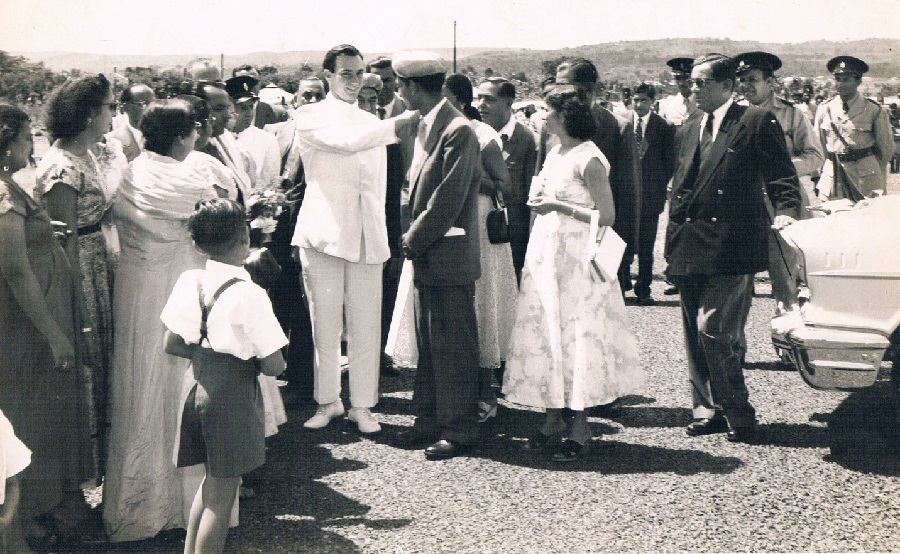
Mawlana Hazar Imam arrives at Jinja airfield, and is received by the Jamati leadership. Here he is seen blessing Kamadia Haji Bachu with Kamadiani Shirin standing next to him. Immediately behind Hazar Imam is Mukhi Shamsudin Mohamed (with hat). Leaning on the car is Alwaez Jaffererali Sufi. On the extreme right is our father (‘Sir’) in full uniform, standing behind Mr. Haji Molu, his colleague.Photo: Gulamali Kara Somani Family Collection.
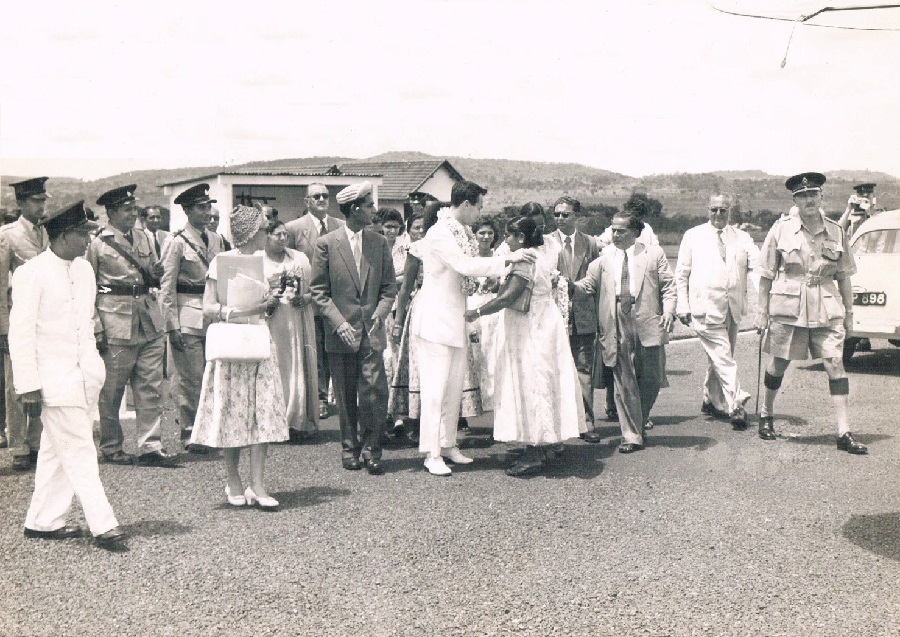
Mawlana Hazar Imam blesses Mrs. Jenabai Karim after being garlanded by her upon his arrival at the Jinja airfield. In the foreground, dressed in white with a hat is Mr. Sadruddin Karim, who was designated to drive Mawlana Hazar Imam’s car in Jinja. In volunteer uniform, at far left, are (left to right): Mr. Amin Alarakhia, Mr. Haji Molu and our father, Mr. Gulamali Kara Somani (‘Sir’). The two persons shown immediately to the left of the policeman (in shorts) are President Mr. Haji Rashid Khamis (in a light colored suit and dark glasses) and Mr. Abdulla Hassam Gangji (light suit). Photo: Gulamali Kara Somani Family Collection.
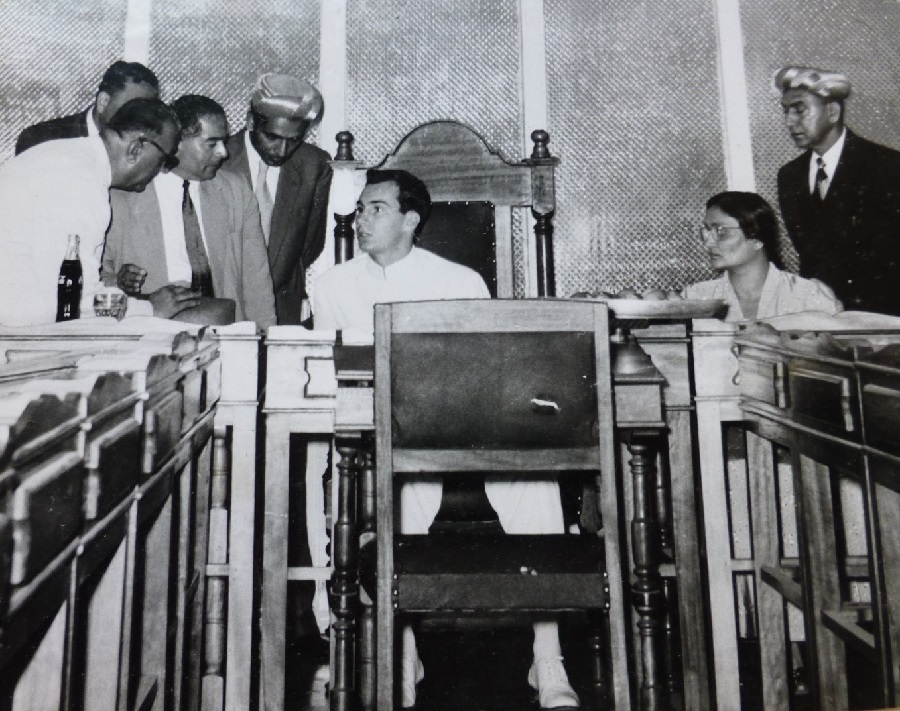
Mawlana Hazar Imam paid a visit to the Jinja Provincial Council Chamber during his 1957 visit. In this photograph, he is seen conferring with the leaders of the Jamat. Seen from left to right are President Haji Rashid Khamis, person standing (not visible), Mr. Abdulla Hassam Gangji, Kamadia Haji Bachu, Mawlana Hazar Imam, Mrs. Zohrakhanu Allidina (seated), who held the portfolio of Member for Women and Mukhi Shamsudin Mohamed (standing).Photo: Allidina Family Collection.
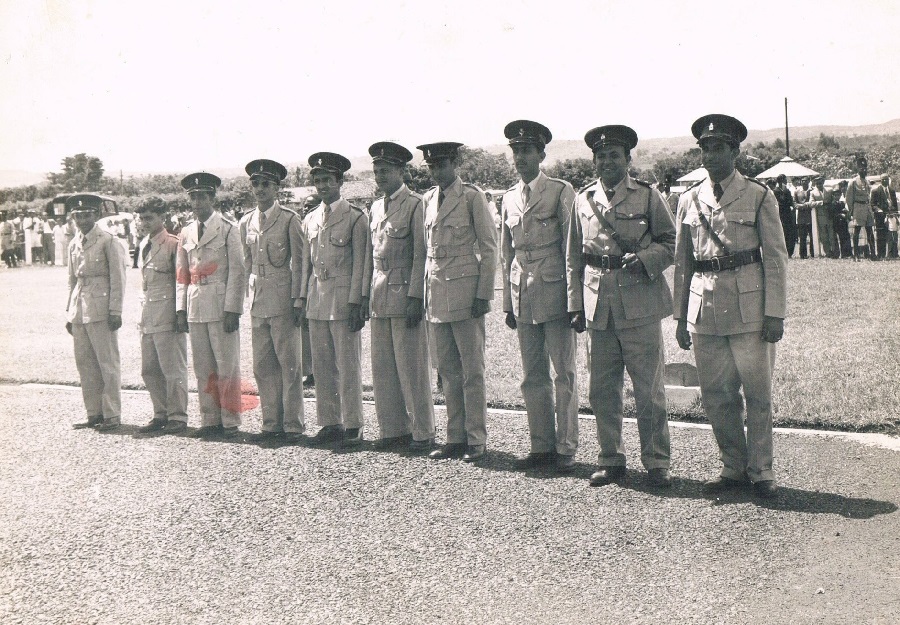
The Jinja Ismaili volunteers in full uniform on duty in 1957 during Mawlana Hazar Imam’s arrival at the Jinja airfied. Standing from right to left: Our father Gulamali Kara Somani (Lieutenant), Haji Molu (Lieutenant), Amin Alarakhia, Bahadur Fazal, Hassam Mawji, Ahmed Jamal, Madat Khamis, Feroz Khamis, Sultan Allidina and Nizar Sheriff.Photo: Gulamali Kara Somani Family Collection.
Visit by Mawlana Hazar Imam to Jinja in 1966
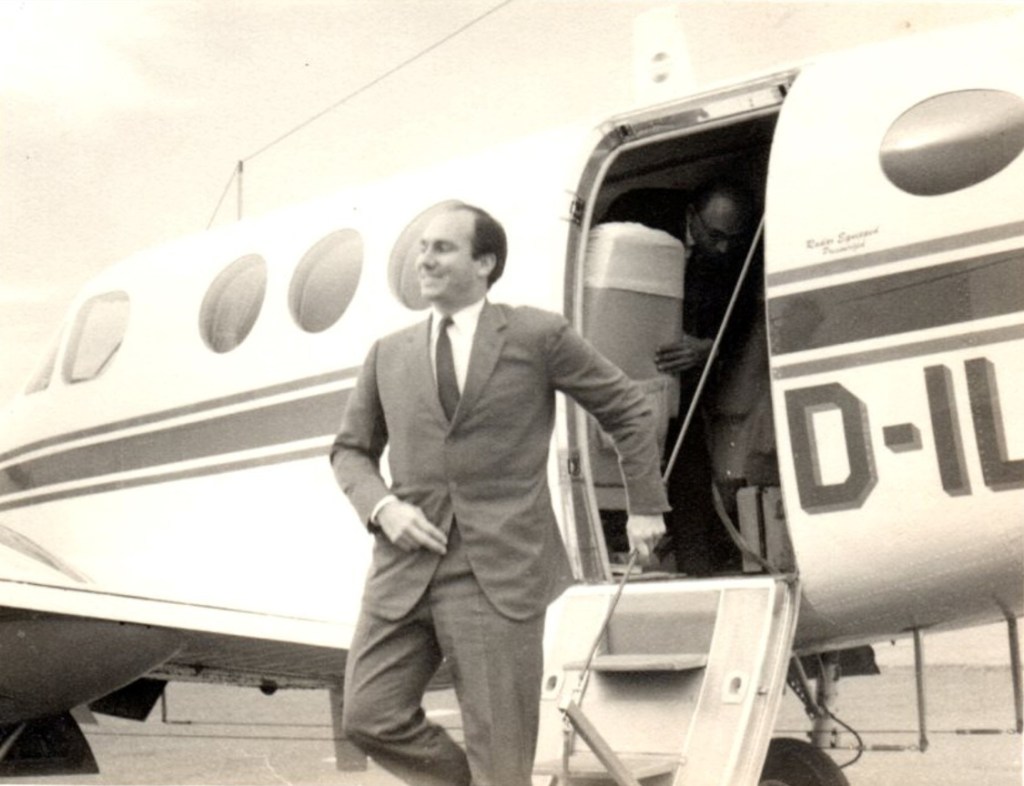
Mawlana Hazar Imam graced the Jinja Jamat with a second visit in 1966. The photos shown are also from our album. The first photo, though, where Hazar Imam is seen stepping down, is of his arrival at Entebbe Airport.
Mawlana Hazar Imam arrives at Entebbe Airport for his visit to Uganda in 1966.Photo: Gulamali Kara Somani Family Collection.
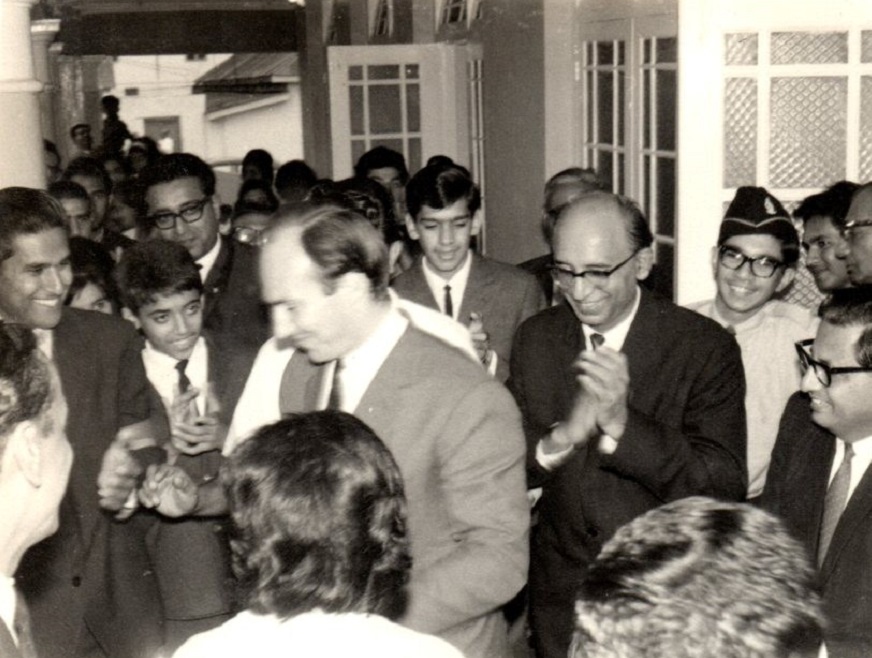
Mawlana Hazar Imam leaving the Ismaili Council Chamber building surrounded by his murids, trying to get a last glimpse before his departure. From left to right are Amir Madhavji, Zulfikar Devji, Abdul Alarakhia, Mehboob Charania, Malik Kassim-Lakha, Salim Somani, Nizar Sheriff and Sadruddin Karim.Photo: Gulamali Kara Somani Family Collection.
____________________
Conclusion
We trust that this short essay has served to provide some history of the Jinja Jamat from our perspective and in so doing, we have honored the memory of our beloved father. But by no means is it complete. There may be some minor errors that need to be corrected and some omissions and information gaps that need to be filled. We are sure that there is much more that others can contribute, and readers can do that by completing the comments box below.
After the 1972 Uganda crisis, when there was a mass exodus, the economy went down tremendously. But since then things have picked up particularly in Kampala, the capital, where there is lot of construction going on. A number of ex-Ugandans have returned and there is new immigration, mostly from India. There is lot of outside investment including by Hazar Imam, e.g Serena Hotel, Bujagali Falls Hydro-electric power station (in partnership between Aga Khan Fund for Economic Development or AKFED, Sithe Global Power of USA, Government of Uganda, Industrial Promotion Services, IPS, and Jubilee Investment Company).
Photo taken in 2000 on the steps of previously used Jinja Council Chamber/Office building, which is now used as a Jamatkhana by the Jinja Jamat. Among those pictured in the front row are Mukhiani Saheba of Jinja (3rd from left), originally from Northern Pakistan, ITREB Uganda Chairman Anil Samji, Religious Education Coordinator Karim Jiwani, and Kamadia Saheb of Jinja Jamat; in middle row at left is Shams Somani of Montreal who was on voluntary assignment in Uganda with Aga Khan Schools during 1999-2000; and in back row are Council Secretary Shellina Hasham with her husband Salim Hasham, ITREB District Member. Photo: Gulamali Kara Somani Family Collection.
The economy in Jinja is still depressed with abandoned buildings and buildings in a state of disrepair. The historic Jamatkhana building still stands but there is now a clinic there. The small Jamat that is there, mostly from India, meets for Jamatkhana in the Council Chamber/Office building (see photo, above).
Let us hope and pray that the beautiful city of Jinja, once the industrial hub of Uganda, prospers and blossoms to its days of past glory and become the dynamic and vibrant city that it once was.
_____________________
A Tribute to Our Late Father, Gulamali Kara Somani
Gulamali Kara Somani (1924 – 2010).
The history of Jinja Jamat and the pictures that we have shared with readers with Simerg are a testimony of our father’s love for Mawlana Hazar Imam and his Jamat. He preserved these photos in our family album for more than 62 years. We wish to pay him our humble tribute.
Our loving father, Gulamali Kara Somani, was born in 1924 in Jinja, He lost both his parents when he was just 8 years old. He was brought up by his uncle and, like many from his generation, he set up shop and started to do business after finishing school. He was always mechanically inclined, fixing things, be it cars, bicycles etc. and was always very creative. For example, he could take a black & white picture and color it using photo tints. (There were no colored pictures at the time). He also developed his own pictures at home. Music was his passion. He started writing and composing songs and played them on a musical stringed instrument of Japanese origin called Taishokoto.
Then he got into repairing watches and got very good at it, a skill that he practiced till his last days. He could pull apart a watch completely, clean the parts, oil them and put them back together for perfect timing. It was this skill that landed him a job in Montreal when he applied to come to Canada. His mind worked on small, intricate details which is why he was very successful in fixing things or creating works of art. At Jamatkhana, when they needed something decorative to be prepared, they knew that they could count on him for something original and he never let them down.
In the 50s and 60s his services were called upon to teach in the religious night school at Jinja to students from junior level to senior secondary level covering all subjects: Du’a and its meanings, Ginans, History of the Imams, Farmans etc. We remember that at one time during a wa’ez competition he wrote a wa’ez in English for us on the subject of: “Education”.
He also served as a senior volunteer (Lieutenant: the highest ranking officer) rendering exceptional services along with other volunteers particularly during Hazar Imam’s two visits to Jinja. We remember seeing him with burn-bubbles on his hands from serving hot, steaming pillau (rice) from the deg (large pot). When he presented himself for Mehmani to Hazar Imam, Hazar Imam blessed him and mentioned: “Good service!”
He was also a member of the Ismaili Band that provided music for dandiyaraas and garba during the Khushiali celebrations.
In 1966 when Hazar Imam visited Uganda, there was a small town named Mbale in Eastern Uganda, on his itinerary (see Uganda map on top of page). Mr. Hadi Jamal of Jinja provided a fleet of cars for Hazar Imam’s staff to travel to Mbale. Our father volunteered to drive one of the cars and was assigned Hazar Imam’s photographer, which was great because he could go everywhere where Hazar Imam went. At one point, Hazar Imam was at a reception and was drinking Coca-Cola from a glass. Our father did not take his eyes off this glass. As soon as Hazar Imam kept his glass on the table and started to leave, our father made a beeline for the glass, picked it up, and then took the glass with him. We still have this glass in our possession which our father preciously guarded and brought it with him to Canada.
A teacher, a volunteer par excellence and above all, a humanitarian, our father served with utmost distinction and dedication, never seeking recognition. His outstanding and exemplary services are truly worthy of admiration and emulation and rubbed off on of us, his children, who have served in various capacities over the years in Jamati institutions.
Our younger sister, Shams, a secular teacher, took one year out of her teaching profession to work as a volunteer with Aga Khan Education Services (AKES) in Kampala from 1999 to 2000. Both our sisters, Layla and Shams were also heavily involved in BUI (Bait-ul Ilm) and have continued to play a role in imparting religious education for many years now. I, Salim Somani, served in various Majalis as Mukhi and Kamadia, in committees (audio visual, catering etc.) and also as a volunteer. My brother Sultan Somani, the co-author with me on this Jinja piece, served as Chairman of Ismailia Association (6 years), as Hon. Secretary on the Aga Khan Council for Quebec & The Maritime Provinces (6 years), Member and Chairman, Conciliation and Arbitration Board (6 years), and as Majlis Mukhi (3 years), among other duties etc.
Never missing a day, except for health reasons, our father attended Jamatkhana everyday in the morning and evening, no matter what the weather was like. We have seen him bundle up and walk to Jamatkhana when it was extremely cold.
Our beloved father passed away in April 2010 at the age of 86.
We pray that may Allah in His Infinite Grace and Mercy forgive all his sins and rest his soul in eternal peace – Amen.
Date posted: July 31, 2020. Last updated: August 12, 2020 (caption updates with name of person(s) as they become available, and typos).
CORRECTIONS:
(1) In the original version of this piece, the year 1958 was mentioned as Mawlana Hazar Imam’s first visit to Jinja, Uganda. Actually, the visit took place in 1957, shortly after Mawlana Hazar Imam’s enthronement (Takhtnashini) ceremony in Kampala on October 25, 1957. The article has been updated with the correct year (correction made on August 9, 2020).
(2) Earlier versions of this piece mentioned that Mawlana Hazar Imam travelled by car to towns outside Kampala, such as Jinja and Mbale. Our attention has been drawn to the fact that in 1957, Mawlana Hazar arrived in Jinja by plane, where there was an airfield available for the landing of military aircraft as well as some civilian planes. We have updated our captions of the 1957 visit to reflect this (correction made on August 10, 2020).
Before departing this website please take a moment to review Simerg’s Table of Contents for links to hundreds of thought provoking pieces on a vast array of subjects including faith and culture, history and philosophy, and arts and letters to name a few.
Please report typo or error in story to Simerg@aol.com.
___________________
We welcome your feedback/letters on this special piece on Jinja by clicking on Leave a comment or writing to the editor, Malik Merchant, at Simerg@aol.com. If you were a Jinja resident, your reminiscences about life in Jinja, your participation as a student, a volunteer, a leader or a member of the Jinja Jamat, as well your surprising anecdotes will uncover a wealth of information about Jinja. We also welcome historical photographs of Mawlana Hazar Imam’s visit to Jinja. Kindly note that your feedback may be edited for length and brevity, and is subject to moderation. We are unable to acknowledge unpublished letters.
____________________
About the Authors
Salim, in volunteers uniform, 1966
The authors of this article, Salim and Sultan Somani, were both born in Jinja, Uganda and now reside in Montreal, Quebec.
Salim immigrated to Canada in 1974 from England where he pursued his studies in Hotel Management & Catering at Huddersfield Polytechnic and specialized in cuisine. Unable to return to Uganda, following the 1972 expulsion of Asians, Salim moved to join his parents in Montreal where over the years he applied his culinary skills at a number of prestigious places, including the Ritz Carlton, Bonaventure Hilton and Montreal Casino in different cuisines. Most recently he worked at the renowned catering company, La Maison Carrier-Besson.
He is married to Rashida and has a son, Hussein, a National Account Executive with RGIS and a daughter, Aliya, Educational Consultant with EMSB (English Montreal School Board). Salim is now retired.
In recent years, Salim has started carving fruits, particularly watermelons, and his impressive work has resulted in him being invited to carve fruits for several important festivals and ceremonial occasions.
Sultan Somani with his daughter, Sarah
Salim’s brother, Sultan, immigrated to Canada in 1973. He was studying Physics/Mathematics at Makerere University, and 3 months before writing his final exams, he was in the unfortunate position of having to leave Uganda due to Idi Amin’s expulsion orders. He proceeded to Nairobi, Kenya, and with the assistance of the United Nations High Commission for Refugees, under the leadership of late Prince Sadruddin Aga Khan, was moved to a refugee camp in Italy where he stayed for 5 months. He then joined his parents in Montreal, where he studied computer science in a university before commencing a career as a systems analyst and programmer at Bell Canada’s Behavioural Sciences Group, Comptrollers Results Department and Corporate Systems Organization (CSO).
Sultan later diversified into a number of businesses in partnership. He has for years dedicated his time to serving Ismaili Institutions in numerous capacities and the Ismaili community in general, for which the title of Rai was bestowed on him. He is now retired, and at the age of 70 is a father of 6 year old daughter, Sarah, whom he takes care of on a full-time basis with his wife, Shainaze.
________________________
The authors recommend the website Sikh Heritage for more information and photos of Jinja.
When Ayaz Pirani is in your neighbourhood doing a reading from one of his books, please attend the event. You will become utterly relaxed listening to his beautiful poetry reading in a calm, gentle and soothing voice. He was in Toronto last year and I attended his reading at Knife Fork Books on 244 Augusta Avenue in the vibrant Kensington Market Area. I couldn’t locate the place easily, and even the NU Bügel staff did not know there was beautiful poetry being served upstairs on a regular basis. After a few more inquiries, I climbed a few set of stairs, excused myself for arriving a little bit late and sat to listen to Ayaz! The small crowd, mainly a gathering of Ismaili youth and professionals, kept urging Ayaz to continue with his reading, and he graciously complied. Meeting him later, I came away even more convinced of the nobility of his heart and soul. I acquired Kabir’s Jacket Has a Thousand Pockets but had to put it away in storage with my other books, as I was preparing to leave for Vancouver to be with my mum. I never got to reading the book nor interviewing this highly gifted literary personality in the Ismaili community. Recently, I asked him to present a short overview of his titles. I am delighted to present his piece below. Links to some on-line stores selling Ayaz’s books are provided at the end of the piece. I look forward to interviewing this literary jewel in the coming months, once my nomadic life style comes to an end!
___________
“My love of ginans is various and unending. They have the charms and rhetorical force of written language as well as the emotional and nourishing elements of oral tradition” — Ayaz Pirani
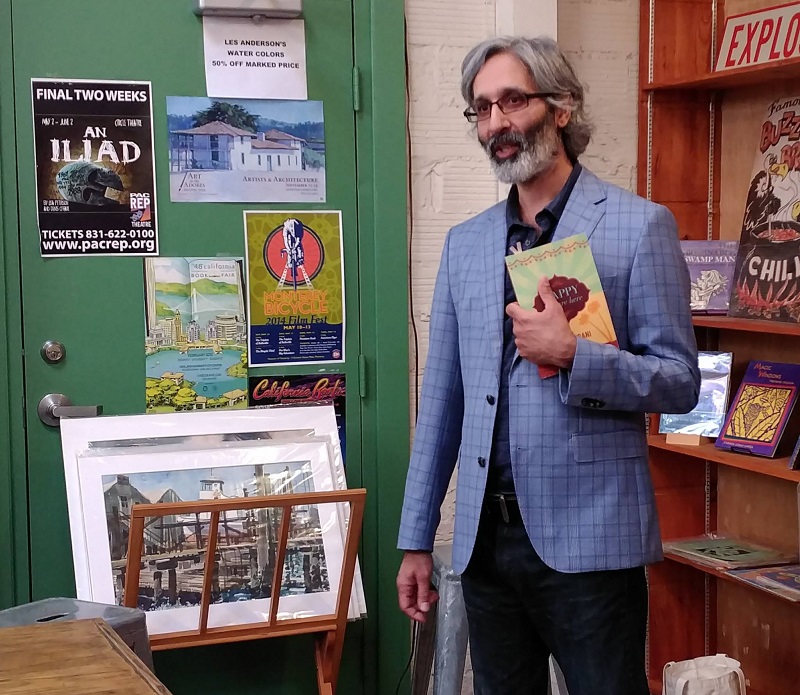
Ayaz Pirani reading from “Happy You Are Here” at Old Capitol Books in Monterey, California. Photo: Ayaz Pirani.
By AYAZ PIRANI
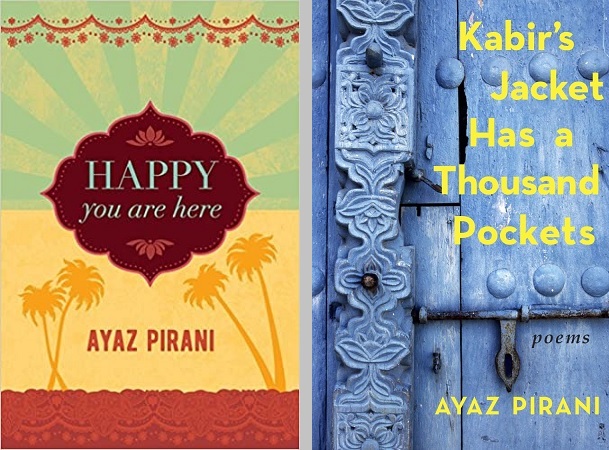
With my first book, Happy You Are Here, I began to wrestle with geography and humanness in my poems. Canadian poet Suzanne Buffam called Happy You Are Here “tender and intimate” and Heather Birrell said “Ayaz Pirani positions himself as a kind of plainspoken anti-prophet, bringing human nosiness and gratitude to a number of subjects—displacement and immigration, the oak woods of the Arroyo Seco, a mother’s love, a pub in Toronto…—as well as the more mysterious geographies of the soul.”
My second book, Kabir’s Jacket Has a Thousand Pockets, was described as “wisdom poetry” that was “surprising and sly” by New England poet David Rivard. All of my work, including my new chapbook, Bachelor of Art, is informed by my affection for Ginans. Perhaps for this reason Rivard felt they were tinged with perennial truths.
My love of Ginans is various and unending. They have the charms and rhetorical force of written language as well as the emotional and nourishing elements of oral tradition. When a Ginan is experienced in situ, that is, in a Jamatkhana, there is further the resonances that come from a living heritage.
Happy You Are Here was reviewed in The Dalhousie Review and Qwerty Magazine and my individual poems have recently appeared in The Malahat Review, ARC Poetry Magazine, and The Antigonish Review.
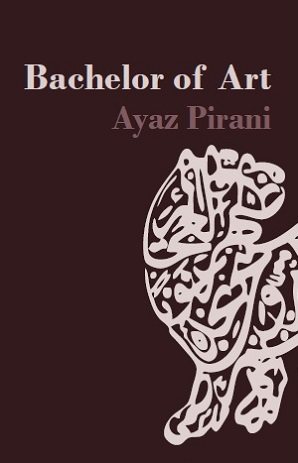
Cover of Bachelor of Art features a calligram of Hazrat Ali as the Tiger of God
My new work, Bachelor of Art, is a chapbook of poems. Individual poems include “Ali’s Tiger,” “Nutshells,” and “Sat Panth.” It’s a bit hard to talk about my own work without sounding pretentious, especially when it’s a genre like poetry which has so many romantic associations. In my work I’m trying to describe a particular diaspora experience by finding resources in various treasuries: ginans, divans (of Kabir, Ghalib, et al.), and English literature. I suppose I’m conscious of trying to situate my poems as a Canadian experience as well. I’m drawn to subjects like loneliness, immigration, faith, human awkwardness, love.
~~~~~~~
Ayaz Pirani’s books are available in local bookstores and online at Amazonand Chapters-Indigo. His new book, Bachelor of Art, is currently available from Anstruther Press for $10. The cover features a calligram of Hazrat Ali as the tiger of God.
Date posted: June 30, 2020.
Before departing this website please take a moment to review Simerg’s Table of Contents for links to hundreds of thought provoking pieces on a vast array of subjects including faith and culture, history and philosophy, and arts and letters to name a few.
____________________
We welcome feedback/letters from our readers. Please use the feedback box which appears below. If you don’t see the box please click Leave a comment. Your comment may be edited for length and brevity, and is subject to moderation. We are unable to acknowledge unpublished letters.
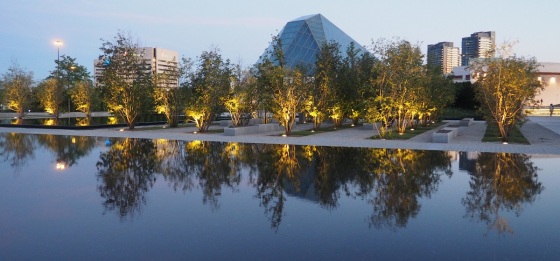
The Aga Khan Museum in Toronto reopens to the public on Saturday, June 27, 2020. As a passionate supporter of the Museum, Simerg’s Malik Merchant decides to visit the grounds on the penultimate day of the reopening to take some pictures. Please click on image below or Aga Khan Museum Reopening Countdown Photos
Please click on photo for Aga Khan Museum countdown to reopening.
“I should like to assure you, my Islamic friends, that under the American Constitution, under American tradition, and in American hearts, this center, this place of worship, is just as welcome as could be a similar edifice of any other religion” — President Eisenhower, June 28, 1957, Islamic Center, Washington D.C.
In an on-line story dated February 3, 2016, TIME magazine informed its readers that President Barrack Obama would be visiting the Islamic Society Mosque in Baltimore, Maryland, thus setting a milestone for his presidency. The reporter, Sarah Begley, reminded readers that the President was far from being the first American President to do so.
Story continues after photo
Islamic Center, Washington, D.C. Conceived in 1944, the site for the mosque was purchased in 1946, and the cornerstone was laid on January 11, 1949. The mosque was designed by Italian architect Mario Rossi and completed in 1954.Photo: Carol M. Highsmith Archive collection / US Library of Congress.
The honour, she said, belonged to President Dwight D. Eisenhower, who served as the 34th President of the United States from 1953 to 1961. He opened the Islamic Center of Washington in the city’s Embassy Row district on June 28, 1957. First lady Mamie Eisenhower accompanied him to the dedication ceremony.
In his speech, President Eisenhower emphasized the importance of religious freedom in the USA, and highlighted the “Muslim genius” that has cultivated some of history’s most important inventions, discoveries, art, literature and thought now considered indispensable to modern civilization.
President Dwight D. Eisenhower’s Remarks at the Opening of the Islamic Center in Washington D.C. on June 28, 1957
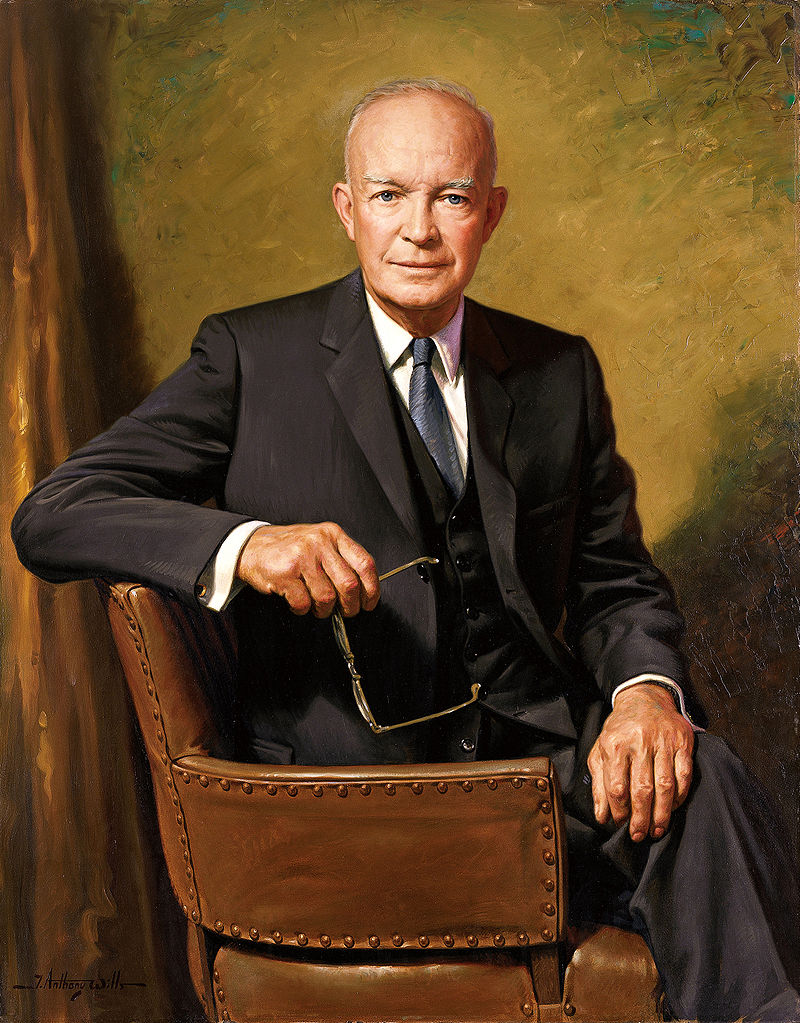
34th US President Dwight D. Eisenhower. White House portrait painted by James Anthony Wills.
By DWIGHT D. EISENHOWER (see profile, below)
[For a photo of the President delivering the speech, please click Politicio — ed.]
Mr. Ambassador, Dr. Bisar, Governors of the Islamic Center, and distinguished guests:
It is a privilege to take part in this ceremony of dedication. Meeting with you now, in front of one of the newest and most beautiful buildings in Washington, it is fitting that we rededicate ourselves to the peaceful progress of all men under one God.
And I should like to assure you, my Islamic friends, that under the American Constitution, under American tradition, and in American hearts, this center, this place of worship, is just as welcome as could be a similar edifice of any other religion. Indeed, America would fight with her whole strength for your right to have here your own church and worship according to your own conscience. This concept is indeed a part of America, and without that concept we would be something else than what we are.
The countries which have sponsored and built this Islamic Center have for centuries contributed to the building of civilization. With their traditions of learning and rich culture, the countries of Islam have added much to the advancement of mankind. Inspired by a sense of brotherhood, common to our innermost beliefs, we can here together reaffirm our determination to secure the foundation of a just and lasting peace.
Our country has long enjoyed a strong bond of friendship with the Islamic nations and, like all healthy relationships, this relationship must be mutually beneficial.
Civilization owes to the Islamic world some of its most important tools and achievements. From fundamental discoveries in medicine to the highest planes of astronomy, the Muslim genius has added much to the culture of all peoples. That genius has been a wellspring of science, commerce and the arts, and has provided for all of us many lessons in courage and in hospitality.
This fruitful relationship between peoples, going far back into history, becomes more important each year. Today, thousands of Americans, both private individuals and governmental officials, live and work — and grow in understanding — among the peoples of Islam.
At the same time, in our country, many from the Muslim lands — students, businessmen and representatives of states — are enjoying the benefits of experience among the people of this country. From these many personal contacts, here and abroad, I firmly believe that there will be a broader understanding and a deeper respect for the worth of all men; and a stronger resolution to work together for the good of mankind.
As I stand beneath these graceful arches, surrounded on every side by friends from far and near, I am convinced that our common goals are both right and promising. Faithful to the demands of justice and of brotherhood, each working according to the lights of his own conscience, our world must advance along the paths of peace.
Thank you very much.
Date posted: April 28, 2020.
Before departing this website please take a moment to review Simerg’s Table of Contents for links to hundreds of thought provoking pieces on a vast array of subjects including faith and culture, history and philosophy, and arts and letters to name a few.
____________________
Pakistan Prime Minister Huseyn Suhrawardy being received at the White House by President Dwight Eisenhower in 1957. Photo: Thomas J. O’Halloran / US Library of Congress.
Dwight D. Eisenhower (1890-1969) served as the thirty-fourth president of the United States, governing from 1953 to 1961, after a military career culminating in his role as Supreme Commander of Allied Forces in Europe during World War II. Eisenhower’s presidency was largely occupied by foreign affairs, most notably the Korean War, the expansion of U.S. involvement in the Middle East after the Suez Crisis, and the general deepening of the Cold War. Even domestically, many of Eisenhower’s achievements were shaped by national security, including the construction of the interstate highway system. Eisenhower joined the Presbyterian Church as an adult and played a role in the addition of “In God We Trust” on American currency. Eisenhower famously stated that “our government has no sense unless it is founded in a deeply felt religious faith, and I don’t care what it is.”
We welcome feedback/letters from our readers. Please use the feedback box which appears below. If you don’t see the box please click Leave a comment. Your comment may be edited for length and brevity, and is subject to moderation. We are unable to acknowledge unpublished letters.
Noteworthy book: “This Day in Presidential History,” by Paul Brandus. For each of the 365 days of the year, Brandus offers fascinating facts, historical anecdotes, and pithy quotations from and about all the presidents of the United States, from George Washington to Donald Trump.
Naad E Ali, Original Song at Youtube, Munir Gillani Official
[Note: The lyrics in the song in both Arabic and English are slightly different from the transliteration and translation published below – Ed.]
Nade Ali, Nade Ali, Nade Ali Nade Aliyyan mazhar al-ajaib Tajidahu awnan lakafin-nawaib Kullu hammin wa ghammin sayanj-i Ali Bi wilayatika, Ya Ali! Ya Ali! Ya Ali!
Translation
Call Ali call Ali call Ali, the manifestation of marvels He will be your helper in difficulty Every anxiety and sorrow will end Through your friendship. O Ali, O Ali, O Ali.
Before departing this website please take a moment to review Simerg’s Table of Contents for links to hundreds of thought provoking pieces on a vast array of subjects including faith and culture, history and philosophy, and arts and letters to name a few.
Date posted: April 6, 2020.
_____________________
We welcome your feedback. Please complete the form below or click on LEAVE A COMMENT if the form is not displayed. Comments are published at the discretion of the editor, and may be subject to moderation.
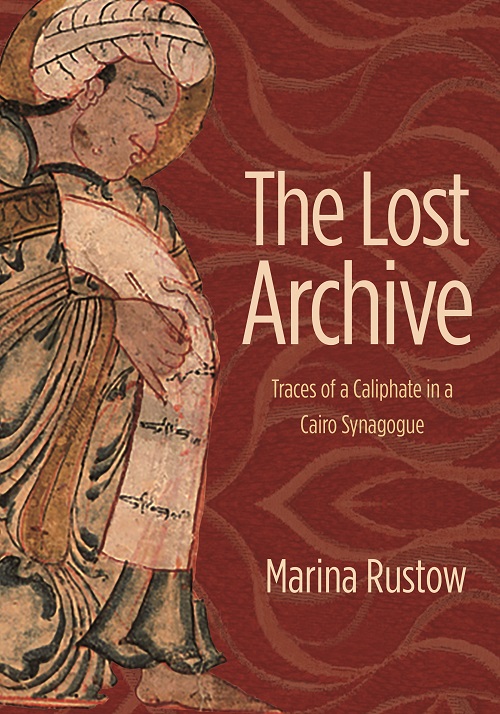
The Lost Archive by Marina Rustow, published on January 14, 2020 by the Princeton University Press; Pages: 624; Size: 7 x 10 in. Illus: 83 color + 17 b/w illus. 4 maps. 4c throughout. To purchase hardcover, Kindle or Kobo versions see links at bottom of this page.
Grabbing our attention now is a splendid new book on the Fatimids that looks at the caliphate’s robust culture of documentation. In an editorial review of the book, Konrad Hirschler of the Freie Universität Berlin describes Marina Rustow’s work “as a veritable magnum opus that will remain a point of reference for decades to come.” He also notes that “there are few books like this one that take the reader on such a long-distance journey across centuries and writing systems.”
The Lost Archive: Traces of a Caliphate in a Cairo Synagogue is Marina Rustow’s second work on the Fatimids. Her first one was entitled Heresy and the Politics of Community: The Jews of the Fatimid Caliphate. Sheis the Khedouri A. Zilkha Professor of Jewish Civilization in the Near East and professor of Near Eastern studies and history at Princeton University. She is director of the Princeton Geniza Lab and a MacArthur fellow. Her latest work is also praised by Geoffrey Khan, University of Cambridge, who states that “with great historiographical skill, Rustow brings new insights into the history of the medieval Middle East through a holistic analysis of the surviving state documents of the Fatimid dynasty. This is a splendid book.”
Marina Rustow has made very interesting and informative presentations of her research and work at the American Philosophical Society and the University of New Mexico. Links to both the videos are provided at the end of this piece.
The lost archive of the Fatimid caliphate survived in an unexpected place: the storage room, or geniza, of a synagogue in Cairo, recycled as scrap paper and deposited there by medieval Jews. In the book Marina Rustow tells the story of this extraordinary find, inviting readers to reconsider the longstanding but mistaken consensus that before 1500 the dynasties of the Islamic Middle East produced few documents, and preserved even fewer.
Beginning with government documents before the Fatimids and paper’s westward spread across Asia, Rustow reveals a millennial tradition of state record keeping whose very continuities suggest the strength of Middle Eastern institutions, not their weakness. Tracing the complex routes by which Arabic documents made their way from Fatimid palace officials to Jewish scribes, the book provides a rare window onto a robust culture of documentation and archiving not only comparable to that of medieval Europe, but, in many cases, surpassing it. Above all, Rustow argues that the problem of archives in the medieval Middle East lies not with the region’s administrative culture, but with our failure to understand preindustrial documentary ecology.
Illustrated with stunning examples from the Cairo Geniza, this compelling book advances our understanding of documents as physical artifacts, showing how the records of the Fatimid caliphate, once recovered, deciphered, and studied, can help change our thinking about the medieval Islamicate world and about premodern polities more broadly.
The hard copy or electronic Kindle version of “The Lost Archive” may be purchased at the following websites: Princeton Amazon & Amazon Canada Indigo
Date posted: March 8, 2020.
__________________
American Philosophical Society presentation by Marina Rustow (34 minutes)
~~~~~~~~~~~~
University of New Mexico presentation by Marina Rustow (1 hour 35 minutes)
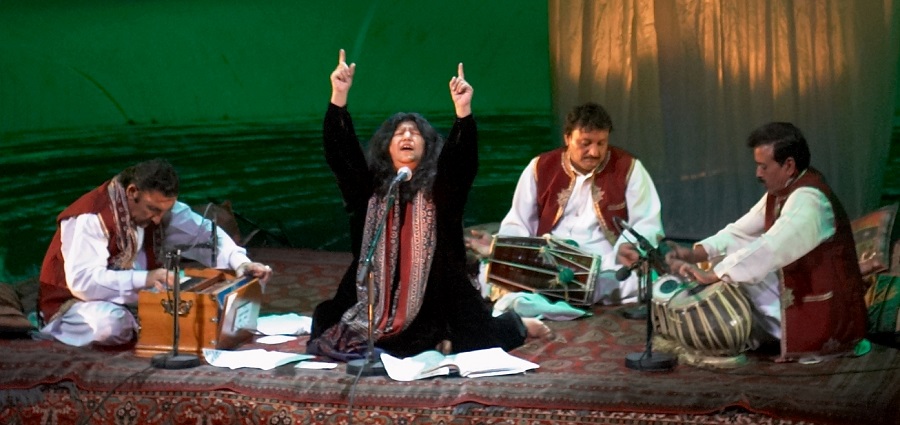
On Saturday, February 29, 2020, Abida Parveen performed in Melbourne, Australia, in a rare appearance outside Pakistan. On the day of her performance she gave an interview to Andrew Ford, host of ABC Australia’s “The Music Show.” In discussing shades of Sufi music (Kafi) towards the end of the interview, the last question Ford asked Abida was what she would be singing in Melbourne that evening, and she replied “Man Kunto Maula.” She demonstrated a few lines from the song in the studio. The famous words are attributed to the Holy Prophet Muhammad (May peace be upon him and his family) at Ghadir Khumm when he said, “He whose Maula I am, Ali is his Maula” thus giving Hazrat Ali parity with himself as his successor to the Divine Institution of Imamat, a hereditary institution that continues to this day under the 49th Imam, Mawlana Hazar Imam, His Highness the Aga Khan. The following rendition of Man Kunto Maula sung by Abida Parveen in Oslo, Norway, is deeply inspiring and worth listening to in full. It has been viewed on YouTube more than 2.7 million times (Update, January 29, 2023: We note the video is no loner available and has been designated as private.).
Date posted: March 1, 2020. Last updated: January 29, 2023 (video unavailable.)
Before departing this website please take a moment to review Simerg’s Table of Contents for links to hundreds of thought provoking pieces on a vast array of subjects including faith and culture, history and philosophy, and arts and letters to name a few.
“Today my Farman is ‘Work and Many Words’. Communicate, enjoy life, be happy…” — Mawlana Hazar Imam, His Highness the Aga Khan, Calgary, May 10, 2018.
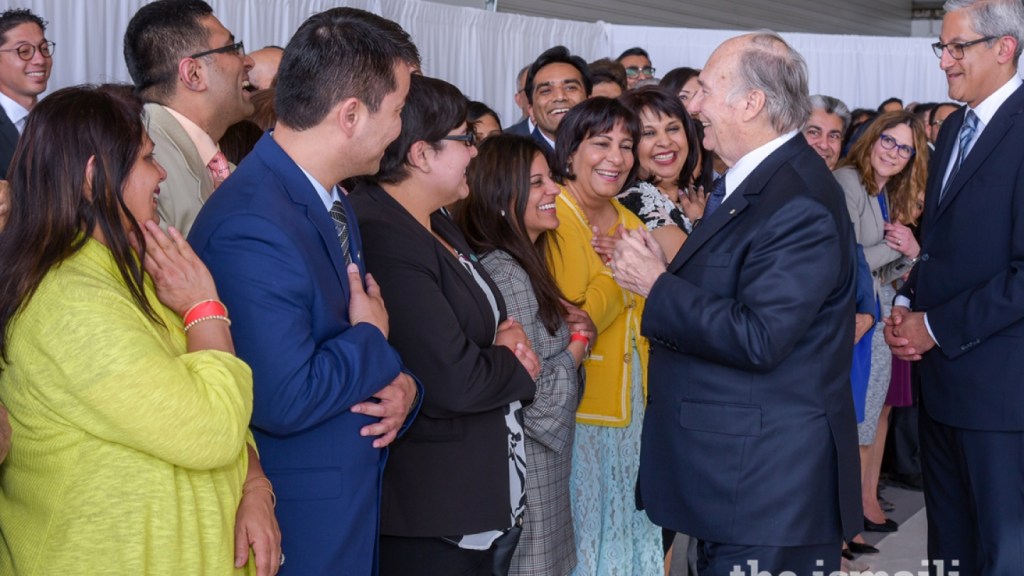
Mawlana Hazar Imam, His Highness the Aga Khan, meets representatives of the Jamat on his arrival in Calgary, Alberta, for his Diamond Jubilee visit in May 2018.
The Ismaili community is a dynamic community with the Imam-of-the-Time guiding his followers according to the time. The essence of the faith remains the same but the form may change over time in cognizance of differences in traditions, cultural, social or other factors. Similarly, there could be changes over time in the manner in which voluntary services may be rendered. Paraphrasing the 48th Imam’s Farman, Mawlana Sultan Mahomed Shah had once said that we should follow the Farmans of the Imam-of-the-Time, noting that as the world changes, even his Farmans would change as time progressed.
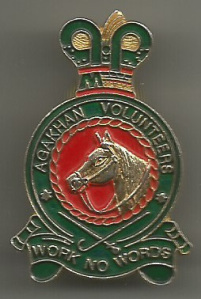
The volunteer’s badge with the motto “Work No Words” is based on Imam Sultan Mahomed Shah’s message, “Today I will give you a small motto and that is ‘Work No Words’.” The motto needs to be revised to reflect Mawlana Shah Karim’s Diamond Jubilee Farman in Calgary “Work and Many Words.”
One of the best known motto given by the late Imam in the 20th century to the volunteers of the Ismaili community was “Work No Words.” It is inscribed on every badge that an Ismaili volunteer wears today. It is also something that many honorary workers serving in institutions in various capacities constantly bear in mind.
What do these words actually mean for any volunteer, badged or otherwise?
I think the motto carries several meanings. Perhaps it is an expression of humility — that one does the work without seeking recognition.
It can be perceived to mean that you serve without question and not react to any attitude that may be shown to you while you are doing your work.
Other volunteers may have their own personal interpretations of the motto during the performance of their duties, and apply it during their service.
Remarkably, that motto was mentioned in the Farman Mawlana Hazar Imam made in Canada during the Diamond Jubilee. At the second Calgary mulaqat, on May 10th, 2018, while mentioning and praising the work of the volunteers, he made a reference to his grandfather’s motto “Work No Words” and declared that “Today my Farman is, ‘Work and Many Words’. Communicate, enjoy life, be happy….”
Eighteen months have since passed but still there seems to be no discussion on this matter. The old motto “Work No Words” appears everywhere in the celebration of the 100th anniversary of the volunteers including a new video “All Work, No Words” that has just been released at The Ismaili website. There is absolutely no reference to the most recent Farman and the new motto. For example, I was quite surprised that the President of the National Council for Tanzania, Amin Lakhani, speaking as recently as July 19, 2019, used the motto that Mawlana Sultan Mohamed Shah gave in one of his speeches, but did not make any reference to the new motto given by Mawlana Hazar Imam. When I raised the issue with a long serving Jamati member, the volunteer became very defensive saying that he would like to see the old motto remain on his badge.
I beg to differ, I believe that we now have to adopt to a new paradigm based on the most recent Farman, “Work, and Many Words.”
How then is this to be interpreted?
Firstly, the volunteers badged and non-badged should not feel fearful to speak up and express their views on matters that concern them on services that they are performing and how they can become more effective, rather than simply taking orders as subordinates. The superiors in the volunteer leadership and heads of various institutions should make their teams more engaged in decision making and seek out creative thoughts, ideas as well as best practices. Quite so often when suggestions are made to institutional heads about new approaches, one is often made to feel that they already knew about the idea that has been brought up. A case in point was when a suggestion was made to make Jamati members more engaged in meetings that the Aga Khan Council and national institutional boards hold on a quarterly basis. The reply was, “We are thinking about it.” For how long?
Many serving in institutions who speak out are left marginalized for speaking out boldly, even when they have done so sincerely and from the heart. This should no longer be the norm. I have personally experienced such treatment.
The old motto “Work No Words” on the badge that volunteers have been wearing for some 70 years is in need of a change. Mawlana Hazar Imam’s Diamond Jubilee “Work and Many Words. Communicate…” should resonate with everyone. We should communicate openly and sincerely and the office bearers should listen respectfully. One area that should require particular attention is legitimate concerns of volunteers in doing their work.
There is one other aspect where the motto “Work, and Many Words” may be applied very effectively. Volunteers of the Jamat participate in many outreach programs outside the community. We have each been considered by the Imam to be his Da’is — a very important term in Ismaili history where only a select few were known as Da’is. Now, remarkably, Mawlana Hazar Imam has told everyone that he or she is a Da’i! The Diamond Jubilee Farmans made at various locations attest to this role we have been asked to play. I think another way of looking at the Farman “Work and Many Words. Communicate…” is in the context of the volunteer who as a Da’i would be a great communicator to others about the ideals, principles and ethos of the Ismaili community. The following Farman made by Mawlana Hazar Imam in 2002 in Dar es Salaam, Tanzania, gives us a clear direction on the role the volunteers as well as the youth and professionals in the Jamat can play:
“…It is important, I think, today, that my Jamat worldwide, not just here in Tanzania, my Jamat worldwide, should reaffirm the traditions that we have, the rectitude and correctitude of our interpretation of Islam, of the role, within Shia Islam, of the intellect, of the human intellect, so that the young, the less young, the old, all of you, wherever you are, are ambassadors of Islam — the Islam that we believe in, that we practice, and that guides us in our lives. So I say to you today, whether you are in Tanzania or whether you are in any other part of the world, stand up, do not run away. Speak openly and frankly about what is our interpretation of Islam.”
Interestingly, in his Diamond Jubilee Farman in Atlanta, USA, Mawlana Hazar Imam asked the Jamat if they knew the meaning of the word Qul (from Sura Ikhlas, which is recited by Ismailis in their Du’a multiple times everyday). One person out of thousands raised a hand! Was that a hint from the Imam to us to seek to understand our faith better? To be effective communicators, requires that we have good knowledge of the faith, its ideals and the work of the Imamat, including for example the AKDN agencies.
So my notion of the work of the volunteers — and indeed each one of us — is to work, and with “many words” express kindness to others, convey good ideas and best practices and pass on the ethos of Islamic and Ismaili principles to everyone we come across.
What should the new badge say? Totally opposite of “Work No Words.” Indeed, the badge should now say “Work and Many Words.” However those “many words” should be spoken with humility, sincerity and thoughtfulness.
I welcome your feedback. Please click LEAVE A COMMENT or send your comment in an email to Simerg@aol.com. You may remain anonymous. Your email address will never be shared.
Before departing this website please take a moment to review Simerg’s Table of Contents for links to hundreds of thought provoking pieces on a vast array of subjects including faith and culture, history and philosophy, and arts and letters to name a few.
Malik Merchant is founding publisher/editor of 3 websites, Barakah (2017), Simerg (2009), and Simergphotos (2012). They are works of passion influenced by his parents involvement with literary pursuits and community publications, as well as his childhood dream of becoming a journalist. However, he spent almost 4 decades working as an IT consultant in both the public and private sectors in the UK, USA and Canada. He has volunteered in the Ismaili community as a teacher and librarian and was co-editor with his late father, Jehangir Merchant, of the flagship UK Ismaili publication Ilm. He has also held numerous institutional and Jamati portfolios, including being the Member for Religious Education and Chairman of the Ottawa Tariqah Committee. He is currently based in Ottawa and Toronto. He welcomes your feedback on this piece by completing LEAVE A REPLY or by sending him an email at Simerg@aol.com.
The following piece has been compiled and adapted from material supplied by the Aga Khan Museum; it incorporates notes by Dr. Ulrike al-Khamis, the Museum’s Director of Collections and Public Programs.
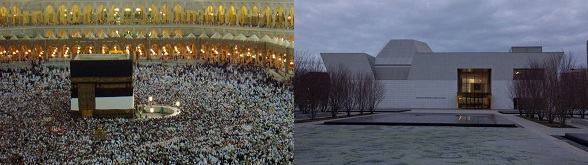
From Mecca to Toronto
Ka’ba in Mecca. Photo: Aga Khan Museum; Toronto’s Aga Khan Museum. Photo: Rian Dewji.
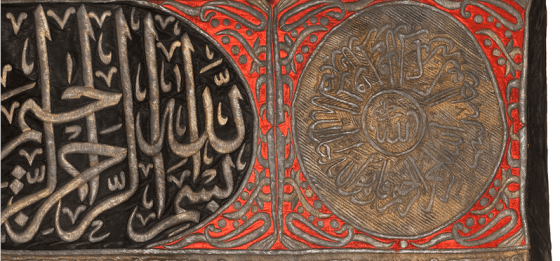
On display for the first time in Toronto is a 100-year-old silk fragment from a hizam — part of a ceremonial draping that covers the Ka’ba, Islam’s holiest site to which millions of Muslims made the annual pilgrimage on Friday August 9, 2019.
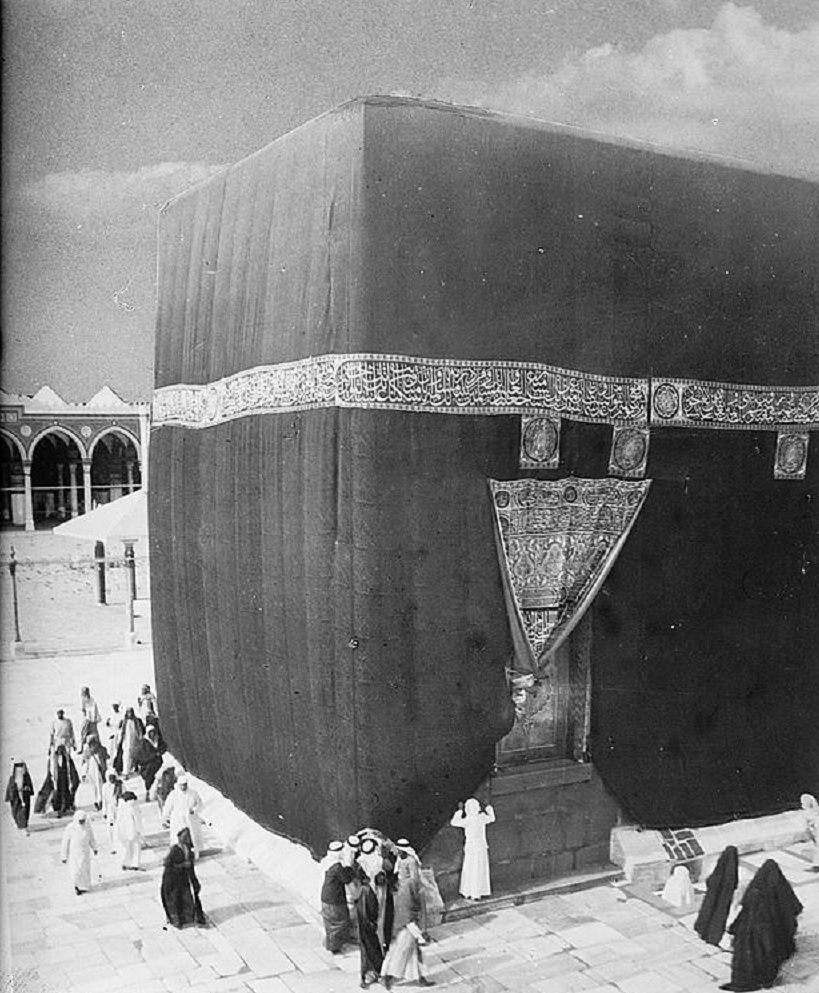
The Ka’ba is draped in a black ceremonial covering known as the kiswa, and around the upper part of the kiswa runs the hizam — an ornamented belt embroidered in silver and silver-gilt thread with Qur’anic verses relating to the pilgrimage.
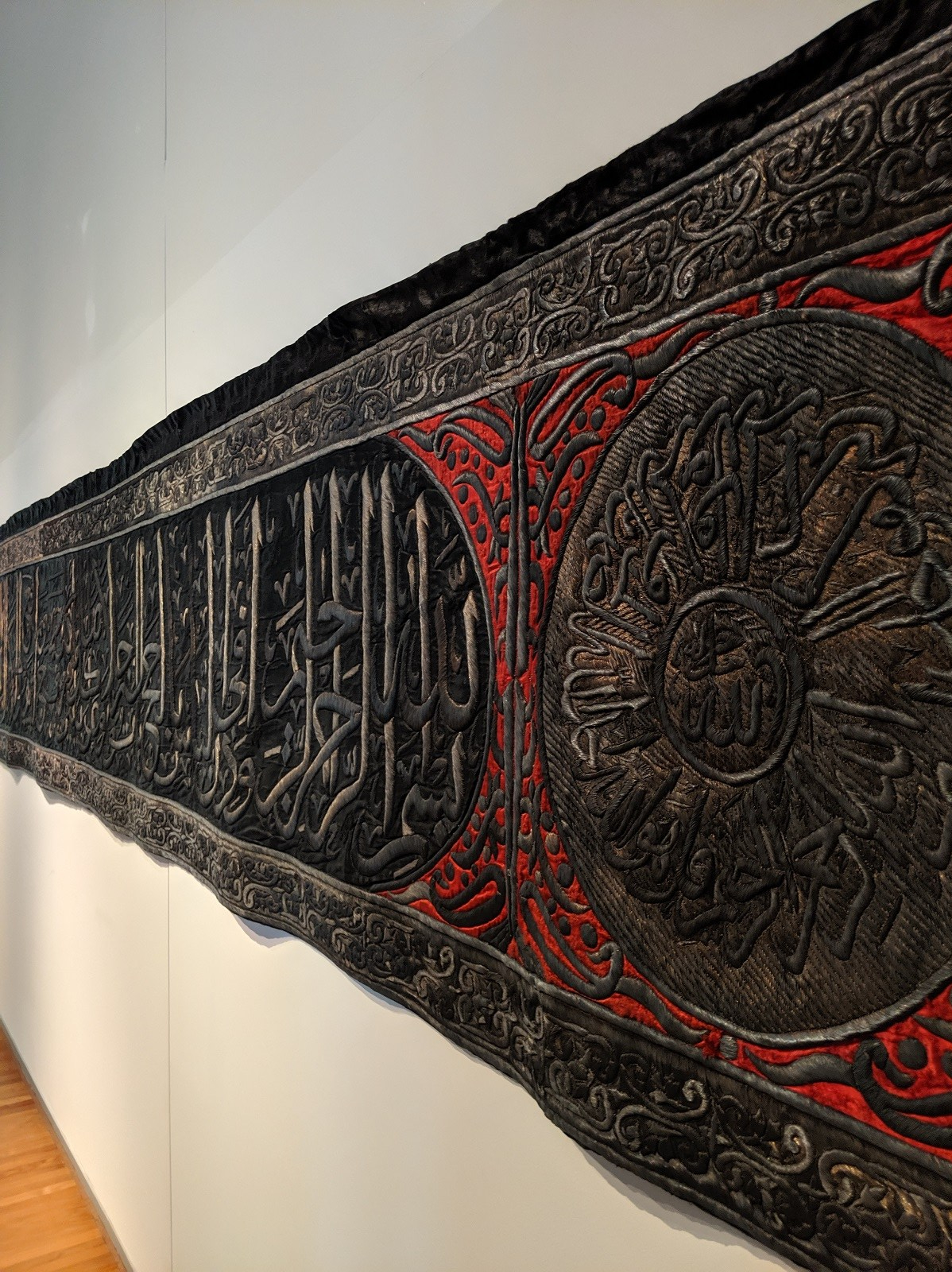
This hizam is one of the Aga Khan Museum’s most significant textiles and is on special display until September 9, 2019. Measuring eight metres long and nearly one metre tall, it once belonged to a kiswa that measured 47 meters and was made in Cairo around the early 20th century.
This textile from the Ka’ba is on display at the Aga Khan Museum until September 9, 2019. Free viewing was available during celebrations marking the Hajj and Eid al-Adha from August 10-14. Photo: The Aga Khan Museum.
As one of the most prominent kiswa ornaments, the hizam traditionally runs the length of the Ka‘ba’s upper perimeter. The inscription here contains verses 27-29 from chapter 22 (Al-Hajj) of the Qur’an:
“And proclaim to mankind the hajj. They will come to you on foot and on every lean camel, they will come from every deep and distant mountain highway. That they may witness things that are of benefit to them, and mention the name of Allah on appointed days, over the beast of cattle that He has provided for them. Then eat thereof and feed therewith the poor who have a very hard time. Then let them complete their prescribed duties and perform their vows, and circumambulate the Ancient House.”
The roundels contain further Qur’anic references that mention ‘God the Eternal’ as well as the Prophet Muhammad.
The Ka‘ba receives a new drape every year during the pilgrimage season. After it ends, the kiswa is taken down, divided and either gifted to dignitaries or sold to raise money for charity.
Note: The museum is open everyday from 10 am to 6 pm (8 pm on Wednesdays). It is closed on Mondays, except holiday Mondays.
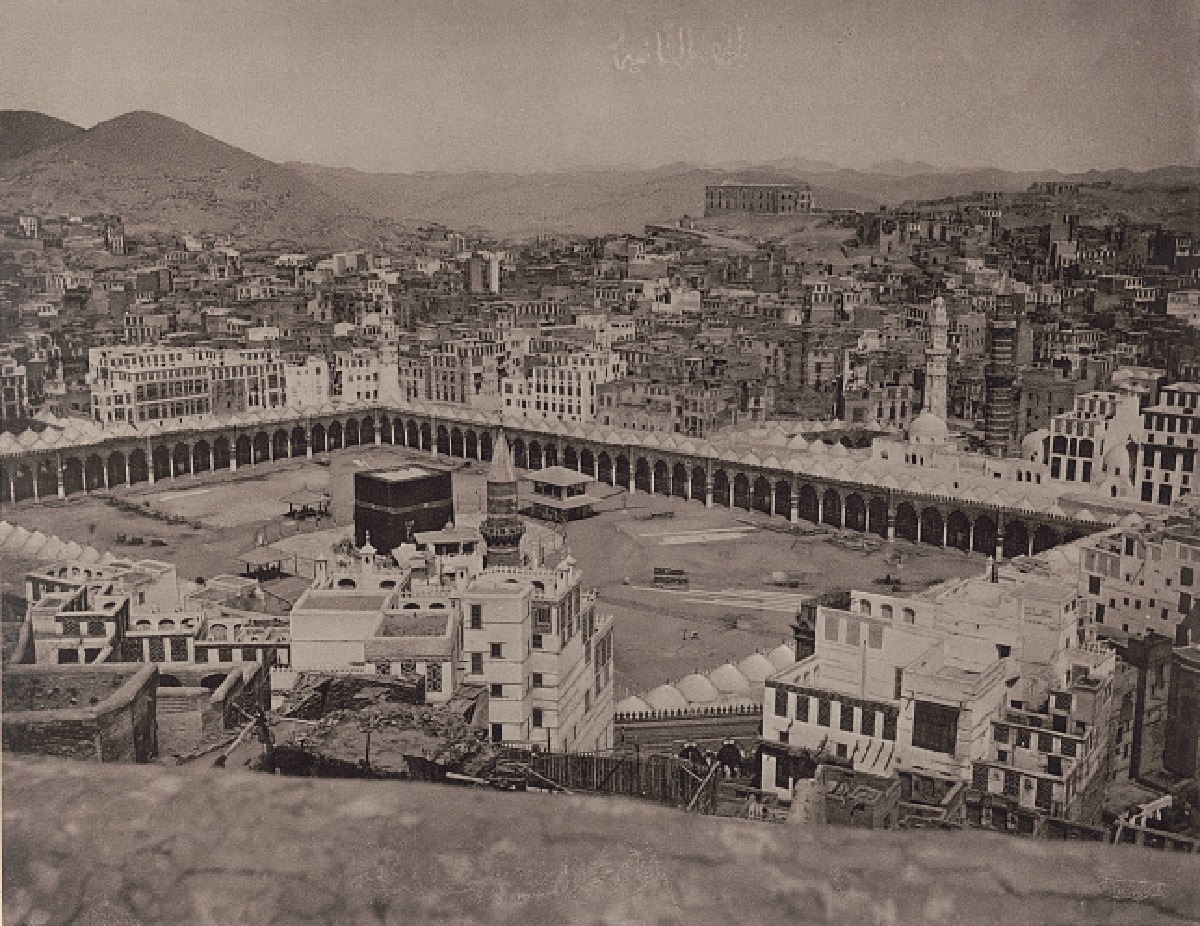
19th/20th Century Views of Ka’ba
A bird’s eye view of the Ka’ba as photographed in 1889. Note the hizam that runs around the upper part of the Ka’ba. Photo: US Library of Congress.
ca. 1910. A close-up photo of the Ka’ba with the hizam running around the upper part of the black cloth (the kiswa). Photo: US Library of Congress.
Date posted: August 7, 2019. Last updated: August 15, 2019.
[Before leaving this page, please take a moment to visit Simerg’s Table of Contents for links to a vast and rich collection of articles and photographs published on this blog as well as its two sister blogs Barakah and Simergphotos.]










 Simerg - Insights from Around the World