Prince Rahim Aga Khan On How Muslims Can Harness the Creativity of Our Knowledge Society to Impact Humanity

On the occasion of Prince Rahim Aga Khan’s 44th birthday on Monday, October 12, 2015, we are pleased to produce excerpts from his commencement address that he delivered at the Graduation Ceremony of the Institute of the Ismaili Studies held in London, England, in September 2007.

Prince Rahim and Princess Salwa on their wedding day on August 31, 2013. Photo: TheIsmaili / Gary Otte.

Prince Rahim Aga Khan and Princess Salwa on their wedding day on August 31, 2013. They have one child, son Prince Irfan, who was born on April 11, 2015. Photo Credit: TheIsmaili /Gary Otte. Copyright.

Prince Rahim is the eldest son of the 49th hereditary Ismaili Imam, His Highness Prince Karim Aga Khan, the direct descendant of the Prophet Muhammad (peace be upon him), and Begum Salimah Aga Khan. Prince Rahim graduated from Phillips Academy in Andover, Massachusetts, in 1990, and from Brown University in the United States in 1995. Based at the Secretariat of His Highness at Aiglemont, north of Paris, France, Prince Rahim is an executive Director of the Aga Khan Fund for Economic Development — the economic development arm of the Aga Khan Development Network.

~~~~~

Islam Enjoins Us To Make a Positive and Visible Impact on the World

“…Absolutist, exclusivist, and rejectionist claims to the truth, especially to religious truth, are increasingly heard from all quarters. Rather than seeing religion as a humble process of growth in faith, some people presume to claim that they have arrived at the end of that journey and can therefore speak with near-divine authority…”

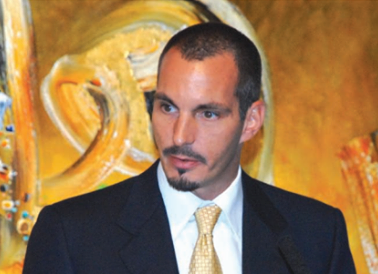
Prince Rahim Aga Khan delivering his commencement address for the Graduation Ceremony of the Institute of Ismaili Studies held at the Ismaili Centre in London in 2007.

Prince Rahim Aga Khan delivering his commencement address at the Graduation Ceremony of the Institute of Ismaili Studies held in London in 2007 at the Ismaili Centre.

BY PRINCE RAHIM AGA KHAN

I am thrilled to join the graduation ceremony in honour of those completing the IIS [Institute of Ismaili Studies] Graduate Programme in Islamic Studies and Humanities. To you, to your families and to all those who have helped you in this achievement, I say mash’Allah.

I am convinced that the institutions of the Imamat and of the Jamat could benefit directly from the contribution of each of you, either in a professional or a voluntary capacity. Such a contribution would certainly be in keeping with the ethic of our faith that makes it incumbent upon each of us to use our blessings –- be they material or intellectual –- to assist our families, to serve the Jamat and the Ummah, and to help improve society, and indeed, all of humanity. The Jamat and its institutions need young and dynamic women and men like you, who are able to draw on the rich heritage of our past, and on the best educations of the present, to address the challenges of the future.

Education, international studies and diplomacy, non-profit leadership, media, development, law, and regional studies will all be among the most relevant fields of expertise in the decades ahead. This will be particularly true in the developing world.

I was impressed to learn that amongst you are represented five different nationalities, as are several diverse cultural traditions of our Jamat. I am certain that this diversity has enhanced your classroom experience, and I am confident that it will have given you a deeper appreciation of the meaning and value of diversity itself.

We are all aware that we live in a world where diversity is often evoked as a threat and, more particularly, where diversity in the interpretation of a faith can be seen as a sign of disloyalty. This phenomenon is sometimes perceived to apply principally to Muslims, but it also exists in other societies. Absolutist, exclusivist, and rejectionist claims to the truth, especially to religious truth, are increasingly heard from all quarters. Rather than seeing religion as a humble process of growth in faith, some people presume to claim that they have arrived at the end of that journey and can therefore speak with near-divine authority.

Unfortunately, in some parts of the Muslim world today, hostility to diverse interpretations of Islam, and lack of religious tolerance, have become chronic, and worsening, problems. Sometimes these attitudes have led to hatred and violence. At the root of the problem is an artificial notion amongst some Muslims, and other people, that there is, or could ever be, a restricted, monolithic reality called Islam.

Our Ismaili tradition, however, has always accepted the spirit of pluralism among schools of interpretation of the faith, and seen this not as a negative value, but as a true reflection of divine plenitude. Indeed, pluralism is seen as essential to the very survival of humanity. Through your studies you have known the many Qur’anic verses and hadiths of our beloved Prophet Muhammad (peace be upon him) that acknowledge and extol the value of diversity within human societies. You all know, I am sure, the hadith to the effect that differences of interpretation between Muslim traditions should be seen as a sign of the mercy of Allah.

It should also be clear to anyone who has studied Islamic history or literature, that Islam is, and has always been, a quest that has taken many forms. It has manifested itself in many ways — in different times, amongst different peoples, with changing and evolving emphases, responding to changing human needs, preoccupations, and aspirations.

Even during the early centuries of Islam, there was diversity of intellectual approaches among Muslims. Today, however — both outside the Islamic world and inside it — many people have lost sight of, or wish to be blind to, Islam’s diversity, and to its historical evolution in time and place along a multitude of paths. It befalls us, then, to help those outside the Muslim World to understand Islamic diversity, even as we provide an intellectual counterpoint to those within Islam who would reject it.

I hope that you, as graduates of this programme, will include this message in your own ways in the years ahead, through your work and your words, by your attitudes, by your actions, and by example.

The untrue and unfair, but increasingly widespread equating of the words “Islam” and “Muslim” with “intolerance”, sometimes even with the word “terrorism”, could lead some Muslims to feel despair, indignation, or even shame. To me, however, the current global focus on the Muslim world, and on Islam itself, presents a golden opportunity for us to educate and enlighten, while actively exemplifying the counterpoint I mentioned before. To my eyes, it creates an opportunity, and an even-greater obligation for us to make a positive and visible impact on the world – on culture and art, science and philosophy, politics and ecology, among others.

In order to respond to this opportunity, it will be crucial to reverse another damaging consequence of intolerance, which has been the dissuasion of many Muslim populations from seeking access to what has been called the Knowledge Society. Without an acceptance of diversity, without the ability to harness the creativity that stems from pluralism, the very spirit of the Knowledge Society is stifled. We must encourage, I believe, that Muslims of all communities come together, working collaboratively to tap into the vast endowment of knowledge available today, and without which progress is, if not halted, at least deferred. This cannot be done in the absence of open-mindedness and tolerance.

Implicit in this approach is the need for humility, which is also a central Muslim value. We must all search for the answers to the challenges of our generation, within the ethical framework of our faith, and without pre-judging one another or arbitrarily limiting the scope of that search. Like the great Muslim artists, philosophers and scientists of centuries past, we must enthusiastically pursue knowledge on every hand, always ready to embrace a better understanding of Allah’s creation, and always ready to harness this knowledge in improving the quality of life of all peoples.

As you look towards the future, I hope that you will remember that intellectual pursuits should, wherever possible, seek to address the universal aspirations of humankind, both spiritual and concrete. Those aspirations, for our generation more than for any before, are intertwined in a single global community.

It can be overwhelming at times to ponder the vast array of new problems which seem to multiply in this globalised world.

These include the implications of new technologies and new scientific insights, raising new ethical and legal questions. They include delicate and complex ecological issues, such as the great challenge of climate change. They include matters ranging from the widening gap between rich and poor, to issues of proper governance and effective, fair, and representative government, and to the spread of rampant consumerism and greed, at the expense of others, or of our environment. In some communities, illiteracy and innumeracy are not only continuing problems but are even growing problems. And our challenges also include the increasing difficulty of nurturing pluralism in the face of strong normative trends – finding ways to accommodate our differences – even as hugely differing peoples find themselves in much closer contact with one another.

You have been engaged in studies, some of which analysed the achievements of past Muslim civilisations. What I hope you have come to see is that understanding past Muslim achievements, traditions, values, and ethics should also have equipped you exceptionally well to address the great emerging issues of our own times.

As you now graduate into this challenging world, you will be taking with you the hopes of those who founded, and of those who now drive this study programme. Their central hope is that you will become global leaders in a variety of fields, bearing with you as you go, and applying always, the open-mindedness of our tradition, and the ethics of our faith.

Date posted: Monday, October 12, 2015.

__________

We welcome feedback/letters from our readers. Please click Leave a comment.

His Highness the Aga Khan on the Imamat and the Unity of Mankind; Id-e-Ghadir – The Designation of Hazrat Ali (a.s.) as Commander of the Faithful

Mawlana Hazar Imam thanking the government for inviting the Ismaili Imamat to establish its permanent Seat in Portugal. TheIsmaili/Gary Otte

Mawlana Hazar Imam thanking the government of Portual for inviting the Ismaili Imamat to establish its permanent Seat in the country. Photo: TheIsmaili/Gary Otte. See text of agreement, click on note 4 below.

“The religious leadership of the Ismaili Imam goes back to the origins of Shia Islam when the Prophet Muhammad appointed his son-in-law, Ali, to continue his teachings within the Muslim community. The leadership is hereditary, handed down by Ali’s descendants, and the Ismailis are the only Shia Muslims to have a living Imam, namely myself.” [1]

~~~

“The Ismaili Imamat is a supra-national entity, representing the succession of Imams since the time of the Prophet. But let me clarify something more about the history of that role, in both the Sunni and Shia interpretations of the Muslim faith. The Sunni position is that the Prophet nominated no successor, and that spiritual-moral authority belongs to those who are learned in matters of religious law. As a result, there are many Sunni imams in a given time and place. But others believed that the Prophet had designated his cousin and son-in-law, Ali, as his successor. From that early division, a host of further distinctions grew up — but the question of rightful leadership remains central. In time, the Shia were also sub-divided over this question, so that today the Ismailis are the only Shia community who, throughout history, have been led by a living, hereditary Imam in direct descent from the Prophet.

“…As you build your lives, for yourselves and others, you will come to rest upon certain principles. Central to my life has been a verse in the Holy Quran which addresses itself to the whole of humanity. It says: “Oh Mankind, fear your Lord, who created you of a single soul, and from it created its mate, and from the pair of them scattered abroad many men and women…”

“I know of no more beautiful expression about the unity of our human race — born indeed from a single soul.” [2]

_____________

Id-e-Ghadir

The twelve months of the Muslim calendar and major Muslim festivals. Image by Simerg.

The twelve months of the Muslim calendar and major Muslim festivals. Image by Simerg.

‘Id-e-Ghadir is celebrated by the Shi ‘ite communities to mark the event that took place at Ghadir Khumm (Valley of the Pond) on the 18th Dhul-Hijjah (which falls on September 30 or October 1 in 2015). This event commemorates the designation (appointment by way of nass) of Hazrat All as the ‘Amir-ul-Mu’minin (commander of the faithful) and Imamul-Muslimin’ (the Imam of the community of believers) at Ghadir-i Khumm when the Prophet (s.a.s.) was returning from his Last Pilgrimage (hajjatul-wida) in the year 632 AC. On this occasion, the Prophet publicly proclaimed Ali to be his successor [3] in guiding the community after the end of the institution of Nubuwwah. According to the Shi’a doctrine, tradition and interpretation of history, the designation of Hazrat Ali marked the beginning of the institution of Imamah. The designated Imam was to continue the ta’wil (interpretation) and talim (teaching) of Allah’s Final Message, i.e. the Holy Qur’an.

This stamp, issued by Iran in 1990, includes the Shahada, Qur'anic ayats and the declaration made by Prophet Muhammad at Ghadir-e Khumm

This stamp, issued by Iran in 1990, includes the Shahada, Qur’anic ayats and the declaration made by Prophet Muhammad at Ghadir-e Khumm “Mun Koontu Mawla, Fa Hada, Aliyun Mawla” (He of whom I am the Mawla, Ali is also the Mawla). Image not exact stamp size.

Accordingly, throughout the course of the history, the Shi’a have commemorated this occasion as a mark of recognition and acceptance of Allah’s mercy to mankind by bestowing continued guidance. Each Imam, since the time of Hazrat Ali has designated his successor. The Imam in his time has continued to guide his followers according to the prevailing conditions. His function has always been to look after the welfare of the community both in spiritual and worldly (material) matters. His guidance to his followers is that they should lead their lives in such a way so as to practice their Faith with a sense of balance and harmony, ensuring that there is no conflict between the two aspects of an individual’s life. The practice of the Faith thus becomes the way of life.

Presently, the Shi’a Imami Ismaili Muslims celebrate the day of accession of their present Imam to the office of Imamah as Yaum-e Imamat or Imamat Day. This occasion is celebrated as a mark of gratitude to Allah in having bestowed His mercy and bounty in guiding them through the office of the Imam on Sirat al-Mustaqim (the Straight Path).

Date re-posted: September 30, 2015 (The Id-e-Ghadir article had first appeared on this blog in 2013, and has been adapted from Ilm magazine, December 1989).

_____________________

Notes

[1] Voices: “The Power of Wisdom” – His Highness the Aga Khan’s Interview with Politique Internationale (English translation)

[2] In a Dynamic and Stirring Address to Members of the Canadian Parliament, His Highness the Aga Khan Shares His Faith Perspectives on the Imamat, Collaboration with Canada, the Muslim World Community (the Ummah), the Nurturing of Civil Society, Early Childhood Education, Voluntary Work, and the Unity of the Human Race

[3] Vagglieri, Ghadir Khumm, The Encyclopedia of Islam, Vol II, E.J. Brill, 1965, pp. 993-994

[4] “Seat of the Ismaili Imamat” — Text of the Historic Agreement Between the Ismaili Imamat and the Portuguese Republic.

@Simergphotos: The Ismaili Centre in Dushanbe, Tajikistan, Through the Lens of Canadian Photographer Muslim Harji

PLEASE CLICK: Dushanbe’s Ismaili Centre Through the Lens of Muslim Harji

Happy Children Faces at the Dushnabe Ismaili Centre. Please click on image for Muslim Harji's Photo Essay.

Happy young faces at the Dushanbe Ismaili Centre. Please click on image for Muslim Harji’s Photo Essay.

Please click on image for Muslim Harji's Photo Essay.

Please click on image for Muslim Harji’s Photo Essay.

Date posted: September 27, 2015.

A UCSF Video Introduction to His Highness the Aga Khan: “He Does Good Work and Moves Quickly”

“[the] Aga Khan and his network have done such remarkable development work across the world, especially in Asia and East Africa, and we’re delighted to play a part in spreading our knowledge throughout the world with partners like him.” — Sam Hawgood, School of Medicine, University of California San Francisco (UCSF)

PLEASE CLICK: The Aga Khan Visits UCSF to Strengthen Partnership to Advance Global Health

Ginan Central: A Portal to the Ismaili Community’s Ginanic Literature

BY KARIM THARANI
University of Saskatchewan Library
Special to Simerg

Ginan Central is a web portal developed at the University of Saskatchewan Library with the goal of digitally preserving and providing access to ginanic literature in order to promote research and education. The projects undertaken and shared on Ginan Central are diverse and ongoing. For example, the Ginan Index and Search Tool or GIST initiative is a web-based application developed for researchers and scholars to locate and digitally access textual sources such as manuscripts and lithographs of ginans. The Ginan Recitals project, on the other hand, focuses on making oral sources of ginans available to students and researchers. Work is also underway to bring together these textual and oral sources to create an evidence-based master list of ginans in order to ascertain how many unique ginans and granths (titled ginans) are available and accessible today. In addition to these projects, the Ginanic Studies section on Ginan Central is dedicated to compiling and maintaining an online bibliography of research outcomes pertaining to ginans. In terms of education and outreach, the Ginan Central portal also hosts a multimedia Khojki Guide for those who are interested in learning the Khojki script to decipher ginan manuscripts.

Please click on image for enlargement

Ginan Central CEM

The Ginan Central portal uses the University of Saskatchewan Library’s Community Engagement Model (CEM), which was recently presented at the Ismaili Studies Conference, held at the University of Chicago in 2014. The CEM model uses the roles of protector and promoter as two contrasting endpoints to illustrate various possibilities and levels of individual and institutional collaboration to digitally share sacred traditions and literature. At one end of the CEM continuum is the role of an idealistic protector, whose basic instinct is to protect the sanctity of knowledge by limiting access as a security measure against real and imaginary threats. On the opposite end of this continuum is the role of an optimistic promoter who is driven by the sentiment of sharing literature to advance human knowledge.

At Ginan Central, we recognize and appreciate this paradoxical dynamic amongst community individuals and institutions. This is why collaborating and sharing collections with Ginan Central does not require our partners to forgo their identity or control over their collections. Our goal is not to appropriate collections or build massive repositories, instead we strive to build partnerships and processes that can unify and link disparate collections and repositories by leveraging work of our partners to advance study of ginans.

Aga Khan Quote

Collaboration, respect, and trust remain the guiding principles for Ginan Central to be able to carry out its purpose of preserving and providing access to ginanic literature. Libraries have been involved in digitally harvesting community knowledge for decades. At the University of Saskatchewan Library as well, we are capable of utilizing modern day technologies in responsible and respectful ways to balance the need of protecting the sanctity of sacred traditions and providing the necessary access to students and researchers to advance the study of ginans.

 Date posted: September 21, 2015.

_________________

Please visit Ginan Central, and for more information on Ginan Central, please contact ginans@library.usask.ca.

The Hajj by Naser-e Khosraw, from Michael Wolfe’s “One Thousand Roads to Mecca”

“….The tallest mountain near Mecca is Abu Qubays, which is round like a dome, so that if you shoot an arrow from the foot of the mountain it reaches its top.…Having come into the city, you enter the Haram Mosque, approach the Ka’ba, and circumambulate….. always keeping the Ka‘ba to your left [shoulder]. Then you go to the corner containing the Black Stone, kiss it, and pass on….”

PLEASE CLICK: Naser-e Khosraw’s Pilgrimages to Mecca

A bird’s-eye view of the Ka’ba crowded with pilgrims. The photo is from the archives of the US Library of Congress and was created by American Colony (Jerusalem), Photo Dept., in 1910. Please click for article by Naser-e Khosraw.

Date posted: September 17, 2015.

________________

Aleppo and Its Majestic Citadel: Chilling Reports from the Current Civil War, and 14th Century Narratives by Ibn Batutta

I. THE HARSH REALITIES OF ALEPPO TODAY

(A). Syria’s Most War-Torn City by Newsweek Magazine

(Note: Newsweek’s story, accessible by clicking on the first image shown below, contain graphic images and may disturb some readers. Discretion is advised).

“Longer even than the journey from Damascus to Aleppo is the time it takes to get from one end of Aleppo to the other. Moving from the east to the western side of the city once took only a short bus ride. Now it involves navigating a labyrinth of side roads and as many as 20 checkpoints; an endurance test that can last between 10 and 16 hours” — James Harkin for Newsweek, August 19, 2015. Please click on Newsweek – Syria’s War Torn City or click on image below for Harkin’s full report.

A sergeant in Lewa Salaheddin, a Kurdish battalion of the Free Syrian Army, sits in front of a block of destroyed buildings in Aleppo, Syria on December 6, 2012. It’s more than three years since the fight for Aleppo began. By late 2012, parts of the city were already in ruins. Patrick Tombola/laif/Redux

A sergeant in Lewa Salaheddin, a Kurdish battalion of the Free Syrian Army, sits in front of a block of destroyed buildings in Aleppo, Syria on December 6, 2012. It’s more than three years since the fight for Aleppo began. By late 2012, parts of the city were already in ruins. Patrick Tombola/laif/Redux

_______________

(B). A Resident’s Account of Aleppo’s Humanitarian Crisis and the Fear for its Historic Citadel

Editor’s note: The following excerpts are from the website of the Centre for Research and Globalization based in Montreal. For a full account published on July 25, 2015, please click on Global Research – Aleppo’s Humanitarian Crisis.

“Aleppo city has shrunk to a fifth of its original site. I walk everyday in the city. I see children and girls without limbs because of a mortar over here or shrapnel over there that hit them randomly and caused them a terrible wounds and horrific memories that will never leave them. The girl who lost one leg is standing on her good leg and selling bread, while the little boy who lost one arm is selling chewing gum. Those are the “injured” people who come in the news, just numbers in one line of a report, after each attack from the terrorists. “Injured” doesn’t mean scratched or having a bleeding finger; it means someone lost his eyes or her limbs.”

continued…

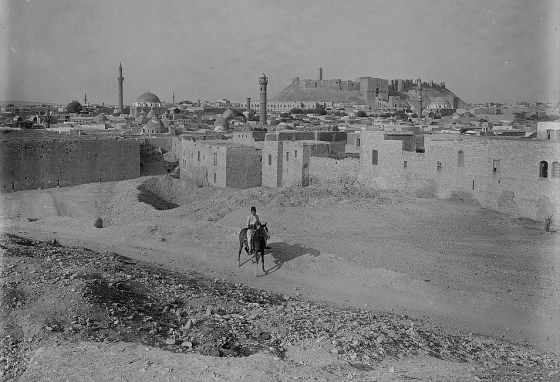
Aleppo and its castle from South West. Created/Published between 1898 and 1946. Photo: USA Library of Congress Collection, Gift Episcopal Home; 1978.

Aleppo and its castle from South West. Photo taken in 1898, and created/published
between 1898 and 1946. Photo: USA Library of Congress Collection, Washington, D.C.

“The last symbol left of Aleppo, is the most famous one: the Citadel. I can see part of it from our balcony, but I can see it more clearly from the roof of the building….It has been badly injured, but it’s still there, dominating the city skyline. It’s where they found the Storm God’s Temple a few years ago. It withstood many invaders, including the Mongols and Crusaders. It has been damaged severely several times through history, but it has been rebuilt over and over again, as an immortal symbol to the inhabitants of one of the oldest living cities in history. I just pray I don’t live to witness its total destruction as I have seen happen to many of the surrounding buildings.”

________________

II. IBN BATUTTA’S 14TH CENTURY DESCRIPTION OF ALEPPO AND ITS CITADEL

The Citadel of Aleppo is a large medieval fortified palace in the centre of the old city of Aleppo, northern Syria. It is considered to be one of the oldest and largest castles in the world. Usage of the Citadel hill dates back at least to the middle of the 3rd millennium BC. Subsequently occupied by many civilizations including the Greeks, Byzantines, Ayyubids and Mamluks, the majority of the construction as it stands today is thought to originate from the Ayyubid period. An extensive conservation work has taken place in the 2000s by the Aga Khan Trust for Culture in collaboration with Aleppo Archeological Society. Dominating the city, the Citadel is part of the Ancient City of Aleppo, a UNESCO World Heritage Site since 1986. The Citadel has received significant damage in the ongoing Syrian Civil War. Photo and caption: Wikipedia.

The Citadel of Aleppo is a large medieval fortified palace in the centre of the old city of Aleppo, northern Syria. It is considered to be one of the oldest and largest castles in the world. Usage of the Citadel hill dates back at least to the middle of the 3rd millennium BC. Subsequently occupied by many civilizations including the Greeks, Byzantines, Ayyubids and Mamluks, the majority of the construction as it stands today is thought to originate from the Ayyubid period. An extensive conservation work has taken place in the 2000s by the Aga Khan Trust for Culture in collaboration with Aleppo Archeological Society. Dominating the city, the Citadel is part of the Ancient City of Aleppo, a UNESCO World Heritage Site since 1986. The Citadel has received significant damage in the ongoing Syrian Civil War. Photo and caption: Wikipedia.

An Introduction to Ibn Batutta

“No intelligent man,” wrote Ibn Djuzayy, the scribe to whom Ibn Batutta (also Batutah etc) dictated his memoirs, “can fail to see that this sheikh is the traveller of the age.” But Ibn Batutah (1304-1368 or 1377) was not only the greatest Arab traveller of the Middle Ages, he was one of the greatest travellers of all time. At the age of twenty-one, he set out from his birthplace, Tangiers (Morocco), and started his travels by undertaking the pilgrimage to Mecca. This was the start of thirty years of wandering during which he would travel almost 120,000 kilometres that would take him halfway round the world as far as China. His account of his travels (the Rihla), in addition to its literary value, gives a panoramic picture of the 14th-century world.

If there are historical inaccuracies in Ibn Battuta’s writings, they are largely attributable to the pronounced taste for the bizarre which was characteristic of the age, and to the loss of his notebooks during a pirate attack in the Indian Ocean.

But errors or exaggerations do not detract from the value of Ibn Battuta’s narrative which is written in a direct, straightforward style punctuated by observations which are not without humour. His entertaining story has been translated, wholly or in part, into some 15 languages and ranks among the masterpieces of Arabic literature.

Ibn Batutta on Aleppo and Its Citadel

From Sermin we proceeded to Haleb (Aleppo), a large city and splendid metropolis. This is how Abulhossein the son of Jobeir described it:

“This city is of enormous worth and its fame will last forever. Kings have often sought to possess it and men have been impressed by its importance. What a number of battles it has provoked, and what a quantity of shining words have been unsheathed for it! Its fortress is renowned for its power and its height is clearly to be seen. No one dared attack it because of its strength, or if they did they did not conquer it.

“The sides are of freestone and its proportions are full of symmetry. It has outlasted the days and the years and has seen nobles and beggars carried to their last resting-places. Where are the Hamdanite princes and their poets now? They are no more, and only the buildings remain. Oh wonderful city! It endures, but its owners have passed on. They have perished but its hour has not come. It was sought for after them and taken without great difficulty. It was coveted and won at the smallest cost.

Such is this city of Aleppo. How many of its kings has it not changed into a past tense (expression borrowed from grammar) and how many vicissitudes has it not defied because of its position! Its name was made in the feminine gender, it was adorned with the finery of a chaste virgin, it succumbed to the victor as others have done. It shone like a young bride after the sword (seif) of its dynasty, Ibn Hamdan (a reference to Prince Seif eddaoulah).

Alas! its youth will pass, it will be no longer desired, only a short while and it will be destroyed.”

continued….

Aleppo from castle. Photo taken in 1898, created/published between 1898 and 1946. Credit: Library of Congress Prints and Photographs Division, Washington, D.C.

Aleppo from castle. Photo taken in 1898, created/published between 1898 and 1946. Credit: Library of Congress Prints and Photographs Division, Washington, D.C.

The fortress of Aleppo is called Ash shahba (the grey one). Within it there are two wells from which water gushes, and there is no fear of thirst there. The castle is surrounded by two walls, there is a great moat from which water rises, and its wall has many towers standing close together. This fortress encloses marvellous chambers pierced with windows. All the towers are occupied and in this fortified castle food is not impaired by the passage of time.

There is a sanctuary which is visited by many people, and it is said that Abraham prayed there to God. This fortress resembles the one called Rahbet (square of) Malik Ibn Thaouk, near the Euphrates, between Syria and Iraq. When the Tartar tyrant Kazan marched against the city of Aleppo, he besieged this fortress for many days. Then, frustrated in his desire to take it, he withdrew. Ibn Jozay says: Alkhalidy, the poet of Seif eddaoulah, writes as follows about this fortress:

“With its high belfry and invincible flanks, it is a vast, grim place which rises up against him who would take it.

“The atmosphere spreads a layer of cloud over this place and adorns the castle with a necklace of brilliant stars.

“When lightning flashes in the night this fortress appears through its interstices, shining like the constellation of the Virgo through the openings in the clouds.

“How many armies has this castle not destroyed and how many conquerors has it not put to flight!”

The same poet also speaks of the castle in the following admirable verses:

“It is a citadel whose base embraces the springs of water, and its summit is higher  than Orion’s Belt.

“It knows no rain, because for it the clouds are a ground,  whose sides are trodden by its cattle.

“When the cloud has given water in abundance, he who lives in the fortress uses all the water in his tanks before its summits are moistened.

“Its belvedere would be counted amongst the stars of the heavens if it passed through their orbits.

“The cunning of this fortress has repulsed the tricks of its enemies and the evils it caused were greater than theirs.”

Here is what Jemal eddin Ali, the son of Abulmansur, has to say about this castle:

“Because of its enormous height and the point which its summit attains, this castle nearly stops the celestial sphere that turns around the earth.

“Its inhabitants have gone to the Milky Way as to a watering place and their horses have nibbled the stars as though grazing on flowering plants.

“The vicissitudes of time turn from it in fear, and for this castle there is no change.”

Date posted: August 22, 2015.

____________________

Editor’s note: The above introduction to Ibn Batutta and his narratives on Aleppo and its Citadel have been adapted from the January 1986 issue of The Unesco Courier which was dedicated to Treasures of World Literature. Please visit http://www.unesco.org/new/en/unesco-courier/.

We welcome your feedback. Please click on Leave a comment.

___________________

FORTHCOMING PHOTO AND LITERARY PIECES ON SIMERGPHOTOS AND SIMERG

  • “Prayer Halls of Badakhshan Through the Lens of Muslim Harji,” to be published week of August 24th, 2015 on Simerg’s photo blog, http://www.simergphotos.com
  • “Naklanki Geeta – Quantum Mechanics in Ginans” by Shiraz Pradhan, to be published week of September 7th, 2015 on this website, http://www.simerg.com.

Great Epics: Ferdowsi’s Shahnameh (The Epic of the Kings), With Two Magnificent Illustrations from the Aga Khan Museum

Written a thousand years ago, Ferdowsi’s Shahnama or The Epic of the Kings tells the story of the Iranian people from the time of the world’s creation. National epic, landmark in world literature and a profound expression of the Iranian soul, Ferdowsi’s masterpiece is still read and recited throughout Iran.

I. THE EPIC OF THE KINGS, AN INTRODUCTION

The statue of Ferdowsi in Ferdowsi Square in Tehran. Photo: Wikipedia.

The statue of Ferdowsi in Ferdowsi Square in Tehran. Photo: Wikipedia.

By Nahal Tadjadod

In a square in Teheran, the capital of Iran, there is a statue of Ferdowsi [or Firdawsi, Firdausi etc, Ed.) where the poet holds his Epic of the Kings (Shahnama or Shahnameh, Ed.) in his hand and gazes at the peaks of the Alborz mountains. When I was young, my parents often took me to this place and while they looked on attentively I recited these lines by Ferdowsi:

“I have toiled painfully these thirty years. I have restored Iran to life by my verse. Henceforth I cannot die; for I live, having broadcast the seeds of my verses.”

These words were engraved in the memory of the child I was then and I know that they have shaped my innermost identity. There is nothing astonishing in that. For a thousand years Ferdowsi’s poem has been read, recited and copied in Iran. Even today it is recited in the cafés. Early on it became our national epic.

Why has it always been so popular? Not because of the originality of its subject the history of ancient Iran from the time of its first mythical king to the last sovereign of the Sassanid dynasty in the seventh century AD nor because of the novelty of its content. “What I will say, all have already told,” Ferdowsi claimed. The poet transmitted; he invented nothing. He drew on old oral traditions and on ancient texts such as the Avesta, a holy book of the eighth century BC, or reworked somewhat earlier tales on the same theme.

The First Masterpiece of Persian Literature
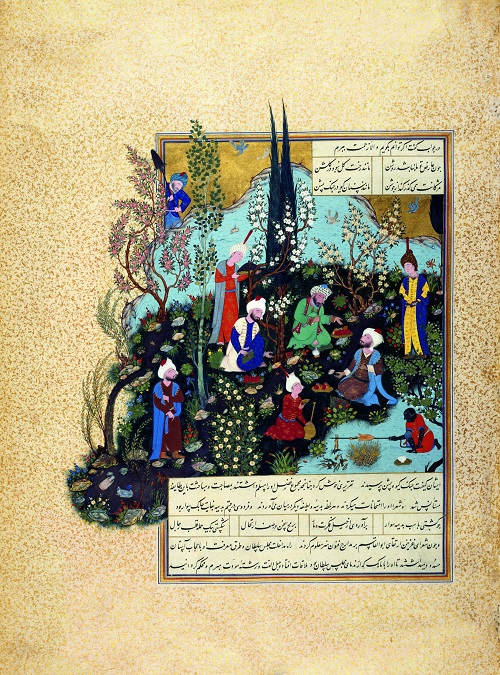
This illustration is from Shah Tahmasp I’s Shahnameh, one of the most remarkable Persian manuscripts, which was started when Shah Tahmasp returned to Tabriz from Herat in 1522. This illustration shows Firdausi, the author of the written version of the Shahnameh, with the three poets of the court of Mahmud, the sultan of Ghazna, a city which is now in modern-day Afghanistan. Firdausi left Tus, his native city, in northeast Iran, to seek out the patronage of the sultan for his Shahnameh. Before meeting with the sultan, he was confronted by three poets of the court who cornered him before finally acknowledging his superior talent. In this miniature painting a small black servant roasts a bird on a spit while young fine-faced boys bring wine and delicacies to the three Ghazna poets, seated, in the centre of the picture, on the grassy bank of a stream of water. Firdausi’s isolation is emphasized by his position to the extreme left of the main group, just where the composition spills over into the margin. Photo and caption credit: Aga Khan Museum, Toronto, Canada. Copyright.

This illustration is from Shah Tahmasp I’s Shahnameh, one of the most remarkable Persian manuscripts, which was started when Shah Tahmasp returned to Tabriz from Herat in 1522. This illustration shows Firdausi, the author of the written version of the Shahnameh, with the three poets of the court of Mahmud, the sultan of Ghazna, a city which is now in modern-day Afghanistan. Firdausi left Tus, his native city, in northeast Iran, to seek out the patronage of the sultan for his Shahnameh. Before meeting with the sultan, he was confronted by three poets of the court who cornered him before finally acknowledging his superior talent. In this miniature painting a small black servant roasts a bird on a spit while young fine-faced boys bring wine and delicacies to the three Ghazna poets, seated, in the centre of the picture, on the grassy bank of a stream of water. Firdausi’s isolation is emphasized by his position to the extreme left of the main group, just where the composition spills over into the margin. Photo and caption credit: Aga Khan Museum, Toronto, Canada. Copyright.

This immense poem of 50,000 couplets appeared in the tenth century, at a key moment in the history of Iranian culture. Since the fall of the Sassanids, the literary language of Iran had been Arabic. Middle Persian, the main vehicle of Sassanid civilization, was disappearing. At this moment, a young literature in an Iranian idiom-Persian emerged in the east. Ferdowsi’s poem would be its first masterpiece.

The Epic of the Kings does not describe the deeds of a single hero or king nor even a long adventure. It begins with the creation of the world and relates the history of fifty reigns on three distinct planes: the mythical, the epic and the historical.

The first part relates civilizing myths. The Pishdadians, the “first created”, teach men to clothe themselves, to work metal, to master fire, to tame animals and to organize themselves in society. After ruling for 700 years, King Jamshid, succumbing to pride, has to yield his throne to a demoniac creature, the tyrant Zahhak who will rule for a thousand years. His malign power will finally be conquered by the justice-loving Faridun. These heroes, who personify the conflict between the forces of darkness and light, constitute a religious theme which is typically Iranian.

The second, longest and most truly epic part of the poem evokes the reign of the Kaianid kings. Here, in the centrepiece of the poem, light has triumphed. Rostam is the champion of all the heroes who live at the Kaianid court. Prodigiously strong, loyal to his king and faithful to his country, he is the terror of the enemy. This period is marked by interminable wars against Turan, a central Asian country whose ruler Afrasiyab is the sworn enemy of Iran.

In the final part, the poet presents a number of historical figures but in a rather fantastic light.  He gives a notable account of the conquest of Alexander the Great (Sekandar), based on the  Alexander legend of the Orient. The ending, even closer to history, tells of the exploits of the Sassanid rulers until the end of the dynasty.

Faridun and Zahhak: The Just man and the Tyrant

The story of Zahhak the tyrant, told in the first and most brilliant part of the poem, extols the  sufferings of a martyred people.

The courageous but wayward son of King Mardas, Zahhak is led astray by Eblis, the devil. After making a pact with Eblis, Zahhak usurps the throne. Revealing himself to the king in various forms, the devil extends his power further each day. One day Eblis presents himself in the guise of a cook. “The diet is not varied,” he says, “for flesh is not eaten,” and he wishes Zahhak to eat all kinds of viands, both birds and quadrupeds. When the devil, who has gained Zahhak’s confidence, embraces him, a black serpent thrusts its head out of each of the tyrant’s shoulders. Whenever he cuts them off they sprout anew like two branches of a tree. Then Eblis appears again, this time disguised as a physician, and proposes as a remedy that Zahhak should eat two human brains each day.

Thus for a thousand years the demons cause evil to reign and no one dares talk openly of good. But one night Zahhak dreams that he is laid low by a young prince who strikes him with a bullheaded mace and drags him in chains to Mount Damavand. Plunged in darkness, the world was as black as a raven’s wing. The tyrant consults the Mubads, the Zoroastrian priests, who read the stars and tell him that his vanquisher, who is not yet born, will be called Faridun. “He will hate you, for his father will die at your hand and you will also kill the cow that will serve him as nurse. To avenge the cow he will take up the bull-headed mace.”

Mad with anxiety, the king hunts everywhere for traces of Faridun. The blessed child is born at the same time as the most marvellous of cows. He is entrusted by his mother to the keeper of the park where the nurse-cow lives, and is nourished with her milk. One day Zahhak hears of the park and the cow, kills the fabulous animal and rushes to Faridun’s house. He finds no one there. Overcome with fear, Faridun’s mother has taken her son to Mount Alborz.

At the age of sixteen Faridun learns of his origins from his mother and decides to fight the tyrant. In  anguish Zahhak convokes all the elders of the land to seek their support. “I desire you to subscribe to a proclamation on my behalf that as commander in chief I have sown no seed but that of uprightness…and that I would never fail to maintain justice.” All consent except one man, Kava the Blacksmith, who rises in protest. “I am Kava, seeking for justice. Most of the wrong done to me comes from yourself. It is you who constantly thrust the lancet into my heart. Why do you inflict harm on my children? I had eighteen alive in the world, and now only one remains.”

Overcome with astonishment and fear, Zahhak restores the man’s remaining son to him and asks him in exchange to add his testimony to the proclamation. Kava reads the proclamation, tears it into pieces, and tramples them underfoot.

Kava leaves the palace and the people crowd around him. Fastening a blacksmith’s leather apron to a spearhead, he calls on the people to free themselves from the tyrant’s yoke. Followed by a multitude of the stout-hearted, Kava the liberator sets out in search of Faridun, who agrees to lead the popular rising. The people of the city and the army mass before the palace, whose guards dare not resist. Faridun rides into the palace without striking a blow and seizes the royal crown. Attacked by Zahhak, the young prince shatters Zahhak’s helmet with his bull-headed mace. At that instant the angel Sorush appears and stops Faridun killing Zahhak. “Do not strike him down,” he says. “His time has not yet come. Tie him securely inside the mountain.” Faridun then drives the tyrant into the mountains and wishes to strike off his head, but the angel Sorush appears again and tells him to leave the captive in fetters on Mount Damavand to endure an eternal agony.

Ferdowsi: A Poet of Human Grandeur

In the person of Faridun, an era of enlightenment and justice succeeds a long period of obscurity and tyranny. Here Ferdowsi returns to pre-Islamic traditions; he takes this idea of an eternal combat between good and evil from Zoroastrian eschatology. The interminable wars between Iran and Turan are the reflection of this. But Ferdowsi does not profess a naive dualism. He shows that these two principles coexist in everyone: human beings can do good as well as spread evil.

Thus, after a thousand years of tyranny, light and good seem to triumph: the new king, mandated by heaven, serves his people devotedly. But evil persists, it has not ceased to exist. This is what the angel means when he twice prevents the tyrant from being put to death. Zahhak is finally fettered on the summit of Mount Alborz as if to show by his existence that the victory of good over evil has not yet been won.

Ferdowsi bases his poem on the implacable force of destiny. This quintessentially epic theme echoes the sense of fatality which is so deeply anchored in the Iranian soul. And yet his characters are still men, torn and tortured by doubt and sensitive to the misfortunes of the age. They are to be pitied rather than condemned. Zahhak, the bloody tyrant, the symbol of cruelty, does not act freely; he has, after all, sold his soul to the devil. He is merely an instrument. As a great tragic epic poet, Ferdowsi thus creates terrible situations in which a man is led to kill his brother, or a father kills his son. Links of kinship add grandeur and resonance to the combat waged by the individual against higher forces.

The Epic of the Kings is still a living epic for Iranians because it is profoundly in tune with the Iranian soul. The Iranian peasant, even if he can neither read nor write, responds to the exploits of Rostam, the hero par excellence, and weeps to think of his sufferings when he is compelled to kill his own son to defend his country. Neither good nor ill will lastfor ever: the finest thing is to leave good deeds to be remembered by.

Ferdowsi’s voice still speaks to us across the ages.

_____________

The above piece has been adapted from the September 1989 issue of The Unesco Courier which was dedicated to “Great Epics, Heroic Tales of Man and Superman.” Please visit http://www.unesco.org/new/en/unesco-courier/.

Quotations from the Shahnama in this article are taken from the translation by Reuben Levy which was published as The Epic of the Kings by Routledge & Kegan Paul (London, 1967) and features in the Unesco Collection of Representative Works.

~~~~~~~~~~

II. THE STORY OF HAFTVAD AND THE WORM 
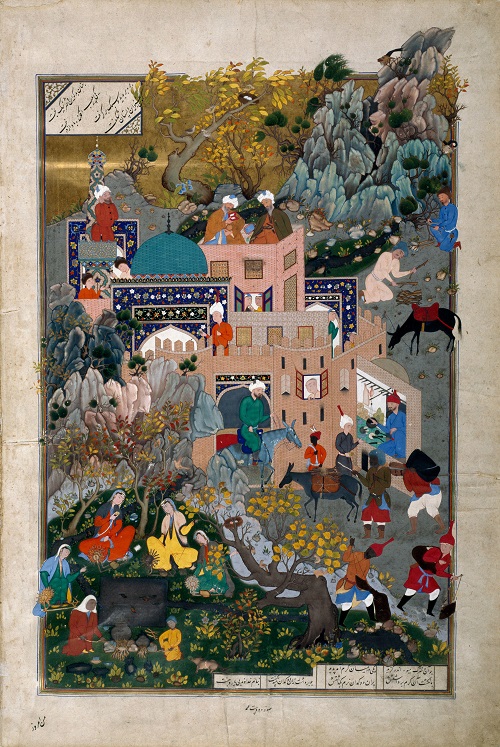
A folio from Shahnameh of Shah Tahmasp depicting the story of Haftvad and the worm. Photo and caption credit: Aga Khan Museum, Toronto, Canada. Copyright.

A  folio from Shahnameh of Shah Tahmasp depicting the story of Haftvad and the worm. Photo and caption credit: Aga Khan Museum, Toronto, Canada. Copyright.

Story from the website of the Aga Khan Museum

In this tale the daughter of Haftvad is spinning cotton with her female friends one day outside the village and discovers a worm in her apple. She decides to keep the worm, regarding it as a lucky charm, and places it in her spindle case for safekeeping. She asserts that the worm will help her to spin greater quantities of cotton than she ever has before, and to her friends’ amazement her boast is realized. With each day she spins greater quantities of cotton and nurtures the worm by feeding it pieces of apple. When her father, Haftvad, learns of this, he takes the worm to be a good omen and over time it grows to fill a custom-made chest, and then a stone cistern. After five years, it is as large as an elephant and has to be housed in a fortress. As the worm grows, so do Haftvad’s fortunes. When King Ardashir learns of this, he becomes jealous and suspicious and plots to kill the worm. Eventually, Ardashir succeeds in penetrating the fortress and kills the worm by pouring molten lead down its throat. The tale ends with the deaths of Haftvad and his sons, vanquished by Ardashir’s army. This painting, one of a few signed works in the Shahnameh of Shah Tahmasp I, is among the last added to the book. A signature, reading “Dust Muhammad painted it” (savvarahu Dust Muhammad), combined with written sources, identifies the artist as Dust Muhammad Musavvir or Dust-i Divana. Although the implications of the signature remain unclear — did he design the composition and/or execute the painting in whole or in part? — the painting is one of the strongest in Shah Tahmasp I’s Shahnameh. The vignette of Haftvad’s daughter spinning cotton at the lower left activates the pictorial narrative, but the remainder of the painting is conceived as evidence of Haftvad’s good fortune. The village, an aggregate of many finely made buildings, bustles with the activities of daily life. A muezzin makes the call to prayer as two figures sit atop a building consulting books with the tools of a scribe set down beside them. Elsewhere in the village, figures transport bundles of wood gathered from the countryside and carry sacks of goods, while a butcher serves a customer. The painting is replete with many other details of the everyday and depicts the elements of its extra-urban landscape with equal depth and complexity.

Date posted: Monday August 17, 2015.

____________________

For more on the Ferdowsi and the Shahnameh please also visit:

  1. http://www.agakhanmuseum.org; and
  2. Listen to http://www.bbc.co.uk/programmes/b01p7dcv

Two Mystical Stories by Farid al-Din Attar

Editor’s note: The following two mystical stories have been adapted from the August-September 1981 issue of The Unesco Courier magazine, which was dedicated to Islam and the Muslim world.

INTRODUCTION
(compiled from UNESCO Courier)

A manuscript by Farid Al Din Attar kept in Pergamon Museum, Berlin, Germany. Photo: Wikipedia.

A manuscript by Farid Al Din Attar kept in Pergamon Museum, Berlin, Germany. Photo: Wikipedia.

We present two extracts from The llahi-nama or Book of God by the great Persian mystic poet Farid al-Din Attar (circa 537-627 AH, 1140-1230 AC) translated into English by John Andrew Boyle. The translation, with a foreword by Annemarie Schimmel, was published by the Manchester University Press in 1976 and forms part of the Unesco Collection of Representative Works.

Doctor, pharmacist and perfumer, Attar, whose name means “He who trades in perfumes”, wrote a prose work containing much information on the mystics, Tadhkirat ul-Auliya (abridged English translation, Biographies of the Saints, 1961) as well as several major works of poetry. In the West his best-known work is Mantiq-ut-Tair (The Conference of the Birds), an allegorical poem describing, the quest of birds for the Simorgh, or Divine Bird, led by the hoopoe, the wisest of them all. But ‘Attar’s masterpiece is doubtless the Mosibat-nameh (“Book of Affliction”), which describes the quest of the soul, embodied by the Pilgrim, for unity.

1. ZUBAIDA AND THE SUFI
A miniature painting by Bihzad illustrating the funeral of the elderly Attar of Nishapur after he was held captive and killed by a . Mongol invader. Photo: Wikipedia.

A miniature painting by Bihzad illustrating the funeral of the elderly Attar of Nishapur after he was held captive and killed by a Mongol invader. Photo: Wikipedia.

Zubaida was seated on a camel-lifter, journeying auspiciously upon the Pilgrimage. A gust of wind blew the curtain to one side: a Sufi caught sight of her and fell headlong to the ground.

He set up such a crying and commotion that no one could silence him. Perceiving that, Sufi Zubaida whispered to a eunuch*: “Free me quickly from his noise even though it cost thee much gold”.

The eunuch offered the man a purse of gold: he would not take it, but when he was offered ten purses he gave way. Having accepted the ten purses of gold, he ceased at once to cry and to utter pitiful moans.

Zubaida, perceiving the true state of affairs, that that Sufi had turned away from the mystery of love, told the eunuch to bind his hands and to break his seven limbs with blows of the rod.

He cried out: “What then did I do that I should suffer these endless blows?”

Said Zubaida:

“0 lover of thyself, what wilt thou do henceforth, liar that thou art?

“Thou didst pretend to love such a one as I, and yet when thou wert shown gold thou hadst enough of loving me. I have found thee nought but pretense from head to feet, and I find thy pretense to be false.

“Thou shouldst have sought after me; since thou didst not I knew for certain that thou wert feeble in action. Hadst thou sought after me, all my goods and property, all my gold and silver, would have been thine absolutely.

“But since thou soldest me I resolved to punish thy ardour. Thou shouldst have sought after me, 0 foolish man, and then all would have been thine at once.”

Fix thy heart on God and thou shalt be saved; if thou fix thy heart on men thou shalt be afflicted. Close tightly to thyself all other doors; seek out His door and fix thy heart upon it entirely, So that through the dark cloud of separation may shine the light of the dawn of knowledge. If thou find that light thou shalt find also the way to knowledge.

The saints that raised their heads to the moon were guided by the light of knowledge.

~~~~~

2. STORY OF BISHR HAFI
The Mausoleum of Attar in Nishapur, Iran. Attar had an immense and lasting influence on Persian poetry and Sufism. Photo: Wikipedia.

The Mausoleum of Attar in Nishapur, Iran. Attar had an immense and lasting influence on Persian poetry and Sufism. Photo: Wikipedia.

Bishr Hafi was walking along early one morning drunk with the lees of wine and yet pure in his soul, when he found lying in the road a piece of paper on which was written the name of God.

All he had in the world was a single grain. He sold it for musk. See what gain! At nightfall that God-seeking man perfumed the name of God with his musk.

That night, just before dawn, he dreamt that there came a Voice to him saying:

“0 thou who didst raise My name from the dust and with reverence didst both perfume and purify it, I have made thee a seeker of the truth; I have both perfumed and purified thee”.

0 Lord this sweet-singing ‘Attar has perfumed Thy name with the perfume of his poetry. And yet what though he sang sweetly? Thy name has always been perfumed. Still by Thy grace make him the dust of Thy doorway; make him famous with Thy name. He can expect nothing save from Thy grace, for he can produce not a single act of devotion.

Date posted: Friday, August 14, 2015.

_________________

Credits: Introduction and stories compiled and reproduced from The Unesco Courier. Please visit the magazine website at http://www.unesco.org/new/en/unesco-courier/. Photos taken from Wikipedia, please visit http://www.wikipedia.org.

* A man who has been castrated, especially (in the past) one employed to guard the women’s living areas at an oriental court.