Simerg is an independent initiative dedicated to Ismaili Muslims, the Aga Khan — their Hereditary Imam — and the Ismaili Imamat, and Islam in general through literary readings, photo essays and artistic expressions
Category Archives: Literary Readings from Ismaili History
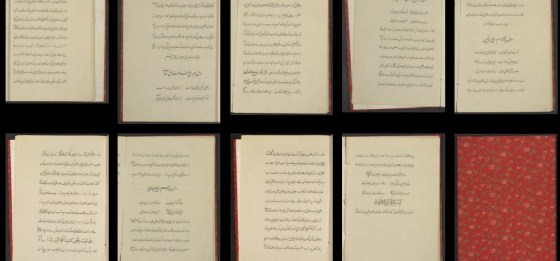
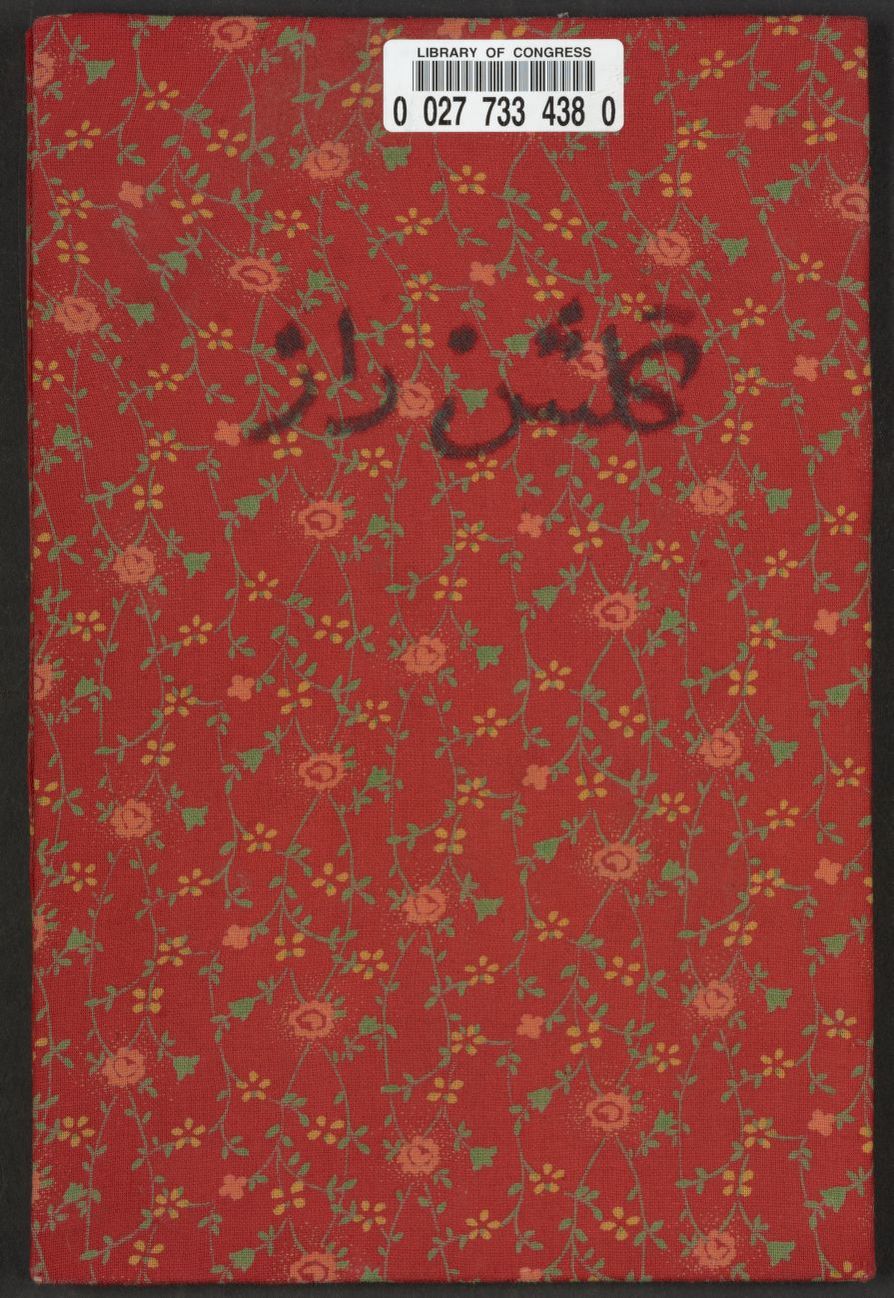
Gulshan-i rāz (The garden of mystery) is a 20th century text on the Nizari Ismaʻili belief system, written by Nadir Shah Kayani (circa 1897 – circa 1971), a leader of the Ismaʻili community in Afghanistan.
Article continues below
Page 1 of 42 of the Ismaili work Gulshan-i rāz. Photo: LOC.
The title of this work deliberately echoes a celebrated Ismaʻili book of verse of the same name composed by Mahmud Shabistari in 1317. Nadir Shah’s work is organized in 14 sections, each of which discusses a philosophical or religious topic such as nafs (the soul) or namaz (prayer). The first section, on tafakkur (the faculty of thought), is written as a commentary on a verse from the original Gulshan-i rāz.
Article continues below, click image to download PDF
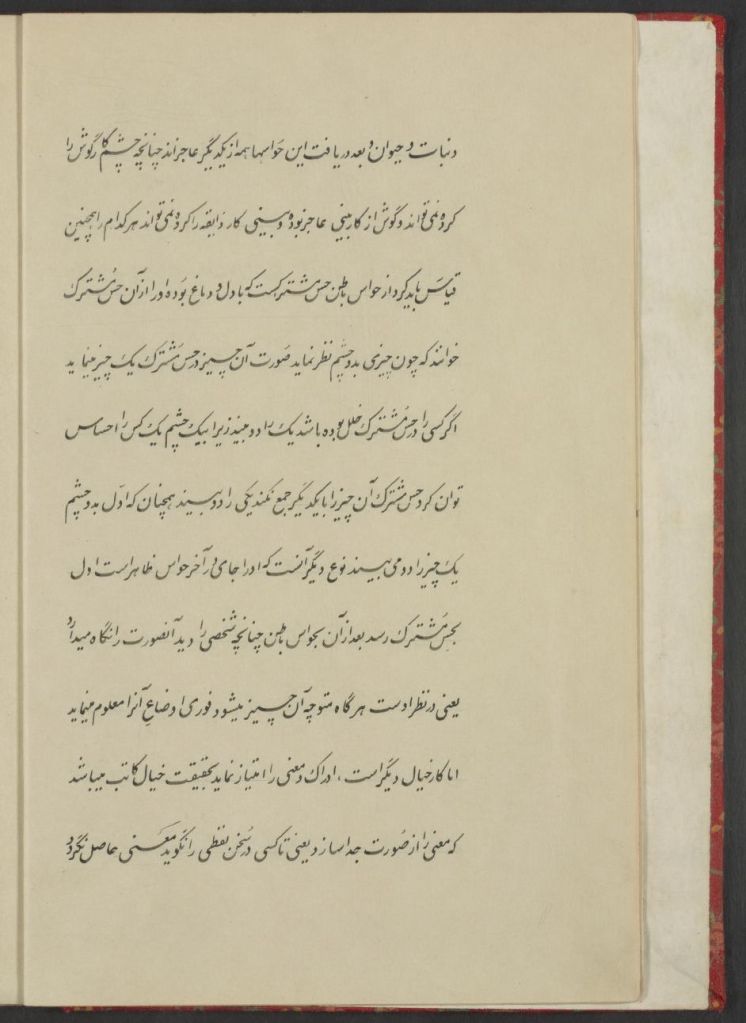
Page 12 of 42 of the Ismaili work Gulshan-i rāz. Photo: LOC; please click on image to download the work in PDF format.
Much remains to be discovered about the Ismaʻili community of Afghanistan during this period. What is known is that Nadir Shah belonged to a family of Ismaʻili leaders based in the Kayan valley in northern Afghanistan. He was a prolific author who wrote both poetry and philosophical texts. The present work is a manuscript, most likely produced in Afghanistan.
Aga Khan III. Photo: LOC.
Kayani’s leadership of the Ismaʻili community coincided with the reign of the 48th Ismaili Imam, Mawlana Sultan Mahomed Shah, His Highness the Aga Khan III (1877-1957; Imam from 1885-1957).
The script is nastaʻliq, written in black ink, 11 lines to the page, on a light-cream paper. The “third” in the title probably refers to Shabistari’s original work as the first Gulshan-i rāz. The identity of the second Gulshan-i rāz is not clear; it could be a reference to the well-known commentary by Shams al-Din Lahiji, written in 1472-73.
Please download Nadir Shah’s work in PDF format by clicking HERE.
Summary of Work
Contributor Names: Kiyānī, Nādir Shāh. Created/Published: Between 1900 and 1999? Notes: Manuscript; Nastalīq script; 11 lines in written area 21.5 x 14 cm; Paper is light cream; black ink; Probably written in Afghanistan; Also available in digital form (PDF and JPEG, click HERE for PDF); In Persian; Acquired for LC only.
Before leaving this website please take a moment to visit Simerg’s Table of Contents for links to hundreds of thought provoking pieces on a vast array of subjects including faith and culture, history and philosophy, and arts and letters to name a few. Also, visit Simerg’s sister websites Barakah, dedicated to His Highness the Aga Khan, and Simergphotos.
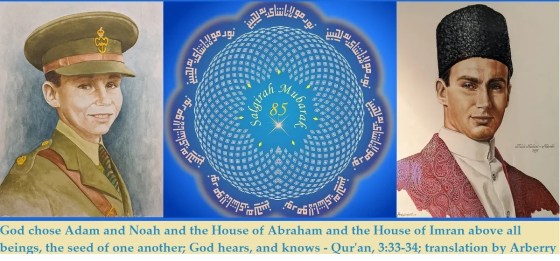
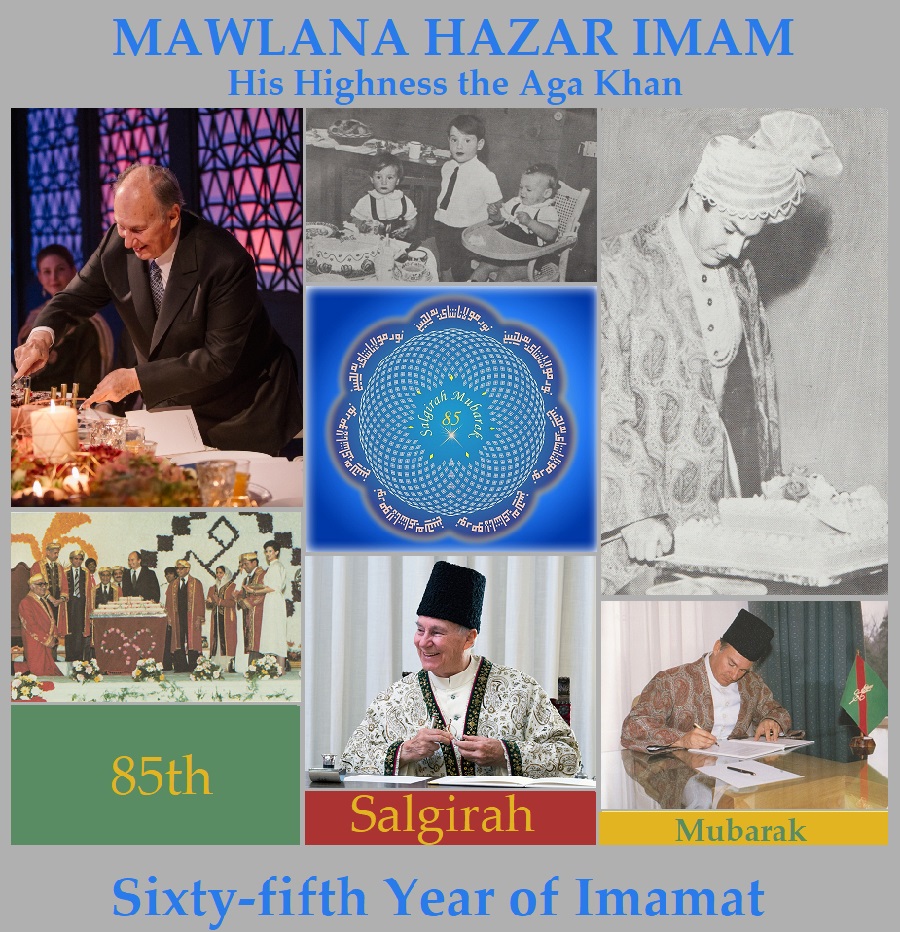
Simerg’s sister website Barakah which is dedicated to Mawlana Hazar Imam, His Highness the Aga Khan, members of his family and the Ismaili Imamat, is pleased to present a profound reading on the subject of Imamat along with a special piece of art by Karim Ismail on the auspicious occasion of Hazar Imam’s 85th Salgirah. The post includes the singing of the Ginan (Hymn) Dhan Dhan Aajno by the (Late) Alwaez Shamshu Bandali Haji, and also has links to its explanation as well as 25 other recitations of the same Ginan by Ismaili singers from around the world. Please click 85th Salgirah Mubarak or on the image below.
Mawlana Hazar Imam, His Highness the Aga Khan, is in his 65th year of Imamat and celebrates his 85th birthday on December 13, 2021. Please click on image for Imamat reading.
Date posted: December 11, 2021.
_________________
Featured image at top of post: In centre, a calligraphy by Toronto’s Karim Ismail and on either side of the art work two paintings of Mawlana Hazar Imam by Vancouver based artist Azeez Khanbhai, who was featured recently in Barakah.
We welcome feedback from our readers. Please complete the LEAVE A REPLY form below or click Leave a comment. Your letter may be edited for length and brevity, and is subject to moderation.
The Ismaili Center Houston (ICH) promises to be an architecturally innovative building. It draws inspiration from several design traditions and will likely generate discussion and debate about present-day Muslim architecture. The confluence of Muslim and non-Muslim motifs in the Center very much reflects the centuries-long Ismaili openness to diverse cultures (e.g. see my article Ismailis: A Pluralist Search for Universal Truth). It is fascinating how the building’s architect, Farshid Moussavi, has intermingled features from the Zoroastrian Sassanid, Christian Byzantine, Muslim Isfahani and secular Western societies in a contemporary Ismaili American edifice.
However, some vital considerations seem to be missing from the building that aspires to stand as “a symbol of dialogue” in responding to its “geographies and contexts.”
An architectural conversation with the first peoples of Texas would have been far-sighted, especially at a time when indigeneity is of rising importance in North American contexts. For example, the challenge of dealing with Houston’s heat and humidity could have turned to the history of the local Akokisa people who built airy beehive-shaped structures to cope with the climate.
Article continues below
The prominent “chorkhona” skylight in the Ismaili Centre Dushanbe. The chorkhona is the defining symbol of the traditional structure of the Pamiri House, whose design principles reflect pre-Islamic philosophical symbols of the Central Asian region. Photo: Karim H. Karim.
A vital principle of architectural practice is attention to the cultural heritage of the proposed building’s daily users. The vast majority of Houston’s Jamat are families that have either arrived directly from India and Pakistan or from the South Asian Ismaili diaspora in Africa. But South Asian architecture appears to have been downplayed in ICH. On the other hand, conscious efforts were made to reflect Pamiri design in Dushanbe’s Ismaili Centre. The databases of the Aga Khan Trust for Culture and the Aga Khan Program in Architecture are rich with information about Muslim architecture in India and Pakistan. Given that the cupola is celebrated in ICH’s design, a nod to the innovative and distinctive chattri in the Indo-Muslim style of Gujarat would have been particularly apropos.
The American Ismaili Jamat’s dominantly South Asian provenance holds other potential that could have been explored through ICH’s architecture. Among the possible partners for dialogue in local and global contexts for Muslims in the USA are diverse Indian American associations. They have strong presence in the American political establishment and are also key players on the transnational scene, including the ties of some with India’s ruling Hindu nationalists. A truly path-breaking pluralist dialogue in the United States holds far-reaching potential for transforming the two diasporic communities’ engagement with each other and charting steps that address the concerns of India’s Muslims with integrity. The AKDN’s calibrated engagement with Afghanistan’s Taliban government is instructive in this regard. One can only imagine the profound diplomatic symbolism of an Islamic architectural pluralism that incorporates design from ancient Indian civilization, as ICH’s architect has creatively done with pre-Islamic Persepolis of her native Iran.
Date posted: November 26, 2021.
_____________________
Karim H. Karim
About the author: Karim H. Karim is Chancellor’s Professor and Director of Carleton University’s Centre for the Study of Islam where he held an International Ismaili Studies Conference. He previously served as Co-Director of the Institute of Ismaili Studies (IIS) and Director of Carleton’s School of Journalism & Communication. Dr. Karim has held visiting scholarly appointments at Harvard University, Aga Khan University/Simon Fraser University, and the IIS. He has also been an advisor for the AKU and the Central Asian University and has served as a member of the AKDN’s Higher Education Forum. Professor Karim is an award-winning author, whose globally-cited writings include publications on culture, architectural design and pluralism as well as on Ismaili communities, institutions, and leadership. He and his wife have established The Karim and Rosemin Karim Prize that recognizes research excellence in understudied areas of Ismaili Studies.
Simerg welcomes your feedback. Please complete the LEAVE A REPLY form below or click Leave a comment.
Before departing this website please take a moment to review Simerg’s Table of Contents for links to hundreds of thought provoking pieces on a vast array of subjects including faith and culture, history and philosophy, and arts and letters to name a few. Please also visit Simerg’s sister websites Barakah and Simergphotos.
Dare to dream and soar the skies, Without ever questioning or wondering why; Life is the canvas and you are the brush, With so many hues, there is no need to rush.
Discover your gifts and leave no stone unturned, It’s your time to claim all that you have yearned; Travel the world, give birth to a precious child, Dig deep into your soul and let your spirit run wild.
Photograph, sing, write, fly, Sculpt, dig, explore on high; Have lunch on the moon or have tea with the Queen Don’t be left wondering wonder what you could have been.
This world is for living in and living in now, Those who lose sight will always wonder “how.” Time stops for no one, so play your best game, With so many days, make no two the same.
And be prepared for those who will tell you you can’t, For it is these same people you will truly enchant. Many are jealous of the gifts we possess, But it is WITHIN US ALL to find true success
So challenge yourself, there is no time to compete, To compare yourself to others is quite simply effete. You’re God’s gifted child, He has plans for you, So dare to dream, it is time for your debut!
You are the butterfly asleep in the Cocoon, You must wait for your time, lest it be too soon. And when the time is right you will no doubt emerge, With uniquely painted wings and upwards you will surge.
Simerg welcomes your feedback. Please complete the LEAVE A REPLY form below or click Leave a comment . Your letter may be edited for length and brevity, and is subject to moderation.
Before departing this website please take a moment to review Simerg’s Table of Contents for links to hundreds of thought provoking pieces on a vast array of subjects including faith and culture, history and philosophy, and arts and letters to name a few. Please also visit Simerg’s sister websites Barakah and Simergphotos.
Malik Merchant recently set out to capture pertinent pictures that would be reflective of the writings of Mawlana Sultan Mahomed Shah, His Highness the Aga Khan III, on the glories of nature and the purpose of life. From the joys of watching beautiful moon and sun rises to the struggles that living things have to endure to sustain themselves as well as to multiply, Malik was lucky enough to experience moments he was seeking out for his new piece in Simergphotos.
A painting of Mawlana Sultan Mahomed Shah by N.B. Dewji that appeared in a voluminous journal called Rahe Rast, published in 1948-49 under the supervision of Dar es Salaam’s iconic religious education teacher Karim Master. Please read Rahe Rast article.
The photo post has been prepared to mark the 144th birth anniversary of the longest reigning Imam in Ismaili history, Mawlana Sultan Mahomed Shah, His Highness the Aga Khan III. Born on November 2, 1877 in Karachi, he became the 48th Ismaili Imam in August 1885 at the age of 7. He passed away on July 11, 1957 after a reign of 71 years, the longest in Ismaili history, handing the Hereditary Imamat that originated with Hazrat Ali (a.s.), the first Shia Imam, to his grandson Mawlana Shah Karim al Hussaini, His Highness the Aga Khan IV. Prince Karim is now in his 65th year of Imamat. Please click SIMERPHOTOS or on any of the two images on this page for a beautiful collection of nature photos as well as quotes on nature and the realities of life by Aga Khan III.
Please click on image for NATURE PHOTOS reflecting the wisdom of Aga Khan III.
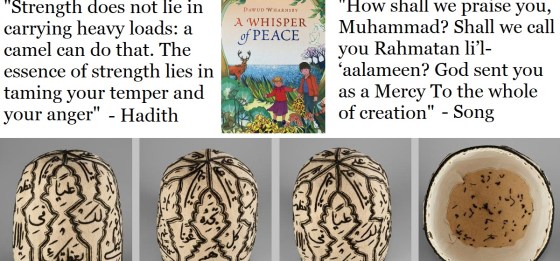
Strength does not lie in carrying heavy loads: a camel can do that. The essence of strength lies in taming your temper and your anger. — Tradition of Prophet Muhammad (S.A.S.) from article How a Muslim Sees Muhammad by Michael Wolfe
The Milad or Mawlid of the Prophet Muhammad (S.A.S.) falls on the 12th day of the Islamic month of Rabi’ al-awwal. In 2021, Muslims in different countries around the world will be observing the birth anniversary between October 18-19. The Ismaili community in Canada will be marking the Milad on Monday, October 18 in Jamatkhanas around the country. The Milad is an appropriate time to learn more about his inspiring life and leadership as well as his faith in God whom he served as the last messenger for 23 long and devoted years, bringing to Muslims the blessing of the Holy Qur’an. We present to you briefs on two books that will appeal to young Muslims and non-Muslims alike, a song by Late Izzat Muneyb (d. May 20, 2017), and an artistic Sufi hat from the collection of the Aga Khan Museum that depicts the well known prayer of Naad-e-Ali invoked by the Prophet.
1. Books on Islam and Prophet Muhammad for the Young
Available at the Aga Khan Museum bookshop or order on-line. Click on image.
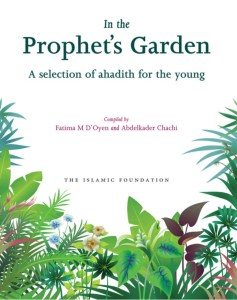
In the Prophet’s Garden is a compilation by Fatimah M D’oyen and Abdelkadir Chahi of two hundred ahadith (sayings of the Prophet Muhammad) taken from authentic sources. The book is thematically arranged in twenty-nine short chapters to cover essential Islamic teachings on faith, religious practices, morals and manners, character, and conduct. Aimed at children and young people from the age of ten onwards, this book also forms a suitable general introduction to the teachings of the Prophet Muhammad for people of other faiths and those new to Islam. The book is a colorful presentation with images, Arabic narration, and English translation. Buy In the Prophet’s Gardenat Aga Khan Museum.
~~~~~~~~~
Available at the Aga Khan Museum bookshop or order on-line. Click on image.
A Whisper of Peace by Dawud Wharnsby, a convert to Islam, is a delightful collection that covers important themes in Islam — its message of peace, love of the Prophet Muhammad, God’s nearness, and caring for and marvelling at the wonders of the world. Full of uplifting rhymes and faithful ideas, this collection will inspire and inform children of all faiths and none. Dawud is well known for writing stories, songs, and poems for people of all ages for many years. Buy A Whisper of Peace at Aga Khan Museum.
This song introduces us to some of the titles by which Prophet Muhammad came to be known. They are: ‘Ahmad’, ‘Mustafa’, ‘Rahmatan li’l-‘aalameen and ‘King of law laak’. The words ‘law laak’ in Arabic mean, “Were it not for…” There is a Hadith of Prophet Muhammad, where Allah speaking to His prophet, says, “Were it not for you, I would not have created the universe – law laaka lamaa khalaqtu’l-aflaaka.” [1]. In the song, the lines marked * are sung twice.
Muhammad, Muhammad, How shall we praise you, Muhammad?*
Shall we call you Ahmad?* He who is praised in heaven Shall be praised here on earth.
Muhammad, Muhammad, How shall we praise you, Muhammad?*
Shall we call you Mustafa?* The Chosen of God on earth, You have brought us the Qur’an.
Muhammad, Muhammad, How shall we praise you, Muhammad?*
Shall we call you Rahmatan li’l-‘aalameen?* God sent you as a Mercy To the whole of creation.
Muhammad, Muhammad, How shall we praise you, Muhammad?*
Shall we call you the ‘King of law laak’?* Even God says He created The universe for you.
Muhammad, Muhammad, How shall we praise you, Muhammad?*
Notes:
[1] Source: Sukheel Sharif, The Jawziyyah Institute, 2006
__________________
3. Nadi Ali
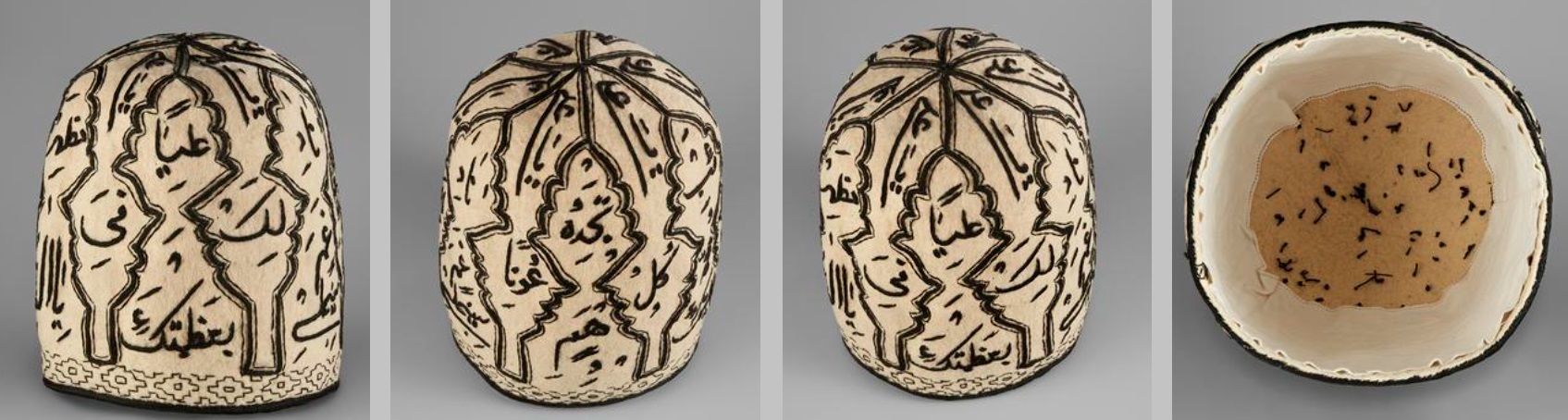
Views of a Sufi hat in the collection of the Aga Khan Museum depicting the famous “Nadi ‘Ali” (also Naad-e-Ali) prayer of the Prophet Muhammad. Photo: Aga Khan Museum, Copyright: Creative Commons CC BY-NC 2.5 CA.
By DR. ULRIKE AL-KHAMIS
This white felt hat [1] once formed part of a dervish’s outfit. It is embroidered with a well-known prayer to ‘Ali (“Nadi ‘Ali”), the cousin and son-in-law of the Prophet Muhammad and the figurehead of Shia Islam. The embroidered text is contained within tall and elongated, gracefully crenellated units that interlock. Hats of this shape are known to have been worn since the Safavid period, but this particular style seems to have emerged much later in the nineteenth century. A similar cap, attributed to the Khaksari Sufi Order and dated to the nineteenth to early twentieth centuries, can be found among the collections of the Fine Arts Museums of San Francisco (Reg. No. 2004.100.5).
Transliteration and Translation of Arabic Inscription
Transliteration:Nadi ‘aliyyan muzhir al-aja’ib. Tajidahu ‘awnan laka fi al-nawa’ib. Kullu hamm wa ghamm sayanjali bi ‘azamatika ya Allah, binabuwwatika ya Muhammad, bi-wilayatika, ya ‘Ali, ya ‘Ali, ya ‘Ali, ya ‘Ali, ya ‘Ali, ya ‘Ali
Translation: Call upon ‘Ali, the revealer of miracles! You will surely find him a helper to you in crisis. Every care and sorrow will pass through your magnificence, oh God, your prophethood, oh Muhammad, your companionship, oh ‘Ali, oh ‘Ali, oh ‘Ali, oh ‘Ali, oh ‘Ali, oh ‘Ali.
Dr. Ulrike Al-Khammis was recently appointed as the Director and CEO of the Aga Khan Museum. She has been a key member of the Aga Khan Museum’s executive and leadership team over the past four years, acting as Director of Collections and Public Programs since 2017. Commenting on the new role that Dr; Ulrike assumed, Prince Amyn Aga Khan, Chairman of the Aga Khan Museum Board and speaking on behalf of the Board of Directors said: “I have worked for four years with Dr. Al-Khamis and it has been a joy. She is committed, creative and always ready to try something new. I think that under her leadership the Museum will play a major educational role and will open new and exciting doors.”
Simerg welcomes your feedback. Please complete the LEAVE A REPLY form below or click Leave a comment. Your letter may be edited for length and brevity, and is subject to moderation.
Before departing this website please take a moment to review Simerg’s Table of Contents for links to hundreds of thought provoking pieces on a vast array of subjects including faith and culture, history and philosophy, and arts and letters to name a few.
Born on October 12, 1971 in Geneva, Switzerland, Prince Rahim Aga Khan has been engaged with the work of the Ismaili Imamat for the past 15 years. Simerg’s sister website, Barakah, has prepared a special tribute taking readers through 50 years of his life with beautiful images, excerpts from his speeches as well as other pertinent material related to his education and responsibilities. Do not miss this extraordinary and inspiring post on Prince Rahim. Please click HERE or on the image below.
Please click on image for Barakah’s exclusive photo essay on Prince Rahim to mark his 50th birthday on OctoBer 12, 2021. Photo: Malik Merchant/Simerg/Barakah.
For the first time in more than 19 months, I accepted an invitation to visit friends who were hosting a BBQ for their family. They regard me as one of their family members. I am fully vaccinated against Covid-19. I have known Salim and Nevin Kanji for decades. Salim’s older brother, Mohamed Amersi, was one of Tanzania’s top table tennis players, and he spent time with me and improved my game at the Diamond Jubilee Hall in Dar es Salaam in the late 1960’s. Mohamed passed away at the age of 51! It was shocking when I got the news some 20-25 years ago. May his soul rest in eternal peace.
Salim’s grandfather was the well known Late Count Amersi Kanji of Zanzibar, who served the Ismaili Imamat for decades. A couple of stories that Sikandar, Salim’s younger brother, told everyone yesterday about their grandfather, deserve a special post. Hopefully, we can prepare a special piece about Count Amersi’s contribution to the Jamat and the Imamat, often in extremely dangerous circumstances. The photos of the late count that are featured in this post are in Salim and Nevin’s home.
Article continues below
Mawlana Hazar Imam, His Highness the Aga Khan, with Salim Kanji’s grandfather Count Amersi Kanji. Photo: Salim Kanji Family Collection.
The BBQ was absolutely delicious and Nevin kindly filled up containers for me to take home. I left their place after about 4 hours, planning to return home and retire early. It was exactly 6:25 PM as I turned left onto Wynford Drive from Don Mills Road. The Ismaili Centre/Headquarters Jamatkhana was 300 metres away. On weekends, the Headquarters Jamatkhana Dua time is 6:30 PM. It was not my scheduled day to attend but deep down something told me to try my luck as a walk-in. I followed my instincts and luckily got a space. I saw the Ab-e-Shifa table set up, and wondered why. Was I wrong about the Milad-un-Nabi date? The mystery was solved when the President of the Aga Khan Council stood up and read the Talika from our beloved Mawlana Hazar Imam, which was followed by the recitation of the Talika Ginan. Everyone’s heart was touched, and there was unbounded joy and happiness on everyone’s face.
Article continues below…with Talika
Mawlana Sultan Mahomed Shah, His Highness the Aga Khan, with the family of (Late) Count Amersi Kanji (seated left with robe). Photo: Salim Kanji Family Collection.
Thanksgiving is an expression of gratitude, and families get together for meals. It was a great afternoon being with a loving family, and I made new friends at Salim’s home with other members of his family that I had never met before. The invitation was a blessing indeed, and the kindness shown to me by Salim, Nevin, their son Hafez (a die-hard Liverpool fan, yes Salah is the best in the world) and all those who were present led me to the Jamatkhana. For me, this Thanksgiving was the happiest one in my 40 years in North America (the USA Thanksgiving comes later in November).
Barakah wishes Ismailis around the world Mubaraki on the auspicious occasion of the Talika. Let us earnestly continue to follow Mawlana Hazar Imam’s guidance, and always keep his blessings in our hearts.
Mawlana Hazar Imam’s Mubarak Talika
Mawlana Hazar Imam, His Highness the Aga Khan.
7th October 2021
My dear spiritual children,
On the occasion of a recent mulaqat with my senior Jamati leaders to review their reports on current Jamati work and activities, I send my warmest and most affectionate paternal maternal loving blessings to all my beloved spiritual children throughout the world.
I send my best loving blessings for the souls of all my ruhani spiritual children, and I pray that their souls may rest in eternal peace.
I am happy that, in the face of the ongoing Covid-19 pandemic, my Jamat is continuing to undertake the measures recommended by the health authorities to mitigate the risks, particularly by accepting to be vaccinated as soon as the opportunity becomes available. I wish all my spiritual children to remain constantly mindful of the importance of maintaining good health in all aspects of human life.
At this time my Jamat in some parts of the world is witnessing political transformation. I remind my spiritual children of our tradition to contribute positively for the growth of a healthy civil society, which I believe will enable the improvement of the quality of life of all peoples and will therefore underpin the restoration of peace and stability.
I send my most affectionate loving blessings for your spiritual wellbeing, worldly success, good health, happiness and progress, with best blessings for my Jamat’s strength of faith and unity.
I send my special loving blessings for mushkil-asan, and for the safety and security of all my Jamat. You are all particularly in my heart, in my thoughts and in my prayers.
Please visit our sister website Barakah’s Talika page for links to all the Talikas that Mawlana Hazar Imam has sent to the Jamats since the beginning of Covid-19.
Simerg welcomes your feedback. Please complete the LEAVE A REPLY form below or click Leave a comment. Your letter may be edited for length and brevity, and is subject to moderation.
Before departing this website please take a moment to review Simerg’s Table of Contents for links to hundreds of thought provoking pieces on a vast array of subjects including faith and culture, history and philosophy, and arts and letters to name a few.
The above post is also published in Barakah, a website dedicated to Mawlana Hazar Imam, members of his family and the Ismaili Imamat. Please visit www.barakah.com.
Chinook salmon successfully leaps over a 6 foot dam on Humber River at Etienne Brulé Park Park in Toronto, October 5, 2021. Image clipped from video by Malik Merchant/Simerg, see video of leap below.
The transliteration and meaning of the popular Ismaili Ginan Ooncha (or Uncha) Re Kot… first appeared on this website in 2009, accompanied by an image of a salmon swimming upstream and trying to jump over a steep rapid. The “borrowed” image was a metaphor for the first verse of the Ginan, where the “fish of the briny deep” seeks to overcome an obstacle — a high cliff — to return to its original abode — in the case of the salmon, the place where the mother had first brought it into the world by releasing the egg a few years earlier (a salmon lays between 1,000 to 17,000 eggs out of which only a few survive). It may be noted that certain species of salmon e.g. the Pacific Chinook, die after spawning, and the salmon that it has given birth to, swim to the lake or the ocean, where they reach maturity in about two to three years. After mating, the adult returns to its place of birth to spawn.
I have lived in Canada since the 1980’s and have on three occasions visited Hell’s Gate in British Columbia, a very popular spot to observe salmon going upstream to spawn. Unfortunately, however, I never got to witness this amazing phenomenon there.
A Chinook salmon swimming in the shallow waters of Don River, at Don Trail East, September 30, 2021. Photo: Malik Merchant/Simerg.
I was not aware that Toronto rivers had salmon as well. Indeed, the Don River, only a few hundred metres from where I live, is active with Chinook Pacific salmon moving upstream in autumn. The Chinook were introduced into Lake Ontario in the mid 1960’s because the native Atlantic salmon had virtually vanished. Their introduction was an immediate boon to the province’s fishing industry. The Don River flows into Lake Ontario, and at the park close to me it does not have high rapids, so you don’t get to see salmon jumping that high.
An amazing video by a visitor to Etienne Brulé Park on October 7, 2021 of a salmon trying to leap unsuccessfully over a dam on Humber River, near the 13 Crosby Avenue entrance. Please watch upper section of the film for the salmon leap. Video provided to Simerg by Ms. Sze Thang of Toronto.
Google search located a great spot in Toronto where I could view the incredible show, referred to as the Salmon Run. I went to the recommended Etienne Brulé Park in Toronto’s west end, where the Humber River flows. A regular visitor here told me that the salmon activity was low on that day (October 5). I reached the man made dam on the Humber River. The crowd was very small. I began my video taking at one end of the river and was able to see the entire breadth of the river. I would keep my video on for around 30 seconds, turn it off and turn it on again within a second or two. I took about 70 videos, and seven of those provided me the images that I wanted. Some salmon repeatedly kept on hitting the cliff rock and falling back. A few nearly made it but fell back. It was painful to see that! But then a couple managed to leap high enough and continue its spawning journey. Wow! What an exciting and thrilling moment. I visited the site again a couple of times, and was able to capture more failures as well as two successful leaps with reactions from the crowd of hurrays and hand-clapping. The happy crowd apologized to me for making so much noise, but I was very happy they were cheering with every successful leap, and would have joined them in the celebration. For visitors who missed the successful jumps, my cameras became the centre of attraction, and numerous individuals asked me to forward them the videos so that they could show them to their children!
The effort that the salmon were making was painful to witness especially when they hit the wall of the dam, but they would not give up despite the setbacks. They had a set goal and objective: to reach the spawning location. And they had more rapids to overcome in their long journey.
This extraordinary effort by the fish reminded me of Mawlana Hazar Imam, His Highness the Aga Khan’s advice to his Jamat (community) in Congo in the early 1960’s that if we have faith it will give us the strength to start life all over again (naveen sharuat in the gujarati translated Farman), even a hundred times if necessary. There are two principles in life that Mawlana Hazar Imam has asked us to be guided by: To work hard and to have faith. Let us work hard, be strong and as eager as the salmon, in our life’s material and spiritual journey. As Mawlana Sultan Mahomed Shah said, “Struggle is the meaning of life; defeat or victory is in the hands of God. But struggle itself is man’s duty and should be his joy.” These notions of hard work and struggle, and then accepting success or failure define Islam: Submission to the Will of God.
Please enjoy the videos, the explanation of the Ginan by Esmail Thawerbhoy and the recitation by the (Late) Alwaez Shamshu Bandali Haji. And those who live in Toronto or close to rivers where there are salmon, please go and see the fascinating show called the Salmon Run.
~~~~~~~~~~
Eji Ooncha Re Kot Bahoo Vech-Na of Pir Hasan Kabiru’d-Deen
Freely rendered in English verse By (Late) ESMAIL THAWERBHOY (iambic tetrameter, rhyme scheme abab)
Verse 1
So high the fort and climbing steep, And surging round its base the sea; I am a fish of the briny deep, Ah Love, haste Thou to succour me. Thy absence frets my heart’s commotion, Beloved come home, my Love return; Forgive Thy slave his scant devotion, Show me Thy face, to Thee I turn. Thy absence frets my heart’s commotion.
Verse 2
This sweet-scented sandalwood home, Enclosed with beauteous acts galore; ‘Tis Love that locks me in my tomb, Beloved I pray Thee ope the door. Thy absence frets my heart’s commotion…
Verse 3
Enmeshed in ties of kith and kind, How few realize its fatal art! My soul’s torment, my body’s grind, Beloved come soothe my aching heart. Thy absence frets my heart’s commotion…
Verse 4
Be not so wroth, O Darling mine, And deign to grant Thy Sight sublime; Pir Hasan Shah entreats divine Redemption from the sea (of time). Thy absence frets my heart’s commotion…
_________________
Must Watch Video 1: Salmon Leaps — Unsuccessful Attempts
Salmon Run on Humber River at Etienne Brulé Park in Toronto, October 5 and 7, 2021. Video: Malik Merchant/Simerg
_________________
Transliteration of Ginan
Verse 1
Eji Ooncha re kot bahoo vech-na, Neeche vahe dariya; Hoon-re dariya vandi maachhli, Sa-yan taaran aav. Hoon-re darshan vina baavri, Baalam ghare aav, Saajan ghare aav; Bando bhooli-yo taari bandagi, Sa-yan soorat bataav, Hoon-re darshan vina baavri.
Eji Pinjar padi-yo pari-vaar no, Koik boojat jann; Merre tann-ki vedana, Sa-yan tapat boojaav. Hoon-re darshan vina baavri…
Verse 4
Eji Itana kop na keeji-ye, Sa-yan deeje didaar, Pir Hasan Shah-ni venati, Sa-yan taaran aav. Hoon-re darshan vina baavri…
_________________
Must Watch Video 2: Salmon Leaps — Unsuccessful Attempts
Salmon Run on Humber River at Etienne Brulé Park in Toronto, October 5 and 7, 2021. Video: Malik Merchant/Simerg
_________________
Commentary of the Ginan
In this Ginan Pir Hasan Kabiru’d-deen speaks of the soul’s yearning for the Beatific Vision (Noorani Didar). The imagery employed by the Pir is the familiar mystical vehicle of human love and the pangs of separation. In mysticism human love is ennobled and elevated to symbolize divine Love.
The word ‘religion’ comes etymologically from the two roots ‘re,’ again, and ‘ligare,’ to bind. It thus implies a former union from which the soul was separated and seeks to be reunited again.
The Holy Qur’an has the Verse with the same signification: Inna li-llahi wa inna ilayhi raaji’oon which means “From Allah we come and to Him is our return.”
A famous Hadith of Prophet Muhammad says: “Between Him and me there are seventy thousand Veils of Light.”
By ‘Veils of Light’ are meant the entanglements of the flesh which hinder the Soul from its meeting the Noor. It is in transcending the limitations of the flesh and establishing rapport with the Noor that the soul finds its ultimate fulfilment.
But this is no easy matter. Family ties, material gains, power and pelf distract man from his duty.
How difficult the task is, is allegorized by the Pir as the effort of the fish (soul) to swim to the edge of the sea, and then climb up a stiff and fortified fort. The soul is also symbolized as a bird in its cage which is enamoured of its cage, and is loth to leave it to find its true place.
Beatific Vision can only be an act of Grace; and no soul, however much it strives, can claim to be entitled to it. If and when Grace comes, it comes from above. It is transcendent, not immanent. That is to say, it must come from outside of our sense-perception, and cannot be induced from within our consciousness. If we can, in Ibadat, eliminate all consciousness of Space and Time, the soul untrammelled by ‘mortal coil’ could, with Divine Grace, hope for a glimpse of the Beatific Vision—Noorani Didar. But it is always an act of Grace, and man cannot claim to merit it on the strength of his effort.
To use the terminology of photography, a sensitized plate kept in a darkroom will not take an impression however long it remains in the darkroom. But if light from an object falls upon it, it immediately takes an impression. The soul, freed from its entanglements, is like a sensitized plate. It is ready to receive Noorani Didar. But this Light must come from outside. It may come in a few days, a few weeks, or months, or years. It may not come at all. Man’s volition cannot accelerate or ensure the moment. He must strive patiently, and hope for Divine Grace.
Redemption is a common motif in many philosophies. In Eastern philosophy the sea is the symbol of the cycle of life (bhava saagar). To be saved from the sea means release from the flux of life. In Neo-Platonic philosophy it stands for the Individual Soul’s relation to the Universal Soul. In Sufism it is fanna fillah baqa hillah (annihilation in God and then everlasting existence in God). In Ismaili philosophy it stands for the absorption of the individual soul into the Noor of Imamat.
_________________
Must Watch Video 3: Salmon Leap — Successful…The Journey Continues
Salmon Run on Humber River at Etienne Brulé Park in Toronto, October 5, 2021 Please see near end for leap. Video: Malik Merchant/Simerg
_________________
Must Watch Video 4: Salmon Leap — Successful… The Journey Continues
Salmon Run on Humber River at Etienne Brulé Park in Toronto, October 7, 2021. Video: Malik Merchant/Simerg
__________________
Recitation of Ginan by (Late) Alwaez Rai Shamshu Bandali Haji
Ginan Uncha Re Kot Bahoo Vech-Na sung by (Late) Alwaez Shamshu Bandali Haji Credit: Ginans Central
Date posted: October 8, 2021.
____________________
We welcome feedback from our readers. Please complete the LEAVE A REPLY form below or click Leave a comment. Your letter may be edited for length and brevity, and is subject to moderation.
Editor’s Note:
This article by the (Late) Esmail Thawerbhoy was published in the July 1977 issue (Volume 3, Number 1) of Ilm magazine, London under the title Ginan Sharif of Pir Hasan Kabiru’d-Deen.
The late Esmail Thawerbhoy, originally from Mumbai, India, was a lawyer by profession and lived in Bangladesh before making London, England, his home in the 1970’s. He participated actively in numerous research and study groups while he was in Mumbai and Dacca. The editor remembers him fondly for his immense interest and support for Ilm magazine, published by the Ismailia Association for the U.K, (now the Ismaili Tariqah an Religious Education Board) and for contributing an extensive article “The Concept of Imamat in Ismailism and Other Schools in Islam” which appeared in the March, 1977 issue of the magazine (Volume 2, Numbers 3 & 4).
Before departing this website please take a moment to review Simerg’s Table of Contents for links to hundreds of thought provoking pieces on a vast array of subjects including faith and culture, history and philosophy, and arts and letters to name a few.
__________________________
Chinook salmon successfully leaps over a dam on Humber River at Etienne Brulé Park in Toronto, October 5, 2021. Image clipped from video. Malik Merchant/Simerg.
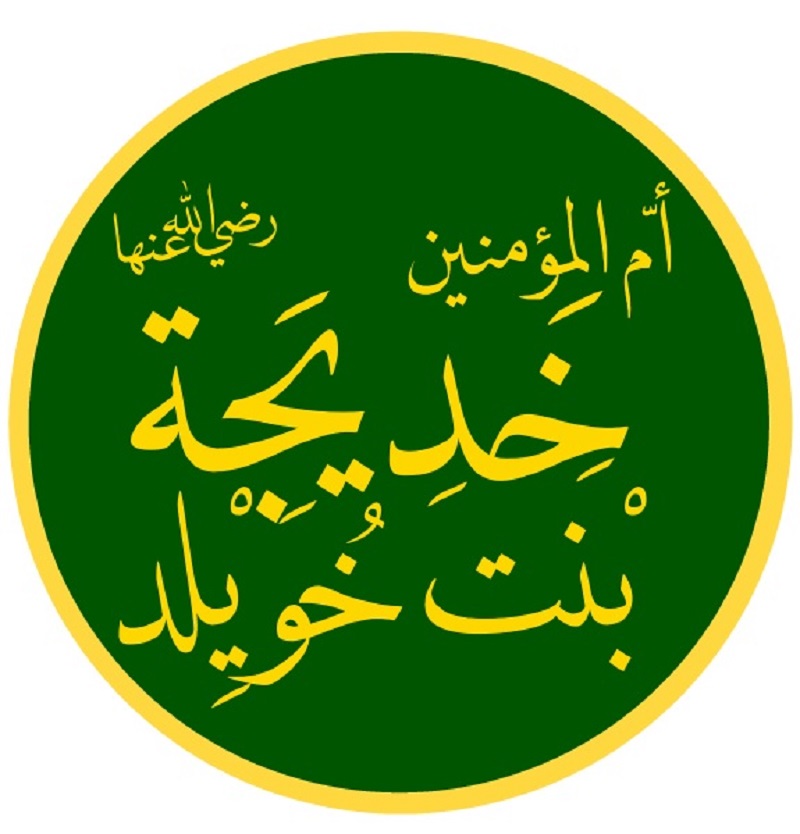
The Islamic phrase “Umm ul Muminin”(Mother of the believers) is followed in the centre by”Khadijah”; the bottom contains the Islamic honoric phrase “Radhi allahu anha” (May Allah be pleased with her). Credit: Maajid Shafi (own work), Wikipedia Creative Commons Attribution-Share Alike 4.0 International. Note: This art work is not part of the article posted below.
*********
When her father died, the young woman [Khadijah] took charge of the family business, which thrived and grew under her direction. Compassionate as well as hard-working, Khadijah gave a great deal of money to help others — assisting the poor, sick, disabled, widows, orphans, and giving poor couples money to marry
Khadijah – First Woman of Islam
Article Credit:From The Unitarian Universalist Association’s Tapestry of Faith curriculum, Building Bridges (Read article at source HERE)
Remarkable women have done remarkable things in every part of the world in every time in history. Most of their accomplishments were not recorded in history books. While just as brilliant, creative, and courageous as men, women in many societies have been valued less, and often their contributions discounted, not recorded at all, or attributed to men. Notable exceptions were women so extraordinary their worth could not be ignored or minimized. One such woman, revered by billions, is Khadijah bint Khuwaylid (Khadijah, daughter of Khuwaylid), born in Mekka in 555 CE.
Khadijah was born to a life of privilege. Her family was important in Mecca and quite wealthy; she could have lived a life of ease all her days. Khadijah, however, was an intelligent and industrious young woman who enjoyed business and became very skilled. When her father died, the young woman took charge of the family business, which thrived and grew under her direction. Compassionate as well as hard-working, Khadijah gave a great deal of money to help others –assisting the poor, sick, disabled, widows, orphans, and giving poor couples money to marry.
Twice Khadijah married, and when each of her husbands died, she overcame her grief and continued to rear her small children and run her successful caravan business by herself. Khadijah had many employees, including the important position of her agent, who traveled with her caravans, negotiated deals in other cities, and took charge of the large amounts of money involved in the trading business.
When Khadijah was 40 years old, she was widely known in Arabia as a powerful, smart, independent woman, and many men wanted to work for her. However, when she needed to hire an agent, she did not hire any of the men who eagerly sought the job. Instead, she selected a hard-working young man named Muhammad who had the reputation of being honest and diligent. Muhammad was only 25 years old when he accepted the job, but he proved to be an excellent employee and a courteous and ethical man. Within a fairly short time Khadijah concluded he would be a suitable partner in life, as well, and so she, Khadijah, proposed marriage to Muhammad.
The difference in their ages was 15 years, but there was never a question of their complete devotion to each other. Muhammad continued to work for Khadijah’s caravan business, and they had six children together, although only one of the children, a girl named Fatimah, lived to adulthood. Khadijah and Muhammad lived happily in this busy, productive way for 15 years, but when Muhammad was 40 their lives took a radical turn.
Khadijah encouraged Muhammad to leave the business and preach full time. She financially supported him so he could preach with all his heart and energy; she sustained him in this way for the rest of her life. When necessary, she supported his followers, too.
Muhammad meditated in a cave outside Mecca from time to time, and one afternoon he returned home from the cave exhausted and frightened, calling to Khadijah for help. He told her the angel Gabriel had spoken to him with a message from God, but he did not know what it meant. Khadijah believed Muhammad. She assured him he was sane and that this news was good, not fearful. Khadijah became the first convert to Islam, and remained Muhammad’s most staunch believer, ally, and friend through the trials that lay ahead.
Khadijah encouraged Muhammad to leave the business and preach full time. She financially supported him so he could preach with all his heart and energy; she sustained him in this way for the rest of her life. When necessary, she supported his followers, too. In the early years, when the growth of Islam was slow and increasingly dangerous, Khadijah protected Muhammad with her political power and influence. As time passed, Muhammad’s compelling word gained followers, and just as steadily, city leaders became more alarmed and wanted Muhammad arrested. Eventually, when the authorities could not be kept away and finally came for him, Khadijah left her comfortable home to join her husband, Muhammad, in hiding. Three years of rugged living followed, during which Khadijah depleted her entire large fortune supporting the followers of Islam. Her wealth was gone and her health strained to the breaking point by deprivation. However, her spirits remained high and her devotion never flagged. Finally, the brave, honorable, and faithful Khadijah became ill and died.
Muhammad revered Khadijah’s memory the rest of his life, and consistently held her up to both men and women as a model of intelligence, virtue, courage, and devotion to family and to God
The year Khadijah died was 619 CE. She was 65 years old, and she and Muhammad had been partners for 25 years. Muhammad’s uncle Abu Talib also died that year, and Muhammad called 619 the Year of Sorrow. It is known in Islamic history as the Year of Sorrow to this day.
Khadijah is recognized as a great woman. Muhammad revered Khadijah’s memory the rest of his life, and consistently held her up to both men and women as a model of intelligence, virtue, courage, and devotion to family and to God. During the 25 years of their marriage, Muhammad remained married only to Khadijah. After Khadijah died, Muhammad had numerous wives at once as was the custom of that time.
Khadijah is revered by Muslims worldwide, honored with the titles First Believer and Mother of Believers. Muslims believe Islam is the true faith, originating with Adam and Eve, so the work of Muhammad did not create Islam. However, its success is in great part due to Khadijah’s unwavering support in its formative years.
Date posted: August 25, 2021.
_________________
We welcome feedback from our readers. Please complete the LEAVE A REPLY form below or click Leave a comment. Your letter may be edited for length and brevity, and is subject to moderation.

















 Simerg - Insights from Around the World