Simerg is an independent initiative dedicated to Ismaili Muslims, the Aga Khan — their Hereditary Imam — and the Ismaili Imamat, and Islam in general through literary readings, photo essays and artistic expressions
Category Archives: Literary Readings from Ismaili History
In my recent piece about my paternal grandparents Alladin and Prembai (see The Story of Tanga’s Alladin Bapu Family) I briefly noted that one of their sons Shariff Alladina (1910-1976), who happened to be my father, had a fine singing voice. I provided links to his Ginans that I had loaded into Soundcloud sometime ago (please click Shariff Alladina’s 4 Ginans, titled as Bapaji 1 thru 4 on Soundcloud). Ever since, I have been pressed for more information about my father as well as his interest in music and Ginans.
Story continues after photo
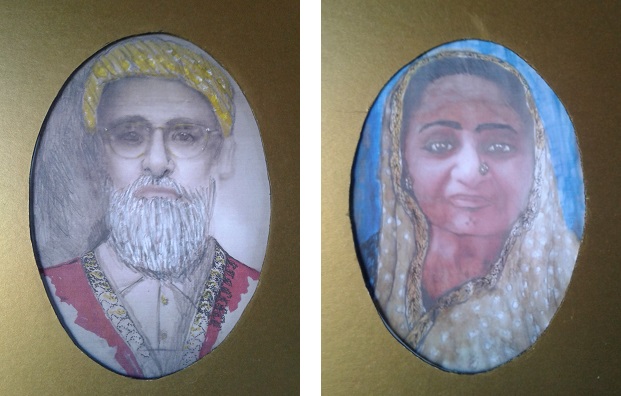
Shariff Alladina’s parents, Alladin and Prembai. Photo: Safder Alladina.
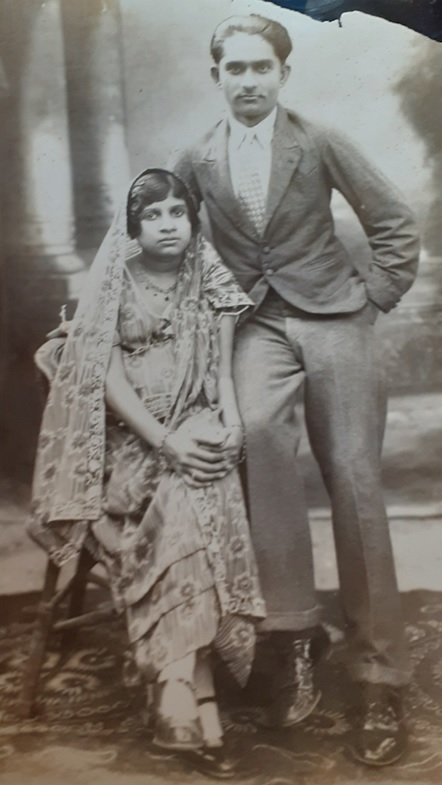
My late father — shown at top of this post — was a business man of Tanga, Tanzania. He came from a musical family. Born in Kathiawar, India, Shariff was brought to Tanganyika in a dhow as a toddler of about two by his parents Alladin and Prembai. In 1930 Shariff married Zera, a Kachhi girl from Zanzibar. It was not very usual for Kathiawari and Kachhi to inter-marry but Saleh Harji, a close friend of Shariff, was able to negotiate the marriage with his niece Zera. She came from well-established families in Zanzibar. Her paternal and maternal grandparents were Mukhi and Kamadia of Zanzibar jamat on multiple times. Zera’s family story is documented in Zahir Dhalla’s piece A rare 100 year old family photo fills in a few blanks of Ismaili Khoja history in East Africa.
Story continues after photo
Shariff and Zera Alladina Patney, 1930. Photo: Safder Alladina Collection.
There were many singers and musicians in the family. My father taught me to sing Jeere waala Paat madaviney chok puravo (a Ginan which is often recited on days when Ab-e-Shifa is partaken) when I was about 10 years old. Mukhi Habib Kassam, who sang the Ginans early in the evening, was so pleased with my singing that he gave me one shilling!
Every Sunday morning, there was a gathering in my house where musicians and music lovers would gather to listen to the singers and instrumentalists. Ustad Ismail Ragi was a local music master who attended these morning sessions of riyaz until he fell ill and the local businessmen got together to raise money to send him with his wife to India for medical attention.
In the 1960s the sessions were attended by Gangu, a harmonium player and Batuk, a young tabla player. The recordings of my father’s songs, including the four Ginans in Souncloud, came out of these sessions of riyaz on Sunday mornings. I was in the UK at the time.
Shariff Alladina recited the Ginans many times in the Jamatkhana. He also gave lectures in the Jamatkhana where he would introduce pieces of Ginans, Bhajans and Sufi poetry in between his speech. He tutored many young people in Tanga to sing Ginans including his daughters Malek, Shirin and Khatun. Khatun’s rendition of Hazrat Ali’s Mowlana Kalam was enjoyed by many.
Ginans Central at the University Saskatchewan is an excellent resource for Ginans and Ginanic research, and I would suggest you visit the website and see items #140, #614, #751, and #464 corresponding to each of the 4 Ginans listed above that are in Soundcloud.
Date posted: July 20, 2020.
Before departing this website please take a moment to review Simerg’s Table of Contents for links to hundreds of thought provoking pieces on a vast array of subjects including faith and culture, history and philosophy, and arts and letters to name a few.
________________
We welcome feedback/letters from our readers. Please use the feedback box which appears below. If you don’t see the box please click Leave a comment. Your comment may be edited for length and brevity, and is subject to moderation. We are unable to acknowledge unpublished letters
Safder Alladina has taught English as a Foreign Language in England, Japan and Portugal and English as a Second Language in England and Canada. In his 35 years of teaching, he has taught Early Years, Primary, Secondary and Adult classes; and developed and taught Teacher Education programmes at graduate and post-graduate levels at the University of North London, UK, and the University of British Columbia, BC. His research work is in Sociolinguistics. He has retired to a hobby farm in the interior of British Columbia where he does his writing under the pen name of S. Giga Patney.
One day, in Mecca, the Prophet Muhammad dropped a bombshell on his followers: He told them that all people are created equal.
“All humans are descended from Adam and Eve,” said Muhammad in his last known public speech. “There is no superiority of an Arab over a non-Arab, or of a non-Arab over an Arab, and no superiority of a white person over a black person or of a black person over a white person, except on the basis of personal piety and righteousness.”
In this sermon, known as the Farewell Address, Muhammad outlined the basic religious and ethical ideals of Islam, the religion he began preaching in the early seventh century. Racial equality was one of them. Muhammad’s words jolted a society divided by notions of tribal and ethnic superiority.
Today, with racial tension and violence roiling contemporary America, his message is seen to create a special moral and ethical mandate for American Muslims to support the country’s anti-racism protest movement.
Apart from monotheism – worshipping just one God – belief in the equality of all human beings in the eyes of God set early Muslims apart from many of their fellow Arabs in Mecca.
Chapter 49, verse 13 of Islam’s sacred scripture, the Quran, declares: “O humankind! We have made you…into nations and tribes, so that you may get to know one another. The noblest of you in God’s sight is the one who is most righteous.”
Muslims of all backgrounds praying around the Kaʻbah during Hajj, the annual pilgrimage to Mecca, in a photo taken between 1885-1889. Photo: Al Sayyid Abd al-Ghaffār, Physician of Mecca / US Library of Congress
This verse challenged many of the values of pre-Islamic Arab society, where inequalities based on tribal membership, kinship and wealth were a fact of life. Kinship or lineal descent – “nasab” in Arabic – was the primary determinant of an individual’s social status. Members of larger, more prominent tribes like the aristocratic Quraysh were powerful. Those from less wealthy tribes like the Khazraj had lower standing.
The Quran said personal piety and deeds were the basis for merit, not tribal affiliation – an alien and potentially destabilizing message in a society built on nasab.
As is often the case with revolutionary movements, early Islam encountered fierce opposition from many elites.
The Quraysh, for example, who controlled trade in Mecca – a business from which they profited greatly – had no intention of giving up the comfortable lifestyles they’d built on the backs of others, especially their slaves brought over from Africa.
The Prophet’s message of egalitarianism tended to attract the “undesirables” – people from the margins of society. Early Muslims included young men from less influential tribes escaping that stigma and slaves who were promised emancipation by embracing Islam.
Women, declared to be the equal of men by the Quran, also found Muhammad’s message appealing. However, the potential of gender equality in Islam would become compromised by the rise of patriarchal societies.
By Muhammad’s death, in 632, Islam had brought about a fundamental transformation of Arab society, though it never fully erased the region’s old reverence for kinship.
Early Islam also attracted non-Arabs, outsiders with little standing in traditional Arab society. These included Salman the Persian, who traveled to the Arabian peninsula seeking religious truth, Suhayb the Greek, a trader, and an enslaved Ethiopian named Bilal.
All three would rise to prominence in Islam during Muhammad’s lifetime. Bilal’s much-improved fortunes, in particular, illustrate how the egalitarianism preached by Islam changed Arab society.
An enslaved servant of a Meccan aristocrat named Umayya, Bilal was persecuted by his owner for embracing the new faith. Umayya would place a rock on Bilal’s chest, trying to choke the air out of his body so that he would abandon Islam.
Moved by Bilal’s suffering, Muhammad’s friend and confidant Abu Bakr, who would go on to rule the Muslim community after the Prophet’s death, set him free.
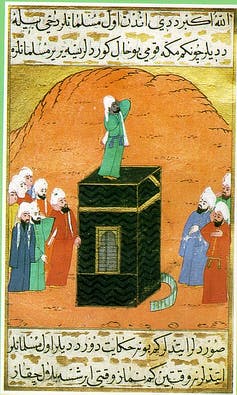
Bilal, center, found freedom in Islam. Wikimedia Commons
Bilal was exceptionally close to Muhammad, too. In 622, the Prophet appointed him the first person to give the public call to prayer in recognition of his powerful, pleasing voice and personal piety. Bilal would later marry an Arab woman from a respectable tribe – unthinkable for an enslaved African in the pre-Islamic period.
For many modern Muslims, Bilal is the symbol of Islam’s egalitarian message, which in its ideal application recognizes no difference among humans on the basis of ethnicity or race but rather is more concerned with personal integrity. One of the United States’ leading Black Muslim newspaper, published between 1975 and 1981, was called The Bilalian News.
More recently Yasir Qadhi, dean of the Islamic Seminary of America, in Texas, invoked Islam’s egalitarian roots. In a June 5 public address, he said American Muslims, a population familiar with discrimination, “must fight racism, whether it is by education or by other means.”
Many Muslims in the U.S. are taking action, supporting the Black Lives Matter movement and protesting police brutality and systemic racism. Their actions reflect the revolutionary – and still unrealized – egalitarian message that Prophet Muhammad set down over 1,400 years ago as a cornerstone of the Muslim faith.
Date posted: July 16, 2020.
[Editor’s Note: I first read the above piece in the religion section of the Salt Lake Tribune, which republished it from The Conversation under a Creative Commons Licence. We do likewise, and invite our readers to read the original piece by clicking HERE; it includes several more hyperlinks within the body of the article that some readers may find useful for further study. Image(s) in Simerg’s piece may vary from those posted in The Conversation and the Tribune .]
Before departing this website please take a moment to review Simerg’s Table of Contents for links to hundreds of thought provoking pieces on a vast array of subjects including faith and culture, history and philosophy, and arts and letters to name a few.
_______________________-
Asma Afsaruddin is Professor of Islamic Studies and former Chairperson, Department of Middle Eastern Languages and Cultures, Indiana University.
This article is republished from The Conversation under a Creative Commons license. To read original article in The Conversation, please click HERE.
_________________
The editor highly recommends the following recent pieces published in Simerg:
Preamble to this series on life in the Ismaili community: This is the second in a series of articles dealing with life in the Ismaili community from the late 19th century onwards. The first in the series was on a Rare 100 year old photo. The piece that follows has been adapted by Safder Alladina from his book “Ties of Bandhana: The Story of Alladin Bapu” which was published under his pen name Safder Giga Patney. The paperback book, see image below, is available on Amazon.
Front and back covers of “Ties of Bandhana”, available from Amazon.
The lead in this special series is Toronto’s Zahir Dhalla, who wishes Jamati members to dig into their archives and submit electronic versions of family historical photos to Simerg@aol.com. Zahir would then be quite willing to work with families, and prepare stories for publication in Simerg or in its two sister websites, Barakah and Simergphotos.
Alladin and Prembai
Alladin Suleman Hasham Mohamad Giga Patney of Chhachhar, Kathiawar, Gujarat, India, c1910. He was born on Sept 9, 1851, in Pattan, India, and died on July 28, 1926 in Tanga, Tanganyika
By SAFDER ALLADINA
Alladin and Prembai owned fields and orchards in Chhachhar in Kathiavar in Gujarat. But at the end of the 19th century the area suffered a series of droughts and famines, and families were looking towards Zanzibar and the East African countries. In addition to this the British Raj, with the connivance of the Nawab of Junagadh and his officials, had imposed excessive taxes and levies. On Mawlana Sultan Mahomed Shah’s advice and support from Ismailiss who had made it good in East Africa, families were encouraged to move to East Africa.
Alladin and Prembai, with their children travelled to German East Africa in a dhow. After thirty odd days on the boat they landed at Tanga, Tanganyika. The family had relations in Moshi so they went there in bullock carts on a journey that took them fifteen days. In Moshi, Alladin and Prembai tried to farm but they were new to the climate, weather and growing conditions. After two years, they decided to return to Tanga. The railways and automobiles had arrived in the country and Alladin, with his eldest son Kassam started a shop selling tires, car parts and other hardware.
The shop was on Marketstrasse, Tanga, Deutsche Ost Afrika (German East Africa, now Tanzania), at the corner of the road that came up from the harbour. A railway line from the station cut through the southern part of the town and went down to the port taking sisal, timber and coffee to the ships anchored in the harbour. Steamboats from Europe brought cars, machinery, cloth and equipment while the dhows from India and the Gulf countries brought cloth, tiles, earthenware pottery, salt cod, carpets, spices and tea.
Kassam, Alladin’s eldest son who had a smattering of German now, was talking to the German officials to be allowed to put a petrol pump at the shop. They liked the young man dressed in long khaki pants and a solar topi in the German fashion, and who spoke German and suggested that he go to Berlin on a scholarship to become an engineer instead of pumping gasoline. Kassam’s young wife, who had a boy and a girl now, and his mother were distraught when they heard this: Hai, hai Allah! Hooñ kadi na jawa daooñ! Prembai asserted. (By God! I’ll never let him go abroad.) [1]
story continues after photo
Prembai Ibrahim Teja. She was born on June 29, 1854, in Chhachhar, India, and died on June 12, 1924 in Tanga, Tanganyika.
A couple of years later, their son Karim was identified by the German officials as suitable candidate to be sent to Berlin for further education. In 1914, a passage was booked for Hamburg on the Deutsch Ost Afrika line the Pandakoti for Karim to go to Berlin. But war broke out and the Pandakoti was bombed and sunk at Manza Bay near Tanga. Karim had to stay in Tanga and after his father died, ran the gas station on Market Street.
Eventually, Kassam got a license to sell petrol. Drums of petrol were brought to the shop front. A piston pump, operated by hand, was attached to a drum and the fuel pumped into cars and trucks and also sold in tin jerry cans. Motorcycles had now appeared in town. Alladin and Kassam found that they had to start keeping car parts and tyres for the growing automobile population in town.
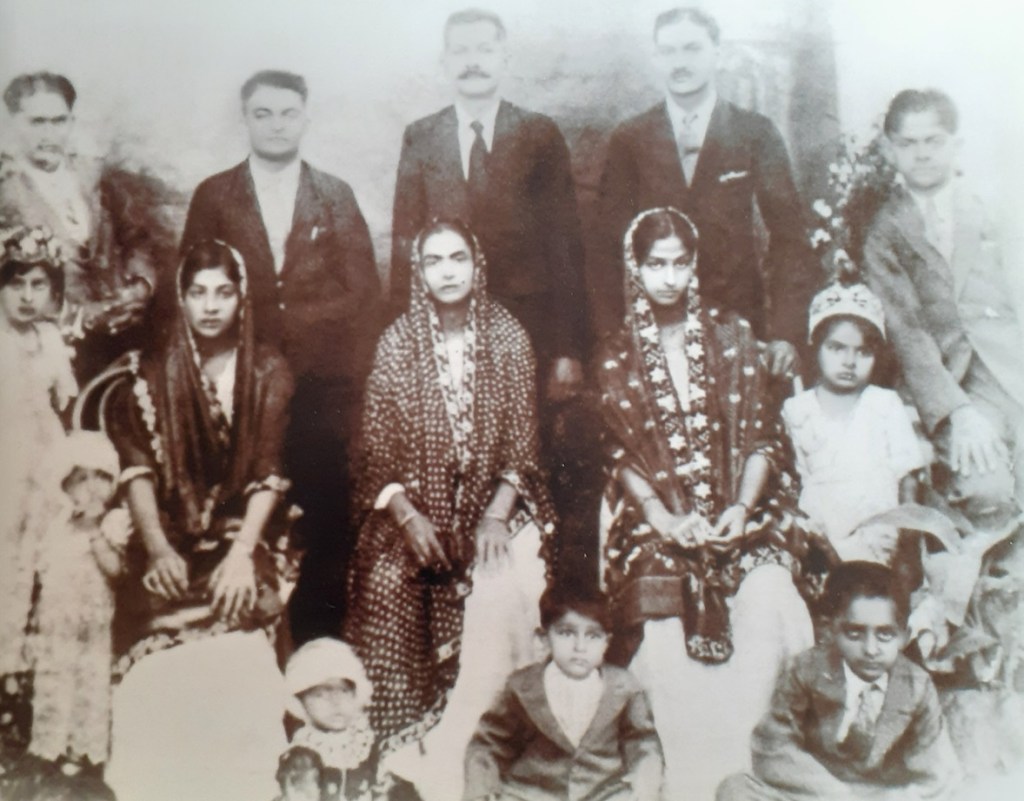
The family photo, below, shows Karim and Alimohamed newly married. Trinkets of gold and bandhanis of silk were brought out for the marriages of their sons Karim and Ali Mohamed. There was now an extended family of Alladin and Prembai: three married sons and their wives and at least five to six children. Shariff and Fatehali, Kassam and Maanbai’s eldest son, were unmarried.
Shariff had a fine singing voice and was a favourite of the ladies in town. He also used to sing Ginans in the Jamatkhana. (For Shariff Alladina’s 4 Ginans, see Soundcloud, Safder, Bapaji )
story continues after photo
Alladin and Prembai’s family, c1925, Tanga, Tanzania (then Tanganyika). Children seated on floor, l. to r : Sherbanu, Amir and Murad; Middle row, l to r: Nurbanu and Milli (2 children), Sikina, Maanbai and Kursum (ladies), Kursum (young girl); Gentlemen l. to r: Shariff, Alimohamed, Kassam, Karim and Fatehali, Kassam and Maanbai’s eldest son. See Note [2] below for more info.
In the August of 1914, there was word around that there was going to be a world war. The British were going to attack German East Africa.
That September, the Districtkommissar went in his open sided automobile to the bigger shops and businesses of the Indians and told them that they would have to leave town and find somewhere to stay until they were given permission to return to their homes. The businessmen were ordered to inform all the other Indian homes in town. Being colonial subjects of the British, the German government saw them as security risk. An Indian owned provision store and Alladin’s petrol pump were told to remain open but their families would have to leave.
story continues after photo
Business cum Residence Alladina Bros & Shariff Service Station, 26 Marketstrasse Tanga, German East Africa, antebellum WW I. Photo: Karim Alladin, via his youngest son Mirza, Vancouver. BC.
Alladin and Kassam stayed to keep the business open, while Prembai, and her sons with their wives and children, left by train for Muheza thirty miles inland, in the foothills of the East Usambara Mountain. They stayed with a family from Kodinar, a small town near Chhachhar, the Alladins home village.
On 14th November of 1918, Armistice was declared and the First World War had ended. On 25 November, what was German East Africa became Tanganyika and was given a Class B Mandate by the League of Nations and effectively became Tanganyika Territory of the United Kingdom. The Union Jack now flew over the Customs House, the boma of the District Commissioner, the police station and the Schule school.
Prembai died after the war and Alladin a few years later. They were buried in the Ismaili cemetery at the southern edge of the town. Maanbai became Moti Ma, the matriarch of the household, and Kassam became Mota Bapa – Big Father of the family.
Today, the Alladin family members are dispersed around the globe in Canada, the USA, the United Kingdom and Belgium, engaged in various professions and businesses – many are still connected to the automobile business.
Date posted: July 14, 2020.
_________________
Safder Alladina
Safder Alladina has taught English as a Foreign Language in England, Japan and Portugal and English as a Second Language in England and Canada. In his 35 years of teaching, he has taught Early Years, Primary, Secondary and Adult classes; and developed and taught Teacher Education programmes at graduate and post-graduate levels at the University of North London, UK, and the University of British Columbia, BC. His research work is in Sociolinguistics. He has retired to a hobby farm in the interior of British Columbia where he does his writing under the pen name of S. Giga Patney.
_________________
The following additional details have been compiled by Zahir Dhalla, author of Ismailis in Tanga.
Alladin and Prembai’s sons started their own businesses in Tanga as follows: Kassam started an auto parts business with his sons; Karim managed the petrol station on Market Street and then went on to start as auctioneer and accountant; Alimohamad started a provision store with his brother Shariff; and Shariff went on to start as copra merchant on his own. He then went into rice milling and producing coir fibre for export.
Collectively, the Alladins became the biggest of Tanga Ismailis Big Five Clans viz. The Alladins: 60; The Hajis: 50; The Nathoos: 40; The Babuls: 30; and The Bhanji Jiwas: 30.
____________________
Notes:
[1]. Kassam and Maanbai were parents to Fateali, Milli, Sherbanu, Amir and Murad; Roshan and Sikina were sisters; all gentlemen standing were sons of Alladin and Prembai and were born in India as was Maanbai. Everyone else in the photo was born in Tanga.
[2]. Offering scholarships to young men was seen elsewhere too: Ismail Jaffer Somji, born 1901, in Bagamoyo, was offered in 1914 full scholarship for himself and elder brother Kassamali. But, as happened above, his ma refused to let them go! Zahir K. Dhalla.
_________________
We welcome feedback/letters from our readers. Please use the feedback box which appears below. If you don’t see the box please click Leave a comment . Your comment may be edited for length and brevity, and is subject to moderation. We are unable to acknowledge unpublished letters
Malik Merchant decides to spend a night in July at the Aga Khan Park, with the full moon as his companion! Please click HERE or on photo below to read his post in Simergphotos.
From the day our beloved Prophet Muhammad (S.A.S.) passed away on June 8, 632, and Hazrat Ali (a.s.) became the first Imam on the Divine Commandment that the Prophet had earlier received at Ghadir Khumm, there have been forty-nine Ismaili Imams, spanning a period of 1388 years in human history.
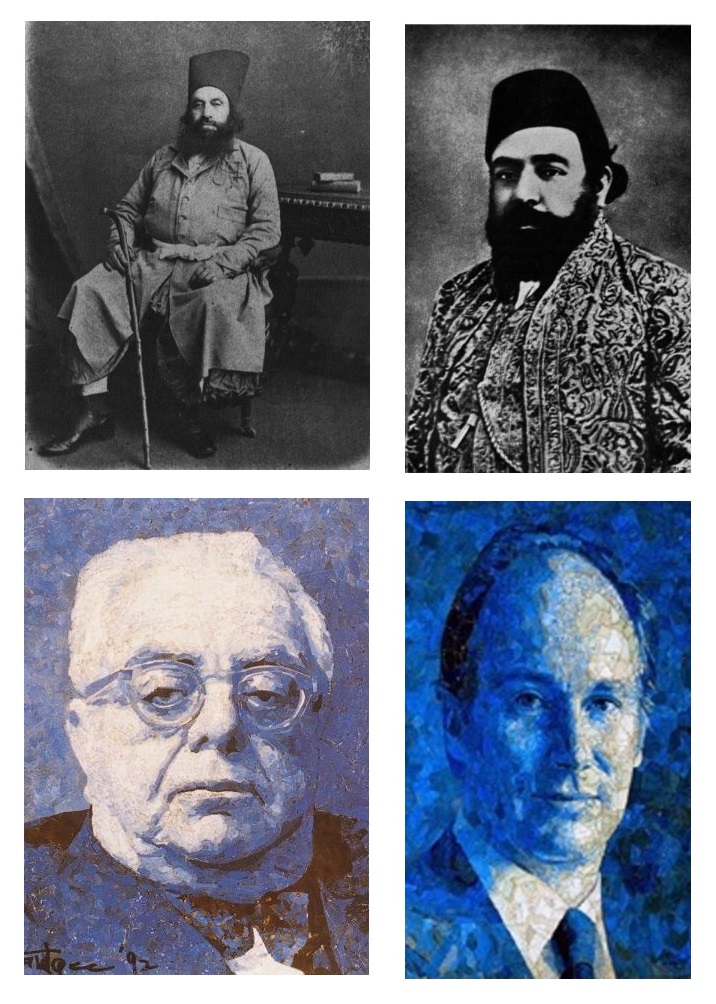
Top: Imam Shah Hassanali Shah and Imam Shah Ali Shah; Bottom: Imam Sultan Mahomed Shah and Mawlana Sha Karim Hazar Imam ( both Gulgee lapis portraits).
Mawlana Hazar Imam and his immediate 3 predecessors have reigned the Jamat for a total of 202 years — 14.6 % of the 1388 years of Imamat to date — as follows: Mawlana Shah Karim Al Hussaini Hazar Imam (His Highness the Aga Khan IV, Imam from 1957 — 2020 and continuing, 63 years, he became the 49th Imam at the age of 20); Imam Sultan Mahomed Shah(His Highness the Aga Khan III, Imam from 1885 – 1957, 71 years, he became the 48th Imam at age 7 years), Imam Shah Ali Shah (Aga Khan II, 1881 – 1885, 4 years, he became the 47th Imam at the age of 51 years), and Imam Shah Hassanali Shah (Aga Khan I, 1817 – 1881, 64 years, he became the 46th Imam at the age of 13 years).
This 203 year period accounts for more time than does the entire Fatimid period, reigned by 8 Imams from Imam Mehdi (11th Imam to Imam Mustansir bi Allah (18th Imam)!
Art work Nurin Merchant, Credit: Infinity design povray.org
Some of the traditions of the Prophet Muhammad on the Imamat are follows: “I leave among you two weighty things: The Book of Allah and my Progeny. If you keep attached to these two never, never will you go astray. Both are tied with a long Rope and cannot be separated until the Day of Judgment.”
I recollect a Farman made by Mawlana Hazar Imam during his Silver Jubilee (1982) in Nairobi, Kenya, where he said that he was the 49th Imam and that there would always be Imams in the future, whether it is the space age or even beyond that! That Allah’s guidance is ever present on this earth through the manifest Imam is reaffirmed in another tradition of the Prophet that says that if the world were to remain without an Imam for one moment, the whole world with everything in it would perish instantaneously.
Purush shan matra pag dharani na dharante, Sansaar, chandra, suraj na dhrashtante, Kuchh na dhrashtante, Bhom kar, megh, dharti na aakaash bhave
Translation:
If the Imam did not have his feet on this earth for even a moment, then the world, moon, sun would vanish and nothing would exist, neither the heaven nor the earth.
On those affirmations from the Prophet Muhammad, our Ginans and Mawlana Hazar Imam, let us therefore truly rejoice that we have a living Imam and that our future generations will also continue to always live under the loving care guidance and protection of the Imam of the Time.
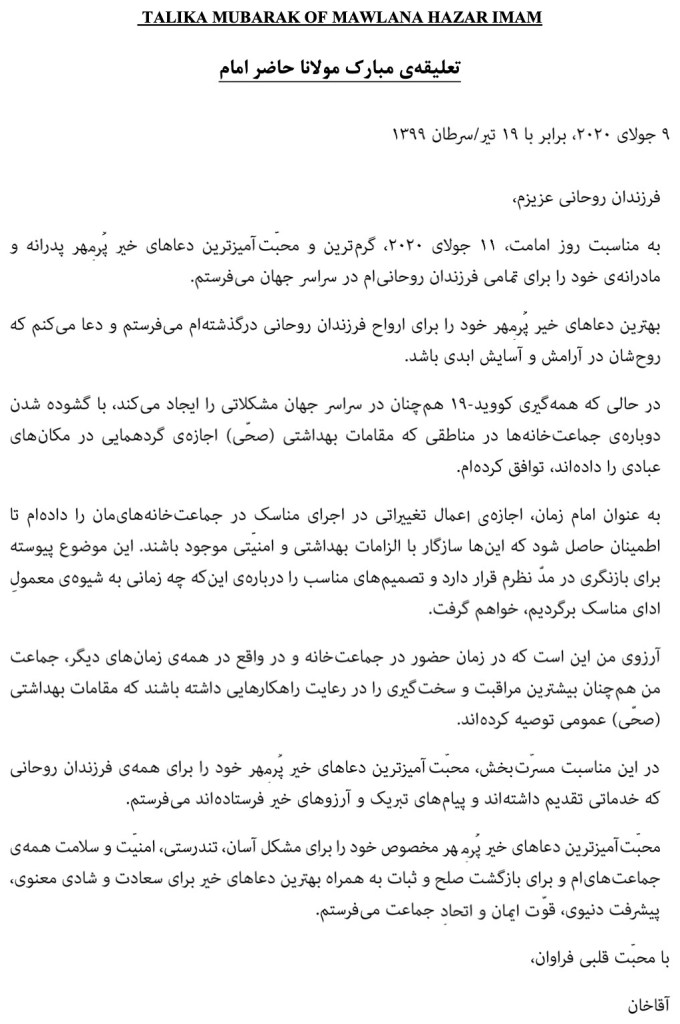
Let us on this auspicious 63rd Imamat Day offer our heartful thanks to Mawlana Hazar Imam for the following Talika that we have received yesterday, July 10, 2020. It was also read out to us last night by ever inspiring President of the Aga Khan Council for Canada, Ameerally Kassim-Lakha, in the weekly reflections program.
We convey Imamat Day Mubarak to our readers and Jamats around the world.
_______________________
Talika Mubarak from Mawlana Hazar Imam (English)
My beloved spiritual children,
On the occasion of Imamat day, the 11th of July 2020, I send my warmest and most affectionate paternal maternal loving blessings to all my beloved spiritual children throughout the world.
I send my best loving blessings for the souls of all my ruhani spiritual children, and I pray that their souls may rest in eternal peace.
While the Covid-19 pandemic continues to pose a challenge globally, I have agreed to the re-opening of Jamatkhanas in areas where the health authorities allow gatherings in spaces of prayer.
As Imam-of-the-Time, I have authorised modifications to the conduct of ceremonies in our Jamatkhanas, to ensure compliance with present health and safety requirements. This matter is constantly under my review, and I will make appropriate decisions on when to return to normal practice.
It is my wish that, in attending Jamatkhana, as indeed at all other times, my Jamat should continue to exercise utmost care and rigour in observing the measures recommended by the public health authorities.
On this happy occasion, I send my most affectionate loving blessings to all my spiritual children who have submitted services and sent messages of congratulations and good wishes.
I send my most affectionate special loving blessings for mushkil-asan, good health, safety and security for all my Jamats, and the restoration of peace and stability, with best loving blessings for your spiritual happiness, worldly progress, strength of faith, and for unity in the Jamat.
Yours affectionately,
Aga Khan
___________________
Message from Mawlana Hazar Imam (French)
A l’occasion de l’Imamat Day, Mawlana Hazar Imam nous a gracieusement béni d’un Saint Talika pour son Jamat global qui est partagé sur le site The Ismaili.
Mes Chers Enfants Spirituels,
A l’occasion de l’Imamat day, le 11 juillet 2020, j’envoie mes plus chaleureuses et mes plus affectueuses tendres bénédictions paternelles et maternelles à tous mes enfants spirituels bien-aimés à travers le monde.
J’envoie mes meilleures bénédictions affectueuses pour les âmes de mes enfants spirituels ruhani, et prie pour que leurs âmes reposent dans la paix éternelle.
Alors que la pandémie Covid-19 continue à poser un défi au niveau mondial, j’ai donné mon accord pour la réouverture des Jamatkhanas dans les zones où les autorités sanitaires autorisent les rassemblements dans les espaces de prière.
En tant qu’Imam-du-Temps, j’ai autorisé des modifications dans la conduite des cérémonies dans nos Jamatkhanas, afin de garantir leur conformité avec les exigences actuelles en matière de santé et de sécurité. C’est un sujet que je suis constamment, et je prendrai les décisions appropriées quant au moment de revenir à une pratique normale.
C’est mon souhait qu’en venant au Jamatkhana, comme en toutes circonstances, mon Jamat continue à faire preuve du plus grand soin et de la plus grande rigueur dans le respect des mesures recommandées par les autorités de santé publique.
En cette heureuse occasion, j’envoie mes plus affectueuses tendres bénédictions à tous mes enfants spirituels qui ont soumis des services et envoyé des messages de félicitations et de bons vœux.
J’envoie mes plus affectueuses tendres bénédictions spéciales pour mushkil-asan, une bonne santé, la sûreté et la sécurité de tout mon Jamat, et le retour de la paix et de la stabilité, avec mes meilleures bénédictions affectueuses pour votre bonheur spirituel, le progrès matériel, la force de la foi, et pour l’unité dans le Jamat.
Affectueusement,
Aga Khan
___________________
Talika from Mawlana Hazar Imam (Portuguese)
Por ocasião do Imamat Day, Mawlana Hazar Imam graciosamente enviou um Talika Mubarak para o Jamat global e que partilhamos pelo The Ismaili.
Meus amados filhos espirituais,
Por ocasião do Imamat Day, 11 de julho de 2020, envio as minhas mais calorosas e mais afetuosas bênçãos paternais e maternais a todos os meus filhos espirituais por todo o mundo.
Envio as minhas melhores bênçãos de amor para as almas de todos os meus filhos espirituais ruhani, e oro para que as suas almas descansem em paz eterna.
Apesar da pandemia de Covid-19 continuar a representar um desafio global, concordei com a reabertura de Jamatkhanas nas áreas onde as autoridades de saúde permitem encontros em locais de oração.
Como Imam do Tempo, autorizei modificações na realização de cerimónias nos nossos Jamatkhanas, de forma a assegurar o cumprimento dos atuais requisitos de saúde e segurança. Este assunto está constantemente sob a minha análise, e tomarei as decisões apropriadas acerca de quando se poderá regressar à prática normal.
É meu desejo que, tanto ao frequentar o Jamatkhana, como também em todos os outros momentos, o meu Jamat continue a exercer o máximo cuidado e rigor no cumprimento das medidas recomendadas pelas autoridades de saúde pública.
Nesta feliz ocasião, envio minhas mais afetuosas bênçãos de amor a todos os meus filhos espirituais que submeteram serviços e enviaram mensagens de felicitações e votos de felicidades.
Envio minhas mais afetuosas e especiais bênçãos de amor para mushkil-asan, boa saúde, segurança e proteção, para todos os meus Jamats, e restauração da paz e estabilidade, com as melhores bênçãos de amor para a vossa felicidade espiritual, progresso material, força de fé e para união no Jamat.
Afetuosamente
Aga Khan
___________________
Talika from Mawlana Hazar Imam (Farsi)
Talika in Farsi
___________________
Talika from Mawlana Hazar Imam (Arabic)
Talika in Arabic
___________________
Talika from Mawlana Hazar Imam (Gujarati)
Talika in Gujarati
___________________
Talika from Mawlana Hazar Imam (Russian)
Talika in Russian
_______________________
Talika from Mawlana Hazar Imam (Urdu)
Talika in Urdu
___________________
Talika from Mawlana Hazar Imam (Tajik)
Talika in Tajik
___________________
Shukrana and Supplication
We submit our humble gratitude to our beloved Mawlana Hazar Imam for his blessings to the world wide Jamat on the occasion of his 63rd Imamat Day.
We submit the following supplications from verse 1 of Pir Hasan Kabirdin’s Ginan Sahebe Farman Lakhi Mokalea:
“O brother! Listen, My Lord Ali has written and sent a Farman. The beloved Lord has remembered this servant today with kindness in his heart”
Date posted: July 11, 2020. Last updated: July 12, 2020.
Before departing this website please take a moment to review Simerg’s Table of Contents for links to hundreds of thought provoking pieces on a vast array of subjects including faith and culture, history and philosophy, and arts and letters to name a few.
CORRECTION: When the post was initially published, the Arabic translation was loaded into the Farsi Talika block, and appeared twice. The post now stands corrected, and we regret the confusion it caused.
_________________________
We welcome feedback/letters from our readers. Please use the feedback box which appears below. If you don’t see the box please click Leave a comment. Your comment may be edited for length and brevity, and is subject to moderation. We are unable to acknowledge unpublished letters
The Aga Khan Museum, closed since March 13, 2020, reopened after more than 100 days. Malik Merchant was present for the opening and shares his experience with story and photos…..MORE ON SIMERGPHOTOS
Sanctuary, a current exhibition running at the reopened Aga Khan Museum. Please click on image for reopening story and photos. Photo: Malik Merchant /Simerg.
Alwaez Rai Jehangir Merchant (1928-2018) — picture above with Mawlana Hazar Imam, His Highness the Aga Khan — is fondly remembered everyday single day by his beloved wife of 66 years, Alwaeza Raisaheba Maleksultan Jehangir Merchant, and all her family members.
He passed away 2 years ago on May 27, 2018 at approximately 1:15 AM. We pray that his soul may rest in eternal peace. Amen.
Jehangir and Maleksultan in front of a large portrait photo of Mawlana Hazar Imam.
My dad was a prolific writer. In England, he edited the flagship Ismaili religious magazine, Ilm, for several years while he served with my mother with the Ismaili Tariqah and Religious Education Board (ITREB). His articles related to the faith, history, principles and doctrines of the Ismaili faith, along with insightful interpretations of Qur’anic verses, as well as moving narratives of Mawlana Hazar Imam’s Mubarak visits to different parts of the world, richly contributed to the Jamats’ understanding of the faith. The closure of Ismaili religious magazines in the very early 1990’s created a significant void in the dissemination of religious material that was deemed to be “official.” I am referring here to insightful articles in monthly or quarterly magazines published by ITREBs around the world, and not to literary and scholarly books, which the Institute of Ismaili Studies has done a fantastic job of publishing over the past 30 years.
From the time this website, Simerg.com, was launched in 2009, Alwaez Merchant was able to devote time to editing and adapting his Ilm pieces for publication on this website for the benefit of readers on the World Wide Web. Links to those pieces are provided at the end of this article. Ill-health prevailed, and he was no longer able to fully complete the remainder of his Ilm pieces for publication on Simerg.
Ilm magazine – one of Alwaez Jehangir’s magnificent contributions to the Ismaili literary scene. Jehangir edited and wrote extensively for the journal.
Now, I am going to take his unpublished essays from Ilm — many of which were quite lengthy — and share them as short pieces of learning over the coming weeks and months. We begin the Jehangir Merchant series, if I may call it that, with the Concept of Tawhid, which forms the first component in his essay entitled “Fundamental Aspects of Ismaili Doctrine.” It appeared in Ilm, Volume 7, Number 1 & 2, July-November 1981, pp. 2-12.
Tawhid
By (LATE) JEHANGIR A MERCHANT
Jehangir and Maleksultan Merchant served the Imam of the Time and Ismaili institutions for more than 60 years.
In all Shi‘a tariqahs of Islam, Tawhid (belief in the Unity of God), Nubuwwah (Prophethood), Imamah (the Institution of the Divine Guide) and Qiyamah (Day of Judgement), are considered as the doctrines of the faith. My brief explanation of each of these 4 doctrines of faith for publication on Simerg are based on a much broader discussion that I provided on these subjects in my original article published in Ilm magazine, which also included a detailed historical background on the subject of Imamat.
The belief in the Unity of God (Tawhid) is the cornerstone of faith (Iman) for all Muslims.
It is articulated in the pronouncement: La ilaha ill-Allah: “There is no god but Allah.”
This doctrine of Unity of God is beautifully summarised in Sura Tauhid, popularly known as Suratul Ikhlas (112:1-4), which says: “Say, He Allah is One; Allah is Absolute, Independent. He did not beget nor He was begotten and there is none like unto Him.”
We know, however, that the Holy Qur’an, ascribes a number of attributes to Allah. God is spoken of as ar-Rahim (The Merciful), al-Wadud (The Loving), al-Sami (The Hearing), al-Barir (The Seeing) etc. The Qur’an also talks about Wajahullah (the Face of God), Yadullah (the Hand of God), and so on.
While there are numerous references which attribute human qualities to God in the Holy Qur’an, the scripture states in very plain words that Allah is above all material conceptions.
For example, the Qur’an says: “Vision comprehends Him not and He comprehends all vision.” (6:104) and “Nothing is like a likeness of Him.” (42:11)
The Unity of God (Tawhid) implies that God is One in His Dhat (essence) and One in His Sifat (attributes).
The concept of Tawhid appears in the works of many Ismaili dais (missionaries) and philosophers. Their works on the subject place an emphasis against anthropomorphising God, that is, giving human attributes to God.
article continues after image
The inscription in the inner margin of this Fatimid coin minted during the reign of Imam al-Zahir reads: la ilah illa / allah wahdahu / la sharik lahu; “no god but God, unique, He has no associate.” Photo: David Museum, Copenhagen.
God is declared in their works as One, Absolutely Transcendent, Omnipotent, Omnipresent, Omniscient, Incomprehensible and a Quality-less Being. A Ginanic verse makes this clear:
La thi un dhat kahave, tanki baat kahi nav jai; Dubki le le gotha khave, Pir Paighambar tai na pavey
Translation:
The Dhat [essence] is from nothingness and nothing can be said about it. Pirs and Prophets delve deep in this knowledge but in vain.
The concept that God has no qualities difficult to grasp, because the human mind cannot comprehend a total lack of qualities, a concept which it has not experienced before. We cannot imagine a man, if we can for the moment call such a being a man, who has no colour, no shape, no size, no special existence, who is neither alive nor dead.
Hence, the notion that God is quality-less becomes unintelligible and the Qur’an, therefore, attributes a number of qualities to God. If we consider the qualities applied to God and examine them carefully we find that the grounds for all of these attributes lie in our own experience of this material world.
Pir Shiahbu’d-din Shah writes in his work Risala dar Haqiqati Din (True Meaning of Religion):
“…people speaking about God (Haqq) attribute to Him any such (perfections) as they can imagine. For instance, regarding blindness as a defect, they say about God that He sees everything. They regard ignorance as a defect, and thus say that God is All-Knowing. Thus, whatever they find in themselves as a vice and defect they attribute to God a perfection opposite to that. Most probably, even animals create their own God free from their own defects, ascribing to Him (the opposite) perfections. Imam Muhammad Baqir says that the tiny ant probably imagines his god as having two stings, because it regards the possession of only one sting as a defect.”
So, when the Qur’an attributes qualities to God, it is to help convey to man the idea of God and not that these terms express the true nature of God, or that they are perfect indicators to His Being.
Ismaili doctrine upholds the belief in a single transcendent Being, whose nature is beyond the comprehension of the human mind and who is inexplicable. This is because our definitions are based on our experiences of the material world, and these definitions cannot be applied to this Being.
Pir Shihabu’d-din Shah, again in his previously cited book, says:
“All that is beyond thy imagination, Is merely the limit of thy fantasy, not God. Wisdom can attain a knowledge of His Substance Only in the case if a piece of straw can sink to the bottom of the sea. And Imam Ja’far-as-Sadiq said: “What God is, Man cannot think: and what Man thinks God is not. Yet man lives by God, and God is nearer to him than himself.”
Thus, in the Doctrine of Tawhid, lsmailism completely avoids any form of anthropomorphism and remains purely monotheistic.
We will continue our next discussion on another Shia doctrine of faith, namely, Nubuwwah or Prophethood which will then be followed by Qiyama (the Day of Judgement) and Imamah (the hereditary leadership in Islam).
Date posted: May 27, 2020.
Before departing this website please take a moment to review Simerg’s Table of Contents for links to hundreds of thought provoking pieces on a vast array of subjects including faith and culture, history and philosophy, and arts and letters to name a few.
_______________________________
The following are links to Alwaez Jehangir Merchant’s articles that have been published on this website:
We welcome feedback/letters from our readers. Please use the feedback box which appears below. If you don’t see the box please click please click Leave a comment. Your comment may be edited for length and brevity, and is subject to moderation. We are unable to acknowledge unpublished letters.
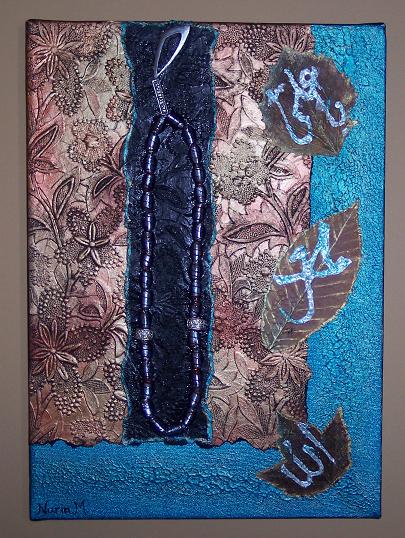
‘The Nature of Prayer’ is a 14″ x 10″ mixed media acrylic painting on canvas. Secured on the canvas with gesso, a strong glue, are a handmade tasbih (prayer beads), and 3 dried leaves bearing the Arabic inscriptions reading from bottom to top, Allah, Muhammad and Ali. The whole piece represents keeping the memory of Allah, and making sure that every day there is in our minds the presence of our faith in our hearts and souls which in itself is a prayer, hence the title of the painting ‘The Nature of Prayer’. This work was Nurin Merchant’s contribution for Colours of Love, an art and culture initiative by the Ismaili Council for Canada in 2008 during the Golden Jubilee Celebrations of Mawlana Hazar Imam, His Highness the Aga Khan.
By DR. V. A. LALANI with additional material by MALIK MERCHANT
In response to a recent piece on the impact of Jamatkhana closures, we were pleased to receive a very inspiring recommendation from Omar Kassam of Vancouver who suggested that we slowly recite the Surah Al-Fatihah while we spend 20 seconds thoroughly washing our hands – the #1 health guideline during the current COVID-19 pandemic. Such is the nature of prayer –- that we can seek out small moments of 1 second, 5 seconds or 20 seconds to the remembrance of God, to exalt Him, and to seek His help. The Surah is regarded as one of greatest Surahs in the Holy Qur’an, along with Surah Al-Ikhlas. The wisdom and prayers contained in this small seven verse Surah are absolutely remarkable.
There are many other opportune moments that we have throughout the day, and Mawlana Hazar Imam has often recommended to us to carry the tasbih with us –- in our pockets or handbags –- and seek out moments of happiness by calling on the name of Allah, Hazrat Ali, Prophet Muhammad or the names of the Imams. He has also asked us to invoke these names during any difficulty we are facing.
What is tasbih and what are its origins in Islam?
The Arabic word tasbih means to exalt God, praise God or to pray to God. It is supererogatory prayer, that is, an act which is considered to be good and beyond the call of duty, and not something that is strictly required.
The word tasbih is also given to the beads strung together in the form of a circle which are used in the process of praying.
The tasbih consists of a string of beads that is looped into a circle. The two ends are passed through a larger, decorative bead where they are tied or woven into a knot. This is the starting point of a tasbih.
Almost all the religions in the world today possess some form of this object which differ a little in size, number and arrangement of beads. Calling it by different names (for example, rosary, in Christianity), they make use of it for the purpose of reciting the name of the deity in whom they believe.
Although tasbih is a constant companion and an object of daily use by the believers, its origin, development and purpose has remained so obscure to most of us that I shall discuss some of the details of this small, but important object.
“Verily in the remembrance of Allah do hearts find rest!” — Holy Qur’an, 13:28
It is said that the first tasbih (supererogatory prayer) was given by the Prophet Muhammad (S.A.S.) to his beloved daughter Hazrat Bibi Fatima (A.S.), the wife of Hazrat Mawla Murtaza Ali (A.S.). This comprise of the praises of Allah, namely, Allahu Akbar (Allah is Great), Subhan Allah (Glory be to Allah) and Al-Hamdu-lillah (All praise is due to Allah). Each of these was to be recited thirty-three times in succession. This is known as Tasbih-e Bibi Fatima.
In the absence of any circular object like the present day tasbih, it is said that Bibi Fatima used to recite these praises taking help of thirty-three stones of dates or thirty-three pebbles.
Later on, as it was found to be very inconvenient to keep loose stones or pebbles, or have to collect them when needed, it was probably decided to string together thirty-three stones of dates or some such object to make a rosary giving it a circular appearance. At a later period, at the point where the knot was tied, a more decorative, larger bead was added, forming what we recognize as the tasbih today. Tasbih prayer beads are made of various materials, including different stones, sterling silver, wood, etc.
The larger bead at the tasbih’s crown is called imam which means ‘a leader’ and it is so called because all recitations start at this point. Imam leads and all the other small beads follow.
In the ordinary Islamic tasbih, the number of beads varies widely from 99 to 102. The 99 bead tasbih may have 2 extra small beads as dividers, after each group of 33 beads. The 102 bead tasbih used in some tariqahs is divided in parts of 12, 22, 34, 22 and 12. Then, of course, we have the commonly used smaller tasbih with 33 beads that is considered in conformity with our Holy Prophet Muhammad’s original conception of tasbih.
As in the 99 bead tasbih, the 33 bead also carries 2 extra beads after each 11 beads, as dividers. The extra small beads act as an informer when the required number of recitations are completed. These are called mui’zin in Arabic which means ‘an informer’ (like the informer who calls Muslims to prayer). In the Indian sub-continent, these two beads are called banga, bangi or bango which all mean ‘a caller’ or ‘an informer’.
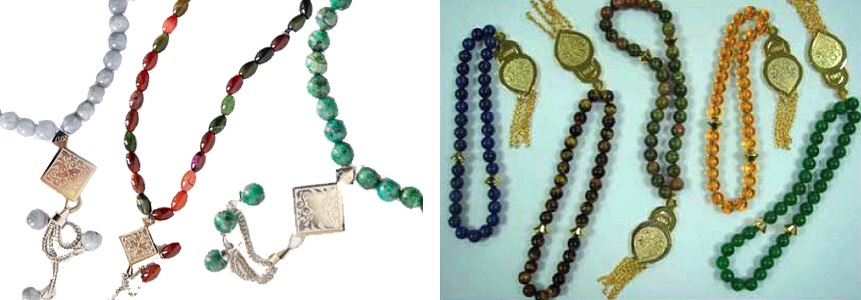
A selection of tasbihs produced during the Diamond Jubilee (left) and Golden Jubilee celebrations of Mawlana Hazar Imam. Photo: The Ismaili.
Among the numerous memorabilia objects that were produced for Mawlana Hazar Imam’s Golden and Diamond Jubilee celebrations in 2007 and 2017, the tasbih was the most sought after item. The Diamond Jubilee tasbihs came with a finely-detailed floral pattern interwoven with intricate and diverging leaves inspired by a Fatimid wood carving. The 33 bead Golden Jubilee tasbihs came in twenty-three varieties of semi-precious stone with the top stem adapted from a 16th century alam (emblem or standard).
“O believers, remember God oft and give Him glory at the dawn and in the evening” — Holy Qur’an, 33:41-42
The last and most important point about tasbih is its purpose. The purpose of tasbih is quite evident and that is to remember Allah.
Over the past 35 years, Mawlana Hazar Imam has sought to encourage us to keep the remembrance of our faith as an integral part of our daily life, and to seek from this remembrance spiritual happiness on an ongoing basis. His most recent reference regarding using the tasbih for calling out the name of Allah, the name of Prophet Muhammad, or Hazrat Ali was in a Farman Mubarak that he made in India in 2018 (see page 144, para. 3, in Diamond Jubilee Farman Mubarak book)
While we all face and feel the effects of the worldwide COVID-19 pandemic with the rest of humanity, let us all recall the message that Mawlana Hazar Imam conveyed to us at the commencement of the Diamond Jubilee year, when he said that the faith of our forefathers would help us to face life’s challenges in times of crisis and rapid changes (see page 12, para. 2, in Diamond Jubilee Farman Mubarak book).
“Sitting, sleeping, going about, take the Lord’s name, take the Lord’s name” — Ginan, Pir Hasan Kabirdin
An illustrious piece of advice regarding our faith comes from none other than our illustrious forefather Pir Hasan Kabirdin, composer of hundreds of Ginans that have illuminated millions of Ismailis over the past seven centuries. In the second verse of Dur Desh Thee Aayo Vannjaaro, he says: “Sitting, sleeping, going about, take the Lord’s name, take the Lord’s name.” (Translation, Aziz Esmail, in his Scent of Sandalwood)
Ginan Dur Desh…sung by Late Shamshu Bandali Haji. Credit: Ginan Central
Carrying the tasbih with us will act as reminder for us to contemplate on the names of Allah, the Prophet and the Imams during any moment in our lifetime. That is the nature of prayer.
Date posted: April 6, 2020.
Before departing this website please take a moment to review Simerg’s Table of Contents for links to hundreds of thought provoking pieces on a vast array of subjects including faith and culture, history and philosophy, and arts and letters to name a few.
______________
This piece contains material from the March 1986 issue of Al-Misbah magazine published by the Ismaili Tariqah and Religious Education Board for the United Kingdom (ITREB). The magazine, like all other religious magazines published by ITREB in numerous countries around the world, ceased publication in the early 1990’s.
Share this article with others via the share option below.
We welcome feedback/letters from our readers. Please use the feedback box which appears below. If you don’t see the box please click LEAVE A COMMENT. Your comment may be edited for length and brevity, and is subject to moderation. We are unable to acknowledge unpublished letters.
[NOTE FROM WRITER: I wish to clarify at the outset that I am not suggesting that we should be establishing Satadas in our own homes while the Jamatkhanas are closed. COVID-19 has impacted the religious and spiritual lives of hundreds of millions of people around the world, who cannot attend their beautiful and inspiring houses of worship and prayers. Ismailis are also affected due to Jamatkhana closures. However, we can perform our obligatory prayers in our homes individually and with family members who are not in isolation.In this post, we suggest (1) extra prayers we may offer for our comfort, courage and happiness, (2) References to Farmans and Mawlana Hazar Imam’s Talikas that we can read, and (3) Ginans we can listen to from outstanding resources that we have at our disposal such as Ginan Central at the University of Saskatchewan. NOTE: According to the Ismaili calendar the Satada would have begun in Jamatkhanas on April 3. However what is suggested in the post is applicable for all times, and not limited to the prayers performed only during Satadas.Hopefully the Satada that we must all unfortunately miss due to Covid-19 will be established when Jamatkhanas are re-opened after the pandemic is over.]
Thousands of Ismaili families across Canada are receiving phone calls from their respective Jamatkhana leadership including Mukhi/Mukhiani and Kamadia/Kamadiani inquiring about our well-being at this time of the Covid-19 pandemic. Their concern has deeply touched our hearts, and we sincerely thank them for the time they are taking to speak to us, and to patiently listen to our experiences, needs and challenges. They are playing their leadership roles, as representatives of Mawlana Hazar Imam, with an immense amount of affection and love, which we can feel in their voices.
In an inspiring prayer filled phone call yesterday from the Ottawa Jamatkhana Kamadiani, I was informed that according to the 2020 religious festivals calendar, the weeklong Jamati Satada (communal congregational special prayers for 7 continuous days) in Canada would have commenced from Friday, April 3.
Jamati Satada are held twice a year across many parts of the Ismaili world (there are also individual Satadas which, in serious personal cases, can be held at any time of the year at the request of individuals seeking special prayers for members of their families).
During the seven days of Jamati Satada, tens of thousands of Ismailis, young and old alike, gather in Jamatkhanas around the world for special prayers and heartful supplications for protection from difficulties (or Mushkil Asan). The special prayers are not exclusively for Ismailis. They include supplications for the world at large. In addition to 2 Jamati Satadas in a year, special Jamati Satadas can be instituted in exceptional or extraordinary circumstances, such as major natural or man-made calamities.
With the Satada in Canada earmarked to start on Friday, April 3, we have provided for our readers an outline of prayers that may be offered in our homes or individual spaces. The summary reflects the Satada practice that would be normally conducted in the Jamatkhanas, with minor differences. One point to note is that different countries may have their own starting dates for the Satada. The important thing to remember, however, is that it is a continuous 7-day observation.
SUGGESTED PRAYERS FOR “PROTECTION FROM DIFFICULTIES”
The Toronto Ismaili Centre with its magnificent Jamatkhana prayer hall dome. Ismailis await its opening once the city of Toronto has declared victory over Covid-19, and allows large gatherings to take place. Photo: Malik Merchant/Simerg.
1. Recite the two evening Du’a. Remember that in the Du’a, we recite Surah Al-Fatihah (opening of 1st part of Du’a) and Surah Al-Ikhlas (opening of 6th part), both of which are considered to be among the greatest Surahs in the Holy Qur’an. In our beautiful Du’a, we also utter phrases that call for Allah’s mercy and support as well as help and strength from the Imam of the Time, Mawlana Shah Karim al Hussaini Aga Khan.
2. Recite the Satada Tasbih of Ya Ali to Rahem Kar, Ya Ali to Fazal Kar, meaning “O Ali be Merciful, O Lord [Ali] be gracious.”
3. Recite or play recordings of pertinent Ginans and Qasidas of supplication; one such Ginan sung by the Late Shamshudin Bandali Haji, with a link to its English transliteration and translation, is provided below.
5. Also, read Farmans from the recently printed Farman Mubarak books authorized by Mawlana Hazar Imam.
6. After 2nd Du’a, partake in Ab-e-Shifa (water of healing) if you have it with you.
Also, during the Coronavirus crisis, and also at other times when times are good:
7. Ask and motivate children and youth to learn and memorize the meaning of the Du’a. Seriously, consider this as one of the most important building block of our faith, and treat it as one of the most important missions that you have. When Mawlana Hazar Imam blessed my late dad Jehangir Merchant with a few precious minutes of his time in Lourenço Marques (now Maputo), one of the first questions he put to him was whether children were being taught the meaning of the Du’a.
8. Make faith part of our daily life. Even if it be for a moment or a few seconds, say Ya Allah, Ya Muhammad or Ya Ali, or call on the names of our Imams, keeping in mind that all hereditary Imams from Hazrat Ali are bearers of the same Noor.
9. Recite the Salwat Allahumm-a Sall-i ‘Ala Muhammad-in Wa Al-i Muhammad, meaning “O, Allah shower thy choicest blessings upon Muhammad and the progeny of Muhammad.” This tasbih is recited on Chandraat.
10. Recite the tasbih of Bibi Fatimah. They are Allahu Akhbar meaning God is Great, Subhanallah meaning Glory be to God, and Alhamdulillah meaning All praise is due to Allah. According to Islamic tradition, the Prophet Muhammad (S.A.S.) had recommended the tasbih to his beloved daughter Bibi Fatimah (A.S.), and hence its name. It is recited on Chandraat, along with the Salwaat.
11. Seek forgiveness by reciting Astaghafirullahi Rabbi Wa Atubu Ilayhi meaning “Verily, I seek the forgiveness of Allah, who is my Lord and Sustainer, and I turn to Him in repentance.” It is recited when prayers are offered for deceased souls.
12. If you are really fearful of what is going on around you, say the Nade Ali a few times for hope, courage and strength.
Nade Ali, Nade Ali, Nade Ali Nade Aliyyan mazhar al-ajaib Tajidahu awnan lakafin-nawaib Kullu hammin wa ghammin sayanj-i Ali Bi wilayatika, Ya Ali! Ya Ali! Ya Ali!
MEANING
Call Ali call Ali call Ali, the manifestation of marvels He will be your helper in difficulty Every anxiety and sorrow will end Through your friendship. O Ali, O Ali, O Ali.
Recitation of Ginan by (Late) Alwaez Shamshu Bandali Haji
Please click Ismaili Heritage for an English transliteration with translation.
Date posted: April 2, 2020. Last updated: April 4, 2020 (editorial note, at top).
______________________
Simerg’s Malik Merchant
Malik Merchant is the founding publisher/editor of Simerg (2009), Barakah (2017) and Simergphotos (2012). A former IT consultant, he now dedicates his time to small family projects and other passionate endeavours such as the publication of this website. He is the eldest son of the Late Alwaez Jehangir Merchant and Alwaeza Maleksultan Merchant, who served Jamati institutions for several decades.
We welcome your feedback. Please complete the form below or click on Leave a comment if the form is not displayed. Comments are published at the discretion of the editor. and may be subject to moderation.
(Note: The following recitation by Late Shamshu Bandali Haji includes a few verses at the end, which may not be part of the same Ginan. We will try and identify the source of the verses. When you start playing the recording, please scroll down to follow the transliteration and meaning of the Ginan. The recitation is from the superb and must visit Ginan Portal website at the University of Saskatchewan containing hundreds of recitations by Shamshu Bandali Haji and other members of the Ismaili community.
Ginan Sahebe Farman Lakhi Mokalea by Pir Hasan Kabirdin; recitation by Late Alwaez Shamshudin Bandali Haji
Transliteration and Translation of Ginan Eji Sahebe Farman Lakhi Mokalea
Transliteration source: PYARALI JIWA; English translation by ZARINA KAMALUDDIN and KAMALUDDIN ALI MUHAMMAD
Editor’s note: Ismaili Pirs, Dai’s and poets in their Ginans and Qasidas referred to the Imam of their era as Ali (a.s.), the first Imam who succeeded the Prophet Muhammad (S.A.S.), thus emphaszing the principle of the Unity of Imamat. For Shia Ismailis, each Imam is the same irrespective of his own age or the time he lives in, as he is the bearer of the same Noor (Light).
VERSE 1
Eji Saahebe faramaan lakhi mokaleaa suno maaraa nar hari yaa Ali; sevak sa(m)bhaa aa vaale aajman maa(n)he mayaa dhari ya Ali
O brother! Listen, My Lord Ali has written and sent a Farman. The beloved Lord has remembered this servant today with kindness in his heart
VERSE 2
Eji Mananaa manorath purajo suno maaraa nar hari yaa Ali deshe vaalo ati sukh raaj siri-a saara(n)g dhani yaa Ali
O my Lord Ali! Listen! Fulfill the hopes of my heart. The beloved Lord will grant much happiness and kingdom
VERSE 3
Eji Ame umaayo tere darage suno maaraa nar hari yaa Ali mayaaa karo maahaaraaj vaiku(n)th naath dhani yaa Ali
O my Lord Ali! Listen! We beseech hopefully at your door. O Lord of paradise! O Ali the great king! Have mercy
VERSE 4
Eji Charan te aapanaa bhetaadajo suno maaraa nar hari yaa Ali najar karo moraa shaam akhiyu(n) amia bhari yaa Ali
O my Lord Ali! Listen! Grant (me) the favor of expressing obeisance to you. O my Lord Ali! Look at me with eyes full of love
VERSE 5
Eji Dukh doyaalaa sarave taalajo suno maaraa nar hari yaa Ali puri karo maahaaraaj aparam paar dhani yaa Ali
O my Lord Ali! Listen! Remove all my sorrows and troubles. O Lord Ali, the great king! O Lord of infinity! Fulfill all my wishes.
VERSE 6
Eji Bahu aparaadh kari jivaddo aavyo tere darage suno maaraa nar hari yaa Ali mayaa karo mahaaraaj vaiku(n)th naath dhani yaa Ali
O my Lord Ali! Listen! After committing many sins this servant has come to your door. O Lord of paradise! O Ali the great king! Have mercy
VERSE 7
Eji Pir Hasan Kabirdin boleaa venati suno maaraa nar hari yaa Ali chade tu(n) tribhovar shaam parane visav ku(n) vaari yaa Ali.
O my Lord Ali! Listen! Pir Hasan Kabirdin (r.a.) has made this entreaty. O Ali! O king of the three worlds! Manifest yourself and marry the virgin earth
Date posted: April 1, 2020.
Before departing this website please take a moment to review Simerg’s Table of Contents for links to hundreds of thought provoking pieces on a vast array of subjects including faith and culture, history and philosophy, and arts and letters to name a few.
________________________
We welcome your feedback. Please complete the form below or click on Leave a comment if the form is not displayed. Comments are published at the discretion of the editor. and may be subject to moderation.

























 Simerg - Insights from Around the World