His Highness the Aga Khan: Democracy To Survive Across Planet Must Lead to Improvement in the Quality of Human Life and Give Genuine Hope for Future

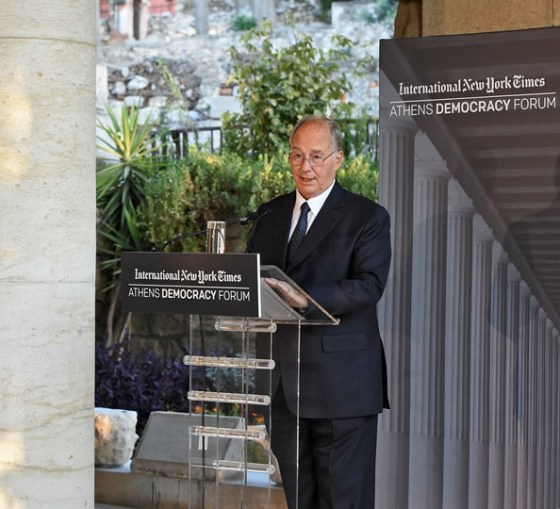
His Highness the Aga Khan delivering the Keynote Address to the 2015 Athens Democracy Forum on September 15, 2015. Photo: AKDN / Gary Otte

His Highness the Aga Khan delivering the Keynote Address to the 2015 Athens Democracy Forum on September 15, 2015. Photo: AKDN / Gary Otte

The following are excerpts from remarks made by His Highness the Aga Khan on September 15, 2015, in a keynote address to the Athens Democracy Forum, an international gathering of diplomats, business leaders and opinion makers. The event was hosted by the International New York Times and the United Nations Democracy Fund.

THE NEW YORK TIMES

I have long admired – since my undergraduate days at Harvard – what the [New York] Times has meant to the pursuit of truth and justice in our world. And I have appreciated our opportunities to work together through our Diplomatic Academy in Paris for example, and also through the good counsel the Times provides for our media company in East Africa.

ELEMENTS FOR STRENGTHENING EFFECTIVENESS OF DEMOCRACY

The topic of democracy and its challenges is one that I have followed closely for a long time, most intently in the developing world….where so many members of the Ismaili community live and where so much of our development work takes place.

I believe that the progress of democracy in our world is fundamentally linked to improving the quality of human life. The promise of democracy is that the people themselves best know how to achieve such progress. But if that promise is disappointed, then democracy is endangered. A UNDP survey of South American publics some years ago demonstrated that most people preferred an effective authoritarian government to an ineffective democratic one. Quality of life was the prime concern.

But what can we say then, about why democratic systems often fall short in their efforts to improve the quality of their constituents’ lives? Let me suggest four elements that could help strengthen democracy’s effectiveness in meeting this central challenge.

(I). Improved Constitutional Understanding

His Highness the Aga Khan speaking at the Stoa of Attalos in Athens where he delivered a Keynote Address at the Athens Democracy Forum on the International Day of Democracy. Photo: AKDN / Gary Otte

His Highness the Aga Khan speaking at the Stoa of Attalos in Athens where he delivered a Keynote Address at the Athens Democracy Forum on the International Day of Democracy. Photo: AKDN / Gary Otte

My first suggestion is that the current challenges to governance should be seen less as problems of democracy than as problems of constitutionality. There are more countries today than I can ever recollect before that are grappling with outdated constitutions – frameworks that seem unable to reconcile opposing factions, advance economic priorities, encourage civil society, or protect human rights.

But constitutional revision, especially in developing countries, is not easy. One problem is a poor understanding of comparative government systems. That subject is not part of most educational curricula, and in the countries I know best, the media rarely explain the logic or the options of constitutional change.

In some countries there actually is no clear constitutional means for constitutional change. Even when a referendum is held to validate such change, most people are neither prepared nor willing to express a considered judgment. The result is that governments in power often have an open field.

In my view then, a first step to better democratic governance is a better public understanding of constitutional principles.

It is easy for example, to say that we want government “of, by and for the people” – that governments should be servants of the people, and ultimately responsible to them. But that does not mean that most governmental decisions must be made by an enormous range of far-flung participants: by vast plebiscites, or popular referenda, or public opinion polling, or the number of hits on an internet blog. Such misapplied versions of democracy can produce irrational leadership choices and poorly informed policies. Sometimes, efforts to impose simplistic popular democracy can create voids of governance, which can be exploited to dangerous ends – and I have seen this in various countries in the developing world.

But then, who should make various governmental decisions? My response would emphasise the idea of balanced authority, including the concept of healthy federalism. For increasingly diverse societies, a constitution that divides and balances power is essential.

In discussing constitutional challenges, it is impossible to ignore the recent revival or creation of new theocratic political parties in the Islamic world. The question is how theocratic principles of governance can operate constitutionally in increasingly secular political environments. It seems essential to me that such principles should be regularly tested by the electoral process, if only so that the Muslim world can have a better understanding of the secularisation processes, which are inherent in western democracy. And democratic principles in turn, must respect the broad diversity of human faiths and cultures.

Finding the right constitutional balance is no easy matter, and we make a great mistake if we think that one size can somehow fit all. Effective constitutions must be adapted to a variety of cultural and demographic realities. But it can be done. One recent example is that of Tunisia, where after intense and arduous negotiation, a promising new constitution won broad public support. My central point, in sum, is that we cannot build better democratic performance over time without a better understanding of constitutional values.

(II). Independent and Pluralistic Media

His Highness the Aga Khan with Stephen Dunbar-Johnson, President, International at The New York Times and Nobel-winning economist Paul Krugman, op-ed columnist at the New York Times. Photo: AKDN / Gary Otte

His Highness the Aga Khan with Stephen Dunbar-Johnson, President, International at The New York Times and Nobel-winning economist Paul Krugman, op-ed columnist at the New York Times. Photo: AKDN / Gary Otte

A second key variable for enhancing democratic effectiveness is the critical role of competent and independent media voices. We often forget that ancient Greek democracy required a highly compact community living within the sound of a “crier’s voice,” as Aristotle said. Under such conditions, face-to-face dialogue could foster a sense of trust and political accommodation.

But these ideal conditions now obtain only rarely. Populations are much larger, more widely scattered, and more diverse. They can most easily be mobilised around vivid but superficial symbols and negative propositions. Often what counts most in our extended societies is not what one is for, but whom one is against.

In such circumstances, polarisation and impasse are constant risks.

Nor can we rely on advances in communication technologies to overcome the obstacles of distance and diversity. In fact, new media technologies have often made matters worse (and I don’t mean the New York Times!) From the development of written language to the invention of printing, to the development of electronic and digital media – quantitative advances in communication technology have not necessarily produced qualitative progress in mutual understanding.

To be sure, each improvement in communications technology has triggered new waves of political optimism. But sadly, if information can be shared more easily as technology advances, so can misinformation and disinformation. If truth can spread more quickly and more widely, then so can error and falsehood.

Throughout history, the same tools – the printing press, the telegraph, the microphone, the television camera, the cell phone, the internet – that promised to bring us together, have also been used to drive us apart.

The age-old promise of democracy is that social cohesion and public progress could be achieved by consensus rather than by coercion. But genuine democratic consent depends on dependable public information.

The danger in an age of mass media is that information also can be misused to manipulate the public. All around the world, authoritarian rulers increasingly use media to “coerce” the consent of the governed. Our hosts today, the International New York Times, recently published a remarkable description of this phenomenon under the headline, “The Velvet Glove.”

The power of a leader’s reasoning or the truth of his arguments, the report suggests, are often less important than his command of media influence. What results can be the illusion of democracy, but not its substance.

No, our technologies alone will not save us. But neither need they ruin us. It is not the power of our tools, but how we use them that will determine our future.

Among other things, this means prioritising the role of independent media, and indeed, of a multiplicity of independent voices. Demographic pluralism must be reflected in healthy media pluralism.

I mentioned earlier my own involvement in the African media scene – as founder of the Nation Media Group. It was launched at the time of Kenyan independence, and for nearly six decades media independence has been its watchword – a sine qua non for democratic health.

(III). Potential of Civil Society
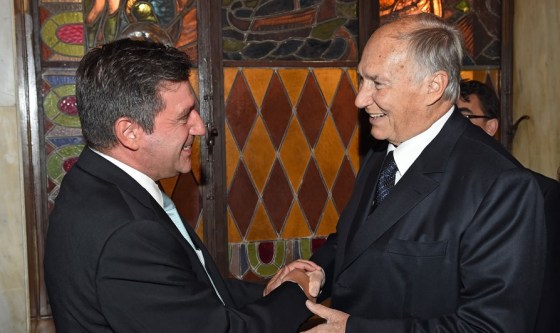
His Highness the Aga Khan is received by the Mayor of Athens, Mr Giorgos Kaminis at a dinner he hosted for Forum participant at Athens City Hall. Photo: AKDN / Gary Otte

His Highness the Aga Khan is received by the Mayor of Athens, Mr Giorgos Kaminis at a dinner he hosted for Forum participant at Athens City Hall. Photo: AKDN / Gary Otte

This leads me to my third observation. Government, while critical, can only take us so far. At a time of democratic disappointment, we must re-emphasise the immense potential of those non-governmental institutions that we call “civil society.”

Too often, our thinking is trapped in a false dichotomy. We talk about the public sector and the private sector, but we often undervalue a third sector – that of civil society.

Civil society is powered by private energies, committed to the public good. It draws on the ancient, classical link between democracy and the publicly-committed citizen.

It includes institutions of education, health, science and research, embracing professional, commercial, labour, ethnic and arts organisations, and others devoted to religion, communication, and the environment.

It seeks consensus through genuine consent. It can experiment, adapt and accommodate diversity. It can in the fullest sense be “of, by and for the people.” It can in the fullest sense be a remarkable support – but only on condition that is it sustained, accepted and encouraged by government.

(IV). Genuine Democratic Ethic

Finally, let me mention a fourth concern that underlies this entire discussion – the central importance of fostering a “democratic ethic.”

At the heart of a democratic ethic is a commitment to genuine dialogue to achieve a better quality of life, even across new barriers of distance and diversity. This means a readiness to give and take, to listen, to bridge the empathy gaps as well as the ignorance gaps that have so often impeded human progress. It implies a pluralistic readiness to welcome diversity and to see our differences not as difficult burdens but as potential blessings.

One ultimate requirement for any effective democracy is the capacity to compromise. Social order rests in the end either on oppression or accommodation. But we can never find that balancing point – where the interests of all parties are recognised – unless competing leaders and their diverse followers alike, are committed to finding common ground.

That common ground, in my view, is the global aspiration for a better quality of life – from the reduction of poverty to quality longevity – built upon opportunities that will provide genuine hope for the future.

Democracy can only survive if it demonstrates – across the years and across the planet – that it is the best way to achieve that goal.

Thank you.

Date posted: September 16, 2015.

_____________

Please click on http://www.akdn.org for complete speech, video and photos.

Ismaili Historical Insights: (I) 1925: Mahatma Gandhi on the Meritorious Deed of a Khoja Ismaili

Letter From Publisher

Simerg's Merchant

Simerg’s Merchant

By Abdulmalik J. Merchant

Simerg’s new feature Short Historical Insights is intended to make history educational, interesting and stimulating for readers through anecdotes, facts, stories as well as images related to Ismailis and their Imams, in no more than  500 words. Information in the series will be unearthed from a maze of documents, including those that are not easily accessible due to their sheer size or location, or material which, in the broader scope, would be of interest for research on specific themes. Of course, we will also rely on other well-known (or lesser-known) treatises and texts as well as libraries and museums for this new feature.

For the first episode, we go to a massive work called The Collected Works of Mahatma Gandhi and reveal a story that appears in Volume 33, which is dedicated to the period from September 1925 to February 1926 in Gandhi’s life. During his visit to Mundra in Gujarat, the father of India, is frustrated with members of his own faith with respect to their treatment of the Untouchables* and, somewhat grudgingly, praises the work of one Khoja (Ismaili) named Ibrahim Pradhan Saheb, who has unselfishly built a school for the outcast children.

This anecdote, by none other than Mahatma Gandhi, is an excellent example of the Ismaili spirit of loyalty to their countries of birth or adoption, a matter which Ismaili Imams have placed on their followers as one of their two principal obligations during their lifetime, the other being their loyalty to the Ismaili Muslim faith. Ibrahim Pradhan was an exemplary Ismaili in this regard, and we are pleased to provide a short account of his contribution from Mahatma’s own two speeches made in 1925.

Readers are invited to contribute to this new feature by submitting their pieces to  Simerg@aol.com. We always acknowledges letters and submissions from non-anonymous sources.

Ibrahim Pradhan’s Meritorious Deed As Recorded By Mahatma Gandhi

102 – Gandhi’s Speech at Mundra, November 1, 1925, page 177 – 181

Mahatma Gandhi spinning yarn in the 1920's. Photo: Wikipedia.

Mahatma Gandhi spinning yarn in the 1920’s. Photo: Wikipedia.

(It is noted by Mahadev Desai that Mahatma Gandhi began his speech with “Antyaja brothers and sisters, their sympathizers, and other Hindu brothers and sisters”)

” ….It is wrong to invite me to a place where the entire public believes in untouchability. It is an insult to invite me to a place where the untouchables are treated with nothing but contempt. After having come here, I heard of the school for the untouchables. I felt that at such a place the Antyajas [lit. the last born – ed] would receive service. I would congratulate Ibrahim Pradhan Saheb on the school but the Hindu public deserves no such congratulations. Its existence puts the Hindus to shame. It is a matter of shame for me if a Muslim builds a Siva temple for my benefit. I was pleased to see the school’s activity of spinning and weaving; however, I immediately felt that neither I nor the Hindus could take credit for this meritorious deed. I can have no sense of satisfaction if a Muslim recites the Gayatri mantra instead of me. I can only feel satisfied when a Brahmin comes along and offers to recite the  Gayatri for me. However, in this case, the Khojas are doing the work that should be done by Hindus. Here, no one is bothered in the least about the Antyajas. I do not see any non-Antyajas except the guests sitting among the  Antyajas here before me. Even those who go around with me during the day have abandoned them and are seated in the enclosure for high-caste gentlemen. If you could rip open my heart today, you would find it crying — ‘O Lord! Could this be the Hindu dharma, where no one cares for the Antyajas? Is there not a single person in the town who will come to their rescue’?…

103 – Gandhi’s Reminiscences of Kutch, November 1, 1925, pages 181-187

Location of Mundra in the Kutch district of  India's Gujarat State. Image: Wikipedia.

Location of Mundra in the Kutch district of India’s Gujarat State. Image: Wikipedia.

I had my bitterest experience in Mundra. I found only hypocrisy, insincerity and play-acting there. Even Muslims were made to sit in the enclosure for those who supported untouchability as if they too believed in it. Hence, only my companions and the Muslim volunteers remained in the section reserved for Antyajas. Many among the Hindu volunteers, though they claimed that they did not believe in untouchability at all, were nevertheless kept in the enclosure meant for those who did believe in it.

There is a school for the Antyajas in Mundra but it is a philanthropic Muslim gentleman, Sheth Ibrahim Pradhan, who runs it at his own expense. The school may be regarded as good up to a point. The children are kept very clean. The building is in the centre of the city. The children had even been taught Sanskrit verses, [which they recited] in a broken accent. Spinning, carding, ginning and weaving were taught in the school itself. Only children’s clothes were not made of khadi [handspun and hand-woven cloth – ed.]; however, the organizers had gone in for the cloth believing it to be pure khadi. The reader might perhaps conclude that this school would give me some satisfaction. It gave me no satisfaction but caused me grief, rather, as the credit for it would not go to a Hindu. I have already mentioned the name of the gentleman who finances it.

Yerawada (or Aga Khan) Palace, now the Gandhi Memorial, was built by the 48th Ismaili Imam to provide a means of livelihood to the famine stricken people in Pune. Historically, the palace holds great significance. Mahatma Gandhi, his wife Kasturba Gandhi and his secretary Mahadev Desai were interned in the palace from 9 August 1942 to 6 May 1944.  In 1969, the current 49th Ismaili Imam, Prince Karim Aga Khan, donated the Palace to the Indian people as a mark of respect to Gandhi and his philosophy. Today, the palace houses a memorial on Gandhi where his ashes were kept.

Yerawada (or Aga Khan) Palace, now the Gandhi Memorial, was built by the 48th Ismaili Imam to provide a means of livelihood to the famine stricken people in Pune. Historically, the palace holds great significance. Mahatma Gandhi, his wife Kasturba Gandhi and his secretary Mahadev Desai were interned in the palace from 9 August 1942 to 6 May 1944. In 1969, the current 49th Ismaili Imam, Prince Karim Aga Khan, donated the Palace to the Indian people as a mark of respect to Gandhi and his philosophy. Today, the palace houses a memorial on Gandhi where his ashes were kept.

The gentleman in charge of this school is the heir of the Aga Khan in Mundra. Sheth Ibrahim Pradhan deserves all praise for his charity, as I was informed that this school is not being run for the purpose of converting the untouchables or schoolchildren to Islam, but in order to enable them to make progress as Hindus. The people of Mundra also informed me that the gentleman in charge, Mauledina Meghji was a Vedantin [belonging to a school of Indian philosophy – ed.] and a learned person. All this must be regarded as satisfactory. However, what is the contribution of the Hindus? Untouchability is an ugly blot on the Hindu religion, it is a sin. The Hindus alone can do prayaschitta [atonement for sins] for it. The dirt on my body will go only when I myself remove it.

This institution adds to the prestige of Sheth Ibrahim Pradhan, and to that extent to the shame of the Hindus.

Date posted: July 26, 2015, word count, appx. 400 words.

_____________

Notes and references:

*Untouchables are outcasts—people considered too impure, too polluted, to rank as worthy beings. Prejudice defines their lives, particularly in the rural areas, where nearly three-quarters of India’s people live….Although the Indian constitution makes caste discrimination illegal, Untouchables living at the bottom of society are subjected to indignities” — from http://ngm.nationalgeographic.com/ngm/0306/feature1/

See complete volume 33 at http://www.gandhiserve.org/cwmg/VOL033.PDF.

Mawlana Hazar Imam’s Letter to Kofi Annan: “The World’s Drug Problem Must Remain a Matter of Permanent Concern”

“…For all clear thinking individuals, wherever they may be, the world’s drug problem must remain a matter of permanent concern. With the density of the Ismaili population in Gorno-Badakhshan, in Afghan Badakshan, in Chitral and Hunza and elsewhere in South West Asia and Africa, the leaders of the Ismaili Community, its institutions and I, as the Imam, must be particularly concerned with this aggressive and damaging problem…” — Excerpt from Aga Khan’s letter to Kofi Annan. Please download complete letter in PDF format below.

LETTER FROM PUBLISHER

By Abdulmalik Merchant

Mawlana Hazar Imam, His Highness the Aga Khan, has throughout his 58 years of Imamat urged his followers not to indulge in dangerous and unhealthy social habits such as alcohol, drugs and smoking. In the eyes of the Imam, all his followers are his spiritual children and, like all parents, the 49th Ismaili Imam desires nothing but the best for his community in both spiritual and temporal matters.

There is one farman on alcohol and smoking that has particularly reverberated in my heart and memory for many decades. I remember it well because Alwaez Nizar Chunara, who was our neighbour in Dar-es-Salaam, had conveyed it to us well before it got read out in jamatkhanas across East Africa. It was made in Mbale, Uganda, sometime in the 1960’s, and Mawlana Hazar Imam said in the farman that some of his spiritual children had the impression and told others in the jamat that they were not socially advanced if they did not drink and smoke. This he said, “is absolute and complete nonsense,” (repeating it), and further stated that if we really wanted to be socially distinguished we should not drink and smoke.

During the same East African visit Mawlana Hazar Imam described alcohol as not being for his jamat because it led to losing our honour and creating a bad impression, especially when one went around being drunk. A few years later in London he mentioned that alcohol was a bringer of spiritual sorrow. Mawlana Hazar Imam’s beloved grandfather when addressing Muslims in South Africa warned about alcohol as follows:

“The greatest danger to every Muslim citizen – I have not the least hesitation in saying it – is alcohol. Time has shown that it is an injury to you; an injury to your person; an injury to your health. It is forbidden because it carries greater evil than good. Believe me, in a community like yours, alcohol is a very grave danger. Once you got into the alcohol habit, I do not know where it would lead you. A handful, here and there, of the weak, or of the unhappy, find their way to this terrible poison. Avoid it at all costs. Avoid it, I say, for in this country you cannot afford to lose one man.”

KOFI ANNAN’S LETTER TO THE LATE PRINCE SADRUDDIN AGA KHAN

Please click on image or S-1100-0016-07-00008

7th Secretary General of the United Nations, from January 1, 1997 – December 31, 2006

Kofi Annan, 7th Secretary General of the United Nations, from January 1, 1997 – December 31, 2006

Then, another farman on social habits that immediately comes to mind, because I was present to hear it as a youth  and as a volunteer standing close to the stage, was the one that he made during his visit to Dar-es-Salaam in 1970 for the opening of the IPS building by President Julius Nyerere. The newly established Karimabad Jamat and the Changombe Jamat located in Dar-es-Salaam’s outskirts were brought together for the mulaqat with Mawlana Hazar Imam at the Diamond Jubilee Hall.

The farman dealt substantially on economic matters; Mawlana Hazar Imam spoke about him being happy if families could afford one car and very happy if they could afford two cars, but he went on to say that he did not want to see that second car. Turning to the subject of health and social habits, he made a plea to the jamat not to be wasteful on drugs, cigarettes and alcohol. This mention of drugs was one of the earliest references to drugs in any farman that Hazar Imam had made from 1957 until 1970.

In this connection, it may be mentioned that the use of drugs, particularly of heroin in the USA, was rising at alarming rates in the 1960’s. The Reader’s Digest had even published an incredible heart wrenching essay, “We are All Animals,” about chilling stories of being a drug addict. My mum, I recall, read the entire article out to her students at the Aga Khan Girls Secondary School. Her students literally had tears in their eyes, hearing the sad stories.

HIS HIGHNESS THE AGA KHAN’S LETTER TO KOFI ANNAN

Please click on image or S-1100-0016-07-00005

Mawlana Hazar Imam, His Highness the Aga Khan, 49th Ismaili Imam

Mawlana Hazar Imam, His Highness the Aga Khan, 49th Ismaili Imam.

So, when I ran into this letter that Mawlana Hazar Imam sent to Kofi Annan, which had been preceded by the Secretary General’s letter to Mawlana Hazar Imam’s late uncle Prince Sadruddin (and perhaps to Mawlana Hazar Imam too, judging by the acknowledgement given), I thought I had also bring to light the general concern about social habits and their absolute wastefulness, and indignity they bring on the community. In making choices between good and bad habits, Mawlana Hazar Imam has asked us to adopt those that would enable the jamat to live happily, leaving aside alcohol, drugs and other social habits that would compromise the well-being of the jamat.

A key point that emerges from Hazar Imam’s letter to Mr. Annan is the damaging and aggressive problem of drugs not merely in the regions of Central Asia, where poppy plants are being grown in abundance, but elsewhere in the world where his community resides. The growth of poppy is destroying the physical and mental lives of hundreds of thousands of people. Others profit from its growth and illegal trade, as the resin from the plants is extracted and refined into morphine, with further refinements yielding different forms and grades of heroin.

Mawlana Hazar Imam is continuously concerned for the well-being of his jamat, and nothing is more important to him than the strength of our mental health and capacity, which he has said must be preserved and enhanced rather than being destroyed through the use of drugs. The Ismaili community can certainly set a true example of  social distinction and wisdom by avoiding all forms of social habits that do not contribute to any form of advancement. As a small community, our resolve to abstain from detrimental social habits would help us to serve our families, our communities and countries more effectively and purposefully in the coming years and decades.

Date posted: July 23, 2015.
Last updated: July 25, 2015 (updated with additional material from the personal notes of my mother, Alwaeza Maleksultan Merchant, on smoking, drinking and drugs).

________________

Credits: The PDF files are from the United Nations Archives and Records Management Section (ARMS). ARMS is open to the public. Materials are available for research, teaching, legal proceedings, publication, television and radio programmes, and for general interest.

Simerg welcomes your feedback. Please click Leave a comment.

Share this post with your friends and contacts around the world. Subscribe to this blog at the top right of this page. For complete contents of this website, please click on Table of Contents (2009–2015).

Iran Nuclear Deal Sealed: Prayers Answered in Holy Month of Ramadan, Says President Hassan Rouhani

1. MAWLANA HAZAR IMAM HAD ADVOCATED THE PRINCIPLE OF “YES TO ENERGY, NO TO ARMS” SEVERAL YEARS AGO

Mawlana Hazar Imam, His Highness the Aga Khan, 49th hereditary Imam of Shia Ismaili Muslims  directly descended from the Holy Prophet Muhammad (s.a.s.). Photo: AKDN/Anya Campbell. Copyright.

Mawlana Hazar Imam, His Highness the Aga Khan, 49th hereditary Imam of Shia Ismaili Muslims  Photo: AKDN/Anya Campbell. Copyright.

“We are a long way from the democratization of nuclear energy. Maybe I’m naïve but I advocate another approach, which I call “positive proliferation.” The positive proliferation that I would dearly love to see happen is based on a simple principle: yes to energy, no to arms….Iran could even contribute to the worldwide removal of nuclear energy for military use. That is what I told the Iranians several years ago: “Your history is that of an intellectual nation several thousand years old which has brought to Islam all the richness of its culture and its philosophical thought. Keep following the path that is truly your own and the world will thank you for it.” — His Highness the Aga Khan. Please read complete interview by clicking on The Power of Wisdom.

________

2. TRIUMPH IN DIPLOMACY

President Hassan Rouhani

 I. President Hassan Rouhani

“Today is a new chapter to work towards growth and development of our dear Iran; a day for our youth to dream again for a brighter future. Many people prayed for the negotiating team during the holy month of Ramadan; I’m privileged to announce their prayers have been answered…This agreement goes both ways. The successful implements of IranDeal can dismantle the wall of mistrust brick by brick.” — Tweets by the President of the Islamic Republic of Iran

I am happy that with the 23-month nuclear talks of Iran with the world six major powers, we have today been able to reach a new point; of course the month of Ramadan has always been source of blessing and destiny making for the 11th Government…The 25th of the month of Ramadhan in the year 1392 [A.H.] was the year of taking presidential oath; the 26th of the month of Ramadhan that year was the swearing-in ceremony and today, it is the day of Iran’s success to bring the six world powers to the Comprehensive Joint Plan of Action.” — Speech Excerpt, President Rouhani, http://www.president.ir/en/

II. The Guardian, UK

“This accord, so long in the making, offers the hope that one of the world’s great civilisations might be drawn back into the international community, with untold benefits not only for Iranians but for its conflict-ravaged neighbours. The opportunity should be seized.” —  Editorial excerpt, http://www.theguardian.com, UK Edition

3. THE NEGOTIATIONS

Secretary of State John Kerry

US Secretary of State

“And I finally want to express my deep respect for the serious and constructive approach that Iran’s representatives brought to our deliberations. The president of Iran, President Rouhani, had to make a difficult decision. We all know the tensions that exist. Foreign Minister Javad Zarif, a tough, capable negotiator, and patriot, a man who fought every inch of the way for the things he believed, and sometimes these were heated and passionate exchanges. But he and his team, while tough, always professional, always dedicated to finding solutions to difficult problems. And we were, both of us, able to approach these negotiations with mutual respect, even when there were times of a heated discussion, I think he would agree with me at the end of every meeting we left with a smile and with a conviction that we were going to come back and continue the process. We never lost sight of the goal that an agreement could bring and the best long-term interests of all concerned” — US Secretary of State, John Kerry

4. IRANIANS CELEBRATE HISTORIC DEAL

Horns honked and flags waved here as darkness fell Tuesday and the Ramadan fast was broken as Iranians marked the nuclear deal reached between Iran and the six world powers led by the US. For the first time in years, they relished the prospect of an improved economy and reengagement with the West.

Narjes Sedaghatfar, a math teacher who voted for Rouhani but has kept expectations in check until now said, “The button has been pressed, we are beginning anew. I will be at home, and just be happy and plan for a happy future. When hope rises, that is celebration in itself.” — From reports in the Christian Science Monitor, http://www.csmonitor.com.

Date posted: July 15, 2015

____________________

We welcome your feedback. Please click Leave a comment.

History in the Making: Establishment of the Seat of the Ismaili Imamat in Portugal

COMPILED BY SIMERG

Please click on photo for enlargement

Mawlana Hazar Imam, His Highness the Aga Khan, 49th hereditary Imam of Shia Ismaili Muslims  directly descended from the Holy Prophet Muhammad (s.a.s.). Photo: AKDN/Anya Campbell. Copyright.

A portrait of Mawlana Hazar Imam, His Highness the Aga Khan, 49th hereditary Imam of Shia Ismaili Muslims. Photo: AKDN/Anya Campbell. Copyright.

In an unprecedented historical event, His Highness Prince Karim Aga Khan, the 49th hereditary Imam of the Shia Imami Ismaili Muslims, and Portugal’s Minister of State and Foreign Affairs, Rui Machete, came together at the historic Necessidades Palace in Lisbon on Wednesday June 3, 2015, to sign a landmark agreement to establish the Seat of the Imamat in Portugal. The Ismaili Imamat is a supra-national entity, representing the succession of Imams since the time of the Prophet Muhammad (s.a.s).

The Agreement marks the first such accord in the Ismaili Imamat’s modern history. It will come into effect once it has been approved by Portugal’s Parliament and ratified by the President of the Portuguese Republic. Present at the signing ceremony was Portugal’s Prime Minister Pedro Passos Coelho and other senior government officials.

Thanking the government for inviting the Ismaili Imamat to establish its permanent seat in Portugal, His Highness the Aga Khan (known to his 15 millions Ismaili followers as Mawlana Hazar Imam), hailed the agreement as a historic milestone in the Imamat’s history and said:

“Today is a unique and important occasion, where for the first time in our history we will have the opportunity to work with a partner with whom we share so many values, so many hopes and so many desires.”

He expressed the hope that the agreement would be approved by the Portuguese Parliament  through the democratic process, and that once it was ratified both the Imamat and Portugal could work together to achieve results that could not be achieved by working alone. His Highness also mentioned his community’s great respect and admiration for Portugal, a country where faith is integrated with civil society, a country where all people are happy, or at least the majority are happy, in a world where happiness is unusual.

The agreement establishing Portugal as the seat of Imamat took place at the Palace of Necessidades. It  is a historical building in the Largo do Rilvas, a public square in Lisbon, Portugal. It serves as headquarters of the Portuguese Foreign Ministry. Palace Photo Photo: Wikipedia.

The agreement establishing Portugal as the seat of Imamat took place at the Palace of Necessidades. It is a historical building in the Largo do Rilvas, a public square in Lisbon, Portugal. It serves as headquarters of the Portuguese Foreign Ministry. Palace Photo: Wikipedia.

The Institution of the Ismaili Imamat goes back 1400 years when, according to Shia Muslim tradition, the Prophet Muhammad (s.a.s.) designated and appointed his cousin and son-in-law Ali Ibn Talib (a.s.) to be the first Imam, and proclaimed that the Imamat should continue by heredity through Imam Ali and his daughter Bibi Fatimat-az-Zahra (a.s).

The Ismailis are the only Shia Muslim community led by a living Imam who is vested with global religious authority and has the responsibility for the community’s spiritual and material well-being.

The succession of Imamat is by way of Nass [designation], it being the absolute prerogative of the current Imam to appoint his successor from amongst any of his male descendants whether they be sons or remoter issue.

The present 49th Imam, Prince Karim, succeeded to the throne of Imamat at the age of twenty on July 11, 1957 upon the demise of his late grandfather, Sir Sultan Mahomed Shah, His Highness the Aga Khan III, who  served the community for 72 years, beginning in 1885 when he was only seven years old.

The historical accord will result in intensified cooperation between Portugal and the Ismaili Imamat in supporting research and the knowledge society and in improving the quality of life of Portugal’s inhabitants.

Responding to the historic signing, the Portuguese Prime Minister Pedro Passos Coelho said at Wednesday’s ceremony:

“The decisive step taken today will enable the deepening of cooperation, until today essential focused on the social area, with the Imamat Ismaili community beginning to support Portuguese institutions dedicated to excellent research on a wide variety of fields of knowledge.

“I am present here today due to it being a historic moment which brings a long and intense relation existing between Portugal and the Ismaili community to a new level, reflecting particularly the importance of the Ismaili community that resides in our country and Portuguese speaking African countries.”

The Prime Minister also pointed out Mawlana Hazar Imam’s role in “promoting a more tolerant world,” and also said that the choice of Portugal as the seat of the Ismaili Imamat was an acknowledgment of the Portuguese community’s ability to promote dialogue and tolerance between peoples, cultures and beliefs.

Hope, and not Despondency, in the Wake of Misfortune and Tragedy

LETTER FROM PUBLISHER
Yellow Tulips - Hope amidst Tragedy
“Despair not of the Spirit of Allah. Lo! None despaireth of the Spirit of Allah save disbelieving folk.” (Holy Qur’an, Chapter 12, Verse 87).

The recent tragedy in Karachi, where dozens of innocent Ismailis were the subject of wanton violence is extremely disquieting. Besides questioning the humanity of our fellow citizens, it may serve to bring to the fore the insecurities of a people who have been subject to religious persecution in the past and are today, without exception, minorities in every single land they live in. As the Ismailis of Karachi (and of Pakistan in general) reflect on the aftermath of this terrible tragedy, perhaps it would natural for them to give in to despondency. This, however, should be cautioned against, for the following reasons.

Today, Ismaili Jamats globally unite in prayers and solidarity with their brethren of Karachi sending a strong message that their brethren are not just a forgotten minority in a big state, but an indivisible part of a strong global brotherhood. Equally, and no less significant, is the Imam’s global work and name, which has resulted in condemnation across the globe by world leaders, and which will ensure that this tragedy will not end up as just another footnote in an unending series of attacks on religious minorities in Pakistan. As K. N. Pandita says in a recent article:

 “But given the international influence and reach of Prince Aga Khan and the great humanitarian works that his Foundation is doing in many parts of the world including Karachi, the massacre is bound to cause ripples in Pakistan politics. This is the reason why the Prime Minister of Pakistan and the Army chief both lost no time in flying into Karachi to take stock of things”. [1]

There is reason to hope that from this tragedy, and from the blood of innocents, a reaffirmation of the rights of religious minorities in Pakistan will result, Inshallah.

Date posted: May 18, 2015.

_______________

[1]  http://www.dailyexcelsior.com/tragedy-descends-on-ismailis/

Leaders and Communities Extend Condolences to His Highness the Aga Khan and His Ismaili Followers as Mass Funeral is Held in Karachi for Terror Victims

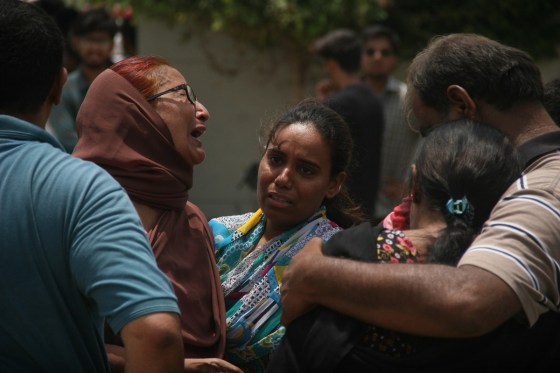
KARACHI, PAKISTAN - MAY 13: Relatives of injured and killed cry and wait outside a hospital following a gun attack on a bus carrying members of Ismaili Shia community, in Karachi, Pakistan, 13 May 2015 that killed at least 45 people including over a dozen women and injuring more than 14 people. (Photo by Sabir Mazhar/Anadolu Agency/Getty Images)

KARACHI, PAKISTAN – MAY 13: Relatives of injured and killed cry and wait outside a hospital following a gun attack on a bus carrying members of Ismaili Shia community, in Karachi, Pakistan, 13 May 2015 that killed at least 45 people including over a dozen women and injuring more than 14 people. (Photo by Sabir Mazhar/Anadolu Agency/Getty Images)

A genuine outpouring of sympathy has been extended to His Highness the Aga Khan and his followers after the gun attack on a bus in Karachi on May 13, 2015 in which 43 Ismailis were killed at point black range. Two more people died later in a hospital from injuries they suffered. An Associated Press report published in both the Washington Post and The Miami Herald (Karachi Mass Funeral) states that Pakistan was observing a day of national mourning, and state-run television was broadcasting live footage, showing mourners attending the last rituals for the victims of Wednesday’s assault. Forty-three of the victims were laid to rest in a mass funeral on Thursday, one was buried earlier, and another body remains to be identified. The following is a selection of messages of sympathy that have been publicly released by numerous leaders and governments around the world.

~~~~~

Statement by the Prime Minister of Canada

Prime Minister Stephen and His Highness the Aga Khan at the Parliament of Canada.

Prime Minister Stephen and His Highness the Aga Khan at the Parliament of Canada.

“Canada condemns the cowardly terrorist attack on a bus carrying Shi’a Ismaili Muslims in Karachi.

“It is particularly chilling that gunmen opened fire indiscriminately, murdering many Ismailis regardless of their gender or age. It is an affront to everyone who cherishes religious freedom. We urge the Government of Pakistan to bring the perpetrators to justice and to ensure that all religious minorities in the country are protected and their religious freedom guaranteed.

“On behalf of all Canadians, Laureen and I offer our deepest condolences to the families and friends of those who perished in this murderous attack. We also offer our heartfelt prayers that those injured may have a speedy recovery.

“I have worked closely with His Highness the Aga Khan over the years and know first-hand of the peaceful nature of the Shi’a Ismaili community here in Canada and around the world. We mourn with His Highness and the entire Shi’a Ismaili Imamat who have consistently stood for peace, pluralism and religious freedom.”

________________

Statement by the US Secretary of State

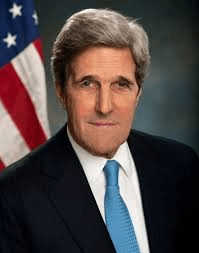
Secretary of State John KerryPress Statement
John Kerry
Secretary of State
Washington, DC May 14, 2015

“I strongly condemn the heinous May 13 attack on a bus in Karachi, which resulted in the deaths of dozens of members of the Ismaili community.

“The American people stand in solidarity with the people of Pakistan, and with the global Ismaili community on this tragic day. Make no mistake: There is more strength by far in the respect and solidarity that we feel towards one another than there could ever be in any terrorist attack.

“I extend my personal condolences to the families of the victims, and to my dear, esteemed friend His Highness the Aga Khan, who has led the Ismaili community in investing in so many important development and education projects not only in Pakistan, but around the world. We will support efforts to bring all those responsible to justice and stand ready to provide assistance to the investigation of this tragic attack.”

________________

Statement by Canadian Senator Hon. Mobina S.B. Jaffer

Senator Mobina Jaffer, left, pictured in Kenya.

Senator Mobina Jaffer, left, pictured in Kenya.

“Honourable Senators, I rise today with a very heavy heart. Very early this morning, I awoke to the news that forty- three innocent Ismaili Muslims who were riding a bus in Karachi, Pakistan, were senselessly gunned down by six armed individuals who were dressed in police uniforms. They were my brothers and sisters in faith.

“Sixty-two people were on the bus on their way to a community centre when the gunmen boarded after cutting off the bus with their motorcycles. Once inside, the gunmen shot indiscriminately at the men, women and children. When the gunmen left, an injured individual drove the bus to a nearby hospital. By the time they arrived at the hospital, most of the passengers had died.

“His Highness the Aga Khan, my spiritual leader, stated: ‘This attack represents a senseless act of violence against a peaceful community. My thoughts and prayers are with the victims and the families of those killed and wounded in the attack’.

“Other leaders across Pakistan have expressed their absolute shock at this attack on the Ismaili Muslim community. The Prime Minister of Pakistan, Nawaz Sharif, called it ‘‘a deplorable attempt to spread chaos in Pakistan.’’

Honourable senators, the Ismaili Muslim community is one of the most peaceful and charitable communities in Pakistan. They are involved in a number of development projects across the country and work in all segments of society. Their roots in Pakistan are very deep, as they have inhabited that area of the world for hundreds of years. While the community is small, their positive impact on Pakistan is tremendous.

“As an Ismaili Muslim and as a Canadian, my heart breaks for the victims of this attack and for their families. Many of those killed had Canadian family members. I understand that one Canadian has lost his father, mother and brother. I know you join me in sending our condolences to those Canadians. I know this Chamber will join me in condemning this abhorrent attack on innocent individuals in Pakistan.

“As mine are, I know your thoughts and prayers are with the victims and their loved ones in Pakistan and Canada.”

Thank you.

___________________

Statement attributable to the Spokesman for the
UN Secretary-General

New York, 13 May 2015

UN Secretary General Ban Ki-moonThe Secretary-General condemns in the strongest possible terms the terrorist attack today on a bus in Karachi, Pakistan, reportedly killing at least 45 members of the Ismaili community and injuring several others. 
The Secretary-General calls on the Government of Pakistan to take all necessary measures to bring to justice the perpetrators of this despicable act.

Taking note that a number of attacks against the Shia and Christian minorities have taken place in the recent past in Pakistan, the Secretary-General urges the Government of Pakistan to take swift measures aimed at effective protection of religious minorities in the country. Creating a climate of tolerance, understanding and respect will greatly contribute to achieving this objective. 

Pakistan, as a responsible member of the international community, must uphold its obligations and commitments towards protecting its citizens, including all minorities. 

The Secretary-General extends his heartfelt condolences to the families of the victims and to the Government and people of Pakistan.  He wishes a speedy recovery to those injured in the attack.

________________

Statement by the Iranian Foreign Ministry

Marziyeh AfkhamIran’s Foreign Ministry spokeswoman Marziyeh Afkham, pictured at left, condemned a Wednesday terrorist attack in the Pakistani city of Karachi that killed scores of Shiite Muslims on a bus.

Afkham slammed the atrocity and condoled with the bereaved families of the victims and the Pakistani people and government.

“Extremism and terrorism are against humanity and Islam, and killing innocent people, with any purpose and in any form, is rejected and unjustifiable,” she said.

The objective of such terrorist attacks is to undermine unity in Pakistan, Afkham warned, but expressed confidence that prudence and rapport between the Pakistani government and nation would safeguard stability and security in Irans neighboring country.

________________

Statement by the Ministry of Foreign Affairs, Turkey

Ministry of Foreign Affairs Turkey“We have learned with great sorrow that more than 40 people lost their lives and around 20 others were injured, according to initial reports, as a result of the armed attack perpetrated against a bus carrying members of the Ismaili sect, in Karachi, Pakistan today (13 May) in the morning hours.


“We strongly condemn this terrorist attack. We share the grief of the friendly and brotherly people of Pakistan and express once again our strong feelings of solidarity with the Government of Pakistan.

“We wish God’s mercy on those who lost their lives in this heinous attack, convey our condolences to their families and wish a speedy recovery to the wounded.”

_______________

Statement by the European Union Spokesperson

13/05/2015

“The deadly attack on a bus in Karachi today that has killed at least 43 people and wounded more civilians is a further instance of the scourge of sectarian violence.

“The Pakistani government must do its utmost to tackle sectarian violence and bring to justice the perpetrators of these violent and criminal acts. There must also be no impunity for these crimes. The rights of all citizens need to be protected, regardless of religion or belief.

“The European Union expresses its condolences to the families and friends of the victims.”

________________

Statement by the Pakistan Consul General in Chicago

Pakistan Consul General

________________

Statement by US Ambassador to Pakistan

May 13, 2015

us-ambassador-olson“On behalf of the American people, U.S. Ambassador Richard Olson extends his deepest sympathies and condolences to the families of the victims of Wednesday’s heinous bus attack in Karachi, and strongly condemns this senseless terrorist act. 

“The United States remains steadfast in its commitment to the people of Pakistan in their efforts to counter terrorism, and supports the right of every person to worship as they choose, without fear of intimidation, coercion or violence. We support Pakistan’s efforts to bring all those involved to justice and stand ready to provide any appropriate assistance to authorities investigating this tragic attack.”

________________

Statement by US Congresswoman Jan Schakowsky

US Congresswoman Jan Schakowsky

WASHINGTON, DC – “I was shocked to learn of the devastating attack that brutally and senselessly murdered 43 innocent Ismailis and wounded many others.  They were attacked because of their religious beliefs by militants who are targeting anyone who doesn’t accept their view of Islam.

“I have a significant and highly respected community of Ismailis within my Congressional District, and I work closely with them.  For years I have participated in the Aga Khan Foundation Partnership Walk in Chicago, a walk that symbolizes the Ismaili community’s work to end global poverty, hunger, illiteracy and poor health around the world.  My district is home to two of their houses of worship called Jamat Khana, one in the Edgewater neighborhood of Chicago and the other in Glenview, Illinois. 

“My heart goes out to the families of the murdered and injured, and to the community as a whole which is deeply shaken by this act of terror.  I stand strongly with the Ismaili people, a peaceful people, and all those across the world who reject violence and intolerance.  We must join together as a global community to do everything possible to keep these attacks from happening in the future.”

___________‏

Statements from Muslim Organizations in Canada

PLEASE CLICK: Canadian Muslim Organizations Offer Condolences to the Ismaili Community + List of Deceased

Please click on image for Muslim organization statements.

Please click on image for Muslim organization statements.

___________

MEDIA DISPATCHES AND OPINIONS

Iran’s Press-TV reported that people in the Pakistani-controlled Jammu and Kashmir, home to other Shia communities, observed mourning and held ceremonies in commemoration of the victims.

Pakistan’s Express Tribune, a publication affiliated with the International New York Times (formerly the International Herald Tribune) reported that participants at the Ithad-e-Ummah Conference, organised by the Pakistan Ulema Council (PUC) condemned the massacre of Ismailis in Karachi, and said that the killers have no religion. Among those attending the conference, which was chaired by PUC Chairperson Tahir Mehmood Ashrafi, was the Chief Guest, Azad Jammu and Kashmir’s President Sardar Muhammad Yaqoob, the Shia Ulema Council Secretary General Allama Arif Waheedi, International Islamic Study Council President Mian Abu Bakar, Qazi Kifayatullah, and Dr Allama Shabbir Hassam Mesmi.

In an opinion piece for the same paper, Raza Rumi, editor at The Friday Times, who is currently a visiting fellow at the National Endowment for Democracy in the US wrote:

“The sheer barbarity of the attack on the Ismaili community in Pakistan’s largest and one of the more misgoverned cities shocked the country. It is not the first time that such a sectarian attack has happened. During the past two years, more than a thousand people have been killed in targeted sectarian attacks. However, this was the largest attack on Ismailis. The head of the Ismaili community, Prince Karim Aga Khan, rightly termed the massacre of 43 men and women “a senseless act of violence against a peaceful community”. It is ironic that the Pakistan movement owes its genesis to the contributions of Sir Sultan Muhammed Shah, Aga Khan III who was the founder, patron and the first president of the All-India Muslim League.”

____________

PEACEFUL REACTIONS IN HUNZA

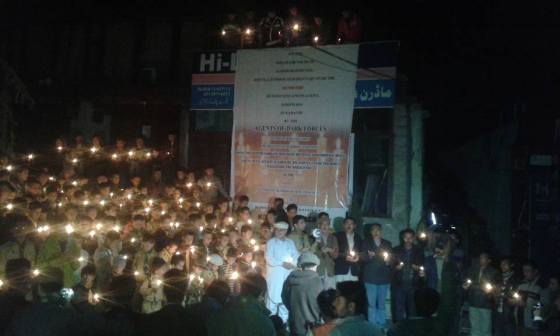
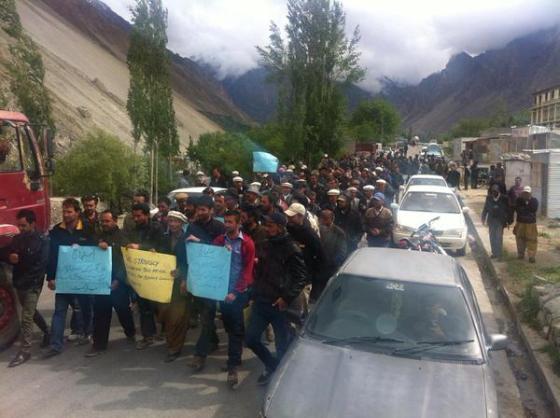
http://www.Pamirtimes.net reports that the news of the attack created anger among the Ismailis of Gilgit-Baltistan. However, demonstrations that were held in Gilgit, Aliabad (Hunza) and Gulmit (Upper Hunza) were peaceful. The Karakuram Highway was blocked by protesters for several hours today to register protests. Shops and markets remained closed in different parts of Gilgit and Hunza after the carnage in Karachi.

Civil society groups held candle-light vigils in different parts of Gilgit city and Karimabad (Hunza). Photo: Pamirtimes.net

Civil society groups held candle-light vigils in different parts of Gilgit city and Karimabad (Hunza). Photo: Pamirtimes.net

Peaceful protests at a demonstration held in Gulmit village of Upper Hunza against Safoora Chowrangi attack. Photo: Pamirtimes.net

Peaceful protests at a demonstration held in Gulmit village of Upper Hunza against Safoora Chowrangi attack. Photo: Pamirtimes.net

Date posted: Wednesday, May 14, 2015 (20:45)
Date updated: Saturday, May 16, 2015 (09:30), more messages of condolences

We shall continue to post additional material on this page in the days and weeks to come.

Please also visit the latest post Canadian Muslim Organizations Offer Condolences to the Ismaili Community + List of Deceased.

___________

Please visit the following external links:

Also visit http://www.ismailimail.wordpress.com for links to numerous articles and photos on this tragic event.

We invite our readers to record their messages of grief and sympathy by clicking Leave a comment.

Also please see:

A Simerg Brief: “I Absolutely Admire the Aga Khan” — Howard Shearer

Howard Shearer

Howard Shearer

Highly accomplished, Jamaican born Howard Shearer served as a member of McMaster University’s Board of Governors while heading Hitachi Canada Ltd. as its President and CEO. In an interview with the University’s McMaster Times for its 2008 Winter/Spring edition, Mr. Shearer talked about “Leading by a Moral Compass” that readers of this website will find interesting.

When asked, “What living person do you most admire?”, Howard Shearer replied:

His Highness the Aga Khan

His Highness the Aga Khan

“I have to say my mother. She dared us to imagine what is possible. That’s crucial. I absolutely admire the Aga Khan. He established a moral compass in terms of his teaching and his commitment to social responsibility – for contributing to society.”

As for his motto, Shearer explains, “Carpe diem. The opportunity to do something always exists today. I encourage people to make every effort to seize the opportunities that are in front of them and not to wait until tomorrow, because tomorrow will bring its own opportunities.”

To read Mr. Shearer’s inspiring interview, please click: Leading by a moral compass, and scroll to page 16.

Date posted: Monday, March 23, 2015.

____________

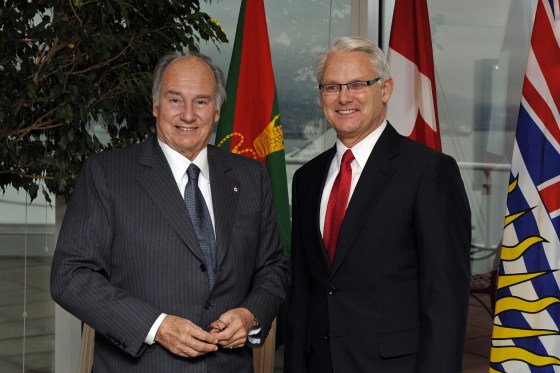
Simerg Profiles His Excellency Gordon Campbell, Canada’s Representative to the Ismaili Imamat

Mawlana Hazar Imam receives His Excellency Gordon Campbell at Aiglemont. Left to right: Malik Talib; Rouben Khatchadourian, Prince Rahim, HE Gordon Campbell, Mawlana Hazar Imam, Dr Mahmoud Eboo, and Dr Shafik Sachedina. AKDN / Cécile Genest

Mawlana Hazar Imam receives His Excellency Gordon Campbell at Aiglemont on March 4, 2015. Left to right: Malik Talib; Rouben Khatchadourian, Prince Rahim, HE Gordon Campbell, Mawlana Hazar Imam, Dr Mahmoud Eboo, and Dr Shafik Sachedina. AKDN/Cécile Genest

Mawlana Hazar Imam received His Excellency Gordon Campbell, Canada’s Representative to the Ismaili Imamat, at Aiglemont, France, on Wednesday, March 4, 2015.

Recently appointed to this role by the Government of Canada, Gordon Campbell has also been serving as Canada’s High Commissioner to the United Kingdom since September 2011. Prior to his appointment, Mr Campbell served three terms as Premier of the province of British Columbia from 2001 to 2011, during which time he was ranked best fiscal manager among Canadian premiers by the Fraser Institute.

Joining Mawlana Hazar Imam and Mr. Campbell at the meeting were Prince Rahim, Mawlana Hazar Imam’s Personal Representative to Canada; Dr Mahmoud Eboo, Resident Representative of the Aga Khan Development Network in Canada; Malik Talib, President of the Ismaili Council for Canada; Rouben Khatchadourian, Political Counsellor at the Canadian High Commission to the UK; and Dr Shafik Sachedina, Head of the Department of Diplomatic Affairs at Hazar Imam’s Secretariat.

Mawlana Hazar Imam at a luncheon hosted by Premier Gordon Campbell that was attended by community, education and business leaders in honour of Mawlana Hazar Imam's Golden Jubilee visit to British Columbia. Gary Otte

Mawlana Hazar Imam at a luncheon hosted by Premier Gordon Campbell that was attended by community, education and business leaders in honour of Mawlana Hazar Imam’s Golden Jubilee visit to British Columbia in 2008. Photo: The Ismaili/Gary Otte.

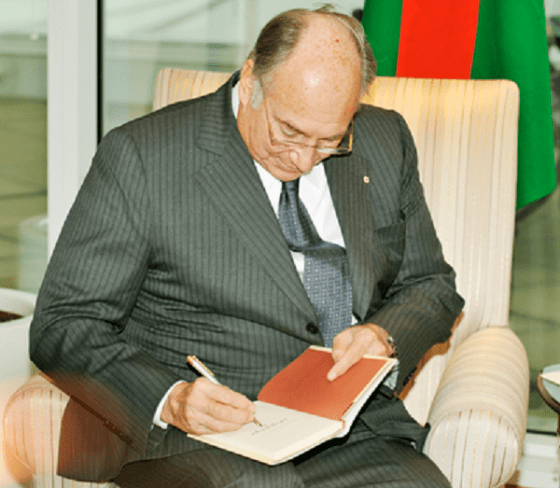
In 2008, Mr. Campbell as BC’s Premier hosted a luncheon in Mawlana Hazar Imam’s honour for the Golden Jubilee visit to the Province. At the event, Mawlana Hazar Imam signed his book Where Hope Takes Root for the Premier. Mr. Campbell spoke about the contribution made by the Ismaili community in the Province and across Canada: “It touches us in British Columbia when we go to the Partnership Walk and we see literally thousands and thousands of people, not just Ismaili people, but many, many others as well joining the Ismaili community here. And most importantly, young people, young people who are becoming aware of the fact that we live in a great place and there may be things we can do to help others live in better places around the world. That is your message, and it is a message that is based on not just talking about the opportunities here before us but actually taking steps down that road to hope and to promise that you have talked about so much in the past.”

Mawlana Hazar Imam, His Highness Aga Khan, signing his book "Where Hope Takes Root" for Gordon Campbell, the Premier of British Columbia during his 2008 visit to the province to celebrate his Golden Jubilee.  Photo: With permission of The Vancouver Sun.  Copyright. Please click on photo for book review.

Mawlana Hazar Imam, His Highness Aga Khan, signing his book “Where Hope Takes Root” for Gordon Campbell, the Premier of British Columbia during his 2008 visit to the province to celebrate his Golden Jubilee. Photo: With permission of The Vancouver Sun. Copyright. Please click on photo for book review.

Mr Campbell, a Vancouver native, studied English and Urban Studies at Dartmouth College in New Hampshire and completed his MBA at Simon Fraser University in British Columbia. He spent two years teaching in Nigeria with the Canadian University Service Overseas (CUSO) where he also coached championship state basketball and track and field teams in addition to launching a major library restoration initiative. After his return to British Columbia, Mr Campbell founded a successful property development firm. He then began his political career in local politics in Vancouver, where he went on to serve as Mayor for three successive terms from 1986 to 1993, and spearheaded key urban regeneration projects and ground-breaking initiatives in literacy and cultural diversity.

As Premier, Mr Campbell was recognized for his leadership on climate change issues and his reconciliation initiatives with Canada’s First Nations.  He was recognized as a champion of Canada’s highly successful 2010 Winter Olympic and Paralympic Games in Vancouver and Whistler, British Columbia.  Mr Campbell worked to ensure that the 2010 Olympics were not just about the city of Vancouver, but were a Games that all Canadians could celebrate and call their own.

The Globe and Mail recently reported that Mr. Campbell is being floated as federal Conservative candidate for a new federal riding in Vancouver. Residents are receiving phone calls asking them if they’d vote for the former B.C. premier were he to run for the federal Conservatives in their electoral district.

Date posted: March 5, 2015.
Last updated: March 6, 2015 (typo, Hazar Imam received Gordon Campbell at Aiglemont on March 4, 2015, and not on February 4 as mentioned previously).

______________

Material compiled from the following sources:

Fascinating Midwife and Nursing Stories from East Africa, as Mawlana Hazar Imam Arrives for Aga Khan University Convocation Ceremonies

BY SHARIFFA KESHAVJEE
Special to Simerg

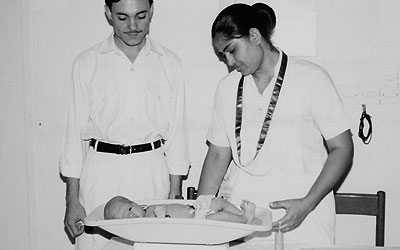
Midwives are frontline health care providers playing a vital role in reducing maternal mortality. The Aga Khan Hospital’s Nursing and Midwifery Service is committed to providing effective and efficient care to meet the needs of its patients. The Service delivers a high standard of patient care that is intended to exceed expectations of patients, families and the local community. Nurses are trained on a regular basis to cope with technological advances and societal complexities.Photo: The Aga Khan Hospital for Women, Karimabad

Midwives are frontline health care providers playing a vital role in reducing maternal mortality. The Aga Khan Hospital’s Nursing and Midwifery Service is committed to providing effective and efficient care to meet the needs of its patients. The Service delivers a high standard of patient care that is intended to exceed expectations of patients, families and the local community. Nurses are trained on a regular basis to cope with technological advances and societal complexities. Photo: The Aga Khan Hospital for Women, Karimabad

Editor’s note: In a recent piece for Simerg, Shariffa Keshavhejee enlightened our readers with The Amazing Story of Kundan Paatni: A Graduate of the Aga Khan Nursing School in Nairobi in the 1960s which included rare pictures of His Highness the Aga Khan. In this new exclusive essay, which coincides with the arrival of Mawlana Hazar Imam to East Africa to preside over the Aga Khan University Convocation in Dar-es-Salaam (February 24, 2015), Kampala (February 26), and Nairobi (March 2), Shariffa tells us contrasting tales of midwifery and nursing from decades earlier, including that of her own birth.

Midwife Noor Banu

My friend Mala Pandurang told me of an Ismaili Khoja midwife who delivered three of her children at home in Bukoba. She was called Noor Banu, the only Asian midwife in the locality. Mala’s search to get more information about Noorbanu at the British colonial office drew a blank. She is now looking at links from India to see if any of the midwives came from the  nursing institutions started by the British early 20th century. Child birthing was associated as unclean, and hence the Hindu women who joined these professions were of the lower castes. Mala also wants to know if any of the midwives were spinsters/widows.

Zarin Jivanjee and Midwife Asbaimasi

Zarin Jivanjee was born at home in 1943 in Nagara. Her house was a traditional Indian home with a fario (deck) in the center where all activities happened — drying clothes, lentils and making large amounts of food.  Midwife Asbaimasi came home. She was old, and well known even by prominent families such as Sir Eboo Pirbhai. Asbaimasi also prescribed herbal medicines for aches, pains, colds, digestive problems, rashes. In her window there was black thread. For each complaint. she would give a thread and a powder. She lived in River Road and had to be summoned at birth. There was a Dr.Anderson but the treatment given by Asbaimasi was more effective and preferred.

Shirinbai, Fatmabai, Roshankhanu and Khatibai

Shirinbai Juma born in 1934 in Jugu Lane. The midwife came home.

Fatmabai was born in Kathiawar, her family came from Harravad.  There was a bai who came to deliver at home. She was given five and a half rupees for delivery.

Roshankhanu Jiwa Nathoo was born in 1935 in Kisii. In Kisii too children were born at home The midwife was an old Nubian lady who was very well versed.

Khatibai Mohamed was born in Jugu Lane in the centre of Nairobi. She would go home and the staff would help with the hot water and cleaning up. If there was a miscarriage, she could not remember what would happen.

The Impact of Imam Sultan Mahomed Shah’s Farmans

Portrait of Mawlana Sultan Mahomed Shah. Photo: US Library of Congress.

Portrait of Mawlana Sultan Mahomed Shah. Photo: US Library of Congress.

I was told by Dr. Sultan Somjee, the author of Bead Bai, that there was a farman (guidance) of Imam Sultan Mahomed Shah, His Highness the Aga Khan III (1877-1957) telling the Ismaili community to take up nursing and not to look down on the profession. Thereafter many Ismaili women trained as nurses that included midwifery. We called them collectively as naaras and not nurse. Fatma naaras was well known in Nairobi. Indeed Somji’s book begins with Birth Stories (Chapter II) told by midwife of old Nairobi, Jugu Bazaar. Now, the Aga Khan Hospitals/University have nursing as priority programmes.

The Story of Shirin

Shirin Cassam Keshavjee was inspired by the 48th Imam’s farman. She joined Witwatersrand University (Whits), South Africa, to train as a nurse and then as a midwife. However she could not practice nursing near her home, being a person of colour.

Fortunately for Shirin, she heard an announcement in the Pretoria Jamatkhana that they were looking to employ a nurse in the Aga Khan Clinic in Kisumu. Lucky for Shirin, her uncle, Habib Keshavjee, was off to East Africa with his family.

So Shirin joined Habib Keshavjee’s family for the trip. She came to Nairobi and proceeded to Kisumu to live with the family of my grandfather, Count Hasham Jamal. Here Shirin was to change the face of midwifery in the Nyanza District. She was the first ever qualified midwife.

She was appalled at the state of the women and the new born child. Her kind hearted and soft spoken manner brought mothers from all over the district of Nyanza, Homa Bay, Kindu Bay, Kissii, Kimlili, and all the way from Kampala too!

She explained early care of the child, sanitation, breast feeding, sterilization, diet of mother and child. Shirin then married my cousin, Amir Shamji. Thus began the liaison. Now there are five Keshavjees, married to five Jamals!! Shirin Shamji (nee Keshavjee) lives in Toronto.

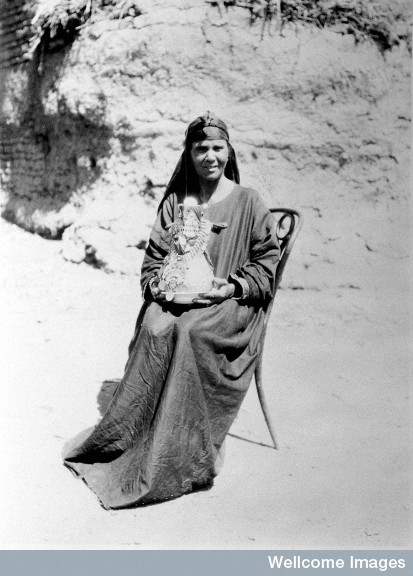
A midwife in Upper Egypt holding a kulleh pot. Also known as the goollah, it is a porous water-jar of sun-dried Nile mud. Photo Credit: Winifred S. Blackman/ Wellcome Library Image, London.

A midwife in Upper Egypt holding a kulleh pot. Also known as the goollah, it is a porous water-jar of sun-dried Nile mud. Photo Credit: Winifred S. Blackman/ Wellcome Library Image, London.

‘Laxmi’ Jenab Nanjee

The following story was narrated by Jenab Nanjee to her daughter-in-law, Nuri Abdul, daughter of Madatali Suleiman Verjee

“I was born in Jugu Lane now called Gulzar Street on Sunday, August 20, 1930. It was my grandfather’s house, Madatali Suleiman Verjee. It  was customary to go to your parents house at the time of birth.

“My mother was in her final days of pregnancy. She was ready now to go to her parental home for Khoro Bharavo. Khoro is the lap. Bharavo is to make full. This is a ceremony filled with abundance on the lap of the new mother. A special prayer is recited and the expectant mother’s mother prepares a coconut and some sweet meats to take to Jamatkhana to make sacred this time of birth. The new mother usually wears green as a symbol of plenty and of happiness.

“A European nurse, a qualified midwife was asked to come home for delivery. This was a privilege of the wealthy. ( I wonder what happened to the not so wealthy)

“I was born on a Sunday. My grandfather was very happy and pleased that a ‘laxmi’, a daughter was born to his daughter. Sometimes a daughter was a bad omen. Suleiman Verjee saw this as a sign of prosperity. He gave me the first gursurdhi  jaggery mixed with water. A sweet drink to  bring sweetness into my life. He gave me the name of Jenab, a name of one of the wives of the Holy Prophet Muhammed (s.a.s).

“My mother and I stayed at my grandfathers house for a month. This was so that my mother could be helped with my first initial upbringing and that my mother would regain her strength. At this time the family visited my mother and she was given many gifts called ‘chati’.

“Customarily it was significant that Mrs Suleiman Verjee was given such good care, received many gifts and that she had the care of a qualified midwife. Jenub, now 82  lives in Nairobi.

“Now the course offered by Aga Khan University in East Africa is call Nursing and Midwifery. It leads the way in East Africa. It offers undergraduate, and graduate programmes as well as conversion and professional and continuing education courses.

“The nurses can achieve international standard, even when they are studying and are mothers. They study as they work.”

During his visit to East Africa in 2009, Mawlana Hazar Imam toured  some of the Hospital’s diagnostic services and specialist clinics.  Photo: AKDN

During his visit to East Africa in 2009, Mawlana Hazar Imam toured some of the Hospital’s diagnostic services and specialist clinics. Photo: AKDN

The Story of My Own Birth

I now share the story about my birth in Kisumu on June 1, 1946. We lived in Jamal Building facing Lake Victoria. The building was constructed on Main Street Station Road in 1945.

Now that she was full term, my mother Khatija had to move to the downstairs room. She could not deliver her baby in the upstairs room, where there was a great deal of traffic of the extended family. Besides older children Zeenat and Amina, she had a brother-in-law Amirkaka, sister-in-law Nasirbanu and of course her in-laws, Bapaji and Ma. The downstairs room was called ‘Nichlo room’.

It was already embarrassing moving down. In 1945, women or men never talked about pregnancy, welfare of the mother and so on. Expectant mothers were covered by a long dress and a pachedi (shawl) would be drawn over the head in the presence of Bapaji or any male relative.

So Khatija, my mum, was all prepared with clean sheets and extra americani sheeting for the baby. No early preparation was made for the baby. It was a bad omen to do so. No layette, no baby showers!!!

It was before 4 a.m on 1st June. Khatija hoped that Bapaji would go for his early morning prayers, so that she could ask my dad to get Sherabai Hirji, the midwife.

Sherabai was smart. She was also cheerful and kind. In her white uniform, she inspired confidence. She was very good at delivering but she did not keep medical notes such as the baby’s weight, height, and temperature. However, my mum was relieved to see the arrival of Sherabai, who was a friend and well known to the family. Seeing my mother out of bed she admonished,  “What are you doing out of bed? You are so close now, get into bed!”

As if to help, my mother said “Let me get the hot water and the sagri….open brazier, jiko.” She got another reprimand, “You are doing no such thing.” Sherabai organised the water, sheeting and towels. She was familiar with the household having brought into the world Amina and Nasirbanu just a few years earlier.

Thus I was born in the presence of midwife and nurse. Sherabai then organized a brick, which would be heated on the jiko and placed on the mother’s stomach to keep it in shape.

Sadly, I was yet another female child. This did not auger well for my mother, nor for the family. Nevertheless, there I was, plump and full of life, to be loved by all the family in Kisumu till a year later we moved to Mombasa.

Date posted: Saturday, February 21, 2015.

Copyright: Shariffa Keshavjee. 2015.

_____________

Shariffa KeshavjeeAbout the writer: Shariffa Keshavjee is  a philanthropist and an entrepreneur with an objective to help women empower themselves. Raised in Kisumu, she considers herself a “pakaa” Kenyan. She is now based in the nation’s capital, Nairobi. Her other interest is in visual arts where she delights in painting on wood, silk and porcelain using water colours, oils and acrylics. She also likes writing, especially for children, and bird watching.

Feedback: We welcome feedback/letters from our readers. Please click Leave a comment or submit your letter to simerg@aol.com. Your feedback may be edited for length and brevity, and is subject to moderation. We are unable to acknowledge unpublished letters.

Links to a selection of articles by Shariffa Keshavjee on simerg and simergphotos:

  1. Bagamoyo’s Historic Ismaili Jamatkhana Through Pictures, Poetry and Prose
  2. Inferno of Alamut
  3. The Jamatkhana in Toronto — “A Seed of Faith Planted…” by Shariffa Keshavjee
  4. My Fascination with the Once “Exotic” World of Paan