Simerg is an independent initiative dedicated to Ismaili Muslims, the Aga Khan — their Hereditary Imam — and the Ismaili Imamat, and Islam in general through literary readings, photo essays and artistic expressions
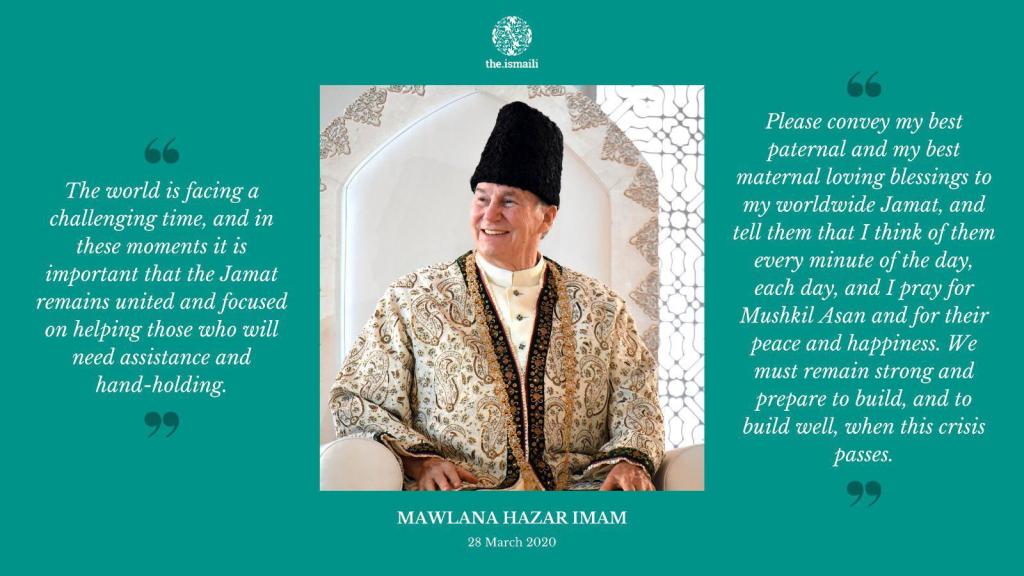
A portrait of His Highness the Aga Khan taken during his Diamond Jubilee, with the 2 columns containing his recent message to worldwide Ismailis. Image: The Ismaili. Please see text below.
[Mawlana Hazar Imam, His Highness the Aga Khan, has sent a message with blessings for his global Ismaili followers, which is shared here by Malik Talib, Chairman of the Ismaili Leaders’ International Forum. The message is reproduced from the official website of the Ismaili community. – Ed.]
By MALIK TALIB (Chairman of the Ismaili Leaders’ International Forum)
On the occasion of Navroz [March 21, 2020, New Year], our beloved Mawlana Hazar Imam blessed us with a Talika Mubarak conveying special blessings for Mushkil Asan, and prayers for our health and well-being. Today, I am pleased to share with you that, recently, in a communication to the International Steering Group coordinating the efforts to ensure the Jamat’s safety and wellbeing, Mawlana Hazar Imam was pleased to bestow blessings for the Jamat as follows:
“Please convey my best paternal and my best maternal loving blessings to my worldwide Jamat, and tell them that I think of them every minute of the day, each day, and I pray for Mushkil Asan [Protection from difficulty – Ed] and for their peace and happiness. We must remain strong and prepare to build, and to build well, when this crisis passes.”
It is in our Tariqah’s long-standing tradition that Mawlana Hazar Imam provides guidance to the Jamat at all times, including during crises, and the Jamat relies on the Imam of the Time’s blessings and direction. Hazar Imam’s message also stated the following:
“The world is facing a challenging time, and in these moments it is important that the Jamat remains united and focused on helping those who will need assistance and hand-holding.”
Hazar Imam expressed his happiness that all the institutions are working collectively to address the challenges that the Jamat is facing under the current circumstances, and reiterated that the Jamat’s safety, security and wellbeing is paramount.
As the COVID-19 virus continues to spread at an alarming rate, it is clear that the single most important action that we can take is to meticulously follow the advice of global health authorities by prioritising the requirements of “physical distancing” to protect ourselves, our families, and our Jamats. This means staying home as much as possible, and following the guidelines for washing hands regularly and thoroughly, avoiding contact with others, covering the mouth when coughing or sneezing, and self-isolating if symptoms arise.
This is a difficult time. We all miss attending Jamatkhana and meeting our family and friends. But for their safety and your own, we must stay strong. Through this period, let us stay connected with our family, friends and neighbours over the phone or through technology. Physical distancing does not mean social distancing – we must stay united as One Jamat and support each other. And let us remember to draw at all times on our faith for comfort and solace by calling on the tasbih as guided by Mawlana Hazar Imam.
Looking forward, Mawlana Hazar Imam has encouraged us to turn our focus to rebuilding, and perhaps in some cases repositioning, when this crisis passes, and focus our efforts to build a stronger future for the global Jamat.
Let us submit our humble Shukrana to Mawlana Hazar Imam for his blessings, encouragement and hope, and pray for the global Jamat’s safety, well-being and Mushkil Asan.
Ameen.
Date posted: March 30, 2020.
______________________
We welcome your feedback. Please complete the form below or click on Leave a comment if the form is not displayed.
The Aga Khan Foundation logo is based on the right hand, a universal symbol of skill, achievement and caring. It symbolizes the humanitarian and positive philosophy underlying the Foundation and its activities.
By KHALIL SHARIFF (Chief Executive Officer, Aga Khan Foundation Canada)
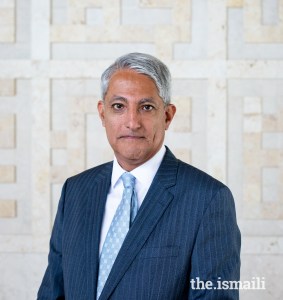
Khalil Shariff. Photo: AKFC
March 25, 2020.
Dear friends,
As conditions around the world change rapidly during these unprecedented times, we wanted to share a brief update to keep you informed of how we are responding to COVID-19.
COVID-19 has now grown from an outbreak in one city to a pandemic of global proportions. It is unlikely any country will be untouched by its ripple effects. More than ever, it is clear how Canada’s future is intertwined with the rest of the world.
The health and safety of our supporters, volunteers, and staff are paramount to us. In Canada, we are following all recommendations of the Government of Canada and the Public Health Agency of Canada, as well as the local public health authorities in the Canadian cities where we operate.
That means, effective last week:
1. All our Canadian colleagues are working from home.
2. We have come to the difficult decision to suspend this year’s World Partnership Walk and World Partnership Golf campaigns. We will have more information on alternate plans to share on these soon.
3. We have cancelled all tours of the Delegation of the Ismaili Imamat building in Ottawa until further notice.
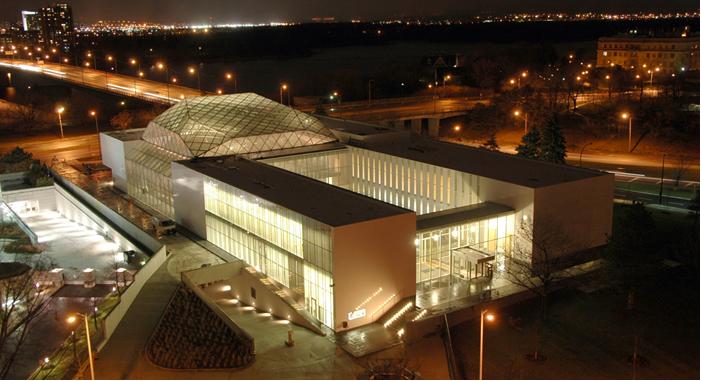
The offices of the Aga Khan Foundation Canada are located inside the Delegation of the Ismaili Imamat on Sussex Drive in Ottawa, pictured above. The building was inaugurated by Mawlana HazarImam, His Highness the Aga Khan, and the Right Honourable Stephen Harper, Prime Minister of Canada, on December 6, 2008.Photo: Maki and Associates/Moriyama and Teshima Architects.
4. Our travelling exhibit, In a Heartbeat, is suspended until further notice.
5. We have postponed our International Youth Fellowship pre-departure training in Ottawa to begin at the end of July, with overseas placements beginning at the end of August. We will continue to monitor the situation in the coming weeks and months, and will adjust the program as required to ensure our fellows’ well-being.
6. All other in-person events have either been cancelled, rescheduled online, or postponed.
We have taken these steps to do our part to slow the spread of COVID-19. We are immensely fortunate in Canada to have such competent health leadership, and we encourage everyone to heed the advice of health authorities as best they can.
Healthcare facilities and workers around the world are at the frontlines of events like these. Canadian support over the past 40 years has strengthened health systems across Africa and Asia, and we remain hopeful these investments will mitigate the impact of COVID-19 in the geographies where we work.
We also want to assure you that we remain committed to our countries and communities of operation during this crisis. The Aga Khan Development Network, of which we are a part, is mounting a robust response to address the many aspects of this pandemic. Now more than ever, it is important that our work of strengthening systems, institutions, and communities for times of fragility pushes forward.
We may all be working remotely for now, but we are still here for you. If you are already connected to a staff member, you can reach them by email. Otherwise, you send an email to info@akfc.ca, and we will direct your inquiry to the right person. If you have questions about your 2019 tax receipts, you can reach our Donor Services team directly at donorservices@akfc.ca or leave a voicemail at 613-237-2532 ext. 191.
In global crises like these, it is easy to dwell on what worries us. But I invite us all to step forward in support of our friends, relatives, and neighbours for whom this time may be especially trying. We can weather this better together.
We will reach out again as the situation and our plans to respond develop. Until then, we wish you and yours continued good health and spirits.
Sincerely,
Khalil Z. Shariff Chief Executive Officer Aga Khan Foundation Canada.
The COVID-19 pandemic is having an enormous impact on individuals and families in our communities and around the world.
AKU [Aga Khan University] is on the front lines of the response to this unprecedented health challenge. Our dedicated physicians, nurses and other medical staff are working tirelessly to save lives.
You can support our efforts to secure specialised medical equipment, provide testing and life-saving care to the vulnerable through our Patient Welfare Programme, and address the needs of our physicians and healthcare personnel during this extraordinary time [Note: readers outside Pakistan have encountered problems in completing the form – please select the COVID-19 Fund over the Zakat Donation COVID-19 Fund option, and see if that works for you – Ed.].
The COVID-19 Fund would support the following:
1. Providing world-class medical care, including for disadvantaged patients through our Patient Welfare Programme;
2. Securing specialised equipment including ventilators and personal protective gear for our staff;
3. Changes to our hospital and University facilities to expand our capacity to respond effectively to this emergency;
4. Research by our infectious disease specialists, and others, that contributes to the global effort to deliver better diagnostics for COVID-19 and care for those infected;
5. Support for our staff who are working exceedingly long hours, and need accommodation and other essential support.
If you would like to make a donation, additional information may be found HERE.
Before departing this website please take a moment to review Simerg’s Table of Contents for links to hundreds of thought provoking pieces on a vast array of subjects including faith and culture, history and philosophy, and arts and letters to name a few. In the past few days, we have published some excellent pieces on Navroz.
Mawlana Hazar Imam, His Highness the Aga Khan, 49th Imam of the Shia Imami Ismaili Muslims, pictured at the Diamond Jubilee Darbar in Kenya. Photo: The Ismaili,
By MALIK TALIB (Chairman of the Ismaili Leaders’ International Forum)
On the occasion of Navroz, our beloved Mawlana Hazar Imam has most graciously sent a Talika Mubarak to be shared with our global Jamat, which reads as follows:
My dear Malik,
On the occasion of Navroz, I send to my worldwide Jamat my best blessings for peace and happiness in their lives.
I am also sending my special blessings for Mushkil Asan for my Jamats wherever they may be, and I pray for their health and their well-being.
Yours affectionately,
Aga Khan
I convey warm Mubarak to the global Jamat on the occasion of Navroz and, on behalf of all the murids world-wide, I express humble shukrana to our beloved Mawlana Hazar Imam for the gracious Talika.
Mawlana Hazar Imam’s Guidance Central to Ismaili Institutions’ decision making during the COVID-19 crisis
….Malik Talib’s message continues below
The festival of Navroz is a time for hope, optimism, renewal, and faith – even in times of uncertainty and difficulty.
I would like to assure the Jamat that all Jamati institutions and leaders around the world are doing everything possible to ensure the Jamat’s safety and security.
For so many of us, the temporary suspension placed on Jamatkhana gatherings is perhaps the most difficult among the wide array of disruptions to our everyday lives. The decision to temporarily suspend our Jamatkhana gatherings was not taken lightly, and was implemented in accordance with Hazar Imam’s guidance to comply with government and public health guidelines around the world.
While we appreciate that this indeed is a very difficult disruption, and that we are no longer able to gather physically at the present time, we remain unified in our faith, in devotion and compassion.
These bonds of community have sustained throughout the vagaries of time and history, and will continue in the difficult weeks and months ahead. As we prepare ourselves, we will work together as a united Jamat.
It is of great importance that we follow the directions given by the Jamati institutions who are working with the AKDN [Aga Khan Development Network] to ensure compliance with government measures to mitigate the effects of COVID-19.
Ours is an esoteric faith. Our Imam has time and time again reminded us of the importance of spiritual contemplation, reflection, personal search and prayer. In these moments we will find peace and solace to overcome our current challenges. We would be well advised to recall Mawlana Hazar Imam’s Farmans regarding engaging in personal prayer, when we are unable to attend Jamatkhana. It is my conviction that adhering to this guidance will bring us comfort in these challenging times.
Virtual Jamatkhanas Inappropriate
Malik Talib, Chairman Ismaili Leaders’ International Forum
….Malik Talib’s message continues below
The temporary closure of our Jamatkhanas has resulted in the appearance of electronic and digital channels offering a “virtual Jamatkhana”. This is clearly inappropriate, as a Jamatkhana may only be established and function under the Imam’s authority, through his institutions and appointed Mukhi-Kamadias.
At this time in particular, it is critical that we understand the risks of misinformation and miscommunication, and rely only on credible government and Jamati institutional sources – including The Ismaili – the official website and social media channels for the Jamat.
At a time of increased economic anxiety, it is also imperative that we act rationally, with prudence and sound judgement.
COVID-19 pandemic at the forefront of Mawlana Hazar Imam’s thoughts
….Malik Talib’s message continues below
The current developments regarding the COVID-19 pandemic have been at the forefront of Mawlana Hazar Imam’s thoughts, and I would like to inform the Jamat that, following Mawlana Hazar Imam’s guidance, an international Steering Group has been established to coordinate the efforts to ensure the Jamat’s safety and well-being, and to support the responses being undertaken in each national Jamati jurisdiction.
These are difficult times. However, as one Jamat, our faith unites us, and gives us the strength, courage and hope to face this adversity, and emerge from it, a stronger community, bound by our values, and our allegiance to the Imam-of-the-Time.
Let us offer shukrana for Mawlana Hazar Imam’s continued love, grace, protection and guidance, and pray for the Jamat’s safety, good health and Mushkil Asan.
Ameen.
_______________________
A Note from the Publisher/Editor of Simerg
By MALIK MERCHANT
Nothing can be more gratifying for a murid of Mawlana Hazar Imam than receiving his blessings on the occasion of Navroz, as well as special blessings for Mushkil Asan at this particular time of a world wide novel coronavirus pandemic. Instead of celebrating Navroz in Jamatkhanas, we will be observing it in our unique ways in our homes. This is unprecedented in recent history! However we have received the Imam’s Blessings as we would in Jamatkhanas. That should bring contentment and happiness in our hearts and give us immense strength and hope for the future.
The message from Malik Talib, the Chairman of the Ismaili Leaders’ International Forum, has outlined our responsibilities as members of a universal brotherhood. It is important that we follow the instructions of the leaders at this time of crisis, and act according to the wishes of Mawlana Hazar Imam.
Date posted: March 21, 2019.
We invite our readers to share their feelings, Navroz greetings, and unique experiences during the extraordinary events that are taking place in light of COVID-19. Please complete the feedback below, and if you don’t see the form please click LEAVE A COMMENT
______________________
Before departing this website please take a moment to review Simerg’s Table of Contents for links to hundreds of thought provoking pieces on a vast array of subjects including faith and culture, history and philosophy, and arts and letters to name a few. In the past few days, we have published some excellent pieces on Navroz.
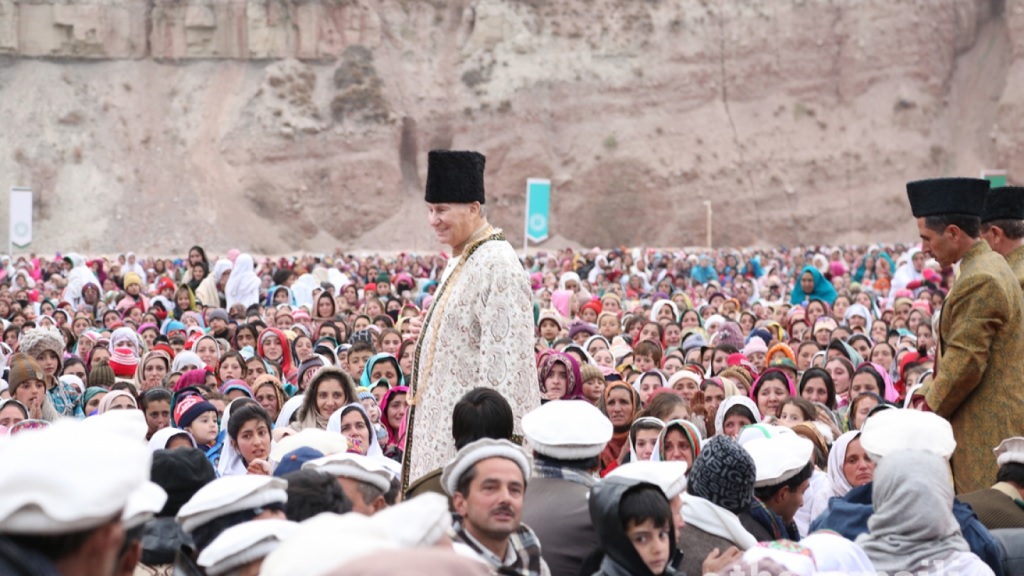
Mawlana Hazar Imam in Booni Chitral during his Diamond Jubilee visit to Pakistan in December 2017. Photo: The Ismaili/ Karim Sadruddin.
By SHIRAZ PRADHAN
As the world struggles to cope with the novel coronavirus pandemic, it is natural to become anxious. We live in extraordinary times. The closure of Jamatkhanas in almost all countries accentuates our anxiety. I do not intend this article to be doom and gloom. To the contrary, I want to portray hope from our faith.
The emergence of this new virus and its global impact has demonstrated the intricate ways in which humanity is interconnected and how it has brought entire humanity to its knees and shown us the vulnerability of the ‘House of Cards’ that is our civilization. There is no ‘foreign virus’ as some have chosen to describe it. This virus is brutally merciless and does not recognize race, colour, gender, religion or national boundaries.
There is already a disruption of social care and communal services as the pandemic progresses in Europe, North America and elsewhere. This will transfer the burden of care of the aged, less able and vulnerable to younger, and healthier family members who may ride through the illness with minor discomfort. The projected time periods are likely to be several months.
Bearing in mind all these factors, how should we react to the pandemic? Ours is an intellectual tradition. Allah possesses the power of miracles, but we do not relay on Allah’s miracle alone.
At this very moment, there are laboratories around the world racing against time to come up with a vaccine against the virus. Indeed, one was tested on a few patients a few days ago. May be the virus is temperature sensitive and as we, in temperate zones transition to spring and rising temperatures, it may abate the virus. May be the ‘herd immunization’ strategy that is talked about will work and lessen the impact of the new virus. As ordinary citizens, we sometimes feel helpless. Under such circumstances, after following all the advice we are given to protect ourselves and our beloved ones, the next tendency in people in troubled times is prayers.
Psychologists have long known this fact. It gives people tremendous hope and alleviates stress in face of adversity. Prayers work, and in this I am reminded of a Farman Mawlana Hazar Imam had made in the 1960’s when he said that those who prayed in difficult times knew how prayers had helped them during their difficulties. At the same time, he reminded us that we should not only pray when times are bad but also when times are good.
Our Ginans can also give us help during these difficult times. Several Ginans have powerful verses of supplication and pleading for Allah’s mercy and compassion and help. These verses are not parochial but are pleadings for Allah’s compassion and mercy for the entire humanity. In the context of the pandemic, this fact comes out clear. It is our hope that this ‘One Humanity’ idea endures beyond the pandemic.
Some of the verses I present are well-known, but I include them for completeness. First is a verse that extols the virtue of congregational prayers. It is from Pir Hasan Kabir’s Anant Akhado, verse 115.
Aashaaji til dharam ne hasti paap sohi gat utaare ji Gat naa vachan te Nar ji maane te maahaadan maanhe nahi puchhaaye.
Translation:
O Lord, our good deeds are minuscule, our sins monumental. These are forgiven in congregational prayers The Lord listens to congregational prayers and spares the questioning on the Day of Judgement.
The physical separateness due to the closure of our Jamatkhanas does not preclude us from offering prayers for humanity in our hearts and/or with our families.
In Pir Hasan Kabir’s Ananta Akhado, verse 32, Pir says that in Lord’s Assembly, He grants you whatever you wish.
Aashaji jiya jem mango, tiya tem verse, Satgur gher anand ji
Translation:
Whatever you ask for in His assembly, He grants. There is joy and no one returns disappointed from His assembly.
In verse 127, the scope of the pleading and supplication expands and encompass the entire humanity.
Aashaji, Sansar serve Shrusti tamari, ane serve mankha jiv ji Daya kari teme amne taaro, Sami serve jiv tamara ji
Translation:
O Lord, the entire creation is Yours, as are the souls, With compassion, save us, O Lord, we all are Your souls.
In Pir Hasan Kabir’s Venti Eji Aash Tamari Shree Ho, which is full of supplications and pleadings, the opening verse portrays the congregation, standing with hands folded, asking for Lord’s compassion:
Eji, Aash tamari Shree Ho Kayam Sami, Saheb Chinta kee je, Ya Shah Sab Gatie Shah ke khde re umayo Shah Raj Rikhisar Ghar Dejo
Translation:
O Lord, we are hopeful of and dependent on your compassion; O Lord, we beseech you, spare your thought for us; the entire congregation is standing in submission; O Lord, bestow prosperity and happiness upon us…
Next is a beautiful venti of sincere submission and heart rendering plea for help by Pir Hasan Kabir in Hum Dil Khalak ya Ali tu(n)hij:
Hum dil Khalak ya Ali tu(n)hij vase, Ya Mawla tu(n)hij vase, avar na dhuja koi, jive pi(n)dhe jo tun(n)hij dhani; Ya Mawla tu(n)hij dhani. Jia(n) kari(n) tiya hoi Maher karo mora saai ya Ali hum tere aadhar Tere aadhar ya Mawla tu(n)hij daatar Maher karo mora saai ya Ali hum tere aadhan
Translation:
Only you reside in my heart O Ali, O Mawla only you, Non-other I think of You, who are master of my soul and body O Mawla, truly you are the Master Your wish and command prevail Show mercy O Lord Ali you are my support, I am dependent in You; O Mawla you are the provider (of all my needs) Show mercy O Lord, Ali you are my only support
The next powerful verse that we often recite to seek divine help is from Seyyad Imam Shah’s Ame Saaheb Saathe, Verse 6
Eji Tuj vinaa koi avar na dise, Saami amne chhe tamaaro aadhaar-ji; Tuj vinaa ame eklaa Saami, Saami tame thaajo rakhvaarr-ji
Translation:
O Lord, You alone we see, O Lord, we rely upon You Without You we are all alone Please be our protector (In these troubled times)
In addition to the Ginans, our daily Arabic Du’a has powerful pleas for help. In part two we recite:
“O Allah, O our Lord from You is my help, upon You is my reliance. You alone we worship and You alone we seek for help. O Aly help me with your kindness.”
In part three of our Du’a, we recite:
“Seek at times of difficulty, the help of your Lord, the present living Imam, Shah Karim al Hussaini.”
In part 4 of our Du’a, we recite:
“O Allah: Forgive us our sins, give us our daily bread and have mercy upon us….”
In part five of our Du’a, we recite:
“Ya Shah Karim, O Mawla, from you is my strength…”
As we go through this difficult time we should take comfort from these Ginanic verses and our Holy Du’a as well the Farmans of Mawlana Hazar Imam that have been published recently. Repeatedly, he assures his murids of his constant presence with them. For example, in his Diamond Jubilee Farman made in Booni, Chitral, Pakistan, he lovingly tells us that he is always with his Jamat, every day, every minute, every second (Diamond Jubilee Farman book, page 57, also pages 51, 62). As such, we should seek to keep his enduring blessings for mushkil-asan (protection from difficulties) alive in our hearts all the time.
I pray that these trying times pass and that Allah in His compassion listens to our plea for help for humanity. His compassion and mercy know no bound.
Date posted: March 18, 2020.
Before departing this website please take a moment to review Simerg’s Table of Contents for links to hundreds of thought provoking pieces on a vast array of subjects including faith and culture, history and philosophy, and arts and letters to name a few.
_____________________
Shiraz Pradhan
Shiraz Pradhan, in parallel with his work as an international engineering consultant, has contributed for several years to furthering religious education among the Ismaili community in the UK, Canada, USA and Japan. He is the author of several articles published on this website and was a regular contributor to UK’s flagship Ismaili magazine, Ilm. Currently he is concluding the script of a full-length play of the 10th Century trial of the Sufi Saint Mansur al-Hallaj in Baghdad based on historical facts.
The author wishes to thank Platinum Rahemtulla for references to Ginanic verses and their translations that are quoted in the article.
____________________
We welcome your feedback. If you don’t see the feedback form below please click on Leave a comment.
We are everyday encountering special words or expressions such as corona / coronavirus / novel coronavirus / COVID-19 / outbreak / epidemic / pandemic / quarantine / self-quarantine / isolation / cordon sanitaire / symptom / symptomatic / asymptomatic / incubation / morbidity / mortality / social distancing. We turn to TIME magazine for an easy to understand glossary of the coronavirus jargon. It is worth your time to read the weekly magazine’s excellent piece, and familiarize yourself with the terms so you can understand what you are reading and explain them to your children and family members!
Date posted: March 17, 2020.
Before departing this website please take a moment to review Simerg’s Table of Contents for links to hundreds of thought provoking pieces on a vast array of subjects including faith and culture, history and philosophy, and arts and letters to name a few.
When you have not missed a day in Jamatkhana attendance over the past several years, how do you cope with sudden and unforeseen closures of your favourite Jamatkhana? We live in difficult circumstances. Covid-19 — the disease caused by the novel coronavirus — has infected tens of thousands around the world and has been declared a pandemic, causing anxiety and worry. I left a pharmacy on Friday March 13 with a customer expressing, “it feels like death can approach anyone of us, and I just feel at the moment that I might die.” When I next visited a supermarket at around noon time, people were filling their shopping carts to the brim with supplies for their families. Ismaili institutions in Canada on the same day announced the closure of Jamatkhanas in several provinces around the country to protect the elderly and everyone who is vulnerable due to compromised immune systems. A similar decision was made by the USA Aga Khan Council for cities across many states on Saturday, March 14. Of course, these are also containment measures to prevent the spread of Covid-19. These measures have also been necessary as a result of bans that have been imposed by state or provincial or even Federal authorities on large gatherings.
In 1979, I was left with a difficult situation of being the only Ismaili in Salt Lake City, Utah, for several months, until a family arrived just before I left the following summer. The nearest Jamatkhanas were in Denver, Las Vegas and Phoenix, hundreds of miles away. I disciplined myself to pray regularly and the happiness and strength I achieved was comparable to my earlier praying days at 5 Palace Gate in London, England. In London, I had become a regular only in 1976, and before that attended Jamatkhanas only on Fridays at Central Hall when I was a student at the Polytechnic of North London. In Salt Lake City, I set aside a corner in my room for the purpose of praying. It was a tiny 12-15 sq ft space beside my bed. The night table contained my rosary (tasbih), with the drawers containing Farman and Ginan books along with a copy of the Holy Qur’an as well as some literary magazines and books. I performed my prayers in an identical fashion to what takes place in Jamatkhana — reciting the Du’a, Farmans and Ginans loudly as well as standing up for the tasbih. My heart and soul enjoyed the spiritual nourishment that I experienced even from praying alone. Chandraat (New Moon day or first day of the Islamic month) was a joyful day for me as I saw the new moon above the Wasatch Mountains that surround the Mormon capital. On my drive home in my roommate’s car, I looked forward to the special Chandraat prayers that I would recite.
A few years ago in Ottawa, I met and interviewed the eldest member of the Ismaily family, who was probably the first Ismaili to settle in Canada in the early 1950’s. He had met our beloved 48th Imam Mawlana Sultan Mahomed Shah, His Highness the Aga Khan III (1877-1957), just before his lone settlement in a new country. He told me the late Imam asked him to set aside a small portion of his room and conduct his prayers in that space just as he would in a Jamatkhana. The Imam also asked him to keep away from bad and evil social habits, and to work hard. Mr. Ismaily abided, and said that the practice that he adopted of praying regularly in a designated space gave him immense strength, comfort and spiritual happiness.
So here are my recommendations to families where Jamatkhanas have been temporarily closed — and we don’t yet know for how long! Try as a family to pray together. Visit your parents or grandparents at their home, if you are not staying with them, and say to them that you would like to join them for prayers. When visiting them, if you are healthy, take precautions such as hand washing and other important recommended hygienic steps like the ones posted by the Government of Singapore.
Remember they have all of a sudden been deprived of the most valuable moments in their lives — being in Jamatkhanas. Tell them you will recite the Du’a out loud. Keep in mind that many elderly people rely on listening to the prayers recited by another person. Many do not have the capacity to recite the Du’a. Play or recite a ginan or qasida, and join together in tasbihs to help ease our difficulties that we are facing at the present time. Say Ya Allah, Ya Muhammad or Ya Ali. Recite Salwats. Recite the tasbihs of Allahu Akhbar (God is Great), Subhanallah (Glory be to God) and Alhamdulillah (All praise is due to Allah) suggested by the Prophet Muhammad (S.A.S) to his beloved daughter Bibi Fatimah (A.S.). Say the tasbih of Ya Ali Tu Rahem Kar (O Ali be Merciful) Ya Mawla Tu Fazal Kar (O Lord [Ali] be gracious) that we recite during Jamati Satada (7 consecutive days of special prayers for the easing of difficulties). Remember, Mawlana Hazar Imam is our strength, so say Ya Shah Karim Ya Mawlana anta Quwati from the 5th part (O Shah Karim, You are my strength/support).
This is a perfect time to come together at home as families, with no live sporting distractions to take occupy our times! It is an opportunity to be together, to help each other out, to motivate each other, to connect more with our parents and children and to build family unity. It is also an opportunity to develop a balanced life, for those who are immersed with worldly issues, and engage more with our faith. Mawlana Hazar Imam’s blessings are with us constantly, and it is an opportune time to read his Farmans from the two-set Farman books that has just been published under his directive. Read them aloud to your children, siblings, parents and grandparents when you are around them.
These are my humble suggestions to ease through the anxious times that we face which is unprecedented in recent history.
May we continue to fulfill our spiritual responsibilities well during this difficult and anxious time in our lives to avail ourselves of Mawlana Hazar Imam’s constant blessings for our well-being, strength and mushkil asan (protection from difficulty).
Date posted: March 13, 2020. Last updated: March 21, 2020.
Before departing this website please take a moment to review Simerg’s Table of Contents for links to hundreds of thought provoking pieces on a vast array of subjects including faith and culture, history and philosophy, and arts and letters to name a few.
_________________
We welcome your feedback. If you don’t see the feedback form below please click on Leave a comment
Please click on image for guidelines and other important information issued by the Ismaili institutions in Canada
Ismaili institutions in Canada respond to COVID-19 with Jamatkhana closures
LATEST DEVELOPMENT: The Aga Khan Museum has announced that it will be temporarily closed until April 7, 2020. All scheduled events and programs up to and including April 6 have been cancelled. Ticket purchases for affected Museum events, programs, and performances will be automatically refunded by March 20, 2020.
Provincial health authorities in Canada have announced additional steps to limit large gatherings and reduce the risk of infection from the spread of COVID-19. As a result, the Jamati Institutions, in consultation with public health officials, and with the aim of protecting the most vulnerable in our Jamat, have closed Jamatkhanas in each jurisdiction. This includes morning, evening and weekend ceremonies. All Jamatkhana-based programming is also cancelled including social events associated with the celebrations of Navroz such as dandia raas, traditional dancing as well as jamans (large scale dining).
The decision to close our Jamatkhanas has not been taken lightly, and we seek the Jamat’s understanding and forgiveness for any inconvenience caused. While the Public Health Agency of Canada continues to assess the risk to the general population in Canada as “low”, we are taking these precautionary steps in the interests of the Jamat’s long-term health and security.
The Jamati Institutions will continue to provide regular information and updates to the Jamat via the electronic Al-Akhbar and iiCanada app. We pray for the safety and security of all Canadians and for all those affected globally.
EARLIER NEWS: Earlier during the day, Ismaili institutions had announced a cap of 250 people in Jamatkhanas in British Columbia, Ontario and Quebec following bans by the three provincial governments of gatherings of more than 250.
The Al-Akhbar newsletter distributed by the Aga Khan Ismaili Council for Canada via subscriptions contains COVID-19 updates with the intention of keeping the community informed of developments as they unfold, with specific reference to the situation in Canada, which is different from that in other parts of the world. Please click here for the latest COVID-19 update.
Ismaili institution response to COVID-19 in other parts of the world
Link(s) to measures taken by Ismaili institutions in other parts of the world for their respective Jamats will be provided below and will be updated regularly:
For non-Portuguese speakers, please use google translate to obtain a fairly accurate translation of the changes that are being implemented in Portugal. Interestingly, the article is pretty open about the specific steps that are being implemented within the ritual and ceremonial aspects of religious practices to contain COVID-19. The Portuguese article also states there have been no confirmed cases of COVID-19 in the country among Jamati members. – Ed.
Muslim countries take steps as Coronavirus plagues the world
Note: The content in this section is not being updated.
. Saudi Arabia has suspended Umrah pilgrimage to Mecca and Medina. Umrah is a pilgrimage that many Muslims elect to perform at any time of the year, and is a shortened version of the annual Hajj pilgrimage that is scheduled to take place in late July. Last year’s Hajj was attended by more than 2 million people, and this year’s Hajj hangs in the balance as fears about the coronavirus plague the world:
. Iran has cancelled Friday prayers across provincial capitals
. Singapore Muslims have been urged to bring own prayer mats to mosques;
. The government of Tajikistan has asked Muslims to avoid going to mosques for the Juma (Friday) prayers;
. Iran, Azerbaijan and Tajikistan are among countries that have halted the annual celebration of Navroz that takes place around March 21;
. In Malaysia, the health ministry has called on mass gatherings to be postponed after 12 cases were linked to a 3 day Islamic conference held in Kuala Lampur recently;
. Singapore has temporarily closed all the country’s mosques for deep cleaning from Friday March 13 after two men contracted the coronavirus while attending the Islamic conference in neighbouring Malaysia;
. The Muslim Council for Britain has just released a four page document containing guidance on the impact on mosques, madrasas and Islamic centres in the UK after the announcement that an emergency legislation is to be introduced to contain the spread of COVID-19;
. Across various faiths and religious denominations, rituals and practices are being tweaked to adapt to the outbreak of a disease that thrives on nothing more than close human contact.
At around noon on Friday, March 13, 2020 in Stouffville, north of Toronto, a Metro grocery store parking lot was full. Concerned shoppers had filled their shopping carts with all the essentials, and the line-ups at the cashiers at the supermarket were long as is shown in the photo above: Photo: Malik Merchant/Simerg.
Date posted: March 13, 2020. Last updated: March 19, 2020.
Before departing this website please take a moment to review Simerg’s Table of Contents for links to hundreds of thought provoking pieces on a vast array of subjects including faith and culture, history and philosophy, and arts and letters to name a few.
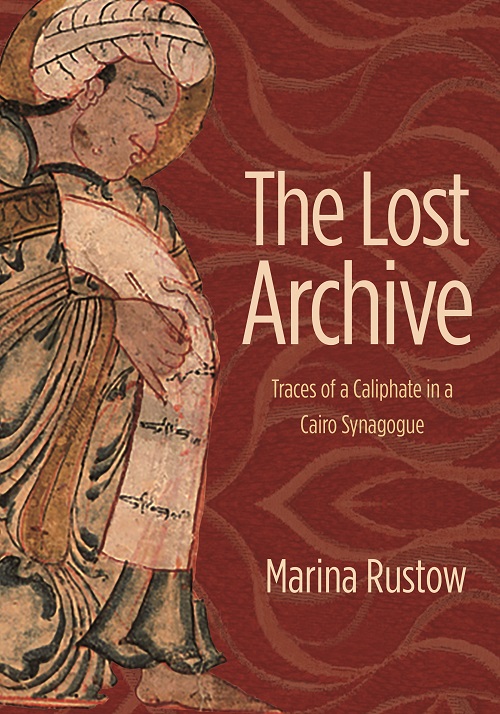
The Lost Archive by Marina Rustow, published on January 14, 2020 by the Princeton University Press; Pages: 624; Size: 7 x 10 in. Illus: 83 color + 17 b/w illus. 4 maps. 4c throughout. To purchase hardcover, Kindle or Kobo versions see links at bottom of this page.
Grabbing our attention now is a splendid new book on the Fatimids that looks at the caliphate’s robust culture of documentation. In an editorial review of the book, Konrad Hirschler of the Freie Universität Berlin describes Marina Rustow’s work “as a veritable magnum opus that will remain a point of reference for decades to come.” He also notes that “there are few books like this one that take the reader on such a long-distance journey across centuries and writing systems.”
The Lost Archive: Traces of a Caliphate in a Cairo Synagogue is Marina Rustow’s second work on the Fatimids. Her first one was entitled Heresy and the Politics of Community: The Jews of the Fatimid Caliphate. Sheis the Khedouri A. Zilkha Professor of Jewish Civilization in the Near East and professor of Near Eastern studies and history at Princeton University. She is director of the Princeton Geniza Lab and a MacArthur fellow. Her latest work is also praised by Geoffrey Khan, University of Cambridge, who states that “with great historiographical skill, Rustow brings new insights into the history of the medieval Middle East through a holistic analysis of the surviving state documents of the Fatimid dynasty. This is a splendid book.”
Marina Rustow has made very interesting and informative presentations of her research and work at the American Philosophical Society and the University of New Mexico. Links to both the videos are provided at the end of this piece.
The lost archive of the Fatimid caliphate survived in an unexpected place: the storage room, or geniza, of a synagogue in Cairo, recycled as scrap paper and deposited there by medieval Jews. In the book Marina Rustow tells the story of this extraordinary find, inviting readers to reconsider the longstanding but mistaken consensus that before 1500 the dynasties of the Islamic Middle East produced few documents, and preserved even fewer.
Beginning with government documents before the Fatimids and paper’s westward spread across Asia, Rustow reveals a millennial tradition of state record keeping whose very continuities suggest the strength of Middle Eastern institutions, not their weakness. Tracing the complex routes by which Arabic documents made their way from Fatimid palace officials to Jewish scribes, the book provides a rare window onto a robust culture of documentation and archiving not only comparable to that of medieval Europe, but, in many cases, surpassing it. Above all, Rustow argues that the problem of archives in the medieval Middle East lies not with the region’s administrative culture, but with our failure to understand preindustrial documentary ecology.
Illustrated with stunning examples from the Cairo Geniza, this compelling book advances our understanding of documents as physical artifacts, showing how the records of the Fatimid caliphate, once recovered, deciphered, and studied, can help change our thinking about the medieval Islamicate world and about premodern polities more broadly.
The hard copy or electronic Kindle version of “The Lost Archive” may be purchased at the following websites: Princeton Amazon & Amazon Canada Indigo
Date posted: March 8, 2020.
__________________
American Philosophical Society presentation by Marina Rustow (34 minutes)
~~~~~~~~~~~~
University of New Mexico presentation by Marina Rustow (1 hour 35 minutes)
[Includes material from multiple sources; a new addendum to the obituary has been added on March 8, 2020, following a feedback from Nazir Kassamali of Edmonton, who joined Nazeer Ladhani’s team at the University of Central Asia (UCA). We thank Kassamali for his input, which shows the significance of Nazeer Ladhani’s contribution at UCA at a critical juncture of its development path. – Ed.]
Simerg has learnt with profound sadness the untimely death of Nazeer Aziz Ladhani at the age of 72, in Nairobi, Kenya. According to an extensive obituary dedicated to him in The Globe and Mail, one of Canada’s most widely read and respected newspapers, Nazeer passed away in his sleep on February 19, 2020. Written by Ian Smillie and published under the title “International development agency CEO Nazeer Aziz Ladhani had a mischevious energy” (subscription may be required to read piece), the obituary is a tribute to the exceptional individual he was and the magnificent services he rendered to the Aga Khan Development Network and its numerous agencies in Canada, Asia and Africa.
Guy Pfeffermann, a long time friend of Nazeer, notes on the website of Global Business School Network (GBSN), that “I loved Nazeer. He was a gentle man, and one of the most learned I ever met on almost any subject. People loved to listen to him speak. In 2014 he sat on a panel of business school deans and other outstanding academics at the prestigious Online Education Berlin conference. He spoke last, and the participants were so enraptured by his Renaissance Man discourse that they just didn’t want to leave; the next group who had booked the room had to wait outside until, reluctantly, he let the audience go.”
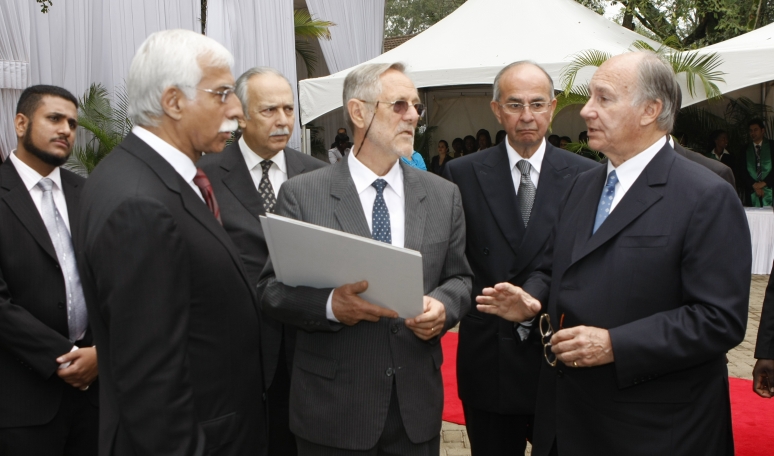
Mawlana Hazar Imam, His Highness the Aga Khan discusses architectural plans with Firoz Rasul, President of the Aga Khan University (AKU), Ambassador Saidullah Khan Dehlavi, Chairman of the AKU Board of Trustees, Trevor Andrews, Managing Director of Planning Systems Services Limited, and Nazeer Ladhani (2nd from right), Project Director of the AKU Graduate School of Media and Communications. Photo: AKDN / Ejaz Karmali.
Nazeer Ladhani’s Contribution to the Ismaili Imamat
Nazeer Ladhani worked in many senior roles with the Aga Khan Development Network and its agencies. He was the Project Director for Graduate Professional Education for Aga Khan University in East Africa, which includes the Graduate School of Media and Communications (see photo, above). He also served as the Director General of the University of Central Asia, a unique, internationally chartered higher university focused on the development of mountain societies, with purpose-built world class residential campuses in Naryn, Kyrgyzstan, and Khorog, Tajikistan and (future) Tekeli in Kazakhstan. Nazeer will be fondly remembered in Canada as the founding Chief Executive Officer of Aga Khan Foundation Canada (AKFC), which he led from start-up to a premier private international development agency in Canada. While at AKFC, Ladhani led efforts to establish the Global Centre for Pluralism in Canada.
Nazeer was born on August 20, 1947 in Tanganyika (now Tanzania) to a farming family. He went on to earn an agricultural diploma in animal husbandry from the famous Egerton University in Kenya. He then completed a series of designated accounting certificate programs, and also pursued an Executive Program at the Stanford University Graduate School of Business. He later earned an MBA from INSEAD, the prestigious business school at Fontainebleau, just outside Paris.
Nazeer leaves behind his wife, Gulabi; daughters, Noor Niyar and Aliya Begum Ladhani; sisters, Zinat Remtulla and Naseem Fazal; and brother, Mushtaq Ladhani. We convey our deep sympathy and condolences to them as well as the entire Ladhani family and to all his colleagues, friends and acquaintances around the world.
Through the services he rendered to Imamat institutions for four decades, Nazir has impacted the lives of millions of people around the world, making a positive difference in their livelihood, well-being and growth. His work will also ensure sustainable growth in communities impacted by the work of the Aga Khan Development Network and Aga Khan Foundation Canada, which holds the annual World Partnership Walk in numerous cities across Canada.
We pray that Nazeer’s soul may rest in eternal peace.
Addendum to Nazeer Ladhani’s Obituary
[Following our publication of Nazeer Ladhani’s obituary, above, we received the following details from Edmonton’s Nazir Kassamali who joined Nazeer Ladhani’s University of Central Asia (UCA) management team as the Director of Finance and Administration. We are pleased to incorporate Kassamali’s feedback into this post, as it reflects Nazeer Ladhani’s outstanding accomplishments at the UCA during the short time he stayed there. He was indeed on an important mission and performed his duties admirably! – Ed.]
By NAZIR KASSAMALI
First of all, I pay my deep respects to Nazeer Ladhani and convey my deep condolences to his family on his recent passing, and pray for the eternal peace of his soul.
I wish to add further to the obituary that has been presented here with respect to his short stint at the UCA whose Administrative Office was in Bishkek, Kyrgyzstan.
During his assignment as the Director General of the University of Central Asia, a unique, internationally chartered higher university focused on the development of mountain societies, with purpose-built world class residential campuses in Naryn, Kyrgyzstan, and Khorog, Tajikistan and (future) Tekeli in Kazakhstan, Nazeer accomplished significant progress which is explained below.
In a meeting in New York, discussion came up about the slow progress of the of University subsequent to the signing of the Agreement with the respective governments, namely, Kazakhstan, Kyrgyzstan and Tajikistan. There were significant issues that were not being addressed to meet the vision of the newly created University. Mawlana Hazar Imam, His Highness the Aga Khan, asked Nazeer Ladhani to takeover the management of the University and address the issues and provide solutions so that the three campuses and core curricula are built on a solid foundation.
Under Nazeer’s leadership and guidance, the UCA team achieved:
• Protocols following the agreements were approved and ratified by the acts of Parliaments of the three countries. This gave recognition equivalent to that of International NGOs such as United Nations which included Diplomatic status of the University, diplomatic license plates for the vehicles, ease of movements of the University employees across the three campuses and trilateral work permits. Government departments and senior employees were educated of the status of the University of Central Asia. This recognition of the UCA status made it easier to work with the Government officials of the three countries. • Three Schools of Continuing Education and vocational training (SPCE) were built and opened. Full enrollments were accepted across the three campuses during Nazeer’s tenure and first cohorts graduated during the Golden Jubilee of Mawlana Hazar Imam; • Administrative and support staff were hired and trained; • Financial, Human Resources and Campus enrollment Systems, business processes and procedures were implemented; • Campus designs of the three Campuses were completed with the Japanese Architects, Arata Sasaki; • Cadastral surveying of the University lands allocated by the three governments were completed and delivered; • For Khorog Campus in Gorno Badakhshan Autonomous Oblast (GBAO), Tajikistan, alternative land and compensations were allocated to the families who were residing inside the University boundary. This took a lot of persuasion and working with the local leaders and the three layers of Governments; • Vocational schools to train brick layers, plasterers, carpenters and painters were established with the grant from US Aid which Nazeer was instrumental in acquiring; and • Incorporation of the Aga Khan Humanities Programme into the UCA’s curriculum.
It takes over three to four decades for a University to achieve the Global standards of recognition and Nazeer Ladhani made an outstanding contribution to give it a solid foundation.
Date posted: March 5, 2020. Last updated: March 8, 2020 (addendum to obituary).
________________________
We invite you to submit your condolences, memories and tributes to Nazeer Ladhani by completing the feedback form below. If form does not show, please click on LEAVE A COMMENT. Alternatively, you may submit your comment for publication to simerg@aol.com; Subject: Nazeer Ladhani.
Simerg offers to all its Ismaili readers around the world an opportunity to submit memorials to honour and celebrate the lives of beloved members of their families who have physically departed this world. For guidelines, please click Passings.









 Simerg - Insights from Around the World