Simerg’s Photo Features: Prince Amyn Aga Khan, Fatimid Glass, Alamut and Bagamoyo Jamatkhana

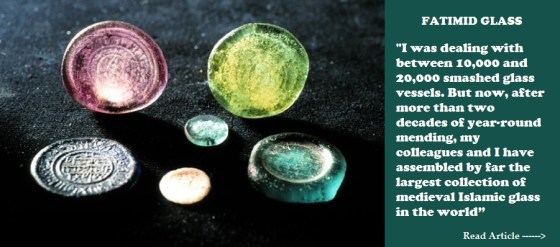
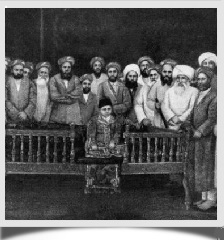
This website’s photo blog, Simergphotos, was launched just over three years ago. Together, Simerg with Simergphotos, has achieved a combined viewership of over two million – 1.8 million and 306,000 since 2009 and 2011 respectively. During the course of this time we have published memorable photo essays covering a vast array of subjects. Beginning this week, we bring you links to highly informative and educational pieces. Our journey commences with Prince Amyn Aga Khan’s Investiture as Head of Ismaili Scouts, the Discovery of Fatimid Glass in a Byzantine Shipwreck, Alamut Where Every Stone Tells a Story, and A Journey to Bagamoyo Jamatkhana. Please click on the images below for these fascinating historical stories.

000 Prince Amyn Investiture~~~~~

002 Fatimid Glass~~~~~

001 Alamut~~~~~

003 Bagamoyo

The Modern Pace of Life and the Place of Faith and Religion – A Reflection by Farouk Topan

Simerg Post Pace of Life

THE FUNDAMENTAL MESSAGE OF RELIGION

By Dr. Farouk Topan

The pace of life today is said to be much faster than it was just a few decades ago. This is an axiom of our times. What, however, is not axiomatic is the corollary that is often assumed to stem from it, namely that spiritual value and worth get diminished in proportion to the increase of pace. It is not uncommon to hear the lament that nowadays people have no time for religion. Many people actually believe this, and that is a great pity. For religion is not a ‘thing’ one ‘does’ if one has time. Religion is a commitment, an involvement of one’s being and personality, utterly, totally and completely.

Human nature, however, accepts few commitments gladly and it abhors those which are seen as imposed externally. Some people consider religion as a process forced upon them from outside themselves. To view religion as an imposition is to misunderstand its message and its function.

The fundamental message of religion to Man is to be at peace — at peace with himself, with his fellow human beings, and at peace with his Creator; the fundamental function of religion is to enable a person to understand and to know his own nature, his environment and to begin to recognise and to know his Creator. Knowledge and peace are interlinked. One makes the attainment of the other possible and a person who attains a degree of both becomes a potential recipient of God’s most valuable gifts to Man: wisdom. Tranquility is a reflection of wisdom.

Photo: John Macdonald.

Photo: John Macdonald.

“I do not believe that we should fear material progress, nor should we condemn it. The danger is that it could become an obsession in our lives and that it could dominate our way of thinking” — Mawlana Hazar Imam [1]

“The day we no longer know how, nor have the time nor the faith to bow in prayer to Allah because the human soul that He has told us is eternal is no longer of sufficient importance to us to be worthy of an hour of our daily working, profit-seeking time, will be a sunless day of despair” — Mawlana Hazar Imam [2]

An essential aspect of knowledge is the understanding that even a tiny part of our lives cannot be isolated from what is termed ‘religion’; for religion properly understood, is nothing less – and even more –  than life itself. We, as Muslims, are not and cannot be ‘outside’ of Islam. Islam involves us completely; that, indeed, is the essence of our existence.

The realization of this simple fact is the basis for experiencing an inner calm and tranquility. Then the pace of life around a person becomes largely immaterial, and its varied speed becomes a matter of petty insignificance. This is not to underestimate the powerful attractions of the style of life prevalent in many parts of the world; it is simply to point out that, if one wants to stop oneself from being drifted away aimlessly by the currents of materialism, one can stabilize oneself through the teachings and practices of Islam.

Date posted: Thursday, November 6, 2014.

_______________

The essay has been adapted from Ilm, Volume 2, Number 1, published by the Ismaili Tariqah and Religious Education Board (ITREB) for the United Kingdom, where it appeared under the title “Islam and the Modern Pace of Life.” Excerpts from the speeches of His Highness the Aga Khan were not part of the original piece by Dr. Topan.

[1] His Highness the Aga Khan, Takht Nashini (ceremonial installation), Karachi, Pakistan, January 23, 2958.
[2] His Highness the Aga Khan, Convocation Address, Peshawar University, Pakistan, November 30, 1967.

________________
Links for speeches of His Highness the Aga Khan:

Special Photo Essay: A Collection of 48 (Plus One) Images from the Glorious Life of the 48th Ismaili Imam, His Highness the Aga Khan

PLEASE CLICK: A Collection of 48 (Plus 1) Memorable Images from the Life of the 48th Imam of the Ismaili Muslims, His Highness the Aga Khan III

Post Layout Aga Khan Special Collection 2Our beloved 48th Imam, Hazrat Imam Sultan Mahomed Shah (a.s.), His Highness the Aga Khan, was born in Karachi on November 2, 1877. He assumed the Imamat at the age of 7 in August 1885, and became the longest-serving Imam in Ismaili history. He passed away on July 11, 1957, at the age of 79, bequeathing the hereditary throne of Imamat to his grandson, Mawlana Shah Karim al Hussaini Aga Khan, the current 49th Imam who has been on the throne for 57 years. In his tribute to his grandfather, Mawlana Hazar Imam said, “Through 72 years of Imamat, he guided his spiritual children to happiness and prosperity.”…..Photo Collection

A Collection of Readings on Imam Hussein and Mawlana Sultan Mahomed Shah Aga Khan – Two Ismaili Imams Who Lived 1250 Years Apart

IMAM SULTAN MAHOMED SHAH, HIS HIGHNESS THE AGA KHAN (1877 – 1957)

Aga Khan Post ImageOur beloved 48th Imam, Hazrat Imam Sultan Mahomed Shah (a.s.) was born in Karachi on November 2, 1877. He assumed the Imamat at the age of 7 in August 1885, and became the longest serving Imam in Ismaili history. He passed away on July 11, 1957, at the age of 79, bequeathing the hereditary throne of Imamat to his grandson, Mawlana Shah Karim al Hussaini Aga Khan, the current 49th Imam who has been on the throne for 57 years. In his tribute to his grandfather, Mawlana Hazar Imam said, “Through 72 years of Imamat, he guided his spiritual children to happiness and prosperity.”…..Read More

IMAM HUSSEIN (626 – 680 CE)

Imam Hussein Post LinkOur beloved second Imam, Hazrat Hussein (a.s.) was born on January 8, 626 AC. He began his reign as the 2nd Ismaili Imam* on the death of his father, Hazrat Ali, on January 27, 661. Imam Hussein was martyred in the Battle of Karbala on the 10th day of the Muslim month of Muharram, or October 10, 680, at the age of 54. He was succeeded to the hereditary throne of Imamat by Imam Zainul Abideen. The Islamic calendar is based on the lunar cycle, and thus shorter than the 365 day solar calendar. This year (2014), the 10th day of the Muharram falls on or around November 3/4……Read more

_________

*Note: Although Shia Nizari Ismailis consider Imam Hussein (a.s.) as the second Imam, he is generally regarded as the 3rd Imam by other Shia Muslims, who treat his brother Hazrat Hassan (a.s.) as the second Imam.

Imam Hussein (a.s.): “The Chief of the Youth of Paradise”

Please click: Muslim and non-Muslim Expressions on Imam Hussein (a.s.)

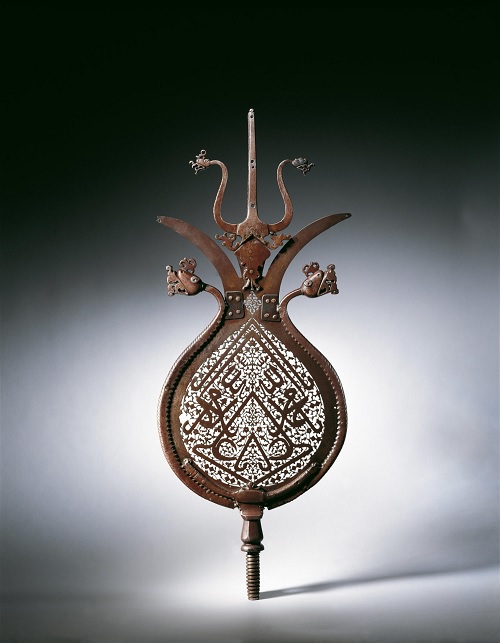
Processional standards (‘alams) are used in Shia processions, particularly on the day of ‘Ashura, the tenth day of the month of Muharram, to commemorate the martyrdom of the Prophet Muhammad’s grandson, al-Hosayn, the son of ‘Ali, in the seventh century in Karbala’, Iraq. In this openwork ‘alam, the form, decorative elements, and function are closely intertwined. The bifurcated blades on the top of the pear-shaped body of this beautifully carved ‘alam are a symbolic reference to the first Shia imam, ‘Ali, the Prophet’s son-in-law, who is known by the epithet dhu’l-fiqar in reference to his bifurcated sword. ‘Ali is also referred to by name in the mirror-image inscription on the central field of this ‘alam: ya Allah ya Muhammad ya ‘Ali, calling upon God, Muhammad, and ‘Ali for support. The symmetrical formation of the invocation ya ‘Ali in the inscription is usually seen as depicting the stylized face of a lion, another symbolic reference to the first imam. Photo and caption: Aga Khan Museum. Accession Number: AKM679, 82cm x 32.5 sm, Iran or India,16th Century, Pierced Steel.

Processional standards (‘alams) are used in Shia processions, particularly on the day of ‘Ashura, the tenth day of the month of Muharram, to commemorate the martyrdom of the Prophet Muhammad’s grandson, al-Hosayn, the son of ‘Ali, in the seventh century in Karbala’, Iraq. In this openwork ‘alam, the form, decorative elements, and function are closely intertwined. The bifurcated blades on the top of the pear-shaped body of this beautifully carved ‘alam are a symbolic reference to the first Shia imam, ‘Ali, the Prophet’s son-in-law, who is known by the epithet dhu’l-fiqar in reference to his bifurcated sword. ‘Ali is also referred to by name in the mirror-image inscription on the central field of this ‘alam: ya Allah ya Muhammad ya ‘Ali, calling upon God, Muhammad, and ‘Ali for support. The symmetrical formation of the invocation ya ‘Ali in the inscription is usually seen as depicting the stylized face of a lion, another symbolic reference to the first imam. Photo and caption: Aga Khan Museum. Accession Number: AKM679, 82cm x 32.5 sm, Iran or India,16th Century, Pierced Steel.

The emigration (Hijrah) of Prophet Muhammad (s.a.s) from Mecca to Medina in the year 622 AC was a significant event and later adopted to mark the beginning of the Muslim Era. The Muslim New Year begins with the month of Muharram (In 2014, October 24). Amongst the Shi’a Muslims, the first part of the month of Muharram is an occasion which is marked with a sense of sorrow and solemnity. The 10th of Muharram was the day when Hazrat Imam Hussein (a.s.) together with most of the members of his family and close companions were martyred on the fields of Karbala….Read more

The twelve months of the Muslim calendar and major Muslim festivals. Image by Simerg.

The twelve months of the Muslim calendar and major Muslim festivals. Image by Simerg.

Photo Essay: Autumn Foliage at Gatineau Park, Wakefield and Canada’s Two Prime Ministers, Mackenzie King and Lester B. Pearson by Malik Merchant

PLEASE CLICK: Photo Essay: Two Great Canadian Prime Ministers, Mackenzie King and Lester B. Pearson, Feature in Simerg’s Peep into Gatineau Park’s Autumn Foliage

Gatineau Simerg Post Image

Happiness of the Talika by Navyn Naran

On the occasion of Prince Rahim Aga Khan’s marriage to Princess Salwa on August 31, 2013, Simerg had published a special photo feature and poem honouring their union. Ismailis around the world now rejoice with their beloved Imam and his family as well as the family of Princess Salwa with the announcement that the couple are  expecting their first child.

We offer our congratulations to Prince Rahim and Princess Salwa, the entire Noorani family as well as Ismailis all around the word on the talika that was received from Mawlana Hazar Imam yesterday. The poem by Navyn Naran may reflect the happiness of the Jamat on receiving this talika. Esoteric in meaning, the poem shares the amazement and happiness of new life.

Form; Hidden-Intermingled; Formless; Untenable-Present

Prince Rahim and Princess Salwa on their wedding day on August 31, 2013. Photo: TheIsmaili / Gary Otte.

Prince Rahim and Princess Salwa on their wedding day on August 31, 2013. Photo: TheIsmaili / Gary Otte.

By Navyn Naran

It was as if Blessings were falling from the sky!
manna  arriving from heaven?
onto an earth parched and dry.
Happiness

Spiritual in physical presence
when submerging,
melting,
now hidden from sight
water
a new journey, a New Life

it takes much Energy to evaporate, doesn’t it?
Formless now, your drop is unseen in the earth,
and on that Moment, when Time is here for you to emerge,
the heat carries you.
and entranced, in a trance,  you rise  up
still un seen,
rise away…mmmm

Looking for you i travel,
in cotton white i see you, can’t touch,
a cool lightness of being,
in facade of the cloud.

yet now, as i look up and see this emanation falling,
Unique you arrive,  physical form, enthralling.
in sunlight you are beautiful,
in the quiet, silently,
MY Happiness

Lily of the vallley. Istockphoto. Copyright.

Unique, a snowflake,
Blessings!
a skip in my step, a faster heart beat,
i feel your presence and i melt
“you are the cat’s meow, the ow in my WOW, the lilt in my step”
Snowflake.

A Blessing is coming,
Here you are!
and i see
a Snowflake mixed with the new
confetti snow.
Happiness

Date posted: Saturday, October 25, 2014.

Copyright: Navyn Naran/Simerg. 2014.

~~~~~~~~~~

Dr. Navyn Naran was born in Dar-es-Salaam, Tanzania, to Anaar and Badrudin Naran. After beginning her high school in the UK, her family immigrated to the USA where she has lived since. Dr. Naran went to medical school at Tufts University School of Medicine in Boston, MA. She currently works in the Paediatric field.

We welcome feedback from readers, Please click on Leave a comment.

Aga Khan Museum’s “The Garden of Ideas” – A Fine Example of Collaboration and Partnership Between Artists, the Museum and Corporate Sponsors

“The Garden of Ideas” is a collection of fascinating, inspiring and vibrant works of art by a team of six Pakistani artists in the gallery spaces inside the Aga Khan Museum as well as outside in the Park. The exhibition received a major boost when three international corporate sponsors stepped in with a generous donation. The three sponsors, Aljomaih Group, Trimark Capital and Asharys are from Saudi Arabia, the United Arab Emirates and Pakistan respectively. Future sponsorships, along these lines, would immeasurably add to the hosting of other fine temporary exhibitions by outstanding local and international artists, and be a boon to the artistic community writes Malik Merchant of Simerg….Read more at Collaboration and Partnership Between Artists, the Aga Khan Museum and Corporate Sponsors

"Garden of Ideas" exhibition in the upper gallery of the Aga Khan Museum. Photo: Malik Merchant/Simerg. Please click for article.

“Garden of Ideas” exhibition in the upper gallery of the Aga Khan Museum. Photo: Malik Merchant/Simerg. Please click for article.

….AND FOR ONCE, ENTER THE AGA KHAN MUSEUM FROM THE INDOOR PARKING LEVEL AND BE WELCOMED BY ENCHANTING ART WORK

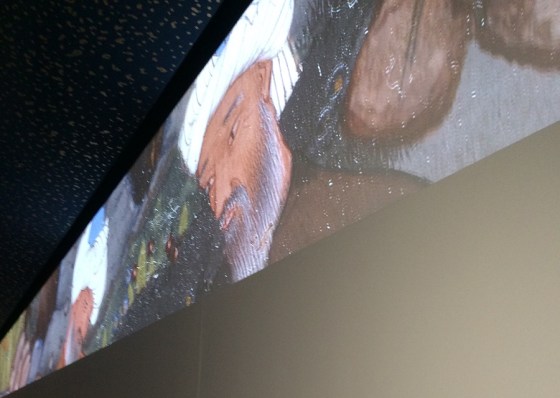
This magnificent display of ever changing panaromic display of images welcomes  visitors to the Aga Khan Museum as they enter its doors from the indoor parking garage. The parking level provides excellent resting facilities for Museum guests. Photo: Malik Merchant/Simerg.

This magnificent panoramic display of ever changing images welcomes visitors to the Aga Khan Museum as they enter its doors from the indoor parking garage. The parking level also provides excellent resting facilities for Museum guests. Photo: Malik Merchant/Simerg.

Orations of Imam Ja’far al-Sadiq: Outstanding Merits of the Prophet and Imams

“Allah chose him, was pleased with him, and selected him. Allah gave him keys of knowledge and sent him as mercy for people and as spring for the country…..Allah, the Exalted, crowned him with solemnity, covered him with the Light of His might. He made a rope to stretch up to heaven. Nothing can be obtained from what is with Allah but through the Imam.”

PLEASE CLICK: Orations of Imam Ja’far al-Sadiq (a.s.)

Please click for Imam Ja'far al-Sadiq's Orations.

Please click for Imam Ja’far al-Sadiq’s Orations.

Ghadir Khumm in Images and Quotations

I

‘Id-e-Ghadir is celebrated by the Shi ‘ite communities to mark the event that took place at Ghadir Khumm (Valley of the Pond) on the 18th Dhul-Hijjah. This event commemorates the designation (appointment by way of nass) of Hazrat All as the ‘Amir-ul-Mu’minin (commander of the faithful) and Imamul-Muslimin’ (the Imam of the community of believers) at Ghadir-i Khumm when the Prophet (s.a.s.) was returning from his Last Pilgrimage (hajjatul-wida) in the year 632 AC. On this occasion, the Prophet publicly proclaimed Ali to be his successor [1] in guiding the community after the end of the institution of Nubuwwah. According to the Shi’a doctrine, tradition and interpretation of history, the designation of Hazrat Ali marked the beginning of the institution of Imamah. The designated Imam was to continue the ta’wil (interpretation) and talim (teaching) of Allah’s Final Message, i.e. the Holy Qur’an.

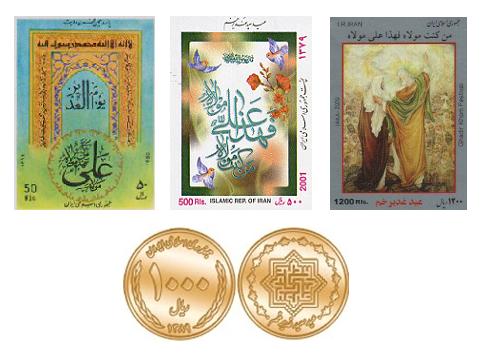
Images of some stamps and coins issued by the Islamic Republic of Iran between 1990 and 2010 commemorating the Idd-e-Ghadir. The inscriptions inlude the Shahada, Qur’anic ayats and the declaration made by Prophet Muhammad at Ghadir Khumm, “Mun Koontu Mawla, Fa Hada, Aliyun Mawla” meaning “He of whom I am the Mawla Ali is also the Mawla.”

Accordingly, throughout the course of the history, the Shi’a have commemorated this occasion as a mark of recognition and acceptance of Allah’s mercy to mankind by bestowing continued guidance. Each Imam, since the time of Hazrat Ali has designated his successor. The Imam in his time has continued to guide his followers according to the prevailing conditions. His function has always been to look after the welfare of the community both in spiritual and worldly (material) matters. His guidance to his followers is that they should lead their lives in such a way so as to practice their Faith with a sense of balance and harmony, ensuring that there is no conflict between the two aspects of an individual’s life. The practice of the Faith thus becomes the way of life.

Presently, the Shi’a Imami Ismaili Muslims celebrate the day of accession of their present Imam to the office of Imamah as Yaum-e Imamat or Imamat Day. This occasion is celebrated as a mark of gratitude to Allah in having bestowed His mercy and bounty in guiding them through the office of the Imam on Sirat al-Mustaqim (the Straight Path).

II

“Muhammad said: ‘He of whom I am the Mawla, Ali is his Mawla. O God, be the friend of him who is his friend and be the enemy of his enemy.’

“This became the proof text for the Shia claim that Ali, the Prophet’s cousin and son-in-law, was the Prophet’s rightful successor after the Prophet’s death in 632. The meaning of Mawla here probably implies the role of patron, lord or protector.” – History in Quotations by M. J. Cohen and John Major.

III

“…As you know, the Shi’a divided from the Sunni after the death of the Prophet Muhammad. Hazrat Ali, the cousin and son-in-law of the Prophet, was, in Shi’a belief, named by the Prophet to be the Legitimate Authority for the interpretation of the faith. For the Shi’a today, all over the world, he is regarded as the first Imam.” – His Highness the Aga Khan, Tutzing Evangelical Academy, May 20, 2006. [1]

IV

His Highness the Aga Khan seen ordaining a new constitution for the Ismaili community worldwide. Clause (G) of the Preamble states: “Mawlana Hazar Imam Shah Karim al Hussaini, His Highness Prince Aga Khan, in direct lineal descent from the Holy Prophet (s.a.s.) through Hazrat Mawlana Ali (a.s.) and Hazrat Bibi Fatima (a.s), is the Forty-Ninth Imam of the Ismaili Muslims.”

“In accordance with Shia doctrine, tradition, and interpretation of history, the Holy Prophet (s.a.s.) designated and appointed his cousin and son-in-law Hazrat Mawlana Ali Amiru-l-Mu’minin (a.s), to be the first Imam to continue the Ta’wīl and Ta‘līm of Allah’s final message and to guide the murids, and proclaimed that the Imamat should continue by heredity through Hazrat Mawlana Ali (a.s) and his daughter Hazrat Bibi Fatimat-az-Zahra, Khātun-i-Jannat (a.s).” – The Preamble of The Constitution of the Shia Imami Ismaili Muslims. [2]

V

“The Ismaili Imamat is a hereditary institution of Muslim leadership, linked to Prophet Muhammad (peace be upon him and his family) by direct lineal descent through Hazrat Ali, his cousin and son in law. The line of Ismaili Imams has continued uninterrupted by hereditary succession from Hazrat Ali through to the present, 49th Imam, His Highness the Aga Khan.” – The Aga Khan Development Network (AKDN) , Brazil and the Ismaili Imamat sign a Protocol. [3]

VI

“Allah did choose Adam and Noah, the family of Abraham, and the family of Imran above all people – offspring, one of the other, and Allah knows and hears all things.” (Sura 3, Ayats 33-34).

With regard to the above verse, the Ismaili poet Nizar Quhistani explained:

“We search for a union with the family of the Chosen (Prophet Muhammad). We search for the truth of son after son. We are totally obedient to his offspring, one of the other. There is no other thing we can add to this but itself. We endeavour in our faith so that we do not turn out to be faithless.” – Quoted in Ismailis in the Middle Ages by Shafique Virani.

~~~~~~~~~~~

[1] To read this and other published speeches at the AKDN Website, please click Tolerance Award from the Evangelical Academy of Tutzing and Speech Archives.

[2] To read background story and complete preamble, please click The Preamble Of “The Constitution of the Shia Imami Ismaili Muslims”.

[3] See The Ismaili Imamat note in AKDN–Brazil Protocol.

___________________