(1) His Highness the Aga Khan visits UNHCR and (2) UN material related to his uncle, Prince Sadruddin, whose name became synonymous with UNHCR

“We must do everything possible to prevent human suffering”

His Highness the Aga Khan with UNHCR chief Antonio Guterres at UNHCR Headquarters. Photo: The Ismaili.

His Highness the Aga Khan with UNHCR chief Antonio Guterres at UNHCR Headquarters. Photo: The Ismaili.

His Highness the Aga Khan visited the UNHCR headquarters on November 6, 2015 to meet UN High Commissioner for Refugees, António Guterres, and discuss past and future cooperation in emergency operations around the world. His Highness is the 49th hereditary Imam of the Shia Imami Ismaili Muslims and nephew of the late Prince Sadruddin Aga Khan, who was high commissioner for refugees from 1965-77, a pivotal period in the organization’s history.

His Highness was greeted by UNHCR staff before he held private talks with the High Commissioner  followed by a meeting with senior UNHCR officials on the long-standing partnership between the Aga Khan Development Network (AKDN) and the UN refugee agency.

The two sides looked at ways of further strengthening their partnership in the Middle East, Asia and East Africa. They discussed possible new joint initiatives in areas such as contingency planning; pluralism and diverse societies; and country specific cooperation in areas where AKDN is active as well as global advocacy to bridge the humanitarian-development divide.

They also discussed the global political situation and the effects of extremism and sectarianism on previously tolerant and diverse societies.

“We must do everything possible to prevent human suffering,” said the Aga Khan. “But preempting humanitarian emergencies requires investments, equipment and the necessary resources to ensure the response system is already in place when the crisis hits.”

The High Commissioner agreed, noting that “UNHCR and the Aga Khan Development Network have a lot in common. It is partnerships like ours that can help broaden the way the international community responds to crises today through a stronger humanitarian-development link, and by promoting closer cooperation with actors from different cultural and geographical backgrounds.”

~~~~~

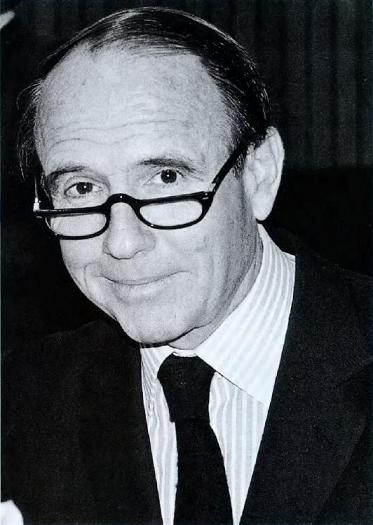
Prince Sadruddin Aga Khan
“AN EXCEPTIONAL MAN”

Prince Sadruddin Aga Khan (1933 - 2003). Photo: UNesco Courier. Copyright

Prince Sadruddin Aga Khan (1933 – 2003). Photo: Unesco Courier. Copyright

Prince Sadruddin Aga Khan, uncle of Mawlana Hazar Imam, His Highness the Aga Khan, led the UN refugee agency during 12 years in the 1960s and 1970s, leaving an indelible print on UNHCR’s history. He led the agency through some of the most challenging moments, and his name became synonymous with UNHCR.

Prince Sadruddin became High Commissioner in January of 1966 at the age of 33 the youngest person ever to lead UNHCR. Prior to becoming High Commissioner, he served for three years as Deputy High Commissioner. He was at the helm of the UN refugee agency during one of its most difficult periods. This included the 1971 the Bangladesh crisis, which uprooted 10 million people, the 1972 exodus of hundreds of thousands of Hutus from Burundi to Tanzania and the Indochinese boat people tragedy of the mid-1970s. In 1972, Prince Sadruddin played a key role in finding new homes for tens of thousands of South Asians expelled from Uganda by Idi Amin.

Prince Sadruddin’s entire adult life was devoted to humanitarian work. After leaving UNHCR at the end of 1977 at his own request, he served in various capacities, dealing with humanitarian situations in many parts of the world on behalf of the United Nations. These included Afghanistan and Iraq during the first Gulf war. He was also a trustee of a number of charity organisations. He published several books and received numerous national and international decorations, including the French Légion d’honneur and the United Nations Human Rights Award.

Simerg has come across many pieces of letters and documents on Prince Sadruddin in the UN archives, and we reproduce two below that serve as reminders of his priceless services to the United Nations.

~~~~~

[I] EXTENSION OF APPOINTMENT LETTER

“This extension…constitutes a new fixed term appointment on a $1 a year basis…” 

Please click on image for enlargement

~~~~~~~~~~

Prince Sadruddin Aga Khan Extension of Appointment

~~~~~~~~~

[2]  “AN EXCEPTIONAL MAN”

“Prince Sadruddin was a statesman in the truest sense of the word. By focusing on the protection of refugees, he represented the moral and compassionate side of the international community…He worked on behalf of the poor and dispossessed, while celebrating humanity through culture and art…”

Please click on image for enlargement

Kofi Annan Message for Prince Sadruddin Aga KhanDate posted: Saturday, November 7, 2015.

_______________

We welcome your feedback, please click Leave a comment.

Credits:

  1. Report of His Highness Aga Khan’s visit to UNHCR and Prince Sadruddin Aga Khan’s profile compiled and adapted from the website of http://www.unhcr.org.
  2. United Nations Archives at https://archives.un.org/

Please also see the following articles on Prince Sadruddin posted on this website:

His Highness the Aga Khan: Democracy To Survive Across Planet Must Lead to Improvement in the Quality of Human Life and Give Genuine Hope for Future

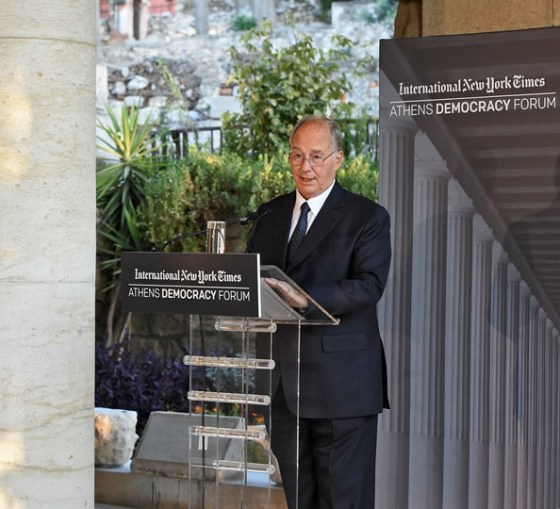
His Highness the Aga Khan delivering the Keynote Address to the 2015 Athens Democracy Forum on September 15, 2015. Photo: AKDN / Gary Otte

His Highness the Aga Khan delivering the Keynote Address to the 2015 Athens Democracy Forum on September 15, 2015. Photo: AKDN / Gary Otte

The following are excerpts from remarks made by His Highness the Aga Khan on September 15, 2015, in a keynote address to the Athens Democracy Forum, an international gathering of diplomats, business leaders and opinion makers. The event was hosted by the International New York Times and the United Nations Democracy Fund.

THE NEW YORK TIMES

I have long admired – since my undergraduate days at Harvard – what the [New York] Times has meant to the pursuit of truth and justice in our world. And I have appreciated our opportunities to work together through our Diplomatic Academy in Paris for example, and also through the good counsel the Times provides for our media company in East Africa.

ELEMENTS FOR STRENGTHENING EFFECTIVENESS OF DEMOCRACY

The topic of democracy and its challenges is one that I have followed closely for a long time, most intently in the developing world….where so many members of the Ismaili community live and where so much of our development work takes place.

I believe that the progress of democracy in our world is fundamentally linked to improving the quality of human life. The promise of democracy is that the people themselves best know how to achieve such progress. But if that promise is disappointed, then democracy is endangered. A UNDP survey of South American publics some years ago demonstrated that most people preferred an effective authoritarian government to an ineffective democratic one. Quality of life was the prime concern.

But what can we say then, about why democratic systems often fall short in their efforts to improve the quality of their constituents’ lives? Let me suggest four elements that could help strengthen democracy’s effectiveness in meeting this central challenge.

(I). Improved Constitutional Understanding

His Highness the Aga Khan speaking at the Stoa of Attalos in Athens where he delivered a Keynote Address at the Athens Democracy Forum on the International Day of Democracy. Photo: AKDN / Gary Otte

His Highness the Aga Khan speaking at the Stoa of Attalos in Athens where he delivered a Keynote Address at the Athens Democracy Forum on the International Day of Democracy. Photo: AKDN / Gary Otte

My first suggestion is that the current challenges to governance should be seen less as problems of democracy than as problems of constitutionality. There are more countries today than I can ever recollect before that are grappling with outdated constitutions – frameworks that seem unable to reconcile opposing factions, advance economic priorities, encourage civil society, or protect human rights.

But constitutional revision, especially in developing countries, is not easy. One problem is a poor understanding of comparative government systems. That subject is not part of most educational curricula, and in the countries I know best, the media rarely explain the logic or the options of constitutional change.

In some countries there actually is no clear constitutional means for constitutional change. Even when a referendum is held to validate such change, most people are neither prepared nor willing to express a considered judgment. The result is that governments in power often have an open field.

In my view then, a first step to better democratic governance is a better public understanding of constitutional principles.

It is easy for example, to say that we want government “of, by and for the people” – that governments should be servants of the people, and ultimately responsible to them. But that does not mean that most governmental decisions must be made by an enormous range of far-flung participants: by vast plebiscites, or popular referenda, or public opinion polling, or the number of hits on an internet blog. Such misapplied versions of democracy can produce irrational leadership choices and poorly informed policies. Sometimes, efforts to impose simplistic popular democracy can create voids of governance, which can be exploited to dangerous ends – and I have seen this in various countries in the developing world.

But then, who should make various governmental decisions? My response would emphasise the idea of balanced authority, including the concept of healthy federalism. For increasingly diverse societies, a constitution that divides and balances power is essential.

In discussing constitutional challenges, it is impossible to ignore the recent revival or creation of new theocratic political parties in the Islamic world. The question is how theocratic principles of governance can operate constitutionally in increasingly secular political environments. It seems essential to me that such principles should be regularly tested by the electoral process, if only so that the Muslim world can have a better understanding of the secularisation processes, which are inherent in western democracy. And democratic principles in turn, must respect the broad diversity of human faiths and cultures.

Finding the right constitutional balance is no easy matter, and we make a great mistake if we think that one size can somehow fit all. Effective constitutions must be adapted to a variety of cultural and demographic realities. But it can be done. One recent example is that of Tunisia, where after intense and arduous negotiation, a promising new constitution won broad public support. My central point, in sum, is that we cannot build better democratic performance over time without a better understanding of constitutional values.

(II). Independent and Pluralistic Media

His Highness the Aga Khan with Stephen Dunbar-Johnson, President, International at The New York Times and Nobel-winning economist Paul Krugman, op-ed columnist at the New York Times. Photo: AKDN / Gary Otte

His Highness the Aga Khan with Stephen Dunbar-Johnson, President, International at The New York Times and Nobel-winning economist Paul Krugman, op-ed columnist at the New York Times. Photo: AKDN / Gary Otte

A second key variable for enhancing democratic effectiveness is the critical role of competent and independent media voices. We often forget that ancient Greek democracy required a highly compact community living within the sound of a “crier’s voice,” as Aristotle said. Under such conditions, face-to-face dialogue could foster a sense of trust and political accommodation.

But these ideal conditions now obtain only rarely. Populations are much larger, more widely scattered, and more diverse. They can most easily be mobilised around vivid but superficial symbols and negative propositions. Often what counts most in our extended societies is not what one is for, but whom one is against.

In such circumstances, polarisation and impasse are constant risks.

Nor can we rely on advances in communication technologies to overcome the obstacles of distance and diversity. In fact, new media technologies have often made matters worse (and I don’t mean the New York Times!) From the development of written language to the invention of printing, to the development of electronic and digital media – quantitative advances in communication technology have not necessarily produced qualitative progress in mutual understanding.

To be sure, each improvement in communications technology has triggered new waves of political optimism. But sadly, if information can be shared more easily as technology advances, so can misinformation and disinformation. If truth can spread more quickly and more widely, then so can error and falsehood.

Throughout history, the same tools – the printing press, the telegraph, the microphone, the television camera, the cell phone, the internet – that promised to bring us together, have also been used to drive us apart.

The age-old promise of democracy is that social cohesion and public progress could be achieved by consensus rather than by coercion. But genuine democratic consent depends on dependable public information.

The danger in an age of mass media is that information also can be misused to manipulate the public. All around the world, authoritarian rulers increasingly use media to “coerce” the consent of the governed. Our hosts today, the International New York Times, recently published a remarkable description of this phenomenon under the headline, “The Velvet Glove.”

The power of a leader’s reasoning or the truth of his arguments, the report suggests, are often less important than his command of media influence. What results can be the illusion of democracy, but not its substance.

No, our technologies alone will not save us. But neither need they ruin us. It is not the power of our tools, but how we use them that will determine our future.

Among other things, this means prioritising the role of independent media, and indeed, of a multiplicity of independent voices. Demographic pluralism must be reflected in healthy media pluralism.

I mentioned earlier my own involvement in the African media scene – as founder of the Nation Media Group. It was launched at the time of Kenyan independence, and for nearly six decades media independence has been its watchword – a sine qua non for democratic health.

(III). Potential of Civil Society

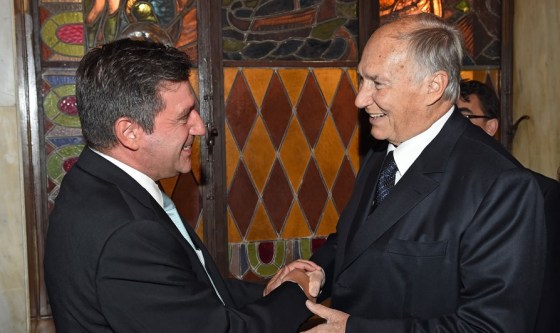
His Highness the Aga Khan is received by the Mayor of Athens, Mr Giorgos Kaminis at a dinner he hosted for Forum participant at Athens City Hall. Photo: AKDN / Gary Otte

His Highness the Aga Khan is received by the Mayor of Athens, Mr Giorgos Kaminis at a dinner he hosted for Forum participant at Athens City Hall. Photo: AKDN / Gary Otte

This leads me to my third observation. Government, while critical, can only take us so far. At a time of democratic disappointment, we must re-emphasise the immense potential of those non-governmental institutions that we call “civil society.”

Too often, our thinking is trapped in a false dichotomy. We talk about the public sector and the private sector, but we often undervalue a third sector – that of civil society.

Civil society is powered by private energies, committed to the public good. It draws on the ancient, classical link between democracy and the publicly-committed citizen.

It includes institutions of education, health, science and research, embracing professional, commercial, labour, ethnic and arts organisations, and others devoted to religion, communication, and the environment.

It seeks consensus through genuine consent. It can experiment, adapt and accommodate diversity. It can in the fullest sense be “of, by and for the people.” It can in the fullest sense be a remarkable support – but only on condition that is it sustained, accepted and encouraged by government.

(IV). Genuine Democratic Ethic

Finally, let me mention a fourth concern that underlies this entire discussion – the central importance of fostering a “democratic ethic.”

At the heart of a democratic ethic is a commitment to genuine dialogue to achieve a better quality of life, even across new barriers of distance and diversity. This means a readiness to give and take, to listen, to bridge the empathy gaps as well as the ignorance gaps that have so often impeded human progress. It implies a pluralistic readiness to welcome diversity and to see our differences not as difficult burdens but as potential blessings.

One ultimate requirement for any effective democracy is the capacity to compromise. Social order rests in the end either on oppression or accommodation. But we can never find that balancing point – where the interests of all parties are recognised – unless competing leaders and their diverse followers alike, are committed to finding common ground.

That common ground, in my view, is the global aspiration for a better quality of life – from the reduction of poverty to quality longevity – built upon opportunities that will provide genuine hope for the future.

Democracy can only survive if it demonstrates – across the years and across the planet – that it is the best way to achieve that goal.

Thank you.

Date posted: September 16, 2015.

_____________

Please click on http://www.akdn.org for complete speech, video and photos.

A Unique Video of the Signing Ceremony Establishing “Seat of the Ismaili Imamat” in Portugal

Editor’s note: We are pleased to offer our readers a link to an extraordinary footage shown on Portuguese Cable News Channel, SIC Noticias,  of the signing ceremony that took place in Lisbon establishing the Seat of the Ismaili Imamat in Portugal. We also include two other short clips of remarks made by the Foreign Minister of Portugal and the Prime Minister of Portugal. The event in Lisbon on June 3, 2015 was a truly historic moment in the modern history of the Ismaili Imamat, and earlier this week we brought you the complete English text of the Agreement. Readers who haven’t read the text are invited to click on “Seat of the Ismaili Imamat” — Text of the Historic Agreement.

I. FANTASTIC VIDEO OF THE HISTORIC SIGNING ESTABLISHING THE SEAT OF THE ISMAILI IMAMAT IN PORTUGAL

Please click on image below or “Video of the Signing of the Historic Agreement Establishing the Seat of the Ismaili Imamat in Portugal

His Highness the Aga Khan signing the historic document establishing the Seat of the Ismaili Imamat in Portugal. Please click on image to view the video.

His Highness the Aga Khan signing the historic document establishing the Seat of the Ismaili Imamat in Portugal. Please click on image to view the video.

~~~~~~

II. REMARKS BY THE MINISTER OF FOREIGN AFFAIRS, RUI MACHETE

Portugal's Minister of Foreign Affairs speaking at the signing of the Agreement  establishing the Seat of the Ismaili Imamat in Portugal. Please click on image to view a video clip of the remarks.

Portugal’s Minister of Foreign Affairs speaking at the signing of the Agreement establishing the Seat of the Ismaili Imamat in Portugal. Please click on image to view a video clip of the remarks.

~~~~~~

III. REMARKS BY THE PRIME MINISTER OF PORTUGAL, PEDRO PASSOS COELHO

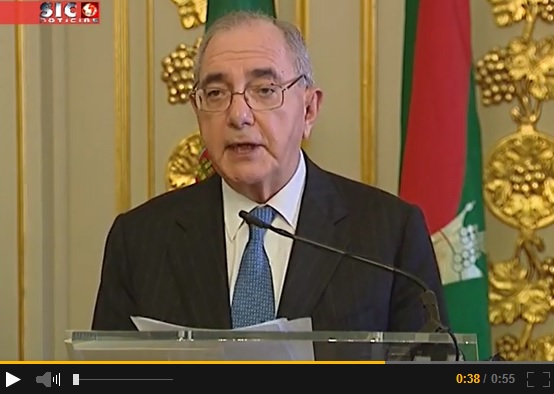
Portugal's Prime Minister speaking at the signing of the Agreement establishing the Seat of the Ismaili Imamat in Portugal. Please click on image to view a video clip of the remarks.

Portugal’s Prime Minister speaking at the signing of the Agreement establishing the Seat of the Ismaili Imamat in Portugal. Please click on image to view a video clip of the remarks.

Date posted: August 6, 2015.

Full English text of agreement at “Seat of the Ismaili Imamat” — Text of the Historic Agreement Between the Ismaili Imamat and the Portuguese Republic.

__________

This post is also reproduced at http://www.simergphotos.com, Simerg’s photo blog.

“Seat of the Ismaili Imamat” — Text of the Historic Agreement Between the Ismaili Imamat and the Portuguese Republic

Introduced by Abdulmalik Merchant
Publisher-Editor, Simerg.com
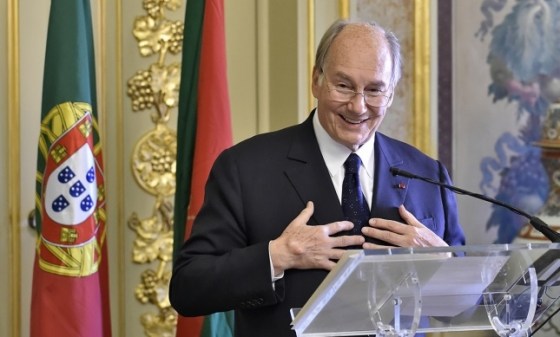
Mawlana Hazar Imam thanking the government for inviting the Ismaili Imamat to establish its permanent Seat in Portugal. TheIsmaili/Gary Otte

June 3, 2015: Mawlana Hazar Imam thanking the government for inviting the Ismaili Imamat to establish its permanent Seat in Portugal. TheIsmaili/Gary Otte

On Thursday June 4, 2015, in a piece entitled History in the Making: Establishment of the Seat of the Ismaili Imamat in Portugal, we informed our readers about a landmark agreement that was signed a day earlier by His Highness Prince Karim Aga Khan, the 49th hereditary Imam of the Shia Imami Ismaili Muslims, and Portugal’s Minister of State and Foreign Affairs, Rui Machete, at the historic Necessidades Palace in Lisbon. The Agreement marked the first such accord in the Ismaili Imamat’s modern history.

We are pleased to inform our readers that we now have access to this milestone agreement which is being reproduced in full below based on the text of the original English version of the document, which appears on the website of the Portuguese Parliament. [1]

The Agreement is divided into 5 chapters dealing with (1) General Provision; (2) The Seat of Imamat; (3) Prerogatives of the Imam and the Members of the Seat; (4) Cooperation; and (5) Final Provisions, and consists of  21 articles. The Agreement, reflecting the mutual trust and esteem which has traditionally characterised the relationship between the Republic of Portugal and Mawlana Hazar Imam, affirms the recognition of the legal personality of the Ismaili Imamat.

During the signing on June 3, His Highness the Aga Khan hailed the agreement as a historic milestone in the Imamat’s history and said:

“Today is a unique and important occasion, where for the first time in our history we will have the opportunity to work with a partner with whom we share so many values, so many hopes and so many desires.”

________________

AGREEMENT BETWEEN
THE PORTUGUESE REPUBLIC
AND
THE ISMAILI IMAMAT
FOR
THE ESTABLISHMENT OF
THE SEAT OF THE ISMAILI IMAMAT IN PORTUGAL
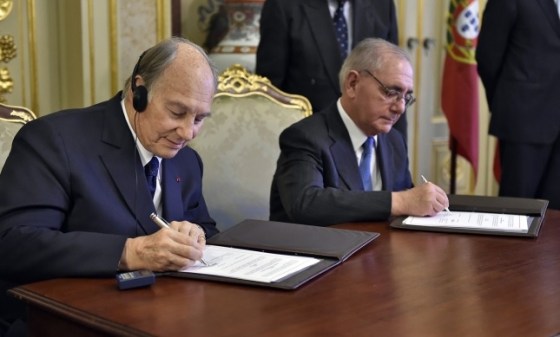
Mawlana Hazar Imam and Portugal’s Minister of State and Foreign Affairs Rui Machete sign a landmark agreement establishing a formal Seat of the Ismaili Imamat in Portugal. TheIsmaili/Gary Otte

Mawlana Hazar Imam and Portugal’s Minister of State and Foreign Affairs Rui Machete sign a landmark agreement on June 3, 2015, establishing a formal Seat of the Ismaili Imamat in Portugal. TheIsmaili/Gary Otte

The Portuguese Republic and the Ismaili Imamat, hereinafter referred to as “Parties”,

Considering the Protocol of Co-operation between the Government of the Portuguese Republic and the Ismaili Imamat, signed in Lisbon on 19 December 2005 and considering further the Protocol of International Co-operation between the Ministry of Foreign Affairs of the Portuguese Republic and the Ismaili Imamat signed on 11 July 2008;

Recalling the Agreement between the Portuguese Republic and the Ismaili Imamat, signed in Lisbon, on 8 May 2009, whereby the legal personality of the Ismaili Imamat is recognised;

Having in mind the common purpose of strengthening the historical ties uniting both Parties, as well as of promoting enhanced enabling conditions for the activities of the Ismaili Imamat, its governance bodies and its dependent institutions, in particular the member entities of the Aga Khan Development Network;

Furthermore having in mind the promotion of the quality of life of the global Shia Imami Ismaili Muslim Community and more generally of the people of the countries where the Ismaili Imamat or its dependent institutions are or may become active, including Portugal and the Portuguese people in particular;

Considering that both Parties assume, as common objectives, the defence of human dignity, economic and social development, interfaith dialogue and the peaceful resolution of conflicts, as ways of achieving justice and peace;

Affirming the interest of both Parties in the establishment of the Seat of the Ismaili Imamat in the territory of the Portuguese Republic and their common will mutually to respect each other’s autonomy in the context of the mutual trust and esteem which has traditionally characterised their relationship;

Believing in the historic significance of such a decision for both Parties and fully appreciating the long term implications and complexities that such a decision entails;

Considering that the privileges, immunities and facilities recognised are not granted for the personal benefit of their holders, but merely in order to contribute to the effective and independent performance of their official and institutional functions on Portuguese territory;

Agree as follows:

Chapter I: General Provisions

ARTICLE 1

Definitions

For the purposes of this Agreement, the following terms shall have the meaning set forth below:

a) “Ismaili Imamat”, a legal entity, means the institution or office of the Imam of the Shia Imami Ismaili Muslims established in accordance with the applicable customary law;

b) “Imam” means the Imam of the Shia Imami Ismaili Muslims, embodying the Ismaili Imamat at any given time in history, designated in accordance with the said customary law;

c) “Dependent Institutions” means the instrumentalities of the Ismaili Imamat, in particular the member entities of the Aga Khan Development Network around the world, more particularly Fundação Aga Khan, a Portuguese foundation created by decree-law in 1996;

d) “Seat” means the global head office of the Ismaili Imamat, as further defined in the present Agreement;

e) “Members of the Seat” means the Senior Officials and the Staff Members of the Seat of the Ismaili Imamat;

f) “Senior Officials” means the Heads of the Ismaili Imamat Departments;

g) “Staff Members” means the Members of the Seat employed in the administrative and technical service of the Seat;

h) “Premises of the Seat” means the buildings or parts of buildings and the land ancillary thereto used exclusively for carrying out the official mission and performing the official functions of the Ismaili Imamat, including the central Seat premises, the premises of the Delegation of the Ismaili Imamat in Lisbon and the official residence of the Imam.

ARTICLE 2

Object

1. The Portuguese Republic acknowledges the legal personality and capacity of the Ismaili Imamat to act in international relations and welcomes the decision of the Imam to establish the Seat of the Ismaili Imamat in Portugal.

2. This Agreement establishes the privileges, immunities and facilities extended by the Portuguese Republic to the Ismaili Imamat, the Imam, the Senior Officials and the Staff Members, as well as to its Seat and assets, with a view to ensuring the performance of their official functions in Portugal and facilitating the same internationally.

_____________

Chapter II: Seat of the Ismaili Imamat

ARTICLE 3

Seat

1. The Portuguese Republic shall ensure the conditions for the establishment of the Seat of the Ismaili Imamat within its territory as well as for the exercise of its functions, in accordance with the present agreement.

2. The location of the Premises of the Seat shall be subject to mutual agreement between the Parties. Pending the construction or acquisition of the central Premises of the Seat, and within a period of five (5) years, the Seat may be established in Lisbon, in the existing premises of the Delegation of the Ismaili Imamat. The Imam shall notify his decision in this respect to the Minister of Foreign Affairs.

ARTICLE 4

Function of the Seat of the Ismaili Imamat

The function of the Seat is to serve as the global head office of the Ismaili Imamat with a view to:

a) Facilitating the spiritual and secular guidance of the Imam to the Ismaili Community globally;

b) Promoting the quality of life of the Ismaili Community globally and more generally of the people of the countries where the Ismaili Imamat or its Dependent Institutions are active;

c) Enhancing international relations and co-operation with States, International Organisations and other entities.

ARTICLE 5

Appointment of the Members of the Seat

1. The appointment of the Senior Officials of the Seat of the Ismaili Imamat by the Imam shall be preceded by a consultation with the Portuguese Government and shall be notified to the Ministry of Foreign Affairs according to the procedures applicable to members of diplomatic missions accredited in the Portuguese Republic.

2. The number of Members of the Seat shall be determined by the Imam as may be necessary to enable the Ismaili Imamat to carry out its functions. The Ismaili Imamat will review such number with the Ministry of Foreign Affairs.

3. The Ministry of Foreign Affairs shall issue diplomatic identity cards to the Members of the Seat, according to the functions they perform, the highest level being attributed to Senior Officials and the other levels to the other Members of the Seat as the Minister of Foreign Affairs and the Imam shall establish.

ARTICLE 6

Inviolability of the Premises of the Seat

1. The Portuguese authorities shall take all appropriate steps to protect the Premises of the Seat of the Ismaili Imamat against any intrusion, threats or damage.

2. The Premises of the Seat, as well as the Ismaili Imamat land, air or sea vehicles used for its official functions, are inviolable, except in emergency situations that endanger public order and security, in case of a serious incident or any other event requiring immediate protective measures.

3. The Premises of the Seat cannot be used as a place of refuge for any individual prosecuted for a crime or flagrante delicto or subject to a court warrant, criminal conviction or a deportation order issued by the Portuguese authorities.

ARTICLE 7

Inviolability of files and correspondence

The files and documents as well as the official correspondence of the Ismaili Imamat are inviolable at any time and wherever located within Portuguese territory.

ARTICLE 8

Use of distinctive signs

The Ismaili Imamat shall be entitled to use distinctive signs, flags and emblems, in the Premises of the Seat as well as on any of the said official vehicles, which shall enjoy a registration status no less favourable than that accorded by the Portuguese Republic to diplomatic missions.

ARTICLE 9

Facilities in respect of communications

The Ismaili Imamat shall enjoy on the territory of the Portuguese Republic, for the purposes of its official communications and correspondence, treatment no less favourable than that accorded by the Portuguese Republic to diplomatic missions.

ARTICLE 10

Immunity from jurisdiction and from execution

The Ismaili Imamat and its assets shall enjoy immunity from jurisdiction and execution within the scope of its official activities, except:

a) When the Ismaili Imamat expressly waives those immunities;

b) In the context of cases related to employment contracts;

c) In a lawsuit brought by a third party with a view to obtaining financial compensation for death and injuries suffered as a result of an accident caused by vehicles owned or used by the Seat, or in case of any offence involving one of those vehicles.

ARTICLE 11

Fiscal exemptions

1. Gifts and bequests made by the Ismaili Imamat or the Imam within the context of their official functions or received by the Ismaili Imamat or the Imam, as well as income received by them, including capital gains, as well as the assets held by the Ismaili Imamat or the Imam, shall not be subject to any tax, including income or wealth tax.

2. Without prejudice to the application of more favourable provisions, granted by the Portuguese Republic to any other religious institution, the provisions of paragraph 1 shall not extend to:

a) Income deriving from any business activity directly exercised in Portugal neither to the assets connected to such activity;

b) Interest and other investment income, either due or paid by any resident in Portugal or effectively connected with the activity of a permanent establishment or fixed base in Portugal, as foreseen in the Portuguese corporate income tax code.

3. The income referred to in paragraph 2 (b) shall be subject to withholding tax, of a final character, in accordance with the corporate income tax legislation of the Portuguese Republic.

4. The Ismaili Imamat shall be exempt from any national or local tax on immovable property as regards the Premises of the Seat.

5. The Ismaili Imamat and the Imam shall be exempt from stamp duty, as well as from any other transfer tax, on the acquisition or sale of movable or immovable properties used or to be used for their official functions.

6. The Ismaili Imamat and the Imam shall be exempt from any taxes or duties on the purchase, ownership, registration, use or sale of land, air or sea vehicles, including spare parts and consumables, used for its official functions.

7. The Ismaili Imamat shall be entitled to a refund of the amounts corresponding to VAT paid on goods, including the vehicles above-mentioned, and services purchased or imported for its official use. The Portuguese Republic will establish the conditions and procedures for the application of such refund.

8. Gifts made to the Ismaili Imamat shall be tax deductible according to the Portuguese legislation applicable to gifts made to religious institutions.

ARTICLE 12

Funds, foreign currency and assets

1. Subject always to the laws and regulations of the Portuguese Republic and of the European Union, namely those regarding the fight against money laundering and terrorism, the Ismaili Imamat may hold funds, securities, gold and other precious metals, or foreign currencies.

2. The Ismaili Imamat shall be free to receive any such values from within or from outside Portugal and hold and transfer the same within Portugal or from Portugal to any country and to convert any currency held or bought into any other currency.

3. This does not preclude the Portuguese Republic from adopting any requirements resulting from its membership of the European Union, including measures prohibiting, restricting or limiting the movement of capital to or from any third country.

Continued after photo below

The agreement establishing Portugal as the seat of the Ismaili Imamat took place at the Palace of Necessidades. It  is a historical building in the Largo do Rilvas, a public square in Lisbon, Portugal. It serves as headquarters of the Portuguese Foreign Ministry. Palace Photo Photo: Wikipedia.

The agreement establishing Portugal as the seat of the Ismaili Imamat took place at the Palace of Necessidades. It is a historical building in the Largo do Rilvas, a public square in Lisbon, Portugal. It serves as headquarters of the Portuguese Foreign Ministry. Palace photo: Wikipedia.

Chapter III: Prerogatives of the Imam and the Members of the Seat

ARTICLE 13

Prerogatives of the Imam

1. The Imam shall be granted the following prerogatives:

a) Ceremonial diplomatic treatment accorded in Portugal to foreign High Entities;

b) His official residence shall enjoy the same inviolability and protection as the premises of the Seat;

c) Inviolability of any type of papers, documents or materials as well as of any communications;

d) Immunity from any judicial action and legal proceedings in respect of acts done in the performance of his functions for the Ismaili Imamat, including immunity from any measures of execution;

2. The direct family members of the Imam shall be accorded the appropriate facilities and courtesy treatment.

ARTICLE 14

Prerogatives of the Senior Officials

The Senior Officials of the Seat shall enjoy such privileges, immunities and facilities as are necessary for the performance of their functions, such as:

a) Ceremonial treatment accorded to diplomatic representatives of equivalent level and in the same circumstances;

b) Their residence shall enjoy the same inviolability and protection as the Premises of the Seat;

c) Inviolability of any type of papers, documents or materials relating to the functions of the Ismaili Imamat, as well as of any communications;

d) Immunity from any judicial action and legal proceedings, including immunity from any measures of execution, in respect of acts done by them in the performance of their functions for the Ismaili Imamat;

e) Exemption from all direct taxes and social charges on salaries, wages and other similar remuneration paid to them in their capacity as Senior Officials by the Ismaili Imamat or its Dependent Institutions;

f) When required by Portuguese or European legislation, facilitation of issuance of visas and residence permits, extended to direct family members.

ARTICLE 15

Prerogatives of the Staff Members

The Portuguese authorities guarantee the protection and necessary assistance to the Staff Members of the Seat with a view to securing the efficient performance of their official functions, including, when required by Portuguese or European legislation, facilitation of issuance of visas and residence permits.

Chapter IV: Cooperation

ARTICLE 16

Support for scientific and economic development

1. The Ismaili Imamat shall actively support the efforts of the Portuguese Republic to improve the quality of life of all those living in Portugal, particularly through the development in Portugal of world-class research projects in the said area, but more generally on subjects of common interest to the Portuguese Republic and the Ismaili Imamat.

2. In view of the above, the Ismaili Imamat shall cause its highest level Dependent Institutions to create a special window devoted to achieving the objectives set out above in cooperation with the relevant Ministries or other entities of the Portuguese Government.

Chapter V: Final Provisions

ARTICLE 17

Joint Committee and Settlement of disputes

The Parties shall establish a Joint Committee composed of six (6) members, three (3) appointed by the Portuguese Republic and three (3) by the Ismaili Imamat, for the following purposes:

a) Aiming to guarantee the implementation of the present Agreement;

b) Settling any differences or disputes concerning the interpretation or application of the present Agreement, with the understanding that, if an agreed solution cannot be found in the context of the Joint Committee, the matter shall be brought to direct negotiation between the Parties.

ARTICLE 18

Amendments

1. The present Agreement may be amended by the Parties by written mutual consent.

2. The amendments shall enter into force in accordance with the terms specified in Article 21 of the present Agreement.

ARTICLE 19

Duration and termination

1. The present Agreement shall remain in force for an unlimited period of time.

2. Either Party may, after an initial period of twenty-five (25) years, terminate the present Agreement upon prior written notice of four (4) years, to be communicated through diplomatic channels. The Parties may by written agreement, modify the length of the said notice time.

ARTICLE 20

Cooperation with competent authorities

The Ismaili Imamat shall fully co-operate with the competent Portuguese authorities, without prejudice to this Agreement, with a view to complying with Portuguese legislation and preventing abuse of the privileges, immunities and facilities granted under the present Agreement.

ARTICLE 21

Entry into force

The present Agreement shall enter into force thirty (30) days after the date of notification in writing by the Portuguese Republic to the Ismaili Imamat, conveying the completion of the constitutional procedures of the Portuguese Republic required for that purpose.

Done in Portuguese and English, in Lisbon, on the 3rd day of June 2015.

For the Portuguese Republic

His Excellency Rui Chancerelle de Machete
Ministry of State and Foreign Affairs

For the Ismaili Imamat

His Highness Shah Karim al-Hussaini Prince Aga Khan, Forty-Ninth Hereditary Imam
of the Shia Imami Ismaili Muslims

Date posted: August 3, 2015.
Last updated: August 6, 2015 (Video link of the signing ceremony added, see below).

___________________

EXTRAORDINARY VIDEO: THE SEAT OF THE ISMAILI IMAMAT IN PORTUGAL

Please click on image below or “Video of the Signing of the Historic Agreement Establishing the Seat of the smaili Imamat in Portugugal

His Highness the Aga Khan signing the historic document establishing the Seat of the Ismaili Imamat in Portugal. Please click on image to view the video.

His Highness the Aga Khan signing the historic document establishing the Seat of the Ismaili Imamat in Portugal. Please click on image to view the video.

~~~~~~

[1] The PDF version of the June 3, 2015 Agreement is in the public domain, and may be viewed by clicking on English Text of the Agreement, PDF File, website of the Government of Portugal.

We welcome feedback/letters from our readers. Please click Leave a comment. For links to articles posted on this Web site since its launch in March 2009, please click Table of Contents.

Ottawa Bait ul-Ilm Students Share a Journey Through Encounters with the Jamat

The recent Encounters showcase by Ismaili students of Ottawa generated great feedback from members of the Jamat. One visitor commented:

“Congratulations to every single member of the BUI team. It is wonderful to conceptualize the brand of AKDN and other Imamat Institutions right at the youngest stage of  Ismaili kids. Well done!”

PLEASE CLICK: Sharing a journey through Encounters with the Jamat

Please click to read the Encounters Showcase article.

A section of the exhibit which was held at the beautiful Ottawa jamatkhana. Please click on image to read the  article.

@Simergphotos: The Silk Road Through the Lens of Muslim Harji and the Smithsonian Folklife Festival

Simergphotos presents An Anthology of the Silk Road Through the Lens of Muslim Harji and Smithsonian’s Folklife Festival with magnificent photos taken by Harji during his recent visits to the iconic Silk Road cities of Samarkand and Bokhara in Uzbekistan. Then the post steps back in time and brings you wonderful memories from the Smithsonian Institution’s Annual Folklife Festival held in Washington D.C. in 2002, which was entirely dedicated to one single subject: The Silk Road. The post contains photos from the opening day, which was attended by His Highness the Aga Khan, as well as an excellent thematic anthology covering many aspects of the exciting Silk Road!…More at Simergphotos.

Please click on image for Silk Roads Photo Essay.

Please click on image for Silk Roads Photo Essay.

PLEASE CLICK: An Anthology of the Silk Road Through the Lens of Muslim Harji and Smithsonian’s Folklife Festival

Mawlana Hazar Imam at the Silk Roads Festival in Washington D.C. IN 2002. Please click for more photos.

Mawlana Hazar Imam at the Silk Roads Festival in Washington D.C. IN 2002. Please click for more photos.

Special Series: Ismaili Expressions on the Imamat — (IV) Contemporary Poetry and a Thank You Letter to the Person of the Institution of Imamat

His Highness the Aga Khan: Ceremonial installation, Kampala, Uganda

His Highness the Aga Khan: Ceremonial installation, Kampala, Uganda

On July 11, 2015, which coincides with the 25th day of Ramadan, Ismailis around the world are celebrating the 58th Imamat Anniversary of Mawlana Hazar Imam, His Highness the Aga Khan.

The poetry and thank you letter produced in this post are expressions of gratitude and love the Ismailis carry in their hearts for their Imam of the Time. Such expressions have resonated throughout Ismaili history, because Ismailis affirm the Principle of the Unity of Imamat, that is the belief and understanding that each Imam, from the time of Hazrat Ali (a.s.), is the bearer of the Noor (Light) of Imamat; he is the same irrespective of his own age or the time he lives in.

On this happy and momentous day, we convey Imamat Day Mubarak to all our readers, and wish everyone barakah (happiness) and success in all aspects of life.

____________

MY ULTIMATE DESIRE

عندما تأتي يأتي النور

Victoria Niema Alhaj

Victoria Niema Alhaj

عندما تأتي يأتي النور
إمامي أنت مولانا
معك نشعر بالسعادة والامان
أنت إمامي
أنت حبيبي
أحب أن أراك دائما
لك حبي ياشاه كريم

By Niema Victoria Alhaj

O my Imam
when you come
comes the Nur.

You’re our Mawla,
and you give us
happiness and protection.

O Shah Karim,
you are my beloved Imam,
and to see you
is my ultimate desire.

Niema was born in Stockholm, to Syrian parents. Niema knows many Arabic qasidas and Qur’anic surahs by heart. She also has many talents including composing poetry, writing short stories, painting, and sports.

~~~~~~

KALEIDOSCOPE OF FAITH

By Zainul Nasser

Takhtnashini in Nairobi
An event so momentous,
So significant
My heart is filled with wonder
And childish piety

Giving Bay’ah in Mombasa
Hazar Imam’s gentle hand
On my bowed shoulder
Benign, protective

The kaleidoscope is set
In simple, comforting patterns
Glowing brightly throughout childhood

Religion is woven
Through our lives
Jamatkhana as familiar
As our homes
Pictures of Hazar Imam
Surround us
A constant, reassuring presence

Childhood ends
And with it certainty
New ideas, new experiences
Overwhelm me
For a while, my inattentive soul
Loses its way
The familiar patterns
Seem blurred and distorted

But I am blessed
At Palace Gate we students
Sit at Hazar Imam’s feet
So fortunate
In this small, intimate setting
Hazar Imam’s gaze
Seems to rest on me
Infinitely understanding, infinitely merciful

My struggling soul is rewarded
Focus is restored
The patterns in the kaleidoscope
Acquire coherence, depth and sparkle

And over the years
The colours dim or brighten
But the patterns remain steady
And my hopeful soul
Journeys on
Towards
Imamat day

We come together
In joyous anticipation
Our hearts beguiled
By fervent Zikr tasbis, qasidah
And the rousing ‘Munajat’

We are shown
Hazar Imam’s untiring efforts
To help the needy
To bring hope and harmony and beauty
Everywhere
A shining beacon in a time of darkness
Our hearts sing with pride
We are inspired
We are humbled

And we are blessed
With the Irshad
So caring and compassionate
So full of love, wisdom and goodness

The kaleidoscope clicks
Into perfect symmetry
The colours polished to a lustrous luminescence
The child in me
Exults in the jewelled splendour
My imperfect soul
Is filled with gratitude
At this gift, this grace
And prays for it to last.

_____________

Zainul Nasser (nee Karmali ) was born in Mombasa and grew up there. She came to the U.K. as an undergraduate and has lived here ever since. Zainul has an Honours degree in English from Bristol University and a Postgraduate Degree in Education. She taught English in secondary schools in Birmingham for several years. She also served on various committees including Education and Women’s activities. Zainul is married with three grown up children. She now lives in Sutton Coldfield, indulging her passion for reading and

~~~~

~~~~~~~~~~~~

THANK YOU LETTER TO THE PERSON OF THE INSTITUTION OF IMAMAT

INTRODUCTION: The following traditions of the Prophet Muhammad (s.a.s) speak about the Person of the Institution of Imamat: “I am leaving amongst you two weighty things after me, the Qur’an and my Progeny (ahl al-bayt). Verily, if you hold fast to them both you will never go astray. Both are tied with a long rope and cannot be separated till the Day of Judgement,” and, “He of whom I am the Mawla, Ali is also the Mawla.”

Thus, the Person of the Institution of Imamat is the direct descendant of Hazrat Ali (a.s.). The preamble of the Shia Imami Ismaili Constitution states: “Mawlana Hazar Imam Shah Karim al Hussaini, His Highness Prince Aga Khan, in direct lineal descent from the Holy Prophet (s.a.s.) through Hazrat Mawlana Ali (a.s.) and Hazrat Bibi Fatima (a.s), is the Forty-Ninth Imam of the Ismaili Muslims.”

In Simerg’s special series dedicated to Thanking Ismaili Historical Figures, Dr. Aziz Kurwa, a retired medical practitioner and a long serving member of the Ismaili community in the United Kingdom, gives his “heartfelt thanks” to the Person of the Institution of Imamat who is responsible for guiding the Ismaili community through the ages, since the time of the first Imam, Hazrat Ali (a.s.). The wisdom of the Imam has inspired and motivated individuals such as Pir Sadardin, Pir Nasir Khusraw and Hasan bin Sabah, and continues to nourish the present-day Jamat.

~~~

Wa Kulla Shay’in Ahsayanhu Fi Imamim-Mubin

(Holy Qur’an, Sura Yaseen, 36:12)

May it Please the Person of the Institution of Imamat,

Thank you for blessing us with an understanding of the miracle and gift of the Person of Imamat, that we may more fully appreciate the miracles of Allah, and our place in His creation. The Person of Imamat is endowed with Knowledge and Wisdom that Allah has bestowed through centuries and the Imam-e-Zaman guides those who believe in Him with the benefit of this wisdom and knowledge .

This wisdom is for the benefit of the murids of the Imam and the Ummah; it is for the individual to access this wisdom and knowledge, and he who uses this wisdom benefits himself as well. Any person can access this but it is according to his or her understanding and ability to use that knowledge for good deeds to be achieved.

I am particularly conscious of this and whenever possible I give shukhrana to Allah for allowing me to learn and to implement the Imam’s guidance. The Imam carries the wisdom and knowledge of the ages and allows us to access this knowledge. It is our duty to acknowledge this and be thankful for the inspiration to act according to the wisdom and knowledge we acquire. As a humble servant of the Imam, I am most grateful for this barakah and constantly pray that I am inspired by it.

Throughout the ages there have been Ismaili Heroes who had the good fortune to access this wisdom and if they were alive today, they would also sing their thanks.

Thus, Pir Nasir Khusraw would be thanking the Fatimid Imams for the esoteric knowledge that led him to Central Asia, to train the murids in Ismaili gnosis, and to write literature and poetry filled with a deep understanding of the Imamat—from which, even today, we draw our inspiration.

Dai Hasan ibn Sabah would have been thankful to the Imam of the time for the initiative to establish the kingdom of Alamut, to train a group of fidai to protect the Ismaili dawa, to establish the programme of talim from which we are benefitting even now—and many such innovations.

Pir Sadardin and other Nizari Pirs, leaders of all those who are now Ismailis of Satpanth tradition in the Indian sub-continent—they would be thanking Imam Islam Shah and other Imams for inspiring them and sending them on such a marvellous journey.

In these modern times, all those who have led the whole Ismaili Jamat with their selfless service must express deep gratitude for the guidance and inspiration from Hazrat Imam Sir Sultan Mahomed Shah and Imam-e-Zaman. These good works and service have been extended through National Councils, Tariqah Boards and the Institute of Ismaili Studies, AKDN Hospitals, Universities, academies and Financial Institutions, all primarily led by honorary members who have been blessed by Imamat inspiration.

By this inspiration, and with hard intellectual effort, we, the Jamat, have come into the most ambitious and envious position in the World to benefit peoples in all countries in the developing world—with no discrimination. All such excellent volunteers are thankful for the guidance from the Imamat and its Institutions. They are the heroes for whom we are thankful, and the heroes in their turn thank the ultimate source of knowledge that is the Divine Institution of Imamat.

The list goes on and will continue to be extended as long as there is an Ismaili Imam to guide the murids. The uniqueness of Ismaili tariqah comes from its thriving on centuries of cumulative knowledge and wisdom, through which all of mankind may be blessed—because of the guidance of the Imams.

Thank you, with all my heart,

Dr. Aziz Kurwa,
London, England.

Last updated: October 15, 2020.

______________

Dr. Aziz Kurwa

About the writer: Aitmadi Dr. Aziz Rajabali Kurwa has served the Ismaili jamat in numerous capacities. In brief, he was appointed in 1979 by Mawlana Hazar Imam as the President of the Ismailia Association for the United Kingdom. A true visionary, as Ismailia Association’s chief, Dr. Kurwa developed the concept of Baitul Ilm during the Silver Jubilee of Mawlana Hazar Imam, which to this day continues to have a tremendous impact on the U.K. Jamat. Dr. Kurwa and his wife, Aitmadibanu Shirin Aziz Kurwa, reside in London.

The Long-Long Awaited Book, “The Children of Time: The Aga Khan and the Ismailis” by Malise Ruthven and Gerard Wilkinson

LETTER FROM PUBLISHER

By Abdulmalik Merchant

Cover page, Children of Time - the Aga Khan and the Ismailis. originally scheduled for publication during the Golden Jubilee of His Highness the Aga Khan, is 8 years overdue.

Cover page, Children of Time – the Aga Khan and the Ismailis. originally scheduled for publication during the Golden Jubilee of His Highness the Aga Khan, is 8 years overdue.

For almost 8 years now, I have been awaiting the release of “Children of Time” which was scheduled to be published by I.B. Tauris, on the occasion of His Highness the Aga Khan’s 50th Imamat Anniversary held during  2007-2008. Tauris is the familiar publisher of many of the scholarly publications of the Institute of Ismaili Studies in London, England.

The  publisher had first announced the publication of the book with the following review, which continues to appear on its website:

“From highland peasant farmers in Central Asia to Canadian industrialists, South Asian businessmen and Europe-based scholars, the Nizari Ismailis are one of the Muslim world’s most diverse Shi’a communities. With adherents living in more than twenty-five countries in Central Asia, South Asia, the Middle East, Europe and North America, they embrace peoples of widely different ethnic and linguistic backgrounds. The spiritual leadership of this highly dynamic community has in recent generations come to be known as the ‘Aga Khan’.This book, which coincides with the fiftieth anniversary of the present Aga Khan’s succession as Imam, or spiritual leader, of the Ismailis, assesses the achievements of his ‘Imamat’ in modernising the communities’ institutions and creating one of the world’s leading development agencies, the Aga Khan Development Network. In the process the book explores how the present Harvard-educated Aga Khan has attempted to preserve and build on a religious tradition rooted in medieval theology while at the same time embracing the modern world without loss of faith or cultural identity.”

Originally, if memory serves me right, the book was going to be authored by Malise Ruthven, who is noted by the publisher as “one of the leading writers on Islam in English and is the author of ‘Islam in the World’, ‘A Fury for God: the Islamist Attack on America’, ‘Fundamentalism: A Very Short Introduction’ and several other highly praised books.” Then, Gerard Wilkinson, who has had  a  distinguished thirty-year career with the Aga Khan in Kenya, Italy and latterly with his secretariat in France, was added as the co-author.

I have been tracking the publication of this title on Amazon since it was first announced, and I have noted that the publication date has been changing ever since. As of today, I note that the Amazon gives the publication date as May 30, 2015, while the I.B. Tauris website gives the book’s release date as September 30, 2015,* with the hardback selling price of $45.00 (£24.50). The Canadian Amazon site lists one hardback copy as being available at C$58.95 but when you click on the link to purchase the book, it is listed as being temporarily out of stock. Perhaps! May 30 has passed, September 30 is 8 weeks in the distant, so it is all rather confusing!

Under the circumstances, Vali Jamal can be forgiven for the delay in publishing his long-awaited wrist-breaking 1600 page plus book “Uganda Asians: Then and Now, Here and There, We Contributed, We Contribute” which I had first announced on this website sometime in 2012, with a publication date of October 2012. It is now scheduled to be released in November of this year.

Hopefully, both the books, Children of Time by Ruthven and Uganda Asians by Jamal will be perfectly timed for autumn of this year for fantastic reading for the holiday season!

Date posted: July 8, 2015.
Date updated: July 12, 2015 (typo and revised publication date).

_________________

*I have noted as of July 12, 2015, that the September 30, 2015 publication date was removed from the book’s primary page. However the bibliographical info cites the publication date as December 18, 2015. The IB Tauris “Religion New and Recent Books 2015” catalogue mentions March 2015 as the publication date.

 We welcome your feedback. Please click Leave a comment.

@Simergphotos: Ottawa Doors Open Leads Simerg to Muslim Cultural Centres, the Algerian Embassy and the Delegation of the Ismaili Imamat

PLEASE CLICK: For 2015 Ottawa Doors Open, Simerg Visits 2 Muslim Centres, the Algerian Embassy and the Delegation of the Ismaili Imamat

Visitors pay close attention as they receive an overview of the key features of the Delegation of the Ismaili Imamat during the 2015 Ottawa Doors Open event. Phooto: Simerg/Malik Merchant.

Visitors pay close attention as they receive an overview of the key features of the Delegation of the Ismaili Imamat during the 2015 Ottawa Doors Open event. Photo: Simerg/Malik Merchant.

History in the Making: Establishment of the Seat of the Ismaili Imamat in Portugal

COMPILED BY SIMERG

Please click on photo for enlargement

Mawlana Hazar Imam, His Highness the Aga Khan, 49th hereditary Imam of Shia Ismaili Muslims  directly descended from the Holy Prophet Muhammad (s.a.s.). Photo: AKDN/Anya Campbell. Copyright.

A portrait of Mawlana Hazar Imam, His Highness the Aga Khan, 49th hereditary Imam of Shia Ismaili Muslims. Photo: AKDN/Anya Campbell. Copyright.

In an unprecedented historical event, His Highness Prince Karim Aga Khan, the 49th hereditary Imam of the Shia Imami Ismaili Muslims, and Portugal’s Minister of State and Foreign Affairs, Rui Machete, came together at the historic Necessidades Palace in Lisbon on Wednesday June 3, 2015, to sign a landmark agreement to establish the Seat of the Imamat in Portugal. The Ismaili Imamat is a supra-national entity, representing the succession of Imams since the time of the Prophet Muhammad (s.a.s).

The Agreement marks the first such accord in the Ismaili Imamat’s modern history. It will come into effect once it has been approved by Portugal’s Parliament and ratified by the President of the Portuguese Republic. Present at the signing ceremony was Portugal’s Prime Minister Pedro Passos Coelho and other senior government officials.

Thanking the government for inviting the Ismaili Imamat to establish its permanent seat in Portugal, His Highness the Aga Khan (known to his 15 millions Ismaili followers as Mawlana Hazar Imam), hailed the agreement as a historic milestone in the Imamat’s history and said:

“Today is a unique and important occasion, where for the first time in our history we will have the opportunity to work with a partner with whom we share so many values, so many hopes and so many desires.”

He expressed the hope that the agreement would be approved by the Portuguese Parliament  through the democratic process, and that once it was ratified both the Imamat and Portugal could work together to achieve results that could not be achieved by working alone. His Highness also mentioned his community’s great respect and admiration for Portugal, a country where faith is integrated with civil society, a country where all people are happy, or at least the majority are happy, in a world where happiness is unusual.

The agreement establishing Portugal as the seat of Imamat took place at the Palace of Necessidades. It  is a historical building in the Largo do Rilvas, a public square in Lisbon, Portugal. It serves as headquarters of the Portuguese Foreign Ministry. Palace Photo Photo: Wikipedia.

The agreement establishing Portugal as the seat of Imamat took place at the Palace of Necessidades. It is a historical building in the Largo do Rilvas, a public square in Lisbon, Portugal. It serves as headquarters of the Portuguese Foreign Ministry. Palace Photo: Wikipedia.

The Institution of the Ismaili Imamat goes back 1400 years when, according to Shia Muslim tradition, the Prophet Muhammad (s.a.s.) designated and appointed his cousin and son-in-law Ali Ibn Talib (a.s.) to be the first Imam, and proclaimed that the Imamat should continue by heredity through Imam Ali and his daughter Bibi Fatimat-az-Zahra (a.s).

The Ismailis are the only Shia Muslim community led by a living Imam who is vested with global religious authority and has the responsibility for the community’s spiritual and material well-being.

The succession of Imamat is by way of Nass [designation], it being the absolute prerogative of the current Imam to appoint his successor from amongst any of his male descendants whether they be sons or remoter issue.

The present 49th Imam, Prince Karim, succeeded to the throne of Imamat at the age of twenty on July 11, 1957 upon the demise of his late grandfather, Sir Sultan Mahomed Shah, His Highness the Aga Khan III, who  served the community for 72 years, beginning in 1885 when he was only seven years old.

The historical accord will result in intensified cooperation between Portugal and the Ismaili Imamat in supporting research and the knowledge society and in improving the quality of life of Portugal’s inhabitants.

Responding to the historic signing, the Portuguese Prime Minister Pedro Passos Coelho said at Wednesday’s ceremony:

“The decisive step taken today will enable the deepening of cooperation, until today essential focused on the social area, with the Imamat Ismaili community beginning to support Portuguese institutions dedicated to excellent research on a wide variety of fields of knowledge.

“I am present here today due to it being a historic moment which brings a long and intense relation existing between Portugal and the Ismaili community to a new level, reflecting particularly the importance of the Ismaili community that resides in our country and Portuguese speaking African countries.”

The Prime Minister also pointed out Mawlana Hazar Imam’s role in “promoting a more tolerant world,” and also said that the choice of Portugal as the seat of the Ismaili Imamat was an acknowledgment of the Portuguese community’s ability to promote dialogue and tolerance between peoples, cultures and beliefs.