Kundan Paatni: A Dedicated Nurse Shares Her Special Moments at the Aga Khan Hospital, Nairobi, in the 1960s

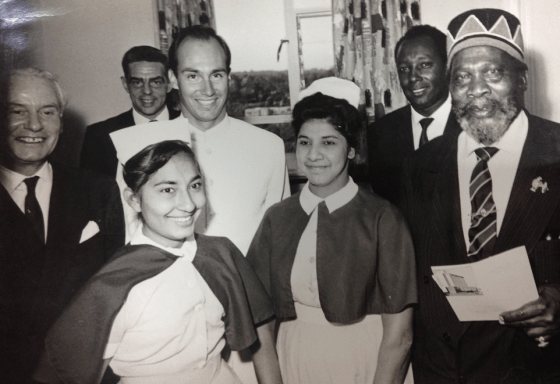
“To my overwhelming surprise the lift door opened on to the fifth floor where I was in charge. There they were, the Aga Khan and the President. I was honoured and awed. I felt like the luckiest person on earth. I met all the dignitaries and escorted them through the impeccable ward of which we were so proud.” — Kundanben Paatni

ESSAYS AND LETTERS: The Amazing Story of Kundan Paatni: A Graduate of the Aga Khan Nursing School in Nairobi in the 1960s

His Highness the Aga Khan and the late President Jomo Kenyatta visit the Aga Khan Hospital. Photo: Kundan Paatni Archives.

His Highness the Aga Khan and the late President Jomo Kenyatta visit the Aga Khan Hospital. Photo: Kundan Paatni Archives.

The Modern Pace of Life and the Place of Faith and Religion – A Reflection by Farouk Topan

Simerg Post Pace of Life

THE FUNDAMENTAL MESSAGE OF RELIGION

By Dr. Farouk Topan

The pace of life today is said to be much faster than it was just a few decades ago. This is an axiom of our times. What, however, is not axiomatic is the corollary that is often assumed to stem from it, namely that spiritual value and worth get diminished in proportion to the increase of pace. It is not uncommon to hear the lament that nowadays people have no time for religion. Many people actually believe this, and that is a great pity. For religion is not a ‘thing’ one ‘does’ if one has time. Religion is a commitment, an involvement of one’s being and personality, utterly, totally and completely.

Human nature, however, accepts few commitments gladly and it abhors those which are seen as imposed externally. Some people consider religion as a process forced upon them from outside themselves. To view religion as an imposition is to misunderstand its message and its function.

The fundamental message of religion to Man is to be at peace — at peace with himself, with his fellow human beings, and at peace with his Creator; the fundamental function of religion is to enable a person to understand and to know his own nature, his environment and to begin to recognise and to know his Creator. Knowledge and peace are interlinked. One makes the attainment of the other possible and a person who attains a degree of both becomes a potential recipient of God’s most valuable gifts to Man: wisdom. Tranquility is a reflection of wisdom.

Photo: John Macdonald.

Photo: John Macdonald.

“I do not believe that we should fear material progress, nor should we condemn it. The danger is that it could become an obsession in our lives and that it could dominate our way of thinking” — Mawlana Hazar Imam [1]

“The day we no longer know how, nor have the time nor the faith to bow in prayer to Allah because the human soul that He has told us is eternal is no longer of sufficient importance to us to be worthy of an hour of our daily working, profit-seeking time, will be a sunless day of despair” — Mawlana Hazar Imam [2]

An essential aspect of knowledge is the understanding that even a tiny part of our lives cannot be isolated from what is termed ‘religion’; for religion properly understood, is nothing less – and even more –  than life itself. We, as Muslims, are not and cannot be ‘outside’ of Islam. Islam involves us completely; that, indeed, is the essence of our existence.

The realization of this simple fact is the basis for experiencing an inner calm and tranquility. Then the pace of life around a person becomes largely immaterial, and its varied speed becomes a matter of petty insignificance. This is not to underestimate the powerful attractions of the style of life prevalent in many parts of the world; it is simply to point out that, if one wants to stop oneself from being drifted away aimlessly by the currents of materialism, one can stabilize oneself through the teachings and practices of Islam.

Date posted: Thursday, November 6, 2014.

_______________

The essay has been adapted from Ilm, Volume 2, Number 1, published by the Ismaili Tariqah and Religious Education Board (ITREB) for the United Kingdom, where it appeared under the title “Islam and the Modern Pace of Life.” Excerpts from the speeches of His Highness the Aga Khan were not part of the original piece by Dr. Topan.

[1] His Highness the Aga Khan, Takht Nashini (ceremonial installation), Karachi, Pakistan, January 23, 2958.
[2] His Highness the Aga Khan, Convocation Address, Peshawar University, Pakistan, November 30, 1967.

________________
Links for speeches of His Highness the Aga Khan:

Aga Khan Museum’s “The Garden of Ideas” – A Fine Example of Collaboration and Partnership Between Artists, the Museum and Corporate Sponsors

“The Garden of Ideas” is a collection of fascinating, inspiring and vibrant works of art by a team of six Pakistani artists in the gallery spaces inside the Aga Khan Museum as well as outside in the Park. The exhibition received a major boost when three international corporate sponsors stepped in with a generous donation. The three sponsors, Aljomaih Group, Trimark Capital and Asharys are from Saudi Arabia, the United Arab Emirates and Pakistan respectively. Future sponsorships, along these lines, would immeasurably add to the hosting of other fine temporary exhibitions by outstanding local and international artists, and be a boon to the artistic community writes Malik Merchant of Simerg….Read more at Collaboration and Partnership Between Artists, the Aga Khan Museum and Corporate Sponsors

"Garden of Ideas" exhibition in the upper gallery of the Aga Khan Museum. Photo: Malik Merchant/Simerg. Please click for article.

“Garden of Ideas” exhibition in the upper gallery of the Aga Khan Museum. Photo: Malik Merchant/Simerg. Please click for article.

….AND FOR ONCE, ENTER THE AGA KHAN MUSEUM FROM THE INDOOR PARKING LEVEL AND BE WELCOMED BY ENCHANTING ART WORK

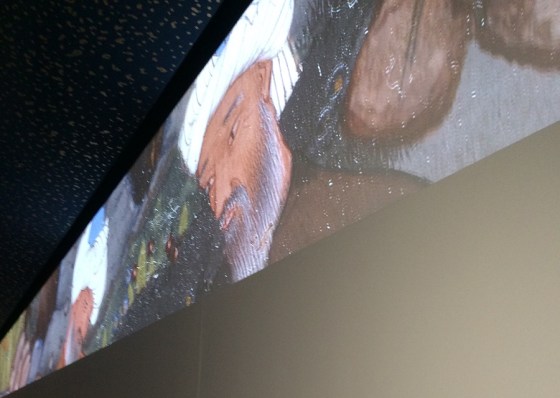
This magnificent display of ever changing panaromic display of images welcomes  visitors to the Aga Khan Museum as they enter its doors from the indoor parking garage. The parking level provides excellent resting facilities for Museum guests. Photo: Malik Merchant/Simerg.

This magnificent panoramic display of ever changing images welcomes visitors to the Aga Khan Museum as they enter its doors from the indoor parking garage. The parking level also provides excellent resting facilities for Museum guests. Photo: Malik Merchant/Simerg.

A Collection of Inspiring Stories, Readings and Photo Essays of the Ismailis of Tajikistan

EVERY LINK ON THIS PAGE IS WORTH A CLICK

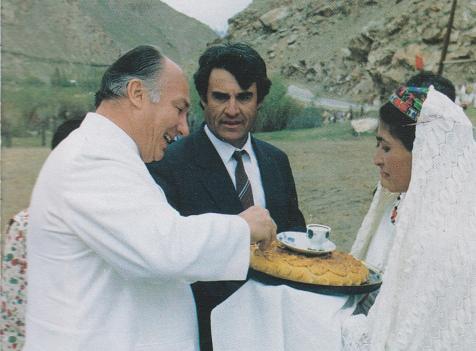
His Highness the Aga Khan's First Historic Visit to Badakhshan

His Highness the Aga Khan’s First Historic Visit to Badakhshan

“Shukr Mawlo, Shukr Mawlo” – When Hope is All You Have Left, a Story for Mawlana Hazar Imam’s Salgirah by Gulnor Saratbekova (Uruguay/Tajikistan)

Literary Reading: The Mystery of the Missing Mount Nasir Khushraw

Olivier Galibert: Ismaili Portraits from Tajikistan by Olivier Galibert (France)

Voices: A Western Correspondent’s Account of the Aga Khan’s Historic First Visit to His Followers in Gorno-Badakhshan

Photo  Gallery: Ismaili Portraits From Tajikistan (I) by A. M. Rajput, UK

Literary Reading: Shi’a Ismaili Tradition in Central Asia – Evolution, Continuities and Changes

“Ba Shokouh” – The Magnificent Ismaili Centre in Dushanbe, Tajikistan

Matthieu Paley: Journey to the Roof of the World (Portraits of Ismailis)


An Ode to the Indian Dukawala of East Africa by Kersi Rustomji

This work is a small tribute to the unsung intrepid pioneering Indian traders and very often their families, who braved the unknown hazards of the “Dark Continent”, carried on regardless of disease, lack of comforts, privations, ill-health, and even death, which they knew was their constant and real possibility.

“While the tribute is aimed at all the Indian, later termed Asians traders and shop keepers, we should bear in mind that these intrepid early trading pioneers also included Ismailis, who became prominent merchants and developers in all economic fields in East Africa. The Ismailis left behind an admirable record of their contribution, and this work touches them too.” — Kersi Rustomji

Hitherto the dukawala remain unrecognised nor given a deservedly appropriate place in the annals of these nations. Without record of these traders and other Indians who also played a very prominent and important part in the economic and the political growth of these nations, the histories of these three East African countries would be incomplete.

PLEASE CLICK: Ode to the Indian Dukawala on East African Plains

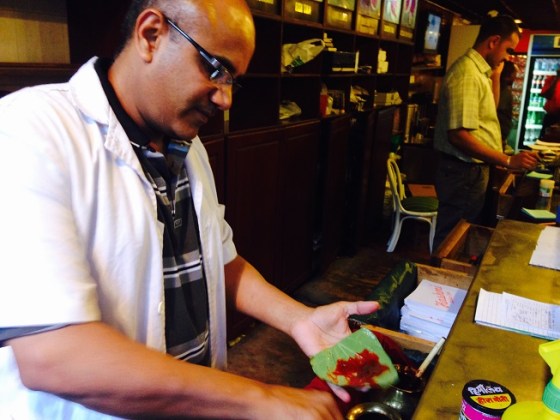
The image depicts on the rich red soil, a typical Indian duka, a small trading store, in small towns and remote country areas of East Africa. The signage is also typically hand painted work of the duka owners. These put up with any paint at hand, included some spelling errors. The man behind the counter is my paternal uncle Jehangirji Rustomji, who first opened a small watch repair duka in the old Indian Bazaar, now Biashara Street, in early 1906 in Nairobi, Kenya. He later moved to the then Government Road,  now Moi Avenue, in the corner of a chemist shop, Chemitex,  next to the old Alibhai Sherrif hardware shop, going towards the Ismaili jamatkhana, on the corner of Government Road and River Road. Later his youngest son Rati joined him, and after Jehangirji’s death, Rati carried on the little business until 2009, when he retired and closed the little duka after 103 years of its existence. Rati still lives in Nairobi. Copyright> Kersi Rustomji.

The image depicts on the rich red soil, a typical Indian duka, a small trading store, in small towns and remote country areas of East Africa. The signage is also typically hand painted work of the duka owners. These put up with any paint at hand, included some spelling errors. The man behind the counter is my paternal uncle Jehangirji Rustomji, who first opened a small watch repair duka in the old Indian Bazaar, now Biashara Street, in early 1906 in Nairobi, Kenya. He later moved to the then Government Road, now Moi Avenue, in the corner of a chemist shop, Chemitex, next to the old Alibhai Sherrif hardware shop, going towards the Ismaili jamatkhana, on the corner of Government Road and River Road. Later his youngest son Rati joined him, and after Jehangirji’s death, Rati carried on the little business until 2009, when he retired and closed the little duka after 103 years of its existence. Rati still lives in Nairobi. Copyright: Kersi Rustomji, Australia.


Ameer Kassam Janmohamed (1931-2014): Leader, Humanitarian and Man of Letters Passes Away in London, UK

REMEMBERING AN ISMAILI MAN OF LETTERS

Born in Kisumu, Kenya, to Rabhiabai and Kassam Janmohamed on June 6, 1931, Ameer Kassam Janmohamed was kind and generous and true to the responsibilities he had to his family and friends, his faith and the noble causes he undertook in public life from his youthful days. His long time service to the Rotarians was particularly significant.

Please click on Ameer Kassam Janmohamed (1931-2014) or photo for tribute.

Ameer Kassam Janmohamed (1931-2014), lived his life to the fullest. Please click on photo for tribute.

Ameer Kassam Janmohamed (1931-2014), lived his life to the fullest. Please click on photo for tribute.

________________

Ismaili Authors: Excerpt from M. H. Velshi’s “Conversation on Three Continents”

Toronto based Ismaili author, M..H. Velshi whose book excerpt can be read by clicking on the image or link below

Toronto based Ismaili author, M..H. Velshi whose book excerpt can be read by clicking on the image or link below

The year is 1936, and the setting for a serious dialogue between a brother and his sister is Mumbai’s famous Chawpati on Marine Drive – with the continent of Africa in the distant horizon, thousands of miles away….

“To Africa,” she said. 

She looked at his startled face and continued, “That’s your future. So many of my friends have gone and bought shops or farms, or found work on the railways…You know for many years our Imam, Mowlana Sultan Mohammed Shah, has been issuing firmans to us Ismailis to migrate to Africa. Now the Ismailis have built large jamatkhanas in Africa where people can pray and meet freely every day. You won’t be alone. When I heard one of his firmans…I knew it was a message meant for you. It’s your way out.”

PLEASE CLICK: “Conversations on Three Continents”

Please click on image for book excerpt.

Please click on image for book excerpt.

To acquire a Kindle version ($9.11) or a paperback copy ($11.66) at Amazon please click on Conversations on Three Continents.


14 Inspirational Thank You Letters to Remarkable Ismaili Historical Figures

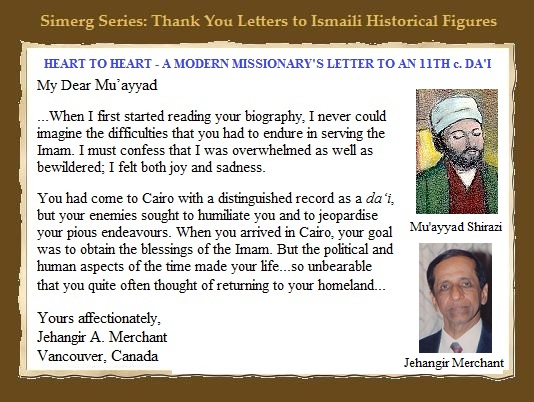
Jehangir Merchant’s Thank You Letter to the Fatimid Ismaili Icon, Da’i Al-Mu’ayyad al-Shirazi by Jehangir A. Merchant (Canada)

Please click for letter
* * *

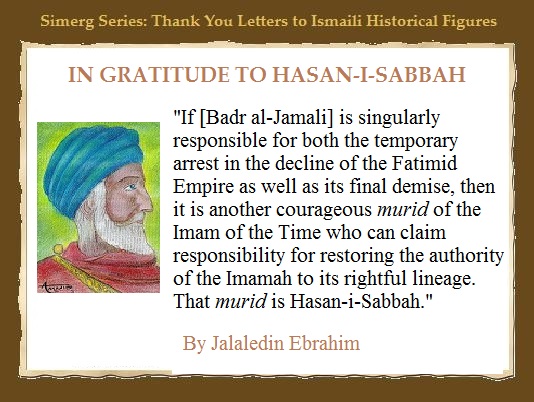
Jalaledin Ebrahim’s Gratitude to Amira Dharrab, Abu Najm Sarraj and Hasan-i-Sabbah by Jalaledin Ebrahim (USA)

* * *

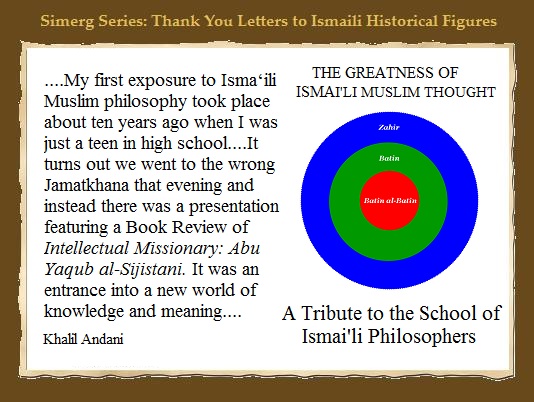
Khalil Andani’s Thank You Letter to the School of Isma‘ili Philosophers by Khalil Andani (USA/Canada)

* * *

Navyn Naran’s Ode to Pir Hasan Kabirdin – the Author of Anant Akhado and the Nav Chugga

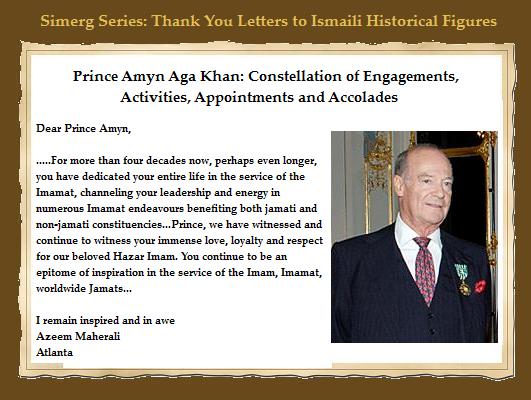
A Thank You Letter Inspired by Prince Amyn Mohammad Aga Khan’s Exceptional Service to the Imamat by Azeem Maherali (USA)

* * *

Vali Jamal’s Thank You Letter to Prince Sadruddin Aga Khan: The 1972 Expulsion of Asians from Uganda by Vali Jamal (Uganda)

* * *

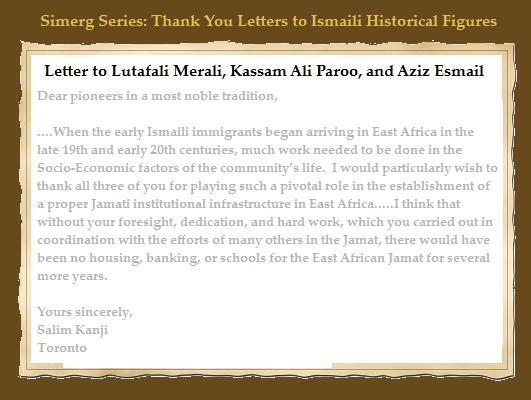
Salim Kanji’s Thank You Letter to Three Ismaili Pioneers in East Africa by Salim Kanji (Canada)

* * *

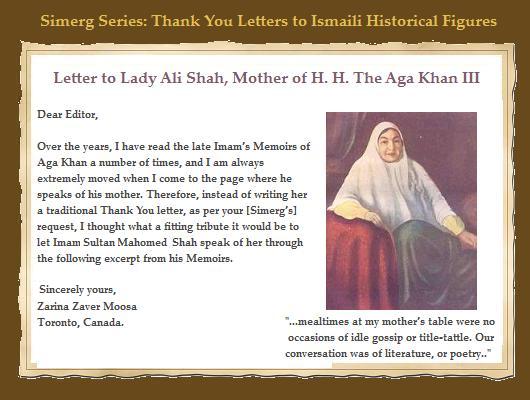
Zarina Moosa’s Thank You Letter to Lady Ali Shah Through the Voice of Her Son, Sir Sultan Mahomed Shah Aga Khan III by Zarina Moosa (Canada)

* * *

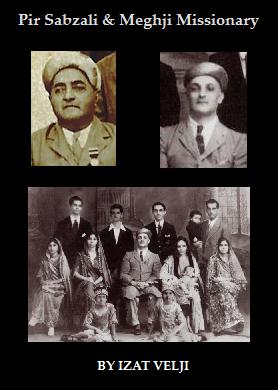
Reminiscences of Two Great Ismaili Missionaries, Pir Sabzali and Meghji Missionary by Izat Velji (Canada)

* * *

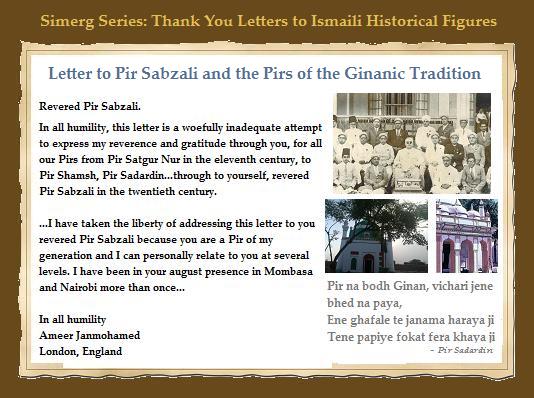
Ameer Janmohamed’s Thank You Letter to Pir Sabzali and the Ismaili Pirs of the Ginanic Tradition by Ameer Janmohamed (UK)

Please click for “Thank You” Letter to Pir Sabzali

* * *

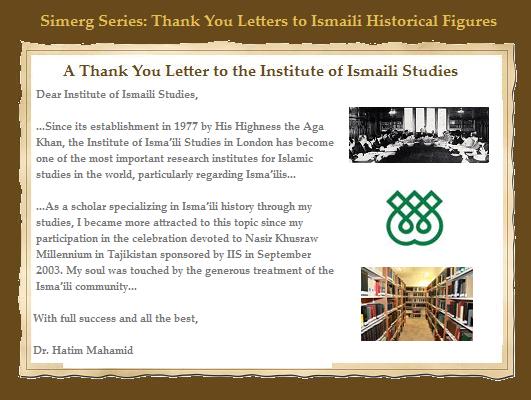
Hatim Mahamid’s Thank You Letter to the IIS by Hatim Mahamid (Israel)

Please click on image to read complete “Thank You” letter.

* * *

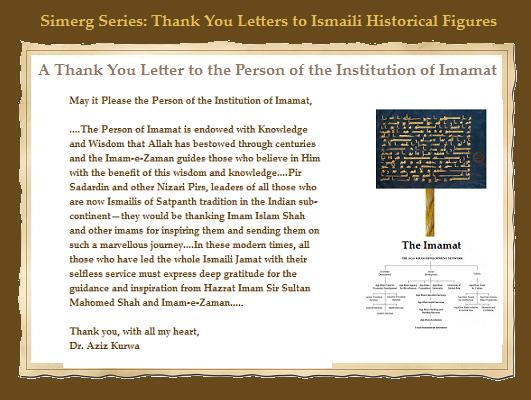
A “Thank You” Letter to the Person of the Institution of Imamat by Aziz Kurwa (UK)

* * *

A Thank You Letter to Prince Sadruddin Aga Khan – “A Man of Multiple Visions” by Mohezin Tejani (Thailand)

* * *

A “Thank You” Letter to the Makers of the Blue Qur’an by Andrew Kosorok (USA)

Please click for thank you letter. Image: Simerg.com.

~~~~~~~~~~~~~~

Has anyone in Ismaili history from the earliest times to the modern period inspired you and left an indelible mark on your life? How would you thank that one individual and what would you say in your letter to the person or groups of persons? We invite your contributions for this on-going imaginative series which began during this blog’s 3rd anniversary.

Please send your contribution to Simerg@aol.com, Subject: “Thank You Series.” All contributors will be contacted before their letters are published. Contributors must include their full name, address and phone number, and accompany their information with a brief profile and, optionally, a photo.

Date posted: Wednesday, January 8, 2014

A Reflection on the Tragedy in Karachi

Editor’s note: For the first time in recent memory, an act of violence and terror was directed against the Ismaili community on Wednesday, August 13, 2013 at two of their Jamatkhanas located in Karachi. Two deaths as well as several dozen injuries were reported by the media in Pakistan. It was indeed a sad day for Ismailis and non-Ismailis alike. Statements of condemnation were issued by numerous sources, and were particularly reported on Pakistan TV networks. A peaceful and generous community had been targeted senselessly by individuals who do not value life, the most precious gift from Allah.

Navyn Naran reflects on the tragedy that has brought profound sadness to countless people. We pray that peace prevails in the entire nation of Pakistan which has seen so much sectarian violence over the past two decades. We also pray for the peace and rest of the departed souls from this tragedy, and wish everyone who was injured from this act of terror quick and complete recovery.

(Following Navyn Naran’s reflection we have provided a few external  links to stories and comments about the tragedy) 

Of Karimabad, A Place of Generosity

By Navyn Naran

it was a place of comfort, a quiet haven in the wood
a cove where a mother fish and her young made home,
by the bank of a trickling brook,
he found solace there in this nook.
hot it became day by day, how shallow the water and nightly he prayed,
would there be rain droplets, just some?
it rained everywhere on earth it seemed, but here in this city,
the brook was drying

the fish drew closer to the bottom.
“Rain! please rain!” his heart implored
taking a few bottles of water, near the fish he poured.
And then the beginning of the end, it came!
Bhoommm!!! Crashh! lightning cracked
the heavens opened and buckets of rain fell
he danced in his shorts, his hair flying wet around his face,
his feet drenched in his sneakers,
soaked from the lovely rain
.

A mother and a child, many people.
A man finds it not easy to cry
But today men cried as bodies bled
and lives were hurt
What was the sense of the two scenes?
The boy, his heart generous, is a seesaw with yours

His action against yours.
What is the message you were sending?
 A message of good? Of right? Of admiration? Of envy? Of strength?
few on this earth will agree.

People were praying!
Prayers for peace where there is conflict

For health where there is illness
For abundance where there is poverty
in those prayer halls women and men seek to better their world
in Karimabad

The Karachi Bomb Attackes

Cowards!! you are cowards, envisioning bloodshed,
tormenting your fellow-man, with nothing gained,
Just Loss.
Our Loss.
For the mothers and children, the men and women you kill
are still alive within our hearts. That,
you can never take.
‘Do not take a life’ it is said, ‘for it is like taking all mankind’.
and who will you face then, but the Face of God?

Is it fear of peace, of the goodness of humanity which sickens you?
That there could be unity amid the plurality
does that threaten your space?
Is the Aga Khan and his teaching abominable to you?
Is the education and growth despicable to you?
How will you erase the entire goodness in humanity?
How will you bow to Nature’s Hand?

For we are one…have you read ?
From one woman and one man we came, do you know?
The family you cared for is the same one you killed.
What did it benefit you?
It is in ripples, you fearful man.
It is in ripples we send an energy;
and behind us is the force of the world.
Beside us is the force of the Universe.
cast a stone into a quiet pool and see ripples form…
Fight for an ethic
befitting your home

Date posted: Thursday, August 15, 2013.
Date updated: Friday, August 16, 2013 (links to stories on the tragedy, see below)

Copyright: Navyn Naran/Simerg.

____________

The tragedy on external websites:

1. Victims Laid to Rest
2. So then to this now
3. Three killed in bomb blasts on I-Day Eve
4. Consecutive blasts in Karachi Jamaat Khana leaves 2 dead, 28 injured
5. Altaf Hussain condemns attacks on Ismaili Jamaat Khanas
6. Two Ismaili Shias Killed in hand grenade attack
7. Violent evening

Dr. Navyn Naran was born in Dar-es-Salaam, Tanzania, to Anaar and Badrudin Naran. After beginning her high school in the UK, her family immigrated to the USA where she has lived since. Dr. Naran went to medical school at Tufts University School of Medicine in Boston, MA. She currently works in Paediatric Critical Care.