Simerg is an independent initiative dedicated to Ismaili Muslims, the Aga Khan — their Hereditary Imam — and the Ismaili Imamat, and Islam in general through literary readings, photo essays and artistic expressions
Omnipotent and Merciful is He, Allah knows what is best, At certain times He chooses To put us through certain tests
He observes our response To His Rightful Command, And on this He Judges, Just exactly where we stand.
It is not meant to be easy, What would be the purpose, So we are challenged in truth, Our response to Him defines us.
Reflect and recall a time when, We chose not to obey His Laws, He being of course, All-Forgiving, No doubt, forgave us our flaws.
But what is to be said, Of Hazrat Ibrahim, The One, On the day he was commanded, To take the life of his own son!
Put yourself in his place, Could you do the same, Take the life of who you hold most dear, The ultimate sacrifice in Allah’s name.
Eid al-Adha celebrates Ibrahim’s loyalty, To The Great and Loving Wise One, Though surely riddled with fear and pain, He placed Ismail, his most precious son,
In front of him, and said a prayer, In the Name of Allah, Lord of All Things, He swang the knife and opened his eyes, And “Oh, But what Mercy God Brings.”
In the place of his very own son’s head A miraculous goat’s head had fallen, Allah rewarded Ibrahim’s obedience, Without even a moment of stalling.
Try to imagine the emotions he went through, Ibrahim was elated and held Ismail near, Most Merciful is Our Most Gracious Creator, Humbled by Allah’s Grace he held back a tear.
Abraham would we if we could, Be as loyal as you are to Allah’s Laws, You stand as a testimony of Great Faith, Without even a moment to pause.
Let it be our endeavour, to faithfully honor, The Words from Above they are in our best interest, Take a moment to reflect this Eid al-Adha, And we, too, will surely be at our best.
(The poem was composed on July 30, 2020).
Date posted: July 30, 2020.
______________________
Farah Tejani
“Heavy topics painted beautifully with her word,” was how one reader responded to Farah Tejani’s recent contribution Elastic Embrace: A Collection of Poems. Farah graduated with her Bachelor of Arts in English Literature and her Master of Fine Arts in Creative Writing from the University of British Columbia in May of 1997 and earned top Honors for her Thesis on Short Fiction. With the help of her agent Barbara Graham she then went on to publish a collection of short stories published by Trafford, called, “Make Your Own Chai, Mama’s Boy!” — ten short stories dealing with different dilemmas South Asians face. Farah also wrote and co-directed her stage play, “Safeway Samosas,” which won “The Best of Brave New Playwrights Award” in July 1995. Her short story , “Too Hot” won third place in the “Canada-Wide Best Short Fiction Award.” and was read at The Vancouver Writers Festival. Currently, Farah is working on Childrens’ stories and a collection of poetry called, “Elastic Embrace” to be published in 2021.
__________________
Before departing this website please take a moment to review Simerg’s Table of Contents for links to hundreds of thought provoking pieces on a vast array of subjects including faith and culture, history and philosophy, and arts and letters to name a few.
We welcome feedback/letters from our readers. Please use the feedback box which appears below. If you don’t see the box please click Leave a comment. Your comment may be edited for length and brevity, and is subject to moderation. We are unable to acknowledge unpublished letters
Sterilized Pebbles, Holy Water in Plastic Bottles, Tracking Wristbands are all Part of Covid-19 measures for the annual Hajj that is currently underway in Mecca, as mentioned in our last post.
Please click on image to see complete story in The Washington Post.
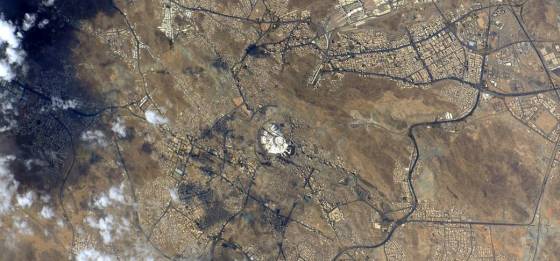
Featured image at top of page (NASA photo): Astronaut Scott Kelly posted the photo taken from the International Space Station to Twitter on Sept. 23, 2015 with the caption, “#GoodMorning to the Holy City of #Mecca #Makkah! #YearInSpace”.
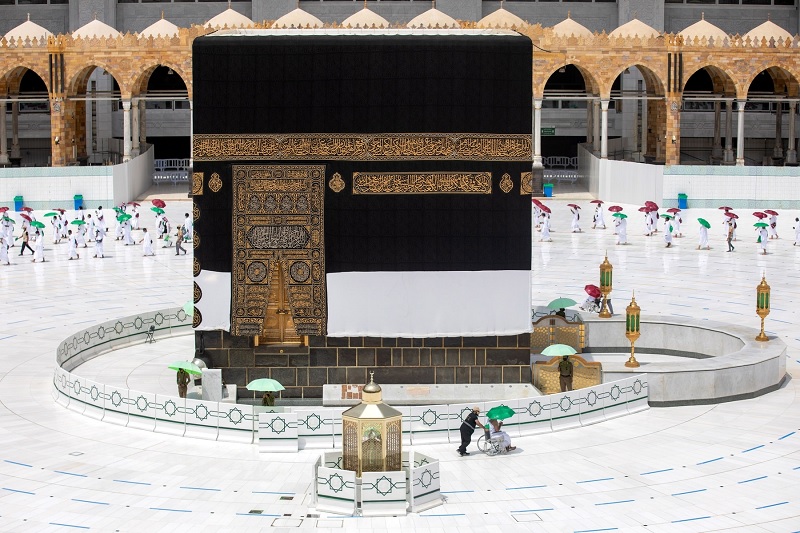
The Hajj, the annual pilgrimage to Mecca, drew almost 2.5 Muslims from around the world in 2019. This year’s Hajj has begun and will end on August 2/3. On Friday, July 31, the 10th day of the Islamic month of Dhul al-Hijjah, Muslims will observe the festival of Eid al-Adha which will last into Sunday or Monday August 2/3. This year’s Hajj is limited to 10,000 pilgrims. Pilgrim selection has been done from among local residents of Saudi Arabia as well as overseas citizens who are already living in the country. Pilgrims are required to wear face masks and will only be able to drink holy water from the Zamzam well in Mecca that has been prepackaged in plastic bottles. Pebbles for casting away evil that are usually picked up by pilgrims along hajj routes will be sterilized and bagged before being distributed to the pilgrims….FULL STORY WITH PHOTOS AT ASSOCIATED PRESS
Please click on image for full article and more photos at Associated Press Website
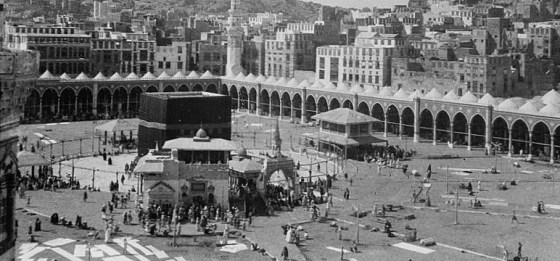
Featured image at top of page: Mecca, ca. 1910. Bird’s-eye view of uncrowded Kaaba. Photo: G. Eric and Edith Matson Photograph Collection / US Library of Congress.
Before departing this website please take a moment to review Simerg’s Table of Contents for links to hundreds of thought provoking pieces on a vast array of subjects including faith and culture, history and philosophy, and arts and letters to name a few.
Date posted: July 28, 2020. Last updated: July 29, 2020.
One day, in Mecca, the Prophet Muhammad dropped a bombshell on his followers: He told them that all people are created equal.
“All humans are descended from Adam and Eve,” said Muhammad in his last known public speech. “There is no superiority of an Arab over a non-Arab, or of a non-Arab over an Arab, and no superiority of a white person over a black person or of a black person over a white person, except on the basis of personal piety and righteousness.”
In this sermon, known as the Farewell Address, Muhammad outlined the basic religious and ethical ideals of Islam, the religion he began preaching in the early seventh century. Racial equality was one of them. Muhammad’s words jolted a society divided by notions of tribal and ethnic superiority.
Today, with racial tension and violence roiling contemporary America, his message is seen to create a special moral and ethical mandate for American Muslims to support the country’s anti-racism protest movement.
Apart from monotheism – worshipping just one God – belief in the equality of all human beings in the eyes of God set early Muslims apart from many of their fellow Arabs in Mecca.
Chapter 49, verse 13 of Islam’s sacred scripture, the Quran, declares: “O humankind! We have made you…into nations and tribes, so that you may get to know one another. The noblest of you in God’s sight is the one who is most righteous.”
Muslims of all backgrounds praying around the Kaʻbah during Hajj, the annual pilgrimage to Mecca, in a photo taken between 1885-1889. Photo: Al Sayyid Abd al-Ghaffār, Physician of Mecca / US Library of Congress
This verse challenged many of the values of pre-Islamic Arab society, where inequalities based on tribal membership, kinship and wealth were a fact of life. Kinship or lineal descent – “nasab” in Arabic – was the primary determinant of an individual’s social status. Members of larger, more prominent tribes like the aristocratic Quraysh were powerful. Those from less wealthy tribes like the Khazraj had lower standing.
The Quran said personal piety and deeds were the basis for merit, not tribal affiliation – an alien and potentially destabilizing message in a society built on nasab.
As is often the case with revolutionary movements, early Islam encountered fierce opposition from many elites.
The Quraysh, for example, who controlled trade in Mecca – a business from which they profited greatly – had no intention of giving up the comfortable lifestyles they’d built on the backs of others, especially their slaves brought over from Africa.
The Prophet’s message of egalitarianism tended to attract the “undesirables” – people from the margins of society. Early Muslims included young men from less influential tribes escaping that stigma and slaves who were promised emancipation by embracing Islam.
Women, declared to be the equal of men by the Quran, also found Muhammad’s message appealing. However, the potential of gender equality in Islam would become compromised by the rise of patriarchal societies.
By Muhammad’s death, in 632, Islam had brought about a fundamental transformation of Arab society, though it never fully erased the region’s old reverence for kinship.
Early Islam also attracted non-Arabs, outsiders with little standing in traditional Arab society. These included Salman the Persian, who traveled to the Arabian peninsula seeking religious truth, Suhayb the Greek, a trader, and an enslaved Ethiopian named Bilal.
All three would rise to prominence in Islam during Muhammad’s lifetime. Bilal’s much-improved fortunes, in particular, illustrate how the egalitarianism preached by Islam changed Arab society.
An enslaved servant of a Meccan aristocrat named Umayya, Bilal was persecuted by his owner for embracing the new faith. Umayya would place a rock on Bilal’s chest, trying to choke the air out of his body so that he would abandon Islam.
Moved by Bilal’s suffering, Muhammad’s friend and confidant Abu Bakr, who would go on to rule the Muslim community after the Prophet’s death, set him free.
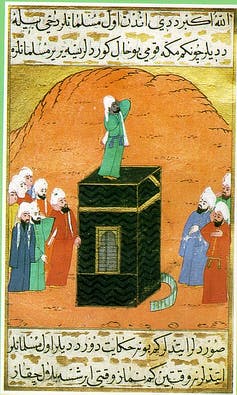
Bilal, center, found freedom in Islam. Wikimedia Commons
Bilal was exceptionally close to Muhammad, too. In 622, the Prophet appointed him the first person to give the public call to prayer in recognition of his powerful, pleasing voice and personal piety. Bilal would later marry an Arab woman from a respectable tribe – unthinkable for an enslaved African in the pre-Islamic period.
For many modern Muslims, Bilal is the symbol of Islam’s egalitarian message, which in its ideal application recognizes no difference among humans on the basis of ethnicity or race but rather is more concerned with personal integrity. One of the United States’ leading Black Muslim newspaper, published between 1975 and 1981, was called The Bilalian News.
More recently Yasir Qadhi, dean of the Islamic Seminary of America, in Texas, invoked Islam’s egalitarian roots. In a June 5 public address, he said American Muslims, a population familiar with discrimination, “must fight racism, whether it is by education or by other means.”
Many Muslims in the U.S. are taking action, supporting the Black Lives Matter movement and protesting police brutality and systemic racism. Their actions reflect the revolutionary – and still unrealized – egalitarian message that Prophet Muhammad set down over 1,400 years ago as a cornerstone of the Muslim faith.
Date posted: July 16, 2020.
[Editor’s Note: I first read the above piece in the religion section of the Salt Lake Tribune, which republished it from The Conversation under a Creative Commons Licence. We do likewise, and invite our readers to read the original piece by clicking HERE; it includes several more hyperlinks within the body of the article that some readers may find useful for further study. Image(s) in Simerg’s piece may vary from those posted in The Conversation and the Tribune .]
Before departing this website please take a moment to review Simerg’s Table of Contents for links to hundreds of thought provoking pieces on a vast array of subjects including faith and culture, history and philosophy, and arts and letters to name a few.
_______________________-
Asma Afsaruddin is Professor of Islamic Studies and former Chairperson, Department of Middle Eastern Languages and Cultures, Indiana University.
This article is republished from The Conversation under a Creative Commons license. To read original article in The Conversation, please click HERE.
_________________
The editor highly recommends the following recent pieces published in Simerg:
I’ve been watching the special Eid ul-Fitr presentation Shukrana since it was launched on Ismaili TV Sunday, May 24 2020, at 2 am! Yes! You are reading the hour correctly. When Saba Rawjani of Ottawa was performing on Sunday, my daughter Nurin was doing her gardening under sunny skies and a temperature of 25c in Ottawa! I urged her to get back and watch Saba (see photo at top of post). What a sweet and charming talent Saba is, and what about the control of her voice! Of course, I have heard her in Ottawa since she was a child, but how much she has grown over the years! Then, on Sunday morning the Syrian performance was incredible. Truly, every performance has been top class! And what about those messages from little children — I’m glad they are repeated every so often. Keep one thing in mind: every composition has been done with the artists’ love for Mawlana Hazar Imam, and in the spirit of ONE JAMAT.
I will review the concert at a later time but in the meantime I simply urge you to leave everything aside, for a few hours everyday, and watch the superb musical talent of the Jamat from every corner of the Ismaili world.
You still have more than 24 hours of continuous watching. What have I been doing during my absolutely essential sleeping time? Take my notebook into my bedroom, lay it on the dresser beside me, with the screen facing my bed! Something or the other nudges me to open my eyes, and I stare at the screen with delight. My ears are always open! I feel rested, and I owe it to delightful voices and instruments of Ismaili artists! What a wonderful intrusion!
WATCH IT, and ask your family members to join you! Sorry, but make the Shukrana viewing mandatory, at least for a few hours of the remaining time that is left! Please click Ismaili.tv.
Date posted: May 25, 2020, 01:05 AM.
Before departing this website please take a moment to review Simerg’s Table of Contents for links to hundreds of thought provoking pieces on a vast array of subjects including faith and culture, history and philosophy, and arts and letters to name a few.
_______________________
Malik Merchant of Simerg
Malik Merchant is the founding publisher/editor of Simerg (2009), Barakah (2017) and Simergphotos (2012). A former IT consultant, he now dedicates his time to small family projects and other passionate endeavours such as the publication of this website. He is the eldest son of the Late Alwaez Jehangir Merchant (1928-2018) and Alwaeza Maleksultan Merchant, who both served Ismaili Jamati institutions together for several decades in professional and honorary capacities. His daughter, Nurin Merchant, is a veterinarian. He may be contacted at Simerg@aol.com.
The following message in English and all the translations that follow are reproduced from the The Ismaili, the official website of the community. After reading the message, please scroll to the bottom of this post to read our supplication to Mawlana Hazar Imam — it follows the Tajik translation. For another version of this post, please visit our sister website Barakah, which is exclusively dedicated to Mawlana Hazar Imam and his family.
Message from Mawlana Hazar Imam (English)
My beloved spiritual children,
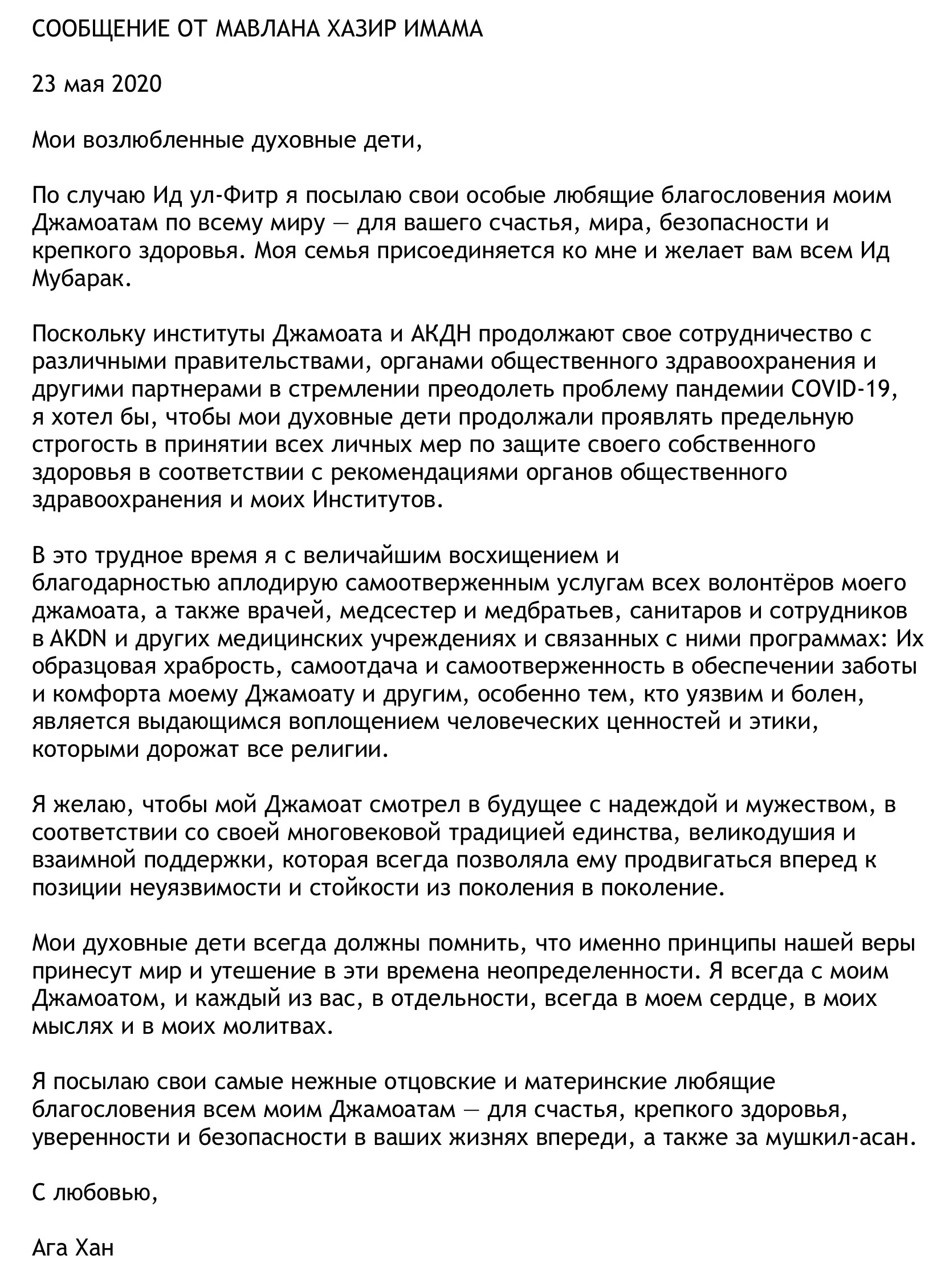
On the occasion of Eid ul-Fitr, I send my special loving blessings to my Jamats throughout the world for your happiness, peace, safety, and good health. My family joins me in wishing you all Eid Mubarak.
As the Jamati and AKDN institutions continue their collaboration with various governments, public health authorities and other partners in the endeavor to overcome the challenge of the COVID-19 pandemic, I would like my spiritual children to continue to exercise the utmost rigor in undertaking all personal measures to safeguard your own health, as recommended by the public health authorities and my Institutions.
At this difficult time, I applaud, with the highest admiration and gratefulness, the selfless services of all my Jamati volunteers, as well as the doctors, nurses, paramedics and support workers in the AKDN and other health facilities and related programmes: Their exemplary courage, commitment and dedication in extending care and comfort to my Jamat and others, and especially to those who are vulnerable and sick, is an outstanding actualization of the human values and ethics that all faiths cherish.
It is my wish that my Jamat should look to the future with hope and courage, in keeping with its age-old tradition of unity, generosity and mutual support which has at all times enabled it to move forward to a position of enhanced strength and resilience, from generation to generation.
My spiritual children should always remain mindful that it is the principles of our faith that will bring peace and solace in these times of uncertainty. I am with my Jamat at all times, and each of you, individually, is always in my heart, in my thoughts and in my prayers.
I send my most affectionate paternal, maternal loving blessings to all my Jamat – for happiness, good health, confidence and security in your lives ahead, and for mushkil-asan.
Yours affectionately,
Aga Khan
___________________
Message from Mawlana Hazar Imam (French)
MESSAGE DE MAWLANA HAZAR IMAM
Le 23 Mai 2020,
Mes chers enfants spirituels,
En cette occasion de Eid-ul-Fitr, j’envoie mes bénédictions affectueuses spéciales aux Jamats du monde entier pour votre bonheur, pour la paix, la sécurité et pour une bonne santé. Ma famille se joint à moi pour vous souhaiter à tous Eid Mubarak.
Alors que les Institutions Jamaties et AKDN poursuivent leurs collaborations avec les gouvernements, les autorités de santé publique et d’autres partenaires pour surmonter le défi de la pandémie COVID-19, je voudrais que mes enfants spirituels continuent à appliquer avec la plus grande rigueur toutes les mesures personnelles pour protéger sa santé, en lien avec les recommandations des autorités de santé publique et de mes Institutions.
En ces temps difficiles, je rends hommage, avec ma plus grande admiration et reconnaissance, aux service dévoués de mes volontaires du Jamat, ainsi qu’aux médecins, infirmiers, personnels paramédicaux, et à tous ceux qui travaillent au sein d’AKDN, des autres établissements de santé et des programmes associés. Leur courage exemplaire, leur engagement et leur dévouement pour apporter soins et réconforts au Jamat et en dehors, et plus spécifiquement aux membres vulnérables et malades, sont une représentation exceptionnelle des valeurs humaines et de l’éthique chères à toutes les religions.
C’est mon souhait que mon Jamat regarde vers le futur avec espoir et courage, en gardant sa tradition séculaire d’unité, de générosité et d’entraide, qui nous a permis en tout temps d’accroître notre position de résilience et de force à travers les générations.
Mes enfants spirituels doivent toujours garder à l’esprit que ce sont les principes de notre foi qui nous apporteront la paix et le réconfort en ces temps incertains. Je suis avec mon Jamat en tout temps et, chacun de vous, individuellement, est toujours dans mon cœur, dans mes pensées et dans mes prières.
J’adresse à mon Jamat mes meilleures bénédictions paternelles et maternelles les plus affectueuses – pour le bonheur, pour une bonne santé, pour la confiance et la sécurité dans votre avenir, et pour Mushkil-asan.
Affectueusement,
Aga Khan
___________________
Message from Mawlana Hazar Imam (Portuguese)
MENSAGEM DE MAWLANA HAZAR IMAM
23 de maio de 2020
Meus amados filhos espirituais,
Por ocasião do Eid ul-Fitr, envio as minhas especiais e amorosas bençãos aos meus Jamats por todo o mundo, para a vossa felicidade, paz, segurança e boa saúde. A minha família junta-se a mim para vos desejar, a todos, Eid Mubarak.
Enquanto as instituições Jamati e as da AKDN continuam a colaborar com os vários governos, autoridades de saúde pública e outros parceiros na tentativa de ultrapassar o desafio da pandemia da COVID-19, gostaria que os meus filhos espirituais continuassem a exercer o máximo rigor na tomada de todas as medidas individuais para salvaguardar a sua própria saúde, tal como recomendado pelas autoridades de saúde pública e pelas minhas Instituições.
Neste período difícil, aplaudo, com a maior admiração e gratidão, os generosos serviços prestados por todos os meus voluntários do Jamat, assim como os prestados pelos médicos, enfermeiros, paramédicos e pelos auxiliares quer na AKDN quer nas outras instituições de saúde e entidades relacionadas: A sua coragem exemplar, compromisso e dedicação na prestação de cuidados e conforto ao meu Jamat e aos outros, e em especial àqueles que são vulneráveis e doentes, é uma afirmação notável dos valores humanos e da ética que todas as fés partilham.
É meu desejo que o meu Jamat olhe para o futuro com esperança e coragem, mantendo a sua longa tradição de união, generosidade e apoio mútuo, que lhe permitiu, em todos os momentos, de geração em geração, seguir em frente para uma posição reforçada de força e resiliência.
Os meus filhos espirituais devem ter sempre em mente que são os princípios da nossa fé que nos trazem paz e consolo nestes tempos de incerteza. Estou com o meu Jamat em todos os momentos, e cada um de vocês, individualmente, está sempre no meu coração, nos meus pensamentos e nas minhas orações.
Envio as minhas mais afetuosas bênçãos paternais e maternais a todo o meu Jamat – para felicidade, boa saúde, confiança e segurança nas vossas vidas futuras, e para mushkil-asan.
Afetuosamente,
Aga Khan
___________________
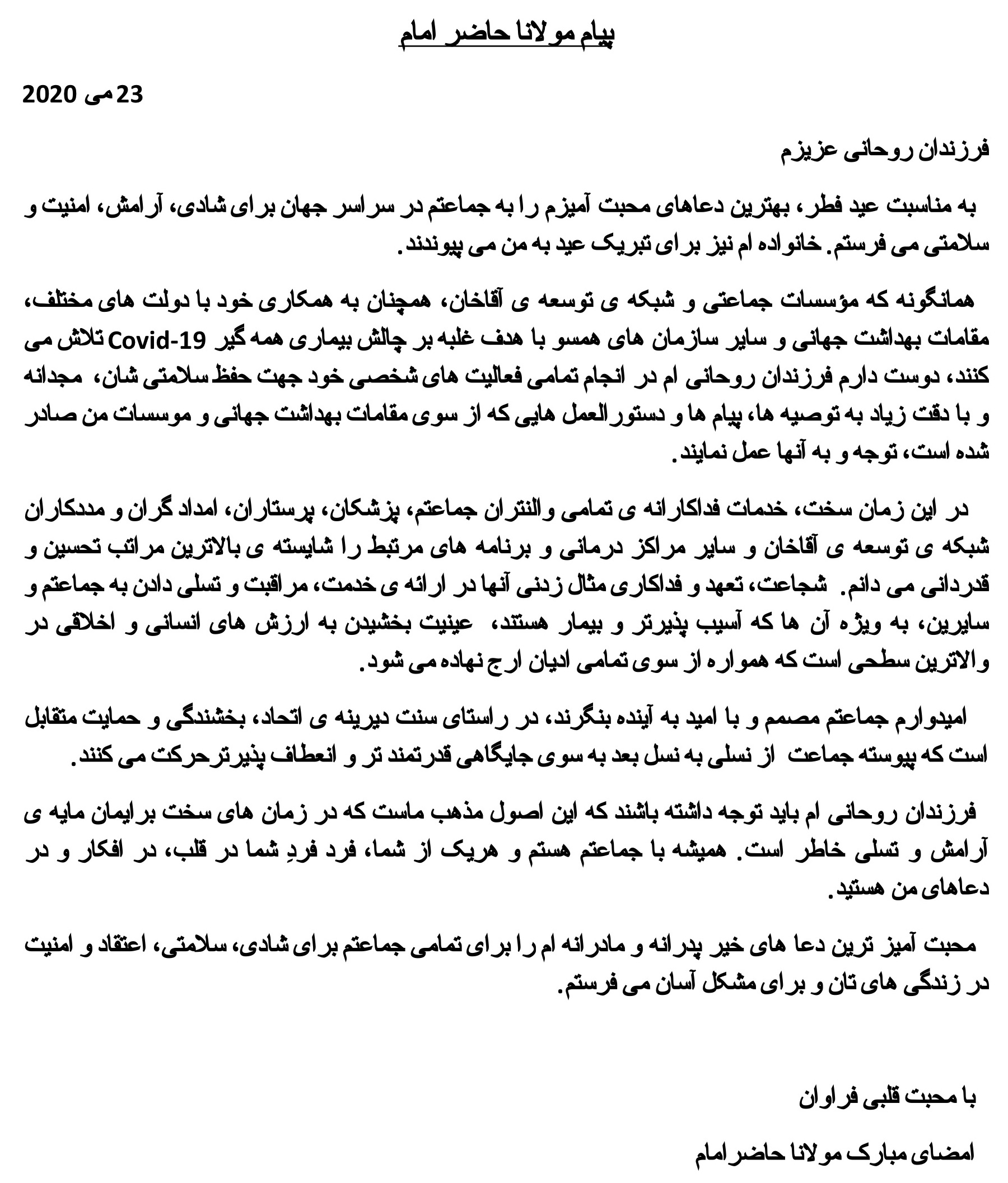
Message from Mawlana Hazar Imam (Farsi)
Message from Mawlana Hazar Imam (Farsi)
___________________
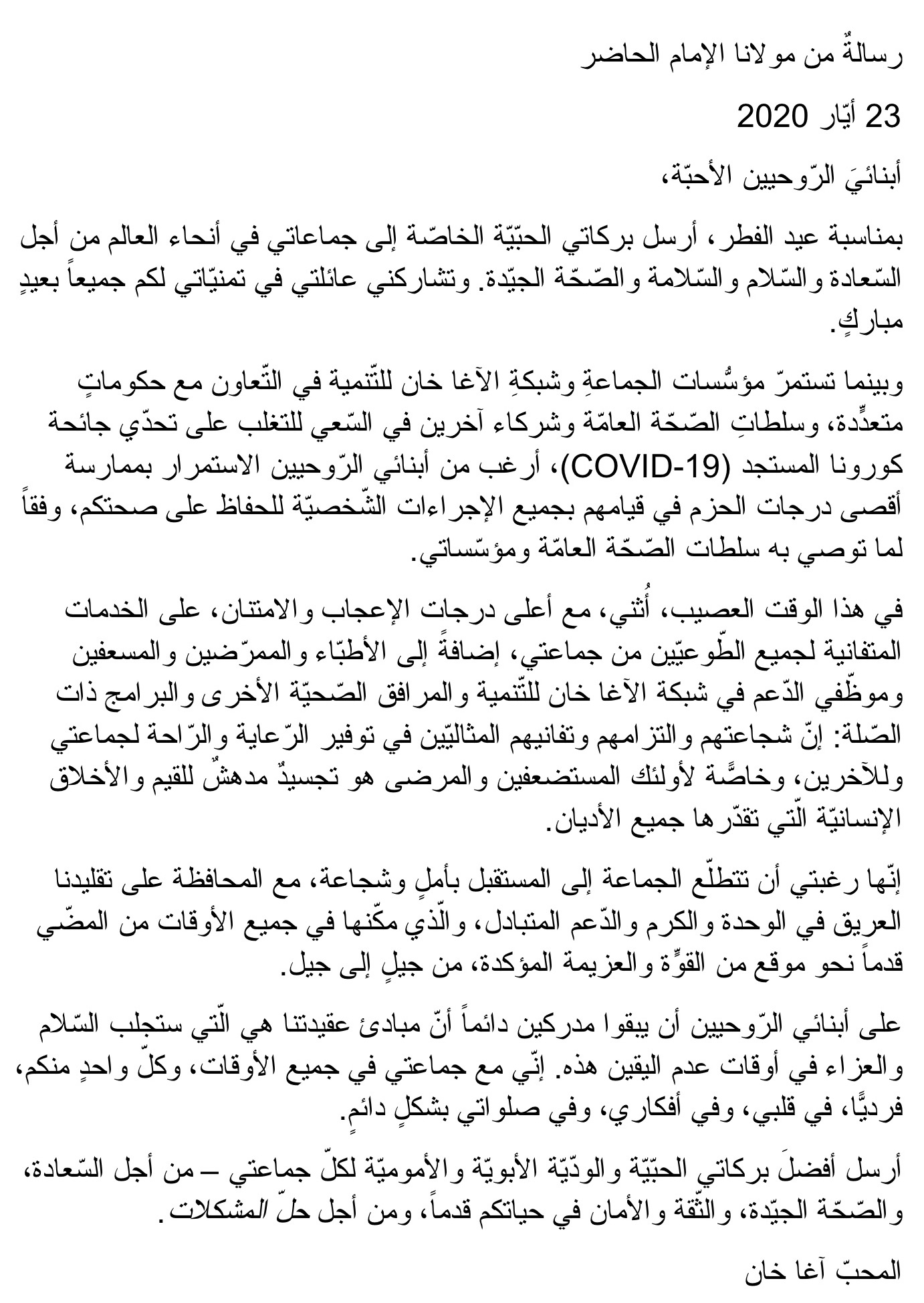
Message from Mawlana Hazar Imam (Arabic)
Message from Mawlana Hazar Imam (Arabic)
___________________
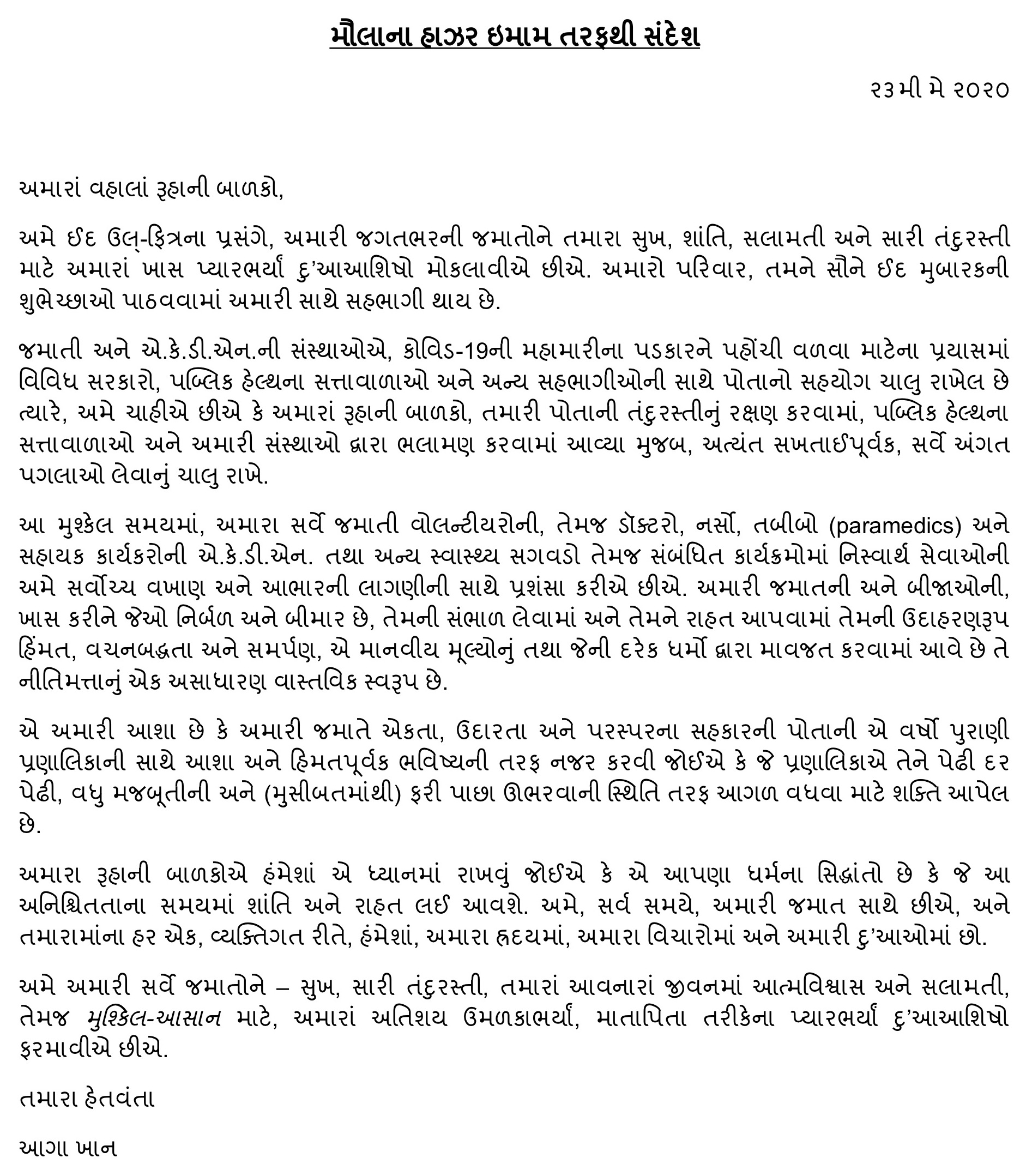
Message from Mawlana Hazar Imam (Gujarati)
Message from Mawlana Hazar Imam (Gujarati)
___________________
Message from Mawlana Hazar Imam (Russian)
Message from Mawlana Hazar Imam (Russian)
_______________________
Message from Mawlana Hazar Imam (Urdu)
Message from Mawlana Hazar Imam (Urdu)
___________________
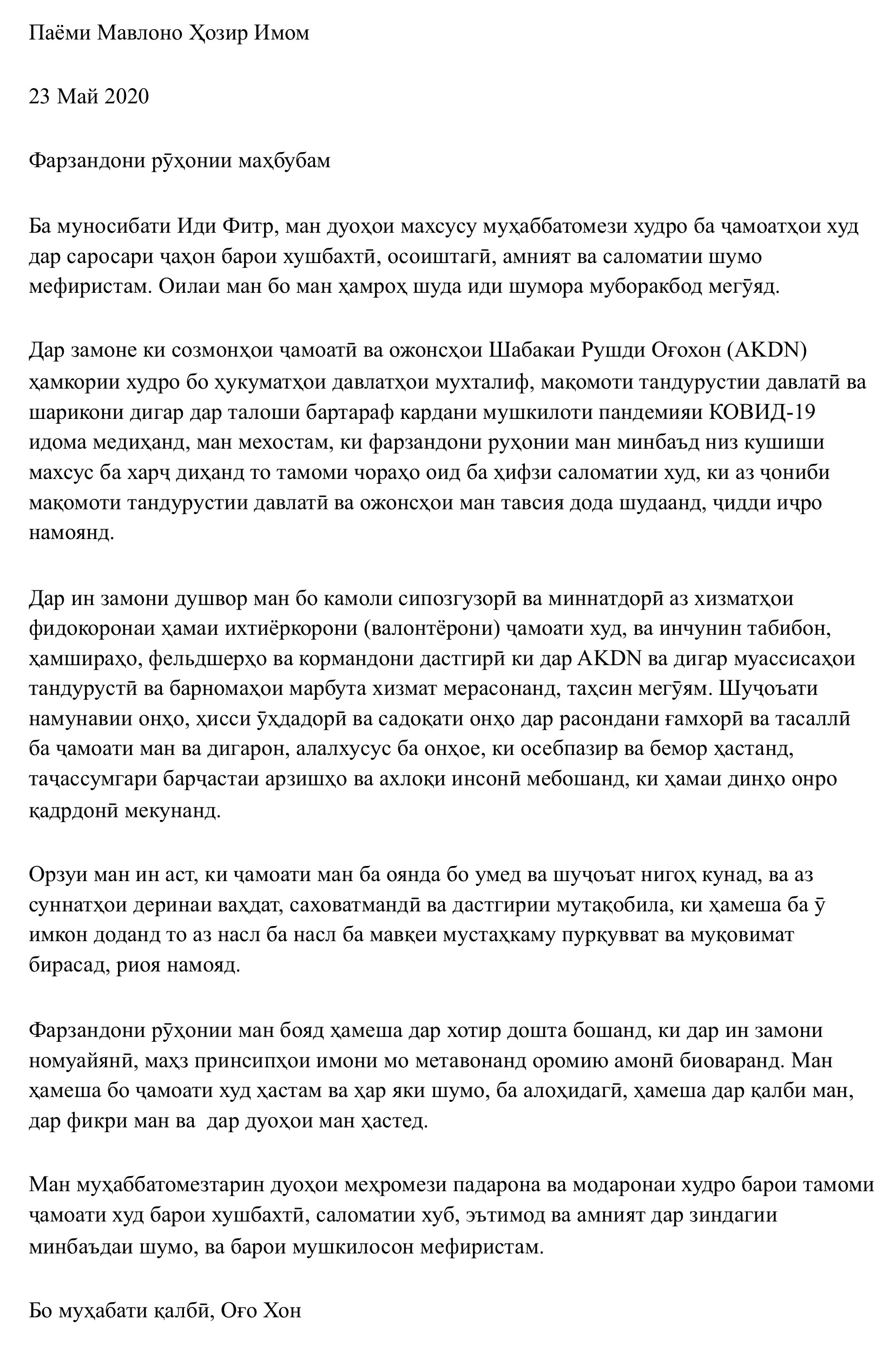
Message from Mawlana Hazar Imam (Tajik)
Message from Mawlana Hazar Imam (Tajik)
___________________
Shukrana and Supplication
We submit our humble gratitude to our beloved Mawlana Hazar Imam for his blessings to the world wide Jamat on the occasion of Eid ul-Fitr
We submit the following supplications from verse 1 of Pir Hasan Kabirdin’s Ginan Sahebe Farman Lakhi Mokalea:
“O brother! Listen, My Lord Ali has written and sent a Farman. The beloved Lord has remembered this servant today with kindness in his heart”
Date posted: May 23, 2020.
_______________
Before departing this website please take a moment to review Simerg’s Table of Contents for links to hundreds of thought provoking pieces on a vast array of subjects including faith and culture, history and philosophy, and arts and letters to name a few.
We welcome feedback/letters from our readers. Please use the feedback box which appears below. If you don’t see the box please click Leave a comment. Your comment may be edited for length and brevity, and is subject to moderation. We are unable to acknowledge unpublished letters.
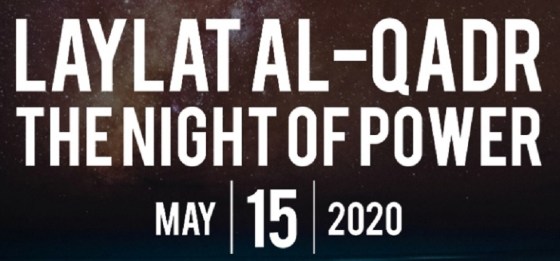
Jamats around the world must participate in this unique venture undertaken by Ismaili Institutions for this most extraordinary night commemorating the revelation of the Holy Qur’an
There is a very impressive array of programming organized for the night of Laylat al-Qadr by the Ismaili Tariqah and Religious Education Boards in the UK, Canada and the USA. Each jurisdiction has its own set of presentations and Simerg urges everyone — wherever they be — to avail themselves of outstanding recitations, sermons, interviews and stories as well as participate in quiet reflective moments that have been designated at specific times. A lot of effort has been put into this programming catered to every member of the Jamat, young and old alike.
Since this is an on-line presentation, viewers will be able to toggle to watch specific programs offered outside their own regions. Please click on the following images or links to see what the ITREBs in North America, the UK and Europe are offering on this truly auspicious and holy night of Laylat al-Qadr. The program can also be seen — for all jurisdictions — on a staggered basis on the website Ismaili TV, where time-zones are common, for example Canada and USA.
Please click on image for link to Laylat al-Qadr USA
Date posted: May 15, 2020.
__________________________
Before departing this website please take a moment to review Simerg’s Table of Contents for links to hundreds of thought provoking pieces on a vast array of subjects including faith and culture, history and philosophy, and arts and letters to name a few.
The echoes of Nature Bring us back to the cave Wherein spirituality harkens the soul Hush What is this ? To “Read”? Not yet. First to calm down Slow down the thoughts And attend the Divine Intellect That which emanates within each of our souls Within the bear of this Magnificent body That is all too human But never humanly created.
The echoes of Nature Bring us back to the cave To will the calm. Creating space to calm the Will. The physical jamat Khana is closed today The spiritual space wide open The windows to spring invite us in To quiet the mind for moments within
The echoes of Nature Light our world Let fresh air be a gift to enjoy. Within the chaos we must remember our Peace The time is given To slow the rat race. Echoes of Nature Harken the soul Can you hear? Perhaps outside in nature Or your child’s face asleep Or the eyes of a pet by your side
About the author: A regular contributor to this website, Dr. Navyn Naran was born in Dar es Salaam, Tanzania, to Anaar (1936-2017) and Badrudin Naran (1930-1979). She is currently in Toronto working in pediatrics and volunteering at the Aga Khan Museum.
____________________
We welcome feedback/letters from our readers. Please use the feedback box which appears below. If you don’t see the box please click Leave a comment. Your comment may be edited for length and brevity, and is subject to moderation. We are unable to acknowledge unpublished letters.
Before departing this website please take a moment to review Simerg’s Table of Contents for links to hundreds of thought provoking pieces on a vast array of subjects including faith and culture, history and philosophy, and arts and letters to name a few.
Heart in a pulsating mode; in rhythm with the breath Mind reaching its zenith; as thoughts meet their death
Gratefulness taking over; Conveying lightness to the body Entire body in smiles; Perhaps the spiritual light in embody
All because of the Dhikr, the constant chanting His attributes in tempo, energy in sync; all else negating
Dhikr: What an effect on the waves of the Gamma and the Theta Both leave defeated, allowing the take-over by the wave of relaxing Alpha
Dhikr: Bringing an awareness of His elements; so many …..Ninety-nine An inner need arises; to ascribe, to impute these traits divine
Dhikr: My heart is in a pulsating mode, in sync with the mind Now there is total unity; as mind, body and soul are totally entwined.
Date posted: May 13, 2020.
Before departing this website please take a moment to review Simerg’s Table of Contents for links to hundreds of thought provoking pieces on a vast array of subjects including faith and culture, history and philosophy, and arts and letters to name a few.
______________________
Editor’s note: We welcome Roxana Jaffer as our new contributor. Dhikr, penned by her in March 2020, is the first of her several poems we will be publishing in the coming weeks.
A Kenyan born girl, brought up in the UK and now residing in UAE, Roxana Jaffer has many awards to her name including “Global Inspirational Leadership Award”, “Best Best Woman in Hospitality UAE Award”, and “The Most Influential Women Leader Award 2019”. She was also recognized as one of the “Indian Super 100 Women Achievers in the Middle East & Africa”. She partners with UN World food program, and her endeavours have managed to feed over 460,000 hungry children in the world. She is instrumental in Holiday Inn Dubai attaining the coveted CSR Arabia award, four years running out of 13 Arab countries.
An Accountant by profession she has an MBA from University of Liverpool in Leadership and is a scholar of the Harvard Business School for Executive Education.
Roxana epitomises the best in human endeavour -– fun, laughter, hard work, creativity, caring for others, leading with a social conscience and above all, striving to make the world a better place and is the founder of the NGO -– ‘abc: an Advent for Building human Capital’ (see www.myabcfoundation.org) which accords English to the unemployed in Hunza and Delhi, resulting in a 70% impact as youth get growth.
Her creativity is taking a different turn as she expresses spirituality through poetry she pens.
______________________
We welcome feedback/letters from our readers. Please use the feedback box which appears below. If you don’t see the box please click Leave a comment. Your comment may be edited for length and brevity, and is subject to moderation. We are unable to acknowledge unpublished letters.
[NOTE FROM WRITER: I wish to clarify at the outset that I am not suggesting that we should be establishing Satadas in our own homes while the Jamatkhanas are closed. COVID-19 has impacted the religious and spiritual lives of hundreds of millions of people around the world, who cannot attend their beautiful and inspiring houses of worship and prayers. Ismailis are also affected due to Jamatkhana closures. However, we can perform our obligatory prayers in our homes individually and with family members who are not in isolation.In this post, we suggest (1) extra prayers we may offer for our comfort, courage and happiness, (2) References to Farmans and Mawlana Hazar Imam’s Talikas that we can read, and (3) Ginans we can listen to from outstanding resources that we have at our disposal such as Ginan Central at the University of Saskatchewan. NOTE: According to the Ismaili calendar the Satada would have begun in Jamatkhanas on April 3. However what is suggested in the post is applicable for all times, and not limited to the prayers performed only during Satadas.Hopefully the Satada that we must all unfortunately miss due to Covid-19 will be established when Jamatkhanas are re-opened after the pandemic is over.]
Thousands of Ismaili families across Canada are receiving phone calls from their respective Jamatkhana leadership including Mukhi/Mukhiani and Kamadia/Kamadiani inquiring about our well-being at this time of the Covid-19 pandemic. Their concern has deeply touched our hearts, and we sincerely thank them for the time they are taking to speak to us, and to patiently listen to our experiences, needs and challenges. They are playing their leadership roles, as representatives of Mawlana Hazar Imam, with an immense amount of affection and love, which we can feel in their voices.
In an inspiring prayer filled phone call yesterday from the Ottawa Jamatkhana Kamadiani, I was informed that according to the 2020 religious festivals calendar, the weeklong Jamati Satada (communal congregational special prayers for 7 continuous days) in Canada would have commenced from Friday, April 3.
Jamati Satada are held twice a year across many parts of the Ismaili world (there are also individual Satadas which, in serious personal cases, can be held at any time of the year at the request of individuals seeking special prayers for members of their families).
During the seven days of Jamati Satada, tens of thousands of Ismailis, young and old alike, gather in Jamatkhanas around the world for special prayers and heartful supplications for protection from difficulties (or Mushkil Asan). The special prayers are not exclusively for Ismailis. They include supplications for the world at large. In addition to 2 Jamati Satadas in a year, special Jamati Satadas can be instituted in exceptional or extraordinary circumstances, such as major natural or man-made calamities.
With the Satada in Canada earmarked to start on Friday, April 3, we have provided for our readers an outline of prayers that may be offered in our homes or individual spaces. The summary reflects the Satada practice that would be normally conducted in the Jamatkhanas, with minor differences. One point to note is that different countries may have their own starting dates for the Satada. The important thing to remember, however, is that it is a continuous 7-day observation.
SUGGESTED PRAYERS FOR “PROTECTION FROM DIFFICULTIES”
The Toronto Ismaili Centre with its magnificent Jamatkhana prayer hall dome. Ismailis await its opening once the city of Toronto has declared victory over Covid-19, and allows large gatherings to take place. Photo: Malik Merchant/Simerg.
1. Recite the two evening Du’a. Remember that in the Du’a, we recite Surah Al-Fatihah (opening of 1st part of Du’a) and Surah Al-Ikhlas (opening of 6th part), both of which are considered to be among the greatest Surahs in the Holy Qur’an. In our beautiful Du’a, we also utter phrases that call for Allah’s mercy and support as well as help and strength from the Imam of the Time, Mawlana Shah Karim al Hussaini Aga Khan.
2. Recite the Satada Tasbih of Ya Ali to Rahem Kar, Ya Ali to Fazal Kar, meaning “O Ali be Merciful, O Lord [Ali] be gracious.”
3. Recite or play recordings of pertinent Ginans and Qasidas of supplication; one such Ginan sung by the Late Shamshudin Bandali Haji, with a link to its English transliteration and translation, is provided below.
5. Also, read Farmans from the recently printed Farman Mubarak books authorized by Mawlana Hazar Imam.
6. After 2nd Du’a, partake in Ab-e-Shifa (water of healing) if you have it with you.
Also, during the Coronavirus crisis, and also at other times when times are good:
7. Ask and motivate children and youth to learn and memorize the meaning of the Du’a. Seriously, consider this as one of the most important building block of our faith, and treat it as one of the most important missions that you have. When Mawlana Hazar Imam blessed my late dad Jehangir Merchant with a few precious minutes of his time in Lourenço Marques (now Maputo), one of the first questions he put to him was whether children were being taught the meaning of the Du’a.
8. Make faith part of our daily life. Even if it be for a moment or a few seconds, say Ya Allah, Ya Muhammad or Ya Ali, or call on the names of our Imams, keeping in mind that all hereditary Imams from Hazrat Ali are bearers of the same Noor.
9. Recite the Salwat Allahumm-a Sall-i ‘Ala Muhammad-in Wa Al-i Muhammad, meaning “O, Allah shower thy choicest blessings upon Muhammad and the progeny of Muhammad.” This tasbih is recited on Chandraat.
10. Recite the tasbih of Bibi Fatimah. They are Allahu Akhbar meaning God is Great, Subhanallah meaning Glory be to God, and Alhamdulillah meaning All praise is due to Allah. According to Islamic tradition, the Prophet Muhammad (S.A.S.) had recommended the tasbih to his beloved daughter Bibi Fatimah (A.S.), and hence its name. It is recited on Chandraat, along with the Salwaat.
11. Seek forgiveness by reciting Astaghafirullahi Rabbi Wa Atubu Ilayhi meaning “Verily, I seek the forgiveness of Allah, who is my Lord and Sustainer, and I turn to Him in repentance.” It is recited when prayers are offered for deceased souls.
12. If you are really fearful of what is going on around you, say the Nade Ali a few times for hope, courage and strength.
Nade Ali, Nade Ali, Nade Ali Nade Aliyyan mazhar al-ajaib Tajidahu awnan lakafin-nawaib Kullu hammin wa ghammin sayanj-i Ali Bi wilayatika, Ya Ali! Ya Ali! Ya Ali!
MEANING
Call Ali call Ali call Ali, the manifestation of marvels He will be your helper in difficulty Every anxiety and sorrow will end Through your friendship. O Ali, O Ali, O Ali.
Recitation of Ginan by (Late) Alwaez Shamshu Bandali Haji
Please click Ismaili Heritage for an English transliteration with translation.
Date posted: April 2, 2020. Last updated: April 4, 2020 (editorial note, at top).
______________________
Simerg’s Malik Merchant
Malik Merchant is the founding publisher/editor of Simerg (2009), Barakah (2017) and Simergphotos (2012). A former IT consultant, he now dedicates his time to small family projects and other passionate endeavours such as the publication of this website. He is the eldest son of the Late Alwaez Jehangir Merchant and Alwaeza Maleksultan Merchant, who served Jamati institutions for several decades.
We welcome your feedback. Please complete the form below or click on Leave a comment if the form is not displayed. Comments are published at the discretion of the editor. and may be subject to moderation.
















 Simerg - Insights from Around the World