Triumphal Moments in Ismaili History: Jawhar’s Conquest of Egypt and Imam al-Muizz’s Resplendent Darbar in Cairo

“I WISH I’D BEEN THERE”

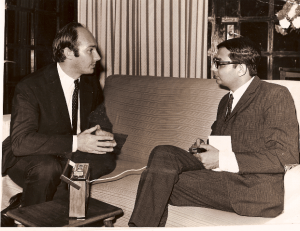
1970: Mansoor Ladha, veteran award winning journalist, writer and author, interviewing His Highness the Aga Khan for Tanzania’s daily, The Standard (now Daily News). Photo: Mansoor Ladha Collection. Copyright.

BY MANSOOR LADHA

As a journalist, a writer and an author, what better time to be than reporting milestones and significant events during the Fatimid Period or the “Golden Age” of Ismailism, when Ismaili Imams ruled over a vast empire and when Ismaili literature, philosophy and law flourished. It was during the Fatimid Period that the Ismaili scholars and authors produced what were to become the classic texts of Ismaili literature dealing with a multitude of exoteric and esoteric subjects. I think I might have made Ismaili fiqh (jurisprudence) my area of specialization, because it had not existed during the pre-Fatimid period. It was codified and became catalogued during the early Fatimid period. It was during the Fatimid period that Ismailis made their important contributions to Islamic theology and philosophy in general and to Shia thought in particular. Modern recovery of Ismaili literature clearly attests to the richness and diversity of the literary and intellectual traditions of the Ismailis.

Egypt became the center of the Fatimid empire that included at its peak North Africa, Sicily, Palestine, Lebanon, Syria, the Red Sea coast of Africa, Yemen and the Hejaz. Egypt flourished as the Fatimids developed an extensive trade and diplomatic network and ties which extended all the way to China. Map: Wikipedia; click to enlarge

But, I think, for me of all the events that I would have reported, there are a number of related incidents that stand out, and which I would have liked to witness in the company of Imam Muizz’s trusted commander, Jawhar al-Siqilli. He was of Sicilian descent.

He had been entrusted by the Imam to conquer Egypt. With a 100,000 men assembled and equipped at a cost of 24 million dinars, he set out for Egypt on February 5th, 969.

Embedded I would be, like the modern journalists in this vast army, alongside my hero! The road to Egypt had been well ascertained, forts had been built through the route at specific places. Jawhar was carrying with him a thousand caskets filled with silver. Camels carried gold ingots in plain sight, cast in the shape of millstones, to impress the crowds and the local peoples through which the army passed. Then four months later, in June of the same year, I would arrive with Jawhar in Egypt, and hardly witness any resistance!

As the first measures after the conquest, I see him issue a proclamation promising financial reforms and an end to injustice. He reached out to Sunnis, Jews and Christians and offered them protection.

Then I had been with him as he crossed the Nile, and on July 6 of the same year, he marched through Fustat, and established himself north of the city in the plain that would become his new capital – a capital that Imam Muizz had expressed a wish would rule the world.

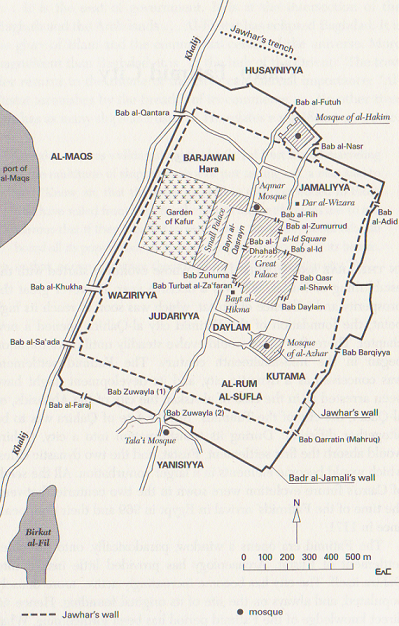
Fatimid Cairo with an outline of Jawhar’s wall shown by dashes (Please click to enlarge)

This site was empty except for a monastery and a castle. On the very night of Jawhar’s arrival in this empty spot, I would have seen the Sicilian mark the perimeter of the city with wooden stakes strung together with belled ropes. A crow would land on the rope and set the bells jingling. The ground breaking work would commence at that spot for what would eventually become known as al-Qahira (“The Triumphant”). I would see the birth of what is now modern Cairo!

But the epochal incident, the Grand Darbar, would come four years later. During this interim time I would see Jawhar establish the new capital, pacify the provinces, institute financial reform, defeat the Qarmats in December 971, and introduce new religious observances in conformity with the Shia Ismaili faith. This would include a call to prayers containing the Shiite invitation to “come to the best prayer.”

Now that all had been done, no further time would be spent. There was nothing left to do but to invite Imam al-Muizz.

In 973, the Imam leaves the Maghreb on his way to Egypt with his sons and relatives with him, along with coffins of his ancestors. One of his stops is Alexandria, where the Imam resolves to dedicate his life in the exercise of good works. He then preaches to them in a manner which draws tears from many who are present.

He departs after spending three days in Alexandria, and on June 6, 973, he reaches a place known as Mina. Jawhar is there to receive him. I see him go forth to meet his master and I witness him drawing near the Imam, dismounting from his horse and kissing the ground before the Imam in a show of loyalty, humility and submission to the Amirul Muminin. This is affection and love for the Imam I see at the highest and deepest level. It is a profound experience and a joy to behold, which I would report.

The Imam would then cross the Nile on the Rawdah bridge, bypass Fustat, and proceed straight to Cairo and take possession of the palace or fort that Jawhar had constructed for the Imam.

It is Ramadhan – year AH 362. The feast marking its end is underway. I’d see Imam Muizz conduct his prayers at the new mosque in Cairo, and then ascend the pulpit to give his sermon, with Jawhar on the steps of the pulpit. I would feel the emotions as the crowds weep and sob at hearing the Imam’s sermon.

Outside, the Imam would then mount his horse surrounded by his four armoured and helmeted sons, while two elephants led the procession. Destination – the fort, and I on my heels to get there for the Darbar!

Then, at the fort, all the citizens eagerly await to pay their allegiance to the new Caliph. Jawhar would be within my sight, and very close to the Imam, to his right.

I would witness the Imam majestically seated on his golden throne as he received all the nobles, Qadis, Vazirs and Ulemas of his city. They would present the Imam with their beautiful gifts as well as a robe made from a rare yarn that is known to grow only in Tunis. The material has a special shine and is gilded with gold and silver. The Imam would then be presented a Turban of a similar material and he would adorn the robe and the Turban. A resplendent Darbar for me to record and report as a journalist!

My friend, Jawhar, would get his turn. I would see him present the Imam, al-Muizz, with the best breed of 150 horses gilded with saddles and bridles of gold and diamonds as well as camels and ponies, saddled with boxes filled with all rare items in Egypt.

Then the Imam Muizz in a remarkable gesture of magnanimity and forgiveness would announce the release of about 1000 of his prisoners and present robes and Khalat to all his nobles and officers.

Would Jawhar be forgotten in the sight of the Imam? No. I would be exuberant to see my beloved Imam’s immense love for someone responsible for conquering Egypt some four years earlier. Jawhar would be honoured as he is presented with a golden Khalat and a turban. Imam Muizz then would tie a sword on Jawhar’s waist and present him with 20 horses with golden saddles, 50 thousand dinars and 200,000 dirhams.

With this Darbar, Egypt and Cairo enter a new era that would last almost two centuries and constitute one of the most brilliant periods in Ismaili history and Islamic Civilization.

Indeed a monumental and epochal event to witness and report! What a story and I Wish I’d Been There with Jawhar.

© Simerg.com

_________________

Front cover of Ladha’s work

About the Writer: Mansoor Ladha is an award-winning journalist based in Calgary, Canada. He has held several senior editorial positions with daily and weekly newspapers in Canada, Kenya and Tanzania, which included the Edmonton Journal, Morinville Mirror, Redwater Tribune, Daily Nation, Kenya, and Daily News, Tanzania. Currently, he freelances for the Calgary Herald, the Vancouver Sun, and the Calgary Senior newspapers and travel magazines. He has also published a book entitled A Portrait in Pluralism: Aga Khan’s Shia Ismaili Muslims and is currently working on memoirs on his life in East Africa and in Canada. Last year, he was one of the several writers, scholars and journalists invited to contribute a chapter in the book called, The Story That Brought Me Here. He has served on several public and voluntary bodies in Canada. His complete profile can be viewed on his Web site www.mansoorladha.ca.

_______________

This piece by Mansoor Ladha is one of 32 succinct pieces on Ismaili history that appeared in this blog’s highly acclaimed first anniversary special series, I Wish I’d Been There.

2. We welcome feedback/letters from our readers. Please click Leave a comment, or email it to simerg@aol.com. Your feedback may be edited for length and brevity, and is subject to moderation. We are unable to acknowledge unpublished letters.

______________

Narrative references:

1. Cairo by Andre Raymond, translated by Willard Wood, published by Harvard University Press, Cambridge, MA, 2000.

Also note: Cairo map shown is from this book

2. Jawhar as-Siqilli by Zawahir Nooraly in book Great Ismaili Heroes, Pakistan. The complete article is also available on-line at:  http://www.amaana.org/heroes/note010.htm

@Simergphotos: Ottawa Doors Open Leads Simerg to Muslim Cultural Centres, the Algerian Embassy and the Delegation of the Ismaili Imamat

PLEASE CLICK: For 2015 Ottawa Doors Open, Simerg Visits 2 Muslim Centres, the Algerian Embassy and the Delegation of the Ismaili Imamat

Visitors pay close attention as they receive an overview of the key features of the Delegation of the Ismaili Imamat during the 2015 Ottawa Doors Open event. Phooto: Simerg/Malik Merchant.

Visitors pay close attention as they receive an overview of the key features of the Delegation of the Ismaili Imamat during the 2015 Ottawa Doors Open event. Photo: Simerg/Malik Merchant.

History in the Making: Establishment of the Seat of the Ismaili Imamat in Portugal

COMPILED BY SIMERG

Please click on photo for enlargement

Mawlana Hazar Imam, His Highness the Aga Khan, 49th hereditary Imam of Shia Ismaili Muslims  directly descended from the Holy Prophet Muhammad (s.a.s.). Photo: AKDN/Anya Campbell. Copyright.

A portrait of Mawlana Hazar Imam, His Highness the Aga Khan, 49th hereditary Imam of Shia Ismaili Muslims. Photo: AKDN/Anya Campbell. Copyright.

In an unprecedented historical event, His Highness Prince Karim Aga Khan, the 49th hereditary Imam of the Shia Imami Ismaili Muslims, and Portugal’s Minister of State and Foreign Affairs, Rui Machete, came together at the historic Necessidades Palace in Lisbon on Wednesday June 3, 2015, to sign a landmark agreement to establish the Seat of the Imamat in Portugal. The Ismaili Imamat is a supra-national entity, representing the succession of Imams since the time of the Prophet Muhammad (s.a.s).

The Agreement marks the first such accord in the Ismaili Imamat’s modern history. It will come into effect once it has been approved by Portugal’s Parliament and ratified by the President of the Portuguese Republic. Present at the signing ceremony was Portugal’s Prime Minister Pedro Passos Coelho and other senior government officials.

Thanking the government for inviting the Ismaili Imamat to establish its permanent seat in Portugal, His Highness the Aga Khan (known to his 15 millions Ismaili followers as Mawlana Hazar Imam), hailed the agreement as a historic milestone in the Imamat’s history and said:

“Today is a unique and important occasion, where for the first time in our history we will have the opportunity to work with a partner with whom we share so many values, so many hopes and so many desires.”

He expressed the hope that the agreement would be approved by the Portuguese Parliament  through the democratic process, and that once it was ratified both the Imamat and Portugal could work together to achieve results that could not be achieved by working alone. His Highness also mentioned his community’s great respect and admiration for Portugal, a country where faith is integrated with civil society, a country where all people are happy, or at least the majority are happy, in a world where happiness is unusual.

The agreement establishing Portugal as the seat of Imamat took place at the Palace of Necessidades. It  is a historical building in the Largo do Rilvas, a public square in Lisbon, Portugal. It serves as headquarters of the Portuguese Foreign Ministry. Palace Photo Photo: Wikipedia.

The agreement establishing Portugal as the seat of Imamat took place at the Palace of Necessidades. It is a historical building in the Largo do Rilvas, a public square in Lisbon, Portugal. It serves as headquarters of the Portuguese Foreign Ministry. Palace Photo: Wikipedia.

The Institution of the Ismaili Imamat goes back 1400 years when, according to Shia Muslim tradition, the Prophet Muhammad (s.a.s.) designated and appointed his cousin and son-in-law Ali Ibn Talib (a.s.) to be the first Imam, and proclaimed that the Imamat should continue by heredity through Imam Ali and his daughter Bibi Fatimat-az-Zahra (a.s).

The Ismailis are the only Shia Muslim community led by a living Imam who is vested with global religious authority and has the responsibility for the community’s spiritual and material well-being.

The succession of Imamat is by way of Nass [designation], it being the absolute prerogative of the current Imam to appoint his successor from amongst any of his male descendants whether they be sons or remoter issue.

The present 49th Imam, Prince Karim, succeeded to the throne of Imamat at the age of twenty on July 11, 1957 upon the demise of his late grandfather, Sir Sultan Mahomed Shah, His Highness the Aga Khan III, who  served the community for 72 years, beginning in 1885 when he was only seven years old.

The historical accord will result in intensified cooperation between Portugal and the Ismaili Imamat in supporting research and the knowledge society and in improving the quality of life of Portugal’s inhabitants.

Responding to the historic signing, the Portuguese Prime Minister Pedro Passos Coelho said at Wednesday’s ceremony:

“The decisive step taken today will enable the deepening of cooperation, until today essential focused on the social area, with the Imamat Ismaili community beginning to support Portuguese institutions dedicated to excellent research on a wide variety of fields of knowledge.

“I am present here today due to it being a historic moment which brings a long and intense relation existing between Portugal and the Ismaili community to a new level, reflecting particularly the importance of the Ismaili community that resides in our country and Portuguese speaking African countries.”

The Prime Minister also pointed out Mawlana Hazar Imam’s role in “promoting a more tolerant world,” and also said that the choice of Portugal as the seat of the Ismaili Imamat was an acknowledgment of the Portuguese community’s ability to promote dialogue and tolerance between peoples, cultures and beliefs.

@Simergphotos: The Aga Khan Park and Its Inauguration – Exclusive Photos

Please click: The Beautiful Aga Khan Park with Exclusive Photos of the Inauguration Ceremony 

Please click for exclusive photos of the opening of the Aga Khan Park. Photo: Simerg/Malik Merchant.

Please click for exclusive photos of the opening of the Aga Khan Park. Photo: Simerg/Malik Merchant.

Exclusive Simerg Photo Essay: His Highness the Aga Khan and Premier Kathleen Wynne Inaugurate the Beautiful Aga Khan Park in Toronto

PATRON AND BUILDER

Please click on photo(s) for enlargement

Mawlana Hazar Imam, His Highness the Aga Khan, 49th hereditary Imam of Shia Ismaili Muslims  directly descended from the Holy Prophet Muhammad (s.a.s.). Photo: AKDN/Anya Campbell. Copyright.

Mawlana Hazar Imam, His Highness the Aga Khan, 49th hereditary Imam of Shia Ismaili Muslims directly descended from the Holy Prophet Muhammad (s.a.s.), is the builder of the Aga Khan Museum, the Ismaili Centre and the newly opened Aga Khan Park that connects the two buildings. Photo: AKDN/Anya Campbell. Copyright.

______________

THE INAUGURATION CEREMONY

The recitation of the Canadian National Anthem at the opening of the Aga Khan Park on May 25, 2015. Photo: Simerg/Malik Merchant/Simerg. Copyright.

The recitation of the Canadian National Anthem at the opening of the Aga Khan Park on May 25, 2015. Photo: Simerg/Malik Merchant. Copyright.

______________

Qur'an reciter Ahsan Afzaly, left, with his back-up colleague, Edrees Amiri, pictured at the Ismaili Centre prior to the opening ceremony. Photo: Simerg/Malik Merchant.

Qur’an reciter Ahsan Afzaly, left, with his back-up colleague, Edrees Amiri, pictured at the Ismaili Centre prior to the opening ceremony of the Aga Khan Park on May 25, 2015. Photo: Simerg/Malik Merchant.

______________

The audience listen to the Ismaili Muslim Choir prior to the arrival of Premier Kathleen Wynne and Mawlana Hazar Imam for the opening ceremony of the Aga Khan Park on May 25, 2015. Photo: Simerg/Malik Merchant

The audience listens to the Ismaili Muslim Choir performing at the far left corner prior to the arrival of Premier Kathleen Wynne and Mawlana Hazar Imam for the opening ceremony of the Aga Khan Park on May 25, 2015. Photo: Simerg/Malik Merchant

______________

Mawlana Hazar Imam, Premier Kathleen Wynne and the reciter of the Holy Qur'an, Ahsan Afzally, look on as a translation of the Qur'anic verses in English and French is underway. Photo: Simerg/Malik Merchant. Copyright.

Mawlana Hazar Imam, Premier Kathleen Wynne and the reciter of the Holy Qur’an, Ahsan Afzally, look on as a translation of the Qur’anic verses in English and French is underway during the opening ceremony of the Aga Khan Park on May 25, 2015. Photo: Simerg/Malik Merchant. Copyright.

______________

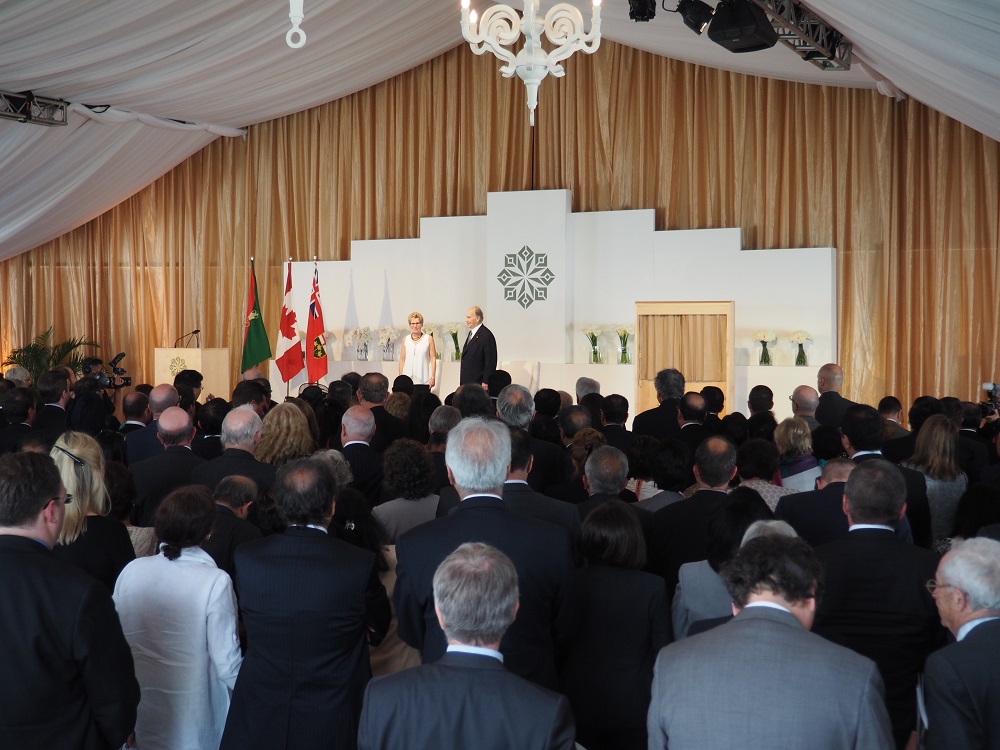
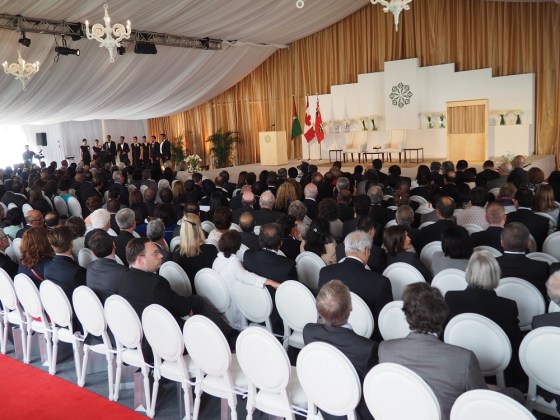
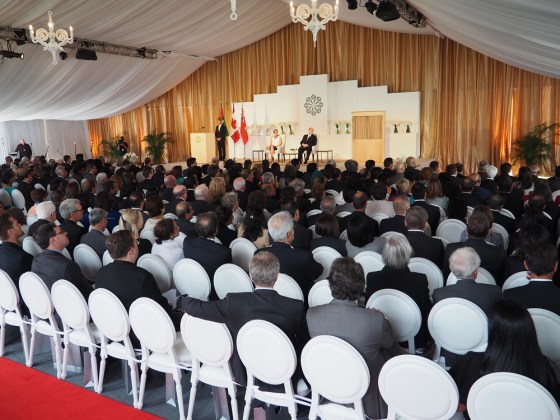
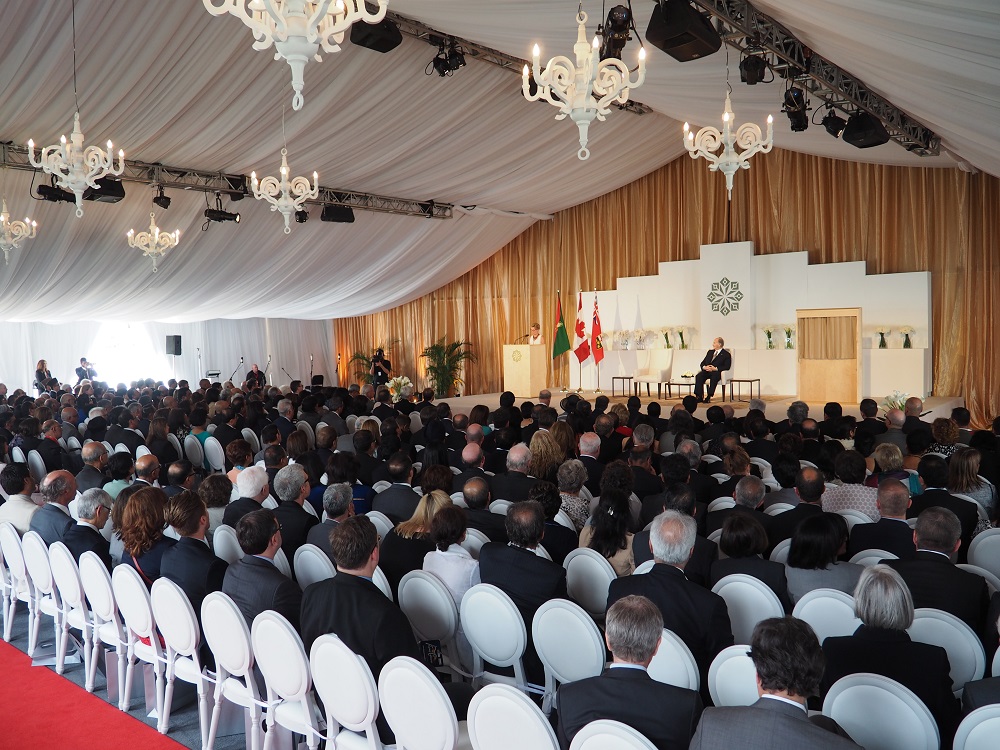
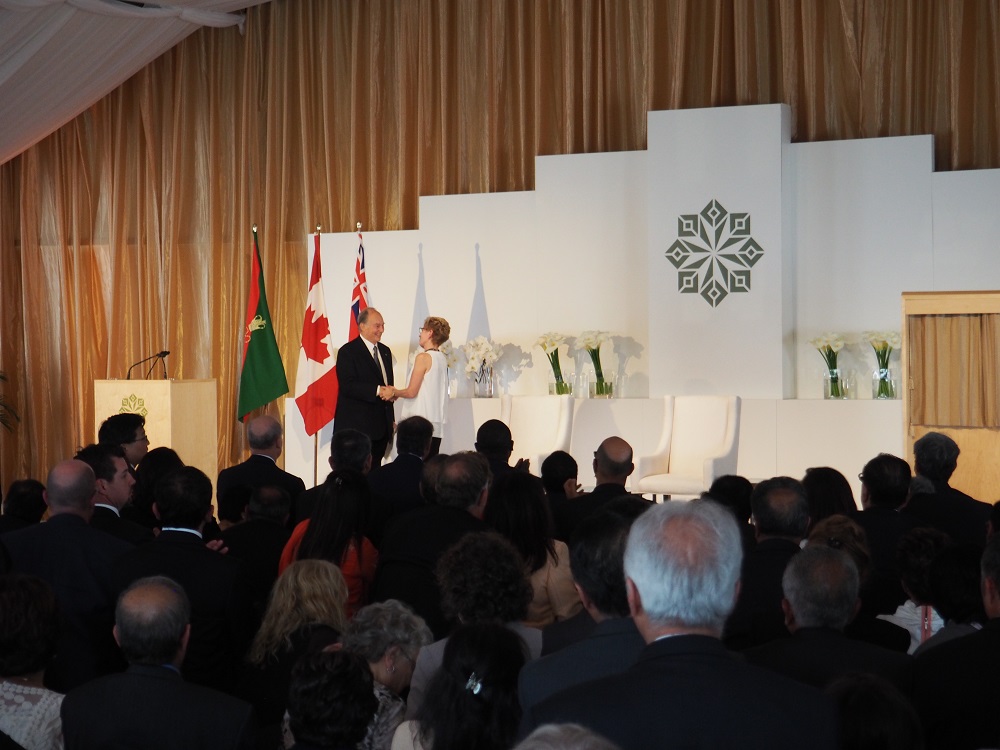
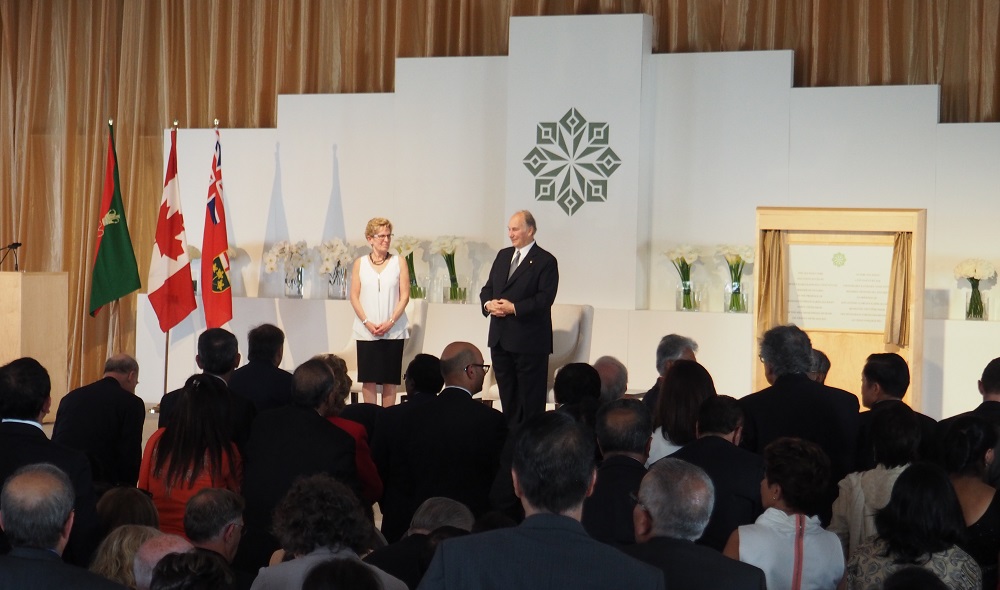
Premier Kathleen Wynne delivering her speech at the opening ceremony of the Aga Khan Park on May 25, 2015. This panoramic view shows the elegance of the event which was held inside a beautifully decorated tent built for the occasion. Photo: Simerg/Malik Merchant. Copyright.

Premier Kathleen Wynne delivering her speech at the opening ceremony of the Aga Khan Park on May 25, 2015. This panoramic view shows the elegance of the event which was held inside a beautiful tent built for the occasion. Photo: Simerg/Malik Merchant. Copyright.

______________

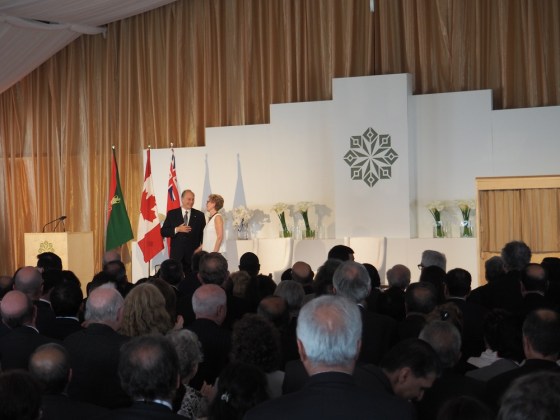
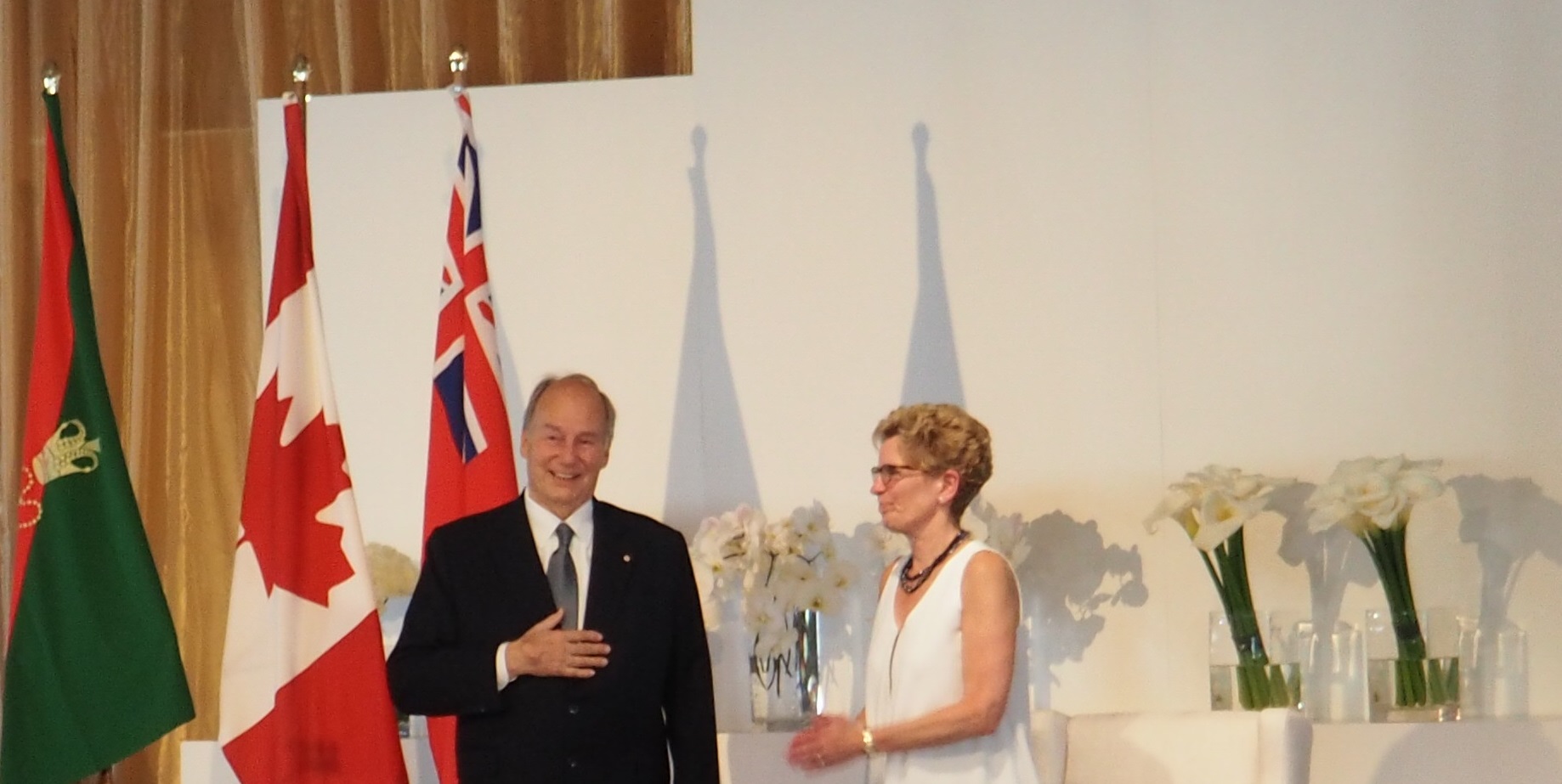
Mawlana Hazar Imam congratulates Premier Kathleen Wynne after the completion of her speech at the opening of the Aga Khan Park on May 25, 2015. Photo: Simerg/Malik Merchant. Copyright.

Mawlana Hazar Imam congratulates Premier Kathleen Wynne after the completion of her speech at the opening of the Aga Khan Park on May 25, 2015. Photo: Simerg/Malik Merchant. Copyright.

______________

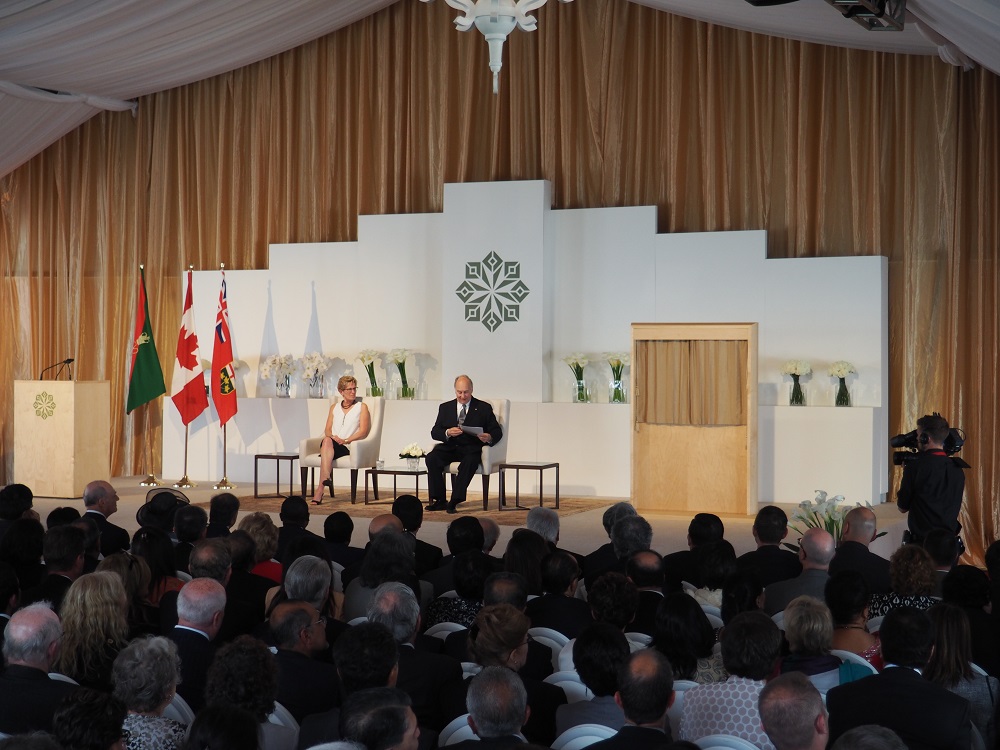
Mawlana Hazar Imam gathers his speech before rising to speak to the audience at the opening of the Aga Khan Park on May 25, 2015. Photo: Simerg/Malik Merchant. Copyright.

Mawlana Hazar Imam gathers his speech before rising to speak to the audience at the opening of the Aga Khan Park on May 25, 2015. Photo: Simerg/Malik Merchant. Copyright.

______________

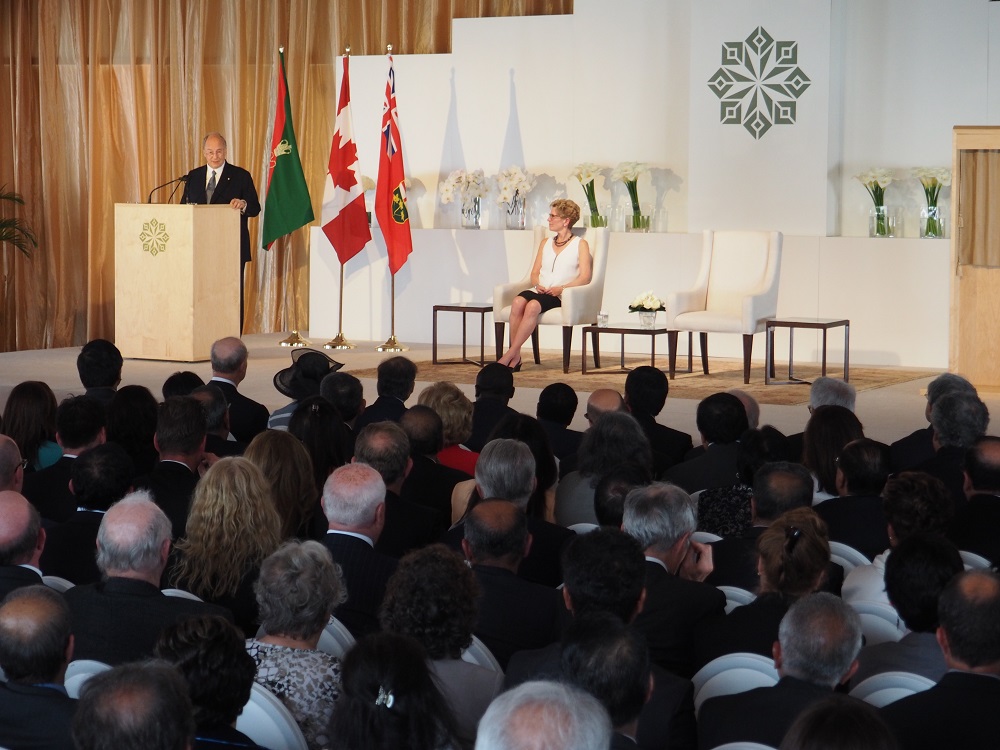
Mawlana Hazar Imam addressing the audience at the opening of the Aga Khan Park on May 25, 2015. Photo: Simerg/Malik Merchant. Copyright.

Mawlana Hazar Imam addressing the audience at the opening of the Aga Khan Park on May 25, 2015. Photo: Simerg/Malik Merchant. Copyright.

______________

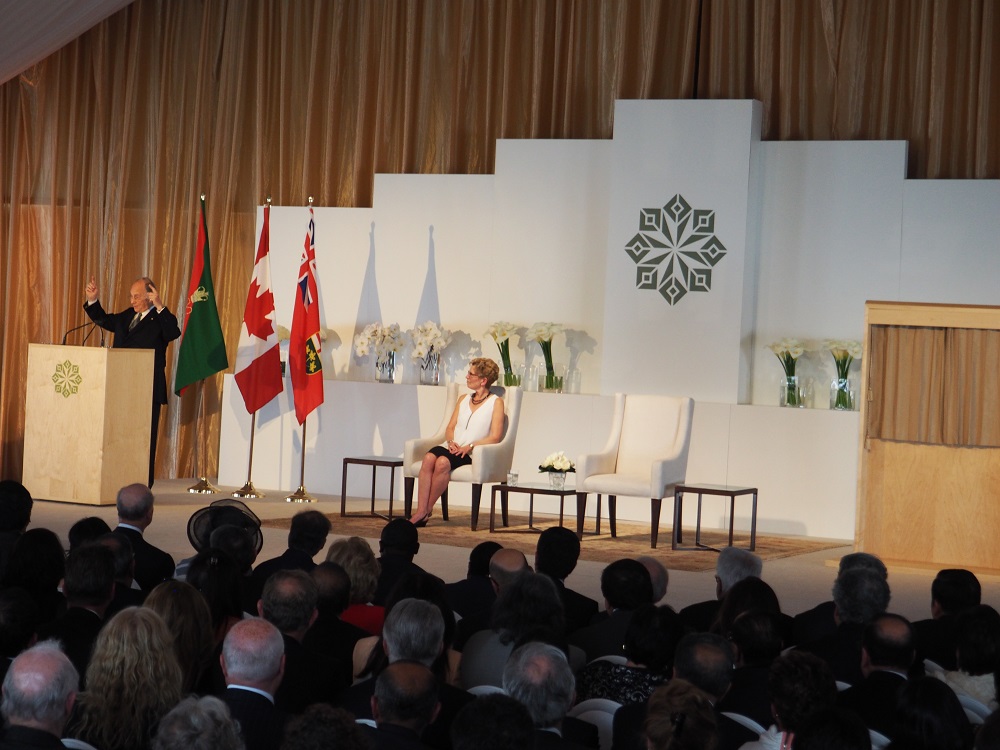
Mawlana Hazar Imam in an animated mood as he shares a joke related to the expulsion of his community from Uganda during the reign of Idi Amin. Photo: Simerg/Malik Merchant. Copyright.

Mawlana Hazar Imam in an animated mood as he shares a joke related to the expulsion of his community from Uganda during the reign of Idi Amin. Photo: Simerg/Malik Merchant. Copyright.

______________

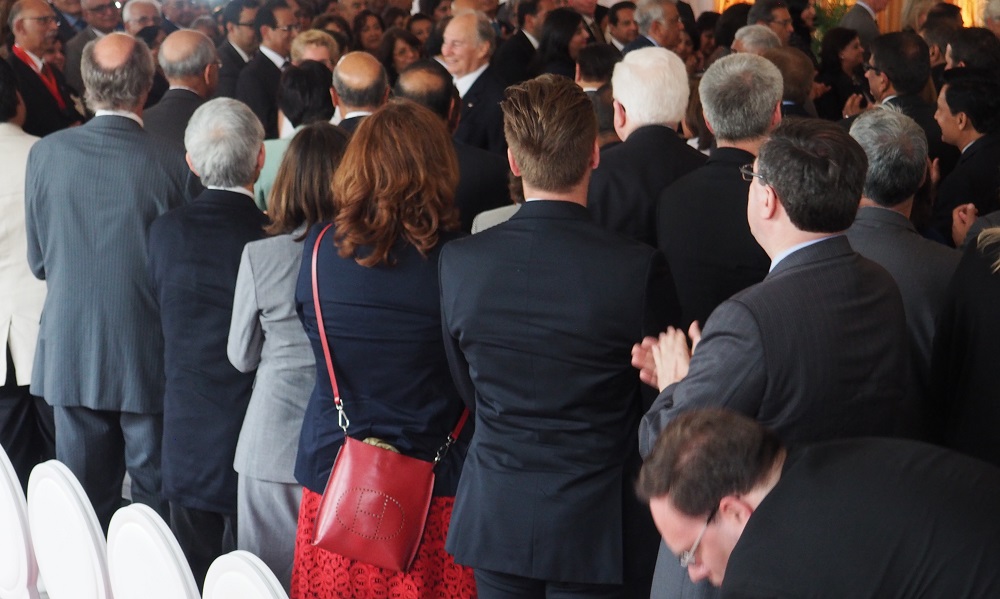
Mwlana Hazar Imam receives a standing ovation as he is congratulated by Premier Kathleen Wynne after the completion of his speech at the opening of the Aga Khan Park on May 25, 2015. Photo: Simerg/Malik Merchant. Copyright.

Mwlana Hazar Imam receives a standing ovation as he is congratulated by Premier Kathleen Wynne after the completion of his speech at the opening of the Aga Khan Park on May 25, 2015. Photo: Simerg/Malik Merchant. Copyright.

______________

Mawlana Hazar Imam graciously accepts the standing ovation he receives after completing his speech at the opening of the Aga Khan Park on May 25, 2015. Photo: Simerg/Malik Merchant. Copyright.

Mawlana Hazar Imam graciously accepts the standing ovation he receives after completing his speech at the opening of the Aga Khan Park on May 25, 2015. Photo: Simerg/Malik Merchant. Copyright.

______________

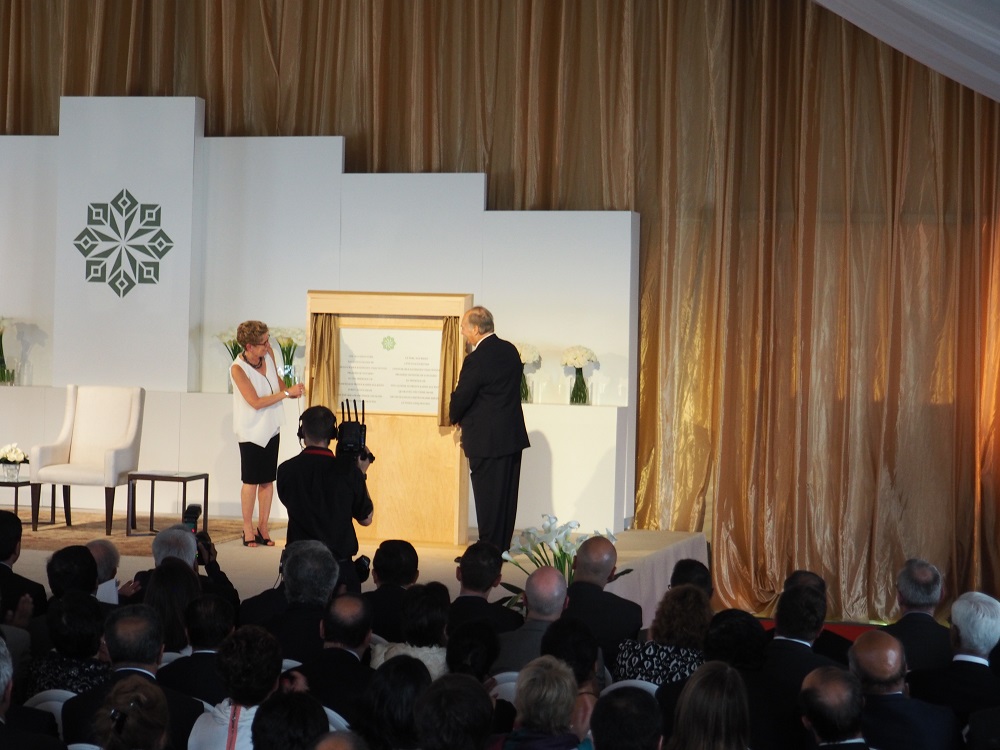
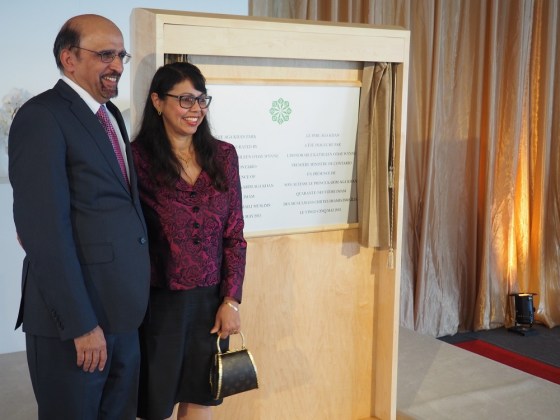
Premier Kathleen Wynne and Mawlana Hazar Imam unveil the plaque to officially open the Aga Khan Park on May 25, 2015. Photo: Simerg/Malik Merchant. Copyright.

Premier Kathleen Wynne and Mawlana Hazar Imam unveil the plaque to officially open the Aga Khan Park on May 25, 2015. Photo: Simerg/Malik Merchant. Copyright.

______________

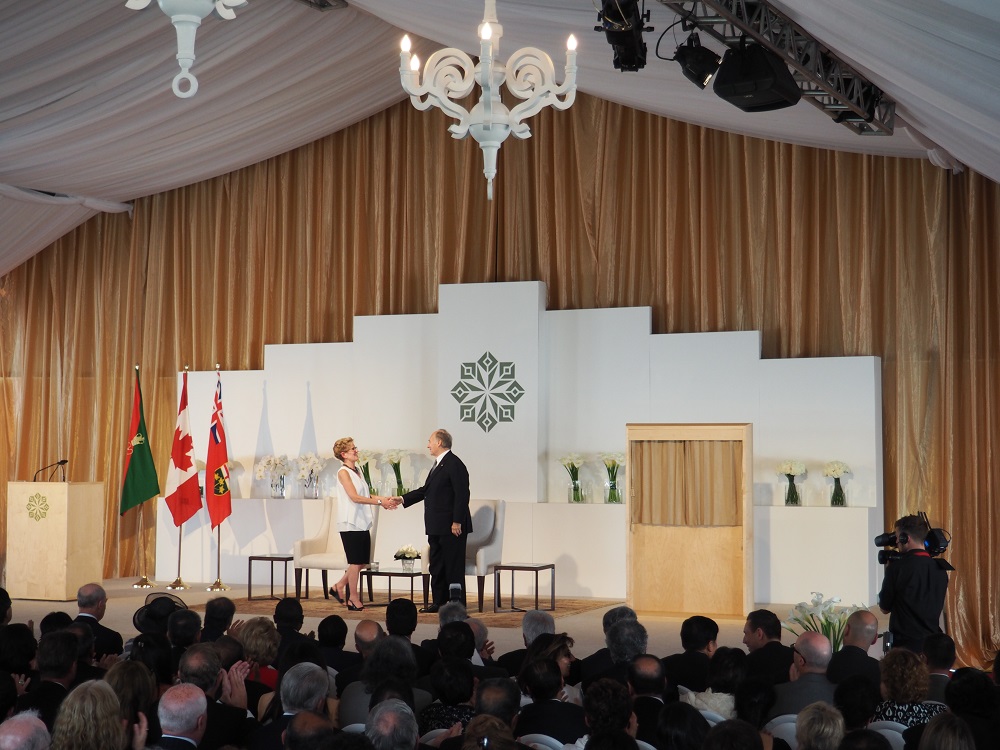
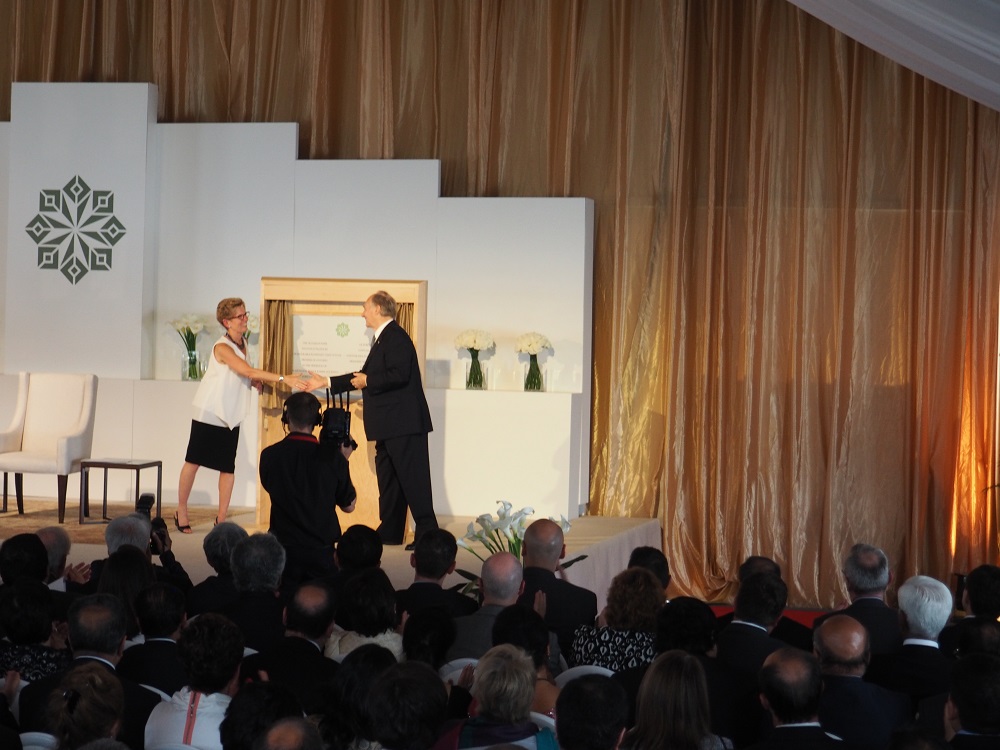
Premier Kathleen Wynne and Mawlana Hazar Imam shake hands after unveiling the plaque to open the Aga Khan Park on May 25, 2015. Photo: Simerg/Malik Merchant.

Premier Kathleen Wynne and Mawlana Hazar Imam shake hands after unveiling the plaque to open the Aga Khan Park on May 25, 2015. Photo: Simerg/Malik Merchant.

______________

Mawlana Hazar Imam and Premier Kathleen Wynne prepare to depart after unveiling the plaque to open the Aga Khan Park on May 25, 2015. Photo: Simerg/Malik Merchant. Copyright.

Mawlana Hazar Imam and Premier Kathleen Wynne prepare to depart after unveiling the plaque to open the Aga Khan Park on May 25, 2015. Photo: Simerg/Malik Merchant. Copyright.

______________

Mawlana Hazar Imam seen departing the exquisitely prepared tent structure that hosted the inauguration ceremony of the Aga Khan Park on May 25, 2015. Photo: Simerg/Malik Merchant. Copyright.

Mawlana Hazar Imam seen departing the exquisitely prepared tent structure that hosted the inauguration ceremony of the Aga Khan Park on May 25, 2015. Photo: Simerg/Malik Merchant. Copyright.

______________

The President of the Aga Khan Council for Australia, Azim Remtulla, was among those who attended the opening ceremony of the Aga Khan Park on May 25, 2015. Photo: Simerg/Malik Merchant. Copyright.

The President of the Aga Khan Council for Australia, Azim Remtulla, was among those who attended the opening ceremony of the Aga Khan Park on May 25, 2015. Photo: Simerg/Malik Merchant. Copyright.

______________

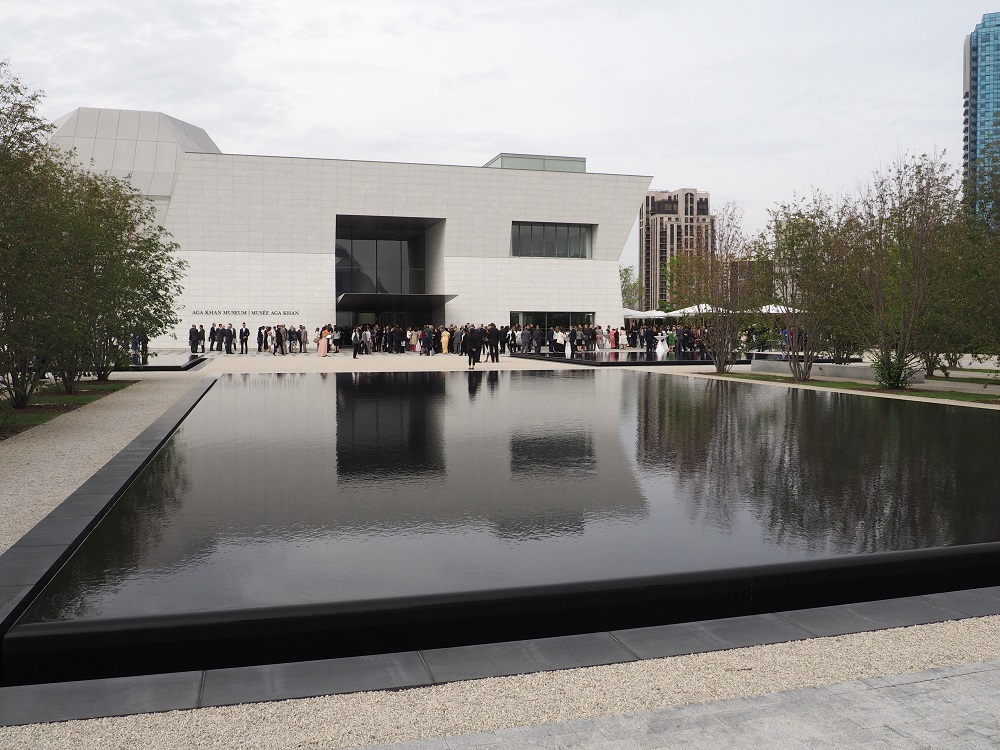
The Aga Khan Museum became the venue for a special reception for guests who attended the opening of the Aga Khan Museum on May 25, 2015. Photo: Simerg/Malik Merchant. Copyright.

The Aga Khan Museum became the venue for a special reception for guests who attended the opening of the Aga Khan Museum on May 25, 2015. Photo: Simerg/Malik Merchant. Copyright.

Date posted: May 27, 2015.

________________

We welcome your feedback. Please click Leave a comment. Subscribe to this website at top right, and receive automatic notifications of great new posts. Subscription is free!

Prophet Muhammad’s Miraj: A Powerful Metaphor for Our Spiritual Journey

Photo: The Trustees of the British Museum. Copyright.

Photo: The Trustees of the British Museum. Copyright. Click on image for article, I Have a Time with God

“While ascent (al-ma’arij) in its simple meaning gives a clue to the upward direction of the Prophet’s journey, it proclaims very emphatically that if God has placed man on this earth, He has also set up a ladder for man to climb up to Him. No wonder Allah calls Himself the Lord of the Ways of Ascent (Dhu ’l-ma‘arij).”Read more

This is an unusual example of the Prophet Muhammad (s.a.s) pictured in an Islamic manuscript. It comes from a royal miniature made to illustrate a copy of the poems of the celebrated Persian Nizami, and depicts the Prophet’s ascension to heaven on the horse Buraq, guided by the archangel Gabriel, with an escort of angels. According to tradition, the face of the Prophet is blanked out in the miniature.

“In spiritual life, serial time no longer exists. The moment a soul breaks through created time and reaches the ‘Eternal Now in God’, everything created is annihilated in its experience. The serial time is torn. Finally, the Prophet says: ‘And He revealed to me secrets that I am not allowed to communicate to you’” — Read more

The identity of the artist who created the illustration is not known. The calligraphy in this piece was created by Shah Mahmud Nishapuri (d. 1564-5) for Shah Tahmasp (r. 1524-76) — the ruler of Iran who at one point owned the Koh-i-noor diamond, then the world’s largest, and now in the Tower of London.

“His yearning for the ‘exalted station’ becomes intense, and as often as he feels this longing he turns to Bilal and says: “O Bilal, comfort us by the call to prayer.” Thus to the Prophet every time of prayer is an ascension (mi’raj) and a new nearness to God.” — Read more

The story of Prophet Muhammad’s journey has had a profound influence on Islamic thought, and Sufism and other esoteric traditions in Islam particular see it as a powerful metaphor for man’s spiritual journey. Please read The Prophetic Tradition ‘I Have a Time with God’ (li ma’a Allah waqt).

Text for image compiled from the website of the British Museum. Please visit http://www.britishmuseum.org.

Date posted: Sunday, May 10, 2015

______________

A Beautiful Fashion Accessory: The Lapel Pin Canadian Ismailis Received on the Occasion of Mawlana Hazar Imam’s 78th Birthday

full pins

By Abdulmalik J. Merchant
Publisher-Editor, Simerg.com

I was among the thousands of Ismailis across Canada who received this tiny object of sublime grace and beauty on the occasion of the 78th Salgirah (birthday) of Mawlana Hazar Imam, His Highness the Aga Khan, on December 13, 2014. The octagonal pin commemorates last September’s opening of the magnificent Toronto Ismaili Centre.

As a fashion accessory, the lapel pin has been growing in popularity in recent years, and is considered to be more memorable than many other accessories, as part of being “well-dressed!”

Lapel Pin Ismaili Centre Opening

The pin is octagonal, a pattern that has become very familiar in Islamic history since the 7th century. Within this octagonal structure are 3-sets of the eight-pointed star, which as a religious symbolism stretches in history to ancient civilizations. [1] The geometric octagonal design permeates numerous aspects of the new Toronto Ismaili Centre opened in 2014 as well as the first Ismaili Centre built in Burnaby, Canada, in 1985. Bruno Freschi, the architect of the Burnaby Ismaili Centre, said in an exclusive interview with Simerg:

‘GEOMETRY governs the entire site, the building. It is symbolized in the octagon, the mythical squaring of the circle. THE OCTAGON is Omni-directional. All axial relationships are equal providing an open and non-hierarchical circulation. The centre is everywhere, and everyone is in the centre.” [2]

Ismaili Jamatkhana and Centre: Light, Shadow and Darkness as sunlight filters through the lantern like windows.The Ismaili Jamatkhana and Centre, Burnaby. According to the architet, Bruno Freschi:

Ismaili Centre Tooronto Foyer

Top photo: Embossed octagonal patterns in the carpet of the  prayer hall of the Ismaili Centre and Jamatkhana located in Burnaby, Canada. Centre: The octagonal domes of the Burnaby Ismaili Centre. Bottom: The design of the exquisite lapel pin distributed to members of the Canadian Jamat on December 13, 2014, matches that of the floor in the foyer of  the Toronto Ismaili Centre, which has repeated octagonal geometric designs within which are 3 sets of the eight-pointed star. Photos: Gary Otte. 

The lapel pin will provide a great opportunity for members of the Jamat to stand out in public and achieve a look that is fresh and original. Wearing the pin will be an opportunity for Canadian Ismailis to make a historical statement in the context of the Jamatkhanas that have been built. It will draw the attention of others not familiar with the Ismaili Centres in Toronto and Burnaby to learn more about the buildings as well as the ethos of the Ismaili community and the Institution of Imamat by which Ismailis have been led since the demise of Prophet Muhammad (s.a.s.). On our part, an understanding of our faith and identity as Ismaili Muslims then becomes essential.

Ismaili Centre Lapel Pin

What may be regarded today as an object of fashion, might become one day an object of historic importance and lasting value like other objects, coins and memorabilia that have been produced during Ismaili history.

In the meantime, this graceful pin, whenever worn as part of your outfit will go to show how the addition of something so small can totally transform a look on someone or help to emphasize the image of our community and faith that we wish to portray. We can thus become role models and true ambassadors for the Jamat.

Enjoy the lapel pin!

Date posted: Monday, May 4, 2015.

________________

[1] For an interesting discussion about the significance of the 8-pointed star in Islamic architecture, please click on http://archnet.org/archive/message_107815.
[2] Please click Voices: Bruno Freschi, Architect of the Ismaili Centre in Burnaby, in Conversation with Simerg.

We invite your feedback and comments. Please click Leave a comment.

Prayers for Syria – An Aid in Righteous Resistance Against Enemies

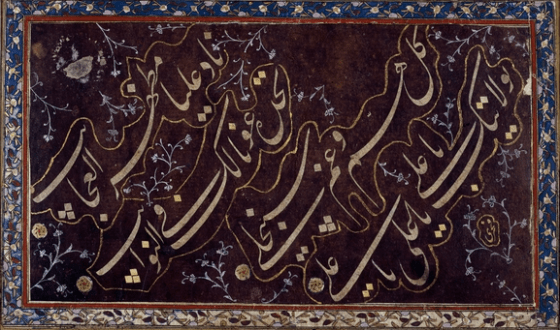
This calligraphy by an Ottoman artists  Fakhri ibn Vali el-Brusevi has the following inscription on it:  "Call upon Ali who causes wonders to appear, you will find him a help to you in adversity, all anguish and sorrow will disappear through your friendship oh Ali, oh Ali, oh Ali." Photo Credit: The Trustees of the British Museum. Copyright.

This calligraphy by an Ottoman artist Fakhri ibn Vali el-Brusevi has the following inscription on it: “Call upon Ali who causes wonders to appear, you will find him a help to you in adversity, all anguish and sorrow will disappear through your friendship oh Ali, oh Ali, oh Ali.” Photo Credit: The Trustees of the British Museum. Copyright.

LETTER FROM PUBLISHER

Simerg’s most recent piece A Message to Our Beloved Ismaili Brothers and Sisters in Syria: Our Hearts and Prayers are With You, You are Never Alone! resulted in more than 30 touching responses from  readers from around the world. We also heard from various members of the Syrian jamat, who have appreciated the readers’ good wishes and prayers for their jamat. Indeed, one teacher went on to state that prayers was all that they needed.

Over the centuries, wars against enemies who are definitely at fault, has not been won by prayers alone. But there are examples which illustrate that a righteous show of resistance against any intruding enemy, such as the one that we may witness in Salamiyah, can be aided by prayers.

When the Sino-Japanese war broke out in August 1894, Tanaka Giichi, an officer in the Imperial Japanese Army  — who then became Japan’s Prime Minister in 1927 — and several of his followers went to a small deserted island called Sakurajima located near Osaka. They built a two-stories platform and enshrined a sword in front of a statue of Nichiren (a Japanese monk in the 13th century) on an altar set to face Peking. The cutting edge of the sword was also made to face the Chinese capital.

Three times a day for over a month, they prayed for the defeat of the enemy, and on the day they concluded the services, word was received that Pyongyang had fallen to the victorious Japanese army. This was powerful vindication of the invocation prayer which called for  the wisdom of the Buddha to be brought to bear upon the evil sphere of China.[1]

Centuries earlier, according to a story in the Islamic tradition narrated by Hussain Rashid in a piece for this website, [2] the Prophet Muhammad laid siege to the fort of Khaybar, but the walls were so well-fortified that the army could not break through. The Angel Gabriel came to the Prophet Muhammad and told him to recite the Naad-e Ali:

“Nade Ali, Nade Ali, Nade Ali
Nade Aliyyan mazhar al-ajaib
Tajidahu awnan lakafin-nawaib
Kullu hammin wa ghammin
sayanj-i Ali Bi wilayatika,
Ya Ali! Ya Ali! Ya Ali!”

“Call Ali call Ali call Ali,
the manifestation of marvels
He will be your helper in difficulty
Every anxiety and sorrow will end
Through your friendship.
O Ali, O Ali, O Ali.”

Hazrat Ali came to the Prophet’s aid, and in an act of heroism he tore down the gate of the fort, and the army of the Prophet crossed over and successfully ended the siege. Ali, of course, was a valiant fighter within the fort and when victory was achieved, the Angel Gabriel appeared to Prophet Muhammad again and said to him:

“There is no hero but Ali; there is no sword but Dhu’lfiqar.”

The prayer of Naad-e-Ali is a very strong Shia tradition, and can be recited today under different circumstances, such as the one we have today in Syria and other parts of the Muslim world. It can be recited when one is surrounded by enemies, as well as when one is facing personal troubles and tribulations. Like the power of prayer witnessed during the Sino-Japanese war, Naad-e-Ali’s recitation even 3 to 5 times daily, will empower those engaged in resisting the enemy, and Inshallah avert the grave crisis from children, women and men who remain close to the frontline.

The constant and regular recitation of Naad-e-Ali, particularly at this difficult time, will infuse within us a deeper commitment to prayer, and a selfless awareness of the needs and struggles of thousands of our brothers and sisters in Syria and other parts of the world.

Date posted: Thursday, April 9, 2015.

________________

[1] Episode quoted from “The Lotus Sutra in Japanese Culture”, page 206, originally mentioned in Tanaka Chicagu Jide.
[2] See Rashid’s Historical Images: The Naad-e-Ali, “Call Upon Ali….oh Ali, oh Ali, oh Ali,” in Ottoman Calligraphy, and Other Shia Inscriptions in the British Museum’s Islamic Collection

YOUR FEEDBACK: We invite our readers to offer their solidarity with the Ismaili jamat in Syria and the people of Syria by conveying their heartfelt prayers by clicking on LEAVE A COMMENT or in the comment box below. If you encounter any difficulty in submitting your comment, please email your comment for publication to Simerg@aol.com, subject “Syria.”

A Message to Our Beloved Ismaili Brothers and Sisters in Syria: Our Hearts and Prayers are With You, You are Never Alone!

Click for enlargement

Salamiyah and surrounding areas shaded in yellow. Map: Adapted from UN Office for the Coordination of Humanitarian Affairs. Please click for enlargement.

Salamiyah and surrounding areas shaded in yellow. Map: Adapted by Simerg from a map produced by the UN Office for the Coordination of Humanitarian Affairs. Please click for enlargement.

LETTER FROM PUBLISHER

In a special post on January 30, 2013, we had mourned the death of numerous members of the Jamat who were brutally killed in Salamiyah, Syria, by suicide bombers. Simerg had paid tribute to these Jamati members with a thoughtful poem (republished below), and sincerely hoped and prayed that peace would return to Syria.

For those not familiar with Ismaili history, the groundwork for the establishment of Fatimid Caliphate over a thousand years ago was laid in Salamiyah — such is its importance and place in Ismaili history. The 11th Imam, al-Mahdi, set out from Salamiyah in the late  ninth century for the long 3,500km caravan journey to Sijilmasa in North Africa, as a first step in establishing the Caliphate. For over 1200 years, Salamiyah (pop. 187,123, by 2004 census) has been home to tens of thousands of Ismailis, who have lived peacefully, side by side, with Sunni and other Shia Muslims as well as the non-Muslim communities. Indeed, the Ismaili Imamat projects in Syria are designed for the well-being and progress of the entire Syrian nation.

The recent beheadings of Westerners, as well as deeply humiliating treatment, torture and beheadings of Shia and Sunni Muslims opposed to IS (Islamic State), including the burning of a Jordanian air pilot captured by ISIS militants, indicate that the ISIS acts of barbarism are not likely to cease.

Letter to ISIS from Muslim scholarsWe now report with utmost dismay, sadness and profound sorrow that during the last 2 weeks, Ismailis along with members of Sunni and other Shia communities have become victims of IS terror once again. The website of the US Secretary of State, Mr. John Kerry, reports in a new release dated April 3, 2015, that “ISIL recently massacred over 40 people in Mabuja in Hama province – reportedly Ismailis and Alawites, including women and children”. [2]

The Canadian Minister for Foreign Affairs, the Honourable Rob Nicholson, in his statement issued on April 2, noted that “…the so-called Islamic State of Iraq and the Levant [ISIL] has demonstrated its contempt for the sanctity of human life through its March 31 attack on the Syrian town of Al Maboujeh, on the outskirts of Salamiyeh. Reports indicate that over 40 people, mostly civilians, were killed, and that dozens more were injured. An unknown number of civilians were also reportedly abducted by the terrorist group. As ISIL continues its campaign to seize territory in Syria, innocent people such as those in Salamiyeh are at risk. Al Maboujeh is largely populated by religious and ethnic minority communities, including Christians, Druze, Alawites, Sunni Bedouins, Shi’a Ismailis, among others, who have been systematically targeted and persecuted by ISIL terrorists.” [3]

A view of Salamiyah. Photo: Wikipedia.

A view of Salamiyah. Photo: Wikipedia.

The website SYRIA DEEPLY, which provides an overview of the latest news, says in a summary that “according to the Syrian Observatory for Human Rights, ISIS militants had killed Alawite, Ismaili and Sunni residents of Mabouja by ‘burning, beheading, and firing on them’.”

It further notes in its dispatch that “IS has been moving westward across Syria in a bid to eventually take Salamiyah, a town east of Hama city” (see map above). The report includes a statement by an anonymous IS militant to Reuters that the Hama campaign is aimed eventually to take Salamiyah. “The ultimate goal is to liberate Salamiyah and Hama but it will not happen before Islamic State is 100 percent ready.” [4]

This is very worrying for all residents of Salamiyah, and everyone around the world who have family members in and around Salamiyah and elsewhere in Syria.

As a united and a deeply loyal community under Mawlana Hazar Imam’s leadership, we deeply feel for our  Syrian brothers and sisters, especially when lives are lost in such senseless acts by IS. We reassure the Syrian Jamat of our concern for them, as well as our deep affection and love for them. Mawlana Hazar Imam himself has articulated that as Imam “his first concern is for the security of his followers.” [5]

We pray for the souls of all those individuals who have lost their lives, and assure the Syrian Jamat of our constant prayers for their strength of faith and courage at such a difficult time in their history. We sincerely offer prayers that peace returns to their homeland soon. This can only occur when political leaders who are opposed to each other come together for the greater welfare of people of Syria. Dialogue, which has failed in the past, is the only solution for peace and long-term stability in the country. Compromise is an essential component in this process towards stability and peace.

____________

YOUR FEEDBACK: We invite our readers to offer their solidarity with the Ismaili jamat in Syria and the people of Syria by expressing their sorrows and feelings by clicking on Leave a Comment or in the comment box below. If you encounter any difficulty in submitting your comment, please email your comment for publication to Simerg@aol.com, subject “Syria.”

~~~~~~~~~~~~~~~~~~~~~~

SALAMIYAH AND SYRIA
“Peace Will Be Again”

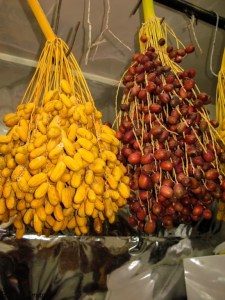
Dates in season - Salamiyya, Syria

BY ELIA BADRUDIN

Salaam , al Salaam, O salaam
to all of humanity, Peace

al Salamiyeh , KNOW that Peace will be again.
the heavens will smile on you again.
all humanity which speaks for Peace
has promised that
the planet has your place

al Salamiyeh, more than a thousand years before
prayers were seeds of this ground
a grassland lying on Syrian steppes
a fertile plain of hope
a soft quiet spawning the golden age
a diverse Ummah immersed with the Fatimids…
you’ve nurtured yourself for the heavens here
and it is not all gone today.
you are not lost to us; neither sand grain lost to the sky.
as hearts are the stronger carrying yours
as anguish is balanced with resolute prayer
transformed, you will return, al Salamiyeh
the world is not asleep.

we are an entire Ummah living together in al Salamiyeh
the world has not left you
nor any other facing terror —
“you may feel alone
but you are not alone”
does not your date tree stand strong in windstorm?
and your smile not nourish your child?
He is “Always with you, Always with you”
remember.
and the world will not sleep.

not dogma, not terror,
there’s no martyrdom in suicide!
whosoever taketh life of another..
brutal condemnation
the bestiality of his own cowardly nature
who will betray your homeland and ours
has fallen to the brainwashing of his idols
and their very own envy

not even an animal kills but of hunger
leave them to their desolate running.
only, the ends of the earth are round
and of the heavens, eternal.
where will they go?

and the world will not sleep
all day and all night
across our globe
Ismailis holding hands with every other faith
for all of Syria and for all your families.
“you are not alone, you are never alone”

our seven days, a satado,
are seven ages of pain vanquished
are hearts awry yet steadfast
and hope takes root in this action
then Time too will make space..

and these fools will not rule
fear not the evils, for though they have drained innocent blood,
their souls and hearts are for His Taking

Salaam , al Salaam, O salaam
to all of humanity, Peace.

Date posted: Sunday, April 5, 2015.
Last updated: April 5, 2015 (quote from a letter from Muslim scholars to ISIS).

Note: The poem by Elia Badrudin was originally published on January 30, 2013 following the deaths of several Ismailis from a suicide bomb attack in Salamiyah.

_______________

We invite our readers to offer their solidarity with the Ismaili jamat in Syria and the people of Syria by expressing their sorrows and feelings by clicking on Leave a Comment or in the comment box below. If you encounter any difficulty in submitting your comment, please email your comment for publication to Simerg@aol.com, subject “Syria.”

_______________

Quotation References:

[1] English text of complete letter to ISIS at http://www.lettertobaghdadi.com/14/english-v14.pdf.
[2] http://www.state.gov/r/pa/prs/ps/2015/04/240326.htm
[3] http://news.gc.ca/web/article-en.do?nid=958439
[4] http://www.syriadeeply.org/articles/2015/04/7041/syria-executive-summary-41/
[5] Voices: “The Power of Wisdom” – His Highness the Aga Khan’s Interview with Politique Internationale

Related:

Great Moments in Ismaili History: The Establishment of the Fatimid Caliphate by Jehangir A. Merchant.

________________

Please note that Simerg is an independent initiative. It is not affiliated with any organizations or institutions, and thus the views expressed here are those of the authors.

A Brief Note on a Manuscript at the Library of Congress Dedicated to Fatimid Imam al-Hakim bi Amr-Allah

A view of the African and Middle Eastern Reading Room at the Library of Congress in Washington, D.C. Inset the Main Building. Photo: Library of Congress, USA.

A view of the African and Middle Eastern Reading Room at the Library of Congress in Washington, D.C. Inset the Main Building. Photo: Library of Congress, USA.

INTRODUCTION

In 1945, the US Library of Congress (LOC) purchased a collection of printed books and manuscripts form Shaykh Mahmud al-Iman al-Mansuri, professor of religion at the al-Azhar University, Cairo. Assembled by the Shaykh from sources in the Middle East, Africa, and Europe, the collection deals with virtually every aspect of Qur’anic and Islamic studies and includes commentaries, biographies, dictionaries, and works on history, literature, and philosophy. Approximately 1,300 of the 5,000 volumes that comprise the collection are book manuscripts. The collection is known as the Mansuri Collection.

MANUSCRIPT DEDICATED TO IMAM AL-HAKIM

Among the thousands of items in the Mansuri Collection, is a work on astronomy dedicated to the 16th Ismaili Imam (or the 6th Fatimid Caliph), al-Hakim bi Amr-Allah (d. 411AH/1021 CE). The text is a popular exposition on the study of the order of events in time, and the order in which they occur, especially in those related to astronomical movements and the measurement of time.

A folio from a manuscript whose original work was dedicated to Ismaili Imam al-Hakim. Photo: Library of Congress, USA.

A folio from a manuscript whose original work was dedicated to Ismaili Imam al-Hakim. Photo: Library of Congress, USA.

Note on fol. 2a says that the author, Ibn Jahhaf al-Ḥusayn ibn Zayd ibn ʻAli, was a famous astronomer during the reign of the 6th Fatimid Caliph al-Ḥakim bi-‘Amr Allah (996–1021). The manuscript is yellowed cream, with watermarks, and is in bad condition due to damage from humidity. Edges of some leaves have been repaired. There are dark stains on edges of paper and the last few leaves are missing. The title page is black and red ink; and the colour of the text is black, red, green and yellow. There are occasional diacritical marks, with notes on title page and marginal notes. There are catchwords on rectos.

SUMMARY

Personal Name
Ibn Jaḥhaf, al-Ḥusayn ibn Zayd ibn ʻAli.

Related names
Watari, Muḥammad ʻAli ibn Zahir, former owner.
Ibn al-ʻAttaar, Muḥammad ibn Muḥammad, active 1426. Kashf al-qina firasm al-arba.
Mansuri Collection (Library of Congress) DLC.

Uniform title
Yawaqit fi maʻrifat al-mawaqii

Main title
Kitab al-yawaqit fi maʻrifat al-mawaqit

Description
8 leaves (33 lines), bound : paper ; 20 x 15 cm.

Binding:
New cardboard covered with cloth; leather spine.

Acquisition source, purchase:
Mahmud al-Mansuri ; 1945.

Additional formats:
Also available in digital form on the Library of Congress website.

LC control no:
2008401930

Geographic area code:
n-us-dc

Type of material:
Rare Book or Manuscript

Date posted: Tuesday, March 31, 2015.

__________________

Please click on either of the following two Library of Congress links for additional images of the manuscript: