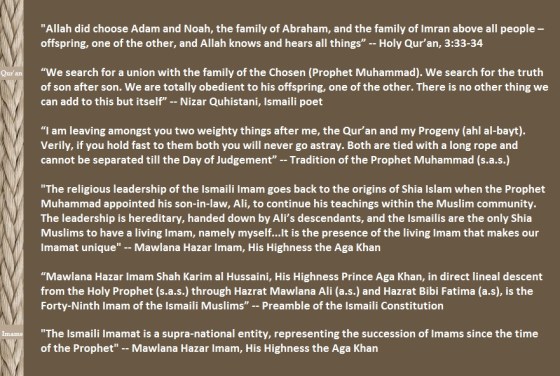
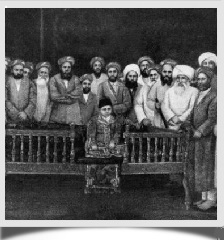
The excerpts shown below from the Holy Qur’an, the tradition of the Prophet Muhammad (s.a.s.) and speeches of Mawlana Hazar Imam, His Highness the Aga Khan, are quite clear about who the term Ahl al-Bayt refers to. However, Farhad Husseinali Patni gives further light on the subject by providing examples and references from early Islamic History, going back to the life of the Prophet and Qur’anic revelation. Please read this important article by clicking on “Ahl al-Bayt” – An Understanding Based on the Holy Qur’an, Hadith and Historical Events or on the image below.
Category Archives: Islam
The Modern Pace of Life and the Place of Faith and Religion – A Reflection by Farouk Topan

THE FUNDAMENTAL MESSAGE OF RELIGION
By Dr. Farouk Topan
The pace of life today is said to be much faster than it was just a few decades ago. This is an axiom of our times. What, however, is not axiomatic is the corollary that is often assumed to stem from it, namely that spiritual value and worth get diminished in proportion to the increase of pace. It is not uncommon to hear the lament that nowadays people have no time for religion. Many people actually believe this, and that is a great pity. For religion is not a ‘thing’ one ‘does’ if one has time. Religion is a commitment, an involvement of one’s being and personality, utterly, totally and completely.
Human nature, however, accepts few commitments gladly and it abhors those which are seen as imposed externally. Some people consider religion as a process forced upon them from outside themselves. To view religion as an imposition is to misunderstand its message and its function.
The fundamental message of religion to Man is to be at peace — at peace with himself, with his fellow human beings, and at peace with his Creator; the fundamental function of religion is to enable a person to understand and to know his own nature, his environment and to begin to recognise and to know his Creator. Knowledge and peace are interlinked. One makes the attainment of the other possible and a person who attains a degree of both becomes a potential recipient of God’s most valuable gifts to Man: wisdom. Tranquility is a reflection of wisdom.

Photo: John Macdonald.
“I do not believe that we should fear material progress, nor should we condemn it. The danger is that it could become an obsession in our lives and that it could dominate our way of thinking” — Mawlana Hazar Imam [1]
“The day we no longer know how, nor have the time nor the faith to bow in prayer to Allah because the human soul that He has told us is eternal is no longer of sufficient importance to us to be worthy of an hour of our daily working, profit-seeking time, will be a sunless day of despair” — Mawlana Hazar Imam [2]
An essential aspect of knowledge is the understanding that even a tiny part of our lives cannot be isolated from what is termed ‘religion’; for religion properly understood, is nothing less – and even more – than life itself. We, as Muslims, are not and cannot be ‘outside’ of Islam. Islam involves us completely; that, indeed, is the essence of our existence.
The realization of this simple fact is the basis for experiencing an inner calm and tranquility. Then the pace of life around a person becomes largely immaterial, and its varied speed becomes a matter of petty insignificance. This is not to underestimate the powerful attractions of the style of life prevalent in many parts of the world; it is simply to point out that, if one wants to stop oneself from being drifted away aimlessly by the currents of materialism, one can stabilize oneself through the teachings and practices of Islam.
Date posted: Thursday, November 6, 2014.
_______________
The essay has been adapted from Ilm, Volume 2, Number 1, published by the Ismaili Tariqah and Religious Education Board (ITREB) for the United Kingdom, where it appeared under the title “Islam and the Modern Pace of Life.” Excerpts from the speeches of His Highness the Aga Khan were not part of the original piece by Dr. Topan.
[1] His Highness the Aga Khan, Takht Nashini (ceremonial installation), Karachi, Pakistan, January 23, 2958.
[2] His Highness the Aga Khan, Convocation Address, Peshawar University, Pakistan, November 30, 1967.
________________
Links for speeches of His Highness the Aga Khan:
Special Photo Essay: A Collection of 48 (Plus One) Images from the Glorious Life of the 48th Ismaili Imam, His Highness the Aga Khan
Our beloved 48th Imam, Hazrat Imam Sultan Mahomed Shah (a.s.), His Highness the Aga Khan, was born in Karachi on November 2, 1877. He assumed the Imamat at the age of 7 in August 1885, and became the longest-serving Imam in Ismaili history. He passed away on July 11, 1957, at the age of 79, bequeathing the hereditary throne of Imamat to his grandson, Mawlana Shah Karim al Hussaini Aga Khan, the current 49th Imam who has been on the throne for 57 years. In his tribute to his grandfather, Mawlana Hazar Imam said, “Through 72 years of Imamat, he guided his spiritual children to happiness and prosperity.”…..Photo Collection
A Collection of Readings on Imam Hussein and Mawlana Sultan Mahomed Shah Aga Khan – Two Ismaili Imams Who Lived 1250 Years Apart
IMAM SULTAN MAHOMED SHAH, HIS HIGHNESS THE AGA KHAN (1877 – 1957)
Our beloved 48th Imam, Hazrat Imam Sultan Mahomed Shah (a.s.) was born in Karachi on November 2, 1877. He assumed the Imamat at the age of 7 in August 1885, and became the longest serving Imam in Ismaili history. He passed away on July 11, 1957, at the age of 79, bequeathing the hereditary throne of Imamat to his grandson, Mawlana Shah Karim al Hussaini Aga Khan, the current 49th Imam who has been on the throne for 57 years. In his tribute to his grandfather, Mawlana Hazar Imam said, “Through 72 years of Imamat, he guided his spiritual children to happiness and prosperity.”…..Read More
IMAM HUSSEIN (626 – 680 CE)
Our beloved second Imam, Hazrat Hussein (a.s.) was born on January 8, 626 AC. He began his reign as the 2nd Ismaili Imam* on the death of his father, Hazrat Ali, on January 27, 661. Imam Hussein was martyred in the Battle of Karbala on the 10th day of the Muslim month of Muharram, or October 10, 680, at the age of 54. He was succeeded to the hereditary throne of Imamat by Imam Zainul Abideen. The Islamic calendar is based on the lunar cycle, and thus shorter than the 365 day solar calendar. This year (2014), the 10th day of the Muharram falls on or around November 3/4……Read more
_________
*Note: Although Shia Nizari Ismailis consider Imam Hussein (a.s.) as the second Imam, he is generally regarded as the 3rd Imam by other Shia Muslims, who treat his brother Hazrat Hassan (a.s.) as the second Imam.
Orations of Imam Ja’far al-Sadiq: Outstanding Merits of the Prophet and Imams
“Allah chose him, was pleased with him, and selected him. Allah gave him keys of knowledge and sent him as mercy for people and as spring for the country…..Allah, the Exalted, crowned him with solemnity, covered him with the Light of His might. He made a rope to stretch up to heaven. Nothing can be obtained from what is with Allah but through the Imam.”
PLEASE CLICK: Orations of Imam Ja’far al-Sadiq (a.s.)
Ghadir Khumm in Images and Quotations
I
‘Id-e-Ghadir is celebrated by the Shi ‘ite communities to mark the event that took place at Ghadir Khumm (Valley of the Pond) on the 18th Dhul-Hijjah. This event commemorates the designation (appointment by way of nass) of Hazrat All as the ‘Amir-ul-Mu’minin (commander of the faithful) and Imamul-Muslimin’ (the Imam of the community of believers) at Ghadir-i Khumm when the Prophet (s.a.s.) was returning from his Last Pilgrimage (hajjatul-wida) in the year 632 AC. On this occasion, the Prophet publicly proclaimed Ali to be his successor [1] in guiding the community after the end of the institution of Nubuwwah. According to the Shi’a doctrine, tradition and interpretation of history, the designation of Hazrat Ali marked the beginning of the institution of Imamah. The designated Imam was to continue the ta’wil (interpretation) and talim (teaching) of Allah’s Final Message, i.e. the Holy Qur’an.

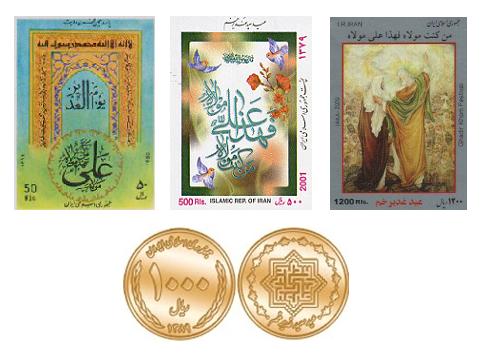
Images of some stamps and coins issued by the Islamic Republic of Iran between 1990 and 2010 commemorating the Idd-e-Ghadir. The inscriptions inlude the Shahada, Qur’anic ayats and the declaration made by Prophet Muhammad at Ghadir Khumm, “Mun Koontu Mawla, Fa Hada, Aliyun Mawla” meaning “He of whom I am the Mawla Ali is also the Mawla.”
Accordingly, throughout the course of the history, the Shi’a have commemorated this occasion as a mark of recognition and acceptance of Allah’s mercy to mankind by bestowing continued guidance. Each Imam, since the time of Hazrat Ali has designated his successor. The Imam in his time has continued to guide his followers according to the prevailing conditions. His function has always been to look after the welfare of the community both in spiritual and worldly (material) matters. His guidance to his followers is that they should lead their lives in such a way so as to practice their Faith with a sense of balance and harmony, ensuring that there is no conflict between the two aspects of an individual’s life. The practice of the Faith thus becomes the way of life.
Presently, the Shi’a Imami Ismaili Muslims celebrate the day of accession of their present Imam to the office of Imamah as Yaum-e Imamat or Imamat Day. This occasion is celebrated as a mark of gratitude to Allah in having bestowed His mercy and bounty in guiding them through the office of the Imam on Sirat al-Mustaqim (the Straight Path).
II
“Muhammad said: ‘He of whom I am the Mawla, Ali is his Mawla. O God, be the friend of him who is his friend and be the enemy of his enemy.’
“This became the proof text for the Shia claim that Ali, the Prophet’s cousin and son-in-law, was the Prophet’s rightful successor after the Prophet’s death in 632. The meaning of Mawla here probably implies the role of patron, lord or protector.” – History in Quotations by M. J. Cohen and John Major.
III
“…As you know, the Shi’a divided from the Sunni after the death of the Prophet Muhammad. Hazrat Ali, the cousin and son-in-law of the Prophet, was, in Shi’a belief, named by the Prophet to be the Legitimate Authority for the interpretation of the faith. For the Shi’a today, all over the world, he is regarded as the first Imam.” – His Highness the Aga Khan, Tutzing Evangelical Academy, May 20, 2006. [1]
IV

His Highness the Aga Khan seen ordaining a new constitution for the Ismaili community worldwide. Clause (G) of the Preamble states: “Mawlana Hazar Imam Shah Karim al Hussaini, His Highness Prince Aga Khan, in direct lineal descent from the Holy Prophet (s.a.s.) through Hazrat Mawlana Ali (a.s.) and Hazrat Bibi Fatima (a.s), is the Forty-Ninth Imam of the Ismaili Muslims.”
“In accordance with Shia doctrine, tradition, and interpretation of history, the Holy Prophet (s.a.s.) designated and appointed his cousin and son-in-law Hazrat Mawlana Ali Amiru-l-Mu’minin (a.s), to be the first Imam to continue the Ta’wīl and Ta‘līm of Allah’s final message and to guide the murids, and proclaimed that the Imamat should continue by heredity through Hazrat Mawlana Ali (a.s) and his daughter Hazrat Bibi Fatimat-az-Zahra, Khātun-i-Jannat (a.s).” – The Preamble of The Constitution of the Shia Imami Ismaili Muslims. [2]
V
“The Ismaili Imamat is a hereditary institution of Muslim leadership, linked to Prophet Muhammad (peace be upon him and his family) by direct lineal descent through Hazrat Ali, his cousin and son in law. The line of Ismaili Imams has continued uninterrupted by hereditary succession from Hazrat Ali through to the present, 49th Imam, His Highness the Aga Khan.” – The Aga Khan Development Network (AKDN) , Brazil and the Ismaili Imamat sign a Protocol. [3]
VI
“Allah did choose Adam and Noah, the family of Abraham, and the family of Imran above all people – offspring, one of the other, and Allah knows and hears all things.” (Sura 3, Ayats 33-34).
With regard to the above verse, the Ismaili poet Nizar Quhistani explained:
“We search for a union with the family of the Chosen (Prophet Muhammad). We search for the truth of son after son. We are totally obedient to his offspring, one of the other. There is no other thing we can add to this but itself. We endeavour in our faith so that we do not turn out to be faithless.” – Quoted in Ismailis in the Middle Ages by Shafique Virani.
~~~~~~~~~~~
[1] To read this and other published speeches at the AKDN Website, please click Tolerance Award from the Evangelical Academy of Tutzing and Speech Archives.
[2] To read background story and complete preamble, please click The Preamble Of “The Constitution of the Shia Imami Ismaili Muslims”.
[3] See The Ismaili Imamat note in AKDN–Brazil Protocol.
___________________
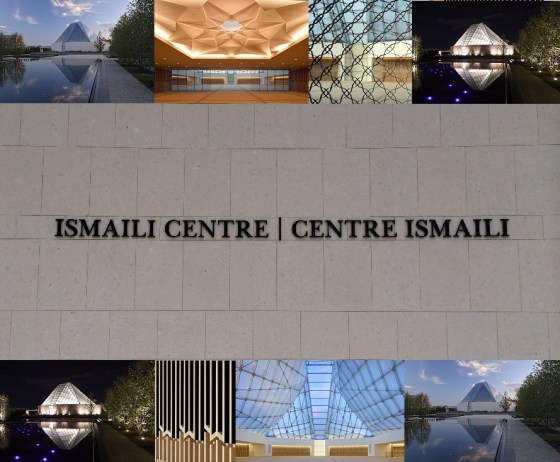
Photo Essay: The Ismaili Centre – “Peace Through Prayer” and “A Splendid Reality”
A Story from ‘Pyara Imam ni Pyari Wato’: Historical Memories by Sairab Abuturabi and Jaferali Bhalwani
Loving Tales of our Beloved Imams: (I) Farazdaq’s Praise and Support of Imam Zainul Abideen (a.s.)
“…This tale belongs to ages past. It goes back to the era of Hazrat Imam Zainul Abideen (a.s.), our third Imam, from whose veins was to ensue the Divine Line of the Imams. He was the Imam who, on the battlefield of Karbala, received the nass of Imamat from his father, Hazrat Imam Hussain (a.s.) with the blessing: “Through you the line of Imamat will continue till the Day of Judgment…”
A Description of the Hajj by Naser-e Khosraw – from “One Thousand Roads to Mecca” by Michael Wolfe
AN INSTALLMENT FROM SIMERG’S MUST READ SERIES ABOUT NASER-E KHOSRAW’S MEMORABLE JOURNEY TO FATIMID EGYPT

“….The tallest mountain near Mecca is Abu Qubays, which is round like a dome, so that if you shoot an arrow from the foot of the mountain it reaches its top.…Having come into the city, you enter the Haram Mosque, approach the Ka’ba, and circumambulate….. always keeping the Ka‘ba to your left [shoulder]. Then you go to the corner containing the Black Stone, kiss it, and pass on….”
Please click: Naser-e Khosraw’s Pilgrimages to Mecca
(Links to all series articles provided below)

A bird’s-eye view of the Ka’ba crowded with pilgrims. The photo is from the archives of the US Library of Congress and was created by American Colony (Jerusalem), Photo Dept., in 1910. Please click for article by Naser-e Khosraw.
________________
Complete series by Michael Wolfe:
Part I – Introduction and Naser-e Khosraw Commences the Journey
Part II – Naser-e Khosraw in Fatimid Cairo
Part III – Naser-e Khosraw’s Pilgrimages to Mecca
Part IV – Naser-e Khosraw’s Dangerous Homeward Journey
The Jamatkhana in Toronto — “A Seed of Faith Planted…” by Shariffa Keshavjee
The Jamatkhana Toronto

BY SHARIFFA KESHAVJEE
A thousand years and more
A seed of faith planted
In Khadak in Mumbai
Transplanted to many soils
India, Pakistan, Afghanistan
Bagamoyo, Zanzibar, Mombasa
Now the park on Wynford Drive
The murid murshid seed
Planted and transplanted
Now sacred space of meeting
People, stories, histories
Identities, languages
Fused, bonded, shared
Nascent unity love and care
For the highest potential
Nurturing and flourishing
The murid murshid seed
Nurtured flourishes
When open arms welcome
Pluralism of mind and heart
Where ideas take root
A Mission is in bloom
The intellect soars
The vision expands
In the park in Canada
The murid murshid spark
A strong foundation

When vision, mission, ideas
Empathetic understanding
In harmonious symphony rise
The universe conspires
The crucible swells
Then there is alchemy
In Toronto in the park
The murid murshid love
Consecrated to Thee
A park, ineffable light, a sacred space,
Where nature, man, knowledge
Come together in unison
Of mind, body and spirit
Of dialogue and collaboration
A mosaic of cultures, languages
Inspiring hope and harmony
The murid murshid bond
Reaches out to man and nature
Circle of infinity encompasses
A Jamatkhana for supplication
The jamat comes together
To submit in humility before the Divine
The hymnal voice rising into the dome
Reaching heavenward ascending
To arrive into the silence of the heart
The murid murshid bond
Reverberating beyond time

The sound of prayer ascends
Reaches a crescendo
From the dome to beyond
Through the crystal clear
To the Divine Light matrix
Into the heart of Divinity
Enlightened luminescence
The bond of murid murshid
Sets free the heart of man
Those who come together in dialogue
Those who contemplate and reflect
Welcome to the open arms of wonder
Sacred space, the crucible
That transmutes base to pure
That nurtures and gives flight
To the wings of the souls
The soul of murid to murshid
Transcends human understanding
Had we but wings
We would fly in the sky
To search for the light
Neither of North, South
East and West
To flutter and land
In the windowsill
Of the Divine Master
Where murid murshid
Blend and Unite
Date posted: Monday, September 22, 2014.
Copyright: Shariffa Keshavjee/Simerg. 2014.
__________
The images shown in the poem may be clicked for enlargement. Image captions are as follows:
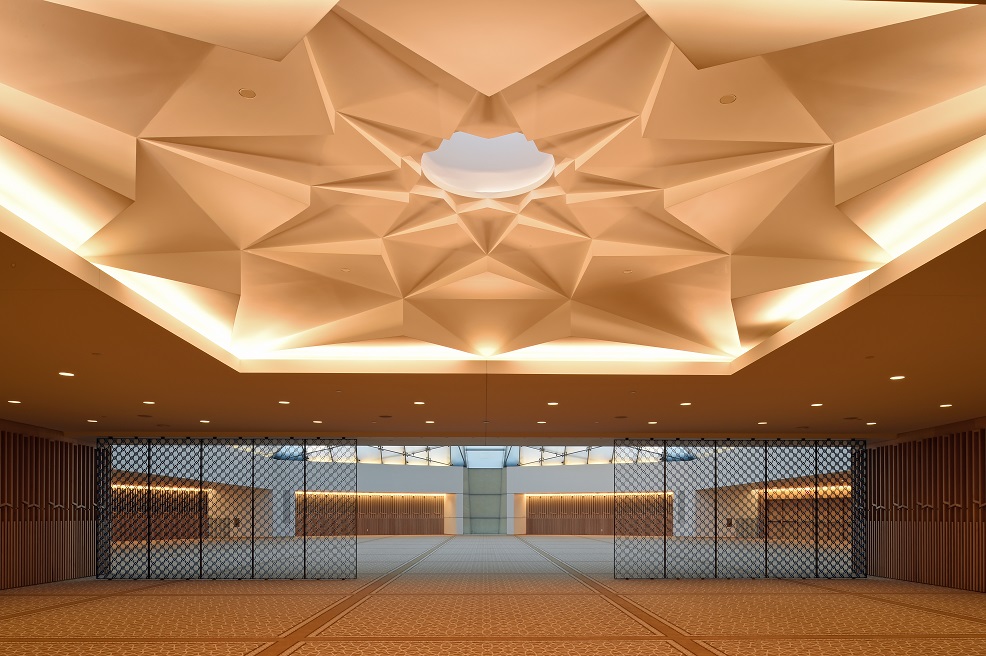
Top image – The “Muqarnas” is a finely crafted corbelled ceiling whose skylight provides a subtle transition from the outside to the serene Jamatkhana inside. Photo: Copyright Gary Otte.
Centre image – A screen made from ribbons of steel separates the anteroom from the prayer hall. It repeats an 8 sided pattern exhibiting a geometric tool used by Muslim artists to create order and rhythm for contemplation. Photo: Copyright Gary Otte
Bottom image – Inside the Jamatkhana, the central skylight panel descends to a white translucent onyx block. Photo: Copyright Shai Gil.
_______________
About the writer: Shariffa Keshavjee is a philanthropist and an entrepreneur with an objective to help women empower themselves. Raised in Kisumu, she considers herself a “pakaa” Kenyan. She is now based in the nation’s capital, Nairobi. Her other interest is in visual arts where she delights in painting on wood, silk and porcelain using water colours, oils and acrylics. She also likes writing, especially for children, and bird watching.
Subscription: Be informed about new post notifications automatically. Subscribe to the blog by simply entering your email at top right of this page, and confirming the subscription notice sent to your email.
Feedback: We welcome feedback/letters from our readers. Please click Leave a comment or submit your letter to simerg@aol.com. Your feedback may be edited for length and brevity, and is subject to moderation. We are unable to acknowledge unpublished letters.