A Brief Introduction to the Spiritual and Temporal Dimensions of the Ismaili Imamat, and its Precious Work Under the Leadership of His Highness the Aga Khan

Compiled and presented by Abdulmalik J. Merchant
Publisher-Editor, www.simerg.com

A portrait of Mawlana Hazar Imam, His Highness Prince Karim Aga Khan, with a framed portrait of Mawlana Sultan Mahomed Shah in the background. Photo by Philippe Le Tellier/Paris Match via Getty Images. Copyright.

An early portrait of Mawlana Hazar Imam, His Highness Prince Karim Aga Khan, with a framed photo of his grandfather, the 48th Ismaili Imam, Mawlana Sultan Mahomed Shah (1877-1957) in the background. Photo by Philippe Le Tellier/Paris Match via Getty Images. Copyright.

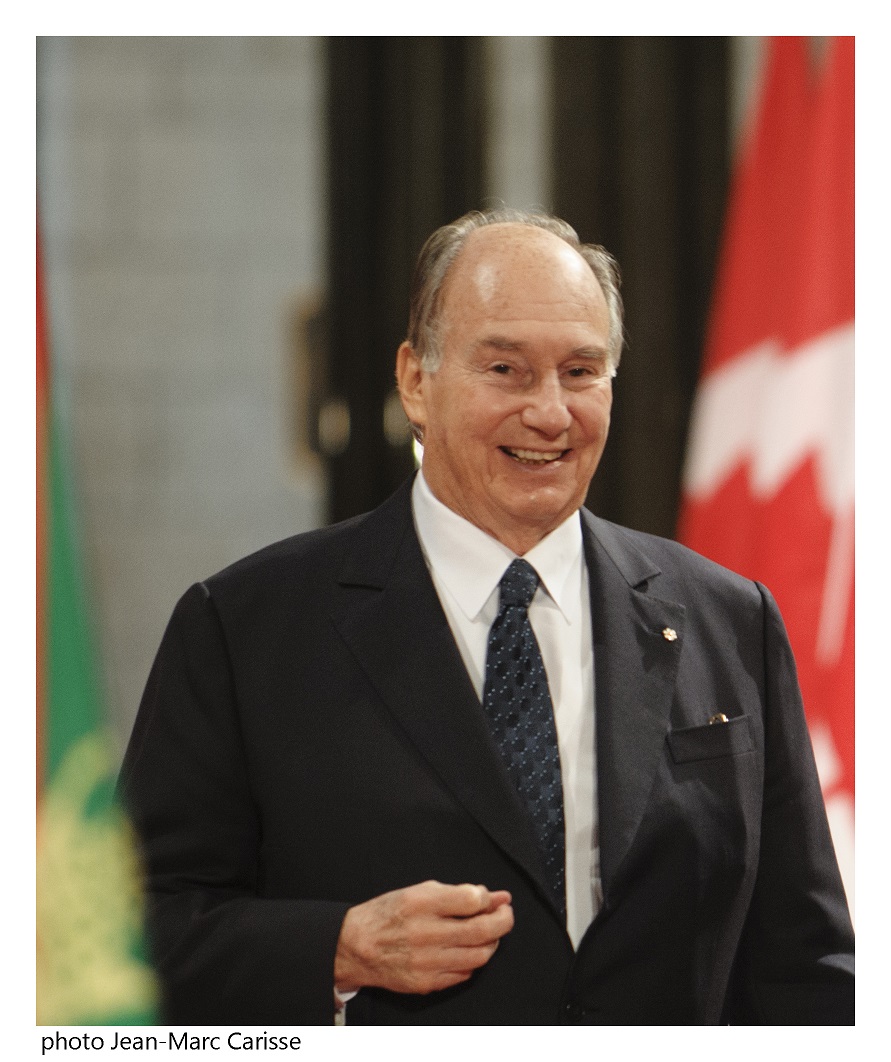
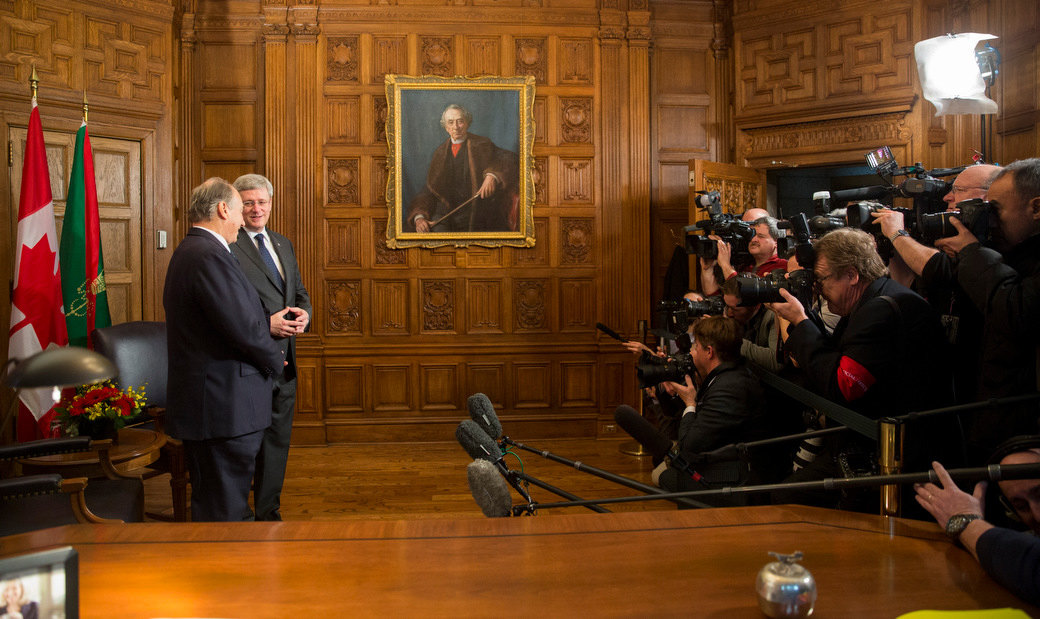
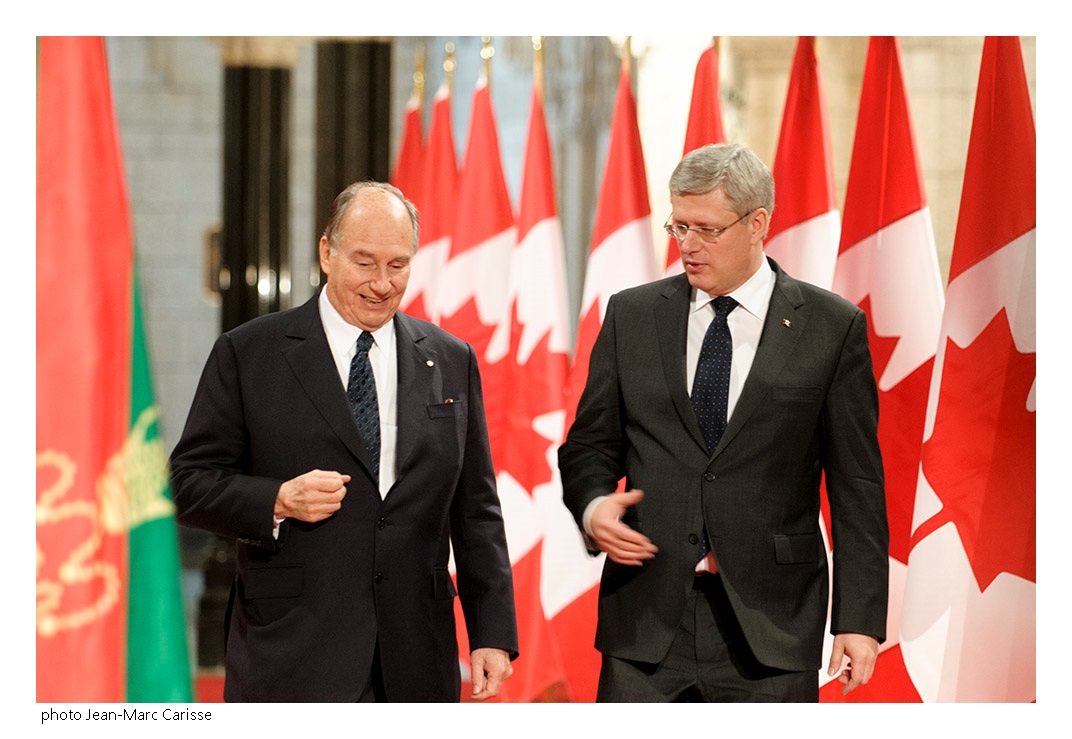
His Highness the Aga Khan is the direct descendant of the Prophet Muhammad (s.a.s) and also the current 49th Imam of a religious office, the Imamat, that he has inherited and which has its origins in the earliest history of Islam. He will be addressing both the Houses of the Canadian Parliament on Thursday, February 27, 2014 at the invitation of the Prime Minister, Stephen Harper. As a precursor to this week’s historical event, the aim of this piece is  to introduce readers to the  Imamat and to highlight its vision and precious work under the leadership of His Highness. This is done with the assistance of short excerpts from articles as well as speeches and interviews given by the Ismaili Imam.

(Please also see His Highness the Aga Khan to Become 5th Muslim Since 1939 to Address Joint Session of Canadian Parliament on February 27, 2014: The ABC’s of the Event Including Past Distinguished Speakers)

________________

BACKGROUND

By Azim Nanji

Islam

The last in the line of the Abrahamic family of revealed traditions, Islam emerged in the early decades of the seventh century. Its message, addressed in perpetuity, calls upon people to seek in their daily life, in the very diversity of humankind, signs that point to the Creator and Sustainer of all creation. Revealed to Prophet Muhammad in Arabia, Islam’s influence spread rapidly, bringing into its fold, within just over a century of its birth, the inhabitants of the lands stretching from the central regions of Asia to the Iberian Peninsula in Europe.

Leadership

During his lifetime, Prophet Muhammad was both the recipient and the expounder of Divine revelation. His death marked the conclusion of the line of prophecy, and the beginning of the critical debate on the question of the rightful leadership to continue his mission for the future generations. In essence, the position of the group that eventually coalesced into the majority, the Sunni branch, which comprises several different juridical schools, was that the Prophet had not nominated a successor, as the revelation contained in the Qur’an was sufficient guidance for the community.

The Party of Ali

The Shi‘at ‘Ali or the ‘party’ of ‘Ali, already in existence during the lifetime of Prophet Muhammad, maintained that while the revelation ceased at his death, the need for spiritual and moral guidance of the community, through an ongoing interpretation of the Islamic message, continued. For them, the legacy of Prophet Muhammad could only be entrusted to a member of his own family, in whom the Prophet had invested his authority through designation. That person was ‘Ali, the Prophet’s cousin, and the husband of his daughter and only surviving child, Fatima. ‘Ali was also the Prophet’s first supporter who devoutly championed the cause of Islam.

The Ismailis

In common with all major Shi‘a groups, the Ismailis believe that the Imamate is a divinely sanctioned and guided institution, through whose agency Muslims are enabled to contextualize the practice of their faith and to understand fully the exoteric and esoteric dimensions of the Qur’an. The Imamate exists to complement prophethood and to ensure that the divine purpose is fulfilled on earth at all times and in all places. — Background Excerpts, Azim Nanji [1]

~~~~~~~~

THE ISMAILI DOCTRINE OF IMAMAT

“In accordance with Shia doctrine, tradition, and interpretation of history, the Holy Prophet (s.a.s.) designated and appointed his cousin and son-in-law Hazrat Mawlana Ali Amiru-l-Mu’minin (a.s), to be the first Imam to continue the Ta’wīl and Ta‘līm of Allah’s final message and to guide the murids, and proclaimed that the Imamat should continue by heredity through Hazrat Mawlana Ali (a.s) and his daughter Hazrat Bibi Fatimat-az-Zahra, Khātun-i-Jannat (a.s).” — Ismaili Constitution [2]

SUCCESSION OF IMAMAT

“Succession of Imamat is by way of Nass [designation], it being the absolute prerogative of the Imam of the time to appoint his successor from amongst any of his male descendants whether they be sons or remoter issue.” — Ismaili Constitution [2]

THE PUBLIC INSTALLATION VS THE INSTANCE OF BECOMING THE IMAM

“Well the ceremony [of enthronement] is a public installation of the Imam. The Ismailis pay homage to the Imam and that is when you are recognised by the world at large as the Imam. I will probably wear the robes that my grandfather wore during his last jubilee and I will receive a sword which is the sword of justice of the Imamat. I will be given these robes and the sword by the leading members of the community and they will present an address at the same time.

“Officially as soon as one Imam passes away, his successor takes on from the very minute that the Imam has passed away.” — Aga Khan [3]

THE NATURE OF IMAMAT

“As Imam of the Ismaili sect, I am in a position to adapt the teachings of the Qur’an to the modern condition. On the question of modernity the issue is essentially whether one is affecting the fundamental moral fabric of society or whether one is affecting the fundamentals of religious practice. As long as these two aspects are safeguarded the rest can be subject to adjustment.” — Aga Khan [4]

“In Islam, imams whether they are Shia or Sunni, they have a duty to serve people. That is the nature of Imamat and, therefore, in countries where the Ismaili Imamat can bring support and help, it is our duty to do so and we’re very happy to do so in Central Asia, like we are doing so in the Indian sub-continent, we’re doing so in East Africa, in West Africa. So it’s part of the mandate of any Imam. But it’s a big mistake to think that you can do development only for Muslim communities. Many countries have mixed communities and therefore you have to do development for all the people within a given area whether they are Muslim or Christian or Jewish or Hindu or Sikh. You have what I would call a civil responsibility.” — Aga Khan [5]

THE ALLEGIANCE TO THE IMAM OF THE TIME

“The authority of the Imam in the Ismaili Tariqah is testified by Bay‘ah [allegiance] by the murid [follower] to the Imam which is the act of acceptance by the murid of the permanent spiritual bond between the Imam and the murid. This allegiance unites all Ismaili Muslims worldwide in their loyalty, devotion and obedience to the Imam within the Islamic concept of universal brotherhood. It is distinct from the allegiance of the individual murid to his land of abode.” — Ismaili Constitution [2]

THE GOVERNANCE OF THE IMAM OVER HIS COMMUNITY

“Historically and in accordance with Ismaili tradition, the Imam of the time is concerned with spiritual advancement as well as improvement of the quality of life of his murids. The Imam’s ta‘lim lights the murid’s path to spiritual enlightenment and vision. In temporal matters, the Imam guides the murids, and motivates them to develop their potential….By virtue of his office and in accordance with the faith and belief of the Ismaili Muslims, the Imam enjoys full authority of governance over and in respect of all religious and Jamati matters of the Ismaili Muslims.” — Ismaili Constitution [2]

THE LIVING IMAM –
MAWLANA HAZAR IMAM, HIS HIGHNESS THE AGA KHAN

“Mawlana Hazar Imam Shah Karim al Hussaini, His Highness Prince Aga Khan, in direct lineal descent from the Holy Prophet (s.a.s.) through Hazrat Mawlana Ali (a.s.) and Hazrat Bibi Fatima (a.s), is the Forty-Ninth Imam of the Ismaili Muslims.” — Ismaili Constitution [2]

“Well the Shia history has followed the same sort of historical developments all hereditary offices have followed, where there have been differences of opinion on who was the legitimate successor to the predecessor, whether it was a secular or religious office. In the case of the Shia Muslims, the Shia branch of Islam split and one branch of the Shia Muslims accepted the concept of the Imam in hiding, the invisible Imam, because the twelfth Imam disappeared as a very young child, and our branch of Shia Islam, in that particular generation of the family, accepted the legitimacy of the eldest son, Ismail, as being the appointed Imam to succeed and that is why they are known as Ismailis. And that branch of the family has continued today hereditarily and that is why there is a living Imam for the Ismaili Muslims.” — Aga Khan [6]

COLLABORATION WITH OTHER COMMUNITIES

“It is the desire and Hidāyat of Mawlana Hazar Imam that the constitutions presently applicable to the Ismaili Muslims in different countries be superseded and that the Ismaili Muslims worldwide be given this constitution in order better to secure their peace and unity, religious and social welfare, to foster fruitful collaboration between different peoples, to optimise the use of resources, and to enable the Ismaili Muslims to make a valid and meaningful contribution to the improvement of the quality of life of the Ummah and the societies in which they live.” — Ismaili Constitution [2]

“If I had to take stock of my life, my feeling would be that I have structured the Ismaili Imamat, for which I was given responsibility nearly 50 years ago, in such a way as to provide it with the institutional means to work for the good of Ismaili communities and the countries in which we are involved.” — Aga Khan [7]

THE ISMAILI COMMUNITY – 50 YEARS AGO AND NOW

“I was still a student at Harvard when I inherited the responsibilities of the Ismaili Imamat from my grandfather, Sir Sultan Mahomed Shah. It seemed inconceivable then that there would ever be substantial communities in the West. The Ismailis were too deeply rooted in their ancestral homes, indeed frozen there by the Cold War in Asia, the Middle East and Africa. But dislocations in the wake of decolonisation, and more recently the collapse of the Soviet Union and the prolonged difficulties in Afghanistan, have caused a number of Ismailis to seek new lands and homes. These migratory movements over the last half-century have resulted in a substantial Ismaili presence in Russia, in Western Europe, the United Kingdom and Portugal, and particularly in the United States and Canada. In these settings Ismailis have found themselves rejoicing with new opportunities, but also confronted by new challenges. Bolstered by a long tradition of self-reliance, and a strong system of community organisations, Ismailis have established themselves quickly as productive members of society in their new homelands.” — Aga Khan [8]

MATERIAL COMFORT AND BALANCE BETWEEN MATTER AND SPIRIT

“In Islam there is nothing wrong in the search for comfort, but the accumulation of wealth for the specific purpose of accumulating wealth or personal power is something which Islam does not like to see. If you are fortunate enough to go past what you personally need then share what you have.” — Aga Khan [9]

“I have been involved in the field of development for nearly four decades. This engagement has been grounded in my responsibilities as Imam of the Shia Ismaili Community, and Islam’s message of the fundamental unity of “din and dunia”, of spirit and of life. Throughout its long history, the Ismaili Imamat has emphasised the importance of activities that reflect the social conscience of Islam, that contribute to the well-being of Allah’s greatest creation — mankind, and the responsibility which Islam places on the fortunate and the strong to assist those less fortunate.” — Aga Khan [10]

A more recent portrait of Prince Karim Aga Khan, taken on June 22, 2012 in Chantilly, France. Photo by Philippe Petit/Paris Match via Getty Images.

A more recent portrait of Prince Karim Aga Khan, taken on June 22, 2012 in Chantilly, France. Photo by Philippe Petit/Paris Match via Getty Images.

THE NOTION OF QUALITY OF LIFE

“The quality of life is determined by a number of different factors that are, in my view, not limited to the World Bank indicators on longevity, or health, or the economic welfare of an individual, or a community. To the Imamat, the meaning of “quality of life” extends to the entire ethical and social context in which people live, and not only to their material well-being, measured generation after generation. Consequently, the Imamat’s is a holistic vision of development, as is prescribed by the faith of Islam. It is about investing in people, in their pluralism, in their intellectual pursuit, and search for new and useful knowledge, just as much as in material resources. But it is also about investing with a social conscience inspired by the ethics of Islam. It is work that benefits all, regardless of gender, ethnicity, religion, nationality or background.” — Aga Khan [11]

ON-GOING CHALLENGES

“A new president comes to power. What does he do? He contacts me immediately and tells me ‘Come back and help me rebuild my country.’ So, if you want, time changes situations, makes them different. Thus the institution that I represent, the Imamat, has to adapt according to the needs. It has to go beyond, it should anticipate situations. It has to be in a position to say that such and such area of the world is at great social, economic, political risk, whatever. Other areas are stable. These are areas where people live in acceptable conditions.” — Aga Khan [12]

MERITOCRATIC LEADERSHIP

“There was a time, earlier in my Imamat, when mediocrity was considered tolerable here because it was “good enough for Africa”. I remember my apprehension at the time, my concern that among all the goals that were set for Africa in those days, the achievement of normal world-class standards was not seen as realistic. But in the rapidly globalising world of the 21st century, the progress of every country and continent will depend on its ability to meet universal standards. To settle for less is an increasingly dangerous decision.” — Aga Khan [13]

“Education has been important to my family for a long time. My forefathers founded al-Azhar University in Cairo some 1,000 years ago, at the time of the Fatimid Caliphate in Egypt. Discovery of knowledge was seen by those founders as an embodiment of religious faith, and faith as reinforced by knowledge of workings of the Creator’s physical world. The form of universities has changed over those 1,000 years, but that reciprocity between faith and knowledge remains a source of strength.” — Aga Khan [14]

“The conviction that home-grown intellectual leadership of exceptional calibre is the best driver of a society’s destiny, underpins the Ismaili Imamat’s endeavour to create catalytic centres of educational excellence.” — Aga Khan [15]

THE UNITY OF MANKIND – A GIFT OF GOD

“I would turn to those words from my grandfather which were quoted in two earlier Peterson Lectures. He included them in a speech he gave as President of the League of Nations in Geneva some 70 years ago. They come originally from the Persian poet, Sadi, who wrote:

‘The children of Adam, created of the self-same clay, are members of one body. When one member suffers, all members suffer, likewise. O Thou, who art indifferent to the suffering of the fellow, thou art unworthy to be called a man’.

“You will readily understand why such words seem appropriate for a Peterson Lecture. They speak to the fundamental value of a universal human bond — a gift of the Creator — which both requires and validates our efforts to educate for global citizenship. I would also like to quote an infinitely more powerful statement about the unity of mankind, because it comes directly from the Holy Qur’an, and which I would ask you to think about. The Holy Qur’an addresses itself not only to Muslims, but to the entirety of the human race, when it says:

‘O mankind! Be careful of your duty to your Lord Who created you from one single soul and from it created its mate and from them twain hath spread abroad a multitude of men and women’.

“These words reflect a deeply spiritual insight — a Divine imperative if you will — which, in my view, should under gird our educational commitments. It is because we see humankind, despite our differences, as children of God and born from one soul, that we insist on reaching beyond traditional boundaries as we deliberate, communicate, and educate internationally.” — Aga Khan [16]

HOMOGENIZATION VS DIVERSITY

“Why would homogenization be such a danger? Because diversity and variety constitute one of the most beautiful gifts of the Creator, and because a deep commitment to our own particularity is part of what it means to be human. Yes, we need to establish connecting bonds across cultures, but each culture must also honour a special sense of self. The downside of globalisation is the threat it can present to cultural identities.

“But there is also a second great challenge which is intensifying in our world. In some ways it is the exact opposite of the globalising impulse. I refer to a growing tendency toward fragmentation and confrontation among peoples. In a time of mounting insecurity, cultural pride can turn, too often, into an endeavour to normatise one’s culture. The quest for identity can then become an exclusionary process — so that we define ourselves less by what we are for and more by whom we are against. When this happens, diversity turns quickly from a source of beauty to a cause of discord.I believe that the coexistence of these two surging impulses — what one might call a new globalism on one hand and a new tribalism on the other — will be a central challenge for educational leaders in the years ahead. And this will be particularly true in the developing world with its kaleidoscope of different identities.As you may know, the developing world has been at the centre of my thinking and my work throughout my lifetime. And I inherited a tradition of educational commitment from my grandfather. It was a century ago that he began to build a network of some 300 schools in the developing world, the Aga Khan Education Services.” — Aga Khan [16]

TOWARDS A PEACEFUL WORLD: A MESSAGE TO MUSLIMS AND NON-MUSLIMS

“What some describe as a clash of civilisations in our modern world is, in my view, a clash of ignorances. This is why education about religious and cultural heritage is so critically important — and why we will continue to invest in these institutions. We deeply believe that scholarship, publication and instruction — of high quality and generous breadth — can provide important pathways toward a more pluralistic and peaceful world.” — Aga Khan [17]

“From the seventh century to the thirteenth century, the Muslim civilisations dominated world culture, accepting, adopting, using and preserving all preceding study of mathematics, philosophy, medicine and astronomy, among other areas of learning. The Islamic field of thought and knowledge included and added to much of the information on which all civilisations are founded. And yet this fact is seldom acknowledged today, be it in the West or in the Muslim world, and this amnesia has left a six hundred year gap in the history of human thought….” — Aga Khan [18]

“As I look to the future of the Ismaili community worldwide, living in many parts of Central Asia, and in more than 25 different countries, and as I look to the future of Tajikistan, with its variegated population, and as I look at the Ummah, I conclude that every and all those peoples, if they wish to achieve a better life for themselves in the generations ahead, must absolutely achieve peace within their societies, and because we are Muslim, conflict must be replaced by a peace which is predicated on the ethics of our faith. We must not kill to resolve our differences, whatever they may be. They must be resolved, as I have said, within the ethic of our faith through dialogue, through compassion, through tolerance, through generosity and forgiveness. These are the pillars on which to build a strong society in modern times — not through weapons.” — Aga Khan [19]

RELIGIOUS EXPRESSION – THE HIJAB

(a) Individual Expressions…

“My own sense is that if an individual wishes to associate publicly with a faith, that’s the right of that individual to do that, whether he’s a Christian or a Jew or a Muslim. That is, to me, something which is important.” — Aga Khan [20]

(b) vs. Compulsion

“To go from there to an imposed process by forces in society, to me is unacceptable. It’s got to be the choice of the individual who wishes to associate with his faith or her faith. I have great respect for any individual who wants in the right way to be associated with his own faith. I accept that totally and I would never challenge it.” — Aga Khan [20]

ENVIRONMENT – MAN’S RESPONSIBILITY

“There is an often quoted ayat [of the Qur’an] which says that you should leave the world in a better environment than you found it. You have a responsibility of legacy of God’s creation of the world, to improve that legacy from generation to generation. So there’s an ethical premise to it.” — Aga Khan [21]

“Islam does not deal in dichotomies but in all-encompassing unity. Spirit and body are one, man and nature are one. What is more, man is answerable to God for what man has created. Since all that we see and do resonates on the faith, the aesthetics of the environments we build and the quality of the interactions that take place within them reverberate on our spiritual lives. As the leader of a Muslim community, and particularly one that now resides in twenty-five countries on four continents, the physical representation of Islamic values is particularly important to me. It should reflect who we are in terms of our beliefs, our cultural heritage and our relation to the needs and contexts in which we live in today’s world.” — Aga Khan [22]

A MESSAGE TO HIS FOLLOWERS

“In a world where quality of life is increasingly measured in material terms there is risk that the essential value system of Islam will be eroded, or even threatened with disappearance. Political situations with a theological overlay are also causing disaffection or antagonism between communities of the same faith, and even more so amongst different faiths. Where we can build bridges with other tariqahs around a common Muslim cosmopolitan ethos, we should make this endeavour.” — Aga Khan [23]

ENCOUNTERS

“Encounters. When two people meet. Or two particles. Or two cultures. In that crucial moment of interaction the results of an encounter are determined. In the simplest of encounters — say, with two billiard balls — the outcome is a predictable result of position, velocity and mass. But the encounters that interest me most are not so simple. In the encounters of people and cultures, much depends on the path that each has taken to that point. These are not stochastic processes. The subjects have histories. The encounter has complexity and rich dimensionality. The result of an encounter between two people or between two cultures is shaped by the assumptions of each, by their respective goals and — perhaps most directly relevant to a university — by the repertoire of responses that each has learned. Encounters therefore have aspects of both the general and the specific. What makes our current time distinctive are the new combinations of people and cultures that are participating in these encounters.” — Aga Khan [24]

THE ROLE OF THE NEW GENERATION

“As the young men and women from this Aga Khan Academy, and over time from its sister schools, grow and assume leadership in their societies, it is my hope that it will be members of this new generation who, driven by their own wide knowledge and inspiration, will change their societies; that they will gradually replace many of the external forces that appear, and sometimes seek, to control our destinies. These young men and women, I am sure, will become leaders in the governments and the institutions of civil society in their own countries, in international organisations and in all those institutions, academic, economic and artistic that create positive change in our world.” — Aga Khan [25]

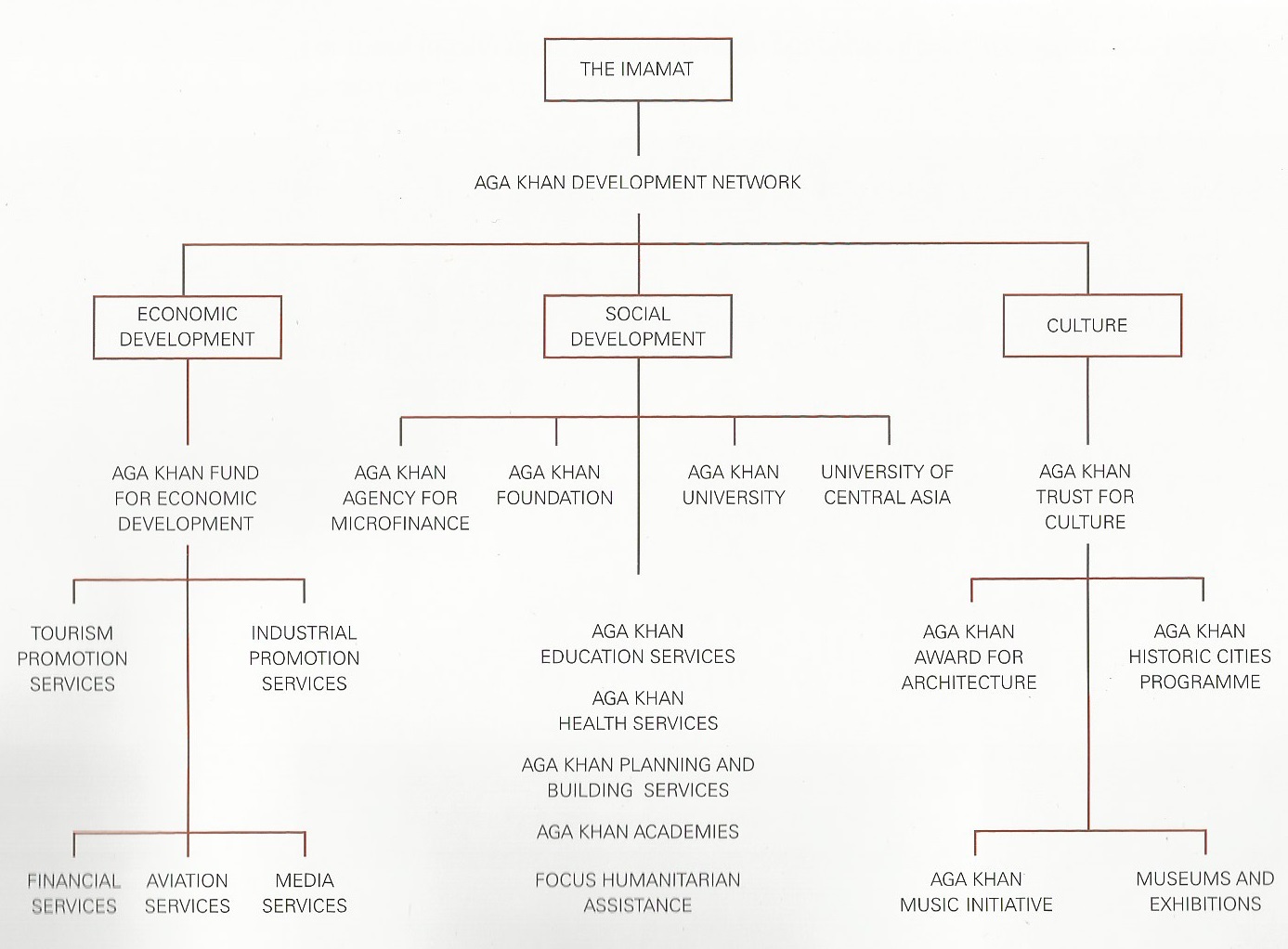
THE ISMAILI IMAMAT’S OPERATIONAL STRUCTURE

Please click on image for enlargement. Credit: Aga Khan Development Network, www.akdn.org
Please click on image for enlargement. Credit: Aga Khan Development Network, http://www.akdn.org
“In Islamic thought and practice, the world of the spirit and the world of daily life are inseparably intertwined. This is why, over a half century, my role as a spiritual leader has also required me to act in a host of social, economic and cultural endeavours, in order to secure and enhance the well-being of the Ismailis and the communities amongst which they live….The approach we take in the Aga Khan Development Network is non-denominational and holistic. It encompasses both the for-profit and not-for-profit sectors. We seek to catalyse the creation of necessary basic infrastructure, together with the provision of good quality education and healthcare. We are concerned with ensuring access to appropriate credit for the poor at the same time as we are working to sustain the arts and culture.” — Aga Khan [26]

Date posted: Sunday, February, 24, 2014.
Last updated: February, 24, 2014, 18:15 EST (footnote corrections)

This piece is subject to frequent updates (ed.)

___________________

Want to give a feedback? Click on Leave a comment or the comment link at top left of this page, or send an email to simerg@aol.com.

Excluding the background material taken from Dr. Azim Nanji’s articles and clauses from the Preamble of the Ismaili Constitution, the numerous excerpts of His Highness the Aga Khan are taken from the following sources available at Nanowisdoms, an excellent website dedicated to speeches, interviews and writings of Ismaili Imams:

  1. The Imamat in Ismailism and What is Shia Islam? by Dr. Azim Nanji, Lifelong Learning Articles at the Institute of Ismaili Studies
  2. The Preamble Of “The Constitution of the Shia Imami Ismaili Muslims”
  3. Interview with an unidentified media outlet 9 days prior to the first Takht Nashini (Enthronement) Ceremony in Dar es Salaam, Interview in Tanzania or London, 19 October 1957, Nanowisdoms
  4. India Today Interview, Aroon Purie (India), February 1989, Nanowisdoms
  5. Press Remarks published at nanowisdoms with an unidentified media outlet, Central Asia, Nanowisdoms
  6. CBC Interview, Man Alive with Roy Bonisteel, Canada, 8 October 1986, Nanowisdoms
  7. Paris Match interview, 3 February 2005, Nanowisdoms
  8. Ismaili Centre Opening Ceremony, Houston, Texas, USA, 23 June 2002, Nanowisdoms, www.akdn.org
  9. Life Magazine Interview, Margot Dougherty and Richard B. Stolley, ‘In Him, East and
    West Meet’, Nanowisdoms
  10. Address to the Annual Meeting of The European Bank for Reconstruction and Development, Tashkent, Uzbekistan, 5 May 2003, Nanowisdoms
  11. Al Watan Interview, Waddah Abed Rabbo, Damascus, Syria, 27 August, 2008, Nanowisdoms
  12. Lebanese Broadcasting Corporation International Interview, Aleppo, Syria and Lebanon, Nanowisdoms
  13. Banquet Hosted in Honour of the President of Uganda, Kampala, Uganda, 22 August 2007, www.akdn.org and Nanowisdoms
  14. Massachusetts Institute of Technology Commencement Ceremony, Cambridge, USA, 27 May 1994, Nanowisdoms
  15. Aga Khan Academy, Maputo, Foundation Stone Ceremony, Mozambique, 25 June
    2004, www.akdn.org and Nanowisdoms
  16. ‘The Peterson Lecture’ at the Annual Meeting of the International Baccalaureate, Atlanta, Georgia, USA, 18 April 2008, www.akdn.org and Nanowisdoms
  17. Imamat dinner for senior members of the Government, diplomats … etc. London, United Kingdom, July 3, 2008, www.akdn.org and Nanowisdoms
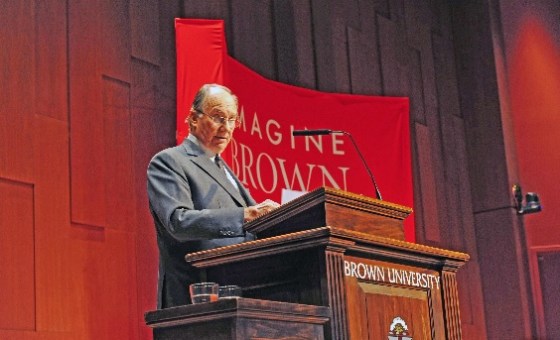
  18. Brown University Commencement Ceremony, Providence, Rhode Island, USA, 26 May 1996, www.akdn.org and Nanowisdoms
  19. Public Address, Rushan, Badakhshan, Tajikistan, 27 May 1995, Nanowisdoms
  20. Irish Times Interview, Alison Healy, ‘Jubilee for an imam among equals’, Maynooth, Ireland, Nanowisdoms
  21. Interview featured in PBS/E2 Series, ‘A Garden in Cairo’, USA, 2 September 2008, Nanowisdoms
  22. Ismaili Centre Opening Ceremony, Houston, Texas, USA, 23 June 2002, www.akdn.org and Nanowisdoms
  23. Golden Jubilee Inaugural Ceremony, Aiglemont, France, 11 July 2007, Nanowisdoms
  24. Massachusetts Institute of Technology Commencement Ceremony, Cambridge, USA, 27 May 1994, Nanowisdoms
  25. Aga Khan Academy, Kilindini, Opening Ceremony, Mombasa, Kenya, 20 December 2003 www.akdn.org and Nanowisdoms
  26. Imamat dinner for senior members of the Government, diplomats … etc. London, United Kingdom, July 3, 2008, www.akdn.org and Nanowisdoms

Note that several speeches made by the Aga Khan can also be read by clicking on www.akdn.org.

We welcome feedback/letters from our readers on the essay. Please use the Comments  LEAVE A REPLY box which appears below. Your feedback may be edited for length and brevity, and is subject to moderation. We are unable to acknowledge unpublished letters.

Please visit the Simerg Home page for links to articles posted most recently. For links to articles posted on this Web site since its launch in March 2009, please click Table of Contents. Sign-up for blog subscription at top right of this page.

Islam’s 99 Names of God: Andrew Kosorok, A Christian Artist from Utah, Seeks to Explore Them Through Glass Sculptures

“I learned that when Mohamed was asked how a person could get into Heaven he told them they needed to learn the Names of God; when pressed on how many there were Mohamed responded that there were 99. This really resonated with me; I began to study the Names and respond to them through glass sculpture, and the 99 Names Project was born…” — Andrew Kosorok, Utah

PLEASE CLICK: A Christian Artist’s Epic and Noble Journey of Uniting Faiths Continues As He Completes the First 25 Sculptures Depicting Islam’s 99 Names of God

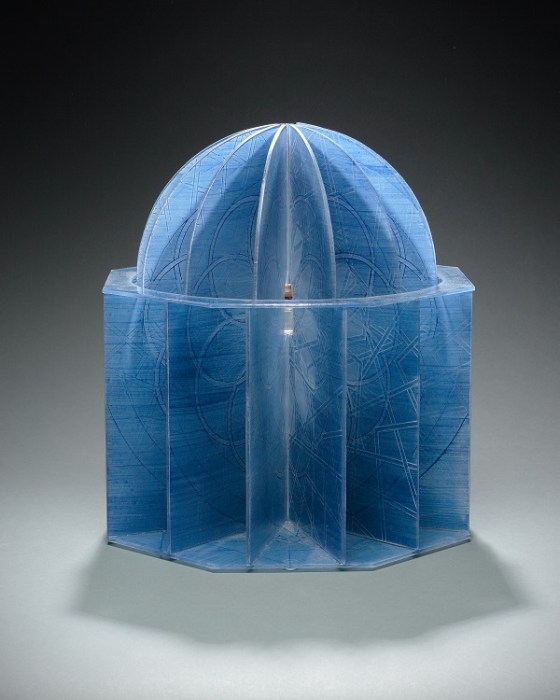
Wellspring of Peace (As-Salam). Photo: Andrew Kosorok. Copyright.

Wellspring of Peace (As-Salam). Photo: Andrew Kosorok. Copyright.

“Jesus in Islam” by Michael Wolfe and “How the Prophet Muhammad Sought Protection for His Embattled Followers in a Christian Land” by Barnaby Rogerson

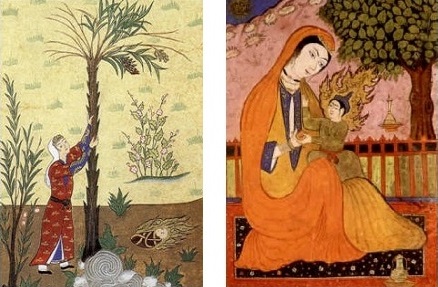
“Christians may be surprised to learn that Muslims believe in the Virgin Birth and Jesus’ miracles”….. Read Michael Wolfe’s Piece

Left: Virgin Mary nurtured by a palm tree in a Turkish miniature, as described in the Qur'an; right: Mary and Jesus in a Persian miniature. Please click on image for Michael Wolfe's article "Jesus Through a Muslim Lens." Images: Wikipedia.
Left: Virgin Mary nurtured by a palm tree in a Turkish miniature, as described in the Qur’an; right: Mary and Jesus in a Persian miniature. Please click on image for Michael Wolfe’s article “Jesus Through a Muslim Lens.” Images: Wikipedia.

_____________

Muhammad, who could do nothing to alleviate the suffering of his small embattled community of believers, at last advised some of his followers to leave sacred Mecca and take refuge elsewhere….. Read Barnaby Rogerson’s Piece

The Altar of the Nativity, beneath which is the star marking the spot where tradition says the Virgin Mary gave birth to Jesus. Photo: Muslim Harji, Montreal, PQ. Copyright. Please click on image for Barnaby Rogerson's piece.
The Altar of the Nativity, beneath which is the star marking the spot where tradition says the Virgin Mary gave birth to Jesus. Photo: Muslim Harji, Montreal, PQ. Copyright. Please click on image for Barnaby Rogerson’s piece.

Date re-posted: May 23, 2022.

__________________

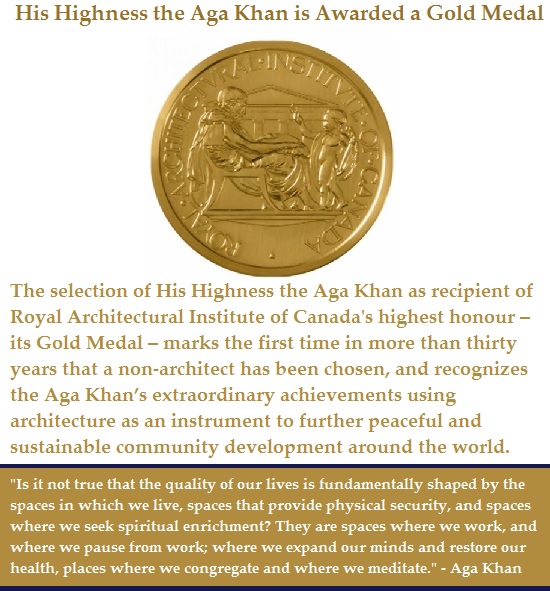
His Highness the Aga Khan Receives RAIC’s 2013 Gold Medal for his Significant Contribution to Canadian Architecture

Please click: Royal Architectural Institute Awards Gold Medal to 49th Ismaili Imam, His Highness the Aga Khan, for his contribution to Canadian architecture

Please click on image for a report of the RAIC Gold award ceremony on November 27, 2013 in Ottawa, Canada.

Please click on image for a report of the RAIC Gold award ceremony on November 27, 2013 in Ottawa, Canada.

Unique Moments from the Extraordinary Life of His Highness the Aga Khan III – the Beloved 48th Imam of the Shia Imami Ismaili Muslims

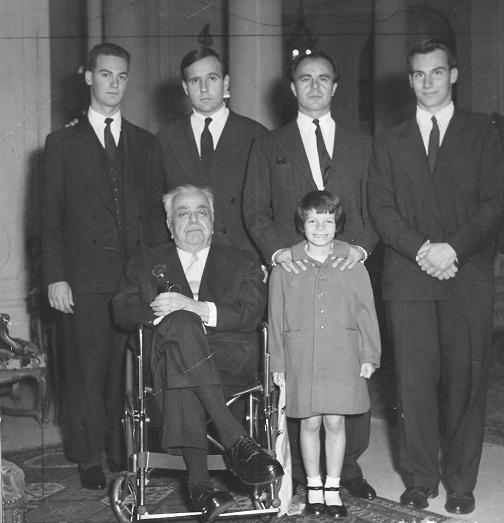
“On 2nd November, 1877 my beloved grandfather was born here in Karachi. Through 72 years of Imamat, he guided his spiritual children to happiness and prosperity….Many many memories come to our minds as we think of him. He achieved in his life, for our community that which could only have been accomplished normally in a period of many generations. The tributes that the world has paid him bear honest testimony to his great life and work” — His Highness Prince Karim Aga Khan, 49th Ismaili Imam

The late 48th Ismaili Imam, His Highness the Aga Khan, seated on a wheelchair with members of his family with his successor, the present Imam, Prince Karim Aga Khan, standing at extreme right. Others in the photo (l to r), grandson Prince Amyn Muhammad ,and the late Imams two sons, the late Prince Sadruddin and Prince Aly Khan, who is seen holding his daughter Princes Yasmin Aga Khan Photo: Zul Khoja Collection, Ottawa.

The 48th Ismaili Imam, His Highness the Aga Khan (1877 – 1957), seated on a wheelchair with members of his family with his successor, the present Imam, Prince Karim Aga Khan, standing at extreme right. Others in the photo (l to r), grandson Prince Amyn Muhammad , and the 48th Imam’s  two sons, the late Prince Sadruddin and Prince Aly Khan who is seen holding his daughter Princes Yasmin Aga Khan. Photo: Zul Khoja Collection, Ottawa.

November 2, 2014 marks the 137th birth anniversary of the 48th Ismaili Imam, Sir Sultan Mahomed Shah, His Highness the Aga Khan III. Born in Karachi in 1877, he assumed the reign of Imamat at the age of seven, and ruled the Ismailis  for 72 years, becoming the community’s longest-serving Imam. He passed away on July 11, 1957, and willed that the mantle of Imamat should pass to his grandson, the present 49th Imam, His Highness Prince Karim Aga Khan IV.

We are pleased to provide our readers with links to diverse articles, stories and photo essays related to the beloved 48th Imam, who has been described in one of the pieces as the Imam of the Socio-Economic Revolution. Please click on the following selections:

BIOGRAPHY, DECORATIONS, IMAM’S WRITINGS AND TRIBUTES

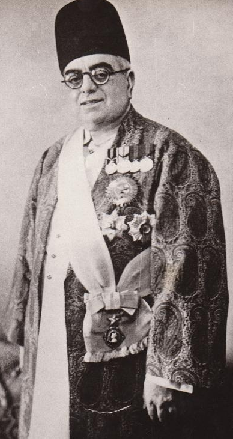
His Highness the Aga Khan III,  48th Imam of Shia Imami Ismailis, in full regalia. Photo: Jehangir Merchant Collection.

His Highness the Aga Khan III, 48th Imam of Shia Imami Ismailis, in full regalia. Photo: Jehangir Merchant Collection.

1. Imam Sultan Muhammad Shah – An Astonishing and Extraordinary Personality

2. Literary Reading: Sir Sultan Muhammad Shah, Aga Khan III – Successor and a Son Reflect on Accomplishments of the 48th Ismaili Imam

3. Titles, Decorations and Honours Conferred on 48th Ismaili Imam; 72 Year Reign Spanned Six British Monarchs and Seventeen PM’s

4. Literary Reading: Sir Sultan Muhammad Shah, Aga Khan III – The Road to Happiness and The Concept of Life

5. “Work No Words” by His Highness the Aga Khan, and Other Rare Ismaili Historical Quotes on Service

6. His Highness the Aga Khan’s “Never-To-Be-Forgotten” Message to Ismaili Youth – “Keep Clean Soul in a Clean Body”

7. Literary Reading: Sir Sultan Muhammad Shah, Aga Khan III – Long Reign Ends

8. Literary Reading: Sir Sultan Muhammad Shah, Aga Khan III: The Face of Imamat 

9. The Memoirs of Aga Khan – World Enough and Time: A Translator’s Voice

ANECDOTES

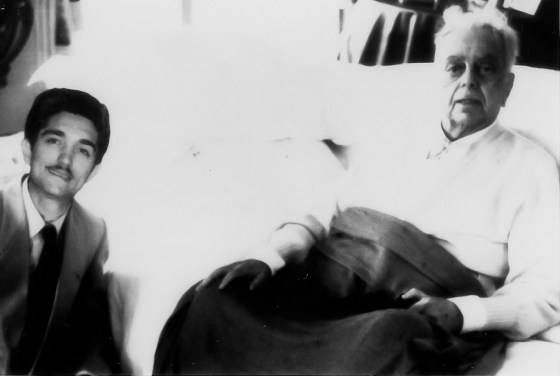
The late Sir Sultan Mahomed Shah Aga Khan III pictured with Badrudin Adatia. Recalls Adatia: "I wanted to take picture of him with us and I asked his permission. The room was dim, however, and I didn’t have a flash on my camera. Although he was very sick and could not even walk, he told me he would head toward the window where there would be better light. Imagine! I clasped my hands with respect and said, “No Khudavind. I will take the picture just as we are.” Photo: Badrudin Adatia collection.

The late Sir Sultan Mahomed Shah Aga Khan III pictured with Badrudin Adatia. Recalls Adatia: “I wanted to take picture of him with us and I asked his permission. The room was dim, however, and I didn’t have a flash on my camera. Although he was very sick and could not even walk, he told me he would head toward the window where there would be better light. Imagine! I clasped my hands with respect and said, “No Khudavind. I will take the picture just as we are.” Photo: Badrudin Adatia collection.

10. I Wish I’d Been There: A Unique Moment in the Life of the Punjab Jamat

11. Yakimour 1954: A Golden Moment for an Aspiring Student – An Audience with the 48th Ismaili Imam, Aga Khan

12. “Mawla Fulfilled My Wish”

13. On Meeting the Noorani Family – My Voyage to Europe

14. An Ismaili Youth’s Rare Moment With Imam Sultan Mahomed Shah

EXTRA ORDINARY VISITS AND THE JUBILEES

His Highness the Aga Khan at a reception by the Ismaili community in South Africa.

His Highness the Aga Khan at a reception by the Ismaili community in South Africa.

15. Lakhpaty’s Intriguing Poster for 48th Ismaili Imam’s Diamond Jubilee Shows Artistic Ingenuity

16. Imam’s Message in South Africa Addressed Artificial Barriers, Unity, Education for All, and Damaging Social Habits

17. Photo Essay: The Historical Jubilees of His Highness the Aga Khan (1877-1957), the Imam of the Socio-Economic Revolution

18. World Renowned Photographer Sarite Sanders Portrays Mysterious Radiance of a Fatimid Tomb and the Elegance of the Aga Khan Mausoleum

19. When His Highness the Aga Khan III First Visited East Africa and the USA

DEDICATION TO ISLAM AND THE MUSLIM WORLD

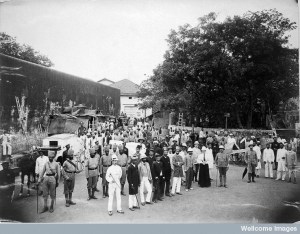
A group comprising doctors, health and public officials gathered on a street in Bombay about to begin the day's work, during an outbreak of plague. Photo Credit: Wellcome Library, London. Wellcome Images. Copyright.

A group comprising doctors, health and public officials gathered on a street in Bombay about to begin the day’s work, during an outbreak of plague. Photo Credit: Wellcome Library, London. Copyright.

20. His Highness the Aga Khan and the Bubonic Plague of 1897: How the Ismaili Imam’s Courage and Leadership Saved Countless Lives

21. Hazrat Imam Sultan Muhammad Shah, Aga Khan III – A “Mendicant” Who Transformed a Dream into Reality and Stirred the Soul of a Bitter Critic

22. Sir Sultan Muhammad Shah, Aga Khan III – A Muslim’s Analysis of Lessons that Can be Learnt from the 48th Ismaili Imam

Date post updated: Saturday, November 1, 2014.

Id-e-Ghadir – The Designation of Hazrat Ali (a.s.) as Commander of the Faithful

Excerpt adapted from Ilm magazine, December, 1989*

The twelve months of the Muslim calendar and major Muslim festivals. Image by Simerg.

The twelve months of the Muslim calendar and major Muslim festivals. Image by Simerg.

‘Id-e-Ghadir is celebrated by the Shi ‘ite communities to mark the event that took place at Ghadir Khumm (Valley of the Pond) on the 18th Dhul-Hijjah. This event commemorates the designation (appointment by way of nass) of Hazrat All as the ‘Amir-ul-Mu’minin (commander of the faithful) and Imamul-Muslimin’ (the Imam of the community of believers) at Ghadir-i Khumm when the Prophet (s.a.s.) was returning from his Last Pilgrimage (hajjatul-wida) in the year 632 AC. On this occasion, the Prophet publicly proclaimed Ali to be his successor [1] in guiding the community after the end of the institution of Nubuwwah. According to the Shi’a doctrine, tradition and interpretation of history, the designation of Hazrat Ali marked the beginning of the institution of Imamah. The designated Imam was to continue the ta’wil (interpretation) and talim (teaching) of Allah’s Final Message, i.e. the Holy Qur’an.

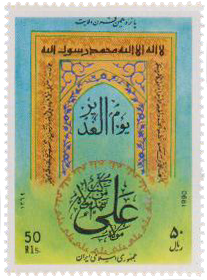
This stamp, issued by Iran in 1990, includes the Shahada, Qur'anic ayats and the declaration made by Prophet Muhammad at Ghadir-e Khumm "Mun Koontu Mawla, Fa Hada, Aliyun Mawla" (He of whom I am the Mawla, Ali is also the Mawla). Image not exact stamp size.

This stamp, issued by Iran in 1990, includes the Shahada, Qur’anic ayats and the declaration made by Prophet Muhammad at Ghadir-e Khumm “Mun Koontu Mawla, Fa Hada, Aliyun Mawla” (He of whom I am the Mawla, Ali is also the Mawla). Image not exact stamp size.

Accordingly, throughout the course of the history, the Shi’a have commemorated this occasion as a mark of recognition and acceptance of Allah’s mercy to mankind by bestowing continued guidance. Each Imam, since the time of Hazrat Ali has designated his successor. The Imam in his time has continued to guide his followers according to the prevailing conditions. His function has always been to look after the welfare of the community both in spiritual and worldly (material) matters. His guidance to his followers is that they should lead their lives in such a way so as to practice their Faith with a sense of balance and harmony, ensuring that there is no conflict between the two aspects of an individual’s life. The practice of the Faith thus becomes the way of life.

Presently, the Shi’a Imami Ismaili Muslims celebrate the day of accession of their present Imam to the office of Imamah as Yaum-e Imamat or Imamat Day. This occasion is celebrated as a mark of gratitude to Allah in having bestowed His mercy and bounty in guiding them through the office of the Imam on Sirat al-Mustaqim (the Straight Path).

Date posted: October 22, 2013

Please also click: Ghadir-Khumm – “I Wish I’d Been There” and Other Writings

_____________________

Notes

[1] Vagglieri, Ghadir Khumm, The Encyclopedia of Islam, Vol II, E.J. Brill, 1965, pp. 993-994

* For link to complete article, please click Muslim Festivals and Religious Observances.

Ghadir-Khumm – “I Wish I’d Been There” and Other Writings

“Allah did choose Adam and Noah, the family of Abraham, and the family of Imran above all people – offspring, one of the other, and Allah knows and hears all things.” (Holy Qur’an, 3:33-34)

I. PREAMBLE OF THE ISMAILI CONSTITUTION

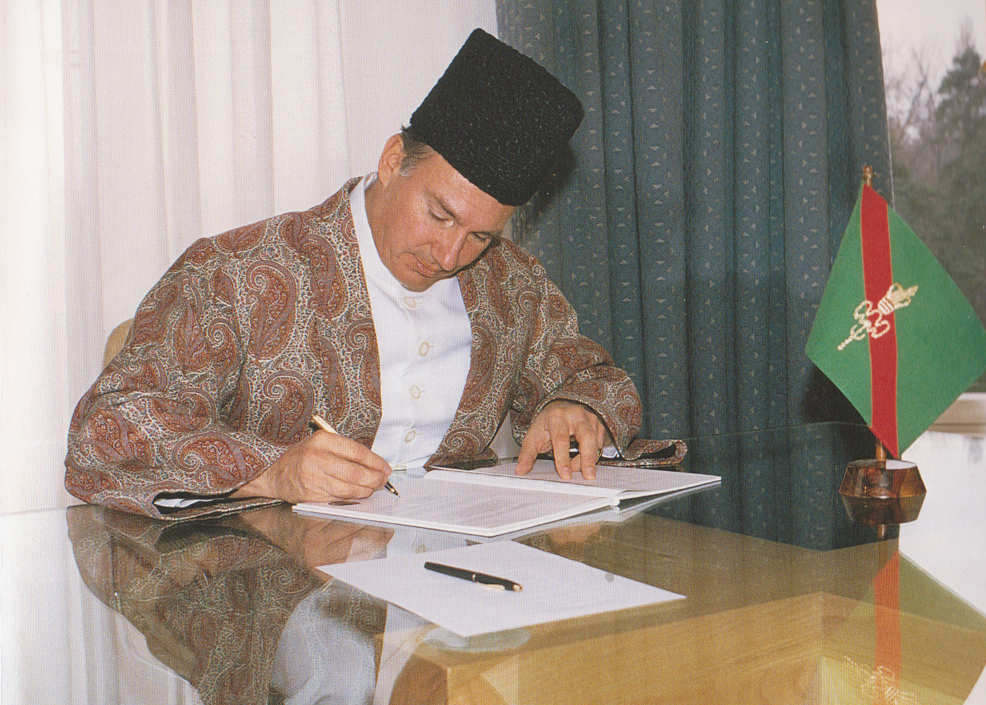
His Highness the Aga Khan seen ordaining a new constitution for the Ismaili community worldwide. Clause (G) of the Preamble states: “Mawlana Hazar Imam Shah Karim al Hussaini, His Highness Prince Aga Khan, in direct lineal descent from the Holy Prophet (s.a.s.) through Hazrat Mawlana Ali (a.s.) and Hazrat Bibi Fatima (a.s), is the Forty-Ninth Imam of the Ismaili Muslims.”

“In accordance with Shia doctrine, tradition, and interpretation of history, the Holy Prophet (s.a.s.) designated and appointed his cousin and son-in-law Hazrat Mawlana Ali Amiru-l-Mu’minin (a.s), to be the first Imam to continue the Ta’wīl and Ta‘līm of Allah’s final message and to guide the murids, and proclaimed that the Imamat should continue by heredity through Hazrat Mawlana Ali (a.s) and his daughter Hazrat Bibi Fatimat-az-Zahra, Khātun-i-Jannat (a.s).” – The Preamble of The Constitution of the Shia Imami Ismaili Muslims. [1]

~~~~~~~~~~~

II. IDD-E-GHADIR STAMPS

Images of some stamps and coins issued by the Islamic Republic of Iran between 1990 and 2010 commemorating the Idd-e-Ghadir. The inscriptions include the Shahada, Qur’anic ayats and the declaration made by Prophet Muhammad at Ghadir Khumm, “Mun Koontu Mawla, Fa Hada, Aliyun Mawla” meaning “He of whom I am the Mawla Ali is also the Mawla.”

~~~~~~~~~~~

III

With 9,000 chronological quotations arranged in 90 thematic chapters, this huge treasury is bursting with historical gems.

With 9,000 chronological quotations arranged in 90 thematic chapters, this huge treasury is bursting with historical gems.

“Muhammad said: ‘He of whom I am the Mawla, Ali is his Mawla. O God, be the friend of him who is his friend and be the enemy of his enemy.’

“This became the proof text for the Shia claim that Ali, the Prophet’s cousin and son-in-law, was the Prophet’s rightful successor after the Prophet’s death in 632. The meaning of Mawla here probably implies the role of patron, lord or protector.” — History in Quotations by M. J. Cohen and John Major.

~~~~~~~~

IV. HIS HIGHNESS THE AGA KHAN AND
HIS DEVELOPMENT NETWORK ON HAZRAT ALI

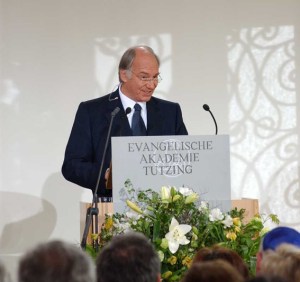
His Highness addressing the Evangelical Academy of Tutzing upon receiving the Tolerance Award, 20 May 2006.

His Highness addressing the Evangelical Academy of Tutzing upon receiving the Tolerance Award, 20 May 2006.

 “…As you know, the Shi’a divided from the Sunni after the death of the Prophet Muhammad. Hazrat Ali, the cousin and son-in-law of the Prophet, was, in Shi’a belief, named by the Prophet to be the Legitimate Authority for the interpretation of the faith. For the Shi’a today, all over the world, he is regarded as the first Imam.” – His Highness the Aga Khan, Tutzing Evangelical Academy, May 20, 2006. [2]

___________

“The Ismaili Imamat is a hereditary institution of Muslim leadership, linked to Prophet Muhammad (peace be upon him and his family) by direct lineal descent through Hazrat Ali, his cousin and son-in-law. The line of Ismaili Imams has continued uninterrupted by hereditary succession from Hazrat Ali through to the present, 49th Imam, His Highness the Aga Khan.” – The Aga Khan Development Network (AKDN) , Brazil and the Ismaili Imamat sign a Protocol. [3]

~~~~~~~~~~~

V. “I WISH I’D BEEN THERE”

By Jehangir Merchant, Aziz Kurwa and Barnaby Rogerson

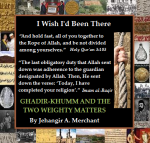
Please click for Jehangir A. Merchant’s “Ghadir-Khumm and the Two Weighty Matters”

Ghadir-Khumm and the Two Weighty Matters by Jehangir Merchant

The last obligatory duty that Allah sent down was al-Walaya (adherence to the guardian designated by Allah). Then, He sent down the verse: “This day have I perfected your religion for you and have completed My favours upon you and have chosen for you Islam as your religion.” (Holy Qur’an, 5:3)…

~~~~~~~~~

Please click for Aziz Kurwa’s “Volunteering at the Dawning of the Age of Imamat”

Volunteering at the Dawn of the Age of Imamat by Aziz Kurwa

Rasul-illah mounted the pulpit and placed Ali on his right. He then delivered a sermon, thanking Allah for His bounty. Taking Hazrat Ali by the hand, he then declared: He of whom I am Mawla, of him Ali is also the Mawla. The volunteers cleared everything and then we sat around campfires in groups. In my group the conversations was buzzing over the historical and momentous events of the day…

~~~~~~~~~~

Please click for Barnaby Rogerson's "A Christian Envoy at the Ghadir Khumm Campsite"

Please click for Barnaby Rogerson’s “A Christian Envoy at the Ghadir Khumm Campsite”

A Christian Envoy at the Ghadir Khumm Campsite by Barnaby Rogerson

What an offer! To travel back in time and return as a true witness to the history that I have so often thought and dreamed about… (and) witness to the exact succession of events at the Ghadir Khumm campsite: the blessings, the sermon and the ritual actions of the Prophet ordaining Ali as his successor…

To download complete series please click I Wish I’d Been There Series – PDF. To read individual pieces, please visit I Wish I’d Been There.

___________________

[1] To read background story and complete preamble, please click The Preamble Of “The Constitution of the Shia Imami Ismaili Muslims”.

[2] To read this and other published speeches at the AKDN Website, please click Tolerance Award from the Evangelical Academy of Tutzing and Speech Archives.

[3] See The Ismaili Imamat note in AKDN–Brazil Protocol.

___________________

A Note to Readers: Please scroll down or click Home page for other recent posts and click What’s New for links to all articles published on this blog since March 2009. Subscribe to this Website via the box near the top right of this page.

A Description of the Hajj by the Ismaili Missionary Naser-e Khosraw – from “One Thousand Roads to Mecca” by Michael Wolfe

AN INSTALLMENT FROM SIMERG’S MUST READ SERIES ABOUT NASER-E KHOSRAW’S MEMORABLE JOURNEY TO FATIMID EGYPT

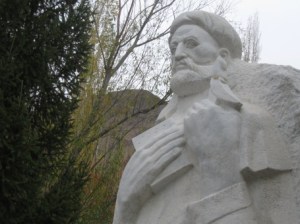
A statue of the famous Ismaili dai Nasir Khusraw in Badakhshan.

“….The tallest mountain near Mecca is Abu Qubays, which is round like a dome, so that if you shoot an arrow from the foot of the mountain it reaches its top.…Having come into the city, you enter the Haram Mosque, approach the Ka’ba, and circumambulate….. always keeping the Ka‘ba to your left [shoulder]. Then you go to the corner containing the Black Stone, kiss it, and pass on….”

Please click: Naser-e Khosraw’s Pilgrimages to Mecca
(Links to all series articles provided below)

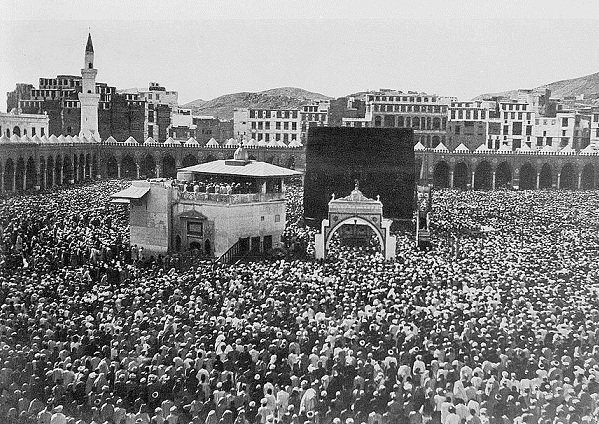
A bird’s-eye view of the Ka’ba crowded with pilgrims. The photo is from the archives of the US Library of Congress and was created by American Colony (Jerusalem), Photo Dept., in 1910. Please click for article by Naser-e Khosraw.

________________
Complete series by Michael Wolfe:

Part I – Introduction and Naser-e Khosraw Commences the Journey
Part II – Naser-e Khosraw in Fatimid Cairo
Part III – Naser-e Khosraw’s Pilgrimages to Mecca
Part IV – Naser-e Khosraw’s Dangerous Homeward Journey

“All People Are A Single Nation” – Prince Aly Khan on Islam’s Basic Teachings and its Closeness to the Ethic of the Christian Faith

A MUST READ PIECE FOR CHRISTIANS AND MUSLIMS ALIKE

“Given a right understanding of the foundations of Islam and Christianity, and the spiritual values which they have proclaimed, it should not prove very difficult to build a bridge of mutual respect and co-operation between the two great religions. Unfortunately, it is a fact that the close similarity between the two remains largely unknown to the West.”

Islam: The Religion of Equality and Universal Brotherhood by Prince Aly S. Khan

Photo taken at the opening on 15th September 1959 of the 14th session of the United Nations General Assembly. Seated at the head of the delegation of Pakistan is Mr. Manzur Qadir, then Minister for Foreign Affairs. At right is Prince Amyn Aga Khan's father, the late Prince Aly Khan, Permanent Representative to the United Nations. Photo: United Nations Photo Library. Please click for article.

Photo taken at the opening on 15th September 1959 of the 14th session of the United Nations General Assembly. Seated at the head of the delegation of Pakistan is Mr. Manzur Qadir, then Minister for Foreign Affairs. At right is Prince Karim Aga Khan’s father, the late Prince Aly Khan, Permanent Representative to the United Nations. Photo: United Nations Photo Library. Please click for article.

__________

Eid ul-Fitr: Sighting of the new moon brings the Holy Month of Ramadan to an end

EID MUBARAK

Conceptual image for the holy month of Ramadan and Eid al Fitr. Photo: Istockphoto

Conceptual image for the holy month of Ramadan and Eid ul Fitr. Photo: Istockphoto. Copyright.

In some parts of the Muslim world, the actual sighting of the new or crescent moon determines the end of the month of Ramadan, whilst other Muslim bodies such as the Fiqh Council of North America determine the end of the month based on “scientifically guaranteed astronomical calculations.” According to a statement released by the Fiqh Council, the new moon was going to be visible with a telescope in California on Wednesday August 7, and Eid ul-Fitr would be celebrated on Thursday, August 8, the first day of the month of Shawwal. Newspapers from India such as the Deccan Herald  reported the sighting of the crescent moon over places such as Kapad beach, near Kozhikode in Kerala, yesterday, Wednesday August 7 and announced that Eid ul-Fitr would take take place on Thursday, August 8. Kuwait, Jordan and Palestine are marking  Eid on Thursday while Oman and Pakistan are expected to observe it on Friday.

Thus over a 1000 million Muslims around the world will be celebrating Eid on Thursday or on Friday August 9th, based on the method used to determine the end of Ramadan. In any case bakeries, confectionaries and toy shops have been witnessing heavy rush of customers as Muslims started preparing for the two-day Eid festival. In Srinagar, Kashmir, where Eid is to be expected to be observed on Friday shopping outlets dealing with clothing including kids-wear, perfumes and footwear have started seeing brisk sales from early in the morning.

A new moon at Mackerricher State Park, California, USA. Photo: Istockphoto. Copyright.

A new moon at Mackerricher State Park, California, USA. Photo: Istockphoto. Copyright.

The festival of Eid, also known as Bairam or Eid Ramadan is one of the most joyous days in the Islamic calendar. It is an occasion for celebration and rejoicing for Allah’s Bounty upon mankind for His revelation of the Qur’an during the holy month of Ramadan.

It is also a time for individuals to express their gratitude to Allah for having given them the strength, courage and resilience to complete the fast, and thus fulfilling the duty enjoined upon them by Allah.

The festival begins with a festive prayer (Salatul-Fitr) with all the believers congregating at  mosques and jamatkhanas. It is also an occasion for socializing and meeting with other Muslims and for fostering a sense of brotherhood and unity amongst the community (ummah). After the communal prayer, families gather together at home with relatives and friends and participate in exchanging gifts and partaking a meal.

Rows of worshippers gather in neat rows facing Mecca in front of the mosque at the Taj Mahal to celebrate the Muslim festival of Eid ul-Fitr in Agra, Uttar Pradesh, India. Eid is the muslim holiday that marks the end of Ramadan. Photo: Istockphoto. October 2, 2008. Copyright.

Rows of worshippers gather in neat rows facing Mecca in front of the mosque at the Taj Mahal to celebrate the Muslim festival of Eid ul-Fitr in Agra, Uttar Pradesh, India. Eid is the muslim holiday that marks the end of Ramadan. Photo: Istockphoto. October 2, 2008. Copyright.

We convey our heartiest felicitations and Eid Mubarak to all our readers as well as Muslims around the world, with the fervent hope and prayer that peace and harmony will soon prevail over many areas of the Muslim world afflicted by horrible conflicts, which are resulting in the loss of lives and contributing to unbearable hardships and struggles. The Islamic ethic of forgiveness, generosity,  and peaceful co-existence and unity through dialogue are keys by which conflicts can be resolved, whereby every Muslim can aspire for a life of material and spiritual well-being and happiness.

Date posted: Wednesday, August 7, 2013.
Date updated: Thursday, August 8, 2013