Eid Mubarak: Send a Greeting Card

Simerg rejoices with its readers all over the world on the auspicious occasion of Eid al-Fitr and invites you to send a festive card to your family members and friends through the official website of the Ismaili community by clicking on http://ecard.theismaili.org/Eid-ul-Fitr-2014 or the image below.

The Ismaili website contains varying themes for its eCards including a wonderful selection of images of Ismaili Jamatkhanas, including those of the high profile Ismaili centres.

The Ismaili Centre, Dushanbe was opened on 12 October 2009 by His Excellency Emomali Rahmon, President of the Republic of Tajikistan, and Mawlana Hazar Imam. It is the first such Centre in Central Asia — a region that has been home to Ismaili Muslims for more than a thousand years. The ceremony was attended by the Mayor of Dushanbe, Mahmadsaid Ubaidulloev, senior government officials, diplomats, scholars and leaders of faith communities. Representatives of the Ismaili community from around the world were also present.

The Ismaili Centre, Dushanbe was opened on 12 October 2009 by His Excellency Emomali Rahmon, President of the Republic of Tajikistan, and Mawlana Hazar Imam. It is the first such Centre in Central Asia — a region that has been home to Ismaili Muslims for more than a thousand years. The ceremony was attended by the Mayor of Dushanbe, Mahmadsaid Ubaidulloev, senior government officials, diplomats, scholars and leaders of faith communities. Representatives of the Ismaili community from around the world were also present.

~~~~~~~~~~~~

EID AL-FITR

The fast of Ramadan ends with the Festival of Breaking Fast, Eid al-Fir, on the first day of the following month of Shawwal. The festival is also known as Bairam or Eid Ramadan. It is an occasion for celebration and rejoicing for Allah’s Bounty upon mankind for His revelation of the Qur’an. It is also a time for individuals to express their gratitude to Allah for having given them the strength, courage and resilience to complete the fast, and thus fulfilling the duty enjoined upon them by Allah.

The Festival begins with a festive prayer (Salatul-Fitr) with all the believers congregating at their respective places of worship. It is also an occasion for socialising and meeting with other Muslims and for fostering a sense of brotherhood and unity amongst the community (ummah). After the communal prayer, families gather together at home with relatives and friends and participate in exchanging gifts and partaking a meal.

~~~~~~~~~~

Please also visit Letter from China: Eid al-Fitr at the Huasheing Mosque in Guangzhou by Zulfikar Mulji.

Date posted: Saturday, July 26, 2014

Imamat Day Mubarak: The House of Imran and the Progeny of Prophet Muhammad (s.a.s)

Chapter 3 Surat al ʿIm'ran - The Family of Imran - 33 and 34

~~~~~~~~~Art work Nurin Merchant, Credit: Infinity design povray.org

~~~~~~~~~

“We search for a union with the family of the Chosen (Prophet Muhammad). We search for the truth of son after son. We are totally obedient to his offspring, one of the other. There is no other thing we can add to this but itself. We endeavour in our faith so that we do not turn out to be faithless.”
Ismaili poet NIZAR QUHISTANI

~~~~~~~~~

Aga Khan III

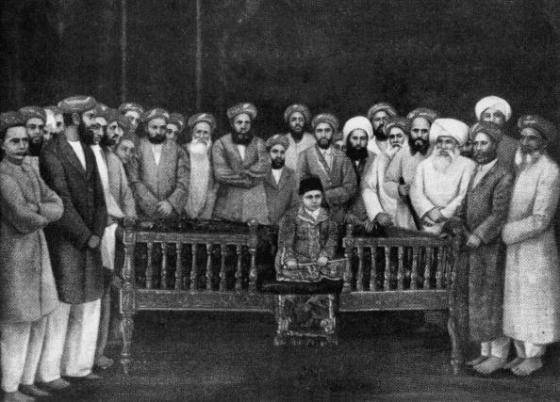
Mawlana Sultan Mahomed Shah, His Highness the Aga Khan III, is pictured above at his enthronement as 48th Imam of the Shia Ismaili Ismaili Muslims in Bombay at the age of seven. His reign lasted for 72 years. In his will, he proclaimed Prince Karim Aga Khan as the 49th Imam with the following words:

“Ever since the time of my first ancestor Ali, the first Imam, that is to say over a period of thirteen hundred years it has always been the tradition of our family that each Imam chooses his successor at his absolute and unfettered discretion from amongst any of his descendants whether they be sons or remoter male issue.

“In view of the fundamentally altered conditions in the world in very recent years due to the great changes which have taken place including the discoveries of atomic science I am convinced that it is in the best interests of the Shia Moslem Ismailian Community that I should be succeeded by a young man who has been brought up and developed during recent years and in the midst of the new age and who brings a new outlook on life to his office as Imam.

“I appoint my grandson Karim, the son of my son Aly Salomone Khan to succeed to the title of Aga Khan and to be the Imam and Pir of all my Shia Ismailian followers.”

~~~~~~~~~

Aga Khan IV enthronement at Villa Barakat in Geneva

Through the special designation (or the Nass) of the late Imam, Shah Karim al-Hussaini became the 49th hereditary Imam of the Nizari Ismailis at the age of twenty.

Shortly after, the newly enthroned Imam met Ismaili leaders and representatives from around the world, and also made the following statement:

“My grandfather dedicated his life to the Imamat and Islam, both of which came first, and above all other considerations. While I was prepared that one day I might be designated the Aga Khan I did not expect it so soon. I follow a great man in a great responsibility and he could have given me no more appreciated honour than to bequeath me this spiritual leadership. My life, as his, will be dedicated to the service of my followers.”

Date posted: July 10, 2014, 23:26 EDT.

The Imamat: By His Highness the Aga Khan, the Ismaili Constitution, Azim Nanji and Abbas Hamdani

“…The Ismaili Imamat is a supra-national entity, representing the succession of Imams since the time of the Prophet…”His Highness the Aga Khan, February 2014

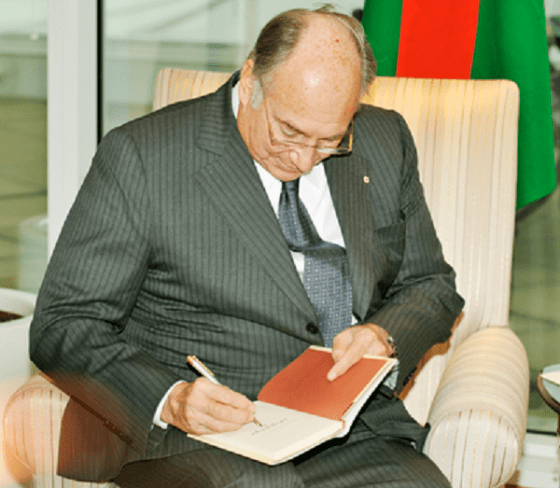
His Highness Aga Khan signing his book "Where Hope Takes Root" for the Premier of British Columbia during his 2008 visit to the province to celebrate his Golden Jubilee. Ismailis will be celebrating his 57th Imamat Day on July 11, 2014. Please click on image for Imamat article. Photo: With permission of The Vancouver Sun. Copyright.

His Highness Aga Khan signing his book “Where Hope Takes Root” for the Premier of British Columbia during his 2008 visit to the province to celebrate his Golden Jubilee. Ismailis will be celebrating his 57th Imamat Day on July 11, 2014. Please click on image for Imamat article. Photo: With permission of The Vancouver Sun. Copyright.

Please click: On the Imamat and Ismailis: By His Highness the Aga Khan, the Ismaili Constitution, Azim Nanji and Abbas Hamdani

His Highness the Aga Khan on Tunisia’s New Constitution + the Constitution’s Preamble

“In Tunisia…a new ‘consensus’ constitution with 94 per cent approval from the elected Constituent Assembly reaffirmed the Islamic identity of the Tunisian state, while also protecting the human rights of religious and ethnic minorities” — His Highness the Aga Khan, Ogden Lecture, Brown University, March 10, 2014

Please click: His Highness the Aga Khan on Tunisia’s New Constitution, with English Translation of the Constitution’s Preamble

Location of Tunisia in North Africa. Please click on map for remarks by His Highness the Aga Khan

Location of Tunisia in North Africa. Please click on map for remarks by His Highness the Aga Khan

Please click: His Highness the Aga Khan on Tunisia’s New Constitution, with English Translation of the Constitution’s Preamble

Insight: The Roots of Western Esoteric Movements in Islam’s Esoteric Tradition

“….throughout history we find people convinced the great religions are a necessary ‘outer shell’ veiling a Primordial Wisdom that alone can reveal humanity’s real origin, purpose and destiny….Some of Europe’s leading seekers after ancient secret wisdom were convinced that in the Muslim lands of the Orient could be found a Primordial Tradition transmitted from generation to generation within closed communities of initiates.”

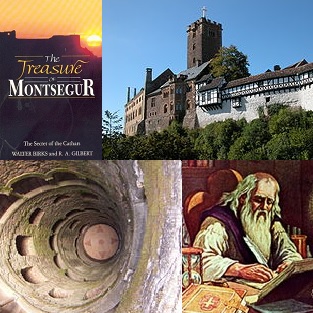
An extraordinary insight into how Western esoteric movements may have roots in the esoteric tradition in Islam, including Sufism and Ismailism. Read More….

Please click on image for article.

Please click on image for article.

 PLEASE CLICK ON: Islam’s Esoteric Tradition and its Influence on European Esoteric Writers and Organizations

Ideas of One Humanity in World Religions: Comparative Study of Ginan “Hum dil Khalak Allah Sohi Vase” by Shiraz Pradhan, With a Recitation

Be careful of your duty to your Lord Who created you from a single soul….” – Holy Qur’an, 4:1

Instability is infectious, but so is hope. And that it is why it is so important for us to carry the torch of hope as we seek to share the gift of pluralism….Profound expressions about our common humanity are embedded in the world’s great religious traditions, including my own…” — His Highness the Aga Khan, Lisbon, June 12, 2014.

Credit: Istockphoto.com. Please click on image for "One Humanity"

Image Credit: Istockphoto.com. Copyright. Please click on image for “One Humanity”

PLEASE CLICK: Ideas of One Humanity, Love and Peace in World Religions: Comparative Study of Ginan “Hum dil Khalak Allah Sohi Vase” with a Hindu Bhajan

The Holy Qur’an: An Anecdote from His Highness the Aga Khan’s Visit to an Ismaili Religious Night School

In this piece Kamaluddin Mohammed, a prominent and highly respected Ismaili scholar and missionary explains the importance of studying the Holy Qur’an, and gives an anecdote from a religious night school visit made by the current 49th Imam of the Ismailis, His Highness the Aga Khan, during his visit to India in 1967.

PLEASE CLICK:  Ismaili Children’s Understanding of the Holy Qur’an Gives Immense Happiness to Mawlana Hazar Imam

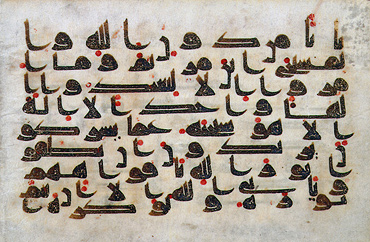
Calligraphy writing has been a preeminent Islamic art since the seventh century when the Qur'an was revealed to Prophet Muhammad and recorded in the Arabic language. Controlled, angular lettering called Kufic script was commonly employed in the writing of early Qurans. This folio from the Qur'an, is Sura 9, "Repentance" (al-Tauba), verses 31-32, Near East or North Africa, ca. 900. Photo:  Doris Duke Foundation for Islamic Art. Please click on image for article.

Calligraphy writing has been a preeminent Islamic art since the seventh century when the Qur’an was revealed to Prophet Muhammad and recorded in the Arabic language. Controlled, angular lettering called Kufic script was commonly employed in the writing of early Qurans. This folio from the Qur’an, is Sura 9, “Repentance” (al-Tauba), verses 31-32, Near East or North Africa, ca. 900. Photo: Doris Duke Foundation for Islamic Art. Please click on image for article.

His Highness the Aga Khan Shows Path to Renew and Re-Express the Post Millennium Development Goals Agreed on by World Leaders in 2000

Compiled and presented by Abdulmalik Merchant
(Editor-Publisher, http://www.simerg.com and http://www.simergphotos.com)
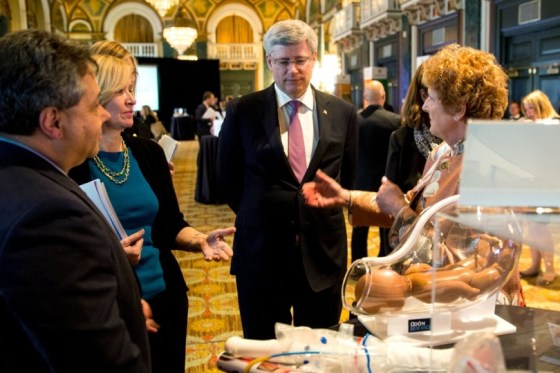
Prime Minister Stephen Harper receiving an explanation about an exhibit displaed at the summit Saving Every Woman, Every Child: Within Arm’s. Phooto: The website of the Prime Minister of Canada.

Prime Minister Stephen Harper receiving an explanation about an exhibit displayed at the summit Saving Every Woman, Every Child: Within Arm’s Reach. Photo Credit: The website of the Prime Minister of Canada.

Editor’s note: In 2000 world leaders joined together in an unprecedented UN summit to develop a blueprint to meet the needs of the world’s poorest, with the targeted date of 2015.  The leaders along with the support of worldwide institutions set the following eight goals in what became known as the Millennium Development Goals (MDGs):

  • Eradicate Extreme Hunger and Poverty
  • Achieve Universal Primary Education
  • Promote Gender Equality and Empower Women
  • Reduce Child Mortality
  • Improve Maternal Health
  • Combat HIV AIDS Malaria and Other Diseases
  • Ensure Environmental Sustainability
  • Develop a Global Partnership for Development

A special summit in Toronto under the theme Saving Every Woman Every Child: Within Arm’s Reach, is addressing some of the MDGs goals and we are pleased to publish below excerpts from His Highness the Aga Khan’s remarks made at the summit on May 29, 2014.

~~~~~

Bismillah-ir-Rahman-ir-Rahim

His Highness the Aga Khan, 49th Ismaili Imam and the direct descendant of the Prophet Muhammad (s.a.s), delivers keynote remarks at the Maternal, Newborn and Child Health Summit in Toronto on 29 May 2014. Photo: The Ismaili/Zahur Ramji.

His Highness the Aga Khan, 49th Ismaili Imam and the direct descendant of the Prophet Muhammad (s.a.s), delivers keynote remarks at the Maternal, Newborn and Child Health Summit in Toronto on 29 May 2014. Photo: The Ismaili/Zahur Ramji.

I. THE ISMAILI IMAM EXPLAINS HIS PRESENCE

“Like you, I am here today because of my conviction that improving maternal, neonatal and child health should be one of the highest priorities on the global development agenda. I can think of no other field in which a well-directed effort can make as great or as rapid an impact.

“I am here, as well, because of my enormous respect for the leadership of the Government of Canada in addressing this challenge. And I am here too, because of the strong sense of partnership which our Aga Khan Development Network has long experienced, working with Canada in this critical field.

“Leadership and partnership – those are words that come quickly to mind as I salute our hosts today and as I greet these distinguished leaders and partners in this audience.”

II. THE MUSKOKA INITIATIVE AND ONE OF ITS OFF-SHOOTS

“Mr Prime Minister – I recall how our partnerships were strengthened four years ago when you launched the Muskoka Initiative. It led to an important new effort in which our Network has been deeply involved in countries such as Afghanistan, Pakistan, Tanzania, Mozambique, and Mali.

“In all of these efforts, we’ve built on our strong history of work in this field. It was 90 years ago that my late grandfather founded the Kharadhar Maternity Home in Karachi. In that same city, for the last thirty years, the Aga Khan University has worked on the cutting edge of research and education in this field – including its new specialised degree in midwifery.”

III. WHAT THE AGA KHAN UNIVERSITY’S NEW REPORT REVEALS, AND HOW THE WORK OF AKDN WORK IMPACTS MILLIONS

“One of our Aga Khan University scholars [Dr. Zulfiqar Bhutta] helped fashion the new series of reports on this topic that was released last week – an effort that involved more than 54 experts from 28 institutions in 17 countries. The reports tell us that right intensified steps can save the lives of an additional 3 million mothers and children annually.

“To that end, our Development Network has also focused on building durable, resilient healthcare systems. One example is the not-for-profit health system by the Aga Khan Health Service in Northern Pakistan – a community-based network of facilities and health workers, including a growing number of nurse-midwives.
Photo: The Government of Canada.

Photo: The Government of Canada.

“We have extended these approaches to other countries, including a remarkable partnership in Tanzania funded by the Canadian government and implementing in close partnership with the Tanzanian government.

“Such AKDN activity now serves some two-and-a-half million people in 15 countries, with 180 health centres both in urban and rural areas, often in high-conflict zones, and embracing some of the world’s poorest and most remote populations.

“Last year alone, these facilities served nearly 5 million visitors, inpatients and outpatients, with more than 40,000 newborn deliveries.

IV. HIS HIGHNESS SHARES WHAT HIS NETWORK
HAS LEARNED FROM EXPERIENCE

“So our experience has been considerable. But what have we learned from it? Let me share a quick overview.

1. Sustainable Systems

“First, I would underline that our approaches have to be long-term. Sporadic interventions produce sporadic results, and each new burst of attention and activity must then start over again. The key to sustained progress is the creation of sustainable systems.

2. Local Ownership

“Second, our approaches should be community-oriented. Outside assistance is vital, but sustainable success will depend on a strong sense of local “ownership”.

3. Broad Health-Care Focus

“The third point I would make is that our approaches should support the broad spectrum of health care. Focusing too narrowly on high-impact primary care has not worked well – improved secondary and tertiary care is also absolutely essential.

4. New Financial Models – Savings Groups, Debts Financing, Tax-Privileged Donations

“Our approaches should encourage new financial models. Donor funding will be critical, but we cannot sustain programmes that depend on continuing bursts of outside money. Let me underscore for example, the potential of local “savings groups” and micro-insurance programmes, as well as the under utilised potential for debt-financing. Also – and I think this is very, very important indeed – we have watched for many years as many developing countries, and their economies of course, have created new financial wherewithal among their people. These growing private resources can and I think should, help social progress, motivated by a developing social consciousness and by government policies that encourage tax-privileged donations to such causes.

5. Reaching the Hardest to Reach with Modern Communications Technology

“Our approaches should also focus on reaching those who are hardest to reach. And here, new telecommunications technologies can make an enormous impact. One example has been the high-speed broadband link provided by Roshan Telecommunications, one of our Network’s companies, between our facilities in Karachi and several localities in Afghanistan and in Tajikistan. This e-medicine link can carry high-quality radiological images and lab results. It can facilitate consultations among patients, doctors and specialists at various centres. And it can contribute enormously to the effective teaching of health professionals in remote areas.

6. Multi-Sectoral Challenges Need Effective Multi-Input Coordination

“Our approaches should be comprehensive, working across the broad spectrum of social development. The problems we face have multiple causes, and single-minded, “vertical” interventions often fall short. The challenges are multi-sectoral, and they will require the effective coordination of multiple inputs. Creative collaboration must be our watchword. This is one reason for the growing importance of public-private partnerships.

“These then are the points I would emphasise in looking back at our experience. I hope they might be helpful as we now move into the future, and to the renewal and re-expression of the Post Millennium Development Goals.”

V. THE USEFULNESS OF MEETINGS –  BUT PARTNERS MUST TALK AND WORK WELL TOGETHER THROUGH CANDID EXCHANGE

His Highness the Aga Khan, President Kikwete of Tanzania and Prime Minister Stephen Harper of Canada, who hosted the 3 days summit in Toronto. Photo: The website of the Prime Minister of Canada. Copyright.

His Highness the Aga Khan with President Jakaya Kikwete of Tanzania and Prime Minister Stephen Harper of Canada, who hosted the summit in Toronto. Photo credit: The website of the Prime Minister of Canada. Copyright.

“As we undertake the new planning process, the opportunity to exchange ideas at meetings of this sort can be enormously helpful. And potential partners must be able to talk well together if they are going to work well together.

“I would hope such occasions will be characterised by candid exchange, including an acknowledgment of where we have fallen short and how we can do better. The truth is that our efforts have been insufficient and uneven. We have not met the Post Millennium Development Goals.”

VI. LEVERAGING PROGRESS THROUGH THE FIELD OF MATERNAL AND NEWBORN HEALTH

“At the same time, we must avoid the risk of frustration that sometimes accompanies a moment of reassessment. Our challenge – as always – is a balance [between] honest realism with hopeful optimism.

“And surely there are reasons to be optimistic.

“In no other development field is the potential leverage for progress greater than in the field of maternal and newborn health.”

VII. RESULTS: THE HEARTENING EXAMPLE OF AFGHANISTAN

“….I thought I might close by talking about some of the results. My example comes from Afghanistan – a heartening example from a challenging environment.

“The rural province of Afghan Badakhshan once had minimal infrastructure and few health-related resources. Less than a decade ago it had the highest maternity mortality ratio ever documented.

“It was about that time that the Afghan government, supported by international donors, contracted with the Aga Khan Health Service to create a single non-governmental health organisation in each district and in each province. Today, the Badakhshan system alone includes nearly 400 health workers, 35 health centres, two hospitals, serving over 400,000 people. Its community midwifery school has graduated over 100 young women.

“The impact has been striking. In Badakhshan in 2005, six percent of mothers died in childbirth – that is 6,000 for every 100,000 births. Just eight years later, that number was down twenty-fold – for every 100,000 live births, death has gone from 6,000 down to 300.

“Meanwhile, infant mortality in Badakhshan has fallen by three-quarters, from over 20 percent to less than 6 percent.”

VIII. CHILDBIRTH RISKS GAPS ARE NOT DESTINED – WITH SCIENCE AND EFFECTIVE COORDINATION RISKS CAN BE TRANSFORMED FOR THE BETTER

“For most of the world, science has completely transformed the way life begins, and the risks associated with childbirth. But enormous gaps still exist. These gaps are not the result of fate – they are not inevitable. They can be changed, and changed dramatically.

“When government and private institutions coordinate effectively in challenging a major public problem, as this example demonstrates, we can achieve substantial, genuine, quantifiable progress – and fairly rapidly.

“This is the story we need to remember, and this is the sort of action we need to take as leaders and as partners in addressing one of the world’s most critical challenges.”

Date posted: Friday, May 30, 2014.

________________

Photos and text used in this post compilation were obtained from the following sources.

1. http://www.pm.gc.ca (Prime Minister of Canada)
2. http://www.akdn.org (the Aga Khan Development Network)
3. http://www.theismaili.org (official website of the Ismaili Community)
4. http://www.undp.org/content/undp/en/home/mdgoverview/
(The Millennium Development Goals)

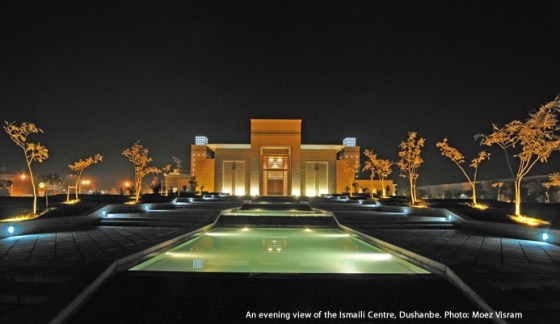
“Ba Shokouh” – The Magnificent Ismaili Centre in Dushanbe @Simergphotos

“We salute those who have donated their time and talent and material resources to this project, including those who designed, constructed and decorated this building and its surroundings. You have created a remarkable building that will enhance the cityscape of Dushanbe.”
His Highness the Aga Khan, 49th Ismaili Imam

Please click: “Ba Shokouh” – The Ismaili Centre in Dushanbe, Tajikistan

View into entry foyer of the Ismaili Centre in Dushanbe. Please click on image for exclusive photos. Photo: FNDA Architecture Inc. Copyright.

View into entry foyer of the Ismaili Centre in Dushanbe. Please click on image for exclusive photos. Photo: FNDA Architecture Inc. Copyright.

Simerg’s Downloadable Nawruz Publication: Poetry, Ginan and Literary Readings

Simerg’s downloadable publication A Rich Collection of Readings and Poetry on Navroz is filled with informative readings and inspiring poems including an explanation of the ginan “Eji Navroz na din sohamna”.

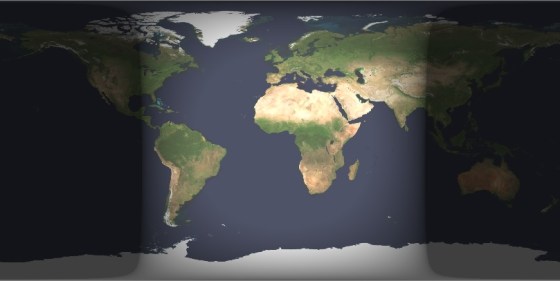
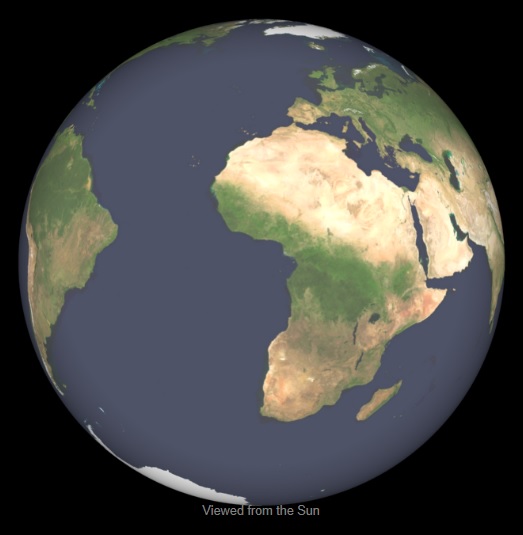
The following NASA images show a cylindrical projection of the earth and the earth as seen from the sun at noon on March 21, 2013. Click on the images to download Navroz booklet.

Earth Cylindrical Projection 2013-03-21 0012UT. NASA Image. Please click on image to download Nawruz booklet.

Earth Cylindrical Projection 2013-03-21 0012UT. NASA Image. Please click on image to download Nawruz booklet.

Earth Spherical View 2013-03-21 0012UT. NASA Image. Please click to download Nawruz booklet.

Earth Spherical View 2013-03-21 0012UT. NASA Image. Please click on image to download Nawruz booklet.