Reminiscences of Two Great Ismaili Missionaries of the 20th Century – Pir Sabzali and Meghji Missionary

“[Pir Sabzali and Meghji Missionary] drew all their courage and strength from their intense and ardent practice of Ibadat and went out to accomplish their missions with intelligence and knowledge, and with the firm belief that the help of Hazar Imam was always with them.”
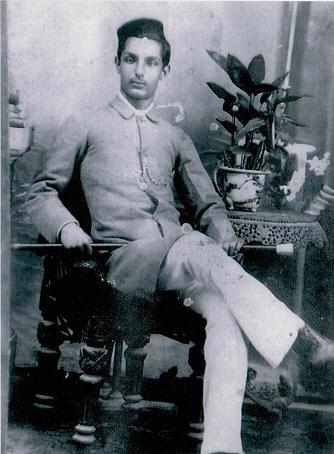
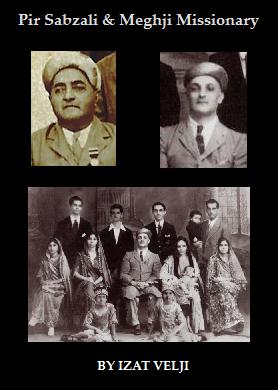
A youthful portrait of the Ismaili missionary, Meghji Maherali (1881 – 1941), of Mombasa, Kenya. Photo Credit: Archives of the family of Meghji Missionary. Copyright.

BY IZAT VELJI

My profound gratitude and thanks [to the late Ameer Janmohamed] for sharing so much about Pir Sabzali – it is indeed a living history. The personal comments and recollections made his Thank You Letter to Pir Sabzali all the more interesting and real. The group picture shown below of Imam Sultan Mahomed Shah with Ismaili missionaries astonished me because there in the photo staring back at me is my nanabapa [maternal grandfather]. I happen to be the proud grand-daughter of Missionary Meghji Maherali, seated at the extreme left in the centre row. In the same row, third from right, is Pir Sabzali.

Every time missionary Pir Sabzali came into Mombasa, he never left without visiting nanabapa. The two had ever so much to share. There was no rivalry, competition or one-upmanship between them. This was very evident from everything that my mother, Noorbanu, shared with us kids.

Mum said that at the dining table, Pir Sabzali and nanabapa shared stories about their travels and advised and helped each other on how to improve each other’s skills in establishing the various jamats they visited. They also discussed ways of improving their waezes [sermons] and participation in discussions so as to become more effective. Apparently, there was a lot of gentleness and warmth as well as mutual respect between them, and they had a soft sense of humour when they recounted personal anecdotes. It seems like they really fed off each other. Pir Sabzali would relay messages of blessings to nanabapa’s family from Mawlana Sultan Mahomed Shah.
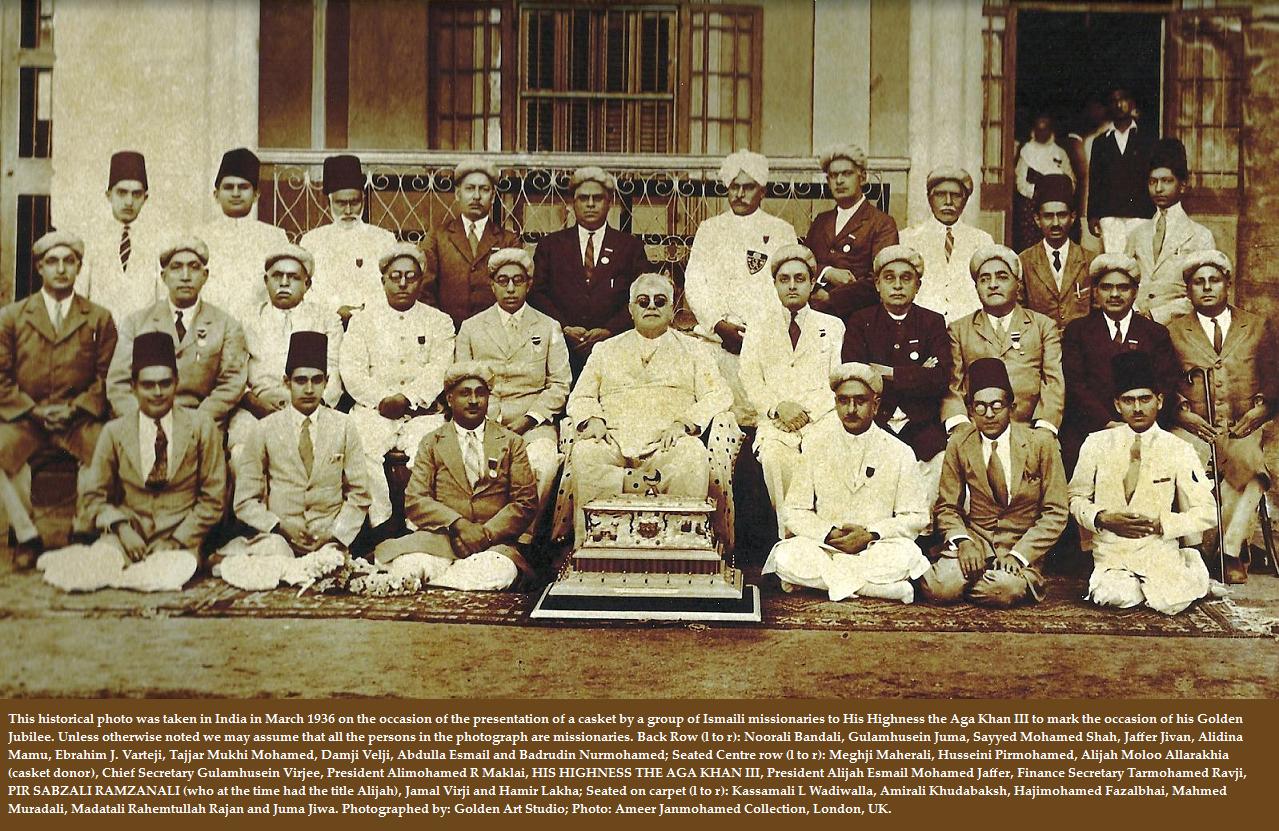
Please click to enlarge and read caption. Photo: (Late) Ameer Janmohamed Collection. UK.

Later, they would retire to the front room where nanima would send a tray of chai and ‘goodies’ via my mum, who was then seven or eight years old. She remembered all this with so much pride and joy. My mum passed away in 2000. She said that the two missionaries would sit for hours apparently discussing all matters Ibadat (special worship prayers).

They drew all their courage and strength from their intense and ardent practice of Ibadat and went out to accomplish their missions with intelligence and knowledge, and with the firm belief that the help of Hazar Imam was always with them. With missionary Sabzali’s encouragement and help, nanabapa established a school of waezins in Mombasa, one of his recruits being my father, Noordin Koorjee. Even back then, our missionary leaders practised ‘succession planning’ so that Imam’s work would not come to a standstill after they passed on.

These two ashaqs [devotees] were very sincere in their service to Mawla, and deeply loyal to their Mashuq (the lord of the devotee).
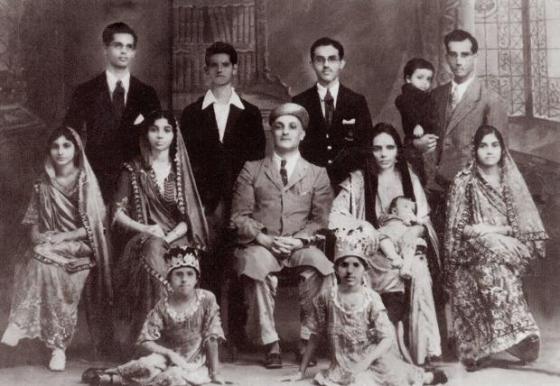
STANDING BACK ROW- l to r: Missionary’s sons Gulamhussein, Fatehali, Sherali, Hussein; 2nd child Mehdi Gulamali is not in picture; SITTING ON CHAIRS – l to r: Daughters Khatija, Fatma, Missionary Meghji Maherali, wife Zainub with Hussein’s 3rd child Shirin, Hussein’s wife, Sikina; SITTING ON FLOOR – l to r: Dolat – Hussein’s 1st child, daughter Noorbanu (mother of Izat Velji, author of this article). Photo Credit: Archives of the family of Meghji Missionary. Copyright.

When Pir Sabzali’s health deteriorated and he was in his last days, Imam Sultan Mahomed Shah sent him a message saying that he still wished to send Sabzali to Africa. Missionary Sabzali died a few days later. This came verbally from my parents, not once but several times. I have no way of authenticating this statement, but if it’s true then only Mawlana Sultan Mahomed Shah and Mawlana Shah Karim, the present Imam, would know the true import and reach of this message to Pir Sabzali.

When nanabapa died, Imam Sultan Mahomed Shah sent a telegram to the Mombasa Council that “Missionary Meghji’s funeral be held with a lot of pomp because of Meghji’s long and wonderful service to the Mombasa jamat.” So, out came the Scouts Band, all spit and polish followed by the cubs and scouts troops followed by the jamat giving kandh to nanabapa all the way from Chief jamat khana to the cemetery. That’s a long distance.

Today, almost eighty years later, I stand head bowed, in sheer admiration for nanabapa and Missionary Sabzali, whose soul was granted Piratan by Imam Sultan Mahomed Shah. Incidents and events like these are simply overwhelming and sometimes difficult to grasp and comprehend. It is their spirit and devotion which keep the Jamat inspired.

Copyright: Izat Velji/Simerg.

_________________

Editor’s note: Izat Velji’s piece originally appeared on this website in response to Ameer Janmohamed’s Thank You Letter to Pir Sabzali and the Ismaili Pirs of the Ginanic Tradition, which was  published as part of this website’s highly acclaimed third anniversary series on thanking Ismaili historical figures.

We welcome your feedback – please click Leave a comment.

About the writer: Izat Velji spent her early childhood years in Kenya and Tanzania. After completing her secondary schooling in Kenya, she pursued a degree in education and teaching at the University of Nairobi. She then settled in Canada where she completed her degree in Medical Lab Sciences. Later, she was recruited into the faculty of the Aga Khan School of Nursing in Karachi where she taught a number of science subjects including Clinical Microbiology and Basic Immunology. During her tenure in Karachi, she was very fortunate to have met His Highness the Aga Khan who visited her lab and class, once with the late Pakistani President Zia ul-Haqq, and on another occasion with his brother Prince Amyn. Encouraged by her husband, Izat also undertook voluntary assignments with the Aga Khan Health Board for Karachi to develop, conduct feasibilities as well as implement Health Education materials for the province of Sindh and the Northern Areas of Pakistan including Hunza and Chitral. The material that she helped prepare continues to be used today by AKDN Agencies such as Focus in their teaching modules. Since returning to Canada, Izat has been very active with the Ismaili community as a volunteer and especially with the Duke of Edinburgh’s program for youth aged 14 to 25. Most recently in 2011, she was acknowledged by the Governor General at the Gold Award Ceremony.

~~~~~~~~~~~~

Varas Ismail Gangji: The Turning Point by Alwaeza Maleksultan Merchant

Editor’s note: While I constantly think of my mum, Alwaeza Maleksultan J. Merchant, as she continues her recovery at the Royal Columbian Hospital in New Westminster, near Vancouver, from an open heart surgery some 5 weeks ago, I felt I should re-post her excellent piece on Varas Ismail Gangji that she contributed as part of Simerg’s highly acclaimed “I Wish I’d Been There” series. Her photo, left at image below, was taken by my brother, Alnoor, when he visited her at the RCH a few days ago. To read her inspiring piece, please click on the photo or on Varas Ismail Gangji: The Turning Point

Alwaeza Maleksultan Merchant, 83, shown at left in image above seen recovering at the Royal Columbian Hospital following her triple bypass surgery. Please click on photo for her article on the great Ismaili hero Varas Ismail Gangji. Photo/image: Alnoor Merchant/Nurin Merchant.

Alwaeza Maleksultan Merchant, 83, shown at left in this image, is seen recovering at the Royal Columbian Hospital following her triple bypass surgery. Please click on image for her article on the great Ismaili hero Varas Ismail Gangji. Photo/image: Alnoor Merchant/Nurin Merchant.

A Thank You Note to Pir Hasan Kabirdin by Navyn Naran

“…The Nav Chugga are our choice. In the poem, if all goes well, the inevitability is for the butterfly (or silk moth) to emerge and do its butterfly thing, remembering its delicate wings can intricately avert the forces of evil with strength of flight and purpose. Only by guidance, reflection and intention can this occur for the ruh (spirit)…”

Navyn Naran’s Ode to Pir Hasan Kabirdin – the Author of Anant Akhado and the Nav Chugga

Please click for “An Ode to Pir Hasan Kabirdin.” Image in frame is copyright Istockphoto.com.

_________________
For series, please click Thanking Ismaili Historical Figures

Chapter Five of Nasir-i Khusraw’s Wajh-i Din: The Gateway and Key to Paradise by Rukhsana Ali

“By the generosity of the Imam of the time, we say that Paradise in truth is the Intellect, and the Gateway of paradise is the Prophet (peace and salutation be upon him) during his time, and his wasi, his rank, and the Imam of the time during his age. The Key to the gateway of paradise is the utterance of the phrase, La ilaha illa Allah, Muhammadan rasul Allah.”

Please click:  Pir Nasir-i Khusraw on the Gateway and Key to Paradise

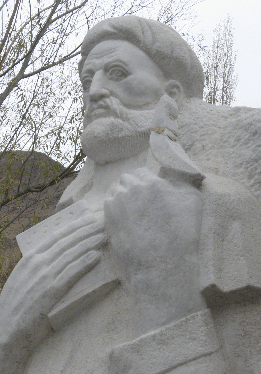
This statue of the Ismaili da’i and intellectual giant Nasir Khusraw stands in his memory in Badakhshan. Please click for article.

A Story from ‘Pyara Imam ni Pyari Wato’: Historical Memories by Sairab Abuturabi and Jaferali Bhalwani

Loving Tales of our Beloved Imams: (I) Farazdaq’s Praise and Support of Imam Zainul Abideen (a.s.)

“…This tale belongs to ages past. It goes back to the era of Hazrat Imam Zainul Abideen (a.s.), our third Imam, from whose veins was to ensue the Divine Line of the Imams. He was the Imam who, on the battlefield of Karbala, received the nass of Imamat from his father, Hazrat Imam Hussain (a.s.) with the blessing: “Through you the line of Imamat will continue till the Day of Judgment…”

Please click for story

An Interview on Nasir Khusraw: Australian Broadcaster in Conversation with Alice Hunsberger

Rachael Kohn: Hello, this is “The Ark”, and I am Rachael Kohn. A thousand years ago a Persian poet defied the conventions of the day. His name was Nasir Khusraw, an Ismaili Muslim, a branch of Shi’a Islam. Instead of lavishing praise on the sultan or his horse, he praised learning and spiritual purity…..Click to read the Australian broadcaster’s interview with Nasir Khusraw specialist Alice Hunsberger

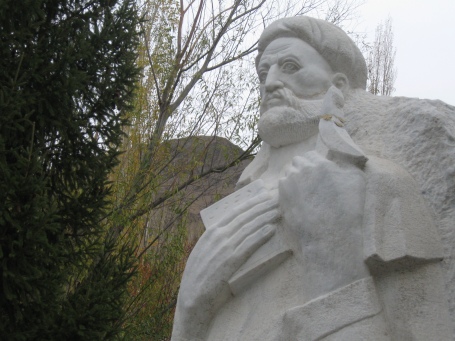
A statue of the famous Ismaili dai Nasir Khusraw in Badakhshan. Please click on image for interview.

A statue of the famous Ismaili dai Nasir Khusraw in Badakhshan. Please click on image for interview.

Lessons from Ismaili History

LETTER FROM THE PUBLISHER

Abdulmalik Merchant,  Publisher-Editor, Simerg. Click photo for profile.

Abdulmalik Merchant, Publisher-Editor, Simerg. Click photo for profile.

To mark Simerg’s 3rd anniversary, a special series “Thanking Ismaili Historical Figures” was launched  because I have felt that learning about outstanding Ismaili figures can help us to make better decisions as members or leaders of the community to which we belong, and instill in us greater sense of responsibility when dealing with community success stories, issues and challenges as well as personal disappointments and setbacks. Fourteen different individuals have contributed to the series so far and their thank you letters to numerous individuals covering 1400 years of history are a must read. Please click on 14 Inspirational Thank You Letters to Remarkable Ismaili Historical Figures and take your time to read each thank you letter over the next few days or weeks. I am sure you will be enlightened by these letters to Prince Amyn, Prince Sadruddin, Pir Sabzali, Ismaili philosophers and other historical figures.

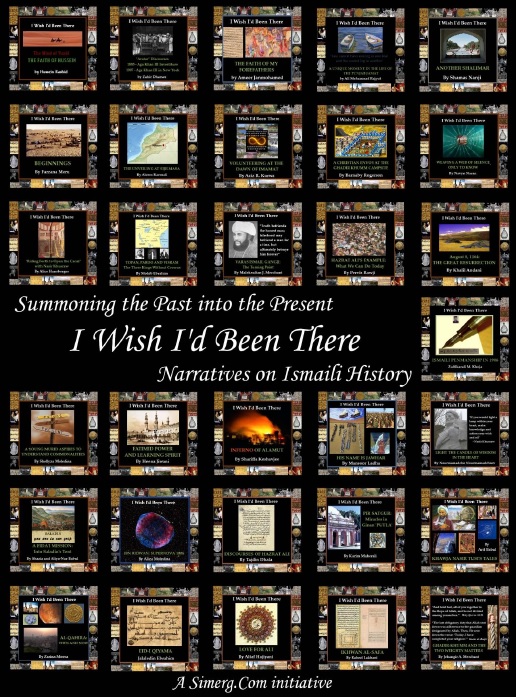
Please click on image to download series "I Wish I'd Been There"

Please click on image to download series “I Wish I’d Been There”

In the same vein as “Thanking Ismaili Historical Figures”, Simerg had earlier presented a series called “I Wish I’d Been There” in which 31 writers from different backgrounds took an incident in Ismaili History and briefly described why they would have liked to have been a witness to an iconic moment of their choice.

From the historical period of Prophet Muhammad, Hazrat Ali and Imam Hussein to Imam Mahdi’s unveiling at Sijilmasa in today’s Morocco to the burning of the library in Alamut as well as the more recent history covering the periods of Tharia Topan and Ismail Gangji, this rich series deserves to be read. The 121 page PDF publication can be quickly downloaded by clicking on I Wish I’d Been There Series – PDF or the series articles can be  individually accessed by clicking on I Wish I’d Been There.

Both the series are engaging, informative as well as inspiring, and we are sure readers will wish to share them with their family members and friends.

Date posted: Sunday, January 12, 2014.

14 Inspirational Thank You Letters to Remarkable Ismaili Historical Figures

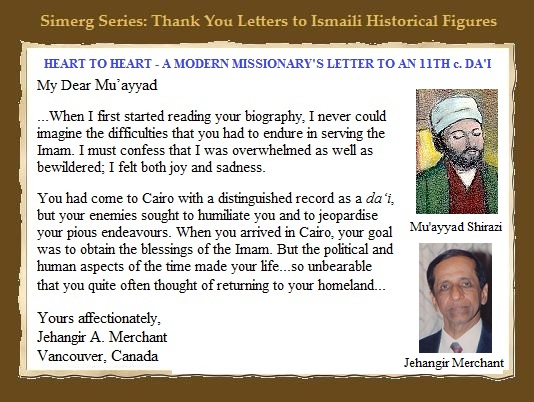
Jehangir Merchant’s Thank You Letter to the Fatimid Ismaili Icon, Da’i Al-Mu’ayyad al-Shirazi by Jehangir A. Merchant (Canada)

Please click for letter
* * *

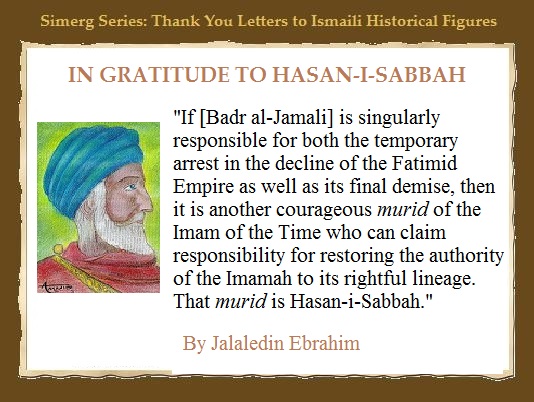
Jalaledin Ebrahim’s Gratitude to Amira Dharrab, Abu Najm Sarraj and Hasan-i-Sabbah by Jalaledin Ebrahim (USA)

* * *

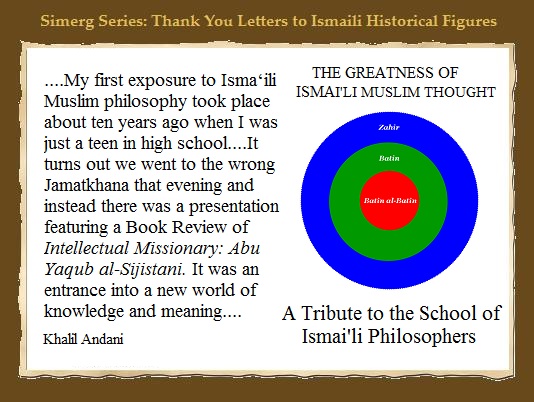
Khalil Andani’s Thank You Letter to the School of Isma‘ili Philosophers by Khalil Andani (USA/Canada)

* * *

Navyn Naran’s Ode to Pir Hasan Kabirdin – the Author of Anant Akhado and the Nav Chugga

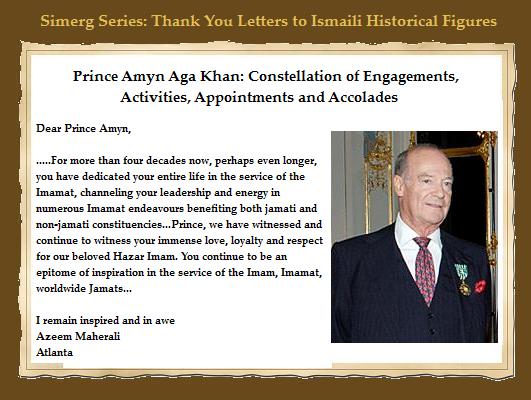
A Thank You Letter Inspired by Prince Amyn Mohammad Aga Khan’s Exceptional Service to the Imamat by Azeem Maherali (USA)

* * *

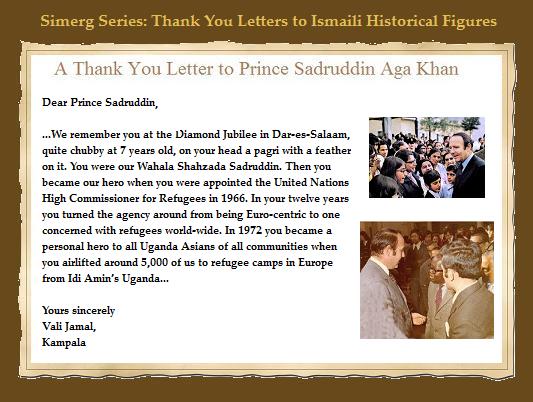
Vali Jamal’s Thank You Letter to Prince Sadruddin Aga Khan: The 1972 Expulsion of Asians from Uganda by Vali Jamal (Uganda)

* * *

Salim Kanji’s Thank You Letter to Three Ismaili Pioneers in East Africa by Salim Kanji (Canada)

* * *

Zarina Moosa’s Thank You Letter to Lady Ali Shah Through the Voice of Her Son, Sir Sultan Mahomed Shah Aga Khan III by Zarina Moosa (Canada)

* * *

Reminiscences of Two Great Ismaili Missionaries, Pir Sabzali and Meghji Missionary by Izat Velji (Canada)

* * *

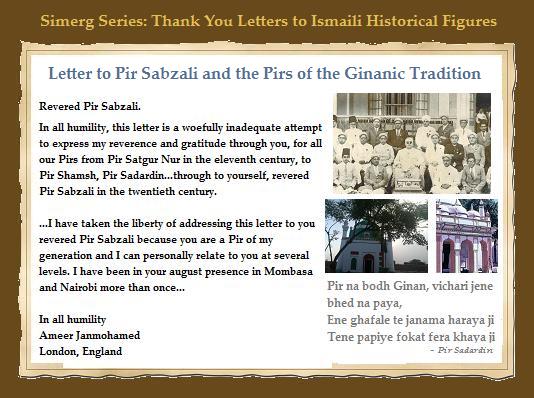
Ameer Janmohamed’s Thank You Letter to Pir Sabzali and the Ismaili Pirs of the Ginanic Tradition by Ameer Janmohamed (UK)

Please click for “Thank You” Letter to Pir Sabzali

* * *

Hatim Mahamid’s Thank You Letter to the IIS by Hatim Mahamid (Israel)

Please click on image to read complete “Thank You” letter.

* * *

A “Thank You” Letter to the Person of the Institution of Imamat by Aziz Kurwa (UK)

* * *

A Thank You Letter to Prince Sadruddin Aga Khan – “A Man of Multiple Visions” by Mohezin Tejani (Thailand)

* * *

A “Thank You” Letter to the Makers of the Blue Qur’an by Andrew Kosorok (USA)

Please click for thank you letter. Image: Simerg.com.

~~~~~~~~~~~~~~
Has anyone in Ismaili history from the earliest times to the modern period inspired you and left an indelible mark on your life? How would you thank that one individual and what would you say in your letter to the person or groups of persons? We invite your contributions for this on-going imaginative series which began during this blog’s 3rd anniversary.

Please send your contribution to Simerg@aol.com, Subject: “Thank You Series.” All contributors will be contacted before their letters are published. Contributors must include their full name, address and phone number, and accompany their information with a brief profile and, optionally, a photo.

Date posted: Wednesday, January 8, 2014

His Highness the Aga Khan III: Historic First Landings in East Africa in 1899 and the USA in 1906

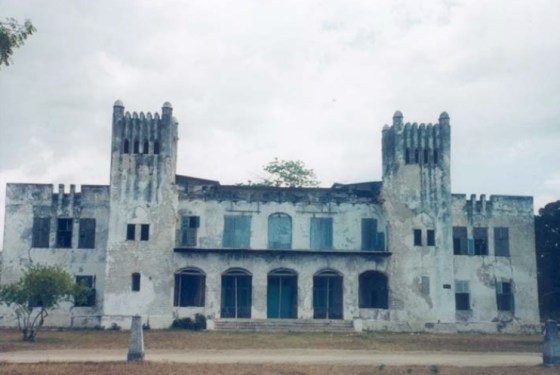
The Old Boma where His Highness the Aga Khan was received with great honours by the Chief of the District, Surgeon-Major Gaertner, and all the Europeans, among them the author of the article. Please click on image to read both the East Africa and USA accounts.

The Old Boma where His Highness the Aga Khan was received with great honours by the Chief of the District, Surgeon-Major Gaertner, and all the Europeans, among them the author of the article. Please click on image to read accounts of both the East Africa and USA visits.

“….The enthusiasm and veneration for His Highness at his arrival [in Bagamoyo] as well as during his whole stay was tremendous and will linger in the memories of all who, like me, had the honour to be present” — Otto Mahnke…Read More

~~~~~

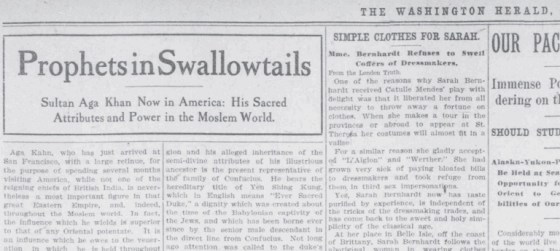
Clip of page from the Washington Herald dated January 27, 1907 containing article on His Highness the Aga Khan. Please click on image to read accounts of both USA and East Africa visits.

Clip of page from the Washington Herald dated January 27, 1907 containing article on His Highness the Aga Khan. Please click on image to read accounts of both USA and East Africa visits.

“The Pope and the Dalai Lama of Tibet are great spiritual chiefs, but in them the principle of inheritance is absent” — The Washington Herald, 1907…Read More

Unique Moments from the Extraordinary Life of His Highness the Aga Khan III – the Beloved 48th Imam of the Shia Imami Ismaili Muslims

“On 2nd November, 1877 my beloved grandfather was born here in Karachi. Through 72 years of Imamat, he guided his spiritual children to happiness and prosperity….Many many memories come to our minds as we think of him. He achieved in his life, for our community that which could only have been accomplished normally in a period of many generations. The tributes that the world has paid him bear honest testimony to his great life and work” — His Highness Prince Karim Aga Khan, 49th Ismaili Imam

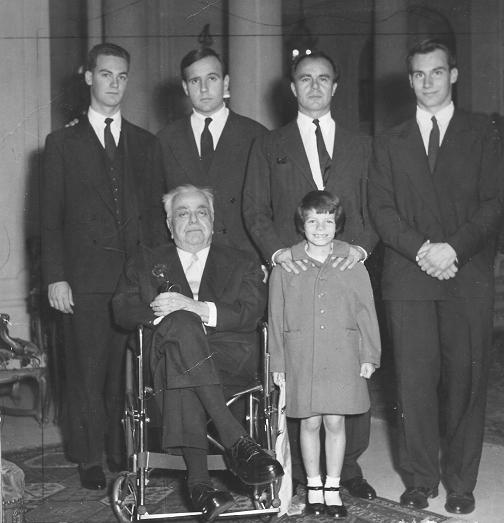
The late 48th Ismaili Imam, His Highness the Aga Khan, seated on a wheelchair with members of his family with his successor, the present Imam, Prince Karim Aga Khan, standing at extreme right. Others in the photo (l to r), grandson Prince Amyn Muhammad ,and the late Imams two sons, the late Prince Sadruddin and Prince Aly Khan, who is seen holding his daughter Princes Yasmin Aga Khan Photo: Zul Khoja Collection, Ottawa.

The 48th Ismaili Imam, His Highness the Aga Khan (1877 – 1957), seated on a wheelchair with members of his family with his successor, the present Imam, Prince Karim Aga Khan, standing at extreme right. Others in the photo (l to r), grandson Prince Amyn Muhammad , and the 48th Imam’s  two sons, the late Prince Sadruddin and Prince Aly Khan who is seen holding his daughter Princes Yasmin Aga Khan. Photo: Zul Khoja Collection, Ottawa.

November 2, 2014 marks the 137th birth anniversary of the 48th Ismaili Imam, Sir Sultan Mahomed Shah, His Highness the Aga Khan III. Born in Karachi in 1877, he assumed the reign of Imamat at the age of seven, and ruled the Ismailis  for 72 years, becoming the community’s longest-serving Imam. He passed away on July 11, 1957, and willed that the mantle of Imamat should pass to his grandson, the present 49th Imam, His Highness Prince Karim Aga Khan IV.

We are pleased to provide our readers with links to diverse articles, stories and photo essays related to the beloved 48th Imam, who has been described in one of the pieces as the Imam of the Socio-Economic Revolution. Please click on the following selections:

BIOGRAPHY, DECORATIONS, IMAM’S WRITINGS AND TRIBUTES

His Highness the Aga Khan III,  48th Imam of Shia Imami Ismailis, in full regalia. Photo: Jehangir Merchant Collection.

His Highness the Aga Khan III, 48th Imam of Shia Imami Ismailis, in full regalia. Photo: Jehangir Merchant Collection.

1. Imam Sultan Muhammad Shah – An Astonishing and Extraordinary Personality

2. Literary Reading: Sir Sultan Muhammad Shah, Aga Khan III – Successor and a Son Reflect on Accomplishments of the 48th Ismaili Imam

3. Titles, Decorations and Honours Conferred on 48th Ismaili Imam; 72 Year Reign Spanned Six British Monarchs and Seventeen PM’s

4. Literary Reading: Sir Sultan Muhammad Shah, Aga Khan III – The Road to Happiness and The Concept of Life

5. “Work No Words” by His Highness the Aga Khan, and Other Rare Ismaili Historical Quotes on Service

6. His Highness the Aga Khan’s “Never-To-Be-Forgotten” Message to Ismaili Youth – “Keep Clean Soul in a Clean Body”

7. Literary Reading: Sir Sultan Muhammad Shah, Aga Khan III – Long Reign Ends

8. Literary Reading: Sir Sultan Muhammad Shah, Aga Khan III: The Face of Imamat 

9. The Memoirs of Aga Khan – World Enough and Time: A Translator’s Voice

ANECDOTES

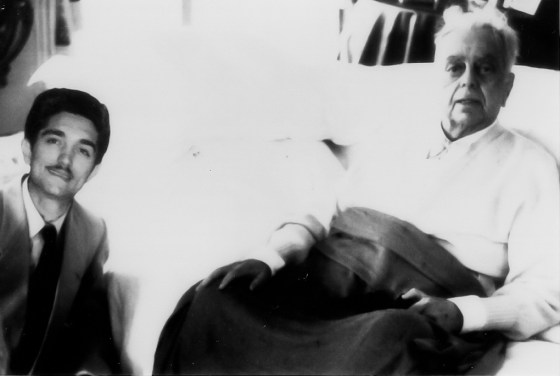
The late Sir Sultan Mahomed Shah Aga Khan III pictured with Badrudin Adatia. Recalls Adatia: "I wanted to take picture of him with us and I asked his permission. The room was dim, however, and I didn’t have a flash on my camera. Although he was very sick and could not even walk, he told me he would head toward the window where there would be better light. Imagine! I clasped my hands with respect and said, “No Khudavind. I will take the picture just as we are.” Photo: Badrudin Adatia collection.

The late Sir Sultan Mahomed Shah Aga Khan III pictured with Badrudin Adatia. Recalls Adatia: “I wanted to take picture of him with us and I asked his permission. The room was dim, however, and I didn’t have a flash on my camera. Although he was very sick and could not even walk, he told me he would head toward the window where there would be better light. Imagine! I clasped my hands with respect and said, “No Khudavind. I will take the picture just as we are.” Photo: Badrudin Adatia collection.

10. I Wish I’d Been There: A Unique Moment in the Life of the Punjab Jamat

11. Yakimour 1954: A Golden Moment for an Aspiring Student – An Audience with the 48th Ismaili Imam, Aga Khan

12. “Mawla Fulfilled My Wish”

13. On Meeting the Noorani Family – My Voyage to Europe

14. An Ismaili Youth’s Rare Moment With Imam Sultan Mahomed Shah

EXTRA ORDINARY VISITS AND THE JUBILEES

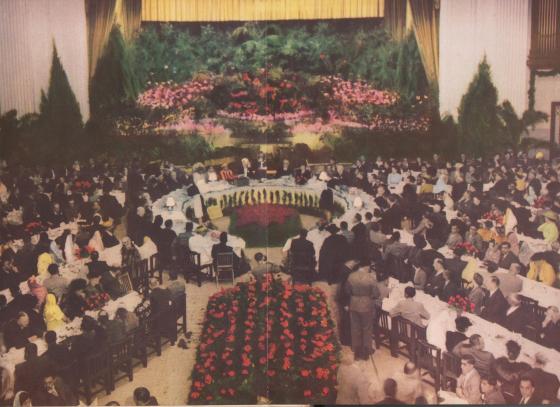
His Highness the Aga Khan at a reception by the Ismaili community in South Africa.

His Highness the Aga Khan at a reception by the Ismaili community in South Africa.

15. Lakhpaty’s Intriguing Poster for 48th Ismaili Imam’s Diamond Jubilee Shows Artistic Ingenuity

16. Imam’s Message in South Africa Addressed Artificial Barriers, Unity, Education for All, and Damaging Social Habits

17. Photo Essay: The Historical Jubilees of His Highness the Aga Khan (1877-1957), the Imam of the Socio-Economic Revolution

18. World Renowned Photographer Sarite Sanders Portrays Mysterious Radiance of a Fatimid Tomb and the Elegance of the Aga Khan Mausoleum

19. When His Highness the Aga Khan III First Visited East Africa and the USA

DEDICATION TO ISLAM AND THE MUSLIM WORLD

A group comprising doctors, health and public officials gathered on a street in Bombay about to begin the day's work, during an outbreak of plague. Photo Credit: Wellcome Library, London. Wellcome Images. Copyright.

A group comprising doctors, health and public officials gathered on a street in Bombay about to begin the day’s work, during an outbreak of plague. Photo Credit: Wellcome Library, London. Copyright.

20. His Highness the Aga Khan and the Bubonic Plague of 1897: How the Ismaili Imam’s Courage and Leadership Saved Countless Lives

21. Hazrat Imam Sultan Muhammad Shah, Aga Khan III – A “Mendicant” Who Transformed a Dream into Reality and Stirred the Soul of a Bitter Critic

22. Sir Sultan Muhammad Shah, Aga Khan III – A Muslim’s Analysis of Lessons that Can be Learnt from the 48th Ismaili Imam

Date post updated: Saturday, November 1, 2014.