His Highness the Aga Khan III: Historic First Landings in East Africa in 1899 and the USA in 1906

The Old Boma where His Highness the Aga Khan was received with great honours by the Chief of the District, Surgeon-Major Gaertner, and all the Europeans, among them the author of the article. Please click on image to read both the East Africa and USA accounts.

The Old Boma where His Highness the Aga Khan was received with great honours by the Chief of the District, Surgeon-Major Gaertner, and all the Europeans, among them the author of the article. Please click on image to read accounts of both the East Africa and USA visits.

“….The enthusiasm and veneration for His Highness at his arrival [in Bagamoyo] as well as during his whole stay was tremendous and will linger in the memories of all who, like me, had the honour to be present” — Otto Mahnke…Read More

~~~~~

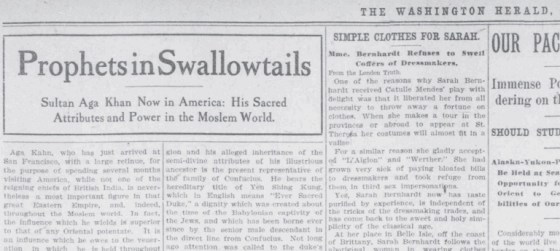
Clip of page from the Washington Herald dated January 27, 1907 containing article on His Highness the Aga Khan. Please click on image to read accounts of both USA and East Africa visits.

Clip of page from the Washington Herald dated January 27, 1907 containing article on His Highness the Aga Khan. Please click on image to read accounts of both USA and East Africa visits.

“The Pope and the Dalai Lama of Tibet are great spiritual chiefs, but in them the principle of inheritance is absent” — The Washington Herald, 1907…Read More

Unique Moments from the Extraordinary Life of His Highness the Aga Khan III – the Beloved 48th Imam of the Shia Imami Ismaili Muslims

“On 2nd November, 1877 my beloved grandfather was born here in Karachi. Through 72 years of Imamat, he guided his spiritual children to happiness and prosperity….Many many memories come to our minds as we think of him. He achieved in his life, for our community that which could only have been accomplished normally in a period of many generations. The tributes that the world has paid him bear honest testimony to his great life and work” — His Highness Prince Karim Aga Khan, 49th Ismaili Imam

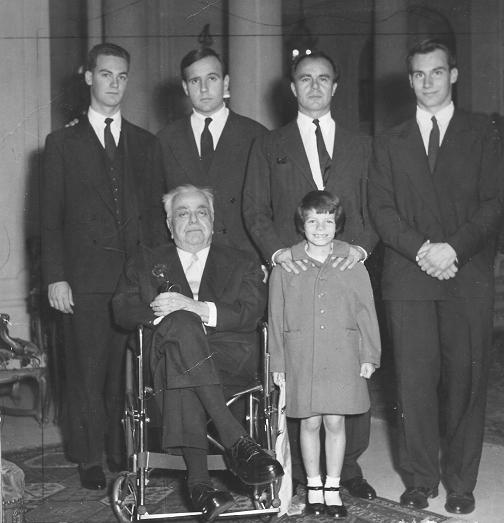
The late 48th Ismaili Imam, His Highness the Aga Khan, seated on a wheelchair with members of his family with his successor, the present Imam, Prince Karim Aga Khan, standing at extreme right. Others in the photo (l to r), grandson Prince Amyn Muhammad ,and the late Imams two sons, the late Prince Sadruddin and Prince Aly Khan, who is seen holding his daughter Princes Yasmin Aga Khan Photo: Zul Khoja Collection, Ottawa.

The 48th Ismaili Imam, His Highness the Aga Khan (1877 – 1957), seated on a wheelchair with members of his family with his successor, the present Imam, Prince Karim Aga Khan, standing at extreme right. Others in the photo (l to r), grandson Prince Amyn Muhammad , and the 48th Imam’s  two sons, the late Prince Sadruddin and Prince Aly Khan who is seen holding his daughter Princes Yasmin Aga Khan. Photo: Zul Khoja Collection, Ottawa.

November 2, 2014 marks the 137th birth anniversary of the 48th Ismaili Imam, Sir Sultan Mahomed Shah, His Highness the Aga Khan III. Born in Karachi in 1877, he assumed the reign of Imamat at the age of seven, and ruled the Ismailis  for 72 years, becoming the community’s longest-serving Imam. He passed away on July 11, 1957, and willed that the mantle of Imamat should pass to his grandson, the present 49th Imam, His Highness Prince Karim Aga Khan IV.

We are pleased to provide our readers with links to diverse articles, stories and photo essays related to the beloved 48th Imam, who has been described in one of the pieces as the Imam of the Socio-Economic Revolution. Please click on the following selections:

BIOGRAPHY, DECORATIONS, IMAM’S WRITINGS AND TRIBUTES

His Highness the Aga Khan III,  48th Imam of Shia Imami Ismailis, in full regalia. Photo: Jehangir Merchant Collection.

His Highness the Aga Khan III, 48th Imam of Shia Imami Ismailis, in full regalia. Photo: Jehangir Merchant Collection.

1. Imam Sultan Muhammad Shah – An Astonishing and Extraordinary Personality

2. Literary Reading: Sir Sultan Muhammad Shah, Aga Khan III – Successor and a Son Reflect on Accomplishments of the 48th Ismaili Imam

3. Titles, Decorations and Honours Conferred on 48th Ismaili Imam; 72 Year Reign Spanned Six British Monarchs and Seventeen PM’s

4. Literary Reading: Sir Sultan Muhammad Shah, Aga Khan III – The Road to Happiness and The Concept of Life

5. “Work No Words” by His Highness the Aga Khan, and Other Rare Ismaili Historical Quotes on Service

6. His Highness the Aga Khan’s “Never-To-Be-Forgotten” Message to Ismaili Youth – “Keep Clean Soul in a Clean Body”

7. Literary Reading: Sir Sultan Muhammad Shah, Aga Khan III – Long Reign Ends

8. Literary Reading: Sir Sultan Muhammad Shah, Aga Khan III: The Face of Imamat 

9. The Memoirs of Aga Khan – World Enough and Time: A Translator’s Voice

ANECDOTES

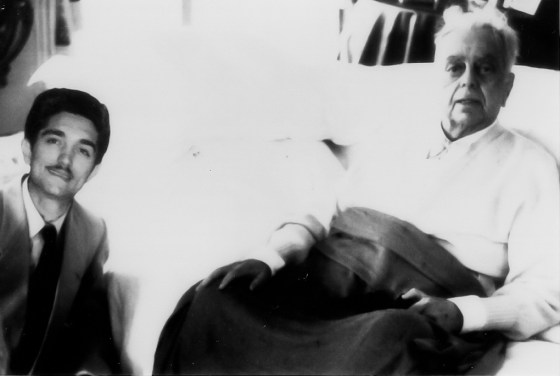
The late Sir Sultan Mahomed Shah Aga Khan III pictured with Badrudin Adatia. Recalls Adatia: "I wanted to take picture of him with us and I asked his permission. The room was dim, however, and I didn’t have a flash on my camera. Although he was very sick and could not even walk, he told me he would head toward the window where there would be better light. Imagine! I clasped my hands with respect and said, “No Khudavind. I will take the picture just as we are.” Photo: Badrudin Adatia collection.

The late Sir Sultan Mahomed Shah Aga Khan III pictured with Badrudin Adatia. Recalls Adatia: “I wanted to take picture of him with us and I asked his permission. The room was dim, however, and I didn’t have a flash on my camera. Although he was very sick and could not even walk, he told me he would head toward the window where there would be better light. Imagine! I clasped my hands with respect and said, “No Khudavind. I will take the picture just as we are.” Photo: Badrudin Adatia collection.

10. I Wish I’d Been There: A Unique Moment in the Life of the Punjab Jamat

11. Yakimour 1954: A Golden Moment for an Aspiring Student – An Audience with the 48th Ismaili Imam, Aga Khan

12. “Mawla Fulfilled My Wish”

13. On Meeting the Noorani Family – My Voyage to Europe

14. An Ismaili Youth’s Rare Moment With Imam Sultan Mahomed Shah

EXTRA ORDINARY VISITS AND THE JUBILEES

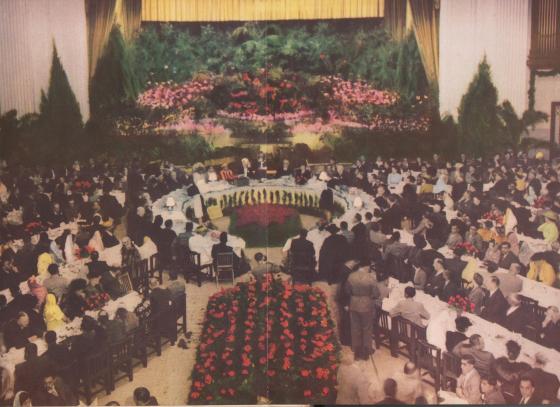
His Highness the Aga Khan at a reception by the Ismaili community in South Africa.

His Highness the Aga Khan at a reception by the Ismaili community in South Africa.

15. Lakhpaty’s Intriguing Poster for 48th Ismaili Imam’s Diamond Jubilee Shows Artistic Ingenuity

16. Imam’s Message in South Africa Addressed Artificial Barriers, Unity, Education for All, and Damaging Social Habits

17. Photo Essay: The Historical Jubilees of His Highness the Aga Khan (1877-1957), the Imam of the Socio-Economic Revolution

18. World Renowned Photographer Sarite Sanders Portrays Mysterious Radiance of a Fatimid Tomb and the Elegance of the Aga Khan Mausoleum

19. When His Highness the Aga Khan III First Visited East Africa and the USA

DEDICATION TO ISLAM AND THE MUSLIM WORLD

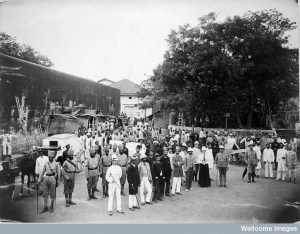
A group comprising doctors, health and public officials gathered on a street in Bombay about to begin the day's work, during an outbreak of plague. Photo Credit: Wellcome Library, London. Wellcome Images. Copyright.

A group comprising doctors, health and public officials gathered on a street in Bombay about to begin the day’s work, during an outbreak of plague. Photo Credit: Wellcome Library, London. Copyright.

20. His Highness the Aga Khan and the Bubonic Plague of 1897: How the Ismaili Imam’s Courage and Leadership Saved Countless Lives

21. Hazrat Imam Sultan Muhammad Shah, Aga Khan III – A “Mendicant” Who Transformed a Dream into Reality and Stirred the Soul of a Bitter Critic

22. Sir Sultan Muhammad Shah, Aga Khan III – A Muslim’s Analysis of Lessons that Can be Learnt from the 48th Ismaili Imam

Date post updated: Saturday, November 1, 2014.

Id-e-Ghadir – The Designation of Hazrat Ali (a.s.) as Commander of the Faithful

Excerpt adapted from Ilm magazine, December, 1989*

The twelve months of the Muslim calendar and major Muslim festivals. Image by Simerg.

The twelve months of the Muslim calendar and major Muslim festivals. Image by Simerg.

‘Id-e-Ghadir is celebrated by the Shi ‘ite communities to mark the event that took place at Ghadir Khumm (Valley of the Pond) on the 18th Dhul-Hijjah. This event commemorates the designation (appointment by way of nass) of Hazrat All as the ‘Amir-ul-Mu’minin (commander of the faithful) and Imamul-Muslimin’ (the Imam of the community of believers) at Ghadir-i Khumm when the Prophet (s.a.s.) was returning from his Last Pilgrimage (hajjatul-wida) in the year 632 AC. On this occasion, the Prophet publicly proclaimed Ali to be his successor [1] in guiding the community after the end of the institution of Nubuwwah. According to the Shi’a doctrine, tradition and interpretation of history, the designation of Hazrat Ali marked the beginning of the institution of Imamah. The designated Imam was to continue the ta’wil (interpretation) and talim (teaching) of Allah’s Final Message, i.e. the Holy Qur’an.

This stamp, issued by Iran in 1990, includes the Shahada, Qur'anic ayats and the declaration made by Prophet Muhammad at Ghadir-e Khumm "Mun Koontu Mawla, Fa Hada, Aliyun Mawla" (He of whom I am the Mawla, Ali is also the Mawla). Image not exact stamp size.

This stamp, issued by Iran in 1990, includes the Shahada, Qur’anic ayats and the declaration made by Prophet Muhammad at Ghadir-e Khumm “Mun Koontu Mawla, Fa Hada, Aliyun Mawla” (He of whom I am the Mawla, Ali is also the Mawla). Image not exact stamp size.

Accordingly, throughout the course of the history, the Shi’a have commemorated this occasion as a mark of recognition and acceptance of Allah’s mercy to mankind by bestowing continued guidance. Each Imam, since the time of Hazrat Ali has designated his successor. The Imam in his time has continued to guide his followers according to the prevailing conditions. His function has always been to look after the welfare of the community both in spiritual and worldly (material) matters. His guidance to his followers is that they should lead their lives in such a way so as to practice their Faith with a sense of balance and harmony, ensuring that there is no conflict between the two aspects of an individual’s life. The practice of the Faith thus becomes the way of life.

Presently, the Shi’a Imami Ismaili Muslims celebrate the day of accession of their present Imam to the office of Imamah as Yaum-e Imamat or Imamat Day. This occasion is celebrated as a mark of gratitude to Allah in having bestowed His mercy and bounty in guiding them through the office of the Imam on Sirat al-Mustaqim (the Straight Path).

Date posted: October 22, 2013

Please also click: Ghadir-Khumm – “I Wish I’d Been There” and Other Writings

_____________________

Notes

[1] Vagglieri, Ghadir Khumm, The Encyclopedia of Islam, Vol II, E.J. Brill, 1965, pp. 993-994

* For link to complete article, please click Muslim Festivals and Religious Observances.

Ghadir-Khumm – “I Wish I’d Been There” and Other Writings

“Allah did choose Adam and Noah, the family of Abraham, and the family of Imran above all people – offspring, one of the other, and Allah knows and hears all things.” (Holy Qur’an, 3:33-34)

I. PREAMBLE OF THE ISMAILI CONSTITUTION

His Highness the Aga Khan seen ordaining a new constitution for the Ismaili community worldwide. Clause (G) of the Preamble states: “Mawlana Hazar Imam Shah Karim al Hussaini, His Highness Prince Aga Khan, in direct lineal descent from the Holy Prophet (s.a.s.) through Hazrat Mawlana Ali (a.s.) and Hazrat Bibi Fatima (a.s), is the Forty-Ninth Imam of the Ismaili Muslims.”

“In accordance with Shia doctrine, tradition, and interpretation of history, the Holy Prophet (s.a.s.) designated and appointed his cousin and son-in-law Hazrat Mawlana Ali Amiru-l-Mu’minin (a.s), to be the first Imam to continue the Ta’wīl and Ta‘līm of Allah’s final message and to guide the murids, and proclaimed that the Imamat should continue by heredity through Hazrat Mawlana Ali (a.s) and his daughter Hazrat Bibi Fatimat-az-Zahra, Khātun-i-Jannat (a.s).” – The Preamble of The Constitution of the Shia Imami Ismaili Muslims. [1]

~~~~~~~~~~~

II. IDD-E-GHADIR STAMPS
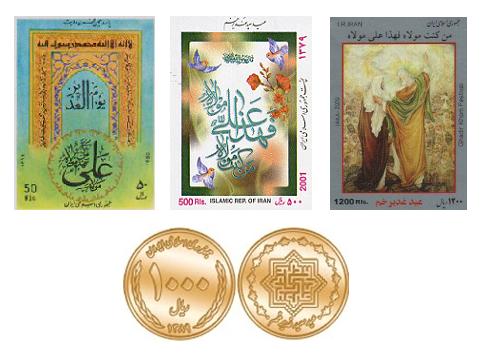
Images of some stamps and coins issued by the Islamic Republic of Iran between 1990 and 2010 commemorating the Idd-e-Ghadir. The inscriptions include the Shahada, Qur’anic ayats and the declaration made by Prophet Muhammad at Ghadir Khumm, “Mun Koontu Mawla, Fa Hada, Aliyun Mawla” meaning “He of whom I am the Mawla Ali is also the Mawla.”

~~~~~~~~~~~

III

With 9,000 chronological quotations arranged in 90 thematic chapters, this huge treasury is bursting with historical gems.

With 9,000 chronological quotations arranged in 90 thematic chapters, this huge treasury is bursting with historical gems.

“Muhammad said: ‘He of whom I am the Mawla, Ali is his Mawla. O God, be the friend of him who is his friend and be the enemy of his enemy.’

“This became the proof text for the Shia claim that Ali, the Prophet’s cousin and son-in-law, was the Prophet’s rightful successor after the Prophet’s death in 632. The meaning of Mawla here probably implies the role of patron, lord or protector.” — History in Quotations by M. J. Cohen and John Major.

~~~~~~~~

IV. HIS HIGHNESS THE AGA KHAN AND
HIS DEVELOPMENT NETWORK ON HAZRAT ALI

His Highness addressing the Evangelical Academy of Tutzing upon receiving the Tolerance Award, 20 May 2006.

His Highness addressing the Evangelical Academy of Tutzing upon receiving the Tolerance Award, 20 May 2006.

 “…As you know, the Shi’a divided from the Sunni after the death of the Prophet Muhammad. Hazrat Ali, the cousin and son-in-law of the Prophet, was, in Shi’a belief, named by the Prophet to be the Legitimate Authority for the interpretation of the faith. For the Shi’a today, all over the world, he is regarded as the first Imam.” – His Highness the Aga Khan, Tutzing Evangelical Academy, May 20, 2006. [2]

___________

“The Ismaili Imamat is a hereditary institution of Muslim leadership, linked to Prophet Muhammad (peace be upon him and his family) by direct lineal descent through Hazrat Ali, his cousin and son-in-law. The line of Ismaili Imams has continued uninterrupted by hereditary succession from Hazrat Ali through to the present, 49th Imam, His Highness the Aga Khan.” – The Aga Khan Development Network (AKDN) , Brazil and the Ismaili Imamat sign a Protocol. [3]

~~~~~~~~~~~

V. “I WISH I’D BEEN THERE”

By Jehangir Merchant, Aziz Kurwa and Barnaby Rogerson

Please click for Jehangir A. Merchant’s “Ghadir-Khumm and the Two Weighty Matters”

Ghadir-Khumm and the Two Weighty Matters by Jehangir Merchant

The last obligatory duty that Allah sent down was al-Walaya (adherence to the guardian designated by Allah). Then, He sent down the verse: “This day have I perfected your religion for you and have completed My favours upon you and have chosen for you Islam as your religion.” (Holy Qur’an, 5:3)…

~~~~~~~~~

Please click for Aziz Kurwa’s “Volunteering at the Dawning of the Age of Imamat”

Volunteering at the Dawn of the Age of Imamat by Aziz Kurwa

Rasul-illah mounted the pulpit and placed Ali on his right. He then delivered a sermon, thanking Allah for His bounty. Taking Hazrat Ali by the hand, he then declared: He of whom I am Mawla, of him Ali is also the Mawla. The volunteers cleared everything and then we sat around campfires in groups. In my group the conversations was buzzing over the historical and momentous events of the day…

~~~~~~~~~~

Please click for Barnaby Rogerson's "A Christian Envoy at the Ghadir Khumm Campsite"

Please click for Barnaby Rogerson’s “A Christian Envoy at the Ghadir Khumm Campsite”

A Christian Envoy at the Ghadir Khumm Campsite by Barnaby Rogerson

What an offer! To travel back in time and return as a true witness to the history that I have so often thought and dreamed about… (and) witness to the exact succession of events at the Ghadir Khumm campsite: the blessings, the sermon and the ritual actions of the Prophet ordaining Ali as his successor…

To download complete series please click I Wish I’d Been There Series – PDF. To read individual pieces, please visit I Wish I’d Been There.

___________________

[1] To read background story and complete preamble, please click The Preamble Of “The Constitution of the Shia Imami Ismaili Muslims”.

[2] To read this and other published speeches at the AKDN Website, please click Tolerance Award from the Evangelical Academy of Tutzing and Speech Archives.

[3] See The Ismaili Imamat note in AKDN–Brazil Protocol.

___________________

A Note to Readers: Please scroll down or click Home page for other recent posts and click What’s New for links to all articles published on this blog since March 2009. Subscribe to this Website via the box near the top right of this page.

A History of the Ismaili Community in Daman from the Portuguese Period to the Present by Toral Pradhan

A FASCINATING JOURNEY INTO THE PAST

Do we have written accounts or histories of Ismaili settlements and jamatkhanas in little East African towns such as Manyoni, Eldoret, Jinja, or Lushoto? How about remoter areas in Central Asia, the Middle East and the Indian sub-continent or for that matter even bigger cities such as Toronto (Canada), Christchurch (New Zealand), Denver (USA), Regina (Canada) and Stoke-on-Trent (UK)?

Please click on image(s) or on A Brief History of the Khoja Ismaili Community in Daman, India, from the Portuguese Period to the Present

A ‘Badge of Honour’ presented to the Ismaili Scout Band in Daman in the 1940's.

A ‘Badge of Honour’ presented to the Ismaili Scout Band in Daman in the 1940s.

For the forthcoming 40th anniversary of the inauguration of the new Ismaili jamatkhana in Daman, a tiny Portuguese enclave for 400 years until it was absorbed into India on December 19, 1961, the town’s resident writer Toral Pradhan made a determined effort to find out more about the two-hundred year history of the Ismaili Jamat living there. Her piece, augmented with images and material from archives, will hopefully stimulate other writers as well as youth to research about the origins of the Ismaili community in small towns they live in or where their parents or forefathers once had their homes.

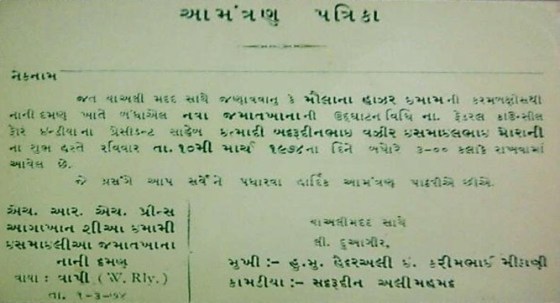
A Gujarati invitation card for the inauguration of the new Jamatkhana in Daman. Please click for article.

A Gujarati invitation card for the inauguration of the new Jamatkhana in Daman. Please click for article.

PLEASE CLICK: A Brief History of the Khoja Ismaili Community in Daman, India, from the Portuguese Period to the Present

56th Imamat Anniversary: Magnificent Historical Portraits of His Highness the Aga Khan, with Quotes on the Nature of Imamat and Succession

Compiled by Malik Merchant
(Publisher-Editor, Simerg and Simergphotos)

MAWLANA HAZAR IMAM, HIS HIGHNESS THE AGA KHAN

A portrait of the new 49th Ismaili Imam taken shortly after he succeeded his late grandfather to the throne of Imamat on July 11, 1957 at the age of twenty. A framed portrait of the late 48th Imam who served the community for 72 years is seen in the background. Photo by Philippe Le Tellier/Paris Match via Getty Images. Copyright. Please click on image for full enlargement.

A portrait of the new 49th Ismaili Imam taken shortly after he succeeded his late grandfather to the throne of Imamat on July 11, 1957 at the age of twenty. A framed portrait of the late 48th Imam who served the community for 72 years is seen in the background. Photo by Philippe Le Tellier/Paris Match via Getty Images. Copyright. Please click on image for full enlargement.

THE WILL OF IMAM MAWLANA SULTAN MAHOMED SHAH, THE 48TH IMAM

“Ever since the time of my first ancestor Ali, the first Imam, that is to say over a period of thirteen hundred years it has always been the tradition of our family that each Imam chooses his successor at his absolute and unfettered discretion from amongst any of his descendants whether they be sons or remoter male issue.

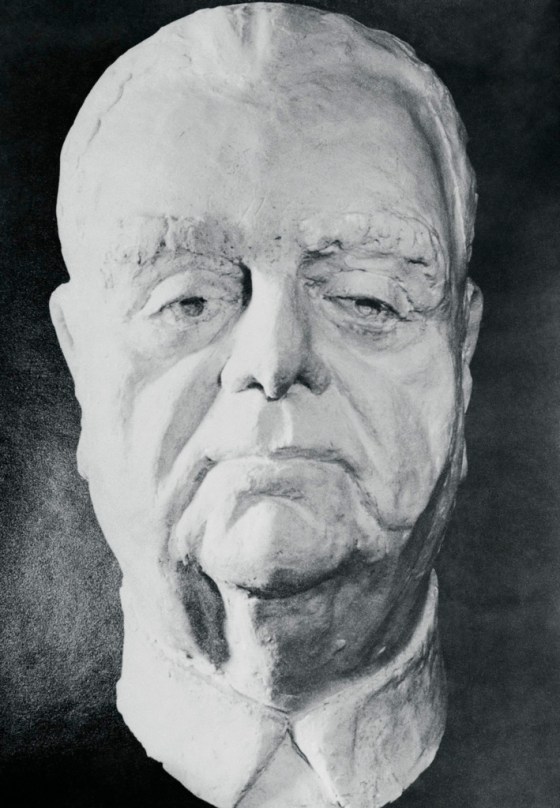
This thoughtful study of the late Aga Khan was done in clay by his late wife, the Begum Aga Khan. Image by © Bettmann/CORBIS. Please click for enlargement.

This thoughtful study of the late 48th Imam, His Highness the Aga Khan, Sir Sultan Mahomed Shah  was done in clay by his late wife, the Begum Aga Khan. Image by © Bettmann/CORBIS. Please click for enlargement.

“In view of the fundamentally altered conditions in the world in very recent years due to the great changes which have taken place including the discoveries of atomic science I am convinced that it is in the best interests of the Shia Moslem Ismailian Community that I should be succeeded by a young man who has been brought up and developed during recent years and in the midst of the new age and who brings a new outlook on life to his office as Imam.

The late 48th Ismaili Imam, His Highness the Aga Khan Sir Sultan Mahomed Shah, seated on a wheelchair, is pictured with members of his family including his successor, Prince Karim Aga Khan, standing at extreme right. Photo: Zul Khoja Collection, Ottawa.

The late 48th Ismaili Imam, His Highness the Aga Khan Sir Sultan Mahomed Shah, seated on a wheelchair, is pictured with members of his family including his successor, Prince Karim Aga Khan, standing at extreme right. Photo: Zul Khoja Collection, Ottawa.

“I appoint my grandson Karim, the son of my son Aly Salomone Khan to succeed to the title of Aga Khan and to be the Imam and Pir of all my Shia Ismailian followers.”….His Highness the Aga Khan III.

SUCCESSION AND THE NATURE OF IMAMAT

Ceremonial installation of the 49th Imam in Kampala, Uganda.

One of the several ceremonial installations of the 49th Imam that took place around the world. This photo is from the installation (Takht Nashini) that took place in Kampala, Uganda.

“…the [installation] ceremony is a public installation of the Imam. The Ismailis pay homage to the Imam and that is when you are recognised by the world at large as the Imam. Officially as soon as one Imam passes away, his successor takes on from the very minute the Imam has passed away.” — His Highness Prince Karim Aga Khan [1]

A TRIBUTE TO THE 48TH IMAM, AND THE NEW IMAM’S DEDICATION

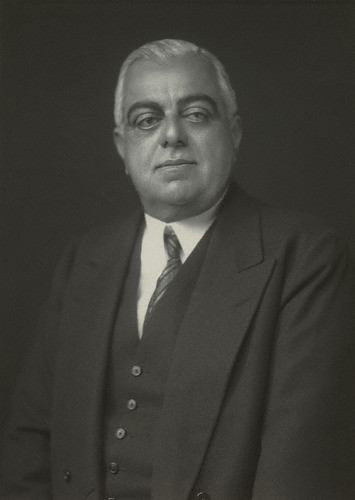
Sir Sultan Muhammad Shah, His Highness the Aga Khan (1877-1957), direct descendant of the Prophet Muhammad (s.a.s) and 48th Imam of the Shia Imami Ismaili Muslims. Photo: Copyright National Portrait Gallery, London.

Sir Sultan Muhammad Shah, His Highness the Aga Khan (1877-1957), direct descendant of the Prophet Muhammad (s.a.s) and 48th Imam of the Shia Imami Ismaili Muslims. He ruled the Ismailis for 72 years. Photo: Copyright National Portrait Gallery, London.

“My grandfather dedicated his life to the Imamat and Islam, both of which came first, and above all other considerations. While I was prepared that one day I might be designated the Aga Khan I did not expect it so soon. I follow a great man in a great responsibility and he could have given me no more appreciated honour than to bequeath me this spiritual leadership. My life, as his, will be dedicated to the service of my followers.”….His Highness the Aga Khan.

DEDICATION FULFILLED

"The closer you come the more you will see him." A digital representation of some of His Highness the Aga Khan's activities during his Imamat. Please click ofr enlargement. Copyright: Akber Kanji.

“The closer you come the more you will see him.” A pixel snapshot from a digital portrait of His Highness the Aga Khan representing some of his activities as the 49th Imam of Ismaili Muslims. Please click for enlargement. Copyright: Akber Kanji, Toronto, Canada.

 THE LOVE FOR THE IMAM OF THE TIME

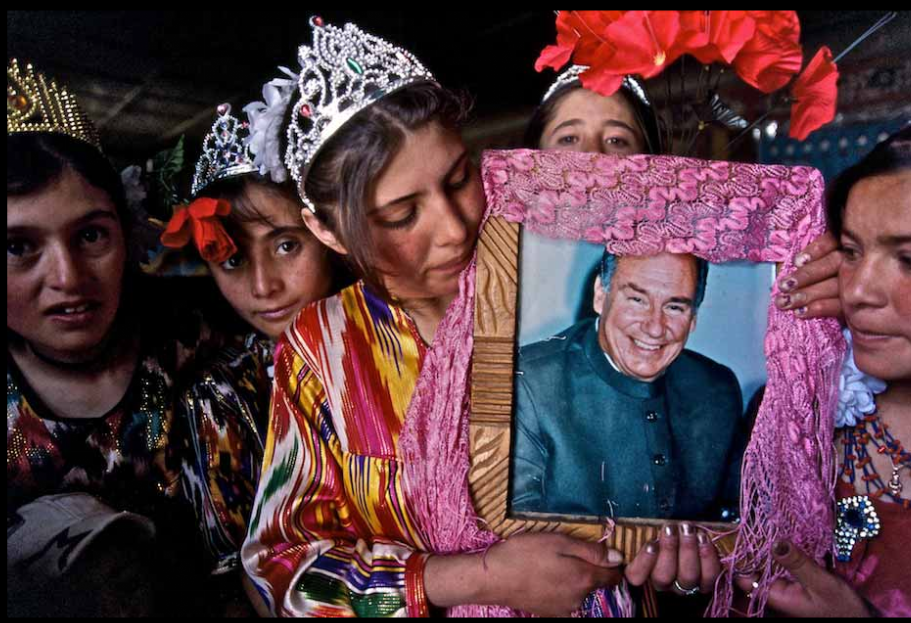
Ismaili girls in Central Asia proudly and lovingly display a decorated frame holding a photo of their beloved 49th Imam, His Highness the Aga Khan. Please click for enlargement. Photo: Matthieu Paley. Copyright.

Ismaili girls in Central Asia proudly and lovingly display a decorated frame holding a photo of their beloved 49th Imam, His Highness the Aga Khan. Please click for enlargement. Photo: Matthieu Paley. Copyright.

In all four ages,
I went about,
looking hard.
I found none
to match you, my lord.

My lord,
my heart
is fond of you. [2]

~~~

MAWLANA HAZAR IMAM, HIS HIGHNESS THE AGA KHAN

A portrait of the new 49th Ismaili Imam taken shortly after he succeeded his late grandfather to the throne of Imamat on July 11, 1957 at the age of twenty. A framed portrait of the late 48th Imam who served the community for 72 years is seen in the background. Photo by Philippe Le Tellier/Paris Match via Getty Images. Copyright. Please click on image to enlarge

A portrait of the new 49th Ismaili Imam taken shortly after he succeeded his late grandfather to the throne of Imamat on July 11, 1957 at the age of twenty. A framed portrait of the late 48th Imam who served the community for 72 years is seen in the background. Photo by Philippe Le Tellier/Paris Match via Getty Images. Copyright. Please click on image to enlarge

Date posted: Monday, July 9, 2013.

© All photos are Copyright by the respective copyright owners. Reproduction strictly prohibited without licensing agreement(s) from the copyright sources mentioned in the photo captions.

For an extra-ordinary version of this photo essay please visit our sister blog Simergphotos. Please click For 56th Imamat Anniversary, Magnificent and Unique Historical Portraits of His Highness the Aga Khan

__________

References:

[1] http://www.nanowisdoms.org/nwblog/10260/

[2] Verse 3 translation of Saiyad Imamshah’s ginan Sahebaji tun more mana bhave,  from “A Scent of Sandalwood” by Dr. Aziz Esmail

For other Imamat related readings including an explanation of the Munajat recited during Imamat Day please click on the following links:

We welcome feedback/letters from our readers. Please use the LEAVE A REPLY box which appears below. Your feedback may be edited for length and brevity, and is subject to moderation. We are unable to acknowledge unpublished letters. Please visit the Simerg Home page for links to articles posted most recently. For links to articles posted on this Web site since its launch in March 2009, please click What’s New.

In Celebration of Father’s Day 2013: Excerpts from a Letter of Hazrat Ali (a.s.) to His Son, Introduced by Azeem Maherali

“My dear son, you are part of my body and soul, and whenever I look at you, I feel as if I am looking at myself. If any calamity happens to you, I feel as if it has happened to me. Your death will make me feel as if it were my own. Your affairs are like my affairs. Therefore I commit this advice to paper. I want you to be attentive to it and to guard it well. I may remain longer in your life or I may not, but I want this advice to remain with you….” — from Hazrat Ali’s Letter….Read more excerpts

This fine steel peacock may have decorated the cross-bar of an alam, a standard carried during religious festivals in Iran. Hazrat Ali and his two sons, Hasan and Husayn, are depicted in the central medallion on the peacock’s fanned tail. The bird is also engraved with stylized inscriptions, princely hunting scenes, human busts and animals in a style typical of the Qajar period (1771-1924) in Iran.  Photo Credit: The Trustees of the British Museum. Copyright

This fine steel peacock may have decorated the cross-bar of an alam, a standard carried during religious festivals in Iran. Hazrat Ali and his two sons, Hasan and Husayn, are depicted in the central medallion on the peacock’s fanned tail. The bird is also engraved with stylized inscriptions, princely hunting scenes, human busts and animals in a style typical of the Qajar period (1771-1924) in Iran.
Photo Credit: The Trustees of the British Museum. Copyright. Please click on image for reading.

Historical Photo Essay: The Ismaili Connection with the Town of Amir Pir in Sindh, Pakistan, by Gulshan Chunara

A very small town by the name of Amir Pir is the setting for a photo essay about the town’s Ismaili connection going back 170 years to the 46th Ismaili, Shah Hasan Ali Shah, Aga Khan I (a.s.).  Gulshan Chunara and Salina Hasan respectively provide the text and photos for this intriguing historical piece…Click for Photos

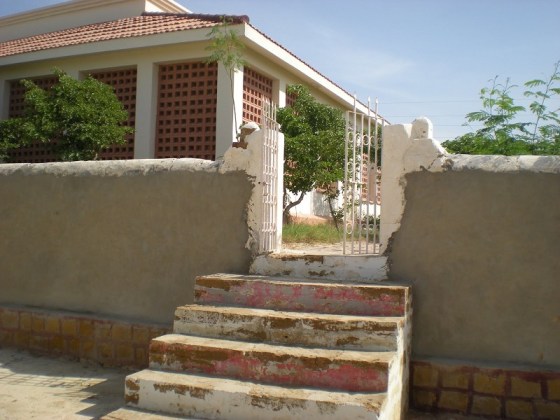
Imam Ali Shah (a.s.), Aga Khan II, residence. Photo: Salina Hasan. Copyright. Please click on image for photo essay.

Imam Ali Shah (a.s.), Aga Khan II, residence. Photo: Salina Hasan. Copyright. Please click on image for photo essay.

Inspiring and Educational Readings for Yaum e-Ali, the Birth Anniversary of Hazrat Ali (a.s.)

Introduction: The birthday anniversary of Hazrat Imam Ali (a.s.) is commemorated on the 13th Rajab. This festival is celebrated by the Shi’te communities and is observed as an occasion to reflect upon the life and teachings of their first Imam. According to the Shi’a doctrine and tradition, Hazrat Ali  was the foundation (asas) of the institution of Imamah. His designation (nass) by the Prophet upon the Command of Allah (al-amr), to guide the believers after the termination of the institution of Nabuwah is central to the Shi’a theology. The Imam’s function is to continue the teaching (ta’lim) and interpretation (ta’wil) of Allah’s Final Message after the demise of the Prophet.

Today, the Shi’a Ismaili Muslims, in addition to the celebration of Yaum e-Ali, commemorate the birthday anniversary (Salgirah) of their present living Imam (Mawlana Hazar Imam), His Highness the Aga Khan, who is the direct lineal descendent of Prophet Muhammad (s.a.s.) through Hazrat Ali (a.s.) and Bibi Fatima (a.s.).

His Highness the Aga Khan seen giving his commencement lecture at the American University in Cairo on June 15, 2006. The excerpt on Hazrat Ali, from whom the 49th Ismaili Imam is directly descended, is from the address. Photo Credit: American University in Cairo.

His Highness the Aga Khan seen giving his commencement lecture at the American University in Cairo on June 15, 2006. The excerpts on Hazrat Ali are from the lecture. Photo Credit: American University in Cairo.

~~~~~~

NADE ALI IN OTTOMAN CALLIGRAPHY

Transliteration

Nade Ali, Nade Ali, Nade Ali
 Nade Aliyyan mazhar al-ajaib
 Tajidahu awnan lakafin-nawaib
 Kullu hammin wa ghammin
 sayanj-i Ali Bi wilayatika,
Ya Ali! Ya Ali! Ya Ali!

Naad-e-Ali in Ottoman calligraphy. Photo Credit: The Trustees of the British Museum. Copyright.

Naad-e-Ali in Ottoman calligraphy. Photo Credit: The Trustees of the British Museum. Copyright.

Translation

Call Ali call Ali call Ali,
the manifestation of marvels
He will be your helper in difficulty
Every anxiety and sorrow will end
Through your friendship.
O Ali, O Ali, O Ali

~~~

LINKS TO TWELVE READINGS

The Love for Ali by Altaf Hajiyani

Hazrat Ali’s Example: What We Can Do Today by Pervis Rawji

The Naad-e-Ali, “Call Upon Ali….oh Ali, oh Ali, oh Ali” by Hussein Rashid

~~~

Blessed is one
who is humble regarding himself,
whose livelihood is good,
whose inner thoughts are virtuous,
whose character is good,
who spends the surplus from his wealth
and removes superfluity from his speech,
who keeps his evil away from people — Hazrat Ali

~~~

The Wisdom of Hazrat Ali: Selections from Nahj al-Balaghah for Young People (II) – Hazrat Ali

An Englishman Reflects on the Nature of Imam Ali by Barnaby Rogerson

Islam’s Great Striver: Hazrat Ali by Lt. Col ‘Abdullah Baines-Hewitt

~~~

One who perseveres patiently
will not be without success,
even if it takes a long time – Hazrat Ali

~~~

Surrender and Realisation: Imam Ali on the Conditions for True Religious Understanding by James W. Morris

Hazrat Ali’s Principles of Good Governance – Early Muslim Style

The Wisdom of Hazrat Ali: Selections from Nahj al-Balaghah for Young People (I) – Hazrat Ali

~~~

One who is headstrong and opinionated perishes,
while one who seeks the advice of others
becomes a partner in their understanding — Hazrat Ali

~~~

Ethics in the Kalam-i Mawla of Hazrat Ali by Farouk M. Topan

Nasir-i-Khusraw on The Excellence of ‘Ali by Nasir Khusraw

Discourses of Hazrat Ali by Tajdin Dhala

~~~

A MESSAGE BY HIS HIGHNESS THE AGA KHAN
ON THE 25TH ANNIVERSARY OF THE AGA KHAN FOUNDATION

"The closer you come..." by Akber Kanji, Toronto, Canada

“The closer you come, the more you will know him” by Akber Kanji, Toronto, Canada

“This is a time of new freedoms, but it is also one in which new choices must be made wisely. In exercising freedom and making choices, our institutions must be guided, as they have been in the past, by the teachings of the Prophet Muhammad (Peace of Allah be upon him), and the tradition of our tariqah, which is the tradition of Hazrat Ali: A thinking Islam and a spiritual Islam – an Islam that teaches compassion, tolerance and the dignity of man – Allah’s noblest creation.” — His Highness the Aga Khan, May 14, 1992.

Date Posted: May 22, 2013.

Farouk Verjee, Former President of the Aga Khan Ismaili Council for Canada, Remembers Baroness Margaret Thatcher

By Malik Merchant, Editor

Recently, I had the immense pleasure of meeting and having a delightful lunch at Vancouver’s well-known Jambo Grill with (Itmadi) Farouk B.K.S. Verjee who was the President of His Highness the Aga Khan Shia Imami Ismaili Council for Canada during the 1980’s. During his term of office, he witnessed the opening of two major Ismaili Centres in the Western World, including one in his own jurisdiction in Canada, the Ismaili Jamatkhana and Centre located in Burnaby, British Columbia. He was, as Canada’s President, very much involved in every phase of the planning, construction, completion and opening of the magnificent Burnaby icon which was designed by Canadian architect Bruno Freschi.

Presidents of National Ismaili Councils around the globe are often invited to major functions and projects related to the Ismailis and the Ismaili Imamat, as community representatives for their respective countries, and Farouk Verjee was present for the historic opening of the London Ismaili Centre from which the following anecdote, with photo,  is published.

Farouk Verjee, left, with Baroness Margaret Thatcher (1925 - 2013) at the opening of the iconic Ismaili Centre in London, England, on April 24, 1985. Looking on in the centre is Anil Ishani, then President of the Ismaili Council for the UK. Photo: Farouk Verjee Collection, Vancouver, Canada.

Farouk Verjee, left, with Baroness Margaret Thatcher (1925 – 2013) at the opening of the iconic Ismaili Centre in London, England, on April 24, 1985. Looking on in the centre is Anil Ishani, then President of the Ismaili Council for the UK. Photo: Farouk Verjee Collection, Vancouver, Canada.

After being introduced to the late Baroness Margaret Thatcher by His Highness the Aga Khan, Verjee told her that the Ismaili Centre in Burnaby was nearing completion and that it would be opening in the coming summer, and he hoped she would visit it on her next visit to British Columbia. She asked,  “Which is the better building?” Farouk replied that one was a Cadillac and the other a Rolls! In a typical British fashion, the Baroness quickly responded, “I hope this one is the Rolls!.” Verjee found the Baroness to be a very amicable person.

The Ismaili Centre and Jamatkhana  in Burnaby was opened a few months later in the same year on August 23 by the then Canadian Prime Minister Brian Mulroney in the presence of His Highness, Premier Bill Bennett of the Province of British Columbia and other dignitaries including members of the Aga Khan’s family. Mawlana Hazar Imam, as His Highness is addressed by members of his community, designated the new Ismaili Jamatkhana as the Darkhana of Canada at a gathering of some 20,000 Ismailis on the same day at BC Place.

It may be of interest to note that Itmadi Farouk Verjee’s father was Kamadia of the London Jamat with Janmohamed Verjee as Mukhi. They were appointed to their positions in a talika (a written message) from Imam Sultan Mahomed Shah, His Highness the Aga Khan III (1877 – 1957), the 48th Imam of Ismaili Muslims, which is dated April 10, 1936. The newly appointed Mukhi and Kamadia were law students in the U.K. at that time. Janmohamed Verjee was the father of Amir Bhurio a well-known personality in the UK Ismaili community.