Congratulations to the Rt. Honourable Justin Trudeau, the new Prime Minister of Canada: For Ugandan Ismaili refugees, he reminds them of the glory days when his father and the Aga Khan facilitated their settlement in Canada

BY VALI JAMAL
Kampala, Uganda
(Special to Simerg)

Justin Trudeau has a special moment with his mother, Mrs. Margaret Trudeau, before the searing in ceremony. Photo: Sgt. Ronald Duchesne, Rideau Hall.

Mr. Justin Trudeau has a special moment with his mother, Mrs. Margaret Trudeau, before the swearing in ceremony. Photo: Sgt. Ronald Duchesne, Rideau Hall.

The remarkable victory by Justin Trudeau in the Canadian Federal Election held last month, and his momentous swearing in ceremony at Rideau Hall on November 4, 2015, as Prime Minister of Canada, has resonated with Uganda-origin Ismailis everywhere for the role played by his father, Prime Minister Pierre Elliott Trudeau (1919 – 2000), in the settlement of 7,000 of them after the expulsion of 1972.

Please click on photo for enlargement

The swearing-in ceremony of the new Prime Minister, Justin Trudeau, seated 5th from left, and his cabinet took place at Rideau Hall. The Governor General of Canada, the Rt. Honourable David Johnston, is seated next to the Prime Minister. Photo: The website of the Governor General of Canada.

The swearing-in ceremony of the new Prime Minister, the Right Honourable Justin Trudeau, seated 5th from left, and his cabinet took place at Rideau Hall on Wednesday November 4, 2015. The ceremony was presided by the Governor General of Canada, the Right Honourable David Johnston, who is is shown in the photo on the right of  the Prime Minister. Photo: Sgt. Ronald Duchesne, Rideau Hall

This is the first time in Canadian history that a child of a former Prime Minister has followed in the footsteps of his father, and taken the top job in the country. The Liberals got a majority of 180 seats, but more, their victory signals a 180 degree turn from the divisive politics of the Conservative government.

Prime Minister Justin Trudeau in the presence of his Cabinet delivers a statement in front of the Rideau Hall facade. Photographer: MCpl Vincent Carbonneau, Rideau Hall.

Prime Minister Justin Trudeau in the presence of his Cabinet delivers a statement in front of the Rideau Hall facade. Photographer: MCpl Vincent Carbonneau, Rideau Hall.

In his address the newly sworn Prime Minister stated: “Canada is strong not in spite of its diversity, but because of it, and we are committed to bringing new leadership and a new tone to Ottawa. We also made a commitment to pursue our goals with a renewed sense of collaboration. Most importantly, we will be a government that governs for all Canadians and brings Canadians together.” These are significant words.

Prime Minister Justin Trudeau was plunged into a selfie ocean as he and his wife, Sophie Grégoire-Trudeau, mingled with the crowd outside Rideau Hall after the swearing ceremony. Photo: MCpl Vincent Carbonneau, Rideau Hall.

Prime Minister Justin Trudeau was plunged into a selfie ocean as he and his wife, Sophie Grégoire-Trudeau, mingled with the crowd outside Rideau Hall after the swearing ceremony. Photo: MCpl Vincent Carbonneau, Rideau Hall.

To me, today’s grand event of Justin Trudeau taking the oath as Prime Minister was also “back to the past”, 1972, when Canada admitted so many of us Uganda Asians under the leadership of his father, Pierre Elliot Trudeau. For me, too, as an Ismaili, the 1972 expulsion is special because of the role my spiritual leader, His Highness the Aga Khan, played in the resettlement of the expellees in Canada, with Pierre Elliot Trudeau, no less, and because of the role played by his uncle Prince Sadruddin as head of UNHCR in taking the last of the Uganda expellees to refugee centres in Europe.

Our success in settling down in Canada led to Canada enshrining Multiculturalism in Canada’s laws in 1987, and to His Highness the Aga Khan siting the Global Centre for Pluralism in Canada.

There were around 65,000 Asians in Uganda at the time of the 1972 expulsion. The British papers racheted it up to 80,000 based on the census of 1969, not realizing that over ten thousand had crept away to UK to beat immigration quotas, and thirty thousand or so had non-British nationalities, including 15-20,000 Ugandans.

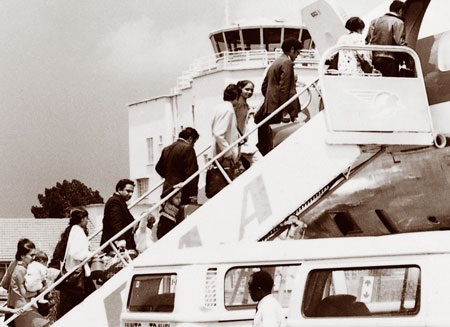
Asian refugees boarding a plane at Kampala's Entebbe airport after Idi Amin's edict in 1972 cleansing Uganda of its Asian citizens and residents. Photo: Government of Canada archives.

Asian refugees boarding a plane at Kampala’s Entebbe airport after Idi Amin’s edict in 1972 cleansing Uganda of its Asian citizens and residents. Photo: Government of Canada Archives.

The UK Prime Minister, Edward Heath, started calling up all Commonwealth Premiers to help with the crisis. Australia said they would not budge from their “White Australia” policy. India and Pakistan said, sure, they’d take their 10,000 nationals but not UK passport-holders. USA said they would accept 1,500 Asians “on parole” – i.e. without going through their immigration processes. The British passport-holders in fact didn’t want to go anywhere except Britain, viewing the expulsion as a blessing in disguise for short-circuiting the never-ending voucher system of the British. Britain eventually accepted responsibility for their 30,000 subjects.

Edward Heath’s pleas fell on receptive ears in Canada. Within a week of the expulsion notice, departmental meetings were held in Ottawa to respond to the Uganda Asian crisis and within a fortnight the Prime Minister, Pierre Trudeau, announced at the parliament that Canada was ready to accept “without numerical limitation those Asians who meet the immigration selection criteria.” His Highness the Aga Khan contacted Mr. Trudeau to negotiate with him how many refugees Canada would accept. In the end Canada admitted around 7,000, one-third non-Ismailis.

Prince Sadrudin Aga Khan pictured with Ugandan Asian refugees at the Naples refugee centre. Photo: Vali Jamal Collection. Copyright.

Prince Sadrudin Aga Khan pictured with Ugandan Asian refugees at the Naples refugee centre. Photo: Vali Jamal Collection. Copyright.

The Aga Khan family played another significant role in the expulsion story in the form of Prince Sadruddin Aga Khan (uncle of His Highness) as head of the UN refugee agency, UNHCR. At the last week of the expulsion deadline there were still around 6,000 Asians in Uganda who wanted to make a go of their verified citizenship or who were handicapped and had failed getting into any country. UNHCR quietly let it be known that they’d take away any Asian wanting to leave. Prince Sadruddin personally visited several UNHCR centres and managed to resettle all the 6,000 or so Uganda Asian refugees in a score of countries within a year.

I have recorded the expulsion drama of the Ugandan Asians in a major well-researched and exhaustive work of around 1700 pages which is expected to be published next spring. I am just so pleased my book will come out under a compassionate administration in Canada, one that holds fast to the tenets of multiculturalism.

FLASHBACKS 25 YEARS APART

[I] THE SILVER JUBILEE OF HIS HIGHNESS THE AGA KHAN (1982-1983)

Please click on photo for enlargement

A unique and historical photo signed by the late Canadian Prime Minister, Pierre Trudeau, which was taken in the Prime Minister's Office during Mawlana Hazar Imam's Silver Jubilee visit to Canada in April 1983. (l to r) - Hon. Sec Farouk Verjee (National Council), Mr. Gerry Wilkinson (His Highness the Aga Khan's Secretariat, Aiglemont, France), Hon. Sec Mohamed Manji (Ontario Council), President Amirali Rhemtulla (Grants Council), Mawlana Hazar Imam, Prime Minister Pierre Trudeau, Prince Amyn Muhammad Aga Khan, President Mehboob Dhanani (Ontario Council) and President Zulficar Lalji(National Council). Canada. The full signature line note from the Prime Minister read: To Farouk with the best of Memories . Trudeau. 1983. Photo: Photo: Farouk Verjee Collection, Vancouver,

A unique and historical photo signed by the late Canadian Prime Minister, Pierre Trudeau, which was taken in the Prime Minister’s Office during Mawlana Hazar Imam, His Highness the Aga Khan’s Silver Jubilee visit to Canada in April 1983. (l to r) – Hon. Sec Farouk Verjee (National Council), Mr. Gerry Wilkinson (His Highness the Aga Khan’s Secretariat, Aiglemont, France), Hon. Sec Mohamed Manji (Ontario Council), President Amirali Rhemtulla (Grants Council), Mawlana Hazar Imam, Prime Minister Pierre Trudeau, Prince Amyn Muhammad Aga Khan, President Mehboob Dhanani (Ontario Council) and President Zulficar Lalji(National Council). Canada. The full signature line note from the Prime Minister read: To Farouk with the best of Memories . Trudeau. 1983. Photo: Photo: Farouk Verjee Collection, Vancouver.

[II] AND TWENTY-FIVE YEARS LATER…THE GOLDEN JUBILEE (2007-2008)

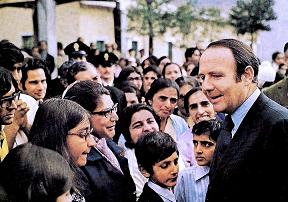
Justin Trudeau greets His Highness the Aga Khan as he arrives in Ottawa, Canada, to celebrate his Golden Jubilee in 2008. Looking on are Senator Mubina Jaffer, left, and MP Yasmin Ratansi. Mr. Trudeau was then an MP for his Papineau riding in the Quebec. Photo: The Ismaili.

Justin Trudeau greets His Highness the Aga Khan as he arrives in Ottawa, Canada, to celebrate his Golden Jubilee in 2008. Looking on are Senator Mubina Jaffer, left, and MP Yasmin Ratansi. Mr. Trudeau was then an MP for his Papineau riding in the Quebec. Photo: The Ismaili.

Date posted: November 4/5, 2015.
Date last updated: November 8, 2015 (new photo at top)

For more photos and reports please visit the websites of the Governor General of Canada at http://www.gg.ca and the Prime Minister of Canada at http://www.pm.gc.ca.
_________________

Dr. Vali Jamal

Dr. Vali Jamal

About the writer: Vali Jamal has a BA from Cambridge (Trinity College) and a PhD from Stanford. He was a Senior Economist with UN-International Labour Organization from 1976 to 2001. He lives in Kampala, Uganda. As noted above in his piece, his mammoth illustrated work on the Ugandan Asians will be released next spring.

We welcome your feedback on Vali Jamal’s piece. Please click Leave a comment.

Memorable Photos, Quotes and Messages of Mawlana Sultan Mahomed Shah, His Highness the Aga Khan III

IRRESPECTIVE OF AGE, THE ISMAILI IMAM’S STATUS IS EXALTED

“O Jamat do not consider me small. I am the descendant of the Prophet and my grandfather is Hazrat Amirul Mominin (Hazrat Ali) and my grandmother is Khatoon-e-Janat (the Lady of Paradise) Hazrat Bibi Fatima. I am the Light (Nur) of both Hazrat Ali and the Prophet (Muhammad). Though young in age I am exalted. We Imams change the physical bodies in this world but our Nur is eternal and originates from the very beginning. You should therefore take it as one Nur. The Light of God is ever present. The Throne of the Imamat of Mawlana Murtaza Ali continues and it will remain till the Day of Judgement.” — Quoted in “Le Renovation du Shiisme Ismailien en Inde et au Pakistan” by Michele Boivien. Click to Read More in a Special Photo Essay.

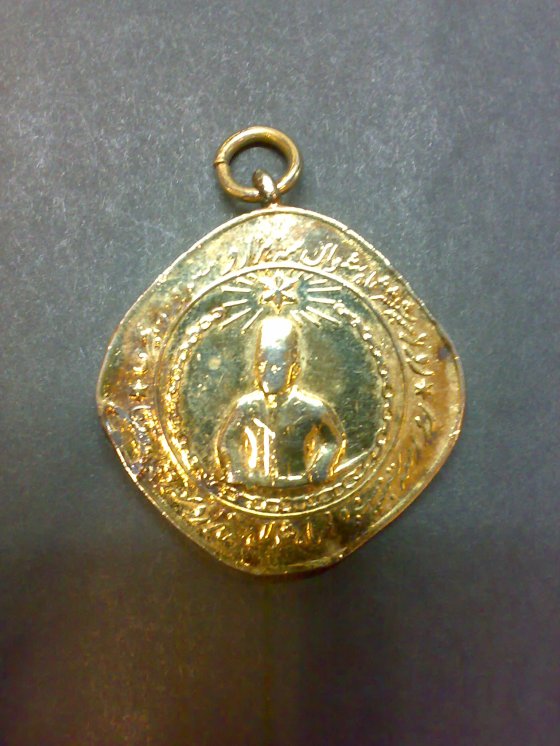
Reverse of a medal commemorating the Diamond Jubilee of Aga Khan III. Photo: Nizar Noorali Collection, Pakistan

Reverse of a medal commemorating the Diamond Jubilee of His Highness the Aga Khan III. Photo: Nizar Noorali Collection, Pakistan. Please click on photo for article on the Jubilees.

In about 20 months, on July 11, 2017, His Highness Prince Karim Aga Khan (addressed as Mawlana Hazar Imam by his Ismaili community) will, inshallah, complete 60 years of his reign as the 49th hereditary Imam of his worldwide followers. He became the Imam upon the death of his grandfather, Mawlana Sultan Mahomed Shah, His Highness the Aga Khan III, who had reigned the community for 72 years, having become the 48th Imam in August 1885 at the age of 7. The quotes mentioned at the top of this post refer to his young age when he became Imam. He was born in Karachi on November 2, 1877.

The late Imam went on to describe his own Diamond Jubilee, 60 years of Imamat, as an “incomparable occasion.” In this piece, we mark Mawlana Sultan Mahomed Shah’s 138th birth anniversary (which falls on November 2, 2015) with a collection of memorable photos, messages and quotes, particularly as they relate to his Golden, Diamond and Platinum Jubilees that the Ismailis celebrated during his life time.

PLEASE CLICK: Photo Essay: The Historical Jubilees of His Highness the Aga Khan (1877-1957), the Imam of the Socio-Economic Revolution

Date posted: November 1, 2015.

His Highness the Aga Khan on the Imamat and the Unity of Mankind; Id-e-Ghadir – The Designation of Hazrat Ali (a.s.) as Commander of the Faithful

Mawlana Hazar Imam thanking the government for inviting the Ismaili Imamat to establish its permanent Seat in Portugal. TheIsmaili/Gary Otte

Mawlana Hazar Imam thanking the government of Portual for inviting the Ismaili Imamat to establish its permanent Seat in the country. Photo: TheIsmaili/Gary Otte. See text of agreement, click on note 4 below.

“The religious leadership of the Ismaili Imam goes back to the origins of Shia Islam when the Prophet Muhammad appointed his son-in-law, Ali, to continue his teachings within the Muslim community. The leadership is hereditary, handed down by Ali’s descendants, and the Ismailis are the only Shia Muslims to have a living Imam, namely myself.” [1]

~~~

“The Ismaili Imamat is a supra-national entity, representing the succession of Imams since the time of the Prophet. But let me clarify something more about the history of that role, in both the Sunni and Shia interpretations of the Muslim faith. The Sunni position is that the Prophet nominated no successor, and that spiritual-moral authority belongs to those who are learned in matters of religious law. As a result, there are many Sunni imams in a given time and place. But others believed that the Prophet had designated his cousin and son-in-law, Ali, as his successor. From that early division, a host of further distinctions grew up — but the question of rightful leadership remains central. In time, the Shia were also sub-divided over this question, so that today the Ismailis are the only Shia community who, throughout history, have been led by a living, hereditary Imam in direct descent from the Prophet.

“…As you build your lives, for yourselves and others, you will come to rest upon certain principles. Central to my life has been a verse in the Holy Quran which addresses itself to the whole of humanity. It says: “Oh Mankind, fear your Lord, who created you of a single soul, and from it created its mate, and from the pair of them scattered abroad many men and women…”

“I know of no more beautiful expression about the unity of our human race — born indeed from a single soul.” [2]

_____________

Id-e-Ghadir

The twelve months of the Muslim calendar and major Muslim festivals. Image by Simerg.

The twelve months of the Muslim calendar and major Muslim festivals. Image by Simerg.

‘Id-e-Ghadir is celebrated by the Shi ‘ite communities to mark the event that took place at Ghadir Khumm (Valley of the Pond) on the 18th Dhul-Hijjah (which falls on September 30 or October 1 in 2015). This event commemorates the designation (appointment by way of nass) of Hazrat All as the ‘Amir-ul-Mu’minin (commander of the faithful) and Imamul-Muslimin’ (the Imam of the community of believers) at Ghadir-i Khumm when the Prophet (s.a.s.) was returning from his Last Pilgrimage (hajjatul-wida) in the year 632 AC. On this occasion, the Prophet publicly proclaimed Ali to be his successor [3] in guiding the community after the end of the institution of Nubuwwah. According to the Shi’a doctrine, tradition and interpretation of history, the designation of Hazrat Ali marked the beginning of the institution of Imamah. The designated Imam was to continue the ta’wil (interpretation) and talim (teaching) of Allah’s Final Message, i.e. the Holy Qur’an.

This stamp, issued by Iran in 1990, includes the Shahada, Qur'anic ayats and the declaration made by Prophet Muhammad at Ghadir-e Khumm

This stamp, issued by Iran in 1990, includes the Shahada, Qur’anic ayats and the declaration made by Prophet Muhammad at Ghadir-e Khumm “Mun Koontu Mawla, Fa Hada, Aliyun Mawla” (He of whom I am the Mawla, Ali is also the Mawla). Image not exact stamp size.

Accordingly, throughout the course of the history, the Shi’a have commemorated this occasion as a mark of recognition and acceptance of Allah’s mercy to mankind by bestowing continued guidance. Each Imam, since the time of Hazrat Ali has designated his successor. The Imam in his time has continued to guide his followers according to the prevailing conditions. His function has always been to look after the welfare of the community both in spiritual and worldly (material) matters. His guidance to his followers is that they should lead their lives in such a way so as to practice their Faith with a sense of balance and harmony, ensuring that there is no conflict between the two aspects of an individual’s life. The practice of the Faith thus becomes the way of life.

Presently, the Shi’a Imami Ismaili Muslims celebrate the day of accession of their present Imam to the office of Imamah as Yaum-e Imamat or Imamat Day. This occasion is celebrated as a mark of gratitude to Allah in having bestowed His mercy and bounty in guiding them through the office of the Imam on Sirat al-Mustaqim (the Straight Path).

Date re-posted: September 30, 2015 (The Id-e-Ghadir article had first appeared on this blog in 2013, and has been adapted from Ilm magazine, December 1989).

_____________________

Notes

[1] Voices: “The Power of Wisdom” – His Highness the Aga Khan’s Interview with Politique Internationale (English translation)

[2] In a Dynamic and Stirring Address to Members of the Canadian Parliament, His Highness the Aga Khan Shares His Faith Perspectives on the Imamat, Collaboration with Canada, the Muslim World Community (the Ummah), the Nurturing of Civil Society, Early Childhood Education, Voluntary Work, and the Unity of the Human Race

[3] Vagglieri, Ghadir Khumm, The Encyclopedia of Islam, Vol II, E.J. Brill, 1965, pp. 993-994

[4] “Seat of the Ismaili Imamat” — Text of the Historic Agreement Between the Ismaili Imamat and the Portuguese Republic.

His Highness the Aga Khan’s Visit to Los Alamos Lab On Thanksgiving Day 56 Years Ago Impressed Scientific Hosts, and Revealed He Was In Top Physical Condition

The 49th Ismaili Imam

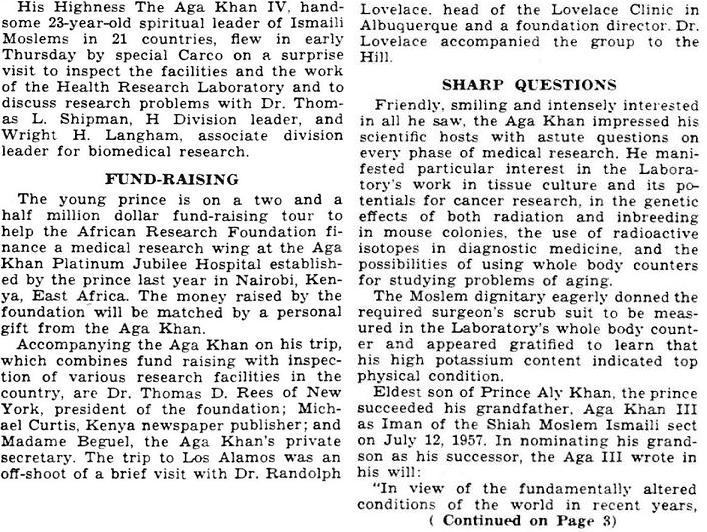
“Friendly, smiling and interested in everything he saw, the Aga Khan impressed his scientific hosts on every phase of the medical research. He manifested particular interest in the Laboratory’s work in tissue culture and its potential for cancer research, in the genetic effects of both radiation and inbreeding in mouse colonies, the use of radioactive isotopes in diagnostic medicine, and the possibilities of using whole body counters for studying the problems of aging.

“The Moslem leader eagerly donned the required surgeon’s scrub suit to be measured in the Laboratory’s whole body counter and appeared gratified to learn that his high potassium content indicated top physical condition.” — Excerpt from “NASL Community News”

aga-khan-iv-in-surprise-visit1

The Aga Khan, seen with Dr. Thomas Shipman, showing immense delight of gift of trinite presented to him during his visit to the Health Research Laboratory in Las Alamos, California, in November 1959

Official News Release of the Aga Khan's Visit to the Lab

OFFICIAL NEWS RELEASE OF THE AGA KHAN’S VISIT TO THE LAB ON THANKSGIVING DAY, NOVEMBER 27, 1959

The following is the transcript:

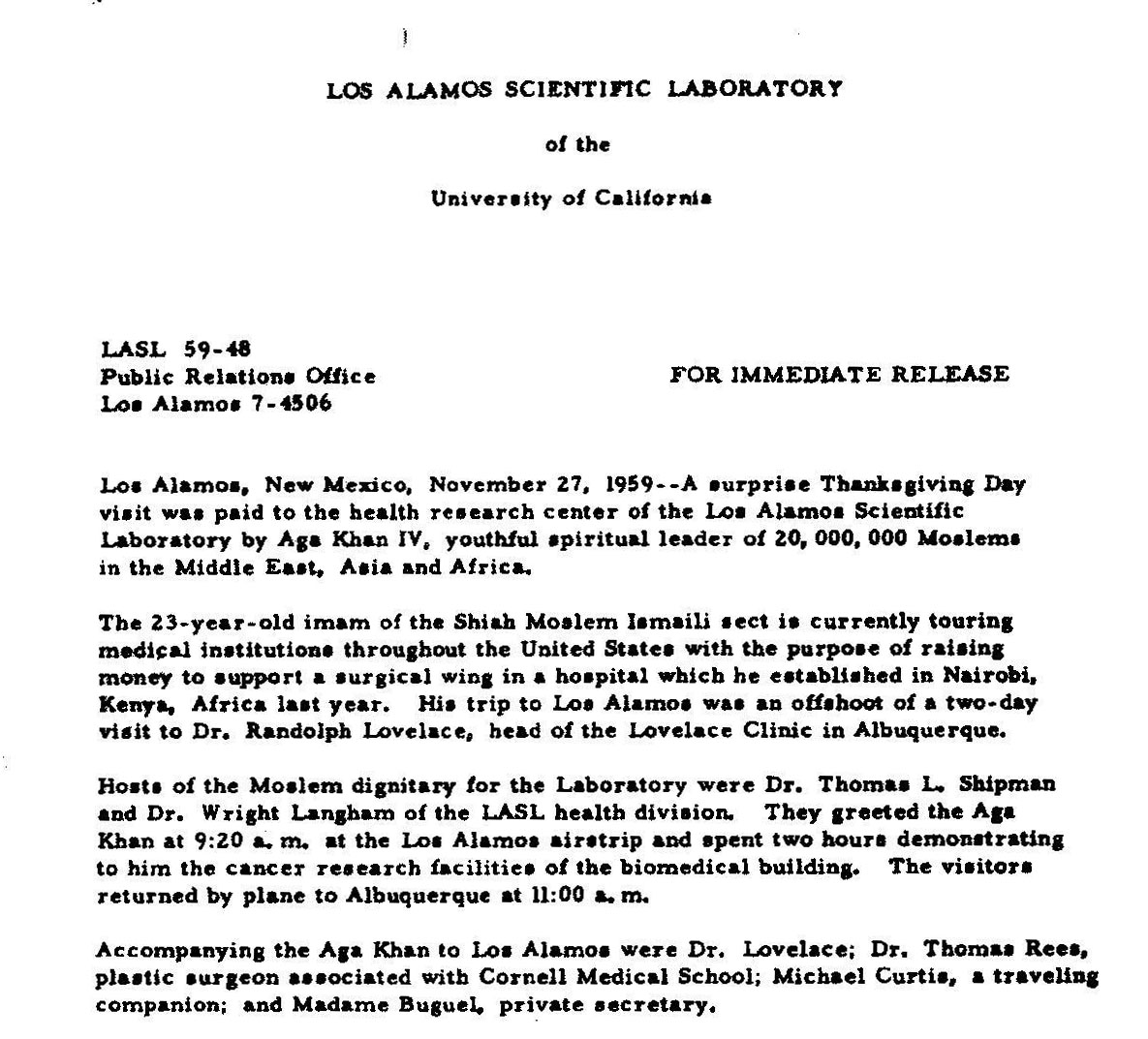
Los Alamo, New Mexico, November 27, 1959: A surprise Thanksgiving Day visit was paid to the health research center of the Los Alamos Scientific Laboratory (LASL) by Aga Khan IV, youthful spiritual leader of 20,000,000 Moslems in the Middle East, Asia and Africa.

The 23-year-old Imam of the Shiah Moslem Ismalli sect is currently touring medical institutions throughout the United States with the purpose of raising money to support a surgical wing in a hospital which he established in Nairobi, Kenya, Africa last year. His trip to Los Alamos was an offshoot of a two-day visit to Dr. Randolph Lovelace, head of the Lovelace Clinic in Albuquerque.

Hosts of the Moslem dignitary for the Laboratory were Dr. Thomas L. Shipman and Dr. Wright Langham of the LASL health division. They greeted the Aga Khan at 9:20 am at the Los Alamos airstrip and spent two hours demonstrating to him the cancer research facilities of the biomedical building. The visitors returned by plane to Albuquerque at 11:00 am.

Accompanying the Aga Khan to Los Alamos were Dr. Lovelace; Dr. Thomas Rees, plastic surgeon associated with Cornell Medical School; Michael Curtis, a traveling companion; and Madame Buguel, private secretary.

_________________

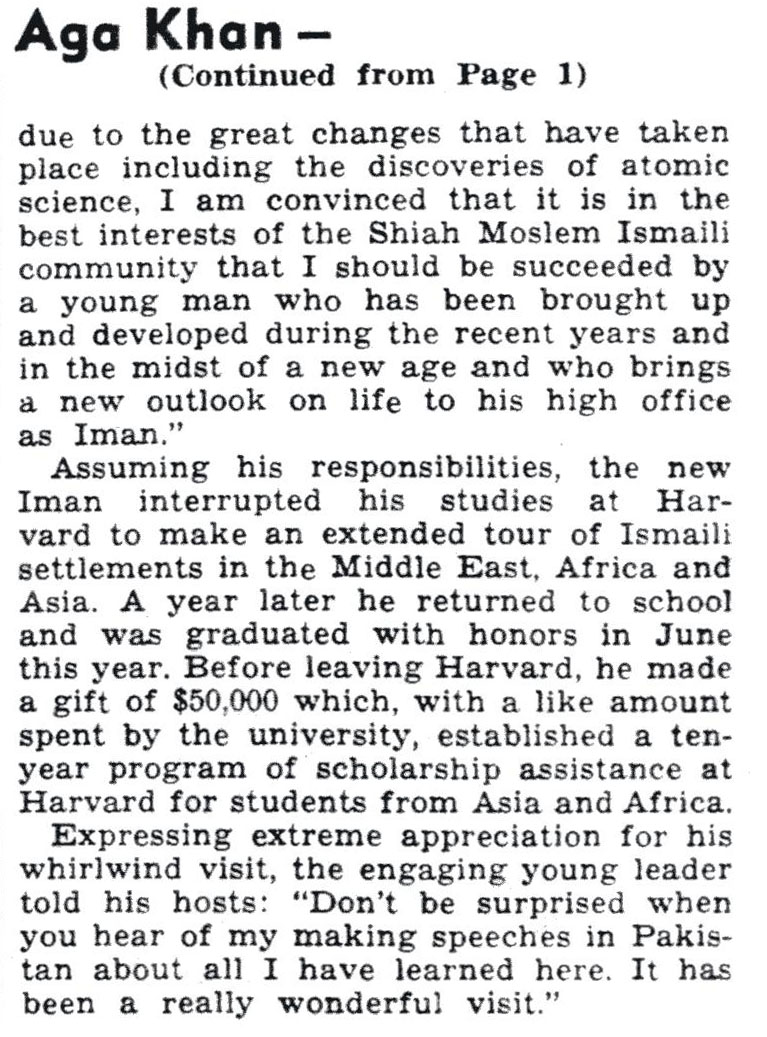
A report of the visit appeared in “NASL Community News” on December 3, 1959, Volume 1 Number 24, under the heading “YOUNG AGA KHAN TOURS HEALTH LAB ON SURPRISE THANKSGIVING VISIT.” See below for images of the report, and click each image on this page for enlargement.

Aga Khan IV Los Alamos Lab Visit News Report page 1

continuation of above news report

Last updated: September 25, 2015.

______________________

NOTES

1. About Los Alamos (from Wikipedia)

In a study conducted by American City Business Journals in 2004, Los Alamos County topped the list as the best place to live in America in terms of quality of life. This was attributed to the high levels of job stability, income and education of Los Alamos residents, many of whom are employed as scientists and engineers at the Los Alamos National Laboratory. The county has one of the highest number of PhDs per capita and the median household income of $78,993 per year is the fourth highest among all the counties in the US. In per capita income, Los Alamos County ranks 1st in New Mexico and 18th in the United States. Other factors contributing to Los Alamos’s high quality-of-life index were the access to affordable housing and short commuting times.

2. Source of article of the Aga Khan’s Visit:

http://www.lanl.gov/

(This piece had appeared on this website earlier – ed.)

A UCSF Video Introduction to His Highness the Aga Khan: “He Does Good Work and Moves Quickly”

“[the] Aga Khan and his network have done such remarkable development work across the world, especially in Asia and East Africa, and we’re delighted to play a part in spreading our knowledge throughout the world with partners like him.” — Sam Hawgood, School of Medicine, University of California San Francisco (UCSF)

PLEASE CLICK: The Aga Khan Visits UCSF to Strengthen Partnership to Advance Global Health

A Unique Video of the Signing Ceremony Establishing “Seat of the Ismaili Imamat” in Portugal

Editor’s note: We are pleased to offer our readers a link to an extraordinary footage shown on Portuguese Cable News Channel, SIC Noticias,  of the signing ceremony that took place in Lisbon establishing the Seat of the Ismaili Imamat in Portugal. We also include two other short clips of remarks made by the Foreign Minister of Portugal and the Prime Minister of Portugal. The event in Lisbon on June 3, 2015 was a truly historic moment in the modern history of the Ismaili Imamat, and earlier this week we brought you the complete English text of the Agreement. Readers who haven’t read the text are invited to click on “Seat of the Ismaili Imamat” — Text of the Historic Agreement.

I. FANTASTIC VIDEO OF THE HISTORIC SIGNING ESTABLISHING THE SEAT OF THE ISMAILI IMAMAT IN PORTUGAL

Please click on image below or “Video of the Signing of the Historic Agreement Establishing the Seat of the Ismaili Imamat in Portugal

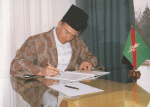
His Highness the Aga Khan signing the historic document establishing the Seat of the Ismaili Imamat in Portugal. Please click on image to view the video.

His Highness the Aga Khan signing the historic document establishing the Seat of the Ismaili Imamat in Portugal. Please click on image to view the video.

~~~~~~

II. REMARKS BY THE MINISTER OF FOREIGN AFFAIRS, RUI MACHETE

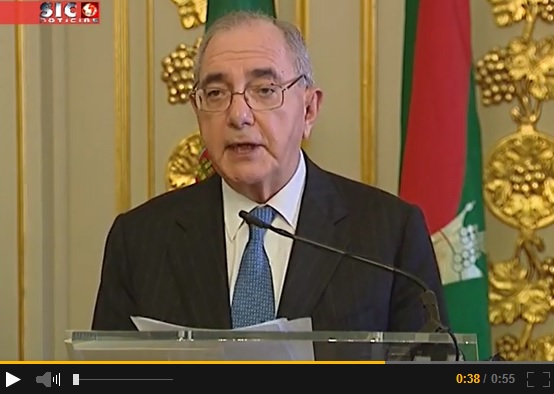
Portugal's Minister of Foreign Affairs speaking at the signing of the Agreement  establishing the Seat of the Ismaili Imamat in Portugal. Please click on image to view a video clip of the remarks.

Portugal’s Minister of Foreign Affairs speaking at the signing of the Agreement establishing the Seat of the Ismaili Imamat in Portugal. Please click on image to view a video clip of the remarks.

~~~~~~

III. REMARKS BY THE PRIME MINISTER OF PORTUGAL, PEDRO PASSOS COELHO

Portugal's Prime Minister speaking at the signing of the Agreement establishing the Seat of the Ismaili Imamat in Portugal. Please click on image to view a video clip of the remarks.

Portugal’s Prime Minister speaking at the signing of the Agreement establishing the Seat of the Ismaili Imamat in Portugal. Please click on image to view a video clip of the remarks.

Date posted: August 6, 2015.

Full English text of agreement at “Seat of the Ismaili Imamat” — Text of the Historic Agreement Between the Ismaili Imamat and the Portuguese Republic.

__________

This post is also reproduced at http://www.simergphotos.com, Simerg’s photo blog.

“Seat of the Ismaili Imamat” — Text of the Historic Agreement Between the Ismaili Imamat and the Portuguese Republic

Introduced by Abdulmalik Merchant
Publisher-Editor, Simerg.com

Mawlana Hazar Imam thanking the government for inviting the Ismaili Imamat to establish its permanent Seat in Portugal. TheIsmaili/Gary Otte

June 3, 2015: Mawlana Hazar Imam thanking the government for inviting the Ismaili Imamat to establish its permanent Seat in Portugal. TheIsmaili/Gary Otte

On Thursday June 4, 2015, in a piece entitled History in the Making: Establishment of the Seat of the Ismaili Imamat in Portugal, we informed our readers about a landmark agreement that was signed a day earlier by His Highness Prince Karim Aga Khan, the 49th hereditary Imam of the Shia Imami Ismaili Muslims, and Portugal’s Minister of State and Foreign Affairs, Rui Machete, at the historic Necessidades Palace in Lisbon. The Agreement marked the first such accord in the Ismaili Imamat’s modern history.

We are pleased to inform our readers that we now have access to this milestone agreement which is being reproduced in full below based on the text of the original English version of the document, which appears on the website of the Portuguese Parliament. [1]

The Agreement is divided into 5 chapters dealing with (1) General Provision; (2) The Seat of Imamat; (3) Prerogatives of the Imam and the Members of the Seat; (4) Cooperation; and (5) Final Provisions, and consists of  21 articles. The Agreement, reflecting the mutual trust and esteem which has traditionally characterised the relationship between the Republic of Portugal and Mawlana Hazar Imam, affirms the recognition of the legal personality of the Ismaili Imamat.

During the signing on June 3, His Highness the Aga Khan hailed the agreement as a historic milestone in the Imamat’s history and said:

“Today is a unique and important occasion, where for the first time in our history we will have the opportunity to work with a partner with whom we share so many values, so many hopes and so many desires.”

________________

AGREEMENT BETWEEN
THE PORTUGUESE REPUBLIC
AND
THE ISMAILI IMAMAT
FOR
THE ESTABLISHMENT OF
THE SEAT OF THE ISMAILI IMAMAT IN PORTUGAL
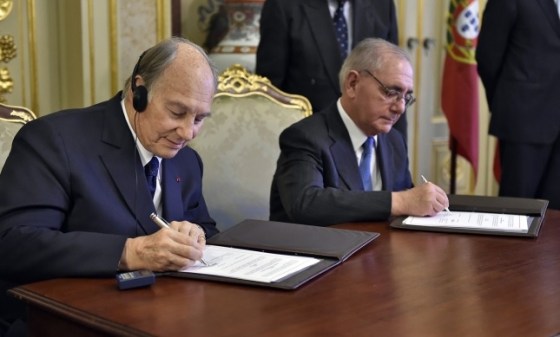
Mawlana Hazar Imam and Portugal’s Minister of State and Foreign Affairs Rui Machete sign a landmark agreement establishing a formal Seat of the Ismaili Imamat in Portugal. TheIsmaili/Gary Otte

Mawlana Hazar Imam and Portugal’s Minister of State and Foreign Affairs Rui Machete sign a landmark agreement on June 3, 2015, establishing a formal Seat of the Ismaili Imamat in Portugal. TheIsmaili/Gary Otte

The Portuguese Republic and the Ismaili Imamat, hereinafter referred to as “Parties”,

Considering the Protocol of Co-operation between the Government of the Portuguese Republic and the Ismaili Imamat, signed in Lisbon on 19 December 2005 and considering further the Protocol of International Co-operation between the Ministry of Foreign Affairs of the Portuguese Republic and the Ismaili Imamat signed on 11 July 2008;

Recalling the Agreement between the Portuguese Republic and the Ismaili Imamat, signed in Lisbon, on 8 May 2009, whereby the legal personality of the Ismaili Imamat is recognised;

Having in mind the common purpose of strengthening the historical ties uniting both Parties, as well as of promoting enhanced enabling conditions for the activities of the Ismaili Imamat, its governance bodies and its dependent institutions, in particular the member entities of the Aga Khan Development Network;

Furthermore having in mind the promotion of the quality of life of the global Shia Imami Ismaili Muslim Community and more generally of the people of the countries where the Ismaili Imamat or its dependent institutions are or may become active, including Portugal and the Portuguese people in particular;

Considering that both Parties assume, as common objectives, the defence of human dignity, economic and social development, interfaith dialogue and the peaceful resolution of conflicts, as ways of achieving justice and peace;

Affirming the interest of both Parties in the establishment of the Seat of the Ismaili Imamat in the territory of the Portuguese Republic and their common will mutually to respect each other’s autonomy in the context of the mutual trust and esteem which has traditionally characterised their relationship;

Believing in the historic significance of such a decision for both Parties and fully appreciating the long term implications and complexities that such a decision entails;

Considering that the privileges, immunities and facilities recognised are not granted for the personal benefit of their holders, but merely in order to contribute to the effective and independent performance of their official and institutional functions on Portuguese territory;

Agree as follows:

Chapter I: General Provisions

ARTICLE 1

Definitions

For the purposes of this Agreement, the following terms shall have the meaning set forth below:

a) “Ismaili Imamat”, a legal entity, means the institution or office of the Imam of the Shia Imami Ismaili Muslims established in accordance with the applicable customary law;

b) “Imam” means the Imam of the Shia Imami Ismaili Muslims, embodying the Ismaili Imamat at any given time in history, designated in accordance with the said customary law;

c) “Dependent Institutions” means the instrumentalities of the Ismaili Imamat, in particular the member entities of the Aga Khan Development Network around the world, more particularly Fundação Aga Khan, a Portuguese foundation created by decree-law in 1996;

d) “Seat” means the global head office of the Ismaili Imamat, as further defined in the present Agreement;

e) “Members of the Seat” means the Senior Officials and the Staff Members of the Seat of the Ismaili Imamat;

f) “Senior Officials” means the Heads of the Ismaili Imamat Departments;

g) “Staff Members” means the Members of the Seat employed in the administrative and technical service of the Seat;

h) “Premises of the Seat” means the buildings or parts of buildings and the land ancillary thereto used exclusively for carrying out the official mission and performing the official functions of the Ismaili Imamat, including the central Seat premises, the premises of the Delegation of the Ismaili Imamat in Lisbon and the official residence of the Imam.

ARTICLE 2

Object

1. The Portuguese Republic acknowledges the legal personality and capacity of the Ismaili Imamat to act in international relations and welcomes the decision of the Imam to establish the Seat of the Ismaili Imamat in Portugal.

2. This Agreement establishes the privileges, immunities and facilities extended by the Portuguese Republic to the Ismaili Imamat, the Imam, the Senior Officials and the Staff Members, as well as to its Seat and assets, with a view to ensuring the performance of their official functions in Portugal and facilitating the same internationally.

_____________

Chapter II: Seat of the Ismaili Imamat

ARTICLE 3

Seat

1. The Portuguese Republic shall ensure the conditions for the establishment of the Seat of the Ismaili Imamat within its territory as well as for the exercise of its functions, in accordance with the present agreement.

2. The location of the Premises of the Seat shall be subject to mutual agreement between the Parties. Pending the construction or acquisition of the central Premises of the Seat, and within a period of five (5) years, the Seat may be established in Lisbon, in the existing premises of the Delegation of the Ismaili Imamat. The Imam shall notify his decision in this respect to the Minister of Foreign Affairs.

ARTICLE 4

Function of the Seat of the Ismaili Imamat

The function of the Seat is to serve as the global head office of the Ismaili Imamat with a view to:

a) Facilitating the spiritual and secular guidance of the Imam to the Ismaili Community globally;

b) Promoting the quality of life of the Ismaili Community globally and more generally of the people of the countries where the Ismaili Imamat or its Dependent Institutions are active;

c) Enhancing international relations and co-operation with States, International Organisations and other entities.

ARTICLE 5

Appointment of the Members of the Seat

1. The appointment of the Senior Officials of the Seat of the Ismaili Imamat by the Imam shall be preceded by a consultation with the Portuguese Government and shall be notified to the Ministry of Foreign Affairs according to the procedures applicable to members of diplomatic missions accredited in the Portuguese Republic.

2. The number of Members of the Seat shall be determined by the Imam as may be necessary to enable the Ismaili Imamat to carry out its functions. The Ismaili Imamat will review such number with the Ministry of Foreign Affairs.

3. The Ministry of Foreign Affairs shall issue diplomatic identity cards to the Members of the Seat, according to the functions they perform, the highest level being attributed to Senior Officials and the other levels to the other Members of the Seat as the Minister of Foreign Affairs and the Imam shall establish.

ARTICLE 6

Inviolability of the Premises of the Seat

1. The Portuguese authorities shall take all appropriate steps to protect the Premises of the Seat of the Ismaili Imamat against any intrusion, threats or damage.

2. The Premises of the Seat, as well as the Ismaili Imamat land, air or sea vehicles used for its official functions, are inviolable, except in emergency situations that endanger public order and security, in case of a serious incident or any other event requiring immediate protective measures.

3. The Premises of the Seat cannot be used as a place of refuge for any individual prosecuted for a crime or flagrante delicto or subject to a court warrant, criminal conviction or a deportation order issued by the Portuguese authorities.

ARTICLE 7

Inviolability of files and correspondence

The files and documents as well as the official correspondence of the Ismaili Imamat are inviolable at any time and wherever located within Portuguese territory.

ARTICLE 8

Use of distinctive signs

The Ismaili Imamat shall be entitled to use distinctive signs, flags and emblems, in the Premises of the Seat as well as on any of the said official vehicles, which shall enjoy a registration status no less favourable than that accorded by the Portuguese Republic to diplomatic missions.

ARTICLE 9

Facilities in respect of communications

The Ismaili Imamat shall enjoy on the territory of the Portuguese Republic, for the purposes of its official communications and correspondence, treatment no less favourable than that accorded by the Portuguese Republic to diplomatic missions.

ARTICLE 10

Immunity from jurisdiction and from execution

The Ismaili Imamat and its assets shall enjoy immunity from jurisdiction and execution within the scope of its official activities, except:

a) When the Ismaili Imamat expressly waives those immunities;

b) In the context of cases related to employment contracts;

c) In a lawsuit brought by a third party with a view to obtaining financial compensation for death and injuries suffered as a result of an accident caused by vehicles owned or used by the Seat, or in case of any offence involving one of those vehicles.

ARTICLE 11

Fiscal exemptions

1. Gifts and bequests made by the Ismaili Imamat or the Imam within the context of their official functions or received by the Ismaili Imamat or the Imam, as well as income received by them, including capital gains, as well as the assets held by the Ismaili Imamat or the Imam, shall not be subject to any tax, including income or wealth tax.

2. Without prejudice to the application of more favourable provisions, granted by the Portuguese Republic to any other religious institution, the provisions of paragraph 1 shall not extend to:

a) Income deriving from any business activity directly exercised in Portugal neither to the assets connected to such activity;

b) Interest and other investment income, either due or paid by any resident in Portugal or effectively connected with the activity of a permanent establishment or fixed base in Portugal, as foreseen in the Portuguese corporate income tax code.

3. The income referred to in paragraph 2 (b) shall be subject to withholding tax, of a final character, in accordance with the corporate income tax legislation of the Portuguese Republic.

4. The Ismaili Imamat shall be exempt from any national or local tax on immovable property as regards the Premises of the Seat.

5. The Ismaili Imamat and the Imam shall be exempt from stamp duty, as well as from any other transfer tax, on the acquisition or sale of movable or immovable properties used or to be used for their official functions.

6. The Ismaili Imamat and the Imam shall be exempt from any taxes or duties on the purchase, ownership, registration, use or sale of land, air or sea vehicles, including spare parts and consumables, used for its official functions.

7. The Ismaili Imamat shall be entitled to a refund of the amounts corresponding to VAT paid on goods, including the vehicles above-mentioned, and services purchased or imported for its official use. The Portuguese Republic will establish the conditions and procedures for the application of such refund.

8. Gifts made to the Ismaili Imamat shall be tax deductible according to the Portuguese legislation applicable to gifts made to religious institutions.

ARTICLE 12

Funds, foreign currency and assets

1. Subject always to the laws and regulations of the Portuguese Republic and of the European Union, namely those regarding the fight against money laundering and terrorism, the Ismaili Imamat may hold funds, securities, gold and other precious metals, or foreign currencies.

2. The Ismaili Imamat shall be free to receive any such values from within or from outside Portugal and hold and transfer the same within Portugal or from Portugal to any country and to convert any currency held or bought into any other currency.

3. This does not preclude the Portuguese Republic from adopting any requirements resulting from its membership of the European Union, including measures prohibiting, restricting or limiting the movement of capital to or from any third country.

Continued after photo below

The agreement establishing Portugal as the seat of the Ismaili Imamat took place at the Palace of Necessidades. It  is a historical building in the Largo do Rilvas, a public square in Lisbon, Portugal. It serves as headquarters of the Portuguese Foreign Ministry. Palace Photo Photo: Wikipedia.

The agreement establishing Portugal as the seat of the Ismaili Imamat took place at the Palace of Necessidades. It is a historical building in the Largo do Rilvas, a public square in Lisbon, Portugal. It serves as headquarters of the Portuguese Foreign Ministry. Palace photo: Wikipedia.

Chapter III: Prerogatives of the Imam and the Members of the Seat

ARTICLE 13

Prerogatives of the Imam

1. The Imam shall be granted the following prerogatives:

a) Ceremonial diplomatic treatment accorded in Portugal to foreign High Entities;

b) His official residence shall enjoy the same inviolability and protection as the premises of the Seat;

c) Inviolability of any type of papers, documents or materials as well as of any communications;

d) Immunity from any judicial action and legal proceedings in respect of acts done in the performance of his functions for the Ismaili Imamat, including immunity from any measures of execution;

2. The direct family members of the Imam shall be accorded the appropriate facilities and courtesy treatment.

ARTICLE 14

Prerogatives of the Senior Officials

The Senior Officials of the Seat shall enjoy such privileges, immunities and facilities as are necessary for the performance of their functions, such as:

a) Ceremonial treatment accorded to diplomatic representatives of equivalent level and in the same circumstances;

b) Their residence shall enjoy the same inviolability and protection as the Premises of the Seat;

c) Inviolability of any type of papers, documents or materials relating to the functions of the Ismaili Imamat, as well as of any communications;

d) Immunity from any judicial action and legal proceedings, including immunity from any measures of execution, in respect of acts done by them in the performance of their functions for the Ismaili Imamat;

e) Exemption from all direct taxes and social charges on salaries, wages and other similar remuneration paid to them in their capacity as Senior Officials by the Ismaili Imamat or its Dependent Institutions;

f) When required by Portuguese or European legislation, facilitation of issuance of visas and residence permits, extended to direct family members.

ARTICLE 15

Prerogatives of the Staff Members

The Portuguese authorities guarantee the protection and necessary assistance to the Staff Members of the Seat with a view to securing the efficient performance of their official functions, including, when required by Portuguese or European legislation, facilitation of issuance of visas and residence permits.

Chapter IV: Cooperation

ARTICLE 16

Support for scientific and economic development

1. The Ismaili Imamat shall actively support the efforts of the Portuguese Republic to improve the quality of life of all those living in Portugal, particularly through the development in Portugal of world-class research projects in the said area, but more generally on subjects of common interest to the Portuguese Republic and the Ismaili Imamat.

2. In view of the above, the Ismaili Imamat shall cause its highest level Dependent Institutions to create a special window devoted to achieving the objectives set out above in cooperation with the relevant Ministries or other entities of the Portuguese Government.

Chapter V: Final Provisions

ARTICLE 17

Joint Committee and Settlement of disputes

The Parties shall establish a Joint Committee composed of six (6) members, three (3) appointed by the Portuguese Republic and three (3) by the Ismaili Imamat, for the following purposes:

a) Aiming to guarantee the implementation of the present Agreement;

b) Settling any differences or disputes concerning the interpretation or application of the present Agreement, with the understanding that, if an agreed solution cannot be found in the context of the Joint Committee, the matter shall be brought to direct negotiation between the Parties.

ARTICLE 18

Amendments

1. The present Agreement may be amended by the Parties by written mutual consent.

2. The amendments shall enter into force in accordance with the terms specified in Article 21 of the present Agreement.

ARTICLE 19

Duration and termination

1. The present Agreement shall remain in force for an unlimited period of time.

2. Either Party may, after an initial period of twenty-five (25) years, terminate the present Agreement upon prior written notice of four (4) years, to be communicated through diplomatic channels. The Parties may by written agreement, modify the length of the said notice time.

ARTICLE 20

Cooperation with competent authorities

The Ismaili Imamat shall fully co-operate with the competent Portuguese authorities, without prejudice to this Agreement, with a view to complying with Portuguese legislation and preventing abuse of the privileges, immunities and facilities granted under the present Agreement.

ARTICLE 21

Entry into force

The present Agreement shall enter into force thirty (30) days after the date of notification in writing by the Portuguese Republic to the Ismaili Imamat, conveying the completion of the constitutional procedures of the Portuguese Republic required for that purpose.

Done in Portuguese and English, in Lisbon, on the 3rd day of June 2015.

For the Portuguese Republic

His Excellency Rui Chancerelle de Machete
Ministry of State and Foreign Affairs

For the Ismaili Imamat

His Highness Shah Karim al-Hussaini Prince Aga Khan, Forty-Ninth Hereditary Imam
of the Shia Imami Ismaili Muslims

Date posted: August 3, 2015.
Last updated: August 6, 2015 (Video link of the signing ceremony added, see below).

___________________

EXTRAORDINARY VIDEO: THE SEAT OF THE ISMAILI IMAMAT IN PORTUGAL

Please click on image below or “Video of the Signing of the Historic Agreement Establishing the Seat of the smaili Imamat in Portugugal

His Highness the Aga Khan signing the historic document establishing the Seat of the Ismaili Imamat in Portugal. Please click on image to view the video.

His Highness the Aga Khan signing the historic document establishing the Seat of the Ismaili Imamat in Portugal. Please click on image to view the video.

~~~~~~

[1] The PDF version of the June 3, 2015 Agreement is in the public domain, and may be viewed by clicking on English Text of the Agreement, PDF File, website of the Government of Portugal.

We welcome feedback/letters from our readers. Please click Leave a comment. For links to articles posted on this Web site since its launch in March 2009, please click Table of Contents.

Ismaili Historical Insights: (I) 1925: Mahatma Gandhi on the Meritorious Deed of a Khoja Ismaili

Letter From Publisher

Simerg's Merchant

Simerg’s Merchant

By Abdulmalik J. Merchant

Simerg’s new feature Short Historical Insights is intended to make history educational, interesting and stimulating for readers through anecdotes, facts, stories as well as images related to Ismailis and their Imams, in no more than  500 words. Information in the series will be unearthed from a maze of documents, including those that are not easily accessible due to their sheer size or location, or material which, in the broader scope, would be of interest for research on specific themes. Of course, we will also rely on other well-known (or lesser-known) treatises and texts as well as libraries and museums for this new feature.

For the first episode, we go to a massive work called The Collected Works of Mahatma Gandhi and reveal a story that appears in Volume 33, which is dedicated to the period from September 1925 to February 1926 in Gandhi’s life. During his visit to Mundra in Gujarat, the father of India, is frustrated with members of his own faith with respect to their treatment of the Untouchables* and, somewhat grudgingly, praises the work of one Khoja (Ismaili) named Ibrahim Pradhan Saheb, who has unselfishly built a school for the outcast children.

This anecdote, by none other than Mahatma Gandhi, is an excellent example of the Ismaili spirit of loyalty to their countries of birth or adoption, a matter which Ismaili Imams have placed on their followers as one of their two principal obligations during their lifetime, the other being their loyalty to the Ismaili Muslim faith. Ibrahim Pradhan was an exemplary Ismaili in this regard, and we are pleased to provide a short account of his contribution from Mahatma’s own two speeches made in 1925.

Readers are invited to contribute to this new feature by submitting their pieces to  Simerg@aol.com. We always acknowledges letters and submissions from non-anonymous sources.

Ibrahim Pradhan’s Meritorious Deed As Recorded By Mahatma Gandhi

102 – Gandhi’s Speech at Mundra, November 1, 1925, page 177 – 181

Mahatma Gandhi spinning yarn in the 1920's. Photo: Wikipedia.

Mahatma Gandhi spinning yarn in the 1920’s. Photo: Wikipedia.

(It is noted by Mahadev Desai that Mahatma Gandhi began his speech with “Antyaja brothers and sisters, their sympathizers, and other Hindu brothers and sisters”)

” ….It is wrong to invite me to a place where the entire public believes in untouchability. It is an insult to invite me to a place where the untouchables are treated with nothing but contempt. After having come here, I heard of the school for the untouchables. I felt that at such a place the Antyajas [lit. the last born – ed] would receive service. I would congratulate Ibrahim Pradhan Saheb on the school but the Hindu public deserves no such congratulations. Its existence puts the Hindus to shame. It is a matter of shame for me if a Muslim builds a Siva temple for my benefit. I was pleased to see the school’s activity of spinning and weaving; however, I immediately felt that neither I nor the Hindus could take credit for this meritorious deed. I can have no sense of satisfaction if a Muslim recites the Gayatri mantra instead of me. I can only feel satisfied when a Brahmin comes along and offers to recite the  Gayatri for me. However, in this case, the Khojas are doing the work that should be done by Hindus. Here, no one is bothered in the least about the Antyajas. I do not see any non-Antyajas except the guests sitting among the  Antyajas here before me. Even those who go around with me during the day have abandoned them and are seated in the enclosure for high-caste gentlemen. If you could rip open my heart today, you would find it crying — ‘O Lord! Could this be the Hindu dharma, where no one cares for the Antyajas? Is there not a single person in the town who will come to their rescue’?…

103 – Gandhi’s Reminiscences of Kutch, November 1, 1925, pages 181-187

Location of Mundra in the Kutch district of  India's Gujarat State. Image: Wikipedia.

Location of Mundra in the Kutch district of India’s Gujarat State. Image: Wikipedia.

I had my bitterest experience in Mundra. I found only hypocrisy, insincerity and play-acting there. Even Muslims were made to sit in the enclosure for those who supported untouchability as if they too believed in it. Hence, only my companions and the Muslim volunteers remained in the section reserved for Antyajas. Many among the Hindu volunteers, though they claimed that they did not believe in untouchability at all, were nevertheless kept in the enclosure meant for those who did believe in it.

There is a school for the Antyajas in Mundra but it is a philanthropic Muslim gentleman, Sheth Ibrahim Pradhan, who runs it at his own expense. The school may be regarded as good up to a point. The children are kept very clean. The building is in the centre of the city. The children had even been taught Sanskrit verses, [which they recited] in a broken accent. Spinning, carding, ginning and weaving were taught in the school itself. Only children’s clothes were not made of khadi [handspun and hand-woven cloth – ed.]; however, the organizers had gone in for the cloth believing it to be pure khadi. The reader might perhaps conclude that this school would give me some satisfaction. It gave me no satisfaction but caused me grief, rather, as the credit for it would not go to a Hindu. I have already mentioned the name of the gentleman who finances it.

Yerawada (or Aga Khan) Palace, now the Gandhi Memorial, was built by the 48th Ismaili Imam to provide a means of livelihood to the famine stricken people in Pune. Historically, the palace holds great significance. Mahatma Gandhi, his wife Kasturba Gandhi and his secretary Mahadev Desai were interned in the palace from 9 August 1942 to 6 May 1944.  In 1969, the current 49th Ismaili Imam, Prince Karim Aga Khan, donated the Palace to the Indian people as a mark of respect to Gandhi and his philosophy. Today, the palace houses a memorial on Gandhi where his ashes were kept.

Yerawada (or Aga Khan) Palace, now the Gandhi Memorial, was built by the 48th Ismaili Imam to provide a means of livelihood to the famine stricken people in Pune. Historically, the palace holds great significance. Mahatma Gandhi, his wife Kasturba Gandhi and his secretary Mahadev Desai were interned in the palace from 9 August 1942 to 6 May 1944. In 1969, the current 49th Ismaili Imam, Prince Karim Aga Khan, donated the Palace to the Indian people as a mark of respect to Gandhi and his philosophy. Today, the palace houses a memorial on Gandhi where his ashes were kept.

The gentleman in charge of this school is the heir of the Aga Khan in Mundra. Sheth Ibrahim Pradhan deserves all praise for his charity, as I was informed that this school is not being run for the purpose of converting the untouchables or schoolchildren to Islam, but in order to enable them to make progress as Hindus. The people of Mundra also informed me that the gentleman in charge, Mauledina Meghji was a Vedantin [belonging to a school of Indian philosophy – ed.] and a learned person. All this must be regarded as satisfactory. However, what is the contribution of the Hindus? Untouchability is an ugly blot on the Hindu religion, it is a sin. The Hindus alone can do prayaschitta [atonement for sins] for it. The dirt on my body will go only when I myself remove it.

This institution adds to the prestige of Sheth Ibrahim Pradhan, and to that extent to the shame of the Hindus.

Date posted: July 26, 2015, word count, appx. 400 words.

_____________

Notes and references:

*Untouchables are outcasts—people considered too impure, too polluted, to rank as worthy beings. Prejudice defines their lives, particularly in the rural areas, where nearly three-quarters of India’s people live….Although the Indian constitution makes caste discrimination illegal, Untouchables living at the bottom of society are subjected to indignities” — from http://ngm.nationalgeographic.com/ngm/0306/feature1/

See complete volume 33 at http://www.gandhiserve.org/cwmg/VOL033.PDF.

@Simergphotos: The Silk Road Through the Lens of Muslim Harji and the Smithsonian Folklife Festival

Simergphotos presents An Anthology of the Silk Road Through the Lens of Muslim Harji and Smithsonian’s Folklife Festival with magnificent photos taken by Harji during his recent visits to the iconic Silk Road cities of Samarkand and Bokhara in Uzbekistan. Then the post steps back in time and brings you wonderful memories from the Smithsonian Institution’s Annual Folklife Festival held in Washington D.C. in 2002, which was entirely dedicated to one single subject: The Silk Road. The post contains photos from the opening day, which was attended by His Highness the Aga Khan, as well as an excellent thematic anthology covering many aspects of the exciting Silk Road!…More at Simergphotos.

Please click on image for Silk Roads Photo Essay.

Please click on image for Silk Roads Photo Essay.

PLEASE CLICK: An Anthology of the Silk Road Through the Lens of Muslim Harji and Smithsonian’s Folklife Festival

Mawlana Hazar Imam at the Silk Roads Festival in Washington D.C. IN 2002. Please click for more photos.

Mawlana Hazar Imam at the Silk Roads Festival in Washington D.C. IN 2002. Please click for more photos.

Condensed Explanation of the Ismaili Munajat, “Ya Ali Khuba Mijalas” with a recitation by Shamshudin Bandali Haji

Imamat Day Calligraphy, Simerg
Calligraphy by Karim Ismaili on the auspicious occasion of Mawlana Hazar Imam’s 63rd Imamat Day Anniversary.

Editor’s note: This is a very condensed, yet comprehensive, post on the munajat, Ya Ali Khuba Mijalas. For the complete version, which offers much more in terms of the ginan’s history, composition, style, and explanation with a glossary, please click Original article.

By Sadrudin K. Hassam

INTRODUCTION

Popular tradition has it that the munajat, Ya Ali Khuba Mijalas, was first recited during the enthronement ceremony of the 48th Imam, Mawlana Sultan Mahomed Shah, His Highness the Aga Khan III, which took place at Aga Hall at Mazagon Road in Mumbai in September 1885. Another tradition says that the recitation first took place when the young Imam met his followers at the main Ismaili Jamatkhana in Mumbai, known as the Darkhana. In any case, the munajat became very much part of the Ismaili tradition in many parts of the world to recite it in jamati gatherings (mijalas) to commemorate the enthronement of their 48th Imam Sultan Muhammad Shah, the late Aga Khan III (1877 – 1957). Continuing with this tradition, this Munajat, with slight variations, is now recited on the occasion of the anniversary of the ascension of Mawlana Shah Karim al-Husseini (His Highness the Aga Khan IV) as the 49th Ismaili Imam.  July 11th, 2020 marks his 63rd Imamat anniversary.

The Arabic word munajat is formed from the root word na-ja-wa which means ‘to converse secretly’ or ‘confidentially’. From the context of the ginanic literature of the Ismailis, the term munajat would be equivalent to venti (supplication). Apart from conveying this basic idea of venti, the term munajat also has the connotation of conveying mubaraki (greetings) and adoration or reverence to a holy person, in this case the Ismaili Imam.

The complete munajat has eight stanzas of four lines each, the chopai. At the end of each stanza there is a warani (refrain) of four lines which ends with the words ‘Mubarak hove’. This refrain is repeated at the end of each stanza for collective recitation and participation of the Jamat.

EXPLANATION

It is not an easy task to explain and translate a Ginan or Qasida from one language to another. For this munajat which is a blend of several languages and is suffused with deep feelings and sublime supplication, the task becomes even more daunting. A conscious effort has been made to be as close to the original as possible and we hope that this explanation will impart our readers with some understanding about Ya Ali Khuba Mijalas.

Each of the transliterated verse (no accents) is accompanied with its translation. [Key glossary terms are included in the detailed Original article — ed.].

VERSE ONE

Transliteration

Ya Ali Khuba Mijalas Zinat Karake
Farasha Bichhai Gali,
Aan Baithe Hay Takht-Ke Upar
Shah Karim Shah Vali

Refrain

Aaj Raj Mubarak Hove,
Noor Ain Alikun Raj Mubarak Hove,
Shah Aal-e Nabi Kun Raaj Mubarak Hove,
Hove Hove Aaj Raj Mubarak Hove.

Explanation

O Ali! In the fair assembly,
gloriously adorned with carpets spread on the floor,
Our Lord Shah Karim sits on the takht,
our Lord Shah Karim our Guardian.

Refrain

Today blessed be your rule
Oh the light of Ali’s eye,
Blessed be your rule
Shah, the descendant of the Holy Prophet,
Blessed be your rule today
Blessed be your rule today.

VERSE TWO

Transliteration

Ya Ali Didar Lenekun Aye Shah Teri,
Hindi Jama-et Sari,
Sijada Baja Kar Najaran Deve
Jan Apniku Vari…. Aaj.

Explanation

O Ali! To be blessed with didar (glimpse of the Imam)
your whole Indian jamat have assembled.
They prostrate and they offer nazrana (homage)
devoting their lives to you.

VERSE THREE

Transliteration

Ya Ali Tera Nasiba Roje Awal-Se,
Deta Haire Kamali,
Shah Sultan Shah Ke Mukhamen Se Nikala,
Shah Karim Shah Vali….Aaj

Explanation

O Ali! Your fortune from the very first day (right from the beginning)
has bestowed perfection upon you,
Hazrat Imam Shah Sultan Muhammad Shah declared that
Mawlana Shah Karim is the Lord and the Guardian.

VERSE FOUR

Transliteration

Ya Ali Shah Kahun To Tujakun Baja Hay,
Bakhta Bulanda Peshani,
Chhoti Umarmen Aali Marataba,
Taluki Hay Nishani….Aaj

Explanation

O Ali! To call you Lord is your due.
Your fortune and greatness is evident on your forehead.
Your exalted status at the young age
is a sign of greatness.

VERSE FIVE

Transliteration

Ya Ali Takhta Ne Chhatra Tujakun Mubarak,
Zaheraji-Ke Piyare,
Abul Hasan Shah Karani So Teri
Jannat Aap Sanvare….Aaj

Explanation

O Ali! May your throne and canopy (exalted position) be blessed,
the dear one of Fatimatuz Zahra.
O Mawla Ali! All this is because of your glorious deeds.
Paradise is embellished by your presence.

VERSE SIX

Transliteration

Ya Ali Takht ne Chhatra sunake tere
Falakase Barase Nooran,
Moti Tabaka Hathunmen Lekar,
Shah KunVadhave Huran….Aaj

Explanation

O Ali! At the news of your Takht Nashini (Takhta ne Chhatra)
the heavens shower Light,
with trays of pearls in their hands,
the houris (chaste heavenly maidens) greet the Lord.

VERSE SEVEN

Transliteration

Ya Ali Maheman Khanemen Momankun Jab
La-i ‘Id Musal-le
Shamsi Jo Salavat Pada Kar
Marafat-Ki Khushiyali….Aaj

Explanation

In the guest-house when the celebration
of your Takht Nashini takes place,

the momins celebrate like ‘Id.
They recite the Shamsi prayer, the salwat,
and they experience the ecstasy of spiritual enlightenment.

VERSE EIGHT

Transliteration

Ya Ali Teri Mubarak Badike Khatar,
Sayyad Karte Munajat,
Shah Najaf Tere Pushta Panah
Tere Dushman Hove Fanah….Aaj

Explanation

O Ali! To offer greetings,
the Sayyads make their humble supplication (munajat)
O Ali, the Lord of Najaf, may your progeny be protected
and your enemies be destroyed.

_____________

RECITATION BY LATE SHAMSHU BANDALI HAJI

Credit: http://ginans.usask.ca/

Date posted: July 11, 2015.
Last updated: July 10, 2020 (Ginan recitation added).

____________

We welcome your feedback; please click Leave a comment.