Prophet Muhammad’s Meritocratic Life and Ethic Demonstrate Ideals to be Achieved in Muslim World: Dynamism, Social Responsibility, and Balance Between Din (Faith) and Dunya (World)

Editor’s note: The following piece on Prophet Muhammad (s.a.s.) has been adapted from Dr. Amir Gulamhussein’s article, “Significance of the Celebration of the Birthday of Prophet Muhammad,” which appeared in Ilm, volume 12, Number 2, December 1989, on pages 15-21. The flagship Ismaili magazine was published by the Ismaili Tariqah and Religious Education Board (ITREB) for the United Kingdom from 1975 until 1992. Dr. Gulamhussein served as ITREB’s chairman for a number of years, and was also on the editorial board of the magazine during its later stages.

THE CELEBRATION OF THE BIRTHDAY OF PROPHET MUHAMMAD (S.A.S.), WITH AUDIO RECORDING OF SPEECH BY MAWLANA HAZAR IMAM

muhammad-inscription-at-the-prophets-mosque-original

Prophet Muhammad’s name, followed by his title “Apostle of God”(left centre), inscribed on the gates of the Prophet’s mosque in Medina. Photo: Wikipedia.

“In the face of this changing world, which was once a universe to us and is now no more than an overcrowded island, confronted with a fundamental challenge to our understanding of time, surrounded by a foreign fleet of cultural and ideological ships which have broken loose, I ask, do we have a clear, firm and precise understanding of what Muslim society is to be in times to come? And if, as I believe, the answer is uncertain, where else can we search than in the Holy Qur’an, and in the example of Allah’s last and final Prophet?” — His Highness the Aga Khan, March 12, 1976, Karachi, Pakistan.

PROPHET’S BIRTHDAY THROUGH THE CENTURIES

The above quotation of Mawlana Hazar Imam, His Highness the Aga Khan, is from a speech that he delivered to eminent scholars from around the world who had gathered in Karachi to present their research findings and reflect upon various aspects of the life of the Holy Prophet Muhammad (s.a.s). The conference was part of a series of events that were organized to mark the birthday anniversary of the beloved Prophet.

Prophet Muhammad was born in Mecca on the night of 12 Rabi’ al-awwal, the third month in the Islamic lunar calendar, in 570 AC. The birthday of the Prophet is called maulid which denotes the festivities organized on this happy and auspicious day. The alternative term miladun-nabi, which means birth anniversary, is also very commonly used.

The commemoration of miladun-nabi on a grand and festive scale emerged first in Egypt during the Fatimid era (969 – 1171 AC). This is not surprising because the Fatimid Caliphs were descendants of Prophet Muhammad (s.a.s.) through his daughter Hazrat Bibi Fatima (a.s.), who was married to the Prophet’s cousin, Hazrat Mawlana Murtaza Ali (a.s.). The Egyptian historian Maqrizi (d. 1442 AC) describes a Fatimid celebration held in 1122 AC in which the gathering included prominent scholars and officials of the religious hierarchy. They listened to sermons (khutba) and were given sweets, particularly honey, the favourite of the Prophet. On that occasion, the poor received alms. The tradition of miladun-nabi in Egypt was continued from the Fatimid days by all subsequent Muslim dynasties.

The way in which the birthday anniversary was celebrated varied in different countries. In Turkey, the mosques were decorated with lights, whereas in other Islamic lands, the occasion was marked by recitations of na’ats (devotional songs) in praise of the Prophet. In Iraq, the birthday came to be considered in the hierarchy of festive days second only to ‘Id al-fitr and ‘Id al-adha. It was also lavishly celebrated during the Middle Ages in Mecca, the city of his birth. In India, celebrations included large exhibitions of paintings, lectures and a funfair of activities ending with lavish feasts in which everybody participated. More recently in this century, 12 Rabi al-awwal was declared a public holiday in the Ottoman Empire.

A ‘BEAUTIFUL MODEL’

The Prophet’s life and his conduct should become a model on which every Muslim should aspire to build one’s life according to the situation facing the person. Allah says in the Holy Qur’an:

“Verily, in the apostle of God you have a good example for everyone who looks forward (with hope and awe) to God and the Last Day and remembers God unceasingly.” — 33:21.

The prophet (nabi) of Allah, Muhammad, never claimed to possess any superhuman qualities. He maintained that he was a mortal and a servant (‘abd) of Allah to whom revelation (wahi) came. He knew that his role was to be the messenger (rasul) and mediator of Allah in guiding mankind. The Prophet preached that the revelation that he received was by Allah’s unbounded grace, and through this act of mercy and kindness, he was appointed to be a guide amongst the people.

He never claimed vanity inspite of his exalted position as indicated in the Holy Qur’an. As Allah ‘taught Adam the names of all things’, (2:31) so did He teach Muhammad the Qur’an; with the first revelation coming to him on the Night of Qadr. (96:3) The designation of the Prophet as being ‘Mercy for the mankind’, rahmat lil-alamin (21:107), is another example of his lofty post. He saw his role amongst his people as their guide and teacher, and by his example he was to steer them to salvation. Whosoever followed him and his way understood their purpose and meaning of their existence in the world. [6] In this context, the chosen (al-mustafa) prophet became the prototype (uswa hasana), a ‘beautiful model’.

MISUNDERSTANDING

The function of the Prophet has been misunderstood by non-Muslims. His function was not only to be a spiritual guide, but also the organiser of the new social order which came as a result of the last of the revealed books, the Holy Qur’an. Outsiders have understood his role, for example, as a political figure of high distinction and great statesmanship. However, his role as a religious and spiritual guide and how his life could be emulated by those who are aspiring sanctity and piety is still misunderstood.

With regard to this misunderstanding Seyyed Hossein Nasr, the eminent contemporary Muslim scholar, says: “This is particularly true in the modern world in which religion is separated from other domains of life and most modern men can hardly imagine how a spiritual being could also be immersed in the most intense political and social activity.” [7] The integration of the material and spiritual aspect of one’s life was the hallmark of the lifestyle of the Prophet, and how he managed to fulfil this dual role should become an example for Muslims, who today face immense challenges and difficulties in trying to live in societies which have become increasingly material.

BALANCE BETWEEN DIN AND DUNYA

Prophet Muhammad participated fully in social life. He married and had a household. He was a ruler, a judge and a soldier who fought many battles in which he underwent painful ordeals. In his personal life, both as an orphan and adult, he underwent many hardships. In spite of this, he always exhibited humbleness and tolerance. He also made time to detach himself from the hustle and bustle of everyday life and indulged in contemplation and meditation. By this practice, he integrated the worldly  aspect of his life with spiritual activities.

In his daily life, he exercised utmost kindness and showed concern for the weak. His loving kindness extended over all beings. He was noted for his love of children and used to greet them and play with them. He was also known for his love of animals. [8]

He lived simply and his saying faqri fakhri (‘my poverty is my pride’) became a motto for the many. Every phase of his work and action became an ideal model of moral perfection. Whatever he did remains exemplary for his followers and thus his actions and sayings were recorded and preserved in the famous hadith literature.

ETHICS

The nobility and generosity of the Prophet was best exemplified in his triumphant entry into Mecca. The very people who had caused untold hardships to him were forgiven instead of him taking revenge and punishing them. This act of generosity was to become a source of immense joy and pride to his followers, who understood that the Message of Allah in the practice of their faith preached tolerance and forgiveness.

The Prophet’s love and compassion for his fellow beings and his concern for their welfare in all spheres of human endeavours are exemplified and recorded. He was their uncrowned king, ruler and father who was concerned with the welfare of his subjects. His total involvement in social welfare matters of the community (ummah) earned him high praises and respect. He continually sought better relationship between the members of the ummah and those of other faiths (Christians and Jews). In this manner he preached brotherhood, tolerance and patience (sabr) as qualities that would ensure peace and harmony. He sought to make the practice of religion an integral part of life so that there was peace and equilibrium between all forces that confront humankind.

The Prophet’s quality of magnanimity, that is the nobility of his soul and his quality to be above petty feelings, exhibited itself most of all in charity towards men and women and all other beings. There was no narrowness or pettiness in the soul of the Prophet, no limitation in giving of himself to others, both in terms of time and resources. The saying that ‘It is more blessed to give than to receive’ [9] was characteristic of his life until his demise in 632 AC at the age of 62.

SMALLER AND GREATER JIHADS

Anything that sought to destroy this equilibrium was counteracted. For example, the many wars that were fought, whether for political or social reasons, were for preserving the Faith (din) and social justice. In this manner, war had a positive meaning as an activity to establish peace and harmony. It is also interesting to note that apart from the outward war (jihad of combativeness), the Prophet also advocated inward combativeness which was necessary for maintaining the inner equilibrium. This battle was called the ‘great holy war’ (al-jihad al-akbar) and is fought within ourselves against forces that tend to negate AlIah’s Will. Interestingly, the outward war was designated by the Prophet as the ‘small holy war’ (al-jihad al-asghar).

PAST, PRESENT AND FUTURE

In the brief account of the qualities of Prophet Muhammad presented here, one of the key features that emerges is that his lifestyle highlights the fact that in order to achieve harmony, peace and tranquillity within the society at large and within the self, we have to live in this world and not reject it. It is through constant struggle in this world, that we will be in a position to transcend the human state and achieve the realisation of the Absolute which is the true destiny for all of us. The life of the Prophet is looked upon as a prototype by the believers in their quest to achieve this lofty status.

Prophet Muhammad’s meritocratic principles and ethic have been beautifully summarized in the concluding paragraph of the Presidential Address given by His Highness the Aga Khan at the Seerat Conference in Pakistan. He said:

“The Holy Prophet‘s life gives us every fundamental guideline that we require to resolve the problem as successfully as our human minds and intellects can visualise. His example of integrity, loyalty honesty, generosity both of means and of time, his solicitude for the poor, the weak and the sick, his steadfastness in friendship, his humility in success, his magnanimity in victory, his simplicity, his wisdom in conceiving new solutions for problems which could not be solved by traditional methods, without affecting the fundamental concepts of Islam, surely all these are foundations which, correctly understood and sincerely interpreted, must enable us to conceive what should be a truly modern and dynamic Islamic Society in the years ahead.” [10]

Date posted: Wednesday, December 7, 2016.

__________________

Notes:

[1]. The Muslim World: Yesterday, Today and Tomorrow by H.R.H. Prince Karim Aga Khan, Aga Khan Ismailia Federal Council for Pakistan, 1977, p. 23-28.
[2]. And Muhammad is His Messenger by Annemarie Schimmel, University of North Carolina Press, London, 1985, p. 144. The book also provides insights into the manner in which this auspicious occasion was observed and celebrated in various countries in which Islam flourished, p. 144 – 158.
[3]. Dalail an-nubuwwa, Abu Nu’aim, p. 110.
[4]. The Faith of Shia Islam by Muhammad Rida al-Muzaffar, The Muhammad Trust of Great Britain and Northern Ireland, 1982, p. 61.
[5]. Kitab al-mawa’iz……al khitat, Maqrizi, 1:433, 466.
[6]. Manqib al-‘arifin, Aflaki, p. 242, Chapter 3, para. 152, quotes Rumi: “To follow the messenger of God, belongs to the duties of the ahl-i ma’na” (those who have reached the inner meaning of life).
[7]. Ideals and Realities of Islam, by S.H. Nasr, George Allen & Unwin Ltd., London, 1966, p. 68.
[8]. And Muhammad is His Messenger, by Annemarie Schimmel, p. 49.
[9]. Ideals and Realities of Islam, by S.H. Nasr, p. 75.
[10]. The Muslim World: Yesterday, Today and Tomorrow by H.R.H. Prince Karim Aga Khan, p. 28.

~~~~~~~~~~

LISTEN TO SEERAT CONFERENCE PRESIDENTIAL ADDRESS BY HIS HIGHNESS THE AGA KHAN

___________________

We welcome your feedback. Please click Leave a comment.

In 2016, His Highness the Aga Khan’s 80th Birthday and the Commemoration of the Milad of the Prophet Muhammad (s.a.s.) are Only Hours Apart

Papa Jan Photo: His Highness the Aga Khan Hunza Visit

The Jamat of Hunza accept the gracious deedar (glimpse) of Mawlana Hazar Imam, His Highness the Aga Khan, as he visits the Princely State in the Northern Areas of Pakistan in 1960. Hunza was then governed by the Mir of Hunza, who is seen following Hazar Imam. Photo: Abdul M. Ismaily. Copyright.

INTRODUCED BY ABDULMALIK MERCHANT
Editor/Publisher, http://www.simerg.com

For the first time in recent Ismaili history since the accession on July 11, 1957 of Mawlana Hazar Imam, Highness the Aga Khan, to the throne of Imamat, millions of Shia Imami Ismailis around the world will be celebrating his 80th birthday or salgirah on December 13, 2016, just after the commemoration of the milad or birthday of Prophet Muhammad (s.a.s) which falls on the 12th day of the Islamic month of Rabi al-Awwal. These two important festivals haven’t been as close to each other as now in the Ismaili calendar, based on information we have gathered.

In India December 13th, 2016, has been designated as a gazetted holiday for the celebration of the milad, while in numerous other Muslim countries and Western countries, the commemoration of the birthday of  the Prophet falls anywhere between December 11th and December 14th. The Ismaili community in Canada will be observing the milad on Sunday, December 11, 2016.

To mark these two very happy and inspiring days that raise our consciousness about the accomplishments of Prophet Muhammad and Mawlana Hazar Imam, we shall be featuring special pieces on this literary website as well as on Simerg’s two sister websites, http://www.simergphotos.com and http://www.barakah.com. It may be noted that barakah has been dedicated for the Diamond Jubilee of Mawlana Hazar Imam.

We begin with a piece from Ismaili ginanic sources on the Divine Institution of Nabuwwat (or Prophethood), which was precursor to the Divine Institution of Imamat.

It is Shia Muslim belief that Prophet Muhammad (s.a.s) designated his cousin and son-in-law Hazrat Ali to be the first Imam (Ghadir-Khumm and the Two Weighty Matters) . Thereafter, the Imamat has continued by heredity through Imam Ali (a.s.) and his wife and Prophet’s daughter, Hazrat Bibi Fatimat-az-Zahra, Khātun-i-Jannat (a.s). Today, the Ismailis are the only Shia community in this hereditary lineage led by a living Imam, His Highness the Aga Khan. The forefathers of His Highness ruled in North Africa and Egypt as the Fatimid Caliphs, and were founders of Cairo and the Al-Azhar University.

~~~~~~~~~~~~

Prophet Muhammad in Ismaili Ginans

BY HAKIM VALI MOHAMMAD SURANI

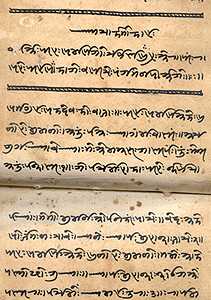
A folio from a manuscript of Ginan Vaek Moto of Pir Shams. Ms. KM 125, 463 folios, 200 x 160 mm; Copied in 1897 Samvat/1841 by Dahio Surijiani. Credit: The Institute of Ismaili Studies, London, http://www.iis.ac.uk

Introduction

The ginanic literature of the Ismailis emerged when Ismaili Pirs (missionaries) came to India to spread the teachings of Islam and the Shia Ismaili Tariqah. The task which lay before the Pirs was to introduce the teachings of their faith in a form which would not be completely alien to the people to whom they were preaching. The ginans were therefore composed on a ‘synthetic pattern’ of the prevalent religious poetry. The Pirs took the local religious terms as conceptual tools to introduce Ismaili and Islamic teachings to the masses and, in so doing, they achieved good results. The method they adopted was most logical and quite in the spirit of the universal nature of Islam. The Holy Qur’an says:

“Call unto the Way of your Lord with wisdom and fair preaching; and reason with them in ways that are best.” — Holy Qur’an, 16:125

Thus the Ismaili Pirs brought the Hindu mind to a logical understanding of the fundamental concepts of Islam. Professor Ivanow makes the following observation on the approach taken by the Ismaili Pirs:

“Either by intuition, or sound and clever reasoning, the Nizari Ismaili missionaries devised some methods which helped them to overcome such local obstacles…One was their bold tactics in separating the meaning and spirit of Islam from its hard Arab shell…They explained the high ideals of Islam in the familiar terms of ancestral religion, Hinduism….They brought the matter a step further by proclaiming Islam the crowning phase of the whole development of Hinduism. According to them, the Qur’an (together with the ta’wil system) was the last and final Ved, completing the earlier revelations. Thus, from a purely Islamic view point, the method of bridging the difference between Islam and Hinduism adopted by Ismaili missionaries was perfectly correct, in no way conflicting with orthodox ideas.” — Excerpts from Ismaili Da’wa in India, by W. Ivanow, Ilm, Volume 4, Number 2.

In this brief article, we will present only a few of the several verses that reference Prophet Muhammad (s.a.s.) in the ginanic literature of the Ismailis.

Nubuwwah

Among the concepts presented by Ismaili Pirs in the ginans was the concept of Nubuwwah (Prophethood).

In the Holy Qur’an this concept is explained with reference to the last Prophet, Hazrat Muhammad Mustafa (may peace be upon him). By giving an analogy of Sirajum-Munira to the Nabi (Prophet) as in the following verse, the Holy Qur’an relates the concept of Nubuwwah with the symbol of Noor (light):

“And as one who invites unto Allah by His permission, and as a lamp that gives light (Sirajum-Munira).” — Holy Qur’an, 33:46.

While the Holy Qur’an describes the Nabi as ‘Bright Lamp’, the ginans use the symbol of ‘Chandni’ (Moon Light) for the Prophet. Both in the Holy Qur’an and the ginans, the Prophet is seen as a Rahemat (Mercy) to mankind. The Qur’an says:

“And We have not sent you but as a mercy to all the nations.” — Holy Qur’an, 21:107.

Obedience to the Prophet is obedience to God and it is also made a necessary condition for the love for God. Those who disobey the Prophet are called the ignorant ones. The ginans also speak in the same vein. The similarities show that the teachings of Ismaili Pirs had their foundations in the Holy Qur’an.

Mercy to Mankind

“An Apostle who rehearses to you the Signs of God containing clear explanations, that he may lead forth those who believe and do good works from darkness unto light.” — Holy Qur’an, 65:11

In the verse quoted above, the Prophet is the source of guidance for mankind. He shows them the right path, removes the veil of ignorance and brings them to Light. In the ginan Satveni Moti, Syed Imam Shah says:

“Nabi Muhammad iis joog mahe aviyaa, tis-thi chand-roona marag paya”

Translation:

“Prophet Muhammad has come in this period, and through this moon-like Light, the Way has been made bright.”

The Pir says that the Institution of Nubuwwah, through the last of the Prophets, is like a moon which expels darkness and shows the way to the travellers. It determines a way of action for salvation, because we are liable to errors and may go astray in this world of many complexities.

The Prophet’s manifestation as God’s Bounty and Mercy is shown by the following verse of the ginan Alaf Nirale Khalaq Raja by Pir Sadr al-Din:

“Bujo-re bhai chhatra kon tana, Chhatra Nabi Muhammad Mustafa tana”

Translation:

“Through whom is the care and protection? Know, O Brothers! The care and protection is through Nabi Muhammad Mustafa (the Chosen).”

This clearly resonates with the Qur’anic verse:

“Allah verily has shown grace to the believers by sending unto them a messenger of their own who recites unto them His revelations, and causes them to grow, and teaches them the Scripture and wisdom.” — Holy Qur’an, 3:164

And Pir Hasan Kabiruddin in his monumental composition, Anant Akhado, says:

“Ashaji Nabi chale Nooraj warsey, Rikhisar ne sir chhai(n)-ji”

Translation:

“There are showers of Noor where Nabi walks and the believers have his protection over them.”

Thus the ginans describe the Prophet’s care and protection as chhatra and chhai(n) respectively. His guidance is Noor (Light), which helps to dispel darkness and makes visible the path leading to reunion with God.

Redeemer

“And those whom they invoke besides God have no power of intercession save he who bears witness to the Truth and they know (him).” — Holy Qur’an, 43:86

“O Muhammad! Raise your head and speak, and you shall be granted your desire, and intercede and your intercession shall be accepted.” — Hadith, Bukhari, 81:51

Since the Institution of Nubuwwah is a Blessing given by Allah, believers will have the intercession of the Prophet on the Day of Judgement. This (intercession) will bring them spiritual bounties in the life hereafter. In the Ginan Yara Shafayat Muhammad Karshe , Pir Sadr al-Din says:

“Yara shafayat Muhammad karsey, Mu’min bahest lahenga.”

Translation:

“O friends! Muhammad will intercede (on the Day of Judgement), and the mu’min (believer) will earn the abode in heaven.”

In Buj Niranjan, the Pir says:

“Jo Nabi Muhammad karey shafayat, Ja(n)ko hai ummat ki riayat” — verse 6, lines 9-10

Translation:

“If Prophet Muhammad intercedes then his followers will find ease (on the Day of Judgement).”

However, a pre-condition of earning the intercession of the Prophet Muhammad is for one to accept his Prophetic role and to follow his guidance. This is beautifully explained in Kalma Kahore Momano by Pir Satgur Noor:

“Eji Nam Nabi-ka mitha hai, jaisa sakar dudh, Kalma kaho dil saach soo(n), to bando shafayat mool”

Translation:

“O mumin! the name of our Nabi is as sweet as sugar and milk. Recite the Kalma with a true and sincere heart. This, indeed, will provide for you the intercession of the Prophet.”

and,

“Eji Nabi to jeevo(n) ka datar hai, Jene Kalma sunaya sar; Je momin manshe to beheshti howenga, Baki gafil bhula gemar”

Translation:

“Nabi is the redeemer of all the souls and he has taught the kalma to you. A mumin who declares his faith in the kalma will earn the heavenly abode but the rest, who ignore the kalma, will be lost and, indeed, they are the foolish ones.”

The consequences of not obeying the Prophet Muhammad to those who have paid allegiance to Islam is provided in the following verse of Syed Imam Shah:

“Nabi Muhammad kahya jeene na kiya, dozakh-ma(n) darwaza une liya”

Translation:

“He who does not obey the teachings of Prophet Muhammad has taken for himself the path towards the gates of hell.”

And, in this vein, the Qur’an declares:

“Establish worship and pay the poor-due and obey the messenger, that you may find mercy. Think not that the unbelievers, are going to frustrate (God’s plan) on earth. Fire will be their home – and it is indeed an evil refuge.” — Holy Qur’an, 24: 56-57.

Folio of Pir Sadr al-Din’s Ginan, Saloko Nano. 492 pages, 200 x 160 mm. Copied between 1924 Samvat/1867 and 1942 Samvat/1885 by various scribes including Khoaja Jafar Khiate Dhalani. Credit: http://www.iis.ac.uk

Pre-Islamic Prophets

(a) Earlier Revelations

“Say (O Muslims): We believe in Allah and that which has been revealed to us and in that which was revealed to Abraham and Ishmael and Issac and Jacob and the tribes, and in what that which was given to Moses and Jesus, and in that which was given to the Prophets from their Lord; we do not make any distinction between any of them, and unto Him we have surrendered.” — Holy Qur’an, 2:136

Belief in Prophet Muhammad as the last of Allah’s Messenger renders it necessary for a believer to accept all the earlier prophets, as shown in the above verse. This essential principle as well as some of the references that the Qur’an makes about the earlier prophets is also found in ginans as shown in the following compositions:

In the Ginan Virabhai Saheb Kero Bhed Na Bujere Koi, Pir Sadr al-Din observes:

“Eji ek lakh-ne chovis hazaar-mahe paigumbar sardar”

Translation:

“Amongst the 124,000 (Prophets), the Prophet (Hazrat Nabi Muhammad Mustafa) is the chief.”

This is in accordance with a well known tradition of the Prophet Muhammad which states that there were 124,000 prophets; the Holy Qur’an mentions only about twenty-five prophets.

(b) Hazrat Adam (a.s.)

“They (Adam and his wife) said: ‘Our Lord! We have wronged ourselves. If Thou forgive us not and have not mercy on us, surely we are of the lost’.” — Holy Qur’an, 7: 23

A corresponding verse is found in Pir Hasan Kabiruddin’s Eji Sarve Jivu-na Lekha Leshey:

“Eji Dada Adam mota barvant kahiye, Tap mota tena kahiye.”

Translation:

“Hazrat Adam was indeed very strong (spiritually), and his penance was complete.”

(c) Hazrat Musa (a.s.)

“And when Moses came to Our appointed tryst and his Lord had spoken unto him, he said: ‘My Lord! Show me (Thyself) that I may gaze upon Thee.” — Holy Qur’an, 7:143

Pir Hasan Kabiruddin, speaking about Hazrat Musa, says:

“Eji Musa Nabi Shah-ku bahot pyara, Niti nit darshan karna”

Translation:

“Prophet Musa was the beloved of the Lord. He always sought and prayed for the vision of Allah.”

(d) Hazrat Ibrahim (a.s.)

“Say: Allah speaketh truth. So follow the religion of Abraham, the upright.” — Holy Qur’an, 3:95

And about Hazrat Ibrahim, Pir Hasan Kabiruddin says:

“Eji Ibrahim Nabiji-ki bataj suniye, Karna aiysa kaam”

Translation:

“Listen to the story of Prophet Ibrahim and do such deeds as he did.”

Nubuwwah to Imamat

“Behold, your Lord said to the angels: ‘I will create a Vicegerent on earth’.” — Holy Qur’an, 2:30

“O mankind! Verily there has come to you a convincing proof from your Lord: for We have sent unto you a light that is manifest.” — Holy Qur’an, 4:174

“He whose Mawla I am, Ali is his Mawla.” — Hadith

Finally, it would be appropriate to add a few ginanic verses which speak about the continuity of the Divine Guidance through the Institution of Imamat after the demise of Allah’s last Prophet, Hazrat Nabi Muhammad Mustafa (may peace be upon him). True, there would be no Prophet after Prophet Muhammad, but God’s guidance for mankind had to continue, or else how could God’s Infinite Mercy and Absolute Justice be explained?

The continuous and perpetual guidance mentioned in the Qur’anic verse:

“O mankind! Verily there has come to you a convincing proof from your Lord: for we have sent you a light that is manifest” — Holy Qur’an, 4:74

is stated by Pir Hasan Kabiruddin as follows:

“Noore-Khalifa iis joog-ma(n)hey awiya, Ta(n)ki amar jyot likhai ji”

Translation:

“Vicegerent of God (Imam) has come in this period and His Light is Eternal.”

However, the belief in and the recognition of Prophet Muhammad is a pre-requisite for a belief in the Imamat and this is reinforced in Pir Hasan Kabiruddin’s Allah Ek Khasam Sabuka:

“Nabi Muhammad bujo bhai, to tamey pamo Imam.”

Translation:

“O brothers! know Nabi Muhammad, i.e. know the teachings of Nabi Muhammad, for it is then that you will gain the recognition of the Imam of the time.”

Date posted: Friday, December 2, 2016.

_______________

This ginanic reading has been adapted from Hakim Vali Mohammad Surani’s piece Prophet Muhammad (s.a.s) in the Light of Ginans, which was originally published in Ilm, March 1980, Volume 5, Number 4, by the Ismailia Association for the United Kingdom, now known as the Ismaili Tariqah and Religious Education Board (ITREB). References to all the ginans quoted in this reading are provided in the original Ilm article.

http://ginans.usask.ca/ is an outstanding research resource for ginans and includes recitations of hundreds of ginans by multiple reciters from around the world.

2016 US Presidential Election: An American Reflects on Conversations on Radio, Mart, Street and Travel

usa-flag

BY SARA BADRUDDIN

The word on the street

The words through upstate roads read;
‘Trump & Pence — make America great again’.
Broken parts and broken starts looking for a change.
A shake up! a break up! A nuclear-headed rake up.
Of wall-making, fear-shaking, yet history has shown,
the best way to make ahead, use the pen not the sword.
‘No free lunch’, no free feathers, no easy out from your niche,
you just gotta work hard, get an education, know your holes from your stitch.
‘Female use, it ain’t abuse, No matter what they say’,
Let’s set it straight, no time to wait,
Nov 8th’s election day!

She’s a game, more o’ the same, the white under cover:
more false guise, no paradise, something hidden it does seem.
The word on the radio, the mart, at the gym,
‘Scratch my back,I’ll scratch yours, Forget about him!’
‘She’s experienced, makes a difference, tolerated throughout nations’,
breaking fences, donning graces, success is in the patience.
People jaded, energy faded, Fear mongering, naught will do,
illegals out, immigration in, to rise further than you know who.
Elbow grease, past below your knees, then you’ll better your very lot.
White is right but tan I must, insulate home, not the foreign polyglot.

The clothes in the closet

Ohhhhh, and…
Ahhhhhh, Harlequin you are.
Power. ego. money?

Envenomations.
Elapidae & Crotalidae in guise.
Which poison you reckon, is best disguised?
Venom of power or ego or flair,
slithery? quick-tongued?, which one do you dare?
The danger of rage, blind-sighted and leather,
the devious smirk, quiet slide on shiny bed feather.
Silken and sweet tongues, words we can share,
but mine is the power, alone you can fare.
Yet once home, the snakeskin as all, comes undone,
but I am the President! The powerful one.

The person on the street

Energy drained, folk feeling behind,
Investments external, is there justice in kind?
‘Drain the swamp’, yes, drain swamp do.
Politics done, a new way to brew.
Media blazing, immigrant hazing, create ploys clouding clarity!
If they focus on ruffles, rather than meat of the truffle,
their real work, truly a rarity!
‘Cyber bully, White Nationalist, multiculturalism, she’s Communist’.

Imbalanced see-saw, as a disease, swirling left, right and skelter,
unkempt is our nation, many in frustration,
kind neighbors give some shelter.
Fix our homeland, strengthen friendship,
responsible care and understanding.
Why unconscionable, intelligent people?
Where will we go with these misunderstandings?
Welfare city, 40K pretty, when the rest work so hard,
create jobs, not fancy knobs, civil society is the card.

Date posted: November 4, 2016.

Copyright: Sara Badruddin/Simerg. 2016.

__________________

Sara Badruddin lives north of USA’s southern states. This piece reflects her experiences of conversations on radio, the mart, the street, and the travels on the eastern part of the USA and Canada as pertaining to the election for US President on Tuesday, November 8, 2016.

Supreme Knowledge: A Sublime Gift of Ismaili Ginans – A Commentary on Pir Sadardin’s Ginan Karshanaji Bhanare Arjun Sambharo by Shiraz Pradhan

PIR SADARDIN SAYS:
The True Guide is the Sustainer of the Universe
Channel your devotion to this (True) Guide
And you shall attain to the Eternal Station….translation, verse 8

PLEASE CLICK: Supreme Knowledge: A Sublime Gift of Ismaili Ginans

Gujarati text of ginan Karsanaji Bhanare Arjun Sambharo composed by Pir Sadardin. Photo: Ginan Central, University of Saskatchewan, Canada.

Gujarati text of ginan Karsanaji Bhanare Arjun Sambharo composed by Pir Sadardin. Image: Ginan Central, University of Saskatchewan, Canada. Please click on image for commentary and link to recitation.

Date posted: Friday, October 21, 2016.

________________

Forthcoming: Silk Road Travelogue by Ali Karim

ali_silkroad5_07

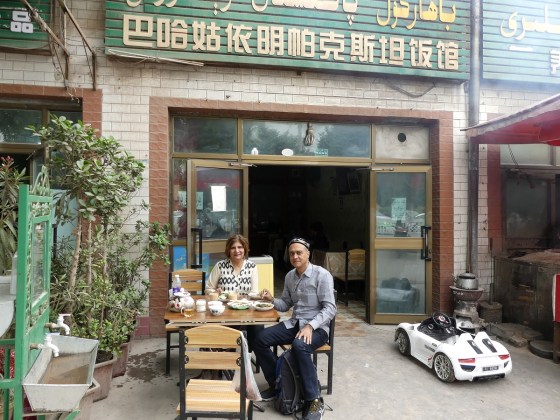
Ali (right) and Dilshad at a Pakistani restaurant in Kashgar, Xinjiang, China. Ali’s travelogue on the couple’s trip to China and Northern Pakistan will be seriaized in Simergphotos commencing week of October 24, 2016. Photo: Ali Karim. Copyright.

My wife Dilshad and I had been dreaming about travelling along the Silk Road in China and Pakistan for years, and so when we had an Expo we needed to attend in Shanghai, and since the season was right, we decided to make this trip happen in May/June this year. Since Western China and Northern Pakistan are remote and non-touristy places, we had to spend several months researching and planning the trip; what to see and what to do.

The trip was absolutely worth it and we highly recommend that everyone do this trip if they can. I hope you enjoy my trip blog and pictures which will be serialized in http://www.simergphotos.com commencing week of October 24, 2016.

_____________

His Highness the Aga Khan’s “Enduring Commitment to Afghanistan” – Watch Videos of Mawlana Hazar Imam at the Brussels Conference on Afghanistan

aga-khan-and-afghanistan-president-at-brussels-conference-2016

His Excellency Mohammad Ashraf Ghani, President of Afghanistan (right) with His Highness the Aga Khan, Founder and Chairman of the Aga Khan Development Network and 49th Imam of Ismaili Muslims. Photo: European Union. Copyright.

Mawlana Hazar Imam, His Highness the Aga Khan, the 49th Imam of Shia Imami Ismaili Muslims, is attending the Brussels Conference on Afghanistan on Wednesday, 5 October, 2016. The conference is being co-hosted by the European Union and Afghanistan. Like previous conferences, this conference is the opportunity to signal sustained political and financial support to Afghan peace, state-building and development. Mawlana Hazar Imam has contributed significantly towards these purposes over the past several years, and has participated and spoken at previous such conferences held around the world.

We are pleased to provide links to videos of Mawlana Hazar Imam’s presence at the conference in Brussels, including his bilateral meetings with conference attendees, a “family photo” of conference participants and the statement that he has made.

FAMILY PHOTO OF BRUSSELS CONFERENCE PARTICIPANTS

~~~~~~~~~

BILATERAL MEETING WITH SWEDEN’S DEPUTY PRIME MINISTER

~~~~~~~~~

BILATERAL MEETING WITH FRANCE’S MINISTER OF STATE

~~~~~~~~~

STATEMENT BY HIS HIGHNESS THE AGA KHAN

If you encounter technical problems in watching any of the videos, please visit https://tvnewsroom.consilium.europa.eu/videos.

Date posted: October 5, 2016.

______________

For more photos and videos of the conference please visit https://tvnewsroom.consilium.europa.eu/videos

An Exploration of Eight Ismaili Ginans on Science, Spirituality and Pluralism

ARTICLES BY SHIRAZ PRADHAN

Mawlana Hazar Imam on Ginans

SPIRITUALITY

Many Ismaili ginans relate the spiritual experiences of Ismaili Pirs and describe the meditative techniques used as an aid in the spiritual journey, and also the important milestones and inner cosmology corresponding to the different stages (maqamat). However, the Pirs emphatically have stated that the experiences of higher spiritual stations are not describable in rational language to people who are not initiated in the tariqa (path) and who have not experienced the different stations themselves. Pradhan uses two ginans by Pir Shams and Pir Sadardin to develop this theme.

PLEASE CLICK: The Inward Odyssey in Two Key Ismaili Ginans, “Brahma Prakash” and “Sakhi Mahapada”

~~~~~~~~~~~

Imam Sultan Mahomed Shah, His Highness the Aga Khan (1877-1957), had once said that “In your heart is a heap of fireworks, if you do not light it, how will you get Light (Roshni) in your heart?” The theme of the re-orientation of the soul and its migration towards the “Country of the Beloved” is captured beautifully in “Ek Shabda suno mere bhai….”

PLEASE CLICK: Ismaili Spirituality in Pir Shams Shabzwari’s Ginan “Ek Shabada Suno Mere Bhai”, accompanied with recitation

~~~~~~~~~~~

Continuing on the theme of spirituality and self-understanding in Ismaili Ginans, Pradhan  uses a parable from a Ginan of a young lion cub who grows up in the flock of sheep, and starts behaving like a sheep until it sees its own reflection in a pool to know its true identity.

PLEASE CLICK: An Explanation of the Ismaili Ginan “Kesri Sinha Sarup Bhulayo”

~~~~~~~~~~~

COSMOLOGY AND SCIENCE

Are the answers to secrets that Hadron Collider will reveal already in the Ginans? Pradhan’s study focuses on a granth composed by Syad Imam Shah around 1400 CE that he regards as one of the most scientifically advanced and compact ancient document, besides the Ikhwa-al safa.

PLEASE CLICK: Cutting-Edge Science in Syad Imam Shah’s Naklanki Geeta — Are the answers to secrets that Hadron Collider will reveal already in the Ginan?

~~~~~~~~~~~

Based on the acceptance by modern science of the Big Bang origin of our universe, Pradhan proceeds to analyse two Ismaili Ginans that have striking parallels of modern cosmology and astrophysics in them.

PLEASE CLICK: Concepts of Modern Cosmology and Astrophysics in Two Ismaili Ginans, Choghadia and Mul Gayatri

~~~~~~~~~~~

PLURALISM AND UNITY OF MANKIND

Our happiness and satisfaction must be anchored on pluralism and the underlying unity of faiths of mankind. Pradhan explores two different old traditions which echo these messages. One is from the Shia Ismaili Ginanic tradition and the other is from the Hindu Gujarati tradition.

PLEASE CLICK: Ideas of One Humanity, Love and Peace in World Religions: Comparative Study of Ginan “Hum dil Khalak Allah Sohi Vase” with a Hindu Bhajan

Date posted: August 15, 2016.
Date updated: August 28, 2016.

_________________

The Nur (Light) of Imamat

A portrait of Prince Karim Aga Khan IV during his enthronement in Geneva, Switzerland after his grandfather, His Highness the Aga Khan III, passed away on July 11, 1957. Photo by Philippe Le Tellier/Paris Match via Getty Images.

A portrait of Prince Karim Aga Khan IV during his enthronement in Geneva, Switzerland after his grandfather, His Highness the Aga Khan III, passed away on July 11, 1957. Photo by Philippe Le Tellier/Paris Match via Getty Images.

The doctrine of Imamat has been central in Shia Islam since the designation by the Prophet Muhammad (s.a.s.) of Hazrat Ali (a.s.) as his successor at Ghadir-Khumm. Among the various interpretations in Shia Islam, the Ismaili Muslims believe in the continuity of the Imamat through a living hereditary Imam descended from Hazrat Ali, through the prophet’s daughter Bibi Fatima (a.s). The current Imam of the Ismailis is His Highness the Aga Khan, who completes his 59th Imamat anniversary as the Ismaili community’s 49th Imam on July 11, 2016. To mark this occasion, we are pleased to provide short selections on the Imamat drawn from numerous writings of historians, theologians, philosophers and poets, Ismailis and non-Ismailis alike. But we begin, on this page, with a short piece prepared for younger readers, followed by a link to other pieces that includes the transliteration and translation of the Munajaat which is recited in many parts of the world specifically for the Imamat Day celebration.  

We wish Ismailis around the world Imamat Day Mubarak, and pray that the Imamat of Mawlana Hazar Imam, His Highness the Aga Khan, may continue for several more years beyond the celebration of his Diamond Jubilee on July 11, 2017, which is now exactly 52 weeks away.

The Nur (Light) of Imamat

The sun is extremely important for all life on earth. It gives us light, warmth and energy. The sun however is not the final source of life. It is Allah who gives life to all living things. It is God who has created the sun and the stars and everything that is in the universe.

The Quran teaches that Allah is the Light of the Heavens and the Earth. Allah guides mankind towards Him through His light. While Allah has created the physical light, He has also provided mankind another kind of light.

Allah says in the Quran:

“O Mankind! Truly there has come to you a proof from your Lord, and We have sent down to you a clear Light.” (Chapter 4, Verse 174)

What is this special light that Allah refers to, which guides and makes things clear? For Shia Muslims, this light is the Light of Imamat. The Shias refer to it as the Nur of Imamat. Nur means light. The Nur of Imamat is a spiritual light.

This spiritual light is with the Ahl al-bayt, the Imams from the Prophet Muhammad’s family. This light was with the first Shia Imam, Hazrat Murtaza Ali and, for Shia Imami Ismailis, it is now with their present 49th Imam, Shah Karim al-Husayni, His Highness the Aga Khan IV. The Imam guides his murids (followers) with his Nur.

The Imam’s Nur is not like ordinary light. It is a different light altogether. It is a spiritual light. Physical light, such as sunlight, helps everyone see things in the physical world. The Imam’s Nur guides his murids both in the spiritual and worldly aspects of their lives. Above all, the Imam’s Nur leads his followers towards inner peace and happiness.

Ever since the time of Hazrat Ali, the Ismaili Imams have guided their followers in succession, one after another. There have been forty-nine Imams up to the present time, but the Nur of Imamat is one, and it remains the same.

The Nur of Imamat is always there to guide through the physical presence of the Imam. The Imam holds his followers hands and leads them through both difficult and good times. He gives them guidance about how they should live in a particular time and place.

Just as the water of a river continues to flow, the line of Imamat never stops. That is, the Nur of Imamat is there to stay eternally.

One of the goals of the murid of the Imam should be to strive to come closer to the spiritual light of the Imam. This, one can do by fulfilling one’s material and spiritual responsibilities to the best of one’s ability. Praying regularly, living by the ethics of Islam, following the Imam’s guidance and thinking about Allah constantly can bring us closer and closer to the Nur of Imamat.

Source: Article adapted from multiple literary sources including the Ta’lim curriculum published by Islamic Publications, London.

____________

PLEASE CLICK: The Munajaat and Imamat As Depicted Through the Ages in Ismaili and non-Ismaili Writings

IMAMS ARE SHIPS OF SALVATION

Feluccas on the Nile in Aswan. The ship occupies a unique position in the Islamic tradition. The Qur’an counts it among the ayat (miracles) of God and devotes twenty-eight verses enumerating its benefits to mankind. For Shaykh Khudr, a contemporary of the Ismaili Imam Nizar, Imams are the Ships of Salvation. Please click on image for numerous selections on Imamat.

Date posted: July 10, 2016.

_________________

A Spiritual Father’s Love for His Community: The 79th Salgirah (Birthday) of Mawlana Hazar Imam, His Highness the Aga Khan

“When I leave this evening I would like that you should remember two things. One, that I will take with me in my heart the remembrance of each and everyone of you, the face of each and everyone of you. Secondly, that my love for my Jamat is a lot stronger than yours can ever be for me and I would like you to remember this…you must remember that Imam loves you more, much more than you can ever love him and you must be strong in this knowledge.” — Mawlana Hazar Imam, Karachi, December 26, 1964.

Photo_AKDN_Anya Campbell

Mawlana Hazar Imam, His Highness the Aga Khan, 49th hereditary Imam of Shia Ismaili Muslims directly descended from the Holy Prophet Muhammad (s.a.s.). Photo: AKDN/Anya Campbell. Copyright.

Spread in various countries around the world, the Shia Imami Ismailis have their own innumerable ways for celebrating important religious occasions according to their various cultural, social and religious traditions and backgrounds. One very important occasion in the annual calendar of the Ismailis is the Salgirah, or the birthday of their spiritual leader (Imam). His Highness the Aga Khan is their present Imam, and Ismailis around the world will be marking his 79th Salgirah on December 13, 2015. The following readings will enhance the readers’ understanding about the occasion as well as the special relationship that binds the Imam of the Time with his spiritual children.

Mawlana Hazar Imam’s Salgirah and the Depth of His Love for the Jamat

The term Salgirah is of Persian origin. Sal means anniversary and girah means knot and hence Salgirah literally means ‘an anniversary knot added on to a string kept for the purpose’. This article approaches the subject of Mawlana Hazar Imam’s birthday in terms of the Imam’s love for his murids and the love and devotion of the murids for their Imam.

In Salgirah Ginan Pir Sadr al-Din Asks Mu’mins to Act Righteously and Gain Spiritual Recognition of Imam-e-Zaman

+ Listen to ginan at Ginan Central

Eji Dhan Dhan Aajano has attained a very special status because it is primarily recited during the festivities marking the birthday of Mawlana Hazar Imam. The appropriateness of reciting the ginan during Salgirah will become apparent as we try to understand the ginan and its underlying spiritual teachings. To listen to various renditions of Eji Dhan Dhan (#160),  as well as over 760 other ginans please click http://ginans.usask.ca/recitals/ginans.php?id=0.

The Preamble Of “The Constitution of the Shia Imami Ismaili Muslims”

The new Ismaili Constitution was ordained, signed and sealed by His Highness the Aga Khan on December 13th, 1986, his 50th birthday. His Highness did this with the belief that the Constitution would provide a strong institutional and organizational framework for his Ismaili community to contribute meaningfully to the societies among whom they live.

His Highness the Aga Khan and the Ismailis

.

.

On the occasion of His Highness the Aga Khan’s 75th birthday on December 13, 2011, Simerg published a three-part photo essay tribute to the 49th Ismaili Imam. For those who may have missed, the series has been consolidated into a captivating one piece photo essay, which can be read by clicking on the above link.

Date posted: November 28, 2015.

___________________

Feedback? Please click Leave a comment.

Archives: Please click Table of Contents for links to all articles published on this blog since March 2009. Subscribe to this Website via the box near the top right of this page.

Syad Imam Shah’s Ginan Naklanki Geeta, the Hadron Collider and Modern Scientific Ideas by Shiraz Pradhan

In this in-depth study of  Syad Imam Shah’s ancient ginan, Naklanki Geeta (generally referred to as granth because of its voluminous size), Shiraz Pradhan explores its much advanced scientific ideas compared to the contemporary knowledge of the era. Pradhan seeks to explain how the composition’s numerous verses might relate to cutting-edge scientific developments taking place today. Pradhan further explores the concept of Nur (Light), and  proposes bold and possible scientific explanations for this mystical concept….Click to read complete article

The Large Hadron Collider (LHC) is the world's largest and most powerful particle collider, the largest, most complex experimental facility ever built, and the largest single machine in the world. Published on the NASA website on February 25, 2008 as its image of the day. Image Credit & Copyright: Maximilien Brice, CERN

The Large Hadron Collider (LHC) is the world’s largest and most powerful particle collider, the largest, most complex experimental facility ever built, and the largest single machine in the world. Published on the NASA website on February 25, 2008 as its image of the day. Image Credit & Copyright: Maximilien Brice, CERN. Please click on image to read Pradhan’s in-depth study.


Varas Ismail Gangji: The Turning Point by Alwaeza Maleksultan Merchant

Editor’s note: While I constantly think of my mum, Alwaeza Maleksultan J. Merchant, as she continues her recovery at the Royal Columbian Hospital in New Westminster, near Vancouver, from an open heart surgery some 5 weeks ago, I felt I should re-post her excellent piece on Varas Ismail Gangji that she contributed as part of Simerg’s highly acclaimed “I Wish I’d Been There” series. Her photo, left at image below, was taken by my brother, Alnoor, when he visited her at the RCH a few days ago. To read her inspiring piece, please click on the photo or on Varas Ismail Gangji: The Turning Point

Alwaeza Maleksultan Merchant, 83, shown at left in image above seen recovering at the Royal Columbian Hospital following her triple bypass surgery. Please click on photo for her article on the great Ismaili hero Varas Ismail Gangji. Photo/image: Alnoor Merchant/Nurin Merchant.

Alwaeza Maleksultan Merchant, 83, shown at left in this image, is seen recovering at the Royal Columbian Hospital following her triple bypass surgery. Please click on image for her article on the great Ismaili hero Varas Ismail Gangji. Photo/image: Alnoor Merchant/Nurin Merchant.