Simerg is an independent initiative dedicated to Ismaili Muslims, the Aga Khan — their Hereditary Imam — and the Ismaili Imamat, and Islam in general through literary readings, photo essays and artistic expressions
“A part of me has gone…he was the greatest human being I have ever met…Muhammad Ali was beautiful…He was a brave American…A brave man of the world…He was real…Boxing was too small for him…He is a part of mankind…God bless Muhammad Ali’s family” — George Foreman in an interview with BBC upon hearing of Muhammad Ali’s death.
~~~~~
Ali’s daughter, Hana, wrote in a tweet that Ali was surrounded by his children in his final moments. They held his once powerful hands. They hugged and kissed their 74-year-old father. They chanted Islamic prayer. Hanna Ali wrote that the children tried to stay strong. Some whispered in his ear.
“You can go now. We will be okay. We love you. Thank you. You can go back to God now.”
After Ali’s organs failed, his daughter wrote in the tweet, his heart continued to beat for another 30 minutes: “A true testament to the strength of his Spirit and Will!”
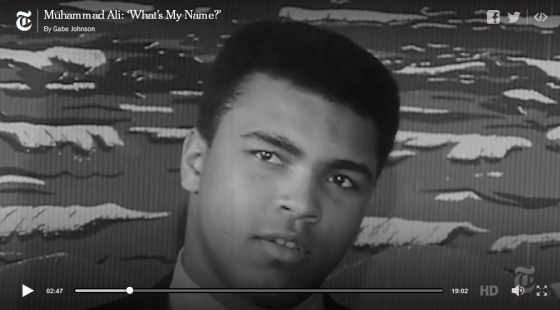
Please click on image to see a comprehensive video of the legend
Muhammad Ali, the greatest heavyweight boxer of all time and one of the best known figures of the 20th century, has passed away at the age of 74, after being admitted to a Phoenix area hospital for a respiratory ailment. He was diagnosed with Parkinson’s disease in 1984, four years after his retirement, but he went on to lift the Olympic Flame in 1996.
Ali was responsible for some of the most legendary moments in the ring. His incomparable work ethic, his revolutionary techniques, and fearlessness towards standing up for his beliefs, all contributed to the legend that was Muhammad Ali.
As we mourn his death, we publish some of the lessons that Hanna Ali, one of his seven daughters, shared in her book “More Than A Hero” published in 2000, in which she offered an intensely personal look at one of the most revered men on the face of the earth. The book serves as an inspirational reminder that we can all achieve greatness. To read excerpts from the book, please click Lessons from the Life of “the greatest,” Heavyweight Hero Muhammad Ali.
His funeral will take place in his birth town , Louisville, Kentucky.
Date posted: June 3, 2016. Last updated: June 4, 2016.
The world is witnessing the highest level of human suffering since the Second World War. This is why, for the first time in the 70-year history of the United Nations, UN Secretary-General Ban Ki-moon has convened the World Humanitarian Summit (WHS) in Istanbul on 23 -24 May.
The Summit will be held at the highest political level possible. Some 5,000 participants, including 65 Heads of State and Government, 177 UN Member States, NGOs, the private sector, aid organizations, civil society, affected communities and youth, among others will attend the Summit.
The Summit has three main goals:
To re-inspire and reinvigorate a commitment to humanity and to the universality of humanitarian principles.
To initiate a set of concrete actions and commitments aimed at enabling countries and communities to better prepare for and respond to crises, and be resilient to shocks.
To share best practices which can help save lives around the world, put affected people at the center of humanitarian action, and alleviate suffering.
The agenda for the Summit was determined after an extensive and inclusive worldwide consultation between May 2014 and July 2015 with over 23,000 people in 153 countries, involving humanitarian stakeholders, including affected people and communities. The consultation process generated over 300 recommendations grouped under five key action areas: dignity; safety; resilience; partnerships and finance. The Aga Khan Development Network was among the hosts and co-chairs of regional consultations that took place in South and Central Asia.
In February 2016, the Secretary-General published his report entitled ‘One Humanity: Shared Responsibility’. In his report, he called for the need to place humanity—people’s safety, dignity and their right to thrive—at the centre of global decision making. The Secretary-General called upon Member States, the United Nations and humanitarian organizations and other relevant stakeholders to accept and act upon five core responsibilities to deliver for humanity.
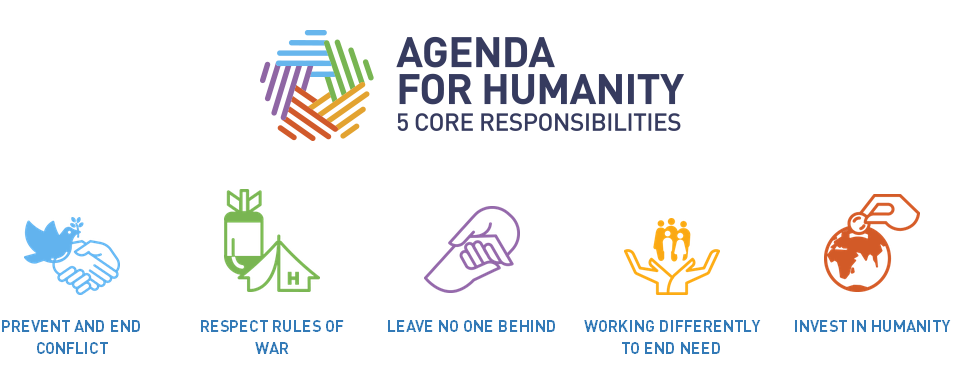
The Leaders’ Segment to be held on May 23, will be an opportunity to discuss the five core responsibilities of the Agenda for Humanity. These five core responsibilities are: one, Political Leadership to Prevent and End Conflict; two, Uphold the Norms that Safeguard Humanity; three, Leave No One Behind; four, Change People’s Lives – from Delivering Aid to Ending Need; and five, Invest in Humanity.
The United Nations Secretary-General has called for humanity—people’s safety, dignity and the right to thrive—to be placed at the heart of global decision-making. To deliver for humanity, stakeholders must act on five core responsibilities.
A statement issued by top officials of the United Nations said:
“We have in front of us a singular opportunity to stand together and deliver a message that we will not accept the erosion of humanity which we see in the world today. We must not fail the people who need us, when they need us most. Istanbul is this opportunity. History will judge us by how we use this moment. We must not let down the many millions of men, women and children in dire need.”
Photographs: Jean-Marc Carisse, http://www.carissephoto.com Text compilation: Abdulmalik Merchant, Editor, Simerg
Please click on photos for enlargement
WITH PRIME MINISTER
His Highness the Aga Khan looks straight at the camera as he greets Prime Minister Justin Trudeau on Tuesday, May 17, 2016, at the Office of the Prime Minister located at the Centre Block of Parliament Hill in Ottawa. Photo: Jean-Marc Carisee. Copyright.
His Highness the Aga Khan, the 49th hereditary Imam of the Shia Imami Ismaili Muslims, was warmly received by Canada’s Prime Minister Justin Trudeau on Tuesday, May 17, 2016, with the words “It’s always a pleasure to welcome a dear friend to Canada, a dear friend to my family as well.” The Prime Minister added that they would discuss “pluralism, diversity and all the things that Canada can contribute to offering more peace and stability in the world.”
His Highness the Aga Khan and Prime Minister Trudeau are seen engaged in a warm conversation during their meeting at Parliament Hill in Ottawa on Tuesday, May 17, 2016. In the background are the flags of the Ismaili Imamat with the gold Imamat crest in the centre, and the iconic Maple Leaf of Canada. Photo: Jean-Marc Carisse. Copyright.
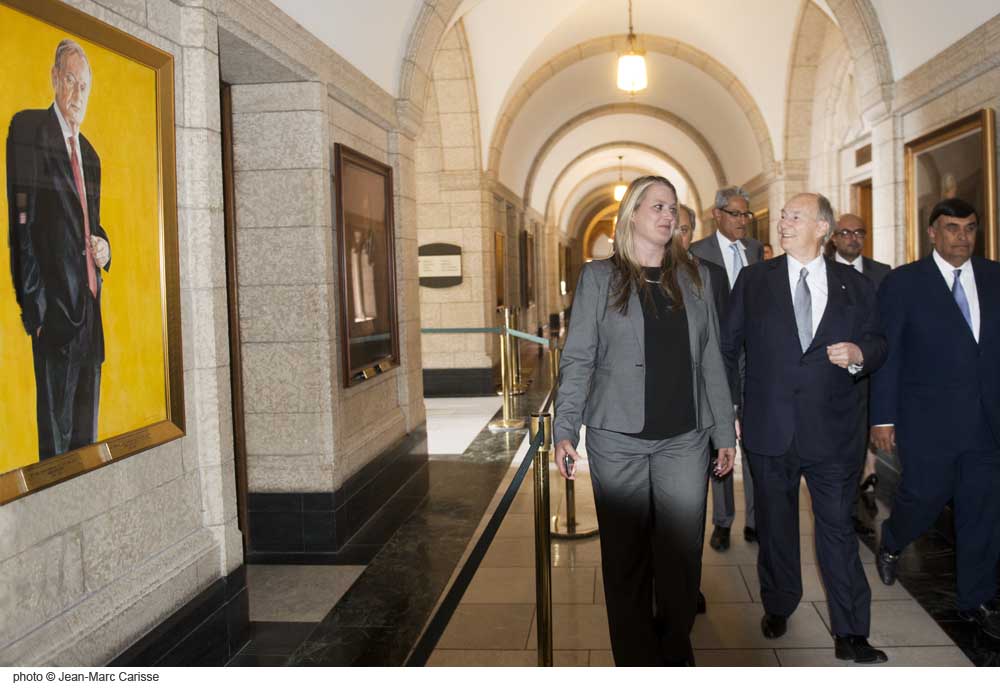
Award winning photographer Jean-Marc Carisse, who took the pictures shown on this page, noted in his email to Simerg that His Highness the Aga Khan’s greeting with the Prime Minister started at approximately 4:13/4:14 pm ET. At 5:05, His Highness walked in the South corridor of Centre Block and observed the portraits of former Prime Ministers Paul Martin and then Jean Chrétien (see photo, below). At 5:07, he entered his car. According to Mr. Carisse, “the Aga Khan was his usual charming personae and pleasantly smiled throughout his Parliamentary visit.”
Over the next few days, Simerg will be presenting more photos as well as reports relating to His Highness the Aga Khan’s current visit to Canada, which began with his arrival in Ottawa on Monday May 16, 2016. He was accompanied by his younger brother, Prince Amyn Aga Khan. His itinerary for the current visit includes delivering the opening remarks at the Global Centre for Pluralism’s Annual Lecture and being awarded with an honorary degree by the Pontifical Institute of Medieval Studies. Both these events will take place in Toronto this week.
We express our deep gratitude to Jean-Marc Carisse for sharing the wonderful photos with readers of Simerg.
His Highness the Aga Khan glances with interest at an oil painting of former Canadian Prime Minister, Jean Chrétien, shortly after his meeting with Prime Minister Justin Trudeau on Tuesday, May 17, 2016. Accompanying him are Kate Bourke, the protocol coordinator, and leaders of the Ismaili community. Photo: Jean Marc Carisse. Copyright.
His Highness the Aga Khan walks happily in the corridor of the Parliament Building following his meeting with Prime Minister Justin Trudeau on Tuesday May 17, 2016. He is accompanied, among others, by protocol coordinator, Kate Bourke and Ismaili leaders Shafik Sachedina and President Malik Talib of the Aga Khan Council for Canada. Photo: Jean-Marc Carisse. Copyright.
His Highness the Aga Khan has a broad smile as he prepares to leave the Parliament Building after his meeting with Prime Minister Justin Trudeau on Tuesday, May 17, 2016. With him in the picture are protocol coordinator, Kate Bourke (left), Shafik Sachedina (right), based at the Ismaili Imam’s headquarters in Aiglemont, France, President Malik Talib (top left) of the Aga Khan Council for Canada, and Mahmoud Eboo (centre), the Aga Khan Development Network’s Resident Representative to Canada. Photo: Jean-Marc Carisse. Copyright.
His Highness the Aga Khan outside the Parliament Building just before his departure after his meeting with Prime Minister Justin Trudeau on Tuesday, May 17, 2016. Photo: Jean-Marc Carisse. Copyright.
His Highness the Aga Khan returns a farewell wave to well-wishers, as his car departs Parliament Hill following his meeting with Prime Minister Justin Trudeau on Tuesday, May 17, 2016. Photo: Jean-Marc Carisse. Copyright
Date posted: May 17, 2016. Last updated: May 18, 2016 (15:51 EST)
“Established in 1967 by Her Majesty Queen Elizabeth II, the Order of Canada is the cornerstone of the Canadian Honours System, and recognizes outstanding achievement, dedication to the community and service to the nation. The Order recognizes people in all sectors of Canadian society. Their contributions are varied, yet they have all enriched the lives of others and made a difference to this country.” — Governor General’s website.
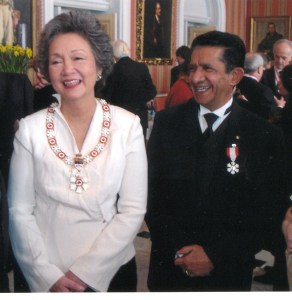
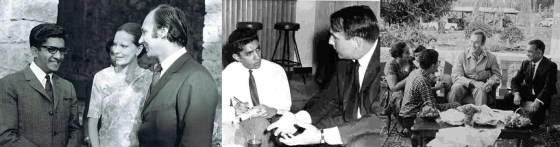
Above: Sultan Jessa with Her Excellency Adrianne Clarkson, the former Governor General of Canada, at the event marking the presentation to him of the Order of Canada. Below: l to r – Sultan Jessa with His Highness the Aga Khan and Begum Salima Aga Khan; interviewing Prince Sadruddin Aga Khan; and members of Sultan Jessa’s family with Prince Amyn Aga Khan at family farm in Tanzania. Photos: Sultan Jessa Collection, Montreal. Please click on images for more photos and full story.
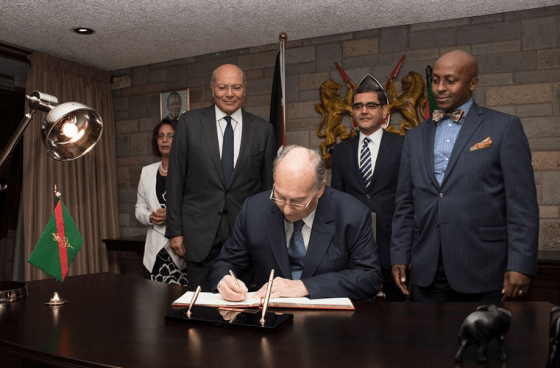
His Highness the Aga Khan, Mawlana Hazar Imam signs the visitor’s book upon his arrival in Nairobi, Kenya on March 16, 2016. Looking on are (l to r) Aga Khan Ismaili Council Vice-President Shamira Dostmohamed, AKDN Resident Representative Aziz Bhaloo, Aga Khan Ismaili Council President Nawaaz Gulam and Kenya’s Chairman of the Defence and Foreign Relations Committee, Hon Ndung’u Gethenj. Photo Aziz Islamshah/The Ismaili.
Editor’s Note: On the 50th anniversary of Kenya’s Daily Nation newspaper in March 2010, Mr. Bill Fairbairn, a former reporter with the paper, dug into his memory and photo archives and contributed a story and photographs for Simerg readers. We are pleased to share this slightly edited version of his lively piece as His Highness the Aga Khan arrives in Kenya (see photo, above) to inaugurate the Nation Media Group’s new state-of-the-art printing press on Thursday, March 17, 2016.
BY BILL FAIRBAIRN
Special to Simerg. Copyright.
Staff of the “Daily Nation” and “Taifa Leo” in a jovial mood as the Mayor of Mombasa (white cap) visits their Nairobi office in 1964. The Mayor is seen talking to Harry Sambo of Taifa, while Joe Rodrigues of the Nation watches from across. Bill Fairbairn is seen next to the Mayor looking straight ahead. Photo: Bill Fairbairn Archives, Ottawa
My name is Bill Fairbairn and I arrived in Nairobi looking for a newspaper job in 1964. I had worked on the Rhodesia Herald in Salisbury and the Northern News in Ndola, Zambia. Things were dangerous for a reporter working across the border from the war in Katanga. So I left the Copperbelt to tour South Africa, and return home by ship to Scotland.
When I arrived at a Cape Town youth hostel, a fellow hosteller said he had just come down from Nairobi and that white journalists were leaving since Kenya had become independent. He said newspapers were looking for staff. I did an about turn mainly because I was not at all keen on leaving Africa.
I hitchhiked to Durban, took a passenger ship to Dar-es-Salaam and arrived by bus in Nairobi as a stringer/correspondent working for the American magazine Newsweek. The Newsweek bureau had no fulltime openings and the East African Standard’s publisher was in Britain recruiting journalists.
The late Kenyan President, Mzee Jomo Kenyatta, addressing hundreds of thousands of supporters at a political rally in Kenya at which Mr. Fairbairn was present. The photo appeared in the “Daily Nation” around the 20th of October, 1965. Photo from Bill Fairbairn Archives, Ottawa.
So with my resume I went across to the Daily Nation office and they told me to sit down at the editing desk to show them what I could do.
Michael Curtis and Jack Beverley hired me on a two-year contract on the spot. I was soon enjoying my work on the Nation but disturbed by its biblical slogan The truth will set you free on the front page. To my delight a few months later, the slogan was removed from the newspaper.
Memorable for me was interviewing President Jomo Kenyatta, who had a train reconstructed for his personal needs travelling from Nairobi to Mombasa. Mr Kenyatta told me he disliked flying and enjoyed a big bed aboard the train.
One of the alarming experiences was my attempt to photograph Elsa, the lioness of the movie Born Free, starring Virginia McKenna and Bill Travers. The Open Roads Film Company of London had fenced off the beach at Malindi for film purposes, so I hired an African boatman to row me to the nearby island to which Elsa was supposed to swim. But I had chosen the wrong day for the event. So eventually we rowed to the beach. Who but Bill Travers and the lioness should walk toward me. My camera clicked and the lion’s ears flickered as they passed by. The film director came racing up saying I was trespassing. He ordered me on my way. I told him I was from the Nation and sought a photograph of Elsa swimming in the sea. He said that would not be possible since they wanted that photograph for billboards when the film went to the cinemas.
My photograph of Elsa on the beach appeared in the Daily Nation along with an article saying Elsa had never been more a prisoner. It prompted a letter from the film company inviting news photographers to their camp to take pictures. They did so from inside a cage with the lions outside!
Socially, I was the only white player on the Daily Nation cricket team and a keen visiting snooker player at the Aga Khan Club in Nairobi.
Seen above is an image of the Number 1 issue of The Nation, dated March 20, 1960. Price 50 cts. Initially the paper started off as a weekend Sunday paper. The daily weekday edition was introduced later in the year on October 3. Image: Mohib Ebrahim Archives, Vancouver
A standing joke that was repeated many times was when the Nation was getting ready to begin publishing. Publisher Michael Curtis was awaiting a key item of machinery for the rotary press. When a plywood box arrived he assumed that was it. He called the staff downstairs to ceremoniously open it. It contained stationary items such as pencils, pens and rulers! However the key gadget did arrive some time later.
I must say that the first two African editors of the Nation were extremely capable. Hilary Ng’weno and James Githi, I believe, were their names. They built for the future.
For my own part I have completed almost 60 years in newspaper work on three continents and written books, including one on Africa, which I sent to His Highness the Aga Khan.
Date posted: March 16, 2016.
_________________
About the writer: Bill Fairbairn, journalist and author, is currently a (volunteer) features editor for Riverviews Park Review, an independent community newspaper in Canada’s capital, Ottawa, where he lives with his wife Janina. His journalism career since 1950 took in stints in Britain, Africa, France and Canada. He has worked for several newspapers including The Sheffield Telegraph, The Sun, The Scotsman and The Vancouver Province and has taught journalism in British Columbia and recently in Ottawa. In his latest book The Printer’s Devil, Fairbairn outlines some of the people and events he encountered across Canada working for newspapers, radio and magazine.
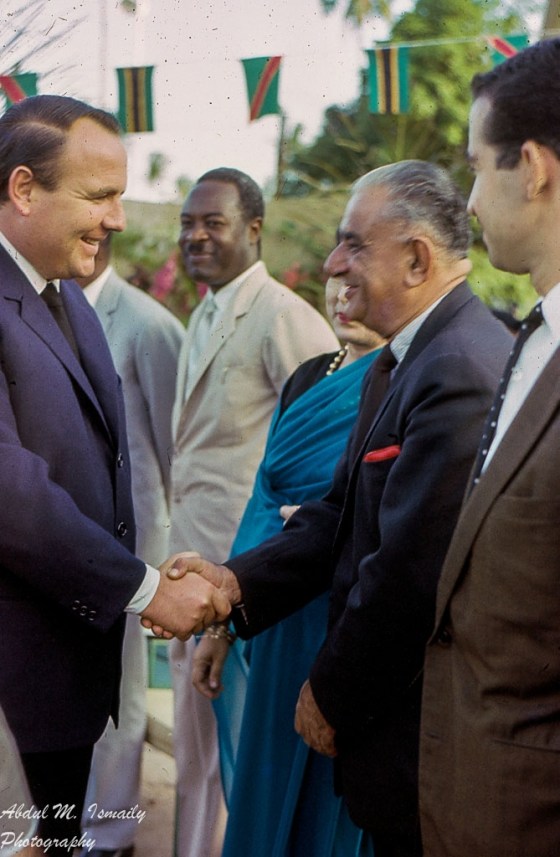
Prince Sadruddin Aga Khan being greeted by President Shamshu Tejapr of the Ismailia Association for Tanzania during a visit to Dar-es-Salaam in the 1960’s. Please click on image for more photos of the Prince’s visit.
Editor’s note: On Sunday, March 6, 2016, Mrs. Nancy Reagan, who served at the White House as the First Lady during the term of her husband’s Presidential reign from 1981 until 1989, died of congestive heart failure at the age of 94 at her home in Los Angeles.
Newlyweds Ronald and Nancy Reagan, March 4, 1952.
The Former First Lady, who once reminisced that “my life really began when I married my husband,” was the principal caregiver during President Reagan’s decade long twilight with Alzheimer’s disease. When the President first learned that he was diagnosed with Alzheimer’s, he issued an open letter to the American people on November 5, 1994 writing:
“I have recently been told that I am one of the millions of Americans who will be afflicted with Alzheimer’s disease. ….In opening our hearts, we hope this might promote greater awareness of this condition. Perhaps it will encourage a clearer understanding of the individuals and families who are affected by it….as the disease progresses, the family often bears a heavy burden. I only wish there was some way I could spare Nancy from this painful experience.”
Following this brave announcement of the diagnosis, Mrs. Reagan used her voice to represent families and increase awareness for Alzheimer’s disease. According to Newsweek magazine, the Former First Lady had also begun talking to Princess Yasmin Aga Khan about her husband’s Alzheimer’s. The princess, whose mother Rita Hayworth also had Alzheimer’s which contributed to the actress’s death at the age of 68, told Mrs. Reagan what to expect in the years to come: the mood changes, what it would be like when your loved one can no longer talk and doesn’t recognize you, how to care for someone who has grown incontinent, how to stimulate swallowing by patting the throat or touching the chin. Nancy was, “of course, devastated, but very brave,” Princess Yasmin told Newsweek.
In mourning the loss of Mrs. Regan last Sunday, the Alzheimer’s Association, of which Princess Yasmin Aga Khan is an Honorary Director, said that “The Alzheimer’s Association mourns the loss of first lady Nancy Reagan. Mrs. Reagan and President Reagan bravely shared his diagnosis of Alzheimer’s disease with the world in 1994….The public disclosure of their Alzheimer’s experience created an enormous and much-needed upsurge of interest in the disease…It was our honor to work with Mrs. Reagan over the years to raise awareness and inspire progress in Alzheimer’s research.”
The late President’s and Mrs. Regan’s advocacy in the fight against Alzheimer’s disease for more than 20 years had been noted much earlier by Princess Yasmin Aga Khan when President Reagan died in 2004. The Princess, daughter of Prince Aly Khan and Rita Hayworth and younger sister of the current 49th Ismaili Imam, His Highness the Aga Khan, has striven for the past 30 years to raise awareness — and much-needed funds — through Alzheimer’s galas honouring her mother. Princess Yasmin’s efforts have raised over $68 million, which combined with other donations, have helped the Alzheimer’s Association make significant progress toward their mission to eliminate Alzheimer’s disease.
STATEMENT BY PRINCESS YASMIN AGA KHAN FOLLOWING THE DEATH OF PRESIDENT RONALD REAGAN
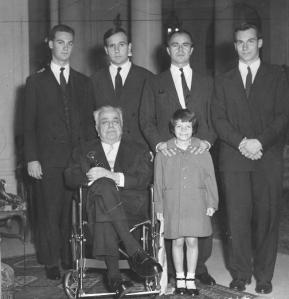
The late 48th Ismaili Imam, His Highness the Aga Khan, seated on a wheelchair with members of his family with his successor, the present Imam, Prince Karim Aga Khan, standing at extreme right. Others in the photo (l to r), grandson Prince Amyn Muhammad, and the Imam’s two sons, the late Prince Sadruddin and Prince Aly Khan, who is seen holding his daughter Princes Yasmin Aga Khan Photo: Zul Khoja Collection, Ottawa.
“In 1983, I was honored to join my fellow Alzheimer’s Association board members in the Oval Office when President Ronald Reagan first proclaimed November as National Alzheimer’s Disease Month. We talked with him about Alzheimer’s disease, and heard his concern for the need to support individuals with Alzheimer’s, their families and friends, and the need to eradicate the disease. In his proclamation, President Reagan said, “The emotional, financial and social consequences of Alzheimer’s disease are so devastating that it deserves special attention. Science and clinical medicine are striving to improve our understanding of what causes Alzheimer’s disease and how to treat it successfully. Right now, research is the only hope for victims and families.”
“As a member of the Alzheimer’s Association national board of directors and, as a family member who cared for my mother, Rita Hayworth, for so many years, I mourn the passing of former President of the United States Ronald Reagan and extend my own deepest sympathies to former First Lady Nancy Reagan and the Reagan family. President and Mrs. Reagan have been leading advocates in the fight against Alzheimer’s disease for more than 20 years, and millions of Americans have been helped by their dedication, compassion and efforts to support caregivers, raise public awareness about Alzheimer’s, and substantially increase our nation’s commitment to Alzheimer research. They proved their commitment again when they joined with the Alzheimer’s Association to create the Ronald and Nancy Reagan Research Institute, to advance scientific knowledge leading to treatments.
Princess Yasmin, 2nd from right, at a recent Alzheimer’s fund raising annual gala held in the memory of her mother Rita Hayworth, who was afflicted with the disease. Photo: Alzheimer’s Association.
“The Alzheimer’s Association is honored that the Reagan family has designated the Association as one of three organizations they recommend to receive contributions in his name. Those who wish to donate to the Alzheimer’s Association’s Ronald and Nancy Reagan Research Institute, or to family support services, may visit http://www.alz.org. A fitting tribute to Ronald Reagan, his life and legacy, would be to join with the Alzheimer’s Association to create a world without Alzheimer’s disease. It is within our reach.”
Note: Princess Yasmin Aga Khan’s statement was reported by media wire sources, with credit to the Alzheimer’s Association.
Editor’s note: Shortly after the 9/11 attacks in the USA in 2001 which killed almost 3000 people in an instant, numerous articles began to appear in the media around the world that drew parallels between the actions of Al-Qaeda and the warfare activity of the Ismailis during the 12th and 13th centuries that over time grew into fantastic legendary tales. In response to one such column that appeared in the October 8 edition of Canada’s National Post newspaper, Professor Azim Nanji and Dr. Farhad Daftary of the Institute of Ismaili Studies in London contributed the following letter in the newspaper:
“It is unfortunate that the search for historical connections in the aftermath of the terrible events of Sept. 11 has made historical truth itself a casualty. George Jonas’s column, Mortal Enemies Are to be Destroyed (Oct. 8) attempts to draw parallels between the ancient history of the Ismaili Muslims and the actions of these terrorists. In the last 25 years, scholarship, Muslim and Western, has shown the legend about the Assassins to be a fabrication concocted by contemporary enemies of the Ismailis. The Nizari branch of Ismaili Muslims organized a state in Iran and Syria in the 12th and 13th centuries. It flourished for almost two centuries, as a place of learning, scholarship and international influence, in spite of adverse circumstances and militant hostility from its neighbours. These Ismailis were heirs to the Fatimid dynasty that founded Cairo and established the University of Al‑Azhar, acts which represented a truly brilliant epoch in medieval Muslim history However, due to hostility prevailing in political and military spheres, the Ismailis became the object of theological and intellectual attacks, as their society attracted many scholars and scientists to their libraries and observatories. This climate of threat was accentuated by direct military attempts to destroy their centres and communities. It is in this context that their attempts at self‑defence need to be understood. These were directed at political and military figures and never against the general populace: a fact recognized by their enemies. Reporters obsessed with tracing tenuous historical links to current episodes of violence can learn much from history about the rich intellectual and cultural interactions among Muslims, Christians, Jews and others.”
Sporadic responses like the letter above, academic books by Dr. Daftary and the late Dr Peter Willey and many others as well as scholarly articles in journals do not appear to have made any impact in demystifying and debunking the myth of the assassins. Furthermore, the non-availability and non-distribution of important historical and theological works on Ismailis, in giant brick and mortar stores like Chapters and Indigo in Canada haven’t helped the cause either. There are a number of enjoyable, accessible and easy to comprehend books, produced by the Institute of Ismaili Studies and other academic and non-academic publishers, that should be on bookstore shelves alongside numerous Sunni, Shia and general works on Islam and other religions to counter misperceptions and negative stereotyping about the Ismailis as well as to impart an understanding of the community’s religious doctrines from Ismaili sources.
The plot of the highly popular video game “Assassins’ Creed” which is now available on almost all computer platforms revolves around the legendary “assassins” of the 12th and 13th centuries. The video game, which was created in 2007, was inspired by the 1930’s novel Alamut by the Slovenian writer Vladimir Bartol. New versions of the game have appeared annually since but the 2016 edition has been bypassed to prepare for a greatly enhanced 2017 version. However, a movie version of the video game is planned for release at the end of this year under the title “Assassin’s Creed: The Movie.”
Now, in response to the idea that ISIS or IS (Islamic State) is based on the Assassins, Dr. Farhad Daftary has contributed the following piece for the February 21, 2016, (USA) edition of The Conversation, which has a mission to provide readers with a reliable source of high quality, evidence based information.
Islamic State and the Assassins: reviving fanciful tales of the medieval Orient
(How do we account for forces and events that paved the way for the emergence of Islamic State? Our series on the jihadist group’s origins tries to address this question by looking at the interplay of historical and social forces that led to its advent.
Today, historian Farhad Daftary debunks the idea that Islamic State is based on the so-called Assassins or hashishin, the fighting corps of the fledgling medieval Nizari Ismaili state).
Many Western commentators have tried to trace the ideological roots of Islamic State (IS) to earlier Islamic movements. Occasionally, they’ve associated them with the medieval Ismailis, a Shiʿite Muslim community made famous in Europe by returning Crusaders as the Assassins.
But any serious inquiry shows the teachings and practices of medieval Ismailis, who had a state of their own in parts of Iran from 1090 to 1256, had nothing in common with the senseless terrorist ideology and ruthless destruction of IS and its supporters.
Attacks on civilians, including women and children, and engaging in the mass destruction of property are forbidden both by Prophet Muhammad and in the tenets of Islamic law. Needless to say, the Ismailis never descended to such terrorist activities, even under highly adversarial circumstances.
Significant discordance exists between the medieval Ismailis and contemporary terrorists, who – quite inappropriately – identify themselves as members of an Islamic polity.
Fanciful Oriental tales
The Ismailis, or more specifically the Nizari Ismailis, founded a precarious state in 1090 under the leadership of Hasan-i Sabbah. As a minority Shi’ite Muslim community, they faced hostility from the Sunni-Abbasid establishment (the third caliphate after the death of the Prophet Muhammed) and their political overlords, the Seljuq Turks, from very early on.
Struggling to survive in their network of defensive mountain fortresses remained the primary objective of the Ismaili leadership, centred on the castle of Alamut (in the north of modern-day Iran). Their state survived against all odds until it was destroyed by the all-conquering Mongols in 1256.
During the course of the 12th century, the Ismailis were incessantly attacked by the armies of the Sunni Seljuq sultans, who were intensely anti-Shiʿite. As they couldn’t match their enemies’ superior military power, the Ismailis resorted to the warfare tactic of selectively removing Seljuq military commanders and other prominent adversaries who posed serious existential threats to them in particular localities.
An agent (fida’i) of the Ismailis (left, in white turban) fatally stabs Nizam al-Mulk, a Seljuk vizier, in 1092. Public domain via Wikimedia Commons
These daring missions were carried out by the Ismaili fidaʾis, who were deeply devoted to their community. The fidaʾis comprised the fighting corps of the Ismaili state.
But the Ismailis didn’t invent the policy of assassinating enemies. It was a practice employed by many Muslim groups at the time, as well as by the Crusaders and many others throughout history.
Unfortunately, almost all assassinations of any significance occurring in the central lands of Islam became automatically attributed to the Ismaili fidaʾis. And a series of fanciful tales were fabricated around their recruitment and training.
These tales, rooted in the “imaginative ignorance” of the Crusaders, were concocted and put into circulation by them and their occidental observers; they’re not found in contemporary Muslim sources.
The so-called Assassin legends, which culminated in Marco Polo’s synthesis, were meant to provide satisfactory explanations for the fearless behaviour of the fidaʾis, which seemed otherwise irrational to medieval Europeans.
The very term Assassin, which appears in medieval European literature in a variety of forms, such as Assassini, was based on variants of the Arabic word hashish (plural, hashishin) and applied to the Nizari Ismailis of Syria and Iran by other Muslims.
In all the Muslim sources where the Ismailis are referred to as hashishis, the term is used in its pejorative sense of “people of lax morality”. There’s no suggestion that they were actually using hashish. There’s no evidence that hashish, or any other drug, was administered to the fida’is, as alleged by Marco Polo.
The literal interpretation of the term for the Ismailis as an “order of crazed hashish-using Assassins” is rooted entirely in the fantasies of medieval Europeans.
Modern scholarship in Ismaili studies, based on the recovery and study of numerous Ismaili textual sources, has now begun to dispel many misconceptions regarding the Ismailis, including the myths surrounding their cadre of fidaʾis.
And the medieval Assassin legends, arising from the hostility of the Sunni Muslims to the Shiʿite Ismailis as well as the medieval Europeans’ fanciful impressions of the Orient, have been recounted and deconstructed.
A culture of learning and tolerance
Living in adverse circumstances, the Ismailis of Iran and Syria were heirs to the Fatimid dynasty that founded the city of Cairo and established al-Azhar, perhaps the earliest university of the world. Although preoccupied with survival, the Ismailis of the Alamut period maintained a sophisticated outlook and a literary tradition, elaborating their teachings within a Shiʿite theological framework.
An entirely fictional illustration from The Travels of Marco Polo showing the Nizari imam Alâ al Dîn Muhammad (1221-1255) drugging his disciples. Public Domain via Wikimedia Commons
Their leader, Hasan-i Sabbah, was a learned theologian. And the Ismaili fortresses of the period, displaying magnificent military architecture and irrigation skills, were equipped with libraries holding significant collections of manuscripts, documents and scientific instruments.
The Ismailis also extended their patronage of learning to outside scholars, including Sunnis, and even non-Muslims. They were very tolerant towards other religious communities.
In the last decades of their state, in the 13th century, even waves of Sunni Muslims found refuge in the Ismaili fortress communities of eastern Iran. These refugees were running from the Mongol hordes who were then establishing their hegemony over Central Asia.
All this stands in sharp contrast to the destructive policies of IS, which persecutes religious and ethnic minorities and enslaves women.
The medieval Ismailis embodied qualities of piety, learning and community life in line with established Islamic teachings. These traditions continue in the modern-day Ismaili ethos. And the present-day global Ismaili community represents one of the most progressive and enlightened communities of the Muslim world.
The Ismailis have never had anything in common with the terrorists of IS, who murder innocent civilians at random and en masse, and destroy monuments of humankind’s shared cultural heritage.
Global terrorism in any form under the banner of Islam is a new phenomenon without historical antecedents in either classical Islamic or any other tradition. IS’s ideology reflects a crude version of the intolerant Wahhabi theology expounded by the Sunni religious establishment of Saudi Arabia, which is itself a narrow perspective that fails to recognise any pluralism or diversity of interpretations in Islam.
Date posted on Simerg:Monday, February 29, 2016. Last updated:March 1, 2016 (12:50 EST).
_______
This is the fifth article in The Conversation website’s series on the historical roots of Islamic State. Look out for more stories on the theme in the coming days on The Conversation website.
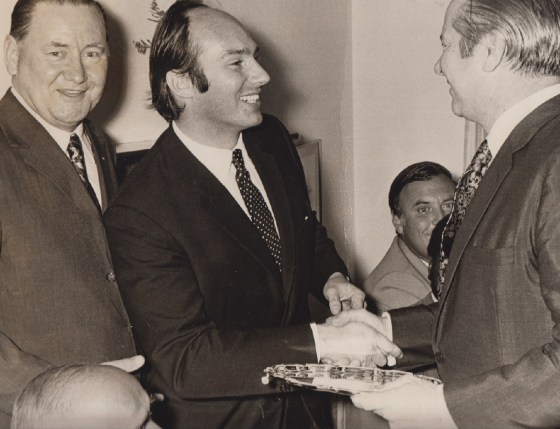
His Highness the Aga Khan being greeted by Mr. Michael Curtis of the Nation Group. Photo: Azhar Chaudhry. Sultan Jessa Collection.
Mr. Michael Curtis, a British Fleet Street editor and executive, was introduced to Mawlana Hazar Imam, His Highness the Aga Khan, just as he had been proclaimed the 49th Ismaili Imam by his grandfather, Imam Sultan Mahomed Shah, His Highness the Aga Khan III. His recruitment as a staff of His Highness was intended as a short term assignment as a speech writer and publicity organizer during a series of public appearances in Asia and Africa related to the Aga Khan’s installation as Imam. This brief assignment, however, grew into an engagement with His Highness that spanned several decades. The visionary Michael Curtis — who was noted by UK’s Guardian Newspaper as being 50 years ahead of his time in the paper’s obituary to the journalist — was asked to establish the Nation Media Group, which started publishing the Sunday Nation and subsequently the Daily Nation in Kenya, competing successfully with the existing colonial newspapers, the Tanganyika Standard and the East African Standard. At the culmination of the process of Africanising the Nation Group, Michael Curtis stepped down in 1977, after pioneering the introduction of the first web-offset presses installed outside the United States as well as increasing the Nation’s circulation to 165,000 and a readership reputed to touch three million.
Mr. Curtis moved to His Highness the Aga Khan’s Headquarters in Aiglemont, France, where he oversaw the Ismaili Imamat’s rapidly expanding non-denominational health and educational activities throughout South Asia and East Africa, until his retirement in 1994.
Michael Howard Curtis, who was born in Cambridge in 1920, died from cancer in 2004 at the age 84.
The following is an excerpt from a piece written by Mr. Michael Curtis for the Daily Nation’s special souvenir published on the occasion of His Highness the Aga Khan’s wedding in 1969 to Princess Salimah.
“I was Serving No Ordinary Man”
BY MICHAEL CURTIS (1920 – 2004)
It was 12 years ago in Dar-es-Salaam in October 1957. Prince Karim, His Highness the Aga Khan, was to be installed as successor to his grandfather in the first of a series of elaborate ceremonies to be held that year throughout Africa and Asia.
As personal aide to His Highness, I had gone ahead as part of an advance party and was greeted by the local leaders who told me that a serious problem had arisen. The only other such ceremony in living memory had taken place 72 years before in Bombay, when Aga Khan III had succeeded to the Imamate.
Not surprisingly, there was some doubt about the form the service would take and it seemed that an acute difference of opinion had arisen as to which verses of the Koran should be included. There was clearly nothing to be done but to await a ruling from the Aga Khan himself.
It was an unforgettable scene and took place in one of the state rooms of Government House where the Aga Khan was guest of the Colonial Governor at that time, the late Lord Twining. The Ismaili leaders were seated, as is their custom, cross-legged in a semi-circle around their young Imam and the two factions elaborated their different points of view.
To a non-Muslim the arguments were difficult to follow, but it was clear to me that a strong difference of opinion existed and that the Aga Khan would be called upon to resolve a ticklish point of theological doctrine.
This was the first occasion on which he had been called to exercise the responsibilities bequeathed to him by his grandfather. Still an undergraduate at Harvard, he looked very young, a trifle pale and tense as he listened to the rival claimants. There was a pause as they finished. Then the Aga Khan asked a question which obviously puzzled his followers. “Who,” he asked, “will recite the verses you wish me to decide upon?”
A chorus of voices assured him that a young man from Zanzibar had been procured for the recitation and that his fame as a psalmodist of the Koran was acclaimed far and wide.
“If that is so,” said His Highness, “let this young man suggest those verses in which his ability is most outstanding and thereafter I shall decide which particular chapters and verses will be selected.”
It was a solution that delighted everyone. The opposing factions accepted it gladly, for neither had lost face. The choirboy for certain would sing as he had never sung before — which in truth he did the following afternoon. It was a decision which reflected the instinctive simplicity of true wisdom and first revealed to me that I was serving no ordinary man.
I have related this tale before, and if I repeat it today it is because I know of no other anecdote which more aptly illustrates his wisdom and judgement.


 ~~~~~
~~~~~













 Simerg - Insights from Around the World

