Simerg is an independent initiative dedicated to Ismaili Muslims, the Aga Khan — their Hereditary Imam — and the Ismaili Imamat, and Islam in general through literary readings, photo essays and artistic expressions
Please click on image for guidelines and other important information issued by the Ismaili institutions in Canada
Ismaili institutions in Canada respond to COVID-19 with Jamatkhana closures
LATEST DEVELOPMENT: The Aga Khan Museum has announced that it will be temporarily closed until April 7, 2020. All scheduled events and programs up to and including April 6 have been cancelled. Ticket purchases for affected Museum events, programs, and performances will be automatically refunded by March 20, 2020.
Provincial health authorities in Canada have announced additional steps to limit large gatherings and reduce the risk of infection from the spread of COVID-19. As a result, the Jamati Institutions, in consultation with public health officials, and with the aim of protecting the most vulnerable in our Jamat, have closed Jamatkhanas in each jurisdiction. This includes morning, evening and weekend ceremonies. All Jamatkhana-based programming is also cancelled including social events associated with the celebrations of Navroz such as dandia raas, traditional dancing as well as jamans (large scale dining).
The decision to close our Jamatkhanas has not been taken lightly, and we seek the Jamat’s understanding and forgiveness for any inconvenience caused. While the Public Health Agency of Canada continues to assess the risk to the general population in Canada as “low”, we are taking these precautionary steps in the interests of the Jamat’s long-term health and security.
The Jamati Institutions will continue to provide regular information and updates to the Jamat via the electronic Al-Akhbar and iiCanada app. We pray for the safety and security of all Canadians and for all those affected globally.
EARLIER NEWS: Earlier during the day, Ismaili institutions had announced a cap of 250 people in Jamatkhanas in British Columbia, Ontario and Quebec following bans by the three provincial governments of gatherings of more than 250.
The Al-Akhbar newsletter distributed by the Aga Khan Ismaili Council for Canada via subscriptions contains COVID-19 updates with the intention of keeping the community informed of developments as they unfold, with specific reference to the situation in Canada, which is different from that in other parts of the world. Please click here for the latest COVID-19 update.
Ismaili institution response to COVID-19 in other parts of the world
Link(s) to measures taken by Ismaili institutions in other parts of the world for their respective Jamats will be provided below and will be updated regularly:
For non-Portuguese speakers, please use google translate to obtain a fairly accurate translation of the changes that are being implemented in Portugal. Interestingly, the article is pretty open about the specific steps that are being implemented within the ritual and ceremonial aspects of religious practices to contain COVID-19. The Portuguese article also states there have been no confirmed cases of COVID-19 in the country among Jamati members. – Ed.
Muslim countries take steps as Coronavirus plagues the world
Note: The content in this section is not being updated.
. Saudi Arabia has suspended Umrah pilgrimage to Mecca and Medina. Umrah is a pilgrimage that many Muslims elect to perform at any time of the year, and is a shortened version of the annual Hajj pilgrimage that is scheduled to take place in late July. Last year’s Hajj was attended by more than 2 million people, and this year’s Hajj hangs in the balance as fears about the coronavirus plague the world:
. Iran has cancelled Friday prayers across provincial capitals
. Singapore Muslims have been urged to bring own prayer mats to mosques;
. The government of Tajikistan has asked Muslims to avoid going to mosques for the Juma (Friday) prayers;
. Iran, Azerbaijan and Tajikistan are among countries that have halted the annual celebration of Navroz that takes place around March 21;
. In Malaysia, the health ministry has called on mass gatherings to be postponed after 12 cases were linked to a 3 day Islamic conference held in Kuala Lampur recently;
. Singapore has temporarily closed all the country’s mosques for deep cleaning from Friday March 13 after two men contracted the coronavirus while attending the Islamic conference in neighbouring Malaysia;
. The Muslim Council for Britain has just released a four page document containing guidance on the impact on mosques, madrasas and Islamic centres in the UK after the announcement that an emergency legislation is to be introduced to contain the spread of COVID-19;
. Across various faiths and religious denominations, rituals and practices are being tweaked to adapt to the outbreak of a disease that thrives on nothing more than close human contact.
At around noon on Friday, March 13, 2020 in Stouffville, north of Toronto, a Metro grocery store parking lot was full. Concerned shoppers had filled their shopping carts with all the essentials, and the line-ups at the cashiers at the supermarket were long as is shown in the photo above: Photo: Malik Merchant/Simerg.
Date posted: March 13, 2020. Last updated: March 19, 2020.
Before departing this website please take a moment to review Simerg’s Table of Contents for links to hundreds of thought provoking pieces on a vast array of subjects including faith and culture, history and philosophy, and arts and letters to name a few.
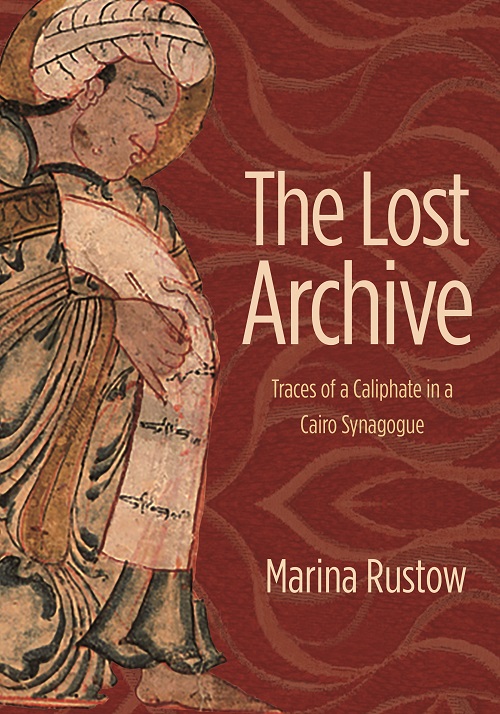
The Lost Archive by Marina Rustow, published on January 14, 2020 by the Princeton University Press; Pages: 624; Size: 7 x 10 in. Illus: 83 color + 17 b/w illus. 4 maps. 4c throughout. To purchase hardcover, Kindle or Kobo versions see links at bottom of this page.
Grabbing our attention now is a splendid new book on the Fatimids that looks at the caliphate’s robust culture of documentation. In an editorial review of the book, Konrad Hirschler of the Freie Universität Berlin describes Marina Rustow’s work “as a veritable magnum opus that will remain a point of reference for decades to come.” He also notes that “there are few books like this one that take the reader on such a long-distance journey across centuries and writing systems.”
The Lost Archive: Traces of a Caliphate in a Cairo Synagogue is Marina Rustow’s second work on the Fatimids. Her first one was entitled Heresy and the Politics of Community: The Jews of the Fatimid Caliphate. Sheis the Khedouri A. Zilkha Professor of Jewish Civilization in the Near East and professor of Near Eastern studies and history at Princeton University. She is director of the Princeton Geniza Lab and a MacArthur fellow. Her latest work is also praised by Geoffrey Khan, University of Cambridge, who states that “with great historiographical skill, Rustow brings new insights into the history of the medieval Middle East through a holistic analysis of the surviving state documents of the Fatimid dynasty. This is a splendid book.”
Marina Rustow has made very interesting and informative presentations of her research and work at the American Philosophical Society and the University of New Mexico. Links to both the videos are provided at the end of this piece.
The lost archive of the Fatimid caliphate survived in an unexpected place: the storage room, or geniza, of a synagogue in Cairo, recycled as scrap paper and deposited there by medieval Jews. In the book Marina Rustow tells the story of this extraordinary find, inviting readers to reconsider the longstanding but mistaken consensus that before 1500 the dynasties of the Islamic Middle East produced few documents, and preserved even fewer.
Beginning with government documents before the Fatimids and paper’s westward spread across Asia, Rustow reveals a millennial tradition of state record keeping whose very continuities suggest the strength of Middle Eastern institutions, not their weakness. Tracing the complex routes by which Arabic documents made their way from Fatimid palace officials to Jewish scribes, the book provides a rare window onto a robust culture of documentation and archiving not only comparable to that of medieval Europe, but, in many cases, surpassing it. Above all, Rustow argues that the problem of archives in the medieval Middle East lies not with the region’s administrative culture, but with our failure to understand preindustrial documentary ecology.
Illustrated with stunning examples from the Cairo Geniza, this compelling book advances our understanding of documents as physical artifacts, showing how the records of the Fatimid caliphate, once recovered, deciphered, and studied, can help change our thinking about the medieval Islamicate world and about premodern polities more broadly.
The hard copy or electronic Kindle version of “The Lost Archive” may be purchased at the following websites: Princeton Amazon & Amazon Canada Indigo
Date posted: March 8, 2020.
__________________
American Philosophical Society presentation by Marina Rustow (34 minutes)
~~~~~~~~~~~~
University of New Mexico presentation by Marina Rustow (1 hour 35 minutes)
[Includes material from multiple sources; a new addendum to the obituary has been added on March 8, 2020, following a feedback from Nazir Kassamali of Edmonton, who joined Nazeer Ladhani’s team at the University of Central Asia (UCA). We thank Kassamali for his input, which shows the significance of Nazeer Ladhani’s contribution at UCA at a critical juncture of its development path. – Ed.]
Simerg has learnt with profound sadness the untimely death of Nazeer Aziz Ladhani at the age of 72, in Nairobi, Kenya. According to an extensive obituary dedicated to him in The Globe and Mail, one of Canada’s most widely read and respected newspapers, Nazeer passed away in his sleep on February 19, 2020. Written by Ian Smillie and published under the title “International development agency CEO Nazeer Aziz Ladhani had a mischevious energy” (subscription may be required to read piece), the obituary is a tribute to the exceptional individual he was and the magnificent services he rendered to the Aga Khan Development Network and its numerous agencies in Canada, Asia and Africa.
Guy Pfeffermann, a long time friend of Nazeer, notes on the website of Global Business School Network (GBSN), that “I loved Nazeer. He was a gentle man, and one of the most learned I ever met on almost any subject. People loved to listen to him speak. In 2014 he sat on a panel of business school deans and other outstanding academics at the prestigious Online Education Berlin conference. He spoke last, and the participants were so enraptured by his Renaissance Man discourse that they just didn’t want to leave; the next group who had booked the room had to wait outside until, reluctantly, he let the audience go.”
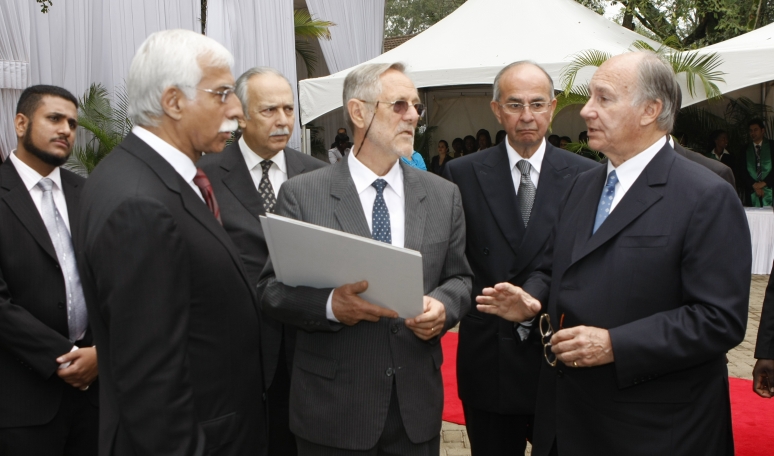
Mawlana Hazar Imam, His Highness the Aga Khan discusses architectural plans with Firoz Rasul, President of the Aga Khan University (AKU), Ambassador Saidullah Khan Dehlavi, Chairman of the AKU Board of Trustees, Trevor Andrews, Managing Director of Planning Systems Services Limited, and Nazeer Ladhani (2nd from right), Project Director of the AKU Graduate School of Media and Communications. Photo: AKDN / Ejaz Karmali.
Nazeer Ladhani’s Contribution to the Ismaili Imamat
Nazeer Ladhani worked in many senior roles with the Aga Khan Development Network and its agencies. He was the Project Director for Graduate Professional Education for Aga Khan University in East Africa, which includes the Graduate School of Media and Communications (see photo, above). He also served as the Director General of the University of Central Asia, a unique, internationally chartered higher university focused on the development of mountain societies, with purpose-built world class residential campuses in Naryn, Kyrgyzstan, and Khorog, Tajikistan and (future) Tekeli in Kazakhstan. Nazeer will be fondly remembered in Canada as the founding Chief Executive Officer of Aga Khan Foundation Canada (AKFC), which he led from start-up to a premier private international development agency in Canada. While at AKFC, Ladhani led efforts to establish the Global Centre for Pluralism in Canada.
Nazeer was born on August 20, 1947 in Tanganyika (now Tanzania) to a farming family. He went on to earn an agricultural diploma in animal husbandry from the famous Egerton University in Kenya. He then completed a series of designated accounting certificate programs, and also pursued an Executive Program at the Stanford University Graduate School of Business. He later earned an MBA from INSEAD, the prestigious business school at Fontainebleau, just outside Paris.
Nazeer leaves behind his wife, Gulabi; daughters, Noor Niyar and Aliya Begum Ladhani; sisters, Zinat Remtulla and Naseem Fazal; and brother, Mushtaq Ladhani. We convey our deep sympathy and condolences to them as well as the entire Ladhani family and to all his colleagues, friends and acquaintances around the world.
Through the services he rendered to Imamat institutions for four decades, Nazir has impacted the lives of millions of people around the world, making a positive difference in their livelihood, well-being and growth. His work will also ensure sustainable growth in communities impacted by the work of the Aga Khan Development Network and Aga Khan Foundation Canada, which holds the annual World Partnership Walk in numerous cities across Canada.
We pray that Nazeer’s soul may rest in eternal peace.
Addendum to Nazeer Ladhani’s Obituary
[Following our publication of Nazeer Ladhani’s obituary, above, we received the following details from Edmonton’s Nazir Kassamali who joined Nazeer Ladhani’s University of Central Asia (UCA) management team as the Director of Finance and Administration. We are pleased to incorporate Kassamali’s feedback into this post, as it reflects Nazeer Ladhani’s outstanding accomplishments at the UCA during the short time he stayed there. He was indeed on an important mission and performed his duties admirably! – Ed.]
By NAZIR KASSAMALI
First of all, I pay my deep respects to Nazeer Ladhani and convey my deep condolences to his family on his recent passing, and pray for the eternal peace of his soul.
I wish to add further to the obituary that has been presented here with respect to his short stint at the UCA whose Administrative Office was in Bishkek, Kyrgyzstan.
During his assignment as the Director General of the University of Central Asia, a unique, internationally chartered higher university focused on the development of mountain societies, with purpose-built world class residential campuses in Naryn, Kyrgyzstan, and Khorog, Tajikistan and (future) Tekeli in Kazakhstan, Nazeer accomplished significant progress which is explained below.
In a meeting in New York, discussion came up about the slow progress of the of University subsequent to the signing of the Agreement with the respective governments, namely, Kazakhstan, Kyrgyzstan and Tajikistan. There were significant issues that were not being addressed to meet the vision of the newly created University. Mawlana Hazar Imam, His Highness the Aga Khan, asked Nazeer Ladhani to takeover the management of the University and address the issues and provide solutions so that the three campuses and core curricula are built on a solid foundation.
Under Nazeer’s leadership and guidance, the UCA team achieved:
• Protocols following the agreements were approved and ratified by the acts of Parliaments of the three countries. This gave recognition equivalent to that of International NGOs such as United Nations which included Diplomatic status of the University, diplomatic license plates for the vehicles, ease of movements of the University employees across the three campuses and trilateral work permits. Government departments and senior employees were educated of the status of the University of Central Asia. This recognition of the UCA status made it easier to work with the Government officials of the three countries. • Three Schools of Continuing Education and vocational training (SPCE) were built and opened. Full enrollments were accepted across the three campuses during Nazeer’s tenure and first cohorts graduated during the Golden Jubilee of Mawlana Hazar Imam; • Administrative and support staff were hired and trained; • Financial, Human Resources and Campus enrollment Systems, business processes and procedures were implemented; • Campus designs of the three Campuses were completed with the Japanese Architects, Arata Sasaki; • Cadastral surveying of the University lands allocated by the three governments were completed and delivered; • For Khorog Campus in Gorno Badakhshan Autonomous Oblast (GBAO), Tajikistan, alternative land and compensations were allocated to the families who were residing inside the University boundary. This took a lot of persuasion and working with the local leaders and the three layers of Governments; • Vocational schools to train brick layers, plasterers, carpenters and painters were established with the grant from US Aid which Nazeer was instrumental in acquiring; and • Incorporation of the Aga Khan Humanities Programme into the UCA’s curriculum.
It takes over three to four decades for a University to achieve the Global standards of recognition and Nazeer Ladhani made an outstanding contribution to give it a solid foundation.
Date posted: March 5, 2020. Last updated: March 8, 2020 (addendum to obituary).
________________________
We invite you to submit your condolences, memories and tributes to Nazeer Ladhani by completing the feedback form below. If form does not show, please click on LEAVE A COMMENT. Alternatively, you may submit your comment for publication to simerg@aol.com; Subject: Nazeer Ladhani.
Simerg offers to all its Ismaili readers around the world an opportunity to submit memorials to honour and celebrate the lives of beloved members of their families who have physically departed this world. For guidelines, please click Passings.
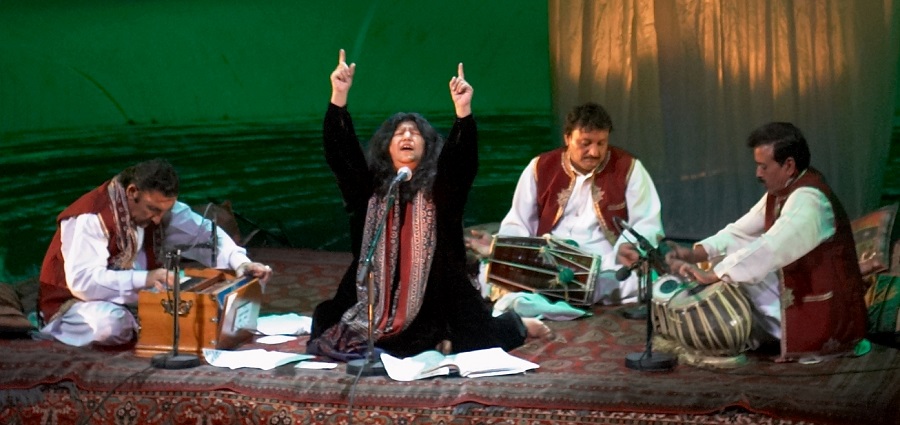
On Saturday, February 29, 2020, Abida Parveen performed in Melbourne, Australia, in a rare appearance outside Pakistan. On the day of her performance she gave an interview to Andrew Ford, host of ABC Australia’s “The Music Show.” In discussing shades of Sufi music (Kafi) towards the end of the interview, the last question Ford asked Abida was what she would be singing in Melbourne that evening, and she replied “Man Kunto Maula.” She demonstrated a few lines from the song in the studio. The famous words are attributed to the Holy Prophet Muhammad (May peace be upon him and his family) at Ghadir Khumm when he said, “He whose Maula I am, Ali is his Maula” thus giving Hazrat Ali parity with himself as his successor to the Divine Institution of Imamat, a hereditary institution that continues to this day under the 49th Imam, Mawlana Hazar Imam, His Highness the Aga Khan. The following rendition of Man Kunto Maula sung by Abida Parveen in Oslo, Norway, is deeply inspiring and worth listening to in full. It has been viewed on YouTube more than 2.7 million times (Update, January 29, 2023: We note the video is no loner available and has been designated as private.).
Date posted: March 1, 2020. Last updated: January 29, 2023 (video unavailable.)
Before departing this website please take a moment to review Simerg’s Table of Contents for links to hundreds of thought provoking pieces on a vast array of subjects including faith and culture, history and philosophy, and arts and letters to name a few.
Between Google and Yelp, Jamila’s Kitchen and Grill located on 2733 Barnet Hwy, in Coquitlam, one of the 21 municipalities comprising Metro Vancouver, has over 220 reviews with an average star rating of 4 (out of 5). Canadian media such as the national newspaper Globe and Mail, and greater Vancouver publishers Tricity News and CityNews1130 recently carried heartwarming stories about the restaurant and its owners, Malik Malikzada and his wife Jamila Malikzada. Please click on links that follow to read the articles. Please also see a brief description about the restaurant taken from its website.
THE GLOBE AND MAIL
In 2000, the Malikzadas, with the help of Ismaili organization were accepted as refugees in Canada where they now run Jamila’s Kitchen and Grill in Coquitlam, B.C. The eclectic menu features South Asian dishes, which Ms. Malikzada learned to cook while living in Pakistan. Read more in the Globe and Mail
TRICITY NEWS
It was always Jamila’s dream to cook food in her own restaurant. Three years ago, she and her husband Malikzada took the plunge….they’re humbled to be able to give back to the community that’s taken them in by offering free food at their Coquitlam restaurant they’ve run for three years to those who can’t afford it. Read more in Tricitynews
CITY NEWS 1130
Whether they can pay or not, the owner of a restaurant in Coquitlam is offering hot meals to anyone who truly needs them. The owner of Jamila’s Kitchen and Grill says the offer is open to everyone, regardless of whether or not they can prove their circumstances. Read more in Citynews1130 (with video)
ABOUT JAMILA’S KITCHEN
Jamila’s Kitchen & Grill is a dream borne from the mind and heart of Jamila, a passionate chef of Afghan descent. Escaping Afghanistan as a family during civil war, she with her family relocated in Karachi, Pakistan and as chef worked in food industry and Aga Khan university hospital’s kitchen for many years and absorbing the culture through its language, art and cuisine.
Upon migrating to Canada Nov 2000, her immigrant experience confirmed to her that the importance of creating and combining ethnic food from Indian subcontinent, Afghanistan, Greek and indo-Chinese, she created Jamila’s Kitchen & Gill and merged with Pizza Island & Indian Spice as a hub for diverse cultures to feel always great.
The fusion approaches to food, contribute to creating a sense of universality while maintaining the quality that she has brought with her to this land. Appreciating the growing movement of lifestyles of health and sustainability, Jamila’s Kitchen & Grill merges with Pizza Island & Indian Spice and operating under one ceiling, and consciously integrates local and organic food into the menu; we love to serve our community.
Simerg wants to her from you…..
If you have eaten at Jamila’s Kitchen and Grill, please give your feedback by clicking on Leave a comment. We also welcome a comprehensive review of the restaurant in 500-600 words. If you wish to submit one, please write to Simerg@aol.com.
Date posted: February 28, 2020.
_______________________
Before departing this website please take a moment to review Simerg’s Table of Contents for links to hundreds of thought provoking pieces on a vast array of subjects including faith and culture, history and philosophy, and arts and letters to name a few.
LATEST NEWS (March 1, 2020): Women’s T20 Pakistan vs South Africa — Diana Baig bowled well. She took the wickets of both the South African openers reducing them to 17 for the loss of 2 wickets. Her figures of 2 wickets for 19 runs from her 4 overs are impressive. South Africa scored 136-6 which included a magnificent knock of 53 by Laura Wolvaardt; Pakistan’s reply of 119-5 was short by 17 runs, and they fail to qualify for semi-finals. South Africa and England proceed from Group B. See Scorecard.
Diana Baig celebrates with her team mates as she takes a wicket. Please click on photo to read article in “The Cricketer.”
_____________
Video: Interview with amazing Diana Baig
_____________
Profile: Diana Baig (adapted from Wikipedia)
Diana Baig (born 15 October 1995) is a Pakistani women’s cricketer and footballer. Baig was included in Pakistan squad for the 2013 Women’s Cricket World Cup and 2016 ICC Women’s World Twenty20 as well as the Twenty20 2020 World Cup being played in Australia.
Diana Baig, an Ismaili, was born in Hunza, Gilgit Baltistan. While growing up, she, like other females of her town, were encouraged by the progressive society around her. Her interest in sports started with street cricket and football. Learned and enthusiastic, she moved to Lahore, for her intermediate and undergraduate studies. She opted for Lahore College for Women University, where her endeavors were rewarded by the college. Her multi-talented sporting side gives her the edge, as she can represent her country at international level for both, football and cricket. She is fluent in English, Urdu and Burushaski.
Baig started her career in 2010, leading the Gilgit-Baltistan women’s cricket team. She was selected for Pakistan’s A team in 2012 and for the squad of the full national team in 2013.
She made her international cricket debut in 2015 against Bangladesh.
Diana began in football by chance. She was selected for the Pakistan football team when there was a shortage of players.
Her bowling and fielding performance in the ODI against India in 2017 Women’s Cricket World Cup was impressive and was praised by Ian Bishop, one of the commentators. She came into the team in place of Kainat Imtiaz, and she immediately made an impact by taking an important wicket, Smriti Mandhana with an inswinger.
In October 2018, she was named in Pakistan’s squad for the 2018 ICC Women’s World Twenty20 tournament in the West Indies. In January 2020, she was named in Pakistan’s squad for the 2020 ICC Women’s T20 World Cup in Australia.
Date posted: February 28, 2020. Last updated: March 1, 2020.
Before departing this website please take a moment to review Simerg’s Table of Contents for links to hundreds of thought provoking pieces on a vast array of subjects including faith and culture, history and philosophy, and arts and letters to name a few.
_______________________
We welcome your comments. Please complete the feedback form below. If you can’t see the comment box please click LEAVE A COMMENT
Please click on photo to read Ben Eltham’s excellent piece in The Guardian
Abida Parveen to perform February 29, 2020 at Melbourne’s Hamer Hall
There are few artists who are spoken about with the same rapturous fervour as Abida Parveen. Perhaps only her spiritual brother, the late Nusrat Fateh Ali Khan, has inspired the same level of devotion among fans.
Parveen has been described by The Guardian newspaper as “the greatest female Sufi singer in history” and by the BBC as “one of the most remarkable voices on the planet.” In his new piece for the Guardian, Ben Eltham writes, “The devotional singer is known to move audiences to a higher plane. Meeting her in Melbourne time went ‘all bendy and loose’.” Please click here to read The Guardian’s excellent piece.
Have you attended a performance by Abida Parveen? What are your impressions? Were you awed by her performance? We welcome your feedback. Please click Leave a comment.
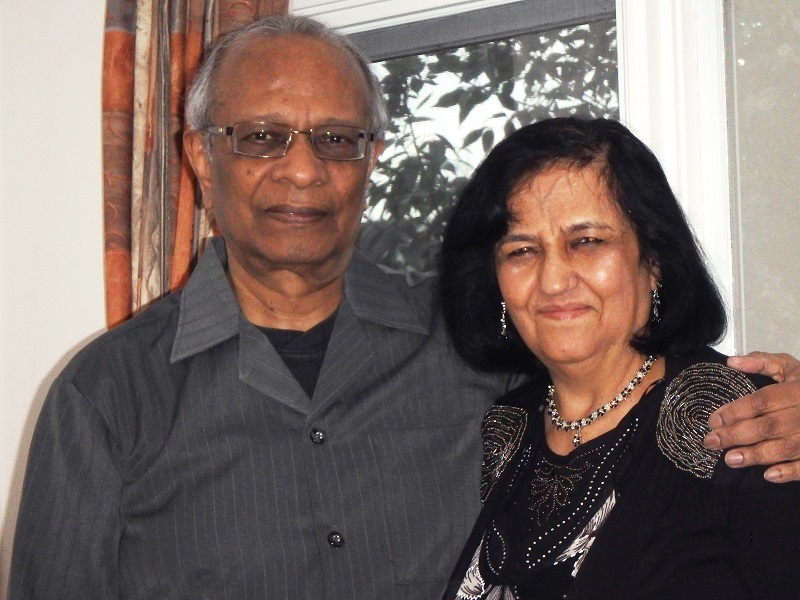
Mahebub Rupani (1941 – 2020) pictured with his wife, Dolatkhanu, in 2014. Photo: Mahebub Rupani Family Collection.
With great sadness, the family of Mahebub Mohamed Juma Rupani announces his passing on January 18, 2020, at the age of 79 after a sudden illness while visiting his relatives in Rajkot, India. The funeral and zyarat ceremonies for Mahebub took place in Ottawa, Canada, on January 27, 2020.
Beloved husband to Dolatkhanu Rupani, devoted father, loving grandfather and a cherished member of an extensive global family, Mahebub possessed a calm, kind, peaceful and generous soul that was valued in both his professional and personal life.
Mahebub Rupani (1941-2020) and his wife Dolatkhanu pictured in 2007 with their sons Tareeq (back row, left) and Qayad (second from right); grandchildren Azra, Laila and Adrik; and daughters-in-law Debbie and Neziera. Photo: Mahebub Rupani Family Collection.
Born in Zanzibar, East Africa, Mahebub dedicated much of his professional life to the insurance industry, mostly at the Jubilee Insurance Company in Mombasa and Nairobi, in Kenya. He then moved to Portugal where he served with the Aga Khan Ismaili Council for Portugal. During his stay in Lisbon, he ran a small business and helped with the planning for Lisbon’s Ismaili Centre. He also served as the Honorary Secretary for the Council in Portugal.
Mahebub Rupani (d. January 18, 2020) pictured in a more recent photo taken in 2019 with members of his family. Back row (l to r) are son Qayad, daughters-in-law Neziera and Debby, and son Tareeq. Seated (l to r) are grandson Azra, wife Dolatkhanu, granddaughter Laila, MAHEBUB RUPANI, and grandson Adrik. Photo: Mahebub Rupani Family Collection.
Mahebub subsequently moved to Canada where he upgraded his executive skills in the insurance industry with a Diploma in Computer Science from the DeVry Institute. Upon retiring, Mahebub worked with the Aga Khan Ismaili Council for Ottawa. A senior Jamati member described Mahebub’s contribution as, “…integral to the formation of what we now know as Canada’s Ismaili Institutions in Ottawa today”.
We pray that Allah rest his soul in peace.
Date posted: February 18, 2020.
_______________________
We invite you to submit your condolences, memories and tributes to Mahebub Rupani by completing the feedback form below or by clicking on LEAVE A COMMENT. Your comment for publication may also be submitted to simerg@aol.com; Subject: Mahebub Rupani.
Simerg offers to all its Ismaili readers around the world an opportunity to submit memorials to honour and celebrate the lives of beloved members of their families who have physically departed this world. For guidelines and more information please click Passings.
I was in Ottawa when a set of two Farman books first went on sale recently. I was glad when the literature counter officer told me 300 sets had been received for sale in Ottawa. There was no reason to panic — everyone who was in the queue that began forming immediately upon the completion of Jamati announcements was able to obtain copies for themselves and their families. My daughter and I had a deep sense of joy as we acquired our copies, and we also saw everyone’s faces lighted up with joy — it was the fulfillment ofa wish of many many years. For the first time in more than 40 years, the guidance given by Mawlana Hazar Imam, His Highness the Aga Khan, to his spiritual children had been authorized by him for publication in printed form.
The last such volume was published in 1976-77 when the Ismailia Association for the UK (now known as the Ismaili Tariqah and Religious Education Board or simply ITREB) and other Associations published Farmans that Mawlana Hazar Imam had made in Mumbai, India, and Kenya in 1973 and 1976 respectively. The writer of this piece was very much involved with his late father, Alwaez Jehangir Merchant, in that exquisite publication in London.
The new set of two books ($10.00 per set) contains Farmans made by Mawlana Hazar Imam from 2011 to 2018. The first book (116 pages) contains a total of 24 Farmans made by Mawlana Hazar Imam during his mulaqats with the Jamats in Tanzania, Uganda, Kenya, Singapore, Bangladesh and India between July 5, 2011 and September 27, 2013. The second book (236 pages) consists of 45 Farmans starting with the Farman made on the inauguration of Mawlana Hazar Imam’s Diamond Jubilee in Aiglemont France on July 11, 2017 — the 60th anniversary of his Imamat — and concludes with the Farman Mubarak made on July 11, 2018 at the Darbar in Lisbon, Portugal, which was attended by more than 40,000 murids from around the world (seated in 3 separate halls). During his Diamond Jubilee year, Mawlana Hazar Imam visited Uganda, Tanzania, Eastern Canada, Pakistan, United Arab Emirates, India, USA, Kenya, Western Canada, France, the UK and Portugal.
The Farmans in both the books are published in chronological sequence and there is a table of contents at the beginning of the book. However, there is no index in the two books and we hope that it will be incorporated in future volumes that are expected to be published in the foreseeable future. We are here referring to Farmans made before 2011 that have been authorized and are read out in Jamatkhanas. Among those are Farmans made (1) during the Golden Jubilee in 2007-2008; (2) Farmans made in Pakistan in 2000; (3) Farmans made during Mawlana Hazar Imam’s first visits to Moscow and the Central Asian Jamats in 1995 and later; and (4) Farmans made during his Silver Jubilee in 1982-83 as well as other selected Farmans during the course of the Imamat from 1957 onwards.
The latest Farman books have been published by Islamic Publications Limited which is based at the new Aga Khan Centre in London. A note has been made that the Farmans are published under exclusive licence from Mawlana Hazar Imam.
Many of us will recall our childhood years during the 1960’s, when our parents would advise us to read a Farman every night before going to bed. At that time we had the benefit of short excerpted Farmans by subject category in tiny books such as Precious Pearls and Precious Gems. In the absence of such books, parents can utilize the newly released Farman books by reading out short excerpts to their babies and young children on a regular basis. The Australian website raising children mentions that reading to babies and children help them to get to know sounds, words and language, and they develop early literacy skills. The website reading rockets states that when the rhythm and melody of language become a part of a child’s life, learning to read will be as natural as learning to walk and talk. It has been recommended that reading should take place at least once everyday at a scheduled time and if this cannot be done, then read to your child as often as you possibly can.
In our particular case of reading out Farmans to children, we are also building the young murids’ attachment, affection and love for Mawlana Hazar Imam. The typeset in the Farman books is large enough for grown up children to comfortably read the Farmans by themselves. Parents and older siblings must encourage and motivate them to do so.
In addition, we urge every member of the Jamat and especially the youth and professionals to devote a few moments on a regular basis to the reading of Farmans, reflecting on them, applying Mawlana Hazar Imam’s guidance in our lives as well as seeking out the blessings that the Imam is conveying. Encouraging friends and family members to do likewise is a very important step in fulfilling our role as a dai, that is, a communicator of matters of faith.
The obedience to the Imam-of-the-Time is a time honoured Ismaili tradition, and Imam Sultan Mahomed Shah had once observed that heaps of pearls are scattered when Imams give Farmans. When a murid of the Imam consciously listens to Farmans in Jamatkhana or reads them in the books such as the ones that have just been published, the listener or reader should treat the blessings conveyed by Mawlana Hazar Imam for all times, and not treat the blessings as if they were for the occasion when the Farman was delivered. Indeed, as we read through the two Farman books, we will come across references to the enduring nature of the Imam’s blessings in his own words.
In her wonderful piece published in Ilm in 1979 and reproduced on this website, Nadya Kassam contextualized the importance of Farmans through a verse of the following ginan by Pir Shams:
Satagur kahere amara vachan je manshe, Te chhe amare galeka har. Tene galeka har kari rakhasu, Tis momanke sukhaka anta na par-re.
The Pir in the verse says that a murid who obeys the Imam’s Farmans is like a garland (around the neck of the Imam). Hazar Imam keeps such a person very near to him, and that the mu’min will be very happy in this world and the next.
Mawlana Hazar Imam has always spoken to his spiritual children in plain language, always maintaining a joyful and warm demeanor. As we read through Mawlana Hazar Imam’s Farmans, his inspiring and perfect guidance as well as munificent blessings will touch our hearts, and raise and renew our hopes and spirits every single day.
It is thus with immense joy and unbounded happiness that we welcome the publication of the Farman set, and express our profound and humble shukhrana to Mawlana Hazar Imam for his constant guidance and blessings for our spiritual and material well-being and advancement.
Finally, in the context of the relationship of the Imam with his murids and the guidance that the Imam gives to his spiritual children, it is appropriate to quote a clause from the preamble of the Ismaili constitution which was ordained on December 13, 1986 by Mawlana Hazar Imam on the occasion of his 50th Salgirah (birthday). It states: “Historically and in accordance with Ismaili tradition, the Imam-of-the-Time is concerned with spiritual advancement as well as improvement of the quality of life of his murids. The Imam’s ta‘lim lights the murid’s path to spiritual enlightenment and vision. In temporal matters, the Imam guides the murids, and motivates them to develop their potential.”
Date posted: February 6, 2020.
Before departing this website please take a moment to review Simerg’s Table of Contents for links to hundreds of thought provoking pieces on a vast array of subjects including faith and culture, history and philosophy, and arts and letters to name a few.
__________________
We welcome your feedback. Please complete the feedback form below or, if you don’t see it, click Leave a comment and scroll to the bottom.
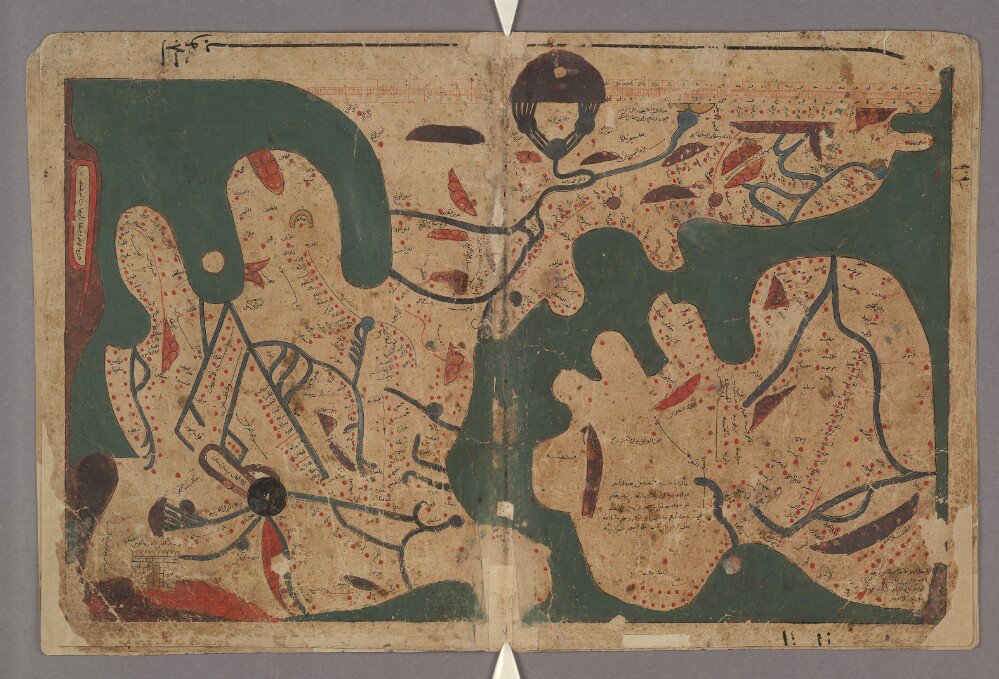
There are 17 maps in the Fatimid manuscript Book of Curiosities, 14 of which are completely unique to this manuscript. Perhaps the most remarkable is this rectangular map of the world. This the only such map to be dated before the renaissance that we know to have survived.
“The Book of Curiosities is one of the greatest achievements of medieval map-making; it is also a remarkable part of the story of Islamic civilization….It is a profoundly Fatimid treatise. Like a tirāz armband, it wears its allegiance to the Fatimid caliphs on its sleeve. This is apparent from the opening dedication, from the blessings heaped on the Fatimid imams” — Emilie Savage-Smith and Yossef Rapoport, authors of Lost Maps of the Caliphs.
About a millennium ago, in Fatimid Cairo, an unknown author completed a large and richly illustrated book. In the course of thirty-five chapters, this book guided the reader on a journey from the outermost cosmos and planets to Earth and its lands, islands, features, and inhabitants. This treatise, known as The Book of Curiosities, was unknown to modern scholars until a remarkable manuscript copy surfaced in 2000. Christie’s auction house in London, who had put up the manuscript for sale, wanted to know more about it and invited Professor Emilie Savage-Smith of Oxford University to examine the manuscript. As it turned out the manuscript was one of the most important discoveries in the history of cartography in recent decades, and was eventually acquired by Oxford University’s Bodleian Library. With Yossef Rapoport, then a young research assistant, Professor Savage-Smith, set out to critically study the manuscript and together they co-authored “Lost Maps of the Caliphs,” with the aim of providing the first general overview of The Book of Curiosities and the unique insight it offers into medieval Islamic thought.
“As tales of scholarly finds go, this is up there with the best….Lost Maps of the Caliphs is a testament both to the scholarship of its authors and to the spirit of inquiry fostered by the Fatimids.” — The Daily Telegraph, London.
The article that follows below was originally published on Jadaliyya on April 8, 2019. We are deeply indebted to Bodleian Library Publishing, publishers of the UK edition of “Lost Maps of the Caliphs,” as well as The University of Chicago Press for facilitating the publication of the complete interview as well as an excerpt from the book on Simerg.
“Lost Maps of the Caliphs” has been acclaimed world wide in numerous reviews. In addition to the very brief excerpt that has been quoted here from London’s Daily Telegraph, the following quote from Imago Mundi goes on to validate the book’s outstanding content: “We are fortunate indeed that Rapoport and Savage-Smith have undertaken fifteen years of meticulous, collaborative research on the Book of Curiosities. The culmination, Lost Maps of the Caliphs, is an exceptional tribute to an exceptional object of study.”
~~~~~~~~
Interview with Yossef Rapoport and Emilie Savage-Smith, authors of Lost Maps of the Caliphs
Jadaliyya (J): What made you write this book?
Yossef Rapoport and Emilie Savage-Smith(YR and ESS): This book started with a discovery. In September 2000, a specialist in Islamic manuscripts at Christie’s auction house in London called Emilie—who specializes in the history of Islamic science—and asked her if she could come into London from Oxford and look at a puzzling Arabic manuscript that was up for sale a couple of weeks later. It was entitled Kitāb Gharāʾib al-funūn wa-mulaḥ al-ʿuyūn, which loosely translates as “The Book of Curiosities of the Sciences and Marvels for the Eye.” Christie’s didn’t know what to make of it, and wanted to seek Emilie’s advice about its importance.
Emilie was shown a rather scruffy manuscript, bound in ill-fitting covers, with a bird-dropping visible on the cover. But inside the covers was a medieval Arabic treatise on the skies and the Earth, accompanied by a series of strange images and maps unparalleled in any other medieval work. Above all, it had a map of the world with a scale of degrees of longitude at the top, in what seemed to be the earliest surviving example of mathematical plotting on any world map known to us.
The manuscript turned out to be one of the most important discoveries in the history of cartography in recent decades. With the support of Oxford colleagues, Emilie began a campaign to ensure the work would be available to the public rather then be kept by private collector. In June of 2002, it was acquired by the Bodleian Library at the University of Oxford, with the help of the National Lottery Fund. Yossi then joined as (then) a young research assistant. We first established that the treatise was written in the first half of the eleventh century, in Cairo, the newly-founded capital of the Fatimid Shi’a Empire. We then spent the following decade carefully preparing a critical edition and annotated translation of the maps and text, published by Brill in 2014.
Our critical edition made the treatise and its maps available for scholars, but it did not explain what they mean or why they are so important. We strongly felt that merely translating the text and presenting the images—beautiful and striking as they are—was not enough. The treatise had to be understood as a whole, because the maps of the sky and of the Earth, of the Indian Ocean and of the Nile, of Sicily, of Mahdia, and of southern Anatolia, all made sense only when read together in the context of the society and culture in which they were produced. Lost Maps of the Caliphs tells the story of this exceptional manuscript—how it was discovered and why it is so significant.
J: What particular topics, issues, and literatures does the book address?
YR and ESS: Because the treatise is so wide-ranging, we use it to reconsider the development of astronomy, astrology, geography, and cartography in the first four centuries of Islam. In the Lost Maps we outline the medieval Islamic understanding of the structure of the cosmos and celestial phenomena. The amalgamation of Hellenistic, Coptic, Hindu and other star lore was all channeled towards an astrological mind-set. The Earth together with the Heavens formed the universe of eleventh-century Cairo. To a medieval person, whose night skies were not blanked-out by city lights and pollution, the contents of the night sky—the ‘Raised-Up Roof’ as our author, following the Qur’an, called it—revealed the workings of the universe and, if properly understood, heralded events on Earth.
Our book is also a contribution to the history of global communication networks at the turn of the previous millennium. We use the geographical materials of the Book of Curiosities to depict the Fatimid Empire as a global maritime power, with tentacles of military and religious authority in the Eastern Mediterranean, the Indus Valley, and along the East African coast. The extent of Fatimid knowledge of Byzantine coasts demonstrates close ties between the Muslim and Christian empires. The material on East Asia sheds new light on Sino-Indian trade routes and is very surprising for a treatise written in Egypt. The treatise’s familiarity with the East African coasts contributes to recent debates on the Islamization of the Swahili coast.
Perhaps most importantly, we use the Book of Curiosities to re-consider the history of early Islamic map-making. The world map of the Book of Curiosities is a result of the dialogue of the Islamic world with Hellenistic, Late Antique geography. The extensive maritime material in the Book of Curiosities sheds new light on navigation in the Mediterranean and the Indian Ocean before the introduction of the compass in the thirteenth century, and presents an Islamic angle on debates concerning the origins of the European portolan chart.
J: How does this book connect to and/or depart from your previous work?
YR and ESS: Emilie has been working on Islamic scientific manuscripts for several decades, and published books on Islamic celestial globes, medieval Islamic magic and divination, and a catalogue of the medical manuscripts in the Bodleian Library. She also co-authored the volume on Medieval Islamic Medicine that won the 2008 Book Prize in Middle Eastern Studies of the British-Kuwait Friendship Society. It was Emilie’s vast experience with Islamic scientific manuscripts that enabled her to appreciate how special this treatise was. In Lost Maps of the Caliphs, Emilie also wrote the chapters that deal with astronomy and astrology, as well as providing a very personal chapter about her campaign to make this gem available for the public.
Yossi came to this project with training in the history of Arabic-speaking medieval Islamic societies, shortly after competing a PhD on the history of marriage and divorce in late medieval Egypt. But, like so many, he was always fascinated with maps, and the deciphering of the maps of the Book of Curiosities was as close as one gets to deciphering a fairy-tale treasure map. Through this project, he became an expert on Islamic maps, navigation, medieval trade routes between India and China, and Hellenistic collections of strange animals.
J: Who do you hope will read this book, and what sort of impact would you like it to have?
YR and ESS: We hope that this book will be widely read as a window onto medieval Islamic views of the world, a perspective on Islamic science that is missing from current debates about the legacies of Islamic civilization. The Book of Curiosities is one of the greatest achievements of medieval map-making; it is also a remarkable part of the story of Islamic civilization. Too often, the achievements of Islamic science are divorced from the culture that produced them and are only brought to light as a trophy in a sterile competition with West. Islamic maps in particular get almost no attention in surveys of Islamic history, and even when they are shown they are rarely explained. Because we tend to view Islamic civilization through the prism of religion and faith, we find no use for these abstract diagrams that tell us nothing about God.
What could be more foundational to any culture than the manner in which it conceived of the sky and the Earth? We hope to show that the discovery of the Book of Curiosities is also a timely rediscovery of those aspects of Islamic history which are too often neglected in academic and non-academic visions of Islam. It is a rediscovery of the sea as an integral part of a civilization that supposedly originated in the desert, of an outward looking scientific enquiry that was built on the foundation of the classical Greek legacy, and of the power of the image in a culture that is too often reduced to texts.
J: What other projects are you working on now?
YR and ESS: It is about time to put the Book of Curiosities behind—it is nearly twenty years since we started working on it. Emilie came back to the history of Islamic medicine and is now completing a mutli-volume translation of a thirteenth-century Syrian biographical dictionary of doctors, to be published by Brill, with selections in the Oxford World Classics series published by Oxford University Press.
Yossi has been working over the past few years on the history of the medieval Islamic countryside. He recently published a monograph, Rural Economy and Tribal Society in Islamic Egypt, whichis a detailed micro-study of the economy and society of the villages of the Egyptian province of the Fayyum as described in a unique thirteenth-century tax register. This book, too, has a lot of maps, mostly modern GIS ones but also a copy of one that was originally made in the tenth century.
~~~~~~~~
Excerpt from Lost Maps of the Caliphs by Yossef Rapoport and Emilie Savage-Smith
Who, then, was the author of the Book of Curiosities? His apparent access to naval military records suggests a direct connection to the Fatimid state. His personal acquaintance with an Ismaʿili missionary who had been to Nubia, and his unique information on itineraries in the world of the Indian Ocean, all suggest he was close to the Ismaʿili missionary network. The map of Palermo with its suburbs, the diagram of Tinnīs, and in particular the map of Mahdia, which is drawn from the perspective of someone looking at the city from a vantage point just outside of its walls, suggest that he had visited these port cities in person. In some ways, he is a successor to the geographer Ibn Ḥawqal and a predecessor of the poet Nāser-e Khosraw—both Ismaʿili missionaries, travelers and keen observers of human societies. Unlike them, however, his interest in trade is minimal, and he is more likely to have been a military man than a merchant. Nor was he a scholar of the caliber of his Egyptian contemporaries, the physician Ibn Riḍwān or Ibn Haytham, the founder of the science of optics. His grasp of mathematical concepts appears to have been quite poor, and he generally avoided technical discussions.
Rather than a scholar our author was, primarily, a mapmaker. It is the maps that make the Book of Curiosities such a distinct work of medieval scholarship and such an appealing manuscript for modern audiences. The author has unprecedented confidence in the ability of maps and diagrams to convey information. Unlike any other geographical treatise before this, the maps are stand-alone artifacts, unsupported by any accompanying text. This is true for some of the maps of the sky, but especially for the rectangular map of the world, the maps of the three great seas, and the maps of the rivers. Even when the maps are related to a text, such as those of the islands of Sicily and Cyprus, or the city of Mahdia, the information they contain goes well beyond that of the preceding prose sections. We do not have the original treatise, only a later copy, so we do not know how lavish it might have been when first penned. But the second part of the title literally translates as “that which is pleasant to the eyes” (mulaḥ al-ʿuyūn), indicating that this treatise was about the images as much as it was about the text.
article continues after image
A photo of the UK edition of Lost Maps of the Caliphs by Yossef Rapoport and Emilie Savage-Smith, published by Bodleian Library, University of Oxford. Please click on image to see book details.
Maps are at the center of this Book of Curiosities, and this anonymous mapmaker offers us his reflections on the craft of cartography. His chapter on mapmaking techniques introduces the maps of seas and islands, the most original maps in the treatise. He opens with a formulation of the purpose of his maps: “Although it is impossible for created beings to know the extent of God’s creation, the knowledgeable and qualified among them are entrusted with witnessing or imparting a small part of it.” The maps that will follow will convey knowledge, albeit imperfect, of God’s creation. He then continues to explain why his maps are intentionally “not accurate representations” of reality: the contours of coastlines change over time, the mapmaking instruments are not fine enough to reproduce reality on a small scale, and labels need to be legible. Here is a mapmaker explaining his choices and reflecting on the purposes and functionality of his maps. The results of his labor are unique medieval versions of “graphic representations that facilitate spatial understanding,” to use the definition of “map” by the leading modern historian of cartography. There is no parallel for this passage in any other medieval treatise known to us.
The Book of Curiosities is a profoundly Fatimid treatise. Like a tirāz armband, it wears its allegiance to the Fatimid caliphs on its sleeve. This is apparent from the opening dedication, from the blessings heaped on the Fatimid imams, and from the curses flung at the rebels who sought to overthrow them. The treatise also reflects some immediate political ambitions of the Fatimid state, especially in the Mediterranean. It depicts visually and in text the defenses of the strategic Fatimid holdings in Tinnīs, Mahdia, and Sicily. There are historical references to the early Islamic conquests of Cyprus, Crete, and Bari, with the inference that they may be ripe targets for Fatimid re-conquest. The mapping of anchorages, ports, and bays deep in Byzantine territory, some of them as far north as the Dardanelles, also reflect a military context. It is likely that much of the material here was actually drawn from the records of the Fatimid navy. And beyond the immediate political objectives, the maritime focus of the Book of Curiosities is also distinctly Fatimid. The unusual categories for organizing the geographical material, from seas to islands, and then to lakes and rivers, reflect the unique maritime orientation of the Fatimids, who, alone among the great medieval Muslim empires, preferred networks of ports, rivers, and islands over horses and land routes.
The treatise can be viewed as part of a westward shift in the geographical tradition and in the center of gravity in the Islamic world in general. Most ninth-century works, such as those by Ibn Khurradādhbih and the Relation of China and India, focused on Asia and the Indian Ocean. By the middle of tenth century, however, the gaze shifts to the Mediterranean, North and Sub-Saharan Africa. Al-Masʿūdī spent much of his later life in Egypt and Syria, and Ibn Ḥawqal provided an unprecedented account of the Maghreb. The eleventh-century Book of Curiosities focuses on the eastern Mediterranean. Later works of the Andalusian author Abū ʿUbayd al-Bakrī (d. 1094) and, of course, the Sicilian based al-Idrīsī (fl. 1154) have their focal point even farther to the west. The heavy reliance of the Book of Curiosities on the work of Ibn Ḥawqal is also suggestive, because the latter was, most likely, also a missionary. The focus on islands in the Book of Curiosities may have had special resonance against the backdrop of the Ismaʿili nomenclature of regional “islands.”
The Ismaʿili context of the Book of Curiosities invites comparisons with the influential Epistles of the Brethren of Piety, an encyclopedic corpus of science and Neoplatonic philosophy, composed in Iraq sometime before the middle of the tenth century. The Epistles are not cited in the Book of Curiosities, nor is there evidence for their circulation in Fatimid Egypt, despite their affinity with Ismaʿili teachings. Yet the Epistles seem to approach the subject matter of the sky and the Earth in a similar manner. Following the Greek astronomer and geographer Ptolemy, geography is seen in the Epistles as an appendix to the study of the stars. But the Epistles also have a higher purpose: the reader is invoked to contemplate the design of the creator, “to ponder wonders (ʿajāʾib) of his creation and reflect on the curiosities (gharāʾib) of what he fashioned.” This desire to observe God’s work explains some of the interest in marvels and wonders exhibited by the Book of Curiosities, as its title suggests.
Like the Epistlesof the Brethren of Piety, the Book of Curiosities draws heavily and without compunction on the heritage of Greek science. Ptolemy, Hippocrates, and Galen provide our author with much of the material on the general structure of the heavens and the Earth, and on the way the former influence the latter. Muslim scholars like al-Masʿūdī correct and add information, especially when one zooms in on the Earth’s size and layout, but the general framework inherited from the Greeks is not questioned. And while God is omnipresent, the Qur’an is cited sparingly, only to invite reflection on creation or to buttress moral points about God’s punishment meted out to the unbelievers. There is only one Tradition from the Prophet in the entire treatise, on the intrinsic purity of water. Such reliance on a Hellenistic heritage was not uncommon in eleventh-century Cairo. Mubashshir ibn Fātik, a wealthy and influential scholar, left us a remarkable collection of ethical sayings from the Greek sages, with special focus on the Late Antique and legendary Hermes.
The author of the Book of Curiosities does not limit himself to Greek authorities, but is also acquainted with Persian, Indian, and Coptic knowledge. He cites an account of the birth of astrology in India, and Persian authorities on the ominous bābānīyah stars. He is also keen to show command of multiple languages. For example, the names of each planet are given in Persian, Classical Greek, “Indian,” and Byzantine Greek; the names of each day of the week are given in Persian, Byzantine Greek, “Indian,” Hebrew, and Coptic. The use of Coptic is of special significance. There is here a deep influence of Egyptian Coptic traditions, an influence which has been overlooked in modern scholarship on Islamic science. Coptic lore was already reworked by al-Masʿūdī, and the Coptic calendar seems to have been used very early when predicting the risings of the lunar mansions. There is even more Coptic material in the Book of Curiosities, including accounts of the moray eel and the foundation of Tinnīs. Most importantly, the explanations related by Copts regarding the flooding of the Nile—that the Nile floods are a result of the summer melting of the snow on equatorial mountains—are as close to the present understanding of the Nile system as was ever achieved by medieval Islamic scholarship.
Date posted: January 26, 2020. Last updated: February 3, 2020.
Before departing this website please take a moment to review Simerg’s Table of Contents for links to hundreds of thought provoking pieces on a vast array of subjects including faith and culture, history and philosophy, and arts and letters to name a few.









 Simerg - Insights from Around the World