Simerg is an independent initiative dedicated to Ismaili Muslims, the Aga Khan — their Hereditary Imam — and the Ismaili Imamat, and Islam in general through literary readings, photo essays and artistic expressions
Author Archives: Malik Merchant, Editor
Founding publisher and editor of www.barakah.com, www.simerg.com and www.simergphotos.com.
Alphonso Davies in action for Canada during a match against Dominica at BMO field in Toronto in October 2018. Photo: Wikipedia, CC BY 2.0. Click on photo for Christian Science Monitor article.
What a marvellous afternoon to be watching the finals of UEFA Champions between Bayern Munich and Paris Saint-Germain, and seeing, YES, 19 year old Canadian Alphonso Davies lift one of the most prestigious trophies in the sporting world! One moment I will never forget from the game was when Alphonso calmly headed back a cross to his own keeper in the second half. His soft precise touch was simply that of a self-assured and confident person. A stronger header, slightly off the goalkeeper’s mark, could have resulted in an own-goal and 1-1 scoreline, taking the game to extra-time if the game remained tied after 90 minutes. It was an amazing touch, and a great footballer commenting the game noted that he would not have dared to do that himself!
Before departing this website please take a moment to review Simerg’s Table of Contents for links to hundreds of thought provoking pieces on a vast array of subjects including faith and culture, history and philosophy, and arts and letters to name a few.
We would like to thank Lesley Bannatyne for permission to reproduce her piece on the latest work of Harvard Professor Richard Wolf, which appeared in a recent issue of The Harvard Gazette. Dr. Wolf is producing a film about two Ismaili poets, who live on either side of Amu Darya in the rugged Wakhan Corridor (see map below). Qurbonsho lives in Vrang in the Ishkashim district of Gorno-Badakhshan in Tajikistan, and Daulatsho lives approximately 80 kilometres away in Yur village in Afghanistan. Both the villages are highlighted in the map. The Wakhan Corridor is a narrow strip of land about 350 km long and 13 to 65 kms widein North Eastern Afghanistan, part of Badakhshan Province. Two large mountain ranges dominate the area, the Pamir in the North, and the Hindu Kush in the South. It is surrounded on three sides by Tajikistan, China, and Pakistan. The United Nations puts the population of the Wakhan Corridor at approximately 10,590, of which about 1,200 are Kyrgyz, and the remainder are mainly Ismailis.
‘Two Poets and a River’: Worlds of Love in the Wakhan Valley
Filmmaker and Ethnomusicologist Richard Wolf is studying two Ismaili poets living in the Wakhan Corridor. Qurbonsho lives in South Eastern Tajkistan in Vrang, in Ishkashim district, and Daulatsho about 50 miles (80 kms) miles away across the Amu Darya (specifically the Panj River) in Yur village in Northeastern Afghanistan.Map: Adapted from University of Texas; updated by Simerg with approximate locations of Vrang and Yur(both circled in red).
By LESLEY BANNATYNE Harvard Correspondent
On opposite sides of the Oxus River [or Amu Darya, see map], border between Tajikistan and Afghanistan live two poet-singers who share a common language [Wakhi], faith [Ismaili Islam], and family network, and yet remain separated by vicissitudes of the Great Game, the 19th-century conflict between the British Empire and Czarist Russia. Ethnomusicologist Richard Wolf has been contemplating the rupture that exists across this divide in “Two Poets and a River,” a film in progress about poet-singers Qurbonsho in Tajikistan and Daulatsho in Afghanistan.
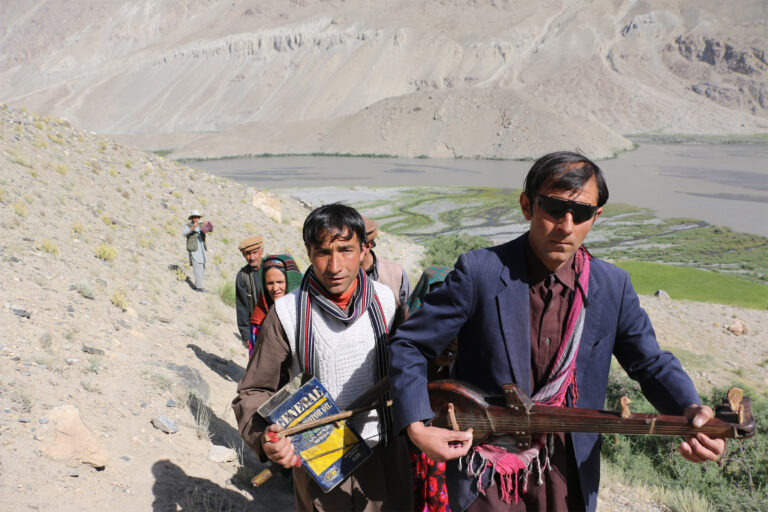
Daulatsho, Yarqub and others playing their instruments and singing as they climb from Yur village to the ayloq (upper pasture). Upper Wakhan, Afghanistan, July 2016. Photo: Richard K. Wolf.
71470016 Qurbonsho, sitting beside his daughter and aunt, in front of his ancestral home. Vrang, Ishkoshim district, Tajikistan, July 2018. Photo: Richard K. Wolf.
Wolf, a professor in music and South Asian studies, has a longstanding curiosity about Central Asian people and music, but his research efforts began in earnest on a Fulbright Fellowship to Tajikistan in 2012.
“I went to Central Asia to work on Wakhi music and soon came to know of Qurbonsho, a poet-singer who lives on the Tajik side of the river,” he said. “I was always curious about the Wakhis living on the Afghan side, but in 2012–13, as a Fulbright scholar, I wasn’t allowed to cross into Afghanistan.”
The border had been negotiated long ago by Britain and Russia, and Wolf was intent on crossing it, but the effort took years. In 2015, he returned to Tajikistan with names of Wakhi poets, musicians, and their villages in hand. He and his small team drove for several days until the road came to an abrupt end: Melting snow had descended in torrents off the mountaintops and washed out the road and many settlements. Wolf and his companions were forced to continue into Upper Wakhan by foot, yak, and donkey. In village after village, he would hear of Daulatsho, who seemed to be everyone’s teacher as well as the composer of most modern Wakhi songs. Wolf arrived at Daulatsho’s village of Yur (alt. 10,500 feet / 3200.4 metres) only to find that the musician had retreated to the higher pastures where Wakhis graze their cattle in the summer months. The poet-singer finds much creative inspiration in the high mountain flowers, fields, rocks, and rushing water.
Richard Wolf and villagers recording Wakhi women singing “bulbulik.” Ayloq (upper pasture) above Yur village, Upper Wakhan, Afghanistan, July 2016. Photo: Katherine Freeze
“I left word that I’d return the next year. In July 2016, Daulatsho was ready for me and set me up in a one-room house. But I didn’t get much of a chance to see what was going on in the village. So I proposed making a film in order to have an excuse to see more of the village,” he said.
Wolf had used other formats to present scholarly material before — his 2014 book, “The Voice in the Drum: Music, Language, and Emotion in Islamicate South Asia,” was a work of creative nonfiction based on 30 years of fieldwork in India and Pakistan. He had been thinking about using a film to create a sequel, but his current research in Central Asia led him to postpone that plan.
“Two Poets and a River” took shape over the next several years and has been shown in the U.S. and Europe as a work in progress. Wolf traces the poets’ contemplations on separation, family, and environment, as well as their imaginings about what lies on the other side of the border. The two singers knew of one another by reputation and through recordings Wolf had made, but they had never met. In the winter of 2018–19, stranded with Daulatsho not far from the border because an enormous truck had broken down and blocked the road, Wolf realized he was close enough to pick up a cellphone signal from Tajikistan. He called Qurbonsho, and the two poets spoke to each other for the first time.
“The life experiences of these two musicians differ significantly,” Wolf said. “Qurbonsho studied in Soviet schools near his house and served as a construction worker for the army; Daulatsho had to relocate to the district center. He has crossed the border into nearby Pakistan but for the most part stays in Wakhan. Qurbonsho lives on what he makes from performing at weddings, but no one can afford to pay Daulatsho for his performances — rather he survives on his meager monthly salary as a schoolteacher. Distances that can be covered in hours on the Tajik side may take days on the Afghan side. Wakhis from Tajikistan see in Afghan Wakhis images of themselves 50 years ago. Afghan Wakhis see in their Tajik counterparts a measure of freedom and wealth.
“But as I worked with each of these musicians I found many similarities. They share common lifeways of pastoralism, house construction, and food. Their musical poetry is based on themes common to the Persianate world. The quintessentially Wakhi song of separation, bulbulik [nightingale], inspires the art of both poets with its sparse, three-line structure. Daulatsho’s Afghan Wakhi poems tend to be lengthy but use only a few melodies. Qurbonsho writes brief, pithy poems that draw from a variety of musical styles current in Tajikistan.”
After more than 100 years of imposed division, what resonates among the Wakhis, what their poets sing and write about, comes from something deeper: love, longing, and distance from a beloved.
“My film considers the broad trope of love as well as what it means for members of a community to be separated across a national divide. I was thinking of ending ‘Two Poets and a River’ with the two men meeting in person,” said Wolf. “But I’m not sure that would be true to the spirit of love, loss, and separation that underlies the river metaphor.”
Date posted: August 26, 2020.
________________
Harvard’s Richard Wolf
Richard Wolf is professor of Music and South Asian Studies at Harvard University who conducts ethnomusicological field research on the musical traditions, languages and cultures of South, Central and West Asia. His website http://richardkwolf.com/ includes samples of songs and film clips related to his work in diverse areas. For his more complete profile, please click Richard Wolf.
Before departing this website please take a moment to review Simerg’s Table of Contents for links to hundreds of thought provoking pieces on a vast array of subjects including faith and culture, history and philosophy, and arts and letters to name a few.
We welcome feedback from our readers. Please complete the LEAVE A REPLY form below or click on Leave a comment. Your letter may be edited for length and brevity, and is subject to moderation.
A decade has passed since the first publication of our series “I Wish I’d Been There” when we asked you to be “a fly on a wall” and pick one moment in Ismaili history that you particularly wish you had lived to see, and why. [Note: The “I Wish I’d Been There” idea had sprung from the December 1984 issue of American Heritage magazine which was dedicated to American history under the same theme.]
The response was superb, with scholars, writers and readers from every field imaginable contributing insightful and thought-provoking pieces — some long and others short and precise. Following the series, a professionally looking booklet was produced, which is downloadable as a PDF file.
Aside from the current Covid-19 pandemic which has wreaked havoc, affected everyone’s day to day life, and disrupted our plans, a great deal has changed in the past 10 years: young children have entered university, students are now in professional employment, and many have embarked on new careers and adventures. New sources of knowledge have come to light and been published, and we have celebrated the Golden and Diamond Jubilees of our beloved Mawlana Hazar Imam, as well as participated in new Imamat initiatives and projects. As such, we have decided to relaunch a series that was so well received and acclaimed for its originality and the remarkable quality of the narratives.
articles continues after image
Simerg Launches a New I Wish I’d Been There Series
Technology and the quality of podcasts keeps on improving. The new “I Wish I’d Been There” series will, therefore, avail of these developments. In addition to textual expressions, we would like to receive contributions in the form of podcasts, as well as videos (of up to 5 minutes).
We would like all age groups to contribute to the series. In 2010, we published thirty-one unique stories. Can we double that count in 2020? The series will commence on October 15th, 2020 and conclude in April 2021.
From 50 words to a narrative of 500-800 words or more (or a 1- to 5- minute podcast/video), see what you can do to inspire, and educate, thousands of readers around the world with your insight of one scene, incident or event in ISMAILI history, recent or past, you would like to have witnessed — and why?
We look forward to a fantastic response. Please write to Malik Merchant at Simerg@aol.com.
Date posted: August 21, 2020.
__________________________
Download the First “I Wish I’d Been There” Series on Ismaili History
Click on image to download complete I Wish I’d Been There Series in PDF Format
____________________
Malik with his mum Maleksultan
Malik Merchant is the founding publisher/editor of Simerg (2009), Barakah (2017) and Simergphotos (2012). A former IT consultant, he now dedicates his time to family projects and other passionate endeavours such as the publication of this website. He is the eldest son of the Late Alwaez Jehangir Merchant (1928-2018) and Alwaeza Maleksultan Merchant who both served Ismaili Jamati institutions together for several decades in Mozambique, Tanzania, Pakistan, the UK and Canada in both professional and honorary capacities. Malik’s daughter, Dr. Nurin Merchant, is a veterinarian and supports his endeavours as an honorary editor of the three websites.
Before departing this website please take a moment to review Simerg’s Table of Contents for links to hundreds of thought provoking pieces on a vast array of subjects including faith and culture, history and philosophy, and arts and letters to name a few.
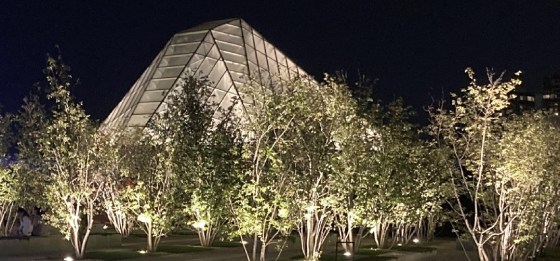
The Toronto Headquarters Jamatkhana located at the Ismaili Centre Toronto on 49 Wynford Drive, reopens Monday August 17, 2020, after 156 days of closure due to Covid-19. We bring you photos of the dome, which was lit for the first time in months, and a unique Garden Party organized by the Aga Khan Museum at the adjacent Aga Khan Park. Please click Jamatkhana in Full Glory or on image below.
Approaching the doors of the Jamatkhana Heads bowed in all humility Lower your gaze Pause a moment Softly say a heartfelt prayer Shukhrana, Al Hamdu’lillah The blessed day has arrived Quieten your thoughts Touch your heart Hand on your heart Smile with your eyes Greet gently Gracious to one and all Carry your mehmani in your heart Let Allah’s light guide you To His threshold Let divine grace Touch your praying hands Embrace the silence Be at peace The sacred space Awaits your soulful zikr
Date posted: August 16, 2020.
_______________________
About the author: Parin’s love of books, music, theatre, and travel sometimes leads her to writing about her experiences, and the reopening of Jamatkhanas inspired her to pen a few lines here. Originally from Kenya, she studied at Makerere University, Kampala, and at the University of Dijon, France, and lived in Oxford, England, before moving to Canada. She has been in Doha, Qatar, for the last 12 years and living in the Middle East has enhanced her appreciation of Islamic art and culture. She is presently back in Calgary.
We welcome feedback from our readers. Please complete the LEAVE A REPLY form below or click on Leave a comment. Your letter may be edited for length and brevity, and is subject to moderation.
____________________
The featured photo shown at the top of this post was taken on the night of Friday August 14, 2020, when the Headquarters Jamatkhana dome at the Ismaili Centre Toronto was lit up for the first time since mid-March when Jamatkhanas across Canada closed down due to the Covid-19 pandemic. The spectacular lit up dome is visible from the busy Don Valley Parkway, and is much admired by pedestrians and drivers alike as they drive through the Parkway or walk along Eglinton Avenue and Wynford Drive. The photo and the beautiful poem penned by Parin Verjee celebrate the opening of the Headquarters Jamatkahana on Monday August 17, as well as other Jamatkhanas that have opened in recent days or will be opening in the coming days.
___________________
Before departing this website please take a moment to review Simerg’s Table of Contents for links to hundreds of thought provoking pieces on a vast array of subjects including faith and culture, history and philosophy, and arts and letters to name a few.
A hundred years ago Katchhi and Kathiawadi Ismaili Khoja Muslims sailed to Africa and Zanzibar to make a living. Today, they have prospered in America, Canada and Europe. They wear western clothes, live in palatial homes and drive expensive cars but in the homes they still speak their rustic dialect and they remember the ‘pacchedi’ (Khoja Muslim head drape) their mothers wore.
The ‘Pacchedi Geet’ in a folk song form, is written in Gujarati, ‘transcreated’ in English, and transliterated in Roman script. The song is composed to remember and celebrate the pioneers who left India a century ago but kept memories of their homeland alive.
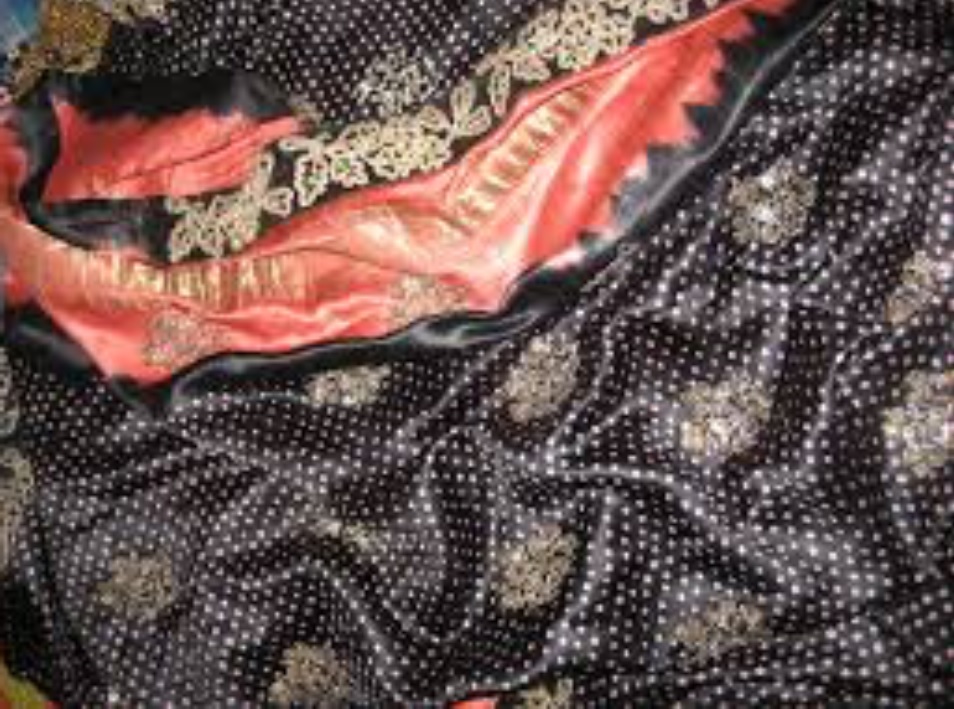
My thanks to Sultan Somjee for permission to use the bandhani image, and Zahir Dhalla for transcribing in Gujarati script.
I welcome singers to set up a geet with the lyrics that have been provided below. Recordings or questions regarding the geet may be sent directly to me at safder8@gmail.com or to the editor of Simerg at simerg@aol.com.
Drape (Khoja Pacched̨̨i)
Kohl-grey silk Studded with white stars A border of a thousand flowers. Mother, how many colours under your drape?
Milk, oudh and attar Strands of jasmine hanging, Underneath, I sleep in deep slumber. Mother, these are the colours under your drape.
Ghee, molasses, Apricots and raisins. Mother, your bread tastes so sweet. Mother, what colours under your drape?
Storms, thunder And lightening! Frightened, I hide under your drape. Mother, colours like these under your drape.
Witches, warlocks Ghosts and giants Scare me not under the shade of your drape. Mother, colours like these under your drape.
With tables and chairs We built boats And flew sails made out of your drape. Mother, how many colours under your drape?
Leaving home We crossed the seas. We spread Giga Patney’s patola. Mother, how can I break from the ties of your drape?
Your eyes closed, Your soul departed. We draped you in rosy pink. Mother, colours like these under your drape.
_________________
પછેડી (Gujarati)
સુરમય રેશમ માથે ધોળા તારા ચારે કોર હજાર ફૂલ ની પટ્ટી …..૧ માઈં તારી પછેડી ની પાછળ કેટલા રંગ ?
દૂધ ઊધ ને અંતર માથે ટાંક્યા મોતિયા છાયેં હું સુવું ઊંડી નીંદરે …..૨ માઈં તારી પછેડી ની પાછળ એવા રંગ!
ઘી ગોળ અને સૂકો મેવો મા, મને મીઠી લાગે તારી રોટલી …..૩ માઈં તારી પછેડી ની નીચે કેવા રંગ ?
વાયુ વીજળી મેધા ઘરજે હું ડરી સંતાઉ પછેડી ની નીચે …..૪ માઈં તારી પછેડી ની પાછળ એવા રંગ!
ડાકણ દઈંત ભૂત રાક્ષસ મને ન ડરાવે પછેડી ના છાયેં …..૫ માઈં તારી પછેડી ની પાછળ તેવા રંગ.
મેજ ખુરસી ના વાણ બનાવયા ઊપર ઊડાડીયા પછેડી ના સઢ …..૬ માઈં તારી પછેડી ની નીચે તેવા રંગ.
દેસ છોડી દરિયા તરીયા ગીગા પટણી ના પટોળા પાથરીયા …..૭ માઈં તારી પછેડી ની પછળ કેમ છોળું ?
આંખ મીચાણી જીવ ઊડયાં ઓઢાળી તને ગુલાબી પછેડી…..૮ માઈં તારી પછેડી ની નીચે એવા રંગ.
_________________
Pached̨i (Gujarati transliteration)
Surmai resham Mathé d̨̨hod̨a tara Chąré kor hajjar ful ni putti Maai tari pacched̨I ni pacchad̨ ketla rung
Dooth, oodh ne antar Mathé tankya motia Cchayeñ huñ suwuuñ oondi ninderé Maai tari pacched̨i ni pacchad ewa rung
Ghee, ghor̨̨ Ané sooko mewo Ma mané mith̨I lagé tari rotli Maai tari pached̨i ni niché kewa rung
Wayuñ, wijad̨i Megha gharajé Huñ santauñ durri pacched̨I ni niché Maai tari pached̨i ni niché kewa rung
Dakan̨, dayint Bhoot, rakshas Mané na darawé pachced̨I na cchayeñ Maai tari pacched̨̨i ni pacchad̨ tewa rung
Mej khud̨si na Waan̨ banawya Ooper oodad̨̨iya pacched̨̨I na suddh Maai tari pacched̨i ni niché kewa rung
Des cchod̨̨i Dariya tariyañ Giga Patney na patol̨a pathariyañ Ma tari pacched̨i ni pucchud̨ kem cchod̨uñ?
Aankhyuñ michan̨̨i Jeev oodiyañ Odh̨ad̨̨i tunné gulabi pacched̨̨i Ma tari pacched̨i ni niché ewa rung
Retroflex d̨, n̨ as in fud̨ (fruit) and pan̨i (water) Nasal ñ as in French ‘pain’ and Portuguese ‘paű’ (bread) Dental t as in tű (you) and d as in diwas (day)
_________________
Pached̨i (Kachchhi transliteration)
Surmai resham Muthé d̨̨hod̨a tara Chąré kor hajjar ful ji putti Maai toji pacched̨I ji pudthia kitra rung?
Retroflex d̨, n̨ as in fud̨ (fruit) and pan̨i (water) Nasal ñ as in French ‘pain’ and Portuguese ‘paű’ (bread) Dental t as in tű (you) and d as in diwas (day)
Date posted: August 15, 2020.
Before departing this website please take a moment to review Simerg’s Table of Contents for links to hundreds of thought provoking pieces on a vast array of subjects including faith and culture, history and philosophy, and arts and letters to name a few.
____________________
This piece is also available as a PDF File, and may be downloaded by clicking on The Drape PDF.
S. Giga Patney
S. Giga Patney has taught English as a Foreign Language in Japan, Portugal and England; and English as a Second Language in England and Canada. He won the Teacher Fellowship at the University of London Institute of Education when he was a teacher with the Inner London Education Authority. He was Head of Language Service In Berkshire, UK and Principal Lecturer in the Department of Teaching Studies at The University of North London. He joined the Department of Language Education at the University of British Columbia, Canada to teach on their post-graduate program. He has now retired and lives in the interior of British Columbia where he does his creative writing.
Books by the author:
Literary Fiction: The Shiv-Shivani Trilogy: Book 1: Shiva – Lord of Dance – A Novel in Raga Bhairava Book 2: Shivani’s Story – A Novel in Raga Bhairavi Book 3: Shivani’s Dance of Destruction – A Novel in Four Movements.
Fact-fiction: Ties of Bandhana- The Story of Alladin Bapu
Facetiae: The Alchemist Quartet Book 1: The Alchemist and the Prince – A Story of the Prince With a Nut in His Navel Book 2: The Alchemist’s Manuscript – Of the Travels of the Merchant of Yemen & His servant in the Erythrean Sea as Related to the Alchemist of Gozo, the Younger Book 3: The Alchemist and the Empire of Evil Book 4 (Forthcoming): The Alchemist and the Indian Boy
_________________________
If you wish to leave a comment, please complete the LEAVE A REPLY form below or click on Leave a comment. Your letter may be edited for length and brevity, and is subject to moderation.
The Ismaili Canada’s iicanada.org portal proudly announces, “Jamatkhana Reopening Welcome Back,” and goes on to state, “As Jamatkhana capacity is limited due to COVID-19 regulations, and to enable contact tracing in the event of a potential infection event, all individuals will need to register online to gain access to Jamatkhana. Pre-registration allows Jamati members to indicate their preferred dates and times of Jamatkhana attendance (including Jamatkhanas not yet open), and be allocated a confirmed spot ahead of time.”
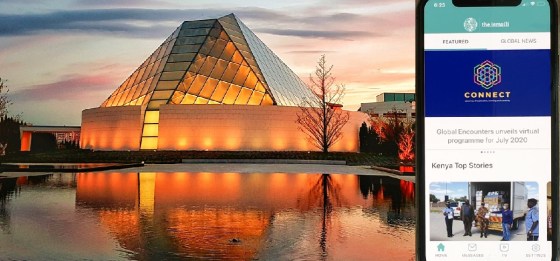
The Ismaili Centre Jamatkhana, known as Toronto’s Headquarters Jamatkhana, shown above as a featured photo, opens on August 17.
Speaking to a close friend in Ottawa, I am told that yesterday’s (Tuesday, August 12, 2020) opening of the Jamatkhana filled it up to the maximum persons permitted in the prayer hall. It felt like a commemorative occasion with the announcement of appointments of new Majlis Mukhi and Kamadia Sahebs as well as Mukhiani and Kamadiani Sahebas. From Vancouver, I get a video from a friend who attends his local Jamatkhana after more than 150 days, since the Jamatkhana closures in mid-March, and he watches the sky with the moon illuminated at 42%. His face glows, and as he reaches his Jamatkhana his heart is filled with joy.
Narratives circulate on the social media and Whatsapp about 1st day experiences in the Jamatkhana after a long long lay-over, especially from Portugal, where Jamatkhanas first opened a few weeks ago.
A comprehensive list of Jamatkhana opening days, registration details etc. for Canada is available at iicanada.org.
The.Ismaili image on Jamatkhana reopenings in Canada
For openings and latest announcements of Jamatkhana openings in some other parts of the world please click FRANCEand PORTUGAL. A few USA Jamatkhanas in small centres were scheduled to open several days ago but the openings have been delayed due to a surge of coronavirus infections in numerous states.
Regrettably, the country portals available through the.ismaili community website are not updated with the status of Jamatkhana openings — except for Canada and France, and local Jamati members in various countries are often informed through their respective Jamati institutions newsletters or Apps. For example in Canada the link iicanada provides a list of Jamati newsletters that you may subscribe to. Of particular importance on the list would be the weekly Al-Akhbar for different regions, BC, Alberta, Ontario etc.
It is advisable that readers download their respective country wide institutional Jamati Apps available in their regions or subscribe to the weekly newsletters for the latest information. However, not everyone is familiar about downloading and using apps, and users accessing the internet via notebooks and desktops are put at a disadvantage.
It is important that there is some consistency about how information for different countries is available through the different portal Ismaili websites for non App users. I was personally confused, and would be happy to stand corrected if others don’t find that to be the case.
For everyone totally comfortable about downloading and using Apps, as we live in an App driven world, I would request readers to visit the official Ismaili community page where instructions are provided for downloading the.Ismaili app onto your hand held device. The Ismaili states that “with the app, which is available to download for free from the Apple App Store and Google Play Store, users can stay up-to-date on global and national news, receive official messages from Jamati institutions, and watch The Ismaili TV live.”
Among other things, the App will “allow you to receive notifications, including breaking news and official messages from Jamati Institutions.” It will also allow you to see news from other countries around the world by toggling to as many countries as the readers wishes to. Again, please visit the page the.Ismaili app.
Date posted: August 13, 2020.
Before departing this website please take a moment to reviewSimerg’s Table of Contents for links to hundreds of thought provoking pieces on a vast array of subjects including faith and culture, history and philosophy, and arts and letters to name a few.
____________________________________
If you wish to leave a comment, please complete the LEAVE A REPLY form below or click on Leave a comment. Your letter may be edited for length and brevity, and is subject to moderation.
Share memories of members of your family who you have lost during the Coronavirus pandemic, either due to Covid-19 or any other cause. Please write to Malik Merchant at Simerg@aol.com; you must include your full name and contact information.Please read earlier tributes in Issue # 1.
___________
Inna lillahi wa inna ilayhi raji’un “Surely we belong to God and to Him we return” — Holy Qur’an, 2:156
Huzurmukhi Madatali Merali Jamal (Canada)
Madatali Jamal, age 89 (d. .April 2020)
Submitted by Shahida Mamdani-Sunderji, daughter of Madatali Jamal
Huzurmukhi Madatali Merali Jamal (April 30, 1930 – April 13, 2020), husband of Dilshad Jamal for 66 years, father of Shahida Mamdani-Sunderji and Amin Jamal, father-in-law of Begum Jamal, and grandfather of Shelina, Shairoz, Rahim and Aminmohamed, passed away in Ottawa during the spring of 2020, just over two weeks short of his 90th birthday. He was surrounded by his family in volunteers uniform at his funeral.
For the past several years, Mr. Jamal had dedicated his service to the Ottawa Jamat, at both the old and new Jamatkhana locations on Carling Avenue and Conroy Road, respectively. For years he lovingly tendered the Jamatkhana garden on 991 Carling Avenue. In the evenings, Mr. Jamal would present himself regularly as a volunteer at both the Jamatkhanas. His record of Jamatkhana attendance and services as volunteer was impeccable. He was accompanied and supported in his service and Jamatkhana attendance by his loving wife of 66 years, Dislshad. He served the Ottawa Jamat enthusiastically until the very last months of his life, when dementia took over.
Born and raised in Kakumiro, Uganda, he and his family settled in Scotland in October 1972 following the expulsion of Asians from Uganda, decreed by dictator Idi Amin. Huzurmukhi Jamal held positions of Mukhisaheb and Kamdiasaheb during his years in Uganda and Scotland. In 1985, he migrated with his family to Ottawa.
His dedication to the house of Imamat inspired his children to serve in numerous positions in the Jamat. His son Amin and wife Begum served as the Kamadia and Kamadiani of Ottawa Jamat for 4 years, which included the Golden Jubilee period of Mawlana Hazar Imam’s Imamat from July 11, 2007 until December 13, 2008. This service of his children filled Mr. Jamal with immense joy and happiness.
He was very fond of Ginanic literature, and instilled the wonderful tradition in his children. His daughter Shahida recites Ginans in Ottawa Jamatkhana regularly. Ambitious for his family, Mr. Jamal always asked them to take on life’s challenges and meet them with courage, hard work and wisdom.
He is deeply missed by all his family members in Canada and around the world, as well as his friends and the entire Ottawa Jamat.
We pray that his soul may rest in eternal peace. Ameen.
_____________________________
Huzur Mukhiani Razia Jamal (United Kingdom)
Razia Jamal, age 73 (d. May 3, 2020)
Submitted by Navrose Chappell, daughter of Razia Jamal
Razia Jamal, born in Kampala, Uganda, in 1947, passed away peacefully in hospital on Sunday, May 3, 2020 with her three children by her side, her family including her much loved grandchildren, brothers and sisters holding her hand virtually, whilst her favourite Zikr tasbih played in the room.
Before she passed away, she spoke with all of her family, received Chanta (sprinkling of water on face), and the Stoke-on-Trent Mukhisaheb bestowed Dua upon her and the family via a conference call.
Razia served Stoke-on-Trent Jamati Institutions for over 40 years. She held the position of Jamati Kamadia Saheba for six years and supported her late husband Huzur Mukhisaheb Shiraz Jamal as he undertook the role of Jamati Mukhisaheb.
She was a dedicated volunteer who also undertook the role of Vice Captain and Captain at Stoke-on-Trent Jamatkhana during her service. Razia was an integral part of the Team in securing a permanent building for Stoke-on-Trent Jamatkhana which was founded in 2000.
As the Central Property Management (CPM) Lead for Stoke-on-Trent Jamatkhana for 14 years, Razia was also the first female CPM Lead in Europe.
Since her passing, the family have received many touching tributes conveying how much of an inspiration she was regarding her voluntary work, remarking on her wonderful services, writing how she was a real example of how voluntary service (seva) should be conducted, describing her as a legend, and commenting on her immense dedication to Stoke-on-Trent Jamatkhana.
Razia was a strong, classy, beautiful, thoughtful and humble lady, who loved her children, grandchildren and family immensely.
She will be fondly remembered by all of her family, friends, Stoke-on-Trent Jamati members, and all the other Ismaili brothers and sisters who she has worked with during her lifetime of seva.
Razia will be deeply missed every day, and we pray for her soul to rest in eternal peace. Ameen.
_____________________________
Alijah Saheba Zubeda Ebrahim Jamal (Canada)
Zubeda Ebrahim Jamal, d. age 83.
Submitted by Shariffa Keshavjee, friend and colleague of Zubeda Jamal
Alijah Saheba Zubeda Ebrahim Jamal’s funeral took place at Burnaby Lake Jamatkhana, in Burnaby, British Columbia, on August 6, 2020. Originally from Kisumu Kenya, she settled in Vancouver, and attended the Darkhana Jamatkhana.
Zubeda and I became friends as she encouraged me to take an active role in the Guiding Movement. In 1959, when I was in Kisumu, Zubeda was a Commissioner of the Girl Guides. I led the Brownies from the Siriguru Singh Saba School. We took the Brownies and Girl Guides camping.
I am grateful to Zubeda for her encouragement because it led me to serve as a girl guide to date. I remain a Trustee with the Kenya Girl Guides Association and an Honorary Associate with the World Association.
Rest in peace dear Zubeda. Ameen.
Date posted: August 12, 2020.
We welcome tributes from our readers to individuals portrayed in this piece. Please use the feedback box which appears below. If you don’t see the box please click Leave a comment. Please also see our earlier tributes by clicking Issue # 1.
_____________________
To submit a tribute to your family member who has passed away due to Covid-19 or any other cause, please read TRIBUTES and write to Malik Merchant at Simerg@aol.com; please include your full name and contact information.
Before departing this website please take a moment to review Simerg’s Table of Contents for links to hundreds of thought provoking pieces on a vast array of subjects including faith and culture, history and philosophy, and arts and letters to name a few.
If there is one Ginan that gets an entire Jamatkhana congregation immediately connected and singing in unison with joy and unbounded happiness, it has to be Pir Sadardin’s Ginanic composition of 7 verses, Eji Anand Anand Kariyo.
Eji Anand Anand is one of the first Ginans every Ismaili child learns at home and memorizes. You can sing it on any occasion or on any day, and if you have arrived in the Jamatkhana with a feeling of sadness or worry, then those worries and apprehension disappear on hearing the first line! It is arguably the most inspiring Ginan, and I personally crave for its recitation. It is good for me, any day any time. Here two beautiful recitations of the Ginan:
Though short, Eji Anand Anand incorporates key messages: the recognition of the Imam of the Time, the importance of unity, that good actions and deeds reap rewards, and the importance of service to the Imam of the Time. The Ginan reminds its listeners about the physical presence of the Imam of the Time, who at the time it was written, was located very far away in Iran. Therefore it has a congratulatory undertone to it. In other Ginans, the Pirs promised their listeners that the Imam would one day arrive at their doorstep in India, referred to as Jampu Dipma. It took several hundred years for that promise to be fulfilled, but it did happen in the 19th century when the 46th Imam, Mawlana Shah Hassanali Shah (a.s.), Aga Khan I, set both feet on Indian soil.
The same could be said for the Central Asian Jamats in the autonomous region of Gorno-Badakhshan, who physically had the mulaqat of the Imam of the Time centuries after they accepted the teachings of the revered Ismaili Da’i Pir Nasir Khushraw and other dais of his tradition, and became Ismailis. Mawlana Shah Karim was the first Imam to have visited Central Asia in centuries. His historical visit took place in 1995, and was commemorated with joy and happiness, as shown in the photo of young Ismaili ladies holding a photo of Mawlana Hazar Imam.
With 9,000 chronological quotations arranged in 90 thematic chapters, this huge treasury of quotations is bursting with historical gems, including a reference to the famous tradition of the Prophet Muhammad, “He of whom I am the Mawla, Ali is his Mawla.”
However, the recognition of the Imam goes back hundreds of years before the time of Pir Sadardin and Nasir Khushraw. The era of the Divine Institution of Imamat began with the tradition of the Prophet Muhammad at Ghadir-Khumm when he declared, by Divine Commandment, that Hazrat Ali was to be his successor. In the book “History in Quotations”, which reflects five thousand years of World History, the authors M. J. Cohen and John Major write as follows: “Muhammad said: ‘He of whom I am the Mawla (patron), Ali is his Mawla. O God, be the friend of him who is his friend and be the enemy of his enemy.’ This became the proof text for the Shia, who claim that Ali, the Prophet’s cousin and son-in-law, was the Prophet’s rightful successor after the Prophet’s death in 632. The meaning of Mawla here probably implies the role of patron, lord or protector.” The authors sum up by stating that, through the use of the term Mawla, Muhammad was giving Ali the parity with himself in this function.
Images of some stamps and coins issued by the Islamic Republic of Iran between 1990 and 2010 commemorating the Eid-e-Ghadir. The inscriptions include the Shahada, Qur’anic ayats and the declaration made by Prophet Muhammad at Ghadir Khumm, “Mun Koontu Mawla, Fa Hada, Aliyun Mawla” meaning “He of whom I am the Mawla Ali is also the Mawla.”
Coming back to the present time, the affirmation of the Institution of Imamat to the world at large has been made by Mawlana Hazar Imam on numerous occasions but none as succintly as in the following two remarks made by him at the Parliament of Canada in 2014 and in an interview in 2010 with the French journal Politique Internationale:
“The Ismaili Imamat is a supra-national entity, representing the succession of Imams since the time of the Prophet Muhammad” — Parliament, 2014
and
“The religious leadership of the Ismaili Imam goes back to the origins of Shia Islam when the Prophet Muhammad appointed his son-in-law, Ali, to continue his teachings within the Muslim community. The leadership is hereditary, handed down by Ali’s descendants, and the Ismailis are the only Shia Muslims to have a living Imam, namely myself.” — Politique, 2010
Mawlana Hazar imam, His Highness the Aga Khan, seen addressing at the House of Commons Chambers to both the houses of Canadian Parliament on Thursday, February 27, 2014. Photo: The Office of the Prime Minister of Canada.
On this auspicious occasion of Eid al-Ghadir falling on August 7, 2020, let us rejoice in the knowledge that for 1388 years, Ismailis in a multitude of settings and practicing different traditions, have been guided by the Rope of Imamat, and that the Noor of Imamat, through the physical manifestation of the Imam of the Time, has lit our path to clarity so that we may obtain spiritual and worldly satisfaction.
Date posted: August 6, 2020.
Before departing this website please take a moment to review Simerg’s Table of Contents for links to hundreds of thought provoking pieces on a vast array of subjects including faith and culture, history and philosophy, and arts and letters to name a few.
________________
An expanded version of this post can be read at Barakah.
Simerg welcomes your feedback. Please complete the LEAVE A REPLY form below or click Leave a comment. Your letter may be edited for length and brevity, and is subject to moderation.
[This special piece for Simerg is a revised version of the original article by the author that was published in Khojawiki in July 2020 — Ed.]
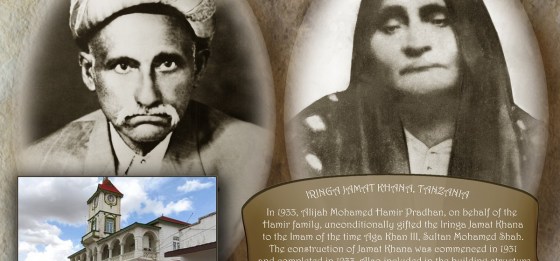
In 1933, in the midst of a global recession, a landmark building, a prayer house, arose in the center of a small provincial town in the interior highlands of Africa. The story of this remarkable building had its genesis in Kutch based family patriarch by the name of Hamir Pradhan, my great grandfather.
The Hamir family of Sinogra/ Nagarpur districts of Kutch was remembered as a reasonably prosperous and enterprising family in the latter half of 1800s. Hamir Pradhan had sired eight sons and one daughter. He was also a person of deep faith and community service. He had built and donated a small Jamatkhana in Sinogra. There is evidence that Hamir Pradhan had created a legacy of community service and sacrifice that left deep impression on his children and the community in Kutch.
During early part of 1900s, six of the Hamir male siblings had joined the large scale migration of peoples from Kutch, Kathiawaar and other parts of Gujarat plagued by large scale famine, to the colonized countries of eastern and southern Africa. One of the young men among these siblings to migrate was Mohamed Hamir Pradhan, my grandfather. He was married to Bachibai, my grandmother. She and their first born daughter Fatma, who was around 3 years at the time, were to join my grandfather in Africa several years later.
My grandfather, Mohamed Hamir (Pradhan) was born in Sinogra, Kutch in 1880. Following his siblings, in 1902, he arrived in Tanganyika (now Tanzania), a German colony at the time. After a short stint in Kilosa with one of his brothers, Haji Hamir, he followed another brother, Satchu Hamir, to Iringa, a quintessential German/British colonial outpost town in the Southern Highlands, where he went to work for him in his retail (duka) shop. He helped his brother expand his business to inland villages, often traveling for weeks with a caravan of porters carrying merchandise. In 1905, three years after his arrival in Tanganyika, he formed his own business.
Benefiting from his trading experience and extensive contacts with both the German and later British colonialist, he was able to capitalize and benefit from the war economy of the First World War (1914-1918). Over the next three decades he became a successful entrepreneur in retail and residential real estate development. Also over the next several years he and my grandmother Bachibai who had joined him from Kutch, expanded the family to include three more daughters and a son. This expanded, and eventually extended family through marriages, was to play a large role in my grandfather’s business successes, and more importantly in helping him achieve his ultimate legacy. Since his son, my father was only 12 or 13 years of age, his daughters played a key role in running his retail business and were deeply involved on his legacy project.
The names of my grandfather’s children and their marital families are (chronologically): daughters Fatma Mahamed Ladha, Sikina Bhimji Asser Sachedina, Jena Ramzan Parpia, and Rehmat Fazal Manji; and son and daughter-in law Akbar and Kulsum Mohamed Hamir.
In early 1930’s and in the midst of The Great Global Economic Depression, our grandfather embarked on a project that would become a matter of pride and an important legacy for our family and the Ismaili community of Iringa. Inspired by his father Hamir Pradhan’s generosity and community service, as well as his own deep faith, he proposed to the community that he wanted to build a Jamatkhana complex and donate it to the Imam for benefit of the Ismaili community in Iringa. My grandfather’s proposal called for a two story Jamatkhana building with a capacity for 600 people, four times the Jamat size at the time. The complex was to include primary school facilities, a social hall, a guest house (dharmshara) and a recreation compound. The building was to be located right in the middle of the main street, which later was named as Jamat Street, a tribute to the Ismaili community of Iringa for the Jamatkhana building that manifested prominently on the street.
With perseverance and after several design changes, he was able to get an agreement on his plan and approval for the project from the appropriate jurisdictional leadership as well as our Imam. The construction was commenced in 1931 and completed in 1933. Due to drastic economic conditions, my grandfather had to resort to borrow money to complete the project. Several prominent families had stepped up to lend him the money. Our family folklore describes his obsession with the project that was of legendary proportion. At times, things got so desperate that he personally and physically toiled on the projects along with our family members to help the project move along to completion.
Street scene with Iringa Ismaili Jamatkhana standing out prominently with its high tower and clock. The Jamatkhana was completed in 1933 with the support and initiative taken by Alijah Mohamed Hamir Pradhan. Photo: Courtesy Shafin Haji.
At the time of the completion of the Jamatkhana in 1933, it was reported to be one of the best in Tanganyika, and architecturally one of the most beautiful in the whole of East Africa. Over the next twenty-five years the Ismaili Jamat in Iringa grew five-fold, exceeding the original capacity of 600. The Jamatkhana complex was not only the anchor of the community, but also a major catalyst for the growth of the Ismaili community in Iringa. Later in the 1960s, my father, Alijah Akbar Mohamed Hamir, expanded the capacity of the Jamatkhana to accommodate the growing Khoja Ismaili community in Iringa.
At the Golden Jubilee of Imam Sultan Mahomed Shah in Nairobi 1936, our grandparents were scheduled for special audience with the Hazar Imam in order to formally present the gift of the Iringa Jamatkhana. However due to the last minute illness of my grandmother they were not able to make the long journey to Nairobi. Our Imam accepted their gift in their absence, and conveyed much appreciation and blessings to them and to their family. This was the happiest moment in our grandfather’s life! The Imam also bestowed on him an honorific title of Alijah.
A close up view of Iringa Ismaili Jamatkhana, completed in 1933 with the support and initiative taken by Alijah Mohamed Hamir Pradhan. Photo: Courtesy Shafin Haji.
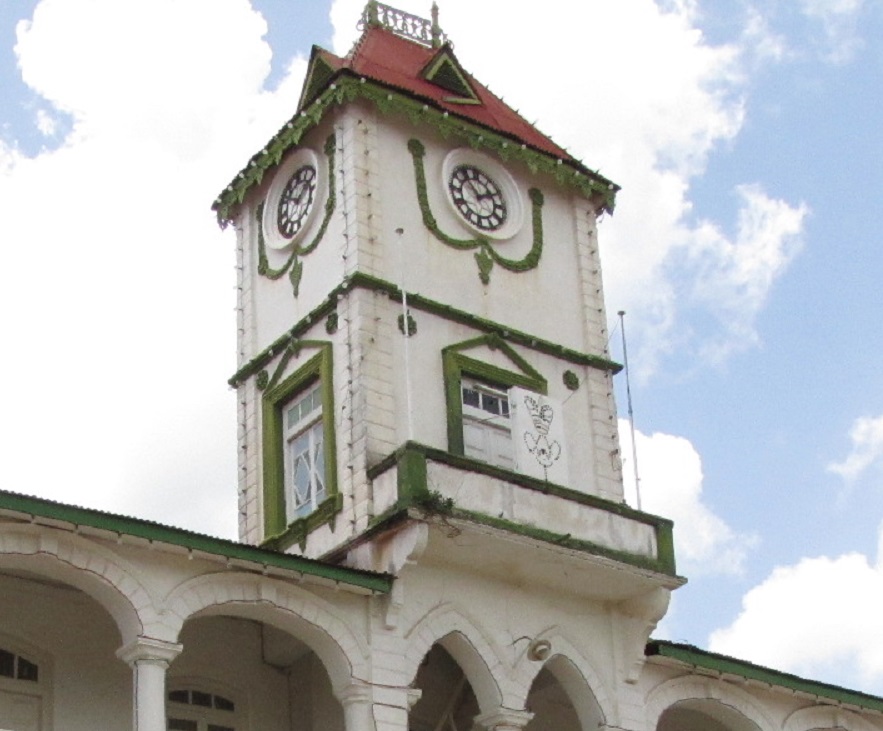
An enlarged view of the prominent bell clock of the Iringa Jamatkhana. Photo: Courtesy Shafin Haji.
Since its manifestation almost 90 years ago, the Iringa Jamatkhana continues to stand as symbol of the town’s identity. Located in the heart of the town, the high and prominent clock tower, adoring the architecturally beautiful building, remains the emblem and inspiration to the local and diasporic community of Iringa. Its large bell clock and high visibility reminds people to the calling of the time, and the out-of-town visitors to their bearings.
It is a source of pride for our community and our family to have the Jamatkhana be such an iconic monument of the town. It is also a tribute to my grandfather’s foresight, faith, leadership and perseverance. His generosity and service to the community is a remarkable legacy and an inspiration for our family and for the future generations.
Date posted: August 2, 2020.
We welcome feedback/letters from our readers. Please use the feedback box which appears below. If you don’t see the box please click Leave a comment. Your comment may be edited for length and brevity, and is subject to moderation. We are unable to acknowledge unpublished letters
___________________
Mohamed Hamir
About the author: Mohamed Hamir, originally from Tanzania, has lived in numerous locations throughout USA since 1969. He is a retired financial services executive including a 20 year career with Citibank in the USA. He has an undergraduate degree in science from London University, UK and an MBA in finance from Indiana University. His work experience and extensive travel included both USA domestic and international markets.
Since his retirement in 2001, he has been passionate about causes involving female infanticide and education of marginalized children. He is on the Advisory Board and member of the LEADers Circle of PRATHAM USA, a prominent global educational NGO. He is also the Executive Producer of “Petals in the Dust”, an award winning documentary exposing gender discrimination, girl killing and violence against women in India.
Among his numerous services to the Ismaili community, he has served as both Mukhi and Kamadia of the Jamats in the USA. From 1988 to 1991 he served as a member of the National Council for USA with a portfolio of fund raising for Jamatkhanas. In 1968, when he was a student in London, he co-founded and was the first president of the inaugural Aga Khan Sports Club of U.K. He currently resides with his family in Southern California.
___________________
Before departing this website please take a moment to review Simerg’s Table of Contents for links to hundreds of thought provoking pieces on a vast array of subjects including faith and culture, history and philosophy, and arts and letters to name a few.