Simerg is an independent initiative dedicated to Ismaili Muslims, the Aga Khan — their Hereditary Imam — and the Ismaili Imamat, and Islam in general through literary readings, photo essays and artistic expressions
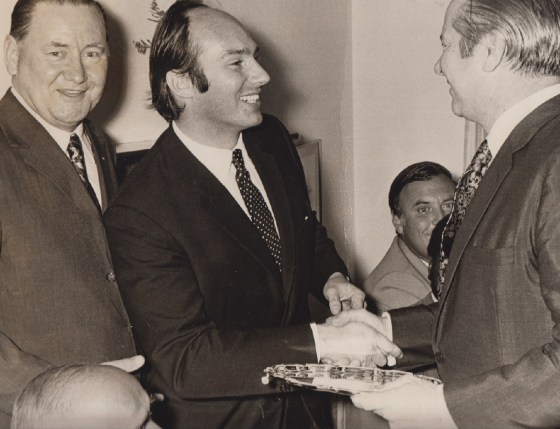
His Highness the Aga Khan being greeted by Mr. Michael Curtis of the Nation Group. Photo: Azhar Chaudhry. Sultan Jessa Collection.
Mr. Michael Curtis, a British Fleet Street editor and executive, was introduced to Mawlana Hazar Imam, His Highness the Aga Khan, just as he had been proclaimed the 49th Ismaili Imam by his grandfather, Imam Sultan Mahomed Shah, His Highness the Aga Khan III. His recruitment as a staff of His Highness was intended as a short term assignment as a speech writer and publicity organizer during a series of public appearances in Asia and Africa related to the Aga Khan’s installation as Imam. This brief assignment, however, grew into an engagement with His Highness that spanned several decades. The visionary Michael Curtis — who was noted by UK’s Guardian Newspaper as being 50 years ahead of his time in the paper’s obituary to the journalist — was asked to establish the Nation Media Group, which started publishing the Sunday Nation and subsequently the Daily Nation in Kenya, competing successfully with the existing colonial newspapers, the Tanganyika Standard and the East African Standard. At the culmination of the process of Africanising the Nation Group, Michael Curtis stepped down in 1977, after pioneering the introduction of the first web-offset presses installed outside the United States as well as increasing the Nation’s circulation to 165,000 and a readership reputed to touch three million.
Mr. Curtis moved to His Highness the Aga Khan’s Headquarters in Aiglemont, France, where he oversaw the Ismaili Imamat’s rapidly expanding non-denominational health and educational activities throughout South Asia and East Africa, until his retirement in 1994.
Michael Howard Curtis, who was born in Cambridge in 1920, died from cancer in 2004 at the age 84.
The following is an excerpt from a piece written by Mr. Michael Curtis for the Daily Nation’s special souvenir published on the occasion of His Highness the Aga Khan’s wedding in 1969 to Princess Salimah.
“I was Serving No Ordinary Man”
BY MICHAEL CURTIS (1920 – 2004)
It was 12 years ago in Dar-es-Salaam in October 1957. Prince Karim, His Highness the Aga Khan, was to be installed as successor to his grandfather in the first of a series of elaborate ceremonies to be held that year throughout Africa and Asia.
As personal aide to His Highness, I had gone ahead as part of an advance party and was greeted by the local leaders who told me that a serious problem had arisen. The only other such ceremony in living memory had taken place 72 years before in Bombay, when Aga Khan III had succeeded to the Imamate.
Not surprisingly, there was some doubt about the form the service would take and it seemed that an acute difference of opinion had arisen as to which verses of the Koran should be included. There was clearly nothing to be done but to await a ruling from the Aga Khan himself.
It was an unforgettable scene and took place in one of the state rooms of Government House where the Aga Khan was guest of the Colonial Governor at that time, the late Lord Twining. The Ismaili leaders were seated, as is their custom, cross-legged in a semi-circle around their young Imam and the two factions elaborated their different points of view.
To a non-Muslim the arguments were difficult to follow, but it was clear to me that a strong difference of opinion existed and that the Aga Khan would be called upon to resolve a ticklish point of theological doctrine.
This was the first occasion on which he had been called to exercise the responsibilities bequeathed to him by his grandfather. Still an undergraduate at Harvard, he looked very young, a trifle pale and tense as he listened to the rival claimants. There was a pause as they finished. Then the Aga Khan asked a question which obviously puzzled his followers. “Who,” he asked, “will recite the verses you wish me to decide upon?”
A chorus of voices assured him that a young man from Zanzibar had been procured for the recitation and that his fame as a psalmodist of the Koran was acclaimed far and wide.
“If that is so,” said His Highness, “let this young man suggest those verses in which his ability is most outstanding and thereafter I shall decide which particular chapters and verses will be selected.”
It was a solution that delighted everyone. The opposing factions accepted it gladly, for neither had lost face. The choirboy for certain would sing as he had never sung before — which in truth he did the following afternoon. It was a decision which reflected the instinctive simplicity of true wisdom and first revealed to me that I was serving no ordinary man.
I have related this tale before, and if I repeat it today it is because I know of no other anecdote which more aptly illustrates his wisdom and judgement.
As part of his famous Apostolic Journey to France in 2008, Pope Benedict XVI, on September 13, paid a visit to the “Institut De France” in Paris. The Pope, who had been elected as the 265th Pope of the Roman Catholic Church in 2005, was presented with a gold medal by the Institut, and also unveiled a plaque commemorating his visit. During his very brief remarks to the audience, the Pope expressed his gratitude to the Institut “both personally and as the successor of [Simon] Peter.”
His Highness the Aga Khan, Mawlana Hazar Imam, was also in attendance at the Institut de France as the Associate Foreign Member of the Académie des Beaux-Arts (Academy of Fine Arts), one of five learned societies within the Institut which was founded in 1795.
Everyone’s attention in the hall was drawn to Mawlana Hazar Imam and the Pope, with an extraordinary sense of interest and keenness, as the two faith leaders greeted each other with a handshake. Simerg is pleased to present this licensed copyright photo with permission from Getty Images.
Everyone’s attention is drawn to Pope Benedict XVI and His Highness the Aga Khan as they greet each other on September 13, at the Institut de France in Paris during an official visit by the Pope to France in 2008. Photo: Copyright. Getty Images. Published on Simerg/Simergphotos with a Licensing arrangement with Getty Images. Fench caption: Vue plongeante du pape BENOIT XVI serrant la main de l’AGA KHAN à son arrive sous la coupole de l’Institut de France à PARIS entouré de nombreux académiciens et autres personnalités dont Gabriel DE BROGLIE, Hélène CARRERE D’ENCAUSSE, Jean-François JARRIGE, Jean-François BACH, Arnaud D’HAUTERIVES, Michel ALBERT, Christian PONCELET président du Sénat, Jean TULARD, Alain DECAUX, Pierre-Jean REMY, Michel MOHRT, Max GALLO, le cardinal André VINGT-TROIS archevêque de Paris et le cardinal Paul POUPARD. (Photo by Philippe Petit/Paris Match via Getty Images).
In 2013, Pope Benedict dramatically resigned his position as the Head of the Catholic Church due to his deteriorating strength, advanced age and the heavy demands of being Pope, and retired at the Mater Ecclesiae, a small monastery located inside the Vatican State City. His present successor is Pope Francis I, born Jorge Mario Bergoglio.
SOME BRIEF NOTES ON THE PAPACY AND THE IMAMAT, AND SIMON PETER IN THE ROMAN CATHOLIC AND ISMAILI TRADITIONS
The Catholics adhere to the belief that the Pope is a successor of St. Peter. The succession of the pope is determined by a college of cardinals who elect the pope, while the office of the Imam of the Ismailis is a hereditary position. The Ismailis regard their 49th hereditary Imam as the direct descendant of the Prophet Muhammad (s.a.s) through Hazrat Ali (a.s.) and Hazrat Bibi Fatima (a.s.). In a speech made at the Canadian Parliament in 2014, the Aga Khan declared that “the Ismaili Imamat is a supra-national entity, representing the succession of Imams since the time of the Prophet.” And, in an interview with Politique International he said, “The religious leadership of the Ismaili Imam goes back to the origins of Shia Islam when the Prophet Muhammad appointed his son-in-law, Ali, to continue his teachings within the Muslim community. The leadership is hereditary, handed down by Ali’s descendants, and the Ismailis are the only Shia Muslims to have a living Imam, namely myself.”
In the Catholic tradition, the foundation for the office of the Pope is found primarily in Matthew, where Jesus is quoted as telling Simon Peter:
“You are ‘Rock,’ and on this rock I will build My Church and the gates of hell shall not prevail against it. And I will give unto thee the keys of the kingdom of heaven: and whatsoever thou shalt bind on earth shall be bound in heaven: and whatsoever thou shalt loose on earth shall be loosed in heaven.”
This series of successions of the Pope is known as “Apostolic Succession,” with the line of Bishops stretching back to the apostles, who lived during the time of Jesus. Simon Peter is recognized as having been the first Pope. Early Christians reserved the title of “Pope” for St. Peter’s successors.
However, in branches of Shia theology as well as Ismailism, Simon Peter’s role is seen as the direct parallel to that of Hazrat Ali as the first Imam. Ismailis along with some other Shia groups maintain that every major Prophet had a spiritual legatee (Waṣi) or successor called the Asas (foundation) who taught the inner meaning to those who had the capacity to understand it. In this regard, Adam had Seth; Noah had Shem; Moses had Aaron, and Jesus had Simon Peter. A well known sacred tradition of the Prophet Muhammad says that “Ali is to me as Aaron was to Moses,” confirming that Ali held the same level of authority as Aaron did.
Date posted: December 31, 2015. Last updated: January 1, 2015.
_______________
We welcome your feedback, please click Leave a commentor send it tosimerg@aol.com, subject: Aga Khan and Pope. Your feedback may be edited for length and brevity, and is subject to moderation. We are unable to acknowledge unpublished letters.
The following were used as references for the compilation of this piece:
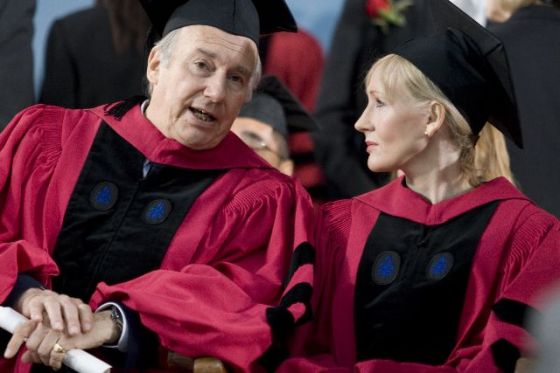
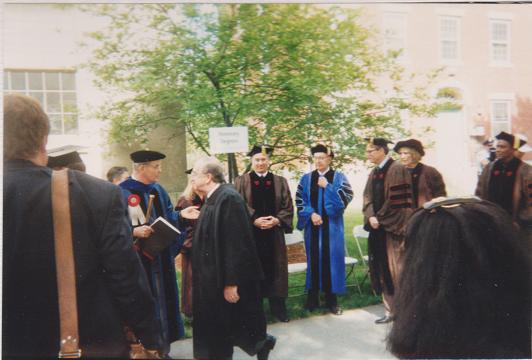
June 5, 2008: His Highness the Aga Khan received an Honorary Doctor of Laws degree from Harvard University in Cambridge, Massachusetts. He is seen speaking to fellow honorary degree recipient British author J.K. Rowling who received an honorary Doctor of Letters degree. Photo Credit: Akdn.org
His Highness the Aga Khan shared his decades long experience as the 49th hereditary Imam of Shia Ismaili Muslims in an address he delivered at Harvard University on November 12, 2015 in which he focused on building a better world through the notion of the Cosmopolitan Ethic. In an analysis of the term and what it means to him, he also emphasized that it resonates with the world’s great ethical and religious traditions. The address that he delivered is one which every Muslim and non-Muslim should reflect on and hold true to their hearts because, as His Highness said, each one of us is born of a single soul.
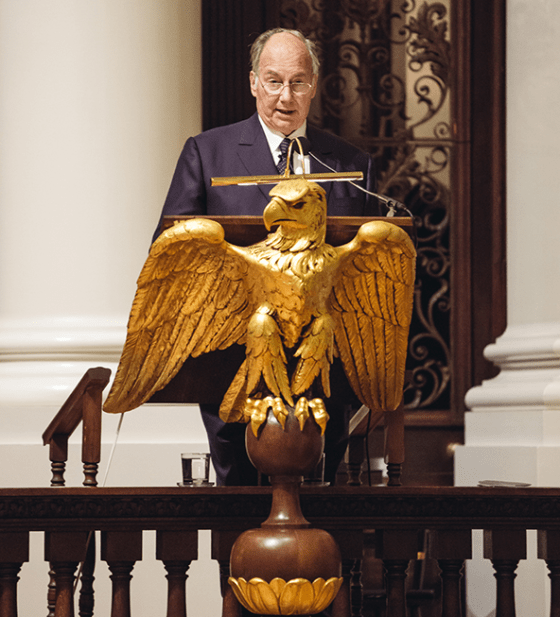
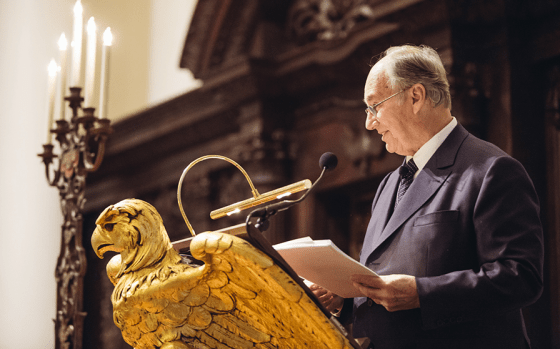
His Highness the Aga Khan spoke at Harvard on November 12, 2015 as part of the Samuel L. and Elizabeth Jodidi Lecture series, which provides for “the delivery of lectures by eminent and well-qualified persons for the promotion of tolerance, understanding and good will among nations, and the peace of the world. Photo: AKDN
“…I would emphasise that a cosmopolitan ethic is one that resonates with the world’s great ethical and religious traditions.
“A passage from the Holy Qur’an that has been central to my life is addressed to the whole of humanity. It says: “Oh Mankind, fear your Lord, who created you of a single soul, and from it created its mate, and from the pair of them scattered abroad many men and women…”
“At the very heart of the Islamic faith is a conviction that we are all born “of a single soul.” We are “spread abroad” to be sure in all of our diversity, but we share, in a most profound sense, a common humanity.
“This outlook has been central to the history of Islam. For many hundreds of years, the greatest Islamic societies were decidedly pluralistic, drawing strength from people of many religions and cultural backgrounds. My own ancestors, the Fatimid Caliphs, founded the city of Cairo, and the great Al Azhar University there, a thousand years ago in this same spirit.
“That pluralistic outlook remains a central ideal for most Muslims today. There are many, of course, some non-Muslims and some Muslims alike, who have perpetrated different impressions.
“At the same time, institutions such as those that have welcomed me here today, have eloquently addressed these misimpressions. My hope is that the voices of Islam itself will continue to remind the world of a tradition that, over so many centuries, has so often advanced pluralistic outlooks and built some of the most remarkable societies in human history.
CENTRAL LESSON FROM A PERSONAL JOURNEY OF 58 YEARS
“Let me repeat, in conclusion, that a cosmopolitan ethic is one that will honour both our common humanity and our distinctive Identities — each reinforcing the other as part of the same high moral calling.
“The central lesson of my own personal journey — over many miles and many years — is the indispensability of such an ethic in our changing world, based on the timeless truth that we are — each of us and all of us — “born of a single soul.”
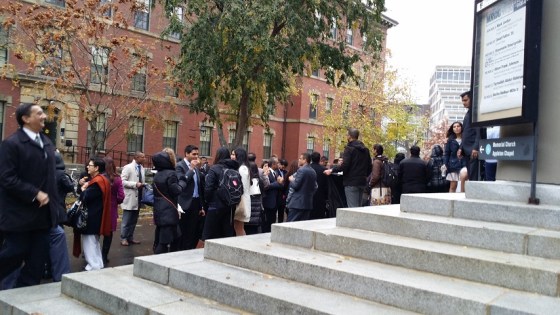
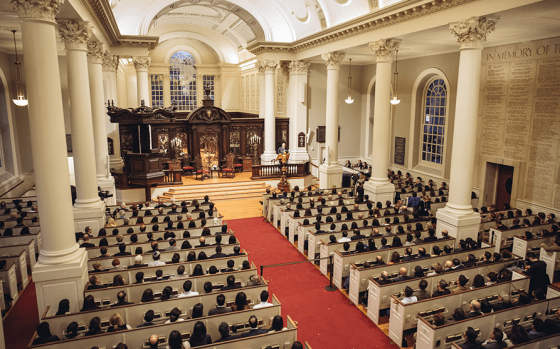
Ticket holders line up to listen to His Highness the Aga Khan at Harvard University on November 12, 2015. Photo: Azeem Maherali.
Editor’s note: Thematic excerpts from speeches made by His Highness the Aga Khan are highly popular with our readers, and we are pleased to present this feature once again for the recent Jodi lecture that was delivered by the 49th Ismaili Imam at Harvard University on Thursday, November 12, 2015. We begin with excerpts from introductory remarks made by Professor Ali Asani’s in welcoming His Highness to Harvard.
~~~~~~~~
WELCOME ADDRESS BY PROFESSOR ALI ASANI
“Your Highness, I am one of those children who many years ago was a student attending Aga Khan schools in Kenya, and with your support and guidance, went on to study and teach here at Harvard. Thank you.” — Dr. Ali Asani, November 12, 2015.
Professor Ali Asani introduces His Highness the Aga Khan before the 2015 Samuel L. and Elizabeth Jodidi Lecture at Harvard University. Photo: Navyn Naran.
“It is my honour and privilege to be here today, and to introduce to you — and to welcome back to Harvard — our guest speaker, His Highness the Aga Khan, 49th hereditary Imam of the Shia Imami Ismaili Muslims, Harvard class of 1959.
“For nearly six decades, the Aga Khan has been responsible for both the spiritual guidance and the material welfare of millions of Ismaili Muslims residing in over 25 countries, sometimes in contexts of conflict and poverty. Under his leadership, this multicultural, multiethnic, multilingual, and transnational community — or Jamat — has witnessed the greatest transformation in its history. He has guided the Ismailis through a dramatic metamorphosis that has impacted the lives of each and every member of his community.
“However, His Highness’s concerns have extended well beyond the communities of his followers to the larger societies in which they live….[He] has made it possible for hundreds of thousands of children of different religious, ethnic and racial backgrounds to study in Aga Khan kindergarten, primary and secondary schools, and academies located both in Africa and Asia. He has created two international universities and endowed professorships at major institutions of higher education — including Harvard.
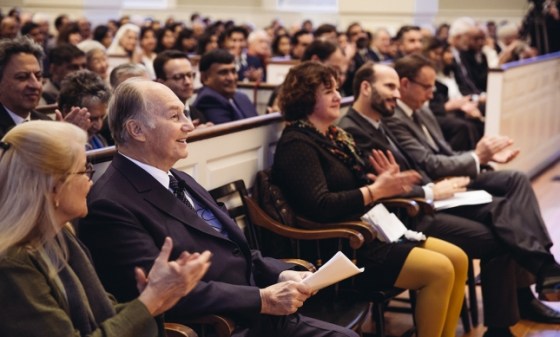
Audience applauds as His Highness the Aga Khan is welcomed to Harvard by Professor Ali Asani. Photo: The Ismaili/Farhez Rayani
“His Highness has made every sector and aspect of the human existence a part of his concern. His institutional efforts are deployed to meet the holistic and multiple needs of millions of people around the world, irrespective of their religion, race or nationality.
“According to a well-known saying attributed to the Aga Khan’s ancestor, the Prophet Muhammad (peace be upon him), “God is beautiful and loves beauty.” In keeping with ancient Islamic traditions of nurturing the arts, His Highness has also enriched the lives of people around the world by giving the priceless gift of beauty.
“While some wanton elements in our world today are sadly intent on destroying humanity’s cultural heritage, the Aga Khan’s institutions have been restoring historic monuments, beautifying urban landscapes with magnificent gardens and stunning award-winning buildings, reviving traditions of music and promoting the role of the arts as bridges of cultural understanding.
“Today, we live in an increasingly polarised world in which people are unable to tolerate difference, let alone understand and engage with it. The lives of one-and-a-half billion Muslims, and perhaps everyone on this planet, have been changed by the machinations of powerful geopolitical forces.
“Your Highness, in our world of increasing division orchestrated by small cells of radical extremists, and often manipulated by powerful forces with consequences that reverberate in large parts of the world, we cherish and honour your lifetime commitment to pluralism and the betterment of society, and look forward to your thoughts on The Cosmopolitan Ethic in a Fragmented World.
“Ladies and gentlemen, please welcome His Highness the Aga Khan.”
~~~~~~~
THEMATIC EXCERPTS FROM THE LECTURE OF HIS HIGHNESS THE AGA KHAN
His Highness the Aga Khan speaks on November 12, 2015 at Harvard University’s Weatherhead Center for International Affairs on “The Cosmopolitan Ethic in a Fragmented World”. Photo: AKDN / Farhez Rayani
Bismillah-ir-Rahman-ir-Rahim
1. WHAT IT MEANS TO BE AN IMAM
Thank you for your warm welcome. It is indeed a great pleasure for me to return to Harvard and this wonderful campus. I am honored as well, to be giving the Jodidi Lecture for 2015, and to join the distinguished list of those who have given this lecture over the past 60 years.
….in 1957 I was a junior when I became the 49th hereditary Imam of the Shia Imami Ismaili Muslims — when my grandfather designated me to succeed him.
…What does it mean to become an Imam in the Ismaili tradition?…. it is an inherited role of spiritual leadership. As you may know, the Ismailis are the only Muslim community that has been led by a living, hereditary Imam in direct descent from Prophet Muhammad.
That spiritual role, however, does not imply a separation from practical responsibilities. In fact for Muslims the opposite is true: the spiritual and material worlds are inextricably connected. Leadership in the spiritual realm — for all Imams, whether they are Sunni or Shia — implies responsibility in worldly affairs; a calling to improve the quality of human life.
________________
2. ON HARVARD, AND THE AGA KHAN’S EXPERIENCES VISITING HIS WORLD WIDE FOLLOWERS ON BECOMING THE IMAM
As I prepared for this new role in the late 1950s, Harvard was very helpful. The University allowed me — having prudently verified that I was a student “in good standing” — to take eighteen months away to meet the leaders of the Ismaili community in some 25 countries where most of the Ismailis then lived, and to speak with their government leaders.
I returned here after that experience with a solid sense of the issues I would have to address, especially the endemic poverty in which much of my community lived. And I also returned with a vivid sense of the new political realities that were shaping their lives, including the rise of African independence movements, the perilous relations between India and Pakistan and the sad fact that many Ismailis were locked behind the Iron Curtain and thus removed from regular contact with the Imamat.
When I returned to Harvard, it was not only to complete my degree, but I was fortunate to audit a number of courses that were highly relevant to my new responsibilities. So as an undergraduate, I had the opportunity to benefit from the complete spectrum of courses offered by this great university.
….Harvard has continued to be a highly valued partner for our Network since this time. The University played a key role in developing the blueprint thirty years ago for the Aga Khan University — working first in the fields of medicine and nursing education, and now offering a broad variety of degrees on three continents. Another close Harvard relationship has involved the Aga Khan Program for Islamic Architecture, launched here and at MIT in 1977.
Regularity in Class Attendance
Incidentally, I must have been the only Harvard undergraduate to have two secretaries and a personal assistant working with me. And I have always been very proud of the fact that I never sent any of them to take notes for me at my class!
3. THE INITIATIVE OF THE AGA KHAN DEVELOPMENT NETWORK IN THE DEVELOPING AND ISLAMIC WORLDS
Through all of these years, my objective has been to understand more thoroughly the developing countries of Asia, Africa and the Middle East, and to prepare initiatives that will help them become countries of opportunity, for all of their peoples.
Concern For Islamic Architecture: Lack of Processes for its Renewal
My concern for the future of Islamic architecture grew out of my travels between 1957 and 1977 in countries with large Muslim populations. What I observed was a near total disconnect between the new built environment I encountered and Islam’s rich architectural legacy. There was no process of renewal, no teaching in architectural schools, no practices that were rooted in our own traditions. Except for the occasional minaret or dome, one of the world’s great cultural inheritances was largely confined to coffee-table books. It seemed to me that this state of affairs represented a monumental menace to our world’s cultural pluralism, as well as a dangerous loss of identity for Muslim communities.
The Aga Khan Programme for Islamic Architecture was one response to this situation, as was the creation of the Aga Khan architectural award, which also continues today. Bringing the art and architecture of the Islamic world to be understood and admired in the West, as it had been in the past, was a goal that also inspired the creation, just one year ago, of the Ismaili Centre and the Aga Khan Museum in Toronto — the only museum in the western hemisphere devoted entirely to Islamic culture.
AKDN Objective in One Word, “Opportunity”, and Thus Hope for Future
Today, the Aga Khan Development Network embraces many facets and functions. But, if I were trying to sum up in a single word its central objective, I would focus on the word “opportunity”. For what the peoples of the developing world seek above all else is hope for a better future.
Too often however, true opportunity has been a distant hope — perhaps for some, not even more than a dream. Endemic poverty, in my view, remains the world’s single most important challenge. It is manifested in many ways, including persistent refugee crises of the sort we have recently seen in such an acute form. And of course confounding new challenges continue to mount, such as the looming threat of climate change. My interest in climate change has been sharpened by recent studies linking it to the threat of earthquakes. This could be an issue in the high mountain areas of South Asia for example, where so many Ismailis live and are concentrated.
Sixty years ago as I took up my responsibilities, the problems of the developing world, for many observers, seemed intractable. It was widely claimed that places like China and India were destined to remain among the world’s “basket cases” — incapable of feeding themselves let alone being able to industrialise or achieve economic self-sustainability. If this had been true, of course, then there would have been no way for the people of my community, in India and China and in many other places, to look for a better future.
His Highness the Aga Khan spoke as part of the Samuel L. and Elizabeth Jodidi Lecture series, which provides for “the delivery of lectures by eminent and well-qualified persons for the promotion of tolerance, understanding and good will among nations, and the peace of the world. Photo: AKDN
Political realities presented further complications. Most of the poorest countries were living under distant colonial or protectorate or communist regimes. The monetary market was totally unpredictable. Volatile currencies were shifting constantly in value, making it almost impossible to plan ahead. And while I thought of all the Ismailis as part of one religious community, the realities of their daily lives were deeply distinctive and decidedly local.
Nor did most people yet see the full potential for addressing these problems through non-profit, private organisations — what we today call “civil society.”
And yet, it was also clear that stronger coordination across these lines of division could help open new doors of opportunity. We could see how renovated educational systems, based on best practices, could reach across frontiers of politics and language. We could see how global science could address changing medical challenges, including the growing threat of non-communicable disease. We could see, in sum, how a truly pluralistic outlook could leverage the best experiences of local communities through an effective international network.
But we also learned that the creation of effective international networks in a highly diversified environment can be a daunting matter. It took a great deal of considered effort to meld older values of continuity and local cohesion, with the promise of new cross-border integration.
A GOAL IN A FRAGMENTED WORLD: SEEKING TO BUILD AN EFFECTIVE COSMOPOLITAN ETHIC
Cosmopolitan Ethic
What was required — and is still required — was a readiness to work across frontiers of distinction and distance without trying to erase them. What we were looking for, even then, were ways of building an effective “cosmopolitan ethic in a fragmented world.”
This often meant working from the bottom up, learning to follow what was sometimes called “field logic.” Most of our initiatives began at a local, community level, and then grew into regional, national and international institutions.
Working in Partnerships
As we moved forward, we learned a number of important lessons. We learned that lifting health and education services to world class standards was a global promise that could inspire local support. We learned to attack poverty simultaneously with multiple inputs, on a variety of fronts. We learned to work with effective partners — including the not-for-profit institutions of civil society. We learned to see our role as one of supporting the public sector, not competing with it. And we learned the importance of measuring carefully the outcomes of our efforts, and then applying that knowledge.
All of these approaches were facilitated by a determination to overcome linguistic barriers through a language policy that promoted better use of the national language, and network-wide English as a strong connecting tool.
And so our Network grew. Today it embraces a group of agencies — non-governmental and non-denominational — operating in 35 countries. They work in fields ranging from education and medical care, to job creation and energy production; from transport and tourism, to media and technology; from the fine arts and cultural heritage, to banking and microfinance. But they are all working together toward a single overarching objective: improving the quality of human life.
PROMISES OF THE PAST AND….
Hope for International Cooperation
Meanwhile, in the Industrialised West, many things were happening that paralleled our AKDN experience. For one thing, an impulse for international cooperation was advancing in the late 1950s at an impressive pace. After half a century of violent confrontation, determined leaders talked hopefully about global integration. New international organisations and cross-border alliances blossomed. And Harvard University decisively expanded its own involvement in world affairs.
When the Jodidi Lectureship was established here in 1955, its explicit purpose (and I quote) was “the promotion of tolerance, understanding and good will among nations.” And that seemed to be the way history was moving. Surely, we thought, we had learned the terrible price of division and discord, and certainly the great technological revolutions of the 20th century would bring us more closely together.
Technological Promises and the New World Order
In looking back to my Harvard days, I recall how a powerful sense of technological promise was in the air — a faith that human invention would continue its ever-accelerating conquest of time and space. I recall too, how this confidence was accompanied by what was described as a “revolution of rising expectations” and the fall of colonial empires. And of course, this trend seemed to culminate some years later with the end of the Cold War and the “new world order” that it promised.
….THE PARADOXES
Disintegration
But even as old barriers crumbled and new connections expanded, a paradoxical trend set in, one that we see today at every hand. At the same time that the world was becoming more interconnected, it also become more fragmented.
We have been mesmerised on one hand by the explosive pace of what we call “globalisation,” a centripetal force putting us as closely in touch with people who live across the world as we are to those who live next to us. But at the same time, a set of centrifugal forces have been gaining on us, producing a growing sense — between and within societies — of disintegration.
Fragmentation
Whether we are looking at a more fragile European Union, a more polarised United States, a more fervid Sunni-Shia conflict, intensified tribal rivalries in much of Africa and Asia, or other splintering threats in every corner of the planet, the word “fragmentation” seems to define our times.
Confrontation and Disconnection
Global promise, it can be said, has been matched by tribal wariness. We have more communication, but we also have more confrontation. Even as we exclaim about growing connectivity we seem to experience greater disconnection.
Perhaps what we did not see so clearly 60 years ago is the fact that technological advance does not necessarily mean human progress. Sometimes it can mean the reverse.
Confusion
The more we communicate, the harder it can sometimes be to evaluate what we are saying. More information often means less context and more confusion. More than that, the increased pace of human interaction means that we encounter the stranger more often, and more directly. What is different is no longer abstract and distant. Even for the most tolerant among us, difference, more and more, can be up close and in your face.
His Highness the Aga Khan speaks at Harvard University on November 12, 2015. Photo: AKDN.
COUNTERING THE PARADOXES: USING COSMOPOLITAN ETHIC TO BRING BEAUTY TO THE SOCIAL FABRIC
The Terms Tolerance, Pluralism and Cosmopolitan
What all of this means is that the challenge of living well together — a challenge as old as the human-race — can seem more and more complicated. And so we ask ourselves, what are the resources that we might now draw upon to counter this trend? How can we go beyond our bold words and address the mystery of why our ideals still elude us?
In responding to that question, I would ask you to think with me about the term I have used in the title for this lecture: “The Cosmopolitan Ethic.”
For a very long time, as you know, the term most often used in describing the search for human understanding was the word “tolerance.” In fact, it was one of the words that was used in 1955 text to describe one of the objectives of this Jodidi Lecture.
In recent years our vocabulary in discussing this subject has evolved. One word that we have come to use more often in this regard is the word “pluralism.” And the other is the word “cosmopolitan.”
You may know that our AKDN Network, a decade ago, cooperated with the Government of Canada to create a new Global Centre for Pluralism based in Ottawa, designed to study more closely the conditions under which pluralist societies can thrive.
What is a Pluralist, Cosmopolitan Society?
A pluralist, cosmopolitan society is a society which not only accepts difference, but actively seeks to understand it and to learn from it. In this perspective, diversity is not a burden to be endured, but an opportunity to be welcomed.
A cosmopolitan society regards the distinctive threads of our particular identities as elements that bring beauty to the larger social fabric. A cosmopolitan ethic accepts our ultimate moral responsibility to the whole of humanity, rather than absolutising a presumably exceptional part.
Perhaps it is a natural condition of an insecure human race to seek security in a sense of superiority. But in a world where cultures increasingly interpenetrate one another, a more confident and a more generous outlook is needed.
Readiness to Dialog and to Listen to Everyone
What this means, perhaps above all else, is a readiness to participate in a true dialog with diversity, not only in our personal relationships, but in institutional and international relationships also. But that takes work, and it takes patience. Above all, it implies a readiness to listen.
What is needed, as the former Governor General of Canada Adrienne Clarkson has said, and I quote, is a readiness “to listen to your neighbour, even when you may not particularly like him.” Is that message clear? You listen to people you don’t like!
Differences Between the Concept of Globalization vs Thoughtful Cosmopolitan Ethic
A thoughtful cosmopolitan ethic is something quite different from some attitudes that have become associated with the concept of globalisation in recent years. Too often, that term has been linked to an abstract universalism, perhaps well-meaning but often naïve. In emphasising all that the human race had in common, it was easy to depreciate the identities that differentiated us. We sometimes talked so much about how we are all alike that we neglected the wonderful ways in which we can be different.
One result of this superficial view of homogenised, global harmony, was an unhappy counter-reaction. Some took it to mean the spread of a popular, Americanised global culture — that was unfair and an assessment that was erroneous. Others feared that their individual, ethnic or religious identities might be washed away by a super-competitive economic order, or by some supranational political regime. And the frequent reaction was a fierce defense of older identities. If cooperation meant homogenisation, then a lot of people found themselves saying “No.”
But an either-or-choice between the global and the tribal — between the concept of universal belonging and the value of particular identities — was in fact a false choice. The road to a more cooperative world does not require us to erase our differences, but to understand them.
What is a Responsible, Thoughtful Process of Globalization?
A responsible, thoughtful process of globalisation, in my view, is one that is truly cosmopolitan, respecting both what we have in common and what makes us different.
It is perhaps in our nature to see life as a series of choices between sharply defined dualities, but in fact life is more often a matter of avoiding false dichotomies, which can lead to dangerous extremes. The truth of the matter is that we can address the dysfunctions of fragmentation without obscuring the values of diversity.
COSMOPOLITAN ETHIC: CONSIDERATIONS FOR PROGRESS
Sensitivity to Economic Insecurity
A cosmopolitan ethic will also be sensitive to the problem of economic insecurity in our world. It is an enormous contributing factor to the problems I have been discussing. Endemic poverty still corrodes any meaningful sense of opportunity for many millions. And even in less impoverished societies, a rising tide of economic anxiety can make it difficult for fearful people to respect, let alone embrace, that which is new or different.
Addressing Human Longevity
This problem has been compounded by the very advances that have long been the source of so much hope. I am thinking here for example about medical advances that have dramatically increased human longevity. People live longer, but they often find that they have outlived their resources.
The developing world is now facing a major challenge: how does it care for the elderly? Even in more developed societies, social changes have eroded some of the domestic support that once eased the burdens of the aging. How, we must all ask, will we manage the new challenges of longevity?
Leadership Responsibilities
All of these considerations will place special obligations on those who play leadership roles in our societies. Sadly, some would-be leaders all across the world have been tempted to exploit difference and magnify division. It is always easier to unite followers in a negative cause than a positive one. But the consequences can be a perilous polarisation.
Quality of Education in the Midst of Information Explosion
The information explosion itself has sometimes become an information glut, putting even more of a premium on being first and getting attention, rather than being right and earning respect. It is not easy to retain one’s faith in a healthy, cosmopolitan marketplace of ideas when the flow of information is increasingly trivialised.
One answer to these temptations will be found, I am convinced, in the quality of our education. It will lie with our universities at one end of the spectrum, and early childhood education at the other — a field to which our Development Network has been giving special attention.
Quality of Education to Overcome Clash of Ignorance
Let me mention one more specific issue where a sustained educational effort will be especially important. I refer to the debate — one that has involved many in this audience — about the prospect of some fundamental clash of civilisations between Islam and the West. In my view, the deeper problem behind any prospective “clash of civilisations” is a profound “clash of ignorances”. And in that struggle, education will be an indispensable weapon.
THE WORLD’S ETHICAL AND RELIGIOUS TRADITIONS, AND A COSMOLITAN ETHIC
The Heart of the Islamic Message: Common Humanity
Finally, I would emphasise that a cosmopolitan ethic is one that resonates with the world’s great ethical and religious traditions.
A passage from the Holy Qur’an that has been central to my life is addressed to the whole of humanity. It says: “Oh Mankind, fear your Lord, who created you of a single soul, and from it created its mate, and from the pair of them scattered abroad many men and women…”
At the very heart of the Islamic faith is a conviction that we are all born “of a single soul.” We are “spread abroad” to be sure in all of our diversity, but we share, in a most profound sense, a common humanity.
Outlook From Islamic History
This outlook has been central to the history of Islam. For many hundreds of years, the greatest Islamic societies were decidedly pluralistic, drawing strength from people of many religions and cultural backgrounds. My own ancestors, the Fatimid Caliphs, founded the city of Cairo, and the great Al Azhar University there, a thousand years ago in this same spirit.
That pluralistic outlook remains a central ideal for most Muslims today.
There are many, of course, some non-Muslims and some Muslims alike, who have perpetrated different impressions.
Hopes from the Voices of Islam
At the same time, institutions such as those that have welcomed me here today, have eloquently addressed these misimpressions. My hope is that the voices of Islam itself will continue to remind the world of a tradition that, over so many centuries, has so often advanced pluralistic outlooks and built some of the most remarkable societies in human history.
CENTRAL LESSON FROM A PERSONAL JOURNEY OF 58 YEARS
Let me repeat, in conclusion, that a cosmopolitan ethic is one that will honour both our common humanity and our distinctive Identities — each reinforcing the other as part of the same high moral calling.
The central lesson of my own personal journey — over many miles and many years — is the indispensability of such an ethic in our changing world, based on the timeless truth that we are — each of us and all of us — “born of a single soul.”
Date posted:November 18, 2015.
_________________
For a comprehensive video of the event, please click on the following image.
“Look at the mountains, the rivers, the trees, the flowers, as evidence of Allah’s love for the people He has created”
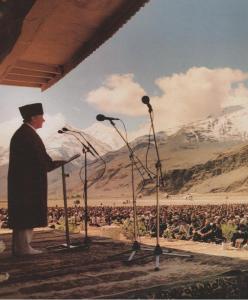
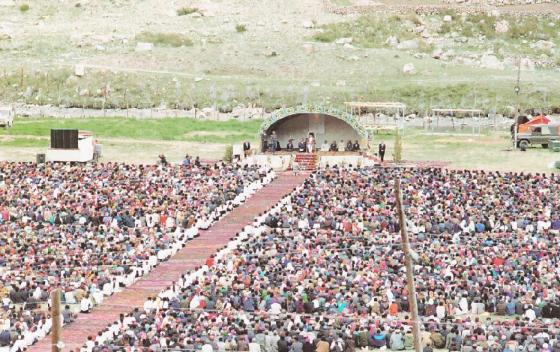
His Highness the Aga Khan, the 49th Ismaili Imam, is seen addressing his followers in Ishkashim, Badakhshan, during his first historic visit to the region in 1995.
“The Qur’an refers very often to nature as a reflection of Allah’s power of creation, and it says, look at the mountains, the rivers, the trees, the flowers, as evidence of Allah’s love for the people whom He has created. Today, I look at the environment and I say to you, I believe Allah is smiling upon you, and may His smile always be upon you.” — His Highness the Aga Khan speaking in a mountainous setting in Badakhshan in 1995.
Visitors enjoying fall colours on the grounds of Rideau Hall. Please click on image for photos of autumn foliage in Ottawa-Gatineau, the National Capital Region. Photo: Malik Merchant/Simerg
“When I invited Professor Maki, a master of form and light, to design this [Delegation of the Ismaili Imamat] building, I made a suggestion to him – one that I hoped would help connect this place symbolically to the Faith of Islam. The suggestion I made focused on creating a certain mystique, centred around the beautiful mysteries of rock crystal.
The architecture of the dome of the Delegation of the Ismaili Imamat Building seen above from Jacques Cartier Park is centred around the beautiful mysteries of rock crystal. Please read the Ismaili Imam’s quote and click on image for photos of Ottawa-Gatineau foliage. Photo: Malik Merchant/Simerg
“Why rock crystal? Because of its translucency, its multiple planes, and the fascination of its colours – all of which present themselves differently as light moves around them. The hues of rock crystal are subtle, striking and widely varied – for they can be clear or milky, white, or rose coloured, or smoky, or golden, or black.
“It is because of these qualities that rock crystal seems to be such an appropriate symbol of the profound beauty and the ever-unfolding mystery of Creation itself – and the Creator. As the Holy Qur’an so powerfully affirms, “Allah is the Creator and the Master of the heavens and the earth.” And then it continues: ‘Everything in the heavens and on earth, and everything between them, and everything beneath the soil, belongs to Him’.” — His Highness the Aga Khan, on the occasion of the inauguration of the Delegation of the Ismaili Imamat Building in Ottawa on December 6, 2008.
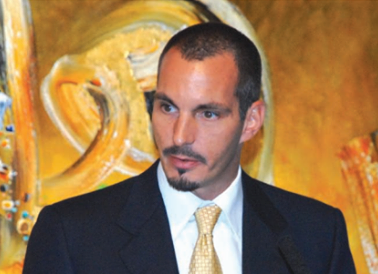
On the occasion of Prince Rahim Aga Khan’s 44th birthday on Monday, October 12, 2015, we are pleased to produce excerpts from his commencement address that he delivered at the Graduation Ceremony of the Institute of the Ismaili Studies held in London, England, in September 2007.
Prince Rahim Aga Khan and Princess Salwa on their wedding day on August 31, 2013. They have one child, son Prince Irfan, who was born on April 11, 2015. Photo Credit: TheIsmaili /Gary Otte. Copyright.
Prince Rahim is the eldest son of the 49th hereditary Ismaili Imam, His Highness Prince Karim Aga Khan, the direct descendant of the Prophet Muhammad (peace be upon him), and Begum Salimah Aga Khan. Prince Rahim graduated from Phillips Academy in Andover, Massachusetts, in 1990, and from Brown University in the United States in 1995. Based at the Secretariat of His Highness at Aiglemont, north of Paris, France, Prince Rahim is an executive Director of the Aga Khan Fund for Economic Development — the economic development arm of the Aga Khan Development Network.
~~~~~
Islam Enjoins Us To Make a Positive and Visible Impact on the World
“…Absolutist, exclusivist, and rejectionist claims to the truth, especially to religious truth, are increasingly heard from all quarters. Rather than seeing religion as a humble process of growth in faith, some people presume to claim that they have arrived at the end of that journey and can therefore speak with near-divine authority…”
Prince Rahim Aga Khan delivering his commencement address at the Graduation Ceremony of the Institute of Ismaili Studies held in London in 2007 at the Ismaili Centre.
BY PRINCE RAHIM AGA KHAN
I am thrilled to join the graduation ceremony in honour of those completing the IIS [Institute of Ismaili Studies] Graduate Programme in Islamic Studies and Humanities. To you, to your families and to all those who have helped you in this achievement, I say mash’Allah.
I am convinced that the institutions of the Imamat and of the Jamat could benefit directly from the contribution of each of you, either in a professional or a voluntary capacity. Such a contribution would certainly be in keeping with the ethic of our faith that makes it incumbent upon each of us to use our blessings –- be they material or intellectual –- to assist our families, to serve the Jamat and the Ummah, and to help improve society, and indeed, all of humanity. The Jamat and its institutions need young and dynamic women and men like you, who are able to draw on the rich heritage of our past, and on the best educations of the present, to address the challenges of the future.
Education, international studies and diplomacy, non-profit leadership, media, development, law, and regional studies will all be among the most relevant fields of expertise in the decades ahead. This will be particularly true in the developing world.
I was impressed to learn that amongst you are represented five different nationalities, as are several diverse cultural traditions of our Jamat. I am certain that this diversity has enhanced your classroom experience, and I am confident that it will have given you a deeper appreciation of the meaning and value of diversity itself.
We are all aware that we live in a world where diversity is often evoked as a threat and, more particularly, where diversity in the interpretation of a faith can be seen as a sign of disloyalty. This phenomenon is sometimes perceived to apply principally to Muslims, but it also exists in other societies. Absolutist, exclusivist, and rejectionist claims to the truth, especially to religious truth, are increasingly heard from all quarters. Rather than seeing religion as a humble process of growth in faith, some people presume to claim that they have arrived at the end of that journey and can therefore speak with near-divine authority.
Unfortunately, in some parts of the Muslim world today, hostility to diverse interpretations of Islam, and lack of religious tolerance, have become chronic, and worsening, problems. Sometimes these attitudes have led to hatred and violence. At the root of the problem is an artificial notion amongst some Muslims, and other people, that there is, or could ever be, a restricted, monolithic reality called Islam.
Our Ismaili tradition, however, has always accepted the spirit of pluralism among schools of interpretation of the faith, and seen this not as a negative value, but as a true reflection of divine plenitude. Indeed, pluralism is seen as essential to the very survival of humanity. Through your studies you have known the many Qur’anic verses and hadiths of our beloved Prophet Muhammad (peace be upon him) that acknowledge and extol the value of diversity within human societies. You all know, I am sure, the hadith to the effect that differences of interpretation between Muslim traditions should be seen as a sign of the mercy of Allah.
It should also be clear to anyone who has studied Islamic history or literature, that Islam is, and has always been, a quest that has taken many forms. It has manifested itself in many ways — in different times, amongst different peoples, with changing and evolving emphases, responding to changing human needs, preoccupations, and aspirations.
Even during the early centuries of Islam, there was diversity of intellectual approaches among Muslims. Today, however — both outside the Islamic world and inside it — many people have lost sight of, or wish to be blind to, Islam’s diversity, and to its historical evolution in time and place along a multitude of paths. It befalls us, then, to help those outside the Muslim World to understand Islamic diversity, even as we provide an intellectual counterpoint to those within Islam who would reject it.
I hope that you, as graduates of this programme, will include this message in your own ways in the years ahead, through your work and your words, by your attitudes, by your actions, and by example.
The untrue and unfair, but increasingly widespread equating of the words “Islam” and “Muslim” with “intolerance”, sometimes even with the word “terrorism”, could lead some Muslims to feel despair, indignation, or even shame. To me, however, the current global focus on the Muslim world, and on Islam itself, presents a golden opportunity for us to educate and enlighten, while actively exemplifying the counterpoint I mentioned before. To my eyes, it creates an opportunity, and an even-greater obligation for us to make a positive and visible impact on the world – on culture and art, science and philosophy, politics and ecology, among others.
In order to respond to this opportunity, it will be crucial to reverse another damaging consequence of intolerance, which has been the dissuasion of many Muslim populations from seeking access to what has been called the Knowledge Society. Without an acceptance of diversity, without the ability to harness the creativity that stems from pluralism, the very spirit of the Knowledge Society is stifled. We must encourage, I believe, that Muslims of all communities come together, working collaboratively to tap into the vast endowment of knowledge available today, and without which progress is, if not halted, at least deferred. This cannot be done in the absence of open-mindedness and tolerance.
Implicit in this approach is the need for humility, which is also a central Muslim value. We must all search for the answers to the challenges of our generation, within the ethical framework of our faith, and without pre-judging one another or arbitrarily limiting the scope of that search. Like the great Muslim artists, philosophers and scientists of centuries past, we must enthusiastically pursue knowledge on every hand, always ready to embrace a better understanding of Allah’s creation, and always ready to harness this knowledge in improving the quality of life of all peoples.
As you look towards the future, I hope that you will remember that intellectual pursuits should, wherever possible, seek to address the universal aspirations of humankind, both spiritual and concrete. Those aspirations, for our generation more than for any before, are intertwined in a single global community.
It can be overwhelming at times to ponder the vast array of new problems which seem to multiply in this globalised world.
These include the implications of new technologies and new scientific insights, raising new ethical and legal questions. They include delicate and complex ecological issues, such as the great challenge of climate change. They include matters ranging from the widening gap between rich and poor, to issues of proper governance and effective, fair, and representative government, and to the spread of rampant consumerism and greed, at the expense of others, or of our environment. In some communities, illiteracy and innumeracy are not only continuing problems but are even growing problems. And our challenges also include the increasing difficulty of nurturing pluralism in the face of strong normative trends – finding ways to accommodate our differences – even as hugely differing peoples find themselves in much closer contact with one another.
You have been engaged in studies, some of which analysed the achievements of past Muslim civilisations. What I hope you have come to see is that understanding past Muslim achievements, traditions, values, and ethics should also have equipped you exceptionally well to address the great emerging issues of our own times.
As you now graduate into this challenging world, you will be taking with you the hopes of those who founded, and of those who now drive this study programme. Their central hope is that you will become global leaders in a variety of fields, bearing with you as you go, and applying always, the open-mindedness of our tradition, and the ethics of our faith.
Date posted: Monday, October 12, 2015.
__________
We welcome feedback/letters from our readers. Please click Leave a comment.
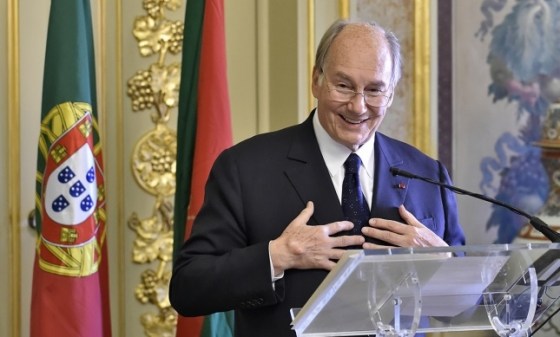
Mawlana Hazar Imam thanking the government of Portual for inviting the Ismaili Imamat to establish its permanent Seat in the country. Photo: TheIsmaili/Gary Otte. See text of agreement, click on note 4 below.
“The religious leadership of the Ismaili Imam goes back to the origins of Shia Islam when the Prophet Muhammad appointed his son-in-law, Ali, to continue his teachings within the Muslim community. The leadership is hereditary, handed down by Ali’s descendants, and the Ismailis are the only Shia Muslims to have a living Imam, namely myself.” [1]
~~~
“The Ismaili Imamat is a supra-national entity, representing the succession of Imams since the time of the Prophet. But let me clarify something more about the history of that role, in both the Sunni and Shia interpretations of the Muslim faith. The Sunni position is that the Prophet nominated no successor, and that spiritual-moral authority belongs to those who are learned in matters of religious law. As a result, there are many Sunni imams in a given time and place. But others believed that the Prophet had designated his cousin and son-in-law, Ali, as his successor. From that early division, a host of further distinctions grew up — but the question of rightful leadership remains central. In time, the Shia were also sub-divided over this question, so that today the Ismailis are the only Shia community who, throughout history, have been led by a living, hereditary Imam in direct descent from the Prophet.
“…As you build your lives, for yourselves and others, you will come to rest upon certain principles. Central to my life has been a verse in the Holy Quran which addresses itself to the whole of humanity. It says: “Oh Mankind, fear your Lord, who created you of a single soul, and from it created its mate, and from the pair of them scattered abroad many men and women…”
“I know of no more beautiful expression about the unity of our human race — born indeed from a single soul.” [2]
_____________
Id-e-Ghadir
The twelve months of the Muslim calendar and major Muslim festivals. Image by Simerg.
‘Id-e-Ghadir is celebrated by the Shi ‘ite communities to mark the event that took place at Ghadir Khumm (Valley of the Pond) on the 18th Dhul-Hijjah (which falls on September 30 or October 1 in 2015). This event commemorates the designation (appointment by way of nass) of Hazrat All as the ‘Amir-ul-Mu’minin (commander of the faithful) and Imamul-Muslimin’ (the Imam of the community of believers) at Ghadir-i Khumm when the Prophet (s.a.s.) was returning from his Last Pilgrimage (hajjatul-wida) in the year 632 AC. On this occasion, the Prophet publicly proclaimed Ali to be his successor [3] in guiding the community after the end of the institution of Nubuwwah. According to the Shi’a doctrine, tradition and interpretation of history, the designation of Hazrat Ali marked the beginning of the institution of Imamah. The designated Imam was to continue the ta’wil (interpretation) and talim (teaching) of Allah’s Final Message, i.e. the Holy Qur’an.
This stamp, issued by Iran in 1990, includes the Shahada, Qur’anic ayats and the declaration made by Prophet Muhammad at Ghadir-e Khumm “Mun Koontu Mawla, Fa Hada, Aliyun Mawla” (He of whom I am the Mawla, Ali is also the Mawla). Image not exact stamp size.
Accordingly, throughout the course of the history, the Shi’a have commemorated this occasion as a mark of recognition and acceptance of Allah’s mercy to mankind by bestowing continued guidance. Each Imam, since the time of Hazrat Ali has designated his successor. The Imam in his time has continued to guide his followers according to the prevailing conditions. His function has always been to look after the welfare of the community both in spiritual and worldly (material) matters. His guidance to his followers is that they should lead their lives in such a way so as to practice their Faith with a sense of balance and harmony, ensuring that there is no conflict between the two aspects of an individual’s life. The practice of the Faith thus becomes the way of life.
Presently, the Shi’a Imami Ismaili Muslims celebrate the day of accession of their present Imam to the office of Imamah as Yaum-e Imamat or Imamat Day. This occasion is celebrated as a mark of gratitude to Allah in having bestowed His mercy and bounty in guiding them through the office of the Imam on Sirat al-Mustaqim (the Straight Path).
Date re-posted: September 30, 2015 (The Id-e-Ghadir article had first appeared on this blog in 2013, and has been adapted from Ilm magazine, December 1989).
“The poor are not mere inanimate, unmotivated, units of deprivation. They are living, thinking people like the rest of us.” Mawlana Hazar Imam, His Highness the Aga Khan, 49th Ismaili Imam
EID MUBARAK
Historical photo: Muslims offering the Eid ul Fitr prayers at the Sheikhantaur Mosque in Tashkent. Photo created/published between 1865 and 1872. Credit: The US Library of Congress.
The festival of Eid, also known as Bairam or Eid Ramadan is one of the most joyous days in the Islamic calendar. It is an occasion for celebration and rejoicing for Allah’s Bounty upon mankind for His revelation of the Holy Qur’an during the month of Ramadan. It is also a time for individuals to express their gratitude to Allah for having given them the strength, courage and resilience to complete the fast, and thus fulfilling the duty enjoined upon them by Allah.
On this joyous occasion, we convey our heartiest felicitations and Eid Mubarak to all our readers as well as Muslims around the world, with the fervent hope and prayer that peace and harmony should prevail over many areas of the Muslim world afflicted by horrible conflicts, which are resulting in the loss of lives and contributing to unbearable hardships and struggles. The Islamic ethic of forgiveness, generosity, and peaceful co-existence and unity through dialogue are keys by which conflicts can be resolved, whereby every Muslim can aspire for a life of material and spiritual well-being and happiness.
The excerpts produced in this post from the Holy Qur’an and the hadith as well as from the farmans, writings and speeches of Hazrat Ali (a.s.) and Mawlana Hazar Imam (His Highness the Aga Khan) are foundation blocks for building harmonious societies around the world. The acts of charity and generosity mentioned in the quotes will facilitate those who are underprivileged to manage their own destinies, thereby leading them to a life of dignity, befitting Allah’s greatest creation.
PROFOUND TEACHINGS OF ISLAM
(Selections from the Holy Qur’an, the hadith and teachings of Shia Ismaili Imams)
Conceptual image for the holy month of Ramadan and Eid ul Fitr. Photo: Istockphoto. Copyright.
“It is not righteousness that you turn your faces towards the East and the West, but righteous is the one who believes in Allah and the Last Day, and the angels and the Books and the prophets, and gives away wealth out of love for Him to the near of kin and the orphans and the needy and the wayfarer and to those who ask and set slaves free.” — Holy Qur’an, 2:177
“And whatever good you may spend on others is for your own good, provided that you spend only out of a longing for God’s countenance.” — Holy Qur’an, 2:272
“You will not enter paradise till you believe, and you will not believe till you love one another. Let me guide you to something by doing which you will love one another: Salute and sundry among you.” — Tradition of the Prophet Muhammad (s.a.s.)
“Have a tender heart, as tender as a fistful of green grass; be not arrogant and stiff as a tree upright in a forest. A tree is toppled in a storm, but grass bends and sways happily with the wind.” Hazrat Ali (a.s.), Kalam-e-Mawla, 8:67
“A great river is not made turbid by a stone. A religious man who takes to heart an injury is as yet, but shallow water. If any misfortune befalls you, bear with it, that by forgiving others you may yourself obtain pardon. O my brother! seeing that we are at last to return to earth, let us humble ourselves in ashes before we are changed into dust.” — Hazrat Bibi Fatima (a.s.). [1]
“…As the world gets smaller, it is fundamental that people should work together and not against each other, and try to be a little more generous than you have been in the past. If people have made mistakes, forgive them their mistakes. If people have harmed you, forget and forgive. Do not hold grudges. Do not turn around and say, ‘he hurt me yesterday, so I will hurt him today’. This is not the spirit of Islam…” His Highness the Aga Khan, Farman Mubarak, Mumbai, 1969, Precious Gems.
“Islam is not passive. It does not admit that man’s spiritual needs should be isolated from his material daily activities. A Muslim must play an active role in helping his family and the brotherhood of believers. The object is not to achieve status, wealth and power, but to contribute to society’s overall development. This implies moral responsibility to help the weaker, less fortunate members.” — His Highness the Aga Khan, Toronto, May 14, 1987. [2]
“…when you are studying the Qur’an, when you are studying the history of Imams, when you are studying the history of pre-Islamic Arabia, I would like you to take from this history that which will help you to live within the spirit of Islam. This means to live honestly, to live purely, to know that you are brothers and sisters, to be available at all times when one or the other needs help, to be generous, to be honest. These are the qualities which you can trace throughout Qur’an-e Shariff, throughout the life of the Prophet, throughout the lives of the Imams. And this is something which I would like you to follow, not only in letter but also in spirit, because it is this spirit which cannot be changed, and which I would like my spiritual children to understand fully…” Farman Mubarak, His Highness the Aga Khan, Karachi, November 29, 1964. [3]
“There are those who enter the world in such poverty that they are deprived of both the means and the motivation to improve their lot. Unless these unfortunate ones can be touched with the spark which ignites the spirit of individual enterprise and determination, they will only sink back into renewed apathy, degradation and despair. It is for us, who are more fortunate, to provide that spark.” — His Highness the Aga Khan, speech, Housing and Development, Mumbai, January 17, 1983.
“The poor are not mere inanimate, unmotivated, units of deprivation. They are living, thinking people like the rest of us.” — His Highness the Aga Khan, Aiglemont, March 16, 1983.
“On the occasion of my Silver Jubilee, I would be deeply happy if the members of my jamat, wherever they are and whatever their age, would reaffirm in a visible and united manner their commitment to the principles of Islam which bind all Muslims together, and which are unique example to all mankind: Belief in Allah, the fulfillment of His message to man, respect and support for His greatest creation, man himself. In this way let us establish even sounder foundations for a good and proper life and let us extend our support to those living in the developing areas of the world.” — His Highness the Aga Khan, 1982. [4]
A new moon at Mackerricher State Park, California, USA. Photo: Istockphoto. Copyright.
[2] Ilm, Volume 13, Number 1, July 1990, page 45-46.
[3] Farman Mubarak Pakistan Visit 1964, published by the Ismailia Association for Pakistan, quoted also in Ilm, Volume 13, Number 1, July 1990, page 38.
[4] Talika Mubarak of Mawlana Hazar Imam, Silver Jubilee, July 11, 1982, quoted in Ilm, July 1990, page 55.
A very happy moment in my life when I travelled to Brown University from Philadelphia in 1996. I snapped this picture of my beloved 49th Imam, His Highness the Aga Khan, and only realized that he was looking straight at my camera after I got the film processed in Philadelphia a couple of days later. Photo by Abdulmalik Merchant
Every Ismaili yearns to see the Imam of the Time. It’s a dream of a lifetime. Throughout history, past and present, Ismailis have travelled far and wide to earn this special moment of grace and barakah (happiness) in their lives. Since the advent of the 20th century, the 48th Imam, Mawlana Sultan Mahomed Shah, and the current 49th Imam, Mawlana Shah Karim (His Highness the Aga Khan), have graciously travelled to lands around the world to give their beloved murids (followers) this blessed opportunity. Scientific and technological advancements have speeded up and shortened the time-gap between visits of Mawlana Hazar Imam with his jamats, though even in these situations, some jamats such as those living in Central Asia, did not have the opportunity of a meeting with the present Imam and his predecessors for decades and centuries. What sustained their faith, sometimes under extremely difficult and extra ordinary circumstances, was their spiritual bond with the Imam of the Time.
His Highness the Aga Khan pictured amongst his followers in Badakhshan in May 1995.
A cornerstone of Ismaili doctrines has been the principle of the Unity of Imamat, that is the Ismaili belief and understanding that each Imam, being the bearer of the Noor (Light) of Imamat, is the same irrespective of his own age or the time he lives in. Thus in Ismaili writings, in addition to the importance of the physical didar (or glimpse) of the Imam, a strong emphasis has been laid on the followers to seek to attain the Beatific Vision of the Imam of the Time through special prayers, in addition to the ritual prayers. This idea is also conveyed in the sixth article of the Preamble of the Constitution of the Ismailis, which states:
“Historically and in accordance with Ismaili tradition, the Imam of the time is concerned with spiritual advancement as well as improvement of the quality of life of his murids. The imam’s ta‘lim lights the murid’s path to spiritual enlightenment and vision…”
The following collection of writings from Ismaili history articulates the importance of both the physical as well as the spiritual glimpse of the Imam of the Time. Our next reading in this short four-part series to commemorate Mawlana Hazar Imam’s 58th Imamat Day will consist of excerpts from the writings of Ismaili Imams on the subject of Imamat. This will be followed by contemporary voices on Imamat by members of the jamat.
1. An Inspiring Anecdote: Da’i Al-Mu’ayyad al-Shirazi ‘s Mulaqat with the 18th Ismaili Imam (or 8th Fatimid Caliph), Imam al-Mustansir Billah
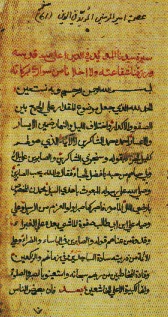
A folio from the manuscript of al-Shirazi’s Sirat. Credit: The Institute of Ismaili Studies.
“I was taken near the place where from I saw the bright Light of the Prophethood. My eyes were dazzled by the Light. I shed tears of joy and felt as if I was looking at the face of the Prophet of Allah and of the Commander of the Faithful, Hazrat Ali. I prostrated myself before the one who is the fittest person to bow to. I wanted to say something, but I was awe-struck.
“I tried to speak but my tongue refused to move. People asked me to say what I wished to say. I could say nothing. The Imam said, ‘Leave him. Let his fear and awe subside’.
“After this, I rose. I took the holy hand of the Imam, placed it on my eyes and on my chest and then kissed it. I left the place with immense joy.”
The same dai, in the following entreaty to Imam Mustansir, typifies an Ismaili’s impatience to behold the face of the Imam of one’s time, and the urgency of this beyond any possible worldly consideration. He states:
“I swear, were you to crown me, and were you to grant me dominion over the world entire and say to me ‘Let our meeting be postponed but an hour’, I would reply: ‘O my Mawla, let us meet instead! For your delay of but an hour has turned my hair gray’.”
2. A Pilgrim’s Experience
During the reign of the 34th Ismaili Imam Gharib Mirza, a pilgrim tracked his way to Anjudan to see the Imam on behalf of the jamats in Khurasan. The identity of the pilgrim is not very clear due to the poor quality of the manuscript but the ode to the Imam reads as follows:
“Greetings! O Emperor of the Realm of Faith and World; I come from Khurasan to behold your face. All I have is a soul imperfect, sins and transgressions galore.
“Despite such worthless goods, I long for your grace, hoping that through me you may forgive the trespasses of your servants-one and all.
“As you are the sovereign and governor of all creation, this being testified to by the Qur’an itself, your proper name has been made manifest to all the faithful.
“You are Shah Gharib and Mustansir, the inheritor of Shah Salam!”
3. Pir Sadr al-Din on the True Guide, the Beatific Vision of the Imam, and the Alchemy of Transformation from Contact with the Imam
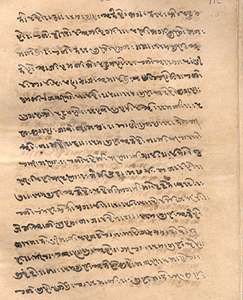
Folio of Pir Sadr al-Din’s Saloko Nano at the Institute of Ismaili Studies.
The following is a translation of Pir Sadr al-Din’s ginanic compositiom “Sakhi māhā pad keri vāt koek jānere.”
“Friend! None but a few know of the exalted station. Indeed, they alone recognize it who have found the true guide.
“Friend! Within the heart, at the confluence of the three spiritual rivers, there is an imperishable light. There – a shimmering effulgence, pearls are showered.
“Friend! I completely lost consciousness of my physical self when my meditation mounted the empyrean, bursting forth.
“Friend! I beheld the place of the lofty throne, I saw the seven islands, the nine continents.
“Friend! The religious scriptures and books cannot fathom this, for there is neither day there, nor night, neither sun, nor shade.
“Friend! My Lord is not such that He can be spoken of. He is to be seen – for He is indescribable, and nameless.
“Friend! How sweet is that Lord, indescribable, nameless. Says Pir Sadr al-Din, truly, with my own eyes, I have seen Him!”
~~~~~~
And the following is a translation of a verse from Sab Ghat Sami Maaro Bharpur Betha on spiritual transformation:
“O Brother, The True Preceptor is like the philosopher’s stone and the followers are like copper.
“When the copper comes in contact with the philosopher’s stone it becomes gold.
“The followers gain spiritual enlightenment from the contact of the Imam. He is the only Glorious, O brother.”
4. Nizar Quhistani on the Imam of the Time As the Source of Salvation, and on the Continuity of Imamat
“Salvation is to be found in the Imam of the Time.
“Ever since I found the Imamate, permanently in human form, I have known no other guide than the living, everlasting Imam.
“For in his command, I have found peace in both the worlds.
“My lover appears in different forms,
“Because for each period there comes a new guidance;
“One after the other, there follows another Qaim Imam Ali.
“I have given up everything except that contained in the Qur’anic verse ‘offspring, one of the other’.”
Date posted: July 8, 2015.
_______________
Readings adapted from The Life and Lectures of the Grand Missionary al-Muayyad-fid-Din al-Shirazi and The Ismailis in the Middle Ages: A History of Survival, a Search for Salvation by Shafique N. Virani, Hardcover, May 3, 2007.







 Simerg - Insights from Around the World